Culture and Change Management: Why Change Efforts Actually Stall
Turn this article into takeaways for your work.


Each assistant summarizes the article only for you and suggests best practices for your work.
Culture is the operating environment change management runs on top of: every framework, Kotter's eight steps, ADKAR, a McKinsey transformation playbook, assumes people will trust the message, believe the reason, and act on it. When the underlying culture does not supply that trust, the framework does not fail because it was applied wrong. It fails because it was built for a system that was not actually there.
That single idea explains most of what goes wrong in change management. A well-run project plan, a clear vision deck, and an experienced program office can still produce nothing, because none of that touches the layer that decides whether people actually change their behavior: whether they believe leadership, whether raising a concern is safe, and whether the old way of doing things quietly still gets rewarded. This article covers culture's specific role inside change management, the frameworks that treat it seriously, the honest story behind the number everyone cites to justify urgency, and what changes when the thing being adopted is AI rather than a new process.
Culture's Role in Change Management: Enabler or Immune System
Culture does not sit next to a change effort. It sits underneath it, and it does one of two things to whatever gets introduced.
Culture as Enabler
A culture with high trust, psychological safety, and a habit of surfacing bad news early acts as an accelerant. People test the new process honestly, report what breaks, and adjust without waiting to be told twice. Psychological safety at work is the clearest predictor of this behavior: teams that already feel safe disagreeing with a plan in the room are the same teams that will tell you, in week two, that the new workflow does not fit how work actually happens, instead of quietly working around it for a year.
Culture as Immune System
A culture built on self-protection, blame, or rigid hierarchy behaves the way a biological immune system treats a transplant: it identifies the change as foreign and attacks it, slowly and without a single visible decision point. Nobody votes to reject the new system. People just route around it, keep the old spreadsheet running in parallel "just in case," and let the initiative die from a thousand small non-adoptions. Schein's three levels of culture explains why this is so hard to see coming: the rejection happens at the level of unconscious assumptions, not stated opinions, so a pre-launch survey asking "are you on board with this change?" will often come back positive right up until the change quietly fails.
Which behavior a given organization gets is not random. It is set well before the change effort starts, by the same systems and habits covered in how to change organizational culture: what gets measured, who gets promoted, and what a leader does the first time the new way of working is inconvenient. Change management frameworks tend to assume the enabler version of culture exists. Most of the interesting failures happen when it doesn't.
Key Facts
- A review of the five most commonly cited sources for the "70% of change initiatives fail" claim found none of them backed by valid empirical evidence. Source: Journal of Change Management
- Active, visible executive sponsorship is the top-ranked contributor to change success in Prosci's benchmarking research, and an effective sponsor can raise a project's odds of hitting its business goal from roughly 25% to 85%. Source: Prosci
- In BCG's work across hundreds of AI transformations, about 10% of value comes from algorithms, 20% from the technology and data layer, and 70% from people and process, roles, workflows, change management, and governance. Source: BCG
- MIT's Project NANDA found that despite an estimated $30 to $40 billion in enterprise generative AI spending, 95% of pilots produced no measurable profit-and-loss return. Source: Fortune, reporting on MIT NANDA
- Gartner predicts over 40% of agentic AI projects will be canceled by the end of 2027 due to escalating costs, unclear business value, or inadequate risk controls. Source: Gartner
- Managers account for at least 70% of the variance in team engagement scores, which is also roughly where most change efforts actually land or die: at the team level, not the company-wide announcement. Source: Gallup
The "70% of Change Fails" Number, Examined Honestly
Anyone who has sat through a change management kickoff has heard it: 70% of change initiatives fail. It shows up in consulting decks, LinkedIn posts, and the opening slide of more transformation kickoffs than anyone could count, almost always without a citation.
It should have one, because the number does not hold up. Researcher Mark Hughes reviewed the five sources most commonly credited with it, Hammer and Champy, Beer and Nohria, a Bain article, a McKinsey article, and John Kotter's own writing, and found that each either stated the figure without supporting data or simply pointed back to one of the others doing the same thing. There is no study behind it. It is a number that got repeated until repetition made it feel measured.
That does not mean change management has a low failure rate. It means the 70% figure is doing a job that a specific, sourced number could do better: creating urgency for something that is genuinely difficult. The honest replacement is not a single percentage. It is a short list of factors that the research does support, and every one of them runs through culture rather than around it.
What Actually Predicts Whether Change Sticks
Prosci's benchmarking, run continuously since 1998, finds active and visible executive sponsorship is the single largest predictor of success, cited more than three times as often as the next factor. Sponsorship is not a kickoff speech. It is a leader who keeps showing up for the change after the first status report is uncomfortable, which is itself a culture behavior, not a project management task. Beneath sponsorship, the recurring failure pattern across serious change research is remarkably consistent: managers who were never actually convinced, employees who correctly read that the old behavior is still what gets rewarded, and a message that landed at the top of the org chart and stopped there. Leadership's role in shaping culture covers why that gap between what leadership believes happened and what the frontline actually experienced is one of the most reliable predictors of a change effort quietly failing.
Kotter's 8 Steps as a Culture Lens
John Kotter's model, first published in 1996 and still the most widely taught framework in change management, treats culture as both the hardest step and the last one. The eight steps are:
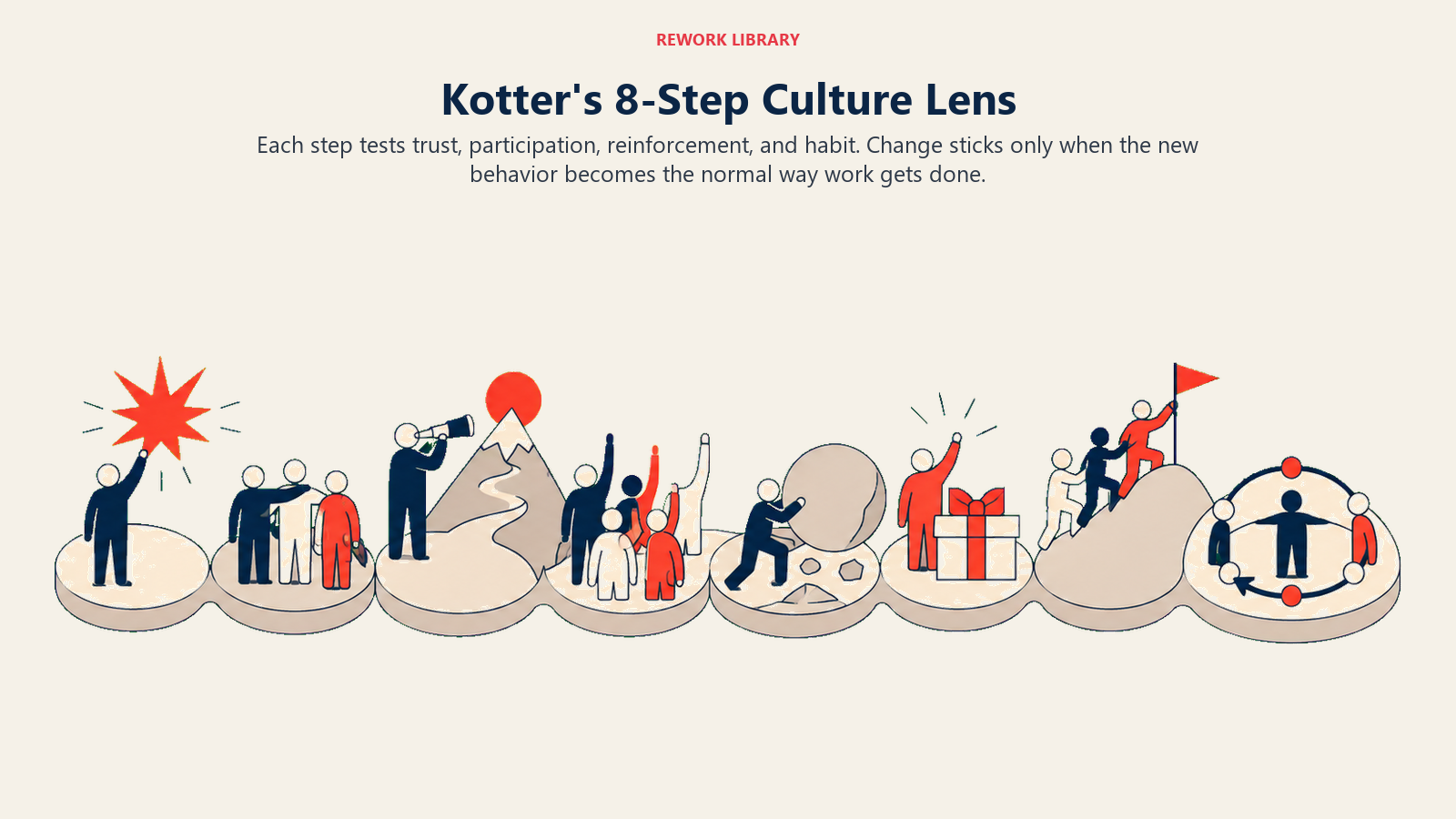
- Create a sense of urgency
- Build a guiding coalition
- Form a strategic vision
- Communicate the vision
- Remove barriers to action
- Generate short-term wins
- Sustain momentum
- Anchor the change in organizational culture
Reading the list as a culture problem instead of a project checklist changes what each step is actually testing. Step 1 fails in a culture where raising an uncomfortable truth carries a career cost, because urgency needs someone willing to say the quiet part first. Step 2's guiding coalition only works if it includes people the workforce actually trusts, not just people with the right titles, which is a trust question more than an org chart question. Step 5, removing barriers, usually means removing a person's fear of being blamed for a mistake made under the new process, which is a psychological safety problem wearing a project management name.
Why Step 8 Is the One Everyone Skips
Step 8, anchoring the change in culture, is the step Kotter's own later research on failure patterns points to most directly, and it is the one organizations skip most often, because by the time a project reaches it, the task force has disbanded and the budget line has closed. Anchoring means the new behavior is now what gets promoted, told as a story, and modeled under pressure, not just documented in a wiki page nobody opens again. Skip it and the earlier seven steps produced a temporary state, not a change. Building a culture of accountability covers the same mechanism from the accountability side: a new standard that nobody is held to reverts to the old one within a year, almost without anyone deciding to let it happen.
ADKAR: The Individual-Level Culture Lens
Where Kotter operates at the organizational level, sequence and coalition and vision, Prosci's ADKAR model works at the level of a single person going through the change, and it is arguably a more precise tool for diagnosing where culture is actually doing the blocking. ADKAR breaks individual change into five building blocks:
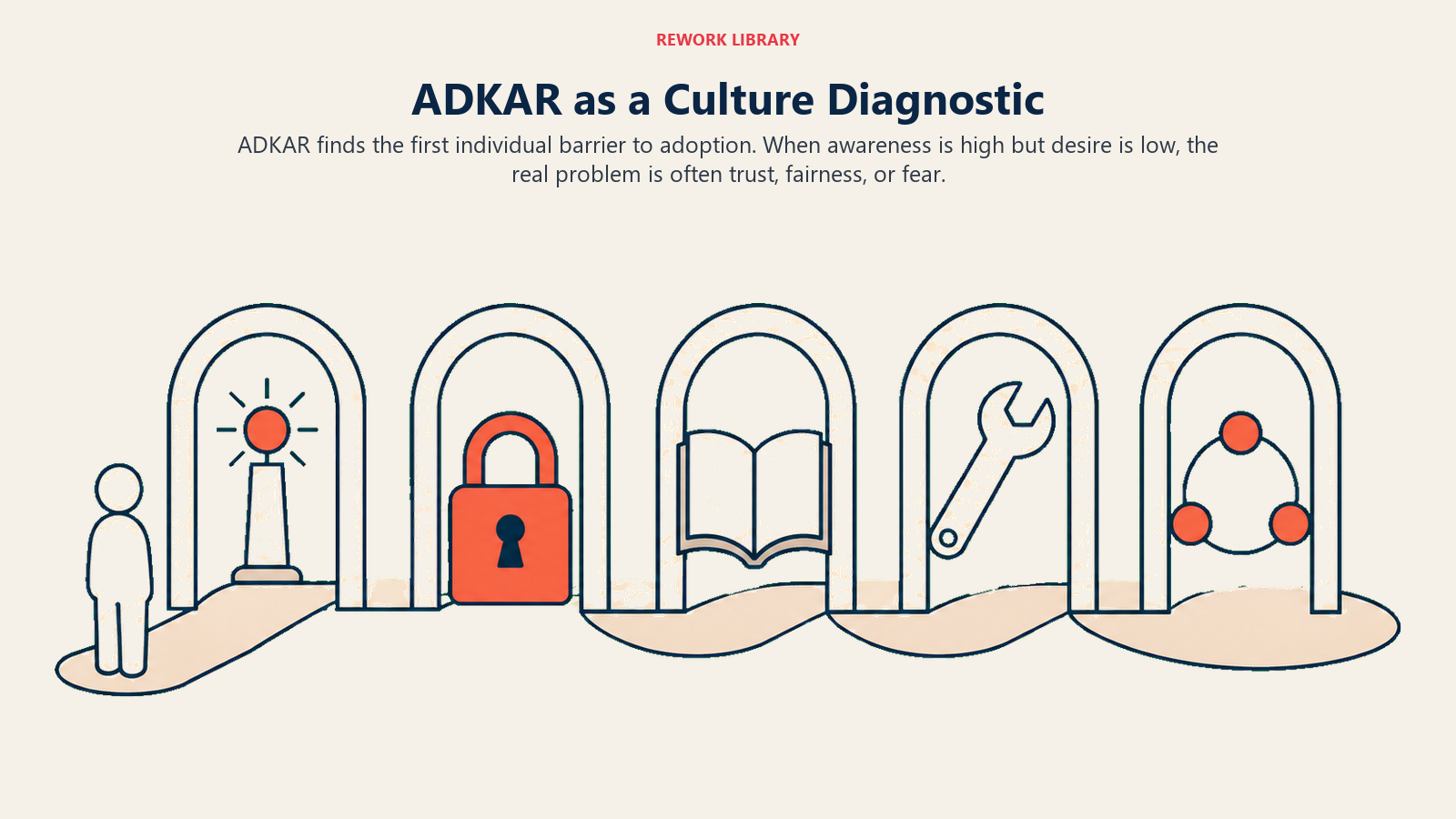
- Awareness of the need for change
- Desire to participate and support it
- Knowledge of how to change
- Ability to apply new skills and behaviors
- Reinforcement to sustain the result
The Barrier Point Principle
ADKAR's most useful idea is the barrier point: a person's progress stalls at the first building block that is insufficient, and no amount of investment in a later block fixes it. This is where culture usually hides in plain sight. A team that has clear Awareness and solid Knowledge, they understand the new process and were trained on it competently, can still stall completely at Desire, because Desire is a trust question: do they believe the change benefits them, or is it something being done to them by people who will not be around to see the fallout. Retraining a team stuck at Desire does nothing. It is not a skills gap. It is a culture gap wearing a training request.
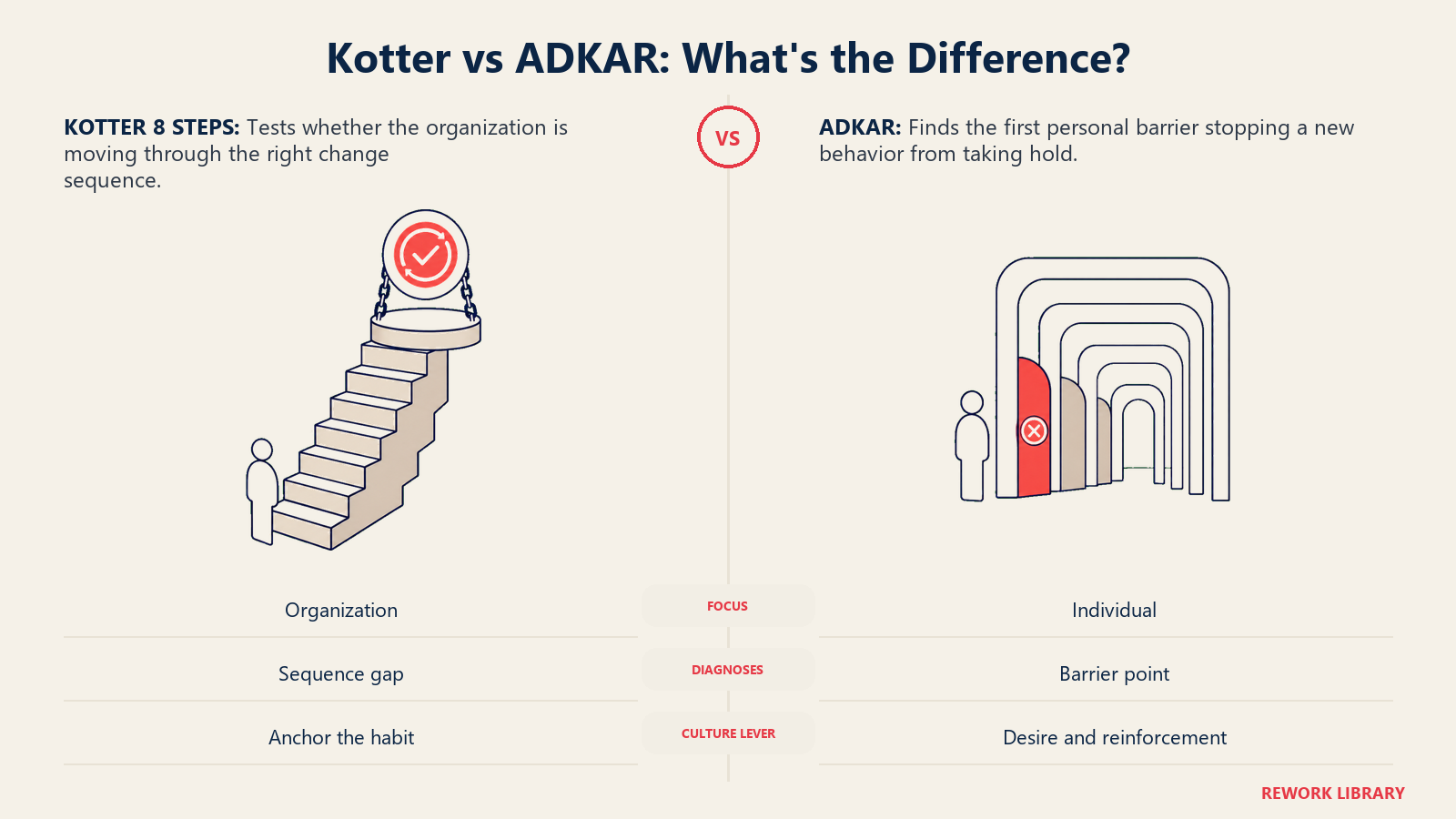
This is also why ADKAR pairs well with Kotter rather than competing with it. Kotter tells an organization what sequence to move in. ADKAR tells a change leader why a specific team, or a specific manager, is stuck at a specific point in that sequence, and whether the fix is a communication problem, a skills problem, or a trust problem that no amount of communication or training will solve on its own.
Kotter vs. ADKAR: What Each One Actually Diagnoses
| Question | Kotter's 8 Steps | Prosci ADKAR |
|---|---|---|
| Level of focus | The organization as a whole | The individual going through the change |
| What it sequences | Urgency, coalition, vision, communication, momentum, anchoring | Awareness, Desire, Knowledge, Ability, Reinforcement |
| Where culture shows up most | Step 1 (urgency requires safety to speak up), Step 8 (anchoring requires systems and promotions to reinforce it) | The Desire block, where trust in leadership's motives decides whether training even gets used |
| Best used for | Sequencing a large, multi-team change program | Diagnosing why one team or manager is stuck when the overall program looks on track |
| Failure mode if culture is ignored | Steps 1 through 7 complete, but Step 8 never happens and the old behavior returns | Awareness and Knowledge get delivered, but Desire never forms, so nothing changes despite a "completed" rollout |
Neither framework was built to fix a broken culture. Both were built assuming a workable one exists, and both quietly stop working the moment that assumption is wrong.
Resistance: Read It as Signal, Not Sabotage
Change management training often treats resistance as an obstacle to overcome through better communication. That framing gets the mechanism backward often enough to cause real damage. Resistance is frequently the most accurate information a change effort receives, delivered by the people closest to the actual work, and dismissing it as stubbornness throws away a diagnostic signal that no dashboard will replace.
There is a real difference worth naming between two kinds of resistance. The first is informed resistance: a frontline employee who knows the new process breaks in a specific, recurring edge case that the design team never saw, because the design team was never close enough to the work to see it. The second is trust-based resistance: opposition rooted not in the plan's quality but in a reasonable, evidence-backed belief that leadership's past promises did not hold. Why teams stay silent in meetings covers the version of this that never even reaches a change manager's inbox, because in a culture where disagreement carries a cost, resistance does not get voiced at all. It gets absorbed and expressed later as quiet non-adoption, which is far more expensive to diagnose than a loud objection in a working session would have been.
Treating every objection as a communication failure to be messaged past, rather than as one of these two distinct signals, is how change programs lose the exact information that would have made the fourth or fifth rollout better than the first three.
Sponsorship: The Difference Between Announced and Owned
The research is unusually consistent on this point: active, visible sponsorship is the strongest predictor of whether a change effort succeeds, ahead of budget, ahead of methodology, and ahead of the quality of the communication plan. But sponsorship is frequently confused with something much thinner: a leader who approves the initiative, appears at a kickoff, and then goes quiet.
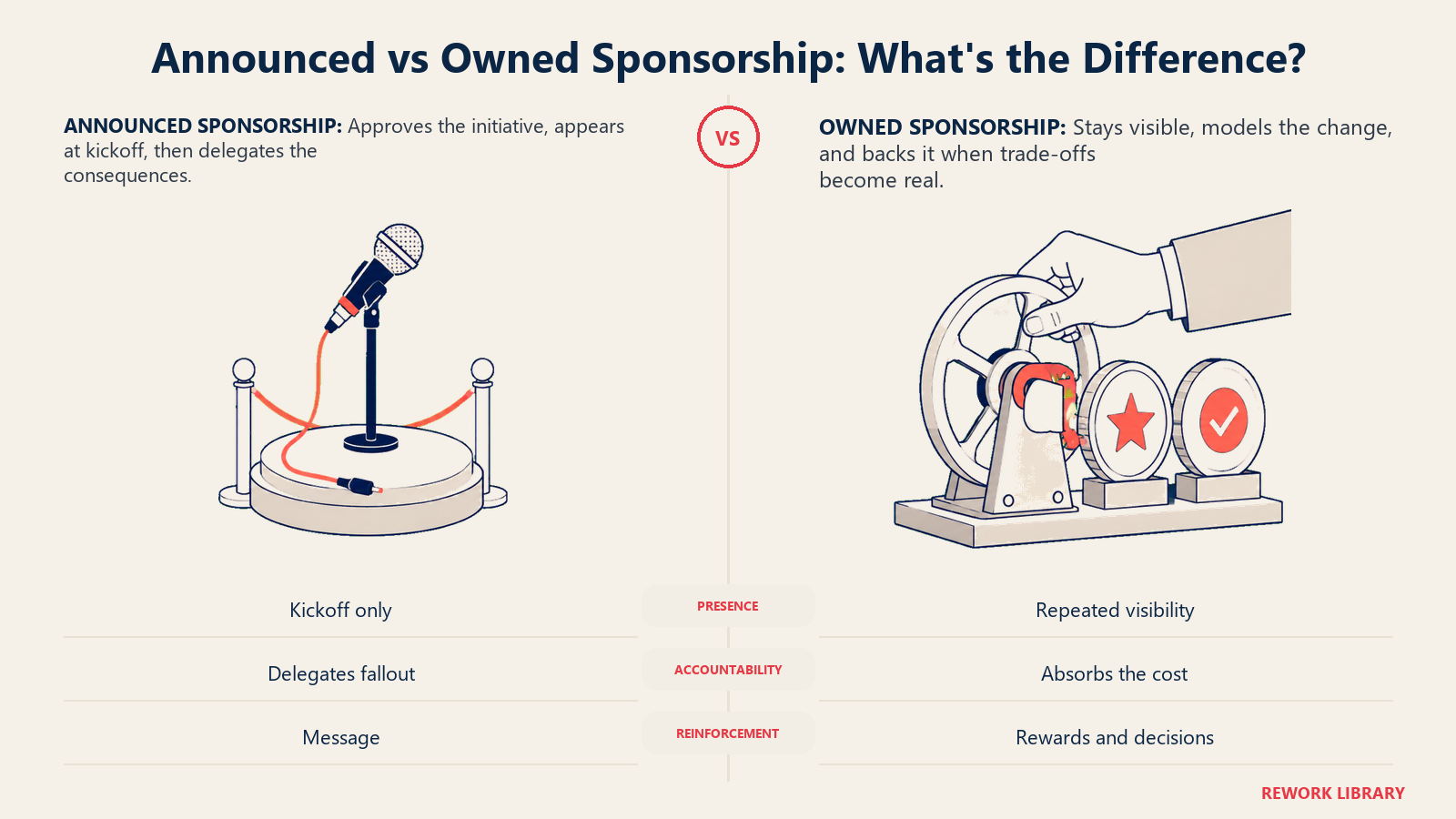
Genuine sponsorship looks specific rather than ceremonial. It means a leader personally reviews whether the new behavior is showing up in promotion decisions, absorbs the short-term discomfort of holding a well-liked manager accountable for reverting to the old way, and tells a concrete story about a moment the change cost them something real. That last part matters more than it sounds like it should: employees calibrate sincerity against cost, and a leader who has visibly paid a price for the change is far more believable than one who has only spoken in favor of it. Culture in mergers and acquisitions is one of the clearest places to watch this play out at scale, because a merger forces two cultures and two sets of leaders to sponsor the same change simultaneously, and the deals that struggle are rarely the ones with a bad integration plan. They are the ones where sponsorship stayed at the announcement level on one side of the table.
Reinforcement: Where Most Change Quietly Reverts
Every framework in this article ends on the same word for a reason. Kotter's Step 8 is anchoring. ADKAR's fifth block is Reinforcement. Both are naming the same failure point: the moment a task force disbands, a project closes, or a champion moves teams, and nothing is left holding the new behavior in place except habit that has not fully formed yet.
Reinforcement is not a single event. It is the accumulation of small, repeated signals: the new process gets used the fiftieth time with the same consistency as the fifth, a manager corrects a return to the old shortcut instead of letting it slide because the deadline is tight, and the recognition given out at the next town hall goes to someone who modeled the new way under pressure. Building a culture of accountability and building trust in the workplace are both, in effect, reinforcement infrastructure: systems that make the new behavior the path of least resistance long after the initiative technically ends. Skip reinforcement and a change effort does not fail loudly. It reverts quietly, one convenient exception at a time, until eighteen months later nobody can quite say when the old way came back.
Culture and Change Management in the Age of AI
AI adoption is, functionally, a change management problem wearing a technology deployment costume, and the organizations treating it as a tooling rollout are the ones producing the sobering numbers piling up in 2025 and 2026. MIT's Project NANDA found that despite tens of billions in enterprise generative AI spending, 95% of pilots showed no measurable profit-and-loss return, and the report's own conclusion pointed at organizational learning gaps, not model quality, as the actual barrier. Gartner separately projects that over 40% of agentic AI projects will be canceled before the end of 2027, citing unclear business value and inadequate governance ahead of any model limitation.
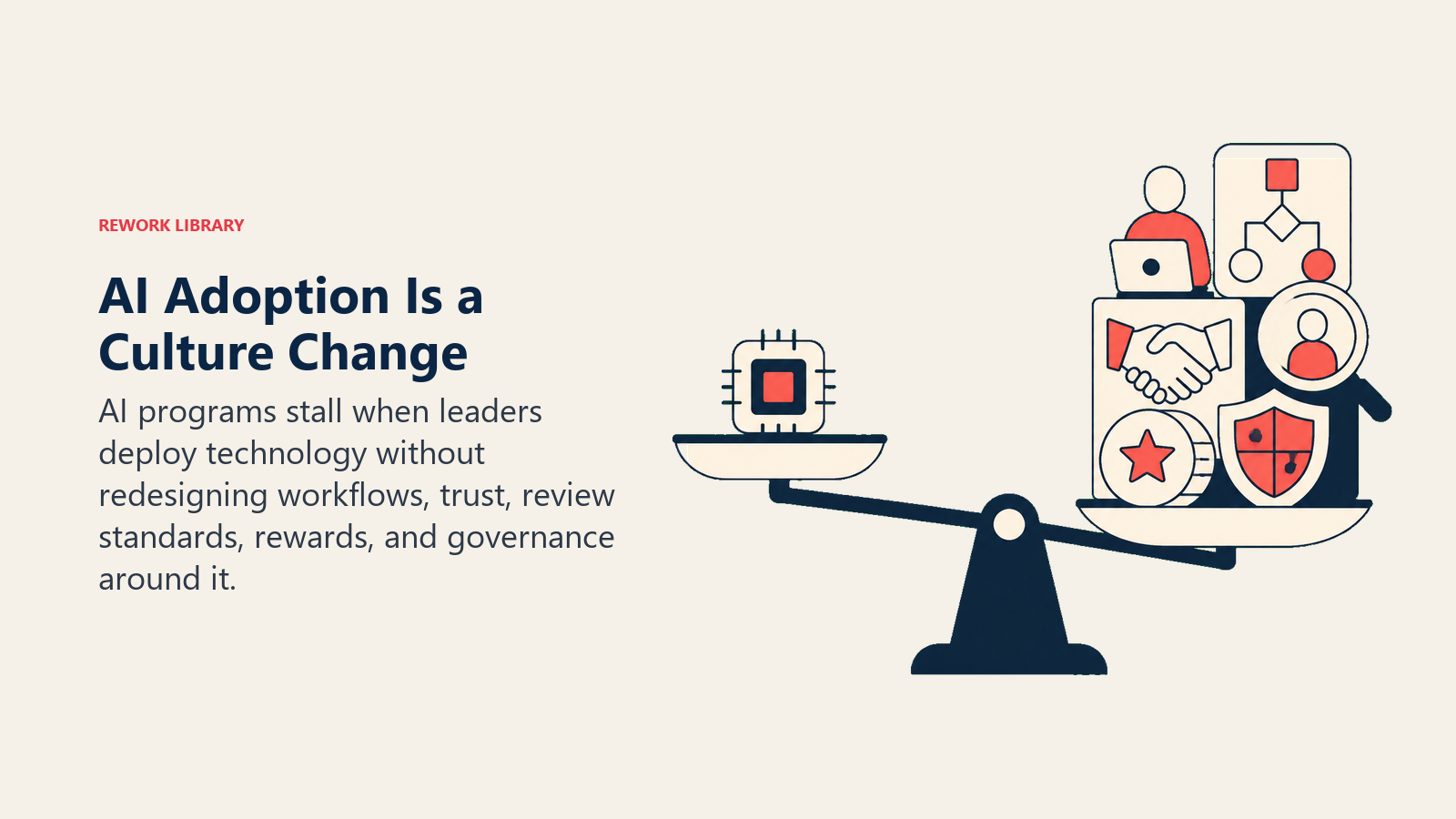
BCG's research across its AI transformation client work quantifies why: roughly 10% of the value comes from the algorithm itself, another 20% from the surrounding technology and data layer, and a full 70% from people and process, the exact same territory Kotter and ADKAR were built to cover. Read against that ratio, most AI rollouts are over-investing in the 30% that is easiest to buy and under-investing in the 70% that is hardest to build: whether people trust that an AI-assisted decision will still hold them accountable fairly, whether flagging that the model got something wrong is safe to say out loud, and whether "reviewed by a human" means something real or has quietly become a rubber stamp.
Run through Kotter's lens, most AI adoption efforts complete steps 1 through 4 (urgency, a coalition, a vision, a communication push) and then stall well before step 8, because nobody set out to anchor new norms around AI-assisted work into what gets promoted and rewarded. Run through ADKAR, most stall at Desire for the same reason a culture-change effort stalls there: Awareness and Knowledge about the tool are usually fine. What is missing is a genuine belief that using it, and being honest about its limits, will not be held against the person who admits the tool got something wrong. Building an AI-ready culture and AI cultural debt go deeper on what accumulates when that trust gap is left unaddressed instead of treated as the actual change management problem it is.
Where to Go Next
- What is business culture?, for the foundational models this article builds on
- How to change organizational culture, for the practical roadmap once culture itself is the target of the change
- Psychological safety at work, for the trust mechanism behind both Desire and genuine resistance
- Building an AI-ready culture, for what a change effort aimed at AI adoption needs to anchor
Frequently Asked Questions about Culture and Change Management
What role does culture play in change management?
Culture decides whether a change management framework actually works, not just whether it gets applied correctly. A culture with trust and psychological safety acts as an enabler, surfacing problems early and adopting new behavior honestly. A culture built on blame or rigid hierarchy behaves like an immune system, quietly rejecting the change through non-adoption rather than open refusal.
Is it true that 70% of change management initiatives fail?
No credible research supports that specific figure. A 2011 review in the Journal of Change Management traced the claim to five commonly cited sources, including Kotter's own writing, and found each one either offered no supporting data or simply cited another source doing the same thing. The number persists because it creates urgency, not because anyone measured it.
What is the difference between Kotter's 8-Step Model and ADKAR?
Kotter's model sequences change at the organizational level: urgency, coalition, vision, communication, removing barriers, short-term wins, sustained momentum, and anchoring the change in culture. ADKAR works at the individual level, diagnosing whether a specific person has Awareness, Desire, Knowledge, Ability, and Reinforcement. They are complementary: Kotter tells you the sequence, ADKAR tells you why one team is stuck within it.
Why is Kotter's Step 8, anchoring change in culture, the one most organizations skip?
By the time a change program reaches Step 8, the task force has usually disbanded and the project budget has closed, so nobody is left to ensure the new behavior is what actually gets promoted, rewarded, and modeled under pressure. Skipping it means the first seven steps produced a temporary state rather than a lasting one.
Should resistance to change always be overcome?
Not automatically. Some resistance is informed: people closest to the work flagging a real flaw the design team could not see. Other resistance is trust-based, rooted in a reasonable read of leadership's past follow-through rather than the plan's quality. Treating every objection as a communication problem to message past throws away one of the most accurate signals a change effort receives.
What is the single strongest predictor of whether a change effort succeeds?
Active, visible executive sponsorship. Prosci's benchmarking research, run since 1998, has ranked it the top contributor to success in every study, and an effective sponsor can raise a project's odds of hitting its business goal from roughly 25% to 85%. Genuine sponsorship shows up in promotion decisions and personal accountability, not just a kickoff appearance.
How is AI adoption a culture and change management problem rather than a technology one?
BCG's research across AI transformations attributes roughly 70% of the value to people and process rather than the algorithm or technology layer, and MIT's Project NANDA found 95% of enterprise generative AI pilots produced no measurable P&L return, with the report pointing to organizational learning gaps as the actual barrier. Most AI rollouts stall at the same point a culture change does: whether people trust that flagging the tool's mistakes is safe.
What keeps a change from reverting after the project officially ends?
Reinforcement, which is not one event but an accumulation of small, repeated signals: the new process getting used as consistently on the fiftieth try as the fifth, a manager correcting a slide back to the old shortcut, and recognition going to whoever modeled the new behavior under real pressure. Without it, change reverts quietly rather than failing loudly.
Change management frameworks are good at sequencing what to do. They are far less good, on their own, at telling a leader whether the culture underneath will carry that sequence forward or quietly absorb it. Kotter and ADKAR both point at the same truth from different altitudes: the technical rollout is rarely the hard part. Whether people trust the reason, believe the reward system has actually changed, and feel safe saying so when it hasn't, that is the part that decides whether the change was real or just an announcement everyone has since learned to work around.

Co-Founder, Rework.com
On this page
- Culture's Role in Change Management: Enabler or Immune System
- Culture as Enabler
- Culture as Immune System
- Key Facts
- The "70% of Change Fails" Number, Examined Honestly
- What Actually Predicts Whether Change Sticks
- Kotter's 8 Steps as a Culture Lens
- Why Step 8 Is the One Everyone Skips
- ADKAR: The Individual-Level Culture Lens
- The Barrier Point Principle
- Kotter vs. ADKAR: What Each One Actually Diagnoses
- Resistance: Read It as Signal, Not Sabotage
- Sponsorship: The Difference Between Announced and Owned
- Reinforcement: Where Most Change Quietly Reverts
- Culture and Change Management in the Age of AI
- Where to Go Next