Blame Culture vs Learning Culture: Turning Failure Into Improvement
Turn this article into takeaways for your work.


Each assistant summarizes the article only for you and suggests best practices for your work.
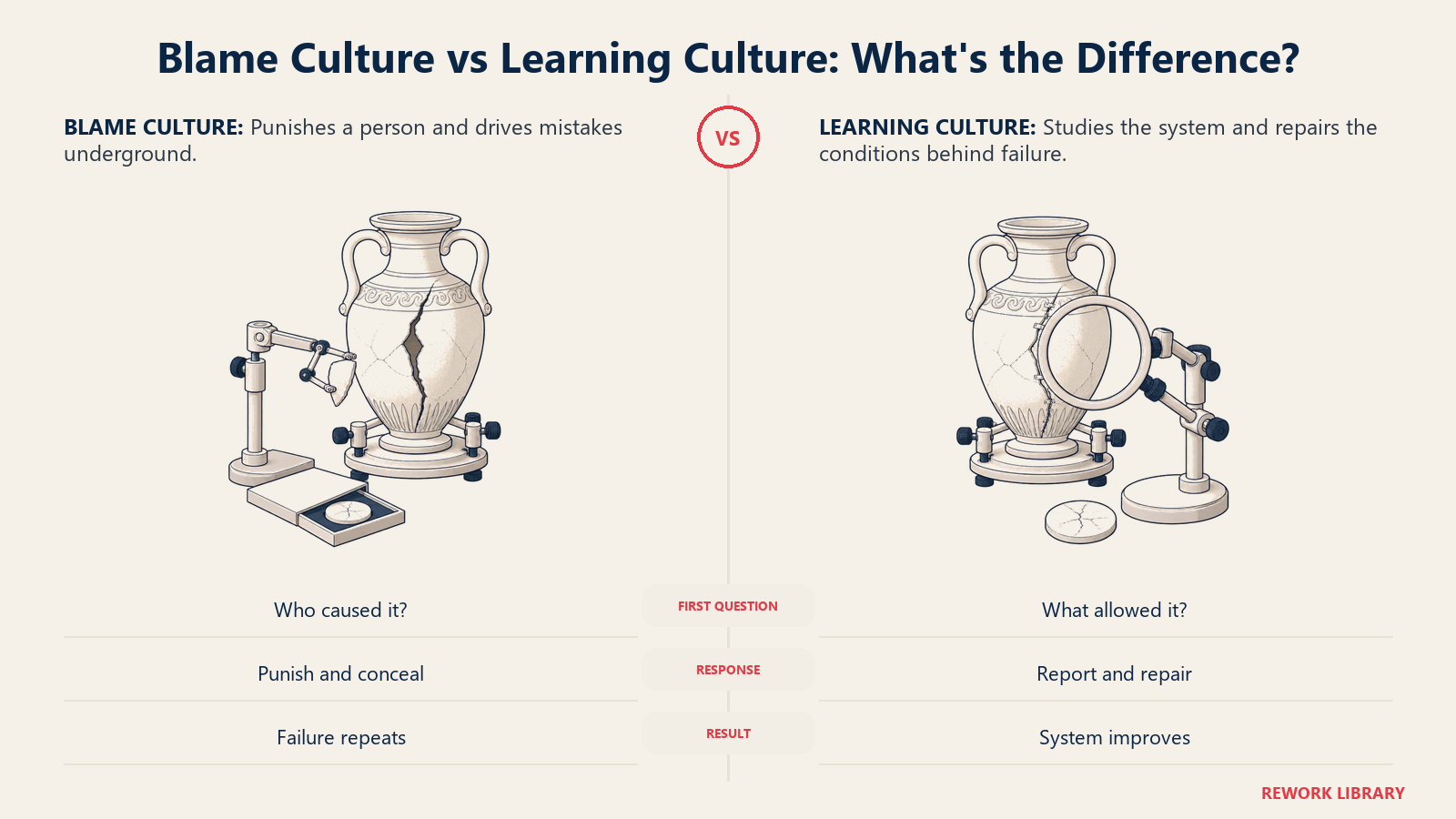
A blame culture treats a mistake as a crime to be solved: something went wrong, so someone must be found responsible and punished for it. A learning culture treats the same mistake as data: something went wrong, so the team asks what the system allowed to happen and fixes that. Both cultures respond to identical events. They produce almost opposite outcomes, because one trains people to hide problems and the other trains people to surface them.
That distinction sounds small until you watch it play out after a real failure. In a blame culture, the first instinct in the room is to figure out who touched it last. In a learning culture, the first instinct is to figure out what the process, the tooling, or the handoff let slip through. The event is the same. The question the team asks about it decides whether the same failure happens again in three months or gets fixed for good, and it is one of the sharpest, most visible parts of what business culture actually is.
Blame Culture: What Fear-Driven Teams Actually Do
Blame culture is not usually a stated policy. Nobody writes "we punish mistakes" into a values deck. It shows up instead as a pattern of reactions that everyone on the team learns to predict after watching it happen a few times: a manager who needs a name attached to every problem, a postmortem that quietly turns into a performance review, a leader who asks "whose fault is this" before asking what happened.
The Telltale Signs
People hide mistakes instead of reporting them. The moment a team learns that admitting an error carries real cost, they stop admitting errors early. They wait, hope the problem resolves on its own, or quietly patch it without telling anyone. This is the same dynamic behind why teams stay silent in meetings: the risk of speaking up outweighs the risk of staying quiet, so silence wins.
Scapegoating replaces investigation. A blame culture looks for the most convenient person to hold responsible, usually whoever is most visible or least senior, rather than the actual chain of decisions that produced the failure. This is faster and more satisfying in the moment, and it means the real cause never gets examined, so the same failure mode is still sitting there waiting to happen again.
CYA behavior spreads. Once people learn that a paper trail is their only protection, they start optimizing for defensibility over speed. Emails get written to establish a record rather than to move work forward. Decisions get run through extra approvals not because they need the input, but because a second signature spreads the blame if something goes wrong. This is one of the clearest signs of a toxic culture: energy that should go into the work goes into self-protection instead.
Bad news arrives late and filtered. By the time a blame-culture leader hears about a problem, it has usually been softened, delayed, or routed through several people who each took some of the edge off before passing it up. The leader ends up managing a version of reality that is several steps removed from what actually happened on the ground.
Learning Culture: What Mistakes-as-Data Actually Looks Like
A learning culture starts from a different assumption: most failures are produced by systems and conditions, not by a single careless person, so the fastest way to prevent the next one is to understand the system, not to punish the individual. That does not mean nobody is ever responsible. It means responsibility and punishment are treated as two separate questions, and the team investigates the first one honestly because it has stopped fearing the second one.
Blameless Post-Mortems in Practice
The clearest applied example comes from Google's Site Reliability Engineering practice. Google's SRE teams run blameless post-mortems after every significant incident: a written document that walks through what was expected to happen, what actually happened, and why the gap occurred, deliberately built to investigate the systemic reasons a person had incomplete or incorrect information rather than to assign fault. The document gets shared widely inside the company, on purpose, so the lesson compounds across teams instead of staying locked in one engineer's memory.
The mechanism matters more than the label. A postmortem that still ends with "and this is why Sarah should have caught it" is not blameless no matter what it is called. A real one ends with a concrete system change: a missing alert that gets added, a runbook that gets rewritten, a review step that gets automated so the same mistake becomes structurally harder to make. That shift, from "who do we blame" to "what do we change," is the entire difference between the two cultures in one sentence.
Why Blame Kills Performance and Safety
The stakes get sharpest in industries where a hidden mistake can kill someone, but the mechanism is the same one behind the link between culture and performance at any ordinary company: teams that trust how leadership handles bad news report problems earlier. Aviation and healthcare spent decades learning this the hard way, and both settled on the same answer: punishing honest error makes people stop reporting, and unreported error is far more dangerous than reported error.
The Just Culture Model From Aviation and Healthcare
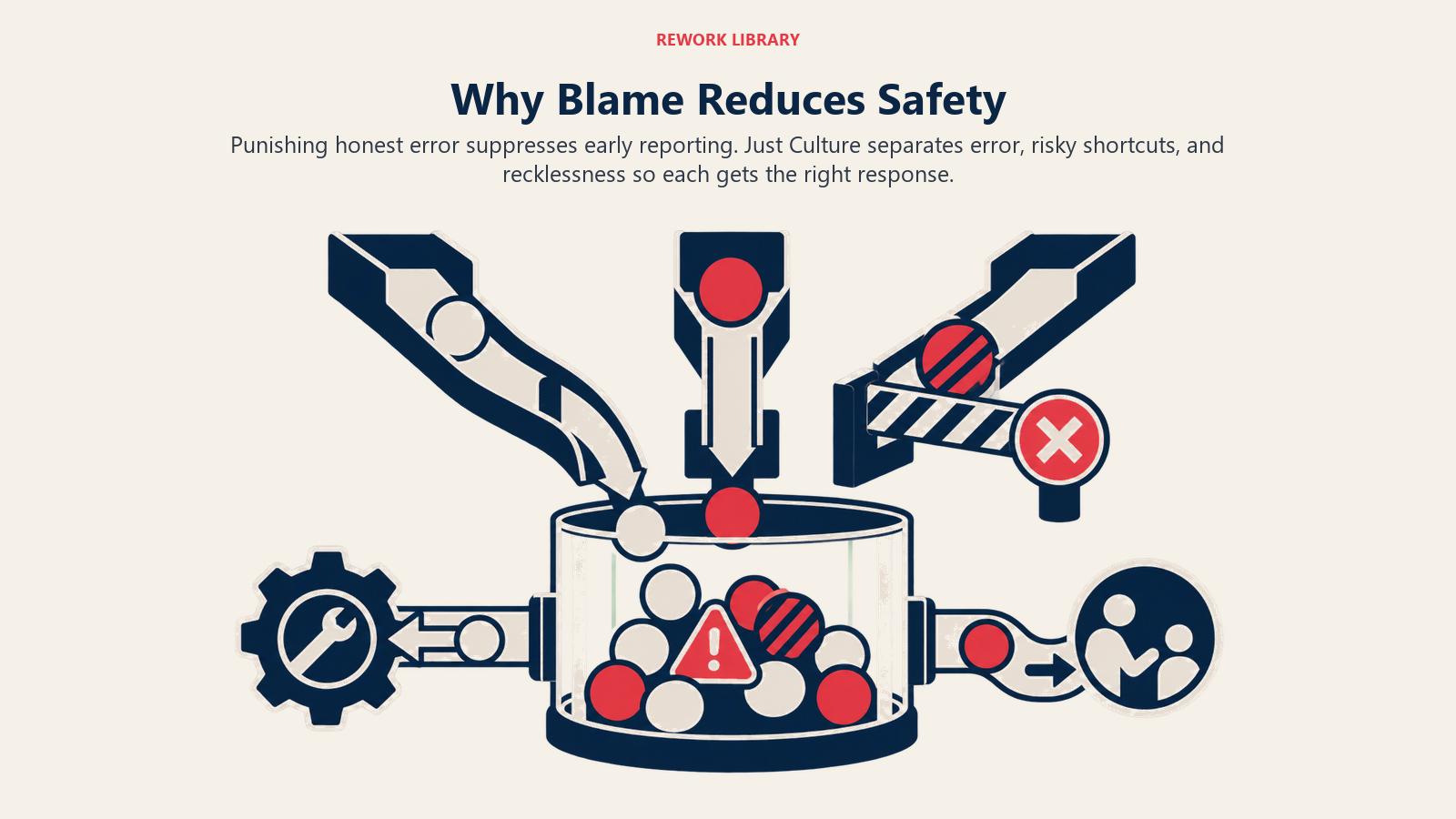
Researcher Sidney Dekker's Just Culture framework, developed from his work studying aviation and healthcare incidents, draws a hard line that most workplaces never bother to draw. A just culture separates three categories of behavior: honest human error (unintentional, and the system should be fixed, not the person), at-risk behavior (a conscious shortcut taken under normal pressure, which calls for coaching), and reckless behavior (a deliberate, unjustified disregard for known risk, which is the one category that actually warrants discipline). Most blame cultures collapse all three into a single bucket and punish them the same way, which is exactly backwards: it disciplines the honest reporter as hard as the reckless one, so people stop volunteering which category they are actually in.
What Confidential Reporting Systems Prove
NASA's Aviation Safety Reporting System, run in partnership with the FAA since 1976, is built entirely around this insight. Pilots, controllers, and crew can file a report confidentially and receive limited immunity from FAA enforcement action for the honest error they are disclosing. The program now takes in over 90,000 voluntary safety reports a year and has collected more than two million since it started. That volume is not a sign the industry is unusually error-prone. It is a sign that when people are not punished for surfacing a near-miss, they will tell you about it, which is exactly the information a safety system needs to catch a pattern before it becomes fatal. A workplace culture that punishes the messenger is choosing, whether it realizes it or not, to fly blind on that early warning.
The Neuroscience of Fear at Work
Blame culture is not just a management style problem. It runs into how the brain actually works under threat. When a person perceives a social threat, being blamed, singled out, or humiliated in front of peers, the amygdala triggers a fight-flight-freeze response, the same threat circuitry that evolved to react to physical danger. Neuroscientist David Rock's SCARF model, widely used in leadership research, groups the social threats that reliably trigger this response into five categories: status, certainty, autonomy, relatedness, and fairness, and public blame manages to hit several of them at once.
The practical cost is that this threat state degrades the part of the brain a person needs most in a crisis. Under a strong threat response, the prefrontal cortex, responsible for reasoning, working memory, and flexible problem-solving, temporarily loses processing priority to more primitive survival circuitry. In plain terms: the moment a mistake happens is exactly when a blame-driven reaction makes the person involved worse at thinking clearly about it. A leader who wants a sharp, honest account of what went wrong undermines that goal every time they meet bad news with visible anger or public blame.
Key Facts
- Sidney Dekker's Just Culture framework, drawn from decades of aviation and healthcare incident research, separates honest human error, at-risk behavior, and reckless behavior into distinct categories, arguing that treating all three the same way suppresses the honest reporting a safety system depends on. Source: Sidney Dekker, "Just Culture: Balancing Safety and Accountability"
- NASA's confidential Aviation Safety Reporting System now receives more than 90,000 voluntary safety reports a year and has logged over two million reports since 1976, protected by limited immunity from FAA enforcement action. Source: NASA ASRS
- Google's Site Reliability Engineering practice runs blameless post-mortems after every significant incident, explicitly built to surface the systemic reasons a person had incomplete or incorrect information rather than to assign individual fault. Source: Google SRE Book, "Postmortem Culture"
- Amy Edmondson's landmark hospital study found that better-performing nursing units reported more errors, not fewer, because psychological safety made it safe to report them; the survey item "if you make a mistake in this unit, it won't be held against you" directly predicted how many errors a unit actually surfaced. Source: Amy Edmondson, "The Fearless Organization"
How to Shift From Blame to Learning
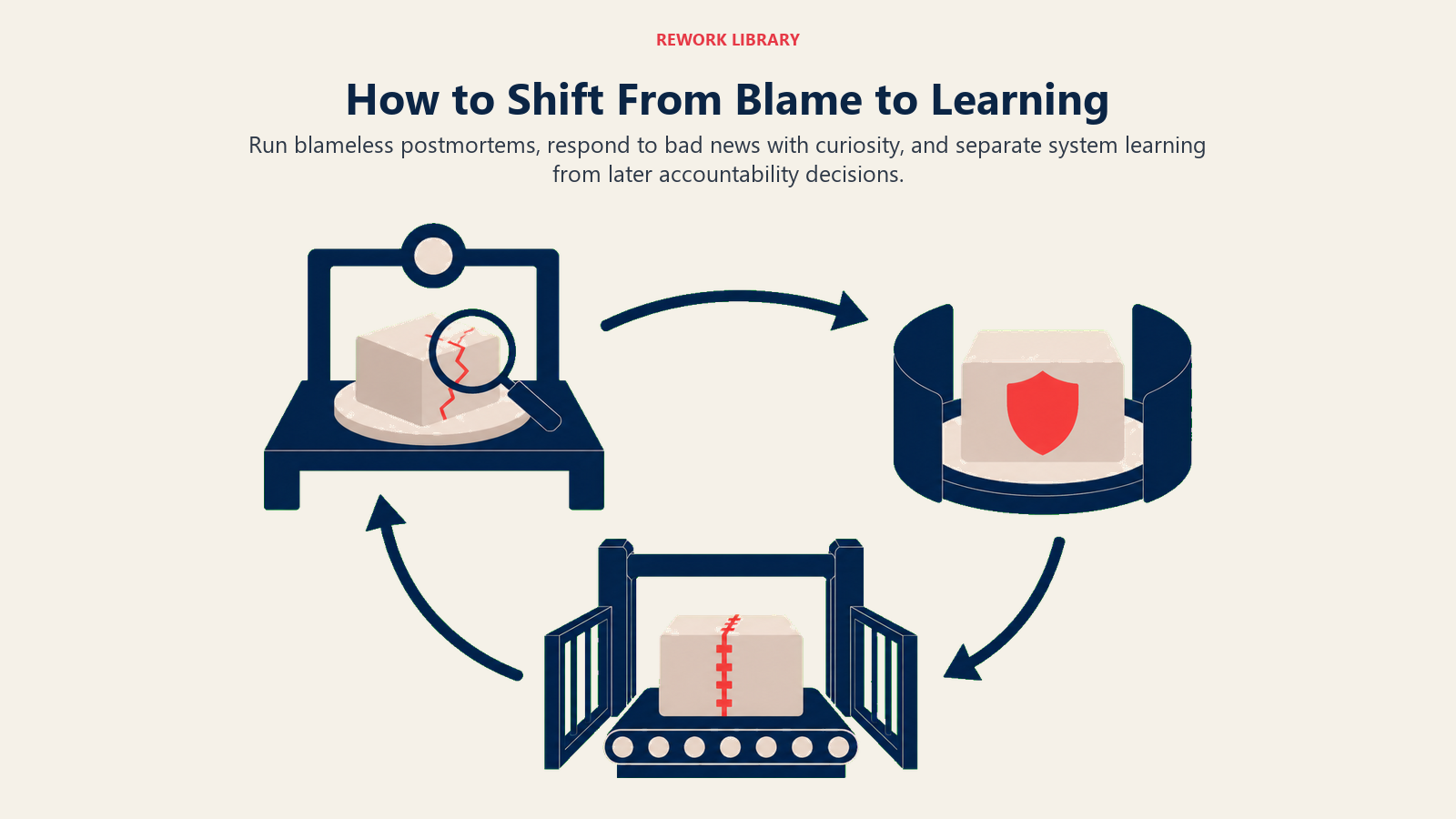
Moving a team from blame to learning is not a single announcement. It is a set of specific mechanisms that have to survive the first real failure after you install them, because that is the moment everyone is watching to see if you meant it.
Run Blameless Post-Mortems
Structure every significant incident review around four fixed questions: what did we expect to happen, what actually happened, why was there a gap, and what will we change so it is structurally harder to happen again. Keep the document focused on the system and the sequence of decisions, not on any one person's name. If a draft comes back with an individual's name attached to the root cause, that is the signal to rewrite it, not to publish it.
How Leaders Respond to Bad News Sets the Tone
Every team calibrates its own honesty to what it has watched leadership do with bad news, not to what leadership says it wants. The first time someone gets visibly punished, embarrassed, or quietly sidelined for reporting a problem early, that channel closes, and it rarely reopens on its own no matter how many "we value transparency" statements follow it. The reverse is just as fast: a leader who receives bad news calmly, asks a clarifying question instead of assigning blame, and thanks the person for surfacing it early teaches the entire team, in one moment, that this is a safe place to be honest. This is the same leverage point covered in building a feedback culture, where how feedback lands matters more than how often it is delivered.
Separate Accountability From Blame
Learning culture is not the absence of accountability. It is accountability aimed at the right target. The person closest to a mistake is still expected to help fix it and explain what happened, the core idea behind building a culture of accountability: ownership looks forward to the fix, while blame looks backward for someone to punish. Hold this line by asking two questions in order: first, what happened and what do we change, with no names attached to the root cause; second, and only afterward, was there reckless or repeated behavior that genuinely warrants a harder conversation. Skipping straight to the second question is how accountability curdles back into blame with better branding.
Blame Culture and Learning Culture in the Age of AI
A newer version of the same instinct is showing up as more work runs through AI tools and agents: blaming the AI when something goes wrong, instead of examining the process that let an unchecked output ship. "The AI wrote it" or "the tool got it wrong" is scapegoating with a new subject, and it fails for the same reason scapegoating always fails. An AI system cannot own a mistake, feel the consequence, or change its behavior out of accountability, so blaming it stops the investigation exactly where the useful part would have started: who reviewed this before it went out, and what in the review process let an error through.
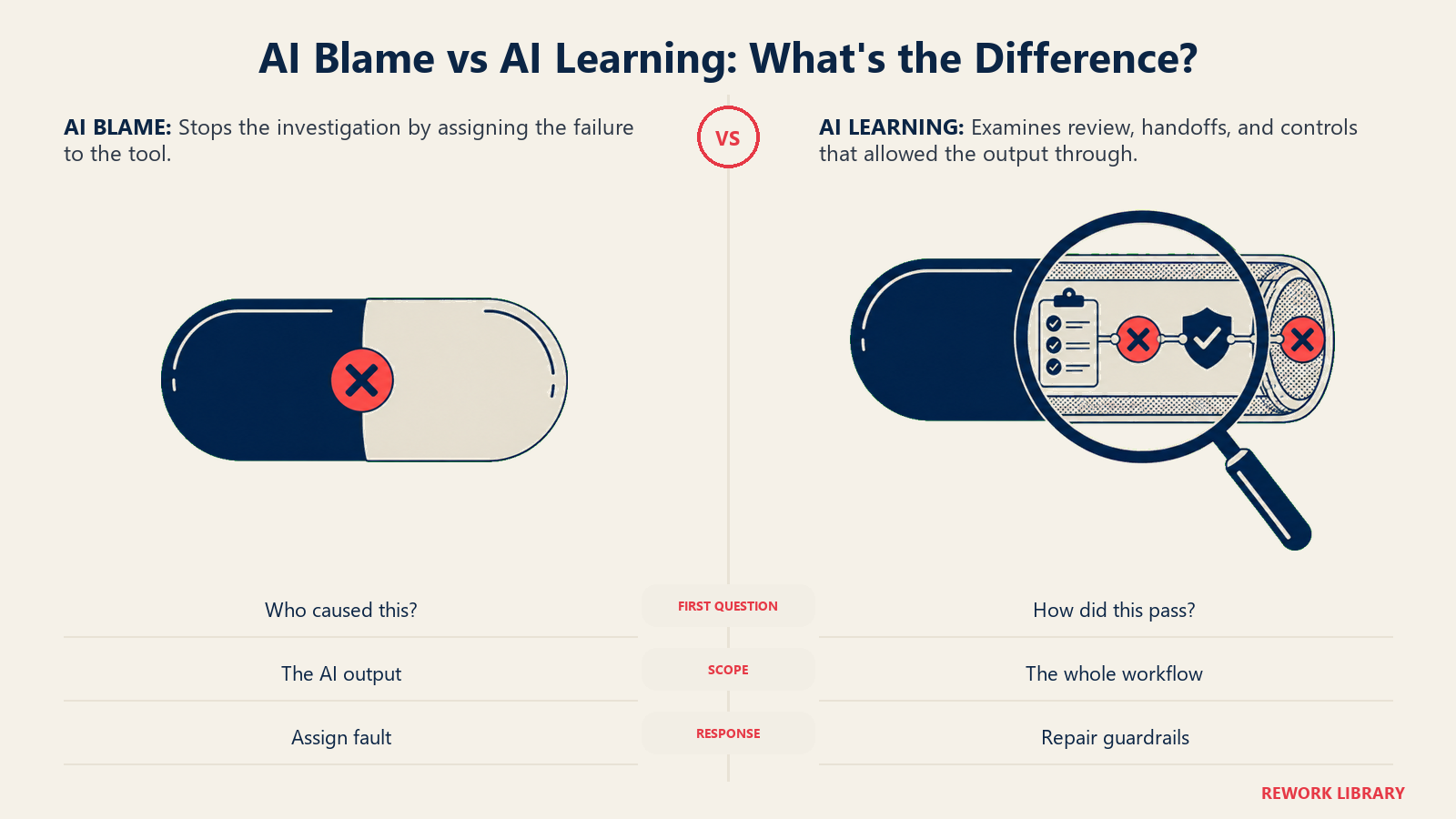
The learning-culture version of this looks structurally identical to a good post-mortem. When an AI-assisted draft, decision, or output turns out to be wrong, the useful questions are the same four from before: what was expected, what happened, why the gap, and what changes, usually in the review step or the handoff, not in the tool's disposition. Who checks AI output before it ships, and how they disclose it was AI-assisted, is the same ground covered in AI etiquette and workplace norms. Treated this way, AI errors become the same kind of institutional learning covered in more depth in human-agent teams and culture. Treated as something to blame the software for, they teach the team nothing, and the same error ships again next week under a different prompt.
None of this requires abandoning honesty about performance. A team can still measure results, flag a genuine pattern of carelessness, and have hard conversations when someone repeatedly cuts corners. What learning culture removes is the reflex to reach for blame first, before anyone has actually looked at what happened. That reflex is expensive precisely because it is invisible: it does not show up as a line item anywhere, it shows up as engagement scores that quietly erode, and as the same category of failure resurfacing every few months because nobody was ever safe enough to name the real cause the first time.
The teams that consistently improve are not the ones with the fewest mistakes. They are the ones where a mistake gets reported within the hour instead of buried for a quarter, because someone learned a long time ago that admitting it was the safer move.
Frequently Asked Questions about Blame Culture vs Learning Culture
What is the difference between blame culture and learning culture?
Blame culture treats a mistake as a crime that needs a guilty party, which trains people to hide problems to avoid punishment. Learning culture treats the same mistake as data about a system that needs fixing, which trains people to report problems early because doing so is safe. Both react to the same event; they produce opposite behavior afterward.
Does a learning culture mean nobody is ever held accountable?
No. Learning culture separates two questions that blame culture merges: what happened and how do we fix the system, asked first and without assigning individual fault, and whether there was genuine reckless or repeated behavior that warrants a harder conversation, asked second and separately. Accountability still exists; it just is not the first question asked after every mistake.
What is a blameless post-mortem?
A blameless post-mortem is a structured review, popularized by practices like Google's Site Reliability Engineering, that documents what was expected, what actually happened, why there was a gap, and what will change, deliberately focused on the process and decisions rather than on any individual's name. The goal is a concrete system fix, not a verdict on who was responsible.
What is the Just Culture model?
Just Culture, developed by researcher Sidney Dekker from decades of aviation and healthcare incident research, separates honest human error, at-risk behavior, and reckless behavior into distinct categories that deserve different responses. It argues that punishing honest error the same way you punish recklessness teaches people to stop reporting, which makes a system less safe, not more.
How does fear affect performance at work?
A perceived social threat, such as public blame, triggers the brain's fight-flight-freeze response and temporarily reduces prefrontal cortex activity, the part of the brain responsible for reasoning and flexible problem-solving. In practice, blaming someone right after a mistake makes them worse at thinking clearly about what actually happened, which works directly against getting an honest, useful account of the failure.
Why do confidential reporting systems work so well in aviation?
NASA's Aviation Safety Reporting System offers confidentiality and limited immunity from enforcement action for honest disclosures, which removes the incentive to hide a near-miss. It now receives more than 90,000 voluntary reports a year, proving that when people are not punished for reporting, they will surface problems early enough to prevent a pattern from becoming a disaster.
How do you start shifting a team from blame to learning?
Start with how leadership responds to the next piece of bad news, since that single reaction teaches the team more than any policy. Respond to an honest disclosure with curiosity instead of anger, run the next incident review as a blameless post-mortem focused on system fixes, and be explicit that reporting a problem early is the behavior you want to see more of, not less.
Should you blame an AI tool when it produces a bad output?
No. An AI system cannot own a mistake or change its behavior out of accountability, so blaming it stops the useful investigation before it starts. Treat an AI error the same way you would treat a human near-miss: ask what was expected, what happened, why the gap occurred, and what changes in the review process, prompt, or handoff so the same error is structurally harder to repeat.

Co-Founder, Rework.com
On this page
- Blame Culture: What Fear-Driven Teams Actually Do
- The Telltale Signs
- Learning Culture: What Mistakes-as-Data Actually Looks Like
- Blameless Post-Mortems in Practice
- Why Blame Kills Performance and Safety
- The Just Culture Model From Aviation and Healthcare
- What Confidential Reporting Systems Prove
- The Neuroscience of Fear at Work
- Key Facts
- How to Shift From Blame to Learning
- Run Blameless Post-Mortems
- How Leaders Respond to Bad News Sets the Tone
- Separate Accountability From Blame
- Blame Culture and Learning Culture in the Age of AI