Skills Half-Life and Continuous Reskilling: Running a Company Where Skills Expire Fast
Turn this article into takeaways for your work.


Each assistant summarizes the article only for you and suggests best practices for your work.
Skills half-life is the idea that a workforce's collective skill set loses market value over time as technology and job requirements shift. The commonly quoted "5 years" figure is a rule of thumb from a 2011 book and a 2017 opinion piece, not a measured statistic. The number worth planning around instead is the World Economic Forum's finding that 39% of workers' core skills will change between 2025 and 2030.
That distinction matters more than it sounds like it should. A company that builds its training calendar around a folk number gets the cadence wrong. A company that builds it around what has actually been measured gets to plan for something real: uneven disruption, concentrated in certain skill categories, arriving faster than most learning and development budgets assume.
Key Facts
- World Economic Forum, Future of Jobs Report 2025: on average, 39% of workers' core skills are expected to be transformed or become outdated between 2025 and 2030, down from 44% in the 2023 edition. Source: weforum.org
- WEF: 59 of every 100 workers will need training by 2030 to keep pace with changing skill demand; 85% of employers plan to prioritize upskilling, and 63% name skill gaps as the single biggest barrier to business transformation. Source: weforum.org
- LinkedIn Global Talent Trends: employees stay 41% longer at companies with high internal mobility than at companies with low internal mobility, independent of pay. Source: linkedin.com
- LinkedIn Workplace Learning Report: only about a third of organizations have a formal internal mobility program, even though roughly 9 in 10 name retention as a top concern. Source: learning.linkedin.com
- The "5-year skills half-life" claim traces to the 2011 book A New Culture of Learning and a 2017 World Economic Forum opinion piece by Upwork's then-CEO. Neither publishes a methodology behind the number, and other versions of the same claim (a "6-year" or "30-year-to-6-year" drop) circulate with no shared source. Source: weforum.org
What "Skills Half-Life" Actually Means, and Why the Popular Number Is Shaky
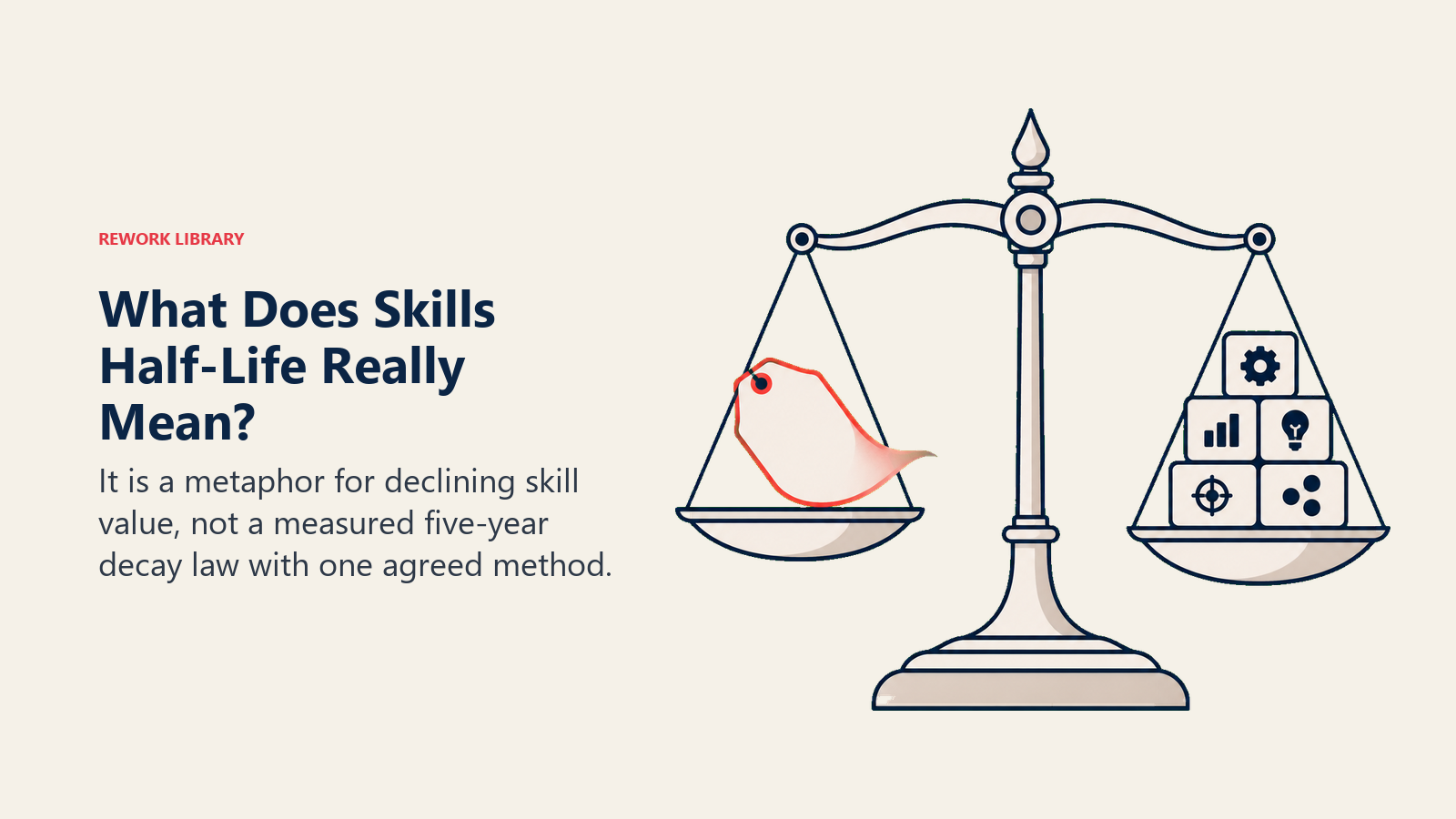
"Half-life" is borrowed from physics: the time it takes for half of a radioactive substance to decay. Applied to skills, the metaphor suggests that after some number of years, roughly half of what a worker knows how to do has lost its market value. It's a vivid image, and that's exactly why it spread faster than anyone checked it.
Where the "5-Year Half-Life" Claim Comes From
The number gets cited constantly in learning and development decks, usually with no footnote. Tracing it back, two sources show up most often. The first is A New Culture of Learning, a 2011 book by John Seely Brown and Douglas Thomas, which popularized the framing without publishing a study behind the specific figure. The second is a 2017 World Economic Forum opinion piece by Stephane Kasriel, then CEO of Upwork, who wrote that the half-life of a learned skill was "about 5 years," meaning a worker's skill set would be worth roughly half as much five years later. It's a plausible estimate from someone with real industry visibility, not a peer-reviewed measurement. Other versions of the claim put the drop at 6 years, or describe a fall "from 30 years to 6 years" with no attribution at all. None share a common methodology, the tell that they are folklore repeating itself, not one study cited three different ways.
This is worth naming plainly rather than repeating politely: if a number cannot be traced to a method, a sample, and a year, it is not data. It's a metaphor doing the work data should be doing.
What WEF Actually Measured, and Why It Isn't the Same Thing
The World Economic Forum's Future of Jobs Report is a different kind of source. It surveys employers, over 1,000 of them representing more than 14 million workers globally for the 2025 edition, and asks what they expect to happen to specific skills over a defined window. The headline result: 39% of workers' core skills are expected to be transformed or become outdated between 2025 and 2030, down from 44% in the 2023 edition, a reminder that even a well-sourced forecast moves between survey rounds and isn't a fixed law.
Notice what this number is not. It is not a decay curve, it doesn't imply skills lose exactly half their value on a fixed clock, and it doesn't distinguish between "less valuable" and "more valuable but different." It's an employer-reported estimate of churn in required skill sets, closer to a labor-market survey than to the tidy physics metaphor attached to it in slide decks. Use the WEF number when you need something defensible, and use the half-life story only to explain the idea to a room, out loud calling it a metaphor, not a measurement.
Why the Distinction Matters for How You Actually Run the Company
Get this wrong and the damage shows up in the training calendar. A leader who has internalized "skills have a 5-year half-life" tends to build a slow cadence: a refresh program every few years, treated as routine maintenance. A leader working from what WEF actually found builds something more urgent and uneven: nearly 4 in 10 core skills changing this decade, concentrated in technology-adjacent categories, with 59% of the workforce needing training now, not on a five-year clock.
The other planning error the folklore version invites is treating skill decay as uniform across a job. It isn't. A single role usually blends durable skills that barely move and specific tool skills that can go stale within a product release cycle. Averaging them into one half-life number erases the distinction that matters for a training budget, the subject of the next two sections.
Why One-Off Training Fails
Most corporate training still gets delivered the way it did two decades ago: a single session, a certificate, an assumption the knowledge sticks. It mostly doesn't. It's forgetting, and an incentive structure that rewards completing training over retaining it.
The Forgetting Curve Problem
Psychologist Hermann Ebbinghaus documented in the 1880s that new information decays fast without reinforcement, with the steepest drop happening in the first day or two after learning it. The exact percentages reported in modern retellings of his curve vary by study and by how "retained" gets measured, which is itself a small lesson in the same theme as the half-life claim: even a well-established phenomenon gets a different number attached every time someone repeats it secondhand. What doesn't vary is the shape of the curve. A single training session, with no follow-up, no practice, and no spaced repetition, produces a spike of knowledge that fades within days unless the workflow itself keeps using it.
The 70-20-10 Myth
A related number worth flagging for the same reason: the "70-20-10" rule, which claims 70% of learning happens through on-the-job experience, 20% through others, and 10% through formal training. It comes from a 1996 survey of a few hundred executives conducted by Morgan McCall, Michael Lombardo, and Robert Eichinger at the Center for Creative Leadership. Researcher Alan Clardy's 2018 review of the evidence behind it found the ratio has never been independently validated at scale, and the original study never claimed the precision that decades of L&D slide decks have since assigned it. The directional insight, that experience and social learning matter enormously, is almost certainly right. The exact ratio is not something to build a training budget around as if it were measured fact.
The practical takeaway from both examples: replace the single annual session with reinforcement that happens where the work happens. That's the design principle behind the operating model in the next section, and it's also why a continuous learning mindset has to be built into how work gets assigned, not just into what gets scheduled on a training calendar.
Durable Skills vs. Tool Skills
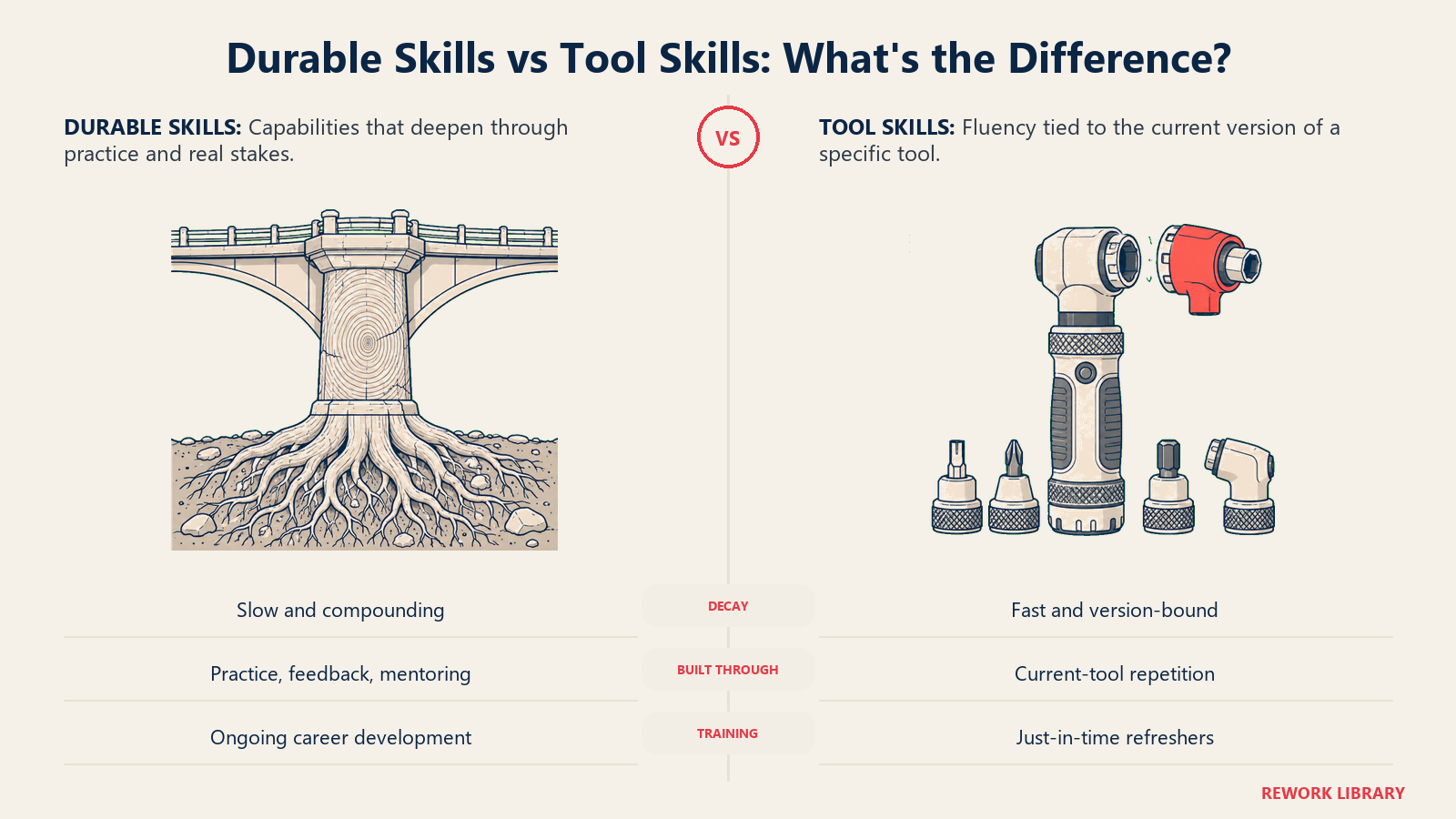
The half-life idea becomes genuinely useful once you stop applying it to "skills" as one lump category and split it into two buckets. Durable skills, things like judgment, negotiation, written communication, and systems thinking, barely decay and often compound with experience. Tool skills, fluency with one piece of software, one vendor's dashboard, or one AI model's quirks, can lose most of their value within a year or two if the underlying tool changes or a competitor replaces it.
| Dimension | Durable Skills | Tool Skills |
|---|---|---|
| Examples | Negotiation, written communication, coaching, systems thinking | Fluency with one specific AI tool, one software's shortcuts, one vendor's dashboard, a single prompting pattern |
| Decay speed | Slow. Compounds with practice and rarely goes fully obsolete | Fast. Can lose most of its value within a product cycle or two |
| How it's built | Practice, feedback, real stakes, mentoring, over years | Repetition on the current version of a specific tool |
| What replaces it | Rarely fully replaced; it deepens instead | A newer tool, often with a different interface and workflow entirely |
| Where training budget should go | Structural, ongoing development tied to career paths | Just-in-time refreshers tied to whatever tool is actually in use right now |
The mistake many training budgets make is spending durable-skill money on tool-skill problems, or the reverse: running a one-time workshop on a durable capability like negotiation as if it were a software certification, then never touching it again. Digital literacy sits in between the two categories in a useful way. The underlying capacity to learn new tools quickly is durable. The specific tool it gets applied to this quarter is not, and treating a tool skill like a piece of technical debt, an asset that depreciates unless someone actively maintains it, is a more honest mental model than pretending everyone just needs "AI training" once and is done. The same logic that governs technical debt in a codebase applies here: unmaintained skill inventories accrue interest quietly until a gap becomes visible in a missed deadline or a botched rollout.
What a Continuous-Learning Operating Model Looks Like in Practice
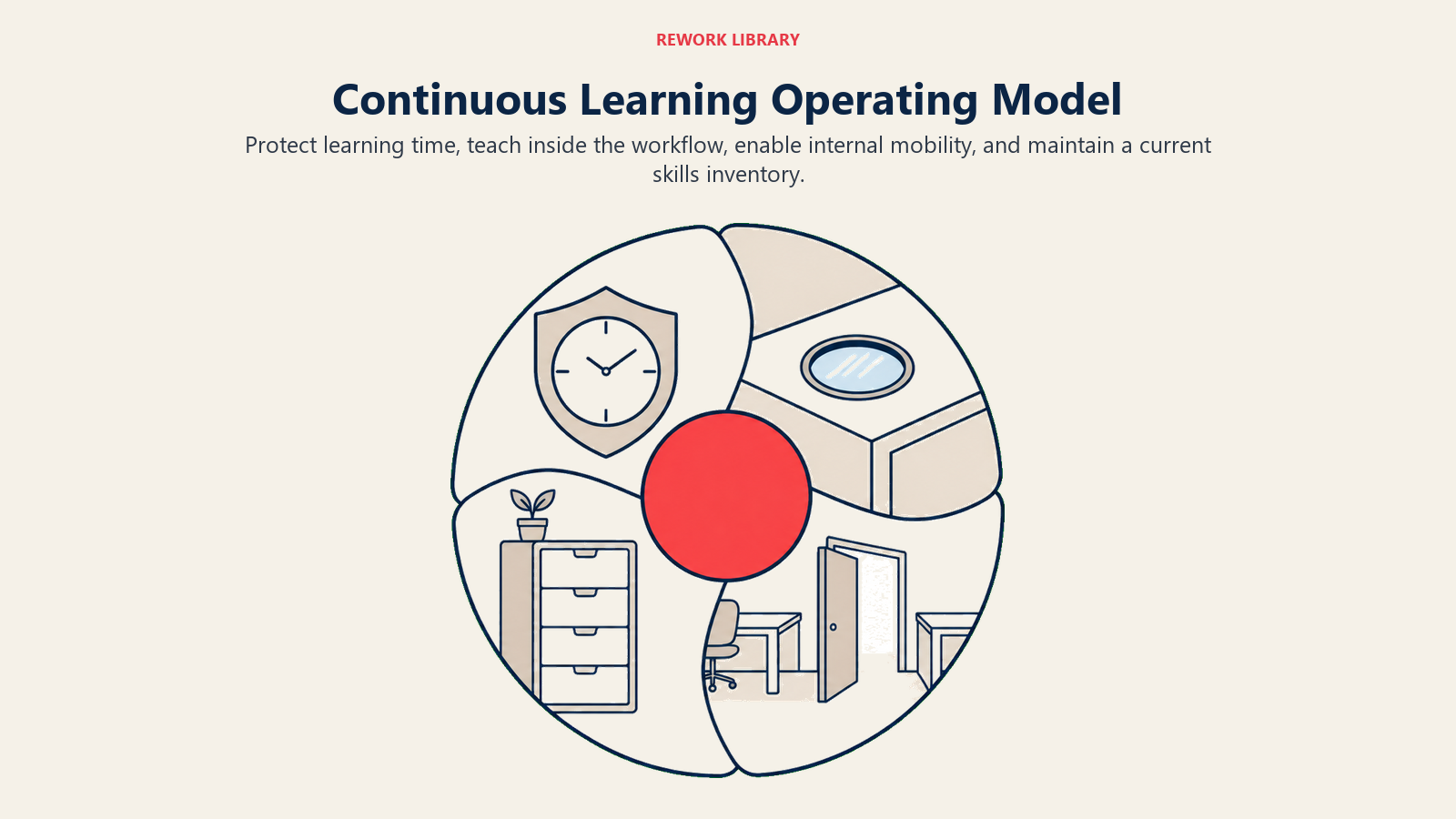
Once the goal is reframed from "close the half-life gap" to "keep durable skills compounding and tool skills current," the operating model looks different from a training calendar. Four pieces do most of the work.
Time Budgets for Learning
The single biggest predictor of whether reskilling happens is whether anyone has protected time for it against a calendar that otherwise fills with delivery work. A stated policy, even a modest one like a fixed weekly block or a rule that a manager cannot fully staff someone at 100% of capacity, matters more than the size of the number. Without a protected budget, learning time is always the first thing sacrificed to a deadline, and the company ends up training only the people already motivated enough to do it unpaid, on their own evenings.
In-Workflow Learning
The forgetting curve argument above points to one clear design rule: put learning where the work already happens instead of pulling people out of it. A prompt library embedded in the tool someone already uses beats a stand-alone AI course. A short explainer surfaced the moment a new process launches beats a training module completed weeks earlier and forgotten by the time it's needed. This is where AI-augmented learning earns its place: an assistant that explains a process in the flow of doing it closes the gap between "was trained on this" and "can currently do this."
Internal Mobility as a Retention and Reskilling Lever
Internal mobility does two jobs a training budget alone cannot. It reskills people by putting them in a new role where the learning is forced and immediate, and it retains the people worth reskilling in the first place. LinkedIn's data shows employees stay 41% longer at companies with strong internal mobility, independent of pay, and yet only about a third of organizations run a formal program for it even as nearly 9 in 10 call retention a top concern. That gap between what clearly works and what most companies actually do is one of the cheapest fixes available to a leader reading this: it usually costs a policy change and a functioning internal job board, not a new budget line. Treating internal moves as a legitimate part of a career path rather than a consolation prize for someone who didn't get promoted changes how people think about applying for one.
Skills Inventories: Knowing What You Actually Have
None of the above works without an honest, current answer to a basic question: what skills does the organization actually have right now, held by whom, and where are the gaps against what the next 12 months will require? Most companies answer this with a stale org chart and job titles that describe a role's history more than its current reality. A real skills inventory tracks capabilities at the person level and gets revisited on a cycle matched to how fast the underlying work is changing, not once a year during performance review season. That's the unglamorous, structural side of workforce data, the kind of record-keeping a People platform is built to hold so a manager can see who has what skill instead of guessing from memory.
Building the System: Where to Start
Start with the inventory, since everything else depends on an honest picture of what's already there. Protect time before adding content, since a stack of new courses on top of zero protected hours just produces more unwatched modules. Then make internal mobility a real option before assuming every gap needs external hiring. None of this requires a perfect number on how fast skills decay. The WEF figure gives a defensible order of magnitude, something close to 4 in 10 core skills changing this decade, enough to treat reskilling as a standing operating discipline rather than an annual event. It's the same discipline that builds a workplace where skills agility and a genuine growth mindset are things the system rewards, not traits an individual has to supply alone. And it's close cousin to what an AI-native culture and a deliberately AI-ready culture both require: treating AI's effect on work as an ongoing condition to manage, not a rollout with an end date. Skip that management and the gap shows up later as AI cultural debt, the same pattern of quiet erosion, just measured in skills instead of trust.
None of this requires solving the unsolvable question of exactly how fast a given skill decays. It requires a system that notices decay early and responds as a matter of routine: protected time on the calendar, learning that lives inside the workflow instead of beside it, a real path for moving internally, and an inventory that tells the truth about what the organization can do right now. Companies that build that system stop needing a precise half-life number, because they're never far enough behind for the number to matter.

Co-Founder, Rework.com
On this page
- Key Facts
- What "Skills Half-Life" Actually Means, and Why the Popular Number Is Shaky
- Where the "5-Year Half-Life" Claim Comes From
- What WEF Actually Measured, and Why It Isn't the Same Thing
- Why the Distinction Matters for How You Actually Run the Company
- Why One-Off Training Fails
- The Forgetting Curve Problem
- The 70-20-10 Myth
- Durable Skills vs. Tool Skills
- What a Continuous-Learning Operating Model Looks Like in Practice
- Time Budgets for Learning
- In-Workflow Learning
- Internal Mobility as a Retention and Reskilling Lever
- Skills Inventories: Knowing What You Actually Have
- Building the System: Where to Start