Career Paths in the Age of AI: What the Ladder, the Lattice, and 'Senior' Now Mean
Turn this article into takeaways for your work.


Each assistant summarizes the article only for you and suggests best practices for your work.
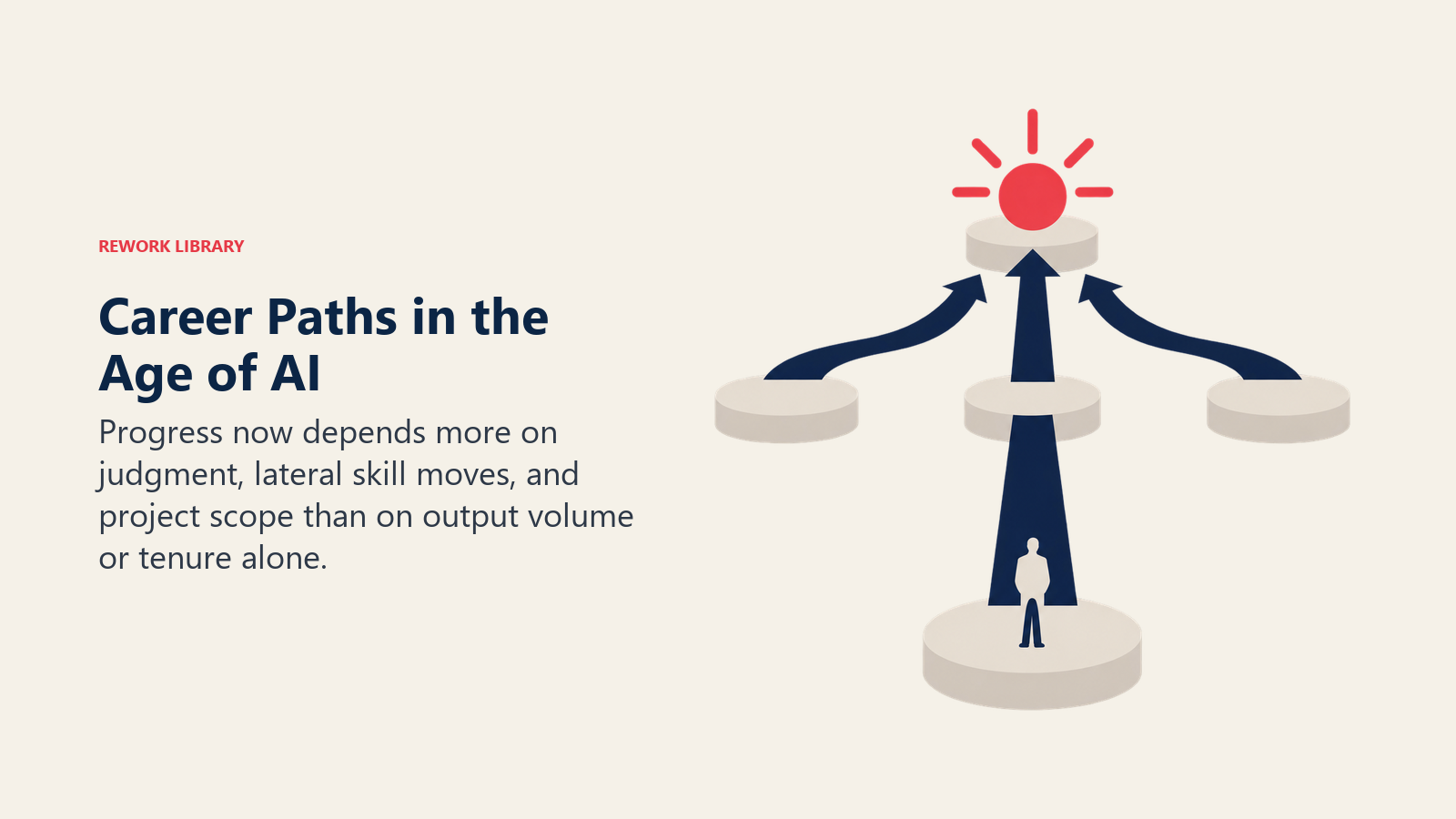
A career path in the age of AI is less a fixed sequence of titles and more a set of moves, some upward, many sideways, built around judgment and skills rather than output volume. AI now produces much of the work that used to prove someone was ready for the next rung, so progression increasingly runs through internal mobility, project scope, and demonstrated judgment instead of tenure alone.
That's a real shift, not a rebrand with new vocabulary. It's also genuinely unsettled: the data shows entry-level compression and rising internal-mobility payoffs clearly enough to plan around, but it doesn't yet show exactly how middle and senior progression resolves over the next five years. This article holds both things honestly.
What "Senior" Means When Output Isn't the Differentiator
For most of the last few decades, seniority tracked reasonably well with a simple proxy: how much a person could produce, how fast, and how independently. A senior analyst built more models than a junior one. A senior engineer shipped more features with fewer bugs. Titles were, in large part, a compressed signal for output capacity accumulated over time.
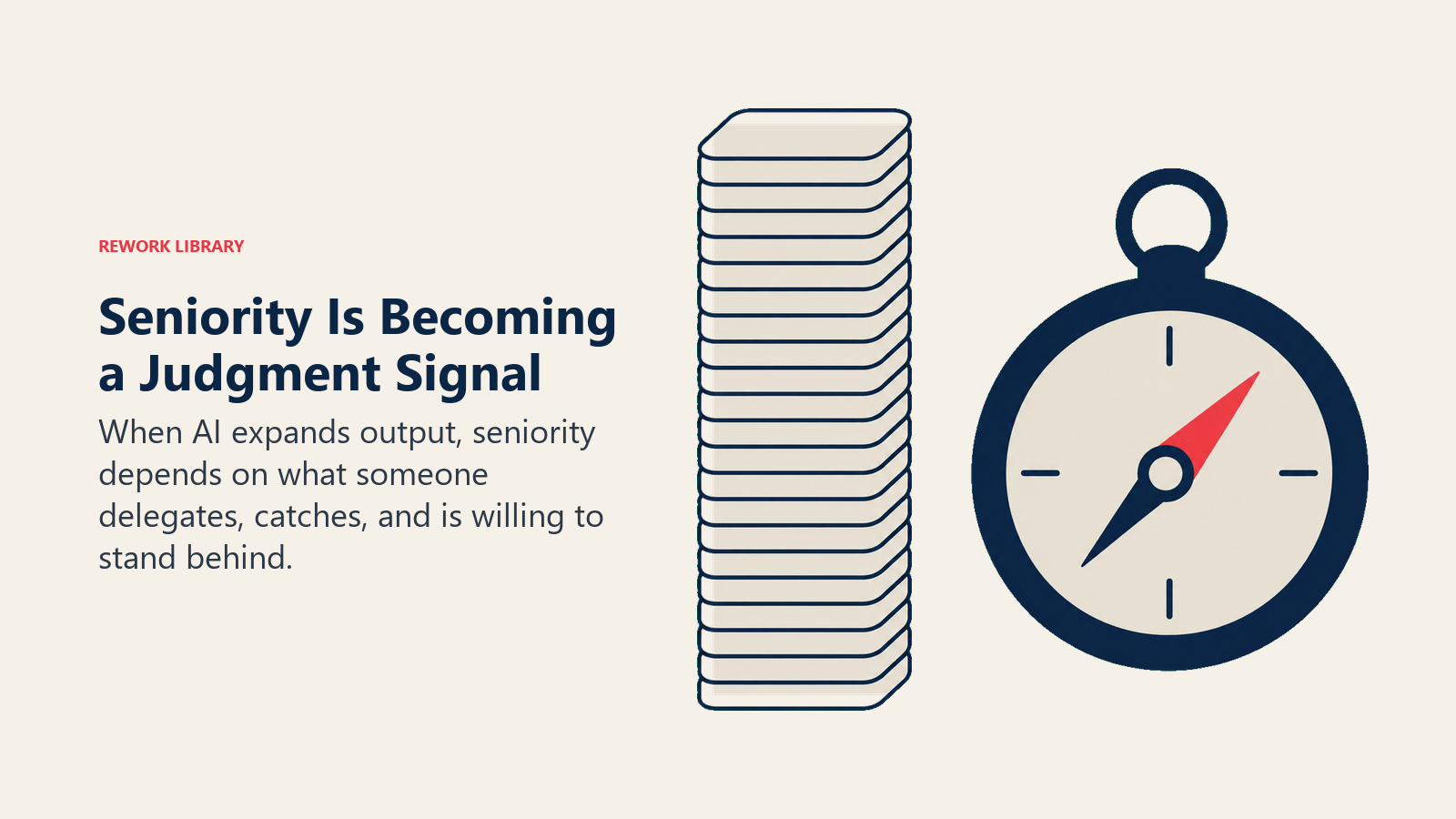
That proxy is breaking down, and it's breaking down specifically because AI now produces a lot of the output. From Doer to Orchestrator covers how the individual contributor's job itself is shifting from producing work to specifying, delegating, and verifying it. Career paths sit downstream of that same shift: if a junior analyst with a well-built AI workflow can produce a volume of first-draft output that used to take a senior person's whole week, volume stops being a usable signal for who deserves the next title.
The Old Signal: Volume and Tenure
The old signal was legible and easy to measure. Years in role, output produced, breadth of responsibility taken on. It correlated reasonably well with judgment because producing more work, for longer, under more scrutiny, was itself a way of building judgment. That's the mechanism The Broken Bottom Rung describes: the grunt work was never just cheap output, it was the apprenticeship that built the judgment senior titles were supposed to certify.
The New Signal: Judgment You'd Bet On
The new signal is harder to measure and harder to be fair about. It's the ability to catch a confidently wrong answer, know which 20% of a task still needs a human hand, and set a quality bar precise enough that someone else could check work against it. None of that shows up in a line count or a ticket-closed metric. Leaders who keep promoting on the old proxy, because it's the one they know how to measure, will keep rewarding the wrong thing for a while before anyone notices.
The Squeeze on Rung-by-Rung Progression
The traditional ladder assumed a fairly even distribution of rungs: a wide entry-level base, a middle layer of individual contributors and first-line managers, and a narrower senior layer above. AI isn't compressing that structure evenly. It's compressing the parts that used to train people for what comes next.
Fewer Rungs, Wider Gaps
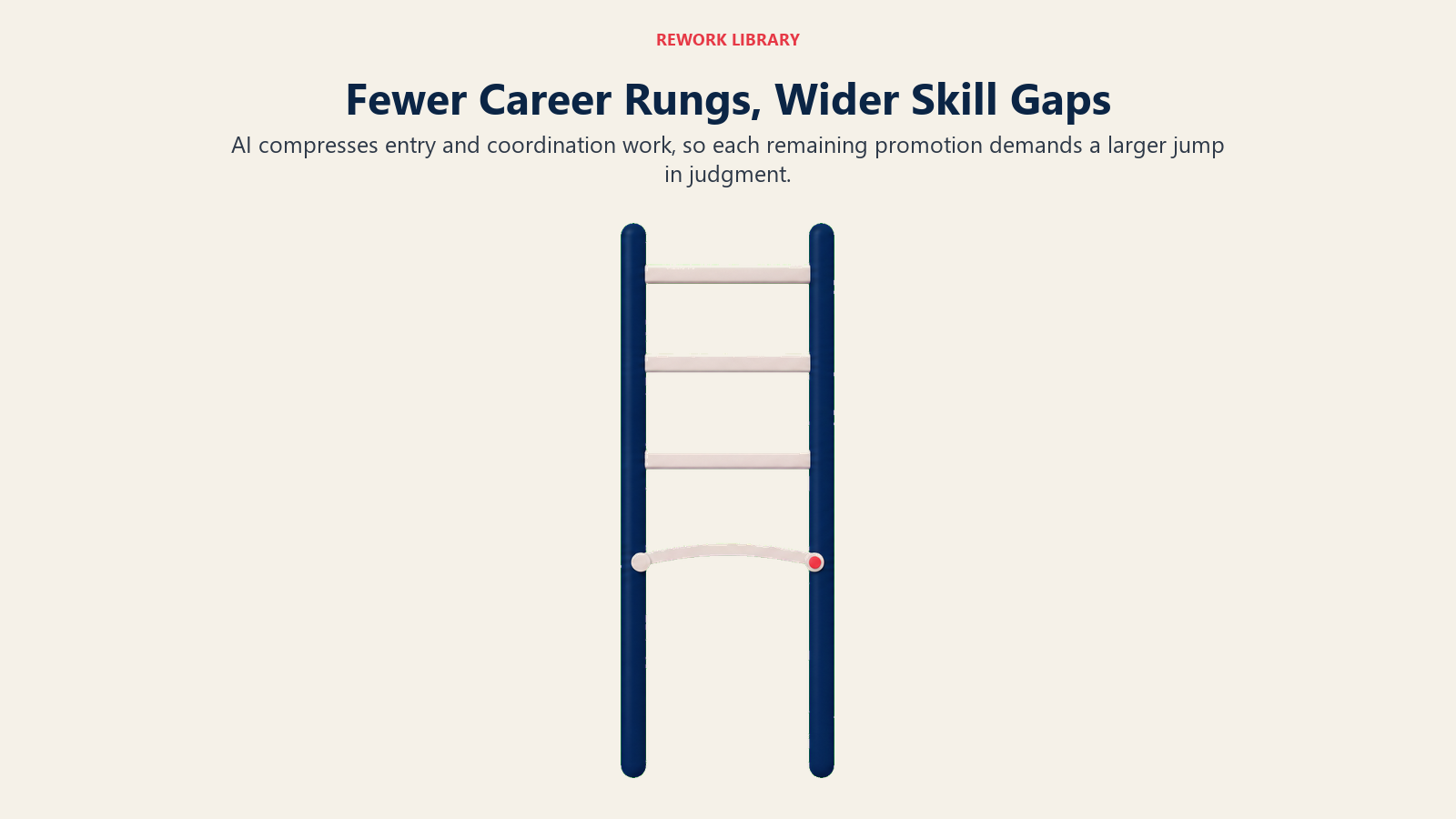
Two effects are stacking here, and it's worth being precise about which is which. The first is a hiring effect: SignalFire's 2026 State of Talent report found entry-level and new-grad hiring at large technology employers down roughly 65% versus 2019, as the twelve to eighteen months juniors used to spend on boilerplate work moved to AI tools. The second is an employment effect, measured more rigorously: Stanford's Digital Economy Lab, using ADP payroll data covering millions of workers, found employment among workers aged 22 to 25 in highly AI-exposed occupations sitting about 19% below where it would otherwise be, a gap that widened from 15% a year earlier.
Fewer people entering at the bottom, combined with AI absorbing some of the coordination and drafting work that used to occupy the middle, means the rungs that remain sit farther apart. Someone who does get hired and promoted is asked to cover more judgment ground per step than the same promotion required five years ago. That can mean faster, more meaningful growth for the people who make it through, but it's a real burden if the mentorship needed to close that wider gap doesn't get rebuilt alongside it, which is the case Skills' Half-Life and Continuous Reskilling makes for deliberate rather than incidental learning.
What the Data Does and Doesn't Show
Read the Stanford research carefully and it's more limited than the headlines suggest. The researchers explicitly find no evidence of "widespread, economy-wide job displacement associated with AI." The effect concentrates in specific, highly AI-exposed occupations, driven by reduced hiring of young workers, not a wave of layoffs of experienced ones. Middle and senior employment in the same occupations hasn't shown the same decline.
So the evidence is strong that the bottom rung is thinning in defined pockets of the labor market. It's much weaker on what happens to the middle and senior rungs over the next five to ten years, since that's a slower-moving, harder-to-measure structural question rather than a hiring-flow number that shows up in payroll data quarterly. Plan for the entry-level squeeze, which is measured. Stay skeptical of anyone offering a confident forecast for everything above it.
Key Facts
- Employees who make an internal move are 40% more likely to stay at the company for at least three years, and workers at companies with high internal mobility show 53% longer tenure overall than those at low-mobility companies. Source: LinkedIn Talent Solutions, "How Internal Mobility Benefits Employers"
- Companies with the highest internal mobility rates see 79% more leadership promotions on a per-employee basis than companies with the lowest rates, yet only 33% of organizations offer a formal internal mobility program. Source: LinkedIn Talent Solutions, internal mobility research
- At the two-year mark, an employee who has made an internal move is almost 20% more likely to stay with the organization than one who hasn't, but only 15% of employees say their organization encouraged them to move into a new role. Source: LinkedIn Learning, "How Career Pathing Leads to Employee Retention"
- The median employee tenure across the U.S. workforce was 3.9 years as of January 2024, the lowest on record since 2002, with workers aged 25-34 at a median of 2.7 years versus 9.6 years for workers aged 55-64. Source: U.S. Bureau of Labor Statistics, Employee Tenure Summary
- 85% of employers plan to prioritize upskilling their existing workforce, 70% plan to hire staff with new skills, and 50% plan to transition staff from declining to growing roles internally rather than replace them, per the World Economic Forum's 2025 Future of Jobs survey. Source: CIO, reporting World Economic Forum Future of Jobs Report 2025 data
From Ladder to Lattice: Lateral Moves as Real Progression
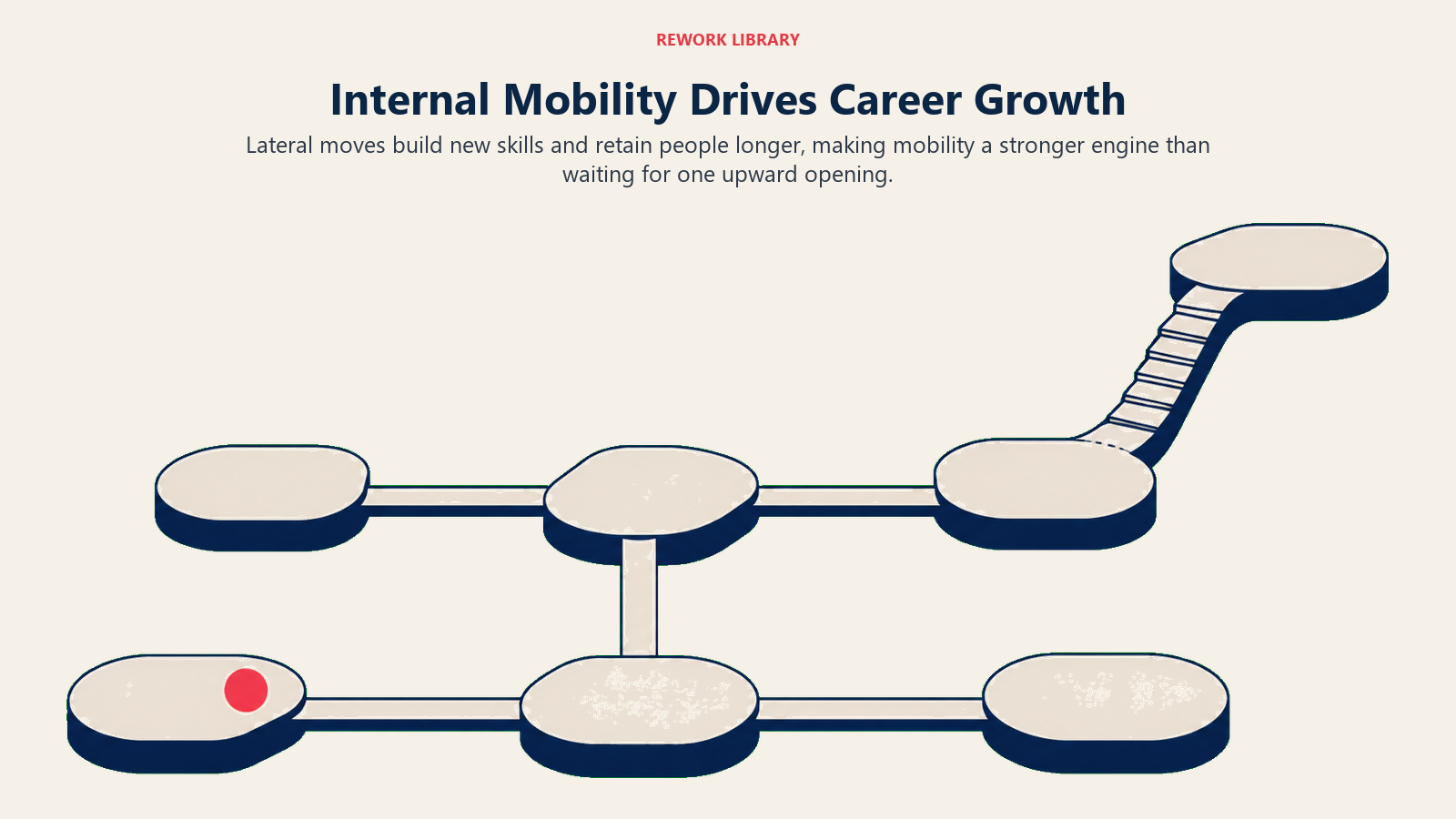
A ladder has one direction: up, one rung at a time, through a fixed sequence of titles. A lattice has many: up, sideways into a different function, diagonally into a role that blends two skill sets, or deeper into a specialist track without ever managing anyone. The metaphor isn't new (it's been part of HR vocabulary for well over a decade), but it's becoming less optional as rungs get farther apart and skills shift faster than a fixed title sequence can track.
What a Lattice Actually Looks Like in Practice
In a lattice, a lateral move, say, a product marketer moving into customer success to build a skill in usage data, isn't a detour from the "real" path. It's a legitimate way to build cross-functional judgment that a growing number of roles now require. The practical difference from a ladder shows up in three places: how a company defines "next level" (skills and scope, not tenure), how it measures progression (judgment demonstrated, not a title change), and how it talks about lateral moves (as growth, not a lack of ambition).
None of this means titles disappear or hierarchy stops mattering. Someone still has to make final calls, own budgets, and be accountable for outcomes, an organizational question that runs alongside shifts like the frontier firm and the agent boss. The lattice is about how people move through the org while that structure evolves underneath them, not a claim that structure stops existing.
The Old Ladder Assumption, What Changes, and What to Do Instead
| Old ladder assumption | What changes under AI | What to do instead |
|---|---|---|
| Time in role plus rising output volume signals readiness for the next title | AI produces much of the routine output, so volume stops correlating with judgment | Promote on complexity of judgment calls handled, not hours logged or drafts produced |
| Progression is a fixed sequence: analyst, senior analyst, manager, director | Coordination and drafting work in the middle gets absorbed by AI and flatter structures, widening the gap between rungs | Define fewer, clearer levels with explicit judgment criteria, and treat a lateral move as valid progress between them |
| Broad generalist competence plus tenure earns the next promotion automatically | Two distinct, equally valid tracks open up: deep specialist expertise and generalist orchestration of people and agents | Let people choose a track and evaluate them against that track's criteria, not one generic ladder for everyone |
| Growth comes mainly from external hiring and occasional promotion | Internal movers show measurably better retention and longer tenure than employees who never move | Post openings internally first, build real transfer paths, and count internal mobility as a retention metric leadership tracks |
| Career conversations happen once a year at review time | Skills, tools, and role definitions shift faster than an annual cycle can track | Make career conversations continuous, tied to skills built and judgment demonstrated since the last one |
Internal Mobility as the Main Growth Engine
If the ladder used to be the primary growth mechanism, internal mobility is becoming the thing that does that job now, at least for companies paying attention to their own data. The gap between how well it works and how often companies actually run it is the most fixable problem here.
The Retention Case Employers Already Have Data On
The numbers in the Key Facts box above aren't soft correlations from a single survey. LinkedIn's analysis of tens of millions of member profiles found that employees who make an internal move are 40% more likely to stay at least three years, and that companies with the highest internal mobility rates see 53% longer tenure overall and 79% more leadership promotions per employee than companies with the lowest rates. Internal mobility isn't a perk sitting next to career development. For companies with real data on it, it functions as one of the more reliable retention levers available.
Why Internal Mobility Programs Still Lag the Data
The catch is that most organizations aren't set up to capture this. Only 33% offer a formal internal mobility program, and just 15% of employees say their organization actively encouraged them to move into a new role. Some of the gap is structural: hiring managers get measured on filling their own headcount, not on releasing a good performer into a role elsewhere in the company, so incentives quietly work against what the retention data says should happen more. Fixing that is less about a new HR tool and more about whether a manager gets credit, not penalized, for a strong employee moving on. It's also a natural extension of the kind of AI-complementary skill-building companies already need: if the skills people need are shifting under them, moving someone into a role that requires practicing those skills directly is often faster than waiting on an external training budget cycle, and it builds exactly the skills agility that a lattice depends on.
Specialist Depth vs. Generalist Orchestration
As the ladder loosens, two distinct, legitimate tracks are opening up where there used to be an implicit assumption that everyone climbs the same generalist path toward management.
Two Viable Tracks, Not One
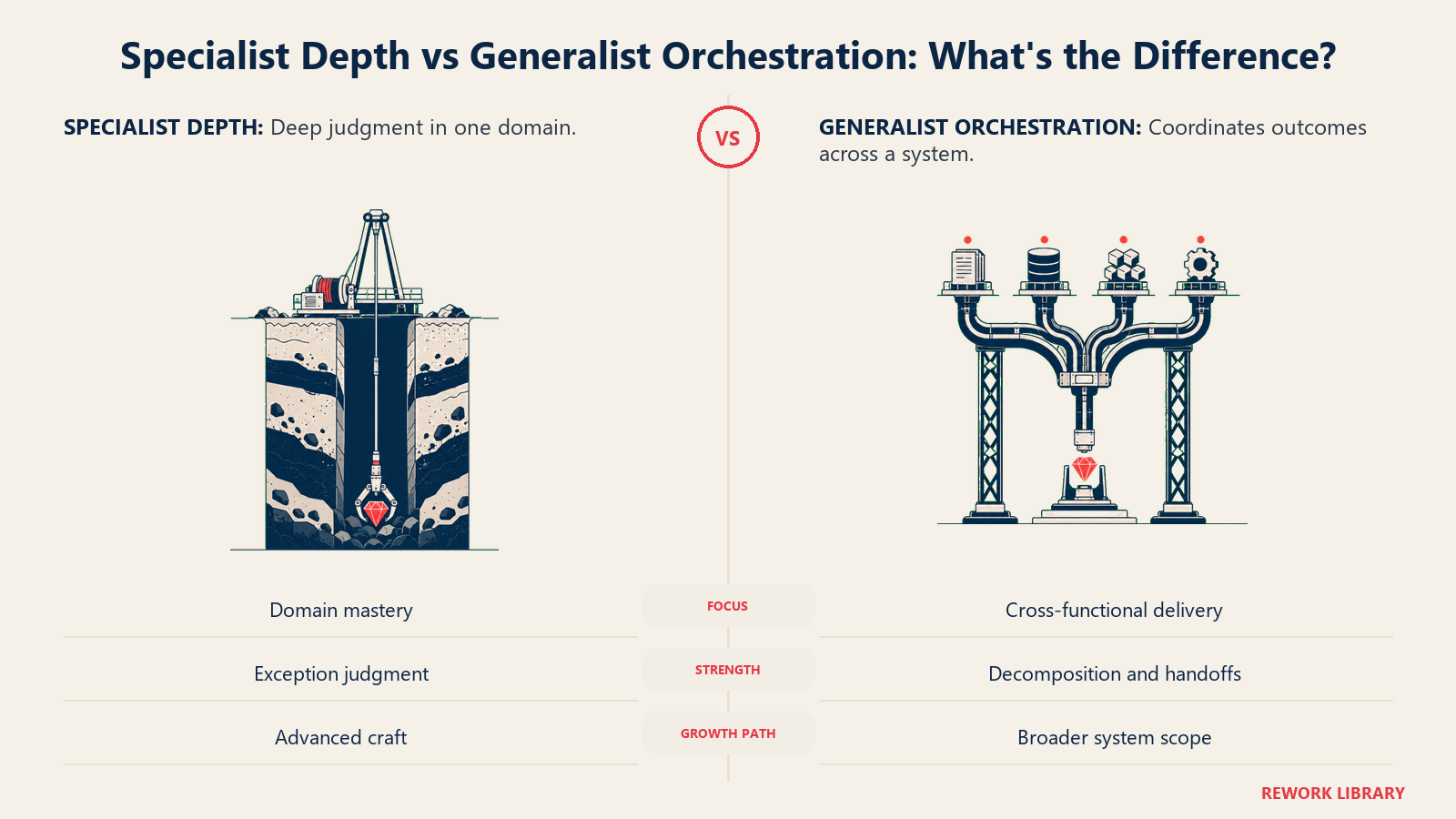
The first track is specialist depth: going deeper into a domain than AI tools can reliably go, the kind of judgment Keeping Human Judgment Sharp describes as worth deliberately protecting. A specialist's value increasingly comes from catching what a model gets confidently wrong in a narrow domain, an underwriter who senses a file is off before naming why, an engineer who can spot the one place an AI-generated architecture fails at scale. That value compounds with years of hands-on practice and doesn't require managing anyone. It is also, often, the part of the job someone actually loved doing before AI took the routine half of it, a loss meaning, identity, and craft in the AI era covers directly.
The second track is generalist orchestration: coordinating across functions, people, and increasingly AI agents, to get a complex outcome delivered. This track leans harder on decomposition, context-setting, and knowing when to step in personally, and less on deep technical mastery of any one domain. Neither track is a consolation prize for the other. A senior specialist and a senior orchestrator can sit at the same level, paid the same, with genuinely different jobs, though compensation and fairness in the AI era covers why "paid the same" gets harder to define once one track's output is AI-leveraged and the other's isn't.
Most career frameworks still implicitly treat orchestration and management as the same thing, forcing strong specialists into people-management roles they don't want just to keep advancing. That's a design choice, not a law of nature, and an increasingly expensive one given which jobs AI actually changes rewards depth in narrow domains AI can't yet reach reliably.
What Leaders Should Tell People Who Ask "What Is My Path Here?"
This is the question every manager is getting asked more often, and the honest answer has three parts.
First: the path is real, but it's less likely to be a straight line through fixed titles than it was five years ago, and pretending otherwise sets people up to feel stalled when they're actually progressing sideways in a way that matters later. Second: growth now shows up as expanding judgment and scope, not rising output, so the honest conversation names specific judgment calls someone is ready to own next, not just "we'll consider you for the next title in a year." Third: internal moves aren't a fallback for people who "couldn't get promoted." Given the retention data above, a good lateral move is frequently the higher-value outcome for both the person and the company, and saying that out loud, not just believing it in an HR deck, changes whether people take the opportunities you offer. That kind of plain talk about what's actually changing is the same standard the social contract of AI at work asks employers to hold themselves to more broadly.
Concretely, that means replacing the annual development-plan conversation with something closer to continuous career management: naming the judgment call someone handled well this quarter and the one they're not ready for yet. It means making internal openings genuinely open to internal applicants before an external search starts. And it means being straightforward when a track narrows: telling someone their function is shrinking is harder than a vague "keep growing," but it's the only version that lets them actually plan.
What's Still Unsettled
Be honest about the edges of this. The data on entry-level hiring compression is solid, and so is the data on internal mobility's retention payoff. What's unresolved is how title structures, pay bands, and promotion cadence settle once companies rebuild around lattices rather than ladders, since most haven't finished that rebuild, part of the broader work of building an AI-ready culture. Anyone describing the exact shape of the 2032 org chart is offering a guess dressed up as a forecast. The safer bet is on the mechanism, not the outcome: judgment is replacing output as the scarce thing worth promoting on, and companies that build a real way to measure it early will keep their best people longer than the ones still running promotion committees on last decade's proxy.

Co-Founder, Rework.com
On this page
- What "Senior" Means When Output Isn't the Differentiator
- The Old Signal: Volume and Tenure
- The New Signal: Judgment You'd Bet On
- The Squeeze on Rung-by-Rung Progression
- Fewer Rungs, Wider Gaps
- What the Data Does and Doesn't Show
- Key Facts
- From Ladder to Lattice: Lateral Moves as Real Progression
- What a Lattice Actually Looks Like in Practice
- The Old Ladder Assumption, What Changes, and What to Do Instead
- Internal Mobility as the Main Growth Engine
- The Retention Case Employers Already Have Data On
- Why Internal Mobility Programs Still Lag the Data
- Specialist Depth vs. Generalist Orchestration
- Two Viable Tracks, Not One
- What Leaders Should Tell People Who Ask "What Is My Path Here?"
- What's Still Unsettled