Reskilling Programs That Actually Work: Why Most Fail and What the Exceptions Do Differently
Turn this article into takeaways for your work.


Each assistant summarizes the article only for you and suggests best practices for your work.
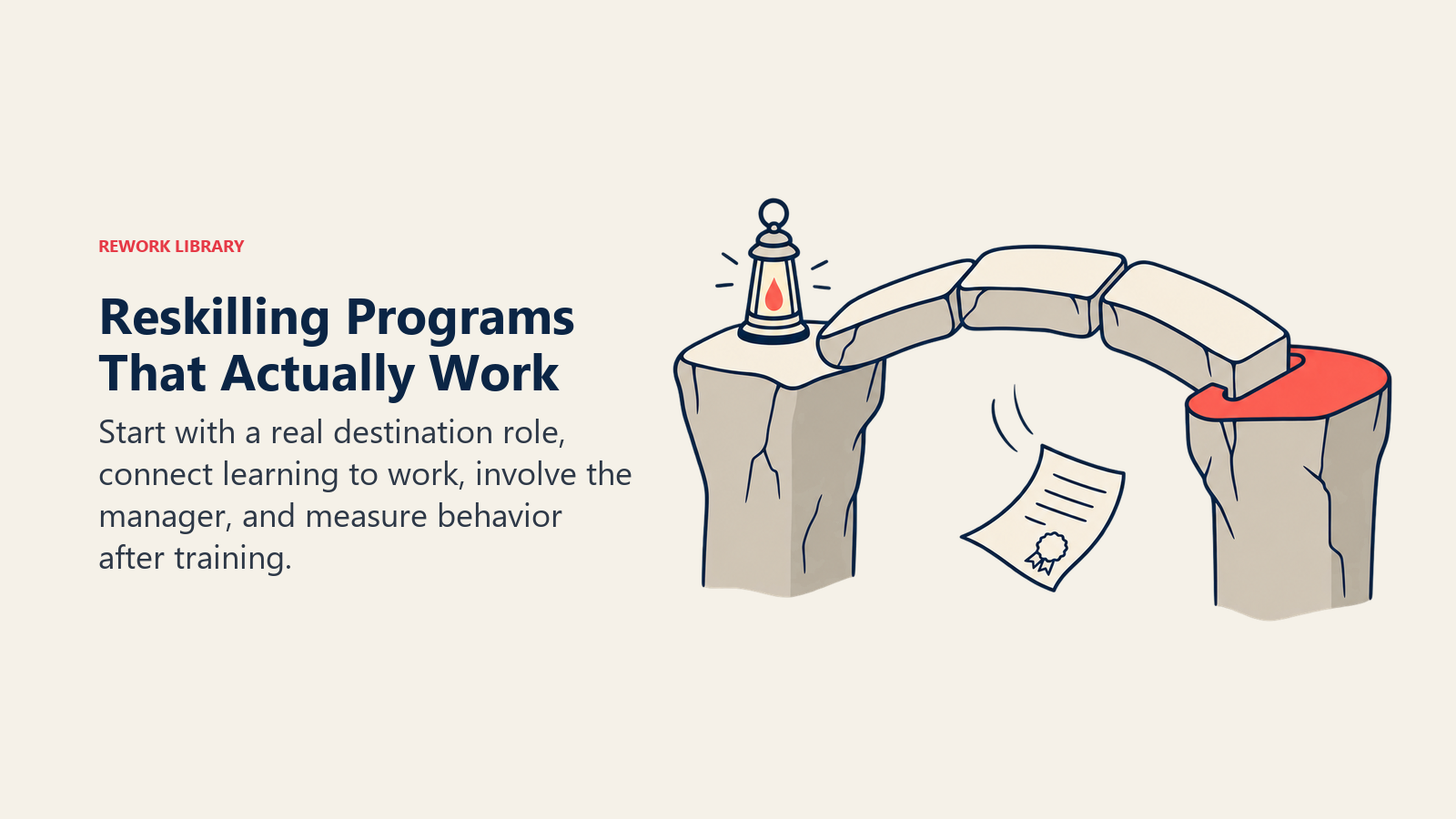
Most corporate reskilling programs fail for four repeatable, documented reasons: low completion in self-serve course libraries, learning that never touches real work, no manager involved, and no defined role waiting at the end. Programs that work fix the last one first. A training budget with no destination role attached is the single biggest predictor of wasted spend, more than the platform, the content, or the badge. A reskilling program is also the main tool available for closing the AI adoption divide inside a company, which is exactly why a program that fails quietly for one of these four reasons leaves that gap wide open.
This is a companion piece to Skills Half-Life and Continuous Reskilling, which covers the operating model: protected learning time, in-workflow learning, internal mobility, skills inventories, and the shaky data behind the "skills half-life" idea. That article is about the system a company runs continuously, one piece of the broader shift covered in What Is the Future of Work?. This one is about a single program: how to design it, staff it, and know honestly whether it worked.
Key Facts
- AT&T's Future Ready program committed over $1 billion to retrain roughly 100,000 of its then-270,000 employees, later reporting 140,000 people in some stage of development and just over 40% of about 40,000 open positions filled internally in a reported year. Source: Fortune, "Can AT&T Retrain 100,000 People?"
- Amazon's Upskilling 2025 commitment was over $1.2 billion aimed at 300,000 employees between 2019 and 2025. Amazon's own announcement describes the initiative as "just starting to scratch the surface" rather than reporting completion or placement data. Source: aboutamazon.com
- In October 2025, Amazon announced a follow-on $2.5 billion "Future Ready 2030" upskilling commitment. Within roughly a week, it announced 14,000 corporate job cuts, a timing juxtaposition widely noted in trade coverage. Source: HR Dive
- LinkedIn's Workplace Learning Report 2025 found only 15% of employees say their manager helped them build a career development plan in the past six months, a 5-point decline from the prior year. Source: LinkedIn Workplace Learning Report
- The widely repeated claim that only about 10% of training transfers to on-the-job performance traces to informal estimates, not a controlled measurement. A 2011 peer-reviewed paper in Performance Improvement Quarterly examined the claim directly and found no solid empirical basis for it. Source: Wiley Online Library, Ford, Yelon & Billington (2011)
Why Reskilling Budgets Disappear Without Changing Anything
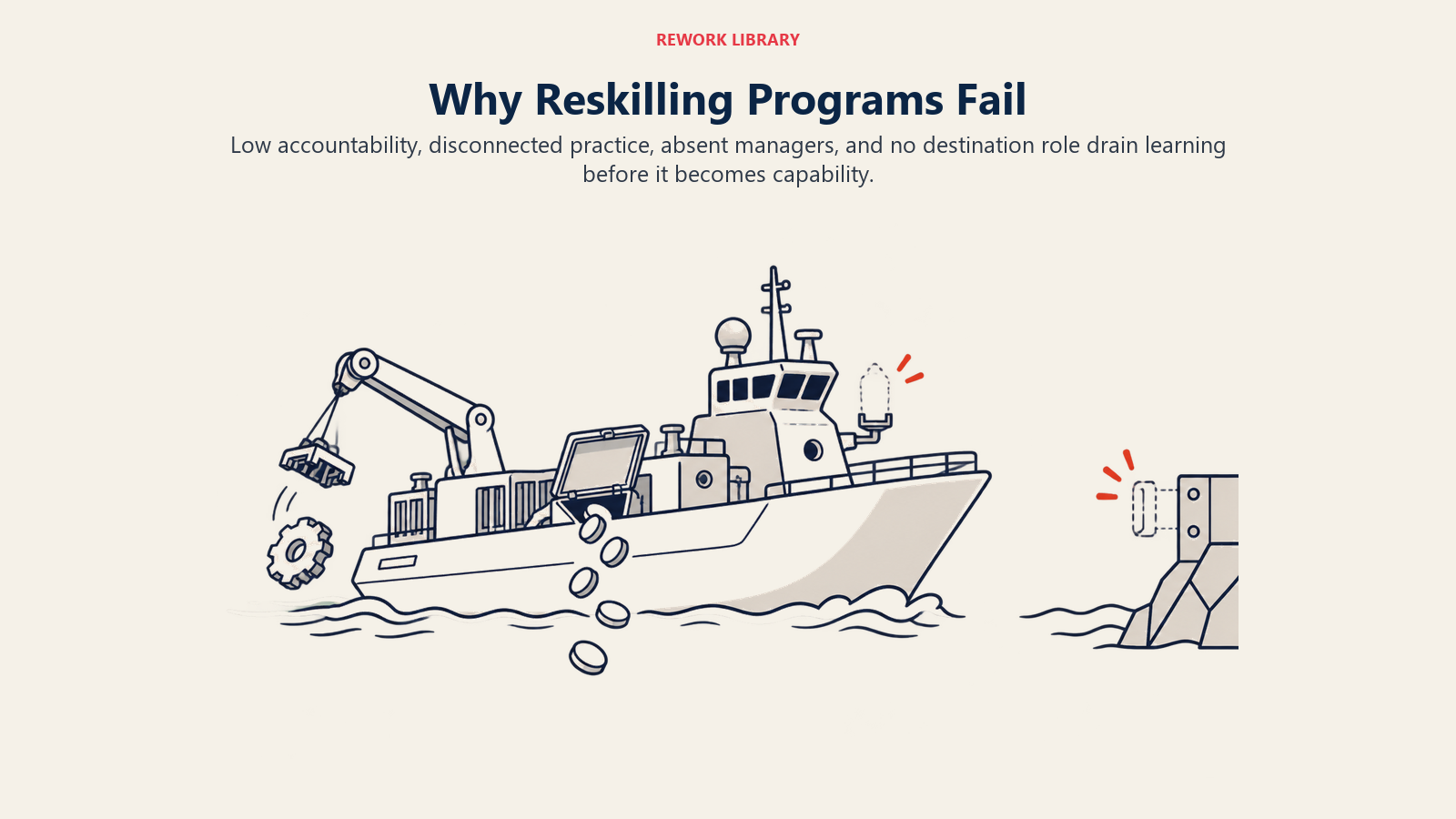
Ask most L&D leaders how their reskilling program is going and you'll get a completion rate. Ask a CFO what it produced and the honest answer is often that nobody knows. That gap between an easy activity metric and a hard capability question is where reskilling budgets quietly evaporate. Four failure modes account for most of it, and they compound: a program loses most of its reach in the first one, then loses whatever survives in the next three.
The Completion-Rate Problem with Self-Serve Course Libraries
The default shape of corporate reskilling is a course library: browse, enroll, watch, maybe finish. It's cheap to stand up, easy to report on, and structurally low on completion. The closest well-documented analog is research on massive open online courses, a different population than employees but the same design pattern: content on demand, no cohort, no deadline, no one checking in. Researcher Katy Jordan's widely cited analysis of 218 MOOCs found a median completion rate of roughly 12.6%, ranging from under 1% to just over half depending on design. The mechanism is the same one that shows up inside a corporate LMS: remove social accountability and a fixed schedule, and most people who start something with no external pressure to finish, don't.
This isn't an argument against self-serve content entirely, only against treating it as the whole program. A reference library someone dips into when needed is doing a different job than a course meant to build a new capability from zero, and only the second one needs the cohort structure that raises completion.
Learning That Never Touches Real Work
A second failure mode survives even a completion certificate: the training happened, and the job didn't change. This is the forgetting-curve problem described in the companion piece on skills half-life, applied to a single program instead of a whole operating model. A course completed in isolation from real work produces a spike of short-term recall and little durable change, because nothing in the daily workflow reinforces it. The fix is to design the assignment before the course: someone should know, going in, exactly which task will use the new skill within days of finishing, not months. Continuous learning as a competency is built this way, in the flow of work, not adjacent to it.
The Missing Manager
Reskilling gets sold to employees, funded by finance, and built by L&D, and the person best positioned to make it stick, the direct manager, is often left out of the design entirely. LinkedIn's 2025 data is specific: only 15% of employees say their manager helped them build a career development plan in the past six months, down from 20% the year before, with parallel declines in managers helping identify what to learn and who to learn it from. That's not a story about managers not caring. It's a story about managers who are stretched thin, rarely trained in coaching skills, and given no time or incentive tied to their team's development. A program that skips the manager skips the person who assigns the work that would reinforce the new skill, sets the expectations that make coachability worth showing up for, and notices, day to day, whether anything actually changed. A team that treats a stalled skill as a performance failure rather than a learning-culture question will quietly kill a well-designed program regardless of the content. See The Middle Manager in the Age of AI for the broader version of this problem: managers are being asked to do more people-development work at the exact moment their capacity for it is shrinking.
No Destination Role at the End
Of the four, this predicts the most waste, because it operates on motivation directly. A course with a named destination, a specific open role, a redesigned job, a project that requires the new skill immediately, gives a learner a concrete reason to push through a forgettable module on a Tuesday evening. A course with no destination is optional in every sense that matters, and treated that way. This is the design principle AT&T's internal-mobility number actually points at: it reports filling roughly 4 in 10 open positions internally in a given year, which only works because the company runs a career center connecting trained employees to real openings, not just a course catalog. Reskilling without a destination role is a training expense. Reskilling with one is a career path.
The Failure Pattern, at a Glance
| Failure mode | Why it happens | The design fix |
|---|---|---|
| Low completion in self-serve libraries | No cohort, no deadline, no accountability; mirrors the ~12.6% median completion Jordan documented across 218 MOOCs | Reserve self-serve libraries for reference learning; run capability courses as cohorts with fixed dates and a facilitator |
| Learning disconnected from real work | Skills fade within days without reinforcement (the forgetting-curve problem); nothing in the job uses what was taught | Assign the real task before the course starts, so practice begins within days, not months later |
| The missing manager | Managers are stretched thin, rarely coached, and carry no incentive tied to team development; LinkedIn found only 15% helped build a career plan in 6 months | Build manager check-ins into the program, with time protected on the calendar, not left to goodwill |
| No destination role at the end | A course with nothing waiting for it is functionally optional; effort and completion both drop | Name the specific role, job, or project the training leads to before anyone enrolls |
Measuring the Wrong Thing: Completions Are Not Capability
Even when a program clears the first four hurdles, most still measure the wrong outcome. Completion and certificates issued are what training platforms report by default because they're easiest to produce, not because they matter. Donald Kirkpatrick's long-standing four-level training evaluation model draws exactly this distinction: Level 1 is reaction, Level 2 is learning (did they pass a test), and only Level 3, behavior, asks whether anyone does the job differently 30, 60, or 90 days later. Most corporate reporting never gets past Level 2.
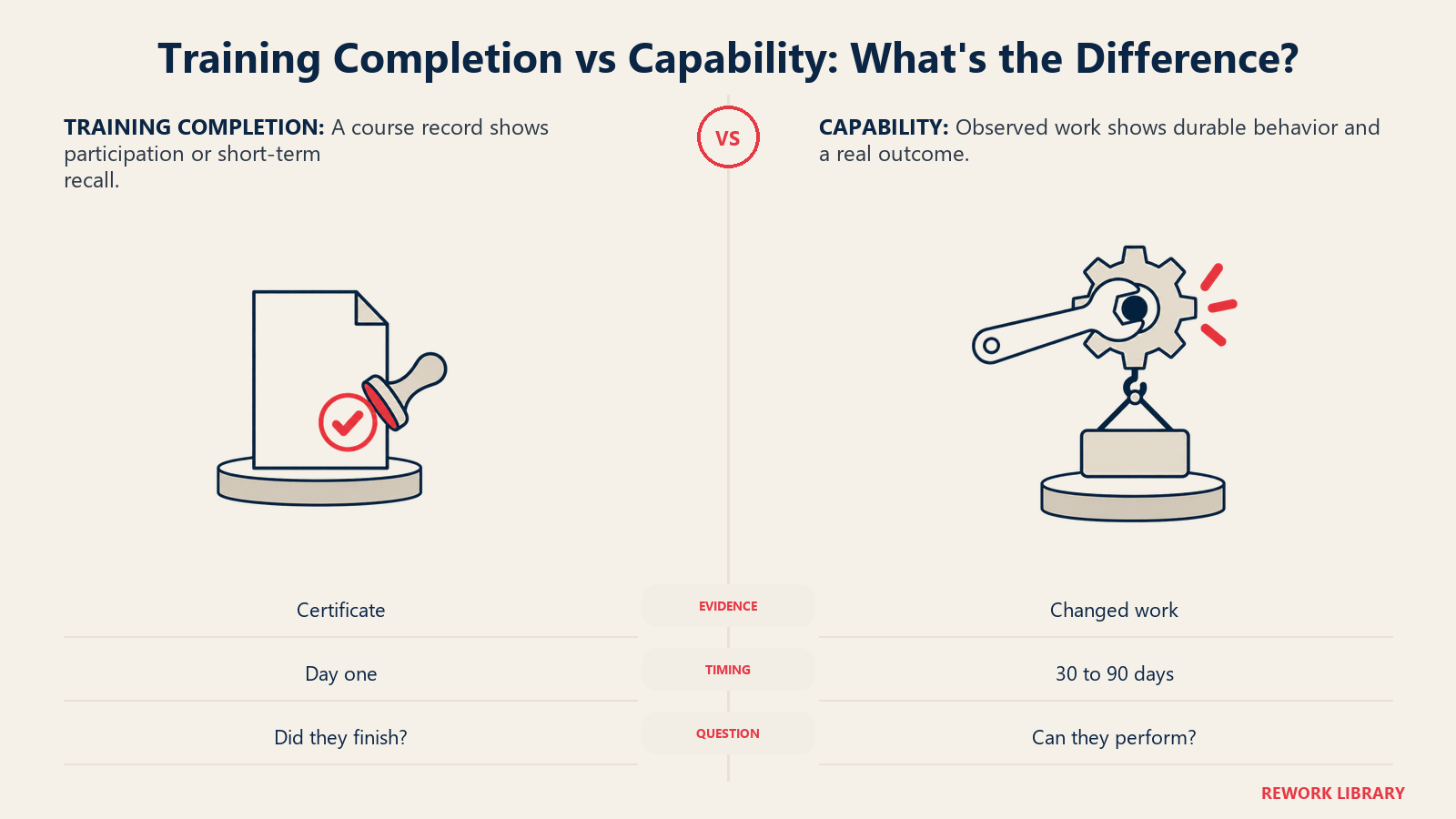
The reason Level 3 gets skipped isn't mystery, it's difficulty. Measuring behavior change means observing the actual work: manager sign-off on a new skill applied to a real task, before-and-after output on a defined metric, or a documented move into the destination role. None of that comes free from an LMS dashboard, which is exactly why it's the number that separates a program that changed something from a stack of unwatched modules and a completion report that looked fine in a board deck.
The historical debate over how much training transfers to the job is a useful caution here, in the same spirit as the "skills half-life" folklore in the companion article. A widely repeated claim puts transfer at roughly 10%, but a 2011 peer-reviewed examination of that exact number in Performance Improvement Quarterly found no rigorous measurement behind it, only informal estimation. That doesn't mean transfer is fine; decades of research since Baldwin and Ford's 1988 foundational review confirm it's a real problem. It means a memorable number with no method is a sign to measure your own program's behavior change, rather than borrow someone else's statistic.
What the Two Most-Cited Programs Actually Show
AT&T's Future Ready and Amazon's Upskilling 2025 are the two case studies nearly every reskilling deck references. Both are real, well-funded, and large in scale. Both are also less conclusively successful than the summary slide suggests, and the honest version of each case is more useful than the polished one.
AT&T's Future Ready: Real Scale, an Honest Gap in the Evidence
AT&T's program, launched as Workforce 2020 and later rebranded Future Ready, is the most heavily documented corporate reskilling effort in existence, the subject of a Harvard Business School case study and years of trade coverage. The scale isn't in dispute: over $1 billion committed, a company-run career center, partnerships with Coursera and Udacity, and, per Fortune's reporting, 140,000 employees engaged in development against a target of retraining 100,000 of roughly 270,000 workers whose roles were built around technology the company expected to phase out. AT&T reports just over 40% of roughly 40,000 open positions filled internally in a given year.
What the coverage doesn't resolve, worth saying plainly, is whether people who completed training ended up better off, or whether the program prevented the layoffs it was framed as an alternative to. Fortune's own reporting describes it as "impressive in a not altogether happy way," notes employees were largely expected to retrain on their own time, and points out that workers whose skills didn't keep pace still faced elimination regardless of the content available. AT&T's then-CEO Randall Stephenson put the stakes bluntly: without successful retraining, the company risked long-term decline, a real acknowledgment the outcome was never guaranteed, not confirmation it fully worked. The activity numbers are AT&T's own reported figures, not independent verification the underlying skills gap closed.
Amazon's Upskilling 2025: A Real Commitment, and a Timing Problem
Amazon's Upskilling 2025 commitment, over $1.2 billion aimed at 300,000 employees from 2019 through 2025, is the other program every reskilling deck cites. Its most credible component, Career Choice tuition assistance, predates the pledge and has run since 2012; Amazon reports over 113,000 employees pursued certifications through it, and more than 175,000 used its tuition, coaching, or certification benefits worldwide. Amazon's own content pairs those numbers with individual success stories but stops short of publishing aggregate data on what share of participants actually landed a better role, a claim worth taking seriously as evidence of activity and worth labeling for what it is: unverified at the population level, built from named examples rather than a completion-to-outcome rate.
The more recent chapter adds a complication, not a resolution. In October 2025, Amazon announced a follow-on $2.5 billion "Future Ready 2030" pledge, expanding Career Choice to salaried employees company-wide. Within about a week, it announced roughly 14,000 corporate job cuts, a sequence trade press flagged directly. Neither event disproves the other; a large employer can invest in reskilling and restructure around AI-driven productivity in the same news cycle. But it's a clean illustration of why a dollar figure and a headline employee count, alone, say almost nothing about whether training changes anyone's actual trajectory. The number worth tracking is what happens to the people in the program, not the size of the check.
A Design Checklist for a Reskilling Program Built to Work
Everything above points at the same design decisions, made before a course gets built:
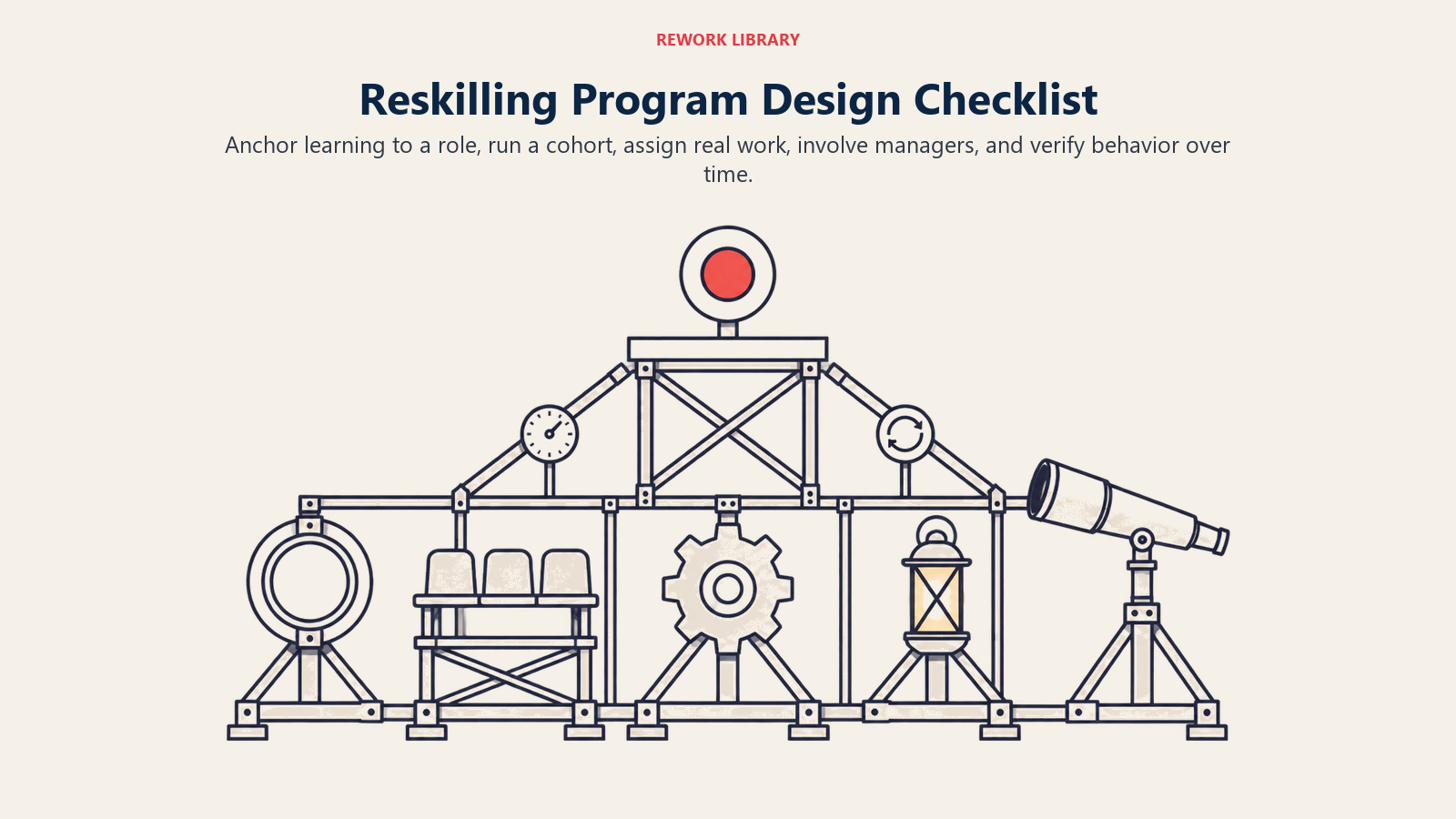
- Name the destination role first. Map every cohort to a specific open role, a redesigned job, or a project, tied to the complementary skills the business actually needs next, decided before enrollment opens.
- Run capability-building content as a cohort, not a catalog entry. A fixed start date, a facilitator, and peers create the accountability a self-serve library structurally lacks.
- Assign the real task before the course ends. Practice should begin within days of finishing, tied to the destination role, not scheduled for "whenever it comes up."
- Build the manager into the program, not around it. Protected time for check-ins and a way to flag whether the new skill actually shows up in the work.
- Measure behavior at 30, 60, and 90 days, not completion at day one. A manager sign-off, a before-and-after metric, or a confirmed move into the destination role is the only real evidence.
- Report your own numbers, not a borrowed statistic. Track your cohort's actual completion, application, and placement rates, and use those to decide what to fund next.
- Treat a stalled cohort as a signal, not a footnote. A vanished destination role or a manager who checks out mid-program calls for a growth mindset response, adjust and keep going, not a wait for the year-end report to notice.
None of this requires the platform vendors pitch as the differentiator. It requires deciding, on purpose, what a person will do differently and where, before spending a dollar on content meant to get them there. Skip that step and a program produces a completion report and little else. Get it right and it produces people doing a different, better job, which was the point.
A reskilling program is, underneath the platform and the press release, a bet that a specific group of people can do a specific different job by a specific date. Every design choice above exists to make that bet honest: a real destination, a manager in the loop, practice that starts before the memory fades, a measurement that checks behavior instead of a completion badge. Skip any one and the program still produces a tidy slide for the board. It just won't produce the thing the slide claims.

Co-Founder, Rework.com
On this page
- Key Facts
- Why Reskilling Budgets Disappear Without Changing Anything
- The Completion-Rate Problem with Self-Serve Course Libraries
- Learning That Never Touches Real Work
- The Missing Manager
- No Destination Role at the End
- The Failure Pattern, at a Glance
- Measuring the Wrong Thing: Completions Are Not Capability
- What the Two Most-Cited Programs Actually Show
- AT&T's Future Ready: Real Scale, an Honest Gap in the Evidence
- Amazon's Upskilling 2025: A Real Commitment, and a Timing Problem
- A Design Checklist for a Reskilling Program Built to Work