What Is the Future of Work? A Definition Grounded in Evidence, Not Prophecy
Turn this article into takeaways for your work.


Each assistant summarizes the article only for you and suggests best practices for your work.
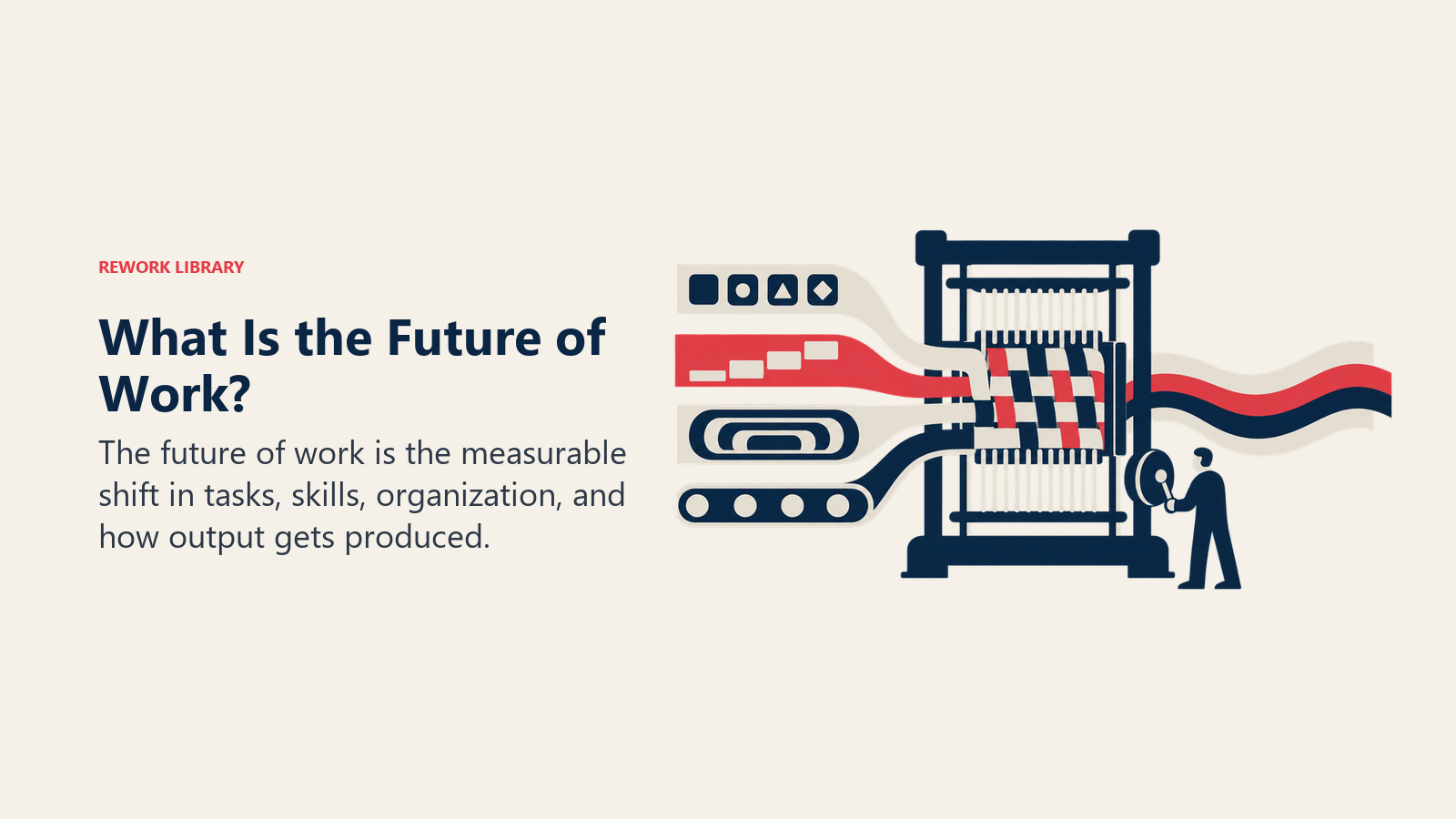
The future of work is the ongoing, measurable shift in which tasks people do, which skills those tasks require, how organizations are structured, and how output gets produced, driven right now mainly by AI. It is not a single event, a fixed date, or a settled verdict on which jobs disappear. It is a set of trends already visible in labor data, adoption surveys, and org charts, most of them partial and some of them contradictory.
That definition is narrower than what gets sold at conferences. Ask ten consultants what "the future of work" means and you get ten forecasts, most extrapolated from a single vendor's roadmap. This collection treats the phrase differently: as a claim that needs a source, a method, and a date, not a slogan that needs a slide.
What "The Future of Work" Actually Means
Strip away the marketing and four things are actually in motion, each with its own evidence base and its own timeline.
Task composition. Within existing jobs, which specific tasks a person spends time on is changing. A recruiter still recruits, but drafting the first-pass outreach message, screening a resume, or summarizing a call increasingly happens through an AI tool first. The job title is stable. The task list underneath it is not.
Skill requirements. What counts as valuable expertise inside a role shifts when a machine can do the routine parts of it. Judging AI output, catching a wrong answer, and knowing when not to trust the tool become skills in their own right, on top of whatever the job already demanded.
Organizational structure. Who supervises whom, how many people a manager oversees, and how many layers sit between a front-line worker and an executive are all under quiet pressure, though far more slowly and unevenly than most org charts drawn on a whiteboard would suggest.
How work gets produced. The mix of human effort, software, and now AI agents that combines to produce a piece of output, a closed support ticket, a shipped feature, a signed contract, is changing inside individual workflows before it changes anything visible at the level of headcount.
None of these four things requires "AI replaces jobs" to be true. All four are already measurable without that claim, which is exactly why they are more useful to a leader making real decisions than a headline number about mass unemployment that has not happened. For the full walkthrough of the measured studies behind these four shifts, including exactly which claims hold up and which ones don't yet, see how AI is changing work and what the evidence shows.
The Adoption-Versus-Impact Gap
The single most important fact for any executive reading future-of-work content in 2026 is this: AI adoption and AI business impact are not the same curve, and the gap between them is currently enormous.
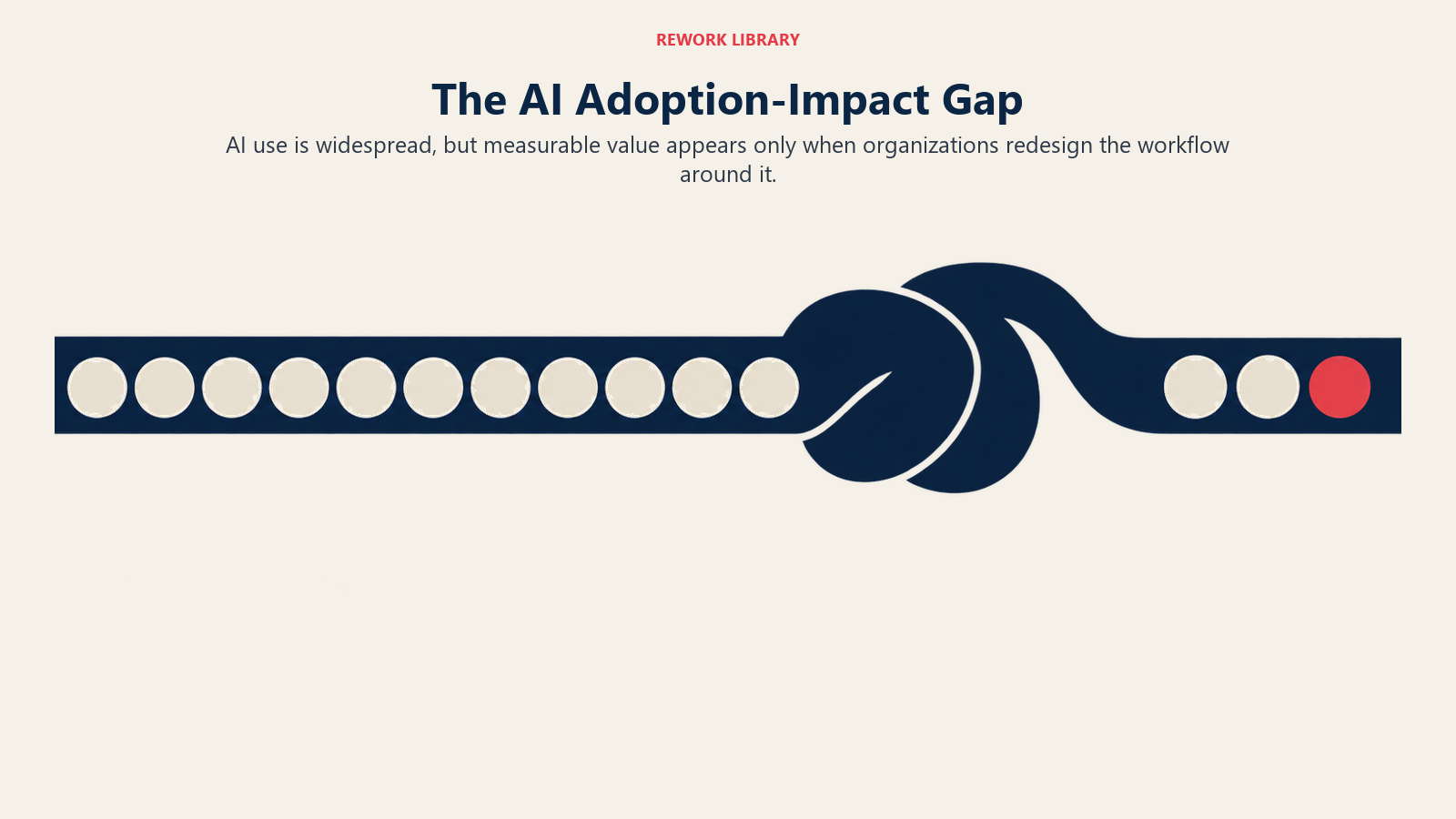
McKinsey's 2025 State of AI survey of nearly 2,000 organizations found that 88% now use AI in at least one business function. That is close to universal adoption. But only 39% of those organizations attribute any measurable EBIT impact to that AI use, and most of that group say the impact is under 5% of earnings. Just 6% qualify as what McKinsey calls "AI high performers," reporting both significant value and meaningful EBIT contribution. The distinguishing factor for that top group was not which model they used. It was that they had actually redesigned the underlying workflow rather than bolting a chatbot onto an unchanged process.
MIT's Project NANDA studied this same gap from a different angle in its 2025 "State of AI in Business" research, built from over 300 initiatives, dozens of executive interviews, and a survey of business leaders. Its finding was blunter: roughly 95% of generative AI pilots showed no measurable effect on profit and loss. The pilots that did work shared a pattern, they were narrow, back-office processes with a clear owner and a tight feedback loop, not broad, ambitious rollouts announced in a press release.
Gartner has forecast where a chunk of the current wave of ambition ends up: it expects more than 40% of agentic AI projects to be canceled before the end of 2027, citing a mix of rising costs, unclear business value, and risk controls that were never built in the first place.
Why the Gap Exists
None of this means AI does not work. It means most organizations are stuck at the pilot stage, running AI alongside an unchanged process instead of redesigning the process around it. A workflow built for a human doing every step in sequence does not get faster just because one step is faster, the bottleneck moves to the next unredesigned handoff. That is a workflow-design failure, not proof the technology is overhyped, and it is the single most common reason a promising pilot never reaches the P&L. The same unevenness shows up inside a single company too, not just across companies: see the AI adoption divide for what actually separates the employees who have rebuilt their workflow around AI from the ones who haven't touched it.
Task-Level Change, Not Wholesale Job Replacement
The most durable finding in this whole field, and the one most often skipped in headline coverage, is that change is happening at the level of the task, not the job.
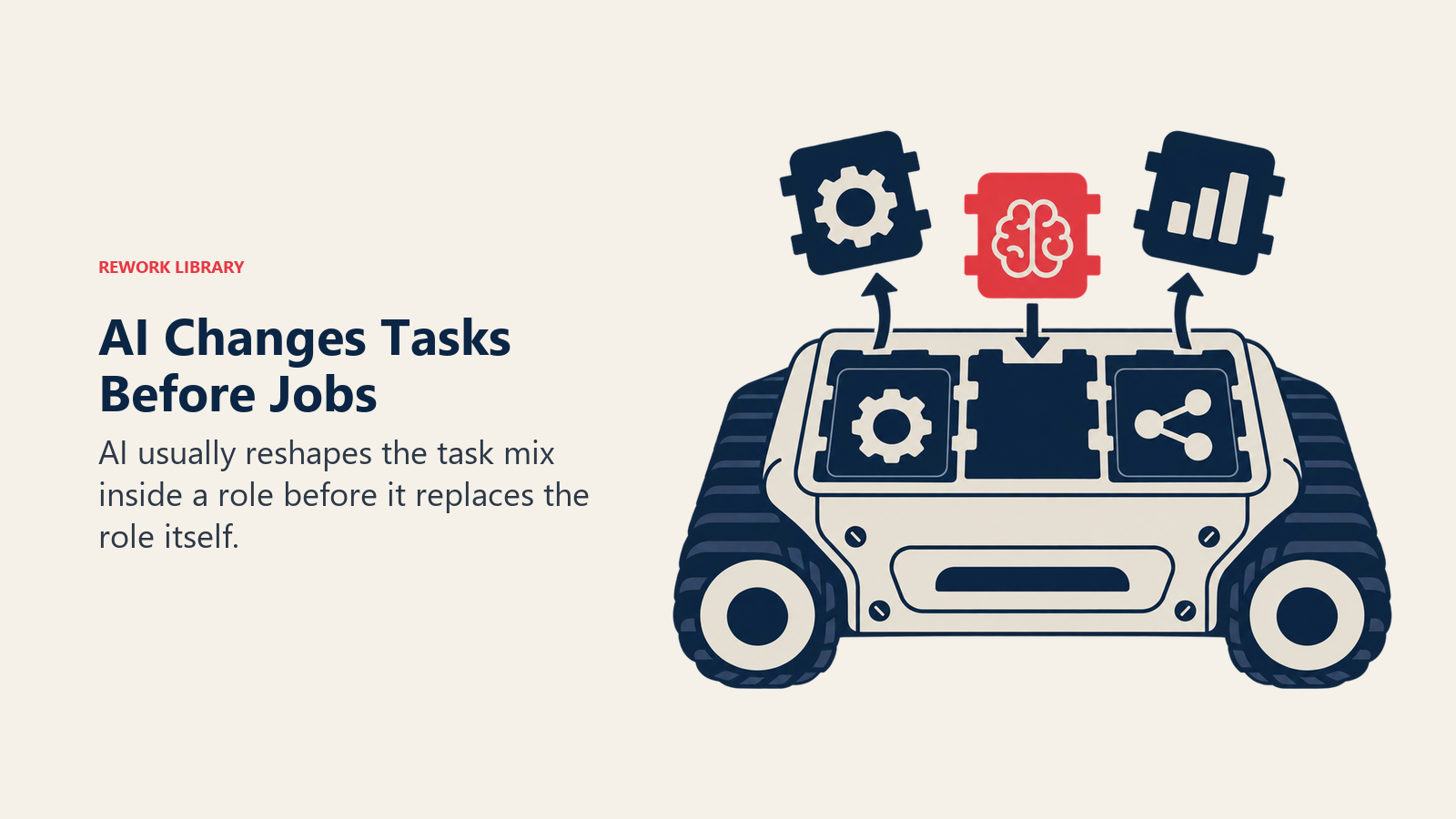
MIT economist David Autor and MIT computer scientist Neil Thompson made this case directly in their research on expertise and automation. Their argument: when a task gets automated, whether that helps or hurts the workers left doing the job depends on whether the automated task was relatively expert or inexpert within that specific occupation. The same task, drafting a routine email versus drafting a legal filing, can be low-skill in one job and high-skill in another, so automating "the same" activity can raise wages and shrink the qualified labor pool in one occupation while lowering wages and widening it in another. Task-level detail, not a blanket "AI replaces X% of jobs" number, is what actually predicts the outcome.
The World Economic Forum's Future of Jobs Report 2025 quantifies the scale of this churn without predicting net collapse. Surveying employers representing more than a billion jobs worldwide, it projects 92 million existing jobs will be displaced by 2030 while 170 million new ones are created, a net gain of 78 million jobs, but a structural churn equal to roughly 22% of today's total formal employment. Read the two numbers together and the honest takeaway is not "AI is safe" or "AI is a jobs apocalypse." It is that a fifth of the labor market's task mix is being rearranged at once, which is disruptive at the level of any single worker or team even when the aggregate math nets out positive.
What the Evidence Does Not Show
Because so much of this space runs on inference rather than measurement, it matters to be explicit about the limits of what is actually known.
The evidence does not show large-scale, economy-wide job destruction that has already happened. It does not show that firm-level AI adoption reliably produces firm-level profit, McKinsey's own data argues the opposite for the vast majority of adopters. It does not show that any single forecast of "X% of tasks automatable by year Y" has a track record of accuracy; those numbers are model outputs from named researchers using specific assumptions, not measured outcomes, and should always be read with the method attached. And it does not show that org-chart flattening, four-day weeks, or mass redeployment programs are currently the norm rather than the exception, even though each gets discussed as though it already were.
Key Facts
- WEF Future of Jobs Report 2025: employers project 92 million jobs displaced and 170 million created by 2030, a net gain of 78 million, equal to a structural churn of about 22% of the roughly 1.2 billion formal jobs surveyed. Source: World Economic Forum
- McKinsey State of AI, 2025: 88% of organizations use AI in at least one business function, but only 39% attribute any EBIT impact to it, and just 6% qualify as "AI high performers" with 5%+ EBIT impact. Source: McKinsey
- MIT Project NANDA, "State of AI in Business 2025": about 5% of generative AI pilots achieve measurable revenue impact, the rest show no measurable effect on profit and loss. Source: Fortune
- Gartner forecast, 2025: more than 40% of agentic AI projects are expected to be canceled by the end of 2027 over cost, unclear value, and weak risk controls. Source: Gartner forecast, reported by RCR Wireless
- Stanford Digital Economy Lab, "Canaries in the Coal Mine?" (2026): employment among 22 to 25 year olds in the most AI-exposed occupations is running about 19% below where it would sit had it tracked less-exposed peers, though the researchers find no widespread, economy-wide displacement. Source: Stanford Digital Economy Lab
- Microsoft Work Trend Index 2025: 82% of leaders say this is a pivotal year to rethink strategy and operations; workers at self-described "Frontier Firms" report their company is thriving at roughly double the global rate. Source: Microsoft WorkLab
- Autor and Thompson (MIT), "Expertise": automating a task raises wages and shrinks the qualified worker pool when the task was expert-level, and does the opposite when it was not, the same activity can be either depending on the occupation. Source: MIT FutureTech
Skills Churn Nobody Gets to Skip
The task-level shift above has a direct skills consequence, and it is arguably the most disruptive part of this whole picture for an individual career, even when the aggregate jobs math looks fine.
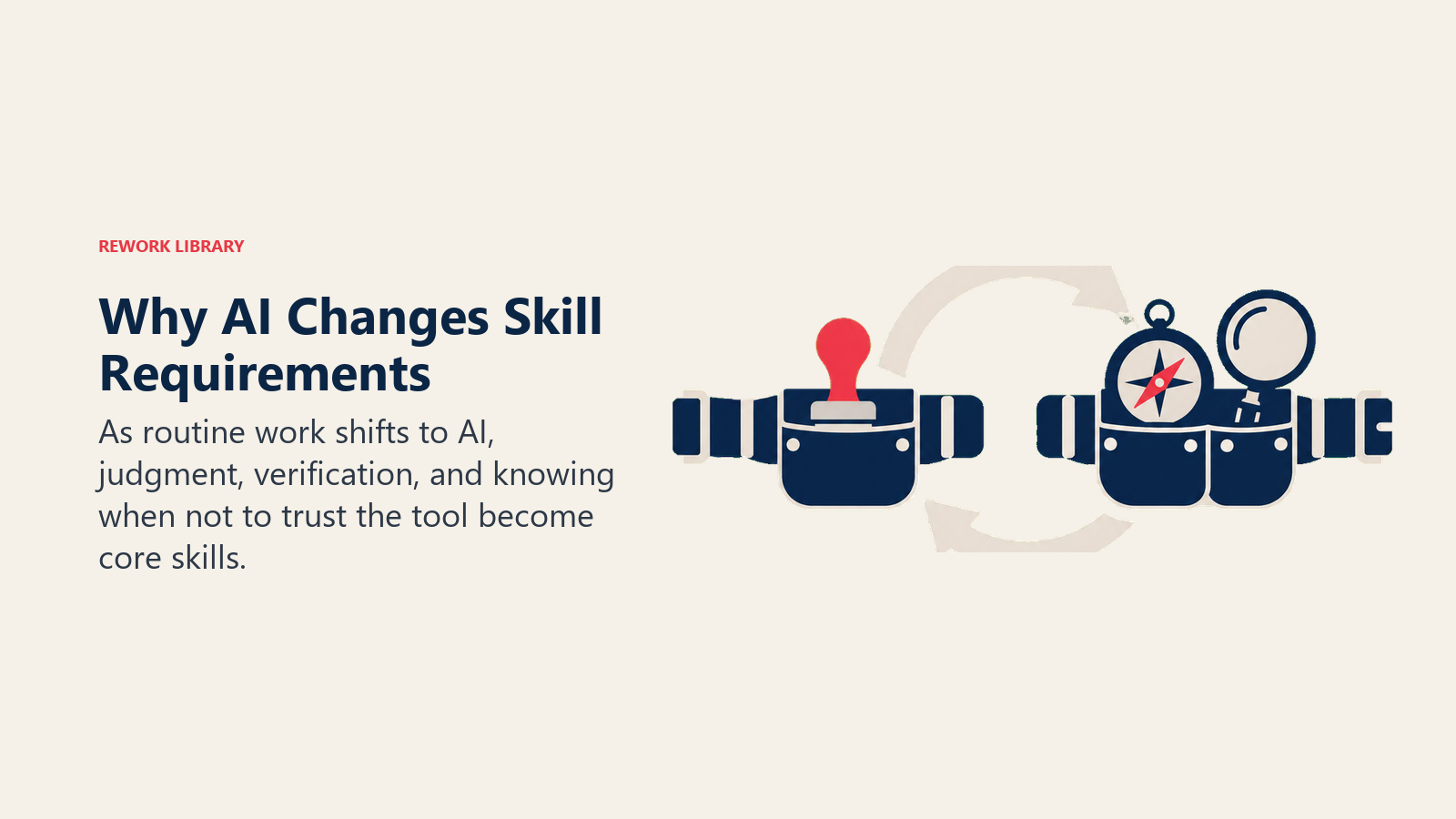
The World Economic Forum's same 2025 survey found employers expect nearly 40% of core job skills to change by 2030, and cited the resulting skills gap as their single biggest barrier to executing any AI-related transformation. That is not a distant forecast. It describes the skill set a person needs for the job they already hold, not just the job they might move into.
The clearest early casualty shows up at the entry level. Stanford's Digital Economy Lab, tracking payroll data through 2026, found employment among 22 to 25 year olds in the most AI-exposed occupations running meaningfully below where it would be if it had kept pace with less-exposed peers the same age, even as overall employment for experienced workers in those same occupations held flat or grew. The mechanism matters more than the headline: the decline concentrates specifically in roles where AI substitutes for the kind of routine, apprenticeship-building work junior employees used to be assigned first. That is a pipeline problem before it is a headcount problem, and it will not show up in an aggregate unemployment rate for years.
Org Structure Is Shifting, More Slowly Than the Narrative
Microsoft's language for this moment, the "Frontier Firm" built around a human workforce paired with AI agents, has become shorthand across the industry for a genuinely real trend: more workers are being asked to direct, review, and correct AI output as part of their core job, a role Microsoft's own research calls the "agent boss." Our sibling collection covers that identity and the norms it creates in more depth in the Frontier Firm and the agent boss and in human-agent teams and culture.
What the data does not yet support is the more dramatic version, where management layers disappear wholesale and org charts flatten across the board. Some functions with high task automation are flattening, most are not, not yet at the scale the trend pieces imply. Org design is one of the slower-moving levers here, held back by legal structures, reporting lines, and plain organizational inertia in ways task-level AI adoption is not.
| Type of change | What actually shifts | Typical example |
|---|---|---|
| Augmentation | The task stays with the person; AI speeds up or improves one step | A support agent uses AI to draft a reply, then edits and sends it |
| Automation | The task moves fully to AI; a person still owns the outcome and exceptions | An AI agent triages and closes routine tickets; a human handles escalations |
| Elimination | The task disappears entirely because the underlying need changes | A manual data-entry step disappears once systems integrate directly |
Most of what gets called "AI taking jobs" in casual conversation is actually the first row, augmentation, misread as the third. Confusing the two causes a lot of avoidable panic, and a lot of avoidable complacency. The middle row, automation with a person still holding the exceptions, is worth watching closest, it is where a human in the loop either stays meaningful or quietly becomes a rubber stamp.
Where Humans Stay Central
Every credible study cited above, even the skeptical ones, agrees on one thing: none of this evidence points to a near-term future without human workers at the center of it. What it points to instead is a redistribution of what humans are for.
Judgment calls under ambiguity, the parts of a decision that do not reduce to a pattern in past data, stay human because AI systems are built to extend existing patterns, not to originate genuinely new ones. Accountability stays human because someone has to own an outcome in a way a system cannot, a fact regulators, courts, and boards all currently agree on regardless of how capable the underlying model gets. And trust, the kind a client or a direct report extends to a specific person over time, is not something an agent can accumulate on a human's behalf, only alongside them.
Building that kind of AI-ready human core is its own discipline, and this collection defers to our business-culture library for the norms and behavior side of it: see what AI-native culture actually looks like, building an AI-ready culture, leading culture in the age of AI, and psychological safety in AI teams. If the debt of skipped norms and undefined behavior piles up, it shows up later as what that library calls AI cultural debt, a cost this collection treats as the structural mirror image of the skills and role questions covered here.
Reading Any Future-of-Work Claim You Encounter
Given how much of this space runs on forecasts dressed as findings, it helps to have a short checklist before repeating a statistic in a board deck or a strategy memo.
| Question to ask | Why it matters |
|---|---|
| Who produced this number, and what did they measure? | A survey of intentions is not the same as a measurement of outcomes |
| Is this a task-level or job-level claim? | Job-level automation percentages usually overstate the practical effect |
| What time horizon is attached? | "By 2030" forecasts and "already happened" data get conflated constantly |
| Does the source name its own limitations? | Rigorous research says what it does not show; marketing rarely does |
| Would this claim survive being wrong by half? | Directionally useful claims should still hold if the number is off |
What This Means for Leaders Right Now
None of the research above argues for standing still. It argues for spending effort where the evidence pays off: redesigning the workflow rather than layering AI on top of an unchanged one, rebuilding the entry-level pipeline junior roles used to provide, and being explicit with your workforce about which of the four shifts, tasks, skills, structure, or output, you are actually planning around.
Some of that work is a data problem before it is a strategy problem: knowing which roles, skills, and workflows exist in your organization today is the baseline every one of these decisions gets built on, the kind of workforce-data foundation a People platform is meant to provide. Standardizing the handoff between a person and an AI agent inside a workflow is a Work Ops problem, once the process has been redesigned rather than just automated in place.
The rest of this collection picks up each thread individually, from the productivity paradox behind the adoption-impact gap and who actually captures the time it frees up, to entry-level careers, to how middle management is changing, to what a workforce strategy built around tasks instead of headcount targets looks like for an executive team building one this year.

Co-Founder, Rework.com
On this page
- What "The Future of Work" Actually Means
- The Adoption-Versus-Impact Gap
- Why the Gap Exists
- Task-Level Change, Not Wholesale Job Replacement
- What the Evidence Does Not Show
- Key Facts
- Skills Churn Nobody Gets to Skip
- Org Structure Is Shifting, More Slowly Than the Narrative
- Where Humans Stay Central
- Reading Any Future-of-Work Claim You Encounter
- What This Means for Leaders Right Now