The Human Premium: What Companies Deliberately Keep Human, and Why
Turn this article into takeaways for your work.


Each assistant summarizes the article only for you and suggests best practices for your work.
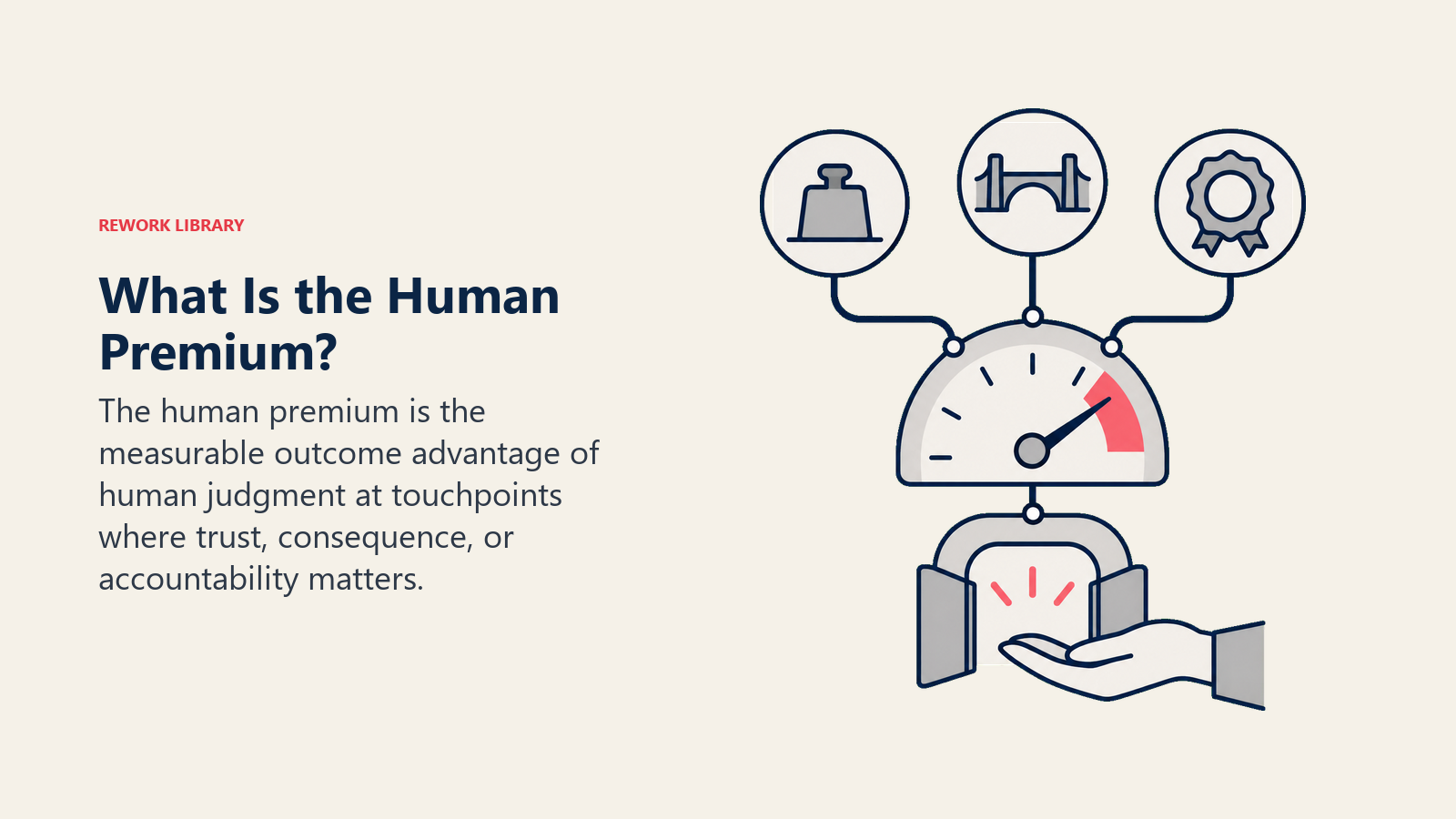
The human premium is a deliberate choice to keep a person, not a model, on a specific task, because a human produces a measurably better outcome there: more trust, higher satisfaction, fewer costly mistakes. It is a resourcing decision made on evidence, not sentiment, and treating it as strategy is what separates companies that get it right from ones that automate everything, or nothing.
Most AI-and-work writing treats "keep it human" as the fallback for anyone uncomfortable with change. This piece treats it as a hypothesis that has to earn its place, and the businesses that read the evidence correctly turn "we keep this human" into a competitive claim instead of a vague comfort.
Key Facts
- Consumers strongly prefer a human agent once an issue gets complicated. A California Management Review synthesis of chatbot-frustration research puts the figure at 70 to 80 percent, and cites a Gartner survey of 5,728 customers in which 53 percent would consider switching providers over AI-only service. California Management Review, "Chatbot Frustration Is Real"
- When a company has to say no, AI does it fine. When it has to say sorry, a human does it better. A 2026 Journal of Business Research study on complaint recovery found human-delivered apologies and AI-delivered denials produced the most favorable outcomes, driven by perceived sincerity. Zhao, Song & Cai, Journal of Business Research (2026)
- People abandon trust in an algorithm faster than in a human after the same mistake. Berkeley Dietvorst's algorithm-aversion research found people lose confidence in an algorithmic forecaster more quickly than a human one after watching it err, even though the algorithms outperformed the humans on average. Chicago Booth Review, "Even When Algorithms Outperform Humans, People Often Reject Them"
- In genuinely high-stakes decisions, people pick the human even when an algorithm performs just as well. A preregistered conjoint experiment with roughly 9,000 US respondents found a 7.6-point preference for human judges over algorithms on pretrial release, and 4.3 points for human loan officers over algorithms on lending. PNAS Nexus, "Public attitudes on performance for algorithmic and human decision-makers"
- Klarna's AI-first customer service bet ran into quality problems automation could not solve. After its AI handled roughly 2.3 million conversations a month and headcount fell 22 percent, CEO Sebastian Siemiatkowski reversed course in 2025, called human support quality "the way of the future," and resumed hiring for the role AI was meant to replace. Entrepreneur, "Klarna Is Hiring Customer Service Agents After AI Couldn't Cut It on Calls"
- Most enterprise generative AI pilots never reach measurable financial impact, per MIT's tracking of enterprise pilots, one reason "keep this human for now" is often the rational default rather than a reluctant fallback. Fortune, "MIT report: 95% of generative AI pilots at companies are failing"
- Microsoft's 2025 Work Trend Index argues some work stays human because someone has to own the consequence. Citing economist Daniel Susskind's framework, it names three reasons: human-AI collaboration is often more efficient, people have a standing preference for human interaction, and moral responsibility needs a person who can bear it. Microsoft WorkLab, "2025: The Year the Frontier Firm Is Born"
What the Human Premium Actually Means
The phrase gets used loosely, so it is worth being precise. The human premium is not "customers like people," a truism that explains nothing about where to spend a scarce headcount budget. It is the measurable gap in outcome (satisfaction, resolution quality, retained revenue, avoided reputational damage) between routing a task to a person versus a model, at touchpoints where that gap matters.
That framing cuts both ways. Where the gap is small, the "premium" is cost with no return, and defending it is expensive habit, not principle. Where the gap is large, treating the human as a line item to trim is the mistake. What the future of work actually looks like is a mix decided touchpoint by touchpoint, and the human premium names the touchpoints where that mix should tilt toward the person.
This differs from which jobs AI changes rather than replaces, which asks how a role's task mix shifts. The human premium asks a narrower, commercial question: does keeping a human as the final voice on this specific moment produce a better business result than removing them, regardless of whether AI is drafting or analyzing underneath?
Where the Evidence Shows People Want a Human
High-Stakes Decisions Nobody Wants a Machine to Own Alone
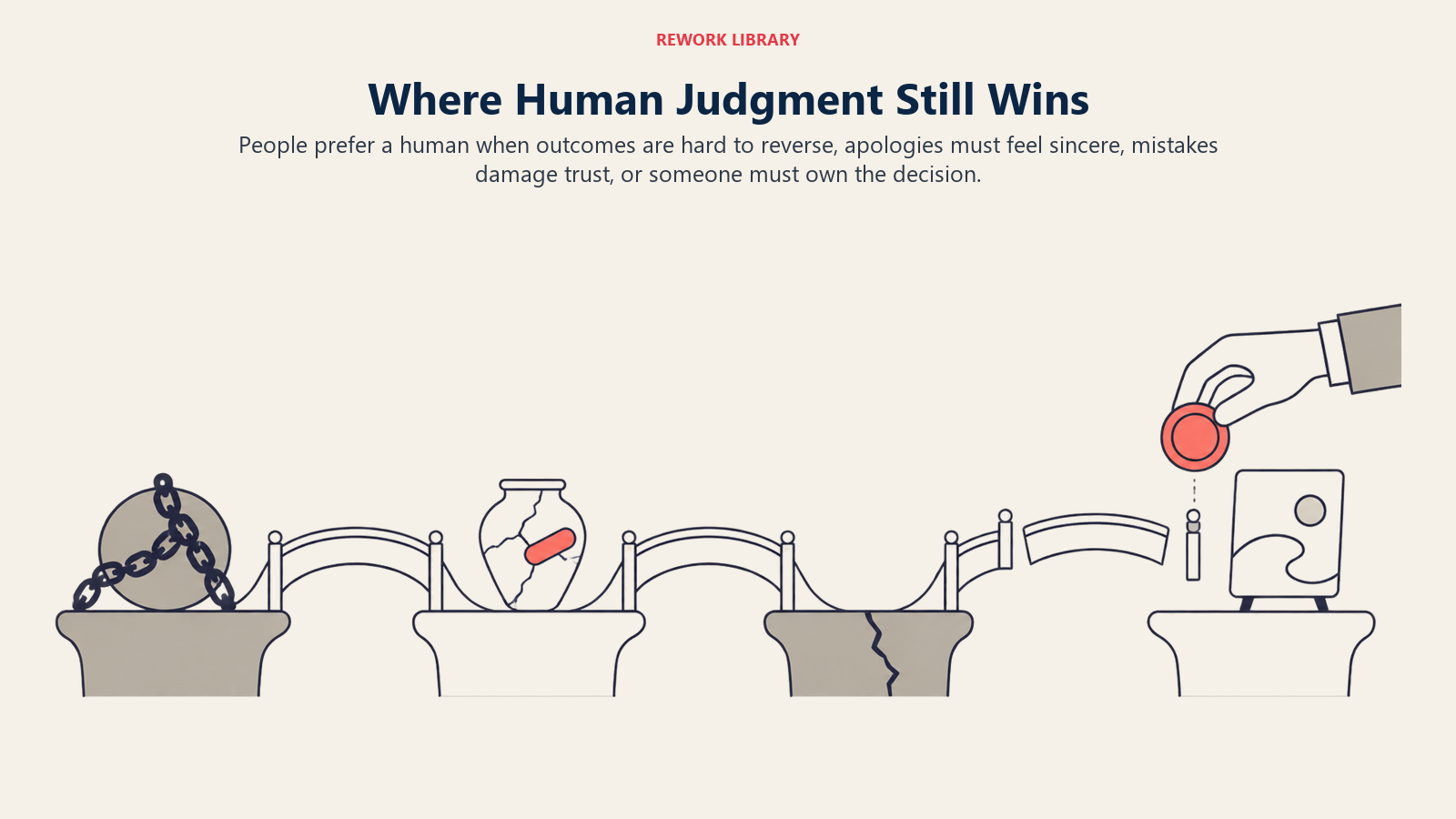
The clearest experimental evidence covers decisions where getting it wrong is expensive and hard to undo. In the PNAS Nexus study cited above, roughly 9,000 respondents favored a human judge over an algorithm on pretrial release, and a human loan officer over an algorithm on lending, even when the algorithm's stated accuracy matched or beat the human's.
The mechanism generalizes past courtrooms and bank branches. Any decision where a real person absorbs a hard-to-reverse consequence triggers the same reaction: people want it made, or at least reviewed, by someone who can be reasoned with and held accountable. That is a different requirement than "get the most accurate answer," which is why a model that out-predicts a loan officer on default risk is still not, alone, a complete substitute for one.
Complex and Emotionally Charged Complaints
Customer service is where this shows up most in practice. The Journal of Business Research finding above is the sharpest data point: when a company has a routine denial to deliver, AI performs fine. When it has to apologize for its own failure, a human apology reads as sincere in a way an AI-delivered one does not, and that perceived sincerity drives satisfaction more than whether the problem got fixed.
This lines up with the broader chatbot-frustration literature (70 to 80 percent preferring a human once things get complicated) and with why culture and customer experience treats a complaint as a relationship moment, not a ticket to close. It also connects to how AI-mediated communication changes what a message signals: a customer who suspects no person engaged with their complaint reads that absence as the company not caring enough to look, and no phrasing fixes it.
Trust-Dependent Moments and the First-Mistake Problem
Algorithm aversion explains a pattern every team running AI in production eventually hits: the first visible AI mistake does disproportionate damage to trust, more than the same mistake by a person would. Dietvorst's work found people lose confidence in an algorithmic forecaster faster than a human one after an identical error, even though the algorithm was demonstrably more accurate overall. People hold algorithms to a near-perfect standard they never apply to humans, and one bad outcome is often enough to sour the relationship for good.
That asymmetry is a real design constraint, not a customer flaw to argue away. On any touchpoint where one visible error would do outsized brand damage, the practical cost of a mistake is higher for AI than for a human doing the same job, purely because of how differently people react to it. It is also why keeping human judgment sharp on these touchpoints matters: a reviewer who stopped practicing the skill of catching a wrong answer is the weak link that lets the first bad mistake through.
Creative Judgment and the Authorship Premium
A smaller but interesting body of research finds people value creative work differently once they know a human made it, even at comparable quality. A recent survey-based study (a preprint, 70 university-student participants, so treat it as suggestive) found 72.9 percent of respondents willing to pay more for work they believed was human-made, tied to perceived effort and authorship rather than polish. Part of the value customers assign to creative and brand-defining output sits in knowing a specific person stood behind it, worth protecting in roles where complementary human skills like taste and judgment are the actual product.
Accountability Someone Can Actually Be Held To
The Microsoft framing above names the piece customer-preference data alone does not capture: some decisions need a person who can be held accountable, not just one customers prefer talking to. An AI system can be retrained or blamed abstractly on "the model," but it cannot be fired, cannot apologize at personal cost, and cannot be the name attached to a decision when someone asks who made this call. Wherever liability for an AI-driven decision would otherwise be unclear, that ambiguity itself signals the touchpoint belongs to a human, and it is why trust in an AI teammate has a ceiling that a trusted person does not.
When AI in Customer Service Backfires: The Klarna Case
Klarna's reversal is the cleanest public case study because the company was transparent about both the bet and the walk-back. In February 2024, CEO Sebastian Siemiatkowski said Klarna's AI assistant did the equivalent work of 700 human agents, handling roughly 2.3 million conversations a month and cutting resolution time from 11 minutes to under two. Headcount fell 22 percent over the period. At the time, it read like the definitive case for full automation of customer support.
By 2025, Siemiatkowski was telling a different story. Service quality had degraded on the complaints and edge cases that make up a small share of volume but a large share of customer sentiment, the exact cases the research above flags as needing a sincere, accountable human. His explanation was direct: the AI-first approach "wasn't the right path," and "investing in the quality of human support is the way of the future." Klarna resumed hiring a largely remote human layer for the interactions that had gone wrong, while keeping AI on the routine volume it continued to handle well.
The lesson is not "AI in customer service fails." Klarna's AI still processes most routine, low-stakes contact, and nobody proposed reversing that. The lesson is that a single blended metric, average resolution time or cost per contact, hid a quality collapse exactly where the evidence above says a human belongs: complex complaints, emotionally charged moments, cases where a customer needed to feel heard. Optimizing only for the average missed the tail, and the tail is where the churn and reputational damage actually lived.
The Human-Washing Risk: Claiming a Premium You Do Not Deliver
Once "we keep it human" becomes a marketing line, it creates a new failure mode: claiming a human premium the company does not deliver. Call it human-washing, the customer-service mirror of AI-washing, where language, names, and interface design imply a person is engaged when the substance is still automated, or where a real person exists but has no authority to change the outcome.
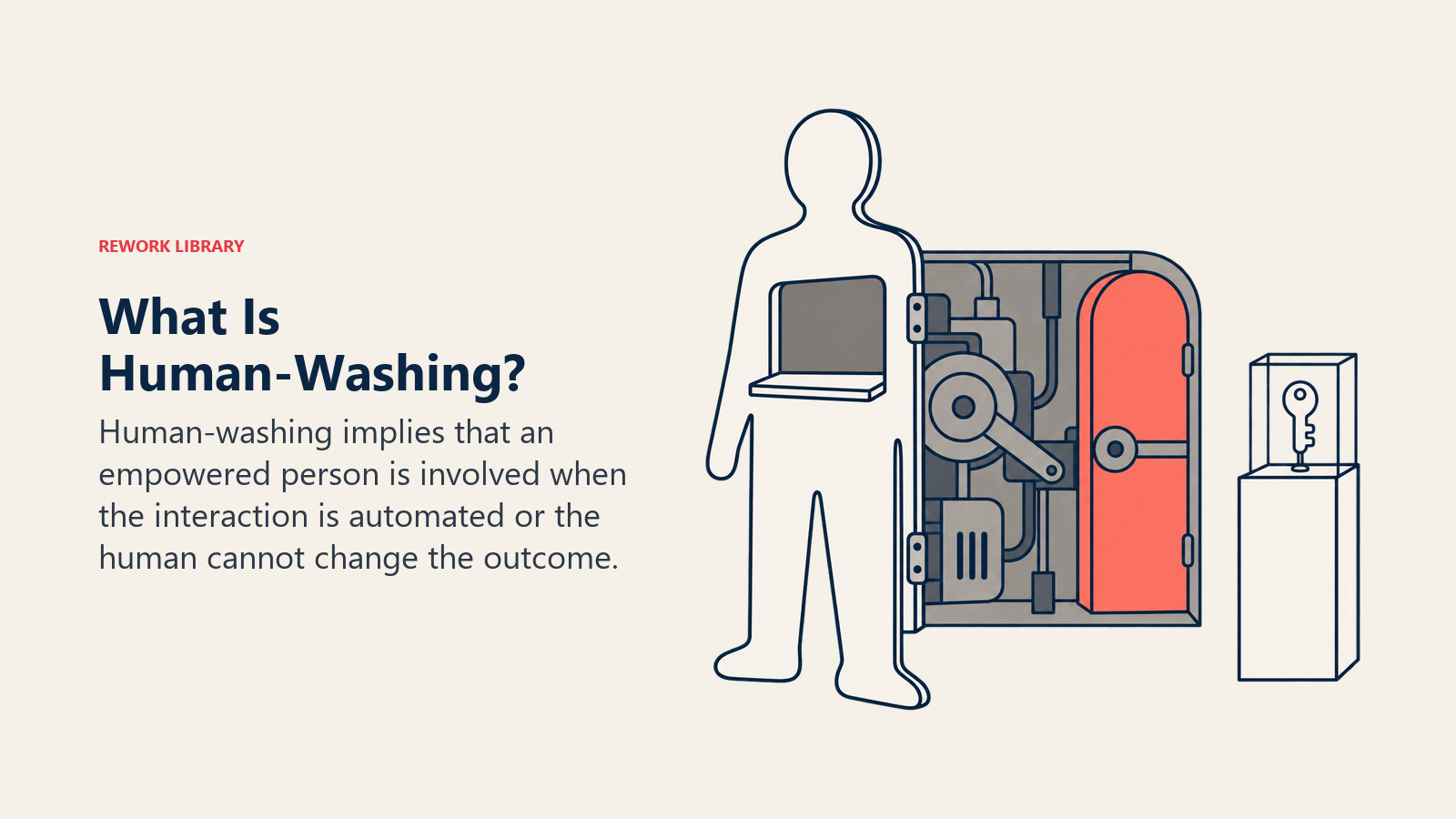
The pattern is recognizable: a chat window with a human-sounding name and headshot that routes to a script the "agent" cannot deviate from; an "escalation to a specialist" that is really a longer queue for the same bot; a promise that "you can always reach a human" where that human cannot override the automated decision that upset the customer in the first place. Each might survive a surface audit while failing what customers actually wanted: a person able to exercise judgment on their situation.
Human-washing is a worse bet than honest automation, not a safer middle ground. Algorithm aversion research shows people punish a disclosed AI mistake harder than an equivalent human one; discovering a promised human was never really empowered adds a second penalty, the sense of having been deliberately misled. Three checks catch most of it before it ships: can this "human" actually change the outcome, not just repeat it more warmly? Is there a real, named, accountable person behind the interaction? And would the company be comfortable if the customer could see exactly how much of it a person actually touched?
How to Decide Which Touchpoints Stay Human: A Clear Test
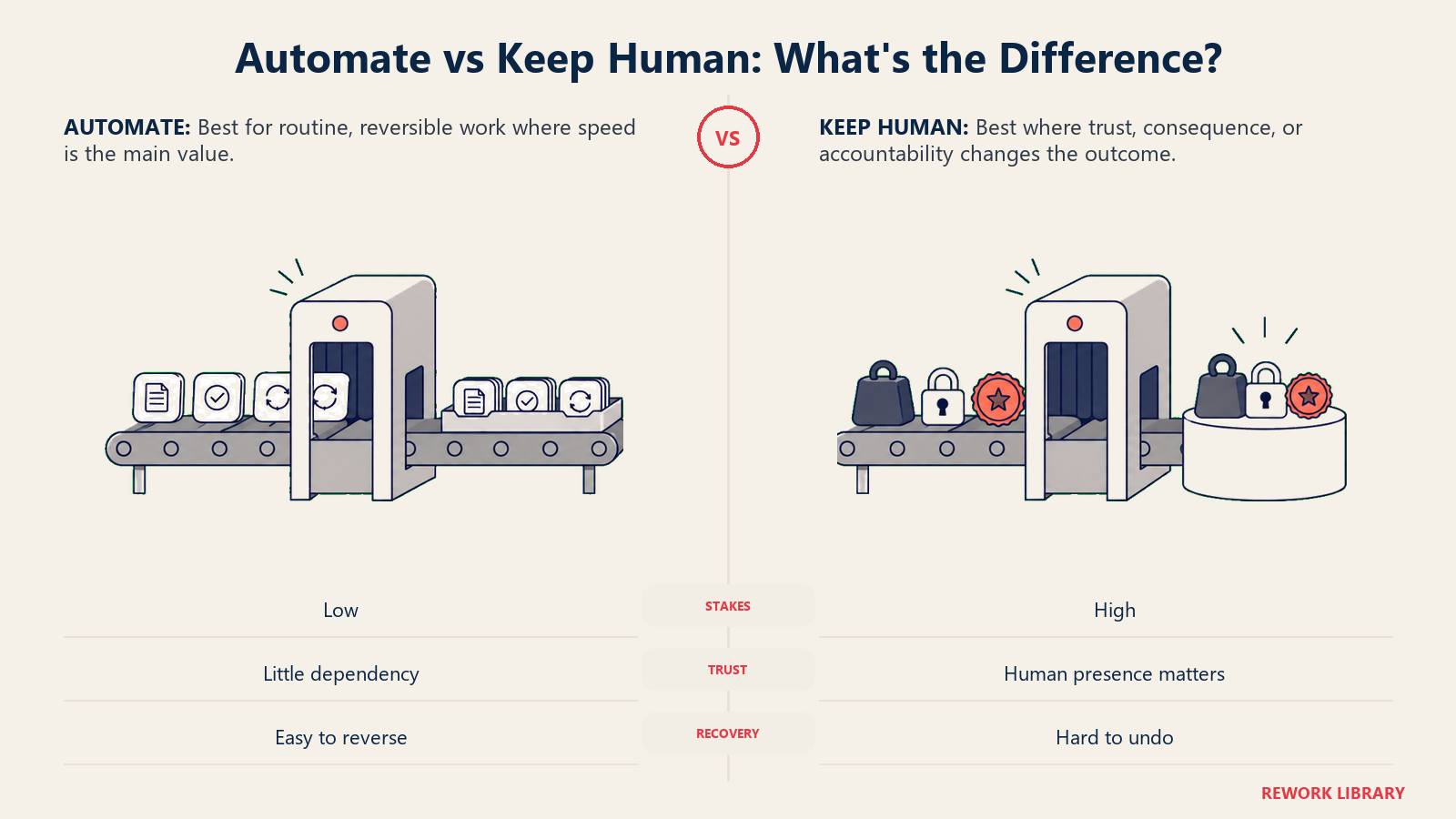
Run every touchpoint through two questions. First, what does a bad outcome actually cost, in money, safety, legal exposure, or a relationship built over years? Second, does trust in the result depend on believing a person engaged with the situation, separate from whether the content itself is correct? A touchpoint scoring high on either question is a human-premium candidate; one scoring low on both is safe, and often better, to automate.
| Touchpoint | Keep human or automate | The test that decides |
|---|---|---|
| FAQ lookup, order status, password reset | Automate | No real stakes and no trust dependency; speed is the whole value |
| Routine billing question under normal terms | Automate, easy opt-out to a person | Low stakes; offer the human premium on request, not by default |
| Complaint involving a genuine company error | Keep human | High trust dependency; apology sincerity drives satisfaction (JBR finding above) |
| Contract cancellation or a retention conversation | Keep human | High financial stakes plus a relationship worth protecting |
| Medical, legal, or financial guidance | Keep human sign-off, AI can draft | High stakes and clear liability exposure if the call is wrong |
| Performance review or compensation decision | Keep human | Accountability nobody can outsource; someone must own the call |
| Termination or disciplinary action | Keep human, no exceptions | Irreversible impact on a livelihood; moral responsibility requires a person |
| Brand voice or creative final approval | Keep human final judgment, AI generates options | Authorship premium; customers value knowing a person stood behind it |
| Internal scheduling, data entry, routine reporting | Automate | No stakes, no trust dependency, pure throughput task |
Run this test honestly and it will recommend automating more than instinct suggests in some rows, and protecting more than the budget wants in others. That tension is the point. A test that only ever recommends automation, or only ever recommends humans, is not actually a test.
The Internal Version: Management Work That Should Never Be Delegated
Everything above applies inside the company too, and the stakes there are usually higher. The middle manager's job is already changing shape under AI, and the temptation to let a model draft, score, or decide parts of people management is real, because AI genuinely helps with the mechanical parts: pulling performance data together, drafting a first version of feedback, flagging patterns across a team.
Where it should stop is the same line the customer-facing test draws. Performance management when AI is doing the underlying work still needs a human to interpret what the numbers mean for this person and deliver the verdict. Promotion, compensation, discipline, and termination are the internal equivalent of pretrial release and loan decisions: high stakes, hard to reverse, and where the person on the receiving end wants a decision-maker who can be questioned and held responsible. Human-in-the-loop done properly does not mean a manager rubber-stamps the dashboard; it means the manager owns the decision and can explain it in their own words, not the model's.
The failure mode inside a company looks like human-washing outside one: a manager who says "the system flagged you for this" while treating the AI's output as the actual decision, rather than one input into a decision they still own. An employee can tell a manager who thought about their situation from one who forwarded a score, and the trust cost of getting caught outsourcing that judgment is often worse than the customer-facing version, because the relationship has nowhere else to go.
Building the Human Premium Into How You Staff
None of this argues against AI doing real work in customer service or management. It argues for spending the human premium where the evidence says it pays off, and reclaiming the hours it frees up elsewhere. Route routine volume to AI without apology. Put the trained, empowered person on the complaint involving your own mistake, the decision that ends someone's contract, and the creative call that carries your name. Measure both sides honestly: the cost saved on what you automated, and the retention and reputational damage avoided on what you protected.
A company that can point to specific touchpoints and say, correctly, "a person handles this, and here is why," has built something a purely automated competitor cannot copy overnight. That is the human premium done right: a short, defensible list of places where keeping a person is the smarter decision, backed by proof the company acts on it.

Co-Founder, Rework.com
On this page
- Key Facts
- What the Human Premium Actually Means
- Where the Evidence Shows People Want a Human
- High-Stakes Decisions Nobody Wants a Machine to Own Alone
- Complex and Emotionally Charged Complaints
- Trust-Dependent Moments and the First-Mistake Problem
- Creative Judgment and the Authorship Premium
- Accountability Someone Can Actually Be Held To
- When AI in Customer Service Backfires: The Klarna Case
- The Human-Washing Risk: Claiming a Premium You Do Not Deliver
- How to Decide Which Touchpoints Stay Human: A Clear Test
- The Internal Version: Management Work That Should Never Be Delegated
- Building the Human Premium Into How You Staff