AI-Mediated Communication: What Happens When AI Writes, Summarizes, and Replies at Work
Turn this article into takeaways for your work.


Each assistant summarizes the article only for you and suggests best practices for your work.
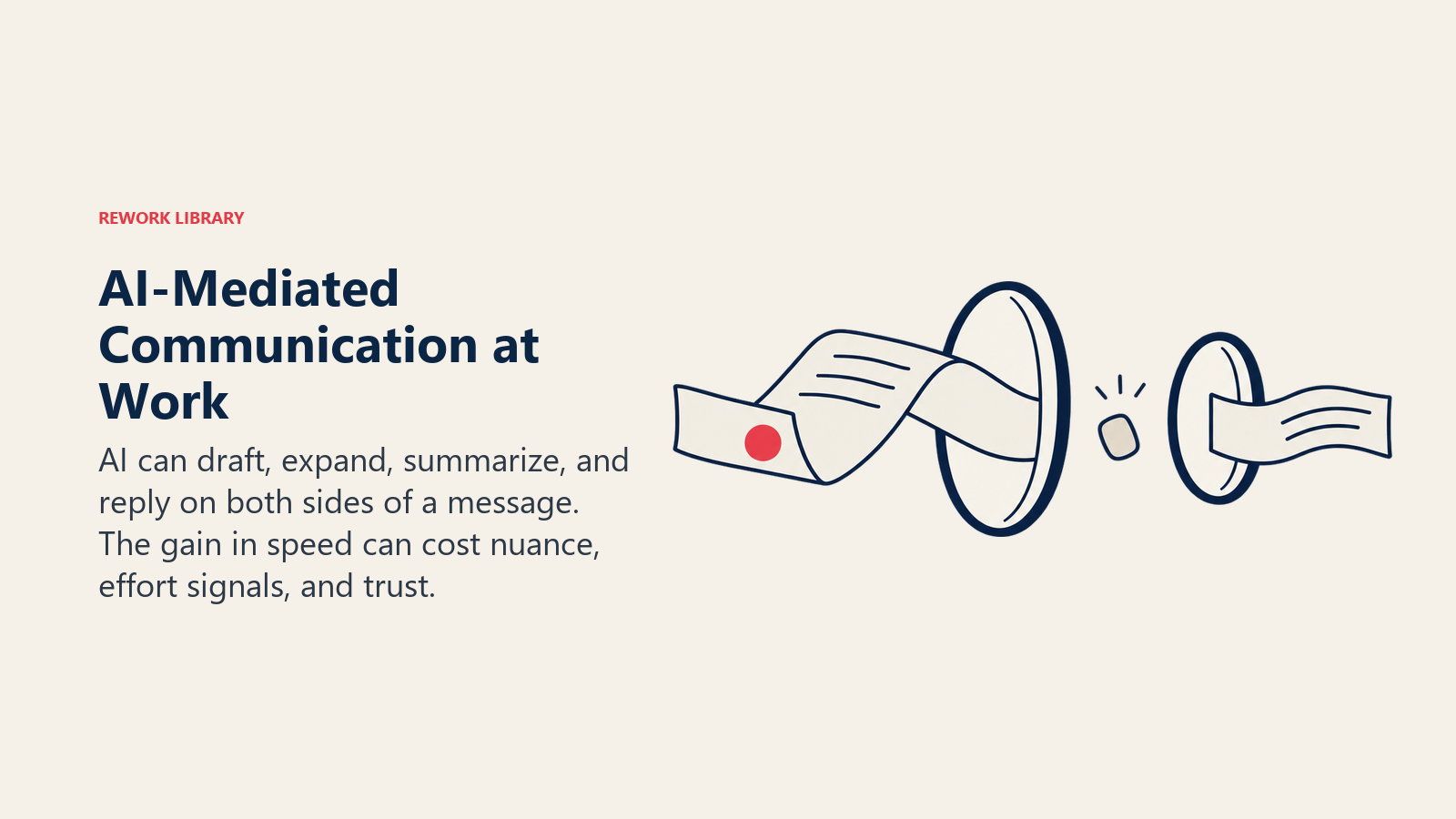
AI-mediated communication (AI-MC) is interpersonal communication in which an intelligent agent drafts, expands, shortens, or replies to a message on someone's behalf. The term comes from Stanford's Jeffrey Hancock and coauthors, who defined it in 2020 as a computational agent operating on behalf of a communicator to accomplish an interpersonal goal. That agent now sits on both ends of nearly every work message.
This is not a piece about whether AI-written text is grammatically fine; it usually is. It is about what happens to a relationship when both the writing and the reading get handed to a machine: the effort that used to signal care disappears, the message balloons and gets compressed back down without anyone reading the middle, and the recipient starts silently discounting anything that sounds a little too polished. None of that shows up in a spell-check pass. All of it shows up in how much people trust each other six months later.
Key Facts
- AI-mediated communication was formally defined in 2020. Hancock, Naaman, and Levy define AI-MC as "mediated communication between people in which a computational agent operates on behalf of a communicator by modifying, augmenting, or generating messages to accomplish communication or interpersonal goals." Hancock, Naaman & Levy, Journal of Computer-Mediated Communication (2020)
- Text perceived as AI-written is rated less trustworthy, even when the words are identical. Stanford's Jakesch, French, Ma, Hancock, and Naaman ran an Airbnb-profile experiment and found a robust drop in trustworthiness ratings for profiles suspected or labeled as AI-generated, the "Replicant Effect." Jakesch et al., Stanford Social Media Lab (2019)
- Over half of employees hide their AI use from their employer. KPMG and the University of Melbourne's global study of more than 48,000 people across 47 countries found 57% of workers admit to concealing how they use AI at work, most commonly passing off AI-generated content as their own. KPMG & University of Melbourne (2025)
- Heavy AI use in a manager's message cuts perceived sincerity roughly in half. USC and University of Florida researchers Cardon and Coman surveyed over 1,100 professionals and found more than 80% rated a low-AI-assistance supervisor message sincere, versus only about 40% for a high-AI-assistance version. Cardon & Coman, University of Florida (2025)
- The average worker receives 117 emails and 153 Teams messages a day, most skimmed in under a minute. Microsoft's Work Trend Index found employees using Microsoft 365 are interrupted roughly every two minutes by a message, a volume that both drives and is driven by AI-assisted drafting and summarizing. Microsoft Work Trend Index (2025)
- High AI adoption has not yet shown up as measured business return. MIT NANDA's survey of 153 leaders and analysis of over 300 enterprise AI deployments found 95% of generative AI pilots produced no measurable P&L impact, a reminder that faster message production isn't the same as better communication. MIT NANDA, "The GenAI Divide: State of AI in Business 2025", via Fortune
What AI-Mediated Communication Actually Covers
AI-mediated communication is a wider category than "using ChatGPT to write an email." Hancock and coauthors break it into dimensions that determine how much trust is at stake: how much the AI changes (a spelling fix versus a fully generated message), how much autonomy it has (a suggestion you approve versus a reply it sends unsupervised), and whose side it works for (sender efficiency versus receiver comprehension). A grammar correction and a fully AI-drafted performance review sit on the same spectrum but are not the same risk, which is why blanket rules and blanket permission both miss the point. The tools involved, from large language models drafting free text to built-in AI copilots suggesting the next sentence, are the same technology whether correcting a typo or writing an entire congratulations note. What changes is the magnitude of the intervention and how much human thinking is still in the message.
Sender-Side and Receiver-Side AI Are Different Problems
Most workplace discussion about AI and communication focuses on the sender: did a person use AI to write this? But Hancock's framework treats the receiver's use of AI as an equally live category, and it is becoming the more common one. A recipient who runs your carefully worded update through a summarizer before reading it is doing AI-mediated communication too, just from the other end. Sender-side AI risks a message that sounds like nobody in particular; receiver-side AI risks discarding exactly the parts you worked hardest to get right. That same handoff problem, deciding what an agent surfaces to a person and in what form, is what managing AI agents as part of the team covers from the operating side, as something to design on purpose rather than leave to default settings.
The Signal-Loss Problem: Why Effort Used to Mean Care
Before generative AI, the time and specificity in a message were a costly, hard-to-fake signal. A three-paragraph personal note took longer to write than a one-line reply, and the length itself communicated how much the sender cared. A manager who remembered a detail from your last conversation and referenced it in feedback was showing, not just telling, that they had been paying attention. Cost was the point: cheap signals are easy to fake, so recipients discount them, and effortful signals were expensive enough that only genuine care would reliably produce them.
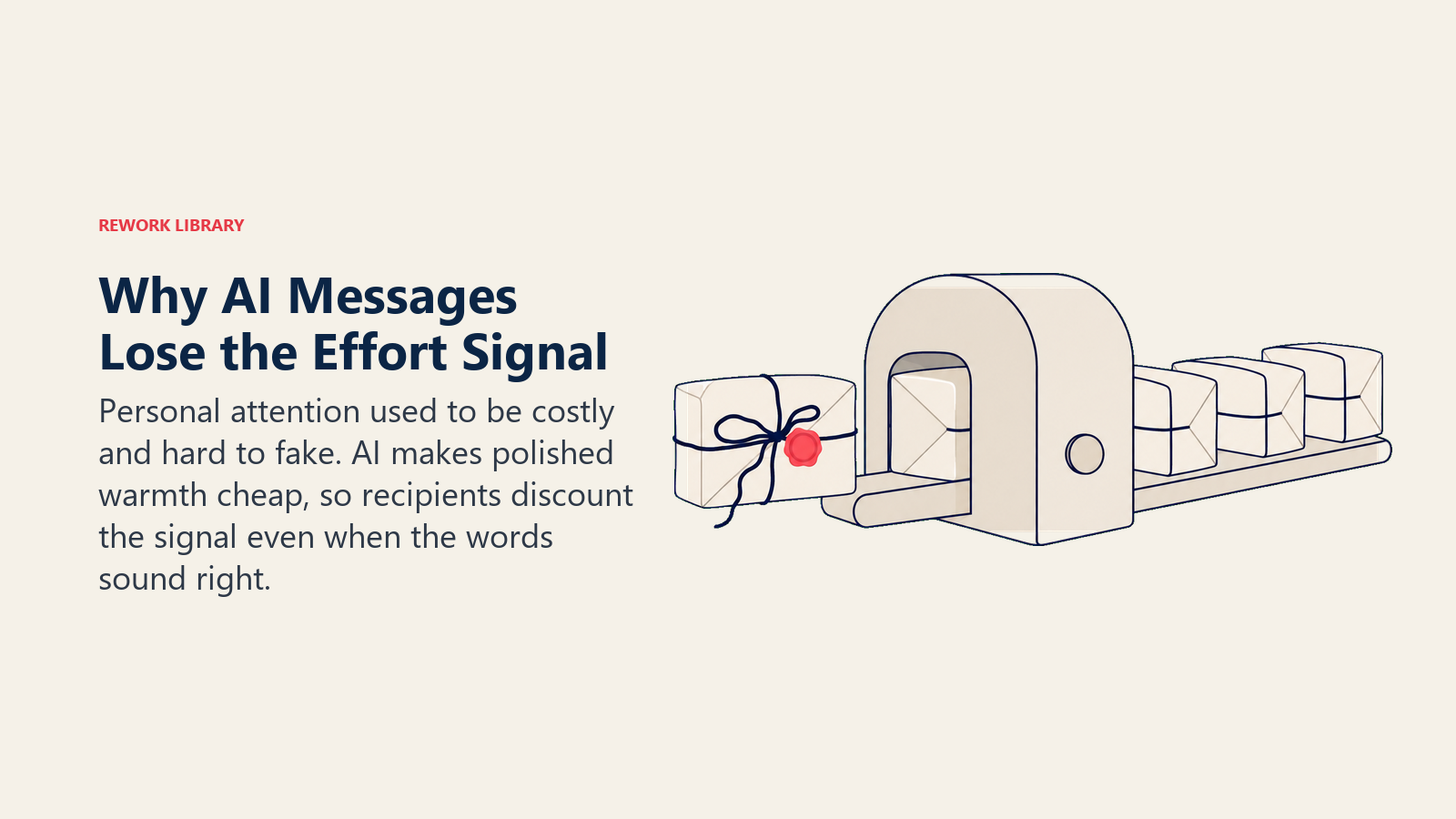
Generative AI breaks that link between effort and cost. A model can produce a personalized-sounding, warmly worded message in ten seconds, with the sender providing almost none of the underlying thought. The Cardon and Coman study above is the clearest workplace evidence of what happens next: employees downgrade their read of the sender's sincerity, caring, and even leadership ability once they suspect heavy AI involvement, and the drop is steepest on exactly the messages where sincerity matters most (congratulations, recognition, personal feedback), not on routine status updates.
The Recipient Doesn't Need Proof, Just Suspicion
Jakesch and colleagues' Airbnb study found something worth sitting with: the trust penalty attached to suspected AI authorship, not confirmed authorship. People do not need to know a message was AI-written to discount it. A message that merely reads as generic or a little too polished for the relationship can trigger the same downgrade a labeled AI message gets. The practical risk is not "will I get caught," it is "will this read as authentically mine," and those are different bars to clear.
| Use case | Helpful or corrosive | The norm to set |
|---|---|---|
| Translating a message for a non-native-English colleague | Helpful | Use it openly; disclosure adds nothing and clarity is the entire goal |
| Fixing grammar, typos, or tone on a message you wrote yourself | Helpful | No disclosure needed; this is closer to spell-check than authorship |
| Making a technical explanation accessible to a non-technical reader | Helpful | Keep your own examples and voice; let AI simplify structure, not substance |
| Drafting a routine status update or meeting logistics note | Mostly helpful | Fine to draft with AI, but skim and edit before sending, don't blind-forward |
| Writing a personal congratulations, thank-you, or recognition note | Corrosive if heavy | Write it yourself, or write the specific detail yourself and let AI only polish phrasing |
| Delivering critical performance feedback | Corrosive | Draft structure with AI if useful, but the substance and delivery must be yours |
| Apologizing for a mistake to a colleague or customer | Corrosive | Never fully AI-generated; sincerity is the entire content of an apology |
| Auto-summarizing every long message before reading it | Corrosive at scale | Reserve full summarization for low-stakes threads; read important ones in full |
The Escalation Problem: A Bullet Becomes an Email Becomes a Bullet
Here is a pattern common enough to have its own shorthand among people who watch workplace AI use closely: someone has a two-line thought, asks AI to expand it into a properly formatted, warmly toned email, and sends it. The recipient, facing 117 emails and 153 chat messages a day per Microsoft's Work Trend Index, runs it through their own AI summarizer, which compresses it back down to roughly the two-line thought it started as. Two AI calls later, the information transferred matches what the two-line message would have carried, except it took longer to produce, longer to process, and carried a false signal of effort in both directions.
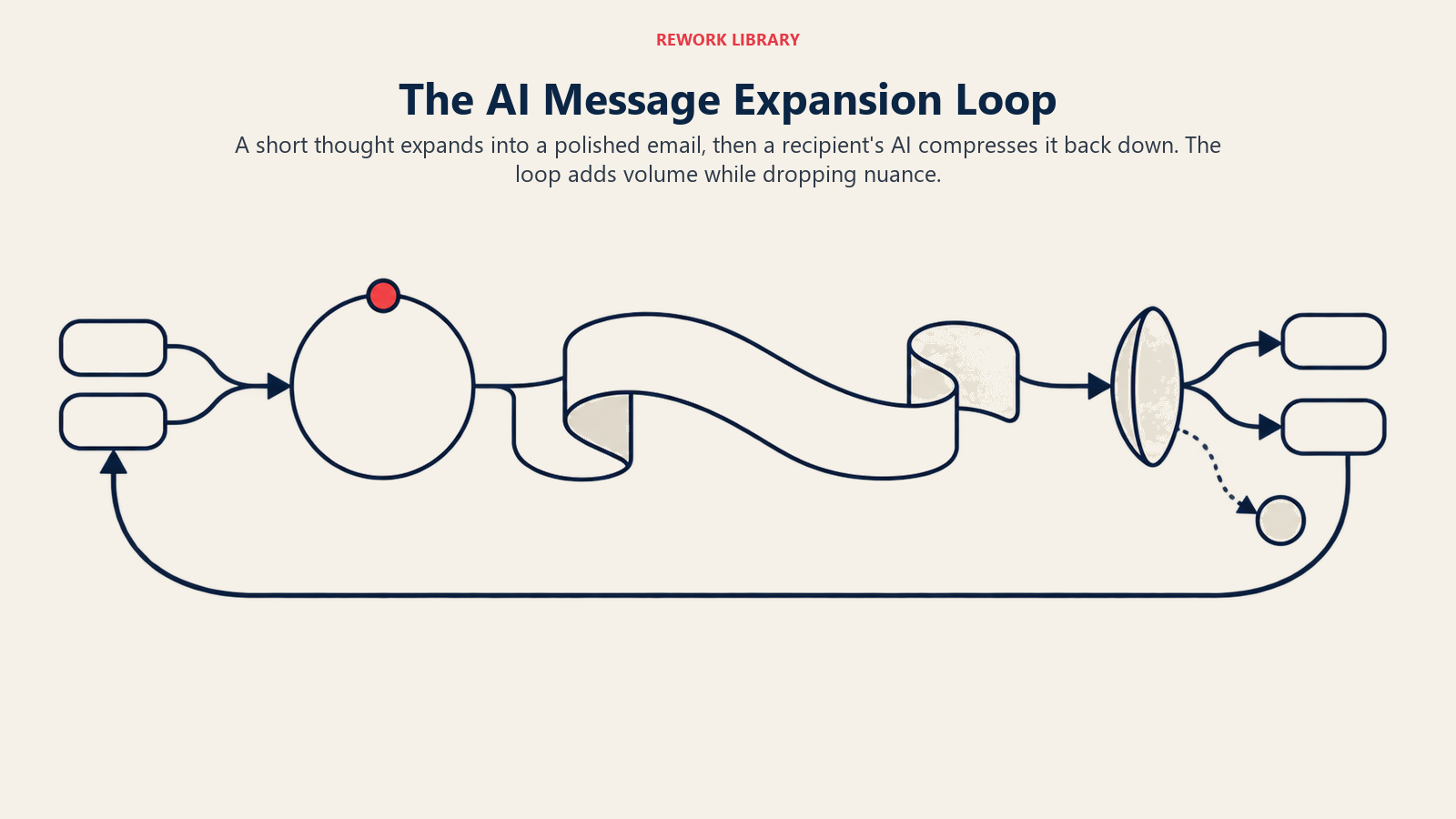
The loop is the natural consequence of two incentives colliding: the sender's tool rewards longer, more polished output because that is what "good writing" looks like to a language model, and the recipient's inbox rewards compression because nobody has time to read 117 fully expanded emails closely. Neither side is doing anything unreasonable alone, but the result is worse communication, because compression on the receiving end is lossy in ways the original short thought was not: a summarizer keeps what looks statistically important and drops caveats, tone, and the specific ask that made the message worth sending.
Why This Costs More Than Time
MIT NANDA's finding that 95% of generative AI pilots show no measured P&L impact is relevant here: individual productivity gains do not reliably add up to organizational gains when the other half of the interaction, someone reading and acting on the message, gets worse at the same rate the first half got faster. Treating email volume as a problem to solve with more AI misses that the volume is often a symptom of cheap drafting meeting no real increase in information content.
What Gets Lost When AI Summarizes the Meeting
Meeting summarization tools solve a genuine problem: nobody retains an hour of discussion accurately, and a written record beats a fuzzy memory. But summarizers are frequency-weighted, not judgment-weighted. They surface what multiple people repeated or what pattern-matches to "action item" phrasing, and are far less reliable at capturing what actually mattered: hesitation in someone's voice, an off-topic aside that was the real concern, or the subtext behind why a decision got tabled. None of that is a formatting problem a better model fixes; it requires a human who was in the room.
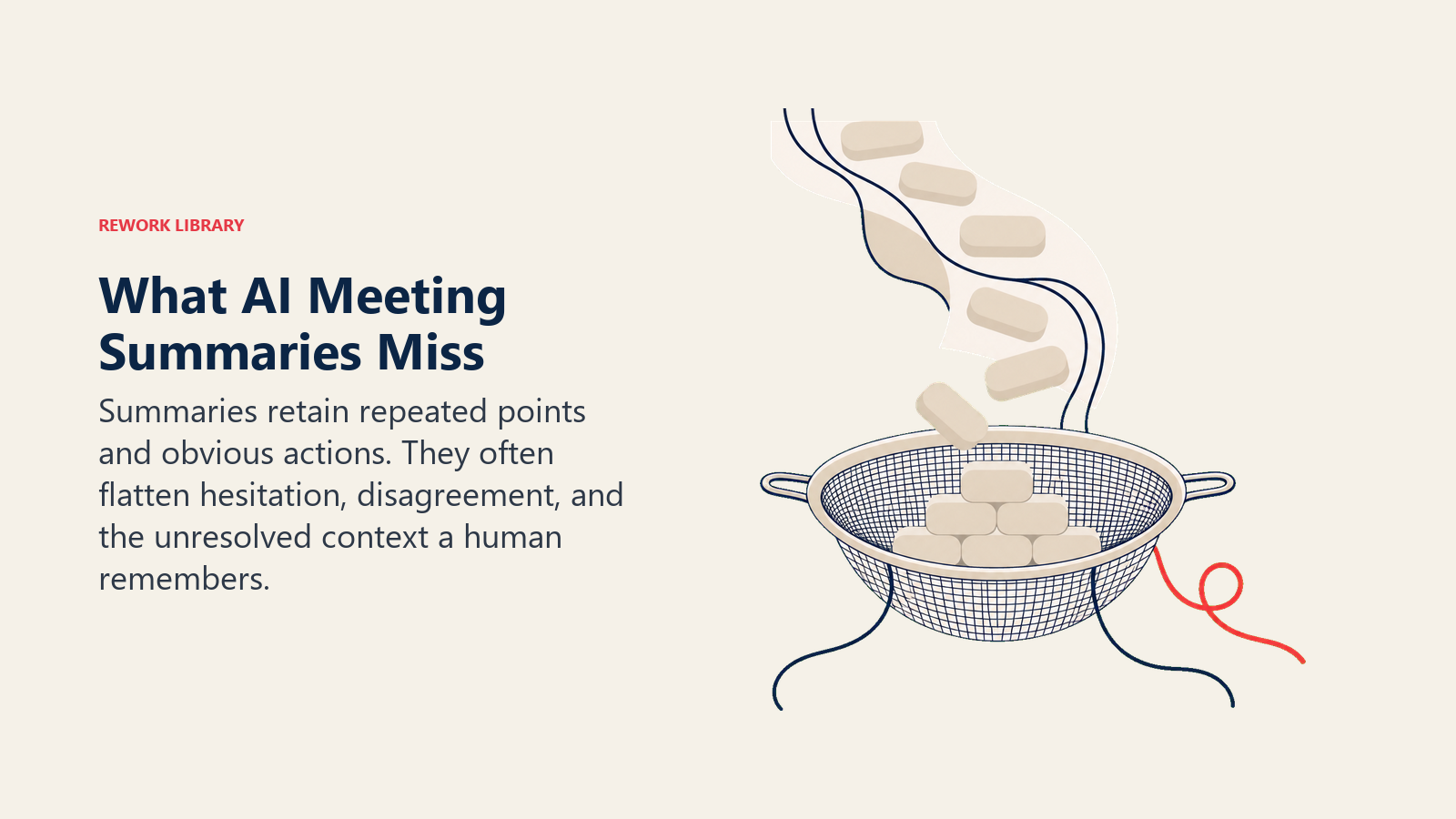
This is distinct from whether people feel safe raising concerns in an AI-observed meeting, which is designing better meeting culture territory. The question here is narrower: once people spoke candidly, does the record that survives still carry the nuance, or does it flatten into a bulleted list that reads as consensus when the room was actually split. Teams that treat the AI summary as the meeting's memory, rather than one input alongside a human's notes, are the ones most likely to rediscover a disagreement weeks later that everyone thought was resolved.
A Cheap Fix That Actually Works
The highest-value habit here is boring: whoever ran the meeting adds two or three lines of their own judgment on top of the AI transcript before it circulates, naming what stayed unresolved and who owns it. That costs two minutes and preserves exactly the signal a frequency-weighted summarizer cannot generate on its own.
The Trust Penalty: When AI Use Is Suspected
The Cardon and Coman research found something sharper than a sincerity dip: when supervisors used high AI assistance without disclosing it, only about a quarter of employees still attributed authorship to the supervisor, down from over 90% at low assistance. That is most of the audience concluding the person supposedly speaking was not really the one talking. This connects to trust when your teammate is AI, except the question runs the other direction here: not trusting an AI teammate, but a human losing colleagues' trust because they suspect a person outsourced the part of the job that was supposed to be personally theirs.
The KPMG finding that 57% of employees hide their AI use adds a second layer: people conceal it because they correctly predict a penalty if it surfaces, meaning the real scale of AI-mediated communication in most organizations runs well above what any usage dashboard shows.
Disclosure Cuts Both Ways
The research does not point to "always disclose" as a clean fix. Explicit disclosure sometimes increases suspicion compared to a message where AI use is merely suspected but unconfirmed: disclosing can read as an admission the message wasn't really yours, while staying quiet risks a larger trust collapse if it surfaces later. Most organizations land on a contextual approach instead: default to human-written for relationship-critical, low-frequency messages (feedback, apologies, recognition), and treat AI assistance on routine, high-frequency messages as unremarkable enough to skip disclosure. This is covered in more depth in AI etiquette and workplace norms; the point here is narrower, that disclosure should track a message's relational stakes, not a blanket policy.
Helpful Uses vs Corrosive Uses
The clearest dividing line in the research is not "AI use" versus "no AI use," it is whether AI closes a real gap between people or substitutes for the human effort that was the actual point of the message. Translation for a colleague who does not share your first language closes a gap: without AI, the alternative was often no communication at all. The same is true for making a dense technical point accessible to someone outside the field, or for an employee with dyslexia using AI to structure a response they fully authored in substance. These uses do not remove a human signal that mattered; they remove a barrier that was never the point of the interaction.
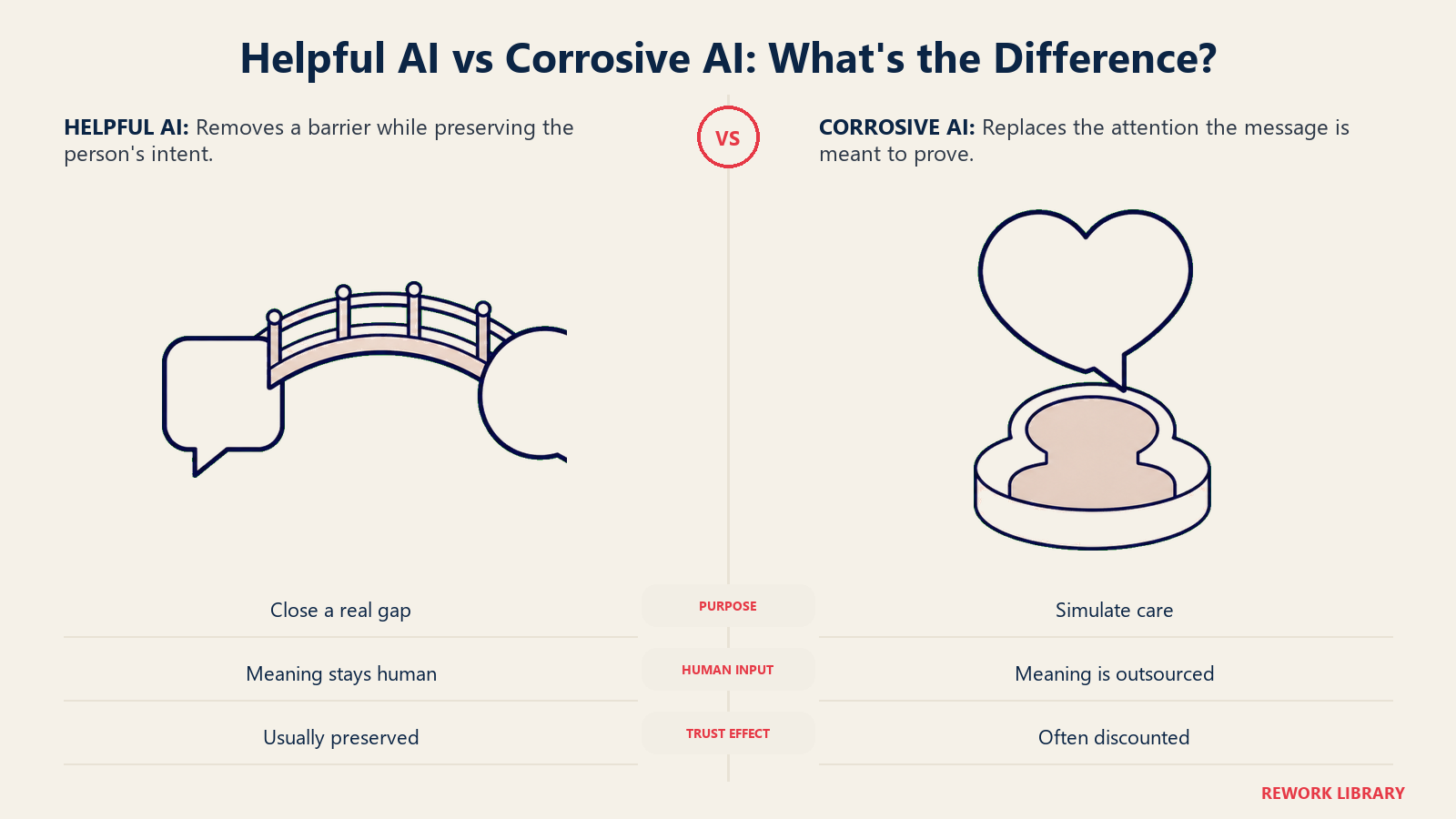
Corrosive uses substitute AI for the exact thing the message was supposed to prove: that a specific person took the time to notice, care, or take responsibility. A congratulations note exists to signal "I noticed and I'm glad," not to transmit information efficiently; if AI generates that signal, it is fake even if the words are warm. An apology exists to signal "I understand what I did and I am accountable," and a fully AI-drafted apology inverts its own purpose. The more a message's job is to prove something about the sender's attention, the more corrosive AI substitution becomes, regardless of how good the output reads.
Practical Norms Worth Setting
Most teams do not need a formal AI communication policy, just a few explicit agreements that remove the guesswork.
First, agree on which message types are relationship-critical enough to write yourself. Recognition, feedback, apologies, and anything referencing a specific personal circumstance belong on this list; status updates and scheduling do not.
Second, if you draft something relationship-critical with AI, add a detail it could not have known: a shared reference or a genuinely personal observation. This counters the generic tone that triggers suspicion.
Third, do not treat an AI meeting summary as a substitute for someone adding two lines of judgment about what stayed unresolved. This one habit prevents most of the "I thought we agreed on that" conflicts AI-summarized meetings produce weeks later.
Fourth, notice which side of the sender-receiver loop you are feeding. If your outgoing messages run consistently longer than the content justifies and colleagues seem to skim rather than read them, sending the two-line version yourself is often the higher-trust move, even though it looks less polished. This relates to, but differs from, workslop, effort, and ownership, which covers AI-generated work dumped on colleagues unreviewed; the communication version is a message dumped on someone without the sender reading it back first. Teams defining an orchestrator role, and what it means to keep judgment sharp while delegating more drafting to AI, will recognize the same tension here.
The oldest test of a workplace message still applies: would you be comfortable if the recipient knew exactly how much of your own thinking went into it. AI hasn't changed that test, only made it much cheaper to fail without anyone noticing right away.

Co-Founder, Rework.com
On this page
- Key Facts
- What AI-Mediated Communication Actually Covers
- Sender-Side and Receiver-Side AI Are Different Problems
- The Signal-Loss Problem: Why Effort Used to Mean Care
- The Recipient Doesn't Need Proof, Just Suspicion
- The Escalation Problem: A Bullet Becomes an Email Becomes a Bullet
- Why This Costs More Than Time
- What Gets Lost When AI Summarizes the Meeting
- A Cheap Fix That Actually Works
- The Trust Penalty: When AI Use Is Suspected
- Disclosure Cuts Both Ways
- Helpful Uses vs Corrosive Uses
- Practical Norms Worth Setting