Meaning, Identity, and Craft in the AI Era: What Happens When AI Takes the Part You Loved
Turn this article into takeaways for your work.


Each assistant summarizes the article only for you and suggests best practices for your work.
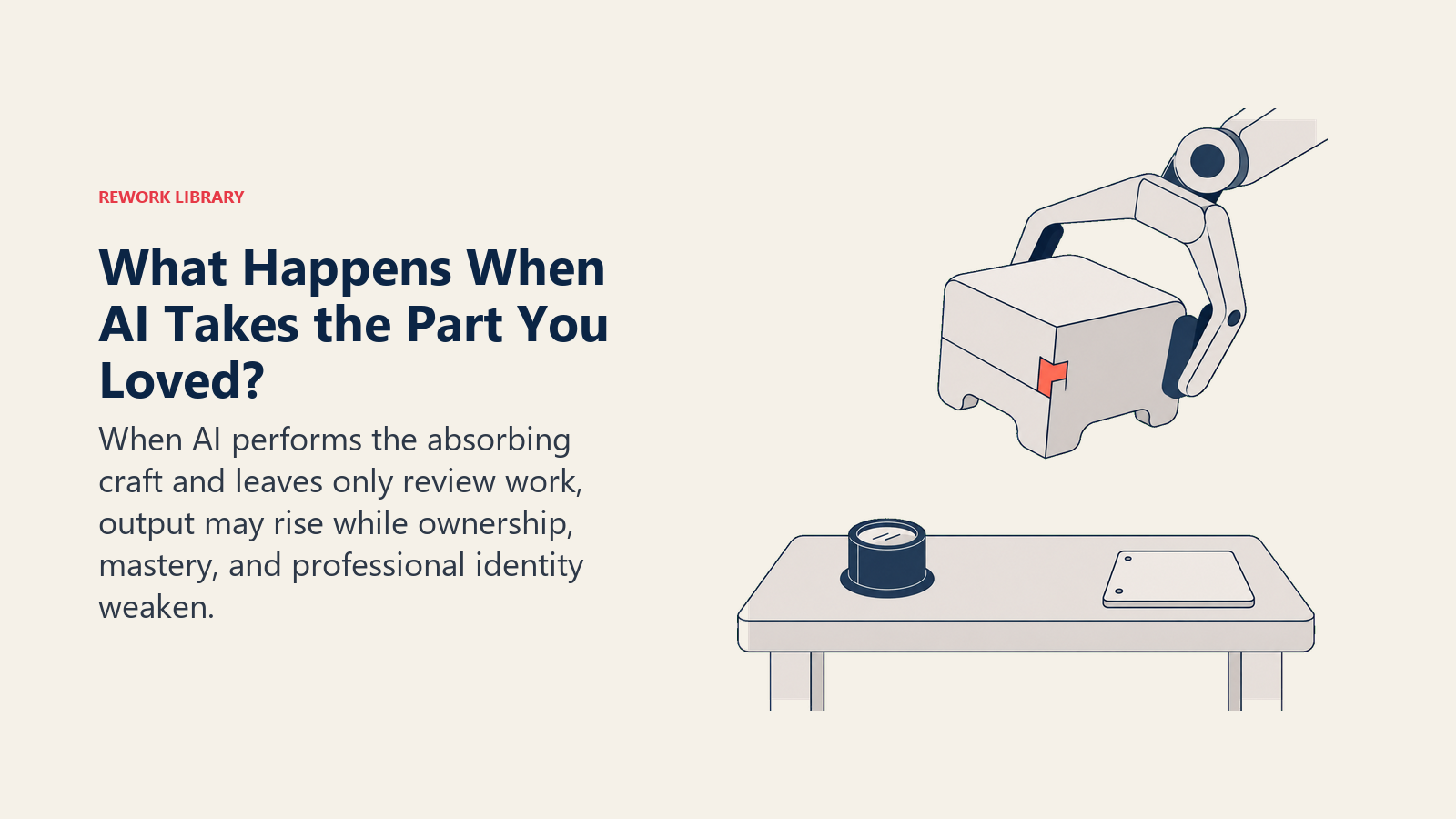
Meaning at work is the sense that your effort matters, that you made the thing rather than merely approved it, and that your skill is visibly your own. AI reshuffles that sense whenever it takes over the demanding, absorbing part of a job (the drafting, the diagnosis, the design) and leaves the person supervising its output instead. The loss is not sentimental. It shows up in engagement scores, in who stays, and in how much discretionary effort people bring to work they no longer feel they authored.
Most conversations about AI and jobs focus on headcount and task counts. Fewer ask what happens to the person who keeps their job but loses the part of it that made them good at what they do, and that made them recognize themselves in the work. That question has decades of motivation research behind it, not because researchers anticipated generative AI, but because the underlying mechanics of mastery, ownership, and identity were already well mapped before AI arrived to test them at scale.
Key Facts
- Only 18% of U.S. employees say their current job has a purpose they personally believe in, and 45% say they work primarily to collect a paycheck. Gallup's August 2025 survey of 4,475 working adults also found the gap runs in the other direction too: 30% say their ideal job would carry personal purpose, well above the 18% who feel it now. Gallup, "Purposeful Work Boosts Engagement, but Few Experience It"
- Self-Determination Theory holds that autonomy, competence, and relatedness are needs, not preferences, and that thwarting any one of them produces measurable costs to motivation and wellbeing. Deci and Ryan's four decades of research found the type of motivation (autonomous versus controlled) predicts performance and persistence better than the sheer amount of it. Self-Determination Theory, official theory page
- People will pay 63% more for furniture they assembled themselves than for an identical pre-built piece, but only if they finished it. Norton, Mochon, and Ariely's "IKEA effect" studies found the valuation boost from labor disappears the moment the task is abandoned or destroyed before completion. Norton, Mochon & Ariely, Journal of Consumer Psychology (2012)
- Of all the events that happen in a person's workday, small, visible progress on meaningful work has the single strongest effect on their mood, motivation, and view of their colleagues. Teresa Amabile and Steven Kramer's diary-based research is the origin of what they called the progress principle. Amabile & Kramer, "The Power of Small Wins," Harvard Business Review (2011)
- 86% of AI users now treat AI output as a starting point rather than a finished answer, and 58% say they're producing work they could not have produced a year ago. Microsoft frames this as human judgment becoming more central to work, not less, as AI absorbs more of the execution layer. Microsoft 2026 Work Trend Index Annual Report
- In a study of 206 medical students and physicians, threats to professional capabilities (autonomy and role as care provider) directly predicted resistance to AI, while threats to professional recognition worked indirectly through a feeling of personal threat. Experienced physicians showed measurably less resistance and less self-threat than students earlier in their careers. Jussupow, Spohrer & Heinzl, JMIR Formative Research (2022)
Why Meaning at Work Is Not a Soft Topic
It is tempting to file "does my job feel meaningful" under employee-satisfaction nice-to-haves, somewhere below throughput and cost per output. The Gallup numbers above argue against that filing. Only 18% of employees currently describe their job as carrying a purpose they personally believe in, yet 30% say that is exactly what their ideal job would offer. That 12-point gap is not a preference gap; it is a retention and effort gap sitting in plain sight, and it predates the current AI rollout by years. AI does not create the meaning problem. It changes which jobs fall on which side of that gap, and it can widen the gap fast if a redesign is handled carelessly.
The mechanism runs through discretionary effort, the portion of a person's capability they choose to bring and that no manager can mandate. A person doing meaningful work volunteers for the hard problem, catches the error nobody assigned them to look for, and stays an extra ten minutes to get something right. A person doing work stripped of meaning does the minimum defined by the job description and looks elsewhere the moment a better offer appears. Nearly half of employees in the Gallup sample, 45%, already describe their relationship to work as transactional: showing up for the paycheck. That is the population most exposed when AI removes the last piece of the job that felt like theirs.
The Specific Loss: When AI Takes the Interesting 20% and Leaves the Oversight
When AI Removes the Routine Overhead, Meaning Can Rise
The clearest version of this problem is structural, not emotional. Most jobs are a mix of tasks: some genuinely demanding and absorbing, some routine, some pure overhead. When AI is deployed well, it removes the routine overhead and leaves the person with more of the demanding, engaging work. Support agents who get AI drafts for routine tickets and keep the complex escalations tend to report higher satisfaction, because AI took the part they did not want.
The Residual Task Problem
The failure mode runs the other direction. When AI takes over drafting, diagnosis, or design work that required judgment and produced a visible, ownable output, it can leave the human with the part nobody wanted in the first place: reviewing, validating, and correcting the model's output line by line. Run this against Hackman and Oldham's job characteristics model, the 1976 framework that still holds up well against new work arrangements. Their model identifies five job dimensions, skill variety, task identity, task significance, autonomy, and feedback, that build toward what they called experienced meaningfulness of work: the sense that the job is meaningful and that the effort in it is valued. Monitoring an AI's output for errors scores poorly against nearly every one of those five dimensions. There is little skill variety in checking the same output over and over. Task identity, the sense of having made a whole thing start to finish, is gone; the AI made it, the human merely inspected it. And the contribution becomes invisible: nobody credits careful verification the way they credit a finished draft or a closed case handled from scratch.
This is also why keeping human judgment sharp is a harder problem than it looks. Verification work is not just less satisfying than the generative work it replaces; it erodes the very judgment a reviewer needs to catch a subtle AI error, since that judgment is built by doing the work manually, not by inspecting someone else's attempt at it. A team that hands the interesting 20% of a job to AI and calls the rest "quality control" has not simplified the job. It has swapped a demanding, motivating task for a demanding, demotivating one, and asked the same person to be equally good at both.
The IKEA Effect: Why Effort and Ownership Are the Same Thing
Norton, Mochon, and Ariely's IKEA effect research offers the cleanest explanation for why this swap costs more than it looks like it should. Their studies found that people who assembled their own furniture, folded their own origami, or built their own Lego sets valued the finished object dramatically more than an identical object someone else made, by as much as 63% in one study. Participants' own imperfectly-assembled creations were rated close to expert-made equivalents by their own standard, an inflation the researchers attribute to the labor itself, not the outcome.
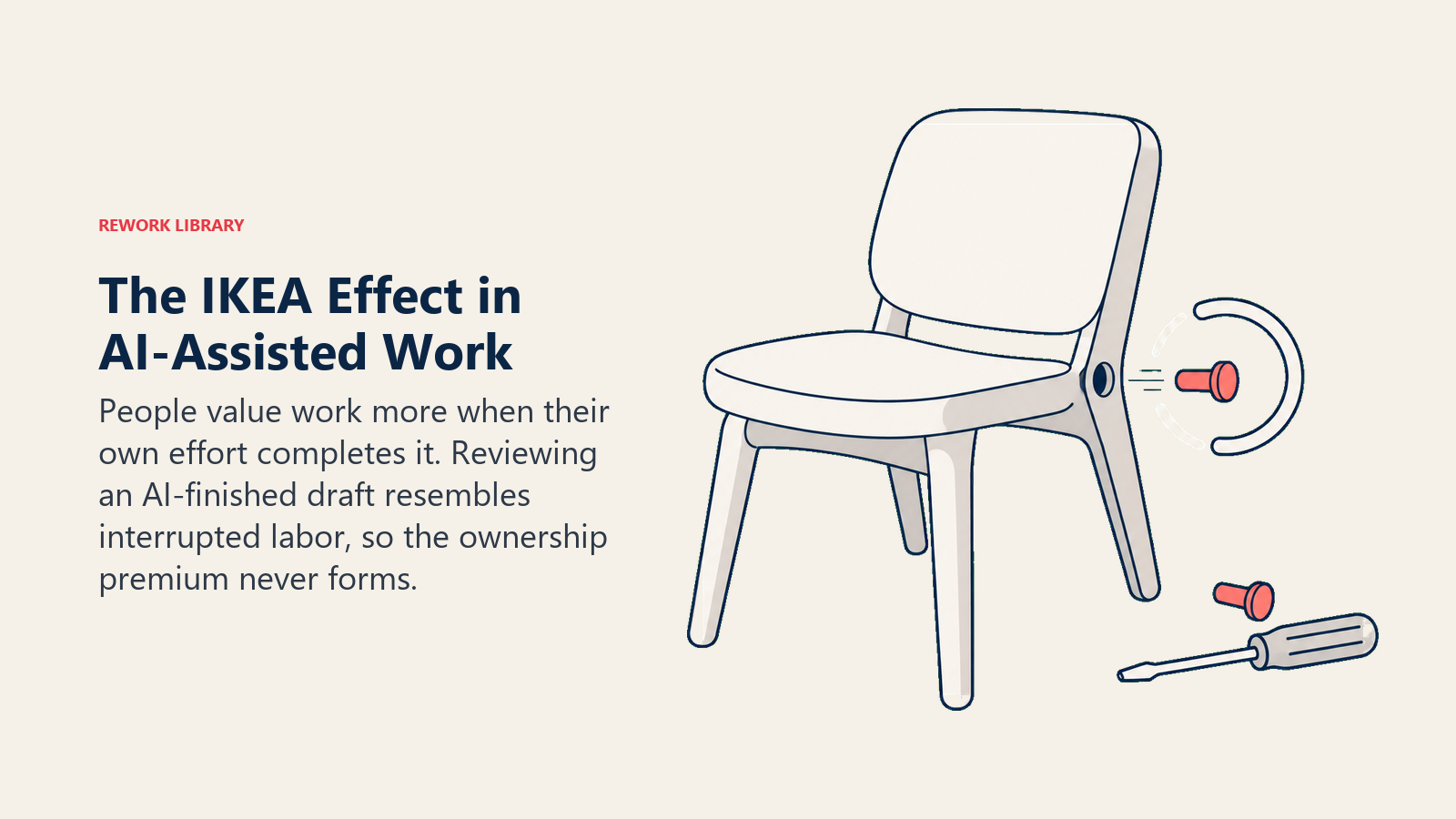
The finding that matters most for AI-era work design is the boundary condition: the ownership premium only appears when the person actually finishes the task. Interrupt the labor, or hand the last step to someone else, and the effect disappears with it. Reviewing an AI's finished draft is functionally the interrupted condition. The human contributed effort, but not the effort that produces ownership, because the AI finished the thing. This is not an argument against using AI to produce drafts. It is an argument that a job redesigned around review-only work should not be surprised when the ownership and pride that used to come with that job quietly disappear, even if the measured output looks the same or better on a dashboard.
Identity Threat: When Expertise Was Who You Were
For a smaller but consequential group, the loss goes past task satisfaction into identity. People who spent a decade building deep expertise in a domain, radiology, tax law, systems architecture, senior copywriting, often experience their expertise as part of who they are, not just what they do. When AI performs the diagnostic pattern-matching, the first-pass legal analysis, or the initial draft that used to require that expertise, the threat is not "will I have a job." It is closer to "if the machine does the thing I am known for, what distinguishes me."
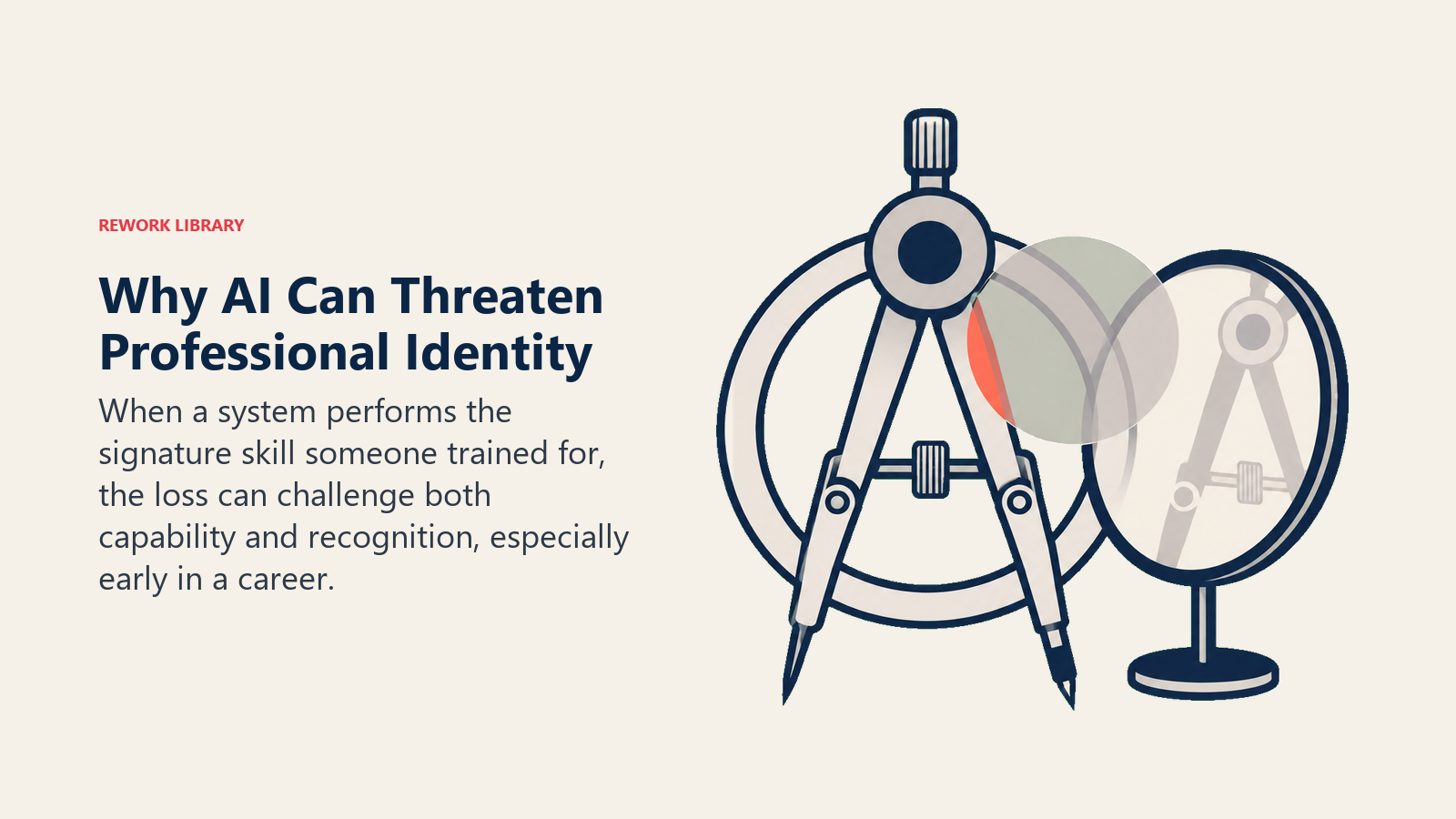
Research on AI-driven identity threat gives this a useful structure. A study of 206 medical students and practicing physicians found two separate threat dimensions: threats to professional recognition (status and expertise being acknowledged) and threats to professional capabilities (autonomy and the actual work of being a care provider). Threats to capability predicted resistance to AI directly; threats to recognition worked indirectly, mediated by how personally threatened someone felt. The two groups also differed by career stage: medical students, who had invested heavily in an identity they had not yet fully exercised, showed both stronger resistance and stronger self-threat than experienced physicians who had already built a career's worth of proof their capability was real. Identity threat from AI does not fall evenly across a workforce; it concentrates on people whose sense of professional worth is newer or more tightly tied to the exact skill AI now performs.
This is different from a simple change-management problem, and treating it as one (a training deck, a rollout email, a town hall) misses what is actually happening. A person whose expertise is under identity threat is not confused about how the new tool works. They are recalculating who they are at work, and that recalculation takes longer than a training cycle.
What Genuinely Preserves Meaning
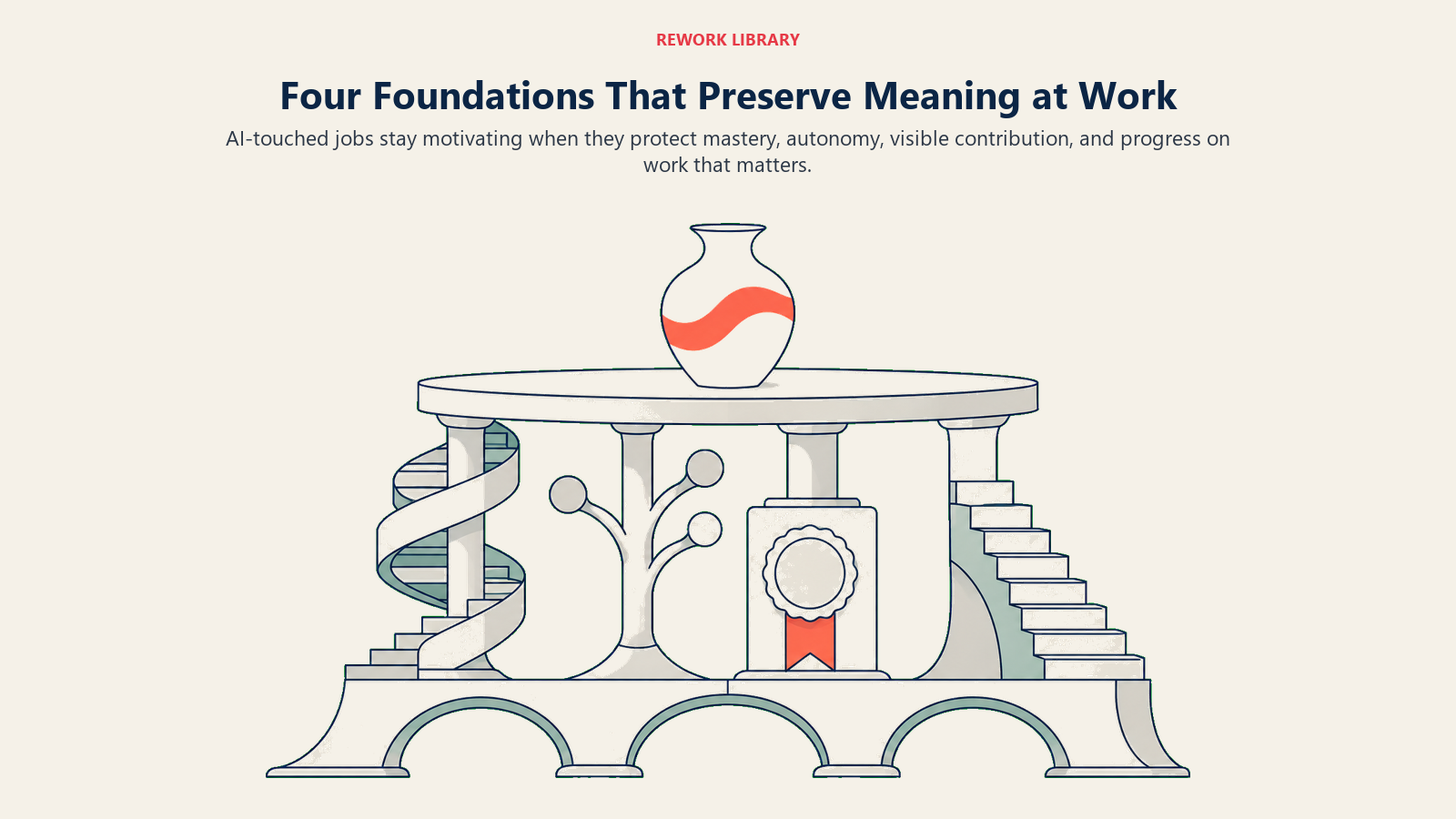
The research points to a consistent short list, and none of it is about slowing AI adoption down.
Mastery
Self-Determination Theory's competence need is satisfied by visible skill growth, not by avoiding challenge. Redesigned work should still contain a path to getting measurably better at something the person can point to, whether that is judgment calls AI cannot make, the parts of the craft that remain hands-on, or a new skill the AI shift created room for.
Autonomy
Deci and Ryan's autonomy need is about feeling like the origin of your own actions, not about having zero oversight. Work that keeps meaningful discretion, deciding how to approach a problem, when to override the AI, how to sequence the work, protects this even when the AI handles more of the execution.
Visible Contribution
Hackman and Oldham's task identity and feedback dimensions both point the same direction: people need to see the whole thing they made and hear back on how it landed. Redesigns that fragment work into invisible checking steps strip this out; redesigns that give people ownership of a complete outcome, even a smaller one, keep it.
Progress on Something That Matters
Amabile and Kramer's progress principle is arguably the most actionable of the four. Their diary research found the single strongest driver of a good day at work was visible forward motion on meaningful work, and that setbacks had an even larger effect the other direction. Leaders can engineer this deliberately: clear milestones, fast feedback loops, and recognition that names the specific contribution rather than crediting the tool.
The table below maps these against how AI can threaten each one and what actually holds it in place.
| Source of meaning | How AI can threaten it | What protects it |
|---|---|---|
| Mastery (competence) | Skills stop being exercised once AI does the task; judgment atrophies from disuse | Deliberate practice kept in the loop, a visible skill-growth path tied to what AI cannot yet do well |
| Autonomy | Work narrows to reviewing AI output on the AI's terms, with little discretion over approach | Real decision rights preserved: when to override the AI, how to sequence work, which judgment calls stay human |
| Visible contribution (task identity) | Contribution becomes invisible checking rather than a finished, attributable piece of work | Ownership of a complete outcome, plus specific recognition naming the person's actual contribution |
| Progress on meaningful work | Setbacks and invisible effort dominate the day when the satisfying part of the job is gone | Milestones and fast feedback engineered into the redesigned workflow, not left to chance |
| Professional identity | Deep expertise feels replicated or diminished by a system that performs the signature skill | Honest acknowledgment of the shift, a defined path to what the expertise becomes next, time to adjust |
What Leaders Can Actually Do
Start by auditing which tasks AI removed and which remained, using the job characteristics lens rather than a headcount lens. If AI took the routine 80% and left the demanding, judgment-heavy 20%, the redesign is probably fine and may even improve meaning. If it took the demanding, satisfying part and left oversight, the job needs active redesign, not just a new tool bolted onto the old structure.
Give people something to finish. The IKEA effect is a design constraint, not a metaphor: structure AI-assisted work so a human completes a whole, attributable piece of it, rather than perpetually inspecting someone else's finished product. Even a smaller scope, owned fully, beats a larger scope owned partially.
Protect real autonomy, not the appearance of it. Letting someone choose which font to use while removing every substantive judgment call from their job satisfies no one, and Self-Determination Theory is specific that autonomy means feeling like the origin of the decision, not being consulted about a decision already made.
Engineer visible progress on purpose. Amabile and Kramer's finding was that progress on meaningful work drives good days more than any other single event, which means it is manageable: set milestones inside AI-assisted workflows, close the feedback loop fast, and name what a specific person actually contributed instead of letting a fast AI-assisted output blur into ambient team throughput.
Treat identity threat as a longer conversation than a rollout announcement, especially with people earlier in their careers who have the most identity riding on a skill AI now touches. The physicians-and-students research suggests this group needs more than reassurance that their job is safe; they need a credible account of what their expertise becomes next, and enough time to build confidence in that account before being asked to trust it.
None of this requires slowing AI down. It requires treating the redesign of the job as seriously as the deployment of the tool, because the tool changes what people do in an afternoon and the redesign decides whether they still recognize themselves in the work a year from now. For a broader look at how roles shift when AI takes on execution, see from doer to orchestrator and which jobs AI changes rather than replaces. The career-stage pattern in the identity-threat research also connects directly to career paths in the age of AI and to the broken bottom rung, since the people with the least proven identity to fall back on are disproportionately early in their careers. And because meaning erosion compounds into retention risk, it sits close to culture and employee retention, burnout culture, workslop and the effort-ownership link, and building a culture of accountability, all worth reading alongside this one. The bigger frame is in what is the future of work.
Frequently Asked Questions about Meaning and Identity at Work
Why does AI sometimes make a job less satisfying even when it makes the person more productive?
Productivity and meaning are measured differently. If AI removes the demanding, absorbing part of a job and leaves oversight and correction work, output can rise while the job scores worse on skill variety, task identity, and visible contribution, the dimensions Hackman and Oldham's research ties to experienced meaningfulness.
What is the IKEA effect and why does it matter for AI-assisted work?
It's Norton, Mochon, and Ariely's finding that people value something roughly 63% more when they made it themselves, but only if they actually finished the task. Reviewing an AI's completed draft is the interrupted-labor condition where that ownership premium does not form, which explains why supervising AI output can feel unrewarding even when the result is good.
Is professional identity threat from AI a real, researched phenomenon or just anecdotal?
It's studied directly. A 2022 study of 206 medical students and physicians found distinct threats to professional recognition and professional capabilities, with capability threats directly predicting resistance to AI and recognition threats working through a felt sense of personal threat.
Does Self-Determination Theory say people need total independence to stay motivated?
No. Autonomy in Deci and Ryan's framework means feeling like the origin of your own actions and choices, not the absence of oversight or structure. A job with clear goals and real discretion over how to reach them satisfies the autonomy need; a job with no substantive choices left does not, regardless of how little supervision exists.
What is Amabile and Kramer's progress principle in simple terms?
Based on diary data from knowledge workers, they found that visible, incremental progress on work that feels meaningful is the single strongest driver of a good day at work, more than recognition, incentives, or interpersonal support. Setbacks have an even larger effect in the opposite direction.
Who is most at risk of identity threat when AI changes their role?
The research on medical students versus experienced physicians suggests it concentrates on people earlier in their careers, who have invested in an expertise-based identity without yet accumulating years of proof that their capability is real and valued.
Can a company redesign AI-touched jobs to protect meaning without slowing down adoption?
Yes. The mechanisms in the research, mastery, autonomy, visible contribution, and engineered progress, are design choices about how a workflow is structured, not arguments for using less AI. Teams that use AI heavily while deliberately preserving these elements tend to keep both output and engagement.
How is this different from the culture-focused articles on AI and the workplace?
This article is about what happens to the job itself, the skill, the sense of contribution, and professional identity. The business-culture collection covers the norms and behaviors around AI use, such as trust, etiquette, and psychological safety. The two overlap but answer different questions.

Co-Founder, Rework.com
On this page
- Key Facts
- Why Meaning at Work Is Not a Soft Topic
- The Specific Loss: When AI Takes the Interesting 20% and Leaves the Oversight
- When AI Removes the Routine Overhead, Meaning Can Rise
- The Residual Task Problem
- The IKEA Effect: Why Effort and Ownership Are the Same Thing
- Identity Threat: When Expertise Was Who You Were
- What Genuinely Preserves Meaning
- Mastery
- Autonomy
- Visible Contribution
- Progress on Something That Matters
- What Leaders Can Actually Do