Predict: How AI Forecasts Business Outcomes
Turn this article into takeaways for your work.


Each assistant summarizes the article only for you and suggests best practices for your work.
Predict is where the most expensive AI mistakes happen quietly.
The scoring model gets deployed. Reps use the scores for a few weeks, then stop. Nobody officially kills the tool. It just gets ignored. The sales manager stops bringing it up. Renewal time comes and the license quietly disappears. The post-mortem, if there is one, says something vague like "the output didn't match our intuition." But that's not really what happened.
What happened: the model was working exactly as designed. The labels it learned from were wrong. The historical "closed-won" deals it trained on reflected a business that no longer exists, because the company changed its ICP, its pricing, or its sales motion, and nobody retrained the model. A 74% confidence score is 74% confident about the past. If the past doesn't look like the present, the number means nothing.
This pattern plays out across every Predict sub-capability: lead scoring that becomes a coin flip, demand forecasts off by 40%, churn models that flag the wrong accounts. The failure chain is consistent, and almost none of it lives in the algorithm.
This article breaks down what Predict actually is, how its five sub-capabilities work, and why most Predict deployments fail before they get the chance to prove their value.
What Predict actually does
In the ACE Framework, Predict uses historical data to produce probabilistic statements about the future, or about unknowns. It answers: what's likely?
The key word is "probabilistic." Predict never tells you what will happen. It tells you the distribution of outcomes given what it knows. An 87% lead score means that historically, accounts with this profile converted at roughly that rate. If your historical data is wrong, the probability is wrong.
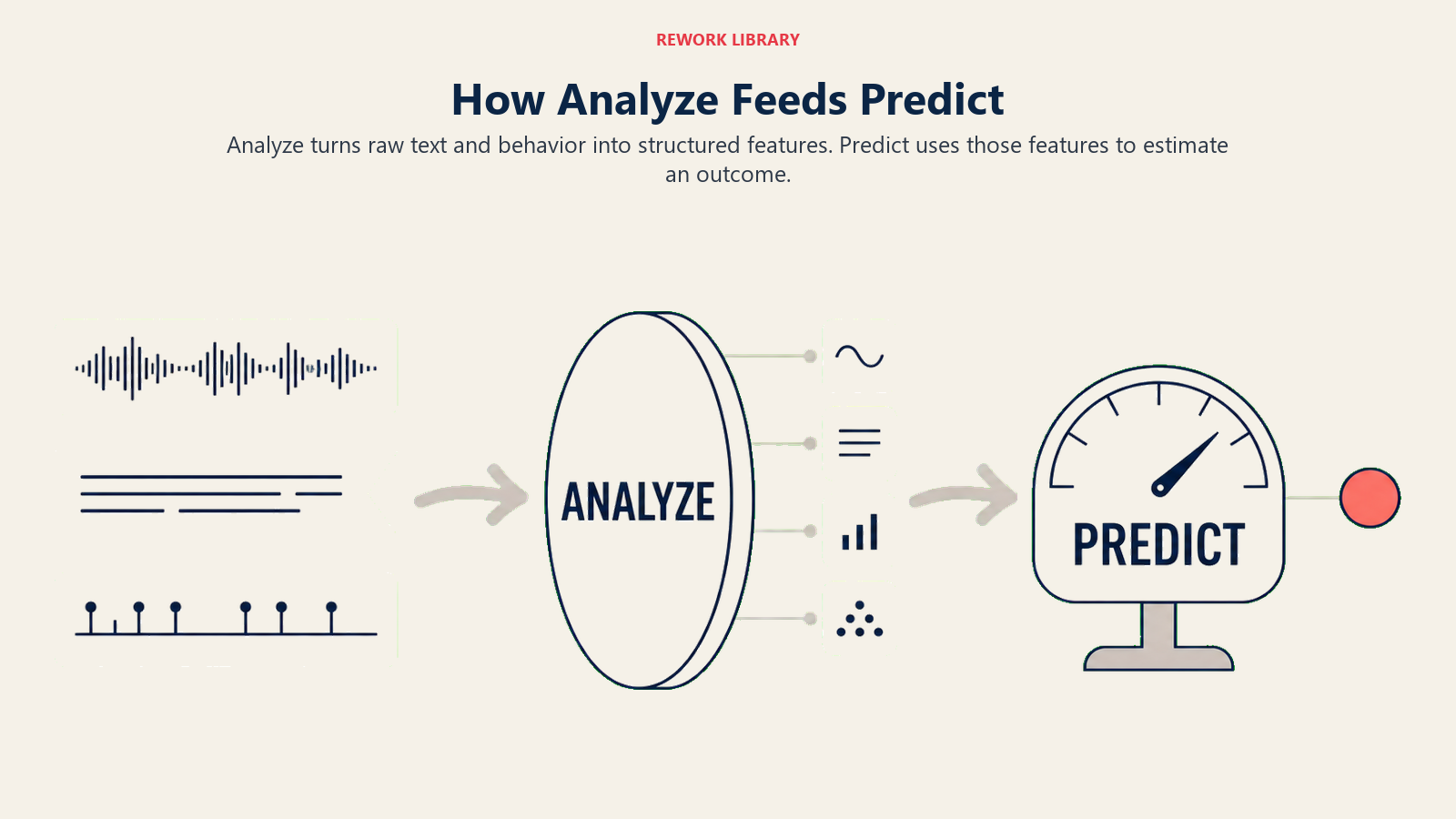
Predict works on three input types: structured historical data (CRM records, transaction history, firmographics), time-series data (revenue by month, sensor readings), and increasingly text signals such as call transcripts and ticket language, extracted via Analyze and fed in as structured features.
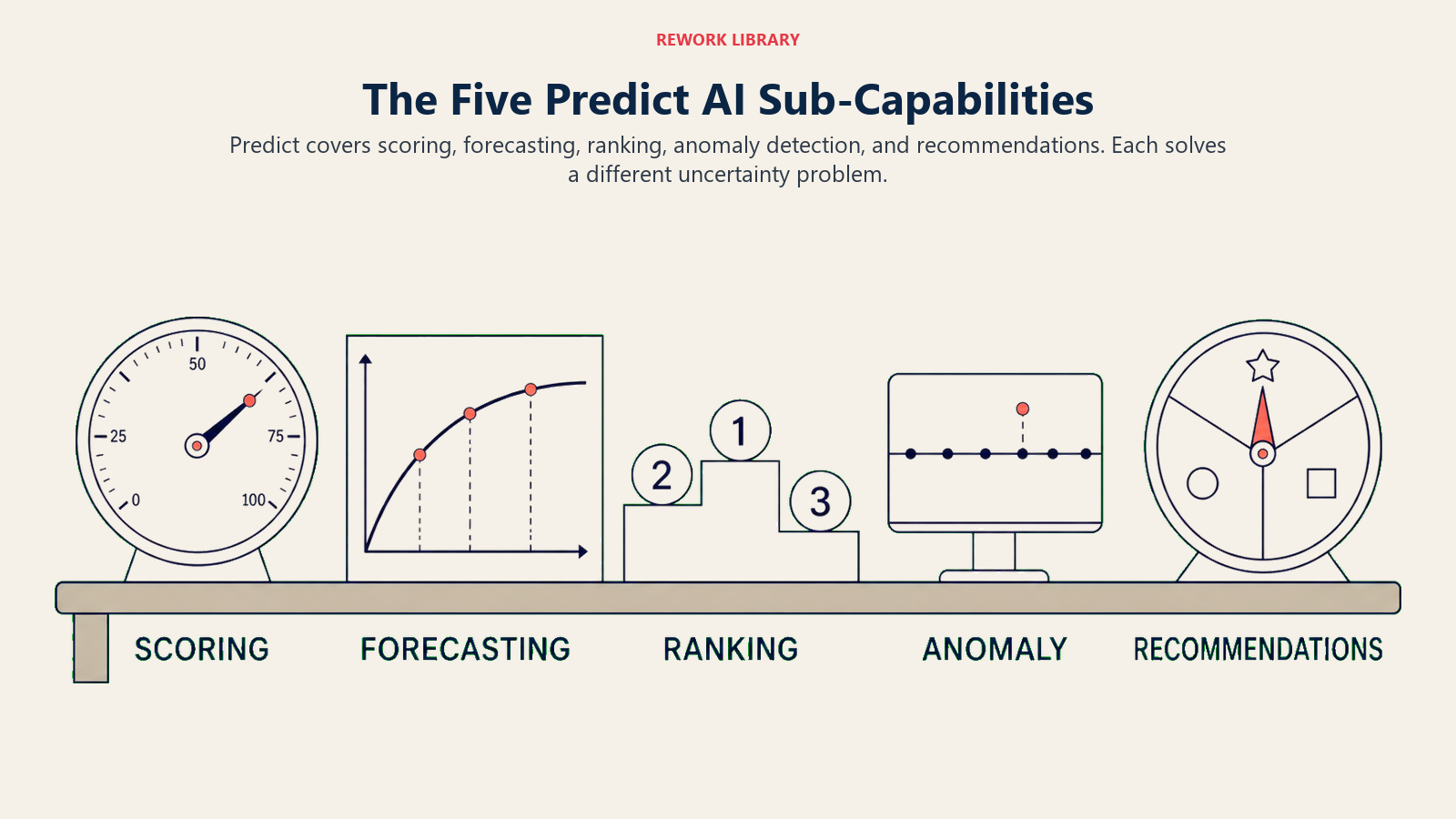
The outputs are probability scores, forecasted values, ranked lists, flagged anomalies, or recommended next actions.
The 5 sub-capabilities of Predict
Predict isn't monolithic. There are five distinct things it does, and they require different data, different models, and different organizational commitments to maintain.
Scoring
Assign a probability to a specific outcome. A lead score, a churn risk score, a credit risk score. The model looks at inputs (behavior, firmographics, deal history) and outputs a single number representing likelihood. HubSpot Predictive Lead Scoring assigns each contact a likelihood-to-close percentage based on engagement history. Gainsight PX outputs a health score per account, blending product usage, support volume, and NPS trend.
The inputs must be historically labeled. If your CRM doesn't have clear "won" and "lost" outcomes attached to past deals, a scoring model has nothing to learn from.
Forecasting
Project future values over a time horizon. Revenue forecasting, demand forecasting, inventory planning. The model learns patterns in historical time-series data and extends them forward. Salesforce Einstein Forecasting predicts closed-won revenue per rep per quarter, adjusting for pipeline age and deal velocity. Prophet (open-source, developed by Meta) builds seasonality-aware demand curves for inventory and demand planning teams.
Forecasting requires enough time-series history to capture seasonality. Fewer than 12 months is usually insufficient for anything seasonal.
Ranking
Order a set of items by expected value without assigning an exact probability to each. "Top 10 accounts to call this week." Ranking is often more useful than scoring in practice. Reps don't need to know the probability; they need to know who to call first. Clari's pipeline intelligence ranks open deals by close likelihood. Zendesk's AI ticket prioritization ranks incoming tickets by urgency and customer tier.
Ranking is more forgiving than point-estimate scoring. You don't need to know if an account has a 74% or 71% chance of closing. You need to know it should rank above the 48% account.
Anomaly detection
Flag things that deviate from a statistical baseline. Fraud detection. Uptime monitoring. Expense policy violations. Churn early warning. Stripe Radar scores each transaction against its fraud baseline, flagging 0.3% of transactions for human review. Ramp's AI flags expense line items that deviate from category spend norms.
Anomaly detection is the one Predict sub-capability that doesn't require labeled outcome data. The model learns the distribution of normal; it doesn't need past examples of fraud labeled as such. But it does need volume. A company processing 50 transactions a week doesn't have the volume for a meaningful fraud model. One processing 50,000 does.
Recommendations
Predict preferences to suggest the most relevant content, product, or next action for a specific user. The model uses behavioral history plus profile similarity to predict what a person will find valuable.
Real examples: Netflix's recommendation engine predicts watch completion probability per user. Salesforce Einstein Next Best Action suggests which offer to present in a support interaction. Learning management systems rank courses by role, past completions, and peer behavior.
A history lesson: Predict is older than the AI hype
Predict is not a 2022 innovation. Logistic regression dates to the 1950s. Decision trees were in commercial use by the 1980s. Ensemble methods like XGBoost became dominant in data science competitions in the early 2010s. FICO scores were introduced in 1989.
What changed after 2022 wasn't that prediction became possible. It was that cloud infrastructure made deploying prediction models accessible without a data science team, and SaaS vendors bundled pre-trained models into CRM tools so Predict became a feature you could turn on. The underlying category is stable. Predict is the most mature capability in the ACE Framework, with a 30-year track record. That means we know a lot about when it works and when it fails.
What makes Predict hard
The algorithm is usually not the problem. These five factors are.
Labels decay
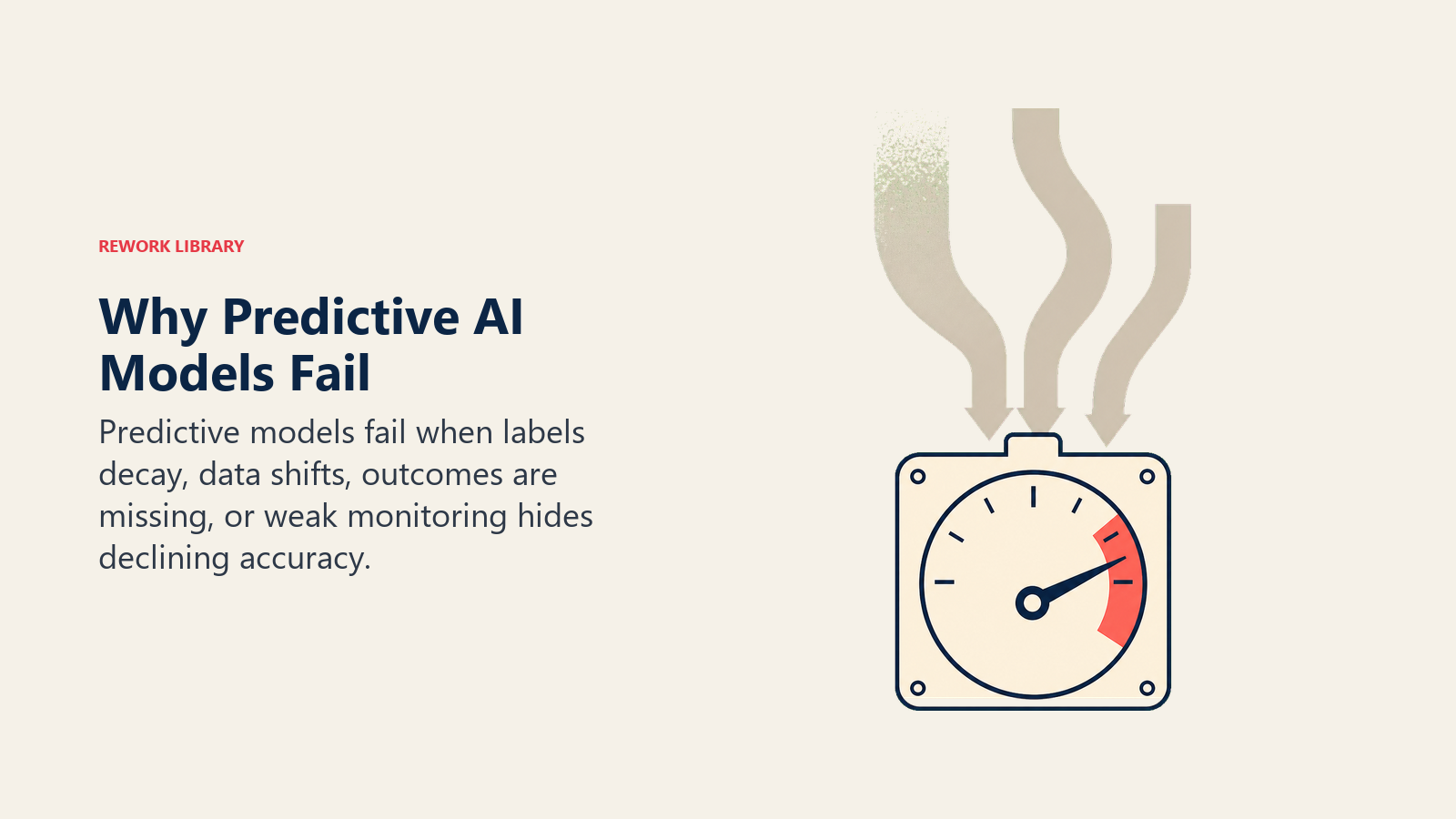
The most common Predict failure. Training data reflects a business that no longer exists: the ICP shifted, pricing changed, or the sales motion evolved. The "won" deals from two years ago look nothing like the deals you're trying to close today. The model learned an outdated pattern and applies it faithfully to the wrong universe.
Labels decay when your business changes: sales process, ICP, pricing. Models don't notice. They keep scoring against the historical pattern until you retrain them. Predict models need scheduled retraining. Most vendors don't mention this in the sales cycle.
Distribution shift
Related but distinct: the world changes, and the model doesn't know. COVID demand curves are the canonical example. Every retail forecasting model trained on pre-2020 data failed in March 2020. The model had never seen a global supply chain shutdown.
Distribution shift happens at smaller scales too. A competitor launches and changes your win rates. A new channel brings in a different buyer profile. The model keeps predicting based on the old distribution until someone notices the outputs are wrong. Detection requires monitoring: track whether predictions are matching outcomes over time. Without that loop, distribution shift is invisible until it's embarrassing.
Explainability requirements
For a lead scoring model, "trust the score" is frustrating but survivable. A rep ignores it and calls the lead anyway.
For credit decisions, hiring screens, or loan underwriting, explainability isn't optional. In the US, the Equal Credit Opportunity Act (ECOA) requires applicants denied credit to receive a specific reason. The EU's GDPR Article 22 grants individuals rights against purely automated decisions with significant effects.
Classical ML models (logistic regression, shallow decision trees) are inherently interpretable. XGBoost and random forests are harder but have explainability tools like SHAP values. Neural network-based predictors are the hardest to explain. In financial services, healthcare, HR, or legal, explainability is a deployment prerequisite, not a nice-to-have.
Small test sets hide model weakness
A company with 400 closed deals over two years has a thin training set for a lead scoring model. Statistical patterns that look significant at 400 examples often don't hold at 4,000. The model appears to work in evaluation, then performs unpredictably on live data.
Vendors with pre-trained models drawing on millions of examples across customers (Salesforce Einstein, HubSpot Predictive Lead Scoring) partially solve this cold-start problem. The trade-off is that their model learns industry-wide patterns, not your specific ones. For most mid-market teams, starting with a vendor model and refining over 12-18 months is more realistic than training from scratch.
Missing historical outcomes
Predict needs labeled data. Sales scoring needs deals marked won or lost. Churn models need accounts marked churned or retained. If your CRM doesn't have mandatory win/loss fields, or they've been optional and inconsistently filled, you don't have the training signal to build a meaningful model.
Data readiness for Predict is more demanding than for Analyze. Analyze can extract value from unstructured text with minimal labeling. Predict requires outcome-labeled historical records, ideally hundreds to thousands, covering a representative range of inputs and results.
Inputs and outputs: a reference table
| Input type | Typical Predict sub-capability | Example output |
|---|---|---|
| Structured CRM records + deal history | Scoring | Lead probability score (0–100) |
| Time-series revenue or demand data | Forecasting | Next-quarter revenue with confidence interval |
| Behavioral activity + firmographics | Ranking | Top 10 accounts to contact this week |
| Transaction stream | Anomaly detection | Flagged transactions for review |
| User behavior + peer similarity | Recommendations | Next 5 products / courses / actions |
Tools for Predict: buy, integrate, or build
Built-in (buy): Salesforce Einstein scores leads and opportunities using your CRM data plus Salesforce's cross-customer training signal, works best with 1,000+ historical deals. HubSpot Predictive Lead Scoring weights contact activity and firmographics (Marketing Hub Professional and above). Gainsight PX builds customer health scores from product telemetry, support volume, and NPS.
Custom (integrate or build): scikit-learn is the standard Python library for classical ML. XGBoost and LightGBM are gradient boosting libraries that dominate structured-data prediction benchmarks. Prophet (open-source, developed by Meta) handles time-series forecasting with seasonality and trend changepoints. Amazon SageMaker provides managed model training and deployment on AWS.
LLM-augmented: The newest approach isn't a replacement for classical Predict; it's a complement. Instead of "model says 74%," you get a reasoning chain: "this account is likely to close, they've opened four emails, their contract expires in 60 days, and three similar accounts converted after a pricing call." Classical is faster, cheaper, and more explainable for high-volume decisions. LLM-augmented can incorporate unstructured signals (email tone, transcript content) that classical models struggle with. Use cases requiring regulatory explainability still favor classical.
Predict and Analyze: the standard pairing
In practice, Predict rarely operates alone. The standard pattern is Analyze extracting structured features from raw data, then Predict consuming those features to produce a score or forecast. A churn model might use Analyze to pull sentiment scores and ticket frequency from support transcripts, then feed those into a Predict model alongside product usage data. This is why the ACE Framework's capabilities are composable: understanding them as distinct atoms helps you see where each one's data requirements apply.
Governance checklist for Predict deployments
Predict without governance is how companies get embarrassed. Here's the minimum before deploying any scoring, forecasting, or anomaly detection system that affects business decisions.
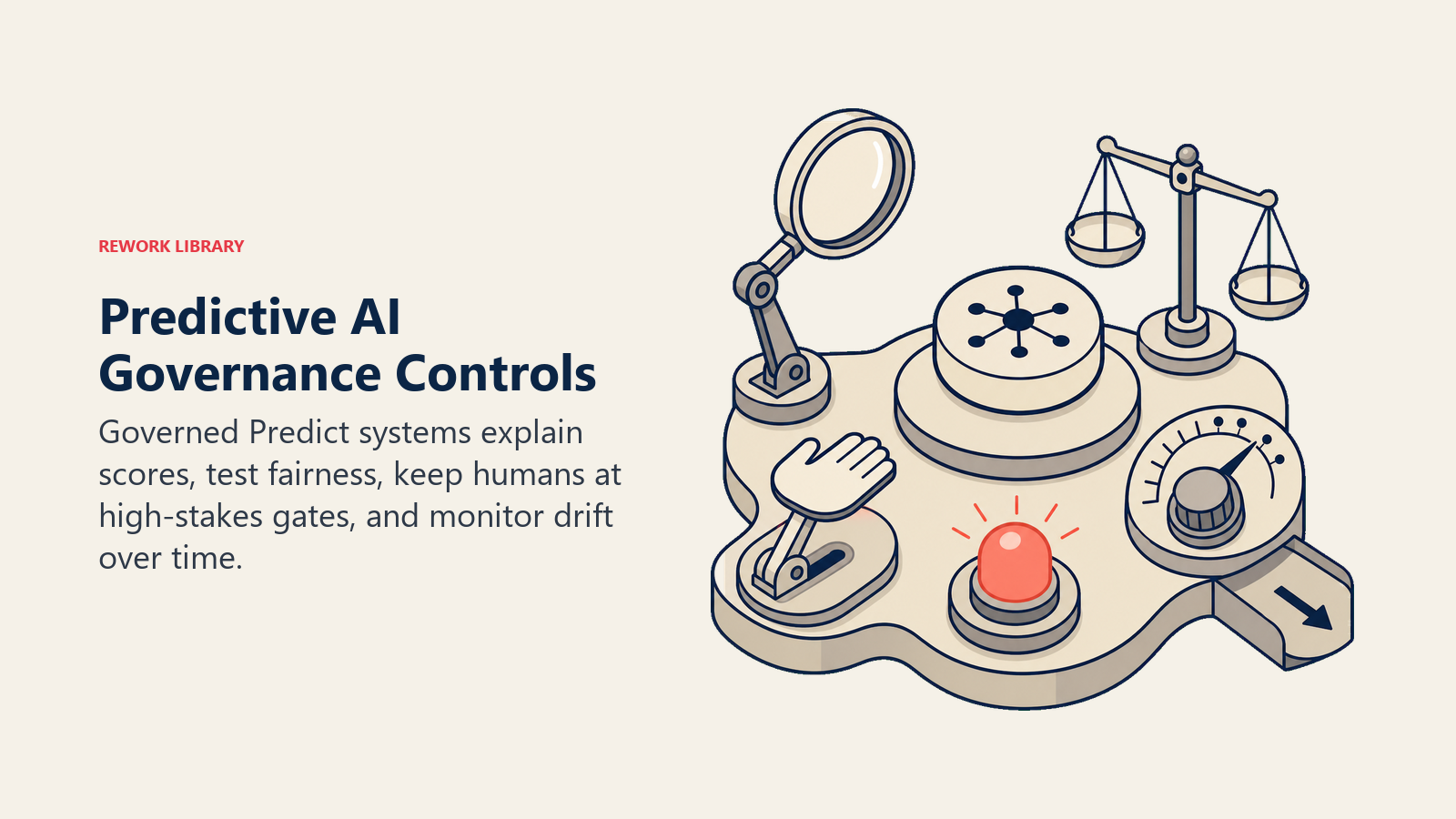
Auditability: Can you explain what features drove the score? If a regulator asks why a credit application was denied, you need a defensible answer. Track feature importance for every model in production.
Fairness review: Does the model perform equally across groups? Lead scoring models inherit historical biases. If past wins skewed toward certain geographies for non-predictive reasons, the model embeds that skew. Run a basic fairness audit before deploying any model that affects people.
Bias mitigation: For models that affect personnel decisions (hiring screens, promotion recommendations), testing for disparate impact before deployment is mandatory, not optional.
Human review gates: High-stakes predictions (credit decisions, large-deal prioritization) should have a human in the loop before driving action. Route the score to a human rather than directly to an Execute action.
Drift monitoring: Check quarterly whether model predictions are matching outcomes. If accuracy drifts, trigger a retraining review before the outputs become meaningless.
When NOT to use Predict
When you don't have labeled historical data. A startup with 90 closed deals doesn't have the training signal for a meaningful scoring model. Use judgment, build the labeling habit, and wait for 500+ outcomes.
When the future is structurally different from the past. Post-COVID demand curves, a new market category, a major regulatory change. Predict models extrapolate from historical patterns. When the future won't look like the past, those patterns are actively misleading. The model keeps predicting; the scores are anchored to a world that no longer exists.
When the decision is one-shot and irreversible. 87% confident is still 13% wrong. For decisions where being wrong once is catastrophic (certain legal actions, safety-critical operations), a probabilistic output isn't the right input. You need a different evaluation process.
When you need exact truth rather than probability. Predict tells you likelihoods. If your use case can't tolerate any error rate, Predict is the wrong capability for the decision gate.
The honest summary
Predict is the capability every executive wants: "Tell me who's going to close. Tell me where revenue is going. Tell me who's about to churn." And it fails most often in practice, not because the models are bad but because the inputs are wrong.
The failure chain is consistent: missing or inconsistent labels, stale historical data that no longer reflects current reality, no retraining cadence, and no monitoring to catch drift. The algorithm works. The data it learned from doesn't represent the world it's being asked to predict.
Data readiness for Predict is more demanding than for any other ACE capability. You need labeled outcomes, enough volume, and consistent definitions of "won," "churned," or "anomalous." Done right, Predict delivers the clearest ROI: fewer hours wasted on cold leads, better resource allocation, earlier churn intervention. Most operators sitting on three or more years of structured account data could get genuinely useful early-warning signals from it. But not until they fix their labels.
What to read next
- The ACE Framework: how Predict fits with the other four capabilities in the full stack
- Analyze: the capability that feeds structured features into Predict models
- Predictive AI vs. Generative AI: the industry split explained, and where Predict fits
- Data Readiness: the prerequisite Predict depends on more than any other capability
- Execute: what happens after a Predict output drives an action, and why the governance requirements jump
- Evolution of Business AI: the 30-year history of Predict, from classical ML to modern LLM-augmented forecasting

Principal Solution Architect
On this page
- What Predict actually does
- The 5 sub-capabilities of Predict
- Scoring
- Forecasting
- Ranking
- Anomaly detection
- Recommendations
- A history lesson: Predict is older than the AI hype
- What makes Predict hard
- Labels decay
- Distribution shift
- Explainability requirements
- Small test sets hide model weakness
- Missing historical outcomes
- Inputs and outputs: a reference table
- Tools for Predict: buy, integrate, or build
- Predict and Analyze: the standard pairing
- Governance checklist for Predict deployments
- When NOT to use Predict
- The honest summary
- What to read next