日本語

Scaling Alignment: How Marketing-Sales Alignment Breaks at 3 Growth Inflection Points

Marketing-sales alignment at three growth inflection points

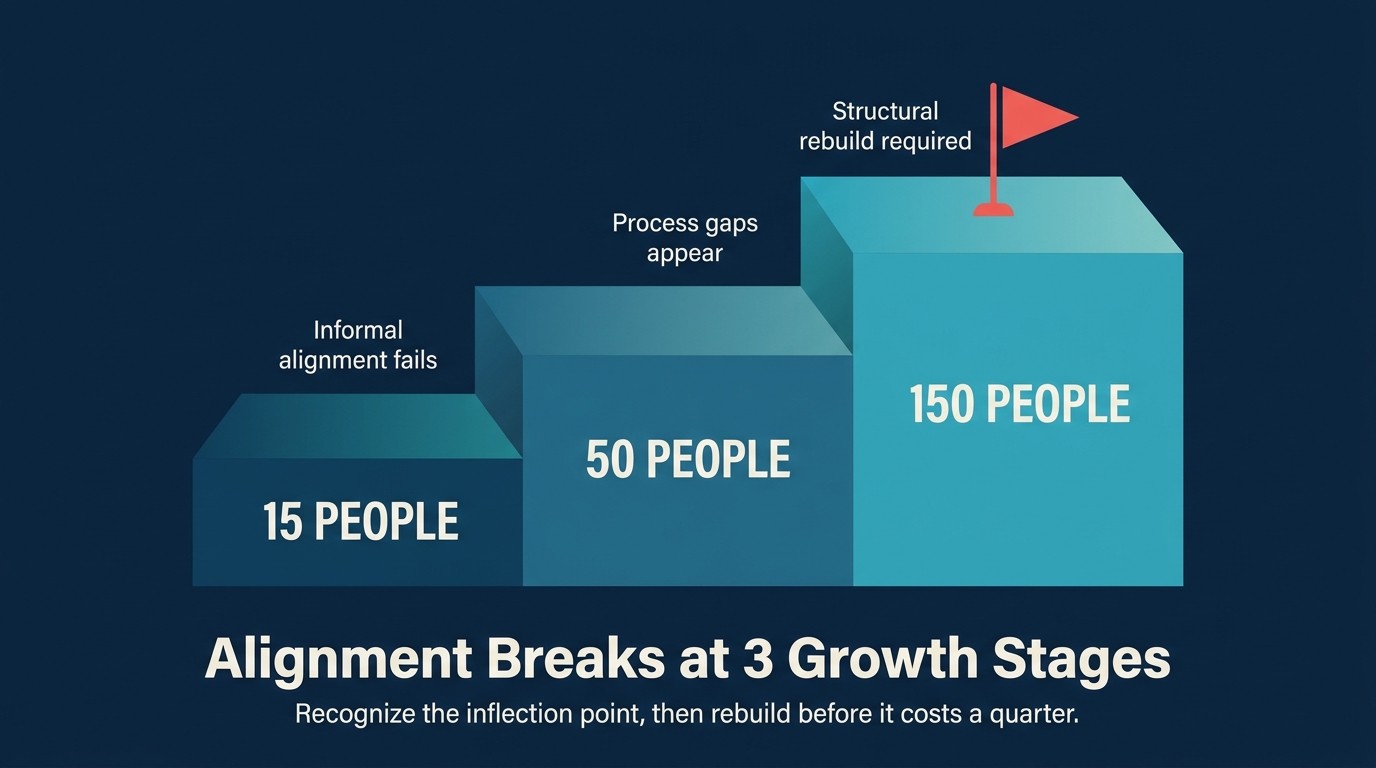
Alignment doesn't break once. It breaks at 15 people, again at 50, and again at 150.

Every revenue leader who has scaled a company through those thresholds has felt this. Things that worked perfectly at the previous stage suddenly stop working. Not because the team got worse, but because the operating model that fit 15 people doesn't fit 50. The informal processes, the shared Slack channel, the "just ask Mike" approach to lead handoffs: they worked when everyone could see what was happening. They collapse when the team grows past the point where informal coordination is enough.

The pattern is consistent enough that you can predict when alignment will break. And if you can predict it, you can get ahead of it. Rebuild the operating model before it fails rather than after.

Why Alignment Doesn't Scale Automatically

The common assumption is that alignment is a leadership problem. If the CMO and CRO are aligned, the teams will be aligned. At 10 people, that's roughly true. The leaders are close enough to the work that their alignment transmits through informal conversation.

But at 50 people, the CMO and CRO can be completely aligned while their teams operate with different MQL definitions, different data systems, and different expectations about what a good lead looks like. Leadership alignment doesn't transmit at that scale. It sits at the top and leaks before it reaches the teams doing the daily work.

What scales is process and infrastructure. Written definitions. Shared systems. Documented SLAs. Rituals that create regular points of contact. Every time headcount growth overwhelms the existing informal coordination mechanisms, alignment needs to be re-engineered, not patched. HBR's research on successful scale-ups identifies the same dynamic: between the exploration and exploitation stages of company growth is a critical extrapolation phase where processes must be formalized so that each new customer generates revenue without requiring proportionally more coordination overhead.

Key Facts: Growth, Scale, and Revenue Team Alignment

  • Companies that proactively rebuild alignment processes at growth inflection points lose 1-2 quarters of productivity compared to 2-4 quarters for companies that react after breakdown, according to McKinsey's B2B sales research.
  • Organizations that implement formal alignment structures before reaching 100 employees see 28% higher revenue per employee at scale than those that wait until dysfunction forces a fix, according to SiriusDecisions.
  • McKinsey's B2B growth research finds that an extra five percentage points of annual revenue growth correlates with an additional three to four percentage points of total shareholder return, making the timing of alignment rebuilds a genuine financial decision, not just a people management one.

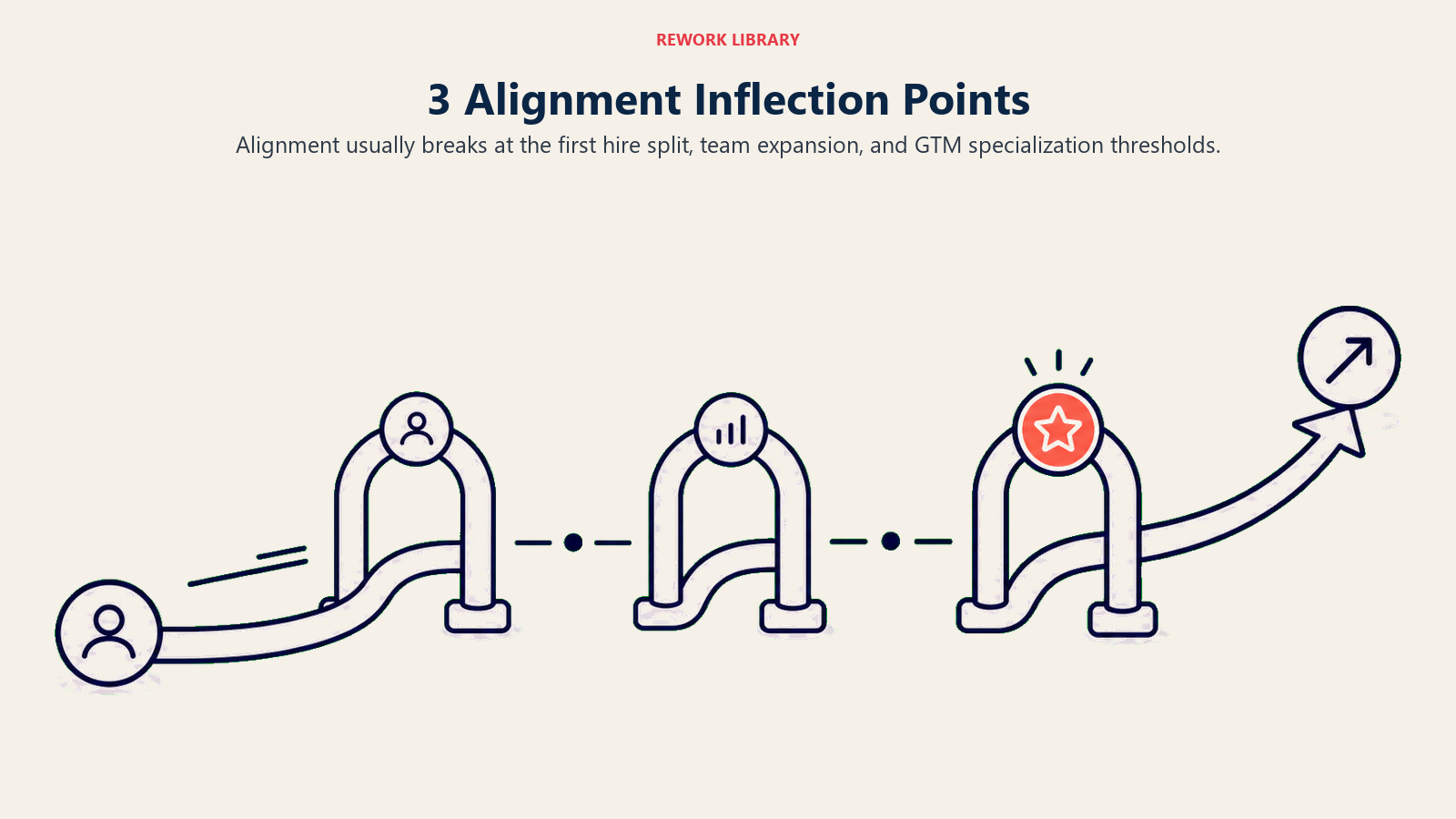
The 3 Alignment Inflection Points Framework

Named Framework: The 3 Alignment Inflection Points Marketing-sales alignment doesn't fail randomly. It breaks at three predictable moments that correspond to headcount thresholds, not calendar dates. Inflection Point 1: The First Hire Split (10-20 employees): Marketing and sales become separate functions for the first time. The fix is a first MQL definition, a basic handoff SLA, and a shared communication channel. Inflection Point 2: The Team Expansion (50-100 employees): Multiple SDRs apply the MQL definition inconsistently. The fix is written criteria with examples, a rejection reason taxonomy in the CRM, a weekly lead quality call, and a first shared pipeline dashboard. Inflection Point 3: The Go-to-Market Specialization (150-300 employees): Segmentation breaks the unified MQL definition and RevOps is needed as a strategic function. The fix is segment-specific MQL criteria, multi-touch attribution, a dedicated RevOps hire, a formal joint pipeline review cadence, and ABM-specific handoff protocols. Companies that identify which inflection point they're approaching, before it arrives, avoid losing the 2-4 quarters of productivity that reactive rebuilds cost.

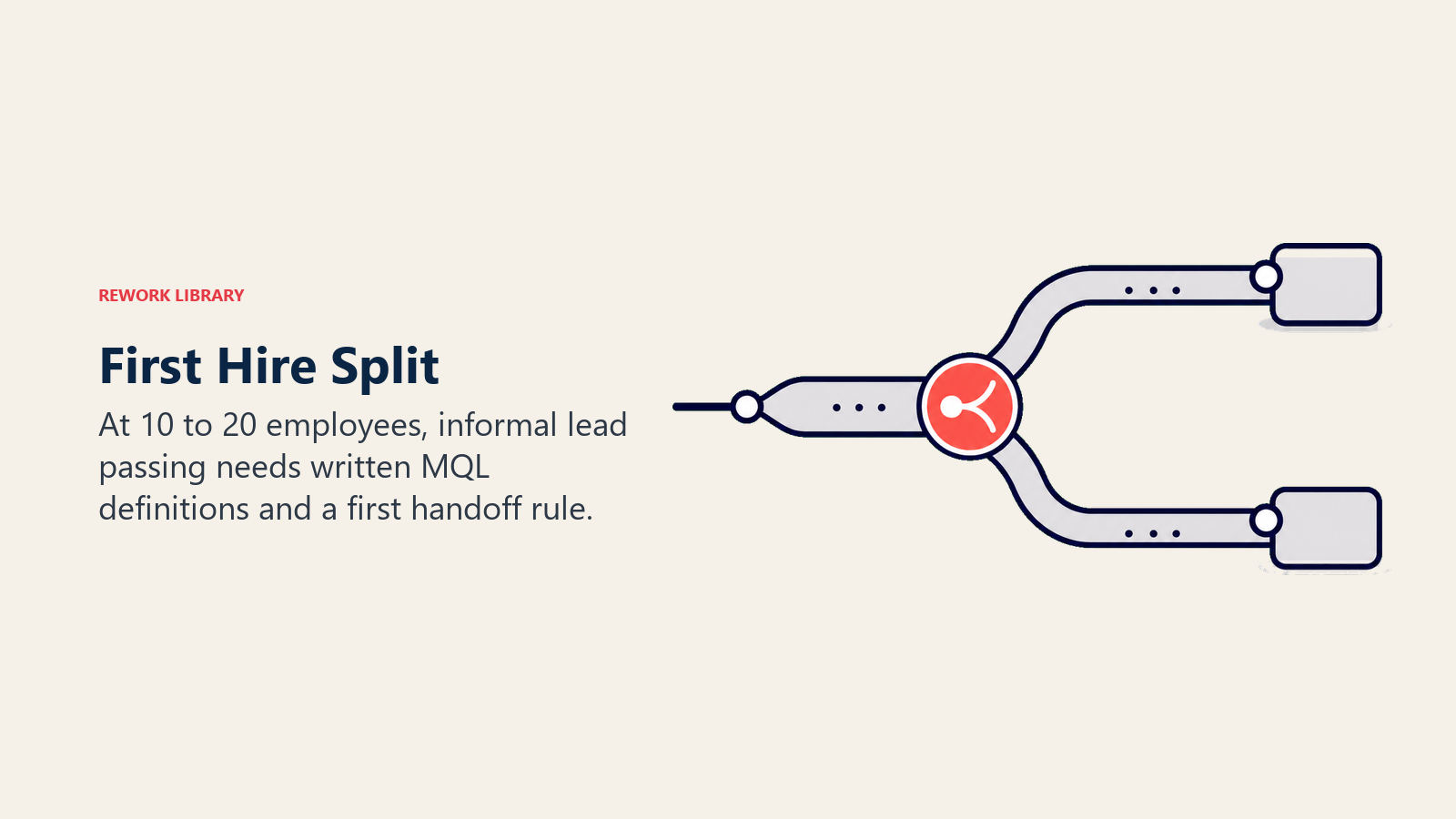
Inflection Point 1: The First Hire Split (10-20 Employees)

What happens at this stage: Marketing and sales become separate functions for the first time. Previously one person or a small founding team handled both. Now there's someone whose job is specifically marketing and someone whose job is specifically sales, and they're different people with different goals.

What breaks: The informal "pass the lead to Mike" process doesn't survive when there are three Mikes and two of them are new. Before the split, whoever was doing marketing also knew exactly which leads were ready for a conversation. After the split, that judgment has to be communicated between people who don't share the same context.

The leading indicator you've hit this inflection: more than two "where did that lead go?" questions per week. When the handoff process is breaking down, the symptom is confusion about lead ownership, not necessarily about lead quality.

What to build at this stage:

A first MQL definition. It doesn't have to be perfect. It has to exist. Even something simple like "a lead is sales-ready when they've requested a demo or trial" creates a shared language that prevents the most basic handoff failures. Write it down. Put it somewhere both teams can find it.

A basic handoff SLA. Marketing commits to passing qualified leads within a certain timeframe. Sales commits to following up within a certain timeframe. Even a 24-hour SLA on both sides, documented in a shared doc, is better than no SLA.

A shared communication channel. One Slack channel (or equivalent) where both teams can see lead activity, ask questions, and raise issues. The point isn't to create more meetings. It's to create a place where the informal coordination that used to happen organically can happen explicitly.

What NOT to build at this stage: attribution models, RevOps functions, joint dashboards, or formal pipeline reviews. These are overhead that a 15-person company doesn't have the bandwidth to maintain, and building them too early creates bureaucracy without benefit. Focus on the minimum: a definition, an SLA, and a communication channel.

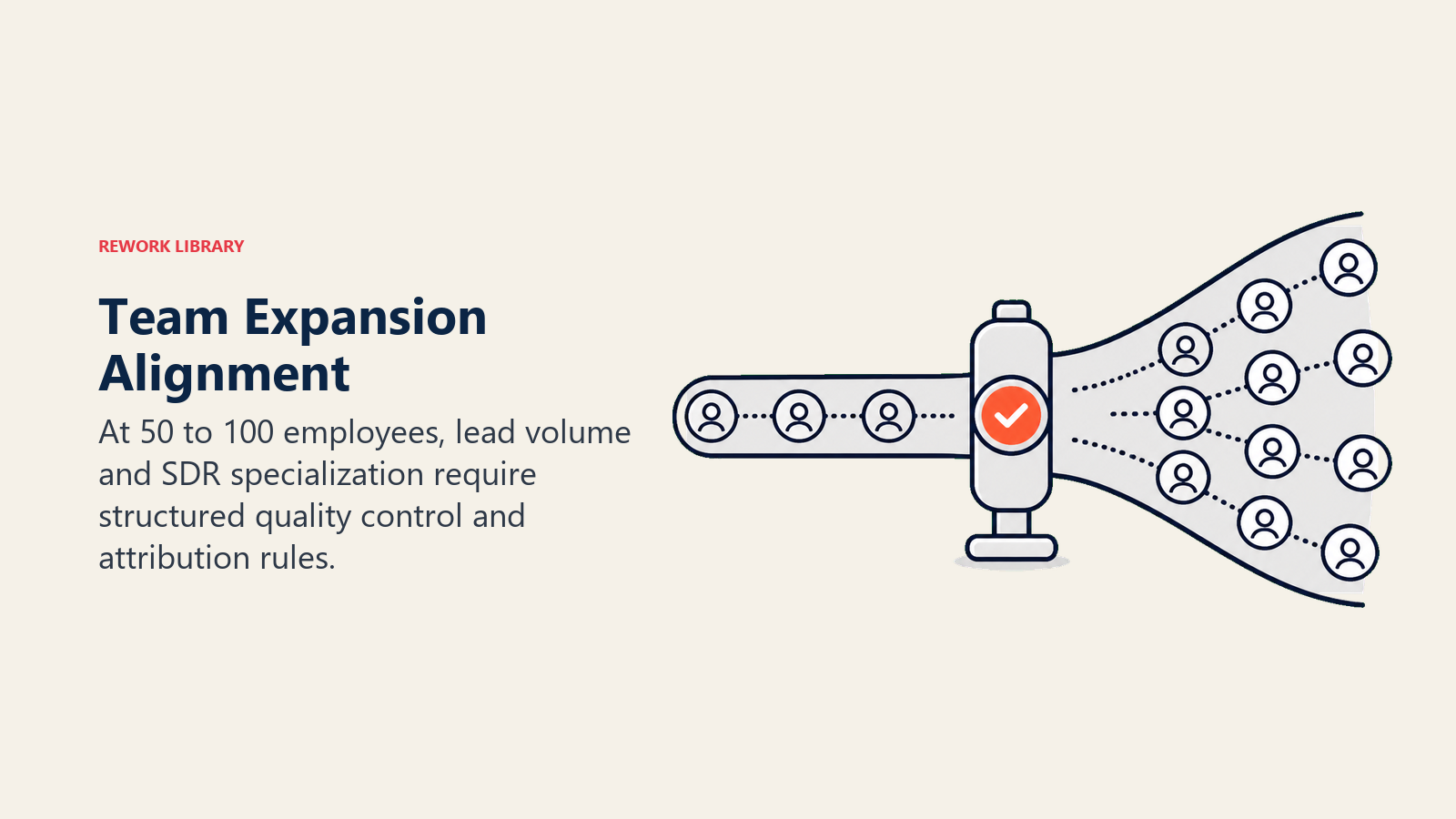
Inflection Point 2: The Team Expansion (50-100 Employees)

What happens at this stage: Multiple SDRs are now working the pipeline. A dedicated marketing manager (or a small demand gen team) is running programs. Lead volume has increased enough that informal quality control is no longer possible. Attribution becomes contested for the first time because there are enough resources at stake that both teams care about credit.

What breaks: The informal MQL definition doesn't hold across five SDRs with different standards. When one SDR accepts 70% of MQLs and another accepts 30%, the problem isn't the definition. It's that the definition hasn't been operationalized in a way that produces consistent behavior across a larger team.

The leading indicator you've hit this inflection: MQL rejection rate climbing above 30% with no one sure why. When rejection rate is high and the reasons are unclear, it usually means the definition and criteria haven't scaled with the team.

What to build at this stage:

Written MQL and SQL criteria, with examples. Not just "sales-ready intent." Specific criteria: job title matches ICP, company size above X, engagement score above Y, submitted a product-related form (not just content download). Examples of qualifying and disqualifying leads are as important as the criteria themselves. Shared definitions with examples are what actually produce consistent behavior across multiple SDRs.

A rejection reason taxonomy in the CRM. When a lead is rejected, the reason needs to be captured in a structured field: not in a Slack message, not in a note, but in a dropdown picklist in the CRM. The taxonomy doesn't need to be exhaustive: 6-8 categories cover most situations (bad fit, bad timing, already customer, duplicate, insufficient data, no engagement). This creates the feedback loop that lets marketing improve over time.

A weekly lead quality call. A 30-minute call between the marketing lead and the SDR team lead to review rejection patterns, discuss quality concerns, and agree on adjustments. This is the operational ritual that keeps the MQL definition from drifting as both teams grow. Without this call, the definition stays in a document and stops being a living agreement.

A first shared pipeline dashboard. Not a sophisticated attribution model, just a simple shared view that shows both teams the same pipeline numbers. MQL volume, acceptance rate, MQL-to-SQL conversion, and pipeline coverage. The goal is to eliminate the "whose numbers are right" argument by ensuring both teams start from the same data set. See CRM as single source of truth for the infrastructure that makes this possible.

RevOps at this stage: You don't need a dedicated hire yet. But someone needs to own the operational pieces: CRM hygiene, the MAP-to-CRM sync, the dashboard maintenance. Recognizing this as a role, even part-time, prevents it from falling through the cracks.

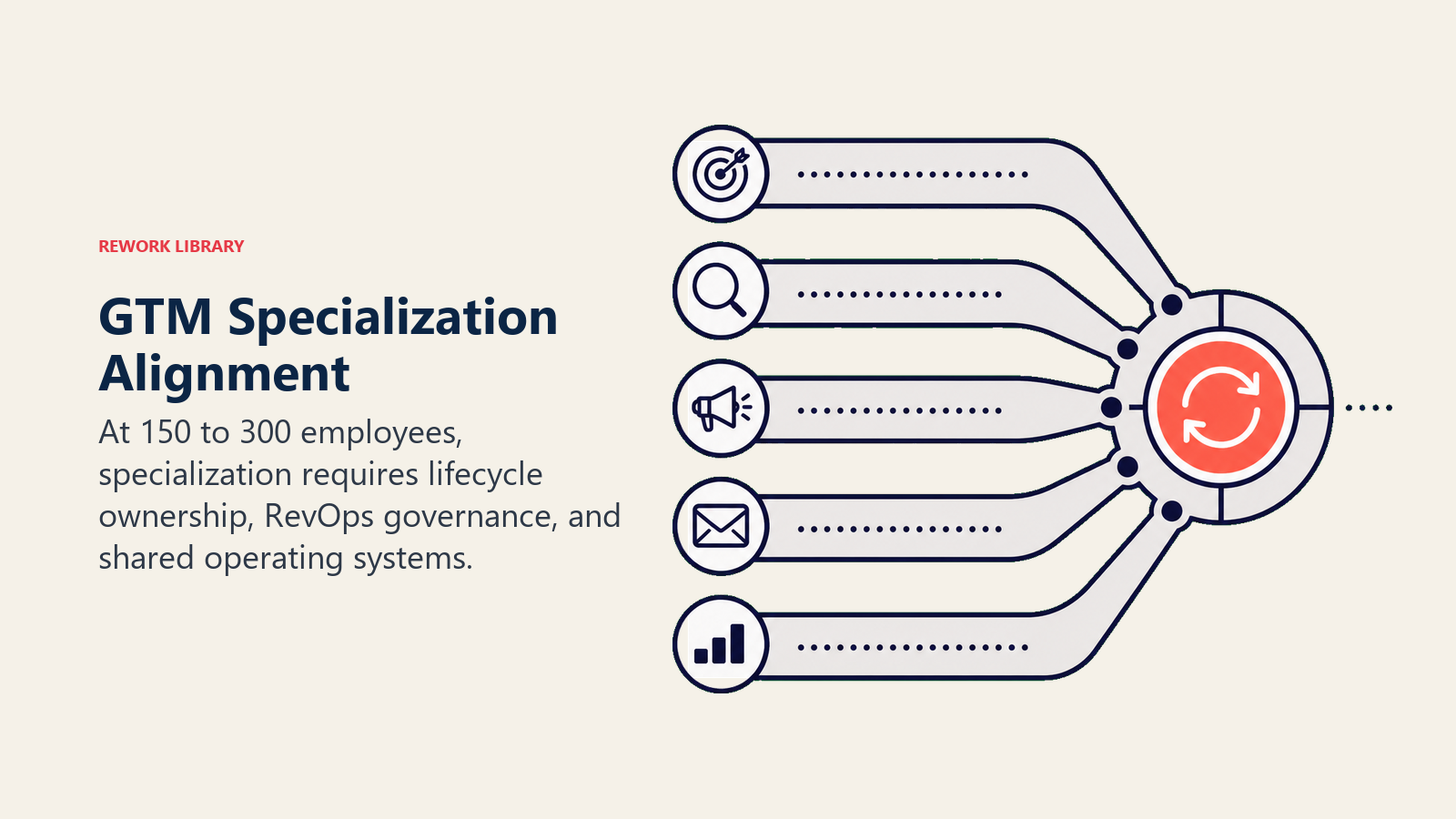
Inflection Point 3: The Go-to-Market Specialization (150-300 Employees)

What happens at this stage: The revenue team has genuinely specialized. Demand gen and ABM are separate functions within marketing. The SDR team splits into inbound and outbound tracks. Account executives are segmented by deal size or industry. Sales ops and marketing ops are distinct roles.

With specialization comes segmentation, and segmentation breaks the unified MQL definition from Stage 2. A definition that worked for a single mid-market ICP doesn't work when you're running separate programs for SMB, mid-market, and enterprise with different conversion criteria, different sales cycles, and different pipeline expectations.

What breaks: The shared MQL definition no longer fits all segments. An enterprise ABM lead with 20 touchpoints over six months gets the same status as an SMB inbound lead with one form fill, and that creates measurement distortions for both teams. Attribution is under pressure because the multi-touch journeys are longer and more complex. And RevOps, if it exists at all, is functioning as a ticket queue rather than a strategic function.

The leading indicator you've hit this inflection: marketing and sales leaders are citing different pipeline numbers in the same meeting. When the CMO presents "450 influenced opportunities" and the CRO presents "300 active opportunities" and neither team can explain the difference, the measurement infrastructure hasn't scaled with the go-to-market complexity. A conversion rate analysis across segments usually reveals where the definitions are diverging.

What to build at this stage:

Segment-specific MQL criteria. The enterprise ABM track, the mid-market inbound track, and the SMB self-serve track need separate criteria for what constitutes a sales-ready lead. This requires collaboration between demand gen, sales development, and segment-specific AE teams, not just a marketing ops decision.

Multi-touch attribution. If you've been running first-touch or last-touch attribution, this is the stage where the conversations about attribution credit get complex enough that a simple model produces real distortions. The U-shaped or W-shaped model is typically the right move at this stage, crediting both acquisition and qualification without requiring a full data science buildout. Understanding what lead management is at scale helps clarify which touchpoints should count as attribution events.

A dedicated RevOps function. Not a part-time ops person wearing multiple hats. A dedicated RevOps role with explicit authority over field definitions, process design, and cross-functional data governance. At 150-300 employees, the complexity of the revenue stack (CRM, MAP, sales engagement platform, pipeline forecasting tool, BI layer) requires someone who owns it as a full-time function.

A formal joint pipeline review cadence. The weekly lead quality call from Stage 2 isn't enough at this stage. You need a structured bi-weekly or monthly joint pipeline review where both teams review pipeline health, marketing contribution, and joint actions. The format and agenda matter now in a way they didn't when the team was smaller.

ABM-specific handoff protocols. When marketing is running account-based programs targeting named accounts, the handoff is fundamentally different from inbound MQL handoff. Account-level engagement signals need to flow to the AE team, not just the SDR team. Marketing and sales need agreed criteria for when an ABM account is "active" enough to trigger outbound engagement.

What to avoid at this stage: rebuilding from scratch. The MQL definition from Stage 2 isn't wrong. It needs to be segmented, not replaced. The shared dashboard isn't broken either. It needs segment-level views, not a restart. Audit what's working and layer on top.

The Alignment Maturity Spectrum

Across these three inflection points, there's a four-stage maturity spectrum. Most companies move through it roughly in sequence, though some stages can be skipped or compressed.

Stage What it looks like Where most SMB/mid-market companies are
Stage 1: Ad hoc No defined process; alignment depends on whether the CMO and CRO happen to get along personally Early-stage startups
Stage 2: Defined MQL definition exists and is documented; basic handoff SLA is in place Most companies at Inflection Point 1
Stage 3: Managed SLAs are enforced by the system; shared dashboards are in use; weekly quality feedback ritual exists Target state at Inflection Point 2
Stage 4: Optimized Attribution model is agreed on; ABM programs are jointly owned; RevOps functions as strategic planning partner Target state at Inflection Point 3

Most SMB and mid-market companies ($10M to $75M ARR) are somewhere between Stage 2 and Stage 3. They have a written MQL definition but it's drifting. They have a handoff SLA but it's not consistently enforced. They have one shared dashboard but three spreadsheet versions circulating alongside it.

That's not a failure state. It's the normal state of a growing company that's in the process of formalizing what used to be informal. The question is whether the formalization is keeping pace with the growth, or falling behind it.

The 5-Question Alignment Diagnostic

Use these questions to identify which inflection point your company is approaching and what to prioritize:

  1. Can any new SDR explain your MQL definition in one sentence without looking it up? If no, you're at or approaching Inflection Point 1. The definition isn't operational yet.

  2. Does your CRM capture rejection reasons in a structured field, and do you review rejection patterns monthly? If no, you're at or approaching Inflection Point 2. The feedback loop between sales and marketing is broken.

  3. Can both your CMO and CRO cite the same pipeline coverage number from the same source? If no, you're likely between Inflection Points 2 and 3. Your data infrastructure isn't unified.

  4. Do you have segment-specific MQL criteria for each of your go-to-market tracks (SMB, mid-market, enterprise, ABM)? If no and you have multiple distinct segments, you're at or approaching Inflection Point 3.

  5. Does RevOps own field definitions and process decisions, with authority to enforce them across both teams? If no, your alignment infrastructure is person-dependent, which means it breaks when people change roles.

The questions map to the three inflection points in order. If you're failing questions 1-2, fix those before worrying about questions 4-5. Attempting to implement multi-touch attribution at a company that doesn't have consistent rejection reason logging is building the roof before the foundation. The three cross-cutting patterns that explain why these breaks happen are worth understanding before you start.

Cross-Cutting Lessons From All Three Inflection Points

Three patterns show up at every alignment breakdown:

The trigger is headcount growth outpacing process. Alignment breaks because informal mechanisms stop functioning at the new team size, not because the team got worse. The fix is explicit documentation and structured process, not better people.

The fix is documentation, not more meetings. When alignment breaks, the instinct is to schedule another cross-functional meeting. But meetings surface the problem. Documentation and system changes fix it. Shared definitions and structured data capture do more work than any recurring sync.

Leadership change is the most common catalyst. Use the reset intentionally. When a new VP of Marketing or CRO joins, alignment often gets rebuilt. That's an opportunity. Plan the alignment rebuild as part of the onboarding. Don't wait for the new leader to discover the dysfunction six months in.

Rework Analysis: The companies that navigate alignment inflection points most smoothly treat each threshold as a planned infrastructure upgrade rather than an emergency repair. The pattern is predictable: informal coordination works at 15 people, starts failing at 30, and fully breaks between 50 and 75. The leading indicators are consistent: rising MQL rejection rates without logged reasons, pipeline numbers that differ between CMO and CRO presentations, SDRs applying the MQL definition inconsistently. When leadership spots two or more of these signals at once, the inflection point has arrived. The question is whether to rebuild proactively (1-2 quarters of managed transition) or reactively (2-4 quarters of dysfunction plus turnover).

Quotable Nuggets

"Companies that proactively rebuild alignment processes at growth inflection points lose 1-2 quarters of productivity during the transition. Those that react after breakdown lose 2-4 quarters, plus the turnover." (McKinsey B2B Sales Research)

"65% of high-growth companies report significant marketing-sales friction as a key operational challenge, with friction typically peaking at 50-150 employees. That's exactly the Inflection Point 2 threshold." (Bain & Company)

"Organizations that implement formal alignment structures before reaching 100 employees see 28% higher revenue per employee at scale than those that wait until dysfunction forces a fix." (SiriusDecisions)

The ROI of Getting Ahead

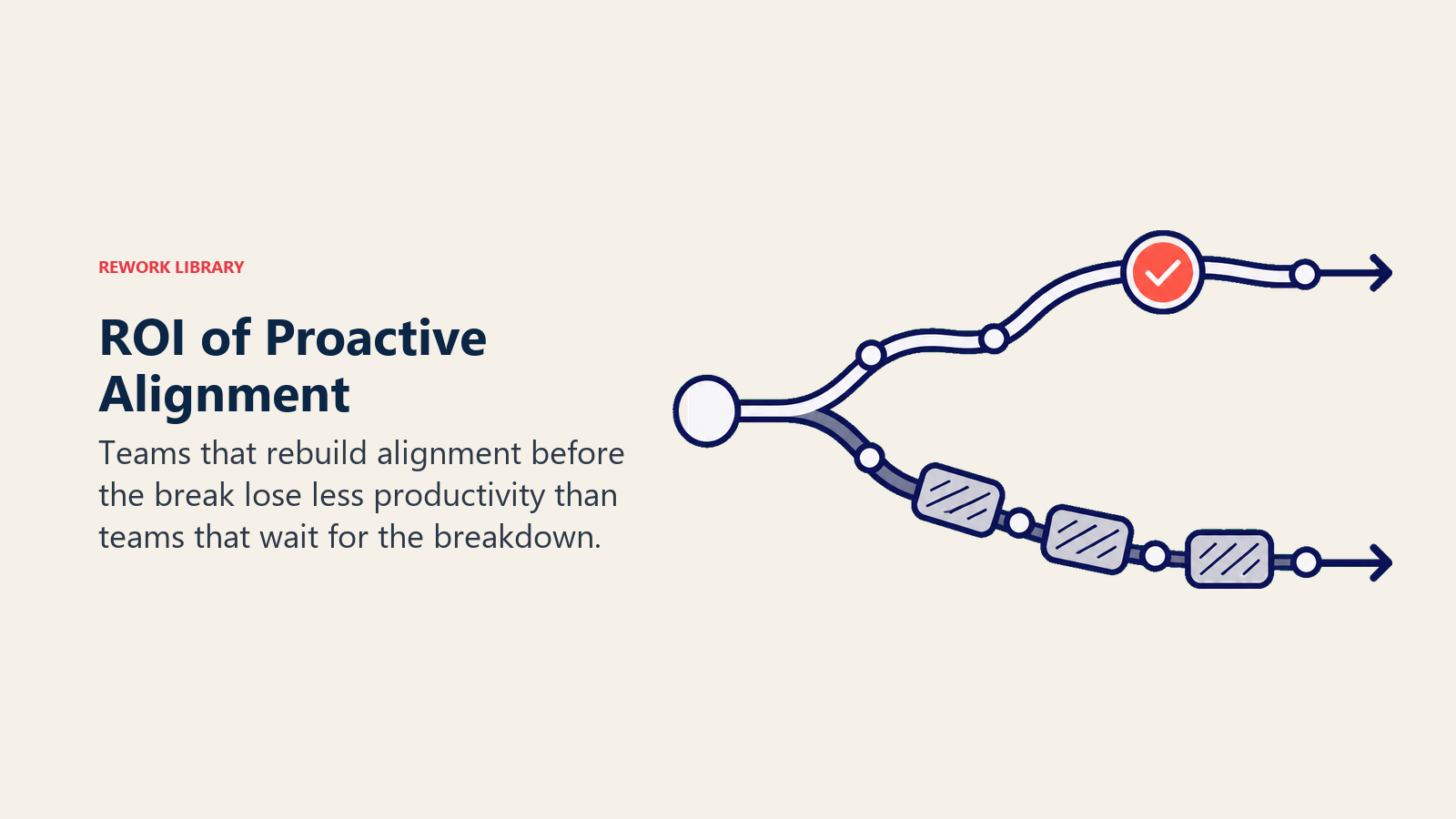
Companies that rebuild alignment before it breaks lose one to two quarters of productivity during the transition. Companies that react after it breaks lose two to four quarters, plus the turnover that comes when SDRs and marketing managers get tired of a dysfunction that leadership seems unwilling to address.

The timing is predictable. You can see the inflection points coming from your hiring plan. The alignment maturity model shows where you are now; the inflection point framework shows when the next break is likely. Put those two together and you have something most companies don't: enough lead time to fix the alignment infrastructure before it becomes a crisis.

Frequently Asked Questions

When does a company need a dedicated RevOps function?

Most companies need a dedicated RevOps hire when they reach 150-300 employees and have segmented their go-to-market into at least two distinct tracks (for example, SMB inbound and enterprise ABM). Before that threshold, a part-time ops owner, someone who maintains CRM hygiene, MAP-to-CRM sync, and dashboard maintenance as a recognized responsibility, is usually sufficient. The signal that you need a dedicated hire: RevOps work is consistently deprioritized because the person doing it has another primary role, and data quality is visibly declining as a result.

When does informal alignment stop working?

Informal alignment ("just Slack Mike," shared context from proximity, founder-led handoffs) works reliably up to about 15 people. It starts failing between 20 and 30 people as the team grows past the point where everyone can see what's happening. By 50 people, informal alignment is unreliable even when leaders are closely aligned. The mechanism fails because informal coordination doesn't transmit through organizational layers. Leadership alignment sits at the top and leaks before it reaches the SDRs applying the MQL definition day-to-day.

What specifically changes at each alignment inflection point?

At Inflection Point 1 (10-20 employees), the handoff from "the person who does marketing" to "the person whose job is sales" needs an explicit MQL definition and handoff SLA, because shared context no longer exists between separate roles. At Inflection Point 2 (50-100 employees), the MQL definition needs to be operationalized with written criteria and examples, because inconsistent SDR interpretation becomes the primary quality problem. At Inflection Point 3 (150-300 employees), the single MQL definition needs to split into segment-specific criteria, because a unified definition produces distortions across enterprise, mid-market, and SMB tracks with fundamentally different qualification standards.

What are the leading indicators that alignment is about to break?

Three early signals appear reliably before alignment fully breaks: (1) more than two "where did that lead go?" questions per week, indicating handoff process breakdown; (2) MQL rejection rate climbing above 30% with no one able to explain why, indicating the definition hasn't scaled with the team; (3) the CMO and CRO citing different pipeline numbers from different sources in the same meeting, indicating the data infrastructure hasn't unified. Any single signal warrants investigation. Two or three at once means the inflection point has arrived.

Is RevOps the same as sales ops?

No. Sales ops focuses on sales team performance: territory design, quota setting, compensation structure, rep-level reporting, and CRM enablement for the sales organization. RevOps is a broader function that owns the revenue operating model across marketing, sales, and customer success: field definitions that apply to all three teams, the MAP-to-CRM sync, cross-functional reporting, pipeline governance, and process design for handoffs between functions. At companies under 150 employees, one person often covers both roles. At scale, they're distinct functions that need to coordinate closely.

How do you get ahead of the next inflection point before it breaks?

Use your hiring plan as the signal. If you're at 30 employees and planning to hire to 60 in the next 12 months, Inflection Point 2 is 6-9 months away. Start building the Inflection Point 2 infrastructure now: written MQL criteria with examples, a rejection reason taxonomy in the CRM, a weekly lead quality call, and a first shared pipeline dashboard. The companies that navigate inflection points smoothly are the ones that read the hiring plan as a process roadmap, not just a headcount exercise. You can see the threshold coming. That lead time is the advantage.

Learn More