Pemeriksaan Kesiapan Data per Pola AI

Turn this article into takeaways for your work.


Each assistant summarizes the article only for you and suggests best practices for your work.
Alasan utama implementasi AI gagal dalam 90 hari pertama adalah kesenjangan kesiapan data yang tidak diaudit di fase perencanaan.
Bukan karena pemilihan pola yang salah. Bukan kegagalan vendor. Bukan kurangnya dukungan tim. Ini adalah kesenjangan antara apa yang dibutuhkan pola tersebut dan kondisi data yang sebenarnya, yang baru ditemukan tiga bulan setelah budget dialokasikan. Riset Gartner pada Februari 2025 tentang data siap AI memberikan angka konkretnya: 63% organisasi tidak memiliki, atau tidak yakin apakah mereka memiliki, praktik manajemen data yang tepat untuk AI, dan Gartner memprediksi organisasi akan meninggalkan 60% proyek AI yang tidak didukung data siap AI.
Artikel ini adalah auditnya. Jalankan sebelum Anda menandatangani kontrak, sebelum memulai implementasi, sebelum mengumumkan deployment. Setiap pola memiliki persyaratan data minimum yang berbeda dan mode kegagalan yang berbeda ketika data tidak mencukupi. Saran generik tentang "memastikan data bersih" tidak berguna di sini. Ini spesifik. Konteks yang lebih luas tentang mengapa ini penting ada di kesiapan data: prasyarat yang sering dilewati proyek AI, dan taksonomi data lengkap ada di 7 tipe data yang mendukung AI bisnis.
Apa arti kesiapan data per pola
Lima dimensi, dinilai per pola:
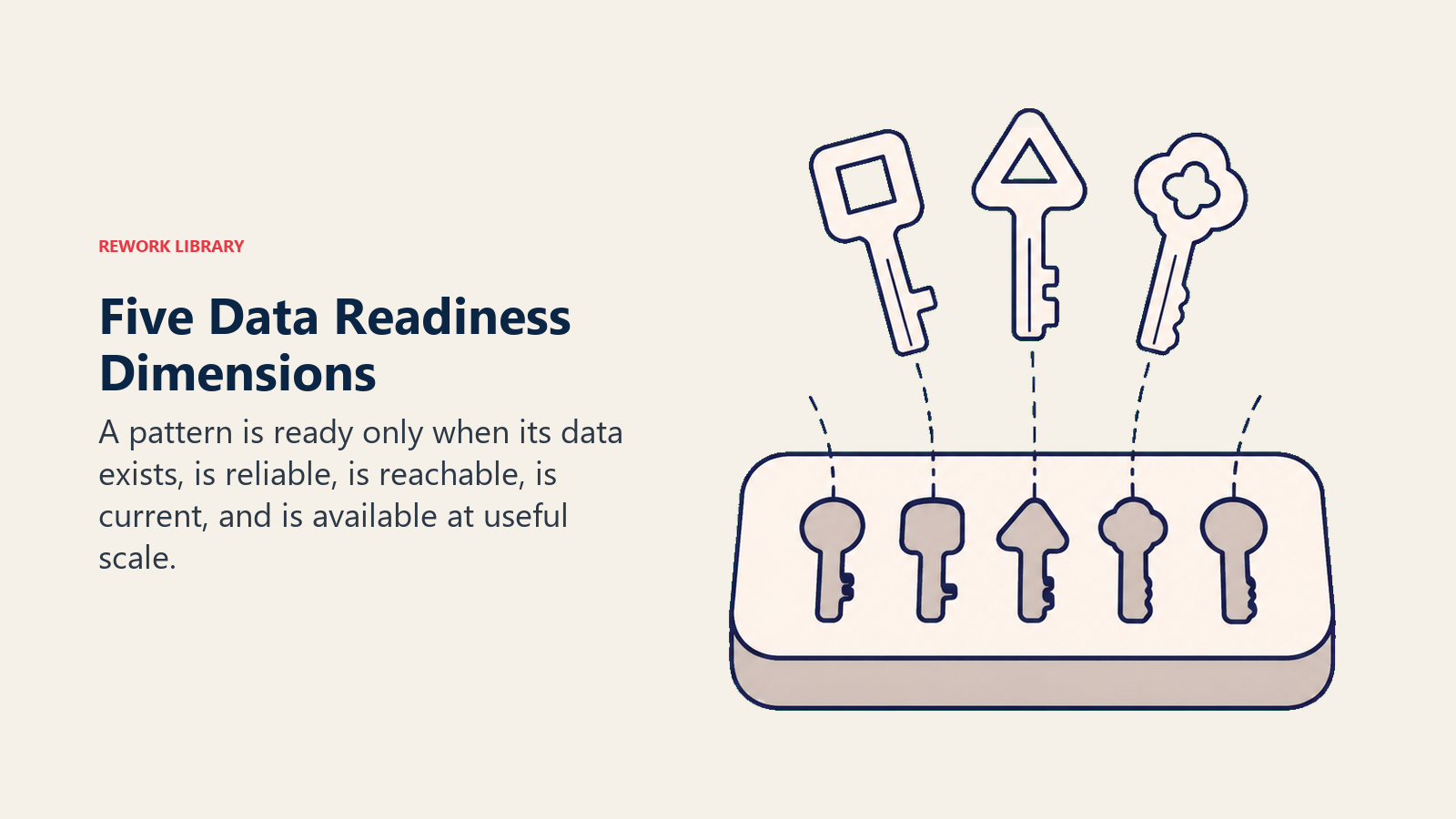
Ketersediaan: Apakah data ada di organisasi Anda? Jika jawabannya tidak, Anda memiliki kesenjangan data, bukan kesenjangan kesiapan. Pola tersebut tidak dapat di-deploy sampai datanya ada.
Kualitas: Apakah data cukup akurat, lengkap, dan konsisten untuk tujuan pola tersebut? Persyaratan kualitas bervariasi per pola. RAG Assistant membutuhkan dokumen yang tidak saling bertentangan. Model scoring membutuhkan label outcome pada catatan historis. Anomaly Agent membutuhkan aliran baseline yang bersih dan tidak terputus.
Akses: Apakah sistem AI benar-benar dapat mengakses data tersebut? Dapat diakses secara teknis dan dapat diakses secara organisasional adalah dua hal yang berbeda. Pembatasan hukum, keamanan, atau kepatuhan dapat memblokir akses ke data yang ada dan berkualitas tinggi.
Freshness: Apakah data cukup terkini untuk berguna bagi pola ini? RAG Assistant yang menggunakan kebijakan berusia 2 tahun memberikan jawaban yang percaya diri tapi salah. Model scoring yang dilatih dengan data deal dari sebelum perubahan produk terakhir Anda melakukan scoring berdasarkan pola yang tidak lagi berlaku.
Volume: Apakah ada cukup data untuk membangun baseline yang andal, melatih model yang bermakna, atau memberikan konteks yang memadai? Beberapa pola memiliki persyaratan volume minimum yang spesifik. Kebanyakan operator meremehkan seberapa banyak data historis yang dibutuhkan pola berbasis Predict untuk menghasilkan output yang andal.
Key Facts: Kesiapan Data dan Kegagalan AI
- 63% organisasi tidak memiliki, atau tidak yakin apakah mereka memiliki, praktik manajemen data yang tepat untuk AI. (Gartner, Februari 2025)
- Gartner memprediksi organisasi akan meninggalkan 60% proyek AI yang tidak didukung data siap AI hingga 2026, terlepas dari pilihan model atau vendor.
- 99% proyek AI dan ML mengalami masalah kualitas data selama implementasi, dengan biaya remediasi kualitas data rata-rata $12,9 juta per tahun untuk perusahaan. (SpaceO Technologies, 2026)
RAG Assistant
Ketergantungan kritis: Knowledge base yang terawat baik dan tidak saling bertentangan.
Persyaratan minimum:
- Dokumen dapat ditemukan dan diindeks (tidak terkunci dalam format file yang tidak dapat diproses sistem RAG, tidak tersebar di shared drive yang tidak dapat diakses)
- Tidak ada dua dokumen yang secara aktif bertentangan satu sama lain tentang topik yang sama
- Dokumen menyertakan metadata untuk filtering: tanggal dibuat atau diperbarui, topik atau departemen, apakah dokumen masih berlaku atau sudah digantikan
- Setidaknya 80% dokumen mencerminkan kebijakan dan proses saat ini (bukan yang berlaku 12-18 bulan lalu)
Kesenjangan umum:
- Dokumen kebijakan yang saling bertentangan. Panduan tunjangan dari 2023 dan yang diperbarui dari 2025 ada bersamaan, dan sistem mungkin mengambil salah satunya.
- Konten tanpa tanggal. Sistem RAG tidak dapat memfilter berdasarkan freshness jika dokumen tidak memiliki metadata tanggal.
- Struktur dokumen yang buruk. PDF panjang dan tidak terstruktur tanpa heading menghasilkan retrieval yang buruk. Sistem tidak dapat menemukan bagian yang relevan dalam dokumen 40 halaman jika tidak ada anchor point.
- "Shadow knowledge" yang hidup di thread Slack, rantai email, atau kepala orang-orang, bukan dalam dokumen. Sistem RAG hanya sebaik apa yang ada dalam indeks.
Uji kesiapan: Minta karyawan baru untuk menemukan jawaban atas lima pertanyaan kebijakan menggunakan hanya dokumen yang akan Anda masukkan ke sistem RAG. Jika mereka menemukan jawaban yang bertentangan, atau tidak dapat menemukan jawaban sama sekali untuk pertanyaan yang seharusnya tercakup, Anda memiliki masalah kualitas knowledge base. Perbaiki knowledge base sebelum melakukan deployment.
Scoring dan Routing
Ketergantungan kritis: Label outcome historis.
Persyaratan minimum:
- Minimal 12 bulan catatan historis dengan label outcome (lead ditandai menang/kalah, tiket ditandai diselesaikan/dieskalasi, lamaran ditandai diterima/tidak diterima)
- Volume minimum biasanya 1.000+ outcome berlabel untuk model scoring yang andal. Catatan yang lebih sedikit menghasilkan model yang tidak andal dan membutuhkan waktu kalibrasi yang signifikan.
- Periode data harus mencerminkan model bisnis Anda saat ini. Jika proses penjualan, ICP, atau produk Anda berubah signifikan 18 bulan lalu, data dari sebelum perubahan itu kemungkinan menyesatkan, bukan membantu.
- Fitur kunci yang digunakan dalam scoring (ukuran perusahaan, industri, tahap deal, produk) harus ada di setidaknya 70% catatan. Nilai kosong yang tinggi pada fitur kunci menurunkan kualitas model.
- Kode alasan menang/kalah (jika digunakan untuk coaching atau peningkatan routing) perlu setidaknya sebagian terisi dan konsisten.
Kesenjangan umum:
- Tidak ada pelacakan outcome. Kesenjangan paling umum: deal ada di CRM, tetapi field menang/kalah tidak diwajibkan. Model tidak memiliki apa pun untuk dilatih.
- Label historis yang bias. Jika data historis Anda dibuat di bawah sistem routing sebelumnya yang menyukai rep atau segmen tertentu, model belajar bias tersebut, bukan ground truth.
- Data yang jarang untuk segmen baru. Jika Anda memasuki pasar baru 6 bulan lalu, Anda tidak memiliki cukup data outcome dari segmen tersebut untuk melakukan scoring secara andal. Model akan default ke pola dari segmen lama Anda.
- Data yang usang. Menggunakan data pelatihan dari 3 tahun lalu ketika sales motion Anda telah berkembang menghasilkan model yang percaya diri tapi salah tentang pola Anda saat ini.
"Model scoring yang di-deploy pada dataset CRM di mana label outcome ada di kurang dari 70% catatan menghasilkan noise scoring, bukan sinyal. Model menghasilkan angka yang percaya diri yang tidak berkorelasi dengan probabilitas menang. Lead dengan skor tinggi ditutup dengan tingkat yang sama seperti yang berskor rendah. Masalahnya bukan modelnya. Data pelatihan tidak memiliki cukup sinyal untuk dipelajari." (Rework CRM Data Readiness Analysis, 2026)
Uji kesiapan: Ambil 100 catatan historis secara acak. Berapa persentase yang memiliki label outcome menang/kalah? Berapa persentase yang memiliki lima field fitur terpenting Anda terisi? Jika salah satu jawaban di bawah 70%, Anda memiliki masalah kelengkapan data yang perlu diselesaikan sebelum melatih model scoring yang bermakna.
Vision Extract
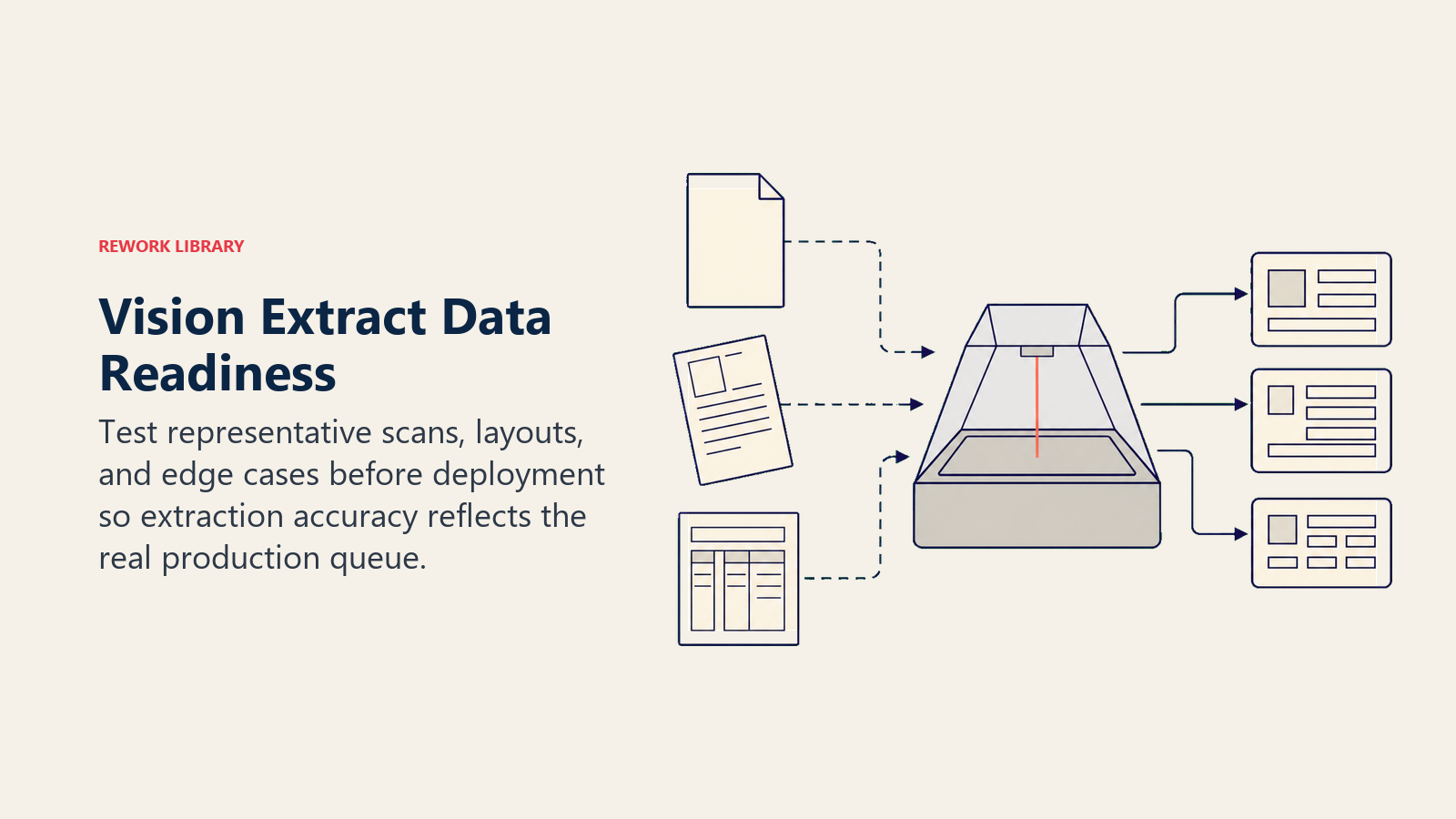
Ketergantungan kritis: Kualitas dokumen dan cakupan format.
Persyaratan minimum:
- Resolusi gambar yang cukup untuk OCR (biasanya minimum 200 DPI; 300 DPI direkomendasikan untuk dokumen dengan teks kecil)
- Format dokumen yang mewakili seluruh varian yang akan Anda proses dalam produksi. Model yang dilatih pada faktur digital yang jelas akan gagal pada faktur yang dipindai dari vendor yang sama jika kualitas pindaian bervariasi.
- Sampel pelatihan berlabel untuk format dokumen apa pun yang berbeda secara signifikan dari standar (formulir kustom, faktur non-bahasa Inggris, tata letak khusus industri)
- Struktur field target yang konsisten. Jika informasi yang sama (nama vendor, nomor faktur, total jumlah) muncul di posisi berbeda di berbagai varian dokumen, model membutuhkan sampel pelatihan yang mencakup setiap varian.
Kesenjangan umum:
- Format dokumen campuran dari beberapa vendor di mana setiap vendor menggunakan template faktur yang berbeda. Model dasar menangani faktur standar dengan baik tetapi gagal pada 15% format non-standar.
- Anotasi tulisan tangan. OCR teks ketikan sudah matang dan andal. OCR teks tulisan tangan jauh kurang andal. Jika dokumen Anda berisi field atau anotasi tulisan tangan, tandai ini secara eksplisit selama evaluasi vendor.
- Dipindai dengan sudut miring. Dokumen yang dipindai sedikit miring menghasilkan akurasi OCR yang menurun. Ini umum terjadi ketika dokumen diproses melalui printer multifungsi kantor.
- Pindaian gelap atau kontras rendah. Tinta yang memudar, eksposur pindaian yang buruk, dan kertas berwarna semua mengurangi akurasi.
Uji kesiapan: Kumpulkan 50 dokumen representatif dari antrean produksi Anda, termasuk semua edge case (vendor berbeda, format berbeda, kualitas pindaian berbeda). Jalankan melalui demo atau uji coba vendor mana pun. Perhatikan di mana ekstraksi gagal. Jika kegagalan terkonsentrasi pada format yang sering Anda lihat, Anda memerlukan model yang lebih baik atau data pelatihan kustom sebelum deployment.
Meeting Intelligence
Ketergantungan kritis: Akses rekaman yang konsisten dan kualitas data CRM.
Persyaratan minimum:
- Rekaman diaktifkan di platform meeting (Zoom, Teams, Google Meet) dengan dokumentasi persetujuan peserta di yurisdiksi yang memerlukannya
- Kualitas audio yang cukup untuk transkripsi. Panggilan yang direkam terutama melalui speaker, lingkungan yang bising, atau koneksi bandwidth rendah menghasilkan transkrip yang buruk.
- Speaker diarization (mengetahui siapa yang mengatakan apa) membutuhkan setidaknya dua saluran audio yang berbeda atau identifikasi speaker yang andal. Audio saluran tunggal yang digabungkan mengacaukan atribusi pembicara.
- Catatan kontak dan akun CRM yang terkait dengan peserta. Alat Meeting Intelligence yang tidak dapat menghubungkan panggilan ke deal atau akun menghasilkan ringkasan yang berguna untuk meeting individual tetapi tidak dapat berkontribusi pada analitik deal atau analisis coaching.
Kesenjangan umum:
- Kebijakan rekaman yang tidak konsisten di seluruh tim. Jika hanya 40% panggilan yang direkam, data Meeting Intelligence Anda mencerminkan rep yang paling patuh, bukan tim secara keseluruhan.
- Tidak ada tautan CRM-ke-panggilan. Panggilan yang tidak terhubung ke catatan CRM ada sebagai ringkasan terisolasi. Mereka tidak dapat masuk ke Scoring + Routing, analisis kesehatan deal, atau coaching.
- Praktik persetujuan yang tidak jelas. Di yurisdiksi dua pihak (sebagian besar negara bagian AS, sebagian besar negara UE), merekam tanpa pemberitahuan menciptakan risiko hukum. Banyak tim menemukan praktik rekaman mereka memiliki kesenjangan kepatuhan ketika mencoba men-deploy alat Meeting Intelligence.
Uji kesiapan: Ambil 50 panggilan penjualan terakhir Anda. Berapa persentase yang direkam? Berapa persentase rekaman tersebut yang terhubung ke catatan CRM? Jika cakupan rekaman di bawah 70%, selesaikan masalah kebijakan dan tautan teknis sebelum melakukan deployment. Data parsial menghasilkan analitik yang menyesatkan.
Anomaly Agent
Ketergantungan kritis: Baseline yang stabil dan cukup panjang.
Persyaratan minimum:
- Minimum 60-90 hari data yang bersih dan tidak terputus sebelum mengaktifkan alert. Bisnis dengan pola musiman membutuhkan satu tahun penuh untuk menetapkan seperti apa "normal" di semua variasi musiman.
- Granularitas data yang sesuai dengan anomali yang ingin Anda deteksi. Deteksi penipuan pada transaksi membutuhkan data per transaksi. Anomali manufaktur pada lini produksi per jam membutuhkan pembacaan sensor per jam. Rollup harian tidak akan mendeteksi anomali dalam hari yang sama.
- Konsistensi aliran data. Metrik yang mengubah instrumentasi di tengah aliran (unit berbeda, laju sampling berbeda, nama field berbeda) menciptakan anomali buatan pada saat perubahan instrumentasi. Bersihkan perubahan aliran sebelum menetapkan baseline.
- Tidak ada celah data yang lebih besar dari interval pengukuran alami. Celah dalam aliran terlihat seperti anomali bagi model, atau lebih buruk, menyembunyikan anomali nyata yang terjadi selama celah tersebut.
Kesenjangan umum:
- Panjang baseline yang tidak mencukupi. Dua atau empat minggu data bukanlah baseline. Tim melakukan deployment, segalanya tampak anomalus di minggu ketiga, kelelahan alert muncul, dan deployment dinonaktifkan. Ini adalah mode kegagalan Anomaly Agent yang paling umum.
- Data musiman tanpa penyesuaian musiman. Volume transaksi perusahaan ritel tampak anomalus di bulan November jika baseline tidak memperhitungkan lonjakan liburan. Model perlu mempelajari musiman sebelum dapat menandai penyimpangan dari norma musiman.
- Sumber data campuran dengan schema yang berbeda. Jika aliran metrik Anda menggabungkan data dari dua sistem yang mendefinisikan kejadian yang sama secara berbeda, model mempelajari pola yang tidak konsisten.
Uji kesiapan: Jalankan model dalam mode observasi selama 90 hari sebelum mengaktifkan alert apa pun. Setiap hari, tinjau item yang ditandainya. Jika lebih dari 30% jelas bukan anomali (dapat dijelaskan oleh konteks yang Anda miliki), baseline belum terbentuk. Terus observasi.
Generative Research
Ketergantungan kritis: Aksesibilitas sumber dan fidelitas kutipan.
Persyaratan minimum:
- Akses API langsung atau akses scraping yang andal ke sumber yang perlu dicakup penelitian
- Jadwal pembaruan yang konsisten: sumber yang diperbarui lebih cepat dari indeks akan menghasilkan penelitian yang mengutip informasi usang
- Standar kutipan yang terdefinisi: setiap klaim dalam output membutuhkan kutipan sumber yang dapat dilacak, bukan hanya parafrase
- Gate tinjauan manusia sebelum output penelitian apa pun didistribusikan secara eksternal atau ke pengambil keputusan senior
Kesenjangan umum:
- Sumber di balik paywall yang tidak dapat diakses sistem. Model baik menghallusinasikan konten yang "diharapkannya" ada di sana, atau hanya menghilangkan sumber tersebut tanpa menandai bahwa itu hilang.
- Lag freshness indeks. Untuk intelijen kompetitif, alat penelitian yang mengindeks sumber setiap minggu akan melewatkan peluncuran produk dan pengumuman dari minggu berjalan.
- Tidak ada audit trail. Jika tim mendistribusikan output penelitian dan sebuah fakta ternyata salah, tidak ada cara untuk melacak asal kesalahan jika kutipan sumber tidak dicatat.
Uji kesiapan: Ajukan lima pertanyaan penelitian di mana Anda sudah mengetahui jawabannya (peluncuran produk kompetitor terbaru, statistik industri terbaru). Periksa apakah jawaban alat tersebut akurat dan apakah setiap klaim memiliki kutipan yang dapat dilacak. Jika akurasi di bawah 80% pada fakta yang diketahui, akses sumber atau kualitas generasi belum siap untuk penggunaan produksi.
Document Review
Ketergantungan kritis: Standar referensi untuk dibandingkan.
Persyaratan minimum:
- Pustaka template atau standar: untuk review kontrak, ini berarti NDA, MSA, perjanjian vendor, dan addenda kustom standar Anda. AI mengidentifikasi penyimpangan dari standar ini, sehingga standarnya perlu ada.
- Aksesibilitas format dokumen: PDF perlu berupa PDF berlapis teks, bukan PDF gambar. PDF gambar memerlukan pre-processing OCR, menambahkan kompleksitas dan potensi kesalahan.
- Tinjauan penanganan data vendor: kontrak sering berisi ketentuan rahasia, nama pelanggan, dan kewajiban keuangan. Kebijakan penanganan data vendor perlu ditinjau sebelum mengirim dokumen melalui sistem mereka.
Kesenjangan umum:
- Tidak ada standar untuk dibandingkan. Tim sering menginginkan AI review kontrak tetapi belum memformalkan ketentuan standar mereka. AI tidak memiliki baseline untuk "apa yang seharusnya dikatakan klausul ini?" Perbaiki ini sebelum melakukan deployment.
- Format dokumen yang sangat bervariasi. Jika setiap vendor yang Anda ajak bekerja sama menggunakan template kontrak mereka sendiri, kemampuan AI untuk menandai penyimpangan bergantung pada seberapa banyak varian yang dilatihnya untuk ditangani. Kontrak standar dari vendor besar biasanya tercakup. Kontrak bespoke dari vendor kecil atau internasional mungkin tidak.
- Pertimbangan kerahasiaan yang mencegah pengiriman dokumen melalui sistem vendor. Beberapa organisasi memproses kontrak yang berisi informasi rahasia klien yang tidak dapat mereka bagikan dengan sistem AI vendor. Ini adalah pemblokir yang memerlukan opsi build atau vendor dengan jaminan penanganan data tertentu.
Uji kesiapan: Pilih 20 dokumen representatif dari antrean kontrak terbaru Anda. Verifikasi bahwa semuanya adalah PDF berlapis teks (bukan pindaian gambar). Periksa apakah pustaka template standar Anda didokumentasikan dalam bentuk yang dapat direferensikan AI. Jika lebih dari sepertiga dokumen Anda adalah PDF gambar, tambahkan pre-processing OCR ke rencana implementasi Anda.
Workflow Copilot, Personalization Engine, Autonomous Agent
Workflow Copilot: Ketergantungan kritis adalah akses konteks. Copilot membutuhkan akses baca langsung ke apa pun yang sedang dikerjakan pengguna. Jika integrasi konteks memerlukan API yang tidak ada atau tidak tersedia, copilot tidak dapat memberikan saran yang relevan. Pemeriksaan pra-deployment: petakan setiap sumber data yang perlu dibaca copilot, konfirmasi akses API ada, dan verifikasi kualitas data di setiap sumber.
Personalization Engine: Ketergantungan kritis adalah telemetri perilaku. Anda membutuhkan event perilaku per pengguna (klik, tampilan, pembelian, waktu keterlibatan) yang dilacak secara konsisten, setiap event dikaitkan dengan identifier pengguna, dan volume yang cukup per pengguna untuk membangun profil preferensi individu. Untuk aplikasi B2B, "pengguna" mungkin berarti akun daripada individu. Pemeriksaan pra-deployment: tarik rata-rata event-per-pengguna-per-bulan Anda. Kurang dari 50 event per pengguna per bulan umumnya tidak mencukupi untuk personalisasi yang bermakna.
Autonomous Agent: Ketergantungan kritis adalah kontrak API tool dan definisi batas keamanan. Agent membutuhkan kontrak API yang terdokumentasi untuk setiap tool yang dapat dipanggilnya, dengan izin eksplisit untuk apa yang dapat dibaca, apa yang dapat ditulis, dan tindakan apa yang diblokir. Batas keamanan (apa yang tidak pernah boleh dilakukan agent secara otonom) perlu didefinisikan sebelum deployment, bukan setelah insiden pertama. Pemeriksaan pra-deployment: dapatkah Anda membuat daftar tertulis setiap API yang dipanggil agent, data apa yang dibacanya dari masing-masing, tindakan apa yang dapat dilakukannya, dan tindakan apa yang secara eksplisit diblokir?
Uji Kesiapan Data 5 Dimensi
Uji Kesiapan Data 5 Dimensi adalah framework audit yang mengevaluasi deployment pola AI mana pun terhadap lima dimensi ortogonal sebelum implementasi dimulai: Availability (apakah datanya ada?), Quality (apakah cukup akurat, lengkap, dan konsisten?), Access (apakah sistem AI dapat menjangkaunya?), Freshness (apakah cukup terkini untuk tujuan pola ini?), dan Volume (apakah cukup untuk pelatihan atau baseline yang andal?). Setiap dimensi dinilai dari 1 (tidak siap) hingga 5 (sepenuhnya siap). Dimensi mana pun di bawah 3 adalah pemblokir prasyarat, bukan risiko yang perlu dikelola. Tes ini dirancang untuk dijalankan bersama tim yang memiliki setiap sumber data, bukan hanya tim yang memiliki deployment AI, karena hasil paling berguna adalah memunculkan ketidaksepakatan antara pemilik data dan tim deployment AI tentang apa sebenarnya datanya.
Rework Analysis: Berdasarkan temuan Gartner bahwa 63% organisasi tidak tahu apakah praktik manajemen data mereka memenuhi persyaratan AI, dan temuan McKinsey bahwa 70% organisasi AI berkinerja tinggi melaporkan kesulitan mengintegrasikan data ke dalam model AI dengan cepat, Uji Kesiapan Data 5 Dimensi menangani fase implementasi AI yang paling kurang diinvestasi. Dalam data implementasi Rework, tim yang menyelesaikan audit kesiapan data formal sebelum memulai pekerjaan build menghabiskan rata-rata $47.000 lebih sedikit untuk remediasi data di tengah implementasi dibandingkan tim yang menemukan kesenjangan kesiapan selama pengujian integrasi.
Scorecard kesiapan data
Untuk setiap pola yang Anda rencanakan untuk di-deploy, nilai diri Anda pada setiap dimensi dari 1 (tidak siap) hingga 5 (sepenuhnya siap). Dimensi mana pun di bawah 3 adalah pemblokir prasyarat, bukan risiko implementasi.
| Pola | Ketersediaan | Kualitas | Akses | Freshness | Volume | Tindakan jika ada < 3 |
|---|---|---|---|---|---|---|
| RAG Assistant | /5 | /5 | /5 | /5 | /5 | Perbaiki knowledge base sebelum deployment |
| Scoring + Routing | /5 | /5 | /5 | /5 | /5 | Kumpulkan outcome berlabel sebelum pelatihan |
| Vision Extract | /5 | /5 | /5 | /5 | /5 | Kumpulkan sampel representatif terlebih dahulu |
| Meeting Intelligence | /5 | /5 | /5 | /5 | /5 | Perbaiki cakupan rekaman dan tautan CRM |
| Anomaly Agent | /5 | /5 | /5 | /5 | /5 | Tetapkan baseline 90 hari sebelum alert |
| Generative Research | /5 | /5 | /5 | /5 | /5 | Audit akses sumber dan proses kutipan |
| Document Review | /5 | /5 | /5 | /5 | /5 | Dokumentasikan template standar terlebih dahulu |
| Workflow Copilot | /5 | /5 | /5 | /5 | /5 | Petakan dan uji semua integrasi API konteks |
| Personalization Engine | /5 | /5 | /5 | /5 | /5 | Verifikasi volume event per pengguna |
| Autonomous Agent | /5 | /5 | /5 | /5 | /5 | Dokumentasikan semua kontrak tool dan batas keamanan |
Jalankan scorecard ini bersama tim yang memiliki setiap sumber data, bukan hanya tim yang memiliki deployment AI. Hal paling berguna yang dilakukan latihan ini adalah memunculkan ketidaksepakatan tentang kualitas data antara orang yang mengelola data dan orang yang ingin menggunakannya. Riset McKinsey mengkonfirmasi dinamika organisasi ini: bahkan di antara organisasi AI berkinerja tinggi, 70% melaporkan kesulitan mengintegrasikan data ke dalam model AI dengan cepat, dan yang berkinerja tertinggi adalah mereka yang mendesain ulang alur kerja data daripada melapisi AI di atas infrastruktur data lama.
Sebelum Anda mengalokasikan budget
Kesiapan data adalah audit prasyarat, bukan pertanyaan filosofis. Hasil audit ini adalah daftar item pemblokir yang perlu diselesaikan sebelum pola dapat di-deploy, bukan aspirasi umum untuk meningkatkan kualitas data.
Setiap item pemblokir membutuhkan pemilik, timeline, dan kriteria keberhasilan. "Tingkatkan kualitas data CRM" bukan resolusi item pemblokir. "Jadikan alasan menang/kalah sebagai field wajib dan backfill 12 bulan deal historis pada 1 Agustus" adalah. Untuk versi penjualan spesifik dari ini, kebersihan data CRM dengan AI copilot menunjukkan bagaimana kebersihan CRM dan kesiapan AI adalah masalah yang sama.
Lihat Ketergantungan dan Prasyarat Pola AI untuk bagaimana kesenjangan kesiapan data dalam satu pola memblokir deployment pola yang bergantung padanya. Lihat Mengurutkan Pola AI dalam Roadmap Multi-Tahun untuk cara mempertimbangkan kesenjangan kesiapan dalam timeline deployment Anda.
Dan jika Anda sudah men-deploy pola dan hasilnya tidak memuaskan, Anti-Pattern: Kombinasi AI yang Gagal mencakup sinyal diagnostik dan langkah pemulihan untuk setiap mode kegagalan utama. Sebagian besar deployment AI yang berkinerja rendah dapat ditelusuri kembali ke kesenjangan kesiapan data yang ada saat peluncuran tetapi tidak terdeteksi.
Pola-polanya bekerja. Persyaratan datanya nyata. Jalankan audit sebelum Anda mengalokasikan budget.
Pertanyaan yang Sering Diajukan
Apa kegagalan kesiapan data AI yang paling umum?
Label outcome yang hilang atau tidak lengkap untuk pola yang memerlukan data pelatihan historis. Scoring dan Routing membutuhkan label menang/kalah. Anomaly Agent membutuhkan periode baseline yang bersih. Ini adalah pola yang paling sering ingin di-deploy tim terlebih dahulu, dan yang paling mungkin gagal ketika catatan historis tidak pernah terstruktur untuk penggunaan AI. Uji Kesiapan Data 5 Dimensi secara khusus memeriksa dimensi Volume dan Quality terhadap persyaratan minimum setiap pola sebelum build dimulai.
Apa itu Uji Kesiapan Data 5 Dimensi?
Uji Kesiapan Data 5 Dimensi mengevaluasi deployment pola AI mana pun terhadap Availability, Quality, Access, Freshness, dan Volume sebelum implementasi. Setiap dimensi dinilai 1-5, dan skor di bawah 3 adalah pemblokir prasyarat. Tes ini paling efektif ketika dijalankan bersama tim yang memiliki data, bukan hanya tim yang memiliki deployment, karena proses itu memunculkan ketidaksepakatan tentang apa sebenarnya datanya.
Bagaimana kesiapan data berbeda dari kualitas data umum?
Kualitas data umum menanyakan apakah data akurat, lengkap, dan konsisten. Kesiapan data AI menambahkan dua dimensi: Freshness (apakah data cukup terkini untuk tujuan spesifik pola ini?) dan Volume (apakah ada cukup data untuk melatih model yang andal atau menetapkan baseline yang bermakna?). CRM dengan kualitas data umum yang tinggi masih bisa gagal pemeriksaan Freshness untuk model scoring jika sales motion berubah signifikan dalam 18 bulan terakhir.
Apa yang harus dilakukan tim jika audit kesiapan data mengungkapkan kesenjangan pemblokir?
Setiap item pemblokir membutuhkan pemilik, timeline, dan kriteria keberhasilan yang spesifik. "Tingkatkan kualitas data CRM" tidak dapat ditindaklanjuti. "Jadikan alasan menang/kalah sebagai field wajib di CRM dan backfill 12 bulan deal historis pada 1 Agustus" adalah. Biaya remediasi data rata-rata $12,9 juta per tahun ketika ditemukan di tengah implementasi dibandingkan ditangani selama fase audit. Perbaiki item pemblokir sebelum mengalokasikan budget untuk build pola.
Berapa lama persiapan data Anomaly Agent biasanya berlangsung?
Anomaly Agent memerlukan minimum 60-90 hari data baseline yang bersih dan tidak terputus sebelum alert dapat diaktifkan. Bisnis dengan pola musiman membutuhkan satu tahun penuh. Selama periode baseline, model harus berjalan dalam mode observasi: mencatat apa yang akan ditandainya tanpa memicu alert apa pun. Periode ini juga saat tim mengkalibrasi ambang batas antara "variasi normal" dan "anomali aktual" untuk konteks spesifik mereka.

Co-Founder, Rework.com