Mengapa 10 Pattern Mencakup 90 Persen Kasus Penggunaan Business AI

Turn this article into takeaways for your work.


Each assistant summarizes the article only for you and suggests best practices for your work.
Sebagian besar perusahaan yang mengevaluasi alat AI tahun ini akan menghabiskan berbulan-bulan dalam proses tersebut. Demo produk, tinjauan keamanan, rapat penyelarasan pemangku kepentingan, program pilot. Dan sejumlah besar yang mengejutkan akan berakhir membeli solusi untuk masalah yang sudah diselesaikan tim lain enam bulan lalu, menggunakan alat yang melakukan hal yang sama dengan nama berbeda di atasnya. Penelitian McKinsey tentang generative AI mengidentifikasi bahwa organisasi paling sering menerapkan AI dalam pemasaran dan penjualan, operasi layanan, dan manajemen pengetahuan. Ini adalah kluster fungsi yang sama di mana redundansi pattern paling sering muncul.
Kesenjangan kosakata adalah masalahnya. Perusahaan tidak memiliki cara untuk mengatakan "vendor ini memecahkan kelas masalah yang sama seperti vendor itu." Jadi mereka mengevaluasi segalanya dari awal, setiap saat.
Pemikiran pattern adalah kosakata tersebut. Dan begitu Anda melihatnya, lanskap business AI runtuh dari "ratusan alat yang bersaing" menjadi "10 jenis masalah yang dapat dikenali, masing-masing dengan segelintir vendor yang mengimplementasikannya dengan baik."
Sepuluh bukanlah angka yang sewenang-wenang. Ini adalah yang muncul ketika Anda melepas alat AI ke formula kemampuan mereka dan mengelompokkannya berdasarkan masalah bisnis yang mereka pecahkan.
Mengapa daftar yang pendek itu kredibel
Argumen daftar pendek bertumpu pada fakta bahwa kemampuan ACE dikombinasikan dengan cara yang terbatas, sementara workflow bisnis nyata mengulang bentuk yang serupa.
ACE Framework mengidentifikasi 5 kemampuan: Ingest, Analyze, Predict, Generate, Execute. Ini adalah blok pembangun. Pattern adalah kombinasi dari 2 hingga 4 di antaranya, seperti yang dijelaskan secara rinci di bagaimana AI pattern menggabungkan kemampuan menjadi solusi. Berapa banyak kombinasi yang berguna?
Secara matematis, 5 kemampuan menghasilkan 25 kombinasi dua elemen, 10 kombinasi tiga elemen, dan 5 kombinasi empat elemen (mengabaikan urutan, memilih tanpa penggantian). Itu adalah 40 kombinasi yang mungkin sebelum mempertimbangkan urutan dan jenis data tertentu yang terlibat. Ruangnya dibatasi.
Tetapi tidak semua kombinasi memecahkan masalah bisnis nyata. "Execute kemudian Ingest" bukanlah alur kerja bisnis. "Predict tanpa Analyze" jarang berguna (Anda membutuhkan fitur sebelum dapat menilai). Kombinasi yang muncul berulang kali, di seluruh industri, sebagai solusi berulang untuk masalah berulang, jauh lebih sedikit.
Angka yang keluar dari pengamatan empiris (mengamati ratusan penerapan business AI di seluruh penjualan, dukungan, keuangan, HR, hukum, dan pemasaran) adalah sekitar 10. Bukan 10 karena seseorang memutuskan angka bulat. Sepuluh karena itulah berapa banyak jenis masalah berbeda yang dapat ditangani business AI secara andal dengan pendekatan siap pakai.
Hipotesis 90-Percent Coverage
Klaim bahwa 10 pattern mencakup 90% kasus penggunaan business AI dapat diuji: ambil inisiatif AI apa pun di fungsi mana pun, lepaskan ke input, output, dan urutan kemampuannya, dan itu akan memetakan ke salah satu dari 10 pattern atau ke gabungan dua atau tiga di antaranya. 10% yang tersisa adalah tugas persepsi yang sangat terspesialisasi (pencitraan medis, ilmu material) atau sistem kontrol fisik real-time yang tidak memiliki tumpang tindih arsitektur dengan AI bisnis standar. Jika kasus penggunaan menolak pemetaan ke 10 setelah reduksi yang jujur, tim berada di 10% yang terspesialisasi atau bekerja dengan varian domain-spesifik yang terdengar unik di permukaan tetapi menggunakan formula kemampuan standar di bawahnya.
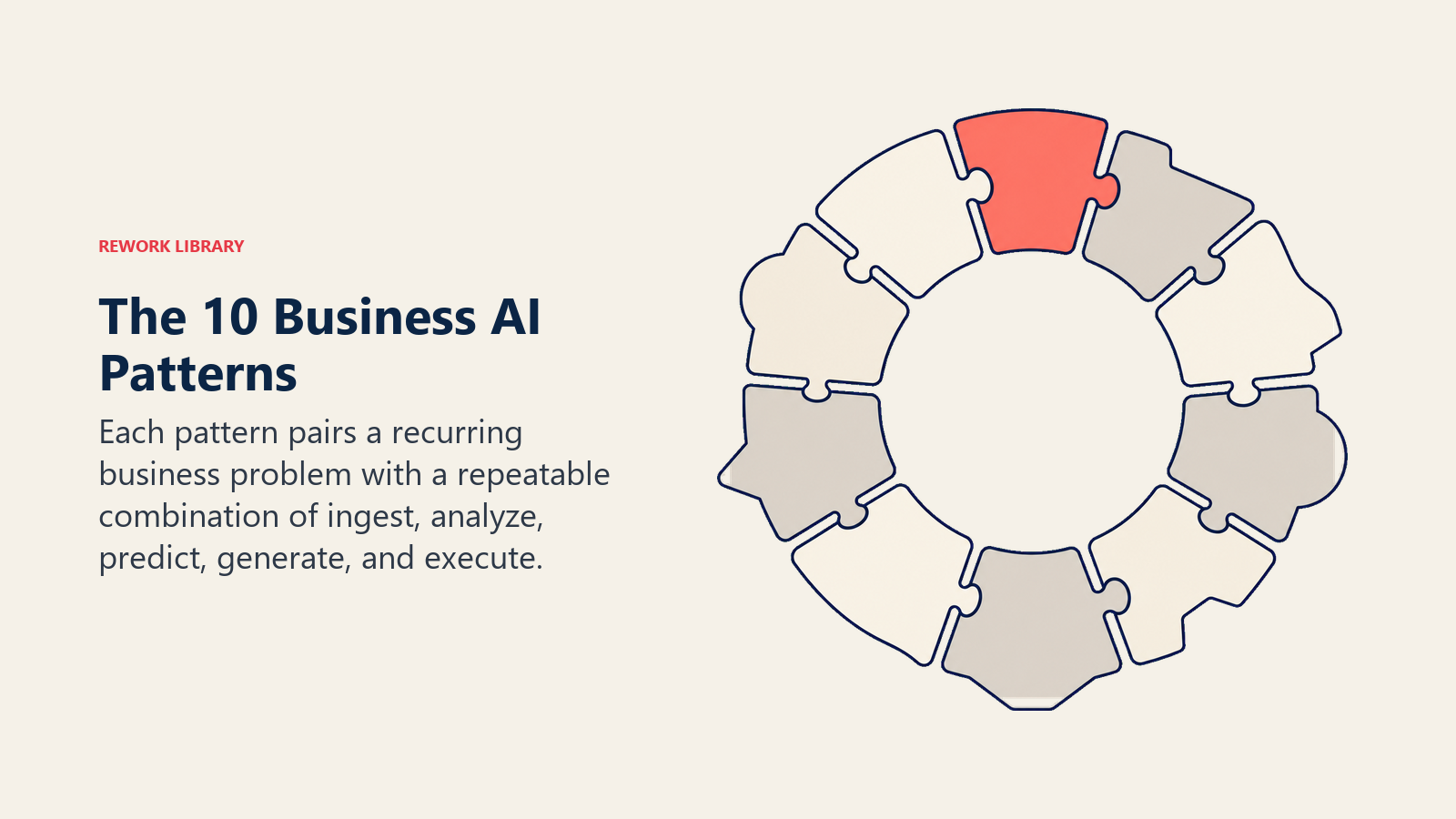
10 pattern
Rangkaian yang berulang ini lebih mudah dievaluasi sebagai satu sistem operasi: sepuluh pattern berbeda yang menggunakan ulang kemampuan ACE yang sama dalam kombinasi yang berbeda.
| Pattern | Masalah bisnis | Formula kemampuan |
|---|---|---|
| RAG Assistant | Karyawan membutuhkan jawaban dari basis pengetahuan internal yang besar | Ingest (pertanyaan) → Analyze (ambil dokumen) → Generate (jawaban) |
| Scoring plus Routing | Item masuk membutuhkan triase: lead, tiket, aplikasi | Ingest (catatan) → Analyze (fitur) → Predict (nilai) → Execute (rute) |
| Vision Extract | Informasi yang terjebak dalam gambar dan dokumen yang dipindai | Ingest (gambar/pindaian) → Analyze (ekstrak bidang) → Generate (catatan terstruktur) → Execute (dorong ke sistem) |
| Meeting Intelligence | Pengetahuan rapat mati setelah panggilan | Ingest (audio/video) → Analyze (transkrip + topik) → Generate (ringkasan/catatan) → Execute (distribusikan) |
| Anomaly Agent | Unknown unknowns: hal-hal yang seharusnya tidak terjadi | Ingest (aliran) → Analyze (baseline) → Predict (tandai outlier) → Execute (peringatan/eskalasi) |
| Generative Research | Jam membaca dipadatkan menjadi menit | Ingest (korpus multi-sumber) → Analyze (sintesiskan) → Generate (laporan/brief) |
| Document Review | Dokumen panjang ditinjau untuk kepatuhan dan risiko | Ingest (dokumen) → Analyze (ekstrak klausa) → Predict (vs. template) → Generate (tanda/ringkasan) |
| Workflow Copilot | Pekerjaan pengetahuan berulang membutuhkan asisten setingkat peer | Ingest (konteks pengguna) → Analyze (maksud) → Generate (saran) → Execute (dengan persetujuan) → ulangi |
| Personalization Engine | Sajikan konten atau penawaran yang relevan kepada setiap pengguna dalam skala besar | Ingest (perilaku) → Analyze (profil) → Predict (preferensi) → Generate (konten) → Execute (kirimkan) |
| Autonomous Agent | Tujuan multi-langkah yang memerlukan penggunaan alat, keputusan, dan penelusuran kembali | Semua 5 kemampuan dalam loop hingga tujuan tercapai |
Cetak tabel ini. Setiap inisiatif AI yang sedang dipertimbangkan atau sedang dijalankan bisnis Anda memetakan ke salah satu baris ini. Jika tidak, itu juga informasi penting, dan kita akan membahasnya di bagian 10 persen di bawah. Untuk kerangka keputusan tentang baris mana yang cocok dengan masalah Anda, lihat memilih AI pattern yang tepat.
Key Facts: Cakupan AI Pattern dan Penerapan Enterprise
- Analisis McKinsey atas 400+ penerapan AI enterprise menemukan bahwa 10 kategori kasus penggunaan teratas mencakup 89% dari semua nilai bisnis yang terukur (McKinsey Global AI Value Study, 2024)
- Lebih dari dua pertiga organisasi yang menggunakan AI kini menerapkannya di berbagai fungsi bisnis, tetapi hanya 1 dari 3 yang secara formal mengevaluasi apakah setiap alat baru tumpang tindih dengan penerapan yang ada (McKinsey State of AI, 2025)
- Organisasi yang mencocokkan inisiatif AI dengan pattern yang dikenali sebelum pengadaan menghabiskan 45% lebih sedikit waktu dalam evaluasi vendor dan mengurangi kelebihan biaya proyek integrasi sebesar 38% (Gartner AI Procurement Report, 2025)
Bukti untuk cakupan 90 persen: empat fungsi
Memetakan inisiatif umum lintas fungsi membuat klaim cakupan ini konkret: beberapa pattern yang sama terus muncul kembali di bawah nama departemen yang berbeda.
Telusuri empat fungsi bisnis dan lihat bagaimana setiap inisiatif AI umum dipetakan.
Penjualan
Tumpukan AI penjualan perusahaan perangkat lunak pasar menengah:
- "AI yang menilai lead dan merutekannya ke rep yang tepat": Scoring plus Routing pattern
- "AI yang mentranskripsikan panggilan discovery kami dan menulis catatan CRM": Meeting Intelligence pattern
- "AI yang meneliti akun sebelum panggilan dan membangun dokumen briefing": Generative Research pattern
- "AI yang menyusun email tindak lanjut setelah setiap rapat": Workflow Copilot pattern (langkah Generate dalam workflow rapat mereka)
- "AI yang memantau pipeline dan menandai deal yang berisiko tidak ditindaklanjuti": Anomaly Agent pattern
Lima inisiatif. Lima pattern. Nol yang berada di luar 10. Tumpang tindih antara output Meeting Intelligence (ringkasan panggilan, catatan CRM) dan Workflow Copilot (draf email tindak lanjut) bukanlah pattern yang berbeda. Itu adalah dua pattern yang sama yang berjalan secara berurutan, yang merupakan cara AI Agent di Level 3 dirakit.
Dukungan Pelanggan
Tim dukungan dengan 50 orang di perusahaan SaaS:
- "AI yang menjawab pertanyaan umum menggunakan dokumen bantuan kami": RAG Assistant pattern
- "AI yang mengklasifikasikan tiket masuk berdasarkan jenis dan prioritas dan merutekan ke tim yang tepat": Scoring plus Routing pattern
- "AI yang memantau volume tiket dan menandai lonjakan sebelum SLA dilanggar": Anomaly Agent pattern
- "AI yang membantu agen menyusun respons untuk tiket kompleks": Workflow Copilot pattern
- "AI yang mensintesiskan tiket selama sebulan menjadi laporan tren untuk tim produk": Generative Research pattern
Lima inisiatif. Lima pattern. Setiap satu adalah pattern yang dikenali, dilayani oleh pasar alat yang mapan.
Keuangan
Tim keuangan di perusahaan dengan 200 karyawan:
- "AI yang mengekstrak data dari faktur vendor dan mendorongnya ke ERP": Vision Extract pattern
- "AI yang memantau laporan pengeluaran dan menandai pelanggaran kebijakan": Anomaly Agent pattern
- "AI yang membantu analis menulis komentar varians untuk penutupan bulanan": Workflow Copilot pattern
- "AI yang meninjau kontrak vendor dan menandai klausa non-standar": Document Review pattern
- "AI yang membangun ringkasan keuangan bulanan dari data sumber": Generative Research pattern
Lima inisiatif. Lima pattern. Satu-satunya yang mendekati tepi adalah alat tinjauan kontrak, tetapi Document Review adalah pattern yang mapan dengan vendor yang matang (hukum dan keuangan keduanya menggunakannya secara ekstensif).
HR
Tim orang di organisasi dengan 400 karyawan:
- "AI yang menjawab pertanyaan karyawan tentang tunjangan, PTO, dan kebijakan": RAG Assistant pattern
- "AI yang menyaring resume dan memunculkan 20% teratas untuk tinjauan recruiter": Scoring plus Routing pattern
- "AI yang menganalisis rekaman wawancara untuk umpan balik coaching terstruktur": Meeting Intelligence pattern
- "AI yang menyusun deskripsi pekerjaan dari formulir intake manajer perekrutan": Workflow Copilot pattern
- "AI yang memantau penyelesaian onboarding dan menandai karyawan baru yang berisiko": Anomaly Agent pattern
Lima inisiatif. Lima pattern. Setiap satu memiliki pilihan vendor yang mapan. Tidak ada yang memerlukan pengembangan AI kustom.
Di seluruh empat fungsi ini, 20 inisiatif AI nyata memetakan ke 9 dari 10 pattern (Personalization Engine lebih umum dalam pemasaran dan e-commerce daripada di HR atau keuangan). Poinnya tetap berlaku.
Seperti apa 10 persen itu
10 persen yang tidak memetakan ke pattern ini bukanlah "masalah bisnis yang unik." Ini adalah kategori kasus penggunaan yang spesifik: tugas persepsi yang sangat terspesialisasi dan aplikasi ilmiah yang baru.
Pencitraan medis khusus: Menginterpretasikan pemindaian radiologi untuk temuan diagnostik bukanlah hal yang sama dengan Vision Extract pattern yang memproses faktur. Ekstraksi faktur dibatasi (bidang-bidangnya didefinisikan, mode kegagalannya diketahui, persyaratan akurasi terpenuhi oleh model yang ada). Interpretasi radiologi memerlukan pelatihan model pada kumpulan data klinis yang dimiliki sendiri, validasi klinis terhadap kinerja spesialis, dan persetujuan regulasi FDA untuk penggunaan yang berdekatan dengan diagnostik. Itu adalah pembangunan kustom, bukan pattern.
Penemuan obat dan ilmu material: Menggunakan AI untuk memprediksi pelipatan protein, menyaring kandidat molekular, atau mengidentifikasi material baru adalah Predict pada tingkat spesialisasi domain yang jauh melampaui AI pattern bisnis. Data tersebut terspesialisasi (urutan genomik, simulasi molekular), model-model dibuat sesuai tujuan, dan masalahnya tidak memiliki solusi vendor siap pakai yang dapat digeneralisasi antar perusahaan.
Kontrol dunia fisik real-time: Robotika pabrik, navigasi kendaraan otonom, dan kontrol kualitas real-time pada lini manufaktur berkecepatan tinggi melibatkan fusi sensor, batasan latensi milidetik, dan persyaratan penerapan edge yang secara arsitektur berbeda dari AI pattern bisnis dalam daftar ini.
Ini adalah aplikasi yang nyata dan berharga. Mereka tidak berada dalam 10 pattern karena memerlukan rekayasa, data, dan pekerjaan validasi yang secara fundamental berbeda. Sebagian besar bisnis tidak akan pernah membutuhkannya. Bisnis yang membutuhkannya sudah mengetahuinya.
Mengapa cakupan pattern penting untuk pengadaan
Jika kasus penggunaan Anda memetakan ke pattern yang diketahui, Anda membeli solusi di pasar yang kompetitif dengan vendor yang mapan, playbook integrasi, dan tolok ukur yang jelas untuk seperti apa "yang baik." Itu adalah masalah pengadaan dengan jawaban yang dapat ditangani. Keputusan beli vs. bangun untuk setiap AI pattern mencakup dengan tepat kapan harus melewati garis tersebut. Lebih dari dua pertiga organisasi kini menggunakan AI dalam lebih dari satu fungsi bisnis, yang berarti sebagian besar tim menavigasi beberapa pattern secara bersamaan, dan kesenjangan kosakata bertambah di setiap inisiatif baru (McKinsey State of AI, 2025).
Tim enterprise yang dapat mengidentifikasi tumpang tindih pattern dalam tumpukan AI mereka menemukan rata-rata 2,4 alat yang berlebihan per fungsi (Gartner, 2025). Redundansi tersebut rata-rata menghabiskan $180.000 dalam pengeluaran langganan yang terbuang per tahun per fungsi, di perusahaan pasar menengah dengan 100-500 karyawan.
Jika kasus penggunaan Anda tidak memetakan ke pattern yang diketahui, Anda membangun. Pengembangan AI kustom berarti berbulan-bulan pekerjaan rekayasa, pelatihan model yang dimiliki sendiri, dan pemeliharaan berkelanjutan. Ini diukur dalam tahun-tim dan jutaan dolar, bukan biaya langganan.
Pencocokan pattern membutuhkan lima menit. Lima menit tersebut dapat menghindarkan Anda dari memulai pembangunan multi-tahun ketika penerapan vendor enam bulan sudah cukup. Atau dari membeli langganan untuk sesuatu yang akan Anda kustomisasi melampaui pengakuan di tahun pertama.
Pertanyaan pengadaan menjadi: "Pattern mana yang dibutuhkan kasus penggunaan ini? Apakah vendor mengimplementasikan pattern tersebut dengan baik untuk domain kami?" Bukan: "Apakah produk AI ini mengesankan? Apakah saya mempercayai roadmap vendor ini?"
Keberatan umum: "Kasus penggunaan kami unik"
Hampir tidak pernah secara arsitektur unik. Ini domain-spesifik.
Ada perbedaan nyata. Perusahaan logistik yang berkata "kami membutuhkan AI untuk merutekan paket berdasarkan komitmen jendela pengiriman dan lalu lintas real-time" adalah domain-spesifik: Scoring plus Routing pattern, terspesialisasi untuk logistik. Pattern yang mendasarinya standar. Input data dan aturan bisnis adalah domain-spesifik. Vendor yang mengimplementasikan Scoring plus Routing pattern dengan baik dan menawarkan kustomisasi API yang kuat dapat melayani ini tanpa pembangunan kustom.
Perusahaan yang berkata "kami membutuhkan AI untuk menginterpretasikan citra satelit untuk mengidentifikasi pola penyakit tanaman sebelum menyebar" lebih dekat ke arsitektur yang unik: interpretasi gambar terspesialisasi, domain baru, data pelatihan terbatas dari sumber publik. Itu adalah pengembangan kustom atau vendor vertikal yang sangat terspesialisasi.
Sebagian besar kasus penggunaan yang "unik," ketika Anda menekannya, adalah implementasi domain-spesifik dari pattern standar. Kekhususan domain memengaruhi vendor mana yang Anda pilih dan berapa banyak kustomisasi yang Anda butuhkan. Itu tidak mengubah pattern yang mendasarinya.
Pertanyaan yang perlu ditanyakan pada diri sendiri: "Jika saya menggambarkan kasus penggunaan ini dalam hal input dan output, apakah itu menyerupai sesuatu dalam daftar 10-pattern?" Biasanya jawabannya ya, dan keunikannya ada dalam jenis data dan aturan bisnis yang spesifik, bukan arsitektur kemampuan.
Latihan penilaian mandiri
Penilaian mandiri mengubah inisiatif AI yang direncanakan menjadi bahasa pattern dengan memperjelas input, output, tinjauan manusia, dan perilaku loop.
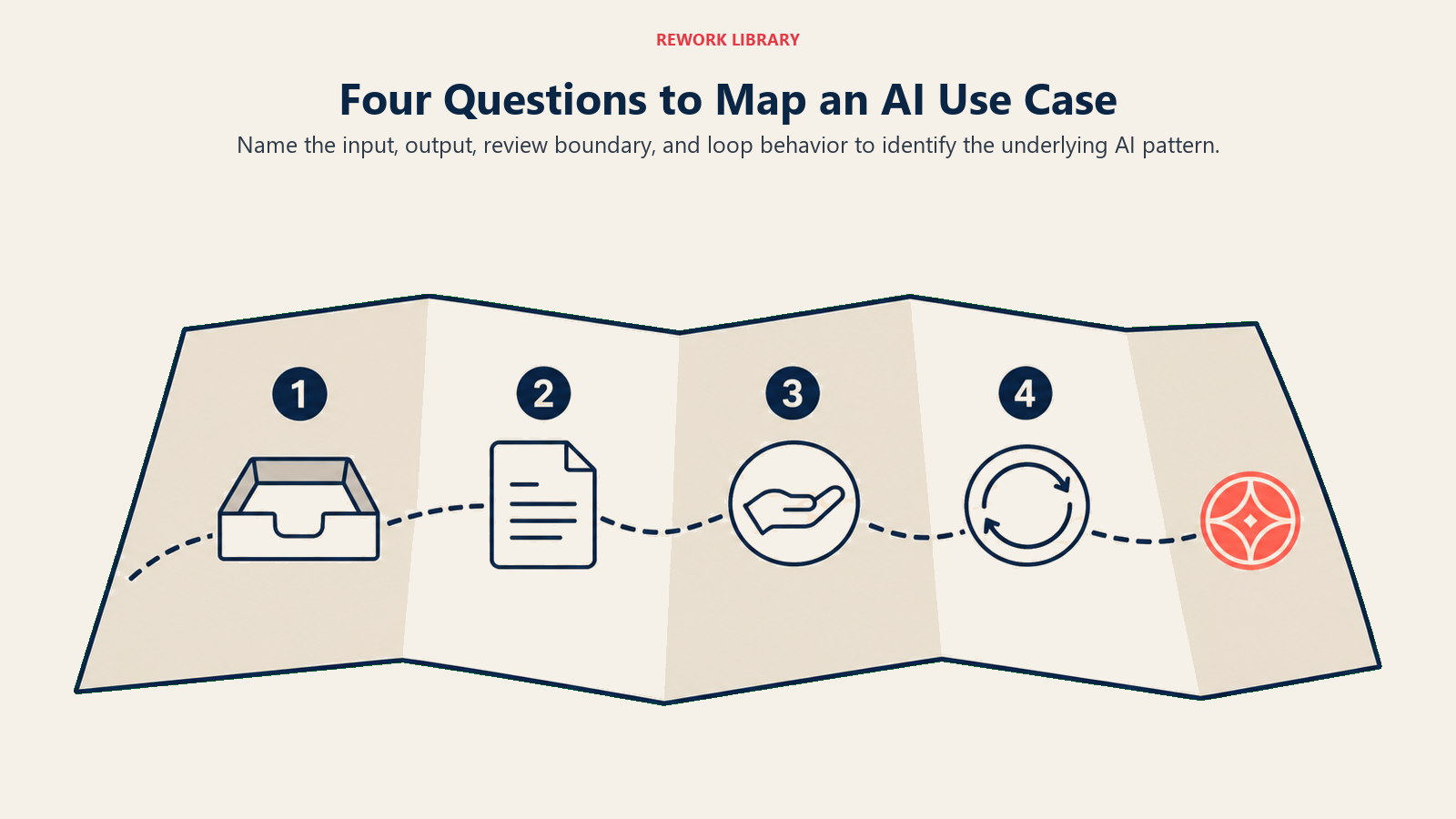
Ambil inisiatif AI Anda yang saat ini sedang berjalan atau direncanakan. Untuk setiap satu, jawab empat pertanyaan ini:
- Apa input utamanya? (Teks, data terstruktur, gambar, audio, dokumen, perilaku pengguna)
- Apa output utamanya? (Keputusan nilai/perutean, artefak yang dihasilkan, tindakan otomatis, jawaban, tanda)
- Apakah output tersebut diberikan kepada manusia untuk ditinjau, atau apakah itu langsung memicu tindakan sistem?
- Apakah ini transformasi sekali jalan atau loop yang berulang hingga tujuan tercapai?
Sekarang cocokkan ke tabel. Input adalah gambar atau dokumen yang dipindai, output adalah data terstruktur yang didorong ke sistem? Vision Extract. Input adalah aliran transaksi, output adalah tanda atau blokir? Anomaly Agent. Input adalah pertanyaan, output adalah jawaban yang didasarkan pada dokumen internal? RAG Assistant. Input adalah konteks tugas saat ini pengguna pengetahuan, output adalah saran atau draf (manusia meninjau sebelum bertindak)? Workflow Copilot.
Jika Anda tidak dapat mencocokkannya setelah latihan ini, Anda mungkin benar-benar berada di 10 persen. Tetapi lebih mungkin, Anda menghadapi versi domain-spesifik dari pattern yang lebih sulit dikenali karena kasus penggunaan spesifik terdengar sangat berbeda dari contoh generik. Coba menggambarkannya pada tingkat abstraksi yang lebih tinggi. Pemilihan pattern berdasarkan jenis data juga dapat membantu ketika format input adalah titik awal yang paling jelas.
Rework Analysis: Keberatan "kasus penggunaan kami unik" hampir tidak pernah bertahan dalam audit tingkat kemampuan. Ketika kami menjalaninya bersama tim, keunikannya hampir selalu ada dalam domain data atau aturan bisnis, bukan formula kemampuan yang mendasarinya. Perusahaan logistik yang merutekan paket berdasarkan lalu lintas real-time dan jendela komitmen menggunakan Scoring plus Routing pattern yang sama seperti tim penjualan yang merutekan lead. Datanya berbeda. Taruhannya berbeda. Pattern-nya identik. Ini penting karena menentukan apakah Anda membeli atau membangun. Kekhususan domain adalah pertanyaan pemilihan vendor. Keunikan arsitektur adalah pertanyaan pembangunan kustom. Kosakata pattern memungkinkan Anda memisahkan keduanya dalam lima menit pertama percakapan vendor.
Pertanyaan yang Sering Diajukan
Mengapa hanya 10 pattern yang mencakup sebagian besar kasus penggunaan business AI?
ACE Framework mendefinisikan 5 kemampuan, dan permutasi yang berguna dari 2 hingga 4 kemampuan yang memecahkan masalah bisnis berulang dibatasi. Pengamatan empiris atas ratusan penerapan AI enterprise di seluruh penjualan, dukungan, keuangan, HR, dan pemasaran secara konsisten memunculkan 10 kluster jenis masalah yang sama. Analisis McKinsey mengkonfirmasi bahwa 10 kategori kasus penggunaan AI teratas mencakup 89% nilai bisnis yang terukur di seluruh 400+ penerapan.
Berapa persentase kasus penggunaan business AI yang berada di luar 10 pattern?
Sekitar 10% berada di luar pattern standar. Ini adalah tugas persepsi khusus (pencitraan medis, genomik), sistem kontrol fisik real-time (robotika, kendaraan otonom), dan aplikasi ilmiah baru (penemuan material, pelipatan protein). Sebagian besar fungsi bisnis standar, termasuk penjualan, dukungan, HR, keuangan, hukum, dan pemasaran, sepenuhnya memetakan ke 10 core pattern.
Bagaimana cara mengetahui apakah kasus penggunaan AI saya benar-benar unik?
Terapkan tes empat pertanyaan: Apa input utamanya? Apa output utamanya? Apakah output diberikan ke manusia atau memicu tindakan sistem secara langsung? Apakah ini transformasi sekali jalan atau loop yang berulang? Jika kasus penggunaan menolak pemetaan ke tabel 10-pattern setelah reduksi yang jujur, kemungkinan berada di 10% yang terspesialisasi. Tetapi sebagian besar kasus yang "unik" adalah versi domain-spesifik dari pattern standar, di mana data dan aturan bisnis terspesialisasi tetapi formula kemampuannya standar.
Apa biaya redundansi AI pattern dalam tumpukan enterprise?
Penelitian pengadaan AI Gartner 2025 menemukan bahwa tim enterprise yang mengidentifikasi tumpang tindih pattern menemukan rata-rata 2,4 alat yang berlebihan per fungsi, mewakili sekitar $180.000 dalam pengeluaran langganan yang terbuang per tahun per fungsi untuk perusahaan pasar menengah. Pencocokan pattern membutuhkan lima menit. Lima menit tersebut secara langsung mengimbangi berbulan-bulan siklus pengadaan dan anggaran yang terbuang.
Bagaimana pemikiran pattern mengubah pengadaan AI?
Alih-alih membandingkan daftar fitur atau mempercayai nama kategori vendor, pemikiran pattern bertanya: formula kemampuan mana yang digunakan alat ini, dan apakah formula tersebut memecahkan kelas masalah yang sebenarnya kita miliki? Tim yang mengadopsi kerangka ini menghabiskan 45% lebih sedikit waktu dalam evaluasi vendor dan mengurangi kelebihan biaya proyek integrasi sebesar 38%, menurut Gartner AI Procurement Report 2025.
Apa itu 90-Percent Coverage Hypothesis?
90-Percent Coverage Hypothesis menyatakan bahwa 10 AI pattern yang dinamai secara kolektif menangani 90% kasus penggunaan business AI yang berulang. Hipotesis ini dapat diuji: petakan inisiatif AI apa pun ke input, output, dan urutan kemampuan. Itu cocok dengan salah satu dari 10 pattern atau merupakan gabungan dari dua hingga tiga pattern. Kasus penggunaan yang menolak pemetaan berada di 10% yang terspesialisasi, yang dicirikan oleh persyaratan pelatihan model kustom, rezim data yang dimiliki sendiri, atau batasan kontrol fisik real-time.
Pelajari lebih lanjut
- Apa Itu AI Pattern? Blok Pembangun Business AI
- Memilih AI Pattern yang Tepat untuk Masalah Anda
- Bagaimana AI Pattern Menggabungkan Kemampuan Menjadi Solusi
- Gradien Risiko di Seluruh AI Pattern
- Apa Itu Business AI? Definisi Praktis untuk Operator
- Meeting Intelligence Pattern
- Workflow Copilot Pattern
- Pemilihan Pattern berdasarkan Jenis Data

Co-Founder, Rework.com
On this page
- Mengapa daftar yang pendek itu kredibel
- Hipotesis 90-Percent Coverage
- 10 pattern
- Bukti untuk cakupan 90 persen: empat fungsi
- Penjualan
- Dukungan Pelanggan
- Keuangan
- HR
- Seperti apa 10 persen itu
- Mengapa cakupan pattern penting untuk pengadaan
- Keberatan umum: "Kasus penggunaan kami unik"
- Latihan penilaian mandiri
- Pelajari lebih lanjut