Estilo de Liderazgo de Jensen Huang: La Apuesta del Fundador de 30 Años Que Se Convirtió en la Era de la IA
Turn this article into takeaways for your work.


Each assistant summarizes the article only for you and suggests best practices for your work.
Datos Clave: Jensen Huang (nacido en 1963 en Tainan, Taiwán) cofundó NVIDIA en 1993 y ha sido CEO desde su inicio — 31 años en el mismo puesto. En 2006 lanzó CUDA y continuó financiando software de computación paralela durante 15+ años antes de que el auge de la IA le diera un propósito. La capitalización de mercado de NVIDIA pasó $3 billones en 2024, brevemente convirtiéndose en la empresa más valiosa del mundo. Dirige la empresa con un estilo de gestión "piloto en el fuego", una org deliberadamente plana con 40+ reportes directos (supuestamente más cercano a 60), sin reuniones 1:1 programadas, y una chaqueta de cuero negro característica que se ha convertido en una categoría propia en presentaciones.
En 1993, Jensen Huang cofundó NVIDIA con dos colegas en una cabina de Denny's en San Jose. La empresa casi muere tres veces en su primera década. El chip Riva TNT en 1998 se lanzó tarde y con especificaciones insuficientes. La línea GeForce enfrentó competencia brutal de ATI alrededor de 2001. Una apuesta fallida en GPUs móviles contra Qualcomm alrededor de 2010 costó cientos de millones con casi ningún retorno.
Sigue siendo CEO. Ha sido CEO durante 31 años.
En 2006, NVIDIA lanzó CUDA, un framework de software que permitía a los desarrolladores usar GPUs para computación de propósito general. No había un mercado masivo para esto. El aprendizaje automático era una disciplina académica marginal. Pero Huang continuó financiando CUDA durante casi una década antes de que la ola de IA le diera un propósito. Para 2024, NVIDIA brevemente se convirtió en la empresa más valiosa del mundo, con más de $3 billones en capitalización de mercado. Ese resultado es un producto de 30 años de decisiones compuestas, la mayoría de las cuales se veían como apuestas malas en el momento.
Entender cómo Huang piensa sobre convicción de plataforma, estructura organizacional, y urgencia operativa te da un modelo que no depende de estar en IA o semiconductores para ser útil.
La Doctrina de Horizonte Largo de Huang
La Doctrina de Horizonte Largo de Huang es la práctica de financiar una apuesta de plataforma durante una década o más antes de que el mercado la valide, mientras se ejecutan operaciones diarias con paranoia de nivel startup. Empareja paciencia estratégica con urgencia táctica: la convicción sobre la tesis de 10 años es innegociable, pero la ejecución dentro de cualquier ventana de 90 días se trata como si la empresa estuviera a 30 días de la quiebra. La doctrina solo funciona cuando la apuesta larga se paga con un negocio actual rentable, y cuando el CEO personalmente absorbe el escepticismo que viene con sostener una plataforma no rentable a través de múltiples ciclos de auge-caída.
Desglose del Estilo de Liderazgo
| Estilo | Peso | Cómo se manifestó |
|---|---|---|
| Líder de Convicción de Plataforma | 70% | Huang no optimiza para el mercado actual. Apuesta en qué necesitará el mercado cuando la tecnología converja. CUDA fue financiado durante una década sin un cliente claro. La transición de GPUs de videojuegos a infraestructura de centro de datos fue una transición de 10 años que requería venta interna constante. Sostiene estas apuestas sin cubrirlas. |
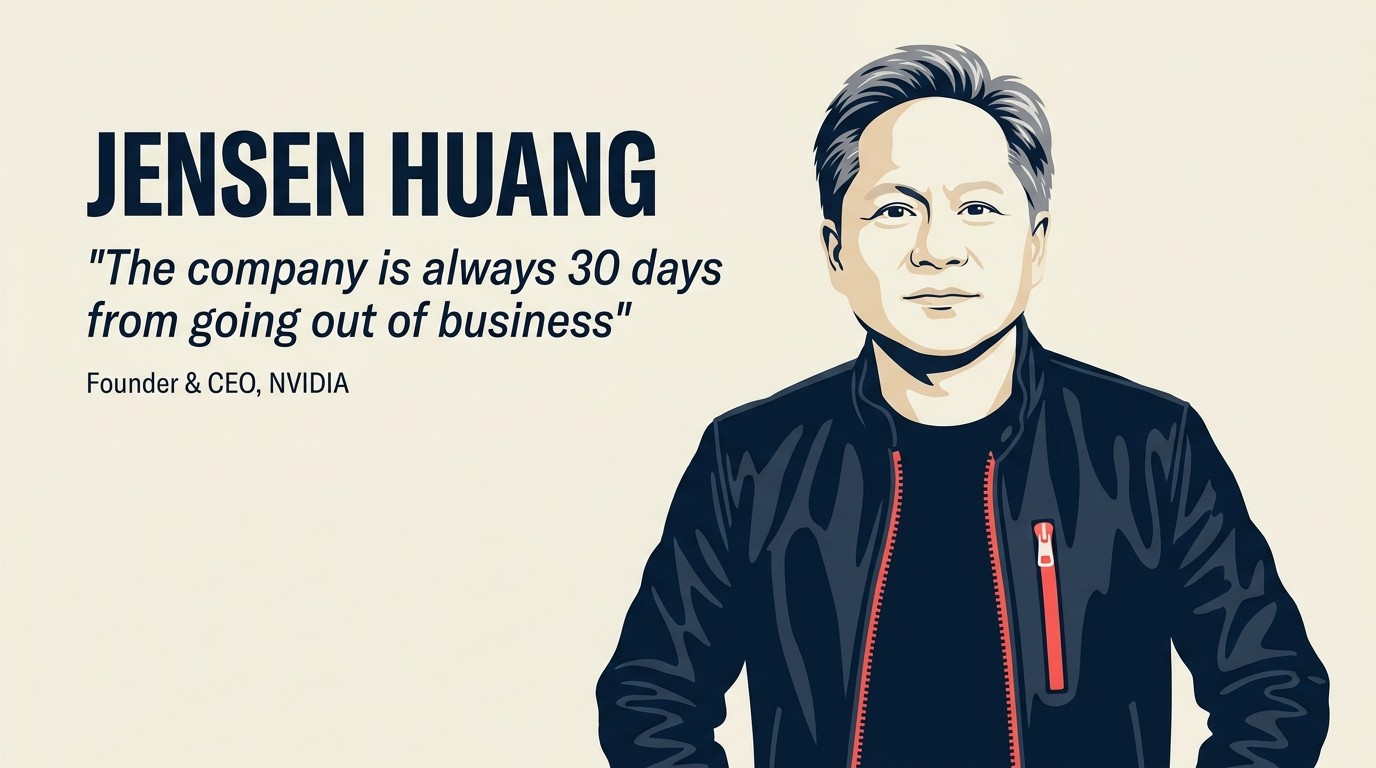
| Operador de Urgencia Paranoica | 30% | "La empresa está a 30 días de quebrar". Huang ha dicho alguna versión de esto repetidamente, incluso durante períodos cuando NVIDIA crecía rápidamente. No es teatro — es un mecanismo cultural. Al institucionalizar la ansiedad existencial, mantiene una organización grande operando con la urgencia de un startup. |
La división 70/30 importa porque la convicción sola produciría una empresa que apuesta en las cosas correctas y ejecuta lentamente. La paranoia sola produce una empresa que ejecuta rápidamente en las cosas equivocadas. Huang combina certeza de plataforma de horizonte largo con urgencia operativa de horizonte corto. Esa combinación es inusual y difícil de replicar.
Rasgos de Liderazgo Clave
| Rasgo | Calificación | Qué significa en la práctica |
|---|---|---|
| Convicción de plataforma | Excepcional | CUDA se lanzó en 2006 y no fue significativamente rentable durante años. La mayoría de las empresas que cotizan en bolsa no podrían sostener esa inversión sin una cronología clara de retorno. Huang lo hizo porque creía que la computación de GPU de propósito general era inevitable, no porque la hoja de cálculo lo soportara. Ese tipo de convicción requiere un CEO dispuesto a absorber años de escepticismo de analistas e inversores. |
| Planitud organizacional | Muy Alta | Huang supuestamente tiene alrededor de 60 reportes directos. Eso no es un error tipográfico. No hace reuniones 1:1 — las reemplaza con configuraciones de equipo donde la información se comparte, no se filtra. Su lógica declarada: "Si tengo un 1:1, hay información en la sala que el equipo no tiene. Eso es desperdicio". Obliga a una cultura de transparencia primero pero también significa que la organización depende mucho de su ancho de banda. |
| Urgencia institucionalizada | Alto | El encuadre de "30 días de quiebra" es deliberado. Huang lo usa para prevenir complacencia a escala. Cuando NVIDIA se convirtió en una empresa de billones de dólares, el riesgo no era que el equipo dejara de trabajar — era que comenzaran a proteger lo que habían construido en lugar de construir la siguiente cosa. El mantra de paranoia es un contrapeso a la enfermedad de éxito organizacional. |
| Opacidad de sucesión | Medio | Huang no tiene un plan de sucesión claro y público después de 31 años como CEO. La estrategia de NVIDIA, cultura, y hoja de ruta del producto están profundamente moldeadas por su juicio específico sobre apuestas de plataforma. Eso es un riesgo de concentración. El mismo mandato largo que habilitó CUDA también crea una empresa que puede luchar para hacer la siguiente apuesta de 30 años sin él. |
Las 3 Decisiones Que Definieron a Jensen Huang como Líder
1. Financiando CUDA Una Década Antes de Que el Mercado Estuviera Listo
CUDA se lanzó en 2006 como un framework de programación que permitía a investigadores usar GPUs de NVIDIA para cargas de trabajo más allá de gráficos. La audiencia objetivo era una pequeña comunidad de usuarios académicos y de computación científica. El ingreso del ecosistema CUDA fue marginal durante años.
Huang continuó financiándolo. Los investigadores de aprendizaje automático en universidades comenzaron a usar CUDA para entrenar redes neuronales en los años 2010 tempranos. El papel AlexNet en 2012 entrenó su modelo en dos GPUs GTX 580 — una tarjeta gráfica de consumidor ejecutando CUDA. Ese papel efectivamente lanzó la era del aprendizaje profundo.
La decisión de liderazgo se tomó en 2006, no en 2012. Huang identificó que el procesamiento paralelo eventualmente importaría para computación a gran escala, incluso sin una señal clara del mercado. Estaba dispuesto a absorber años de bajo desempeño en una unidad de negocio porque la tesis de la plataforma era correcta. La mayoría de los ejecutivos no tienen la autoridad institucional o convicción personal para sostener esa posición durante ese tiempo.
2. Sobreviviendo Tres Momentos Cercanos a la Muerte Sin Pivotar
NVIDIA estuvo cerca del colapso al menos en tres momentos distintos. El chip Riva TNT en 1998 llegó tarde y tuvo bajo desempeño contra competidores, poniendo la empresa en una posición financiera seria. Alrededor de 2001, la competencia con ATI se volvió lo suficientemente intensa como para que la posición de mercado de NVIDIA estuviera genuinamente amenazada. Y alrededor de 2010, la apuesta en GPUs móviles (compitiendo contra Qualcomm en chips de smartphone) quemó cientos de millones con retorno mínimo.
En cada ocasión, Huang no cambió fundamentalmente lo que NVIDIA era. Arregló la ejecución, cortó la iniciativa que perdía, y se reenfocó en lo que funcionaba. La pérdida de GPU móvil fue costosa y tomó años absorber, pero no produjo una crisis de identidad estratégica.
La lección es sobre la diferencia entre flexibilidad táctica y compromiso estratégico. Huang ajustó tácticas agresivamente cuando fracasaban. Pero no permitió que pérdidas operacionales reformaran la tesis central de plataforma. La mayoría de las empresas que sobreviven momentos cercanos a la muerte lo hacen convirtiéndose en algo diferente. NVIDIA sobrevivió siendo mejor en lo que ya era.
3. Rechazando Agregar Capas de Gestión Mientras NVIDIA Escalaba
Conforme NVIDIA creció de un startup a una empresa de $10 mil millones a una empresa de $3 billones, la mayoría de los líderes hubieran reestructurado alrededor de menos reportes directos, más jerarquía de gestión, y separación divisional más fuerte. Huang hizo lo opuesto.
Mantuvo aproximadamente 60 reportes directos. Eliminó reuniones 1:1 a favor de configuraciones de equipo. Explícitamente enmarco capas de gestión como una forma de distorsión de información — cada capa entre él y el trabajo es una capa donde la señal se filtra o se suaviza.
Esa estructura solo funciona porque tiene ancho de banda personal y una cultura donde se espera comunicación directa en cada nivel. Crea velocidad: las decisiones se toman más cerca de la información. Pero también significa que NVIDIA a escala funciona en el sistema operativo de Jensen Huang de una manera que la mayoría de grandes empresas no funcionan en el de su CEO. La org plana es un activo y un pasivo simultáneamente.
Qué Haría Jensen Huang en Tu Rol
Si eres CEO, la lección de CUDA se aplica directamente a tu hoja de ruta de producto. ¿En qué estás invirtiendo que no tiene un cliente claro aún pero es estructuralmente inevitable dado las tendencias de tecnología y mercado? La mayoría de CEOs en tu etapa están completamente asignados a clientes actuales e ingresos actuales. Huang establecería un porcentaje significativo de I+D para una apuesta de plataforma con un horizonte de 5 a 10 años. La pregunta no es si puedes permitírtelo. Es si puedes permitirte no hacerlo cuando esa ventana se cierra.
Si eres COO o líder de operaciones, el modelo de org plana vale la pena examinar cuidadosamente. Los 60 reportes directos de Huang no son replicables para la mayoría de operadores, pero el principio subyacente sí. ¿Dónde tus capas de gestión crean pérdida de información? La agenda de cada revisión de ops debe comenzar con: ¿qué sé hoy que no sabía la semana pasada, y cómo lo descubrí? Si la respuesta es "mi VP me lo dijo", pregunta qué se filtró antes de que te alcanzara.
Si eres líder de producto, el patrón cercano a la muerte es instructivo. NVIDIA sobrevivió tres crisis serias sin convertirse en una empresa diferente. Cuando tus apuestas de producto fracasan — y algunas lo harán — la pregunta es cuál parte del fracaso es táctica (ejecución, tiempo, precio) y cuál parte es estratégica (la dirección de la plataforma era equivocada). Huang consistentemente cortó las pérdidas tácticas rápidamente y sostuvo las posiciones estratégicas. La mayoría de los fracasos del producto son tácticos. Trátalos de esa manera.
Si eres en ventas o marketing, el encuadre de paranoia tiene una aplicación directa. Huang usa "30 días de quiebra" para mantener viva la urgencia en una empresa exitosa. En ventas, el equivalente es tratar cada trimestre como si tus tres cuentas principales estuvieran en riesgo, independientemente del pronóstico de renovación. La complacencia es un problema de ingresos antes de que aparezca en un CRM. Construye urgencia en tu cultura de ventas antes de que la necesites.
El Análisis de Rework
El modelo de Huang son dos cosas pegadas juntas: apuestas de plataforma de horizonte largo y ejecución de org plana. La mayoría de líderes pueden ejecutar uno u otro — casi ninguno ejecuta ambos. La razón por la que la org plana funciona en NVIDIA es que la información llega a Jensen sin ser lavada a través de seis capas de gestión media. Cuando escalas un equipo por encima de 30 personas, esa claridad es la primera cosa que pierdes.
Esa es la carrera para la que Rework fue construida. El CRM y Sales Ops de Rework (desde $12/usuario/mes) y Work Ops (desde $6/usuario/mes) dan a un equipo en escalado visibilidad de org plana sin plantilla de org plana: cada trato, cada tarea, y cada trasvase entre funciones se sienta en un sistema donde el fundador puede verlo directamente. No necesitas 40 reportes directos para ejecutar una operación estilo Huang — necesitas la densidad de información que sus 40 reportes producen. Ese es un problema de herramientas, y es solucionable antes de alcanzar 100 personas.
Citas Notables y Lecciones Más Allá de la Sala de Juntas
"Cuanto más compras, más ahorras". Huang dijo esto sobre GPUs H100 en 2023, con cara seria, en un momento cuando la lista de espera era de meses de duración y los clientes pagaban primas en el mercado secundario. Es una línea que solo funciona cuando el producto es genuinamente irremplazable. Pero captura algo real sobre su filosofía comercial: cuando tienes la plataforma correcta, la confianza en el precio es una señal, no arrogancia.
"Prefiero tener 60 personas que todas saben qué sé yo que 6 personas que cada una sabe una décima parte de lo que sé". Ese encuadre explica la org plana. No se trata de rango de control. Se trata de densidad de información. Huang quiere un equipo de liderazgo donde cada persona tiene contexto completo, no contexto siloed. Eso es un principio de diseño inusual para una empresa grande, y es por qué NVIDIA se mueve más rápido que empresas una quinta de su tamaño.
El mandato de 31 años en sí mismo es la lección más subestimada. La mayoría de los founder-CEOs o se reemplazan por la junta después de alcanzar escala, o se quedan demasiado tiempo y se convierten en un arrastre en la organización. Huang logró el resultado más raro: permanecer relevante a través de múltiples ciclos de tecnología. Eso requiere estar genuinamente dispuesto a aprender, que es diferente de estar dispuesto a decir que estás aprendiendo.
Dónde Se Rompe Este Estilo
La org plana con 60 reportes directos funciona en NVIDIA porque de Jensen Huang específicamente. Es su ancho de banda, su juicio, y su capacidad para procesar información en dominios simultáneamente lo que lo hace funcional. Trasplantar esa estructura a una empresa con liderazgo diferente no produce los mismos resultados — produce caos.
El problema más profundo es riesgo de concentración. Las apuestas de plataforma de NVIDIA — CUDA, el pivote de centro de datos, la posición de infraestructura de IA — son todas expresiones de la tesis de una persona sobre hacia dónde iba la computación. Esa tesis ha tenido razón repetidamente. Pero una empresa que ha tenido razón durante 30 años porque el juicio de una persona también es una empresa que no ha demostrado capacidad para hacer la siguiente apuesta de 30 años sin esa persona. La pregunta de sucesión no es solo sobre continuidad de gestión. Es sobre si la convicción de plataforma que construyó NVIDIA es institucional o personal. Ahora mismo, la respuesta honesta es personal.
Los paralelos más cercanos en intensidad liderada por fundadores vale la pena estudiar lado a lado. El apilamiento de apuestas multi-empresa de Elon Musk ejecuta un modelo de convicción similar, aunque sin la gestación de plataforma paciente de una década de Huang. El turnaround de AMD de Lisa Su es el mejor caso de estudio actual de construir en la sombra de NVIDIA — y entender esa rivalidad agudiza cómo lees ambos líderes. Andy Grove en Intel es el ancestro directo de semiconductores: "Solo los Paranoides Sobreviven" de Grove es la fundación filosófica de la que Huang opera. Y OpenAI de Sam Altman es la relación de cliente más importante en la historia actual de NVIDIA — la construcción de IA en la que Huang apostó décadas temprano es, en gran parte, la factura de infraestructura de Altman.
¿Quieres profundizar en qué permite este tipo de liderazgo de mandato largo?
- Empresas Lideradas por Fundadores: Cuándo Transicionar de Fundador a CEO
- Pensamiento de Plataforma: Cómo Construir Productos Que Crean Categorías
- Gestión de Alto Rendimiento: Qué Jensen Huang Robó de Andy Grove
- Estilo de Liderazgo de Jack Ma: Origen Andrajoso, Imperio de $300 mil millones, y Qué Sucede Cuando el PCCh No Está de Acuerdo

On this page
- La Doctrina de Horizonte Largo de Huang
- Desglose del Estilo de Liderazgo
- Rasgos de Liderazgo Clave
- Las 3 Decisiones Que Definieron a Jensen Huang como Líder
- 1. Financiando CUDA Una Década Antes de Que el Mercado Estuviera Listo
- 2. Sobreviviendo Tres Momentos Cercanos a la Muerte Sin Pivotar
- 3. Rechazando Agregar Capas de Gestión Mientras NVIDIA Escalaba
- Qué Haría Jensen Huang en Tu Rol
- El Análisis de Rework
- Citas Notables y Lecciones Más Allá de la Sala de Juntas
- Dónde Se Rompe Este Estilo