Triple Constraint: Das Eiserne Dreieck im Projektmanagement
Turn this article into takeaways for your work.


Each assistant summarizes the article only for you and suggests best practices for your work.
Das Triple Constraint ist das Framework, das jeder Projektmanager nutzt, um zu verstehen, warum man nicht alles haben kann, und wie man entscheidet, was man aufgibt, wenn die Realität mit dem Plan kollidiert.
Was ist das Triple Constraint?
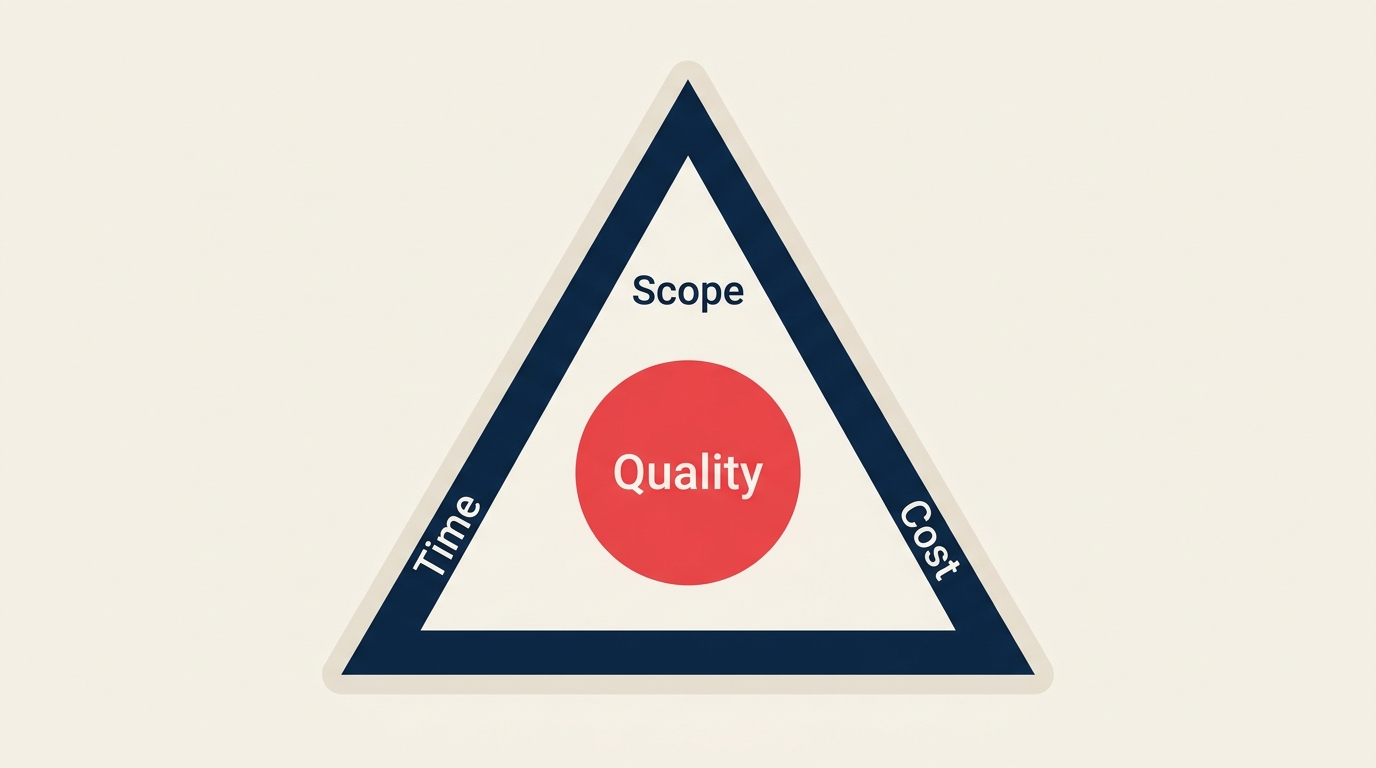
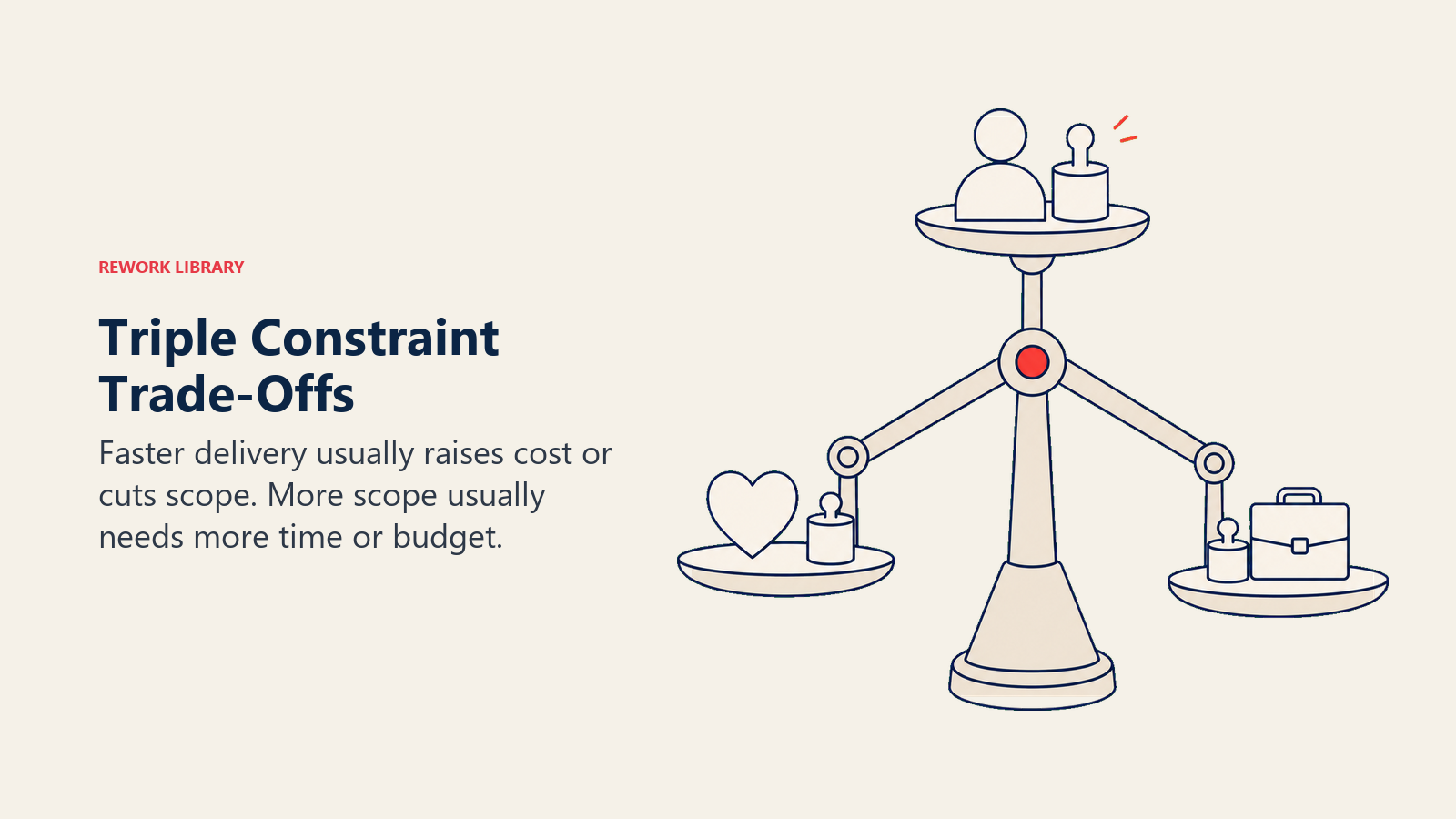
Das Triple Constraint ist ein Modell, das drei voneinander abhängige Grenzen für jedes Projekt definiert: Umfang (was Sie liefern), Zeit (wann Sie es liefern) und Kosten (was Sie dafür ausgeben). Qualität steht im Mittelpunkt des Dreiecks und wird direkt davon beeinflusst, wie gut die drei Seiten ausbalanciert sind. Verändert man eine Einschränkung, ohne die anderen anzupassen, trägt die Qualität die Konsequenzen.
Das Modell wird auch als Eisernes Dreieck oder Projektmanagement-Dreieck bezeichnet, weil die Beziehung zwischen den drei Seiten starr ist: Man kann eine nicht dehnen, ohne eine andere zu stauchen. Ein Projektsponsor, der mehr Umfang für dasselbe Budget und denselben Termin fordert, verlangt etwas geometrisch Unmögliches, ohne irgendwo an Qualität einzubüßen.
Key Facts
- 70 % der Projekte verfehlen mindestens eines ihrer ursprünglichen Ziele für Umfang, Zeitplan oder Budget (PMI Pulse of the Profession, 2024).
- Der Standish Group CHAOS Report (2024) stellte fest, dass nur 31 % der Softwareprojekte pünktlich, im Budgetrahmen und im Umfang abgeliefert wurden.
- 52 % der Projekte sind von Umfangsausweitung betroffen, die häufigste Ursache für Zeit- und Budgetüberschreitungen (PMI, 2024).
Die drei Seiten des Dreiecks
Jede Seite des Dreiecks steht für eine Einschränkung, die das Projektteam aktiv managen muss. Zu verstehen, was jede davon steuert und was bricht, wenn sie sich verschiebt, ist die Grundlage realistischer Projektplanung.
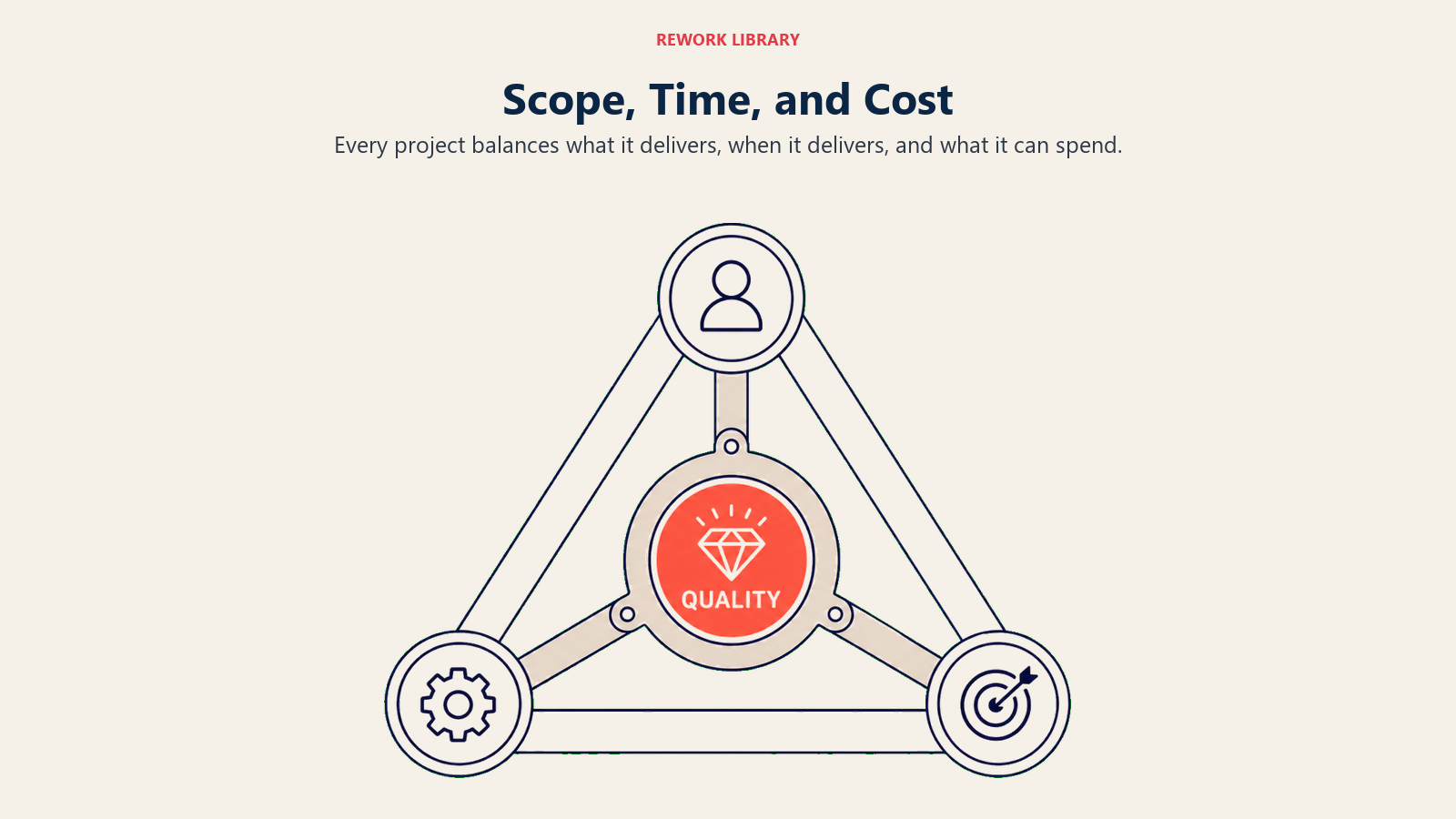
Umfang ist die vollständige Definition der Arbeit: die Funktionen, Liefergegenstände und Anforderungen, die das Projekt liefern muss. Eine klare Projektumfangsbeschreibung legt den Umfang zu Beginn fest und gibt dem Team etwas, auf das es verweisen kann, wenn neue Anforderungen eintreffen.
Zeit ist der Zeitplan, vom Kickoff bis zur Lieferung. Er umfasst jeden Meilenstein, jede Abhängigkeit und jede Deadline. Tools wie ein Gantt-Diagramm und die Analyse des kritischen Pfads helfen, den Zeitplan zu visualisieren und zu schützen.
Kosten sind das Gesamtbudget: Personal, Materialien, Softwarelizenzen, Auftragnehmergebühren und Gemeinkosten. Kosten und Zeit sind eng verknüpft, da die meisten Projektkosten aus den Stunden der Beteiligten bestehen.
| Einschränkung | Was sie steuert | Was passiert, wenn sie sich ändert |
|---|---|---|
| Umfang | Funktionen, Liefergegenstände, Anforderungen | Mehr Umfang erhöht Zeit und Kosten; weniger Umfang kann die Lieferung beschleunigen oder Ausgaben reduzieren |
| Zeit | Zeitplan, Meilensteine, Deadlines | Zeitplan verkürzen erhöht typischerweise die Kosten (Überstunden, mehr Ressourcen) oder erzwingt Umfangskürzungen |
| Kosten | Budget, Ressourcen, verfügbare Stunden | Budgetkürzungen erzwingen eine Zeitplanverlängerung oder Umfangsreduzierung; Budgeterhöhung kann Zeit zurückgewinnen |
Die wesentliche Erkenntnis: Qualität ist keine vierte Einschränkung neben den anderen. Sie ist das Ergebnis davon, wie gut die drei Einschränkungen ausbalanciert sind. Wenn Teams versuchen, alle drei starr zu halten und neue Anforderungen zu absorbieren, ist es die Qualität, die still darunter leidet.
Triple Constraint vs. erweiterte Einschränkungen
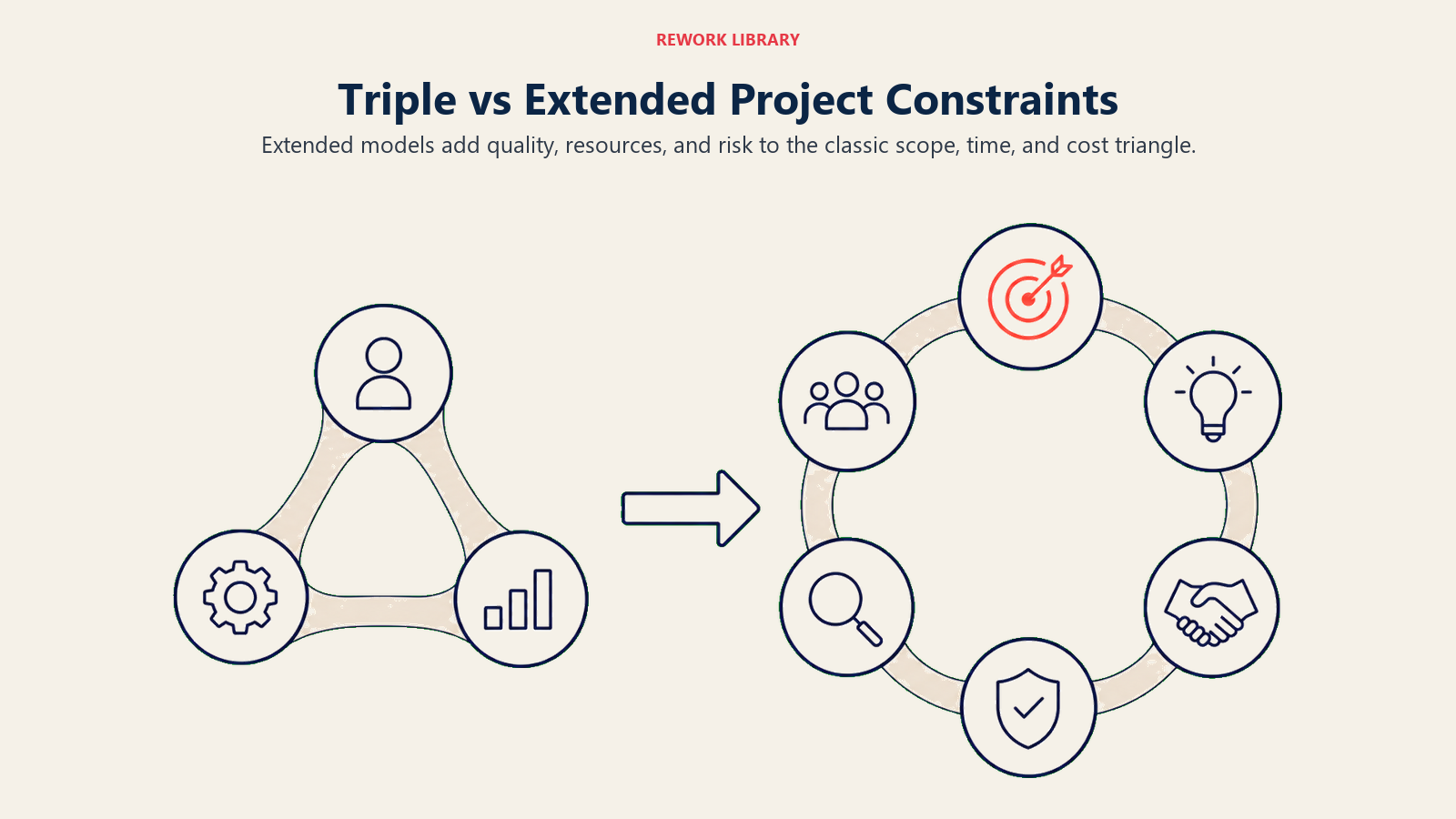
Das Triple-Constraint-Modell stammt aus den Anfängen des formalen Projektmanagements. Als Organisationen komplexere Programme angingen, erkannten Praktiker, dass drei Einschränkungen nicht ausreichen, um alles zu erfassen, was ein Projekt entgleisen lassen kann. Erweiterte Modelle fügen drei weitere Variablen hinzu:
| Einschränkung | Was sie erfasst |
|---|---|
| Qualität | Explizit als verwaltete Einschränkung, nicht nur als Nebenprodukt |
| Risiko | Wahrscheinlichkeit und Auswirkung von Ereignissen, die Umfang, Zeit oder Kosten verschieben könnten |
| Ressourcen | Verfügbarkeit von Personen, Ausrüstung und Materialien (abgegrenzt vom reinen Budget) |
Manche Frameworks nennen dies das „Sechs-Einschränkungen-Modell" oder das „Constraint-Diamant-Modell". In der Praxis beginnen die meisten Projektmanager weiterhin mit den ursprünglichen drei, da diese direkt mit Kundenverpflichtungen verknüpft sind. Risiken und Ressourcen werden separat in einem Risikoregister und einem Ressourcenplan verfolgt.
Warum das Triple Constraint wichtig ist
Das Eiserne Dreieck ist nicht nur ein theoretisches Modell. Es hat direkte, praktische Konsequenzen für jedes Gespräch, das ein Projektmanager mit einem Sponsor, einem Kunden oder einem Lieferteam führt.
Es verhindert magisches Denken. Wenn ein Stakeholder sagt „Wir brauchen es schneller und können nicht mehr ausgeben", macht das Dreieck die Kosten dieser Forderung konkret. Etwas muss nachgeben. Das Framework erzwingt dieses Gespräch früh, wenn Anpassungen noch günstig sind, statt spät, wenn sie teuer sind.
Es gibt Ihnen ein Verhandlungsinstrument. Mit dem Dreieck in der Hand können Sie exakt zeigen, welche Trade-offs eine Änderungsanforderung erfordert. „Wir können diese Deadline einhalten, wenn wir das Berichterstattungsmodul streichen und zwei Auftragnehmer hinzuziehen" ist eine konkrete, umsetzbare Antwort statt einer vagen Ablehnung.
Es schützt die Qualität. Teams, die die drei Einschränkungen explizit managen, erzielen tendenziell bessere Ergebnisse als Teams, die jede Veränderung informell absorbieren. Wenn Qualität als Mittelpunkt des Dreiecks sichtbar ist, lässt sie sich schwerer still opfern.
Es setzt Stakeholder-Erwartungen. Ein Projektauftrag, der auf das Triple Constraint verweist, signalisiert den Sponsoren, dass Änderungen echte Konsequenzen haben. Dieses gemeinsame Verständnis macht die Änderungssteuerung weit weniger konfliktträchtig.
Häufige Fehler
Alle drei Einschränkungen als unveränderlich behandeln. Die gefährlichste Annahme ist, dass Umfang, Zeit und Kosten alle nicht verhandelbar sind. In Wirklichkeit muss mindestens eine flexibel sein, oder das Projekt wird nicht lieferbar. Die unveränderliche Einschränkung frühzeitig identifizieren und klar kommunizieren.
Qualität als Puffer ignorieren. Teams unter Druck sagen oft, sie würden alle drei Einschränkungen einhalten, planen aber heimlich, Abstriche bei Tests, Dokumentation oder Review-Zyklen zu machen. Das ist kein Management des Triple Constraint. Das versteckt ein Qualitätsproblem, bis es später als Defekt oder Nacharbeitszyklen auftaucht.
Umfangsänderungen genehmigen, ohne Zeit und Kosten anzupassen. Umfangsänderungen, die isoliert genehmigt werden, ohne eine entsprechende Zeitplan- und Budgetanpassung, sind die strukturelle Definition von Umfangsausweitung. Jede genehmigte Umfangsänderung muss eine Neubewertung der anderen zwei Einschränkungen auslösen.
Beim Projektstart keine Baseline für alle drei festlegen. Ohne Dokumentation des Ist-Stands von Umfang, Zeit und Kosten beim Kickoff fehlt der Referenzpunkt für die Messung von Veränderungen. Ein Projektauftrag und eine Projektumfangsbeschreibung schaffen gemeinsam diese Baseline.
Stakeholder die Einschränkung nachträglich auswählen lassen. Manche Sponsoren warten, bis das Projekt in Schwierigkeiten ist, bevor sie entscheiden, was flexibel ist. Dann sind die Optionen schlechter und die Anpassungskosten höher. Welche Einschränkung unveränderlich ist, sollte von Anfang an vereinbart werden.
Den Dominoeffekt der Zeitkomprimierung unterschätzen. Sechs Wochen aus einem sechs Monate langen Projekt zu streichen klingt nach 20 %. Aber bei einem Projekt, bei dem der kritische Pfad durch eine handvoll Personen verläuft, kann diese Komprimierung eine Verdopplung des Teams, eine Neuanordnung von Abhängigkeiten und parallele Arbeitsstränge erfordern, die neue Koordinationsrisiken einführen.
Wie man das Triple Constraint managed
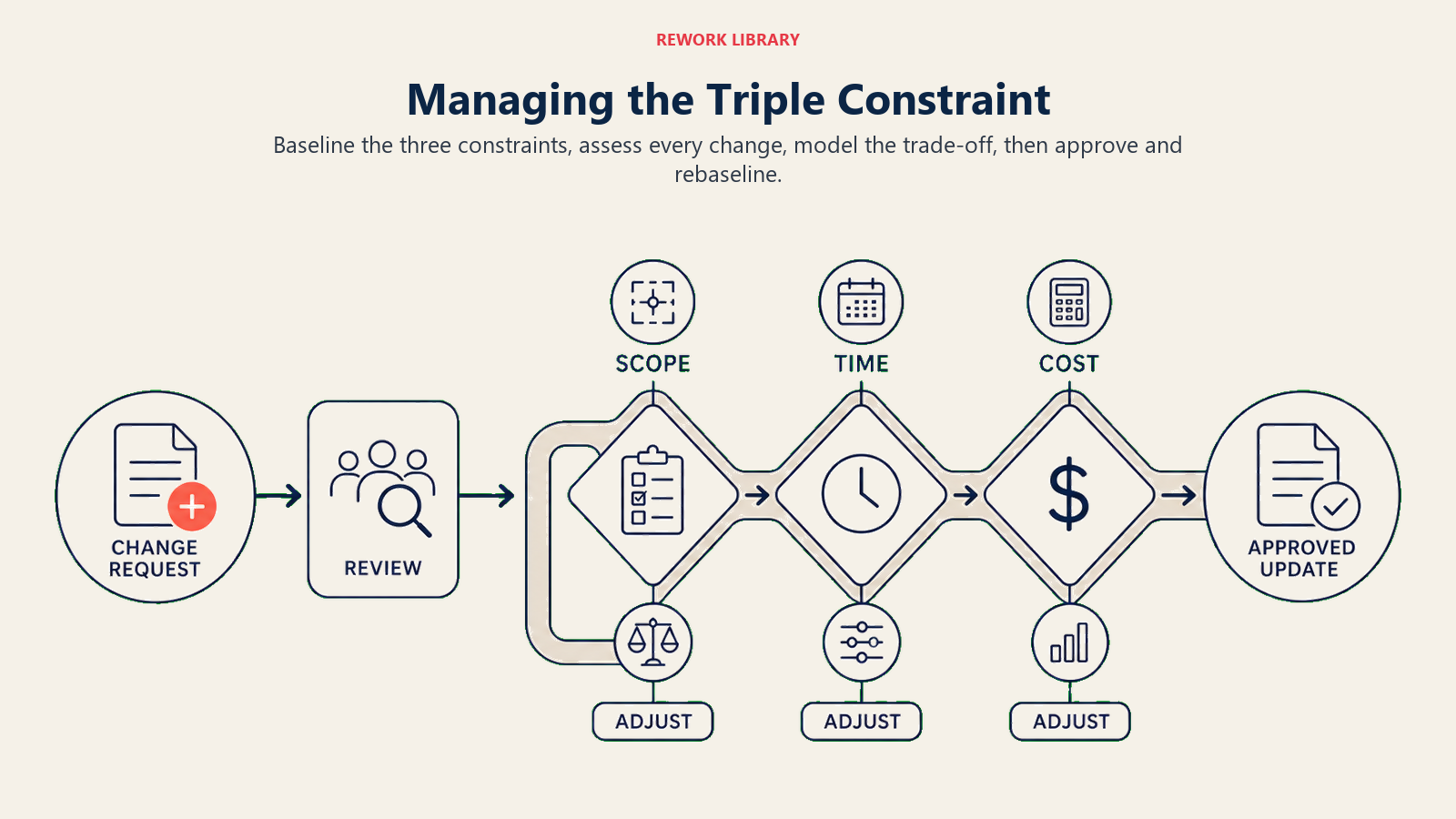
Das Management des Dreiecks beginnt mit einer Baseline und macht dann aus jedem Änderungsantrag einen expliziten Trade-off zwischen Umfang, Zeit und Kosten.
Schritt 1: Umfang, Zeit und Kosten als Baseline festlegen
Bevor jegliche Arbeit beginnt, die genehmigten Werte für alle drei Einschränkungen dokumentieren. Die Umfangs-Baseline kommt aus der Projektumfangsbeschreibung. Die Zeit-Baseline kommt aus dem Zeitplan (idealerweise ein Gantt-Diagramm, das mit dem kritischen Pfad verknüpft ist). Die Kosten-Baseline kommt aus dem genehmigten Budget. Diese drei Werte zusammen sind der Referenzpunkt für jede zukünftige Änderung.
Der Projektstrukturplan ist das Tool, das Umfang mit Zeit und Kosten verbindet: Durch die Zerlegung von Liefergegenständen in Aufgaben können Stunden geschätzt und Ressourcen zugewiesen werden, um einen realistischen Zeitplan und ein realistisches Budget zu erstellen. Ohne WBS ist die Baseline nur eine Schätzung.
Schritt 2: Identifizieren, welche Einschränkung unveränderlich ist
Nicht alle Einschränkungen haben bei jedem Projekt dasselbe Gewicht. Bei einem Compliance-Projekt mit einer gesetzlichen Deadline ist die Zeit unveränderlich. Bei einer Startup-MVP mit einer festen Startfinanzierungsrunde sind die Kosten unveränderlich. Bei einer Rebranding-Kampagne, bei der jedes Detail durch Markenstandards vorgegeben ist, ist der Umfang unveränderlich.
Den Projektsponsor direkt fragen: Wenn wir eine dieser drei Einschränkungen opfern müssten, welche wäre am akzeptabelsten? Die Antwort bestimmt, wie Sie auf künftige Trade-off-Entscheidungen reagieren werden. Im Projektauftrag dokumentieren.
Schritt 3: Trade-offs modellieren, bevor Änderungen zugesagt werden
Wenn eine Änderungsanforderung eingeht, nicht sofort genehmigen oder ablehnen. Zuerst eine Trade-off-Analyse durchführen. Wenn der Kunde eine neue Funktion möchte, die Auswirkung auf den Zeitplan (zusätzliche Aufgaben auf dem kritischen Pfad) und die Kostenauswirkung (Stunden, Ressourcen) berechnen. Wenn der Sponsor das Budget kürzt, identifizieren, welche Umfangspositionen oder Zeitplanpuffer das auffangen können.
Die RACI-Matrix hilft zu klären, wer für die Genehmigung von Trade-offs verantwortlich ist. Bei komplexen Projekten gehen Umfangsänderungen an ein Change Control Board; Budgetänderungen gehen an den Finanz-Sponsor; Zeitplanänderungen erfordern die Genehmigung des PM und den Input des Teams.
Schritt 4: Die Auswirkungen an die Stakeholder kommunizieren
Eine Änderungsanalyse, die in der PM-Tabelle verbleibt, schützt das Projekt nicht. Die Trade-off-Optionen in der Sprache der Stakeholder präsentieren: „Wenn wir die Integration hinzufügen, verschiebt sich der Go-live-Termin vom 30. September auf den 12. November, und wir benötigen zusätzliche 28.000 Euro für Auftragnehmer-Stunden." Konkrete Zahlen wirken anders als abstrakte Warnungen.
Für Führungskräfte die Trade-offs in geschäftlichen Begriffen rahmen. Verlorene Wochen bedeuten verzögerter Umsatz. Budgetüberschreitungen beeinflussen Quartalsprognosen. Umfangskürzungen beeinflussen Kundenverpflichtungen.
Schritt 5: Änderungen durch einen formalen Prozess steuern
Informelle Umfangsänderungen sind der Weg, auf dem das Triple Constraint in der Praxis zusammenbricht. Jede Änderung an Umfang, Zeit oder Kosten sollte einen dokumentierten Änderungsanforderungsprozess durchlaufen: angefordert, analysiert, genehmigt oder abgelehnt und aufgezeichnet. Ohne diesen Prozess driftet die Baseline, und Sie verlieren die Fähigkeit zu erklären, warum das Projekt vom ursprünglichen Plan abgewichen ist.
Den Änderungssteuerungsprozess mit den Meilensteinen des Projektlebenszyklus verknüpfen. Änderungen sind in der Planungsphase am günstigsten. In der Ausführungsphase steigen die Änderungskosten stark an, weil Nacharbeit bereits abgeschlossene Arbeit betrifft.
Triple-Constraint-Beispiele
Diese drei Szenarien veranschaulichen, wie das Dreieck in der Praxis wirkt.
| Szenario | Die Forderung | Trade-off-Optionen |
|---|---|---|
| Kunde möchte es 6 Wochen früher | Lieferung beschleunigen, ohne den Umfang zu ändern | Option A: Zwei Auftragnehmer hinzufügen (Kosten steigen). Option B: Zwei nicht-wesentliche Funktionen streichen (Umfang sinkt). Option C: Höheres Defektrisiko durch komprimierte Tests akzeptieren (Qualität sinkt). |
| Budgetkürzung mitten im Projekt | Sponsor reduziert das Budget um 20 % | Option A: Umfang reduzieren (weniger prioritäre Funktionen streichen). Option B: Zeitplan verlängern (bestehendes Team langsamer einsetzen). Option C: Auftragnehmer durch weniger erfahrene interne Mitarbeiter ersetzen (Qualitätsrisiko). |
| Umfangserweiterungsanforderung | Kunde fügt nach dem Kickoff eine neue Integration hinzu | Option A: Zeitplan um die geschätzte Build-Zeit verlängern. Option B: Budget für einen Spezialisten-Auftragnehmer erhöhen. Option C: Einen bestehenden Liefergegenstand äquivalenter Größe entfernen. |
Beachten Sie, dass jedes Szenario drei Optionen hat, und keine davon lautet „die Änderung ohne Anpassung absorbieren". Das ist das Eiserne Dreieck: Es gibt keine vierte Option. Die Aufgabe des PM ist es, die echten Optionen zu präsentieren und die Entscheidungsträger wählen zu lassen.
Best Practices
- Die unveränderliche Einschränkung schriftlich beim Kickoff festlegen. Sobald der Sponsor die Einschränkung benennt, die er um jeden Preis verteidigen wird, im Projektauftrag dokumentieren. Dieser eine Satz spart später stundenlange Debatten.
- Den Projektstrukturplan nutzen, um Umfang mit Zeitplan und Budget zu verknüpfen. Eine Umfangsbeschreibung, die nicht in Aufgaben zerlegt wird, kann nicht korrekt kalkuliert oder eingeplant werden.
- Das Triple Constraint bei jedem wichtigen Meilenstein überprüfen. Nicht auf eine Krise warten. Eine kurze Überprüfung an jedem Phasentor zeigt, ob die drei Einschränkungen noch im Gleichgewicht sind oder ob bereits eine Abweichung begonnen hat.
- Das Eiserne Dreieck mit einem Risikoregister kombinieren. Risiken, die eintreten, greifen oft ohne Vorwarnung eine Einschränkung an. Ein vorher identifizierter Risikomaßnahmenplan gibt Ihnen eine vorab genehmigte Trade-off-Reaktion, die sofort ausgeführt werden kann.
- Den Qualitäts-Opfer-Reflex vermeiden. Wenn Teams unter Druck stehen, ist der Instinkt, Test- oder Review-Zyklen zu kürzen, weil sie optional erscheinen. Sie sind es nicht. Qualitätsmängel, die in der Produktion entdeckt werden, kosten weit mehr als die Zeit, die in die Prävention investiert wurde.
- Umfangsausweitung mit einem Änderungsprotokoll verfolgen. Kleine, informelle Ergänzungen summieren sich. Ein laufendes Protokoll jeder genehmigten Änderung am ursprünglichen Umfang macht die kumulative Auswirkung sichtbar, bevor sie unkontrollierbar wird.
Häufig gestellte Fragen
Ist Qualität Teil des Triple Constraint?
Qualität ist keine der drei ursprünglichen Einschränkungen, steht aber in direktem Zusammenhang mit allen dreien. Denken Sie daran als Mittelpunkt des Dreiecks: Wenn Umfang, Zeit und Kosten gut ausbalanciert sind, bleibt die Qualität erhalten. Wenn das Team versucht, alle drei starr zu halten und dabei neue Anforderungen zu absorbieren, ist es die Qualität, die zuerst leidet. Manche erweiterten Frameworks (das Sechs-Einschränkungen-Modell) machen Qualität zu einer expliziten vierten verwalteten Einschränkung neben Risiko und Ressourcen.
Was ist der Unterschied zwischen dem Triple Constraint und dem Eisernen Dreieck?
Es gibt keinen praktischen Unterschied. Eisernes Dreieck ist ein informeller Name für dasselbe Modell und betont, dass die Beziehung zwischen Umfang, Zeit und Kosten starr und nicht flexibel ist. Man sieht auch „Projektmanagement-Dreieck" synonym verwendet. Der formale Begriff im PMI-PMBOK-Framework ist Triple Constraint.
Welche Einschränkung sollte zuerst festgelegt werden?
Das hängt vom Projekt ab. Regulatorische Deadlines machen die Zeit unveränderlich. Feste Startfinanzierung macht die Kosten unveränderlich. Vertraglich festgelegte Liefergegenstände machen den Umfang unveränderlich. Der richtige Ansatz ist, den Sponsor bei der Projektinitiierung direkt zu fragen, welche Einschränkung nicht verhandelbar ist. Sobald das vereinbart ist, werden die anderen beiden zu den Hebeln für das Management von Trade-offs.
Können alle drei Einschränkungen gleichzeitig unveränderlich sein?
Theoretisch ja, wenn die ursprünglichen Schätzungen korrekt sind und keine Änderungen auftreten. In der Praxis nein. Schätzungen sind unvollkommen, Risiken treten ein und Anforderungen entwickeln sich. Jedes Projekt von nennenswerter Komplexität wird mindestens einen Moment erleben, in dem das Team eine Einschränkung gegen eine andere abwägen muss. Das Eiserne Dreieck ist ein Modell zur Handhabung dieser Realität, nicht zum Vortäuschen, dass sie nicht eintreten wird.
Wie gilt das Triple Constraint bei agilen Projekten?
Agile Projekte legen typischerweise Zeit (die Sprint-Länge) und Kosten (die Teamgröße) fest, während der Umfang als flexible Variable behandelt wird. Jeder Sprint liefert die Elemente mit der höchsten Priorität, die in die feste Kapazität passen. Das ist die Umkehrung des traditionellen Waterfall-Ansatzes, bei dem der Umfang oft fest ist und Zeit/Kosten geschätzt werden, um ihn zu erfüllen. Beide Ansätze nutzen das Triple-Constraint-Modell; sie wählen nur unterschiedliche feste Punkte.
Weiterführende Artikel
- Projektumfangsbeschreibung
- Projektauftrag
- Projektstrukturplan
- Methode des kritischen Pfads
- Projektlebenszyklus
- Was ist ein Gantt-Diagramm
- RACI-Matrix
- Risikoregister
Jedes Projekt beginnt mit einem Dreieck. Die Teams, die pünktlich, im Budgetrahmen und mit etwas Liefernswürdigem abschließen, sind jene, die frühzeitig entscheiden, welche Seite flexibel sein kann, und diese Wahl dann bei jeder neuen Anforderung konsequent verteidigen.

Senior Operations & Growth Strategist
On this page
- Was ist das Triple Constraint?
- Die drei Seiten des Dreiecks
- Triple Constraint vs. erweiterte Einschränkungen
- Warum das Triple Constraint wichtig ist
- Häufige Fehler
- Wie man das Triple Constraint managed
- Schritt 1: Umfang, Zeit und Kosten als Baseline festlegen
- Schritt 2: Identifizieren, welche Einschränkung unveränderlich ist
- Schritt 3: Trade-offs modellieren, bevor Änderungen zugesagt werden
- Schritt 4: Die Auswirkungen an die Stakeholder kommunizieren
- Schritt 5: Änderungen durch einen formalen Prozess steuern
- Triple-Constraint-Beispiele
- Best Practices
- Weiterführende Artikel