Six Sigma Belts: White Belt to Master Black Belt Explained
Turn this article into takeaways for your work.


Each assistant summarizes the article only for you and suggests best practices for your work.
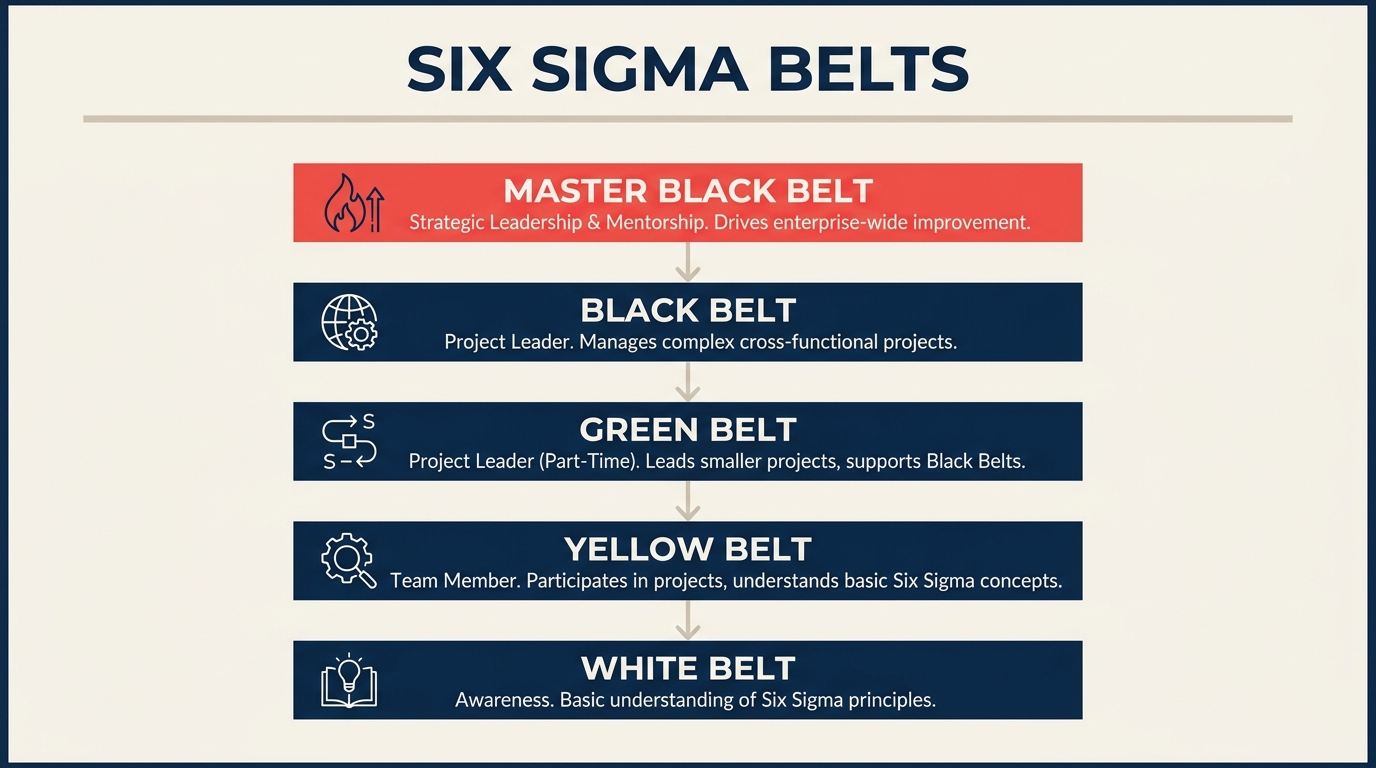
Six Sigma belts give every practitioner a clear rank and a defined job to do. The system borrows its color-coded levels from martial arts, and the result is that any manager, analyst, or executive can immediately understand who leads a project, who supports it, and who signs off on it. Whether you're just learning the basics or building a team of certified improvers, understanding the belt structure is the starting point.
Six Sigma itself is a data-driven methodology for reducing defects to 3.4 per million opportunities. The belt hierarchy exists to organize that work: each level carries specific training requirements, project responsibilities, and decision rights. Getting the levels right is how organizations avoid the common trap of running "Six Sigma programs" where nobody knows what they're actually supposed to do.
What Are Six Sigma Belts?
Six Sigma belts are a tiered certification hierarchy that classifies practitioners by their depth of training and their role in improvement projects. Like the ranking system in martial arts, belts progress from beginner (White) through competent (Yellow, Green) to expert (Black) and master (Master Black Belt), with a separate leadership track for executives called Champion.
DMAIC (Define, Measure, Analyze, Improve, Control) is the core problem-solving framework taught at every belt level, but the depth of instruction increases as you climb. A White Belt learns what DMAIC means; a Black Belt leads full DMAIC projects independently. That gap in depth is intentional: not every process improvement needs a PhD-level statistician. The belt system lets organizations deploy the right expertise to the right problem.
Certification bodies such as ASQ (American Society for Quality) and IASSC (International Association for Six Sigma Certification) provide the exams and standards. Some companies also run proprietary programs certified internally.
Key Facts
- Six Sigma was developed at Motorola in 1986 by reliability engineer Bill Smith, helping the company win the first Malcolm Baldrige National Quality Award in 1988. (Source: Motorola corporate history)
- The method targets 3.4 defects per million opportunities (DPMO), which corresponds to six standard deviations from the process mean. (Source: ASQ)
- Jack Welch made Six Sigma the operating backbone of GE starting in 1995, with the company reporting over $10 billion in cumulative savings by 2000. (Source: GE Annual Reports, 1999-2000)
The Six Sigma Belt Levels
The table below covers all recognized belt levels plus the Champion role, which is not a technical certification but a critical part of how Six Sigma projects succeed in practice.
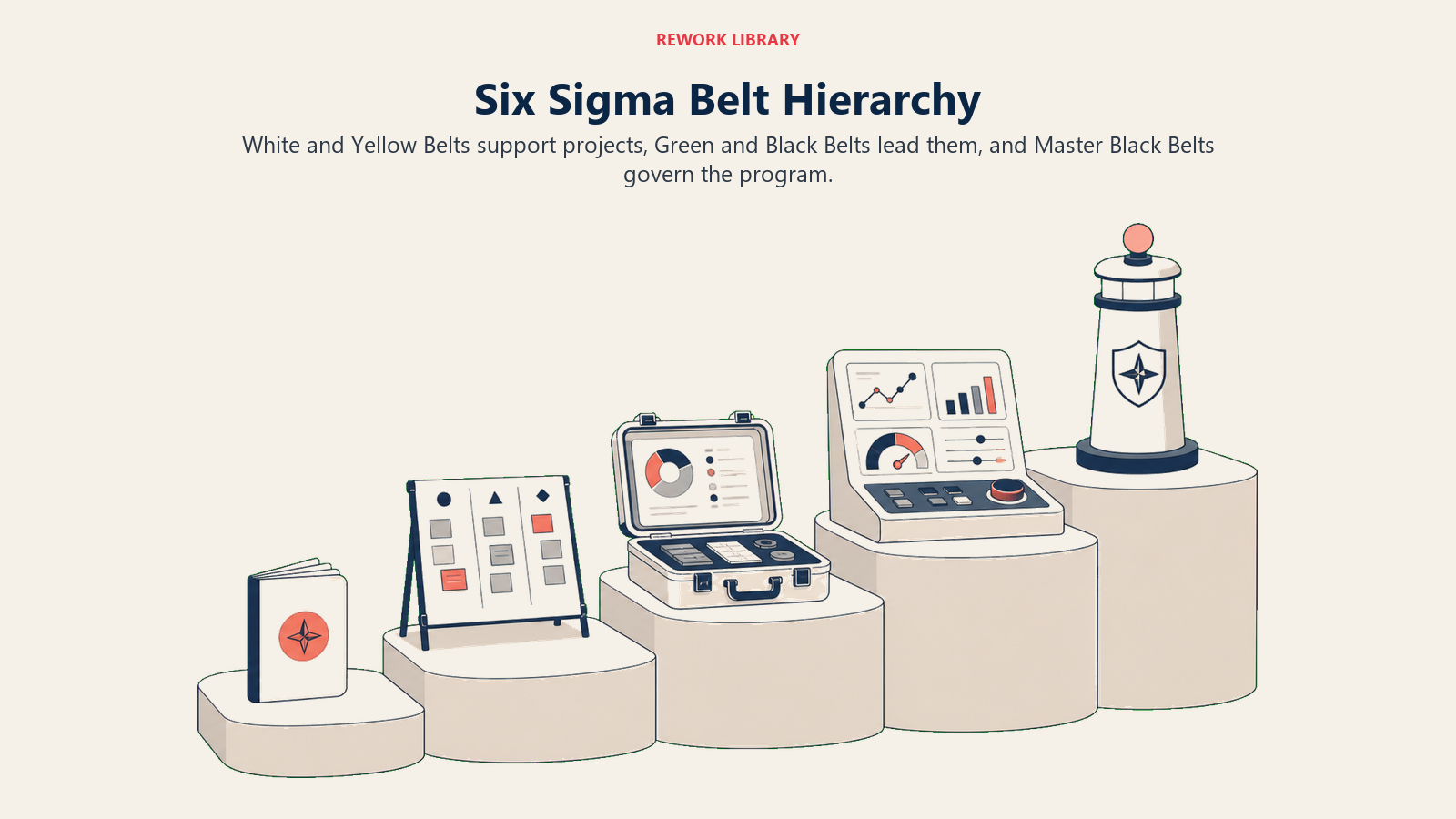
| Belt | Role | Typical Training Duration | Core Responsibilities |
|---|---|---|---|
| White Belt | Awareness-level contributor | 1-3 days | Understand Six Sigma basics, support project teams, participate in local improvements |
| Yellow Belt | Part-time project member | 1-2 weeks | Collect data, map processes, assist Green or Black Belts on defined tasks |
| Green Belt | Part-time project leader | 2-4 weeks (plus project) | Lead smaller DMAIC projects within their function, support Black Belts on larger initiatives |
| Black Belt | Full-time project leader | 4 months (plus project) | Lead complex, cross-functional DMAIC projects; mentor Green Belts; report results to Champions |
| Master Black Belt | Internal expert and coach | Years of experience post-BB | Design training programs, select projects, coach Black and Green Belts, set the quality strategy |
| Champion | Executive sponsor | 2-3 days (executive briefing) | Remove organizational barriers, allocate resources, connect project work to business strategy |
One thing to note: most organizations don't require employees to hold every belt in sequence. A manager might go straight to Green Belt if their role involves leading process projects. A quality director might target Black Belt directly. The path depends on the job, not on completing lower levels first.
Green Belt vs Black Belt
This comparison gets asked constantly, and it's worth a direct answer.
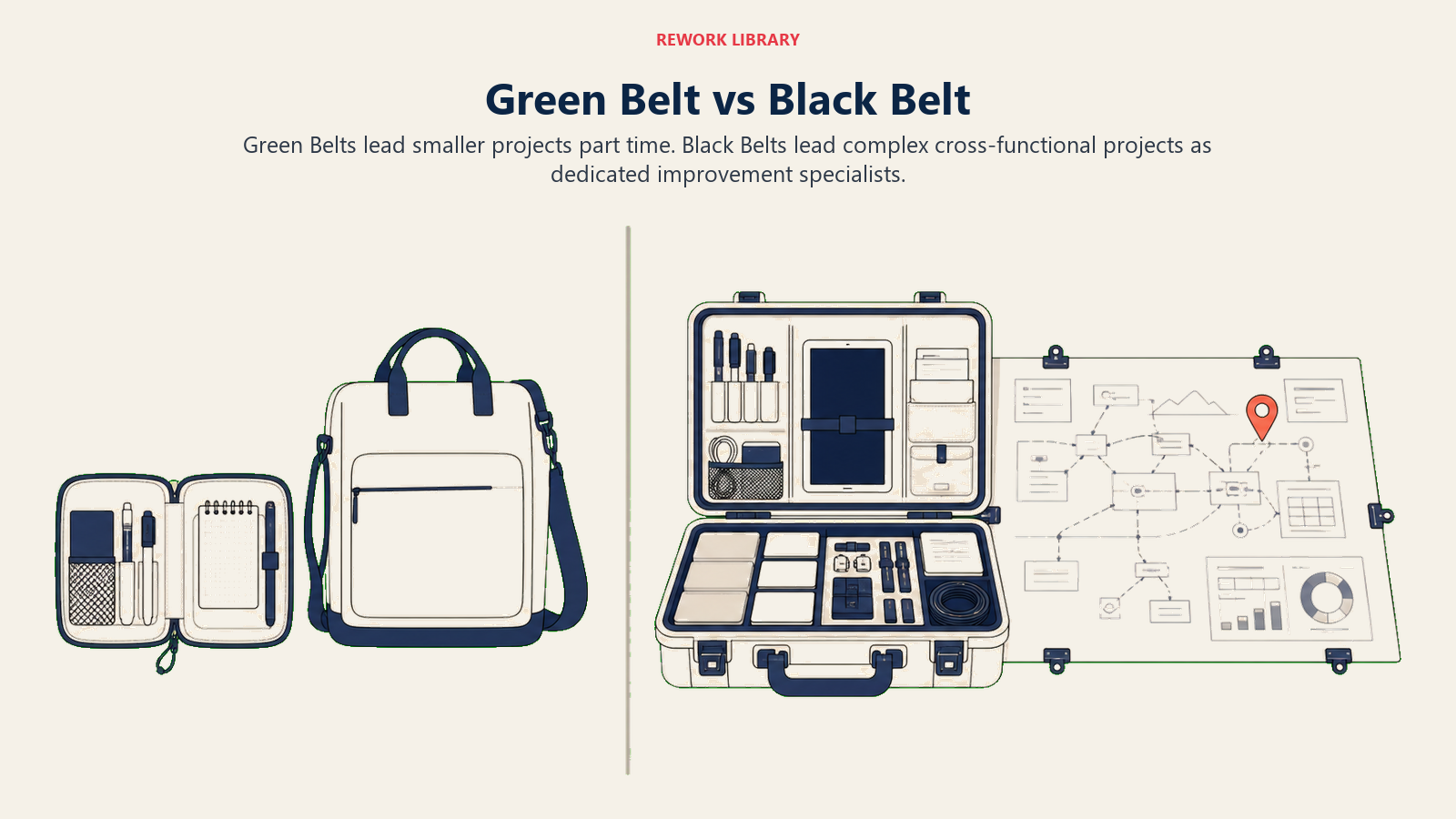
| Attribute | Green Belt | Black Belt |
|---|---|---|
| Time commitment | Part-time (25-50% of role) | Full-time Six Sigma role |
| Project scope | Single function, moderate complexity | Cross-functional, high complexity |
| Statistical depth | Core statistics (hypothesis testing, regression basics) | Advanced statistics (DOE, MSA, multivariate analysis) |
| Team leadership | Leads small teams within department | Leads cross-functional teams, coaches Green Belts |
| Typical training | 2-4 weeks classroom, 1 project | 4+ months, 2 projects with demonstrated savings |
| Certification exam | ASQ CSSGB or IASSC ICGB | ASQ CSSBB or IASSC ICBB |
| Career path | Functional manager, process improvement specialist | Quality director, operations leader, MBB candidate |
The short version: Green Belts improve processes in their own area; Black Belts fix problems that cross organizational lines and require rigorous statistical tools.
What Each Belt Does
White Belt
White Belts are participants, not leaders. Their job is to understand the language of Six Sigma well enough to support a project team. They know what DMAIC stands for, what a defect means in statistical terms, and why reducing variation matters. In practice, a White Belt might join a project kickoff, help log data, or attend team meetings to relay information to their local team.
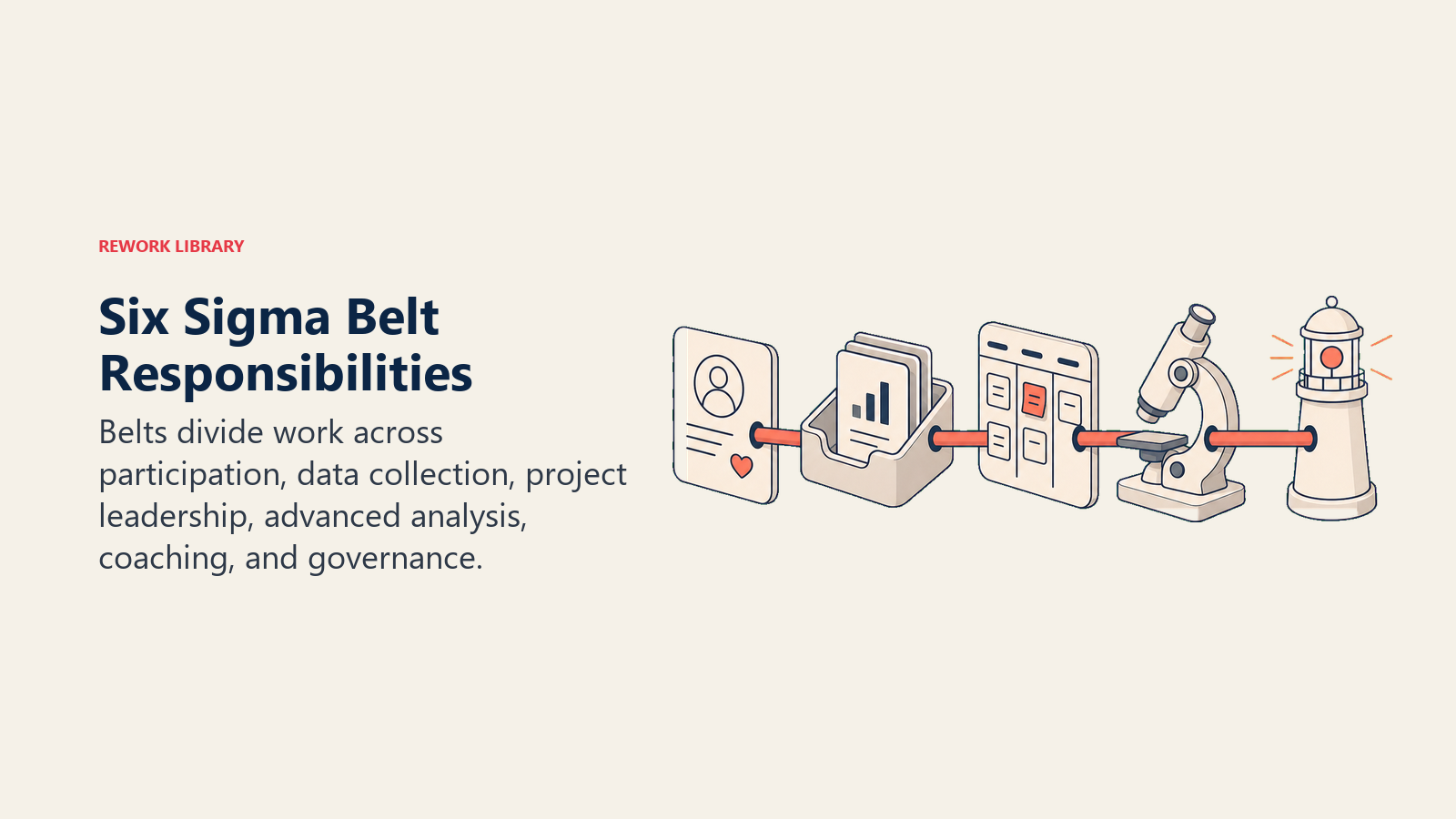
This level suits frontline employees who need awareness without needing to run projects. Some organizations use it as a required baseline for anyone whose work might be reviewed in a Six Sigma project.
Yellow Belt
Yellow Belts contribute to projects in a supporting role. They understand the DMAIC phases well enough to collect process data, create basic process maps, and help analyze root causes. A Yellow Belt typically works under the direction of a Green or Black Belt and handles tasks like data collection, fishbone diagramming, or SIPOC diagram creation.
The Yellow Belt level is practical for team leads, supervisors, and individual contributors who interact with process improvement work but don't own a full project.
Green Belt
Green Belts own projects within their function. They use DMAIC to define a problem, measure current performance, identify root causes through statistical analysis, implement changes, and put controls in place to hold the gains. Projects at this level tend to stay within one department or process area.
A typical Green Belt project might target reducing invoice processing time from five days to two, or cutting scrap rates in a production line by 40%. Green Belts usually spend 25-50% of their time on Six Sigma work alongside their regular duties.
Black Belt
Black Belts are the workhorses of a Six Sigma program. They run full-time, leading projects that cross functional boundaries and require serious statistical analysis. Design of Experiments (DOE), Measurement System Analysis (MSA), and multivariate regression are standard tools at this level. Black Belts also mentor Green Belts and report project outcomes to Champions.
A Black Belt project might tackle a quality issue that affects procurement, manufacturing, and logistics simultaneously. The financial impact at this level is expected to be significant, often $250,000 or more per project, which is why most certification programs require candidates to complete two projects before earning the credential.
Six Sigma as a whole depends on Black Belt talent being available and well-supported. Organizations that build a strong Black Belt bench tend to sustain their programs; those that don't see the methodology fade after the first wave of projects.
Master Black Belt
Master Black Belts are the architects of a Six Sigma program. They don't typically lead projects themselves; instead, they design the training curriculum, coach Black and Green Belts, select which projects get priority, and work with senior leaders to embed quality thinking into strategy.
MBBs need deep statistical expertise plus the ability to teach and communicate. They're the people a Black Belt calls when they hit a statistical challenge they haven't seen before. Reaching MBB usually takes several years of Black Belt experience plus a significant portfolio of project leadership and coaching.
Champion
Champions are executives or senior managers who sponsor Six Sigma projects at the organizational level. They don't need deep statistical training, but they need to understand how to read project results, remove barriers that block progress, and connect individual project outcomes to business strategy.
Without active Champions, Six Sigma projects stall. The Champion role is what links lean methodology and process improvement work to budget decisions and leadership priorities.
How to Get Six Sigma Certified
Step 1: Choose Your Belt Level
Pick the belt that fits your current role and career direction. If you're a frontline team member or department supervisor, Yellow or Green Belt is the right starting point. If your job involves leading cross-functional process projects full-time, Black Belt is the target. Don't aim for Black Belt just for the credential: the training and exam are rigorous, and the certification requires demonstrating real project results.
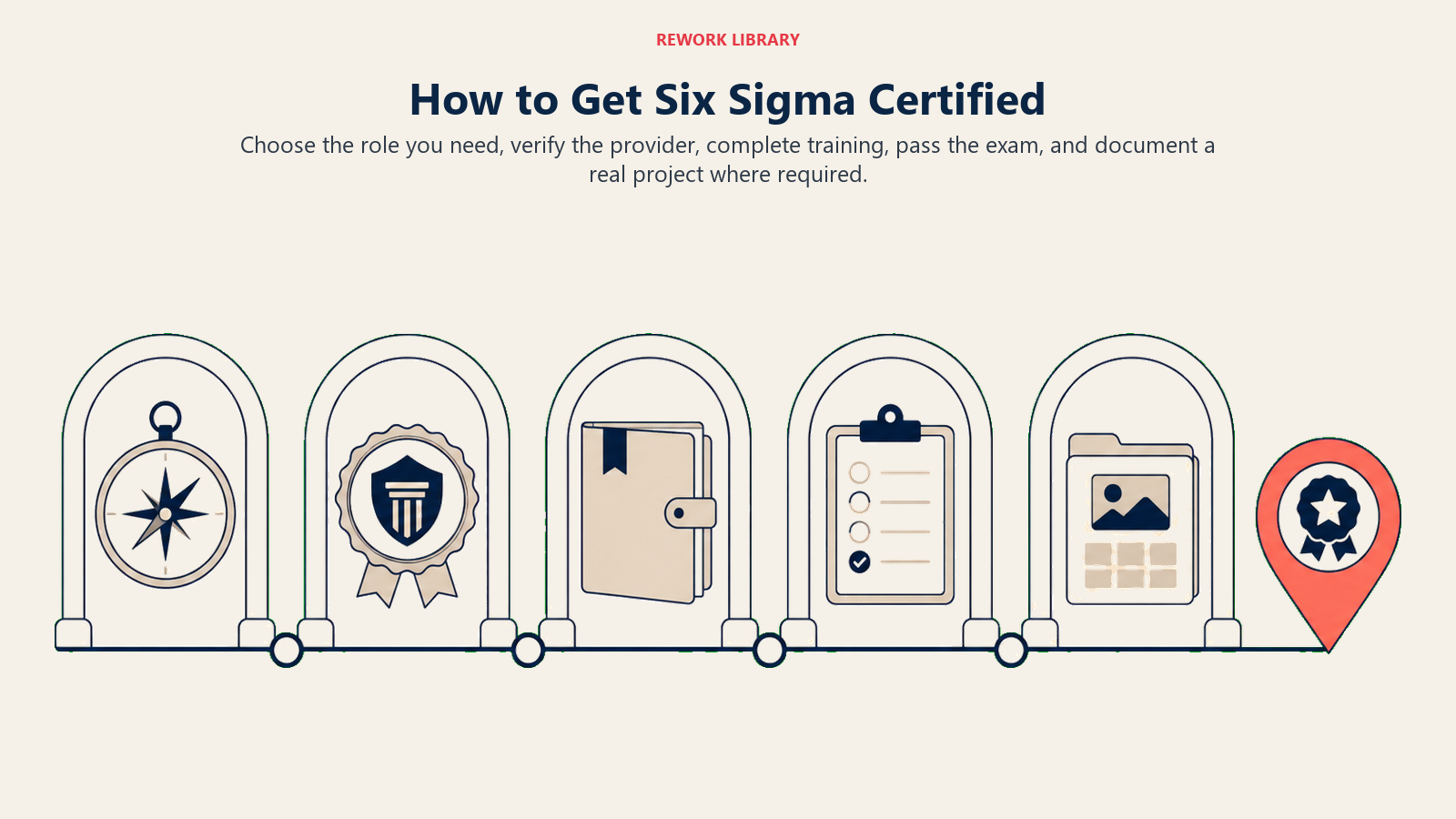
Step 2: Pick a Certification Body
The two main independent bodies are:
- ASQ (American Society for Quality): The CSSGB (Certified Six Sigma Green Belt) and CSSBB (Certified Six Sigma Black Belt) are among the most recognized globally. ASQ exams require a mix of formal education, work experience, and in some cases, a completed project.
- IASSC (International Association for Six Sigma Certification): The ICGB and ICBB are fully exam-based, meaning no work experience or project submission is required. This makes IASSC attractive for practitioners who need flexibility.
Some employers run internal Six Sigma programs with their own certification standards. GE and Motorola famously ran their own belt programs. If you work at a company with an established program, internal certification may be recognized more highly within that organization than an external credential.
Step 3: Complete the Training
Training options range from in-person boot camps to self-paced online courses. For Green Belt, expect a minimum of two weeks of focused instruction. For Black Belt, expect four to six months when combining classroom work, statistical software practice (Minitab is the industry standard), and project coaching.
Total quality management principles form the backdrop for all Six Sigma training. If you're new to quality concepts, it helps to read a primer on TQM before diving into DMAIC.
Step 4: Pass the Exam and Complete Your Project
ASQ exams are open-book, timed, and cover statistics, process tools, and case analysis. IASSC exams are closed-book. For ASQ CSSBB candidates, you also need to submit a signed affidavit confirming project completion. Study time averages 100-150 hours for Green Belt, 200-300 hours for Black Belt, not counting the project work itself.
Benefits of Six Sigma Certification
Certified practitioners bring measurable value. Projects led by Black Belts at GE, Motorola, and Honeywell generated billions in documented savings over the 1990s and 2000s, which is why the credential carries weight in hiring decisions across manufacturing, healthcare, finance, and supply chain.
For individuals, certification signals problem-solving rigor: you know how to frame a problem with data, not opinion, and how to hold a solution in place after implementation. For employers, having a belt-certified workforce means fewer reliance on consultants and faster internal response to quality problems.
Value stream mapping and process capability analysis become much faster to apply when a team includes certified practitioners who already speak the same language.
Common Misconceptions
"You need to start at White Belt and work up." You don't. Most people enter at the level that fits their job. Many Green Belts have never completed a White or Yellow Belt program.
"Six Sigma is only for manufacturing." False. Hospitals use it to reduce medication errors. Banks use it to cut loan processing errors. Call centers use it to improve first-call resolution. The tools are industry-neutral.
"Certification is a one-time achievement." ASQ certifications must be recertified every three years through continuing education or retesting. IASSC certifications don't expire, but the field's expectations do evolve.
"Master Black Belt is just a senior Black Belt." The roles are different, not just scaled. MBBs coach, design programs, and influence strategy. They're teachers and architects, not just more advanced project managers.
"A Champion needs technical training." Champions need business acumen and authority, not statistical depth. Sending an executive through a full Black Belt training program is a common mistake that wastes their time and misses the point of the Champion role.

Senior Operations & Growth Strategist
On this page
- What Are Six Sigma Belts?
- The Six Sigma Belt Levels
- Green Belt vs Black Belt
- What Each Belt Does
- White Belt
- Yellow Belt
- Green Belt
- Black Belt
- Master Black Belt
- Champion
- How to Get Six Sigma Certified
- Step 1: Choose Your Belt Level
- Step 2: Pick a Certification Body
- Step 3: Complete the Training
- Step 4: Pass the Exam and Complete Your Project
- Benefits of Six Sigma Certification
- Common Misconceptions