Lean Manufacturing Implementation: A Step-by-Step Guide for Operations Leaders
Turn this article into takeaways for your work.


Each assistant summarizes the article only for you and suggests best practices for your work.
Lean manufacturing looks simple on paper. Eliminate waste. Flow value to the customer. Respect people. But the gap between reading about the lean manufacturing principles and actually running a facility that lives them is where most transformations fail.
The statistics are sobering. Research consistently finds that 60-70% of lean initiatives don't deliver their promised results. Not because the tools don't work, but because implementation is hard in ways that aren't obvious until you're in the middle of it. Leaders underestimate the cultural shift required. They treat lean as a set of tools rather than a management system. They launch too many initiatives at once and sustain none of them.
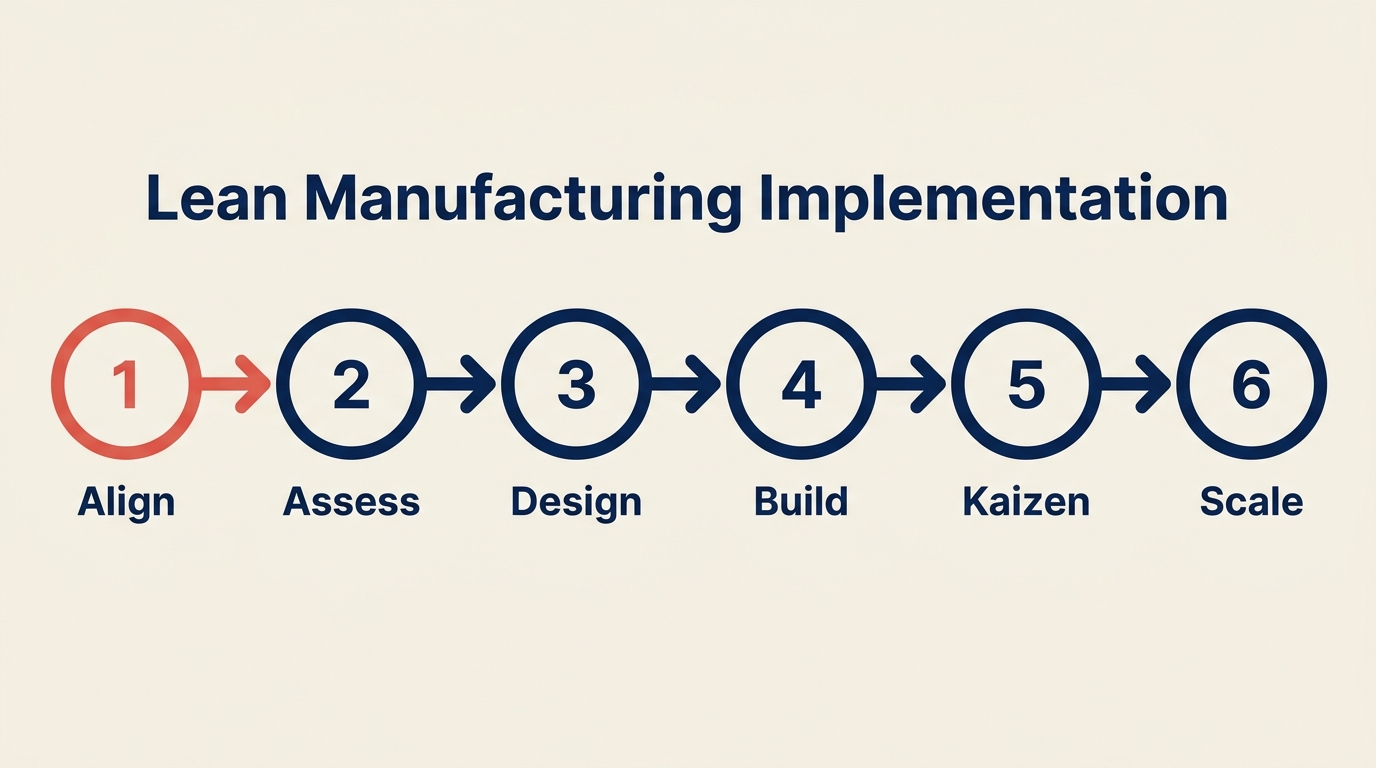
This guide is a practical roadmap for operations leaders who want to implement lean manufacturing and actually make it stick.
Why Most Lean Implementations Fail
Before covering what to do, it's worth being honest about why implementations derail. Understanding failure modes shapes better decisions from the start.
Treating lean as a cost-cutting program. When executives frame lean as headcount reduction, operators protect information and resist changes. Lean works through engagement. Tell people the goal is eliminating waste to grow capacity and improve jobs, not to eliminate jobs.
Starting with tools instead of problems. Running a 5S event because "5S is lean" misses the point. Start with your biggest operational problem and apply the tool that addresses it. Tools without problem-solving context don't stick.
Not addressing the management system. Lean tools on a shop floor managed by traditional command-and-control practices create friction. The daily management system (how problems are surfaced, escalated, and solved) must change alongside the physical environment.
Insufficient coaching. Lean requires new skills across every level. Frontline operators need to see waste differently. Supervisors need to shift from firefighting to problem prevention. Managers need to ask questions instead of giving answers. This takes sustained coaching, not a two-day training session.
No follow-through on improvements. When operators suggest improvements and nothing happens, they stop suggesting. A reliable system for capturing, prioritizing, and implementing ideas (and communicating results back to the suggestor) is non-negotiable.
Phase 1: Leadership Alignment (Weeks 1-4)
Lean implementations succeed or fail at the leadership level before a single tool hits the shop floor.
Define the business case clearly. What specific problem are you solving? Customer complaints about on-time delivery? Quality escapes costing rework and warranty claims? Capacity constraints limiting growth? Tie lean to a concrete business outcome with measurable targets.
Educate the leadership team. Most operations leaders have surface familiarity with lean vocabulary but haven't worked in a genuinely lean environment. Take the team through a plant tour of an established lean operation if possible. Simulations and tabletop exercises help, but seeing real implementation builds conviction.
Address the job security question directly. Before launching, leadership must commit to a policy on workforce implications. The standard lean commitment is that improvements free capacity for growth rather than trigger layoffs. Document this and communicate it. Operators will ask, and vague answers kill engagement.
Establish executive sponsorship with real time commitment. Lean needs a senior sponsor who visits the floor weekly, participates in problem-solving sessions, and visibly applies lean principles to their own work. Sponsorship that lives only in steering committee meetings doesn't generate the cultural change lean requires.
Set a three-year trajectory, not a one-year sprint. Lean transformation takes years. Set expectations accordingly. The first year builds foundations and demonstrates proof of concept. Years two and three scale and deepen what works. Organizations that expect dramatic results in 90 days usually burn out their teams and abandon the effort.
Phase 2: Current State Assessment (Weeks 4-8)
You can't improve what you don't understand. A rigorous current state assessment reveals where to start and establishes the baseline you'll measure against.
Select a pilot value stream. Don't try to transform the entire operation at once. Choose a single product family that represents a significant portion of revenue or customer importance, where leadership has direct influence, and where improvement would create visible impact. This is your proof-of-concept.
Map the current state. Value stream mapping traces the flow of material and information from raw material to customer delivery for your selected product family. Walk the actual production flow with a cross-functional team. Map every step, including wait times, transport, inventory, and rework loops. The map reveals waste that spreadsheets never show.
Measure baseline performance. Capture current performance on the metrics that matter: lead time, on-time delivery, first-pass yield, overall equipment effectiveness, inventory turns, and cost per unit. These baselines let you demonstrate improvement and calibrate effort.
Conduct process observation. Spend time at each workstation watching actual work, not the standard work (which may not reflect what actually happens). Look for interruptions, workarounds, informal process variations, and the problems operators deal with daily but have stopped reporting because nothing gets fixed.
Engage frontline operators early. The people doing the work have the most accurate picture of what's actually happening. Involve operators in current state mapping. Their knowledge accelerates the assessment and begins building the engagement that sustains implementation.
Phase 3: Future State Design (Weeks 8-12)
With a clear current state picture, design the improved future state. The future state map becomes your implementation blueprint.
Establish the design principles for your future state. Most lean future states aim for: production paced to customer demand (takt time), continuous flow wherever possible, pull systems where flow isn't practical, and leveled production scheduling. Apply these principles to your specific situation.
Identify the kaizen bursts. On the future state map, kaizen bursts mark specific improvement projects needed to achieve the future state. Each burst becomes a project with an owner, timeline, and expected outcome.
Prioritize by constraint. The constraint in your value stream limits throughput regardless of improvements elsewhere. If assembly is your bottleneck, improving machining capacity doesn't help until assembly is addressed. Use production bottleneck analysis to find and sequence your improvement projects correctly.
Design the future management system. What daily metrics will teams review? What visual management will make problems visible? How will problems be escalated and solved? How will improvement ideas be captured and implemented? The management system design is as important as the physical layout.
Set targets and create the implementation plan. Translate the future state into specific measurable targets (reduce lead time from 12 days to 4 days, improve first-pass yield from 87% to 95%, eliminate one batch operation by converting to flow). Sequence the kaizen bursts into a realistic implementation plan.
Phase 4: Implementation Foundations (Months 3-6)
Before running improvement events, build the foundations that make improvements sustainable.
Implement 5S in the pilot area. 5S workplace organization (Sort, Set in Order, Shine, Standardize, Sustain) creates the visual workplace foundation lean requires. It builds discipline habits, makes abnormalities visible, and demonstrates that leadership will follow through on commitments. Start here.
Develop standard work. Standard work documents the current best-known method for each operation: cycle time, sequence of operations, and work-in-process requirements. Without standard work, you can't train consistently, identify deviations, or improve reliably. Standard work is the baseline for all future improvement.
Establish visual management. Visual management makes the status of operations visible to anyone, instantly, without asking. Production tracking boards showing planned versus actual output, quality charts, downtime logs, and improvement idea boards all belong on the shop floor. Problems become visible before they become crises.
Launch daily team meetings. Short (5-10 minutes), structured daily team meetings at the work area level create the cadence for daily problem identification and resolution. Teams review yesterday's performance, identify today's challenges, and assign quick action items. These meetings build the problem-solving discipline lean requires.
Create the problem-solving system. Establish a clear, simple process: operators identify a problem, it gets captured on a standard form, it gets reviewed in the daily meeting, an owner gets assigned, and the result gets communicated back. The system matters less than the follow-through. If problems disappear into a suggestion box and nothing happens, the system dies quickly.
Phase 5: Kaizen Events (Months 4-12)
Kaizen events are structured improvement workshops that transform specific processes in a focused week-long effort.
Staff events correctly. A kaizen event team includes operators who do the work (they know what's actually happening), support function representatives (maintenance, quality, engineering), the area supervisor, and a lean facilitator. Keep teams at 6-10 people. Larger groups lose focus.
Follow the kaizen event structure. Day 1 focuses on current state observation and measurement: walk the process, time it, count everything. Day 2 analyzes the data and designs the future state. Days 3-4 implement changes (moving equipment, building fixtures, writing standard work, creating visual aids). Day 5 reviews results, documents remaining items, and presents to leadership.
Achieve real results in the event week. The best kaizen events change the physical space, write new standard work, implement visual management, and measure results before the week ends. Leaving everything as "action items to complete later" defeats the purpose. Push for same-week implementation even if it means working into the evening.
Handle resistance professionally. Some operators will resist changes, especially to workstations they've run for years. Involve resistors in the event team. Their deep process knowledge is valuable, and participation often converts skeptics more effectively than any presentation. When resistance comes from legitimate safety or quality concerns, address them seriously.
Sustain with audits. Every kaizen event should include a 30-day, 60-day, and 90-day audit of results. Who audits, what they measure, and how results get reported should be defined before the event ends. Audits catch backsliding early and demonstrate leadership commitment to sustaining gains.
Phase 6: Scaling and Sustaining (Year 2+)
A successful pilot proves the concept. Scaling it across the operation is a different challenge.
Expand systematically, not everywhere at once. Add one new value stream at a time. Each expansion applies lessons from previous implementations, builds the organization's lean capability, and maintains quality of execution. Moving faster than the organization can absorb creates chaos rather than improvement.
Develop internal lean capability. In the early phases, external lean consultants or a dedicated lean team drives implementation. Over time, supervisors and operators must develop enough skill to lead improvements themselves. The goal is a self-sustaining improvement engine, not permanent dependence on lean specialists.
Connect lean to kaizen continuous improvement at every level. Daily kaizen (small improvements every day) complements event-based kaizen. Operators who know how to identify and remove waste from their own workstations create compounding improvement between major events. Celebrate small improvements as loudly as big ones.
Address the management system evolution. As lean matures, the management system must evolve. Leaders at every level need to shift from managing results to managing processes. Hoshin kanri or similar strategy deployment tools help align improvement priorities from the executive level down to the shop floor. The daily management system ties daily work to strategic direction.
Use material requirements planning integration. Lean flow principles need to connect with planning systems. As you convert from batch to flow, your MRP inputs and planning logic must adapt to reflect actual lean production capabilities rather than the old batch assumptions. This integration is often underestimated in early lean planning.
Measuring Implementation Progress
Lean implementation progress shows up in both operational metrics and cultural indicators.
Operational metrics to track:
- Lead time (order to shipment): target 50-70% reduction from current state
- On-time delivery: target 95%+
- First-pass yield: target 98%+
- OEE on key equipment: target 75%+ for most operations
- Inventory turns: target 2-3x improvement from baseline
- Space utilization: typically 25-40% reduction as flow replaces batch and queue
Cultural indicators that predict sustainability:
- Number of improvement ideas submitted per employee per month (target: 1-2+)
- Percentage of submitted ideas implemented (target: 75%+)
- Audit scores on 5S and standard work compliance
- Percentage of problems solved at the level where they occur (rather than escalated)
- Supervisor time spent coaching versus firefighting
When cultural indicators are trending well, operational metrics follow. When operational metrics improve but cultural indicators stagnate, gains rarely sustain.
Common Implementation Pitfalls to Avoid
Skipping standard work. Teams resist writing standard work because it takes time and feels bureaucratic. But without a documented baseline, every shift runs differently and improvement is impossible to sustain. Make standard work non-negotiable.
Confusing activity with progress. Running lots of kaizen events is not the same as making progress on your future state. Every event should connect to your value stream future state. Random improvement activity creates busy-ness without strategic direction.
Neglecting manufacturing safety culture. Lean layouts and material flow changes affect safety. Never implement flow improvements that create new safety hazards. Build safety review into every kaizen event and make safety the first item in every daily team meeting.
Under-investing in supervisor development. Supervisors are the most critical implementation layer. They either model lean behaviors daily or they don't. Investing 20% of your lean training budget on supervisor development often yields better returns than three times that on operator training.
Declaring victory too soon. Leadership enthusiasm that leads to "we've completed lean" announcements undermines the continuous improvement mindset. Lean is a direction of travel, not a destination. Communicate progress, celebrate milestones, and always point to the next target condition.
Getting Started
The best lean implementation starts smaller and moves more carefully than most leaders expect. The fundamentals always apply: select a specific pilot area, understand the current state deeply before designing the future, build standard work before trying to improve, develop your people's problem-solving capability alongside the process changes, and follow through on every commitment made to the workforce.
Done right, lean manufacturing implementation creates a self-sustaining improvement engine that builds competitive advantage compounding over years. Done wrong, it creates cynicism that makes the next improvement initiative even harder to launch.
The choice of how to implement determines which outcome you get.
Frequently Asked Questions about Lean Manufacturing Implementation
How long does lean manufacturing implementation take?
A meaningful pilot value stream typically takes 6-12 months to transform. Full facility implementation across multiple value streams takes 2-5 years. Organizations that expect dramatic facility-wide results in 90 days consistently underperform those that plan for a 3-year transformation.
How much does lean implementation cost?
Costs vary widely. A focused pilot with internal lean capability and one or two external consultants for initial guidance might run $50,000-$150,000 in direct costs. A comprehensive facility transformation with significant consulting support could run $500,000-$2 million. Most organizations find that properly done lean generates positive ROI within 12-18 months of a pilot.
Should we hire a lean consultant or build internal capability?
Both. External consultants accelerate early phases and transfer knowledge. But organizations that remain dependent on consultants indefinitely never build the internal capability lean requires. Plan from the start to develop internal lean leaders who can sustain and expand the implementation without ongoing external support.
What's the difference between lean manufacturing implementation and lean principles?
Lean principles describe the philosophy and concepts (eliminate waste, create flow, pull from demand). Implementation is the practical work of applying those principles in a specific facility: selecting priorities, running improvement events, changing the management system, developing people, and sustaining gains over time.
How do we sustain lean gains after implementation?
Sustainability comes from three sources: daily management systems that make problems visible and create accountability for quick resolution, standard work that documents the improved methods and enables consistent training, and a culture where everyone at every level sees identifying and solving problems as part of their job. Without all three, gains erode within 12-18 months.

Founder & CEO
On this page
- Why Most Lean Implementations Fail
- Phase 1: Leadership Alignment (Weeks 1-4)
- Phase 2: Current State Assessment (Weeks 4-8)
- Phase 3: Future State Design (Weeks 8-12)
- Phase 4: Implementation Foundations (Months 3-6)
- Phase 5: Kaizen Events (Months 4-12)
- Phase 6: Scaling and Sustaining (Year 2+)
- Measuring Implementation Progress
- Common Implementation Pitfalls to Avoid
- Getting Started