Supply Chain Optimization: How Manufacturers Cut Costs and Improve Delivery Performance
Turn this article into takeaways for your work.


Each assistant summarizes the article only for you and suggests best practices for your work.
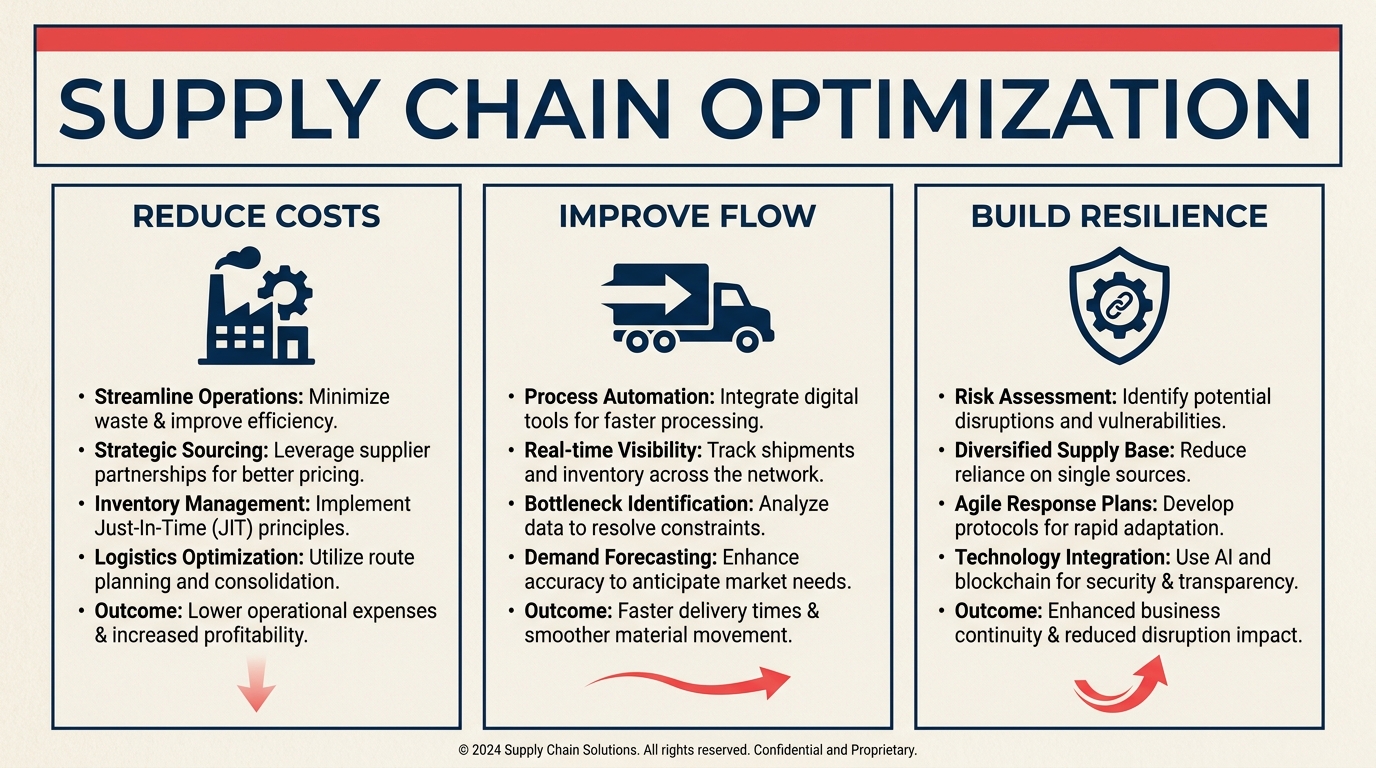
Supply chain costs typically represent 50-70% of a manufacturer's total revenue. That ratio means supply chain optimization has more leverage on profit than almost anything else an operations team can do. A 5% reduction in supply chain costs often doubles operating margin for mid-market manufacturers running at typical margins of 5-10%.
But optimization is harder than cost reduction. Cutting corners on supplier quality, reducing safety stock below sensible thresholds, or consolidating to a single source for critical components all lower costs in the short run while building fragility that erupts during the next disruption. True optimization balances cost, service, and resilience, not just one of the three.
This guide covers the practical methods manufacturers use to optimize supply chains without building in the fragility that creates the next crisis.
Understanding Your Supply Chain's Current Performance
Before optimizing anything, you need an accurate picture of current performance. Most manufacturers track procurement cost per unit but have limited visibility into total supply chain cost, which includes much more.
Total supply chain cost includes:
- Purchase price (what you pay suppliers)
- Freight and logistics (inbound and outbound)
- Carrying cost of inventory (typically 20-30% of inventory value per year)
- Warehouse handling and storage
- Quality costs from supplier defects (inspection, rework, customer returns)
- Expediting costs when supply disrupts production
- Obsolescence on slow-moving or end-of-life inventory
Many manufacturers are surprised to find that purchase price represents only 40-50% of total supply chain cost. Inventory carrying cost, quality failures, and expediting often account for as much as freight itself.
Key performance metrics to establish as baselines:
- On-time delivery from suppliers (percentage of orders arriving on promised date)
- Supplier quality performance (defect rate per million parts or per shipment)
- Total inventory turns (cost of goods sold divided by average inventory value)
- Days of supply at each tier (raw material, WIP, finished goods)
- Lead time from order placement to goods receipt by category
- Purchase price variance (actual versus standard or target cost)
Establish these baselines before starting optimization initiatives. They let you measure impact and prioritize where to focus first.
Demand-Driven Planning: The Foundation of Optimization
Most supply chain problems begin with poor demand planning. When forecasts are inaccurate, you end up with too much inventory of some items and shortages of others. Both are waste.
Connect planning to actual customer demand. Master production scheduling should reflect actual customer orders and realistic forecasts rather than production-driven assumptions. Build in statistical safety stock based on actual demand variability and supplier lead time variability, not just rules of thumb like "keep two weeks of everything."
Reduce the planning horizon to what you can actually forecast. Many manufacturers plan 12 months out in detail when forecast accuracy beyond 4-6 weeks is below 70%. A rolling 13-week detailed plan with longer-range rough-cut planning is more accurate and actionable than an annual plan maintained in fiction.
Segment inventory by demand pattern. High-volume, predictable items (A-items) warrant tight replenishment logic and frequent review. Low-volume, sporadic items (C-items) need different logic, often with longer replenishment cycles and higher safety stock relative to average demand. Using the same replenishment logic for everything creates excess on some items and shortages on others.
Use kanban for appropriate replenishment. Kanban system implementation works well for C-parts, MRO supplies, and standard purchased components where demand is reasonably steady. Visual, pull-based replenishment eliminates the overhead of managing these items through the ERP and reduces the stock-outs from forgotten reorder points.
Supplier Network Optimization
Your supply chain is only as good as the weakest supplier in it. But most manufacturers have far more suppliers than they need, many of whom supply small volumes at premium prices with limited leverage for performance improvement.
Rationalize the supplier base. A manufacturer spending $50M in procurement typically has 300-500 active suppliers. But 80% of spend usually flows through 20-30 suppliers. The tail suppliers (those representing less than 1% of spend individually) consume disproportionate procurement bandwidth for minimal leverage. Consolidating tail suppliers to preferred partners with broader scope reduces administrative cost, improves leverage for cost and service, and lets you build real supplier relationships.
Develop strategic partnerships with key suppliers. Transactional relationships with key suppliers leave value on the table. Strategic partnerships with preferred suppliers include annual cost improvement agreements, shared capacity planning, joint quality improvement programs, and open-book costing on high-value components. These relationships generate cost reductions that wouldn't be visible in competitive bidding.
Establish clear performance metrics and review cadences. Suppliers need to know exactly what you measure and how often you review it. A simple quarterly supplier scorecard covering delivery, quality, lead time, and responsiveness creates accountability and gives you objective data for commercial conversations. Strong suppliers respond well to clear metrics. Poor performers self-select out when they see themselves measured.
Qualify alternative sources for critical components. Single-source dependency on critical components is one of the most common supply chain risks manufacturers carry without quantifying. For any component where a supplier failure would stop production within 30 days, you need either a qualified alternative source or a formal risk mitigation plan (extended safety stock, long-term supply agreements with force majeure protections). This work feels expensive until you need it.
Inventory Optimization
Inventory is the most visible form of supply chain waste and typically the largest target for optimization. But cutting inventory without improving underlying flow is dangerous.
Map inventory to demand variability and lead time. Inventory optimization strategies start with understanding why you hold inventory, not just how much. Safety stock protects against demand and supply variability. Cycle stock reflects replenishment lot sizes. Anticipation stock covers planned production or demand spikes. Hedge stock covers supply risk. Each type has different root causes and different optimization levers.
Reduce lot sizes to reduce cycle stock. Cycle stock is driven by replenishment lot sizes, which are driven by setup time and order costs. Reducing setup times (as lean SMED methods do for internal operations) and negotiating smaller minimum order quantities with suppliers directly reduces average cycle stock without touching safety stock. Many manufacturers find that 30-40% of their inventory is cycle stock driven by artificially large lots.
Compute safety stock properly. Most manufacturers set safety stock based on intuition or round numbers. Statistical safety stock calculation based on actual demand variability (standard deviation of demand) and supply lead time variability gives you the right number for each item at each service level target. Often this means less safety stock on predictable items and more on volatile ones. The total may not change much, but the allocation improves service while holding the same dollars.
Address slow-moving and obsolete inventory proactively. Set a formal policy defining when an item becomes slow-moving (say, less than one turn in 12 months) and obsolete (no forecast demand). Review these items quarterly and make disposition decisions: return to supplier, apply to current demand through engineering changes, sell at discount, or write off. Obsolescence that sits on the books ties up working capital and clutters warehouse operations.
Logistics and Transportation Optimization
Freight costs have grown faster than most other supply chain costs over the past decade. Optimizing transportation requires both tactical execution and strategic network design.
Consolidate inbound freight. Many manufacturers receive dozens of small inbound shipments daily, each incurring the fixed cost of a pickup and delivery. Milk run programs that consolidate pickups from multiple nearby suppliers into single loads, or scheduled consolidated freight programs with carriers, can reduce per-unit freight cost by 20-35% for inbound shipments.
Optimize carrier relationships. Rather than using dozens of spot carriers, concentrating freight volume with 3-5 core carriers generates better rates, priority service, and accountability. Annual freight contracts with committed volume guarantees give carriers the predictability they need to offer competitive pricing.
Evaluate make-or-buy decisions for warehousing. Make vs buy decision framework applies to logistics assets as much as production. Many manufacturers run internal warehouses at higher cost than 3PL providers who can amortize facilities across multiple customers. If you're not filling a dedicated warehouse, compare total costs before assuming ownership is cheaper.
Review distribution network design periodically. Distribution network design (how many warehouses, where they're located, what they stock) has a major impact on freight cost and service levels. Most manufacturers design their networks around historical legacy decisions and never revisit them. A network design analysis every 3-5 years often surfaces significant opportunities.
Technology Enablers
Supply chain visibility has improved dramatically with modern technology, but technology alone doesn't optimize supply chains. It makes it easier to see and act on supply chain data, which only delivers value if the people and processes respond appropriately.
ERP integration is the baseline. ERP for manufacturing provides the data foundation for supply chain optimization: purchase orders, inventory positions, demand signals, supplier performance records. Without clean ERP data, optimization is flying blind. Investing in data quality before adding optimization tools is always the right sequence.
Demand sensing improves short-term accuracy. Statistical demand forecasting in ERP looks backward. Demand sensing tools use current signals (point-of-sale data, customer order patterns, leading indicators) to adjust near-term forecasts more accurately. For manufacturers with volatile demand or long-supply-lead items, demand sensing can reduce forecast error by 20-40% in the 0-8 week horizon.
Supplier portals improve collaboration. Web-based supplier portals let suppliers see open purchase orders, confirm deliveries, submit advance ship notices, and flag supply problems before they become production disruptions. Simple portals require minimal supplier investment and improve supply chain visibility significantly over phone and email communication.
Real-time inventory visibility reduces safety stock. When you can see inventory levels across warehouses and in-transit in real time, you can reduce safety stock at each location because you can redistribute inventory rapidly when imbalances emerge. Visibility is worth 10-15% of safety stock reduction in most operations.
Building Supply Chain Resilience
Optimization and resilience are not opposites, but they require explicit trade-off management. The most efficient supply chain has no redundancy. The most resilient supply chain has maximum redundancy. The right answer for most manufacturers is somewhere in the middle, with resilience investments concentrated on the most critical, hardest-to-substitute supply chain elements.
Assess supply chain risk systematically. Supply chain risk management starts with identifying which supply disruptions would cause the most damage (production stops, customer delivery failures, financial loss) and which risks are most likely to occur. The combination of impact and likelihood drives prioritization. A Tier 2 supplier in a high-risk region making a highly engineered single-source component deserves more attention than a commodity supplier with multiple alternatives.
Distinguish between efficiency and fragility. Lean inventory is efficient because it eliminates carrying cost on stock you don't need. But lean inventory on a critical single-source component is fragile if the supplier has quality problems or capacity constraints. Apply lean thinking to items where demand is predictable and supply is reliable; maintain strategic buffer stock where supply is genuinely uncertain.
Near-shoring for strategic categories. The economics of near-shoring have shifted considerably since 2020. For components where supply disruption risk is high or product innovation requires close collaboration, the premium for domestic or near-shore production often makes sense when you account for the full cost of disruption risk, freight, and inventory carrying cost. Run the numbers explicitly rather than assuming offshore is always cheaper.
Implementation Sequence
Supply chain optimization is not a single project; it's a continuous program. But sequencing matters.
Start with demand planning accuracy, because poor forecasts undermine every downstream optimization. Fix the signal before optimizing the response.
Next, address the top 3-5 supplier performance problems. Poor supplier quality and delivery creates expediting, excess safety stock, and production disruption, none of which are addressable by internal process changes alone.
Then attack inventory, starting with obsoletes and slow-movers (which free up working capital and warehouse capacity without risk) before optimizing safety stock (which requires confidence in demand planning and supplier performance).
Logistics optimization follows, because optimal freight programs require stable volumes and patterns. Changing them while demand and supply are unstable produces limited savings.
Finally, technology investments come after the processes are right. Technology amplifies what you do, so it amplifies both good and bad processes. Fix the processes first.
Measuring Optimization Progress
Track these metrics monthly and review quarterly with the leadership team:
| Metric | Typical Target | What It Tells You |
|---|---|---|
| Inventory turns | 8-12x for most discrete manufacturing | Efficiency of capital deployment |
| On-time supplier delivery | 95%+ | Supply reliability |
| Supplier quality (DPPM) | Less than 500 | Quality from source |
| Freight cost as % of revenue | Benchmark to industry; target 2-4% for most manufacturers | Logistics efficiency |
| Days of supply (finished goods) | 15-30 days depending on lead time and service requirements | Working capital exposure |
| Purchase price variance | Within 2% of standard | Commercial performance |
No single metric tells the whole story. On-time delivery at 98% with 60 days of supply and poor quality is not optimization. The portfolio of metrics reveals trade-offs and guides decisions.

Founder & CEO
On this page
- Understanding Your Supply Chain's Current Performance
- Demand-Driven Planning: The Foundation of Optimization
- Supplier Network Optimization
- Inventory Optimization
- Logistics and Transportation Optimization
- Technology Enablers
- Building Supply Chain Resilience
- Implementation Sequence
- Measuring Optimization Progress