Sales Hiring Process: How to Build a Team That Actually Hits Quota
Turn this article into takeaways for your work.


Each assistant summarizes the article only for you and suggests best practices for your work.
Bad sales hires are expensive in ways most companies undercount. The obvious cost is salary and benefits during a tenure that ends in termination or attrition. The hidden costs are harder to see but larger: the leads and deals that sat untouched, the damage to customer relationships from poor-fit reps, the manager time spent on performance management instead of coaching, and the team morale hit when someone who can't perform stays on the roster too long.
The average cost of a bad sales hire is estimated at 6-10x their annual salary when you account for recruiting costs, ramp time, lost pipeline, and backfill. For an enterprise AE at $120K base, that's $720K to $1.2M in value destroyed.
The good news: most bad sales hires are predictable. The signals were there in the interview process. The problem is the process didn't have the structure to surface them.
Key Facts: Sales Hiring Benchmarks
- The average sales rep takes 6 to 9 months to fully ramp and reach quota, with enterprise roles extending to 9 to 12 months for complex products. (Sales Management Association)
- Voluntary and involuntary sales rep turnover averages 27% annually, meaning roughly 1 in 4 reps on your team today won't be there in a year. (Bridge Group)
- Companies that use structured, skills-based hiring assessments see a 26% improvement in first-year retention compared to unstructured interview processes. (Harvard Business Review)
- Only 57% of sales reps hit quota in a given year, meaning over 4 in 10 reps on the average team are underperforming at any point in time. (Salesforce State of Sales)
- Reps hired through an employee referral program have a first-year quota attainment rate 15% higher than those hired through job boards. (LinkedIn Talent Insights)
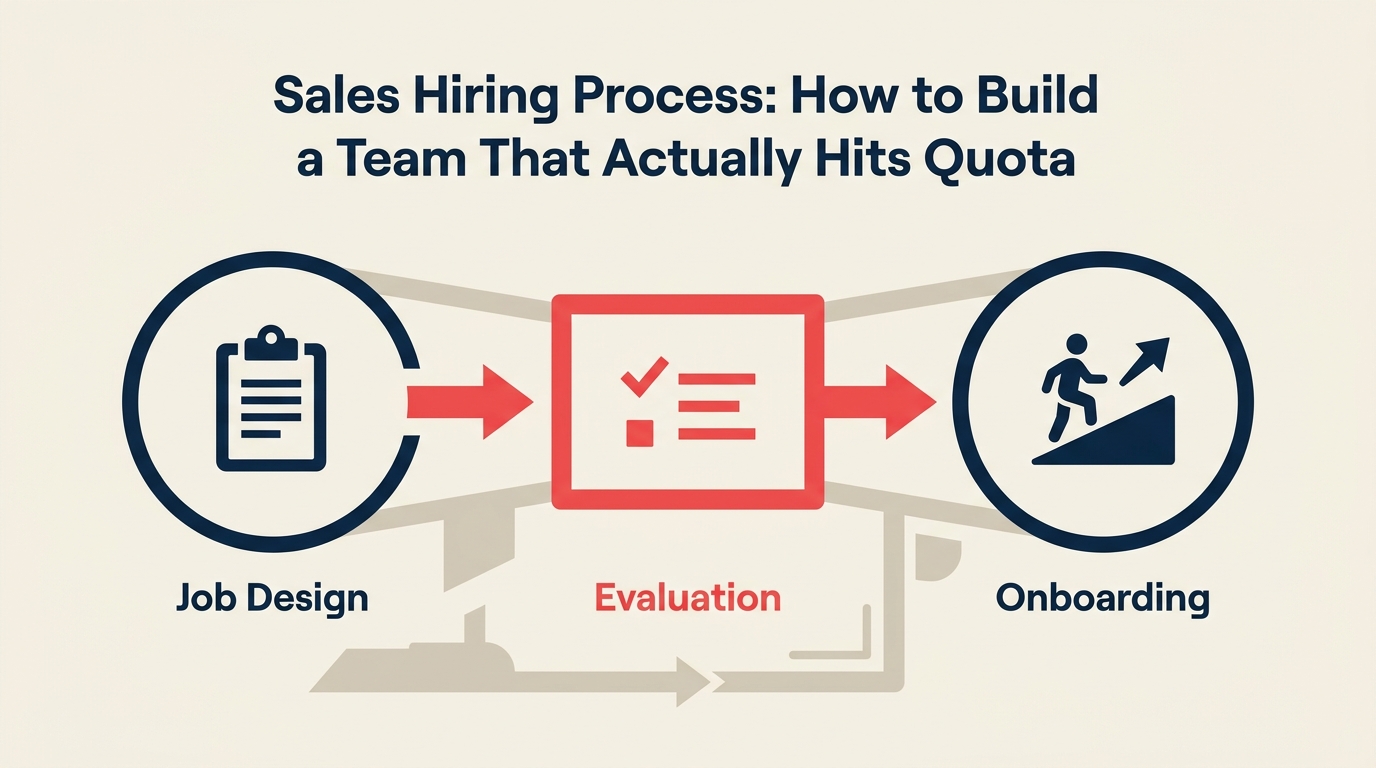
The Three Phases of a Strong Sales Hiring Process
Most organizations spend the majority of their hiring energy on the interview phase. But the real leverage is at the front (job design and sourcing) and the back (structured evaluation and onboarding). A poorly designed job spec will attract the wrong candidates, no matter how good your interviews are.
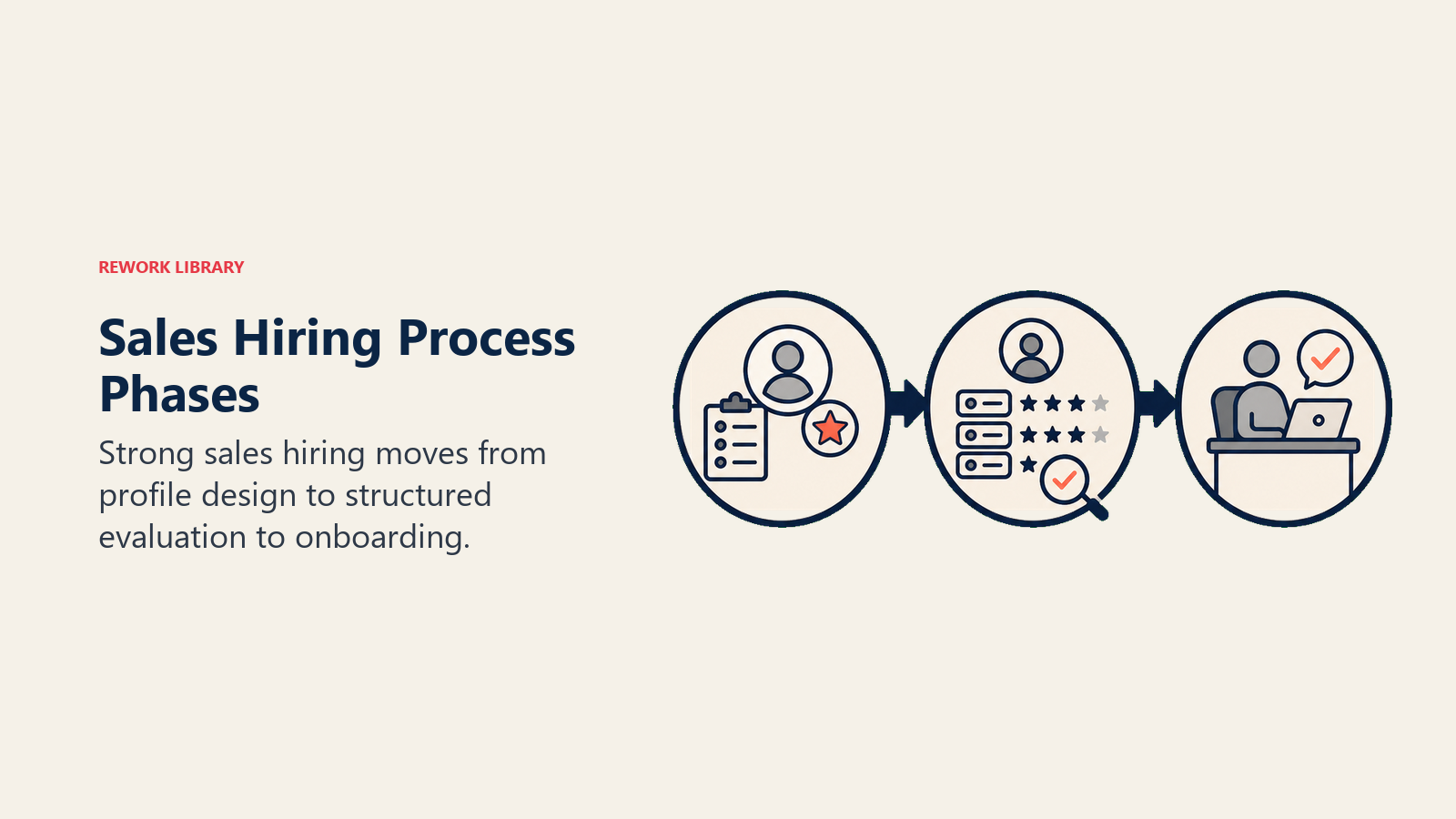
Phase 1: Job Design and Profile Building
Before writing a job description, get clear on three things:
What does this person actually do all day? Sales is not a monolithic job. An SDR who cold-calls into enterprise accounts has almost nothing in common with an account manager who renews and expands existing customers. A channel sales rep who manages partner relationships is different from an inside sales rep who runs 30-minute demos. Write out an honest account of a typical day in this role, including the mundane parts.
What does success look like in 12 months? Be specific. "Hit quota" is not specific. "Close 8 new logo accounts between $30K and $80K ACV, with 90% of them in our target verticals, and achieve an average sales cycle of under 60 days" is specific. This definition of success becomes the lens through which you evaluate every candidate.
What skills and traits actually predict success in this role? The answer is different for every sales role. An enterprise AE needs patience, executive presence, and the ability to navigate complex organizations over long cycles. An SDR needs resilience, curiosity, and the ability to book qualified meetings consistently. Confusing these profiles leads to a hire who might be a great rep in a different environment but fails in yours.
The best source of data for this profile is your current top performers. Interview your top 3 reps. Ask them: What do you do that lower performers don't? What did you learn in your first 90 days that made you effective? What would have disqualified you if interviewers had known to ask about it?
Phase 2: Sourcing
Most sales hiring defaults to posting a job description and waiting for applications. This approach surfaces candidates who are actively looking (often for a reason) and misses the larger pool of passive candidates who might be very open to the right opportunity.
A diversified sourcing strategy for sales:
Employee referrals: consistently the highest-quality source. Reps refer people whose work they know. Build a referral incentive that's meaningful ($2-5K per successful hire, paid out at 6 months). Ask your best reps specifically: "Do you know anyone in a similar role who you'd want to compete with?"
LinkedIn outreach: passive sourcing from current employees of comparable companies, especially those who just hit a tenure milestone (2 years) or a promotion plateau. Personalized outreach from the hiring manager converts at higher rates than recruiter messages.
Sales communities: communities like Pavilion, RevGenius, and industry-specific Slack groups are where top performers gather. Job posts in these communities reach people who are invested in their craft.
Pipeline from the prospecting strategy playbook: the same principles that make outbound lead generation effective apply to talent acquisition. You're identifying a target profile, building a list, and running a multi-touch outreach sequence. Treat top performers the same way you'd treat high-value prospects.
Phase 3: Structured Evaluation
Unstructured interviews are notoriously poor predictors of sales performance. Research consistently shows that interviewers are heavily influenced by likability and cultural similarity, which correlate poorly with actual quota attainment.
A structured evaluation process removes these biases and creates a fair comparison across candidates.
The screening call (30 minutes): cover the basics. Why are they looking? What are their comp expectations? Can they articulate their current role, metrics, and what they're proud of? Listen for specificity. Vague answers about "driving revenue" from someone who can't name their quota, their win rate, or their average deal size are a red flag.
The first interview (45-60 minutes): use a structured competency framework. For each competency you care about (prospecting, discovery, objection handling, deal management, resilience), ask one behavioral question and one situational question. Write down their answers. Grade them against a rubric after, not during.
The skills assessment (1-2 hours): the best predictor of sales performance is watching someone sell. Give candidates a 15-minute mock discovery call based on a real scenario from your business. Brief them in advance so it tests preparation and structure, not improvisation. Have 2-3 people on the panel. Grade it blind before comparing notes.
The reference check: most reference checks are perfunctory. Change that. Call the references the candidate provides, but also ask them: "Is there a manager or peer from this period who I should also speak with?" Find one reference who wasn't pre-curated. Ask that reference: "On a scale of 1 to 10, how likely are you to re-hire this person? What would make it a 10?" The gap between where they rate and why it isn't higher tells you more than any structured question.
Key Competencies to Evaluate for Sales Roles
Not all competencies matter equally for all roles. But these are the ones most predictive of success across the majority of B2B sales positions:
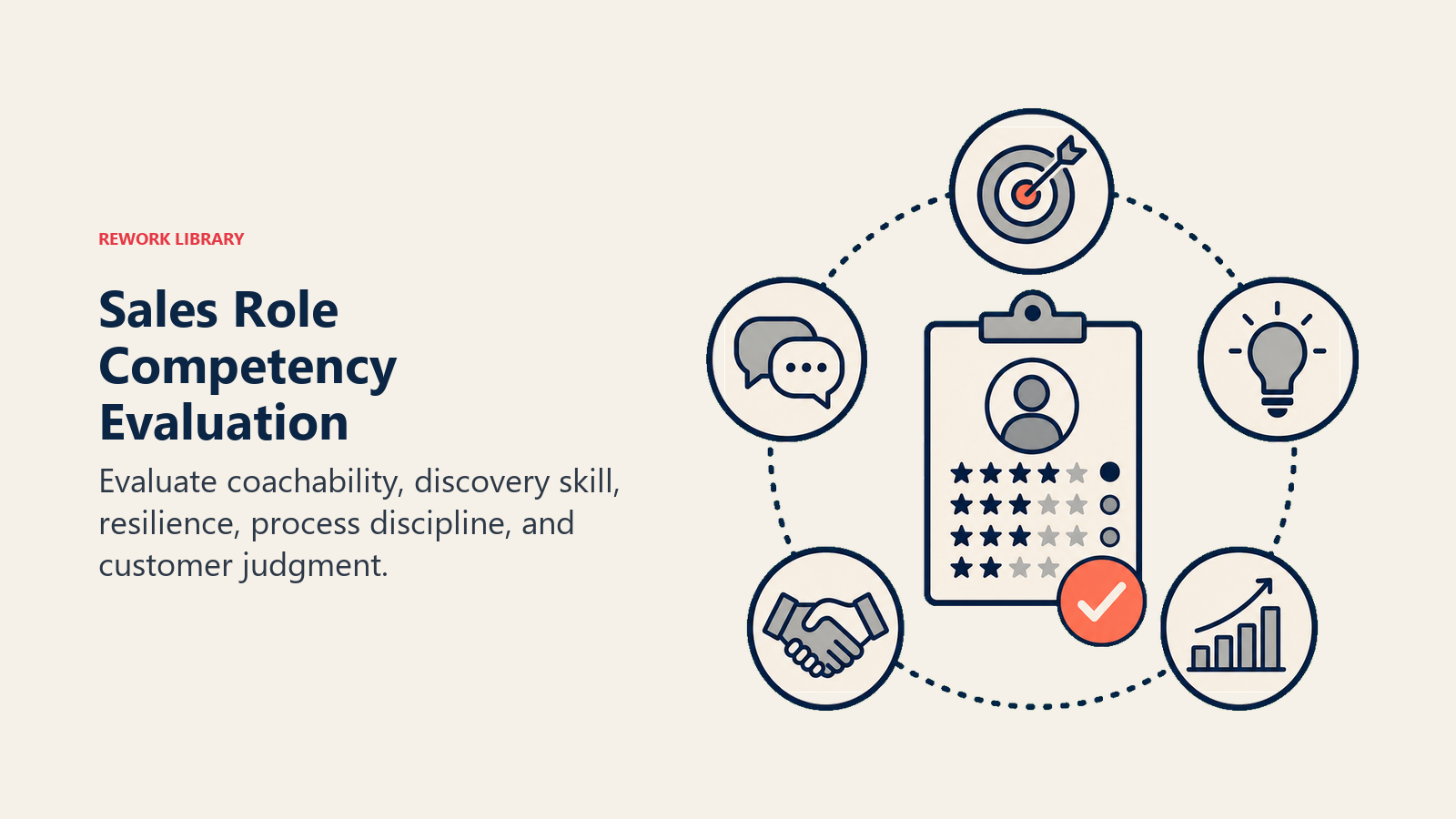
Coachability: the willingness to receive feedback, change behavior, and apply what was learned. This is the single most important trait for long-term development. Ask: "Tell me about a time a manager gave you feedback you disagreed with. What did you do?"
Discovery quality: top performers are curious and ask questions before pitching. In your mock call, watch whether they ask questions to understand the prospect's situation or default to presenting features. (Good sales discovery practices can be taught, but baseline curiosity is a prerequisite.)
Resilience: sales involves a lot of rejection. Candidates who have experienced and recovered from professional setbacks are better prepared. Ask about a deal they lost that they shouldn't have, or a period where they were struggling with quota.
Pipeline management discipline: top reps know their numbers. They can tell you their quota, their win rate, their average deal size, their average sales cycle. If a candidate can't articulate their own performance data, that's a signal about how they manage their book of business.
Autonomy and initiative: especially for field roles or outbound-heavy roles, the ability to self-direct without waiting for management guidance is critical. Ask for examples of a time they identified an opportunity nobody else was pursuing.
Reducing Time-to-Productivity with Structured Onboarding
Hiring doesn't end at the offer letter. The onboarding process is part of the hiring process, because it determines how quickly your investment in a new hire starts generating return.
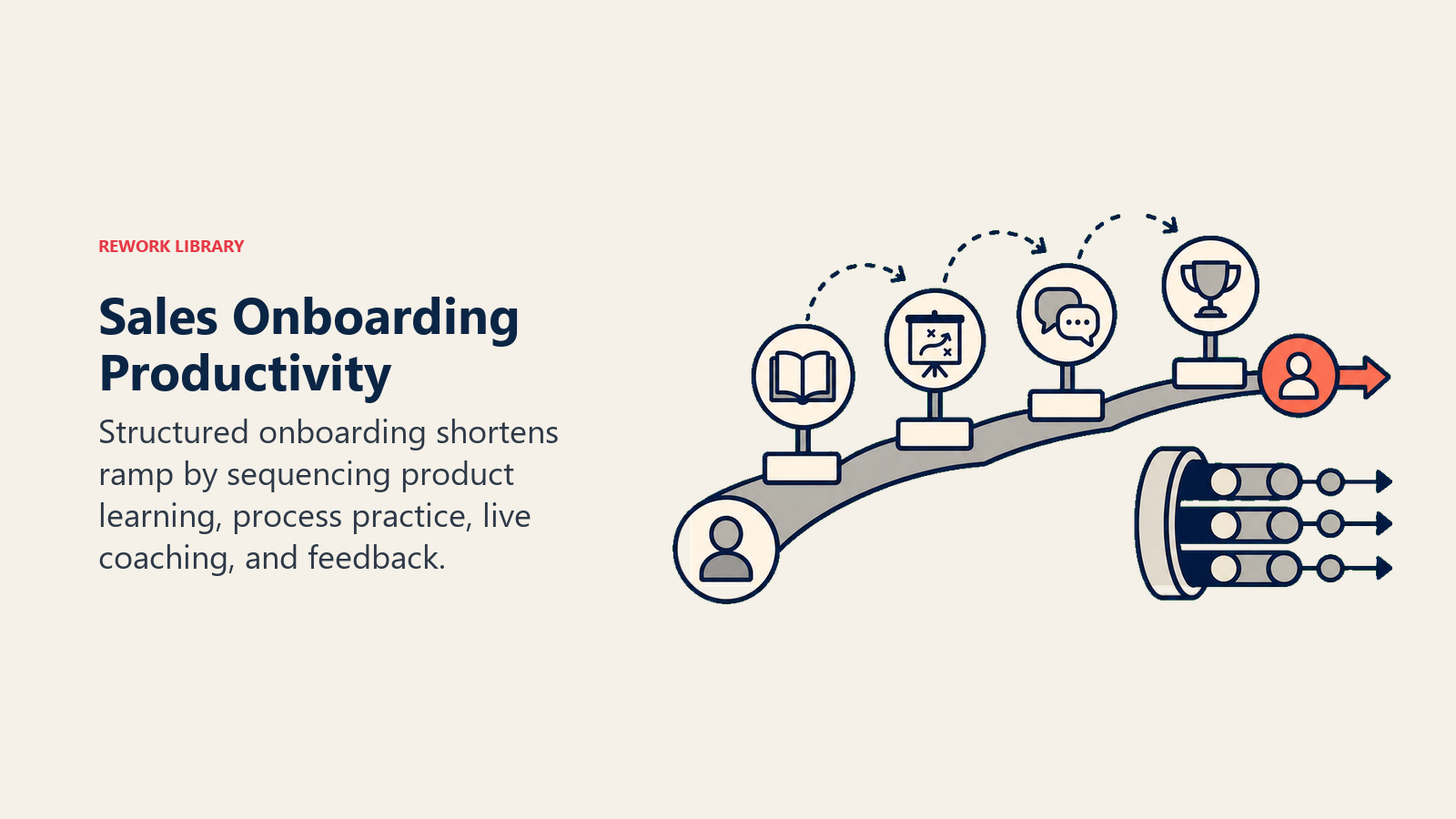
The average ramp time of 6-9 months is not a fixed law. Companies that structure onboarding well get reps to productivity in 3-4 months. The difference is usually:
Front-loaded product knowledge: reps can't sell what they don't understand. The first 30 days should include structured product training backed by a real sales enablement strategy, not just shadowing. Build a certification that reps must pass before they run their first solo demo.
Defined 30-60-90 day plans: each phase should have specific, measurable milestones. 30 days: complete certification, shadow 20 calls, take 5 calls with a manager present. 60 days: run 10 solo calls, achieve specific pipeline metrics. 90 days: first closing activity, on track for quota.
CRM and lead management system fluency: reps should be proficient in the CRM, the lead routing system, and the qualification process before they touch real leads. A rep who doesn't log activity correctly or mishandles lead status management creates bad data that compounds through the whole operation.
Manager-led deal reviews from week one: don't wait until reps are struggling to introduce coaching. Early, consistent coaching on real deal reviews builds habits and accelerates learning faster than any training module.
Metrics to Measure Hiring Process Quality
Like all operations, the hiring process should be measured:
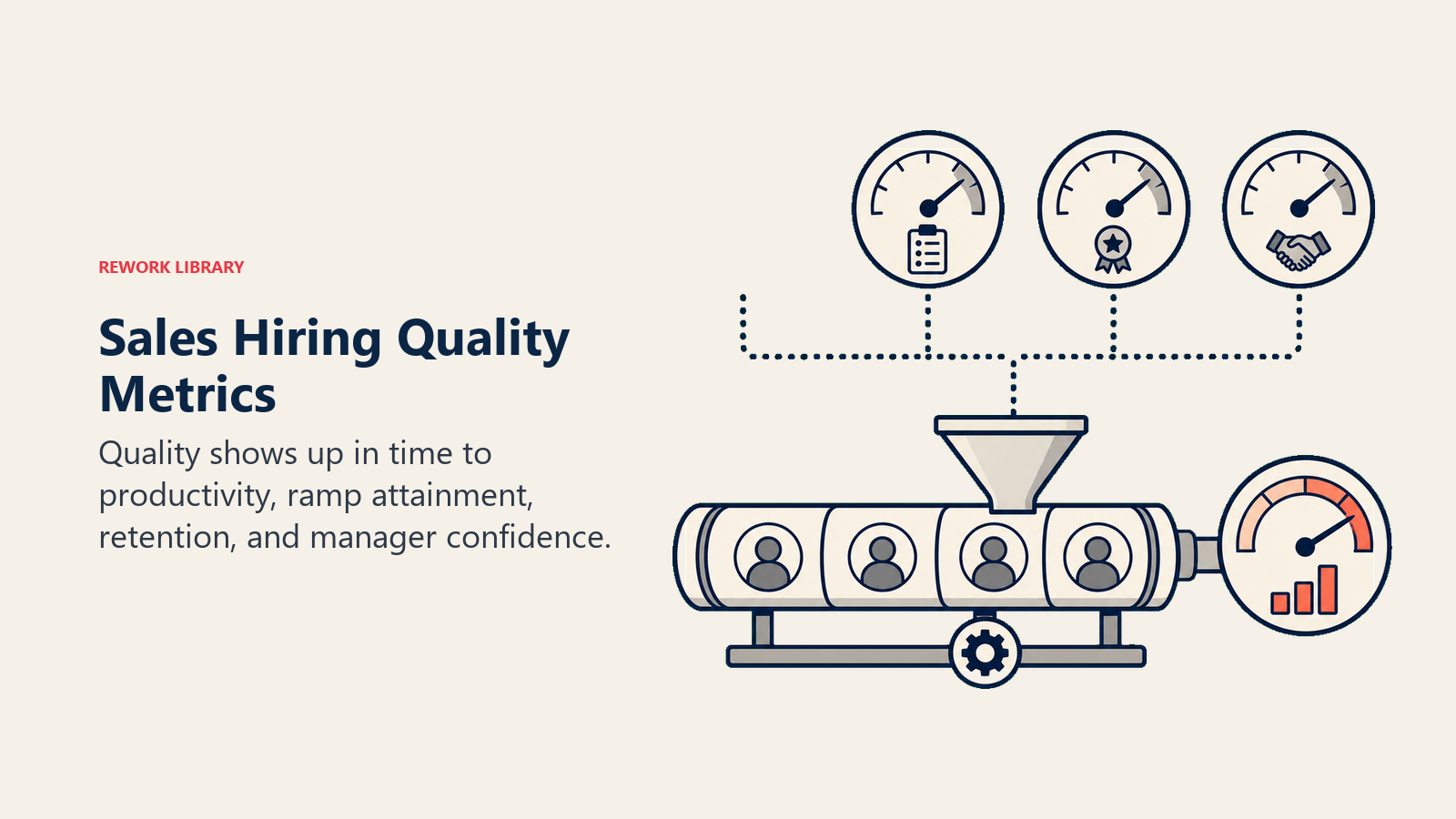
Time-to-fill by role: how long does it take from approved headcount to offer accepted? Benchmark: 30-45 days for SDRs, 45-60 days for AEs, 60-90 days for senior individual contributors.
Time-to-first-deal: for closed-loop tracking, how long from start date to first closed deal? This is the most direct measure of ramp effectiveness.
First-year quota attainment rate: what percentage of reps hired in the last 12 months hit quota? If it's below 60%, the hiring profile or onboarding process needs review.
12-month retention rate: reps who leave within their first year usually signal a job description or culture fit problem. If your 12-month retention is below 75%, audit your hiring process for mismatch signals.
Offer acceptance rate: if fewer than 70% of candidates who receive offers accept them, your compensation structure or process experience may be leaking top candidates.
Connecting Hiring to the Broader Sales Operation
A strong sales team is only valuable if the surrounding operation sets them up to succeed. The best reps in the world can't hit quota if the lead distribution strategy sends them unqualified leads, if there's no lead follow-up process to keep them disciplined, or if the CRM is a mess that makes it impossible to manage a real pipeline.
When you bring on new reps, evaluate the operational support systems they'll be working within:
- Are leads routed automatically based on territory or availability, or is routing still manual?
- Do reps have response time SLAs they're held to?
- Are they getting leads with enriched data, or are they expected to research every prospect from scratch?
Great hiring, combined with a well-run lead management operation, is the foundation of predictable revenue growth.
Related resources:

On this page
- The Three Phases of a Strong Sales Hiring Process
- Phase 1: Job Design and Profile Building
- Phase 2: Sourcing
- Phase 3: Structured Evaluation
- Key Competencies to Evaluate for Sales Roles
- Reducing Time-to-Productivity with Structured Onboarding
- Metrics to Measure Hiring Process Quality
- Connecting Hiring to the Broader Sales Operation