Account-Based Marketing (ABM): Strategy and Examples
Turn this article into takeaways for your work.


Each assistant summarizes the article only for you and suggests best practices for your work.
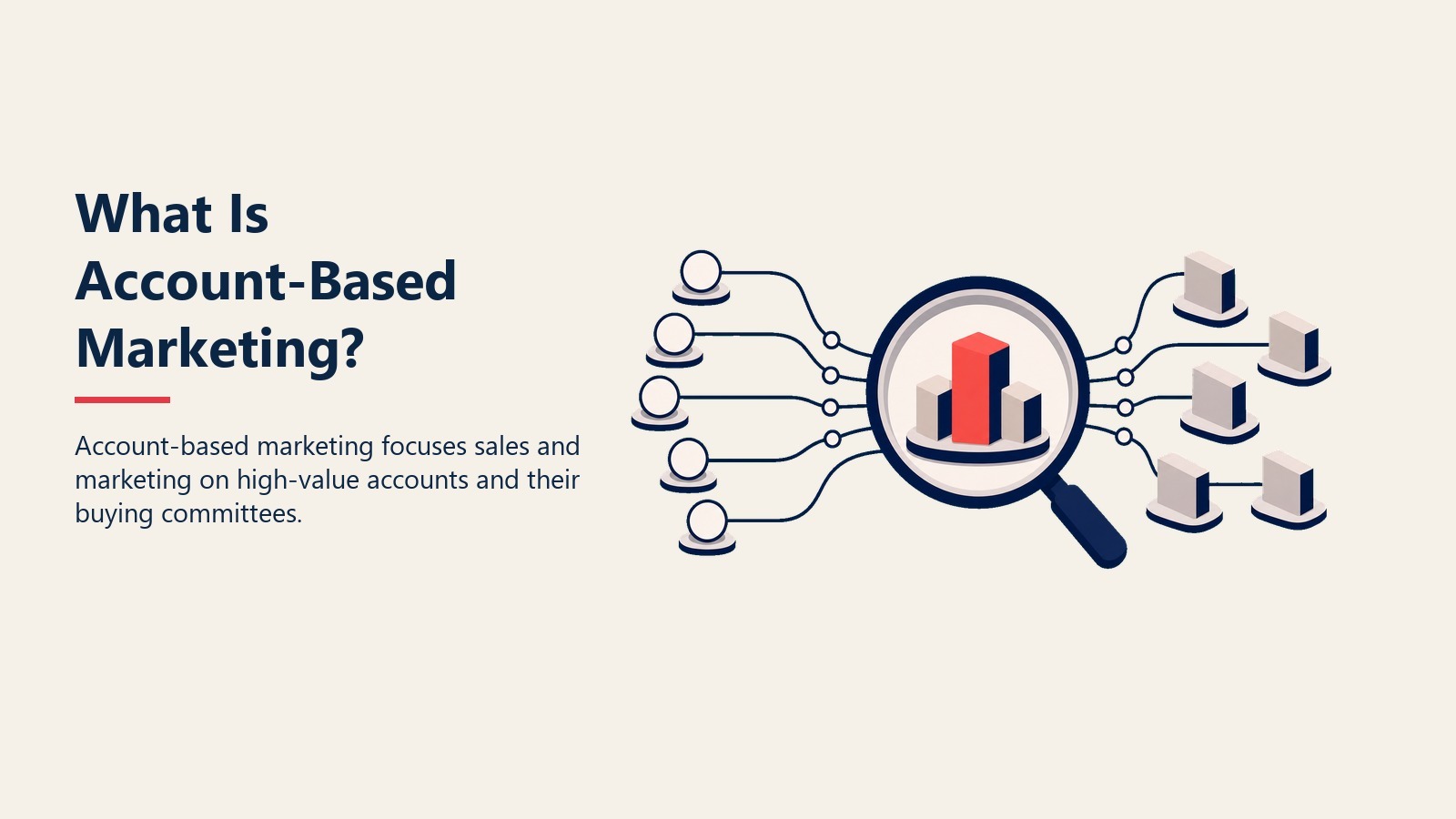
Account-based marketing (ABM) is how B2B teams stop spraying their message at thousands of strangers and start investing in the accounts that actually matter. Instead of filling the top of the funnel with everyone who might be a buyer, ABM starts with a short list of high-value companies and builds a coordinated marketing and sales effort around each one.
What is account-based marketing (ABM)?
Account-based marketing (ABM) is a B2B go-to-market strategy where marketing and sales teams jointly identify a defined set of target accounts, then coordinate personalized campaigns to engage the buying committee at each account.
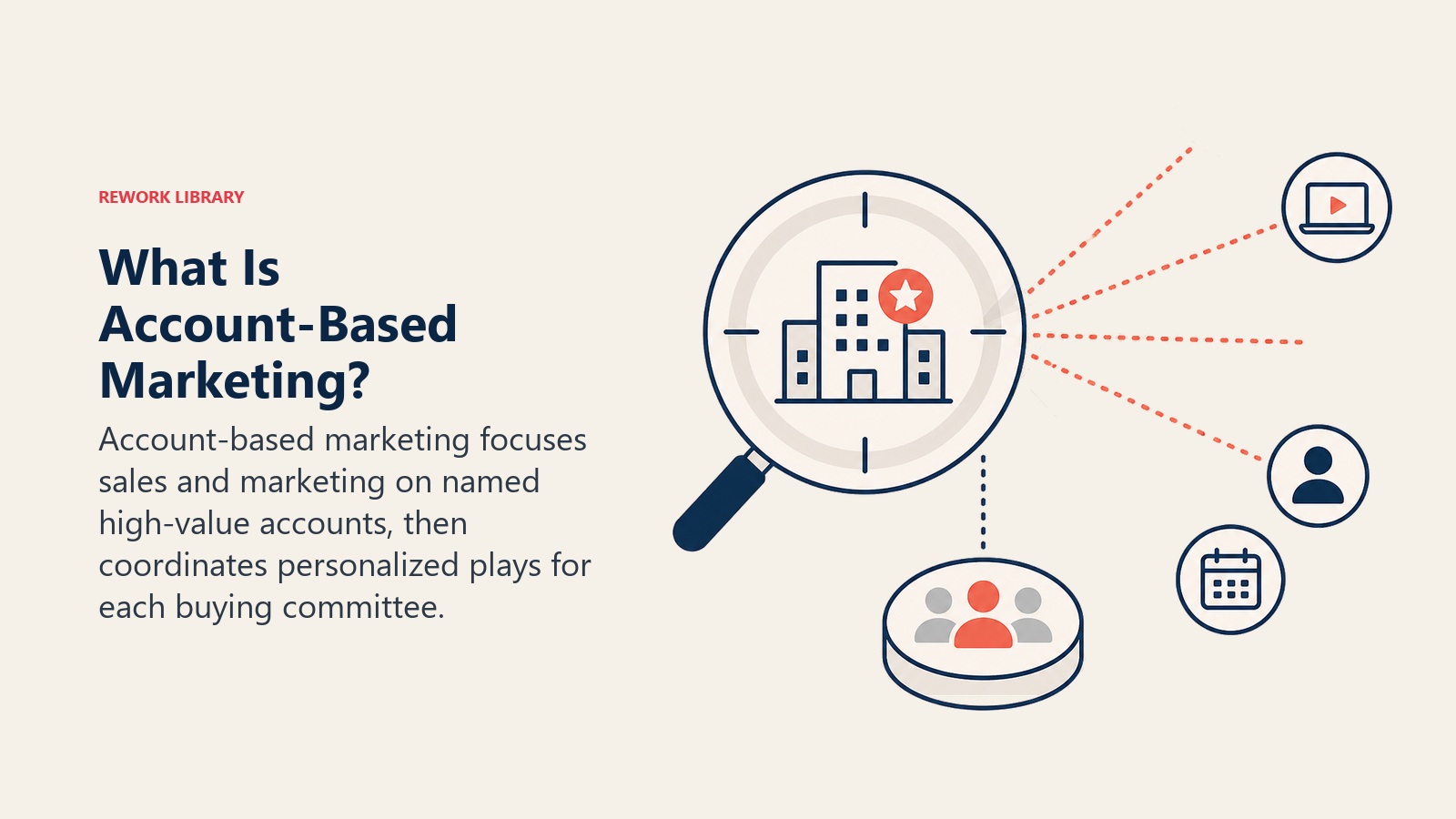
Rather than generating volume and hoping the right leads appear, ABM works backward: pick the accounts you want, map the people inside them, and create experiences tailored to their specific situation. The result is tighter sales and marketing alignment, shorter sales cycles, and higher average deal values.
ABM works hand-in-hand with a strong ideal customer profile. Your ICP defines the characteristics of accounts worth pursuing; ABM is the execution engine that turns that profile into targeted revenue.
Key Facts: Account-Based Marketing
- 87% of B2B marketers report that ABM initiatives outperform other marketing investments in terms of ROI (ITSMA, 2021)
- Companies running mature ABM programs see a 208% increase in revenue attributed to marketing compared to non-ABM peers (Forrester, cited in SiriusDecisions ABM benchmark research)
- 70% of ABM users say their sales and marketing teams are "mostly" or "completely" aligned, versus 51% of non-ABM respondents (ITSMA ABM Benchmark Study, 2022)
ABM vs traditional demand generation
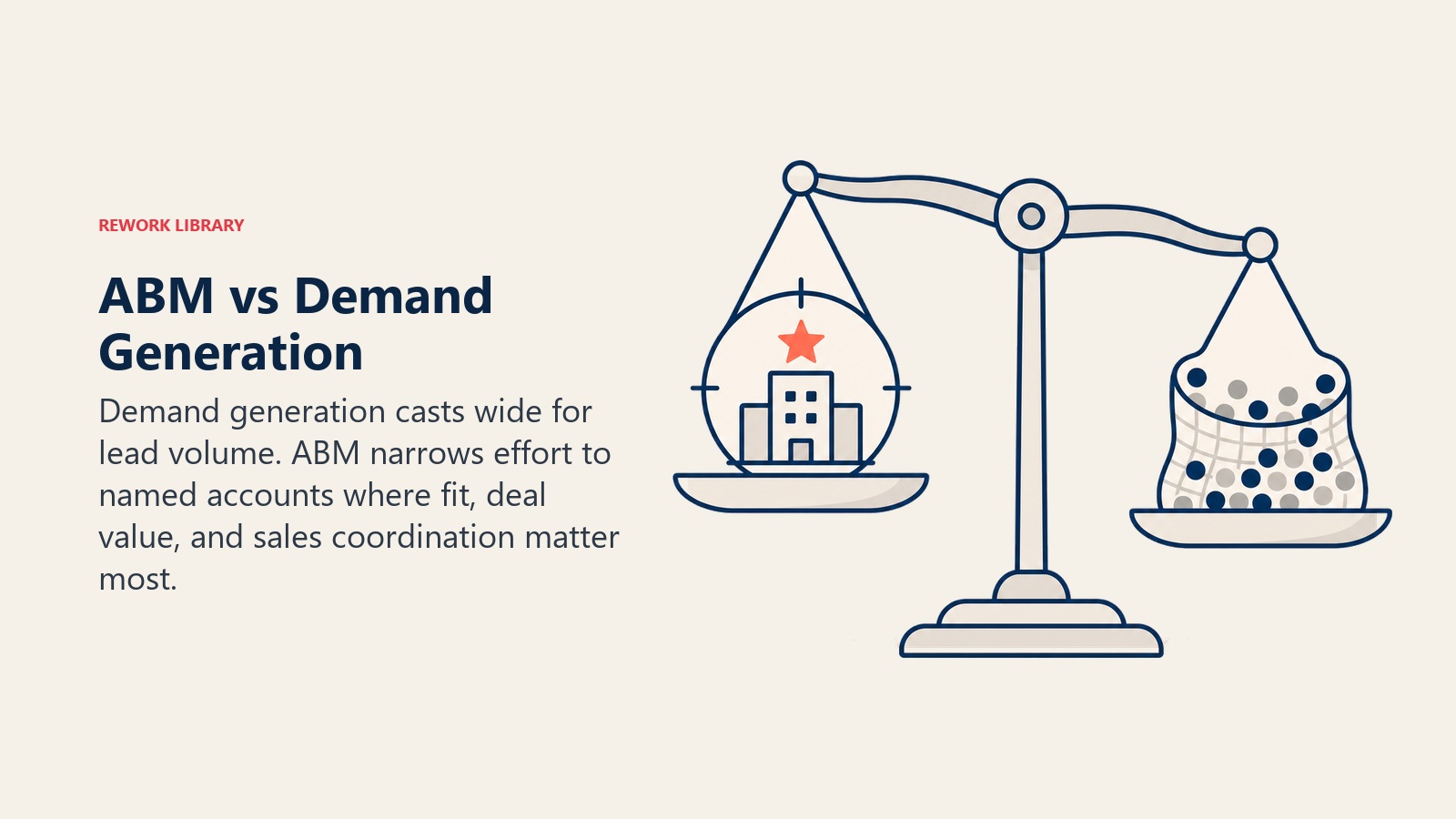
Traditional demand generation casts wide. It optimizes for volume: more leads, more downloads, more ad clicks. ABM inverts that logic entirely. It sacrifices volume for precision.
| Dimension | Traditional demand generation | Account-based marketing |
|---|---|---|
| Starting point | Broad audience or persona | Named account list |
| Goal | Fill top of funnel | Engage specific buying committees |
| Content | Generic, persona-level | Personalized by account or segment |
| Sales involvement | Post-lead handoff | Joint planning from day one |
| Success metric | Lead volume, CPL | Pipeline influenced, account engagement |
| Sales cycle | Variable | Typically shorter (decision makers targeted directly) |
| Best for | High-volume, lower ACV products | Complex deals, longer sales cycles, high ACV |
The shift isn't just tactical. It's a different philosophy: quality over quantity, precision over reach.
For teams that rely on inbound lead generation or outbound lead generation as their primary engine, ABM doesn't replace those motions. It runs alongside them, focused specifically on the accounts that represent outsized revenue opportunity.
The three types of ABM
ABM exists on a spectrum from hyper-personalized to scaled. The right tier depends on the number of target accounts and their deal value.
| ABM tier | Also called | Account count | Personalization level | Common tactics |
|---|---|---|---|---|
| One-to-one | Strategic ABM | 1 to 10 accounts | Full custom: bespoke content, events, microsites | Executive briefings, custom ROI models, account-specific white papers |
| One-to-few | ABM lite | 10 to 100 accounts | Segment-level: tailored by industry or use case | Industry-specific landing pages, role-targeted email sequences, targeted ads |
| One-to-many | Programmatic ABM | 100 to 1,000+ accounts | Tech-enabled: dynamic personalization at scale | Intent data targeting, personalized display ads, account-level content recommendations |
Most companies run all three tiers simultaneously: a short list of must-win accounts gets strategic treatment, a broader tier of good-fit prospects gets ABM lite, and a long tail of intent-signaling companies gets programmatic plays.
Benefits of account-based marketing
Higher win rates on the accounts that matter. When you personalize messaging to a specific company's challenges, you're not competing on generic features. You're demonstrating that you understand their business.
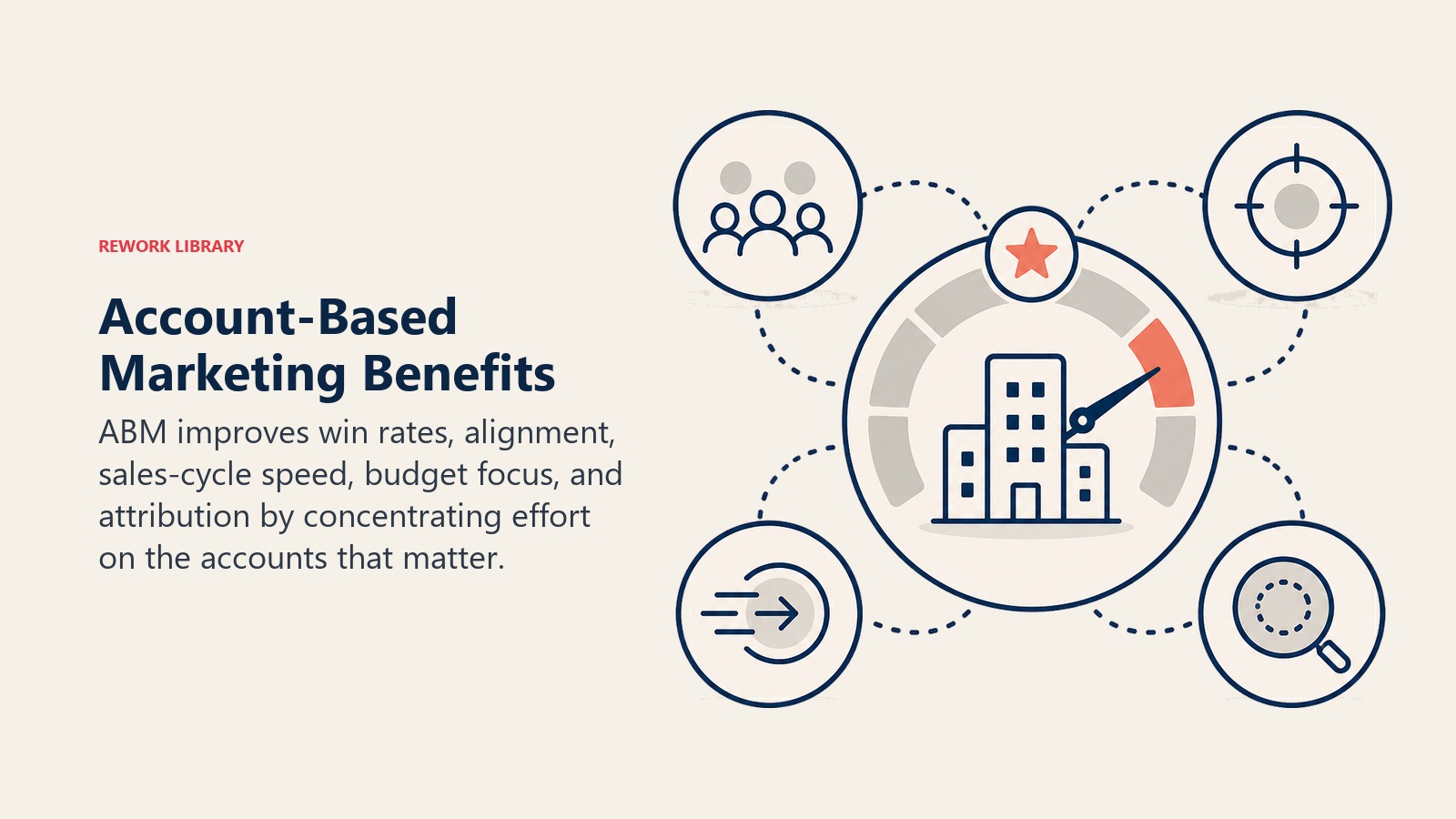
Better sales and marketing alignment. ABM forces the two teams to agree on which accounts to pursue before any campaign launches. That shared target list eliminates the classic "marketing sends leads, sales ignores them" breakdown.
Shorter sales cycles. By engaging the full buying committee early (not just one contact), ABM reduces the number of stakeholders who show up late in the process to slow or kill deals.
Efficient use of budget. Spending $50,000 on 50 precisely targeted accounts often outperforms spending $50,000 broadcasting to 50,000 people who may never buy.
Cleaner attribution. ABM-driven pipeline is easier to trace because you know which accounts were in-program and which weren't.
Common ABM mistakes
Starting without a real ICP. ABM built on a vague or aspirational target list wastes resources. If you can't articulate exactly why an account belongs on the list, the campaign won't land.
Letting marketing run ABM alone. ABM without sales input is just targeted advertising. Sales needs to be involved in account selection, messaging, and follow-up from the start.
Treating all accounts the same. A strategic account that could be a $500K deal deserves a different investment than a $20K prospect. Map tier to deal value honestly.
Measuring ABM with demand-gen metrics. Tracking MQL volume from an ABM program misses the point. The right metrics are account engagement score, pipeline sourced from target accounts, and influenced revenue.
Over-personalizing at scale. Teams sometimes try to apply one-to-one effort to 200 accounts. The content gets thin, the team burns out, and the "personalization" is obvious and hollow.
Skipping the buying committee. Targeting a single champion at each account is a fragile strategy. Most B2B deals involve 6 to 10 decision-makers. Map each role and engage them distinctly, using well-developed buyer personas for each function.
How to build an ABM strategy
Step 1: Define your ideal customer profile
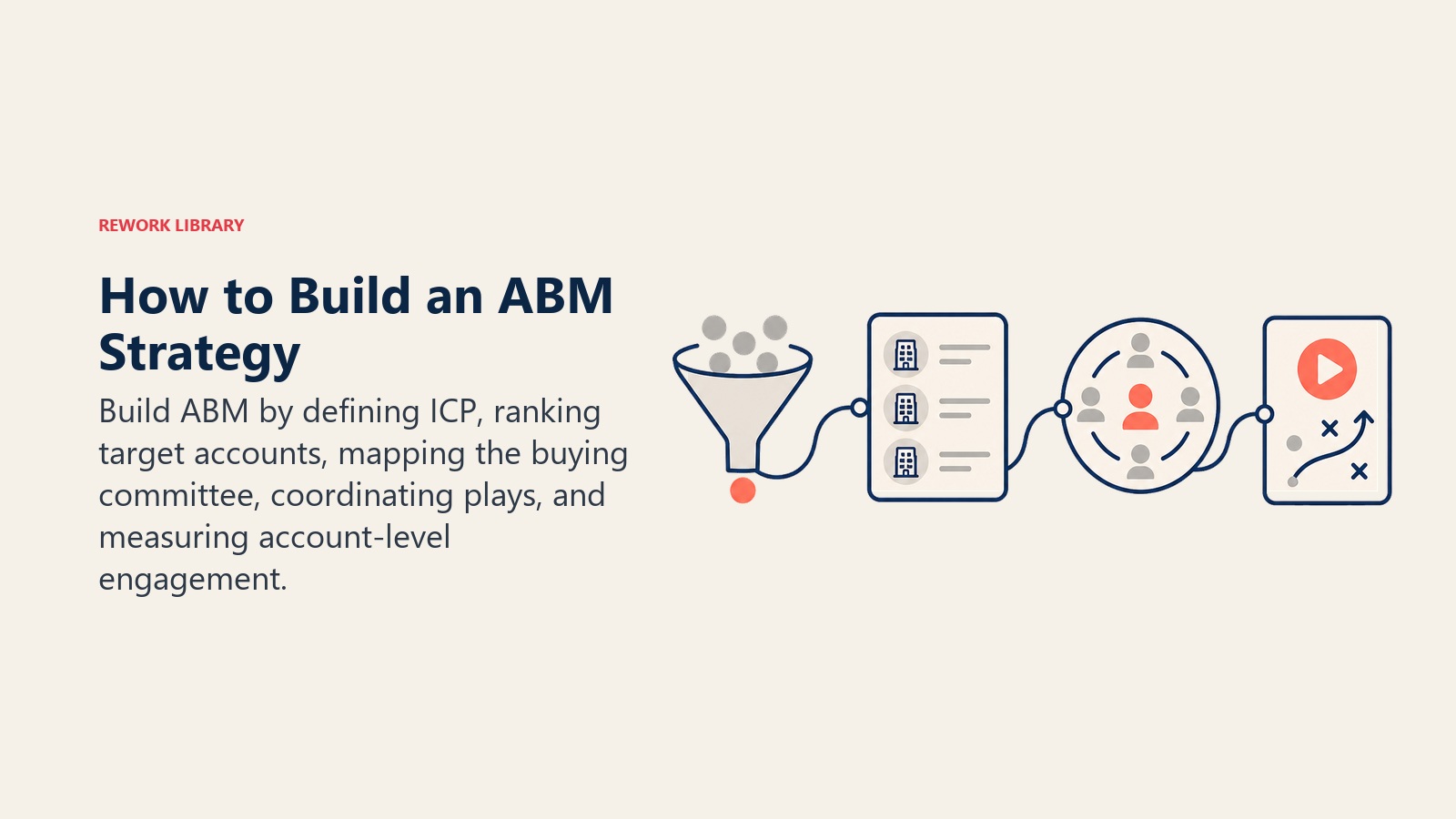
Before you can build an account list, you need a precise definition of what a good-fit account looks like. Firmographics (industry, company size, revenue) are the starting point. Pair them with behavioral signals: companies actively hiring for roles your product supports, companies using complementary tools, companies that match your best existing customers. See ideal customer profile for the full framework.
Step 2: Build your target account list
Work with sales to rank accounts into tiers. Strategic accounts (tier 1) get the most investment. Use intent data, CRM data, and sales knowledge to prioritize. Aim for a list your team can actually work, not a wish list of logos.
Step 3: Map the buying committee
For each tier-1 and tier-2 account, identify the stakeholders: the economic buyer, the technical evaluator, the end users, and the internal champion. Understanding who each person is, what they care about, and where they consume information is essential before any outreach begins.
Step 4: Create personalized content and messaging
Develop content that speaks to the specific challenges, priorities, and language of each account or segment. For strategic accounts, this might mean a custom ROI model or a tailored case study. For programmatic accounts, it means dynamic ads and landing pages that reflect their industry.
Connect personalized content to strong lead nurturing programs that keep accounts warm between active sales touches.
Step 5: Orchestrate multichannel plays
ABM works across channels: paid ads targeted at account IP ranges, direct mail, personalized email sequences, LinkedIn outreach, and executive events. The key is coordination. Every touchpoint reinforces the same message, and sales and marketing are synchronized on timing.
Use account-based routing to ensure that when target accounts engage inbound, they're immediately directed to the right rep without delays.
Step 6: Measure and optimize
Track account-level engagement (not just individual leads), pipeline sourced from target accounts, deal velocity, and win rates on ABM accounts versus non-ABM accounts. Review the account list quarterly. Move accounts between tiers based on buying signals and remove accounts that show no engagement after a defined period.
Account-based marketing examples
| Tier | Company scenario | ABM tactic | Outcome |
|---|---|---|---|
| One-to-one | Enterprise SaaS targeting a single $2M opportunity at a global retailer | Custom microsite with the retailer's logo, tailored ROI model, exec briefing invitation | Accelerated deal from 8 months to 5 months |
| One-to-few | Cybersecurity vendor targeting 40 mid-market financial services firms | Industry-specific white paper, targeted LinkedIn ads, personalized email sequence referencing FS regulatory pressures | 3x higher response rate vs generic outbound |
| One-to-many | HR tech platform targeting 600 accounts showing intent signals | Programmatic ads served to job titles at in-market accounts, account-specific landing pages | 22% increase in pipeline from target account set |
Drift (now part of Salesloft) is often cited as an ABM practitioner that applied personalized conversational marketing to named accounts, using account-level website personalization to show different homepage messaging based on the visitor's company. Demandbase itself (an ABM platform) ran one-to-one programs targeting its top 200 accounts with custom content hubs.
The most effective ABM examples share a pattern: sales and marketing agreed on the account list before any campaign launched, and both teams stayed accountable to the same revenue outcome.
Best practices
Do:
- Start small. Run a 30-day pilot with 10 to 15 strategic accounts before scaling.
- Align on a shared definition of "target account" before building the list.
- Use intent data to prioritize accounts showing active buying signals.
- Connect ABM to your lead magnet strategy so inbound interest from target accounts triggers ABM follow-through.
- Review your account list quarterly and retire accounts with no engagement.
Don't:
- Measure ABM success with MQL counts.
- Let marketing run ABM without daily sales collaboration.
- Personalize at a scale your team can't sustain with genuine quality.
- Treat ABM as a campaign. It's a sustained, account-level relationship-building motion.
Frequently Asked Questions about Account-Based Marketing
What is ABM in simple terms?
Account-based marketing is a B2B strategy where marketing and sales focus their combined effort on a specific list of high-value companies, tailoring every message and touchpoint to those companies rather than broadcasting to a broad audience.
How is ABM different from traditional lead generation?
Traditional lead generation optimizes for volume: generate as many leads as possible and let sales sort through them. ABM works the opposite way. You start with the accounts you want to win, then build campaigns specifically designed to engage those accounts. ABM prioritizes quality and fit over raw lead count.
How do you measure ABM success?
The core ABM metrics are: pipeline sourced from target accounts, account engagement score (how many stakeholders at a target account are interacting with your content or ads), win rate on ABM accounts vs non-ABM accounts, and deal velocity. MQL count is not a useful ABM metric.
How many accounts should be in an ABM program?
It depends on the tier. Strategic (one-to-one) programs typically cover 1 to 10 accounts. ABM lite covers 10 to 100. Programmatic ABM can cover hundreds or thousands. The right number is whatever your team can genuinely personalize and engage. Most teams underestimate the per-account effort and over-build their initial list.
Does ABM work for SMB deals?
ABM works best when deal values are high enough to justify the per-account investment. For SMB deals with low average contract values, the economics often favor programmatic ABM or traditional demand generation instead. The sweet spot is typically deals above $30,000 ACV, where the investment in personalization pays back in win rate improvement.
ABM isn't a campaign type. It's a go-to-market philosophy that reroutes resources from volume to precision. For teams selling complex, high-value solutions, the shift from "generate leads and hope" to "target accounts and coordinate" is one of the highest-leverage moves available. Start with a short, honest account list, align sales from day one, and measure what actually predicts revenue.

On this page
- What is account-based marketing (ABM)?
- ABM vs traditional demand generation
- The three types of ABM
- Benefits of account-based marketing
- Common ABM mistakes
- How to build an ABM strategy
- Step 1: Define your ideal customer profile
- Step 2: Build your target account list
- Step 3: Map the buying committee
- Step 4: Create personalized content and messaging
- Step 5: Orchestrate multichannel plays
- Step 6: Measure and optimize
- Account-based marketing examples
- Best practices