Enterprise Sales Strategy: How to Sell to Large Organizations and Win
Turn this article into takeaways for your work.


Each assistant summarizes the article only for you and suggests best practices for your work.
Enterprise sales is not mid-market sales at a larger scale. The rules are different. The timeframes are longer. The number of people who can kill a deal is higher. And the skills that make someone great at closing SMB deals can actively hurt them when selling to large organizations.
A $200K enterprise deal might involve 10 stakeholders across 4 departments and take 9 months to close. Trying to run that the same way you would run a $15K mid-market deal will end in frustration for everyone.
This is the playbook for doing enterprise sales right: how to get in, how to build internal support, how to navigate the buying process, and how to close.
Key Facts: Enterprise Sales Benchmarks
- The average enterprise B2B sales cycle runs 6-12 months, with deals above $250K often extending to 12-18 months from first meeting to signed contract. (Salesforce State of Sales, 2024)
- Large purchases involve an average of 6-10 stakeholders in the buying decision, and 77% of B2B buyers describe their last purchase as complex or very complex. (Gartner B2B Buyer Survey, 2024)
- 58% of enterprise sales cycles stall not because the prospect chose a competitor but because the deal died to "no decision" (status quo wins). (CSO Insights, Win-Loss Study)
- Deals with a documented champion inside the buyer organization close at 2.5x the rate of deals without one, according to internal data from multiple CRM providers analyzed in Gartner's 2024 sales benchmark study.
- Enterprise sales reps who use a mutual action plan with prospects reduce deal slippage by 31% and improve forecast accuracy by 26% compared to reps who do not. (Salesforce Research, 2025)
What Makes Enterprise Sales Different
Before building a strategy, understand what you are actually dealing with.
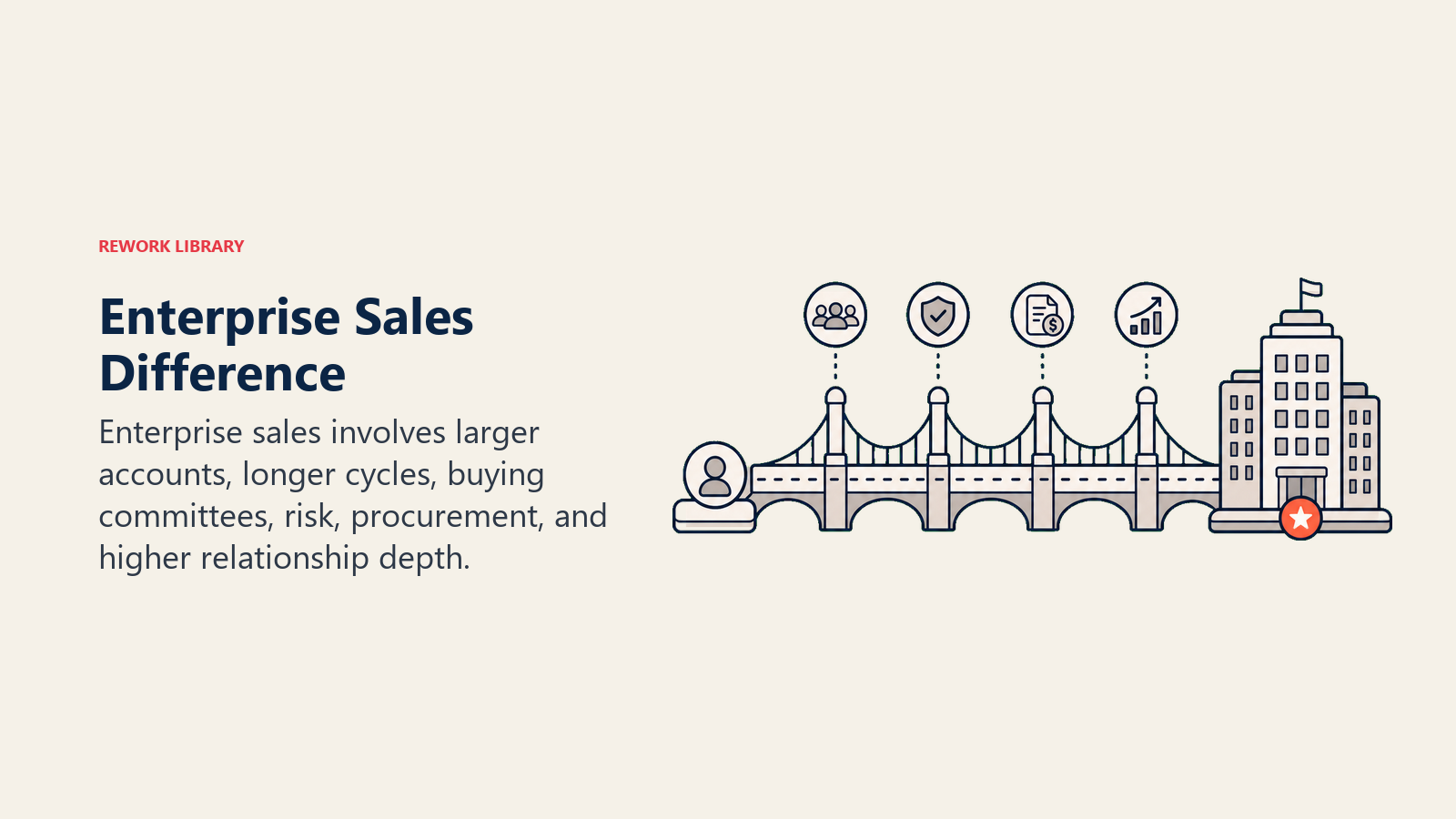
Multiple decision-makers. You are not convincing one person. You are convincing a committee. Some of those people will never talk to you directly. They will form opinions based on what your champion tells them, what they read online, and what your proposal looks like. Each person on that committee has different priorities, different risks they are trying to avoid, and different definitions of success.
Long timelines. Enterprise deals take months. Sometimes more than a year. The prospect's priorities will shift during that time. Budgets get cut. Sponsors change roles. New competitors enter the picture. Your strategy needs to account for delays and keep deals moving without applying pressure that damages the relationship.
Procurement and legal. In mid-market sales, you close with the economic buyer and sign a contract. In enterprise, the deal goes through procurement after the buyer says yes. Procurement will renegotiate price, security will run an assessment, legal will redline your contract. None of this means the deal is dead. But it adds weeks or months, and you need to plan for it.
Higher scrutiny. A $200K annual software contract gets reviewed more carefully than a $5K one. There will be security questionnaires, reference checks, competitive RFP processes, and business case requirements. Your job is to help your champion navigate this process, not just wait for it to finish.
Larger upside. Enterprise deals justify the time investment. A single $500K contract can be the equivalent of 50 mid-market deals. Done right, enterprise accounts expand over time as they deploy the product across additional teams, regions, or use cases.
Step 1: Account Selection and Qualification
The biggest mistake in enterprise sales is spreading attention across too many accounts. Each enterprise pursuit requires significant investment of time, research, and relationship-building. You have to choose which accounts are worth that investment.
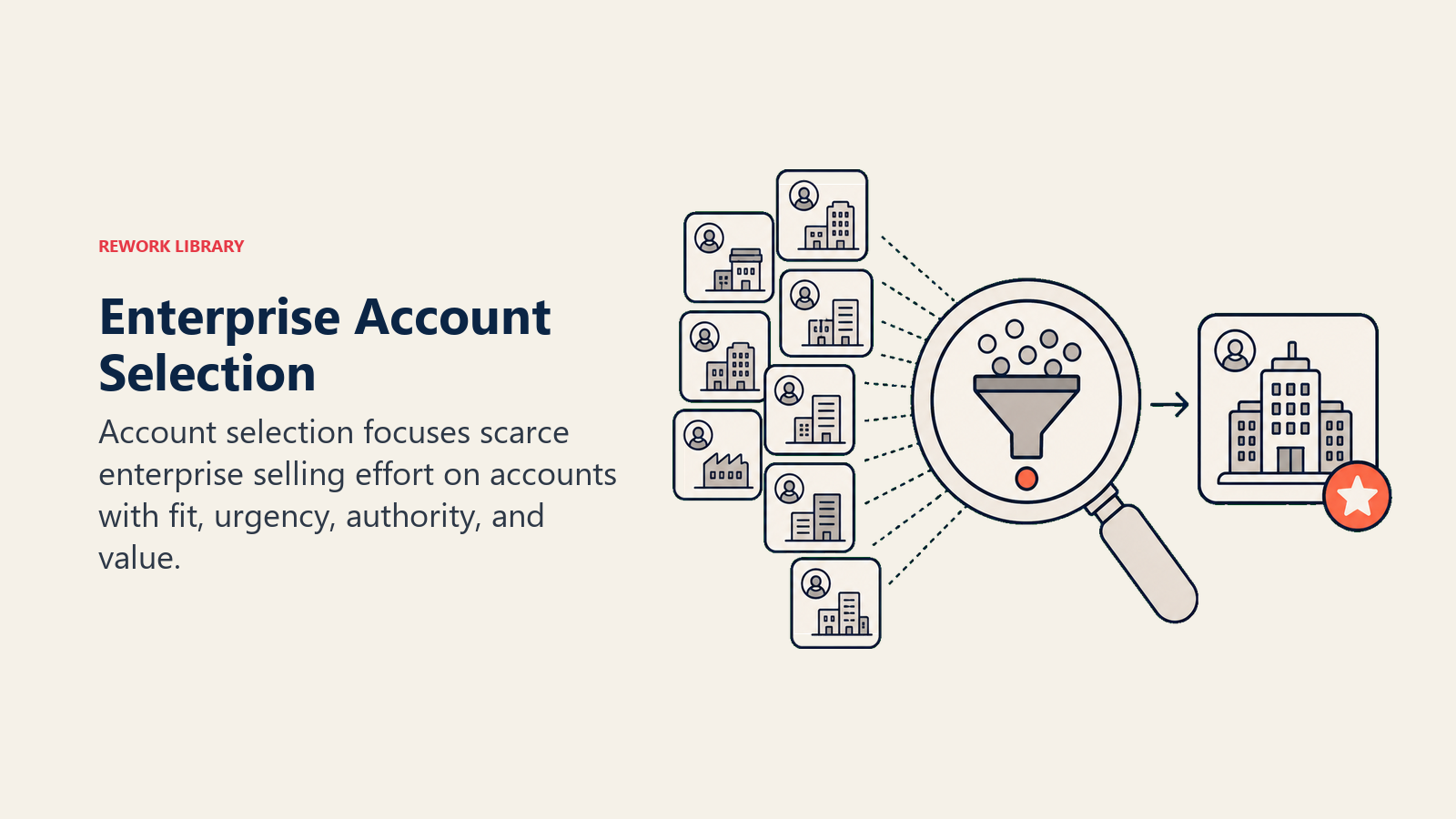
Your ideal customer profile for enterprise should be more specific than your general ICP. Beyond company size and industry, it should include: organizational structure (do they have the teams and roles that use your product?), technology environment (does your product fit their stack?), business situation (are they actively feeling the pain you solve?), and buying authority structure (can you get access to the right decision-makers?).
When qualifying enterprise prospects, the question is not just "do they have the budget?" It is "does this deal have a realistic path to close within a timeframe we can commit resources to?" Deals that stall indefinitely consume sales time without producing revenue. Better to disqualify early than to carry dead wood for six months.
Use lead qualification frameworks like MEDDIC or MEDDPIC specifically designed for enterprise sales. These force you to document: Metrics (what quantified outcomes does the customer need?), Economic Buyer (who controls the budget?), Decision Criteria (how will they evaluate options?), Decision Process (what steps does the deal go through?), Identify Pain (what problem is urgent enough to justify the investment?), and Champion (who inside the organization is advocating for your solution?).
If you cannot answer most of these for an account, you do not have a qualified enterprise opportunity. You have an early-stage prospect that needs more development before it deserves significant attention.
Step 2: Account Mapping
Enterprise sales starts with understanding who is who inside the account before you engage them.
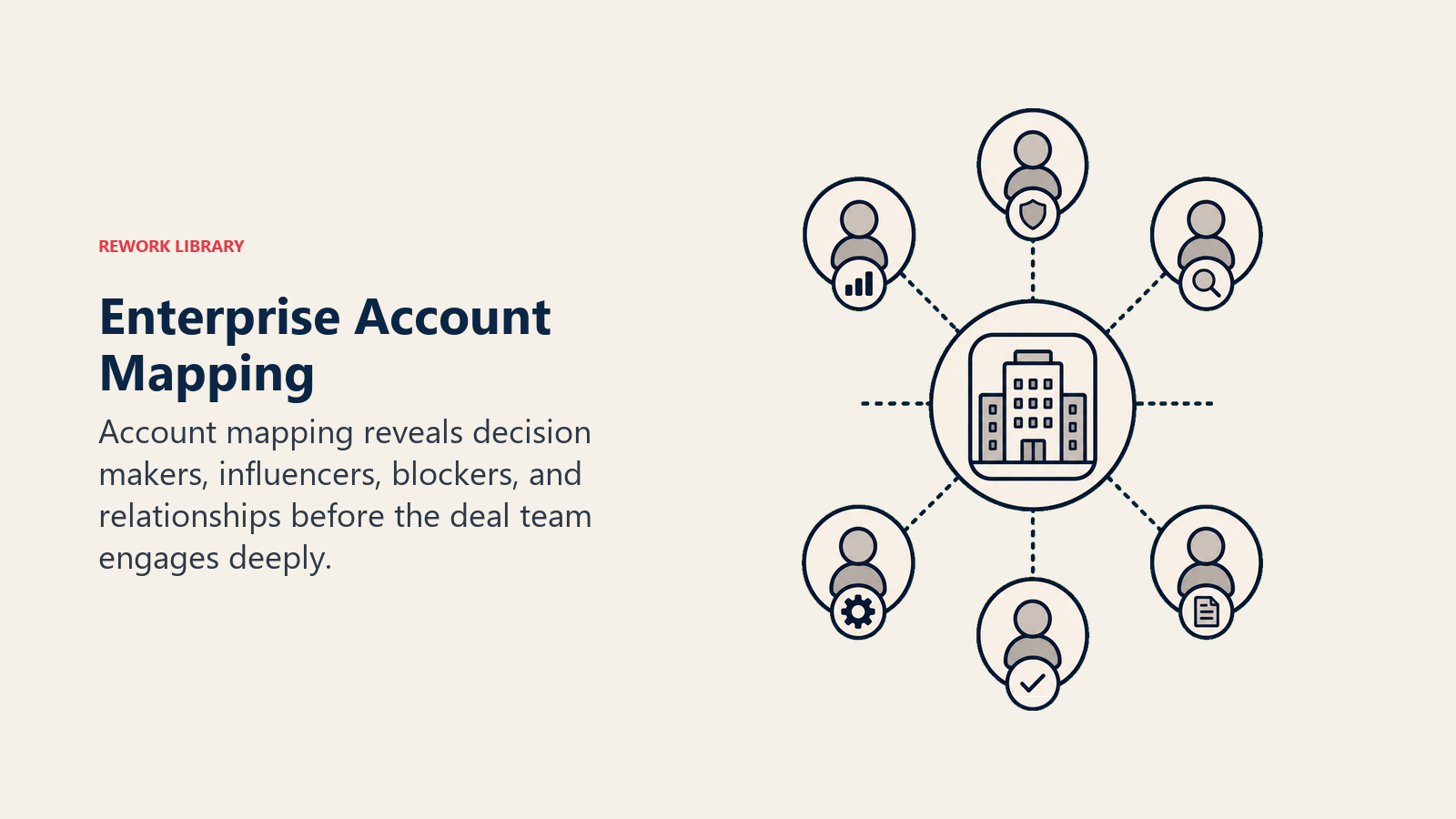
An account map documents every relevant stakeholder in the buying process:
- Economic Buyer: Controls the budget and signs the final agreement. Often a VP, SVP, or C-level executive. Does not always attend every meeting but has final veto power.
- Champion: Your internal advocate. Believes in your solution and is willing to sell it internally. The single most important person in an enterprise deal.
- Technical Evaluator: Assesses whether the solution works. Usually IT, security, or the technical owner of the business unit you are selling into.
- End Users: The people who will actually use the product day to day. Their adoption determines whether the customer sees value, which affects renewal and expansion.
- Procurement: Manages vendor relationships and contract terms. Often involved late in the process but can create significant friction.
- Coach: Someone inside the organization who will help you navigate without necessarily being your champion. May not have a stake in the deal but knows the politics and can give you honest feedback.
For each person, document: their role in the decision, their priorities and success metrics, their relationship to your solution (supportive, neutral, or skeptical), and how much influence they have.
Update this map continuously as you learn more. Deals get won and lost based on the accuracy of your account map.
Step 3: Finding and Developing Your Champion
The champion is the center of gravity for an enterprise deal. Without one, you are selling from the outside. With one, you have someone who can access conversations you are not in, surface objections before they kill the deal, and build internal consensus on your behalf.
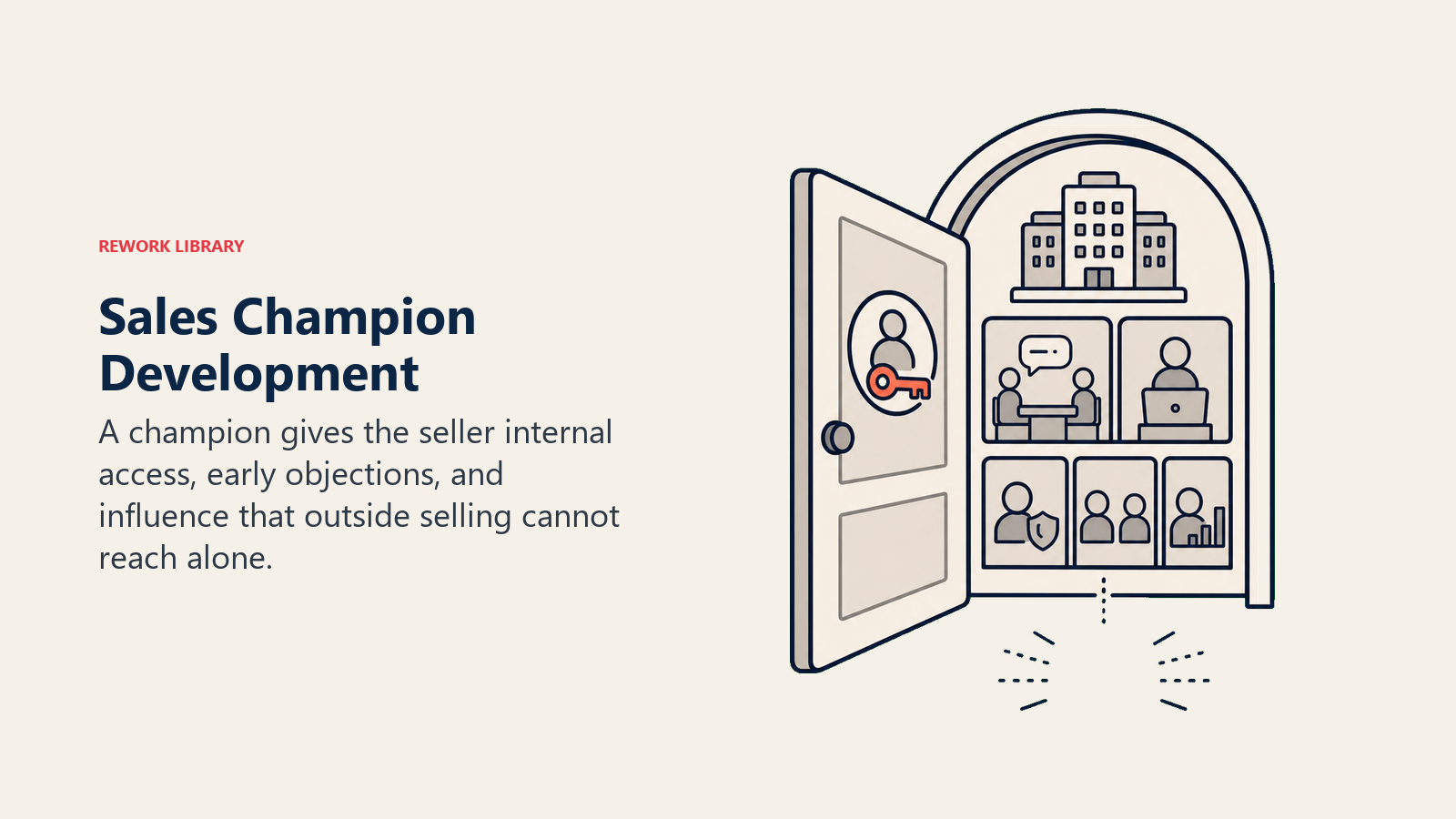
Champions are not the same as sponsors. A sponsor approves the budget. A champion actively advocates for your solution because they have a personal stake in the outcome. Their career benefits from the project succeeding. They are willing to make internal calls, schedule meetings with stakeholders you have not met, and coach you on the internal dynamics.
Finding champions requires doing discovery before you pitch. Early in an enterprise engagement, your job is not to sell. It is to understand. Which individuals have the clearest pain? Who has tried to solve this problem before and failed? Who has organizational credibility and the relationships to drive a decision?
Developing champions requires giving them what they need to succeed internally. That means:
- A clear business case with numbers they can defend
- Presentation materials they can use in internal meetings you are not invited to
- Answers to the objections they will face from skeptics
- Visibility into your company's roadmap and commitment to the account
A champion who does not feel supported will stop advocating. They have their own job to do. Make it easy for them to champion your solution by removing every obstacle in their way.
Step 4: Multi-Stakeholder Management
Your champion cannot reach every stakeholder alone. At some point you need to build relationships across the buying committee directly.
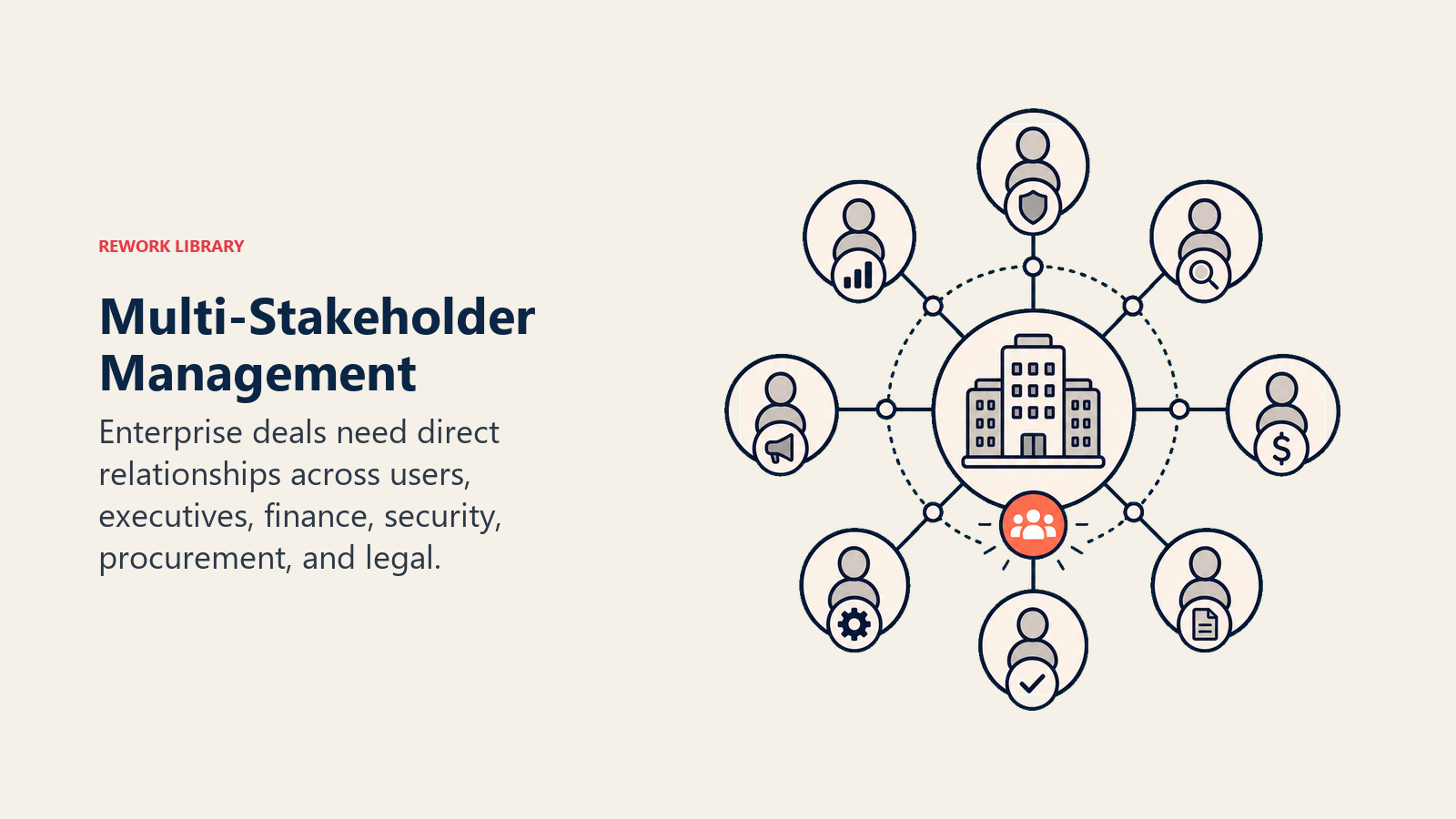
Different stakeholders need different conversations. The CFO wants to understand total cost of ownership and payback period. The CISO wants to know how you handle data security and compliance. The VP of Operations wants to know how implementation works and how disruptive it will be. The end users want to know if the product is actually easier than what they are doing today.
Map each stakeholder's key concerns and design your outreach accordingly. A single pitch deck trying to address everyone usually addresses no one.
The sequence matters too. In most enterprise deals, you want to land at the practitioner level first (the people who have the problem and will use the solution), build credibility and a business case there, then get access to economic buyers through warm introductions from your champion rather than cold outreach. Trying to start at the C-suite level without a warm introduction often produces a polite referral back down to someone more junior who does not have budget authority.
Track where each stakeholder is on a simple scale: unaware, aware but unconvinced, supportive, actively advocating. Your multi-stakeholder strategy is to move each person at least one step forward through every interaction.
Step 5: The Sales Process and Milestones
Enterprise sales needs structure. Without it, deals drift. The mutual action plan (MAP) is how you impose structure while maintaining a collaborative feel.
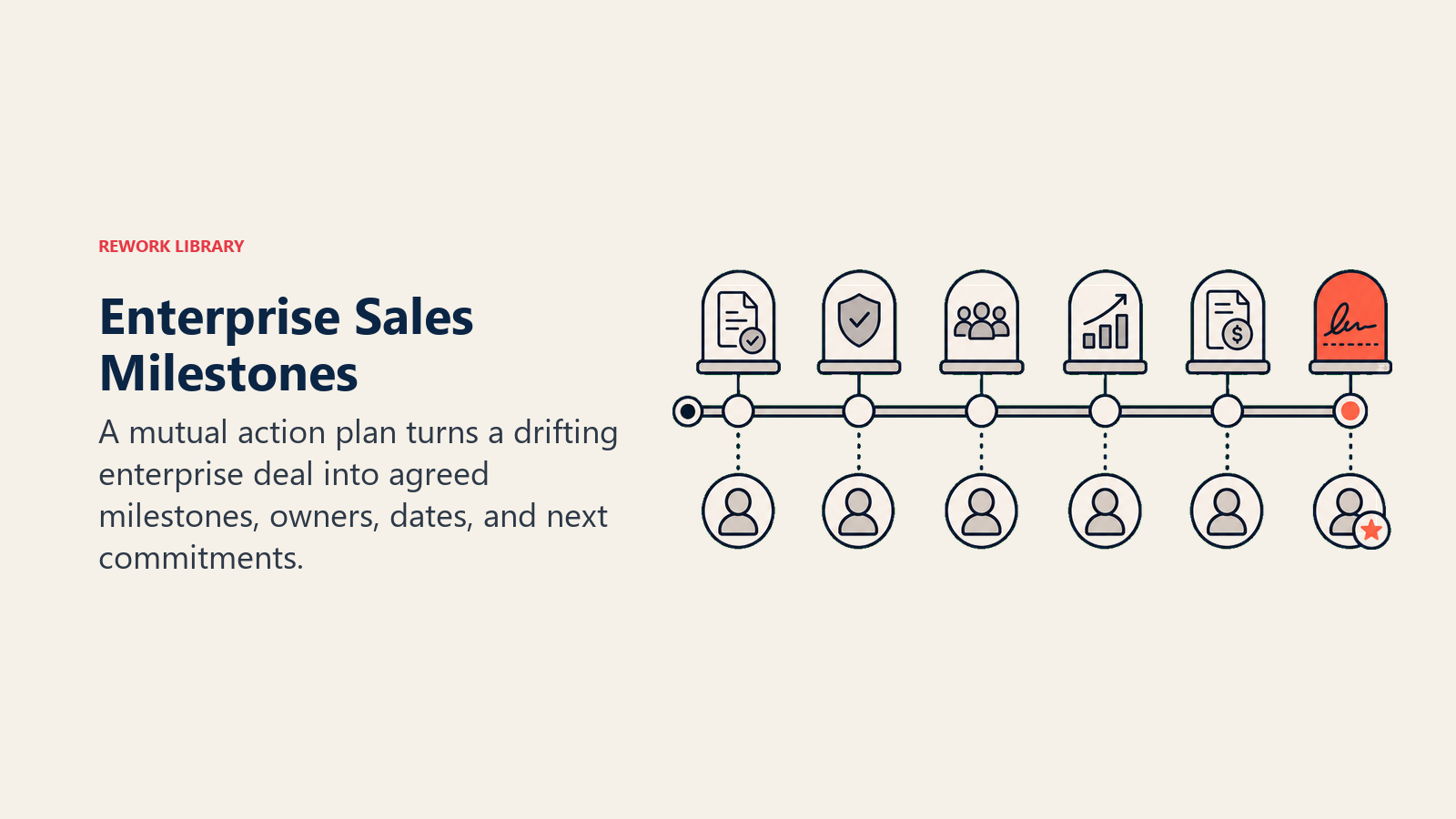
A MAP documents:
- The customer's desired go-live date (work backward from this)
- The key milestones between now and go-live (technical evaluation, security review, legal negotiation, procurement approval, executive sign-off)
- Who owns each milestone on both sides
- Deadlines for each step
Present this as a shared tool, not a vendor timeline. Ask the customer to validate it and tell you if anything is missing. When they co-create the MAP, they have more ownership of the timeline and more motivation to move things forward.
Update the MAP at each significant interaction. When milestones slip, address them directly. "You mentioned legal review would start in two weeks. It has been three. What can we do to unblock that?"
The MAP also serves as your lead status management tool for enterprise deals. It shows clearly what stage each deal is at, what the next action is, and whether the deal is moving or stalling.
Step 6: Navigating Procurement and Legal
Most enterprise AEs dread procurement. The deal is closed in their mind, the customer says yes, and then it sits in procurement purgatory for three months while attorneys redline every clause.
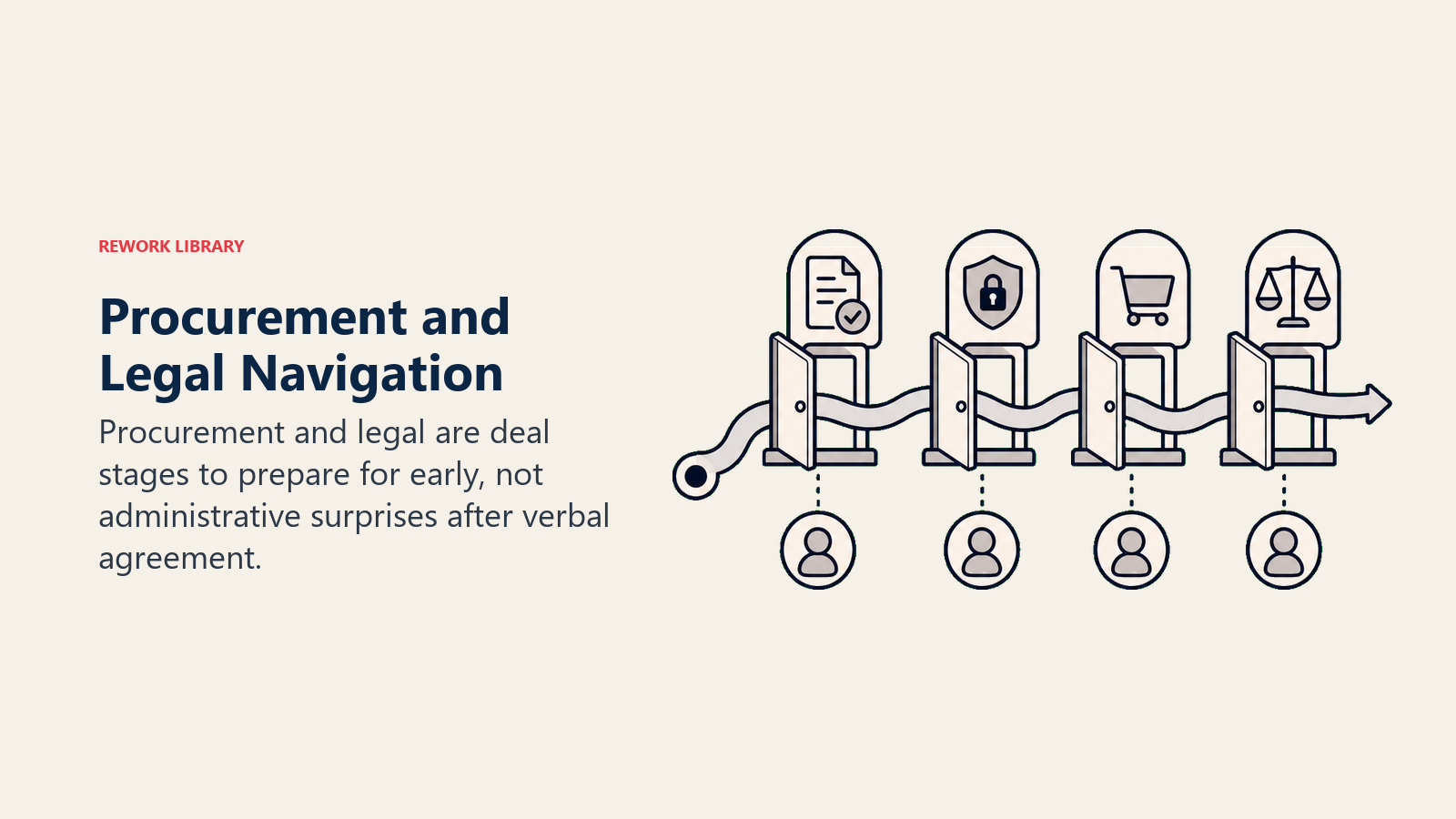
The teams that handle this best treat procurement and legal as part of the deal process, not an obstacle after it.
Start the procurement process earlier than you think you need to. Ask your champion who owns the vendor approval process and make an introduction early in the evaluation. Get their security questionnaire before the evaluation is complete so you can complete it in parallel rather than waiting until the deal is done.
Have your standard contract terms ready and know which ones you can flex on and which are non-negotiable. Nothing slows a legal review like an AE who has to escalate every redline to their own legal team. Know the limits of your authority and communicate them clearly.
For security reviews, prepare in advance. Most enterprise software deals require a security assessment covering data handling, access controls, SOC 2 compliance, penetration testing results, and encryption standards. Have your security documentation package ready to send at the first mention of a security review.
Price negotiation in procurement is almost universal. Build some room into your initial pricing for this. Know your floor. Be willing to trade concessions in areas that cost you little (payment terms, contract length, training credits) in exchange for holding price or protecting margins.
Step 7: Closing the Enterprise Deal
Enterprise deals do not close in a single meeting. They close across a series of incremental commitments that build toward a final signature.
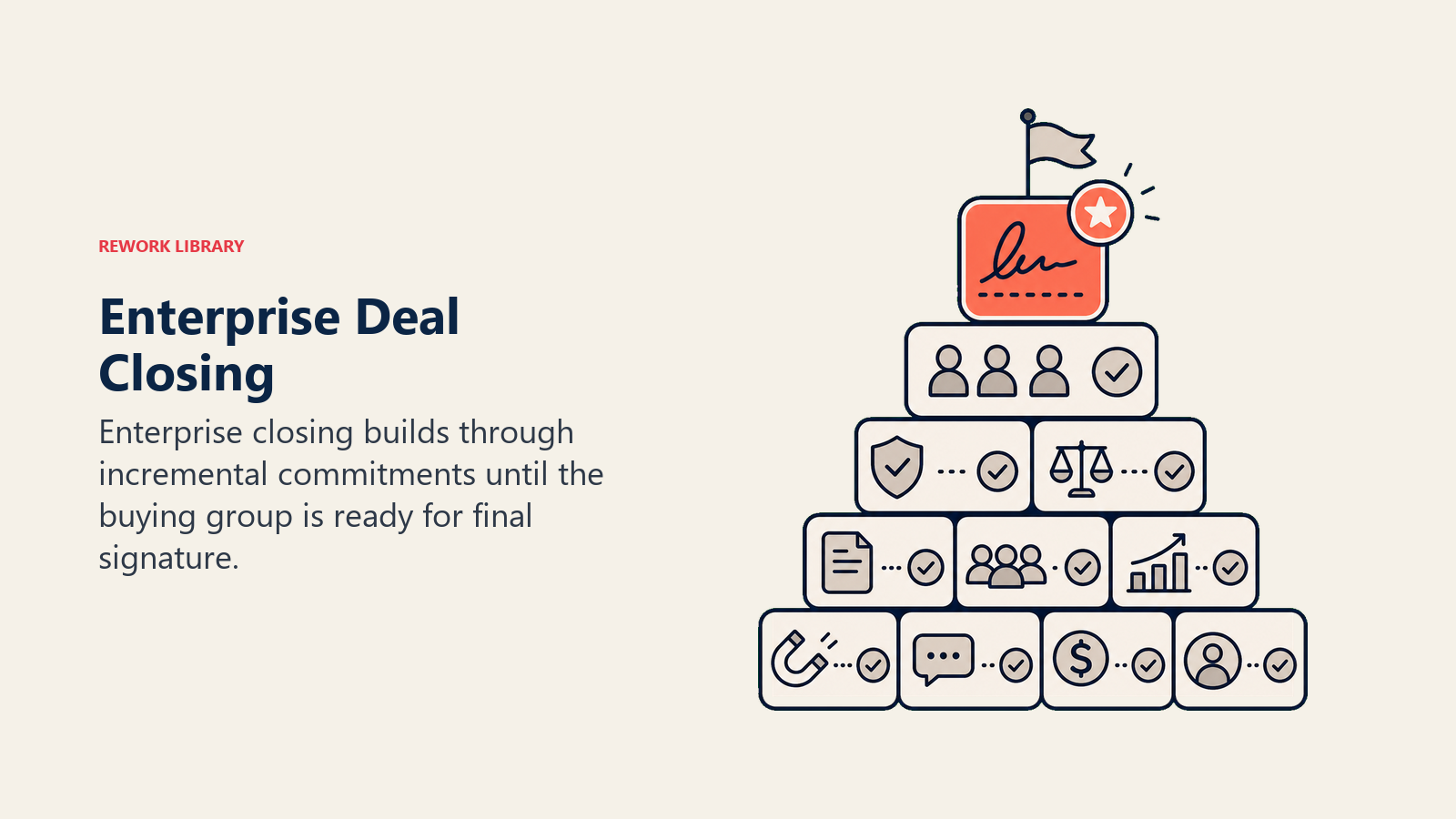
The trial close is your tool for testing readiness without forcing a premature decision. After a product demonstration: "Based on what you have seen, does this solve the problem you described?" After a security review: "Did that address the concerns your team had?" These questions surface objections early while they are still manageable.
When you reach the verbal close (the customer says yes), do not assume the deal is done. Move immediately to the next concrete step: send the contract that day, schedule the kick-off call, initiate the mutual action plan for implementation. Deals that sit at "verbal yes" while waiting for paperwork are at risk from every distraction and competitor that comes along.
Executive involvement at close can accelerate the process. A call from your VP or CEO to the customer's economic buyer, thanking them for their trust and reinforcing your company's commitment, often smooths the final contract negotiation and speeds signatures.
Know your close date drivers. What is creating urgency for the customer? Fiscal year end? A board presentation where they need to show cost savings? An implementation that needs to be complete before a product launch? Work backward from those dates and use them to give the timeline structure without manufacturing false urgency.
Metrics for Enterprise Sales Health
Enterprise sales is harder to measure than volume-based transactional sales. But the right metrics reveal where the machine is working and where it is breaking.
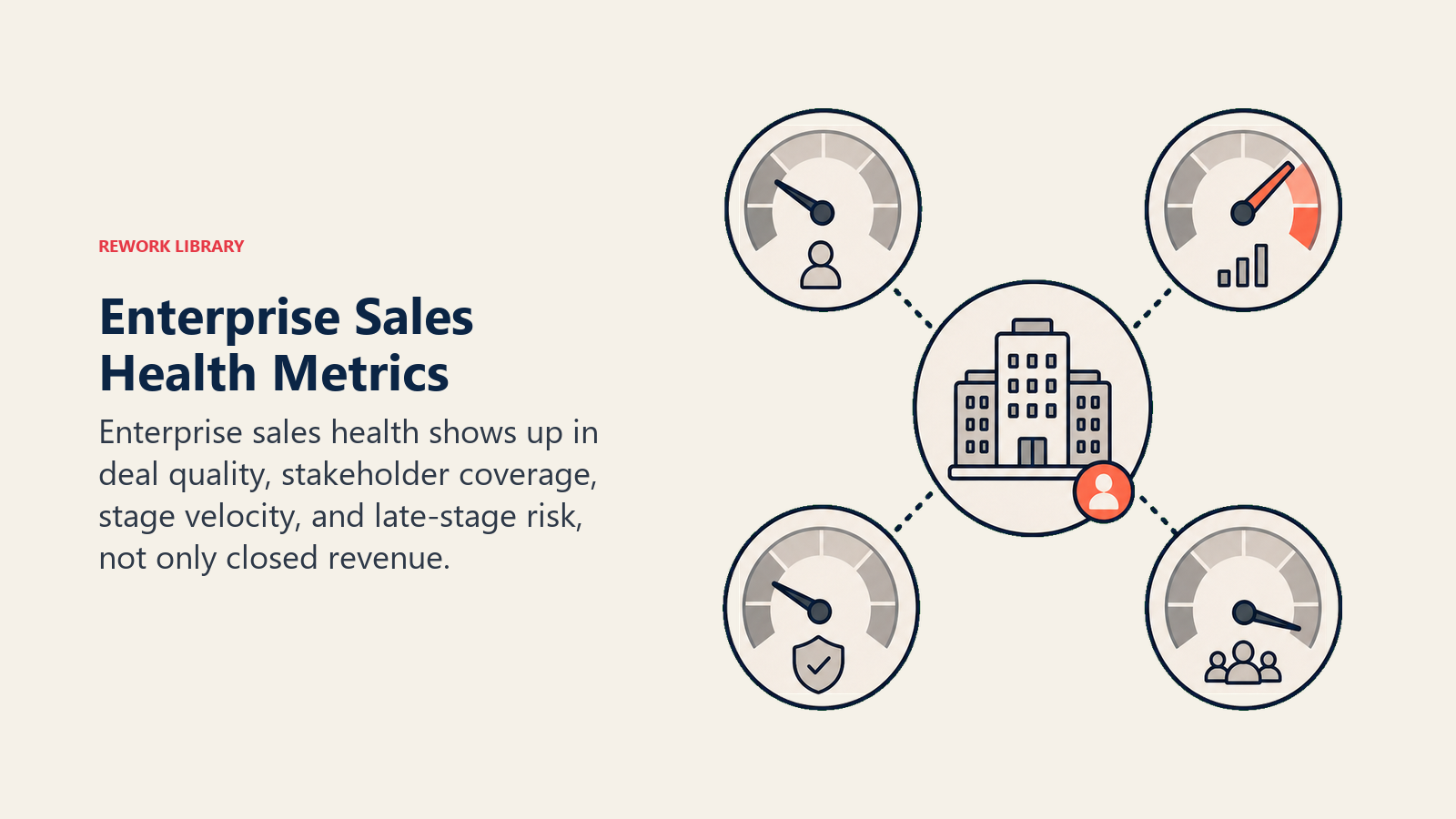
Win rate against qualified pipeline: What percentage of properly qualified enterprise opportunities close? Below 20% suggests a problem in late-stage execution. Above 40% might suggest you are being too conservative with what you qualify.
Average sales cycle length: Track this by deal size and segment. Deals taking significantly longer than your benchmark should be examined for stalls.
Deal slippage rate: How often do enterprise deals miss the quarter they were originally forecast to close? High slippage indicates poor mutual action planning or deals moving through the pipeline without genuine commitment.
Champion engagement: Are your champions actively scheduling meetings, forwarding materials, making introductions? A disengaged champion is an early warning sign of a deal at risk.
Competitive win rate: When you get into a formal evaluation against named competitors, what percentage do you win? This tells you about competitive positioning, not just sales execution.
These enterprise metrics should integrate into your overall lead scoring systems to give you a complete view of pipeline quality from first touch to close.
Common Enterprise Sales Mistakes
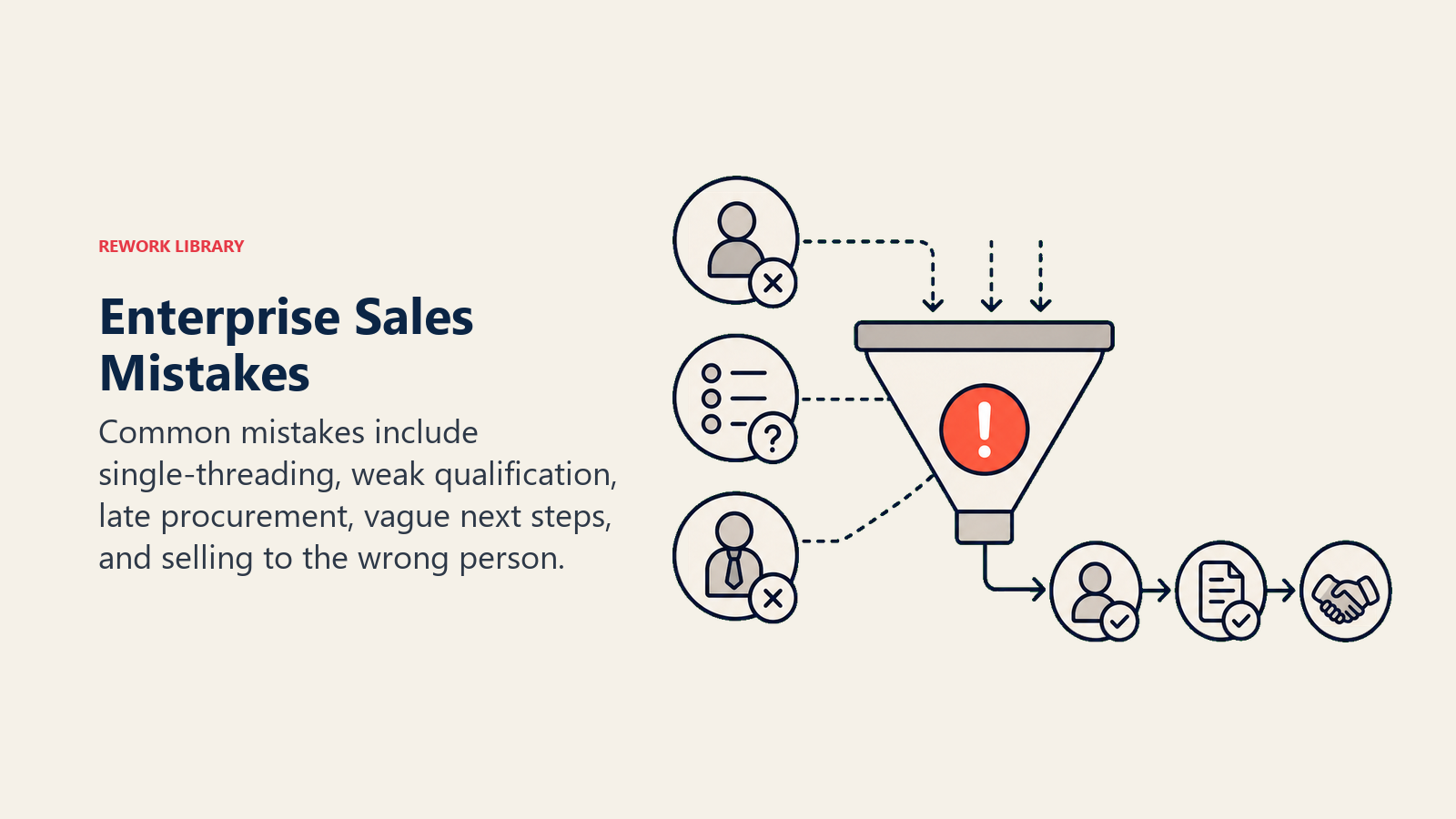
Selling to the wrong person too long. Building a relationship with a VP who has no budget authority feels productive but often leads nowhere. Get multi-threaded early. Find the economic buyer.
Discounting to win speed. Large discounts given early signal that your original price was not defensible. Worse, they train procurement to always ask for more. Discount strategically, tied to something the customer gives you (faster close, longer contract term, a reference).
Neglecting the champion. Once a deal is moving, it is easy to focus on the economic buyer and leave your champion without support. Keep them informed, give them materials, and close the loop after every internal meeting they host on your behalf.
Missing the "no decision" risk. The most common enterprise outcome is not a competitor winning. It is the status quo winning. If the customer can live with the current situation, they will choose it over the risk and effort of change. Your job is to make the cost of inaction higher than the cost of change.
Poor discovery before demos. Enterprise demos that show every feature rarely win. Demos that are tightly scoped to the three problems the customer cares most about consistently outperform. Do not demo until you have done enough discovery to know exactly what to show.
Integrating Enterprise Sales into Your Lead System
Enterprise sales requires different lead handling than your SMB or mid-market motion. Enterprise leads need separate lead routing automation rules that route them to your most senior AEs, not your general lead queue.
Lead qualification for enterprise should happen before an AE picks up the phone. Marketing and SDR teams working enterprise accounts should be scoring and enriching leads to confirm company size, decision-making structure, and budget potential before routing. This is where lead data enrichment becomes especially valuable, helping you prioritize which enterprise accounts deserve immediate attention.
The lead response time standards are also different. An inbound enterprise lead from a Fortune 500 company deserves a response within the hour from a senior AE, not a follow-up from a BDR the next morning.
Build your enterprise sales machine around these realities and you will close more of the deals you should be winning.
Frequently Asked Questions about Enterprise Sales Strategy
How long does a typical enterprise sales cycle take?
Most enterprise B2B deals take 6-12 months from first meeting to signed contract. Deals above $250K ARR often run 12-18 months, particularly when they require significant procurement, legal, and security review. The timeline is driven by internal buying process complexity rather than your sales effort. Your goal is to accelerate the customer's internal process through a mutual action plan, not to compress the timeline artificially.
What is the most important factor in winning enterprise deals?
A strong internal champion. Gartner research shows deals with a documented internal advocate close at 2.5x the rate of deals without one. Your champion navigates the internal politics, advocates for your solution in meetings you are not in, and surfaces objections early enough for you to address them. No other single factor predicts enterprise deal outcomes more reliably.
How do you handle multi-stakeholder enterprise deals without losing control?
Account mapping is the discipline that keeps multi-stakeholder deals manageable. Document every stakeholder's role, priorities, and stance on your solution. Design specific outreach for each persona rather than using a single pitch. Use a mutual action plan to keep all stakeholders aligned on timeline and process. And maintain a single point of contact on the customer side (usually your champion) who coordinates internal alignment while you coordinate the external process.
When should you discount in enterprise sales?
Discount only in exchange for something. The most effective discounting is tied to a customer commitment: a faster close date, a longer contract term, serving as a reference customer, or an expanded scope. Discounting without a trade signals that your original pricing was not serious and invites procurement to push harder. Build flexibility into your pricing structure so you can give a 10-15% discount when needed without it coming out of your commission.
How do you prevent enterprise deals from stalling?
The mutual action plan is your primary stall-prevention tool. When deals have documented milestones with owners and deadlines on both sides, it is much easier to surface a stall before it becomes a dead deal. Check in on blocked milestones proactively. Ask why a security review is taking longer than expected. Understand what internal resource constraints are slowing procurement. Most enterprise deal stalls are fixable if you catch them early enough.

On this page
- What Makes Enterprise Sales Different
- Step 1: Account Selection and Qualification
- Step 2: Account Mapping
- Step 3: Finding and Developing Your Champion
- Step 4: Multi-Stakeholder Management
- Step 5: The Sales Process and Milestones
- Step 6: Navigating Procurement and Legal
- Step 7: Closing the Enterprise Deal
- Metrics for Enterprise Sales Health
- Common Enterprise Sales Mistakes
- Integrating Enterprise Sales into Your Lead System