Cold Email Strategy: A Complete Framework for B2B Outreach That Converts
Turn this article into takeaways for your work.


Each assistant summarizes the article only for you and suggests best practices for your work.
Most cold email fails before the prospect ever reads a single word. The problem is almost never the message. It is the infrastructure around it.
Deliverability is broken. The sequence is set up wrong. The targeting is too broad. Fix those three things first, and suddenly your reply rate climbs from 1% to 8%. That is the difference between a dead outbound motion and one that fills a pipeline.
This guide walks through the complete cold email system: technical setup, targeting, message writing, sequence design, and how to measure what is actually working.
Key Facts: Cold Email Performance
- The average B2B cold email reply rate is 4-5%, but well-segmented campaigns with strong personalization regularly hit 10-20%. (Belkins, 2025 Cold Email Benchmark Report)
- Only 21% of cold emails are ever opened, yet personalized subject lines using the recipient's name or company context lift open rates by 26%. (Salesloft, 2024 State of Sales Engagement)
- Sending a follow-up sequence of 4-7 emails generates 3x more replies than stopping at one message, with the second and third emails often outperforming the first. (Woodpecker, 2025 Cold Email Study)
- 47% of recipients open emails based on subject line alone. Emails with subject lines of 6-10 words see the highest open rates. (HubSpot Email Marketing Report 2024)
- B2B cold email campaigns with strong technical hygiene (SPF, DKIM, DMARC, warmed sending domain) achieve inbox placement rates above 90%; campaigns without these see rates drop below 60%. (Mailreach, 2025 Deliverability Report)
Why Most Cold Email Underperforms
Before getting into tactics, it helps to understand where campaigns actually break down. There are three failure modes, and they compound each other.
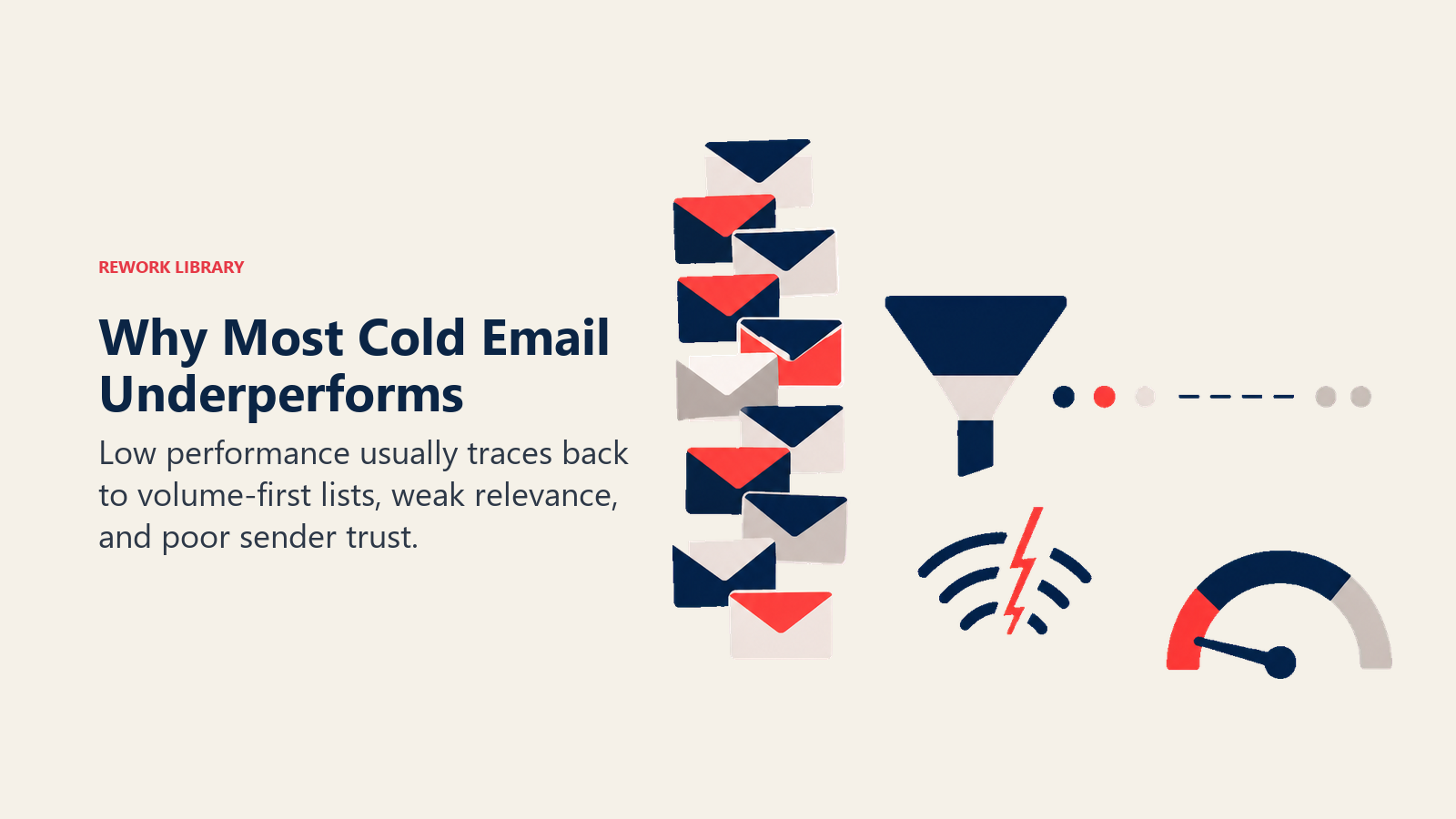
The first is technical: emails land in spam before anyone sees them. You can write the best message in the world and it will not matter if Gmail routes it to junk.
The second is targeting: the list is too broad or the wrong people are on it. Sending 10,000 emails to a loosely defined "VP Sales in SaaS" list will produce worse results than 200 emails to precisely the right people at precisely the right companies.
The third is the message itself: it is generic, it leads with your product, and it asks for too much. People delete it in two seconds.
Most teams jump straight to fixing the message. But if your deliverability is broken and your list is weak, even a perfect email will fail. Fix these in order.
Step 1: Technical Setup and Deliverability
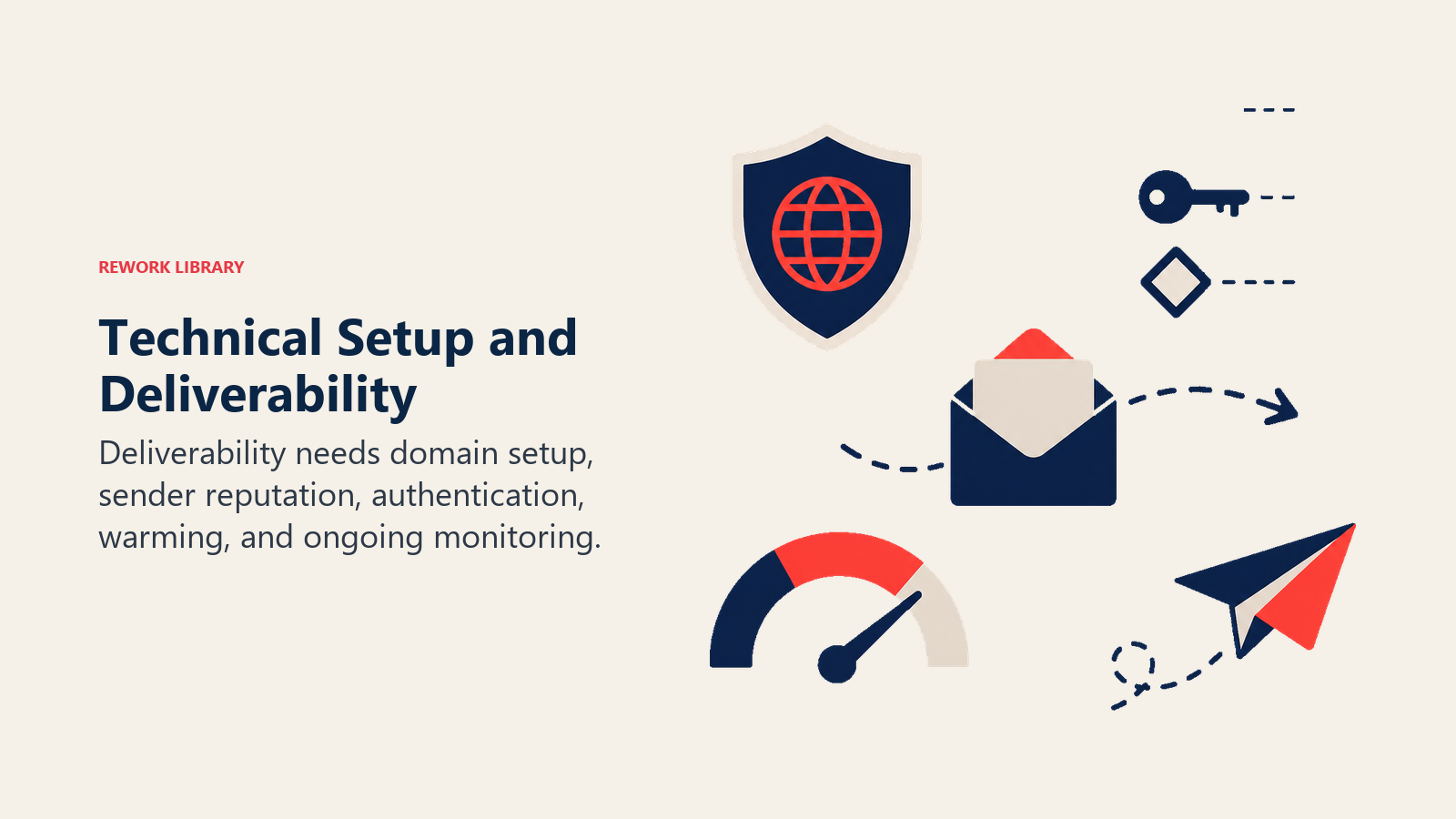
Getting emails to the inbox is infrastructure work. It is not exciting, but it is the foundation of everything else.
Domain and Sending Account Setup
Do not send cold email from your primary company domain. If a campaign goes wrong, you do not want to damage the domain your whole company uses for internal email and transactional messages.
Set up a dedicated sending domain. Something like trycompany.com or getcompany.com alongside your main company.com. Buy it, configure it exactly like your main domain (same MX records, professional DNS setup), and use it exclusively for outbound prospecting.
Then create two or three sending accounts on that domain. This spreads volume and reduces the risk that a single blocked account kills your entire outbound motion.
Authentication: SPF, DKIM, DMARC
These three DNS records tell receiving mail servers that your emails are legitimate. Skip them and you will end up in spam regardless of how good your messages are.
SPF (Sender Policy Framework) lists the mail servers authorized to send email from your domain. DKIM (DomainKeys Identified Mail) adds a cryptographic signature to each email, proving it was not tampered with. DMARC (Domain-based Message Authentication, Reporting, and Conformance) ties the two together and tells receiving servers what to do when emails fail authentication.
Set all three. Most email tools walk you through this configuration. It takes about 30 minutes and prevents the most common deliverability failures. This is as critical as any other part of your lead data management infrastructure.
Domain Warm-Up
A brand-new domain sending 200 emails on day one looks like spam. Warming means starting slow and building volume gradually over 4-6 weeks.
Week 1: send 5-10 emails per day, mixing cold outreach with warm conversations you are already having. Week 2-3: increase to 20-30 per day. Week 4-6: scale to 50-80 per day per sending account.
Several tools (Instantly, Lemlist, Smartlead) automate warm-up by having your accounts exchange emails with a network of other addresses. This builds sending reputation faster. But do not rush it. A burned domain takes months to recover.
List Hygiene
Bad email addresses hurt your sender reputation. Every hard bounce is a signal to mail servers that you are sending to unverified data.
Before sending, run your list through an email verification tool (ZeroBounce, NeverBounce, Kickbox). Remove anything that comes back as invalid or risky. Expect 10-20% of even purchased lists to fail verification. That is normal. Better to have a smaller, cleaner list than a large one that destroys your deliverability.
Keep bounce rates below 2% and unsubscribe rates below 0.5%. If either climbs higher, stop and fix your list before continuing.
Step 2: Building a Targeted Prospect List
Volume is not the goal. Relevance is. A tight list of 200 perfectly matched prospects will outperform a sloppy list of 2,000 every time.
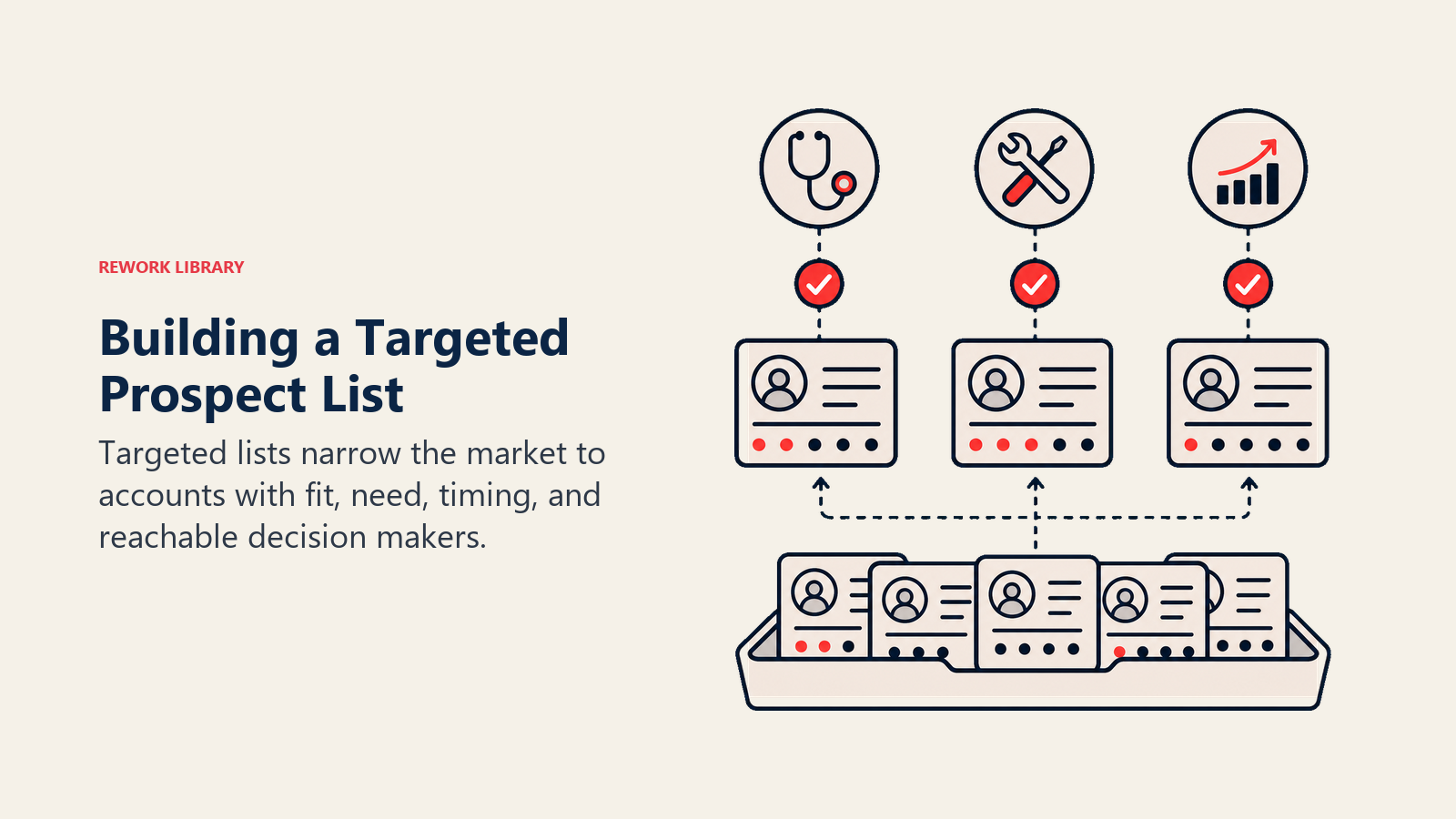
Start with your ideal customer profile. What company size, industry, geography, and tech stack characterize your best current customers? What role holds buying authority for your solution? What problems do they have that you solve?
Get specific. "VP Sales at SaaS companies" is too broad. "VP Sales at B2B SaaS companies with 50-200 employees, using Salesforce, that have raised Series A or B in the last 18 months" is a real targeting filter.
Sources for building these lists:
- LinkedIn Sales Navigator: filter by title, company size, industry, seniority, geography
- Apollo.io or ZoomInfo: firmographic data plus contact information
- Crunchbase: funding signals, growth data
- Intent data platforms (Bombora, G2): companies actively researching your category
Cross-reference signals. A company that recently raised funding AND is hiring sales reps AND uses tools that integrate with yours is a much warmer prospect than one that just matches industry and size.
For higher-value accounts, run a manual review on each company before adding them to a sequence. A few minutes of research per prospect can double your reply rate. For broader lists, let the tool filter and just verify the contact information manually on the highest-priority accounts.
This feeds directly into your lead qualification frameworks. Even before a prospect replies, the quality of your targeting is the first qualification gate.
Step 3: Writing the Cold Email
Now you get to write. The fundamentals here have not changed much. What has changed is that prospects are more cynical and better at pattern-matching generic outreach. You have less margin for error.
The Structure That Works
A high-performing cold email has four parts:
1. Subject line: Gets the email opened. Should be specific, low-commitment, and curiosity-inducing. Not click-bait, not a false sense of urgency. Examples: "Quick question about [topic]", "[Mutual connection] mentioned you might be dealing with [pain]", "[Company name] + [Your company]".
2. Opening line: Establishes relevance immediately. Reference something specific to them: a recent press release, a LinkedIn post they wrote, a job posting on their site, a product launch. This is the personalization hook that separates you from every other email in their inbox.
3. Value prop: One or two sentences connecting what you do to a specific problem they likely have. Do not describe your product. Describe the outcome. "We help ops teams at Series B companies cut manual CRM updates from 3 hours a week to 15 minutes" is better than "We offer an AI-powered CRM integration platform."
4. Call to action: Make it easy. Not "Can we schedule a 45-minute demo?" but "Do you have 15 minutes next week to see if this is relevant?" One question, low commitment, easy to answer yes or no.
What to Avoid
Skip the intro ("Hi, my name is X and I work at Y doing Z"). They can see who you are.
Avoid "I hope this email finds you well." It is filler that signals a generic template.
Cut any sentence that starts with "I" or "We" that does not follow immediately with a benefit to them.
Do not ask for a meeting in the first email. Build to it. Your first email should open a conversation, not jump straight to the close.
And keep it short. If it takes more than 45 seconds to read, it is too long. Most top-performing cold emails are under 100 words.
Personalization at Scale
Full personalization for every email is not realistic at volume. The practical approach is templated personalization: build a strong base template and swap in specific details.
For each prospect, you need three data points before sending: a company-specific observation (recent news, LinkedIn activity, job postings), a pain point relevant to their role and company stage, and a peer reference (a company similar to theirs that you have helped).
With a good list and a few research tools, you can prepare these details for 20-30 prospects per hour. That is realistic for a sales rep or SDR managing ongoing outbound.
For high-value accounts (top 50 targets), go deeper. Read their quarterly reports, look at what their leadership is saying publicly, understand their competitive position. A five-minute email that demonstrates you actually understand their business is worth more than 50 generic ones.
Step 4: Sequence Design
Single-touch outreach does not work. You need a sequence, and you need to design it thoughtfully.
How Many Touches
Research consistently shows that most replies come after the second, third, or fourth email. Stopping at one means leaving the majority of your potential responses on the table.
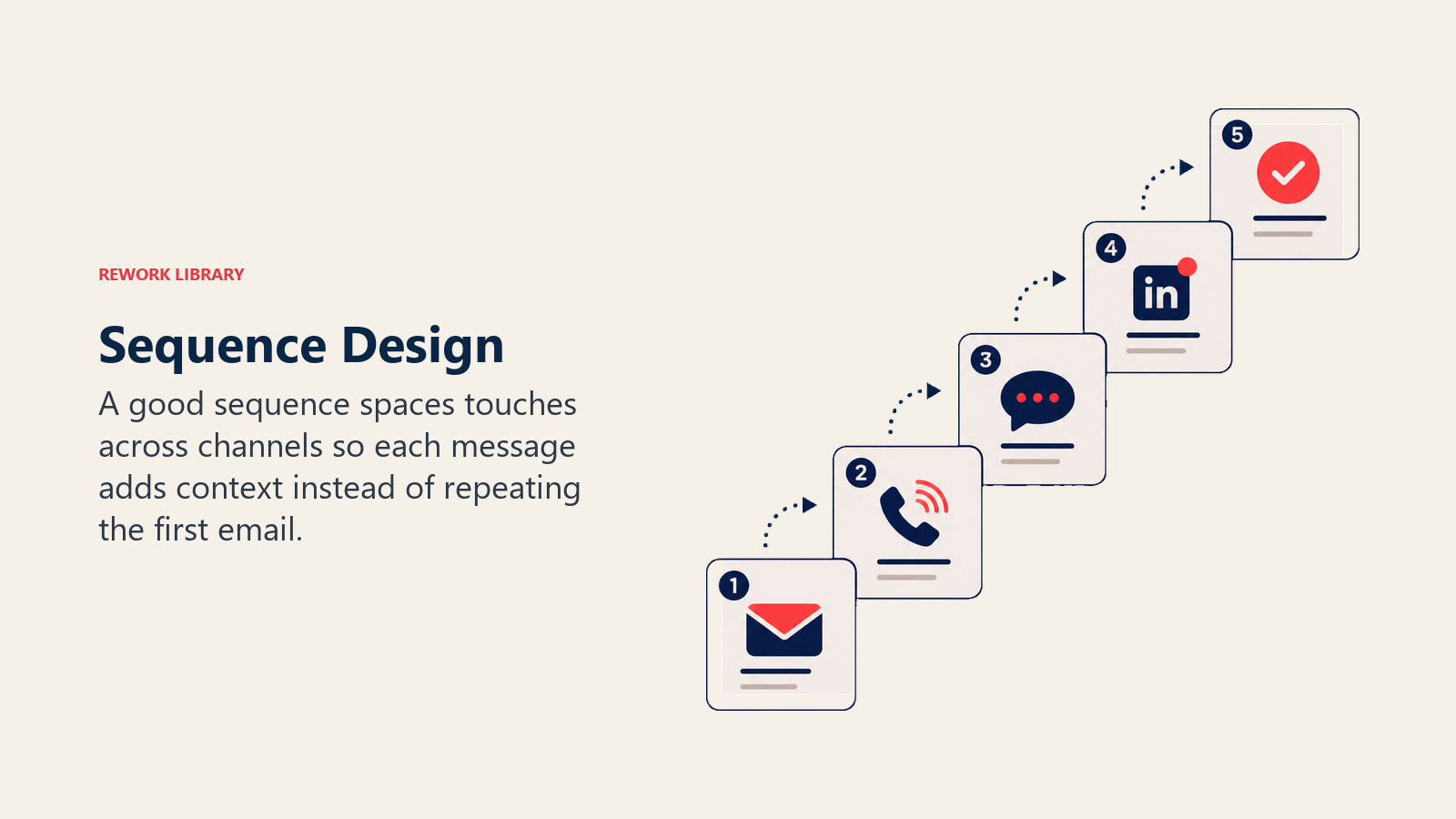
A typical effective sequence runs 5-7 touches over 3-4 weeks. This sounds aggressive, but each email adds something new. The goal is to show persistence without being annoying. Done right, most prospects respect the follow-through even if they do not reply.
Timing Between Touches
Day 1: Initial email. Day 3-4: First follow-up. Keep it short. Reference the first email briefly, add one new piece of context or a different angle on the value prop. Day 7-8: Second follow-up. Try a different channel if possible (LinkedIn message, phone call). New case study or stat. Day 12-14: Third follow-up. Often works to try a completely different hook or frame. Day 18-21: Fourth follow-up. Might shift to a different persona at the same company. Day 28-30: Break-up email. "I don't want to keep filling your inbox if this isn't relevant. Is this a no for now, or just bad timing?"
The break-up email is often the highest-performing touch. Something about the finality of it prompts responses.
Multi-Channel Sequencing
Email alone is one channel. The best sequences combine email with LinkedIn touchpoints and calls for high-value targets.
After touch 1 (email), connect on LinkedIn with a short personalized note. Not a pitch, just a connection request that acknowledges the outreach.
After touch 2 or 3, if you have a phone number, call. Leave a brief voicemail that references the emails.
At touch 4 or 5, comment on a LinkedIn post they have published if there is something genuine to say.
The combination is not about bombardment. It is about showing up consistently across the channels they actually use. Some people live in email. Others respond faster on LinkedIn. You do not know which type you are dealing with until you try both.
This multi-channel approach is central to effective outbound lead generation at scale.
Step 5: Measuring and Improving
You can not improve what you do not measure. These are the numbers that matter.
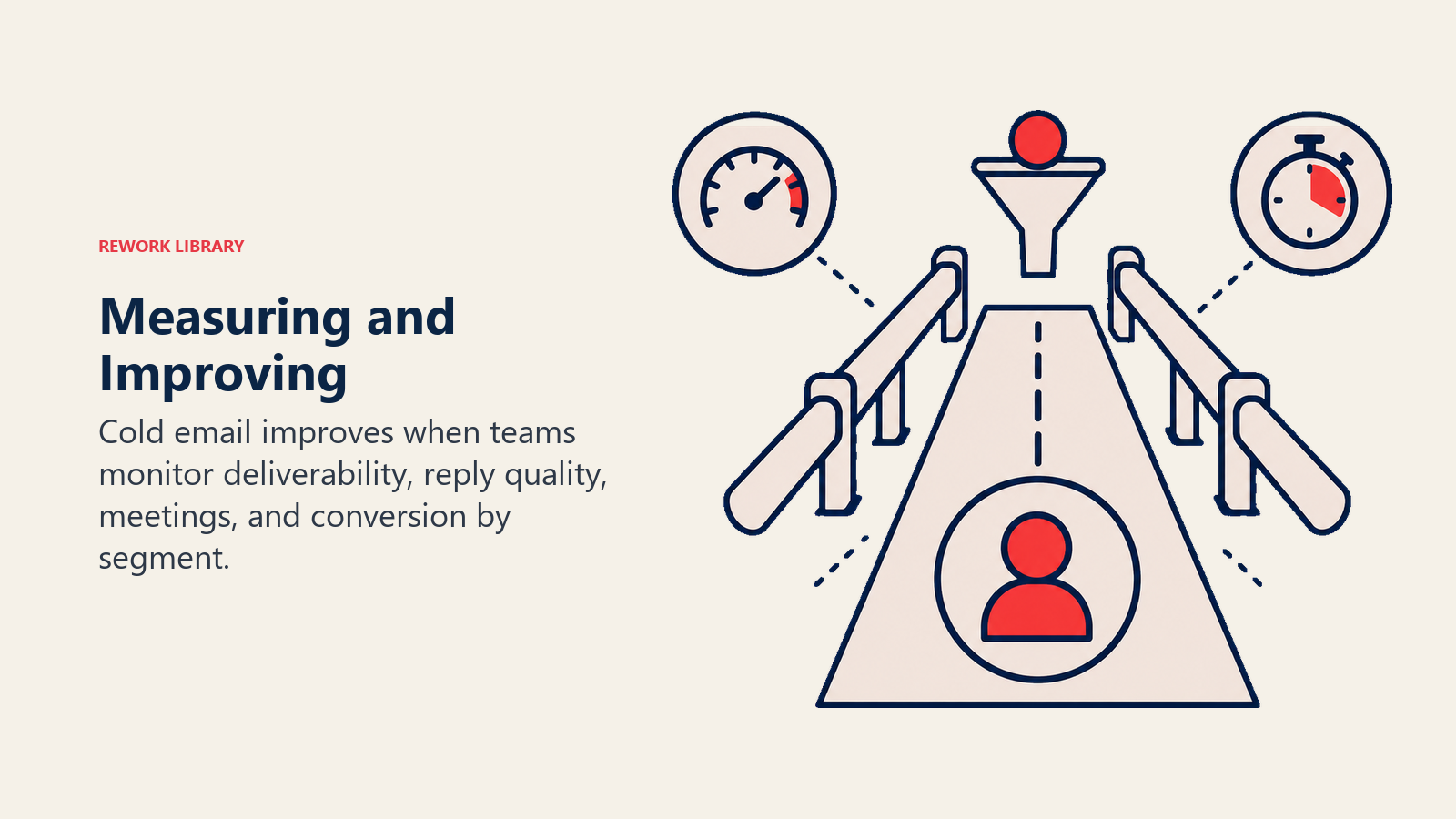
Deliverability rate: What percentage of your emails are actually reaching the inbox. Aim for 95% or higher. If it is lower, you have a technical problem to fix before anything else.
Open rate: Benchmark is 27-40% for well-targeted cold email. Below 20% means your subject lines need work, or your targeting is off.
Reply rate: Industry benchmark is 4-5%. Teams that do this well consistently hit 8-15%. Below 2% means something fundamental is broken (deliverability, targeting, or message).
Positive reply rate: Not all replies are good. Track separately the percentage that expressed interest versus unsubscribed or told you to stop. This is a better signal of message-market fit than raw reply rate.
Meeting booked rate: The number that actually connects to revenue. Track meetings booked per 100 emails sent. A reasonable target is 1.5-3 meetings per 100 emails.
Run A/B tests on subject lines, opening lines, and calls to action. Change one variable at a time. Give each variant at least 50 sends before drawing conclusions.
Review your sequences monthly. Which touches are generating replies? Which are dead weight? Cut what does not work and double down on what does.
Feeding this data back into your lead conversion rate analysis gives you a clearer picture of where cold email fits in your overall acquisition mix and how to optimize it over time.
Common Cold Email Mistakes
Even experienced teams make these errors repeatedly.
Sending too much too fast. Volume without warm-up destroys deliverability. Burning a domain takes a week. Rebuilding reputation takes months.
Pitching the product in email one. Cold email opens a conversation. It does not close a sale. If your first message is describing features, you are thinking about this wrong.
Using spam-trigger language. Phrases like "free trial", "limited time offer", "act now", "guaranteed", or using excessive capitalization and exclamation points will trigger spam filters even if you have solid technical setup.
Following up without adding value. "Just checking in" is not a follow-up. Each touch should add something: a new data point, a customer story, a different angle. Otherwise you are just reminding them to ignore you.
Ignoring replies from disinterested prospects. When someone asks to be removed, remove them immediately. Not just from the current sequence but from all future outreach. Arguing with these requests wastes time and damages reputation.
Giving up too early. Most reps send one email and move on. The data consistently shows that replies stack up across a sequence. Persistence, done professionally, gets results.
Cold Email as Part of the Broader Strategy
Cold email is one piece of a complete lead generation system. It works best when it feeds into a well-designed lead lifecycle stages process that can handle replies, qualify interested prospects, and move them into the pipeline efficiently.
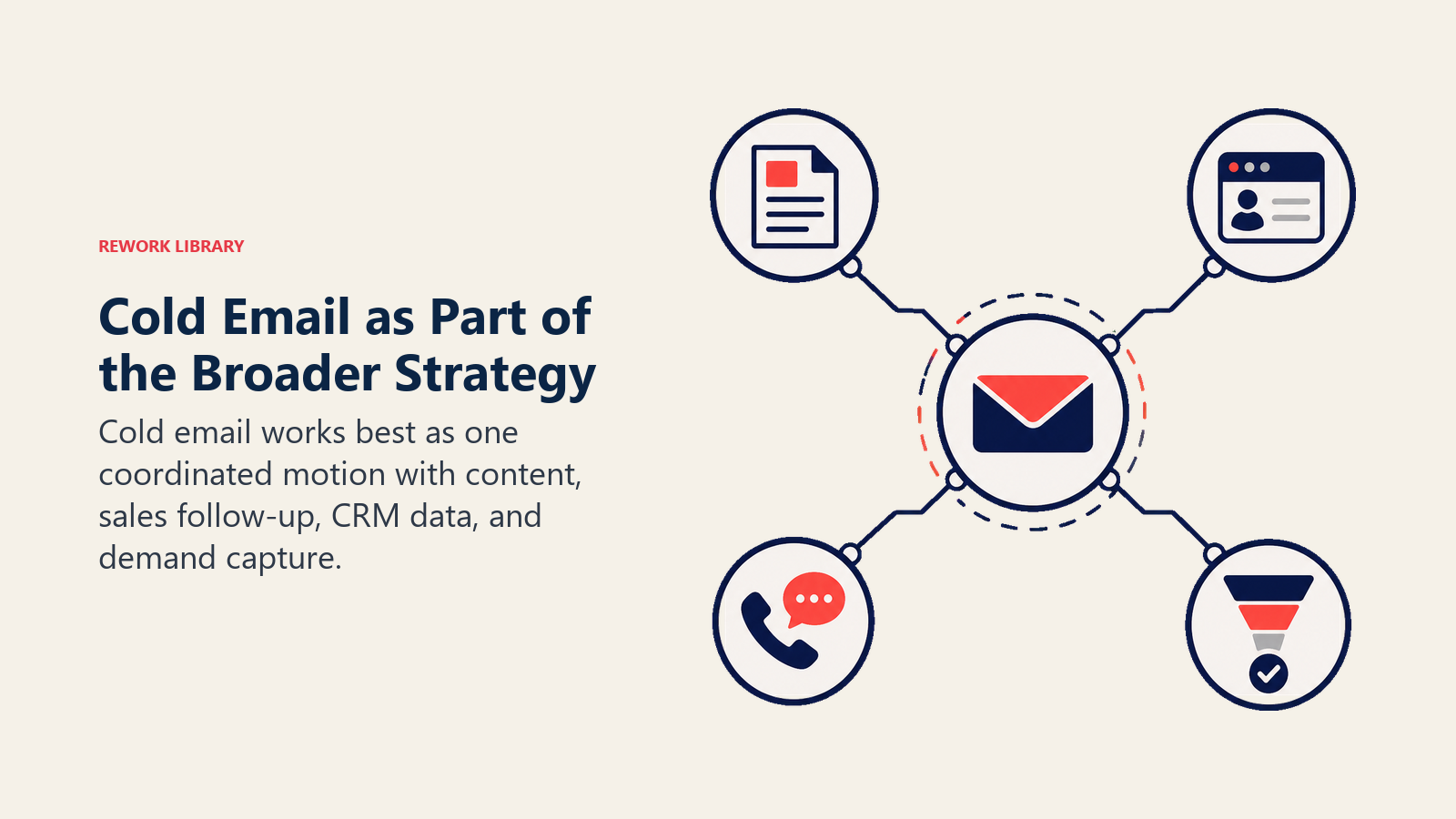
The metrics from your email campaigns should also feed back into your lead scoring systems. Prospects who open multiple emails, click links, or engage with follow-up content are showing intent signals that are worth tracking. They may not be ready to buy now, but they are worth including in longer-term lead nurturing programs.
Cold email is also most effective when it is not the only channel running. Combine it with content marketing that builds awareness, paid ads that warm up your target accounts, and a referral motion that turns happy customers into warm introductions. Prospects who have already heard of you before your first cold email reply at 2-3x the rate of completely cold contacts.
Used well, cold email is not a spray-and-pray channel. It is a precision tool for reaching exactly the right people at the right time with a message that resonates.
Frequently Asked Questions about Cold Email Strategy
What is a realistic cold email reply rate for B2B sales?
The industry average is 4-5% across all B2B cold email. Campaigns using tight list segmentation, personalized opening lines, and multi-touch sequences regularly achieve 10-15%. If your reply rate is below 2%, the problem is usually deliverability, targeting, or a message that leads with product features rather than prospect pain.
How many emails should be in a cold email sequence?
Most effective sequences run 5-7 touches over 3-4 weeks. Research from Woodpecker and Belkins consistently shows that 40-60% of positive replies come after the second email. Stopping at one or two messages means leaving most of your potential responses behind. Each follow-up should add new information rather than simply repeating the original ask.
Should I use a personal domain or my company domain for cold email?
Use a secondary sending domain dedicated to cold outreach, not your primary company domain. If a campaign damages sender reputation (through high bounce or spam complaint rates), you do not want that to affect your company's main email deliverability. A secondary domain like try{company}.com keeps cold outreach risk isolated.
How long should a cold email be?
Under 100 words for the body is a strong target. Top-performing cold emails read in under 45 seconds. Each additional sentence increases the chance the prospect closes the email before reaching your call to action. Subject line, personalized hook, one-sentence value prop, simple ask. That is the full structure you need.
What is the best time to send cold emails?
Tuesday through Thursday generally outperform Monday and Friday. Morning sends (7-9 AM local time for the recipient) and late afternoon sends (4-6 PM) tend to see higher open rates than midday sends when inboxes are most cluttered. But test this for your specific audience. Industry and role can shift these patterns significantly.
How do I avoid the spam folder with cold email?
The three non-negotiables are technical authentication (SPF, DKIM, DMARC), a warmed sending domain and account, and clean list hygiene (verified emails with low bounce rates). Beyond that, avoid spam-trigger language in subject lines and body copy, keep your text-to-link ratio high, and do not use attachment files in cold outreach.

On this page
- Why Most Cold Email Underperforms
- Step 1: Technical Setup and Deliverability
- Domain and Sending Account Setup
- Authentication: SPF, DKIM, DMARC
- Domain Warm-Up
- List Hygiene
- Step 2: Building a Targeted Prospect List
- Step 3: Writing the Cold Email
- The Structure That Works
- What to Avoid
- Personalization at Scale
- Step 4: Sequence Design
- How Many Touches
- Timing Between Touches
- Multi-Channel Sequencing
- Step 5: Measuring and Improving
- Common Cold Email Mistakes
- Cold Email as Part of the Broader Strategy