Storytelling at Work: How to Communicate With Impact
Turn this article into takeaways for your work.


Each assistant summarizes the article only for you and suggests best practices for your work.
Storytelling is one of the oldest and most effective communication tools humans have. But most professionals never think of it as a skill they can develop deliberately. They give presentations full of data, send emails packed with bullet points, and walk out of rooms without having moved anyone. The people who do move rooms aren't necessarily smarter or more senior. They're better at telling stories.
What Is Storytelling at Work?
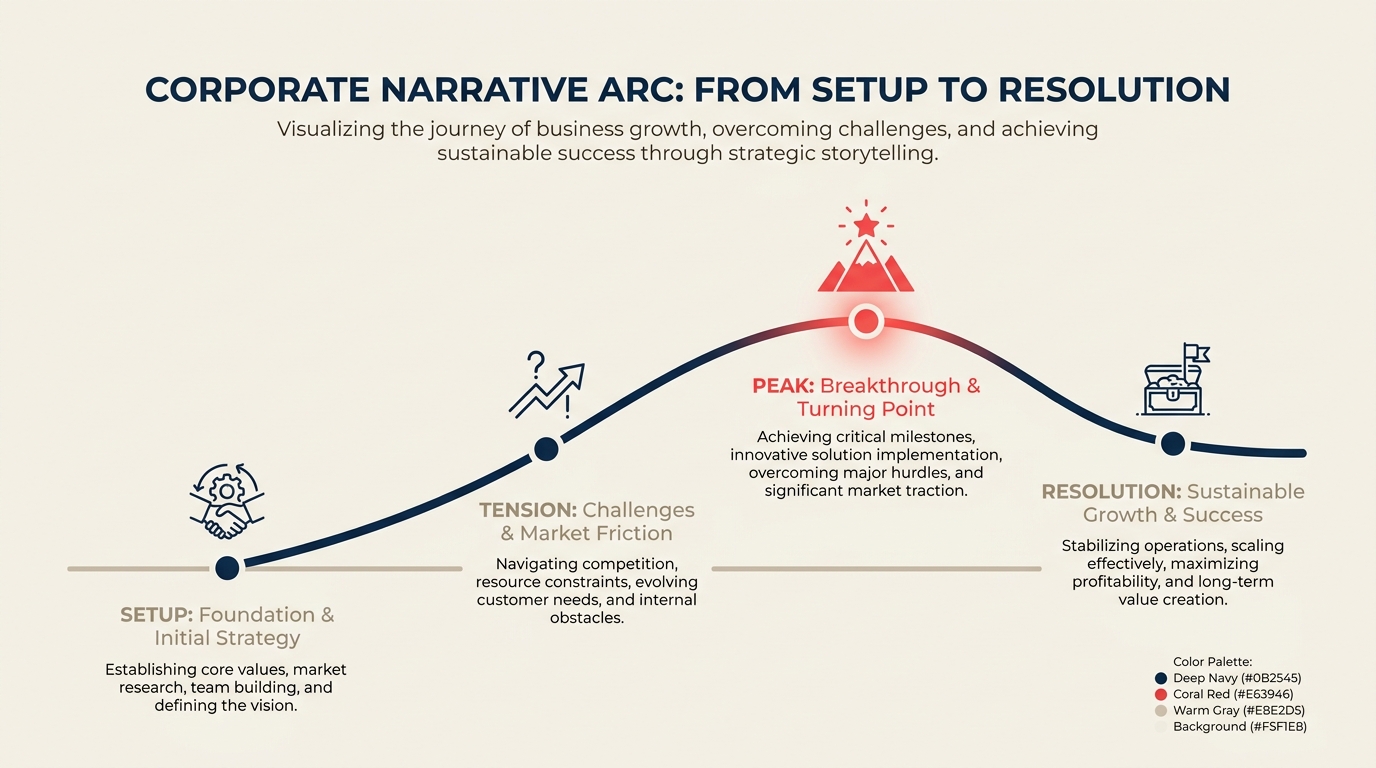
Storytelling at work means using narrative structure, a character, a tension, and a resolution, to make ideas, data, and change clear, memorable, and persuasive in a business setting. It's distinct from fiction: business stories are true, purposeful, and brief. You're not writing a novel. You're giving your audience a way to understand something complex, care about it, and act on it.
Business storytelling covers a wide range: a two-minute pitch in a strategy meeting, a data presentation that opens with a customer anecdote, a change-management email that explains why a reorg matters. The format changes but the underlying mechanics stay the same, someone experiences something, faces a problem, and either solves it or needs help solving it.
Key Facts
- People are up to 22 times more likely to remember information presented as a story than as a list of facts, according to research by cognitive psychologist Jerome Bruner. (Note: the exact multiplier is widely cited but the underlying directional finding, that narrative dramatically boosts recall, is robust and replicated across memory research.)
- Researchers at Claremont Graduate University led by Paul Zak found that narrative-driven content triggers oxytocin release, the neurochemical linked to trust and empathy, making listeners more likely to cooperate and take action after hearing a story.
- A Stanford study found that, after a persuasive pitch, 63% of people remembered the story while only 5% remembered a specific statistic. (Source: Chip Heath and Dan Heath, "Made to Stick," 2007.)
"Facts inform, but stories are what people repeat after the meeting ends."
Why Storytelling Matters at Work
Data alone rarely changes minds. Most leaders have sat through a slide deck full of charts and left thinking nothing different from when they walked in. Stories change that dynamic for three concrete reasons.
Recall. People forget bullet points within hours. A well-told story about a real customer, a real failure, or a real decision stays with an audience for weeks. If you want your message remembered after the meeting, give it a narrative spine.
Trust. Sharing the struggle behind a result, what went wrong before you got it right, what the team almost missed, signals honesty. Leaders who only present polished outcomes read as guarded. Leaders who share the real arc build credibility faster.
Decisions. Numbers justify; stories motivate. When a finance team recommends a platform change, the ROI slide gets them in the room. But it's the story of the analyst who spent three hours reconciling a spreadsheet that should have taken ten minutes that makes the exec sign off. Persuasion skills and storytelling overlap heavily here.
Alignment. Teams that share stories, about what the company is trying to do, who they're trying to help, why certain choices matter, stay aligned better than teams that run on process documents alone. Stories give the "why" a human face.
The Building Blocks of a Business Story
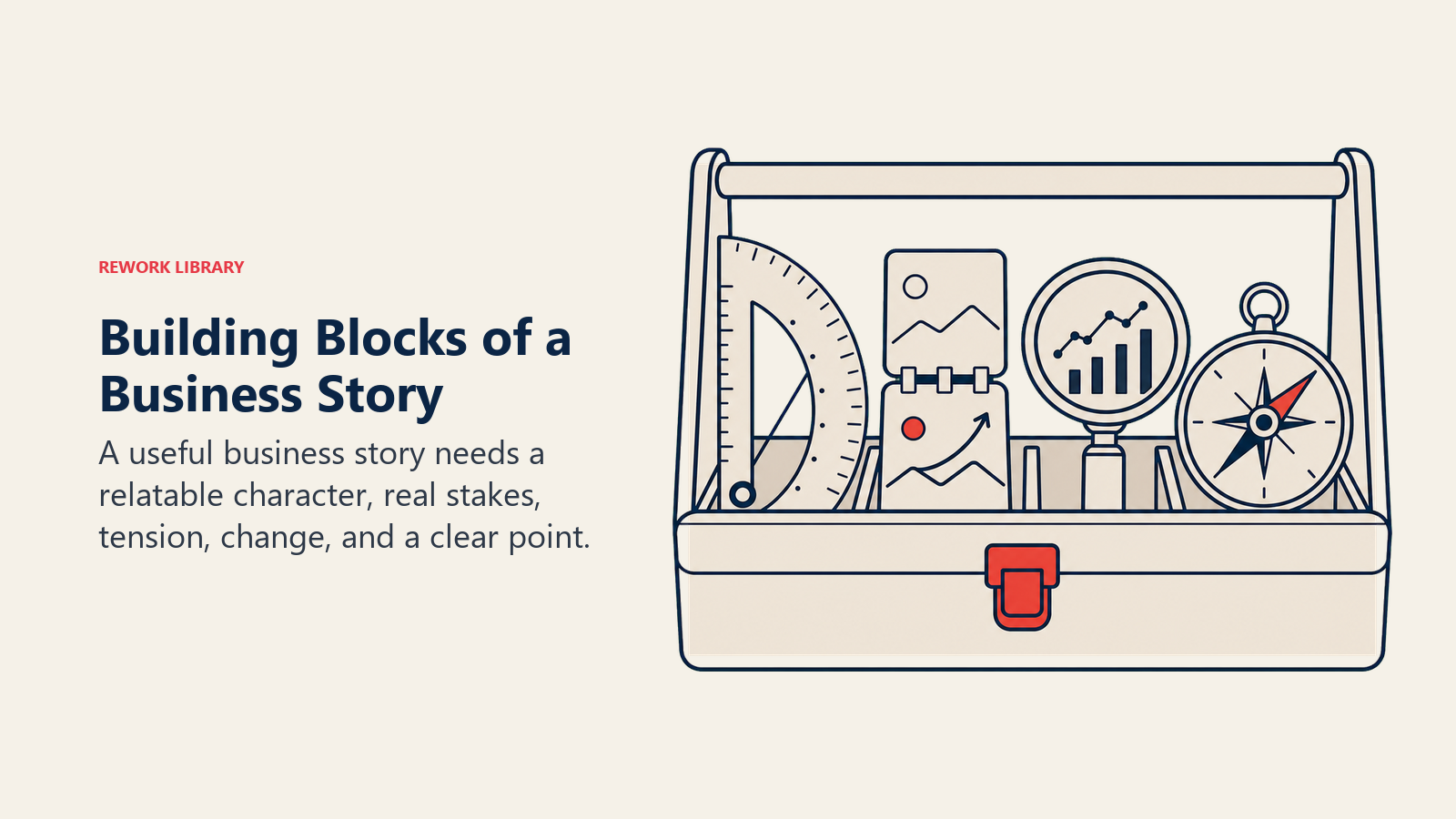
Every effective business story, regardless of format or length, has the same components. Think of these as the non-negotiables you need to check before you tell a story in any professional setting.
| Building block | What it is | Why it matters |
|---|---|---|
| Character / audience | The person or team at the center of the story (often the listener or a person they relate to) | Creates identification; listeners need someone to root for |
| Context | The situation before anything happened | Sets the stakes and makes the conflict understandable |
| Conflict / stakes | The problem, challenge, or question that needed answering | Without tension, there's no story, just a report |
| Resolution | What happened, what decision was made, what changed | Gives the audience a satisfying close and a model to follow |
| The point / ask | The one thing you want the audience to think, feel, or do | Business stories always have a purpose; name it |
The most common storytelling mistake in business is skipping straight to resolution without establishing context or conflict. If your audience doesn't feel the tension, the resolution means nothing.
Storytelling Frameworks You Can Use
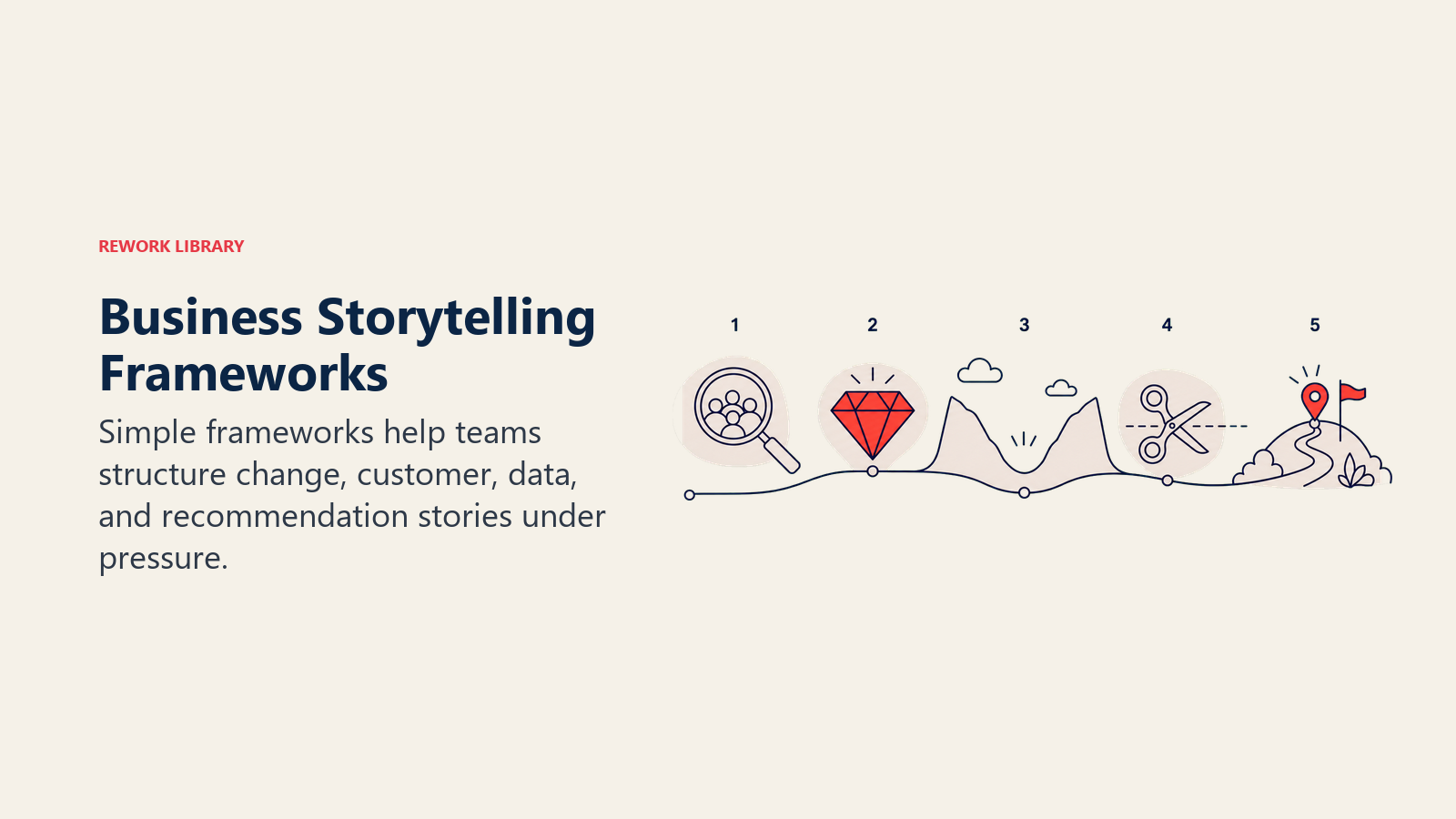
You don't need to invent structure from scratch. These four frameworks cover most business storytelling situations and are simple enough to use on short notice.
| Framework | What it stands for | Best for |
|---|---|---|
| STAR | Situation, Task, Action, Result | Interview answers, project debriefs, performance conversations |
| SCR | Situation, Complication, Resolution | Executive updates, change communication, strategy presentations |
| Hero's journey (simplified) | Ordinary world, challenge, transformation | Vision-setting, brand narratives, culture stories |
| Before-After-Bridge | How things were, how things are now, how to get there | Sales pitches, process-change communication, proposals |
The situation, task, action, result (STAR) method is the most versatile starting point for most professionals. It's especially useful in interviews and performance reviews because it keeps you specific and concrete. The situation-complication-resolution (SCR) framework is better for executive audiences who want to understand a problem and its fix quickly, without unnecessary background.
Before-After-Bridge is the go-to for sales and change communication: describe the pain, show the better state, then explain how to cross the gap.
How to Tell a Story at Work
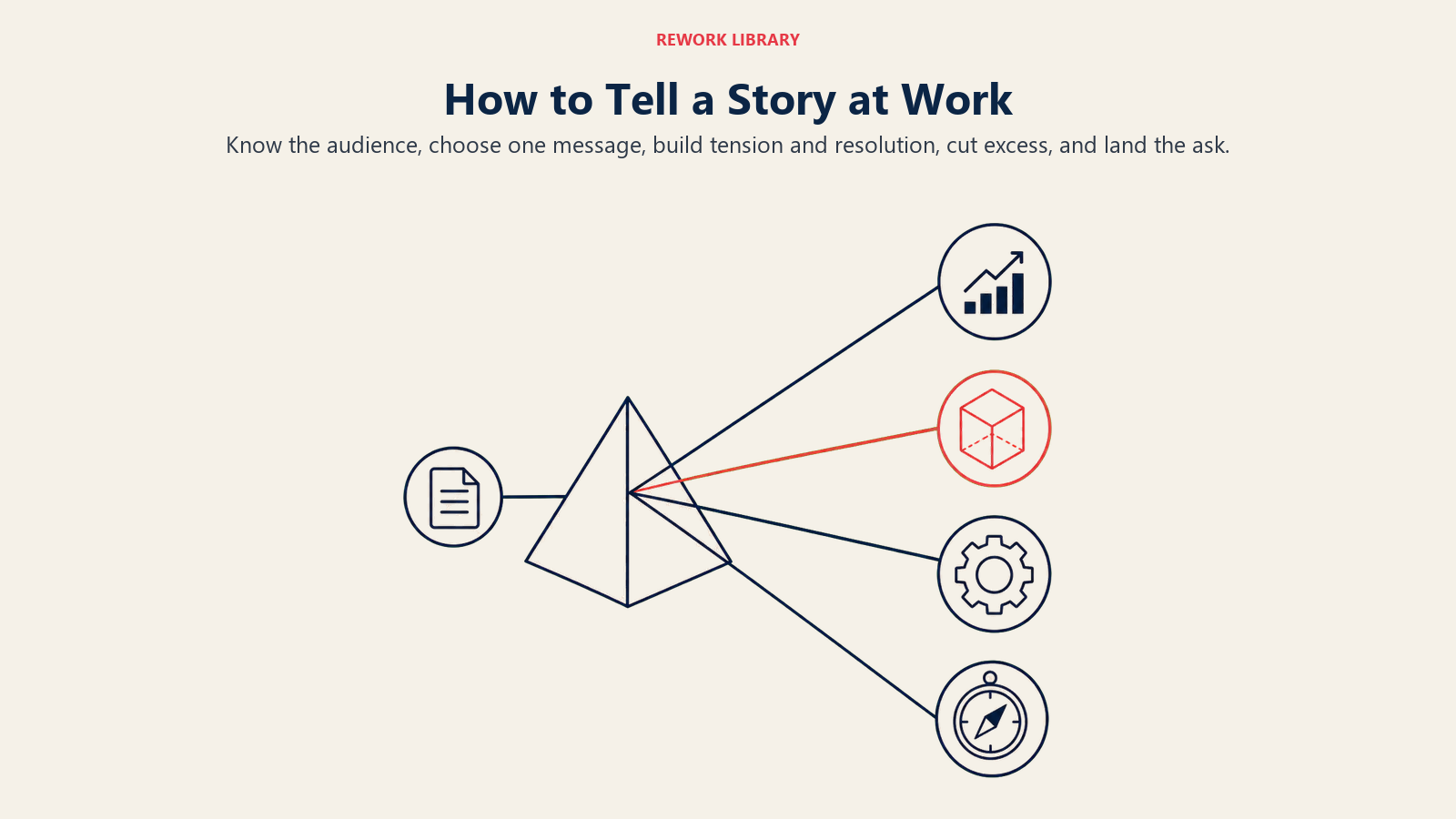
Knowing the theory doesn't close deals or win buy-in. These steps turn the mechanics into a practice you can use in any conversation.
Step 1: Know your audience and goal
Before you build your story, answer two questions: who specifically is in the room, and what do you want them to do or decide after you're done? A board-level audience needs different context than a product team. A story designed to inspire action at an all-hands is structured differently from a story meant to get budget approved. Communication skills start with understanding your receiver.
Step 2: Find the one core message
Every business story should have exactly one point. If you're not sure what it is, you're not ready to tell the story. Write it down in one sentence before you build anything else. Everything you include either serves that sentence or it goes.
Step 3: Structure with tension and resolution
Pick your framework (STAR, SCR, Before-After-Bridge) and map the key beats: context, conflict, resolution, point. The conflict is the most important and most skipped element. If you're presenting a new process, the conflict is the problem the old process created. If you're making a strategy recommendation, the conflict is what happens if the company doesn't change. Don't soften or rush the tension, that's what makes the resolution satisfying.
Step 4: Cut to the essentials
Most business stories run twice as long as they need to. Once you have your draft, cut anything that doesn't move the story forward or build tension. Remove background that only you find interesting. Remove data that doesn't directly support your core message. If cutting it makes the story worse, keep it. If it doesn't, it goes.
Step 5: Land the ask
End with clarity. State what you want the audience to do, decide, or remember. This is where many storytellers fumble: they tell a compelling story and then trail off. A strong close sounds like "So I'm recommending we run a 60-day pilot with these three accounts, and I need a decision today." Influencing skills and storytelling converge right here.
Storytelling Examples by Role
Different roles need different story types. Here's what effective storytelling looks like across four common professional contexts.
Leader casting a vision. A new VP of Sales opens an all-hands not with a revenue target but with a story about a customer who almost churned last quarter, the three calls it took, the handoffs that went wrong, and the rep who stayed late to save the deal. Then: "That shouldn't be heroics. That should be our standard process. Here's how we get there." The goal isn't to describe the future state; it's to make the team feel the gap between where they are and where they need to be.
Salesperson with a customer story. A rep doesn't walk into a discovery call and lead with product features. They open with a story from a similar customer: "A team like yours was spending about 40% of their week on manual reconciliation. Here's what changed for them in the first 90 days." The prospect hears their own problem described back to them, which creates attention and trust before a single feature is mentioned.
Analyst making data land. An analyst presenting churn data doesn't open with a chart. They open with a single customer story that illustrates the trend: "In March, we lost 12 accounts. The pattern in the exit surveys was almost identical, they all said onboarding felt rushed. Let me show you what the data looks like at scale." The story gives the number a face. Now the chart means something.
Candidate in an interview using STAR. Asked "Tell me about a time you handled conflict with a stakeholder," a strong candidate doesn't say "I'm a good communicator." They use STAR: "I was leading a product launch (situation and task) when the engineering lead pushed back on the deadline I'd committed to (conflict). I scheduled a 30-minute working session with both teams to map the dependencies openly (action). We adjusted the launch by two weeks and shipped with zero post-launch defects (result)." Specific, structured, credible.
How to Develop Storytelling Skills
Storytelling is a skill, not a talent, which means it responds to deliberate practice. Here's where to start.
Mine your experience for stories. You already have the raw material. Think about a project that went wrong, a customer interaction that surprised you, a decision that looked obvious in hindsight but wasn't at the time. Write these down in a simple document, a story bank. When you need a story, you pull from it rather than inventing under pressure.
Practice out loud. Reading your story silently is nothing like telling it. Record yourself on your phone, or tell the story to a colleague before the real moment. You'll notice immediately where you rush, where you add unnecessary detail, and where the point gets buried.
Study storytellers you admire. Watch how good communicators open talks, handle transitions, and land their close. This applies to public speaking and presentation skills, they're closely related to storytelling but distinct. Good presentation skills amplify a good story; they can't rescue a bad one.
Pair with business writing practice. Written business communication and verbal storytelling reinforce each other. If you can write a clear, narrative-driven business writing piece, you'll find it easier to tell the same story verbally.
Facilitate conversations with stories. In meetings and workshops, use a brief story as an anchor for discussion rather than leading with a question into a vacuum. This is one of the core applications in facilitation skills, stories create context that makes group discussion more focused and substantive.
Use feedback loops. After important presentations or pitches, ask someone you trust a simple question: "What did you take away?" If they can't recall your core message, the story didn't land. That data point is more valuable than general encouragement.
Common Mistakes
Burying the point. The most common storytelling error in business: spending eight minutes on context and leaving the ask for the last 30 seconds when attention is gone. The resolution and the ask need to be prominent, not tacked on.
Too long, no stakes. Length without tension is just background. If your story doesn't have a moment where something is genuinely at risk, a deal that could fall through, a decision that could go wrong, a team that might not make it, you don't have a story. You have a summary.
No purpose. A story without a point is entertainment, not communication. Every business story should answer the implicit question your audience is asking: "Why are you telling me this?" If you can't answer that before you start, don't start.
Data without narrative. Numbers without context don't persuade. Presenting ten slides of metrics and calling that "data storytelling" isn't storytelling, it's reporting. Wrap your data in a specific situation, and the numbers gain meaning.
Starting with "I'm going to tell you a story." Let the story do the work. Starting with a meta-announcement kills the momentum before you've built any.
The professionals who move decisions, align teams, and build lasting credibility aren't necessarily the most senior people in the room. They're the ones who've learned to translate information into narrative, who make the audience feel the problem before they present the solution. Storytelling is a learnable craft, and the gap between where most people start and where they could be is smaller than it looks. Pick one framework, find one story from your own experience, and practice it out loud before your next important conversation.
Related reading

Senior Operations & Growth Strategist
On this page
- What Is Storytelling at Work?
- Why Storytelling Matters at Work
- The Building Blocks of a Business Story
- Storytelling Frameworks You Can Use
- How to Tell a Story at Work
- Step 1: Know your audience and goal
- Step 2: Find the one core message
- Step 3: Structure with tension and resolution
- Step 4: Cut to the essentials
- Step 5: Land the ask
- Storytelling Examples by Role
- How to Develop Storytelling Skills
- Common Mistakes
- Related reading