Negotiation Skills: Strategies and Techniques

Turn this article into takeaways for your work.


Each assistant summarizes the article only for you and suggests best practices for your work.
Negotiation skills determine whether you leave a conversation with a better outcome, an equal one, or a worse one than you walked in expecting. Every professional negotiates constantly: raises, project budgets, deadlines, vendor contracts, team headcount. But most people treat it as an awkward contest rather than a learnable craft.
What are negotiation skills?
Negotiation skills are the ability to reach agreements with other parties through structured discussion, mutual exploration of interests, and well-timed concessions. They combine preparation, communication, emotional control, and strategic thinking to move two or more parties from differing positions toward a workable deal.
Negotiation is not about winning by making others lose. Done well, it creates value for both sides by surfacing what each party actually needs beneath the positions they state up front.
Key Facts
- Professionals who negotiate their salary at job offer earn an average of $5,000 to $7,500 more per year than those who accept the first offer (Fidelity Investments Salary Negotiation Study, 2023).
- Only 37% of workers always negotiate their salary, while 18% never do (Salary.com, 2023).
- Companies spend roughly 70% of their revenue on negotiated inputs such as goods, services, and labor, making negotiation one of the highest-leverage business skills (Harvard Business School Online, 2022).
Distributive vs integrative negotiation
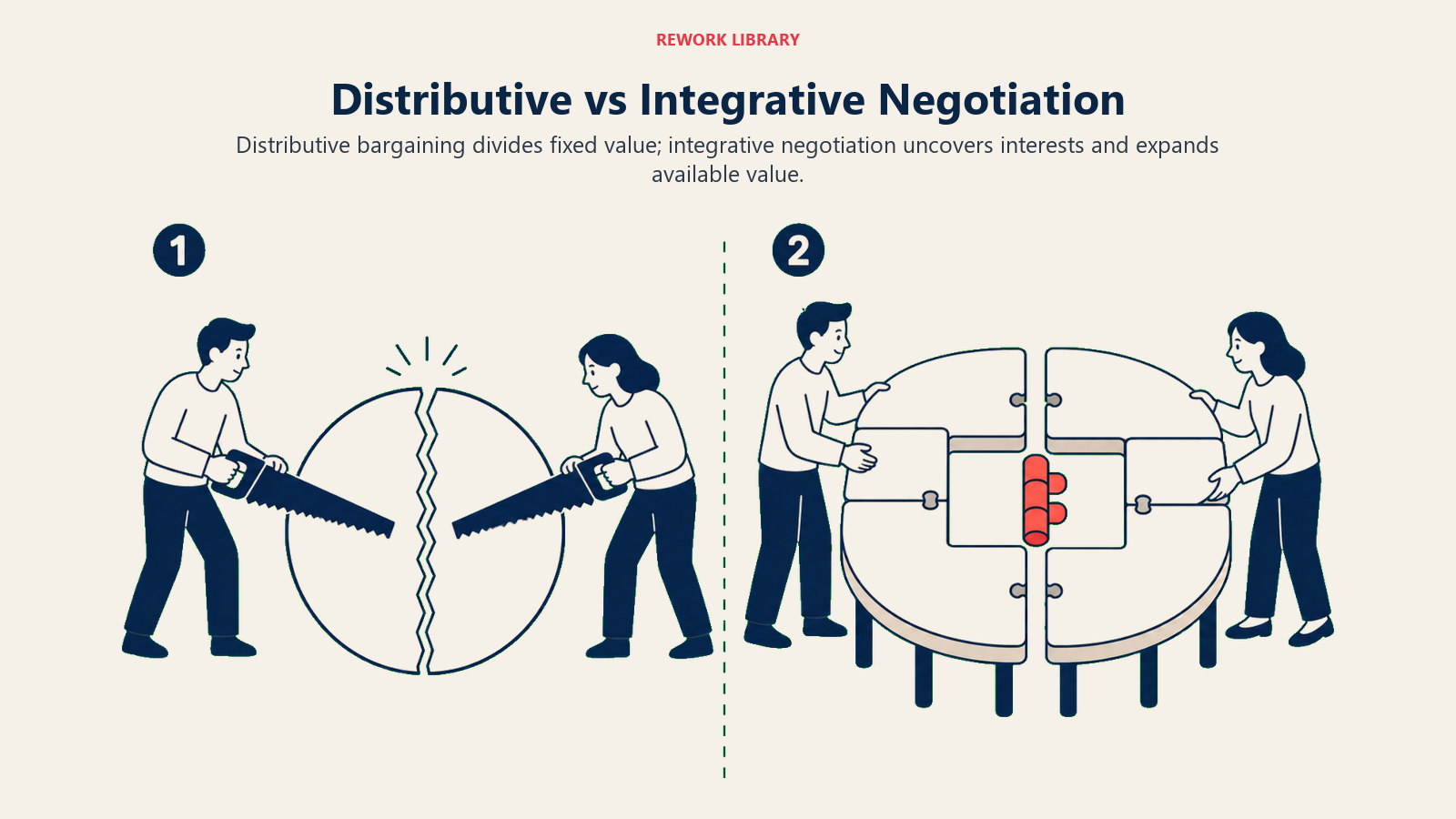
Understanding which type of negotiation you are in shapes every tactic you choose.
| Type | Goal | Best for | Example |
|---|---|---|---|
| Distributive | Claim the largest share of a fixed resource | One-time transactions, price-only deals | Buying a used car |
| Integrative | Expand total value, then divide it | Ongoing relationships, multi-issue deals | Salary + benefits + remote days |
Three terms every negotiator needs to know:
BATNA (Best Alternative To a Negotiated Agreement) is what you will do if talks fail. Your BATNA sets your floor. A strong BATNA (another job offer, another supplier) gives you genuine leverage. A weak BATNA (no alternatives) pressures you to accept almost anything. Before any negotiation, define your BATNA clearly so you know exactly when to walk away.
ZOPA (Zone Of Possible Agreement) is the range between the lowest price a seller will accept and the highest a buyer will pay. Any deal that lands inside the ZOPA works for both parties. Deals outside it collapse. Understanding the ZOPA helps you move toward an agreement instead of arguing past it.
Reservation point is the specific limit beyond which a deal is worse than your BATNA. It is your true walk-away number, kept private. Many people confuse their reservation point with their opening ask, which weakens their position from the start.
Core negotiation skills
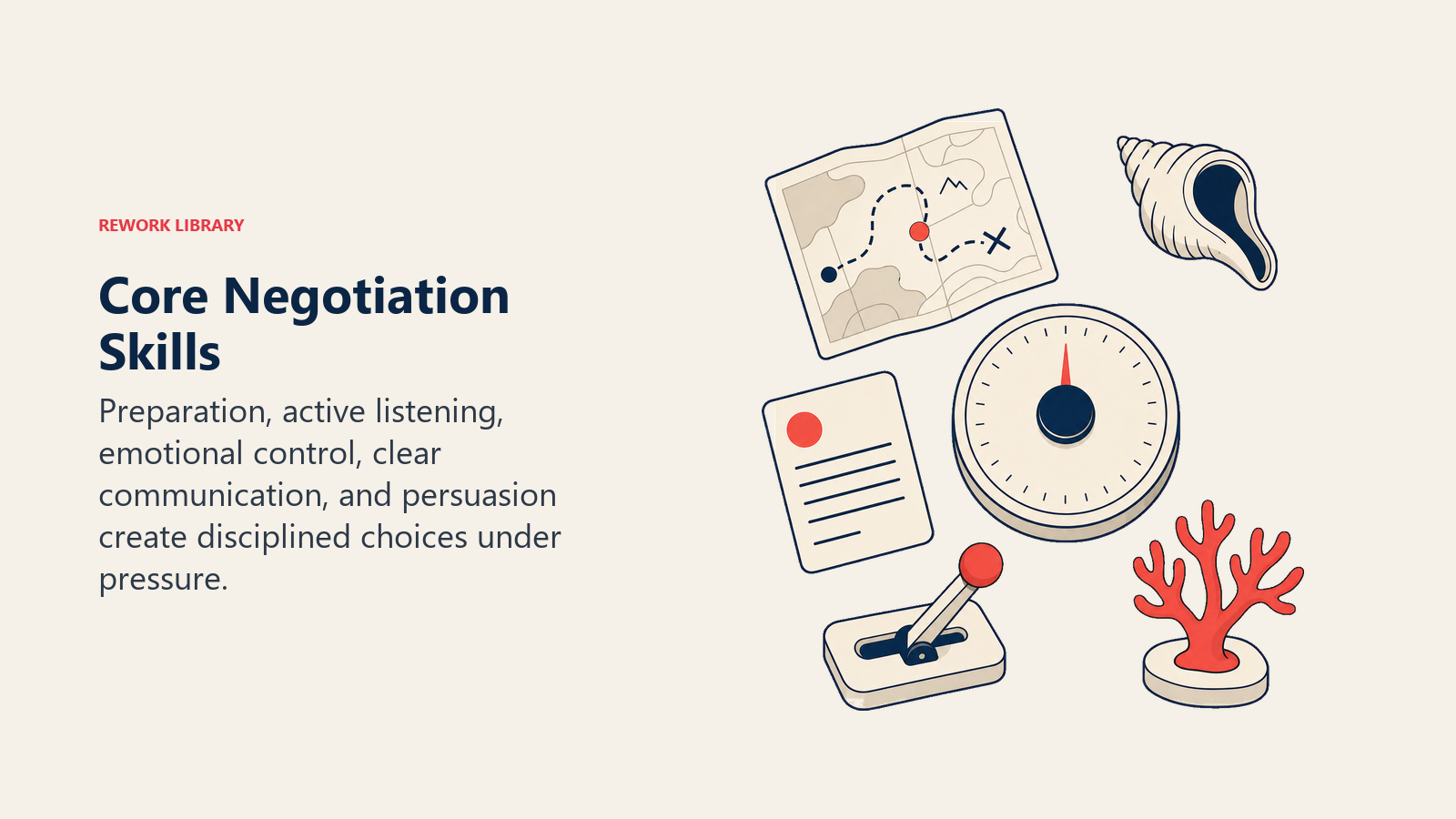
Strong negotiation depends on preparation before the conversation and disciplined communication once offers, tradeoffs, and pressure enter the room.
| Skill | Why it matters |
|---|---|
| Preparation | Knowing your BATNA, ZOPA, and the other party's likely interests before you sit down |
| Active listening | Picking up on what the other party values most, including what they don't say directly |
| Emotional intelligence | Staying composed when offers feel insulting, reading the room's temperature |
| Communication | Framing proposals clearly, asking questions that open options rather than close them |
| Problem-solving | Repackaging a deal when the first structure hits a wall |
| Patience | Tolerating silence, resisting the urge to fill pauses with concessions |
| Persuasion | Building a case around the other party's interests, not just your own |
| Relationship building | Keeping the long-term relationship intact even in competitive negotiations |
Strong negotiators rarely win through pressure alone. They win because they understand what the other side actually needs and find a path that satisfies enough of it to close a deal.
Proven negotiation strategies and techniques
Anchoring, framing, conditional concessions, silence, and calibrated questions shape value without self-negotiation.
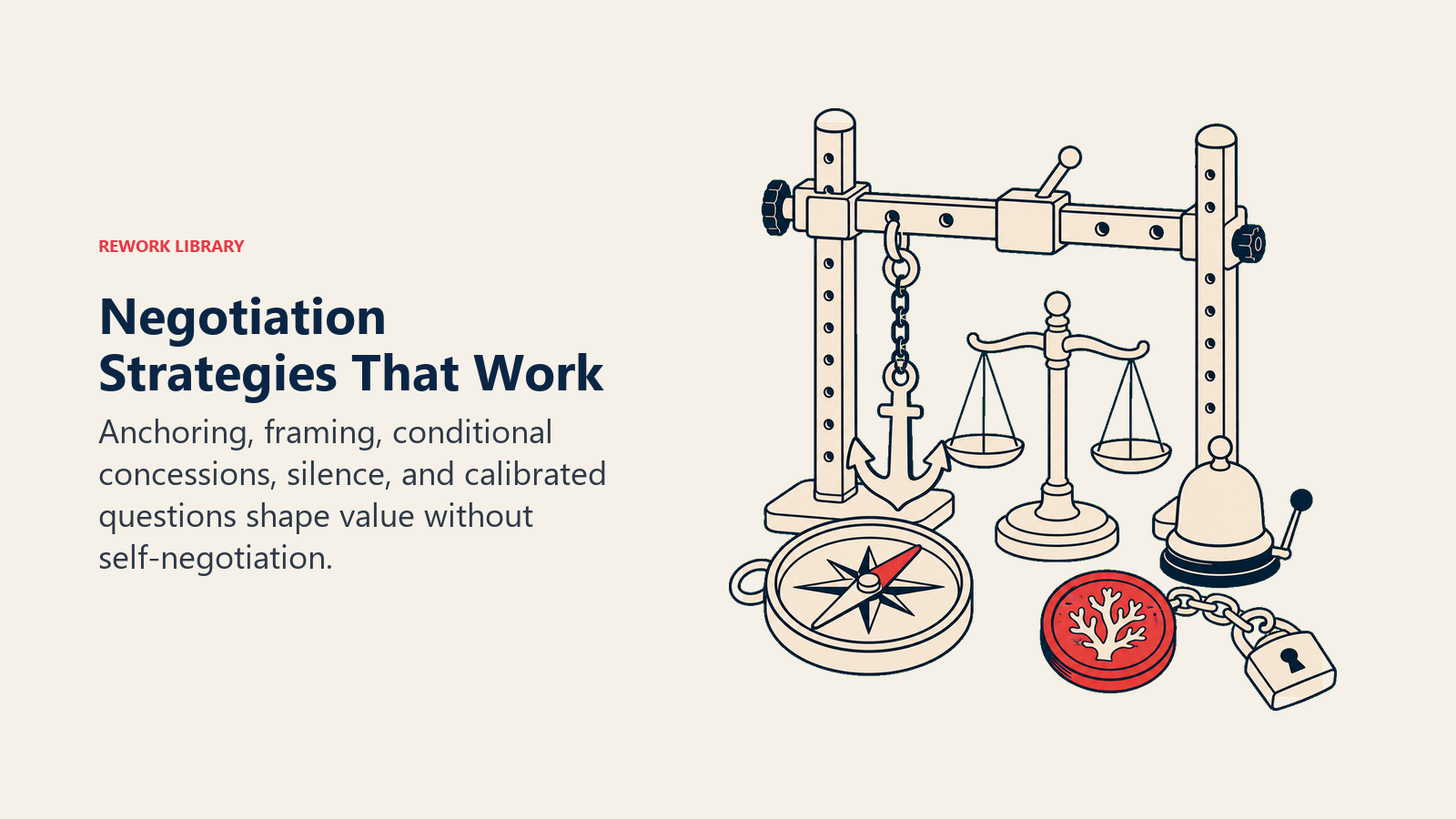
Anchoring. The first number stated in a negotiation pulls the final outcome toward it. Research from Columbia Business School shows that salary negotiations anchored by a high opening offer consistently produce higher final salaries, even when both parties know it is an anchor. Make the first offer when you have done your research. Don't when you haven't.
Framing. How you present a proposal changes how it lands. "This saves your team ten hours a week" frames the same feature differently than "this costs $400 a month." Frame your proposals around the gain the other party receives, not the cost you're asking them to absorb.
Trading concessions. Never give something away for nothing. Every concession should purchase a concession. "If I can move on timeline, can you move on price?" Unconditional concessions signal that you have more room to give, which invites further pressure.
Finding shared interests. Positions are what people say they want. Interests are why they want it. A vendor who insists on net-30 payment terms might really need cash flow predictability, not specifically those terms. Exploring interests often reveals creative solutions: extended payment plans, volume commitments, retainers that serve both parties better than the stated positions.
Strategic silence. After making an offer, stop talking. Many negotiators undercut their own proposals by immediately qualifying them. Silence puts the pressure on the other party to respond, and it often leads to better counteroffers than anything you could say next.
The "if-then" structure. Conditional proposals keep you from making permanent concessions. "If you can commit to a two-year contract, then I can offer a 12% discount" ties your move to a reciprocal move, preserving value on both sides.
Common negotiation mistakes
Going in without a BATNA. When you have no alternative, you have no leverage. Find one before any significant negotiation starts, even a weak one.
Revealing your reservation point. Sharing your walk-away limit removes the incentive for the other party to offer anything better. Keep it private.
Negotiating against yourself. Offering multiple concessions before the other side responds suggests you don't believe in your own opening position. State your offer, then wait.
Treating every negotiation as distributive. Assuming the pie is fixed leads to missed opportunities. Ask what else matters to the other party and look for ways to add items that cost you little but mean a lot to them.
Letting emotions drive the conversation. An insulting low offer isn't a personal attack. Reacting emotionally makes it harder to think clearly about your next move. Conflict resolution skills help here: name the tension without escalating it.
Skipping the confirmation step. Verbal agreements evaporate. Always close with a written summary of what was agreed, who does what, and by when.
How to improve your negotiation skills
Prepare your BATNA, set target and walk-away points, listen for interests, trade conditionally, and review each negotiation.
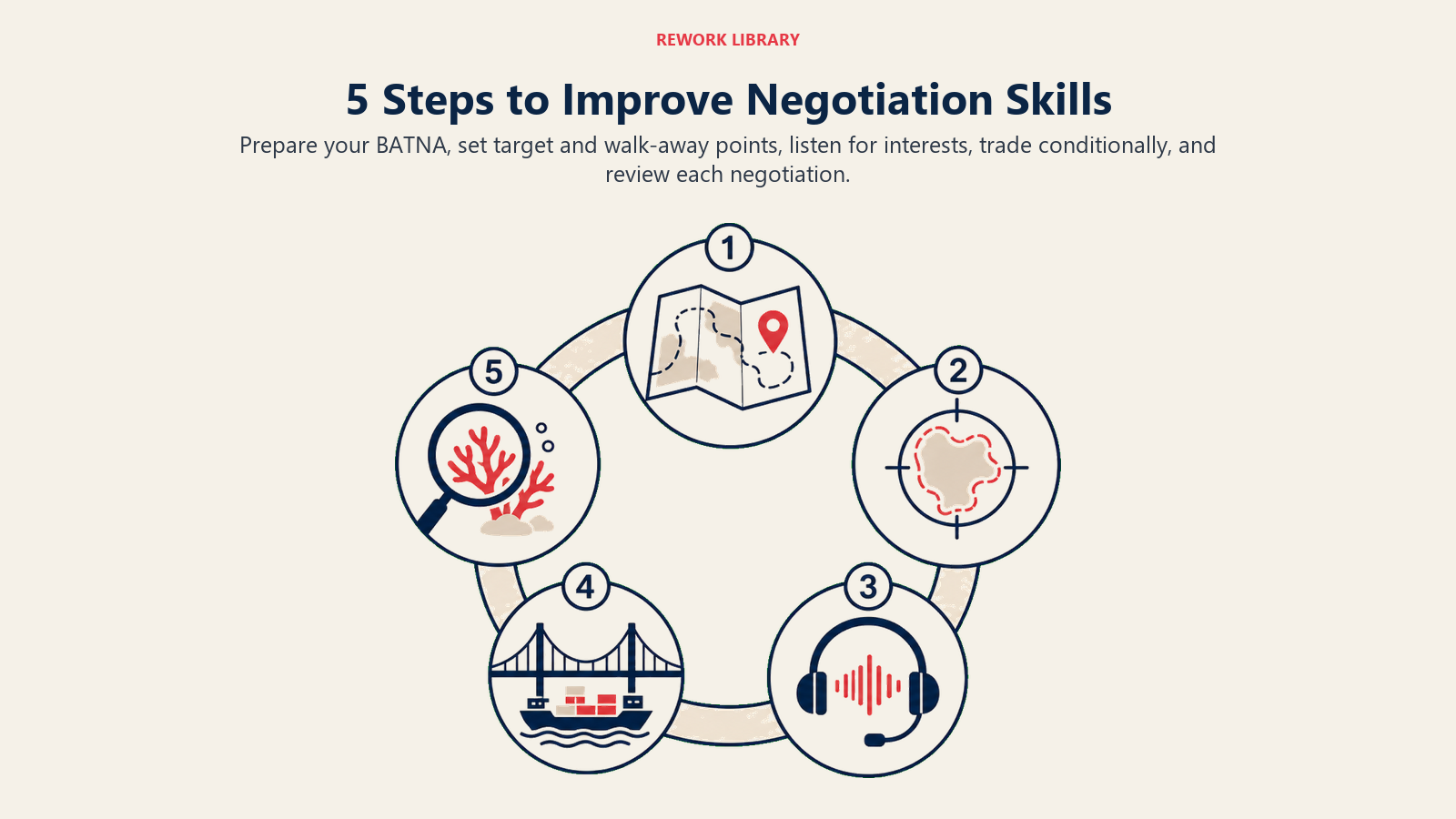
Step 1: Prepare and know your BATNA
List every alternative you have if this deal falls through. Research the other party's needs, constraints, and typical patterns. The more you know going in, the less you improvise under pressure. Use your decision-making framework to set clear priorities before the conversation starts.
Step 2: Set your target and reservation point
Your target is the outcome you'd be genuinely pleased with. Your reservation point is the line you won't cross. Write both down. Negotiators who plan specific targets outperform those who plan only floors.
Step 3: Listen and ask questions
In the first portion of any negotiation, ask more than you tell. "What matters most to you in this arrangement?" and "What would make this work on your end?" surface the interests beneath the positions. Pair this with active listening: confirm what you heard before responding.
Step 4: Anchor, then trade
Make your opening proposal when you have the information to anchor well. State it with confidence, without immediately hedging. Then respond to counteroffers by trading concessions for concessions rather than offering unilateral moves.
Step 5: Close and confirm in writing
Signal the close clearly: "So if we can agree on X, we have a deal?" Once both parties confirm, send a written summary within 24 hours. This prevents re-negotiation and surfaces any misunderstandings before they become disputes.
Negotiation examples
Salary negotiation. You receive a job offer at $90,000. Your research shows the market range is $95,000 to $110,000. Your BATNA is your current role at $88,000. You anchor at $108,000, citing your specific skills and a competing offer. The employer counters at $96,000. You trade: "If you can get to $100,000, I'll sign today and skip the competing process." You close at $100,000, a $10,000 gain from not accepting the first offer.
Vendor contract. Your team needs software that costs $48,000 annually. Your budget is $40,000. Rather than just asking for a discount, you explore interests: the vendor wants a case study and a two-year commitment. You offer both in exchange for a $40,000 rate. Both sides gain something they actually value.
Internal resource negotiation. You need two engineers from another team for six weeks. The other manager's interest is protecting her team's existing commitments. You propose sharing one engineer full-time and one part-time, plus offering to staff a QA task from your team in return. The deal works because you focused on her constraint, not just your need. Influencing skills and relationship building matter as much as formal technique in these internal conversations.
Frequently Asked Questions about Negotiation Skills
What is BATNA and why does it matter?
BATNA stands for Best Alternative To a Negotiated Agreement. It is what you will do if the current negotiation fails. Your BATNA sets your true walk-away point. A strong BATNA gives you real leverage; a weak one forces you toward accepting poor terms. Define it before every negotiation, not during.
Can negotiation skills be learned, or are some people just natural negotiators?
They can absolutely be learned. Research on negotiation training consistently shows that even a few hours of structured practice improves outcomes. Natural confidence helps at the start, but preparation and technique outperform personality in the long run.
What is the difference between negotiation and manipulation?
Negotiation is transparent influence: you present real interests and real trade-offs to reach a mutual agreement. Manipulation involves hiding information, creating false urgency, or exploiting the other party's vulnerabilities. The distinction matters practically: manipulation destroys trust and often unravels deals after the fact.
How do you negotiate when you have low leverage?
Focus on integrative tactics. Find what the other party values that you can offer: flexibility, speed, a long-term commitment, a referral, a case study. Lower leverage in one dimension (price, for example) often coexists with higher value in another. And always work to improve your BATNA before the negotiation begins.
Is it ever better not to make the first offer?
Yes. If you lack information about the other party's range, let them anchor first. Their opening offer reveals information about their expectations that you can use to respond well. But once you have solid market data, anchoring first is usually advantageous. Negotiation is not a talent reserved for salespeople and executives. It is a daily professional skill that compounds over a career. Every raise you negotiated, every contract you improved, every internal deadline you adjusted with a fair trade adds up. Start with preparation, anchor with confidence, listen for interests, and confirm in writing. The mechanics are straightforward. The discipline to apply them consistently is what separates good negotiators from great ones.
Related reading
- Communication - The foundation of every negotiation conversation
- Active Listening - Hear what the other party actually needs
- Conflict Resolution - Manage the tension that often surfaces mid-negotiation
- Influencing Skills - Build the case for your position without pressure tactics
- Emotional Intelligence - Stay composed when stakes are high
- Relationship Building - Protect the long-term relationship through the deal
- Decision Making - Set clear priorities before you sit down to negotiate
- Attention to Detail - Catch what's in the fine print before you sign

Senior Operations & Growth Strategist
On this page
- What are negotiation skills?
- Distributive vs integrative negotiation
- Core negotiation skills
- Proven negotiation strategies and techniques
- Common negotiation mistakes
- How to improve your negotiation skills
- Step 1: Prepare and know your BATNA
- Step 2: Set your target and reservation point
- Step 3: Listen and ask questions
- Step 4: Anchor, then trade
- Step 5: Close and confirm in writing
- Negotiation examples
- Related reading