Performance Review Framework: A Practical Guide for Managers
Turn this article into takeaways for your work.


Each assistant summarizes the article only for you and suggests best practices for your work.
The most common complaint about performance reviews isn't that they happen. It's that they don't do anything.
Managers fill out forms. Employees receive scores. Documents get filed. And then everyone goes back to work in exactly the same way as before, because the conversation didn't surface anything useful, didn't lead to any real commitments, and didn't change anyone's behavior.
This is a framework problem, not a people problem. Managers who run bad performance reviews aren't lazy or uncaring, they're often working within a structure that almost guarantees the review will be superficial.
A good performance review framework does three things: it assesses where someone actually is (not where their manager thinks they should be), it identifies what development looks like in the next period, and it creates accountability for both the manager and the employee to act on what the conversation surfaced.
The Four Elements of a Functional Framework
Any performance review framework, regardless of frequency or format, needs to cover four elements.
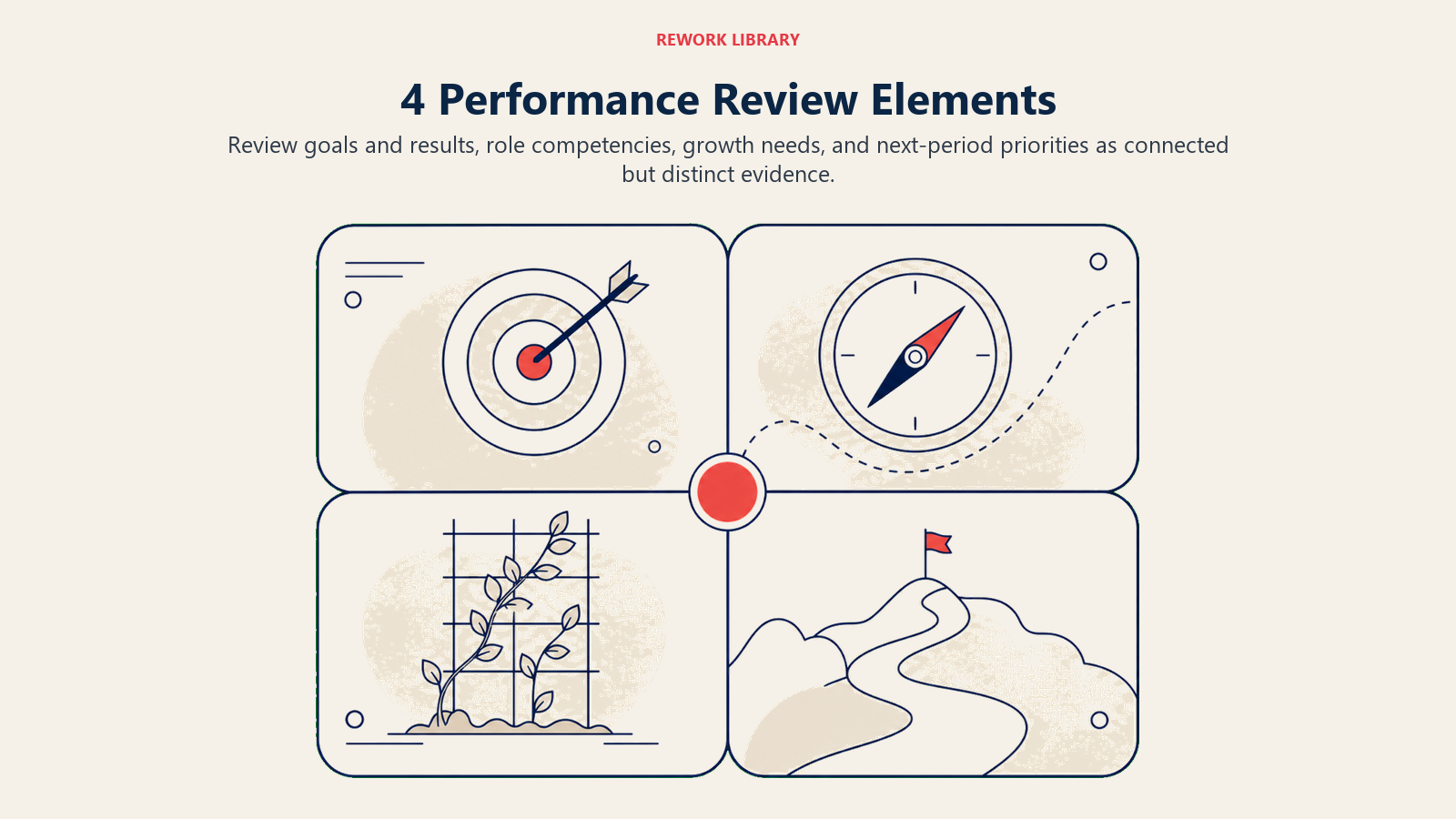
1. Performance Against Defined Goals
This is the most objective part of the review and should be anchored in goals that were set at the beginning of the review period. If goals weren't set clearly at the start, this section will be almost entirely subjective, which is where bias creeps in.
The goals being reviewed should be specific, have a clear success criteria, and have been communicated clearly enough that the employee knew what they were working toward. If that didn't happen, acknowledge it in the review and use the conversation to set better goals for the next period.
For each goal, the assessment should answer: was it achieved, partially achieved, or not achieved, and why? The "why" matters. A goal that wasn't achieved because the business changed direction tells a different story than one that wasn't achieved because the employee didn't prioritize it.
2. Competency Assessment
Beyond what someone achieved, you need to assess how they achieved it. Two employees can hit the same quota while operating very differently: one builds strong customer relationships that generate referrals and reduce churn; the other closes deals through pressure tactics that create short-term revenue but long-term attrition.
Competency assessment looks at behaviors and skills rather than outcomes alone. For most roles, the relevant competencies cluster into a few categories: the technical skills the role requires, how the person communicates and collaborates, how they handle complexity and setbacks, and whether they're developing over time.
The employee-competency framework your organization uses (or should use) defines these competencies and what proficiency looks like at each level. Reviews that lack this dimension tend to reward whoever has the most visible wins, regardless of how they achieved them or whether those wins are sustainable.
3. Development Trajectory
A performance review that only looks backward misses half its value. The forward-looking section should answer: where is this person going, and what does the manager commit to supporting?
Development trajectory has two components. The first is the employee's own career direction, what they want to grow toward, what skills they're building, what role or scope they'd like to take on. The second is the manager's honest read on what gaps exist between where the employee is now and where they want to go.
These two components need to be discussed, not delivered. A manager who hands an employee a development plan they wrote without input isn't doing a performance review, they're issuing a directive. The conversation should surface the employee's perspective first, then layer in the manager's observations.
4. Calibrated Rating
If your organization uses performance ratings, they should come after the conversation, not before it. Many managers commit to a rating before the review, which turns the conversation into a defense of the rating rather than a genuine assessment.
Ratings also need to be calibrated across managers. A "meets expectations" from one manager who rates conservatively is functionally different from a "meets expectations" from another manager who rates generously. Without calibration sessions, ratings lose meaning and employees in different parts of the organization are evaluated against different implicit standards.
Frequency and Format
The annual review is widely recognized as insufficient, but many organizations still rely on it as the primary feedback mechanism. The problem isn't the annual review itself, it's treating it as the only review.
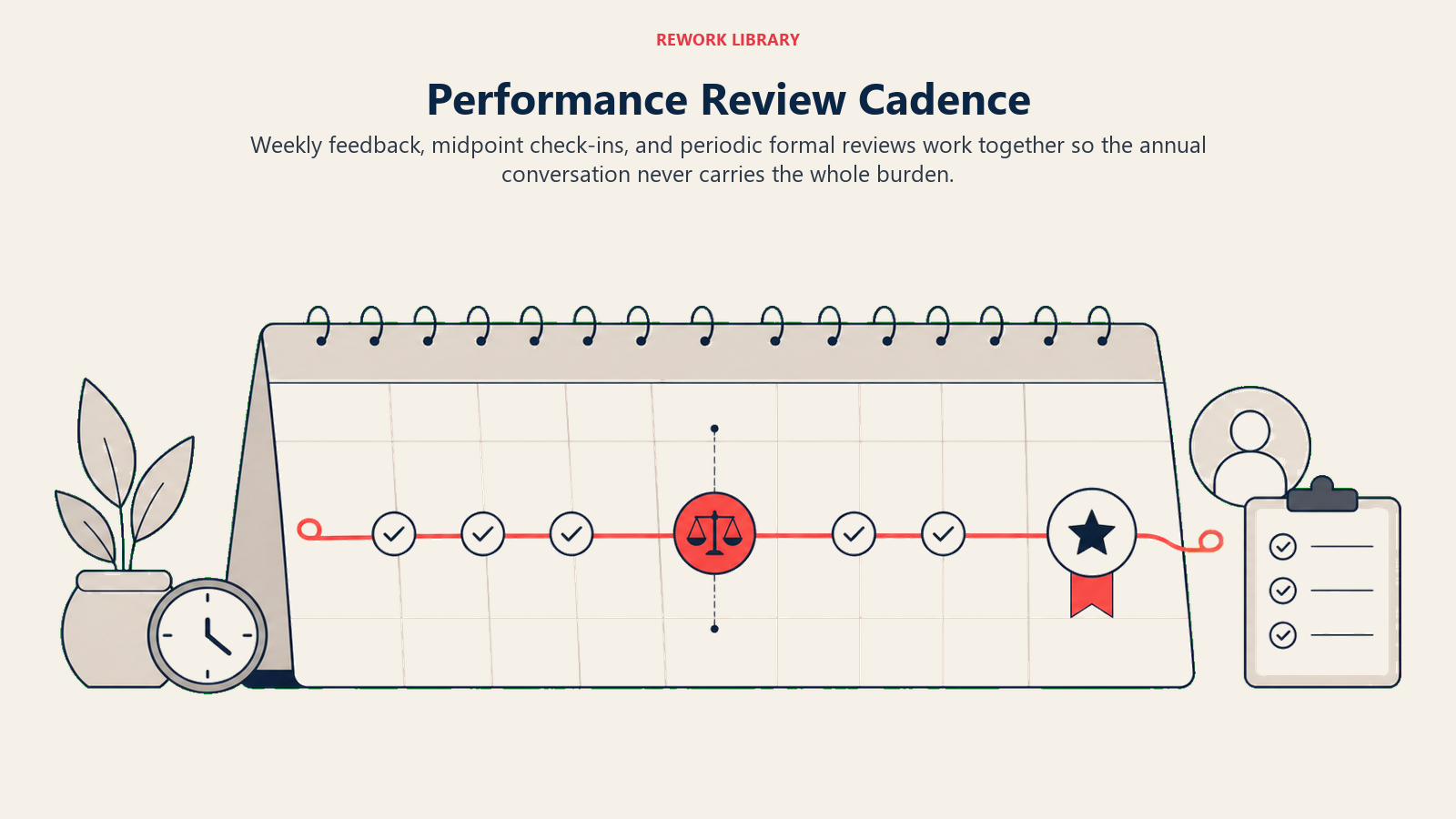
A functional cadence looks something like this:
Weekly or biweekly 1:1s: Ongoing feedback, progress check-ins, blockers. Not formally documented but formative for the annual review. This is where most real development happens.
Midpoint check-in (quarterly or at 6 months): A structured but lightweight assessment against the goals set at the start of the year. No forms, but a real conversation about whether goals are still the right goals, how performance is tracking, and whether any development support is needed.
Annual or semi-annual formal review: Full assessment against goals and competencies, documented rating if applicable, and development plan for the next period.
The formal review should never deliver surprises. If a manager has been giving consistent, honest feedback in 1:1s throughout the year, the formal review is a summary of ongoing conversations, not a revelation.
Designing the Review Conversation
The review conversation itself is where the framework succeeds or fails. A well-designed conversation structure:
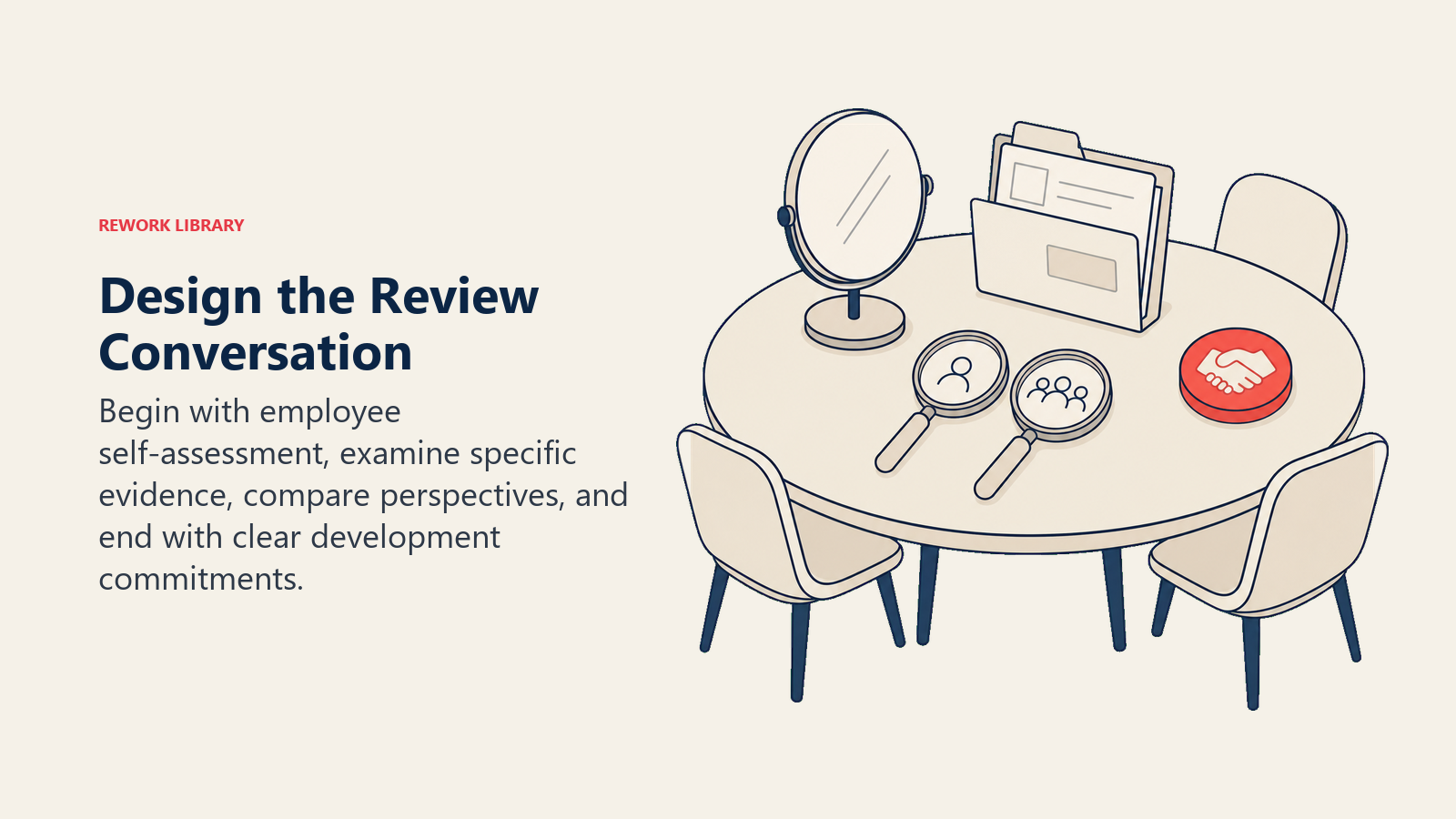
Opens with employee self-assessment. Ask the employee to evaluate their own performance first. This does two things: it gives you insight into how they see themselves (alignment or misalignment with your view is diagnostic), and it makes the conversation collaborative rather than evaluative. If you lead with your assessment, you've ended the conversation before it starts.
Explores specific examples. General statements ("you're a strong communicator") don't develop anyone. Specific examples do. "The way you handled the Q3 account conflict, bringing in the customer success team before it escalated, is the kind of communication that builds long-term trust." Name the behavior, explain why it mattered.
Addresses development directly, not diplomatically. Many managers soften developmental feedback to the point where the employee doesn't understand there's a gap. "I think there might be some room to grow in stakeholder management" is easy to dismiss. "Stakeholder management is the biggest thing standing between you and a promotion" is harder to dismiss, but more useful.
Ends with mutual commitments. What will the employee do differently or pursue in the next period? What will the manager do, introductions, stretch assignments, learning resources, clearer feedback? Both sides should leave with specific commitments, not vague intentions.
Rating Scales: What Works
The most common rating scales are 3-point ("below/meets/exceeds expectations"), 4-point, and 5-point. Each has tradeoffs.
3-point scales are simple and force a cleaner distribution, but "meets expectations" becomes a catch-all that mixes a wide range of performance levels.
5-point scales allow more differentiation but create calibration problems. In practice, many organizations find that managers cluster ratings in the middle (3 out of 5), which reduces the scale's value.
A common alternative is to eliminate numerical ratings altogether and use narrative assessments with a simpler "ready for more / performing well at level / needs significant development" categorization. This reduces the gaming that often happens when employees know ratings affect compensation.
Whatever scale you use, the rating criteria should be documented and shared with employees before the review period, not revealed during the review. Employees should know what "exceeds expectations" looks like before they're evaluated against it.
Common Framework Failures
Recency bias: Managers assess the last 4-6 weeks rather than the full review period. The fix is keeping running notes on each direct report throughout the year, not just before review season.
Halo and horn effects: One strong (or weak) attribute colors the entire assessment. A salesperson who hit their number gets high marks on competencies regardless of how they actually performed on those dimensions.
Promotion inflation: Managers rate everyone highly to avoid difficult conversations, which devalues ratings, obscures real development needs, and creates surprises when employees who expected promotions don't receive them.
No follow-through: Commitments made in the review conversation are never revisited. The fix is building a simple tracking mechanism into your 1:1 cadence, even just reviewing the development plan every 6-8 weeks.
Manager-only process: The employee is a passive recipient rather than an active participant. The fix is building self-assessment and goal co-creation into the process.
Connecting Reviews to the Broader Competency Framework
Performance reviews are more useful when connected to a clear competency framework that defines what good performance looks like at each role level. Without this, assessments are entirely subjective and calibration across managers is nearly impossible.
Your competency framework should define the behaviors expected at each proficiency level for each relevant competency. A "results orientation" competency, for example, might look very different at an individual contributor level (consistent delivery of assigned work) than at a senior manager level (setting goals that stretch the team and creating accountability systems that catch drift early).
Reviews that reference the competency framework give employees a clear map of where they are and what development toward the next level looks like. Reviews that don't have this anchor tend to be vague about development, "be more strategic" is not actionable guidance.
Related Resources
- Goal Setting Competency - Structuring goals that anchor the performance review cycle
- Giving Feedback Effectively - The feedback skills that make review conversations productive
- Coaching Skills for Managers - Moving from evaluation to development in review conversations
- Results Orientation Competency - What outcome-focused performance looks like at each level
- Strategic Thinking Competency - Assessing forward-looking competency in senior roles
- Mentoring Skills for Team Leaders - How strong mentors use performance conversations as development tools
- Decision Making Competency - Assessing judgment quality across review periods

Senior Operations & Growth Strategist
On this page
- The Four Elements of a Functional Framework
- 1. Performance Against Defined Goals
- 2. Competency Assessment
- 3. Development Trajectory
- 4. Calibrated Rating
- Frequency and Format
- Designing the Review Conversation
- Rating Scales: What Works
- Common Framework Failures
- Connecting Reviews to the Broader Competency Framework
- Related Resources