Persuasion Skills: Techniques That Work
Turn this article into takeaways for your work.


Each assistant summarizes the article only for you and suggests best practices for your work.
Persuasion skills are what separate the professionals who get things done from those who have great ideas that never leave the whiteboard. Whether you're pitching a budget increase, building buy-in for a strategic shift, or convincing a client to try something new, the ability to move people from "no" or "maybe" to "yes" is one of the most valuable things you can develop.
What Are Persuasion Skills?
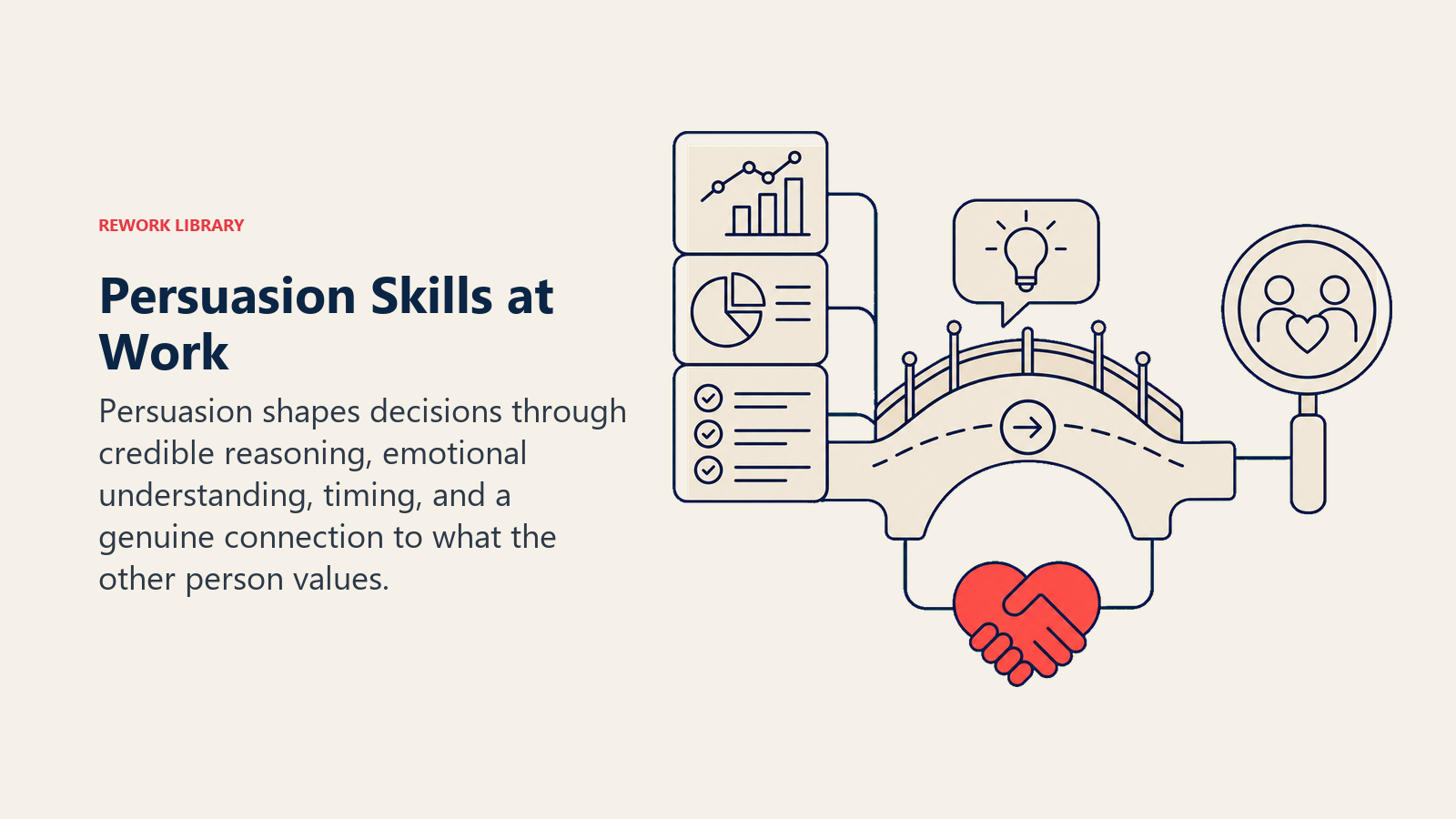
Persuasion skills are the ability to shape someone's beliefs, decisions, or actions through reasoned communication, emotional connection, and an understanding of what actually drives the other person. They're distinct from authority: you don't need a title to persuade, and a title alone won't do it for you.
Effective persuasion draws on communication, emotional intelligence, and active listening. It's a craft that combines logic, timing, and genuine empathy for the other person's position.
Key Facts
- In Cialdini's foundational persuasion research, people who used the "because" structure (giving a reason, even a simple one) for a request were granted compliance 94% of the time, versus 60% without it (Langer, Blank & Chanowitz, 1978).
- Sales professionals who led conversations by exploring a prospect's stated needs before presenting a solution closed at a significantly higher rate than those who pitched first (Neil Rackham, SPIN Selling research, 1988).
- 93% of executives said that interpersonal skills, which include the ability to persuade, influenced whether someone was promoted into leadership (Stanford Research Institute and Carnegie Mellon Foundation meta-study).
Why Persuasion Skills Matter at Work
You can't do much of significance alone. Getting budget, gaining buy-in, winning clients, rallying a team around a hard decision, even getting a deadline extended all require moving other people. And most of the people you need to move don't report to you.
In leadership, persuasion replaces the instinct to dictate. Leaders who rely only on authority get compliance when someone is watching and quiet resistance when they're not. Leaders who persuade get genuine commitment.
In sales, it's the entire game. Customers don't buy from people who overwhelm them with features. They buy from people who understand their problem and make the solution feel obvious.
In cross-functional work, you rarely have the authority to demand cooperation. You have to make colleagues want to help. That's persuasion.
In career growth, your ideas are only as powerful as your ability to communicate why they matter. Strong presentation skills and persuasive communication together are what get proposals approved and keep you visible to decision-makers.
Cialdini's 6 Principles of Persuasion
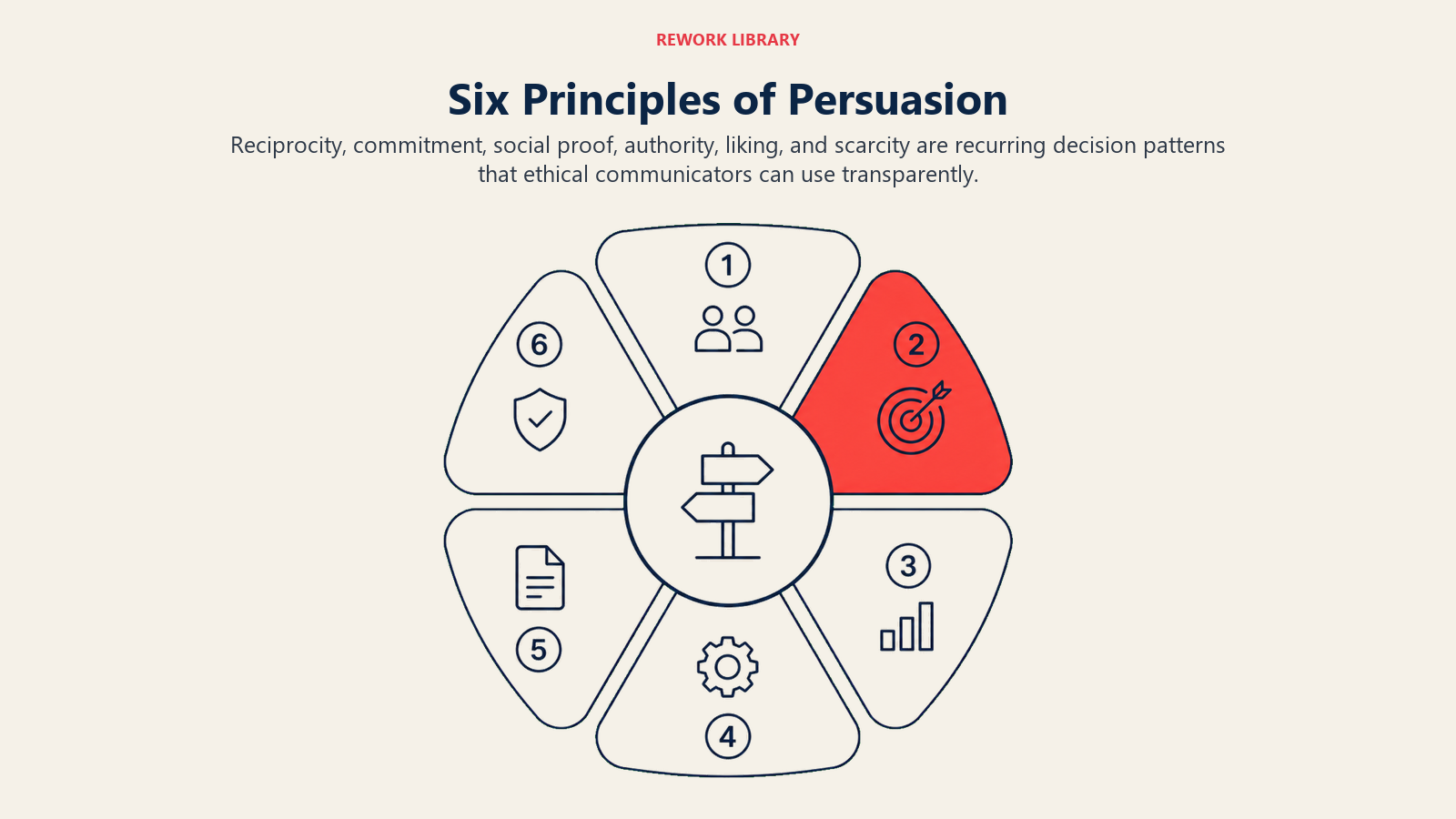
Robert Cialdini's research, published in his book "Influence: The Psychology of Persuasion" (1984), identified six psychological drivers that consistently move people toward agreement. These aren't tricks. They're patterns in how human beings actually make decisions.
| Principle | What It Means | Workplace Example |
|---|---|---|
| Reciprocity | People feel compelled to return favors. If you give first, they want to give back. | Share a useful report or intro before asking for support on your project. |
| Commitment and Consistency | Once someone agrees to something small, they're more likely to follow through with larger related asks. | Get a verbal "yes, that's a real problem" before pitching your solution. |
| Social Proof | People look to what others are doing, especially when uncertain. | "Three other regional teams have already piloted this" is more persuasive than any feature list. |
| Authority | People defer to credible expertise. Credentials, track record, and specific knowledge all signal authority. | Cite your direct experience or bring in a recognized expert to co-present. |
| Liking | People say yes to people they like. Common ground, genuine interest in the other person, and warmth all matter. | Build rapport before the ask. Find something real to connect on. |
| Scarcity | People value what's rare or time-limited more than what's freely available. | "We can only take on one more client this quarter" focuses attention and speeds decisions. |
The most skilled persuaders don't lean on just one principle. They read the situation and the person, then decide which combination fits. A data-driven analyst might need authority and social proof. A relationship-first executive might respond better to liking and reciprocity first.
Persuasion vs. Manipulation
The line between persuasion and manipulation is intent and honesty.
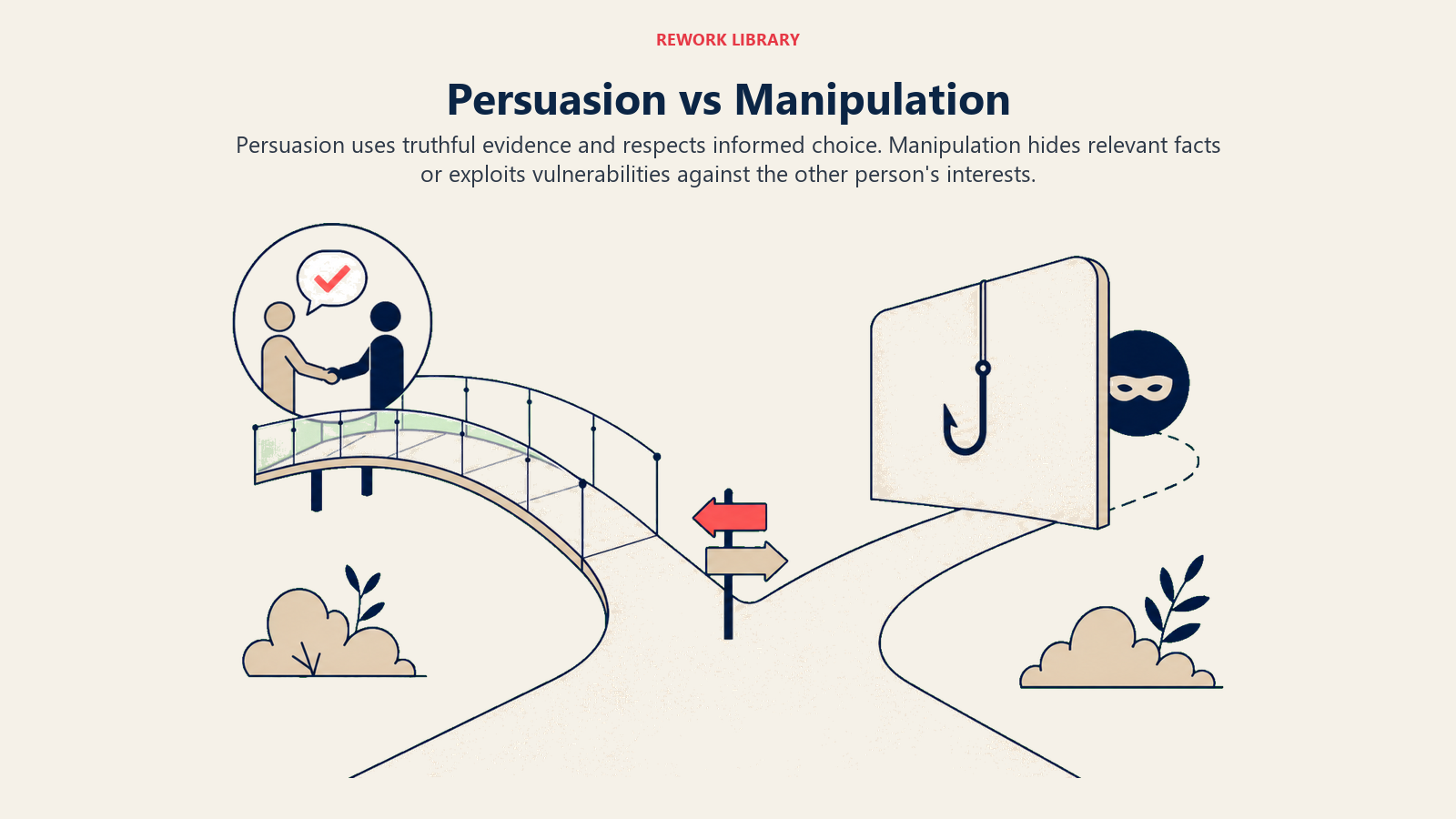
Persuasion works with what's true. You present real benefits, real evidence, and real reasons. You adjust your framing and timing, but you don't misrepresent facts or exploit someone's blind spots against their own interests.
Manipulation works against the other person. It involves creating false urgency, withholding information that would change their decision, or exploiting psychological vulnerabilities to push them somewhere they wouldn't go if they could see clearly.
The practical test: if the other party found out everything you did to persuade them, would they feel fairly treated or deceived? Ethical persuasion passes that test. Manipulation doesn't.
This distinction matters practically, not just morally. People who feel manipulated don't stay persuaded. They reverse decisions, damage relationships, and warn others. Sustainable influence comes from relationship building built on trust.
How to Improve Your Persuasion Skills
1. Start with their interests, not yours. Before any persuasion attempt, ask yourself what the other person actually cares about. What problem keeps them up at night? What does success look like for them? Shape your case around their interests, and connect your ask to outcomes they want. If you can't do that, reconsider whether this is the right ask, the right person, or the right time.
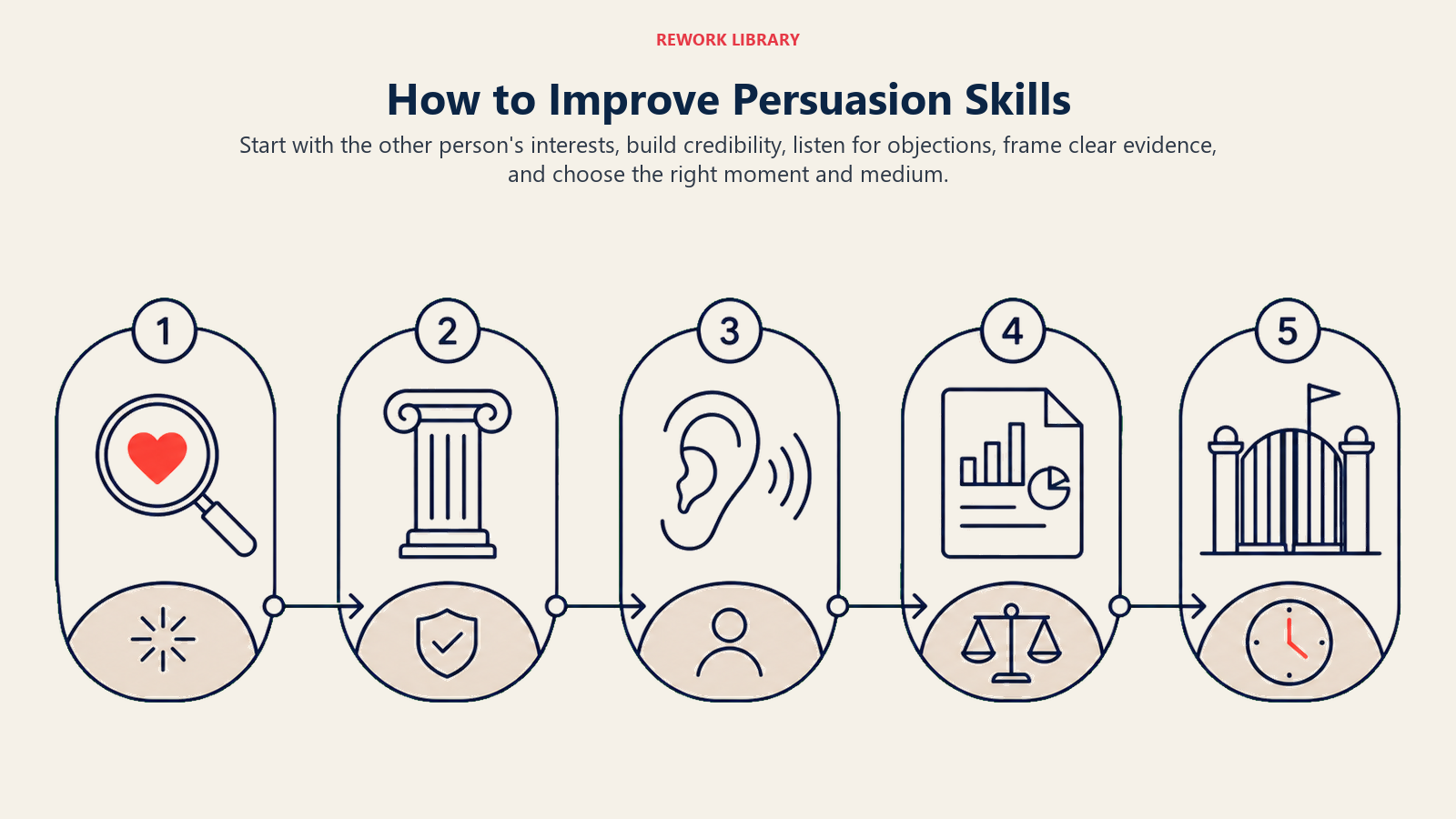
2. Build credibility before you need it. Persuasion is much harder when someone doesn't know you or doesn't trust you yet. Invest in relationship building and in demonstrating expertise before the moments when you need buy-in. People who have seen you deliver are far easier to persuade than strangers.
3. Listen more than you talk. The fastest way to kill a persuasion attempt is to present your case without understanding the other person's objections. Active listening surfaces what actually matters to them so you can address it directly rather than talking past it.
4. Use concrete evidence and specific examples. Vague claims are easy to dismiss. "This will improve efficiency" means nothing. "This cut processing time from three days to four hours at our Manchester office" means something. Be specific. Real examples and real numbers carry more weight than any amount of confident-sounding language.
5. Adapt your style to the person. Some people want data first. Others want to understand the narrative before they look at numbers. Some need time to think before committing; pushing them for an immediate decision triggers resistance. Match your approach to how they process, not to what's most comfortable for you.
6. Practice in low-stakes situations. Persuasion is a skill you improve through repetition. Practice it in small moments: proposing a different approach in a team meeting, suggesting a change in process to your manager, explaining a technical idea to a non-technical colleague. Each small attempt builds the muscle.
7. Debrief after every significant persuasion attempt. Whether you succeeded or not, ask yourself what worked, what resistance came up that you didn't anticipate, and what you'd do differently. Emotional intelligence includes the ability to reflect honestly on how your communication landed.
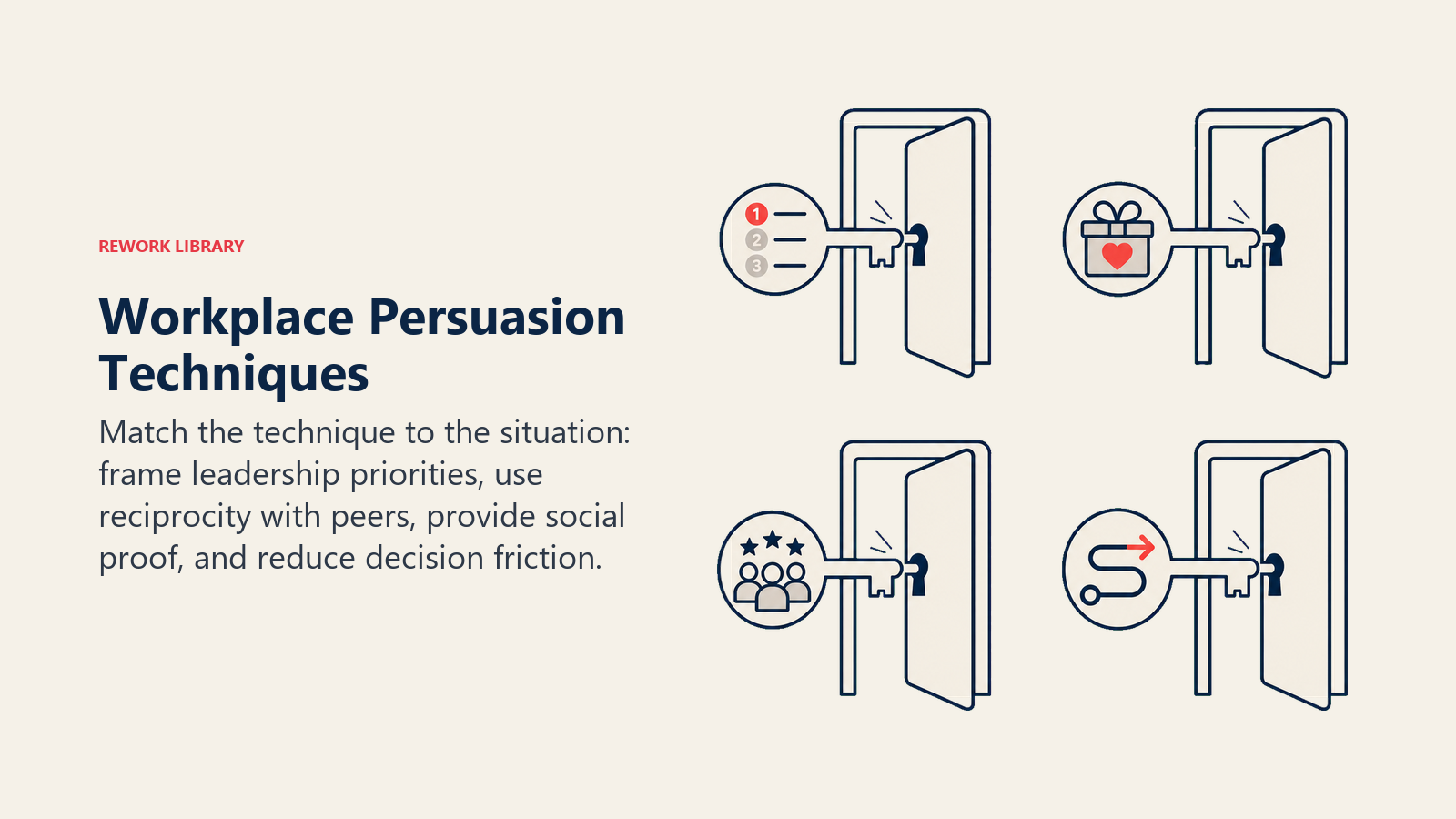
Persuasion Techniques at Work
| Situation | Technique | Why It Works |
|---|---|---|
| Pitching a new initiative to leadership | Frame it as solving their stated priority, not as your idea | Leaders approve what solves their problems, not what proves your creativity |
| Getting a reluctant colleague's support | Use reciprocity: offer something first | Creates a felt obligation to cooperate |
| Responding to "we tried that before" | Acknowledge it, then show what's different now | Validates their experience while removing the objection |
| Presenting to a skeptical audience | Lead with social proof, then authority | Reduces "why should I believe this" before you make your case |
| Closing a client who's hesitating | Name a specific and real constraint: "We can start you in June or we'd be looking at September" | Scarcity makes the decision feel concrete rather than open-ended |
| Building buy-in before a formal vote | Pre-persuade: have individual conversations first | People defend positions they've already stated publicly |
| Dealing with "it's too expensive" | Reframe cost as cost of not acting | Shifts the comparison from price to risk |
Common Mistakes
Talking too much. The urge to overwhelm someone with reasons is a sign of anxiety, not confidence. More reasons can actually weaken a case by diluting the strongest argument.
Ignoring the emotional dimension. People make decisions with both logic and feeling. A technically perfect case that doesn't acknowledge how someone feels about a situation will often fail anyway.
Pushing when the timing is wrong. A persuasion attempt during a crisis, when someone is distracted, or when they've just had a bad day is working against you. Read the moment.
Making it about you. "I need this approved" is weaker than "this solves the problem you raised in last month's review." The moment your ask is clearly framed around their interests, resistance drops.
Treating every objection as an obstacle. Objections are often genuine questions or concerns. Taking them seriously and responding thoughtfully is itself a persuasion tool. It signals that you've thought things through and respect the other person's perspective.
Skipping the ask. Some people build a compelling case and then don't make a specific request. Be clear about what you want. Vagueness makes it easy for people to stay neutral.
Best Practices
Keep your opening strong. The first 30 seconds shape whether someone is genuinely listening or just waiting for you to finish. Lead with the outcome that matters to them, not with background or context.
Match the medium to the message. Some persuasion works best in person, where you can read body language and adjust in real time. Complex proposals often need a written document first so the other person can think before you discuss. Know when to talk and when to write.
Use public speaking skills for group persuasion. One-on-one persuasion and group persuasion require slightly different approaches. In groups, pacing, presence, and handling objections in front of others all matter. Building your comfort with public speaking extends your persuasive reach significantly.
Follow up. A single conversation rarely closes a decision. Often the real work is done in the follow-up: the email that summarizes what was agreed, the quick check-in that keeps momentum, the additional piece of evidence that addresses the one concern left on the table.
Related Reading
- Influencing Skills - The broader capability persuasion sits within
- Communication - The foundation every persuasion attempt rests on
- Active Listening - Understand what actually matters to the other person before you speak
- Emotional Intelligence - Read the room and manage your own reactions under pressure
- Interpersonal Skills - Build the rapport that makes persuasion easier
- Presentation Skills - Deliver your case with clarity and confidence
- Relationship Building - The trust that makes persuasion sustainable
- Public Speaking - Extend your persuasive reach to groups and audiences