Organizational Skills: Definition, Examples, and How to Improve
Turn this article into takeaways for your work.


Each assistant summarizes the article only for you and suggests best practices for your work.
Organizational skills determine whether you're the person who always knows where things stand or the one who's constantly playing catch-up. They're not about being a neat freak or color-coding your calendar into submission. They're about having reliable systems that let you do your best work without burning mental energy on logistics.
What Are Organizational Skills?
Organizational skills are the abilities that let you plan, coordinate, and manage your time, tasks, workspace, and resources efficiently so you can meet commitments without chaos. They sit at the intersection of cognitive habits and practical behaviors, covering everything from how you structure your email inbox to how you sequence a project plan under a tight deadline.
The term is broader than most people realize. Physical organization (keeping a clean desk, filing documents logically) is only part of the picture. Digital organization (structured folders, searchable notes, sensible naming conventions) matters just as much in modern work. And mental organization (knowing your priorities without checking a list, tracking multiple threads simultaneously, shifting context without losing your place) is often the piece that determines who gets promoted.
Organizations don't run themselves. Every team depends on individuals who can reliably hold their piece of the system together, and those people are the ones with strong organizational skills.
Key Facts
- LinkedIn's Global Talent Trends data consistently ranks time management and organization among the top five most in-demand soft skills across industries, appearing in over 40% of job postings surveyed (LinkedIn Talent Insights, 2024).
- A report from the American Psychological Association found that employees who use deliberate planning and organization strategies report 26% lower stress levels and significantly higher job satisfaction than those who don't (APA Stress in America, 2023).
- SHRM research found that disorganization and poor task management cost companies an estimated 20-25% of productivity annually due to time lost to duplicated effort, missed deadlines, and unclear priorities (SHRM Workplace Productivity Report, 2022).
Types of Organizational Skills
Organizational skills span several distinct domains. Knowing which type you're weakest in tells you where to focus improvement effort.
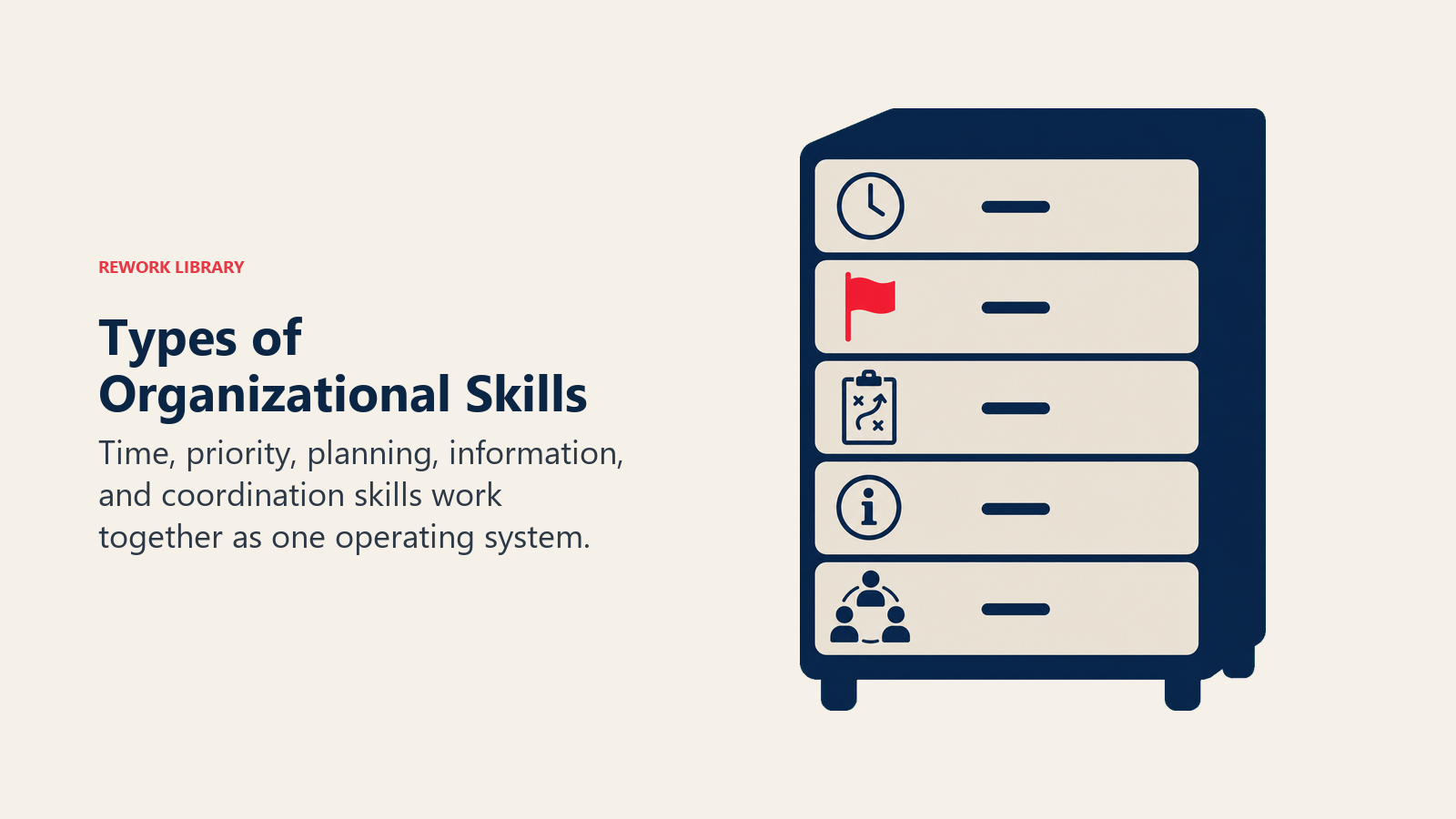
| Type | What it covers | Example behaviors |
|---|---|---|
| Physical and space organization | Managing your physical environment so you can find things fast and work without clutter | Clean desk policy, logical filing system, materials ready before meetings |
| Time management | Allocating hours and energy to the right work at the right time | Time-blocking, estimating task duration accurately, protecting focused work time |
| Planning and prioritization | Deciding what to do, in what order, and what to defer or drop | Weekly planning sessions, using priority frameworks like MoSCoW or Eisenhower matrix |
| Resource management | Tracking who has what, what's been spent, and what's left | Budget tracking, capacity planning, knowing where shared resources are |
| Digital and information organization | Keeping files, notes, emails, and data structured and findable | Consistent folder naming, single source of truth for documents, tagged notes |
| Mental and cognitive organization | Holding multiple priorities in your head, shifting context cleanly, remembering commitments | Using a trusted capture system, end-of-day shutdown routines, context notes between tasks |
Most people are strong in one or two areas and underdeveloped in others. A manager might be great at planning meetings but terrible at digital filing. An analyst might keep flawless data records but consistently underestimate how long tasks take.
Why Organizational Skills Matter at Work
Organizational skills don't show up on performance reviews as often as communication or leadership. But they're load-bearing. Here's why they matter.
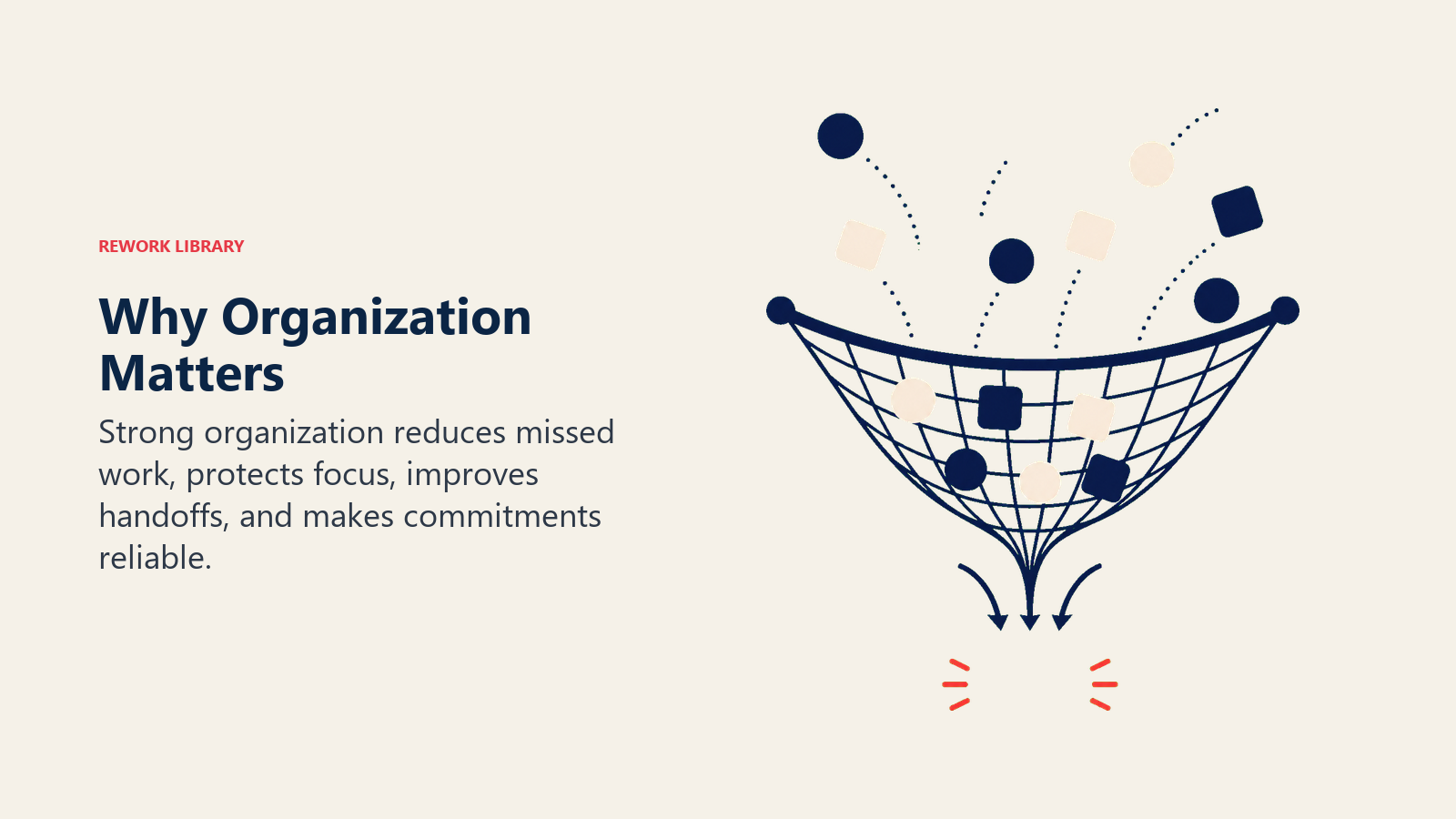
Reliability compounds. When people know you deliver what you commit to, they give you more responsibility, more trust, and more interesting work. Disorganization is a career ceiling. You can be talented and still never advance past a certain level if you're the person who drops balls, misses deadlines, or needs constant follow-up.
Decision quality improves. When your information is organized, you can find it. When you can find it, you make better decisions faster. Managers who have organized records of past decisions, metrics, and team performance don't have to reconstruct context from scratch every time a question comes up. This connects directly to analytical skills because good analysis depends on organized inputs.
Cognitive load drops. An organized system does your remembering for you. Instead of holding a mental list of 25 open threads, you have one place where they live. That frees working memory for the actual thinking your role requires. It also means fewer errors, because you're not trying to juggle tasks in your head while executing them.
Teams work better. Individual disorganization creates coordination overhead for everyone around you. When you're late, unclear, or unprepared, others compensate. When you're organized, collaboration runs more smoothly and your teammates don't have to buffer for you.
You scale. As roles get more senior, the number of things you're responsible for grows faster than the number of hours in your day. Organizational skills are what let you manage more surface area without burning out. They're the multiplier that makes time management work at scale.
Organizational Skills Examples
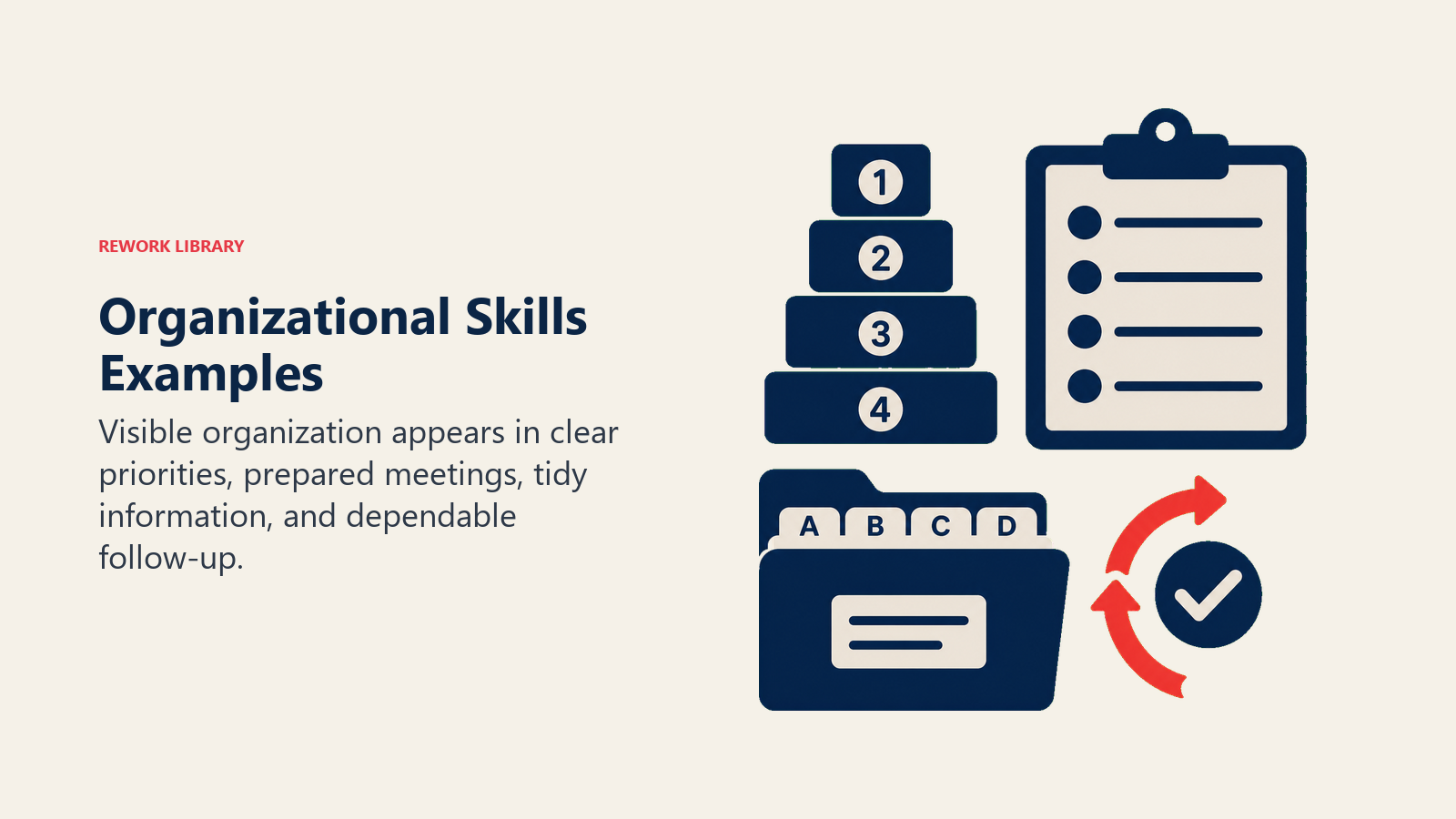
Organizational skills look different depending on your role and context. Here's how they show up across common professional situations.
For individual contributors:
- Keeping a daily task list with clear priorities, not just a dump of everything to do
- Organizing project files so a colleague can find anything within 30 seconds
- Blocking focused work time before meetings eat the day
- Sending a status update before someone has to ask for one
- Knowing the status of all active tasks without checking with a manager
For managers:
- Running meetings with a clear agenda distributed in advance
- Maintaining a tracking system for direct reports' goals and blockers
- Keeping team documents in a shared location with consistent naming
- Planning project timelines backward from the deadline, not forward from today
- Having a reliable system for following up on delegated work without micromanaging
For project leads:
- Breaking complex work into phases with owners and due dates
- Tracking dependencies so delays in one area get flagged before they cascade
- Keeping a change log when scope shifts
- Running retrospectives and filing the output where future teams can find it
- Knowing, at any moment, what's done, what's in progress, and what's blocked
The thread across all of these is systems thinking applied to practical work. Organized people aren't just tidy. They design workflows that remove friction and create clarity.
How to Improve Your Organizational Skills
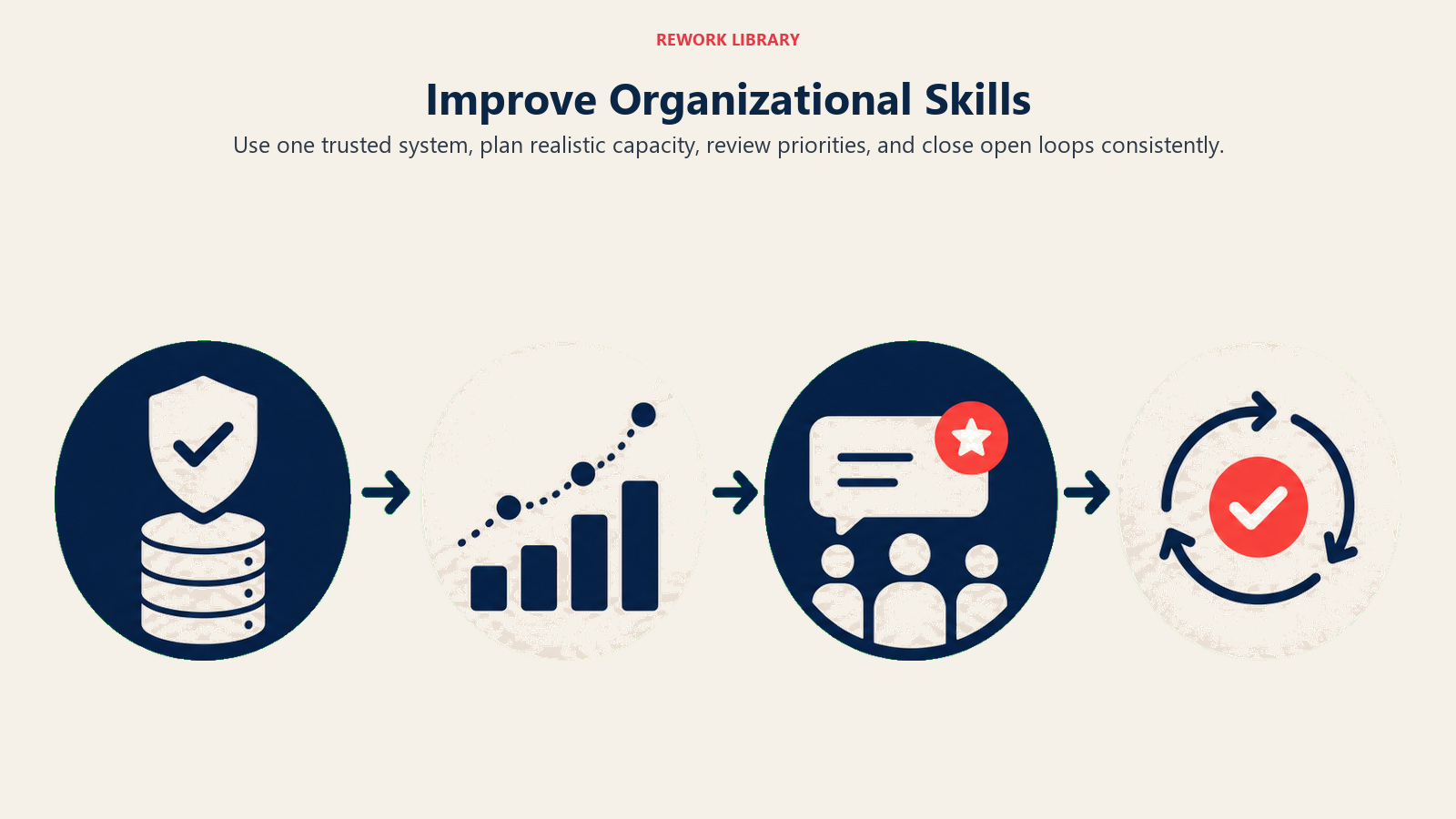
Step 1: Declutter before building new systems
New systems fail when they're layered on top of accumulated mess. Start by clearing. Archive old files, delete redundant documents, unsubscribe from email lists that produce noise, and close open loops by either completing small tasks or explicitly deciding to drop them. A clean starting point makes the system you build actually work.
Step 2: Choose one capture system and use it consistently
The most common organizational failure isn't having the wrong system. It's having too many. Notes in one app, tasks in another, random items in email, and a paper list on the desk. Pick one place where everything goes: tasks, commitments, follow-ups, ideas. It doesn't matter which tool you choose. What matters is that you actually trust it and actually use it, every time, without exception.
Step 3: Time-block your work intentionally
Open calendars fill with other people's priorities. Time-blocking means scheduling your own work as appointments, not just your meetings. Block time for focused deep work in the morning if that's when you're sharp. Block a slot for email and messages rather than leaving it always open. Block a weekly planning session where you review the week ahead. The act of scheduling forces prioritization decisions you'd otherwise avoid.
Step 4: Prioritize explicitly, not just urgently
Urgency and importance aren't the same thing. Many people spend their days responding to whatever feels urgent and end up not moving their most important work forward. A simple tool: at the start of each day, name the one or two things that matter most, and protect time for them before other demands crowd in. Effective attention to detail depends on this: you need to be in the right task before the detail-level focus is worth anything.
Step 5: Review weekly
A weekly review is the maintenance routine that keeps your organizational system from degrading. Set aside 30 minutes at the end of each week to clear your capture inbox, review open commitments, check what's coming next week, and close out completed tasks. Without this loop, your system slowly fills with stale items and you stop trusting it. The review is what turns a tool into a system.
Common Organizational Mistakes
Even people who care about being organized fall into predictable traps.
Over-organizing the system instead of doing the work. Reorganizing your folders, redesigning your task system, or color-coding your calendar can feel productive while accomplishing nothing. Systems should take minutes to maintain, not hours. If you're spending more time on your organization system than on your actual work, the system is the problem.
Tool-hopping. Every productivity app promises a new level of clarity. Many people switch tools every few months, spending the transition period importing old data and learning new interfaces. Consistency beats optimization. A modest system used reliably outperforms a sophisticated one used inconsistently. Stick with a tool long enough to develop real habits before deciding it isn't working.
No review loop. Building a system is step one. Maintaining it is steps two through infinity. Most organization attempts fail not because the initial setup was wrong but because there was no recurring habit to keep it current. Without a weekly or daily review, tasks pile up, commitments get missed, and the system becomes untrustworthy, which means you stop using it.
Organizing tasks instead of outcomes. A to-do list full of activity (review document, respond to email, attend meeting) without clear outcomes is just a tally of motion. Organizing your tasks around clear outcomes (finalize the proposal for Wednesday's client call, resolve the billing dispute with the vendor) makes the list meaningful and makes it easier to prioritize. This connects to how strong problem-solving and critical thinking actually get applied: you need to know which problems deserve your time first.
How to Show Organizational Skills on a Resume and in Interviews
Organizational skills are best demonstrated through specifics, not claims. "Highly organized professional" on a resume says nothing. Here's what actually works.
On a resume, describe systems and outcomes:
- "Managed a portfolio of 12 concurrent client projects across two time zones, maintaining 97% on-time delivery over 18 months"
- "Designed and implemented a document management system adopted by a 25-person team, reducing file search time by an estimated 40%"
- "Ran weekly team standups and maintained a shared tracker that reduced status meeting frequency by 50%"
In interviews, tell a specific story. When asked about organizational skills, pick a real situation where your systems mattered. Walk through what you were managing, what system you used, what broke down (if anything), and what the outcome was. Interviewers can feel the difference between someone who can talk abstractly about organization and someone who has genuinely lived the discipline.
Phrases that show rather than tell:
- "I track all open commitments in [tool]; at any point I can tell you status on every item."
- "Before starting a new project, I always map dependencies and flag the critical path."
- "I have a weekly review habit where I check every open loop and make sure nothing's slipping."
Strong commercial awareness often shows up alongside organizational skills in senior roles: knowing not just how to manage your work but which work matters most to the business and customers.

Senior Operations & Growth Strategist
On this page
- What Are Organizational Skills?
- Types of Organizational Skills
- Why Organizational Skills Matter at Work
- Organizational Skills Examples
- How to Improve Your Organizational Skills
- Step 1: Declutter before building new systems
- Step 2: Choose one capture system and use it consistently
- Step 3: Time-block your work intentionally
- Step 4: Prioritize explicitly, not just urgently
- Step 5: Review weekly
- Common Organizational Mistakes
- How to Show Organizational Skills on a Resume and in Interviews