Empathy at Work: Why It Matters and How to Build It
Turn this article into takeaways for your work.


Each assistant summarizes the article only for you and suggests best practices for your work.
Empathy at work is one of the few interpersonal skills that touches nearly every other competency you build as a professional. When a colleague feels genuinely heard, trust goes up, conflict goes down, and collaboration gets easier for everyone on the team.
But empathy is not a soft trait you either have or don't. It's a learnable set of behaviors. And for managers especially, building it deliberately is one of the highest-leverage moves available.
What Is Empathy at Work?
Empathy at work is the ability to understand and share the perspective or emotional state of a colleague, direct report, customer, or stakeholder, and to respond in a way that acknowledges that understanding.
It's distinct from simply being nice. You can be polite without understanding why someone is frustrated. You can agree with someone without grasping why the issue matters to them. Empathy goes deeper: it asks you to step into another person's frame before you respond.
At its most practical, empathy at work means pausing to ask "Why does this person feel this way?" before deciding what to do next.
Key Facts
- 87% of employees say that feeling valued and understood by their manager directly affects their intention to stay with the company (Businessolver State of Workplace Empathy, 2023).
- 76% of employees say they are more engaged when their employer demonstrates empathy, compared with 32% who work for less empathetic organizations (Catalyst, 2021).
- Only 48% of employees believe their company's empathy is authentic rather than performative (Businessolver, 2023).
The Three Types of Empathy
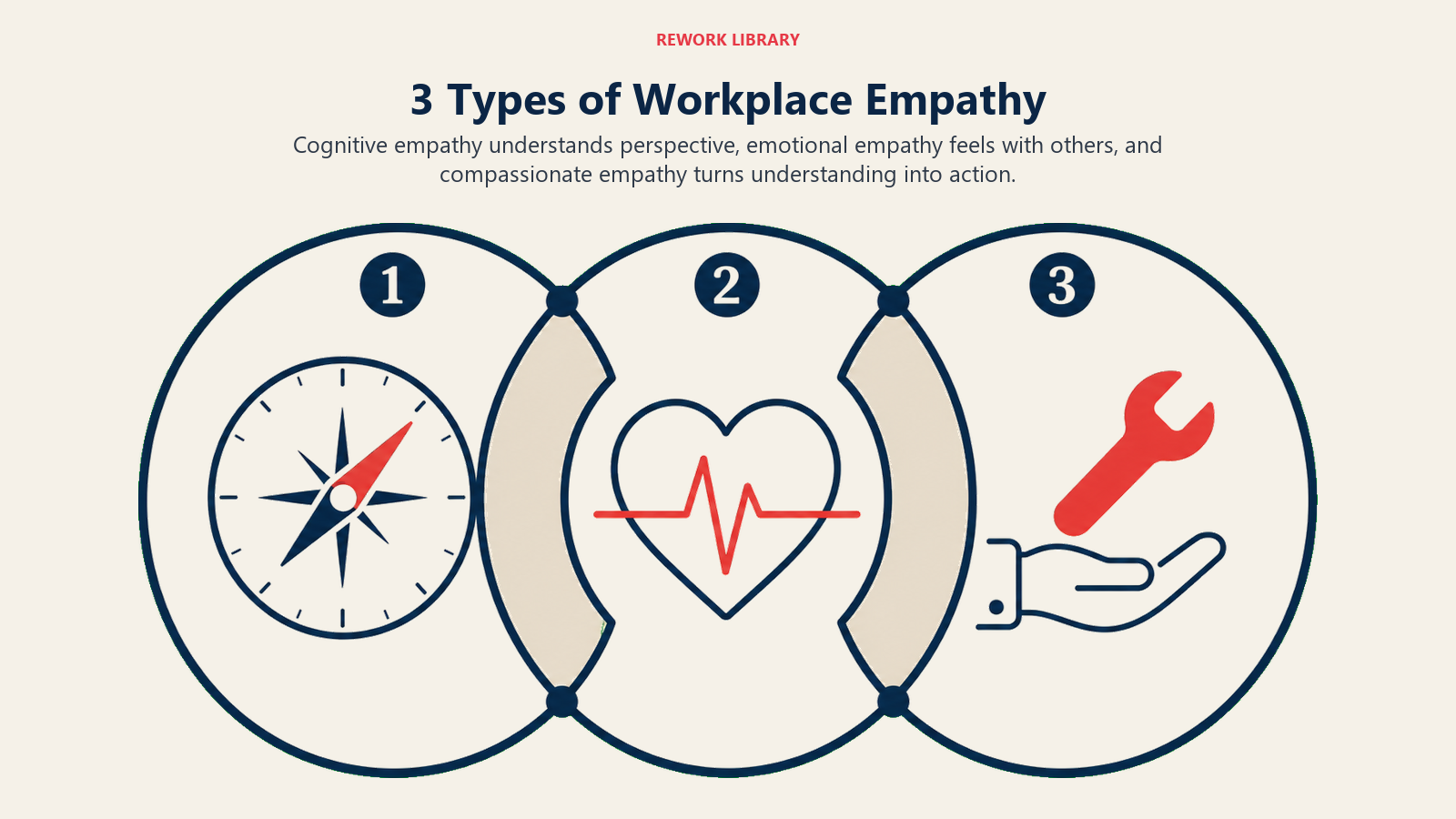
Psychologists often break empathy into three distinct types. Each has a role to play at work, and the most effective colleagues and managers draw on all three.
| Type | What It Means | Workplace Example |
|---|---|---|
| Cognitive empathy | Understanding how someone thinks or sees a situation from their viewpoint | A manager asks a struggling team member what obstacles they're hitting before suggesting solutions |
| Emotional empathy | Feeling what another person feels, not just knowing it intellectually | A colleague sits with a peer who just received bad news rather than jumping to problem-solving mode |
| Compassionate empathy | Understanding, feeling, and then taking action to help | A team lead rearranges priorities so an overloaded employee can finish a critical project without burning out |
Cognitive empathy alone can look cold. Emotional empathy alone can leave you overwhelmed. Compassionate empathy combines both with action, which is why it's the form most relevant to day-to-day management.
Why Empathy Matters at Work
Empathy builds trust, improves collaboration, strengthens leadership, prevents conflict, and supports better customer decisions.
It Builds Trust Faster Than Almost Anything Else
People can tell within minutes whether you're genuinely trying to understand them or just waiting for your turn to talk. When you demonstrate real curiosity about a colleague's perspective, you signal that their input matters. That signal compounds into trust over weeks and months.
Trust, in turn, is the foundation of every high-performing team. Without it, people hedge their opinions, avoid conflict, and hold back ideas they fear will be dismissed.
It Reduces Turnover
Employees don't leave companies. They leave managers who don't see them. When direct reports feel understood, they're far less likely to quietly look for the door. The Businessolver data is consistent on this: empathy from leadership is one of the top predictors of retention.
Replacing a skilled employee costs between 50% and 200% of their annual salary when you factor in recruiting, onboarding, and lost productivity. Empathy is cheap by comparison.
It Unlocks Collaboration and Innovation
Teams that feel psychologically safe share half-formed ideas, push back constructively, and take the kind of creative risks that lead to real breakthroughs. Empathy is a core ingredient of psychological safety. It tells people: if I say something imperfect, I won't be ridiculed or dismissed.
You can see this play out clearly in cross-functional work, where people come in with different priorities and vocabularies. A product manager who genuinely understands why the sales team is anxious about a feature launch will communicate differently, and more effectively, than one who treats that anxiety as a distraction.
It Improves Conflict Resolution
Most workplace conflict is not about facts. It's about unacknowledged feelings: feeling overlooked, undervalued, or blamed. When you approach a conflict by first trying to understand what the other person actually experienced, you defuse most of the emotional charge before you even reach the substantive disagreement. See more on this in conflict resolution.
Empathy vs Sympathy
These two words are often used interchangeably, but they work differently in practice.
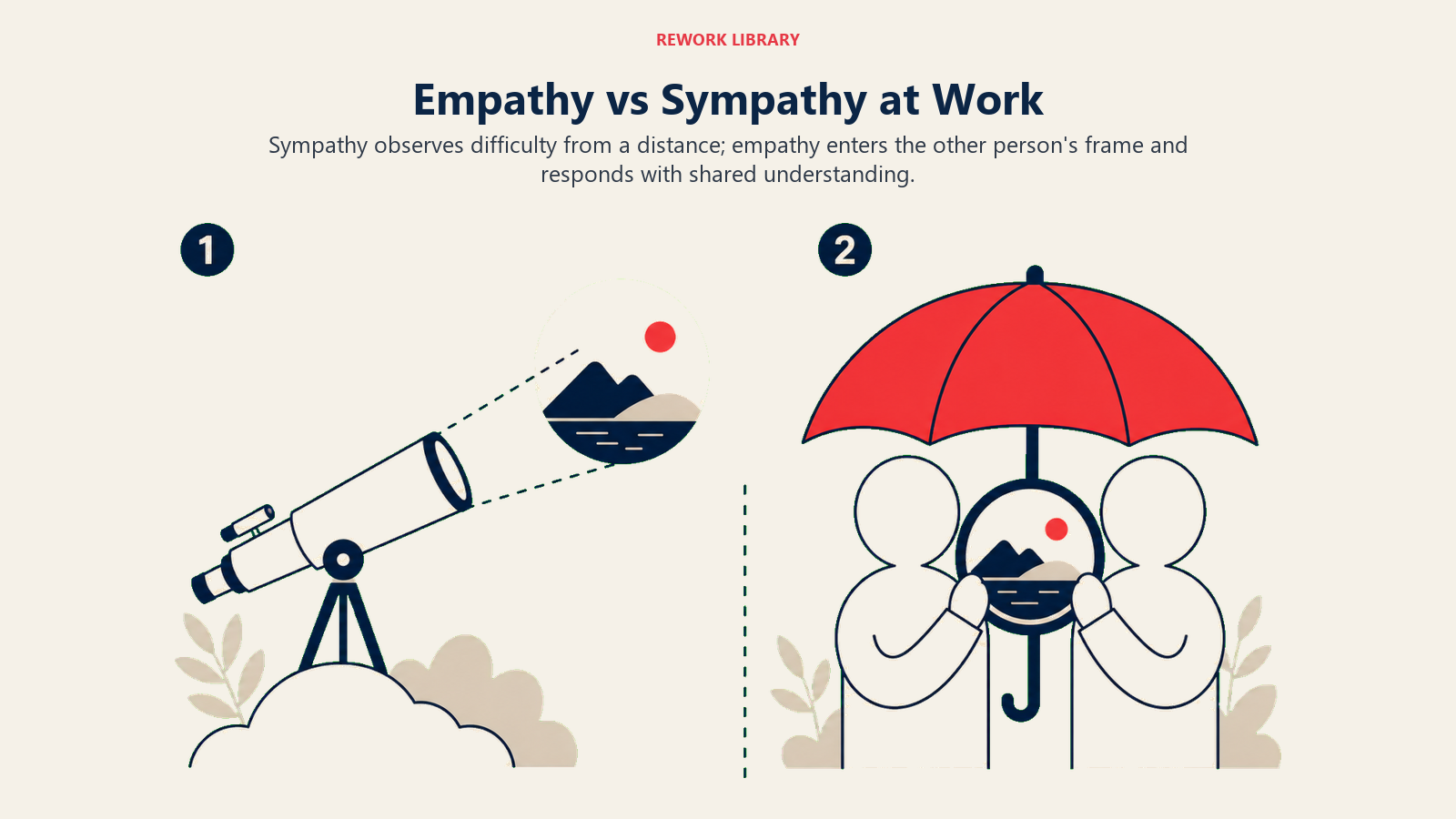
Sympathy is feeling sorry for someone from a distance. "I'm sorry you're going through that." It acknowledges their pain but keeps you outside it.
Empathy is stepping into their experience. "I can see why that situation feels impossible. If I were in your position, I'd be feeling the same pressure." It closes the gap.
Sympathy can unintentionally create a power imbalance, a sense that the person offering it is above the situation while the other person is in it. Empathy equalizes the relationship. It says: I'm with you, not above you.
For managers, this distinction matters a lot. A sympathetic response to an overwhelmed team member ("that sounds hard, hang in there") often feels hollow. An empathetic response ("tell me what's piling up and let's figure out what can move") gets traction.
How to Show More Empathy at Work
These six steps are practical, daily habits, not personality traits you have to be born with.
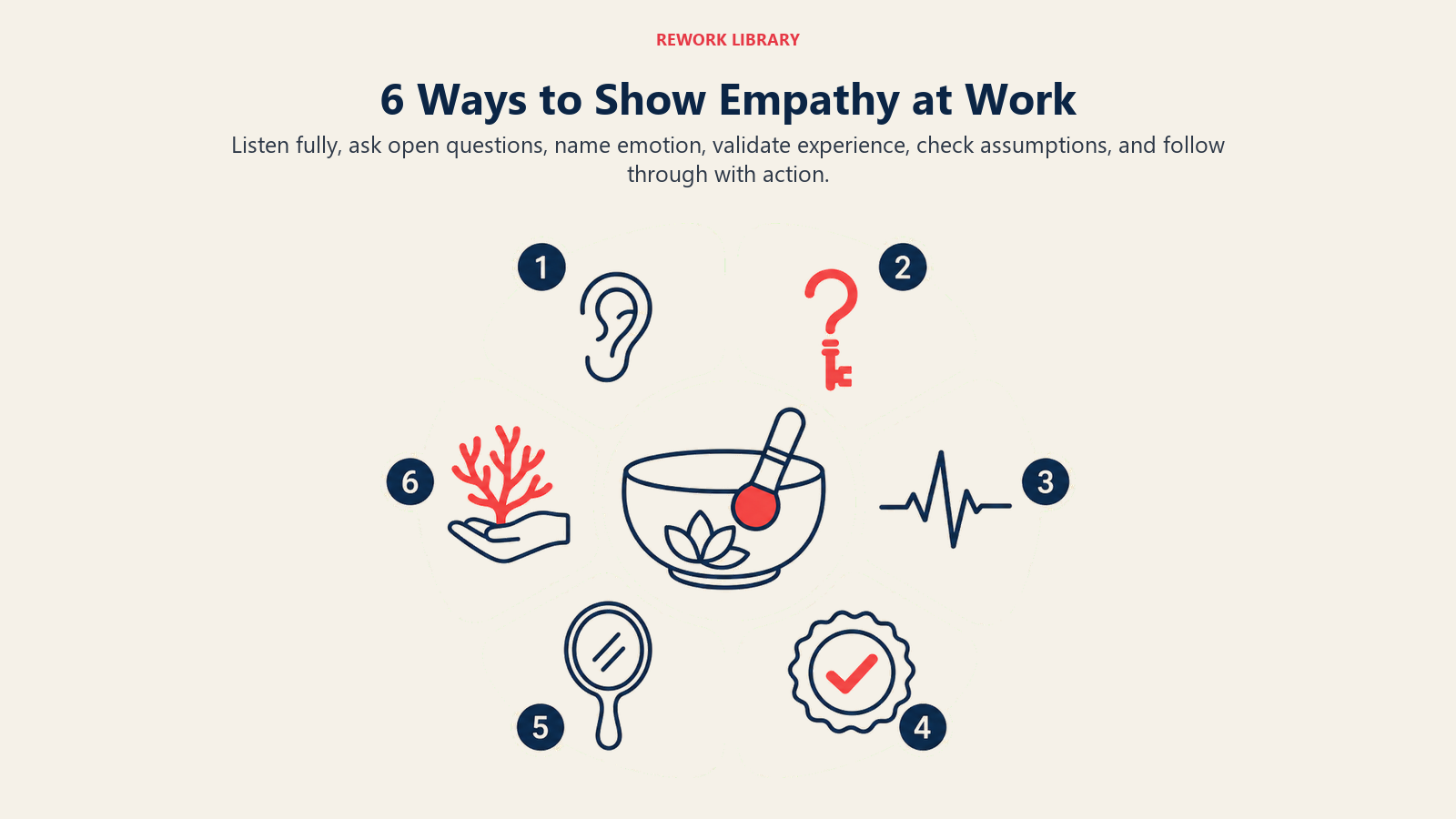
Step 1: Listen to Understand, Not to Respond
Active listening is the mechanics of empathy. It means giving your full attention, not checking your phone, not composing your reply while the other person is still talking, and not finishing their sentences.
A concrete habit: when someone finishes speaking, pause for two seconds before you reply. That pause breaks the automatic respond-first reflex and signals that you actually processed what they said.
Step 2: Ask Before You Advise
Most people offering advice haven't asked whether advice is what's wanted. Before jumping to solutions, ask: "Are you looking for suggestions, or did you mostly need to think this out loud?" You'll be surprised how often the answer is the second one.
This question alone removes a lot of friction from one-on-ones.
Step 3: Name What You're Observing
You don't have to perfectly mirror another person's emotion to be empathetic. You just have to notice and name it. "You seem frustrated with how that conversation went. Is that right?" invites them to correct you if you've misread the situation and confirms that you're paying attention either way.
Naming an emotion is not the same as psychoanalyzing someone. It's a check-in.
Step 4: Separate the Person from the Problem
This is especially relevant in feedback conversations. When someone's work misses the mark, it's easy to conflate the output with the person. Empathetic feedback focuses on the work and its impact, not on judgments about effort or character.
"This report is missing the executive summary the stakeholders asked for" is factual and actionable. "You never read the brief carefully" is an attack that closes down the conversation.
Step 5: Follow Up
Empathy is not a one-time gesture. If a colleague told you they were going through a difficult stretch, checking in a week later signals that you actually heard them and that you care beyond the moment.
This is also where interpersonal skills overlap with empathy: the relationship you build through consistent follow-through is more durable than any single empathetic exchange.
Step 6: Act on What You Hear
Listening without action can feel worse than not listening at all. If someone shares that a process is creating unnecessary friction, and you nod and then change nothing, the message they receive is that their input doesn't matter.
Empathy without action eventually becomes distrust. Where you can act, do. Where you can't, say why.
Examples of Empathy at Work
| Situation | Non-Empathetic Response | Empathetic Response |
|---|---|---|
| A direct report misses a deadline | "This can't happen again." | "I noticed you've had a lot on your plate. What got in the way, and how can I help clear the path?" |
| A peer pushes back hard in a meeting | Defend your position immediately | "That's a strong reaction. Help me understand where that's coming from." |
| A team member announces they're leaving | "Good luck with everything." | "I'm glad you told me. I'd love to understand what drove this so we can do better for others." |
| A colleague seems withdrawn after a reorganization | Say nothing, assume it'll pass | Check in privately: "The last few weeks have been a lot. How are you actually doing?" |
| A customer complains | Explain company policy | "I can hear how frustrated you are. Let me make sure I understand what happened before we figure out next steps." |
Empathy looks different in each case, but the underlying move is the same: you pause, you orient toward the other person's experience, and you respond from there.
Empathy and Related Competencies
Empathy doesn't operate in isolation. It's closely tied to emotional intelligence, which provides the self-awareness to manage your own reactions while staying present for someone else's. Without that self-regulation, empathy can collapse into reactivity.
It's also foundational to collaboration skills. Teams that collaborate well have usually built enough mutual understanding to work through disagreement without it becoming personal. And it sits alongside assertiveness: the ability to hold your own position clearly while still making room for the other person's. Assertiveness without empathy is aggression. Empathy without assertiveness becomes passive. The combination is what makes someone genuinely effective in interpersonal situations.
Frequently Asked Questions about Empathy at Work
Can empathy be learned, or is it a personality trait?
It can be learned. Research from organizations like the Empathy Lab and workplace behavior studies consistently shows that deliberate practice, specifically habits like active listening, perspective-taking questions, and following up, increases empathetic behavior over time. It's not fixed.
What's the difference between empathy and being a pushover?
Empathy is about understanding, not about agreeing or capitulating. You can fully understand why a colleague is upset about a decision and still hold the decision. What changes is how you communicate it and how much space you create for them to process the news. Understanding someone's perspective doesn't obligate you to change course.
How do you practice empathy with someone you find difficult?
Start with curiosity instead of judgment. Most difficult behavior has a cause, stress, fear of failure, a communication style mismatch, a history you don't know about. Asking "What is this person worried about?" before your next interaction with them shifts you from defensive to genuinely curious. It doesn't always solve the relationship, but it usually improves it.
Is empathy more important for managers than individual contributors?
It matters for everyone, but the stakes are higher for managers because of the power differential. A manager who lacks empathy creates a culture of self-protection: people hide problems, don't bring bad news, and disengage quietly. That compounds into team performance problems. Individual contributors who practice empathy are better collaborators, better communicators, and generally easier to work with.
How do remote and hybrid teams maintain empathy without in-person cues?
Intentionally. In a co-located environment, you pick up signals passively. Remotely, you have to create the conditions: cameras on for key conversations, more frequent check-ins, and explicit questions about how people are doing beyond just task status. The same empathetic behaviors apply; they just require more deliberate setup.
Empathy at work won't solve every team problem, but it makes most problems easier to work through. The teams that consistently outperform aren't just technically skilled. They've built enough mutual understanding to stay functional under pressure, disagree without breaking down, and support each other through the rough patches that every organization hits.
Start with one habit: listen without planning your response. Everything else follows from there.

Senior Operations & Growth Strategist
On this page
- What Is Empathy at Work?
- The Three Types of Empathy
- Why Empathy Matters at Work
- It Builds Trust Faster Than Almost Anything Else
- It Reduces Turnover
- It Unlocks Collaboration and Innovation
- It Improves Conflict Resolution
- Empathy vs Sympathy
- How to Show More Empathy at Work
- Step 1: Listen to Understand, Not to Respond
- Step 2: Ask Before You Advise
- Step 3: Name What You're Observing
- Step 4: Separate the Person from the Problem
- Step 5: Follow Up
- Step 6: Act on What You Hear
- Examples of Empathy at Work
- Empathy and Related Competencies