Best Knack Alternatives in 2026: 13 Tools for Building a Permissioned Client Portal
Turn this article into takeaways for your work.


Each assistant summarizes the article only for you and suggests best practices for your work.
If the builder interface is what is pushing you out of Knack, Softr and Bubble are the two here that genuinely look current, and Bubble is the only one that hands you real design control. If you have hit the record ceiling, Caspio and Tadabase both sell the same flat account model Knack does, with far more headroom per dollar at the top. And if the specific thing that broke was Starter including exactly one shared builder while Pro costs more than twice as much, Tadabase charges no per-user fee at all and Zoho Creator starts at $8 per user per month billed annually. Every tool below was judged on billing model, how it treats people outside your organization, how many builders you get, and total annual cost for one concrete scenario, with every price read off the vendor's own pricing page in September 2026.
This is written for ops leads, IT managers, and program managers at organizations of roughly 10 to 500 people who are running a portal that customers, members, patients, students, or contractors log into. One warning before the list. "Unlimited users" is the most repeated and least examined phrase in this category, and three of the tools below use it to mean three different things. Knack's unlimited users are end users, not builders. Caspio's are end users while app authors are capped on the entry tier. Tadabase genuinely charges nothing per user of any kind. Flattening those into one sentence is how buyers end up surprised by a bill.
Key Facts
- By 2026, developers outside formal IT departments will account for at least 80% of the user base for low-code development tools, up from 60% in 2021, and sales of low-code development technologies are forecast to grow 19% to reach $44.5 billion by 2026, per Gartner as reported by InfoWorld.
- The average enterprise now manages 897 applications and only 29% of them are integrated, while IT teams spend 39% of their time creating custom integrations, per the 2025 MuleSoft Connectivity Benchmark Report, a survey of more than 1,050 IT leaders.
- 61% of customers would rather use self-service channels for routine matters, per Salesforce's State of the Connected Customer research, published on Salesforce's customer self-service guide.
- Self-service resolves an estimated 54% of customer issues at organizations that deploy it, per Salesforce's State of Service research, cited on the same Salesforce guide.
- A composite 30,000-employee, $10 billion organization running 200 professional developers and 1,800 citizen developers on Microsoft Power Apps saw a 206% three-year ROI, payback in under six months, and a 50% cut in professional developer application development time, per the Forrester Total Economic Impact study commissioned by Microsoft.
Those numbers explain why this market keeps growing and why the portal half of it is the expensive half. Answering a question once, in a place a customer can reach without emailing anyone, is cheaper than answering it forty times.
Quick Comparison Table
| Tool | Best For | Starting Price | Pricing Model | Key Limitation |
|---|---|---|---|---|
| Caspio | The same flat model with real headroom | $270/mo billed annually | Per account, unlimited end users, 5 authors on Team | Entry price is five times Knack Starter |
| Tadabase | Knack's model with no per-user fee at all | $42/mo billed annually | Per account, no per-user charge of any kind | Smaller community and template library |
| Zoho Creator | Companies already standardized on Zoho | $8/user/mo billed annually | Per user, external portal sold as an add-on | Portal add-on starts at $100/mo on top |
| Quickbase | Governance, audit, and regulated operations | From $35/user/mo priced annually | Per user, plus an unpublished platform minimum | Per-user billing breaks at high external volume |
| Ninox | European teams wanting a real relational engine | EUR 25/user/mo billed annually | Per user, quoted in euros excluding VAT | Per user, so outside users cost the same as staff |
| Bubble | Portals that have to look like a product | $59/mo billed annually | Per plan, metered in workload units | Editor seats ladder up fast, Starter includes 1 |
| Softr | Fixing the dated interface without a rebuild | $19/mo billed annually | Per plan, banded by app-user count | Front end only, you still pay for the database |
| Glide | Portals used on a phone in the field | $25/mo as published | Flat project pricing under GlideOS | Front end only, no annual rate published |
| Airtable | The database half, biggest ecosystem | $20/seat/mo billed annually | Per editing seat | No real external logins on its own |
| SmartSuite | The database half with process built in | $15/seat/mo billed annually | Per editing seat, 3-user minimum | Team tier holds only 5,000 records per solution |
| Baserow | The database half you can self-host, MIT core | $10/user/mo billed yearly | Per user, free when self-hosted | Automation depth trails Airtable |
| Retool | Logic no visual builder can express | $10/standard user/mo | Per builder plus banded external users | External user cost dwarfs the builder cost |
| Budibase | Running the whole platform inside your boundary | Self-hosted free; Pro $19/user/mo annually | Free self-hosted, or per creator plus end user | Cloud end-user add-ons get expensive fast |
Why People Actually Leave Knack
Almost nobody leaves Knack because a competitor demoed better. They leave because one specific thing stopped working, and the right replacement depends entirely on which one it was.
| What broke | What is actually happening | What fixes it |
|---|---|---|
| The builder feels dated | Knack's interface predates the current generation of no-code tooling, and design control is limited by design | Softr or Bubble, or Softr on top of the data you already have |
| You hit the record ceiling | Starter caps at 20,000 records and Pro at 50,000, which arrives fast once you log events rather than entities | Caspio at 250,000 on Team, Tadabase at 125,000 on Growth, or Knack Corporate |
| The Starter to Pro jump | Starter is $49 per month billed annually and Pro is $110, a 124% increase for the next tier | Tadabase Starter at $42 or Growth at $105 per month billed annually |
| One shared builder | Starter includes exactly 1 shared builder, so the second person who needs to edit forces the Pro upgrade | Tadabase, Caspio Team with 5 authors, or Knack Pro if the rest fits |
| Compliance arrived late | Standard Knack plans do not carry a BAA, and Knack Health is a separate product line | Knack Health from $159/mo, Caspio's compliance edition, or Quickbase |
Two of those five are not really product problems. They are pricing-shape problems, and pricing shape is what this category explains worst. For reference, Knack's pricing page lists Starter at $49 per month billed annually and $59 billed monthly with 20,000 records, 3 apps, and 1 shared builder; Pro at $110 billed annually and $130 monthly with 50,000 records, unlimited apps, and unlimited builders; and Corporate at $250 billed annually and $300 monthly with 125,000 to 2.5 million records. The separate Knack Health line starts at $159 per month for HIPAA Forms and $499 for HIPAA Starter, with a signed BAA included on every plan.
Three Jobs Hide Behind One Search
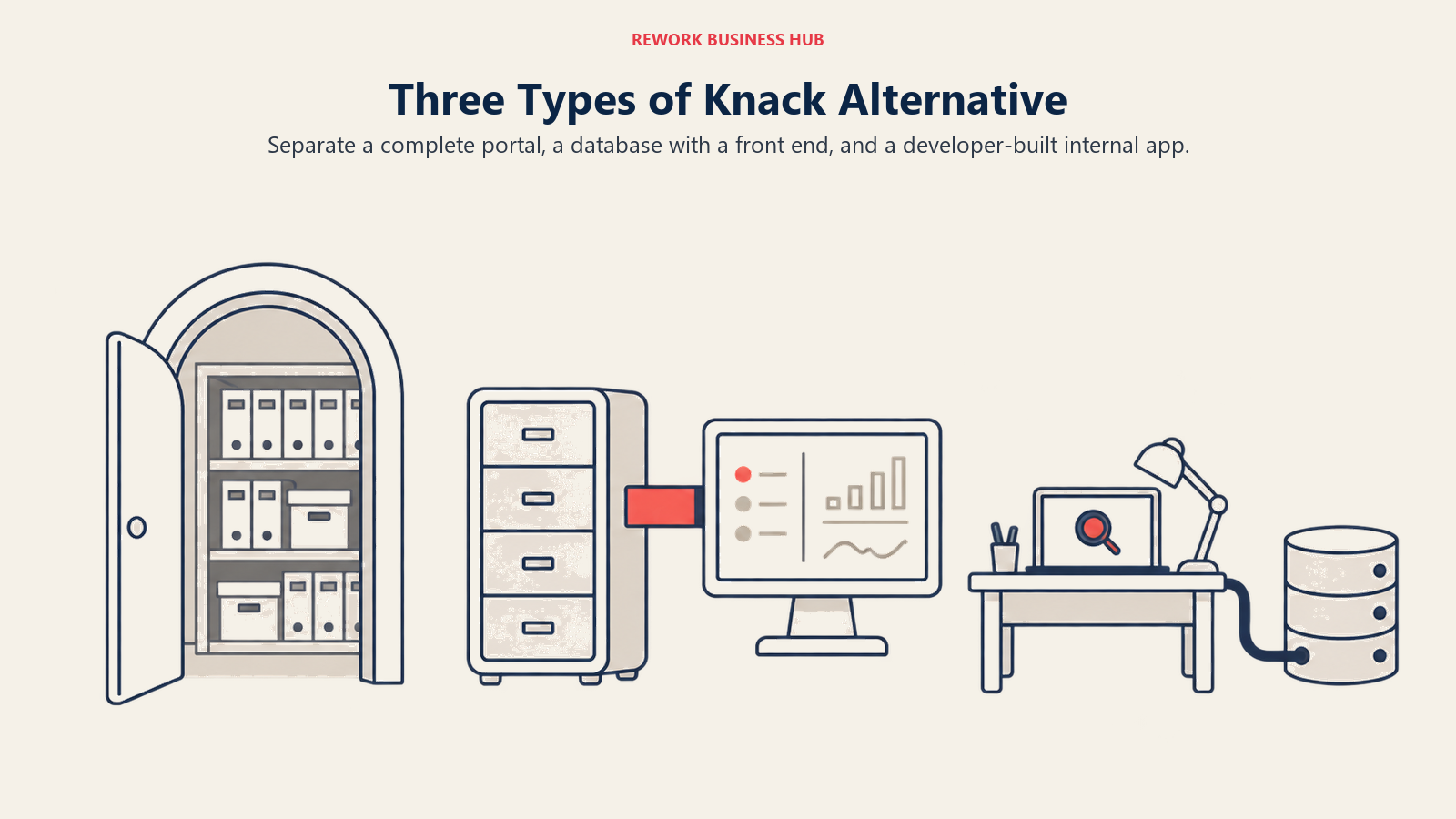
"Knack alternative" returns three different kinds of product. Buying from the wrong group is the single most common way a migration stalls at week six.
| Portal and app builders | Database plus front end | Developer-adjacent | |
|---|---|---|---|
| Tools | Caspio, Tadabase, Zoho Creator, Quickbase, Ninox, Bubble | Softr, Glide, Airtable, SmartSuite, Baserow | Retool, Budibase |
| What you buy | One product that stores data and serves a permissioned app | Two products stitched together, priced separately | A platform that assumes someone writes queries |
| Who logs in | Staff plus customers, members, patients, contractors | Staff in the database, outsiders in the front end | Staff, plus external users at a per-user rate |
| Billing driver | Records, apps, or plan tier | Editing seats underneath, app-user bands on top | Builder seats plus external user bands |
| Fails when | You needed pixel control the platform will not give | You forget to price both halves | Nobody on the team writes SQL |
The test is one question. Count the people who log into your Knack app and are not on your payroll. Zero means you never needed the portal layer and the database half of this list is cheaper and better. A few hundred means per-user pricing will hurt, and the flat-rate group is where to look. The best no-code database software guide maps where that line sits across the wider market, and best Caspio alternatives runs the same comparison from the other incumbent's side.
1. Caspio - the same billing shape with real headroom
Caspio is the closest structural relative Knack has. Both price per account rather than per user, both let an unlimited number of outside people log into what you build, and both cap you on records rather than seats. If you like how Knack bills and dislike everything else, Caspio is the natural upgrade path.
What you buy for the higher price is capacity and governance. Team includes 250,000 records against Knack Pro's 50,000 and caps app authors at 5, so Caspio's unlimited users are app end users, not the people building the app. Business removes that cap and raises records to 1 million. Caspio also productises compliance, where most vendors treat it as a custom enterprise conversation: the Caspio HIPAA Edition starts at $800 per month on a one-year term with no per-user fees, a signed BAA, and a separate HIPAA-compliant cloud environment.
The catch is the floor. Caspio Team costs roughly five and a half times Knack Starter, which is a lot of money for headroom a 12,000-record membership directory will never use. At 200,000 records it is cheaper per record than anything else here that can serve external logins.
| What you get | What you don't |
|---|---|
| Flat account pricing with unlimited app end users | A price a two-person team can justify |
| 250,000 records on Team, 1 million on Business | Unlimited app authors below the Business tier |
| A productised compliance edition with a signed BAA | A builder anyone would call modern |
| DataPage structure that survives an audit | The speed of a grid-first tool |
Pricing: Team is $270 per month billed annually and $300 billed monthly, with 5 app authors, unlimited app end users, and 250,000 records. Business is $540 per month billed annually and $600 billed monthly, with unlimited authors and 1 million records. Pricing is per account, not per user, per Caspio's pricing page.
Best for: Organizations of 20 to 500 whose record volume outgrew Knack Pro and who need the flat-rate model to keep working at scale.
2. Tadabase - the closest match, and genuinely no per-user fee
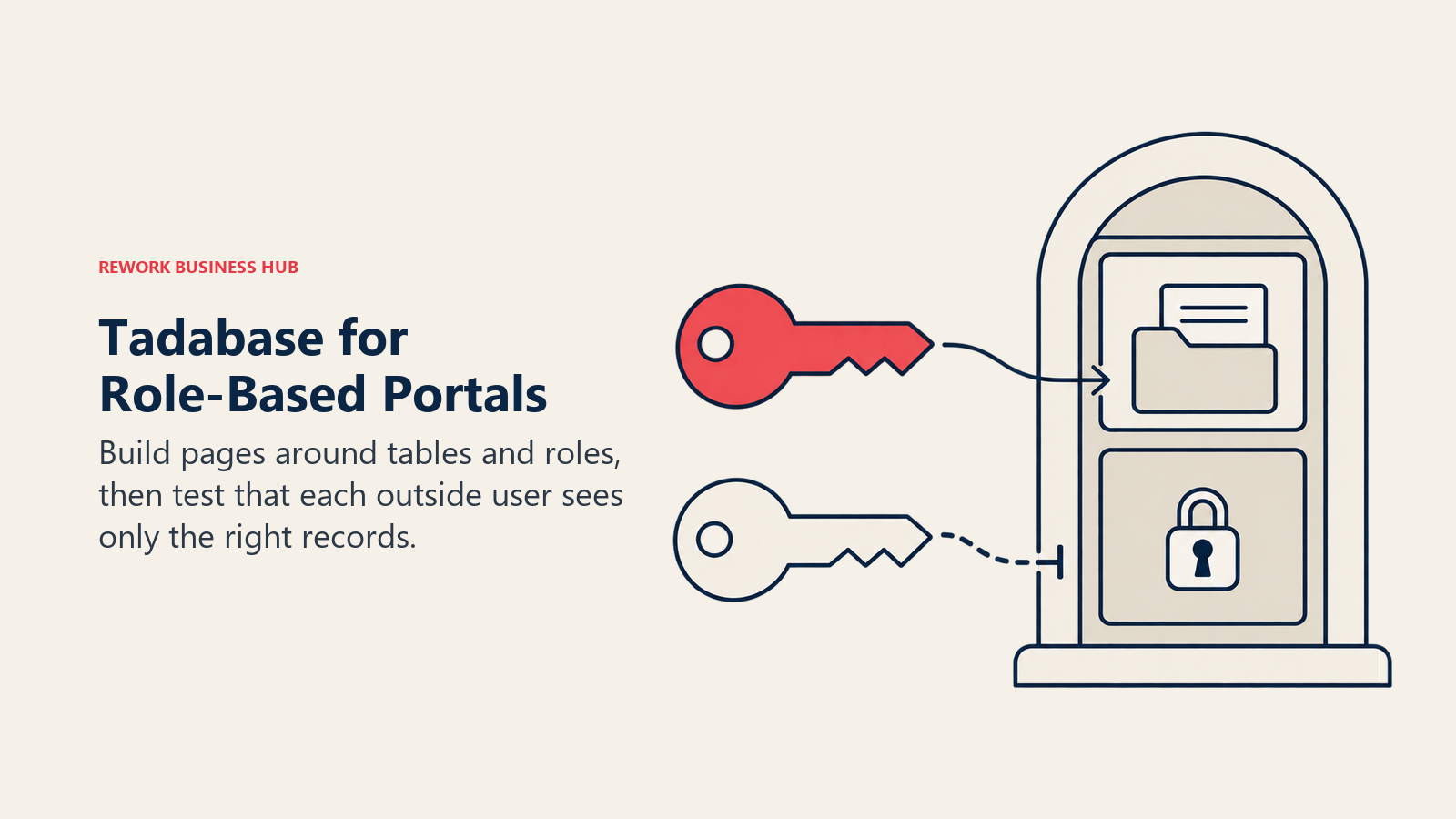
Tadabase is the tool Knack refugees most often have not heard of, and it is the closest thing to a like-for-like swap on this page. It builds the same shape of product: define tables, define roles, publish pages that outside people log into and see only their own records. The difference is the billing headline, which reads "No Per User Fees. Period. One price, unlimited users."
That claim is worth pulling apart, because it is stronger than the version Knack and Caspio publish. Knack gives you unlimited end-user logins but meters builders, with exactly one shared builder on Starter. Caspio gives you unlimited end users and caps app authors at 5 on Team. Tadabase does not charge separately for either category. If the thing that pushed you off Knack Starter was needing a second person who could edit the app, this is the only tool here that solves it without a tier change.
Capacity is competitive too. Starter carries 30,000 records and 3 apps for less than Knack Starter's 20,000, and Growth carries 125,000 records for less than Knack Pro's 50,000. What you trade away is ecosystem: a thinner template library, a smaller consultant community, and fewer answers when you search a specific problem at 11pm.
| What you get | What you don't |
|---|---|
| No per-user fee for builders or end users | A large partner and consultant ecosystem |
| 30,000 records at the entry tier, 125,000 at Growth | The template library Knack has accumulated |
| A separate HIPAA edition at a published price | Brand recognition in a procurement review |
| Straight per-account billing with no seat math | A guarantee your agency has heard of it |
Pricing: Starter is $42 per month billed annually and $50 billed monthly, with 3 apps and 30,000 records. Growth is $105 billed annually and $125 monthly, with 5 apps and 125,000 records. Pro is $210 annually and $250 monthly, Elite is $375 annually and $450 monthly, and a HIPAA edition is $450 per month, per Tadabase's pricing page.
Best for: Teams of 2 to 100 who liked Knack's model and left because of the builder seat limit or the Starter to Pro jump.
3. Zoho Creator - the cheapest route if you already run Zoho
Zoho Creator is a real low-code application platform rather than a spreadsheet hybrid. You model data, then generate web and mobile apps with logic written in Deluge, Zoho's scripting language. It builds genuinely customer-facing applications, and its mobile output is better than anything Knack produces.
The reason to choose it is rarely the builder. It is that your CRM, help desk, books, and HR records already sit in Zoho, and Creator reads them natively instead of through an integration you maintain forever. That MuleSoft finding about IT burning 39% of its time on custom integrations is exactly the tax you skip by staying inside one vendor's data model. If you hold a Zoho One licence, check whether Creator is already included before you buy anything on this page.
The trap is the portal. Creator's per-user price is the lowest here, but external portal users are a paid add-on rather than a plan inclusion. A three-person build with a few hundred portal users is not $24 a month, and any comparison that stops at the seat price is misleading you.
| What you get | What you don't |
|---|---|
| Native access to Zoho CRM, Books, Desk, and People | A reason to buy it if you are not on Zoho |
| Real mobile app generation, not responsive pages | Portal users included in the seat price |
| The lowest published per-user rate in this list | A short learning curve, Deluge is a language |
| Possible zero marginal cost on a Zoho One licence | An independent consultant market of any size |
Pricing: Standard is $8 per user per month billed annually, Professional is $20, and Enterprise is $25, all per user per month billed annually. A free edition covers one custom app. The Customer Portal is a paid add-on ranging from $100 to $10,000 per month by tier, and the page notes yearly billing saves more than 30%, per Zoho Creator's pricing page. For the direct head-to-head on these two billing models, see Knack vs Zoho Creator.
Best for: Companies of 10 to 500 already standardized on Zoho who want apps sitting directly on records they already own.
4. Quickbase - the step up when governance outranks price
Quickbase is where you go if you are leaving Knack upward rather than sideways. It is the oldest platform in this market and the maturity shows in exactly the places auditors look: sandbox and production separation, audit logging, granular role-based control, and hundreds of interconnected applications running across one large organization without becoming shadow IT. Quickbase's compliance page publishes SOC 1 Type II, SOC 2 Type II, and SOC 3 attestations, states that the annual SOC 2 report includes independent attestation to the HIPAA administrative, physical, and technical safeguards, and incorporates a BAA for Business and Enterprise customers on annual or multi-year subscriptions.
It also changed something important this year. Quickbase now publishes pricing on its plans page, which it did not do for most of the last decade. Team starts at $35 per user per month priced annually and Business starts at $55. The page still references a platform minimum without naming a number, so do not budget from the per-user rate alone, and do not trust a third-party article that prints a specific seat floor.
The structural problem for a Knack refugee is the model, not the price. Quickbase bills per user and Knack does not. If your app has 40 staff users, run the comparison. If it has 40 staff and 400 members, per-user billing is the wrong shape and no discount fixes it.
| What you get | What you don't |
|---|---|
| Mature governance, audit trails, and environment separation | A billing model that survives external users |
| SOC 1, SOC 2, and SOC 3 attestations plus a BAA path | A published platform minimum you can plan around |
| Proven at hundreds of apps in one organization | A fast, low-commitment self-serve evaluation |
| A strong field and manufacturing operations track record | An interface anyone calls modern in 2026 |
Pricing: Team "starts at $35 per user, per month, priced annually" and Business "starts at $55", per Quickbase's plans and pricing page. The page references a platform minimum but does not publish the number, so get it in writing.
Best for: Operations organizations of 100 to 5,000 where governance, audit, and IT control matter more than the shape of the bill.
5. Ninox - the European option with a real relational engine
Ninox is the most underrated database-plus-app tool in this comparison and the one European buyers should look at first. It runs on the web, on Mac, and on iOS and Android, with a scripting layer that handles genuinely relational logic rather than spreadsheet formulas dressed up as relationships. Teams that outgrew Airtable's flat-table thinking but do not want a developer platform tend to land here.
For a Knack refugee the appeal is data modelling depth. Ninox handles many-to-many relationships, computed fields, and triggers without the workarounds a grid-first tool needs, and it does it in an interface that is pleasant to work in daily. German and EU-based buyers also get a vendor operating under European data rules by default rather than as an enterprise add-on.
The catch is the billing model, and it is the same one as Quickbase. Ninox charges per user, so your 400 portal members would each be a user. It is a strong replacement for the database half of what Knack does and a weak one for the portal half.
| What you get | What you don't |
|---|---|
| Genuine relational modelling with triggers and scripting | A billing model built for external users |
| Native desktop and mobile apps, not just responsive web | Prices in dollars, the page quotes euros excluding VAT |
| European operation as the default, not an upgrade | A large English-language template ecosystem |
| A free tier that is usable for a real evaluation | A portal layer comparable to Knack's |
Pricing: Team is EUR 25 per user per month billed annually and Business is EUR 40 per user per month billed annually, both listed exclusive of VAT. A free plan covers up to 5 users and 5,000 records, and Enterprise is on request, per Ninox's pricing page. These are published in euros, so treat any dollar figure you see elsewhere as somebody's conversion rather than the vendor's price.
Best for: European teams of 5 to 100 who need relational depth for internal work and do not have hundreds of external logins.
6. Bubble - when the portal has to look like a product
Bubble is the answer to the complaint that started most Knack evaluations: the output looks dated and you cannot do much about it. Bubble gives you a genuine visual design canvas, full control over layout and interaction, a plugin marketplace, and a database underneath. Portals built on it look like products rather than like admin panels, which matters when the people logging in are customers you are trying to keep.
The cost of that control is that Bubble asks more of you. There is no shortcut from data model to working screen the way Knack has one. You lay out pages, wire workflows, and think about states. Teams that expected a faster Knack are usually disappointed; teams that wanted a slower Webflow with a real backend are usually happy.
The billing model catches people twice. Bubble meters usage in workload units, so a busy portal costs more than a quiet one at the same tier, and editor seats ladder up hard. If the reason you are leaving Knack is that Starter gave you one shared builder, note that Bubble's entry tier gives you exactly one editor too.
| What you get | What you don't |
|---|---|
| Real design control and a product-grade front end | A quick path from data model to working page |
| A large plugin marketplace and active community | Predictable cost, workload units meter usage |
| A database, logic, and hosting in one product | More than 1 app editor on the Starter tier |
| The best-looking output on this page | A model where extra builders are free |
Pricing: A free plan covers 50,000 workload units and 1 app editor. Starter is $59 per month billed annually with 175,000 workload units and 1 editor. Growth is $209 per month billed annually with 250,000 units and 2 editors. Team is $549 per month billed annually with 500,000 units and 5 editors, per Bubble's pricing page. The editor ladder, not the base price, is the real cost driver.
Best for: Teams of 2 to 50 building a customer-facing portal where design quality is part of the product, with one person who enjoys building it.
7. Softr - the fastest fix for a dated interface
Softr exists because plenty of teams have solved the data problem and left the interface problem wide open. It sits on a source you already run, usually Airtable, Google Sheets, HubSpot, or its own included store, and turns it into a branded, permissioned client portal or membership site in an afternoon. If the only thing wrong with your Knack app is how it looks, this is the shortest path to fixing it.
The billing model is closer to Knack's than to a per-seat tool, which is why it belongs in this conversation at all. Softr bands app users by plan rather than charging per licence, so a portal with 300 clients is a plan tier rather than a line-item explosion. Permissions, user groups, and conditional visibility all exist, and they are configured rather than coded.
The mistake to avoid is treating Softr as a system of record. It is a front end. If the data lives in Airtable, you inherit Airtable's per-base record caps and Airtable's bill underneath the Softr subscription. Price the pair, not the half.
| What you get | What you don't |
|---|---|
| A current-looking portal in days, not weeks | A database, you bring or rent one |
| App-user banding rather than per-seat licensing | One bill, you will always have two |
| User groups and conditional visibility without code | Deep logic beyond what the data source supports |
| A genuine answer to "our portal looks like 2014" | Independence from the tool underneath it |
Pricing: Basic is $19 per month billed annually, which the page lists as $228 per year, and $25 billed monthly. Pro is $99 per month billed annually, listed at $1,188 per year, and $119 billed monthly. Business is $329 per month billed annually, listed at $3,948 per year, and $395 billed monthly. Enterprise is custom and a free plan exists, per Softr's pricing page. Plans band app users by tier, so confirm which tier covers your headcount before budgeting.
Best for: Teams of 2 to 50 whose data is already in Airtable or Sheets and whose complaint about Knack was purely cosmetic.
8. Glide - when the portal lives on a phone
Glide is the front-end option for portals that are used standing up. Field technicians logging jobs, inspectors filing reports, drivers confirming deliveries, volunteers checking in at an event. Its mobile output is the best on this page by a wide margin, and it is the only tool here that treats the phone as the primary screen rather than the responsive afterthought.

Glide has been rebuilt around GlideOS with flat project pricing rather than the old per-app model, which makes it easier to reason about than it used to be. Like Softr, it is a front end. It can hold data, but the teams that get the most out of it are pointing it at a source they already maintain, which means you are pricing two products again.
For a Knack refugee the decision is narrow but clear. If your portal users are at a desk, Softr is the better front end. If they are in a truck, Glide is, and it is not close. Knack's mobile output is a responsive web app, which is fine for looking things up and awkward for entering data with one thumb.
| What you get | What you don't |
|---|---|
| The best phone experience in this comparison | A database you would want as a system of record |
| Flat project pricing under GlideOS | A published annual rate on the pricing page |
| Fast build times for simple operational apps | Depth for complex, multi-role portals |
| Offline-friendly patterns for field work | A desktop-first experience for office users |
Pricing: A free plan exists, then published tiers at $25 per month, $50 per month, and $125 per month, with Enterprise quoted, per Glide's pricing page. The page did not publish a separate annual rate alongside these, so treat them as the monthly figures and ask about annual terms directly.
Best for: Operations teams of 2 to 50 whose portal users work away from a desk.
9. Airtable - the database half, with the biggest ecosystem
Airtable is the most common answer to "Knack alternative" and the most commonly wrong one, because on its own it does not do the job Knack does. There is no real concept of an external user with a login, a role, and a rule saying they see only their own rows. What Airtable does have is the deepest ecosystem in the category: interfaces, automations, a large app marketplace, and a talent pool that already knows it.
Paired with Softr or Glide, it becomes a legitimate replacement, and that pairing is what most agencies build for clients today. The database is better than Knack's at internal work by a wide margin, the front end looks current, and the two halves are individually replaceable. What you give up is a single vendor and a single bill.
The limit to watch is records per base, not seats. Team gives you 50,000 records per base, which is the same ceiling as Knack Pro, and Business raises it to 125,000. Airtable also only bills users who hold edit permission on at least one base, so commenters and read-only viewers are free, which changes the seat math more than most comparisons admit. Best Airtable alternatives covers the wider field if the database half is the part you are unsure about.
| What you get | What you don't |
|---|---|
| The largest ecosystem and talent pool in the category | Real external logins with per-record rules |
| Free commenter and read-only access | Escape from per-base record ceilings |
| Interfaces, automations, and a deep app marketplace | A single vendor for the whole build |
| A database your ops team will actually enjoy using | A portal, without buying a second product |
Pricing: Free covers 1,000 records per base, 1 GB of attachments, and 100 automation runs. Team is $20 per seat per month billed annually with 50,000 records per base, 20 GB, and 25,000 automation runs. Business is $45 per seat per month billed annually with 125,000 records per base and 100 GB. Enterprise Scale is custom with 500,000 records per base. The page notes you are charged for all users with edit permission on at least one base in the workspace, per Airtable's pricing page. Monthly rates were not published cleanly at the time of checking, so these are the annual figures.
Best for: Teams of 5 to 100 who need a strong internal database and are willing to buy a front end separately.
10. SmartSuite - the database half with process already built in
SmartSuite is Airtable's closest competitor and the better choice when the thing you are replacing is a process rather than a table. It ships with status workflows, checklists, time tracking, and permissions that assume work moves through stages, which is a different starting posture from a grid you decorate with automations.
For a Knack refugee running an internal operations app, that shape often fits better than Airtable's. Case management, onboarding pipelines, grant review, compliance tracking: these are processes with states, and SmartSuite models them natively. Its permission model is also deeper than Airtable's at the same tier, which matters if the reason you were in Knack was role-based visibility.
The number to check before you get excited is records per solution, because it is the trap in this entry. SmartSuite Team holds 5,000 records per solution against Airtable Team's 50,000 per base. That is a tenth of the capacity at a lower price, and Professional at $32 per seat per month billed annually is the tier that gets you to 100,000. Compare tiers, not headline prices. Airtable vs SmartSuite runs that comparison in full.
| What you get | What you don't |
|---|---|
| Process, status, and workflow as first-class concepts | External portal logins of any kind |
| Deeper permissions than Airtable at the same tier | Airtable's record capacity on the entry tier |
| Time tracking and checklists without add-ons | A large third-party integration ecosystem |
| A cleaner fit for stage-driven operations work | A price that beats Airtable once you match tiers |
Pricing: Team is $15 per seat per month billed annually and $20 billed monthly, with a 3 billable user minimum and 5,000 records per solution. Professional is $32 per seat per month billed annually and $36 billed monthly, with a 5 user minimum and 100,000 records per solution, per SmartSuite's pricing page.
Best for: Operations teams of 10 to 200 replacing a stage-driven internal process, with a front end bought separately if outsiders need access.
11. Baserow - the database half you can host yourself
Baserow is the option for teams whose real constraint is where the data sits. The Open Source Edition is licensed MIT Expat, verified in the project's own LICENSE file, with the premium/ and enterprise/ directories carrying separate non-MIT licences and the docs under CC BY-SA 4.0. In a year when two of Baserow's closest peers moved to source-available licences, that MIT core is a checkable difference rather than a marketing line.
Self-hosting means no per-user licence fee, unlimited rows constrained only by your own hardware, and data that never leaves infrastructure you control. For EU public sector, healthcare, and privacy-sensitive buyers, that is often the whole decision. The cloud plans exist too and are priced below Airtable at every equivalent tier.
Baserow also publishes an external app user allowance in its plan limits, at 500 on Free, Premium, and Advanced and unlimited on Enterprise, which is unusual for a database-first tool. Read that as a front-end allowance rather than a Knack-equivalent portal layer. What Baserow does not match is automation depth or the size of Airtable's ecosystem. Best Baserow alternatives and Airtable vs Baserow go deeper on that trade, and best NocoDB alternatives covers the narrower case where the database has to sit on a Postgres instance you already run.
| What you get | What you don't |
|---|---|
| An MIT Expat licensed open source core | Airtable's automation depth or app marketplace |
| Free self-hosting with no per-user licence fee | A managed experience if you self-host |
| Cloud pricing below Airtable at every tier | A portal layer equivalent to Knack's |
| Published external app user allowances | An MIT licence on the premium and enterprise code |
Pricing: Free covers 3,000 rows per workspace, 2 GB, 500 external app users, and 2,000 automation credits. Premium is $10 per user per month billed yearly and $12 billed monthly, with 50,000 rows, 20 GB, and 100,000 automation credits. Advanced is $18 per user per month billed yearly and $22 billed monthly, with 250,000 rows and 500,000 credits. Enterprise is on request with 1 million rows and unlimited external app users, per Baserow's pricing page. Self-hosting the Open Source Edition costs nothing in licence fees.
Best for: Privacy-conscious and EU-based teams of 5 to 150 who need to own the data and the server.
12. Retool - when a query solves what the builder cannot
Retool is the escape hatch for the logic a visual builder will not express. You write SQL and JavaScript against any source, drag components onto a canvas, and ship an internal tool that queries three systems at once. Where Knack asks you to fit your problem into its object model, Retool asks you to bring your own model and just needs someone who can write the query.
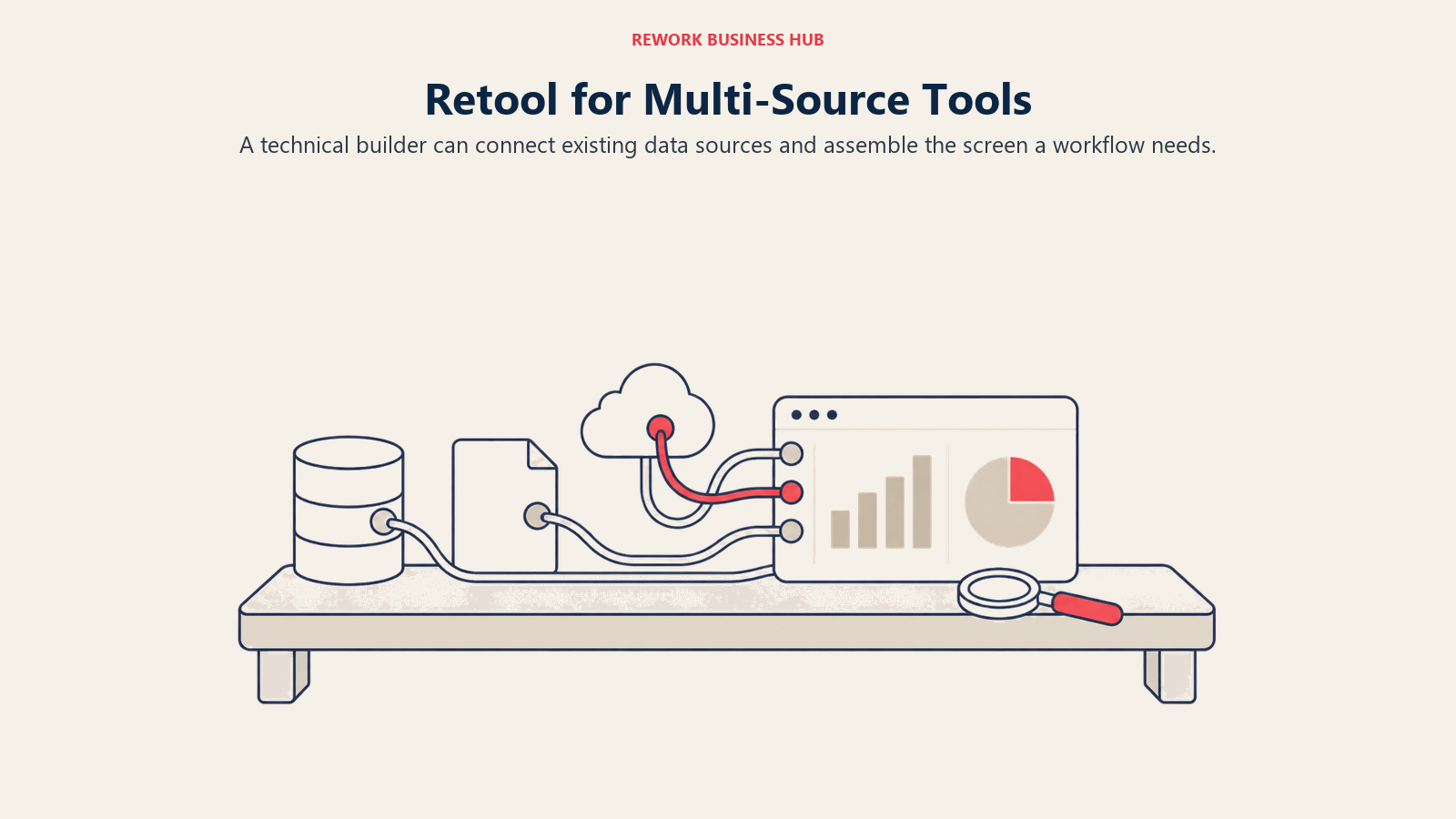
For a Knack refugee that trade is worth naming precisely. Retool is dramatically more capable and dramatically less accessible. If a non-technical ops person built and maintains your Knack app, Retool is not the replacement, whatever the feature list says. If an engineer has been reluctantly maintaining it, Retool will feel like a promotion.
The billing model is the other half of the decision, and it is the opposite shape from Knack's. You pay per builder and again per external user, which is exactly the arithmetic Knack's flat rate avoids. Retool's page also does not say whether a volume band applies marginally or across the whole population, so get that in writing before you model 400 external users.
| What you get | What you don't |
|---|---|
| SQL and JavaScript against any data source | A tool a non-technical owner can maintain |
| Components that assemble into real internal tools | Flat pricing, external users are billed per head |
| A free plan and a low entry price for builders | Clarity on how the volume bands apply |
| The best answer for messy multi-source data | Knack's speed from idea to working portal |
Pricing: A free plan exists. Team is $10 per standard user per month with external end users at $5 per user per month. Business is $50 per standard user per month with end users at $15 per user per month. Published volume end-user tiers run $8 per month for 51 to 250 users and $4 per month above 500, and additional workflow runs are $75 per 5,000 runs per month, per Retool's pricing page. The page did not publish a separate annual rate alongside these figures.
Best for: Engineering-supported teams of 20 to 1,000 building internal tools over data that lives in several systems.
13. Budibase - the app platform you can run inside your own boundary
Budibase is the self-hosting answer in this list. The open source edition runs on your own infrastructure with no licence fee and no user ceiling, which is the closest free equivalent to Knack's unlimited end-user model that exists. For organizations whose security review is harder than their build, that single property outranks everything else on this page.
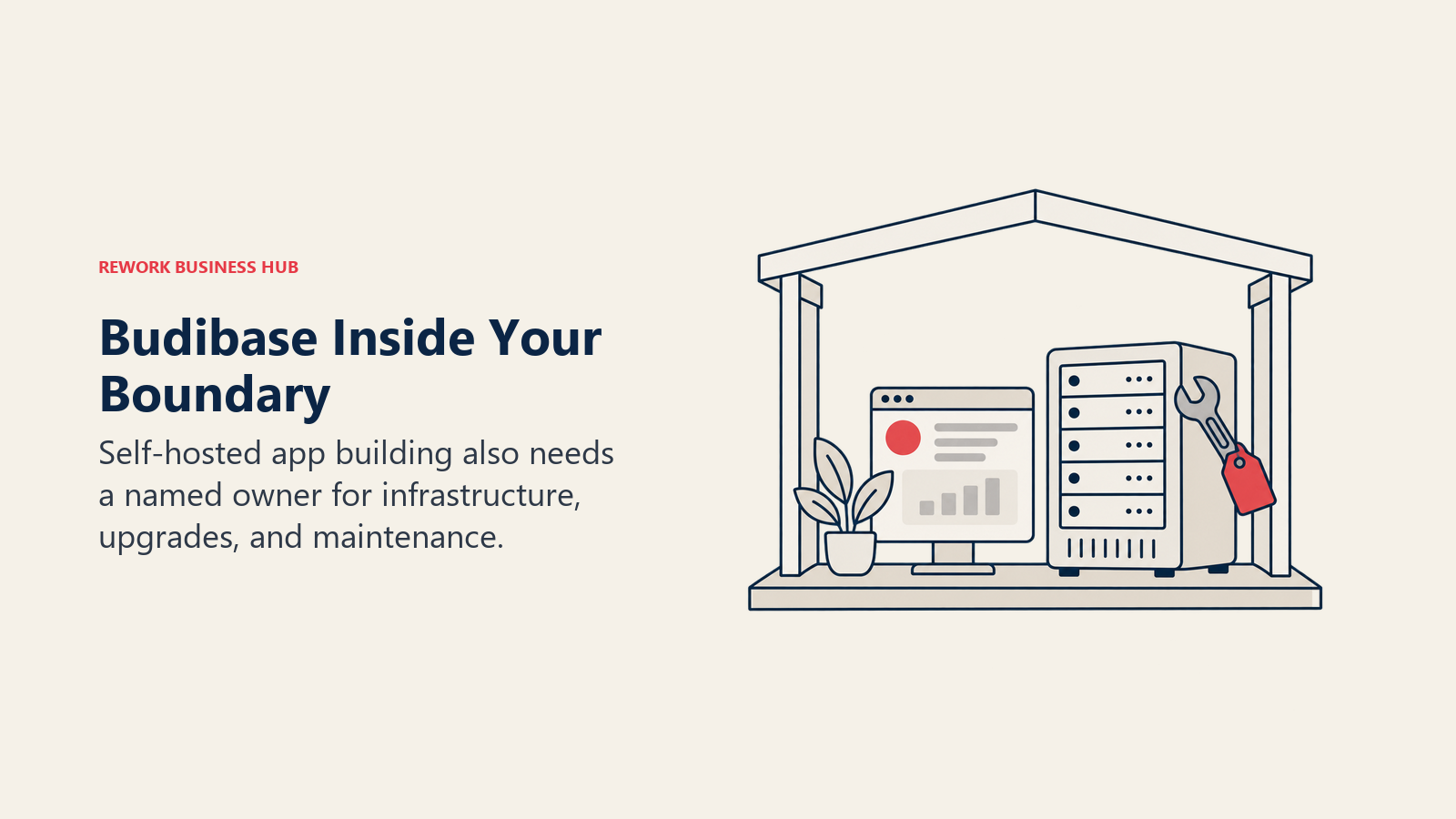
It is a real app platform, not a database with views. Role-based access, forms, automations, and connections to your existing SQL databases, REST APIs, and object storage. Teams that need an internal request portal or an approval workflow inside a network boundary land here regularly, and they land here because nothing else on this list will run in a place with no outbound internet.
The cloud pricing gets expensive in exactly the direction that hurts a Knack replacement, because end users and extra creators are both per-head add-ons on top of the plan fee. A portal with a few hundred outside users on Budibase Cloud costs many times what Knack Pro does. Self-hosted, it costs infrastructure and a named person who owns patching.
| What you get | What you don't |
|---|---|
| A free self-hosted edition with no user ceiling | A cloud price that works for external portals |
| Real role-based access and app-building, not just grids | A managed experience on the free edition |
| Connections to your own SQL, REST, and object storage | Freedom from owning upgrades and patching |
| Deployment inside a closed network boundary | Knack's out-of-the-box portal templates |
Pricing: The open source self-hosted edition is free. Pro is $19 per user per month billed annually and $23 billed monthly. Premium is $49 billed annually and $59 billed monthly. Business is $299 billed annually and $359 billed monthly. Add-ons are $5 per end user per month and $50 per creator per month, per Budibase's pricing page.
Best for: IT teams of 10 to 500 that must host the platform inside their own boundary and have someone to run it.
The "Unlimited Users" Claim, Tool by Tool
Three vendors on this page publish an unlimited-users headline and they do not mean the same thing. This is the table to read twice, because it is where the surprise bills come from.
| Tool | What the unlimited claim covers | Builders or authors included | What actually meters the bill |
|---|---|---|---|
| Knack | Unlimited end-user logins on every plan | Starter includes exactly 1 shared builder; Pro and Corporate are unlimited | Records, apps, and the plan tier |
| Caspio | Unlimited app end users on every plan | Team caps app authors at 5; Business removes the cap | Records and the plan tier |
| Tadabase | No per-user fee at all, for any category of user | Not metered as a separate charge | Apps and records only |
| Bubble | End users are not seats, usage is metered instead | Starter 1 editor, Growth 2, Team 5 | Workload units and editor seats |
| Softr | App users banded by plan rather than licensed | Not the constraint, the band is | The app-user band plus the database underneath |
| Glide | Flat project pricing under GlideOS | Published as project tiers | The project tier plus the database underneath |
| Zoho Creator | Not unlimited, portal users are a paid add-on | Per user | Seats plus a portal add-on from $100/mo |
| Quickbase | Not unlimited, everyone is a user | Per user | Seats plus an unpublished platform minimum |
| Ninox | Not unlimited, everyone is a user | Per user | Seats |
| Airtable | Free for commenters and read-only viewers only | Per editing seat | Editing seats and records per base |
| SmartSuite | Free read-only access, no external portal | Per editing seat, 3 minimum | Editing seats and records per solution |
| Baserow | 500 external app users on Free, Premium, Advanced | Per user | Seats, rows, and the app-user allowance |
| Retool | Not unlimited, external users are billed per head | Per standard user | Builder seats plus banded external users |
| Budibase | Unlimited when self-hosted | Free self-hosted; per creator on cloud | Self-hosted is free; cloud bills end users at $5 |
Knack's headline is honest and the fine print is the part people skip. Unlimited users means unlimited people logging into your app. It has never meant unlimited people editing it, and on Starter the number of those is one.
Total Annual Cost: 3 Builders and 400 External Portal Users
Here is the comparison that decides the question and that almost nobody runs. One concrete build: three people inside your organization who create and edit the app, and 400 people outside it who log in to submit, view, or update their own records. Annual billing where the vendor publishes it, first year, before any underlying database a front-end tool does not include.
| Tool and tier | Estimated annual cost | How the number is built |
|---|---|---|
| Tadabase Starter | $504 | $42/mo billed annually, no per-user fee, 3 apps, 30,000 records |
| Tadabase Growth | $1,260 | $105/mo billed annually, 5 apps, 125,000 records |
| Knack Pro | $1,320 | $110/mo billed annually, unlimited builders, 50,000 records |
| Zoho Creator Standard | From $1,488 | 3 seats at $8/mo billed annually ($288) plus the Customer Portal add-on from $100/mo |
| Caspio Team | $3,240 | $270/mo billed annually, 5 app authors, unlimited end users, 250,000 records |
| Softr Business | $3,948 plus the database | $329/mo billed annually; confirm the tier covers 400 app users, then add the data source |
| Knack Health HIPAA Starter | From $5,988 | From $499/mo, unlimited live app users, unlimited builders, 3 apps, 10,000 records, BAA included |
| Bubble Team | $6,588 | $549/mo billed annually; Growth includes only 2 editors, so 3 needs Team |
| Retool Team | Around $24,360 | 3 standard users at $10/mo plus 400 end users at $5/mo; confirm how the volume bands apply |
| Budibase Cloud Premium | Around $25,788 | $49/mo plus 2 extra creators at $50/mo plus 400 end users at $5/mo, billed annually |
| Quickbase Team | $1,260 at list, plus a minimum | 3 users at $35/mo priced annually; the 400 portal users are users too, and a platform minimum applies |
| Ninox Team | EUR 900 for the builders only | 3 users at EUR 25/mo billed annually excluding VAT; the 400 outside users are also users |
| Budibase self-hosted | $0 in licence | Open source, no user ceiling, cost is infrastructure plus a maintainer |
| Airtable Team | $720, job not done | 3 seats at $20/mo billed annually; the 400 outsiders have nowhere to log in |
| SmartSuite Team | $540, job not done | 3 seats at $15/mo billed annually; no external portal, 5,000 records per solution |
| Baserow Premium | $360, job not done | 3 users at $10/mo billed yearly; the app-user allowance is not a portal layer |
Four things fall out of that table. Tadabase is genuinely cheaper than Knack Pro for the same shape of build and gives you more records, which is the strongest single argument on this page. Knack is not expensive at 400 external users; it is one of the cheapest things that can do the job, and the per-user tools that look cheap in a feature grid cost fifteen to twenty times more at this volume. Bubble's number is high because three editors force the Team tier, not because the platform is expensive. And the bottom three rows look like enormous savings right up until somebody asks how a customer logs in.
Two caveats worth carrying into a negotiation. Retool's public page does not say whether a volume band applies marginally or across the whole population, and Quickbase references a platform minimum it does not publish, so both of those figures are floors rather than quotes.
Stage Fit Matrix
| Tool | Prototype | Live portal under 100 users | Live portal over 500 users | Regulated or audited |
|---|---|---|---|---|
| Caspio | Works | Strong fit | Strong fit | Strong fit |
| Tadabase | Strong fit | Strong fit | Strong fit | Good fit |
| Zoho Creator | Good fit | Good fit | Works, add-on priced | Good fit |
| Quickbase | Limited | Works | Limited by per-user cost | Strong fit |
| Ninox | Strong fit | Works | Limited by per-user cost | Works |
| Bubble | Good fit | Strong fit | Good fit | Limited |
| Softr | Strong fit | Strong fit | Good fit | Limited |
| Glide | Strong fit | Good fit | Works | Limited |
| Airtable | Strong fit | Not on its own | Not on its own | Works internally |
| SmartSuite | Strong fit | Not on its own | Not on its own | Good fit internally |
| Baserow | Strong fit | Limited | Limited | Strong fit if self-hosted |
| Retool | Works | Works | Costly | Strong fit |
| Budibase | Works | Good fit self-hosted | Good fit self-hosted | Strong fit if self-hosted |
Sizing and Persona Table
| Tool | Team size sweet spot | Who buys it | Typical buyer title |
|---|---|---|---|
| Caspio | 20-500 | Teams whose records outgrew Knack Pro | IT Director, Program Manager |
| Tadabase | 2-100 | Knack refugees who needed a second builder | Founder, Operations Manager |
| Zoho Creator | 10-500 | Existing Zoho customers | IT Director, Business Systems Manager |
| Quickbase | 100-5,000 | Regulated and field-heavy operations | VP Operations, IT Director |
| Ninox | 5-100 | European teams needing relational depth | Head of Operations, IT Manager |
| Bubble | 2-50 | Portals where design is part of the product | Founder, Product Lead |
| Softr | 2-50 | Client services and membership businesses | Founder, Client Services Lead |
| Glide | 2-50 | Field, frontline, and inspection teams | Operations Manager, Field Lead |
| Airtable | 5-100 | Internal ops, marketing, and content teams | Ops Manager, Marketing Ops Lead |
| SmartSuite | 10-200 | Ops teams standardizing stage-driven processes | COO, Head of Operations |
| Baserow | 5-150 | Privacy-conscious and EU-based teams | IT Manager, Data Protection Lead |
| Retool | 20-1,000 | Engineering-supported internal tools | Engineering Manager, CTO |
| Budibase | 10-500 | Teams that must host inside their own boundary | IT Manager, Head of Infrastructure |
When Knack Is Still the Right Answer
Most alternatives articles are quietly built to talk you out of the incumbent. This one should not, because Knack holds a combination that is rarer than its dated interface suggests.
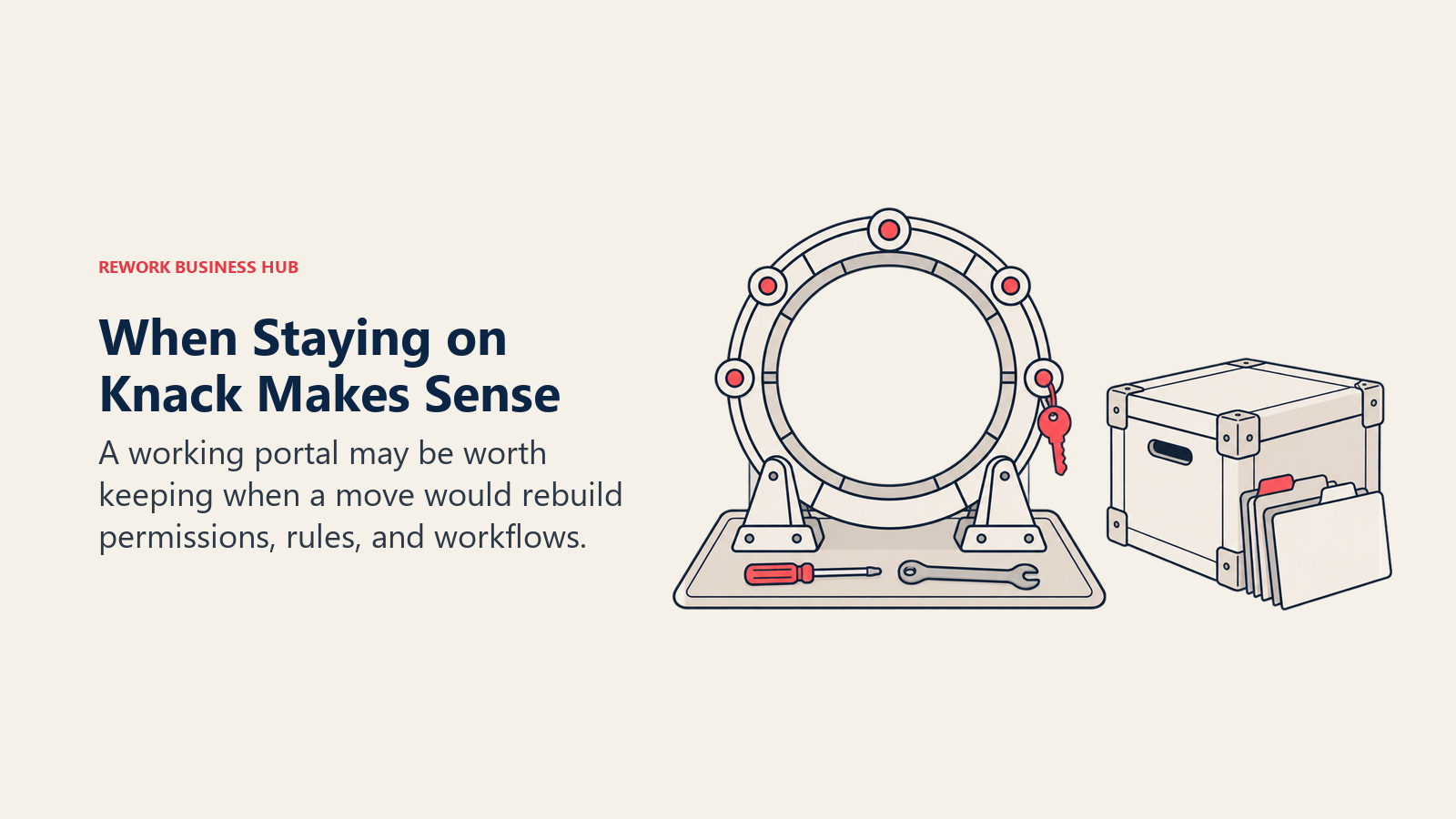
The first thing it holds is flat account pricing with unlimited end-user logins, on the $49 tier as much as the $250 one, though that $49 tier still includes exactly 1 shared builder. Only Caspio and Tadabase match that shape among mainstream tools, and both of those are still the exception rather than the rule. Every per-user platform in this comparison gets dramatically more expensive as your external audience grows, so Knack's cost curve stays flat exactly where the alternatives go vertical.
The second is that the portal layer is built in rather than bolted on. Roles, logins, and record-level visibility rules come from the same product that stores the data. The database-plus-front-end pairs are more modern and more flexible, and they are also two subscriptions, two vendors, two upgrade paths, and one integration you now own. That is a real cost, and it does not appear on any pricing page.
The third is that migration is genuinely expensive. Exporting tables to CSV is the easy part; conditional rules, calculated fields, triggered actions, and per-user filtering are rebuilt by hand every time, and that takes weeks. If your only complaint is aesthetic, Knack Pro plus a design pass is cheaper than any move on this page.
| Stay on Knack if | Leave Knack if |
|---|---|
| Hundreds of outside people log into your app | Fewer than 20 outsiders ever log in |
| Your record count sits comfortably inside the tier | You are pushing the 20,000 or 50,000 ceiling |
| One or two people build and maintain the app | Four people need to edit and Pro still is not enough |
| The complaint is cosmetic and the app works | Design control is part of what you are selling |
| You have no appetite to own a two-tool stack | You already run Airtable and just need a front end |
How to Choose: Decision Framework
Use this after you have narrowed to two or three, not as a substitute for narrowing.
| If you need this... | Choose this | Why |
|---|---|---|
| Knack's model with no builder seat limit | Tadabase | No per-user fee for builders or end users, from $42/mo billed annually |
| Knack's model with far more record headroom | Caspio | 250,000 records on Team at $270/mo billed annually, unlimited end users |
| A portal that looks like a product | Bubble | Real design control, though Starter includes only 1 editor |
| The fastest fix for a dated interface | Softr | A branded portal on your existing data, from $19/mo billed annually |
| A portal used on a phone in the field | Glide | The best mobile output here, published from $25/mo |
| Apps sitting on records already in Zoho | Zoho Creator | Native access at $8/user/mo annually, plus a portal add-on |
| Governance, audit trails, and IT control | Quickbase | Published SOC 1, SOC 2, and SOC 3 attestations, from $35/user/mo priced annually |
| Relational depth for a European team | Ninox | Genuine relational modelling from EUR 25/user/mo billed annually |
| A signed BAA without an enterprise negotiation | Knack Health or Caspio | Knack Health from $159/mo with a BAA included on every plan |
| An internal database, because nobody outside logs in | Airtable or SmartSuite | Cheaper, better at internal work, and honest about what they are |
| To own the data and the server | Baserow or Budibase | Self-hostable, with Baserow's core under MIT Expat |
| Logic no visual builder can express | Retool | SQL and JavaScript against any source, from $10/standard user/mo |
If it turns out the thing you are building is document-shaped rather than record-shaped, best Notion alternatives and notion vs airtable are the better starting points, and best SmartSuite alternatives covers the process-driven end of the database market.
Frequently Asked Questions about Knack Alternatives
Does Knack really include unlimited users?
Unlimited end users, yes, on every plan including Starter. Unlimited builders, no. Knack Starter includes exactly 1 shared builder, and unlimited builders arrive on Pro at $110 per month billed annually. Any comparison that prints "unlimited users" for Knack without naming the builder count is telling you half the story, and it is the half that decides whether Starter works for your team.
What is the cheapest Knack alternative that also has no per-user fee?
Tadabase, and it is cheaper than Knack itself. Tadabase Starter is $42 per month billed annually with 3 apps and 30,000 records against Knack Starter's $49 with 3 apps and 20,000 records, and its pricing page states there are no per user fees of any kind. That means the second person who needs to edit the app does not force a tier upgrade, which is the specific thing that pushes most people off Knack Starter.
Is Caspio a straight upgrade from Knack?
Structurally yes, financially only above a certain size. Both price per account with unlimited app end users, so the billing shape you liked is preserved. But Caspio Team is $270 per month billed annually against Knack Pro's $110, and Caspio caps app authors at 5 on Team where Knack Pro leaves builders unlimited. You are buying record headroom, 250,000 against 50,000, and a productised compliance edition.
Can Airtable replace Knack?
Only if nobody outside your organization logs in. Airtable is an internal database with per-seat billing, no per-record rules for external users, and no real portal. Pair it with Softr or Glide and it becomes a genuine replacement, but then you are pricing two subscriptions and owning the integration between them. Airtable Team is $20 per seat per month billed annually and Softr Basic is $19 per month billed annually, so the pair is not automatically cheaper than Knack Pro.
What is the $19 price I keep seeing on Knack's pricing page?
A promotion, not the price. Knack advertises 66% off the first three months for new monthly customers, which produces $19 for Starter and $49 for Pro during that window only. The real Starter rate is $49 per month billed annually or $59 billed monthly, and Pro is $110 billed annually or $130 billed monthly. Budget from the renewal figure, not the introductory one.
Which Knack alternatives will sign a HIPAA BAA?
Knack's own Knack Health line publishes three plans that all include a signed BAA, starting at $159 per month for HIPAA Forms and $499 per month for HIPAA Starter, both with unlimited live app users and no per-user pricing, though HIPAA Forms includes 1 additional builder where HIPAA Starter makes builders unlimited. Caspio's HIPAA Edition starts at $800 per month on a one-year term with no per-user fees and a signed BAA. Tadabase publishes a HIPAA edition at $450 per month. Quickbase incorporates a BAA for Business and Enterprise customers on annual or multi-year subscriptions, alongside SOC 1, SOC 2, and SOC 3 attestations. Outside those, the list gets short fast.
How long does it take to migrate off Knack?
Plan two to four weeks for a like-for-like move to Caspio or Tadabase, and four to eight for a rebuild on Bubble or a database-plus-front-end pair. CSV export carries the tables and basic field types in a day. What consumes the schedule is the logic: conditional rules, calculated fields, triggered actions, and per-user filtering are rebuilt by hand every time. Prove your hardest screen works before you commit to a date.
What to Do Next
Before you compare another feature grid, write down three numbers: how many people log into your app who are not on your payroll, how many records your largest table holds, and how many people need to edit the app. Those three figures eliminate most of this list in about a minute. Zero outsiders sends you to Airtable, SmartSuite, or Baserow and cuts the bill by most of it. A few hundred outsiders narrows you to Caspio, Tadabase, Softr, or staying put. And if the answer to the third question is two, you have found the real reason Knack Starter stopped working.
Then run one test instead of three demos. Take the single most complicated screen in your current app, the one with conditional logic and per-user filtering, and rebuild only that screen in your top two candidates. Give it one working day. Whatever breaks in that day is what will break during the real migration, and it will tell you more than a month of sales calls.
Related Resources:

Customer Success Operations Manager
On this page
- Key Facts
- Quick Comparison Table
- Why People Actually Leave Knack
- Three Jobs Hide Behind One Search
- 1. Caspio - the same billing shape with real headroom
- 2. Tadabase - the closest match, and genuinely no per-user fee
- 3. Zoho Creator - the cheapest route if you already run Zoho
- 4. Quickbase - the step up when governance outranks price
- 5. Ninox - the European option with a real relational engine
- 6. Bubble - when the portal has to look like a product
- 7. Softr - the fastest fix for a dated interface
- 8. Glide - when the portal lives on a phone
- 9. Airtable - the database half, with the biggest ecosystem
- 10. SmartSuite - the database half with process already built in
- 11. Baserow - the database half you can host yourself
- 12. Retool - when a query solves what the builder cannot
- 13. Budibase - the app platform you can run inside your own boundary
- The "Unlimited Users" Claim, Tool by Tool
- Total Annual Cost: 3 Builders and 400 External Portal Users
- Stage Fit Matrix
- Sizing and Persona Table
- When Knack Is Still the Right Answer
- How to Choose: Decision Framework
- What to Do Next