Best Caspio Alternatives in 2026: 13 Low-Code App Builders Compared
Turn this article into takeaways for your work.


Each assistant summarizes the article only for you and suggests best practices for your work.
If you are leaving Caspio because the entry price is too high for a small team, Knack is the closest honest swap and it costs a fraction as much. If you need the same compliance conversation Caspio was built for, Knack Health and Quickbase are the two that publish a signed BAA. And if you have quietly realised you never needed a deployed application at all, only a shared internal database, Airtable, SmartSuite, and Baserow are cheaper and better at that job than any app platform. Every tool below was evaluated on billing model, external user handling, compliance posture, and total annual cost for a real scenario, with each price taken from the vendor's own pricing page and clearly labelled where a vendor publishes none.
It is written for IT directors, ops leads, and program managers at organizations of 10 to 500 people, either renewing a Caspio contract or shopping before signing one. One warning first. Most articles in this category compare per-seat prices against Caspio's platform price and call Caspio expensive, which is close to meaningless. Caspio charges for app authors and gives you unlimited app end users on every plan. A per-seat tool charges everyone who logs in. Those models produce completely different bills at 500 external users, which is what the cost table below normalises.
Key Facts
- Gartner forecast the low-code application platform segment alone at nearly $10 billion in 2023, growing 25% year over year, inside a wider low-code technologies market forecast to reach $44.5 billion in 2026 at roughly 19% annual growth, per Gartner as reported by InfoWorld.
- By 2026, developers outside formal IT departments will account for at least 80% of the user base for low-code development tools, up from 60% in 2021, per Gartner.
- A composite 30,000-employee organization modelled in Forrester's Total Economic Impact study of Microsoft Power Apps saw a 206% three-year ROI, payback in under six months, and a 50% reduction in professional developer application development time, per the Forrester TEI study commissioned by Microsoft.
- IT teams spend 39% of their time building custom integrations, and 90% of organizations report business obstacles caused by data silos, per the 2025 MuleSoft Connectivity Benchmark Report, which surveyed 1,050 IT leaders.
- Companies that empower citizen developers score 33% higher on innovation than bottom-quartile companies, per McKinsey's Developer Velocity research.
The category grows because the backlog is real. The platforms that win are the ones that let non-IT staff ship something without opening a ticket.
Quick Comparison Table
| Tool | Best For | Starting Price | Pricing Model | Key Limitation |
|---|---|---|---|---|
| Knack | The direct Caspio swap at a fraction of the floor | $49/mo billed annually | Per account, unlimited logins, record capped | Dated builder; record ceilings on entry plans |
| Zoho Creator | Companies already standardized on Zoho | Around $8/user/mo annually (reported) | Per user, portal licensing quoted | No prices rendered on the public page |
| Quickbase | Regulated enterprise operations with governance | Around $35/user/mo annually, 20-seat minimum (reported) | Per user with a hard seat floor | Seat minimum blocks small teams entirely |
| Softr | Branded client portals on a database you already have | Basic $19/mo billed annually, $329 at 500 client users | Per plan, banded by builder and app-user count | Front end only; you still pay for the database |
| Glide | Mobile-first field and frontline apps | Free (1 project); Solo $25/mo; Team $125/mo | Per project and member, metered in credits | Annual rates not published; credit metering |
| Budibase | Self-hosted app platform inside your own boundary | Open source self-hosted free; Pro $19/mo yearly | Free self-hosted, or per creator plus end user | Cloud end-user pricing gets expensive fast |
| Appsmith | Open source with a clear commercial upgrade | Free up to 5 users; Business $15/user/mo | Per user, enterprise flat above 100 | Enterprise jump is steep at $2,500/mo |
| Retool | Teams with a developer and messy multi-source data | Free up to 5 users; Business builders $50/mo annually | Per builder plus banded external users | External user cost dwarfs the builder cost |
| Airtable | Internal database only, biggest ecosystem | Free (1,000 records/base); Team $20/seat/mo annually | Per editing seat | No real external logins; record caps per base |
| SmartSuite | Internal ops database with process built in | $15/seat/mo annually (3-seat minimum) | Per editing seat, read-only free | No external portal; smaller ecosystem |
| Baserow | Internal database with full data ownership | Free (3,000 rows); $10/user/mo annually | Per user, or free when self-hosted | No portal layer; automation depth trails |
| NocoDB | A UI on the SQL database you already run | Free self-hosted; $12/user/mo annually | Per user, unlimited when self-hosted | Setup assumes technical comfort |
| Teable | Internal database on a real Postgres store | Free (1,000 rows); $13/seat/mo annually | Per seat | Youngest product here; no portal layer |
Two Different Products Hide Behind One Search
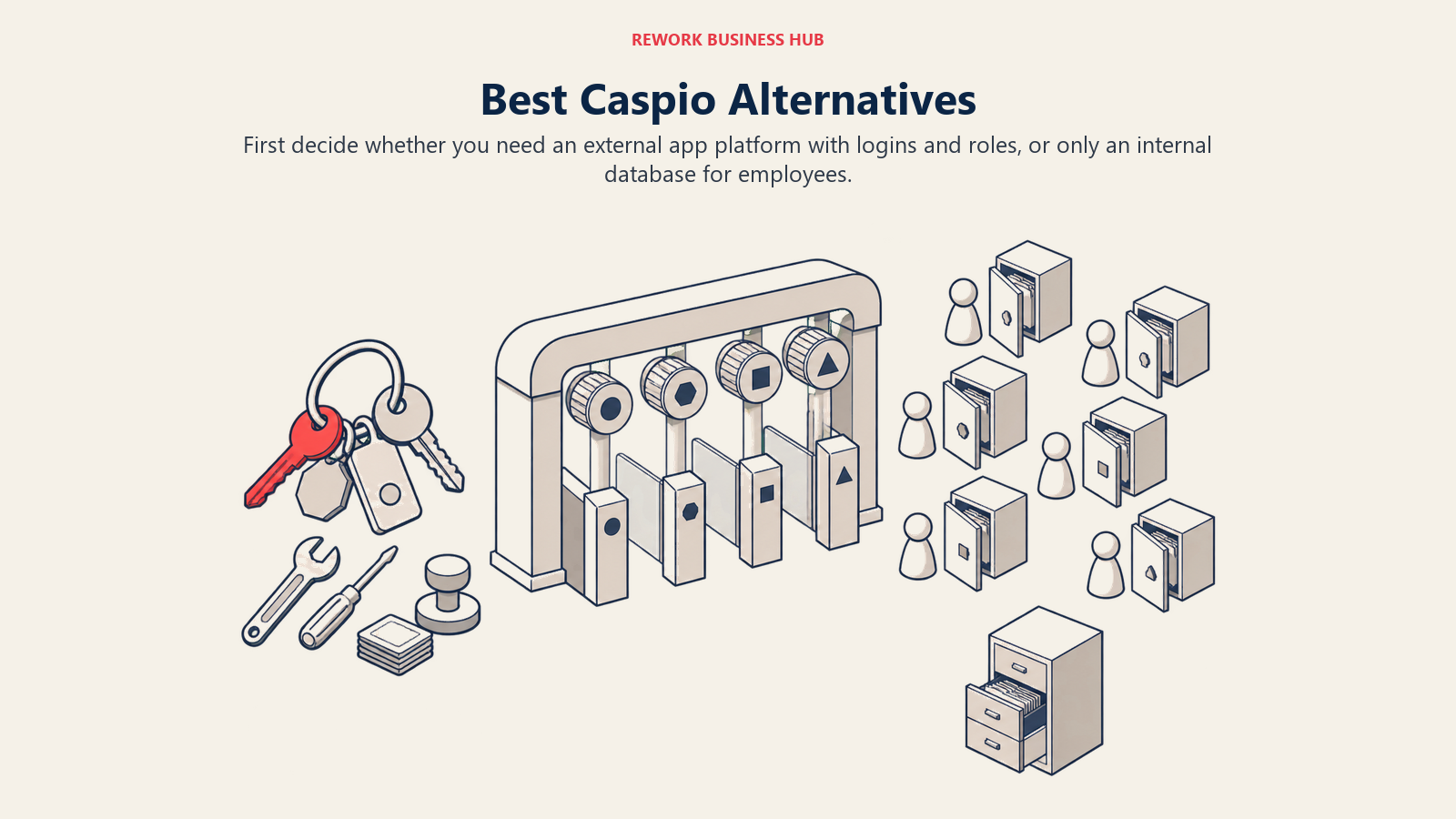
Almost every unhappy Caspio evaluation traces back to the same confusion. "Caspio alternative" returns two categories of tool that do not do the same job, and picking from the wrong one is how a migration fails six weeks in.
Caspio is an online database application platform. You model data, assemble DataPages, and deploy something outside people log into: a patient intake form, a member directory, a grant portal, a contractor compliance tracker. The people using it mostly do not work for you. An internal database tool, by contrast, gives your own staff a nice grid over shared records, with no real concept of an outside user who has a login, a role, and a rule saying they see only their own rows.
| Application platforms (replace all of Caspio) | Internal databases (replace half of Caspio) | |
|---|---|---|
| Tools | Knack, Zoho Creator, Quickbase, Softr, Glide, Budibase, Appsmith, Retool | Airtable, SmartSuite, Baserow, NocoDB, Teable |
| Who logs in | Staff plus customers, members, patients, contractors | Your own employees |
| Access control | Roles, record-level rules, per-user data scoping | Workspace and table permissions |
| Billing driver | Builders, records, or app-user bands | Editing seats |
| What breaks without it | You cannot deploy anything customer-facing | Nothing, if the app was always internal |
The test takes a minute. Count how many people who log into your Caspio app are not on your payroll. If the answer is zero, skip the application-platform half of this list, because you are paying platform prices for a spreadsheet job. If it runs into the hundreds, the internal database tools cannot help you no matter how much cheaper they look, and the best no-code database software guide maps where that line sits across the wider market.
1. Knack - the direct swap when Caspio's floor is too high
Knack is the tool most Caspio refugees actually land on, because it is the only other mainstream platform built around the same idea: flat account pricing with unlimited logins. You define objects and fields, then build pages with logins, roles, and rules on top. Members see their own records. Staff see everything. Nobody gets a seat licence.
The price difference is the whole story. Caspio Team starts at $270 a month billed annually; Knack Starter is $49 with 20,000 records and 3 apps, and Pro is $110 with 50,000 records and unlimited apps. For a portal with a few hundred external users and modest record volume, that is roughly a fifth of the cost for the same billing shape. What you give up is polish. The builder feels older than Caspio's, design control is limited, and record ceilings arrive sooner than expected once you start logging events rather than entities.
| What you get | What you don't |
|---|---|
| Flat account pricing with unlimited logins | A modern, fast builder interface |
| Real roles and record-level visibility rules | Generous record allowances on entry plans |
| A separate HIPAA product line with BAA included | Deep design or front-end control |
| A short path from idea to a working portal | Caspio's DataPage-level structure and governance |
Pricing: Starter is $49 per month billed annually, $59 billed monthly, with 20,000 records, 3 apps, and 2 GB storage. Pro is $110 per month billed annually, $130 billed monthly, with 50,000 records and unlimited apps. Corporate starts at $250 per month billed annually with 125,000 to 2.5 million records. Promotional first-term rates were advertised alongside those numbers on Knack's pricing page in August 2026, so confirm what applies at renewal. Separately, Knack Health HIPAA Starter begins at $499 per month with a signed BAA, unlimited users, unlimited builders, 3 apps, and 10,000 records, per Knack Health's pricing page.
Best for: Teams of 2 to 50 running an external-facing portal who want Caspio's billing model at a small-team price.
2. Zoho Creator - the right answer only if you already run Zoho
Zoho Creator is a genuine low-code application platform, not a spreadsheet hybrid. You model data, then generate web and mobile apps with workflow logic written in Deluge, Zoho's scripting language. It builds real customer-facing apps, and it does mobile better than Caspio does.
The reason to pick it is almost never the builder. It is that your CRM, help desk, books, and HR records already live in Zoho, and Creator reads them natively instead of through an integration you maintain. That MuleSoft finding about IT burning 39% of its time on custom integrations is exactly the tax you avoid by staying inside one vendor's data model. If you hold a Zoho One licence, Creator may already be included, which would make it the cheapest option on this page. Check before buying anything else. If you are not a Zoho customer the calculus inverts: Deluge is another language to learn, and the vendor will not tell you the price without a conversation.
| What you get | What you don't |
|---|---|
| Native access to Zoho CRM, Books, Desk, and People | A reason to buy it if you are not on Zoho |
| Real mobile app generation, not just responsive pages | A published price you can budget against |
| Workflow scripting with genuine logic depth | A modern, delightful building experience |
| Possibly zero marginal cost on Zoho One | A large independent consultant community |
Pricing: Zoho Creator's public pricing page lists Standard, Professional, Enterprise, and a custom Flex plan, plus a free edition limited to one app and a 15-day trial. Third-party listings (reported) put Standard at around $8 per user per month, Professional at around $20, and Enterprise at around $25, all billed annually, per Capterra's Zoho Creator pricing listing. External portal user licensing is quoted rather than published. Confirm everything with Zoho before budgeting.
Best for: Companies of 10 to 500 already standardized on Zoho who want apps sitting directly on existing records.
3. Quickbase - the step up when governance matters more than price
Quickbase is where you go when you are leaving Caspio upward rather than sideways. It is the oldest platform in this market and the maturity shows in the parts auditors care about: sandbox and production separation, audit logging, role-based control, and hundreds of interconnected applications running across one large organization without turning into shadow IT.
Its compliance posture is the closest thing here to Caspio's. Quickbase publishes SOC 1, SOC 2, and SOC 3 attestations, a HIPAA attestation with BAAs for business and enterprise subscribers on annual or multi-year contracts, TX-RAMP Level 2, CSA STAR Level 2, and GDPR compliance on its trust and compliance page. Construction, manufacturing, and large services firms run field operations on it that outgrew spreadsheets years ago. The catch is access: no self-serve path, no published price, and a seat minimum that rules out exactly the small team that found Caspio expensive.
| What you get | What you don't |
|---|---|
| Mature governance, audit, and environment separation | Any published self-serve price |
| SOC attestations, HIPAA BAA, TX-RAMP Level 2 | Access below the seat minimum |
| Proven at hundreds of apps in one organization | A fast, low-commitment evaluation |
| Strong field operations track record | A modern interface by 2026 standards |
Pricing: Quickbase routes buyers to sales. Reported figures put Team at around $35 per user per month billed annually with a 20-user minimum (roughly $8,400 a year) and Business at around $55 per user per month with a 40-user minimum (roughly $26,400 a year), per The Digital Project Manager's Quickbase pricing breakdown. Treat those as (reported) and get a written quote.
Best for: Operations organizations of 100 to 5,000 that need governance more than they need speed or a low floor.
4. Softr - the modern builder Caspio's interface is losing to
Softr exists because plenty of teams have the data problem solved and the interface problem wide open. It sits on a source you already run, usually Airtable, Google Sheets, HubSpot, or its own included store, and turns it into a branded, permissioned client portal or membership site in an afternoon. If the complaint that pushed you off Caspio was that the output looks like 2014, this is the most direct answer here.
The billing model is closer to Caspio's than to a per-seat tool. Softr bands by app-user count per plan rather than charging per licence, so a portal with 300 clients is a plan tier, not a line-item explosion. The mistake to avoid is treating Softr as your system of record. It is a front end. If the data lives in Airtable, you inherit Airtable's record caps and Airtable's bill underneath the Softr subscription, so price the pair together rather than comparing the Softr number alone against Caspio.
| What you get | What you don't |
|---|---|
| A genuinely modern, brandable portal in hours | A database of its own worth relying on |
| App-user banding rather than per-seat licensing | Compliance positioning for regulated builds |
| Good client portal and membership primitives | Deep workflow logic or scripting |
| Fast iteration without developer time | A single bill; you pay for the data layer too |
Pricing: Free covers 3 builders and 5 app users combined. Basic is $19 per month billed annually or $25 monthly, with 1 builder. Pro is $99 annually or $119 monthly, with 2 builders and up to 250 client users. Business is $329 annually or $395 monthly, with 3 builders and up to 500 client users. Enterprise is custom, per Softr's pricing page. Builder seats and app-user counts are the real cost drivers, not editor seats.
Best for: Teams of 2 to 50 who need a good-looking client portal this month and already have somewhere to keep the data.
5. Glide - when the app needs to work on a phone in the field
Glide solves the one job Caspio has never been graceful at: a genuinely good mobile experience for people who are not sitting at a desk. Technicians, inspectors, drivers, and site supervisors get an app that behaves like an app rather than a responsive web page, and you build it from a table rather than a mobile framework.
Glide rebuilt in 2026 around GlideOS with flat project-based pricing instead of the old per-app fees, which removed the most common budgeting complaint about it. What replaced that complaint is credit metering: usage consumes credits allocated per member and per plan, so heavy external usage is less predictable than Caspio's flat unlimited-users promise. Annual rates are not published either, only monthly. For an internal field app with a known headcount that is a non-issue. For a public app with unpredictable traffic, model the credits before you commit.
| What you get | What you don't |
|---|---|
| The best mobile output in this comparison | Predictable cost under unpredictable usage |
| Flat project pricing after the 2026 GlideOS rebuild | Published annual billing rates |
| Very fast build cycle from an existing table | A compliance story for regulated data |
| A real database included on paid plans | Deep governance or audit tooling |
Pricing: Free covers 1 project with limited credits. Solo is $25 per month with 5 projects, 25 GB storage, and a database included. Team is $125 per month starting at 5 members with 50 credits per member, 100 GB storage, and unlimited apps. Enterprise is custom, per Glide's pricing page. Annual rates are not listed.
Best for: Teams of 2 to 50 building mobile-first internal or field apps where the users are known and countable.
6. Budibase - the open source app platform you can host inside your own boundary
Budibase reframes the compliance question instead of buying an answer to it. Rather than paying for a vendor's HIPAA edition, you self-host the platform inside infrastructure your organization already controls and already had assessed. For teams whose blocker was a data-residency clause or a policy about where records physically live, that is often faster than a vendor security review, and the self-hosted open source edition is free with unlimited users and unlimited apps.
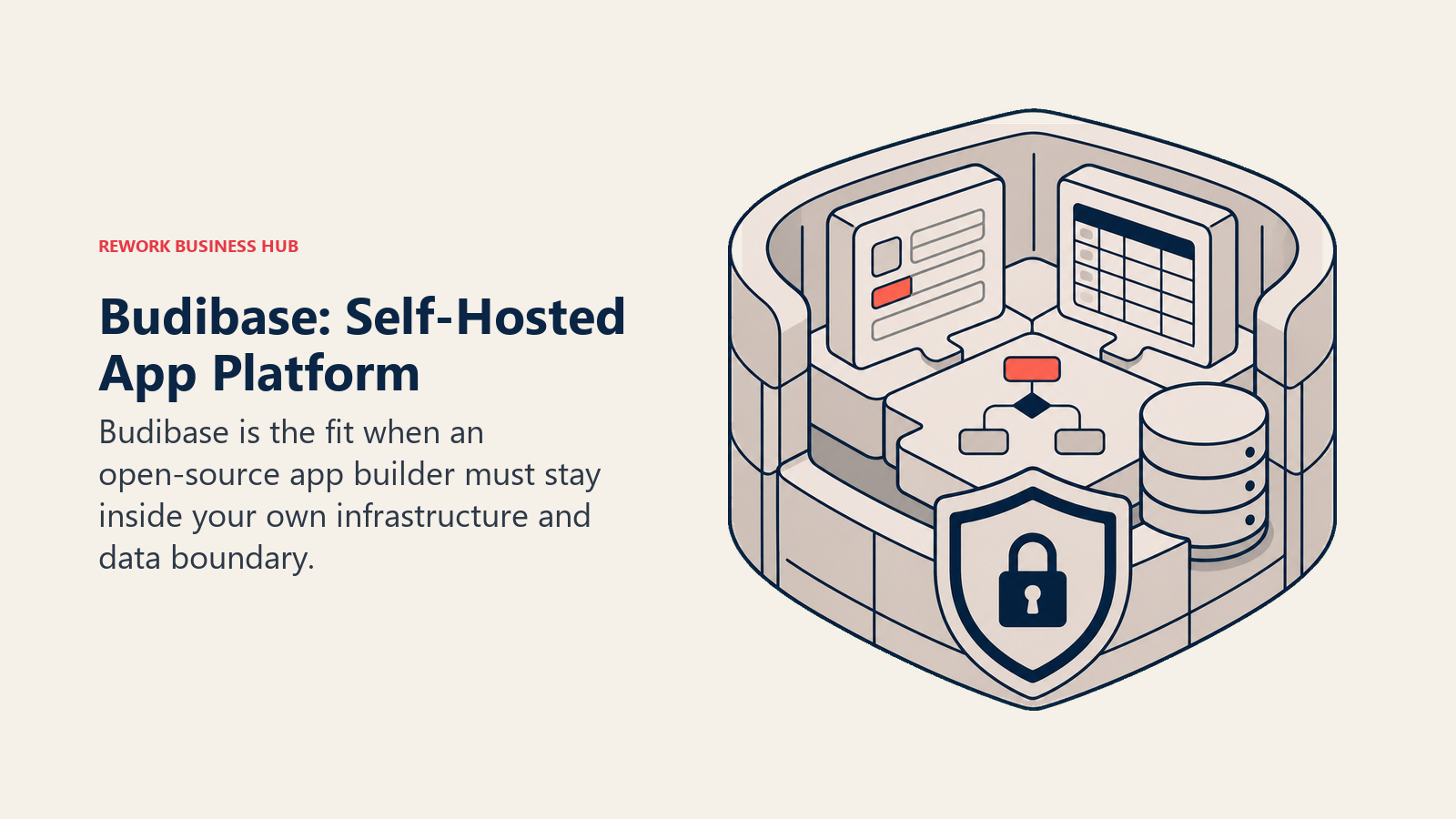
It is a real app builder, not a database with forms bolted on: internal tables or an external source, a screen designer, role-based access, and automations. The trap is the cloud pricing, which behaves nothing like the self-hosted edition. Extra creators cost $50 each per month and end users $5, so a 500-user external app on cloud lands in five figures annually while the identical self-hosted build costs infrastructure and a maintainer. Pick the deployment model deliberately; the two are priced as though they were different products.
| What you get | What you don't |
|---|---|
| Free, unlimited self-hosted open source edition | Cheap external users on the cloud plans |
| Full control of where the data physically sits | Vendor compliance certificates to hand an auditor |
| A real screen designer with role-based access | A managed service unless you pay for one |
| No licence ceiling on users when self-hosted | Someone else to page when the server misbehaves |
Pricing: Self-hosted open source is free with unlimited actions, unlimited apps, and unlimited users on one workspace. Pro is $19 per month billed yearly (1 creator). Premium is $49 per month yearly with 1 creator included and additional creators at $50 per creator per month, plus end users at $5 per user per month. Business is $299 per month billed yearly with 3 creators. Budibase lists the same headline price on monthly and yearly billing, while its own page notes that monthly values are calculated as the yearly price plus 20%, so confirm the billed amount on your quote, per Budibase's pricing page.
Best for: Organizations of 10 to 500 with an infrastructure owner who would rather host the platform than audit a vendor.
7. Appsmith - open source with an honest commercial upgrade path
Appsmith belongs in the same conversation as Budibase and gets picked for a slightly different reason. It leans harder toward internal tools built on data already spread across several systems, and suits people who write some SQL and JavaScript. Drag components onto a canvas, then write real queries behind them. Nothing about the data source is off limits.
For a Caspio refugee the specific draw is the airgapped edition on Enterprise, which matters for defence, healthcare, and public sector work where even a private cloud is a difficult conversation. Pricing is unusually legible too: free up to 5 users on cloud, then a flat $15 per user per month on Business up to 99 users, with builders billed as ordinary users rather than at a premium. The gap is the enterprise jump. Crossing 100 users moves you to a $2,500 per month floor, a cliff rather than a slope, which makes Appsmith an awkward fit for exactly the high-external-user pattern Caspio handles for free.
| What you get | What you don't |
|---|---|
| Open source core with a self-hosted path | A cheap route past 100 users |
| Flat per-user pricing with no builder premium | A no-code experience for non-technical staff |
| Airgapped edition available on Enterprise | Caspio's unlimited external user model |
| Any data source, with SQL and JavaScript escape hatches | Prebuilt compliance editions below Enterprise |
Pricing: Free covers up to 5 users on cloud with 5 workspaces and 3 Git repos. Business is $15 per user per month for up to 99 users, with builders billed as standard users. Enterprise is $2,500 per month starting at 100 users, with SAML and OIDC SSO, SCIM, CI/CD, and the airgapped edition, per Appsmith's pricing page.
Best for: Technical teams of 20 to 100 who want open source with a clear paid tier, and who keep external user counts modest.
8. Retool - when a query solves what the no-code builder cannot
Retool is the endpoint for teams that hit a wall inside a no-code platform and realised the wall was five minutes of SQL wide. It is low-code by design: drag components, then write queries and JavaScript to make them do real work against any API or database. Ops teams end up here for one of two reasons. Either the logic got too specific for a visual builder, or the data sits in four systems and no single-source tool can see all of it.
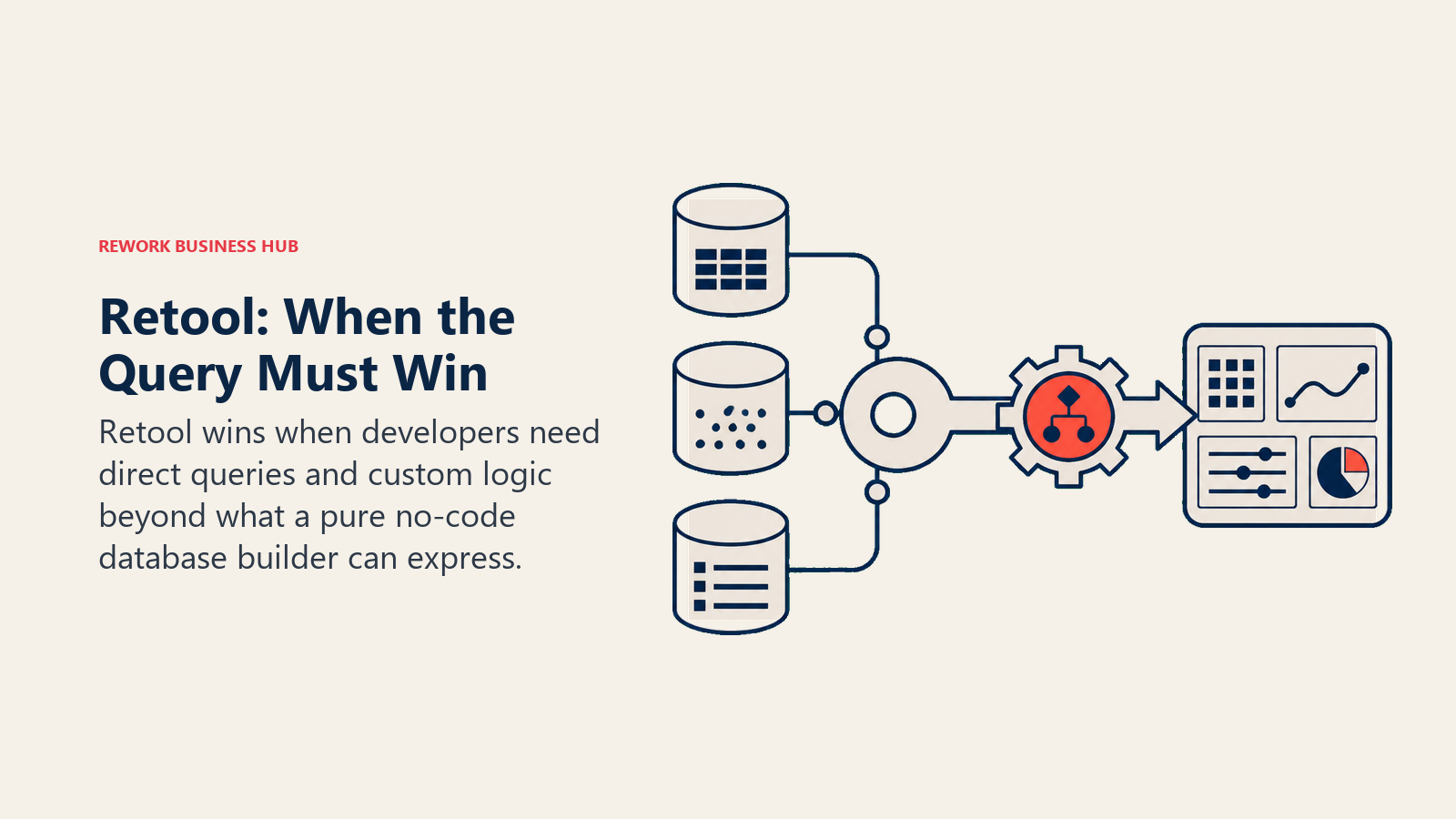
Understand the billing before you fall for the demo. Retool prices builders, internal users, and external users separately, and external users are where the shape diverges hardest from Caspio. Business builders are $50 per month billed annually, internal users $15, and external users are banded: free up to 50, then $8 for 51 to 250, $6 for 251 to 500, and $4 above 500. The first 50 external users are genuinely generous. The 500th is not. If your Caspio app serves hundreds of outside people, Retool is the most expensive replacement on this page, and the cost table shows by how much.
| What you get | What you don't |
|---|---|
| No ceiling on data source, API, or logic | A tool a non-technical buyer can own alone |
| The first 50 external users at no charge | Affordable pricing at hundreds of external users |
| Cloud or self-hosted with the same tiers | Caspio's flat unlimited-user promise |
| Excellent developer ergonomics and Git workflows | A build path that avoids engineering time |
Pricing: Free covers up to 5 users and 500 workflow runs a month. Team bills builders at $10 per month annually ($12 monthly) and internal users at $5 ($7 monthly). Business bills builders at $50 per month annually ($65 monthly) and internal users at $15 ($18 monthly). External users on Business are free from 0 to 50, then $8 per month annually for 51 to 250, $6 for 251 to 500, and $4 above 500, per Retool's pricing page.
Best for: Engineering-supported teams of 20 to 1,000 building internal tools, with fewer than about 50 external users.
9. Airtable - the internal database, if that is all you actually needed
Everything from here down replaces only half of Caspio, and that is the point. Airtable is the category default for internal structured data: a familiar grid, real relational links, and alternate views (kanban, calendar, gallery, Gantt) on the same records. More templates, extensions, consultants, and automation recipes exist for it than for the rest of this list combined.
For a team discovering their Caspio app was only ever used by eleven employees, Airtable is a large cost cut and a usability upgrade at once. Just be clear about what disappears. No external logins with record-level rules, guest access is not a portal, and record caps arrive by tier: 1,000 on Free, 50,000 per base on Team, 125,000 on Business. If any part of your build serves outside users, Airtable cannot take it, and best Airtable alternatives covers where teams go when the caps or seat costs bite.
| What you get | What you don't |
|---|---|
| The largest ecosystem in this category | Any real external user portal |
| Genuinely good relational modeling | Generous record limits at any tier |
| Interfaces for simple internal app front ends | Predictable cost as headcount grows |
| Read-only collaborators and form submitters at no charge | Compliance positioning for regulated builds |
Pricing: Free covers 1,000 records per base. Team is $20 per seat per month billed annually with 50,000 records per base. Business is $45 per seat per month billed annually with 125,000 records per base. Enterprise Scale is custom. All paid plans bill per seat with edit permissions; read-only collaborators, form submissions, and share links are not charged, per Airtable's pricing page.
Best for: Internal teams of 5 to 100 whose Caspio app never had an external user in it.
10. SmartSuite - the internal database with the process already built in
SmartSuite is what to look at when the internal half of your Caspio build was really a workflow: an approval chain, a request queue, an onboarding checklist. It has the same relational shape as Airtable (solutions contain apps, apps contain records, records link across apps) with far more work-management scaffolding in the box: workflow statuses, checklists, time tracking, timeline views, and a permission model built for many departments in one workspace.
Record headroom is the practical advantage over Airtable, at 5,000 per solution on Team, 100,000 on Professional, and 400,000 on Enterprise. Read-only users, commenters, and form submitters are not billed at all, which matters more than it sounds when most of the organization only reads dashboards. What it does not do is external app users, so the Airtable caveat applies. Best SmartSuite alternatives covers the reverse direction if you land here and later outgrow it.
| What you get | What you don't |
|---|---|
| Much higher record limits than Airtable per tier | External logins with record-level rules |
| Free read-only users, commenters, and form submitters | A large consultant and template ecosystem |
| Process features (statuses, checklists, time tracking) | Name recognition your next hire arrives with |
| Multi-department permissions in one workspace | A permanent free tier on the public page |
Pricing: Team is $15 per seat per month billed annually, $20 billed monthly, with a 3-user minimum and 5,000 records per solution. Professional is $32 per seat per month billed annually, $36 monthly, with a 5-user minimum and 100,000 records per solution. Enterprise is custom with 400,000 records per solution. Read-only users, commenters, and form submitters are not charged, per SmartSuite's pricing page.
Best for: Ops teams of 20 to 200 replacing an internal Caspio app that was really a process.
11. Baserow - full data ownership without the platform price
Baserow answers the version of the Caspio complaint that is not about money at all. Some teams are on Caspio because a policy says the records must sit somewhere specific, and a managed platform was the only vendor that would discuss it. Self-hosting Baserow makes that question yours to answer, and the row ceilings, seat ceilings, and residency debates go with it.
The interface is close enough to Airtable that anyone productive in one is productive in the other within an hour, and cloud plans are priced sanely for teams that do not want to run infrastructure. Above roughly 30 users the self-hosted math wins outright, swapping per-seat fees for infrastructure and a maintainer. The gap is automation depth and the integration catalogue, both younger than Airtable's, so expect to lean on webhooks more often. Best Baserow alternatives walks through the trade when that gap starts to hurt.
| What you get | What you don't |
|---|---|
| Open source with a real self-hosted path | An external user portal of any kind |
| No row ceiling when you run it yourself | Airtable's automation and extension depth |
| A clear EU data-residency story | Vendor compliance certificates on the free tier |
| Familiar grid UX with a short learning curve | Managed support unless you buy enterprise |
Pricing: Free gives 3,000 rows per workspace. Premium is $10 per user per month billed yearly, $12 monthly, with 50,000 rows. Advanced is $18 per user per month yearly, $22 monthly, with 250,000 rows. Enterprise is custom at 1,000,000 rows. Self-hosting is offered from the same Baserow pricing page.
Best for: Teams of 5 to 150 whose real requirement was control of the data, not a deployed application.
12. NocoDB - a spreadsheet face on the database you already run
NocoDB inverts the problem. Instead of moving records into another proprietary store, it connects to a Postgres, MySQL, SQL Server, or SQLite database you already operate and gives non-technical staff grid, form, kanban, and gallery views on top. Your engineers keep the schema and the migrations. Your ops team stops filing tickets to see the data.
For Caspio customers with an existing database behind the platform, this is often the cheapest honest exit: keep the data, drop the platform, put a usable interface on top. The self-hosted community edition is free forever with unlimited records, seats, and storage, which no hosted tier on this page can match. The cost is setup. Connection strings and containers are assumed knowledge, which puts NocoDB just out of reach of a non-technical buyer working alone.
| What you get | What you don't |
|---|---|
| Direct connection to an existing SQL database | A no-setup path for non-technical buyers |
| Free, unlimited self-hosted community edition | External app users with roles and rules |
| No sync layer, because there is one copy of the data | A deep native automation builder |
| Views your ops team can use without SQL | A managed compliance story out of the box |
Pricing: The self-hosted community edition is free forever with unlimited records, seats, and storage. Cloud Free covers 3 editor seats, 10 commenter seats, and 1,000 records. Plus is $12 per user per month billed annually ($15 monthly) with 50,000 records. Business is $24 per user per month annually ($30 monthly) with 300,000 records. Scale is $45 per user per month annually with a 3-seat minimum and 1,000,000 records, per NocoDB's pricing page.
Best for: Technical ops teams of 5 to 100 who already have the database and only lost the interface.
13. Teable - the internal database with a real Postgres store underneath
Teable is the youngest tool here and earns a place for one reason: the store underneath is genuine Postgres, not a proprietary format with an export button. If part of your discomfort with Caspio is that the data model belongs to the vendor, Teable removes that concern without asking you to run infrastructure the way NocoDB or Baserow self-hosting does.
Row allowances are unusually generous for the price, at 250,000 rows per space on Pro and 1,000,000 on Business, which suits teams whose record counts were the binding constraint rather than user counts. The trade-offs are the ones any young product carries: a smaller community, fewer prebuilt integrations, less written about it when something breaks at 6pm. Treat it as a strong technical pick rather than a safe institutional one, and note there is no portal layer, so external users are out of scope.
| What you get | What you don't |
|---|---|
| A real Postgres database, not a proprietary store | A large community or consultant ecosystem |
| Very generous row allowances per price tier | Any external app user capability |
| Clean modern interface with a short learning curve | A long track record to reassure a risk review |
| Straightforward per-seat pricing | Deep prebuilt integration coverage |
Pricing: Free covers 1,000 rows per space. Pro is $13 per seat per month billed yearly, $24 monthly, with 250,000 rows per space. Business is $20 per seat per month yearly, $36 monthly, with 1,000,000 rows per space and SSO, per Teable's pricing page.
Best for: Technical teams of 3 to 50 who want database-grade storage without operating a server.
Total Annual Cost: 5 Internal Builders Plus 500 External App Users
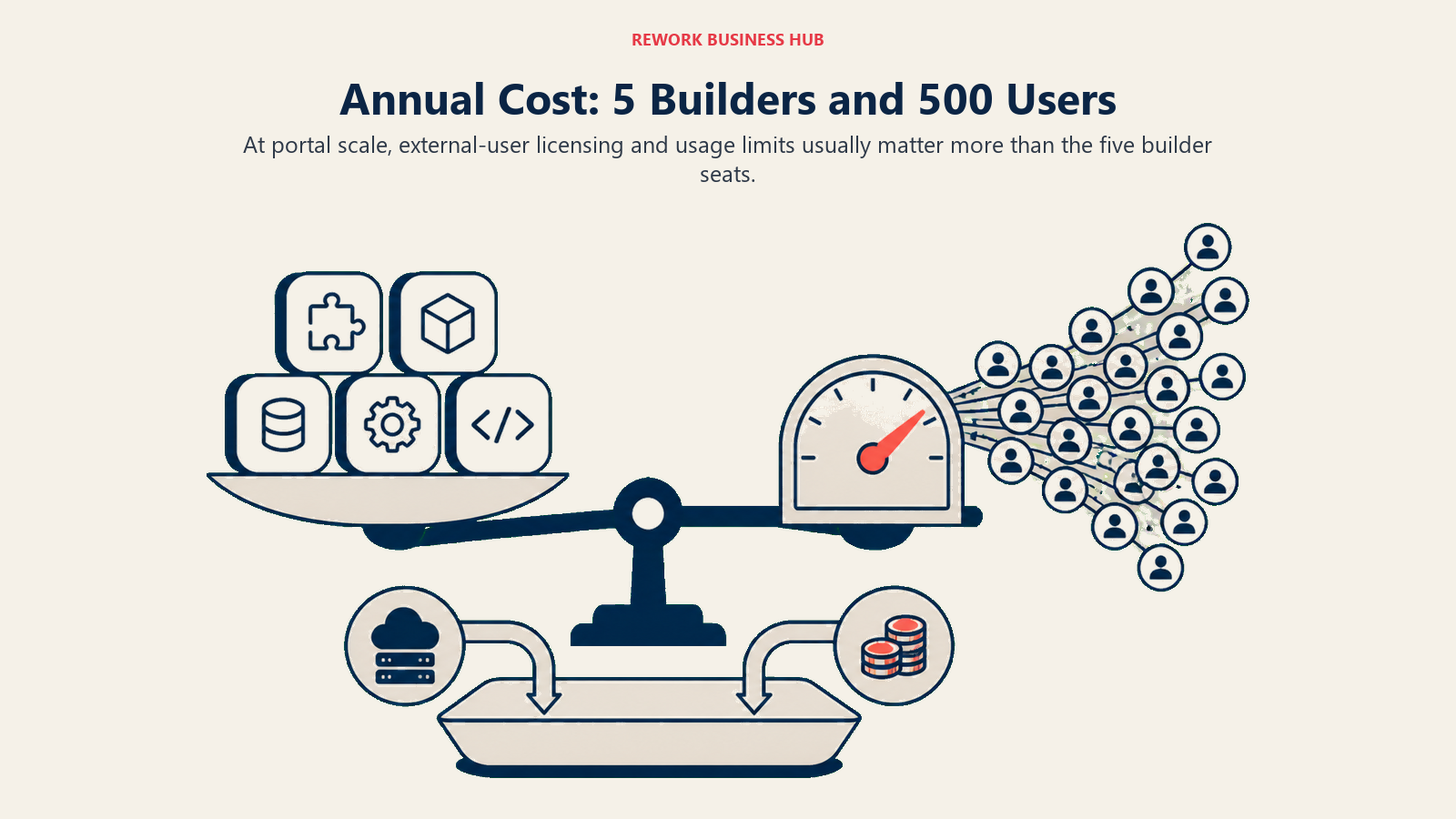
This is the comparison that decides the question, and almost nobody runs it. One concrete build: five people inside your organization who create and edit the app, and 500 outside it who log in to submit, view, or update their own records. Annual billing where the vendor offers it, first year, before any underlying database the tool does not include.
| Tool and tier | Estimated annual cost | How the number is built |
|---|---|---|
| Knack Starter | $588 | $49/mo annually, unlimited logins, 20,000 records, 3 apps |
| Knack Pro | $1,320 | $110/mo annually, unlimited logins, 50,000 records |
| Zoho Creator | Around $480 plus a quote | 5 builders at around $8/user/mo annually (reported), portal licensing quoted |
| Glide Team | $1,500 plus credits | $125/mo, 5 members; external usage metered in credits, annual rates not published |
| Caspio Team | $3,240 | $270/mo annually, 5 app authors, unlimited app users, 250,000 records |
| Softr Business | $3,948 plus the database | $329/mo billed annually for up to 500 client users, plus your Airtable or equivalent bill |
| Knack Health HIPAA Starter | From $5,988 | From $499/mo, unlimited users and builders, 3 apps, 10,000 records, BAA included |
| Caspio HIPAA edition | $9,600 | $800/mo on a one-year term, separate compliant infrastructure, signed BAA |
| Quickbase (reported) | $8,400 floor | Around $35/user/mo annually with a 20-user minimum; 5 builders cannot buy it at all |
| Appsmith Enterprise | From $30,000 | $2,500/mo starting at 100 users; 505 users needs a quote above that |
| Budibase cloud Premium | Around $32,988 | $49/mo plus 4 extra creators at $50 plus 500 end users at $5 |
| Retool Business | Around $39,000 | 5 builders at $50/mo annually plus 500 external users at the 251-500 band rate of $6/mo |
| Budibase self-hosted | $0 in licence | Open source, unlimited users, cost is infrastructure plus a maintainer |
| Appsmith self-hosted | $0 in licence | Open source community edition, same infrastructure caveat |
| Airtable Team | $1,200, job not done | 5 seats at $20/mo annually; the 500 external users have nowhere to log in |
| SmartSuite Team | $900, job not done | 5 seats at $15/mo annually; read-only free but no external portal |
| Baserow Premium | $600, job not done | 5 users at $10/mo yearly; no portal layer |
| NocoDB Plus | $720, job not done | 5 users at $12/mo annually; no portal layer |
| Teable Pro | $780, job not done | 5 seats at $13/mo billed yearly; no portal layer |
Three things fall out of that table. Knack is genuinely cheaper than Caspio for the same billing shape, by roughly $2,000 a year at entry tiers, which is the strongest argument for switching. Caspio is not expensive at 500 external users; it is one of the cheapest options that can do the job, and the per-seat tools that look cheap in a feature comparison cost ten times more at this volume. And the bottom five rows are the trap. They look like enormous savings right up until someone asks how a customer logs in.
Verify Retool's external user banding before budgeting, since the public page does not say whether the rate applies marginally or across the whole band. Either reading lands in the same order of magnitude.
Compliance and External Users at a Glance
| Tool | Unlimited external app users | Self-host option | Compliance posture as published |
|---|---|---|---|
| Caspio | Yes, on every plan | No | Dedicated HIPAA and compliance edition with signed BAA |
| Knack | Yes, each user stored as a record | No | Knack Health HIPAA plans with BAA included |
| Zoho Creator | Portal apps supported, licensing quoted | No | Suite-wide certifications; confirm scope for Creator |
| Quickbase | No, per user with seat minimums | No | SOC 1/2/3, HIPAA attestation with BAA, TX-RAMP Level 2 |
| Softr | Banded by plan, not per seat | No | Not positioned for regulated builds |
| Glide | Metered in credits | No | Not positioned for regulated builds |
| Budibase | Yes when self-hosted, priced per user on cloud | Yes | Your own boundary when self-hosted |
| Appsmith | No, per user until Enterprise | Yes | Airgapped edition on Enterprise |
| Retool | No, banded per external user | Yes | Enterprise controls and self-hosted deployment |
| Airtable | No | No | Internal data tool, not an external app platform |
| SmartSuite | No | No | Internal data tool, not an external app platform |
| Baserow | No | Yes | Self-host for data residency control |
| NocoDB | No | Yes | Self-host for data residency control |
| Teable | No | Yes | Self-host for data residency control |
Sizing and Persona Table
| Tool | Team size sweet spot | Who buys it | Typical buyer title |
|---|---|---|---|
| Knack | 2-50 | Small teams shipping an external portal | Founder, Program Manager |
| Zoho Creator | 10-500 | Existing Zoho customers | IT Director, Business Systems Manager |
| Quickbase | 100-5,000 | Regulated and field-heavy operations | VP Operations, IT Director |
| Softr | 2-50 | Client services and membership businesses | Founder, Client Services Lead |
| Glide | 2-50 | Field, frontline, and inspection teams | Operations Manager, Field Lead |
| Budibase | 10-500 | Teams that must host inside their own boundary | IT Manager, Head of Infrastructure |
| Appsmith | 20-100 | Technical teams wanting open source | Engineering Manager, CTO |
| Retool | 20-1,000 | Engineering-supported internal tools | Engineering Manager, CTO |
| Airtable | 5-100 | Internal ops, marketing, and content teams | Ops Manager, Marketing Ops Lead |
| SmartSuite | 20-200 | Ops teams standardizing many processes | COO, Head of Operations |
| Baserow | 5-150 | Privacy-conscious and EU-based teams | IT Manager, Data Protection Lead |
| NocoDB | 5-100 | Teams with a database and no front end | Technical Ops Lead, Backend Developer |
| Teable | 3-50 | Technical teams wanting Postgres directly | CTO, Technical Founder |
When Caspio Is Still the Right Answer
Most alternatives articles are quietly built to talk you out of the incumbent. This one should not, because Caspio holds a genuinely rare combination, and three situations make it hard to beat.
The first is unlimited app users on every plan, not as an enterprise negotiation. Caspio charges for app authors and lets an unlimited number of outside people use what you build, on the $270 tier as much as the $540 one. Only Knack matches that shape among mainstream tools. Every per-seat platform here gets dramatically more expensive as your external audience grows, so Caspio's cost curve stays flat exactly where competitors' curves go vertical.
The second is the compliance edition. A dedicated HIPAA offering starting at $800 a month on a one-year term, with separate compliant infrastructure and a signed BAA, productises a question most vendors treat as a custom enterprise deal. If your security review is harder than your build, that beats a nicer builder. Knack Health undercuts it, starting at $499 a month, and Quickbase publishes a HIPAA attestation with BAAs for annual subscribers, but the list of vendors that will sign anything ends roughly there.
The third is structural discipline. DataPages assembled into applications feels rigid next to a grid-first tool, and that rigidity becomes a feature when the application has to be auditable years from now. Grid-first tools drift. Somebody adds a column, someone else builds a view, and eighteen months later nobody can say what the source of truth is.
| Stay on Caspio if | Leave Caspio if |
|---|---|
| Hundreds or thousands of external users log into your app | Fewer than 50 outside people ever log in |
| You need a signed BAA and compliant infrastructure | Compliance was never part of the requirement |
| The app must survive an audit two years from now | You need modern design control more than governance |
| Your record volume sits comfortably inside 250,000 | The entry price cannot be justified at your scale |
How to Choose: Decision Framework
Use this once you have narrowed to two or three candidates, not as a substitute for narrowing.
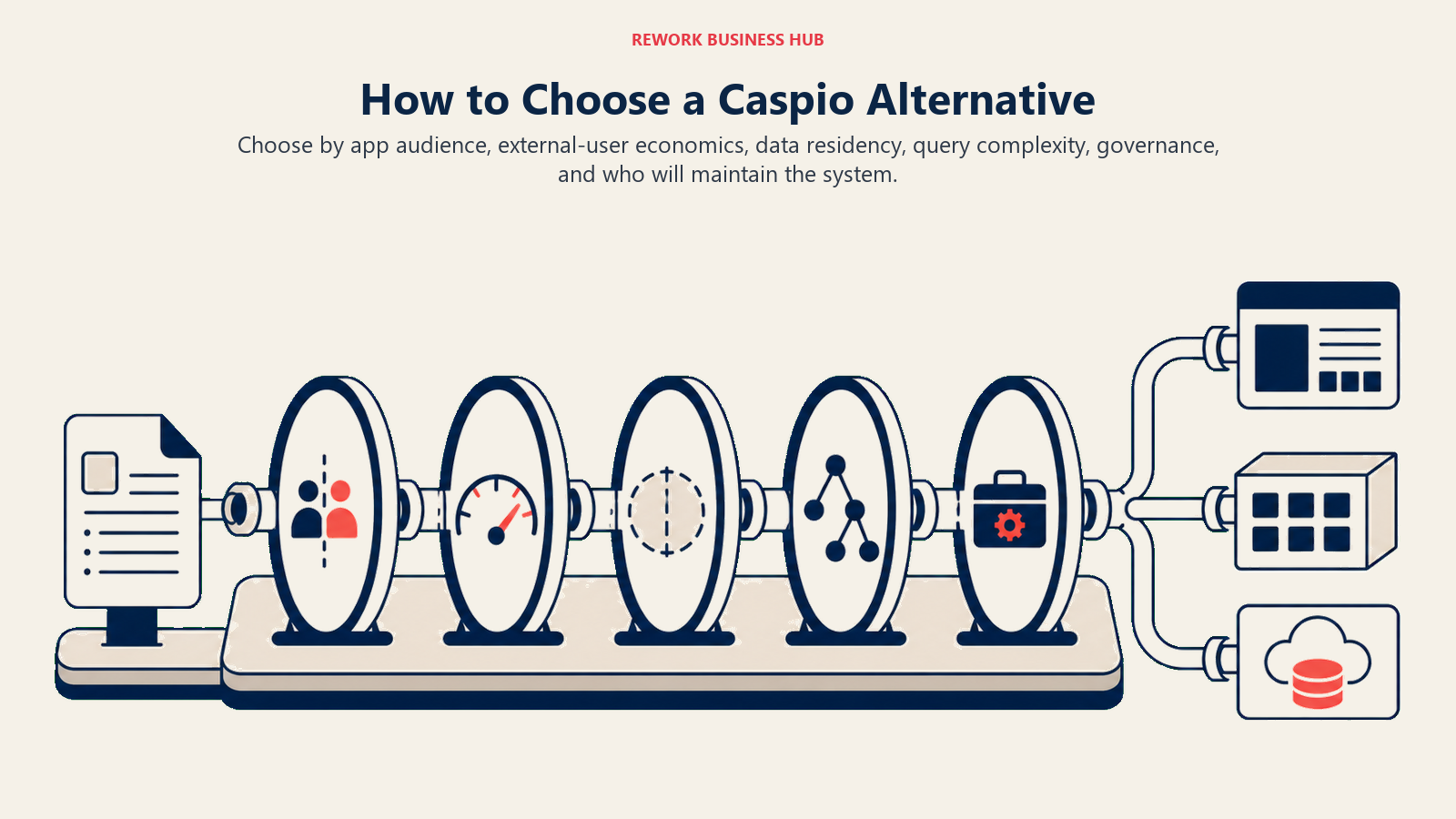
| If you need this... | Choose this | Why |
|---|---|---|
| Caspio's model at a small-team price | Knack | Flat account pricing with unlimited logins, from $49/mo annually |
| A signed BAA without an enterprise negotiation | Knack Health or Caspio HIPAA | Both productise the BAA rather than quoting it |
| Governance, audit, and public-sector attestations | Quickbase | Published SOC attestations and environment separation |
| Apps sitting on records already in Zoho | Zoho Creator | Native access, no integration to maintain |
| A modern-looking client portal this month | Softr | App-user banding and a genuinely current design layer |
| A real mobile app for field staff | Glide | The best phone output in this comparison |
| To host the whole platform inside your own boundary | Budibase or Appsmith | Free self-hosted open source editions with no user ceiling |
| Logic a visual builder cannot express | Retool | SQL and JavaScript against any source, first 50 external users free |
| An internal database, because nobody outside logs in | Airtable or SmartSuite | Cheaper, better, and honest about what they are |
| Data ownership without a platform bill | Baserow, NocoDB, or Teable | Self-hostable or Postgres-backed storage you control |
If your search turns out to be about running projects rather than deploying an application, the best project management software guide is a better starting point, and best Monday.com alternatives covers the visual work-OS end of that market. For document-shaped records rather than structured ones, best Notion alternatives and best Coda alternatives are the relevant shortlists, and best Smartsheet alternatives covers grid-first enterprise options.
Frequently Asked Questions about Caspio Alternatives
What is the cheapest Caspio alternative that still supports unlimited app users?
Knack, by a clear margin. Knack Starter is $49 per month billed annually with 20,000 records, 3 apps, and no limit on how many people log in, against Caspio Team at $270. Knack charges per account rather than per user, the same billing shape that makes Caspio predictable at high external volume.
Is Caspio actually expensive compared to the alternatives?
Not at scale, and that surprises most people. At 5 internal builders and 500 external app users, Caspio Team costs about $3,240 a year while Retool Business lands near $39,000 and Budibase cloud near $33,000, because both bill per external user. Caspio looks expensive only against per-seat tools priced for a handful of internal staff, which is a different product entirely.
Which Caspio alternatives offer a HIPAA BAA?
Three publish one. Caspio's own HIPAA and compliance edition starts at $800 per month on a one-year term with separate compliant infrastructure. Knack Health HIPAA plans start at $499 per month with the BAA included and no user minimum. Quickbase offers a HIPAA attestation with BAAs to business and enterprise subscribers on annual or multi-year contracts, alongside SOC 1 and SOC 2 Type II reports, CSA STAR Level 2, and TX-RAMP Level 2.
Can Airtable replace Caspio?
Only if nobody outside your organization logs in. Airtable is an internal database with per-seat billing, no record-level rules for external users, and no real portal. If employees are the only users, Airtable is cheaper and easier. If customers, patients, members, or contractors sign in, it cannot take the build however the price comparison reads.
What is the difference between a low-code application platform and a no-code database?
An application platform stores data and wraps it in a deployed interface with logins, roles, and per-user visibility rules for people outside your team. A no-code database stores structured records and shows them to your own staff in grids and views. Caspio, Knack, Zoho Creator, and Quickbase are the first kind. Airtable, SmartSuite, Baserow, NocoDB, and Teable are the second.
How do I migrate a Caspio application to another platform?
Export the tables to CSV first, then rebuild the single most complex DataPage in your top two candidates before touching anything else. The data moves easily; the logic does not. Conditional rules, calculated fields, triggered actions, and per-user filtering are where migrations stall, so prove those work on your hardest screen before you commit to a plan or a timeline.
Is there a free open source alternative to Caspio?
Budibase and Appsmith both ship free open source editions you can self-host, and both build real applications with role-based access rather than just database views. Budibase's self-hosted edition supports unlimited users with no licence fee, which is the closest free equivalent to Caspio's unlimited app user model. The cost moves from a subscription to infrastructure and a named person who owns patching.
What to Do Next
Before comparing another feature grid, count two numbers: how many people log into your Caspio app who are not on your payroll, and how many records the largest table holds. Those two figures eliminate most of this list in about a minute. Zero external users sends you to Airtable, SmartSuite, or Baserow and cuts the bill by 80%. Hundreds of them narrows the field to Knack, Zoho Creator, Softr, or staying put.
Then run one test rather than three demos. Take the single most complicated screen in your current application, the one with conditional logic and per-user filtering, and rebuild only that in your top two candidates. Give it a day. Whatever breaks in that day is what will break during the real migration, and it tells you more than a month of sales calls.
Related Resources:

Customer Success Operations Manager
On this page
- Key Facts
- Quick Comparison Table
- Two Different Products Hide Behind One Search
- 1. Knack - the direct swap when Caspio's floor is too high
- 2. Zoho Creator - the right answer only if you already run Zoho
- 3. Quickbase - the step up when governance matters more than price
- 4. Softr - the modern builder Caspio's interface is losing to
- 5. Glide - when the app needs to work on a phone in the field
- 6. Budibase - the open source app platform you can host inside your own boundary
- 7. Appsmith - open source with an honest commercial upgrade path
- 8. Retool - when a query solves what the no-code builder cannot
- 9. Airtable - the internal database, if that is all you actually needed
- 10. SmartSuite - the internal database with the process already built in
- 11. Baserow - full data ownership without the platform price
- 12. NocoDB - a spreadsheet face on the database you already run
- 13. Teable - the internal database with a real Postgres store underneath
- Total Annual Cost: 5 Internal Builders Plus 500 External App Users
- Compliance and External Users at a Glance
- Sizing and Persona Table
- When Caspio Is Still the Right Answer
- How to Choose: Decision Framework
- What to Do Next