Notion vs Airtable: Which Fits Your Team's Data in 2026?
Turn this article into takeaways for your work.


Each assistant summarizes the article only for you and suggests best practices for your work.
Search "Notion vs Airtable" and most of what comes back is a feature grid that scores both products on the same axes, as if they were the same thing built by two different companies. They are not. And the grid quietly hides the only question that actually decides this.
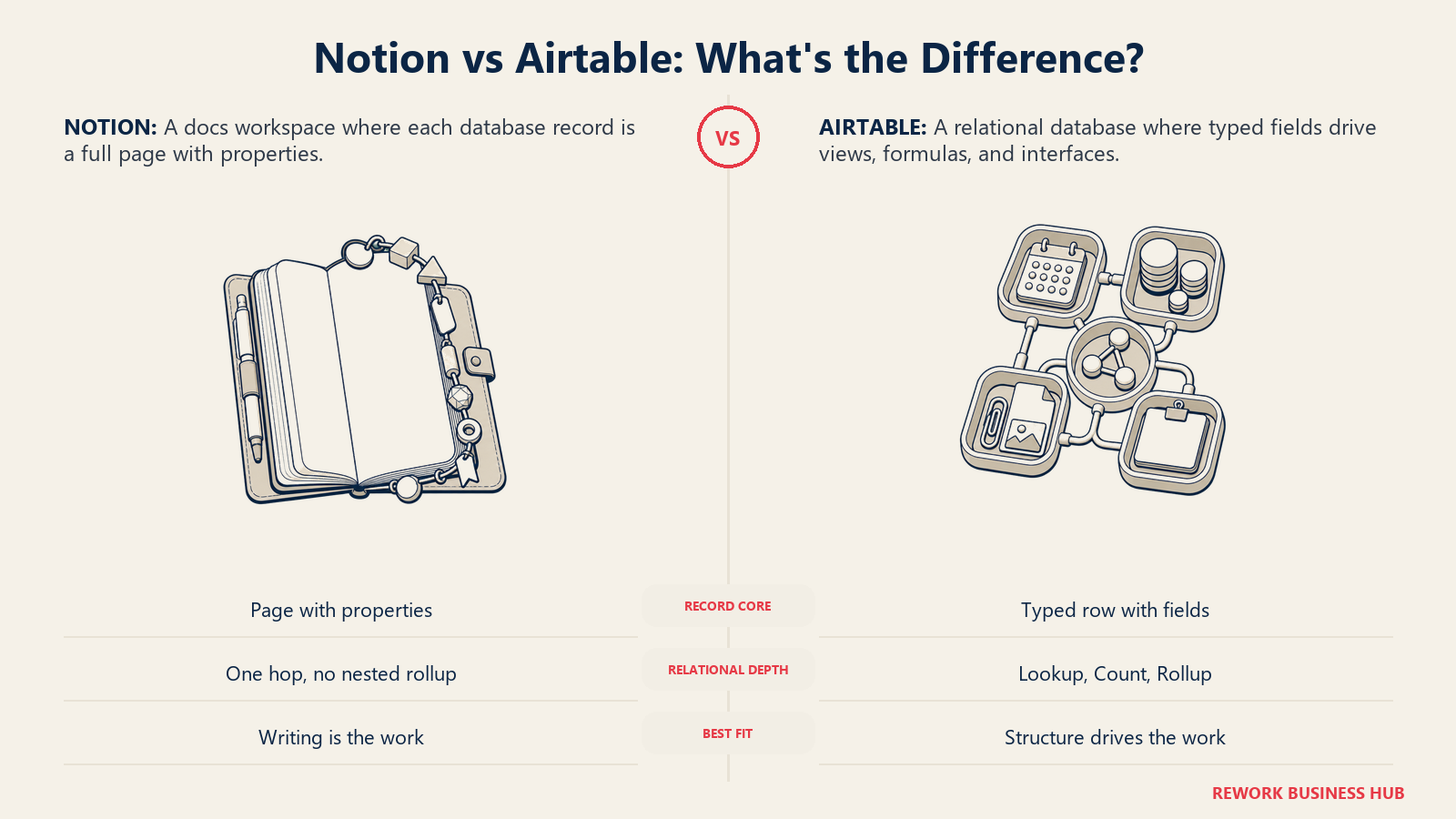
Notion started as a document product. Blocks, pages, a wiki your team reads. Databases arrived later, as a way to file and filter those pages, which is why a Notion record is a page first and a row second. Airtable started from the opposite end. It is a relational database wearing a spreadsheet interface, where a record is a row of typed fields, and the nicer views (kanban, calendar, gallery, timeline) are projections of that row. Almost every difference below falls straight out of those two origins, including the ones that will annoy you in month nine.
So the real question is not which tool has more features. It is this: does your team's work live in prose that occasionally needs structure, or in structured records that occasionally need prose? Answer that honestly and the rest of this article is mostly confirmation. Answer it wrong and you spend a year fighting your own tooling. If you want the wider field before narrowing to two names, the best no-code database software roundup covers 15 options in this category.
TL;DR
| Notion | Airtable | |
|---|---|---|
| What it actually is | A docs and wiki product that grew databases | A relational database that grew views and apps |
| A record is | A page with properties attached | A row with typed fields |
| Data model depth | 22 property types, no separate Lookup or Count | 28 field types, distinct Lookup, Rollup, and Count |
| Relational ceiling | A rollup cannot reference another rollup | Lookups, rollups, and counts as independent fields |
| Published record cap | None published per database | 1,000 free, 50,000 Team, 125,000 Business, per base |
| Cheapest paid tier | Plus, $10 per member per month billed annually | Team, $20 per seat per month billed annually |
| Free plan | Yes, capped at 10 guests and 7-day version history | Yes, capped at 1,000 records per base |
| Automation runs | Not published, and no custom code action | Metered: 100 free, 25,000 Team, 100,000 Business |
| Non-editors cost | Guests are unlimited and unbilled from Plus | Read-only collaborators are unbilled on paid plans |
| Best for | Teams whose records are mostly writing | Teams whose records are mostly fields |
The Real Split: Prose That Needs Structure, or Records That Need Prose
Here is the test that settles it faster than any feature list. Open the thing your team argues about most, and ask what the middle of it looks like.
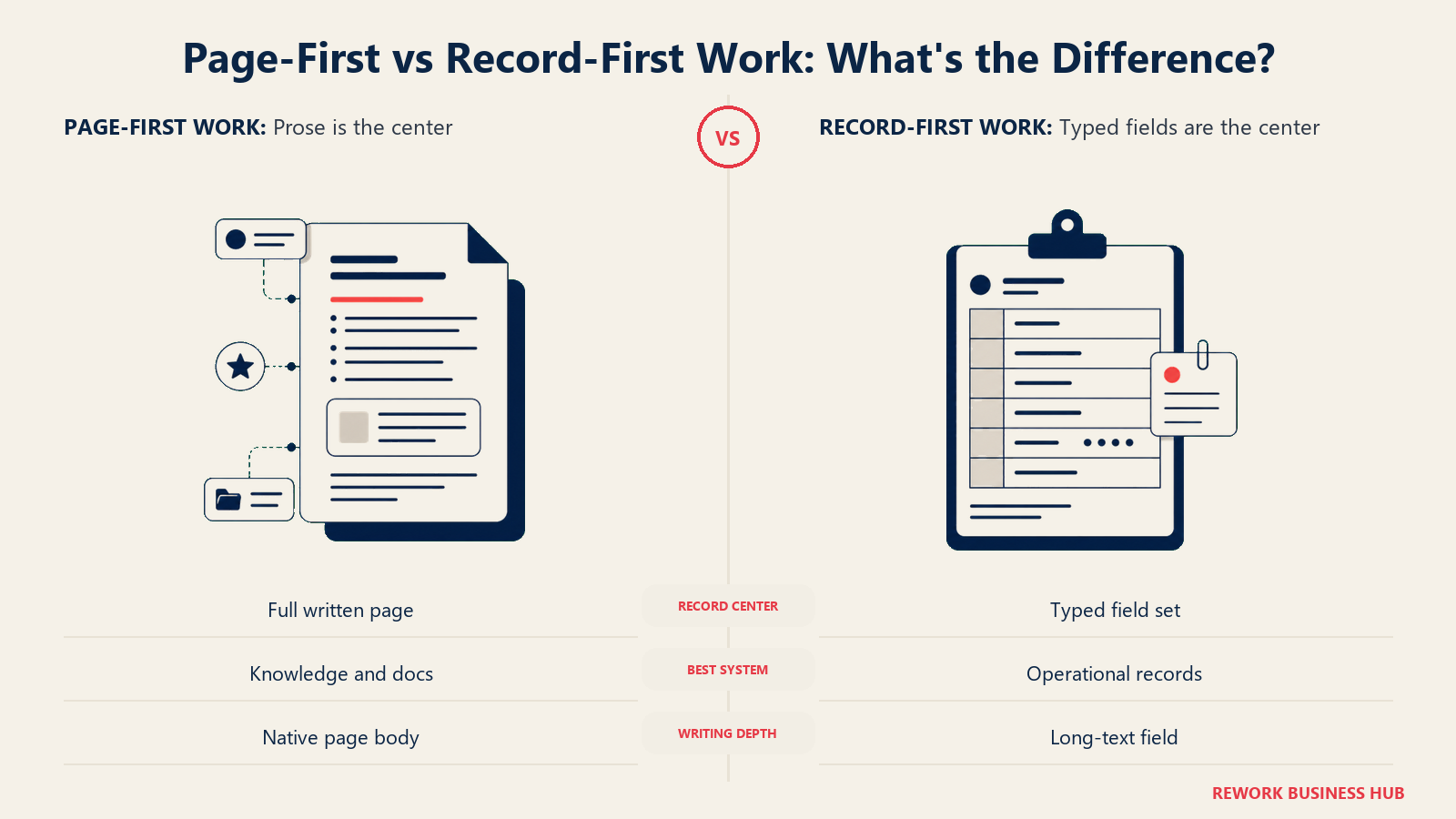
If the middle is writing, Notion wins before the comparison starts. A project brief, a customer account summary, a policy, a research note, a meeting record: these are documents where the structured fields (owner, status, date, tag) are metadata wrapped around the real content. Notion's model matches that exactly, because every row opens into a full page with headings, embeds, comments, and nested subpages. Airtable can hold a long text field, but nobody wants to read a strategy memo inside a spreadsheet cell.
If the middle is fields, Airtable wins the same way. An inventory item, a campaign, a candidate, a purchase order, a piece of equipment: the record is a set of typed values that other records point at and that calculations run over. There is no essay in the middle. What matters is that quantity is a number with a currency format, that the linked supplier is a real link and not a text string somebody typed twice, and that a rollup can sum the line items without exporting to a spreadsheet first.
Most teams have both. That is why so many end up running both, and why the actual decision is usually about which one is your system of record and which one is the reading layer on top. Teams that pick the wrong system of record notice around the time the second team joins, when the workarounds start compounding. The how to choose no-code database software guide walks through that call in more detail if you are still at the framing stage.
Who Each Tool Is Actually Built For
| Notion | Airtable | |
|---|---|---|
| Primary buyer | Chief of Staff, Head of Product, founder, marketing lead | Ops Manager, Marketing Ops Lead, program manager, RevOps |
| Team size sweet spot | 2 to 100, one connected workspace | 5 to 150, one department or a few shared bases |
| Core job | Wiki, docs, meeting notes, lightweight trackers in one place | Structured operational records with real relationships |
| Buying trigger | Documentation lives in five tools and nobody can find anything | A spreadsheet broke, or two teams keep editing different copies |
| What they say six months in | "Our wiki is great, the tracker got slow" | "The base is solid, the bill got big" |
| Typical failure mode | Treating Notion as a database and hitting the relational ceiling | Treating Airtable as a wiki and hitting a wall of unreadable long text |
Neither buyer is wrong. A Head of Product who wants specs and a roadmap in one searchable place and a marketing ops lead who wants 8,000 assets linked to campaigns, owners, and budgets are solving different problems with the same search query.
Key Facts
- Airtable caps records per base at 1,000 on Free, 50,000 on Team, and 125,000 on Business, while Notion publishes no equivalent per-database record cap. (Airtable plans overview, Notion pricing)
- Airtable supports 28 field types including distinct Lookup, Rollup, and Count fields; Notion offers 22 database property types with no separate Lookup and no Count. (Airtable supported field types, Notion database properties)
- Notion's own documentation confirms a rollup cannot reference another rollup, stating "Unfortunately not, as this could create unintended loops." (Notion relations and rollups)
- Airtable meters automation runs at 100 per month on Free, 25,000 on Team, 100,000 on Business, and 500,000 on Enterprise Scale, and its "Run a script" action is unavailable on Free. (Airtable automations)
- Airtable's API allows 5 requests per second per base and 50 per second per personal access token, while Notion's API averages three requests per second per integration. (Airtable rate limits, Notion request limits)
Data Model Depth: What a Field Can Actually Be
This is the least glamorous section and the one that predicts the most regret. Field types are the vocabulary your data has available, and you inherit that vocabulary for as long as you stay.
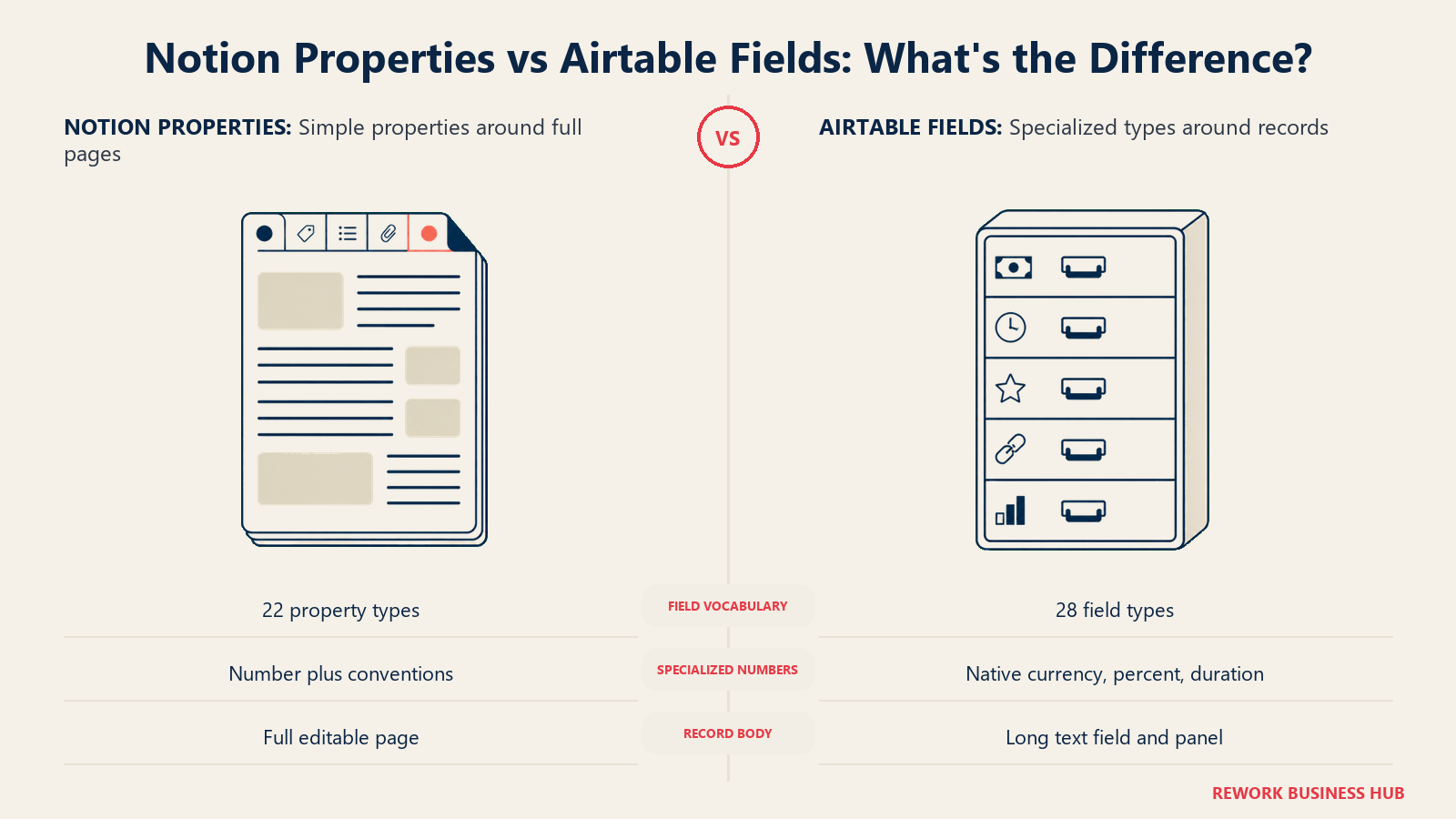
Airtable's list runs to 28 types: Attachment, Autonumber, Barcode, Button, Checkbox, Count, Created time, Created by, Currency, Date and time, Duration, Email, Formula, Last modified by, Last modified time, Linked record, Long text, Lookup, Multiple select, Number, Percent, Phone number, Rating, Rollup, Single line text, Single select, URL, and User. Notion's list runs to 22: Text, Number, Select, Status, Multi-select, Date, Formula, Relation, Rollup, Person, File, Checkbox, URL, Email, Phone, Created time, Created by, Last edited time, Last edited by, Button, ID, and Place.
The gap is not really about the count. It is about what is missing. Notion has no Currency, no Percent, no Duration, no Rating, no Barcode, and no Autonumber. You can fake all of them with a Number field and a naming convention, and thousands of teams do. The cost shows up later, when a formula has to strip a symbol out of a text field, or when a report is wrong because one person typed 15 in a field where everyone else typed 0.15.
| Data model capability | Notion | Airtable |
|---|---|---|
| Total field or property types | 22 | 28 |
| Currency, Percent, Duration | Not available as types, use Number plus convention | Native types |
| Rating, Barcode, Autonumber | Not available | Native types |
| Count of linked records | Rollup set to Count | Dedicated Count field |
| Pull a value from a linked record | Rollup with "Show original" | Dedicated Lookup field |
| Record body | Full page: headings, embeds, comments, subpages | Long text field, expanded record panel |
| Attachments | File property, unlimited uploads from Plus, 5 MB per file on Free | Attachment field, 1 GB per base Free, 20 GB Team, 100 GB Business |
| Status as a first-class type | Yes, dedicated Status property with groups | Single select, plus workflow via views and automations |
Notion's Status property and its page-as-record model are genuine advantages Airtable does not match. If your team writes, the ability to open a row into a real document with nested pages under it is worth more than six field types you would rarely use.
Relational Depth and Where Notion's Ceiling Sits
Both tools have linked records. Both have rollups. That parity claim is where most comparisons stop, and it is where the interesting part begins.
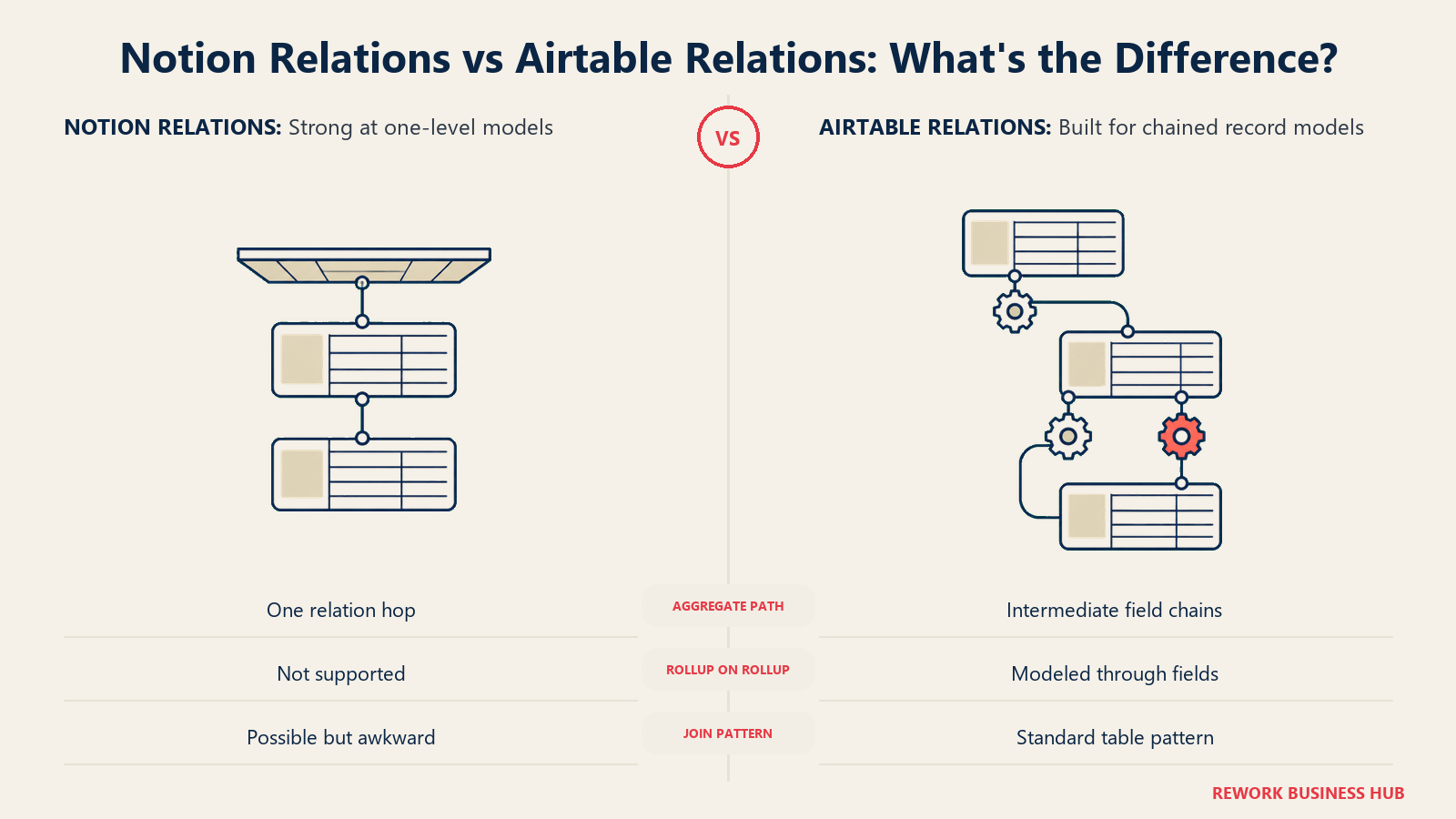
Notion's relation connects two databases, or a database to itself, and a rollup aggregates a property from the related pages. What a Notion rollup cannot do is reference another rollup. Notion's own help documentation is direct about it: "Unfortunately not, as this could create unintended loops." There is also no supported way to aggregate across two relation hops, so a chain of Projects to Tasks to Time Entries cannot roll total hours up to the project without a workaround.
That single limitation is responsible for a large share of the "we outgrew Notion" stories. Real operational data is chained. Orders contain line items that reference products that reference suppliers. Campaigns contain assets that reference budgets. The moment you need a number computed two hops away, Notion asks you to duplicate the relation or maintain a manual field, and both options rot.
Airtable's answer is to split the job across three independent field types. Lookup pulls a value across the link, Count counts the links, and Rollup runs an aggregation, and each of those is a real field that other fields can reference. Combined with formula fields, that gives you room to model the chain rather than flatten it.
| Relational capability | Notion | Airtable |
|---|---|---|
| Linked records between tables | Yes, Relation property | Yes, Linked record field |
| Two-way relation | Yes, toggle on the property | Yes, symmetric link by default |
| Self-referencing relation | Yes, with a two-way toggle for direction | Yes |
| Aggregate a linked value | Rollup only | Lookup, Count, and Rollup as separate fields |
| Rollup that references a rollup | Not supported, stated explicitly in Notion's docs | Not subject to that restriction |
| Aggregate across two relation hops | No supported path | Model it with intermediate fields |
| Junction or join tables | Possible, awkward in practice | Standard pattern, well documented |
| API relation payload cap | 100 related pages per request | 5 requests per second per base |
If your model is one level deep (projects and their tasks, accounts and their contacts) Notion is entirely fine and the ceiling never arrives. If it is two or three levels deep, you will meet the ceiling, and the honest advice is to meet it before you migrate 40 people rather than after. Teams that hit it usually end up working through the best Notion alternatives shortlist for exactly this reason.
Record Limits and What Happens When You Hit Them
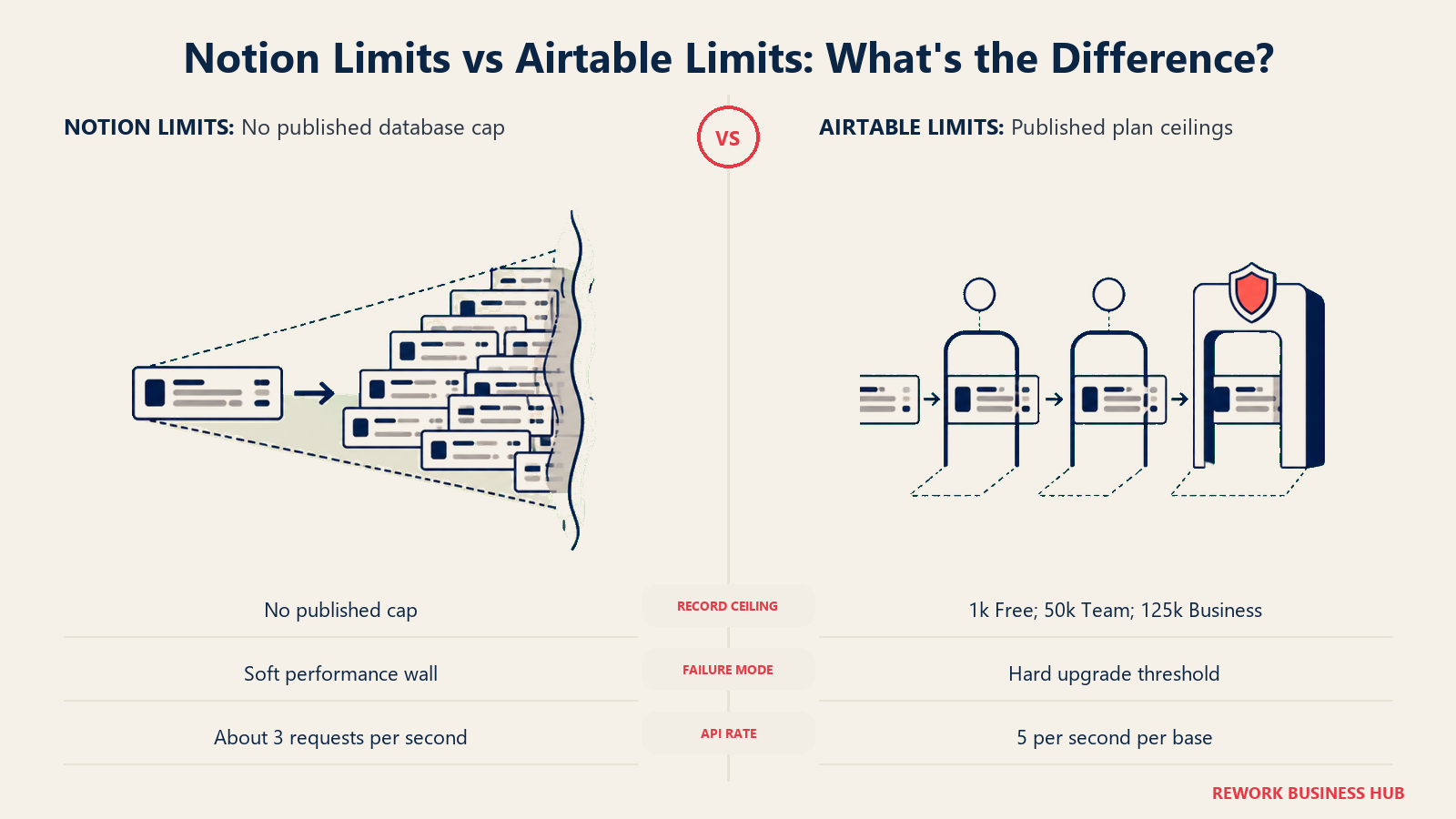
Airtable publishes its ceilings. Notion mostly does not, which reads as a strength on the pricing page and lands as a surprise in production.
| Limit | Notion | Airtable |
|---|---|---|
| Records per base or database | No published cap | 1,000 Free, 50,000 Team, 125,000 Business |
| Attachment or file storage | 5 MB per file on Free, unlimited files from Plus | 1 GB per base Free, 20 GB Team, 100 GB Business |
| Version or revision history | 7 days Free, 30 days Plus, 90 days Business, unlimited Enterprise | 2 weeks Free, 1 year on Team and Business |
| API calls | Rate-limited at roughly three requests per second per integration | 1,000 per workspace per month Free, 100,000 Team, unlimited Business |
| Automation runs per month | Not published | 100 Free, 25,000 Team, 100,000 Business, 500,000 Enterprise Scale |
| Automation run history | Not published | 2 weeks Free, 6 months Team, 1 year Business, 3 years Enterprise Scale |
The practical difference: Airtable tells you exactly when you will need to upgrade, so you can budget for it. Notion lets you keep adding rows until the view feels slow, which is a softer wall but a wall all the same, and it arrives without a line item to point at in a renewal conversation.
Airtable's caps bite in a different way. A 50,000-record ceiling on Team sounds generous until an import of historical data lands, and Business at $45 per seat per month is a large step up from Team at $20 to buy 75,000 more records. That step is the single most common trigger for teams looking at Airtable vs SmartSuite or working through the wider best Airtable alternatives list.
Views, Interfaces, and Who Sees the Data
Both products let you look at the same records several ways. Where they diverge is what happens after the view: whether you can build something a non-editor logs into and uses.
| View or surface | Notion | Airtable |
|---|---|---|
| Table or grid | Yes | Yes |
| Board or kanban | Yes | Yes |
| Calendar | Yes | Yes, with view limitations on Free |
| Gallery | Yes | Yes |
| List | Yes | Yes |
| Timeline | Yes | Listed on Team and above |
| Gantt | Timeline view covers this use case | Listed on Team and above |
| Chart view | Yes, bar, line, and donut | Via extensions, which require Team and above |
| Forms | Yes, Notion Forms | Yes, form view on all plans |
| Locked and personal views | Not a distinct feature | Listed on Team and above |
| App or portal builder | No, shared pages with permissions | Interface Designer, listed on Team and above |
Notion's seven database view types plus forms cover most internal reporting, and the chart view closed a real gap. What Notion still has no answer for is Airtable's Interface Designer, which builds a purpose-shaped screen over a base: a record picker, a filtered list, a form, a dashboard, and buttons, each with its own permissions. That matters when the people using the data are not the people who should be editing the schema, which describes most companies above roughly 30 people.
Automation and Scripting
Airtable's automation layer is a proper workflow runner. Nine trigger types (record enters a view, record created, record updated, record matches a condition, form submitted, scheduled time, incoming webhook, button clicked, plus Google Workspace and Outlook triggers) feed more than 15 action types, including create and update records, send email, Slack and Microsoft Teams messages, Twilio SMS, Jira, Salesforce, GitHub, and a "Run a script" action that executes JavaScript. That last one is unavailable on Free, but on paid plans it turns a base into something close to a small application backend.
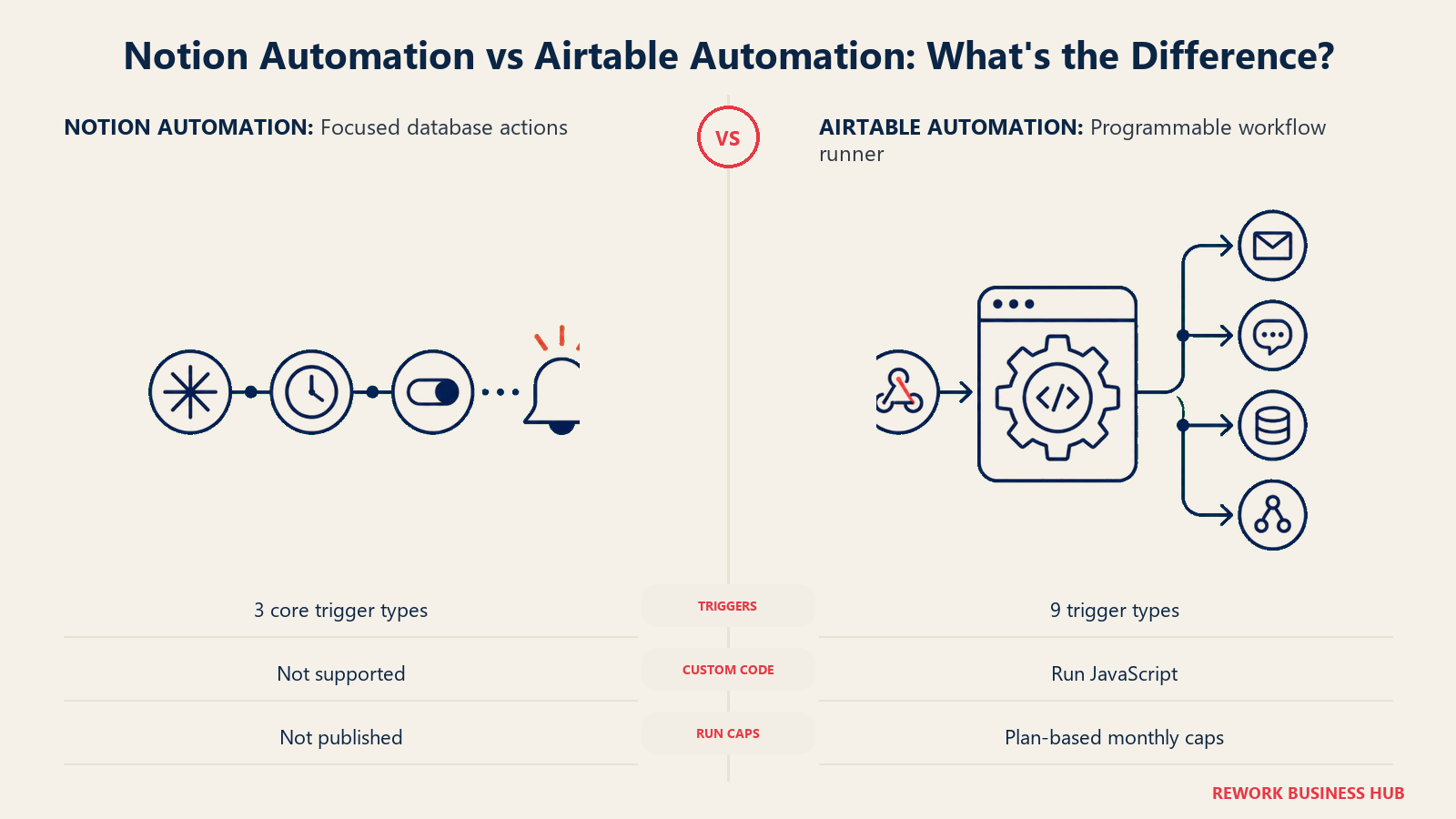
Notion's database automations are narrower by design. Triggers are page added, property edited, and a recurring schedule. Actions cover editing properties, adding pages, notifying members, sending mail through Gmail, posting a webhook, sending Slack notifications, and building variables with formulas. There is no custom code action. Database automations require a paid plan, Free workspaces can only create Slack notification automations, and the Slack action itself is limited to Plus, Business, and Enterprise.
| Automation capability | Notion | Airtable |
|---|---|---|
| Trigger types | 3: page added, property edited, recurring schedule | 9, including webhook received and button clicked |
| Action types | Edit properties, add pages, notify, Gmail, webhook, Slack | 15+, including email, Slack, Teams, Twilio SMS, Jira, Salesforce |
| Run custom code | Not supported | Yes, "Run a script" action, not on Free |
| Available on the free plan | Slack notification automations only | Yes, capped at 100 runs per month |
| Monthly run cap | Not published | 100 Free, 25,000 Team, 100,000 Business |
| Incoming webhook trigger | Not listed as a trigger | Yes |
If your automation needs stop at "notify someone when this status changes," both tools do it. If they include "call an API, transform the response, and write it to three tables," only one of them does, and the other sends you to Zapier or Make with the extra subscription that implies.
Permissions, Guests, and External Access
Notion's permission model is page-based and genuinely good at what it does: Full access, Can edit, Can edit content, Can create, Can comment, and Can view, applied to a page and inherited by everything nested under it. Two of those, Can edit content and Can create, are database-specific, and Can create is limited to Business and Enterprise. Those two tiers also unlock record-level access driven by a Person property, so a page can be visible only to the people named on it.
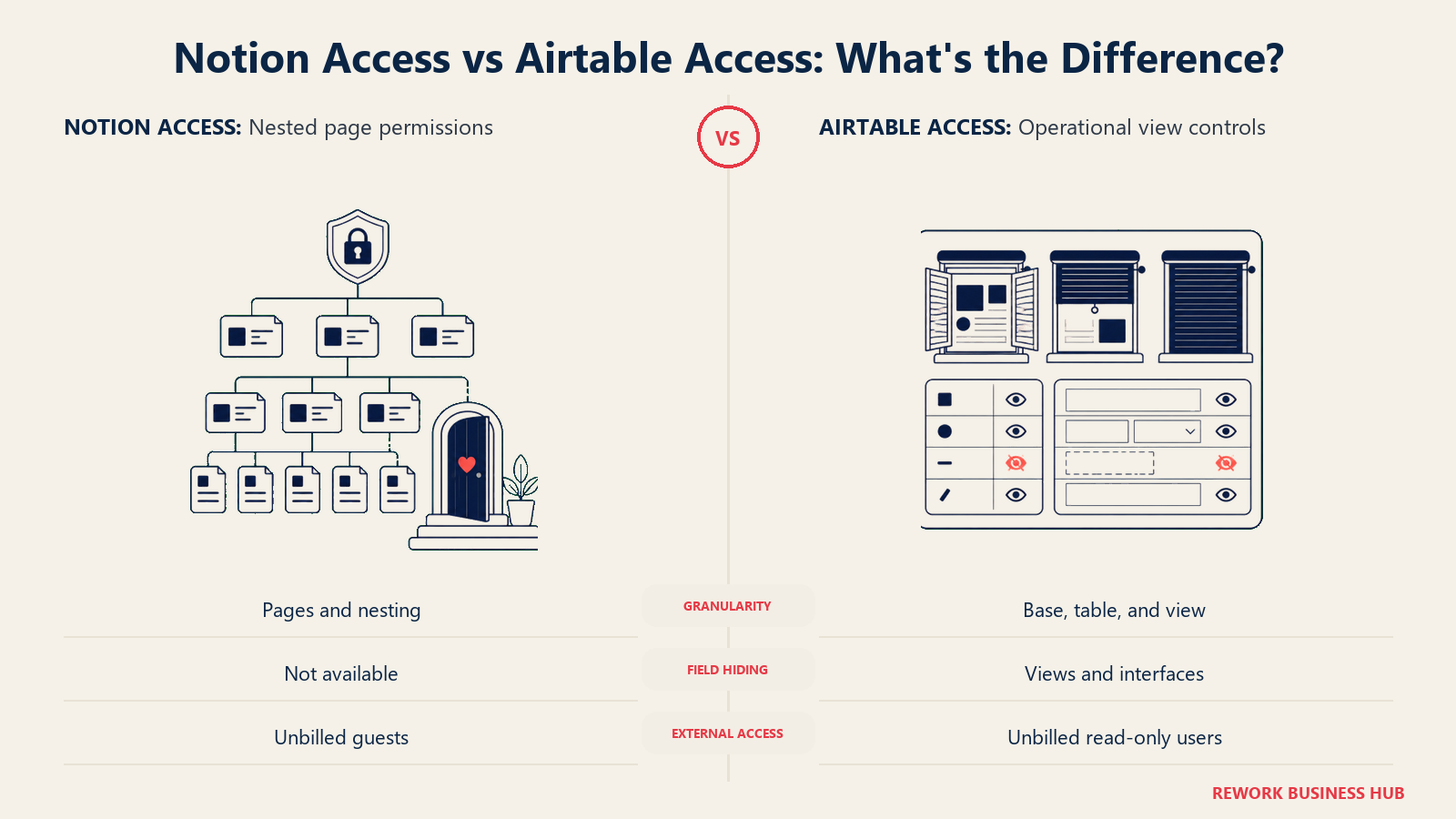
What Notion cannot do is restrict a single property. Permissions are set per page, not per column, so if someone can see a record they can see every field on it, salary and margin included. Guests are capped at 10 on Free and unlimited from Plus, and guests are not billed as members, which is a real cost advantage when outside collaborators are part of the workflow.
Airtable prices access differently, and the detail is worth money. Read-only collaborators are not billable on Team or Business. On Team, commenters are billable. On Business, commenters are not. Free workspaces allow up to 5 Editor or Creator collaborators and 50 commenters, with unlimited read-only on top. The admin panel and two-way sync both require Business or higher.
| Access control | Notion | Airtable |
|---|---|---|
| Permission granularity | Per page, inherited by nested pages | Per workspace, base, table, and view |
| Field or column level restriction | Not available | Available through views and interface configuration |
| Record-level access | Yes, via Person property, Business and Enterprise only | Yes, via filtered views and interfaces |
| Free viewers | Guests, unlimited from Plus, 10 on Free | Read-only collaborators unbilled on paid plans |
| Free commenters | Guests set to Can comment | Unbilled on Business, billable on Team |
| Admin panel | Workspace settings, deeper controls on Enterprise | Business and above |
| External portal | No, shared pages only | Interface Designer, Team and above |
For a knowledge base outside partners read, Notion's unlimited unbilled guests are hard to beat, which is also why it shows up so often in the how to choose internal wiki software conversation. For an operational system where a warehouse team needs to update three fields and nothing else, Airtable's view and interface controls are the ones that survive a security review.
API and Integration Depth
Airtable's Web API allows 5 requests per second per base and 50 requests per second across all traffic from a given personal access token, returning a 429 and a 30-second cooldown when you exceed it. The official JavaScript client handles the back-off automatically. Free workspaces get 1,000 API calls per month, Team gets 100,000, and Business is unlimited.
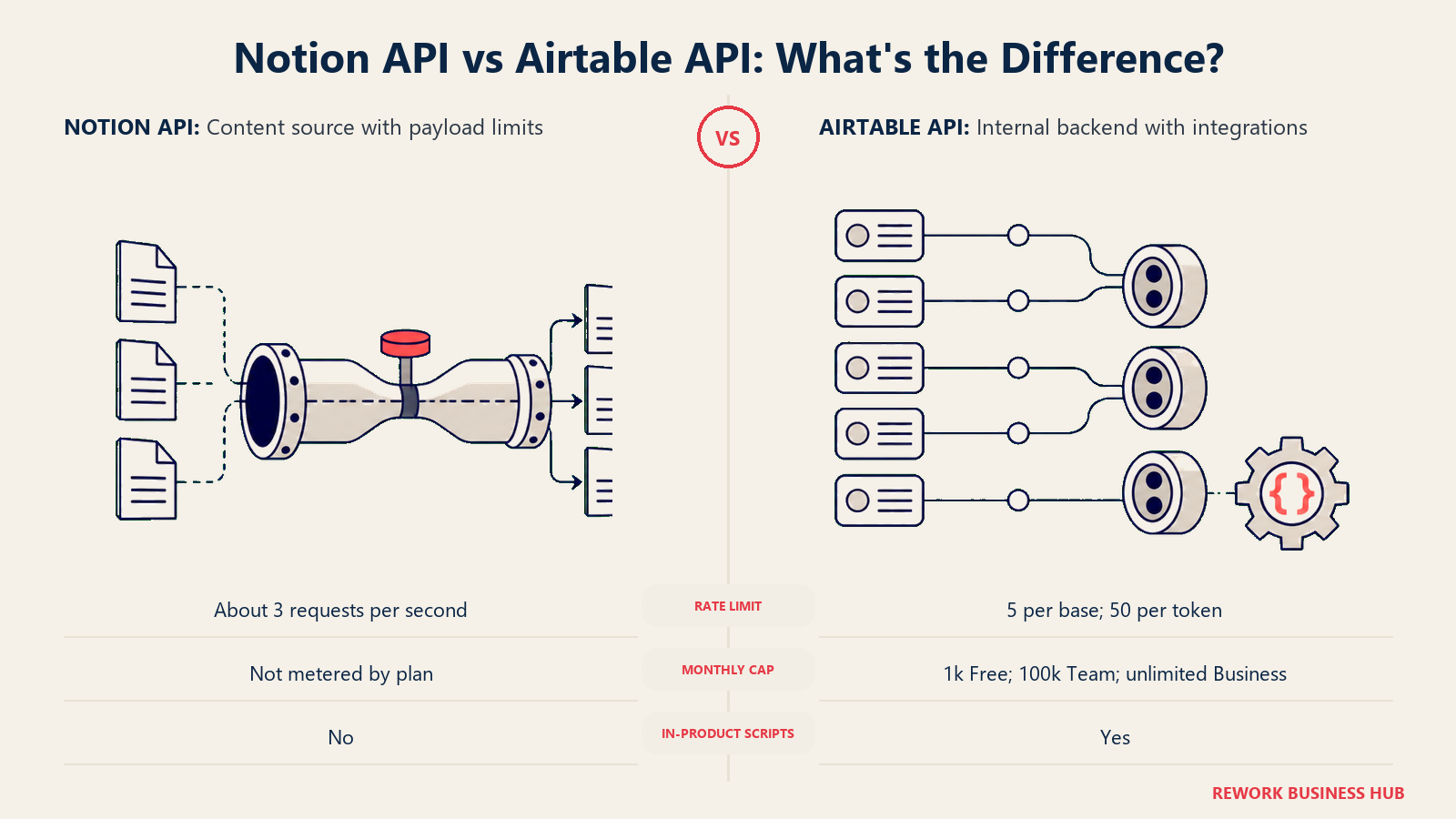
Notion's API averages three requests per second per integration, with a 500 KB payload ceiling, a maximum of 1,000 block elements per payload, and 2,000 characters per rich text or URL value. Relations accept 100 related pages per request, though a relation can hold more than that in total.
| Integration factor | Notion | Airtable |
|---|---|---|
| API rate limit | About 3 requests per second per integration | 5 per second per base, 50 per second per token |
| Monthly call cap | Not metered by plan | 1,000 Free, 100,000 Team, unlimited Business |
| Payload ceiling | 500 KB, 1,000 block elements | Standard REST payloads, batches of 10 records |
| Native two-way sync with other tools | No | Two-way sync, Business and above |
| Extensions or apps marketplace | Integrations gallery | Extensions, Team and above |
| Scripting inside the product | No | Scripting extension and script automation action |
Neither API is fast enough to serve a customer-facing product directly, and neither is meant to. The practical read: Airtable is easier to treat as a lightweight backend for internal tooling, and Notion is easier to treat as a content source you read from and occasionally write to.
AI in 2026: Notion Agents and Airtable Omni
Both vendors folded AI into the plans rather than selling it as a separate seat, and both now meter the expensive parts with credits.
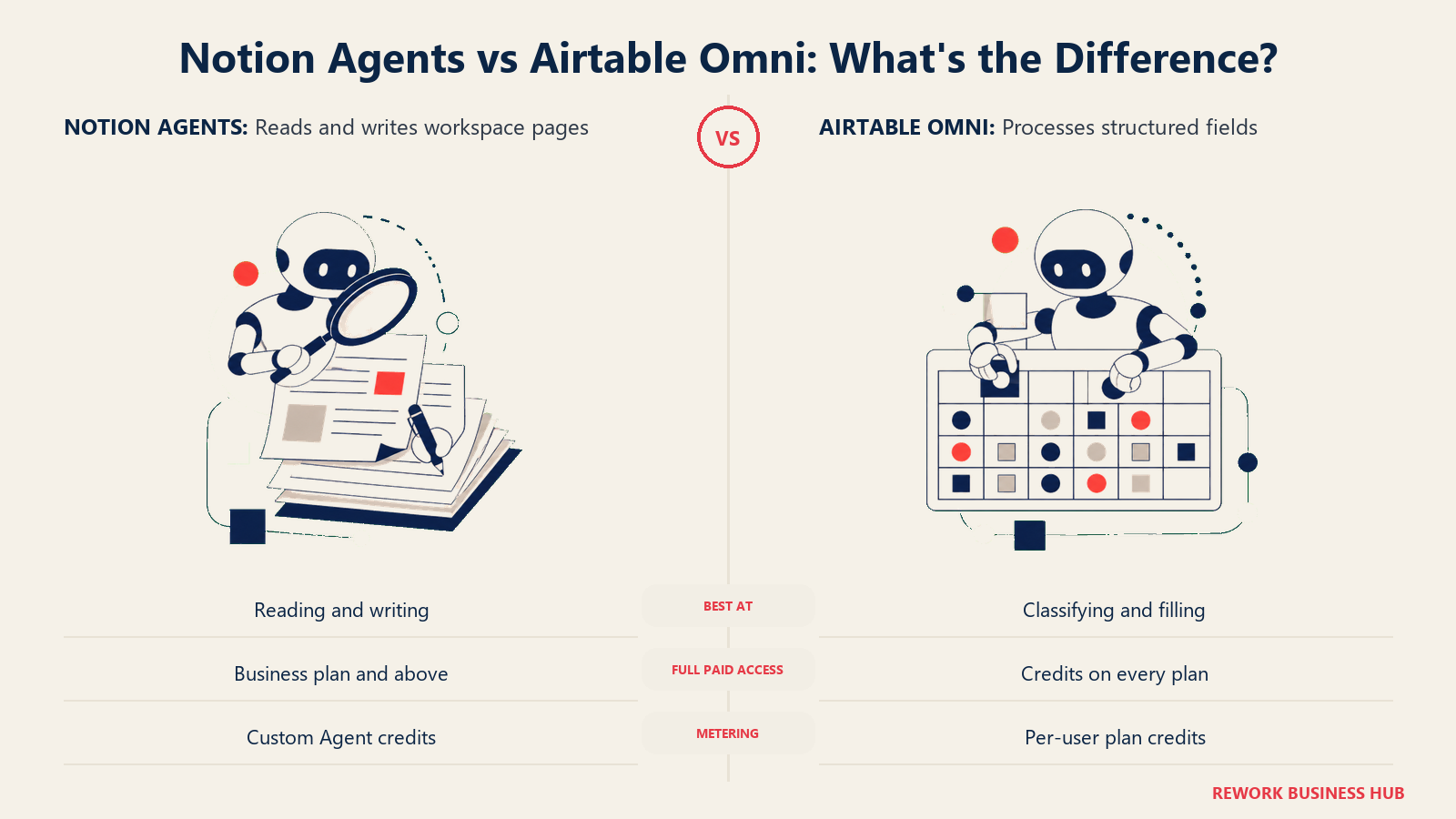
Notion includes AI features across paid plans, with full Notion Agent access, AI Meeting Notes, and Enterprise Search in beta on Business and above. Custom Agents are free to try and then metered at $10 per 1,000 monthly Notion credits, with credits available on Business and Enterprise plans. Notion's Workers are free to try now and start consuming credits on October 15.
Airtable's AI, branded Omni, ships on every plan with a monthly credit allocation: 500 AI credits per editor on Free, 15,000 per billable collaborator on Team, 20,000 per paid user on Business, and 25,000 per paid user at list price on Enterprise Scale.
| AI factor | Notion | Airtable |
|---|---|---|
| Brand | Notion AI, Notion Agent, Custom Agents, Workers | Omni |
| Included on the free plan | Trial of AI capabilities | 500 AI credits per editor per month |
| Included on the cheapest paid tier | Trial access to Notion AI features on Plus | 15,000 AI credits per billable collaborator per month on Team |
| Included on the tier above | Full Agent, AI Meeting Notes, Enterprise Search beta on Business | 20,000 AI credits per paid user per month on Business |
| Metered overage | $10 per 1,000 monthly Notion credits, Business and Enterprise only | Credit allocation set per plan |
| Data retention control | Zero data retention with LLM providers on Enterprise | Governed by plan and workspace settings |
The structural difference matches the products. Notion's AI is aimed at reading and writing: summarize this page, find the answer across the workspace, draft the doc. Airtable's is aimed at fields: classify this record, extract a value, generate a field from other fields at scale. Judge them on which job you actually have.
Pricing: What Each Vendor Publishes
Airtable publishes both billing bases. Notion's pricing page renders its rates with yearly billing selected by default and advertises up to 20% savings on yearly, so monthly billing costs more than the figures shown below.
| Plan | Notion | Airtable |
|---|---|---|
| Free | $0, 10 guests, 7-day version history, 5 MB per file | $0, 1,000 records per base, 1 GB attachments, 2-week history |
| Cheapest paid | Plus, $10 per member per month billed annually | Team, $20 per seat per month billed annually, $24 billed monthly |
| Mid tier | Business, $20 per member per month billed annually | Business, $45 per seat per month billed annually, $54 billed monthly |
| Top tier | Enterprise, custom quote | Enterprise Scale, custom quote |
| Add-ons | Custom domains, $8 per domain per month paid annually, $10 monthly | AI credits included per plan |
| Non-editor seats | Guests unlimited and unbilled from Plus | Read-only unbilled, commenters unbilled on Business |
Sources: Notion's pricing page and Airtable's plans overview.
Annual Cost at 10, 25, and 50 Seats
This is the table that ends most budget conversations, because the per-seat gap compounds quietly.
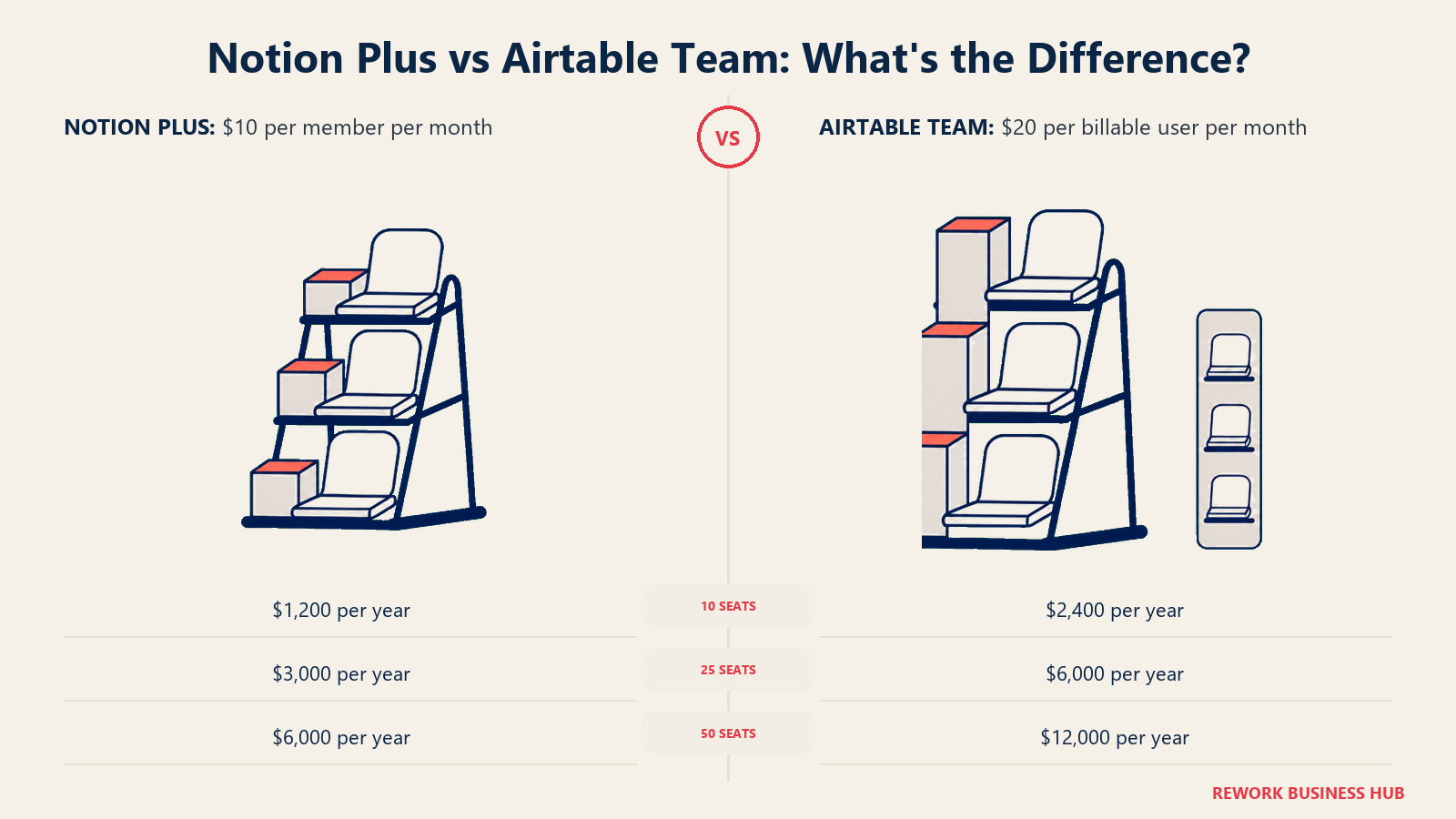
| Seats | Notion Plus (annual) | Notion Business (annual) | Airtable Team (annual) | Airtable Business (annual) |
|---|---|---|---|---|
| 10 | $1,200 | $2,400 | $2,400 | $5,400 |
| 25 | $3,000 | $6,000 | $6,000 | $13,500 |
| 50 | $6,000 | $12,000 | $12,000 | $27,000 |
Every figure uses the annual per-seat rate multiplied by 12 months and the seat count: Notion Plus at $10, Notion Business at $20, Airtable Team at $20, Airtable Business at $45.
Three things fall out of that grid. Notion Business and Airtable Team cost exactly the same at every seat count, which makes them the fairest head-to-head: docs plus shallow databases versus real relational structure at $240 per seat per year. Notion Plus is half the price of Airtable Team, so at 50 seats you are choosing between them on a $6,000 annual difference. And Airtable Business is the outlier at $27,000 a year for 50 seats, which is what makes the 125,000-record ceiling feel expensive rather than generous.
The seat math also cuts differently depending on who is in the room. If 30 of your 50 people only read dashboards, Airtable's unbilled read-only collaborators can shrink the licensed count sharply, while Notion charges per member regardless of what they do. If instead those 30 non-editors sit outside the company, Notion's unlimited unbilled guests do the same job for free. Model your own mix before trusting the headline number, and if per-seat licensing is a live debate on your team, the true cost of software sprawl covers what those seats add up to across a whole stack.
Migration Cost in Each Direction
Moving is not symmetric, and that asymmetry should weigh on the decision more than it usually does.
Notion to Airtable is the easier direction on data and the harder one on content. Properties map cleanly to fields, relations map to linked records, and rollups mostly survive. What does not survive is the page body. Every Notion record holding headings, embeds, nested subpages, and comment threads collapses into a long text field or gets left behind entirely. Teams making this move typically keep Notion for the documents and move only the structured databases, which means paying for both.
Airtable to Notion is the easier direction on content and the harder one on structure. A CSV export imports into a Notion database without much drama, but the typed fields degrade. Currency, Percent, Duration, Rating, and Barcode all land as text or plain numbers, formulas need rewriting in Notion's syntax, and any lookup or count field becomes a rollup you rebuild by hand. Interfaces, script-based automations, and view-level permissions have no destination at all.
Whichever product you pick as system of record is stickier than the one you pick as reading layer. If you are undecided, put the structured data where it is expensive to move and let the other product read from it.
Performance at Scale
Airtable degrades predictably. Grouped views with many rollups across tens of thousands of records are where it starts to drag, and because the ceiling is published you can see the wall coming and plan the upgrade or the migration.
Notion degrades unpredictably, because there is no published number to plan against. The trouble starts with a combination rather than a raw count: a few thousand pages in one database, several rollups, a filtered board view, and a handful of linked databases pulling from it. Page load stretches, the board hesitates, and no tier you can buy fixes it, because nothing is being throttled.
When Notion Is the Right Call
- Your records are documents. Briefs, specs, policies, meeting notes, account summaries. The database is filing, and the writing is the work.
- You want one workspace, not a stack. Wiki, docs, project tracker, and lightweight CRM in one product is a genuinely good deal at $10 per member per month, and it removes three tools from the bill.
- Outside collaborators need access. Unlimited unbilled guests from Plus makes client and partner access cost nothing, where per-seat tools charge for it.
- Your relations are one hop deep. Projects to tasks, accounts to contacts. The rollup ceiling never arrives if the model never chains.
- Adoption matters more than modeling. Notion is the easier product to get a non-technical team using daily, and a tool people actually open beats a better data model nobody touches.
When Airtable Is the Right Call
- Your records are fields, and other records depend on them. Line items, inventory, campaigns, assets, equipment. You need Lookup, Count, and Rollup as real fields, not workarounds.
- You need to compute across a chain. Anything two hops deep is where Notion's documented rollup restriction turns into manual work that quietly rots.
- Non-editors need a purpose-built screen. Interface Designer gives operational users a filtered, permissioned view of the base without handing over the schema.
- Automation is more than notifications. Webhook triggers, a scripting action, and 25,000 runs a month on Team replace a separate automation subscription for a lot of teams.
- You want the ceiling written down. Published record caps, published run caps, and published API limits are easier to budget against than a vague sense that things feel slow.
Decision Framework
Use the center of the record as the deciding test: writing and knowledge point to Notion, while typed operational data and deeper workflows point to Airtable.
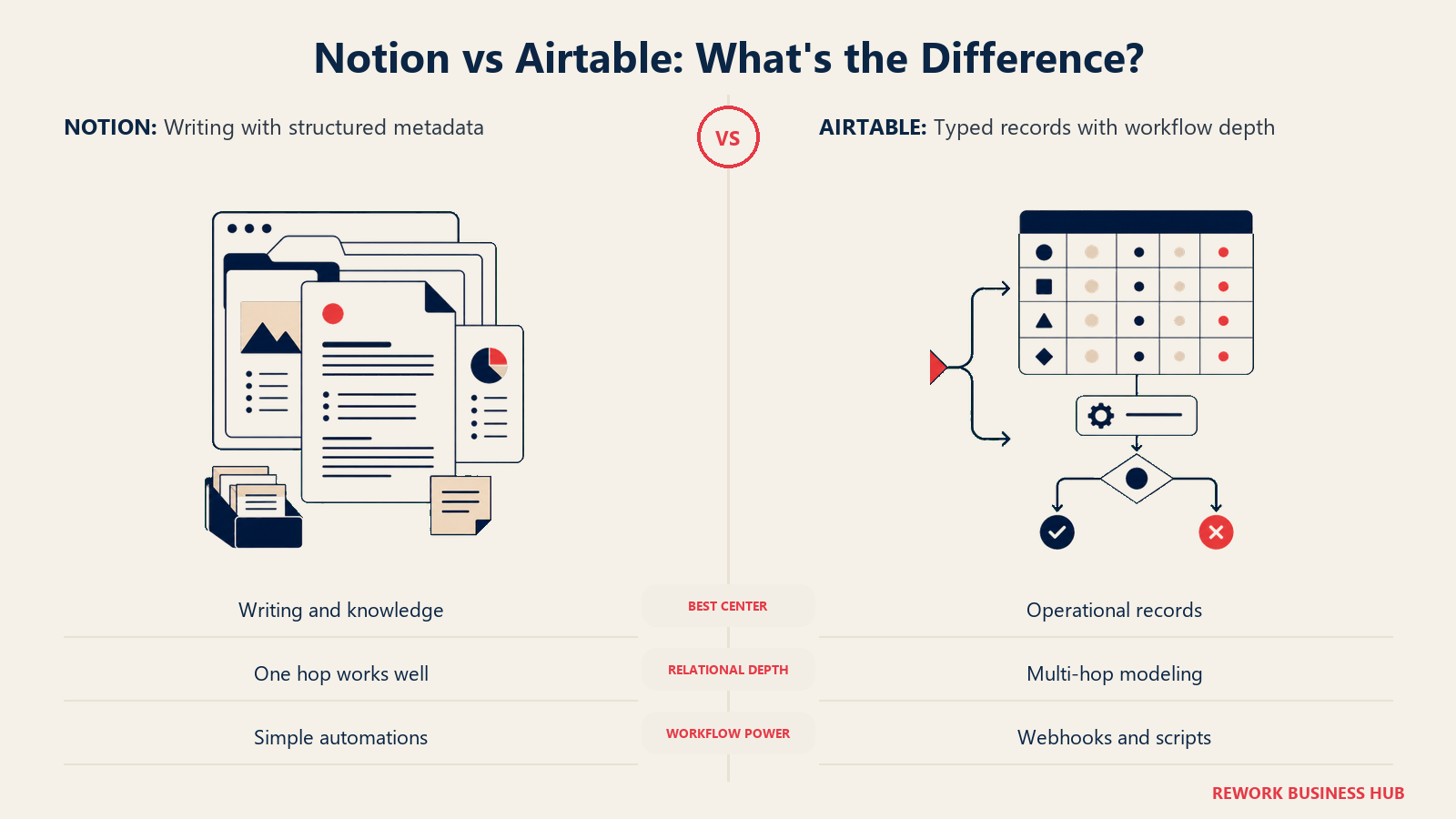
| If this is you | Pick |
|---|---|
| Your records are mostly writing, with a few fields around them | Notion |
| Your records are mostly fields, with a little writing inside them | Airtable |
| You need a number computed two relation hops away | Airtable |
| You need a wiki, docs, and a tracker in one product for under $10 per person | Notion |
| Outside collaborators need read or comment access at no cost | Notion |
| Operational users need a permissioned screen, not the raw table | Airtable |
| Your automation needs a webhook trigger or custom code | Airtable |
| You are past 50,000 records and Airtable Business feels steep | See best Airtable alternatives |
| Notion's databases got slow and you need real structure | See best Notion alternatives |
| You want documents and structured data in one product, but Notion's model is too shallow | See best Coda alternatives |
What to Do Next
- Take your single most contested workflow and model it in both, for real. Not a demo, not a template. Fifty actual records with the actual relations. The rollup ceiling and the field-type gaps both show up inside an hour once the data is real.
- Count your seats by role, not by headcount. Split editors from readers from outside collaborators. That split changes the annual number more than the tier choice does, in both directions.
- Check your deepest relation chain before committing. If any number you report on lives two hops away from where it is stored, Notion will make you maintain it by hand.
- Decide which product is the system of record and which is the reading layer. Plenty of teams run Airtable for structured operations and Notion for documentation, and that combination is a legitimate answer rather than a failure to choose.
- Widen the shortlist if neither fits cleanly. The best no-code database software roundup, Airtable vs SmartSuite, and best Smartsheet alternatives cover the tools teams land on when both names in this article come up short. If the underlying need is project delivery rather than data structure, best project management software is the better starting list.
Frequently Asked Questions about Notion vs Airtable
Is Notion or Airtable better as a database?
Airtable, without much argument. It offers 28 field types including distinct Lookup, Rollup, and Count fields, publishes its record limits per base, and lets you model relationships that chain across tables. Notion offers 22 property types, has no separate Lookup or Count, and its own documentation confirms a rollup cannot reference another rollup. Notion is better when the record is a document rather than a row.
Is Notion cheaper than Airtable?
Yes at the entry tier. Notion Plus is $10 per member per month billed annually against $20 per seat per month for Airtable Team, so at 50 seats that is $6,000 a year versus $12,000. Notion Business and Airtable Team cost the same at $20 per seat per month billed annually. The comparison flips if most of your users only read: Airtable does not bill read-only collaborators on paid plans, and Notion does not bill guests from Plus upward.
How many records can a Notion database hold?
Notion does not publish a record cap, which looks like an advantage on the pricing page. In practice a database with a few thousand pages plus several rollups and filtered views gets noticeably slower, and no plan upgrade fixes it because nothing is being throttled. Airtable publishes hard caps instead: 1,000 records per base on Free, 50,000 on Team, and 125,000 on Business.
Can Notion replace Airtable for a relational database?
Only for shallow models. If your relations are one hop deep, such as projects to tasks or accounts to contacts, Notion handles it fine. If you need to compute a value two hops away, such as total hours across projects to tasks to time entries, Notion has no supported path and you end up maintaining the number manually. That is the most common reason teams migrate off it.
Can I use Notion and Airtable together?
Many teams do, and it is often the right answer. The usual split puts structured operational data in Airtable as the system of record and uses Notion as the documentation and reading layer, linking or embedding Airtable views inside Notion pages. Just decide deliberately which one holds the source of truth, because moving that later is the expensive part.
Which one is easier for a non-technical team to adopt?
Notion, in most cases. It looks like a document, so people who are nervous about databases start using it without training. Airtable looks like a spreadsheet, which is familiar too, but its power lives in linked records and rollups that someone has to design first. Budget for one person to own the Airtable schema; Notion tends to spread on its own.
Related Resources:
- Best No-Code Database Software in 2026
- Airtable vs SmartSuite
- Best Airtable Alternatives
- Best Notion Alternatives
- Best Coda Alternatives
- Best Smartsheet Alternatives
- Best Project Management Software in 2026
- How to Choose No-Code Database Software
- How to Choose Internal Wiki Software
- The True Cost of Software Sprawl

Customer Success Operations Manager
On this page
- TL;DR
- The Real Split: Prose That Needs Structure, or Records That Need Prose
- Who Each Tool Is Actually Built For
- Key Facts
- Data Model Depth: What a Field Can Actually Be
- Relational Depth and Where Notion's Ceiling Sits
- Record Limits and What Happens When You Hit Them
- Views, Interfaces, and Who Sees the Data
- Automation and Scripting
- Permissions, Guests, and External Access
- API and Integration Depth
- AI in 2026: Notion Agents and Airtable Omni
- Pricing: What Each Vendor Publishes
- Annual Cost at 10, 25, and 50 Seats
- Migration Cost in Each Direction
- Performance at Scale
- When Notion Is the Right Call
- When Airtable Is the Right Call
- Decision Framework
- What to Do Next