Braze vs Iterable: Which Customer Engagement Platform Fits Your Team in 2026?
Turn this article into takeaways for your work.


Each assistant summarizes the article only for you and suggests best practices for your work.
Updated August 2026.
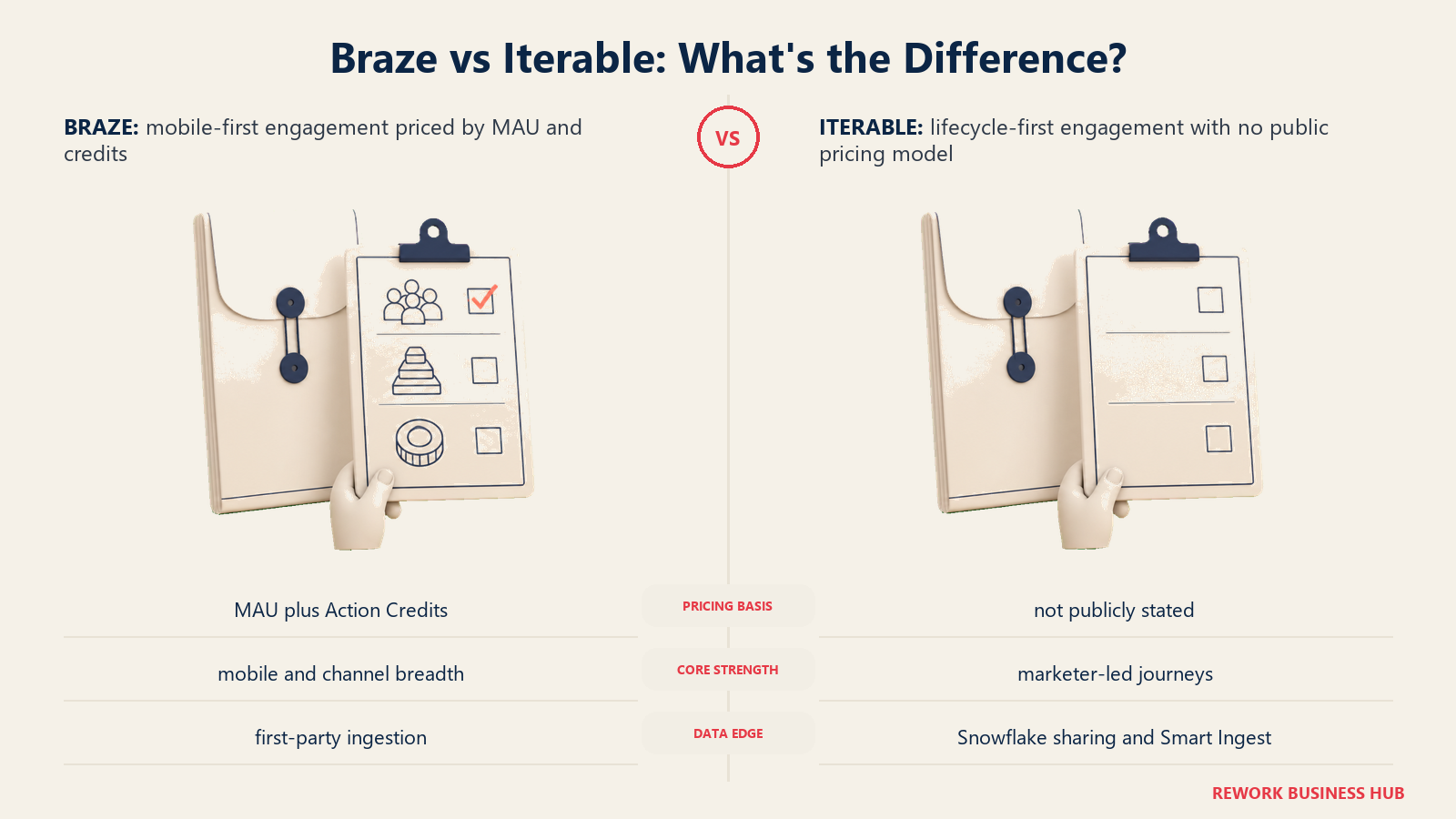
If you're a VP of marketing, a lifecycle lead, or a growth engineer at a consumer brand or app somewhere between 50 and 500 people, Braze and Iterable are almost certainly both on your shortlist. They land in the same analyst reports, they demo against each other constantly, and they do the same job: orchestrate push, in-app, email, SMS, and web messaging off one customer profile that updates in real time. The honest one-line split is heritage. Braze grew up around mobile app engagement and its channel list still reads that way, right down to LINE and KakaoTalk for East Asian audiences. Iterable grew up around email and lifecycle campaigns, and its pitch is that a lifecycle manager can build and change a journey without filing an engineering ticket first.
That split is where most comparisons stop, right before the part that actually decides your deal. Neither company publishes a price. Braze names four editions on its pricing page and tells you the bill scales with monthly active users, without printing a single dollar figure. Iterable doesn't have a pricing page at all: iterable.com/pricing returns a 404, and the only call to action on the site is a demo booking. So the useful thing this comparison can give you is not an invented price table. It's a clear account of what each vendor charges for, which variables move your quote up or down, and the specific terms to pin down in writing before you sign an annual contract you can't easily walk away from. If you want the wider field first, our best Braze alternatives guide covers 11 platforms in this category, and our SMS marketing software roundup covers the messaging stack around it.
TL;DR
| Braze | Iterable | |
|---|---|---|
| Published pricing | None. No dollar figure appears anywhere on braze.com/pricing | None. iterable.com/pricing returns a 404 and the site carries no pricing link |
| Named editions on the vendor's own site | Four: Braze Go, Braze Select, Braze Pro, Braze Enterprise | Zero. Iterable names no tiers publicly |
| What the vendor says the bill scales with | Monthly Active Users, plus an Action Credits model that works across every channel and certain BrazeAI products | Nothing stated publicly |
| Reported contract size (third party, not the vendor) | Median $89,332/yr across 251 purchases, per Vendr's buyer guide | Median $85,775/yr across 235 purchases, per Vendr's buyer guide |
| Heritage | Mobile app engagement | Email and lifecycle campaigns |
| Journey builder | Canvas Flow | Studio, with Journeys built inside it |
| Channels the other one doesn't list | LINE, KakaoTalk, and RCS alongside SMS | Embedded messaging |
| Warehouse ingestion | Cloud Data Ingestion: Snowflake, BigQuery, Redshift, Databricks, Microsoft Fabric, Amazon S3 | Snowflake Secure Data Sharing, plus Smart Ingest co-built with Hightouch |
| AI line | BrazeAI, including a Decisioning Studio built from the $325 million OfferFit acquisition completed June 2025 | Nova: Nova Decisioning, Nova Agent, and a Command Center, announced April 2026 |
| Who it fits | Mobile-first consumer brands where the app is a primary revenue surface, especially with East Asian markets in scope | Lifecycle teams that want marketer autonomy, and Snowflake shops that would rather share data than copy it |
Key Facts
- Marketers use only about one third (33%) of their martech stack's capability, down from 42% in 2022 and 58% in 2020, according to Gartner's 2023 Martech Report as reported by MarTech. Both platforms here sell a ceiling most buyers never reach.
- 93% of marketing leaders believe AI helps them accurately understand customer needs, but only 53% of consumers feel brands are successfully predicting what they want, per the 2026 Braze Customer Engagement Review, a vendor benchmark built on 2,200 VP-level B2C marketing executives and 4,000 US and UK consumers.
- A Forrester Total Economic Impact study commissioned by Braze and completed in April 2026 found a composite organization achieved 457% ROI over three years, a net present value of $23.5 million, and payback in under six months, based on interviews with six customer decision makers (braze.com). Treat vendor-commissioned ROI as a directional signal, not a forecast.
- A Forrester Total Economic Impact study commissioned by Iterable reported $41 million in additional revenue over three years for its composite customer (iterable.com). That study was published in 2018, so it predates most of the product either vendor sells today.
- Senders pushing more than 5,000 messages a day to Gmail must keep spam complaints below 0.30%, authenticate with SPF, DKIM and DMARC, and support one-click unsubscribe, per Google's own bulk sender guidelines. Whichever platform you pick, that bar is yours to clear, not the vendor's.
Who Each Platform Is Actually Built For
Braze's centre of gravity is the mobile app, and you can read that straight off its channel list. Braze names email, mobile app messaging, web messaging, SMS and RCS, WhatsApp, LINE, and KakaoTalk as channels on its own product pages. Two of those, LINE and KakaoTalk, dominate messaging in Japan, Taiwan, Thailand, and South Korea, and neither appears anywhere on Iterable's channel list. If Tokyo or Seoul is a real market for you rather than a slide in next year's expansion deck, that isn't a tiebreaker. It's most of the decision.
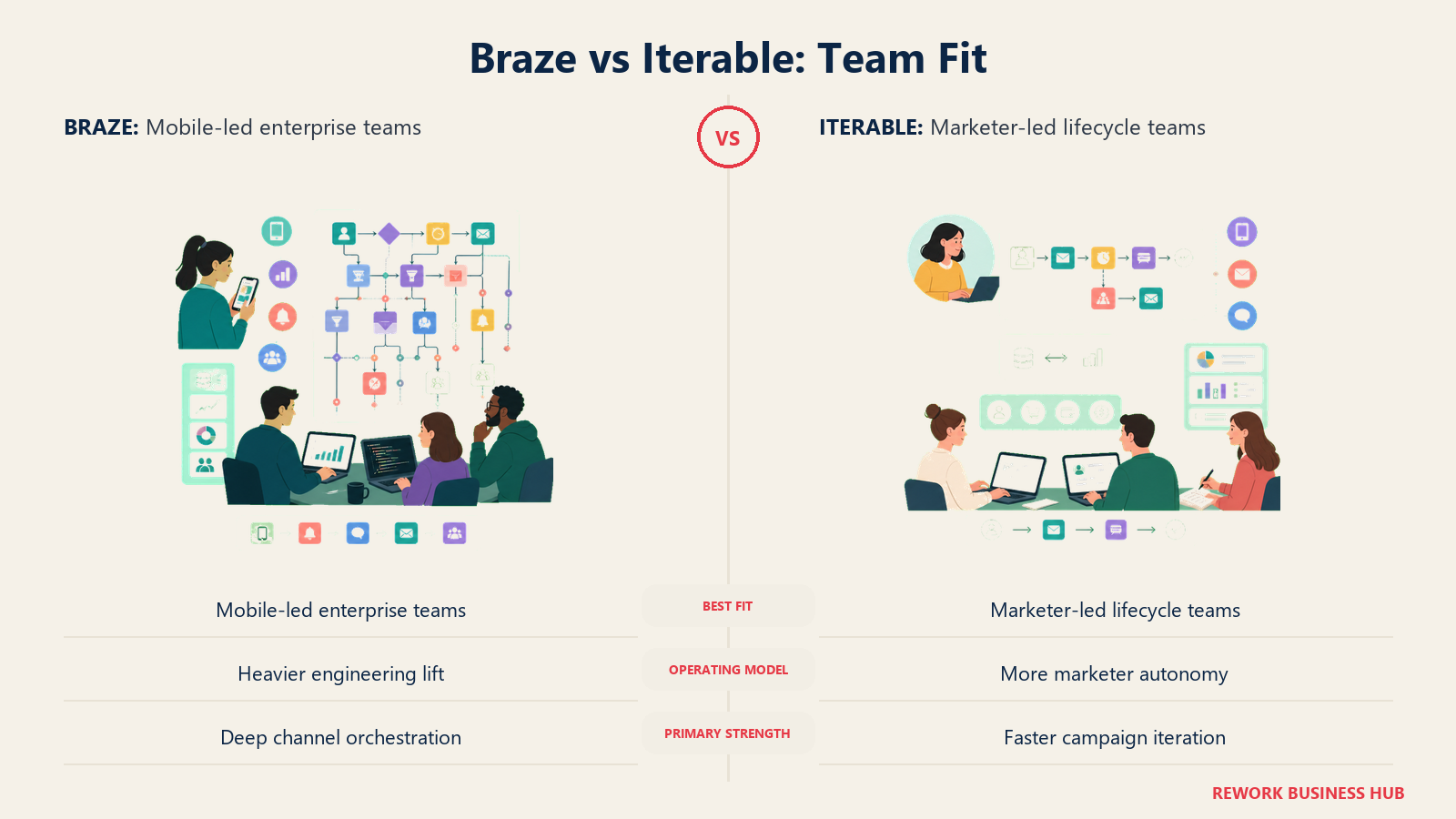
Iterable's centre of gravity is the lifecycle program. Its own documentation describes its channels as email, push, SMS, web push, and in-app messaging, with embedded messages and a native WhatsApp integration that landed in 2025. The heritage is email and campaign management, and the product carries one consistent design assumption: the person who owns the campaign should be able to change the campaign. Studio, its drag-and-drop journey builder, is built for a lifecycle manager rather than a growth engineer, and Smart Ingest exists specifically so a marketer can pull an audience out of the warehouse without waiting on a data team's backlog.
Both are enterprise-shaped from the first call, and neither has a self-serve on-ramp. Braze describes its entry edition, Braze Go, as being for early-stage growth teams, but there's still no signup button and no price. Gartner's finding that marketers use roughly a third of their stack's capability is the exact failure mode a smaller team walks into here: you buy the orchestration ceiling, staff for the campaigns you were already running, and pay for the gap. Below roughly 50,000 monthly active users, most teams are better served by something lighter, which is what our best Braze alternatives guide is for.
| Braze | Iterable | |
|---|---|---|
| Built around | The mobile app as a primary revenue surface | The lifecycle program, with email as the anchor channel |
| Primary internal owner | Usually shared between lifecycle marketing and a mobile or growth engineering counterpart | Usually lifecycle marketing, with engineering involved at setup then stepping back |
| East Asia reach | LINE and KakaoTalk listed as native channels | Neither listed |
| RCS | Listed alongside SMS | Not listed |
| Data stack assumption | Broad warehouse support, first-party and precisely documented | Equally broad through a partner-built tool, with the deepest integration built for Snowflake |
| Self-serve entry | None. Braze Go is sales-led like every other edition | None. The only site-wide call to action is a demo booking |
| Where it strains | Teams under roughly 50,000 MAU pay for a ceiling they won't reach | App-primary businesses find mobile push depth is real but not Braze's |
How Braze and Iterable Are Actually Priced
Here's the fact that shapes every other part of this decision, and the one most comparison articles paper over with numbers they made up: neither vendor publishes a price. Not a starting price, not a per-message rate, not a band. If you've seen a tidy Braze-versus-Iterable price table somewhere, someone either quoted a third-party listing without saying so or invented it.
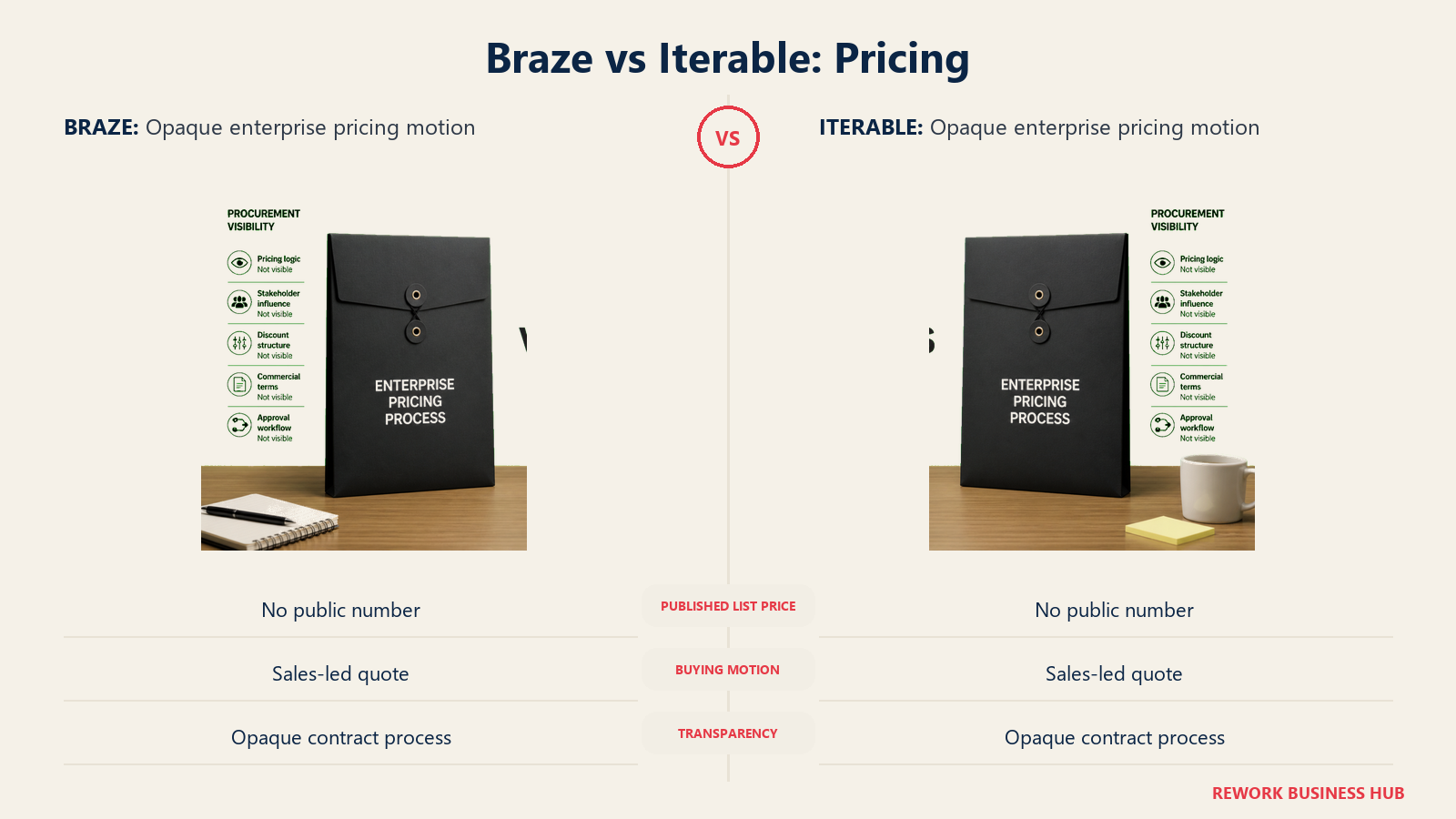
Braze publishes structure but no figures. Its pricing page names four editions, Braze Go, Braze Select, Braze Pro, and Braze Enterprise, and describes what each is for: Go for early-stage growth teams activating customer data, Select for companies scaling across more channels and team members with tighter governance, Pro for brands leaning on advanced BrazeAI capabilities and personalization, and Enterprise for engagement at massive scale with enterprise-grade orchestration and advanced experimentation. The page states that pricing scales with your Monthly Active Users, which it defines as the customers who actively interact with your brand across your digital experiences. On top of MAU sits an Action Credits model, described as a flexible credit-based system that works across every channel and certain BrazeAI products, with credits usable interchangeably across email, SMS, in-product messaging, and the BrazeAI Agent Console. No dollar amount appears anywhere on that page.
Braze's own explainer article breaks the model into three dimensions rather than two: the platform edition you're on, your active user count, and flexible credits covering the messages you send, the features you use, and the AI tasks you run. Braze's stated reason for not publishing a rate card is that it doesn't believe in a one-size-fits-all approach and customizes each package instead.
That three-dimension structure has a real consequence for how you forecast. MAU is measured on active users, not total database size, so a large dormant list doesn't inflate the meter the way it would on a contacts-priced tool like Klaviyo. But it cuts the other way too: if your product grows users faster than it grows revenue, your Braze bill grows with the users. And because credits meter separately, switching a campaign from email to WhatsApp or turning on an AI feature can move your bill without your MAU changing at all. Those are two independent variables, and a budget model that tracks only one of them will be wrong.
Iterable publishes nothing at all. There is no pricing page: iterable.com/pricing returns a 404, and the site's navigation and footer carry no pricing link. The only call to action anywhere on the homepage is a demo booking. Iterable also does not name any tiers publicly, which is worth stating plainly because tier names attributed to Iterable circulate widely.
Where do those names come from? Third-party buyer-data listings. Vendr's Iterable buyer guide reports a median buyer paying $85,775 per year across 235 purchases, and describes MAU-banded tiers it calls Growth (reported at $3,000 to $6,000 per month for 10,000 to 50,000 MAU), Premier (reported at $6,000 to $15,000 per month for 50,000 to 200,000 MAU), and Enterprise (reported at $20,000+ per month above 200,000 MAU), plus onboarding reported at $5,000 to $25,000 and up. Every one of those figures is Vendr's observation of what buyers paid, not Iterable's list price, and Iterable has never published those tier names.
For comparison on the same source, Vendr's Braze buyer guide reports a median buyer paying $89,332 per year across 251 purchases. Useful as a sanity check on order of magnitude, and it lands the two platforms within about 4% of each other at the median.
One caution about leaning on third-party listings, and it's the reason to treat them as directional rather than authoritative: Vendr's Braze guide organizes its data under tier names Core, Pro, and Enterprise. Braze's own pricing page names its editions Braze Go, Braze Select, Braze Pro, and Braze Enterprise. Two of those three third-party names don't match what the vendor actually sells today. If a listing's packaging is a version behind on the vendor that does publish its edition names, treat its numbers for the vendor that publishes nothing with the same caution.
| Braze | Iterable | |
|---|---|---|
| Public rate card | None | None, and no pricing page exists |
| Vendor-published package names | Four: Braze Go, Braze Select, Braze Pro, Braze Enterprise | None |
| Primary volume metric (vendor-stated) | Monthly Active Users, defined as customers actively interacting with your brand | Not published |
| Second meter (vendor-stated) | Action Credits, usable across email, SMS, in-product messaging, and the BrazeAI Agent Console | Not published |
| Third dimension (vendor-stated) | Platform edition, which gates orchestration, governance, AI, and experimentation depth | Not published |
| Vendor's stated reason for no rate card | Braze says it rejects one-size-fits-all pricing and customizes each package | No public statement; the site routes to a demo |
| Contract shape | Annual, sales-led, no self-serve | Annual, sales-led, no self-serve |
| Onboarding fee | Not published | Reported at $5,000 to $25,000+ by Vendr, not published by Iterable |
| Reported median annual contract (third party) | $89,332 across 251 purchases (Vendr) | $85,775 across 235 purchases (Vendr) |
| What you can actually verify yourself | Edition names, the MAU basis, and the credit model | That no price exists publicly. Nothing more |
The practical read: you cannot budget either of these from public information, and any exercise that pretends otherwise is theatre. What you can do is walk into the first call knowing which variables the quote is built from, and hold the vendor to defining each one in writing. That's the next section, and it's worth more to your finance partner than a price table would be.
What to Pin Down in Writing Before You Sign
When there's no rate card, the contract is the price. Every ambiguity you leave in the order form is a number the vendor gets to define later, usually at renewal, usually after you've migrated and lost your leverage. Bring this list to the first call, not the last.
The exact definition of an active user. Which events make a profile count as active? Does an app open count, an email open, a push receipt on a device that never launched? Ask whether the meter reads a monthly peak or a monthly average, because a definition that bills your peak prices your whole year off your single biggest promo day.
Whether anonymous and unknown visitors count. If unidentified web traffic enters the profile store, find out now whether it hits the MAU meter. That's the number that grows fastest and the one nobody models.
What happens when you exceed the band mid-term. Get the overage rate as a number, or a written commitment that overage triggers a true-up at renewal rather than a mid-term invoice. "We'll work with you" is not a rate.
Which channels and AI features consume credits, and at what rate. Specific to Braze, whose Action Credits span every channel and certain BrazeAI products. Ask for per-channel and per-AI-task consumption rates as a contract appendix. A WhatsApp-heavy program and an email-heavy program of identical volume are not the same bill.
A renewal uplift cap, in percent, on the order form. Year two and year three increases capped at a named number. Without it, every efficiency you gain in year one becomes the vendor's margin in year two, because migrating off either platform is expensive enough that you probably won't.
Implementation scope, hours, and the definition of go-live. Vendr reports Iterable onboarding at $5,000 to $25,000 and up; Braze publishes no implementation figure. Attach a statement of work naming deliverables, included hours, and the condition that constitutes go-live, so "launched" isn't decided by whoever wants the invoice paid.
Data export on exit, in writing. Full event history and profile data, in what format, over what window, at what cost. This clause is the difference between year four being a negotiation and year four being a hostage situation. Ask while you're still being sold to.
What a seat is, and which seats are free. Whether read-only viewers, approvers, and analysts consume a paid seat. On a platform whose value is cross-functional visibility, seat definitions quietly decide whether CS and product ever log in.
Sandbox and non-production environments. Whether a test workspace is included or an add-on, and whether it counts against MAU or credits. Skip this and you end up testing in production, which on a real-time engagement platform is exactly as bad as it sounds.
Channel Coverage: Push, In-App, Email, SMS, WhatsApp, and Web
Both platforms cover the core five that most lifecycle programs actually use: push, in-app, email, SMS, and web. Where they separate is at the edges, and the edges are where a channel decision usually gets made.
Braze documents a longer list. Its channel documentation covers in-app messages, Content Cards, and Banners as in-product surfaces, then email, transactional email, landing pages, push, SMS with MMS and RCS, WhatsApp, LINE, KakaoTalk, live notifications, and webhooks as out-of-product channels. Iterable's documented channels are email, push, SMS, web push, in-app messages, embedded messaging, and WhatsApp, which it added natively in 2025 with two-way messaging.
The most interesting pairing there is Braze's Content Cards and Banners against Iterable's Embedded Messaging, because they solve the same problem from different directions. Both give you a non-interruptive surface inside your own app or site, a feed, a carousel, a hero slot, rather than another notification competing for attention. The implementation differs in a way your engineers will care about: Iterable delivers embedded message content to your app as data rather than pre-rendered HTML, so you render it with native components styled to match your product. That's more upfront engineering and more design control. Braze's Content Cards arrive closer to ready to display.
Raw channel count favours Braze, and if LINE, KakaoTalk, or RCS are on your roadmap that gap is decisive. But channel count is not channel depth. A team sending 90% of its volume by email and push gains nothing from seven channels it will never turn on, and on Braze the credit model means the channels you do use are what you pay for. If SMS is your primary revenue channel rather than a supporting one, neither platform is the right shape, and our best Attentive alternatives and best Postscript alternatives guides cover tools built for that job.
| Channel | Braze | Iterable |
|---|---|---|
| Mobile push | Documented | Documented |
| Web push | Documented | Documented |
| In-app messages | Documented | Documented |
| Non-interruptive in-product surface | Content Cards and Banners | Embedded Messaging, delivered as data rather than pre-rendered HTML |
| Documented, with transactional email covered separately | Documented | |
| SMS | Documented | Documented |
| MMS | Documented alongside SMS | Not named separately in Iterable's channel documentation |
| RCS | Documented alongside SMS and MMS | Not listed |
| Documented | Documented, native and two-way since 2025 | |
| LINE | Documented | Not listed |
| KakaoTalk | Documented | Not listed |
| Live notifications | Documented | Not listed |
| Landing pages | Documented | Not listed as a channel |
| Webhooks as a message channel | Documented | Not listed as a channel |
Data Model and Ingestion
This is the section that decides how much engineering time the platform costs you every quarter after go-live, and it's the one buyers under-weight most.
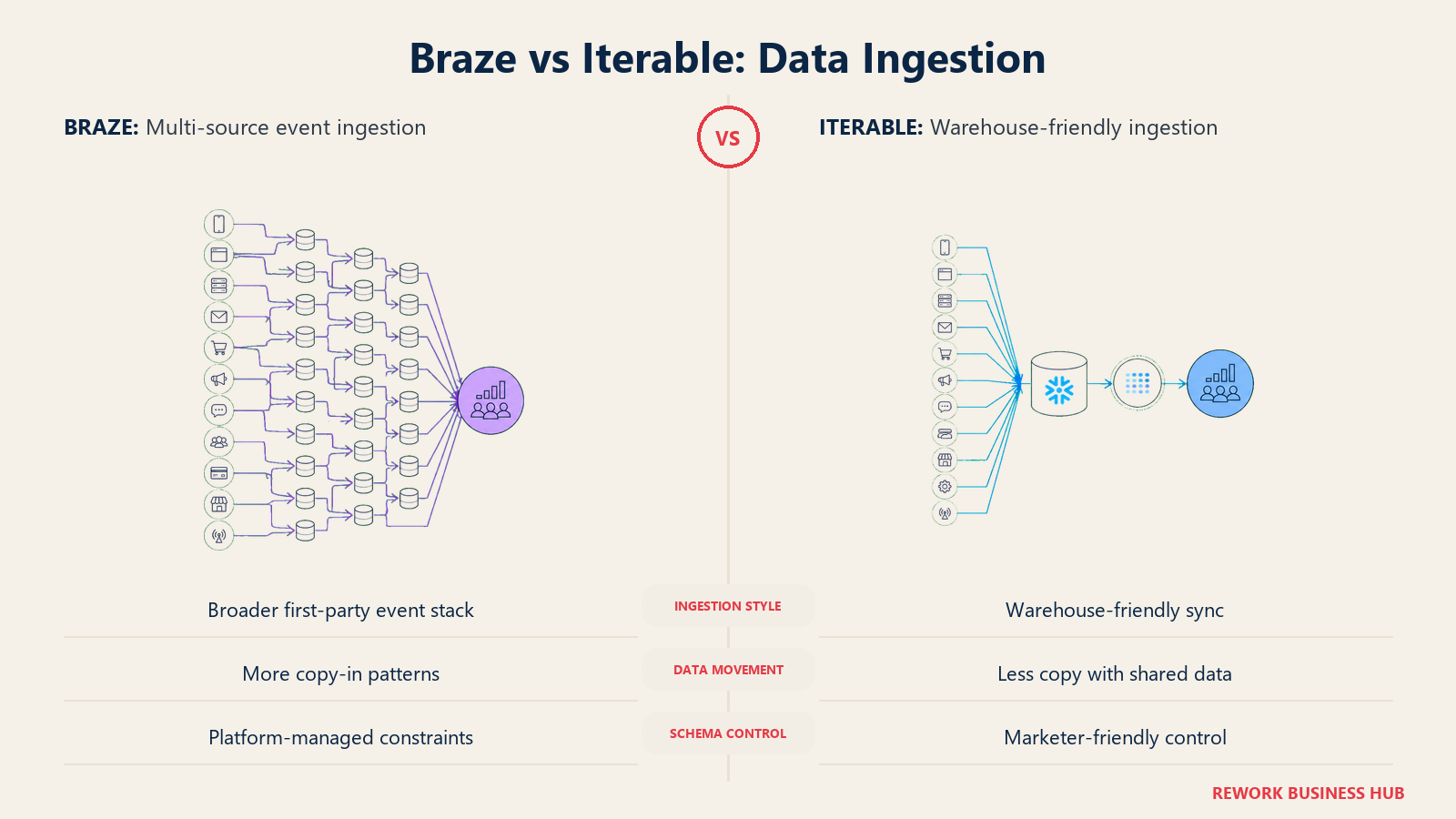
Braze documents its ingestion more precisely. Braze Cloud Data Ingestion natively connects six sources: Snowflake, Google BigQuery, Amazon Redshift, Databricks, Microsoft Fabric, and Amazon S3. It syncs user attributes (including nested custom attributes and arrays of objects), custom events, purchase events, user deletion requests, and catalog items, plus connected sources for zero-copy messaging. Braze documents the cadence too, which almost nobody does: syncs can run as often as every 15 minutes or as rarely as once a month, and anything faster than 15 minutes means REST API calls or a conversation with your customer success manager. Going the other way, Braze Currents streams engagement events out in Avro format to data partners, with Segment, mParticle, and Tealium named among the routing options.
Iterable covers the same warehouses and adds one architecture Braze doesn't. Smart Ingest, co-developed with Hightouch and offered at no additional cost, supports 23 or more sources including Snowflake, Redshift, BigQuery and Databricks, syncing as often as every 15 minutes. It lets a marketer import user attributes, populate lists, and update product catalogs from a cloud data platform without an engineering ticket. On top of that, Iterable's Snowflake Secure Data Sharing integration lets you work with Iterable user profile and campaign data inside your own Snowflake account without copying or moving it between environments, which is a meaningfully different architecture than a sync that duplicates rows on a schedule.
Iterable also ships something Braze doesn't advertise an equivalent for: Data Schema Management, which lets a marketer lock the data structure so unintended fields can't be added. That sounds like housekeeping. It isn't. Schema drift is the quiet reason three-year-old segmentation stops being trustworthy, and a lock on the schema is a governance feature that pays off long after the person who bought the platform has moved on.
The honest read: warehouse coverage is not the differentiator buyers assume it is, because both connect to Snowflake, Redshift, BigQuery and Databricks at a comparable 15-minute cadence. Two things do separate them. Braze's connector is first-party and it publishes the exact data types and sync floor, which is easier to hold a vendor to. Iterable's is co-developed with Hightouch but reaches a wider catalogue of sources overall, and if your warehouse is Snowflake specifically, Secure Data Sharing is arguably the more elegant option of the two because nothing gets copied at all. Ask each vendor to confirm what is live for your warehouse rather than trusting a category claim. And if you're evaluating this because your event data lives somewhere neither handles well, our best Customer.io alternatives guide covers the platforms built around event-driven data models specifically.
| Braze | Iterable | |
|---|---|---|
| Warehouse and object sources | Snowflake, BigQuery, Redshift, Databricks, Microsoft Fabric, Amazon S3 (six, first-party) | Snowflake, Redshift, BigQuery, Databricks and more (23 or more sources stated), plus Snowflake Secure Data Sharing |
| Product name for ingestion | Cloud Data Ingestion | Smart Ingest, co-developed with Hightouch |
| Cost of the ingestion tool | Not separately published | Offered at no additional cost |
| Data types synced in | User attributes including nested attributes and arrays of objects, custom events, purchase events, deletion requests, catalog items | User attributes, list membership, product catalog updates |
| Documented sync cadence | As often as every 15 minutes, as rarely as monthly; faster needs REST API | Not published |
| Warehouse-side sharing | Not the model; ingestion copies data in | Snowflake Secure Data Sharing works inside your account without copying or moving data |
| Streaming data out | Braze Currents, real-time engagement events in Avro | Not published as a named streaming product |
| Named CDP and routing partners | Segment, mParticle, Tealium | Not enumerated publicly |
| Schema governance | Not advertised as a named feature | Data Schema Management lets marketers lock the schema against unintended fields |
Segmentation and Journey Building
Braze's journey builder is Canvas Flow. Iterable's is Studio, with Journeys built inside it as a drag-and-drop interface covering entry rules, messages, delays, and profile updates. Both do multi-branch orchestration across every channel they support, and demoed back to back they feel more alike than different. A two-hour demo won't tell you which one your team is still productive in eighteen months from now.
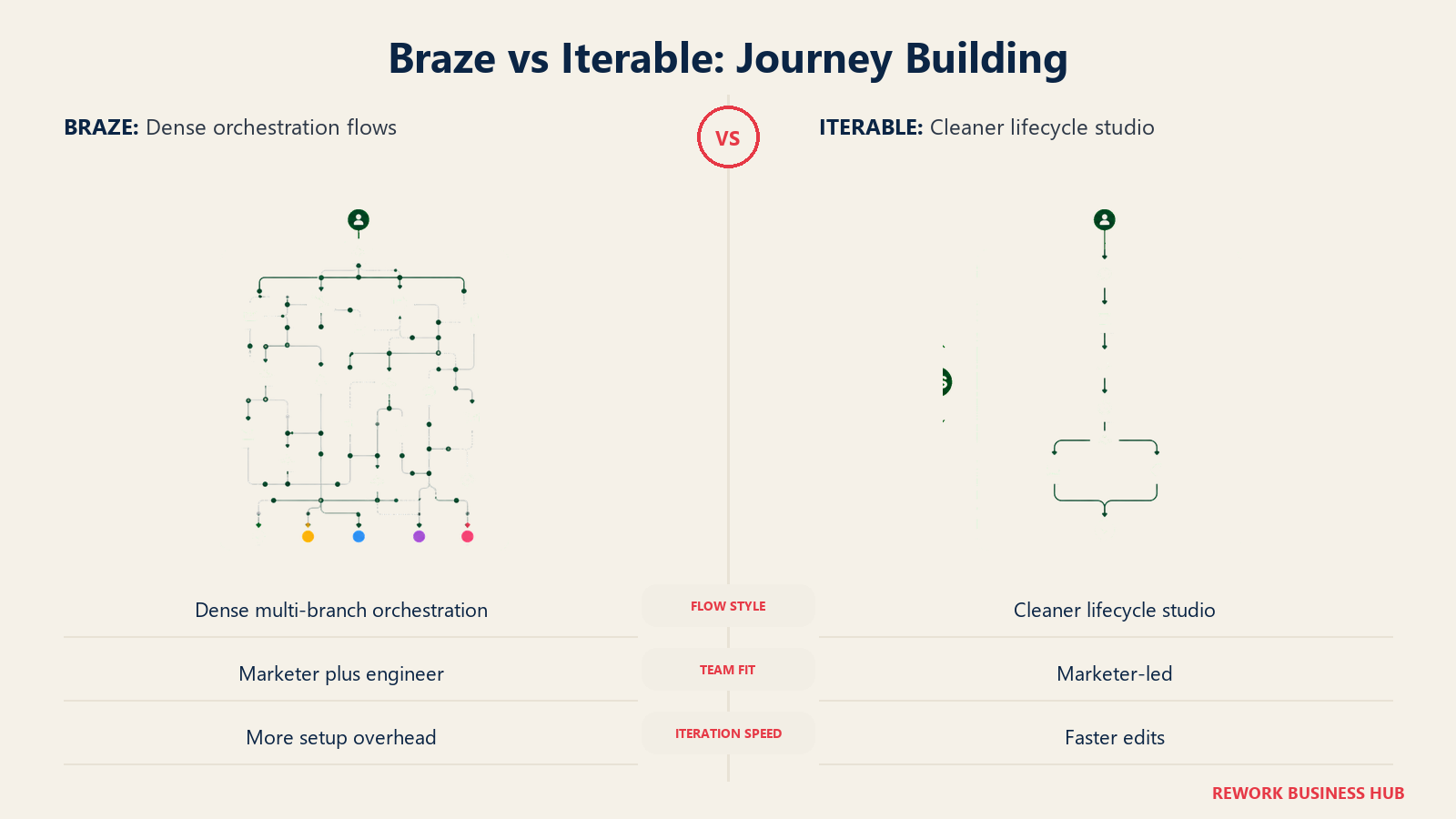
The difference that actually shows up later is who the builder assumes is driving. Iterable's design assumption is the lifecycle marketer, and its Journey Agent extends that by building dynamic workflows without SQL or custom code. Braze's assumption is a marketer working next to an engineer, which buys more precision at the cost of more dependency. Neither is better in the abstract. It depends entirely on whether you have a growth engineer whose job includes your messaging stack, or whether every schema change goes into a shared backlog behind the product roadmap.
There's a second difference that matters more to your budget than to your workflow, and it's easy to miss in a demo. Braze gates orchestration and experimentation depth by edition. Its pricing page describes Select as adding increased orchestration capabilities and enhanced security, Pro as adding predictive AI and AI personalized recommendations, and Enterprise as adding enterprise-grade orchestration and advanced experimentation. So a feature you watched work in a demo may sit two editions above the quote you're being shown. Ask which edition your proposed contract is, then ask which of the features you just saw are in it. On Iterable there are no published tiers to check against at all, which means the same question has to be answered entirely in writing rather than by reading a page.
| Braze | Iterable | |
|---|---|---|
| Journey builder | Canvas Flow | Studio, with Journeys built inside it |
| Design assumption | A marketer working alongside a growth or mobile engineer | A lifecycle marketer working independently |
| No-code workflow building | Available, with depth varying by edition | Journey Agent builds dynamic workflows without SQL or custom code |
| Orchestration depth | Gated by edition: Select adds increased orchestration, Enterprise adds enterprise-grade orchestration | Not gated by any published tier, because no tiers are published |
| Experimentation | Advanced experimentation is described as an Enterprise-edition capability | An Experimentation Agent was announced in the April 2026 Nova wave |
| Predictive personalization | Predictive AI and AI personalized recommendations arrive at the Pro edition | Nova Decisioning determines how, when, and where to engage each customer |
| The question to ask | Which edition is my quote, and which demoed features are in it? | Which features are in my contract, given there is no tier page to check? |
Real-Time Behavior and Scale
Both platforms sell real time as a headline, and for in-product events both deliver it: a user does something in your app, the profile updates, an eligible message fires. The distinction worth understanding is that real time almost never describes your warehouse data, and warehouse data is where most of your best segments actually live.
Braze is unusually specific about that boundary. Cloud Data Ingestion syncs at a documented floor of every 15 minutes, and Braze's own docs say anything faster requires REST API calls or a conversation with your customer success manager. That's less a limitation than an honest published number, and it lets you design around it. If your use case genuinely needs sub-15-minute freshness from a warehouse table, you know before signing that the answer is an API integration rather than a checkbox. On the outbound side, Braze Currents streams engagement events continuously in Avro to downstream partners.
Iterable does not publish an equivalent cadence figure. Its Snowflake Secure Data Sharing model sidesteps part of the question by not copying data at all, which changes the shape of the problem rather than answering the latency question directly.
One fairness note, because the tables in this article can read as lopsided: the asymmetry here is about disclosure, not capability. Braze documents more publicly than Iterable does. That is not evidence that Iterable's platform is slower or smaller, and plenty of large consumer brands run high-volume real-time programs on it. It does mean your due diligence on Iterable has to happen inside the sales process rather than in the docs, so budget for a more demanding technical evaluation and get the answers in writing.
| Braze | Iterable | |
|---|---|---|
| In-product event response | Real time, profile updates trigger eligible messages | Real time, profile updates trigger eligible messages |
| Documented warehouse sync floor | Every 15 minutes, with monthly at the slow end | Not published |
| Path to faster than the documented floor | REST API calls, or escalate to your CSM | Not published |
| Warehouse access model | Ingestion copies data into the platform | Snowflake Secure Data Sharing works in place, without copying |
| Outbound event streaming | Braze Currents, continuous, Avro format | Not published as a named product |
| Published operating footprint | Its 2026 engagement review drew on behavioral data from 779 Braze customers and 6 billion user profiles across 24 sub-industries | Not published |
| Uptime SLA | Not on public pages, negotiated in contract | Not on public pages, negotiated in contract |
| What this means for diligence | Much of it can be done from public docs before the first call | Most of it has to happen inside the sales process |
AI Features
Both vendors have converged on the same idea over the last two years: an agent that decides what to send each individual, rather than a marketer picking a segment and a send time. How each one got there is the part worth knowing, because it tells you what you're actually buying.
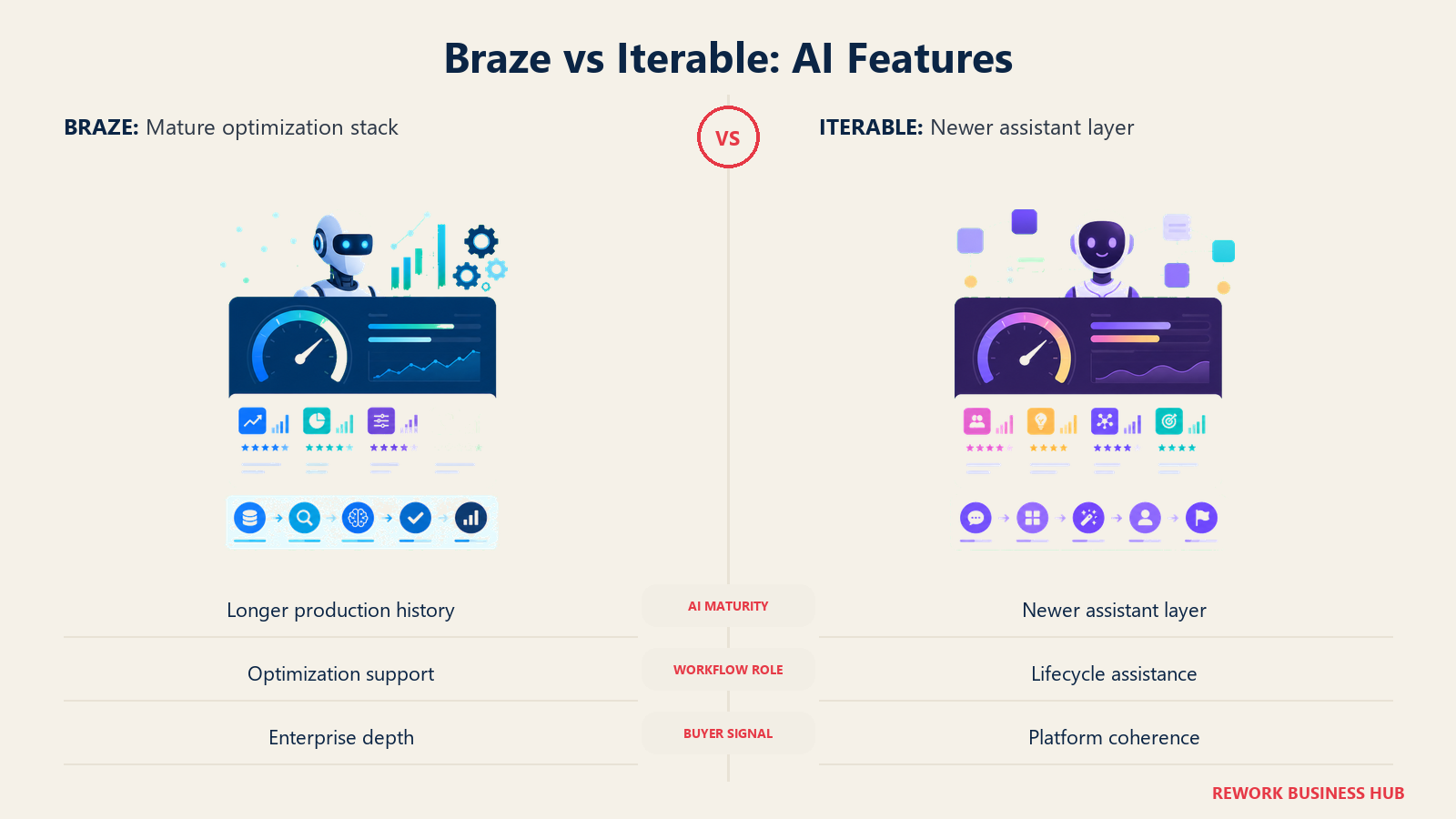
Braze bought its way in. In March 2025 Braze agreed to acquire OfferFit for $325 million, and closed the deal on 2 June 2025. OfferFit had spent four years building a multi-agent decisioning engine that makes one-to-one decisions about the best way to market to each individual customer, and Braze rebranded it as AI Decisioning Studio inside the BrazeAI line. The Forrester study Braze commissioned attributes $8.5 million of its composite organization's incremental profit specifically to that Decisioning Studio component. That's a vendor-funded figure and should be read as one, but it does show where Braze is putting its weight.
Iterable built its own. Nova is Iterable's intelligence layer, announced in April 2026, and it arrives in parts: Nova Insights for reading signals, Nova Decisioning as the layer deciding how, when, and where to engage each customer, and Nova Agent as a goal-driven agent that builds campaigns, audits messages, and runs experiments. The same announcement introduced an Iterable Command Center, Unknown User Activation for engaging high-intent anonymous visitors, a real-time Google Ads audience sync, and an SMS Compliance Toolkit, with an Experimentation Agent slated to follow.
The practical difference is maturity versus coherence. Braze's decisioning engine ran in production for four years under a different logo before Braze owned it, so it's proven technology inside a newer wrapper, with the integration seams that implies. Iterable's is newer as a whole, which cuts both ways: a shorter track record, but designed as one system rather than stitched in after the fact.
Worth holding onto while you evaluate either one: Braze's own 2026 engagement review documents a wide gap between how well marketers believe their AI understands customers and how well consumers think brands actually predict what they want. The vendor publishing that gap is also selling you the tools meant to close it. Buy AI features because a specific decision in your program is currently made badly by a human on a Tuesday afternoon, not because the roadmap slide was persuasive.
| Braze | Iterable | |
|---|---|---|
| AI product line | BrazeAI | Nova |
| Decisioning engine | AI Decisioning Studio, from the OfferFit acquisition | Nova Decisioning |
| How it was built | Acquired for $325 million, announced March 2025, closed 2 June 2025 | Built in house, announced April 2026 |
| Prior production history | Four years as OfferFit before the acquisition | New as of the April 2026 launch |
| Agent products | BrazeAI Agents, with an Agent Console that consumes Action Credits | Nova Agent, Journey Agent, and an announced Experimentation Agent |
| Creative tooling | Creative Studio | Message auditing inside Nova Agent |
| Anonymous visitor activation | Not named as a distinct product | Unknown User Activation |
| Paid ads audience sync | Media Audience Sync | Real-time Google Ads audience sync |
| How AI is metered | Action Credits cover AI tasks, and predictive AI arrives at the Pro edition | Not published |
| Vendor-attributed financial impact | $8.5 million of composite incremental profit credited to Decisioning Studio in a Braze-commissioned Forrester study | No comparable figure published for Nova |
Implementation Effort and Time to Value
Neither vendor publishes an implementation timeline, so anyone quoting you "six weeks on Iterable, six months on Braze" as though it were a property of the software is guessing. What determines your timeline is a short and boringly concrete list of variables, and most of them are about your side of the wire.
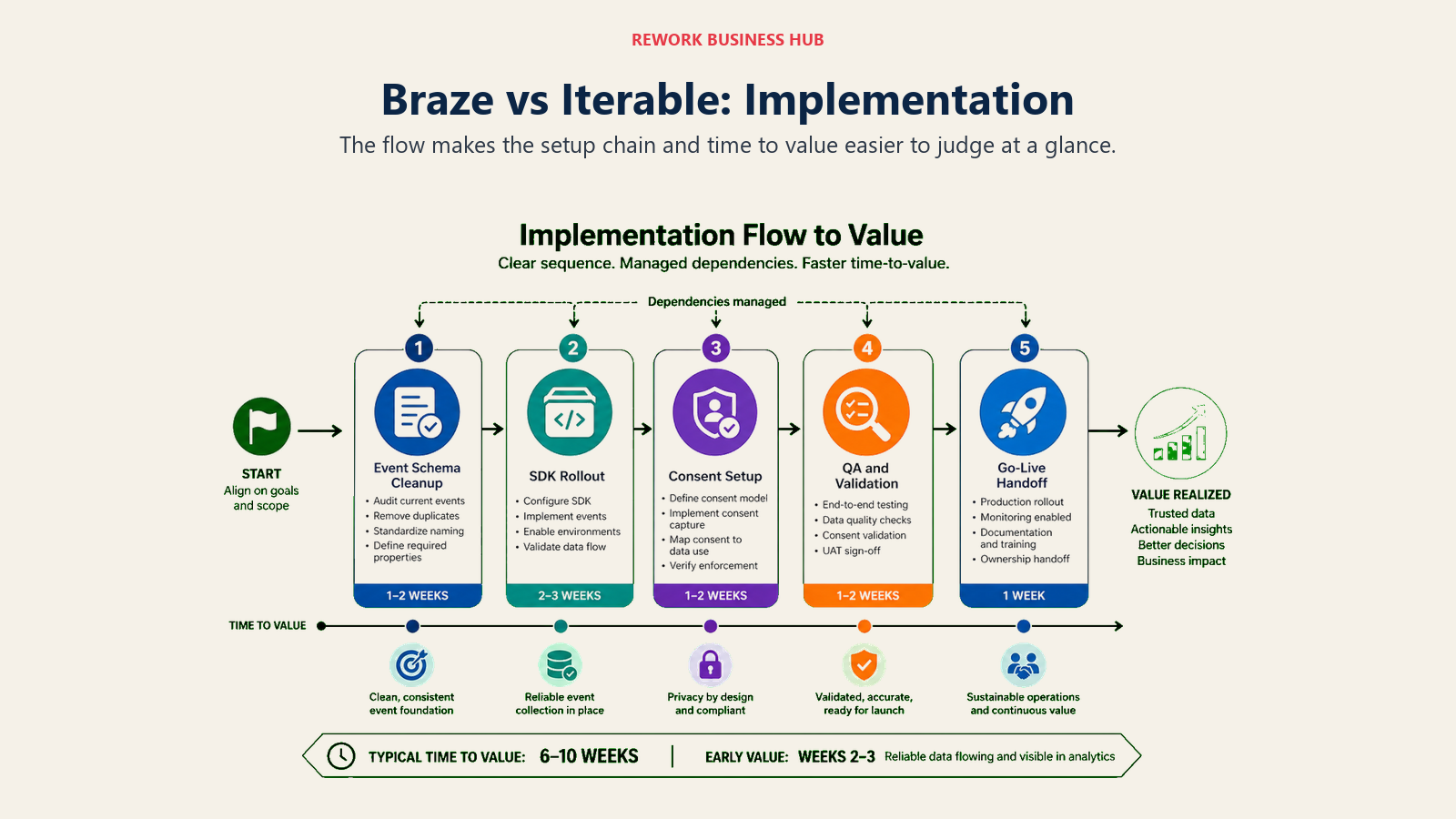
The big one is your event schema. If your product doesn't already emit clean, consistently named, stable events, that work happens before either platform can do anything useful, and it's your engineering team's work rather than the vendor's. Teams that blow through go-live almost always blow through it here, then blame the platform. After that comes SDK integration on each surface, then channel-by-channel setup: SMS needs carrier registration, WhatsApp needs a Business account and template approval, email needs domain authentication and IP warm-up. Each has an external party running its own clock.
Where the two genuinely differ is what happens after go-live. On Iterable, Smart Ingest is the single biggest lever on ongoing effort, because it moves routine data imports from an engineering ticket to a marketer task, at no additional cost, and Data Schema Management keeps the structure from drifting once several people are touching it. On Braze, the equivalent lever is breadth: Cloud Data Ingestion connecting natively to six sources means less custom pipeline work if your stack is already on one of them, and the certified implementer bench is deeper, with more than 5,200 certifications completed through its partner network.
On money, the asymmetry continues. Vendr reports Iterable onboarding at $5,000 to $25,000 and up (reported, not an Iterable figure). Braze publishes no implementation fee at all. The Forrester study Braze commissioned credits its composite organization with 108,500 hours reclaimed and 80% annual engineering labor savings, which is a vendor-funded number and belongs in the "directionally interesting" pile rather than your business case.
| Factor | Braze | Iterable |
|---|---|---|
| Mobile and web SDK work | Required on each surface you support | Required on each surface you support |
| Warehouse connection effort | Low on any of six first-party sources | Low across a wider source list, lowest on Snowflake specifically |
| Who can import data after go-live | Engineering, or your CSM for anything beyond the documented sync cadence | A marketer, through Smart Ingest, at no additional cost |
| Ongoing schema maintenance | No named feature for it | Data Schema Management locks the schema against unintended fields |
| Published implementation timeline | None | None |
| Published implementation fee | None | Reported at $5,000 to $25,000+ by Vendr, not published by Iterable |
| Certified implementer bench | More than 5,200 certifications completed through Braze Alloys | 46 partners listed in the public partner directory |
| Vendor-claimed efficiency | 108,500 hours reclaimed and 80% annual engineering labor savings in a Braze-commissioned Forrester study | No comparable published figure |
| The thing that actually delays go-live | Your event schema | Your event schema |
Support and Partner Ecosystem
Neither vendor publishes support tiers the way a self-serve tool does. There's no page telling you whether you get chat, a phone line, or a named contact. That follows from the sales-led model: support level is a contract term negotiated alongside everything else, which also means it's negotiable, and most buyers forget to negotiate it.
What you can compare publicly is the partner bench, and it matters more than it looks. On a platform with no published support SLA, whoever unblocks you at 4pm on launch day is often a partner agency rather than the vendor.
Braze runs the Alloys Partner Network, split into Technology Partners and Delivery Partners. Its public figures are more than 5,200 certifications completed, more than 2,400 customers using a partner integration, and coverage across more than 30 global markets. The technology logos it displays line up with the ingestion story: Snowflake, Databricks, Amazon S3, Google Cloud Storage, plus Shopify and Meta, with consultancies including Deloitte Digital and Merkle.
Iterable runs Solutions Partners and Technology Partners as its two categories, with 46 partners listed in its public directory across agencies, CRM and lifecycle specialists, data and analytics shops, and mobile marketing firms. Named agencies include Tinuiti, Merkle, DEPT, and Bounteous.
One practical detail buried in those two lists: Merkle appears in both. If you already work with a large agency, check whether it holds certifications on both platforms before you let partner availability influence the decision, because it may well be a non-factor.
| Braze | Iterable | |
|---|---|---|
| Published support tiers | None on public pages | None on public pages |
| Support model | Contract term, negotiated per deal | Contract term, negotiated per deal |
| Partner program | Braze Alloys Partner Network | Iterable Solutions and Technology partner programs |
| Partner categories | Technology Partners, Delivery Partners | Technology Partners, Solutions Partners |
| Public scale signals | 5,200+ certifications, 2,400+ customers using a partner integration, 30+ global markets | 46 partners listed in the public directory |
| Named technology partners shown publicly | Snowflake, Databricks, Amazon S3, Google Cloud Storage, Shopify, Meta | Directory spans technology and solutions partners |
| Named agencies shown publicly | Deloitte Digital, Merkle | Tinuiti, Merkle, DEPT, Bounteous |
| Agency overlap | Merkle appears in both ecosystems | Merkle appears in both ecosystems |
| What to negotiate | Support tier, response-time SLA, and whether a technical account manager is included | The same, and harder, because less is documented anywhere |
What Else Is in the Running
If you got this far and the honest answer is "both of these are bigger than what we need", that's a legitimate conclusion rather than a failed evaluation. Reported medians on both sit near $90,000 a year, and plenty of teams shopping them are solving a problem a lighter tool solves for a tenth of that. Here's the rest of the field, with what each one actually publishes. Figures below are monthly-billing rates from each vendor's own pricing page, checked in August 2026.
| Platform | Published entry price | What that covers | How it relates to Braze and Iterable |
|---|---|---|---|
| Customer.io | Tier figures don't render on its public pricing page | Essentials includes 5,000 profiles and 1 million monthly emails, with published overages: profiles at $0.009 each, email at $0.12 per 1,000, AI credits at $10 per 100,000. Companies that have raised under $10 million get a full year free through its startup program | The honest step down for technical teams that want event-driven messaging without an enterprise contract floor |
| OneSignal | Growth from $19/mo plus usage | Mobile push at $0.012 per MAU, web push at $0.004 per subscriber, 20,000 free monthly emails then $1.50 per 1,000 | Push-first rather than lifecycle-first. The fastest and cheapest on-ramp here, with email and SMS as supporting acts |
| CleverTap | Core at $85/mo, covering up to 5,000 MAU | A 30-day trial before billing starts. Pro and Ultimate revert to custom quotes | The only MAU-priced peer in this weight class that publishes an entry number you can read before booking a call |
| Klaviyo | Email from $30/mo at 1,000 active profiles; SMS separately from $15/mo for 1,250 credits | Email and SMS are separate plans that stack, so $30/mo is the email floor and not the all-in floor | A different data model entirely, built on ecommerce transactions rather than generic product events |
| MoEngage | None published | Four lines (Inform, Growth, Enterprise, Personalize), all routed to sales, with no free tier or trial listed | Closest to Braze on mobile depth, with a similar enterprise sales motion and floor |
| Airship | None published | Airship Experience Platform for enterprise, plus Airship Essentials with a self-service signup | Long push and in-app heritage, and one of the few in this tier with any self-serve entry point at all |
For a full peer comparison of the two most likely step-downs, see our best Customer.io alternatives guide and, if your data model is really ecommerce rather than product-event, our best Klaviyo alternatives guide. If the enterprise marketing-automation end of the market is where you're actually shopping, our best Marketo alternatives and best ActiveCampaign alternatives guides cover that side.
When Braze Is the Right Call
- Your mobile app is the product, not a companion to it. Braze documents in-app messages, Content Cards, Banners, and live notifications as separate in-product surfaces. If the app is where your customer relationship lives, that variety is worth real money.
- East Asia is a market, not an aspiration. LINE and KakaoTalk are documented Braze channels and neither appears on Iterable's list. If Japan, Taiwan, Thailand, or South Korea are in your two-year plan, this comes close to deciding the evaluation on its own.
- You want the ingestion path first-party and documented. Cloud Data Ingestion is Braze's own connector, and it publishes the exact source list, the data types it syncs, and a 15-minute sync floor you can design around. Iterable reaches more sources but does it through a partner-built tool, which is a different thing to hold a vendor to in a contract.
- You want to finish technical diligence before the first sales call. Braze documents its channels, ingestion sources, sync cadence, editions, and pricing dimensions publicly. On Iterable, most of that has to be extracted from a salesperson.
- You have a growth engineer, or you're hiring one. Braze rewards a marketer-plus-engineer pairing with more precision than a marketer working alone will get out of it. If that pairing isn't coming, you'll under-use what you're paying for.
- RCS is on your channel roadmap. Braze documents it alongside SMS and MMS. Iterable doesn't list it.
When Iterable Is the Right Call
- Your lifecycle manager needs to move without filing a ticket. Studio, Journey Agent, and Smart Ingest all reduce how often the person who owns the campaign waits on someone who doesn't. If your engineering backlog is measured in quarters, that's the difference between running a program and describing one.
- Snowflake is your source of truth and you'd rather not duplicate it. Secure Data Sharing lets you work with Iterable profile and campaign data inside your own Snowflake account without copying or moving it between environments. That keeps one fewer copy of your customer data in a vendor's store.
- Several people touch your data schema. Data Schema Management lets a marketer lock the structure against unintended fields, and Braze advertises no equivalent. Schema drift is the unglamorous reason three-year-old segments quietly stop being trustworthy.
- Email carries your program. If most of your revenue-attributed messages are email, Iterable's heritage puts you on the product's strongest muscle rather than its supporting one.
- You want non-interruptive in-product content rendered natively. Embedded Messaging delivers content as data rather than pre-rendered HTML, so your app renders it with native components. More engineering effort at the start, more design control permanently.
- Acquisition and lifecycle report to the same person. Unknown User Activation for high-intent anonymous visitors, paired with a real-time Google Ads audience sync, suits teams running paid and owned as one program rather than two.
Decision Framework
The decision board turns team model, data complexity, and channel breadth into a shortlist.
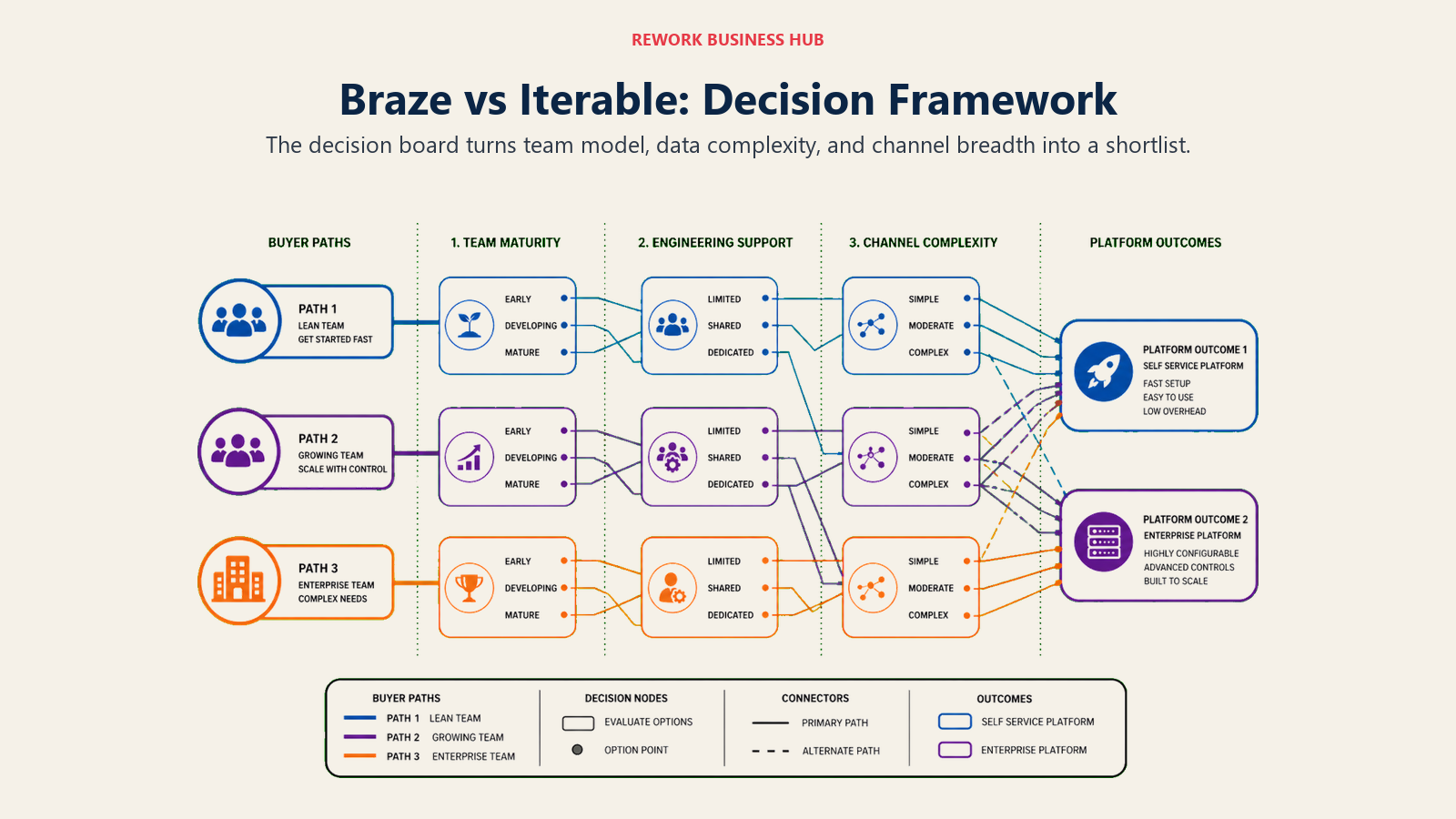
| If this is your situation | Pick |
|---|---|
| Your mobile app is the primary revenue surface | Braze, for the depth of its in-product channels |
| Japan, Taiwan, Thailand, or South Korea are real markets | Braze, on LINE and KakaoTalk alone |
| Your warehouse is Microsoft Fabric or Amazon S3 | Braze, the only one of the two that names them |
| Your warehouse is Snowflake and you'd rather not copy the data | Iterable, Secure Data Sharing works in place |
| Your lifecycle team has no dedicated engineer and won't get one | Iterable, the whole product assumes marketer autonomy |
| Several people touch your data schema and drift is a real risk | Iterable, Data Schema Management |
| You need to complete technical diligence before the first sales call | Braze, far more is documented publicly |
| RCS is on your channel roadmap | Braze, documented alongside SMS and MMS |
| You want a decisioning engine with production history behind it | Braze, four years as OfferFit before the acquisition closed |
| You'd rather have AI designed as one system than integrated after an acquisition | Iterable, Nova was built in house |
| Your realistic budget is well under the reported $85,000 to $90,000 medians | Neither. Start with best Braze alternatives |
| SMS is your primary revenue channel rather than a supporting one | Neither. See Attentive vs Postscript and best Attentive alternatives |
Frequently Asked Questions about Braze vs Iterable
How much does Braze cost?
Braze doesn't publish a price. Its pricing page names four editions (Braze Go, Braze Select, Braze Pro, Braze Enterprise) and says the bill scales with Monthly Active Users plus an Action Credits model, without printing a single dollar figure anywhere. Vendr's buyer guide reports a median Braze buyer paying $89,332 a year across 251 purchases, which is an observation of what buyers actually paid rather than a list price.
How much does Iterable cost?
Iterable publishes nothing at all. iterable.com/pricing returns a 404, and the site carries no pricing link in its navigation or footer. Vendr's buyer guide reports a median Iterable buyer paying $85,775 a year across 235 purchases (reported), plus onboarding reported at $5,000 to $25,000 and up. Those are third-party observations, not Iterable figures.
Does Iterable have Growth, Scale, and Enterprise tiers?
Not according to Iterable, which names no tiers publicly at all. Tier names attributed to Iterable come from third-party pricing listings and vary between them: Vendr, for instance, uses Growth, Premier, and Enterprise. Treat any published Iterable tier structure as a third-party reconstruction and ask the vendor in writing what your specific quote includes.
Which one is better for a mobile app?
Braze, on balance. It grew up around mobile app engagement, and it documents in-app messages, Content Cards, Banners, push, and live notifications as separate in-product surfaces. Iterable supports push, in-app, and embedded messaging too, but the variety of in-product surfaces and the mobile depth are Braze's stronger side.
Which one is better if our data lives in Snowflake?
Iterable has the more elegant answer there. Its Snowflake Secure Data Sharing integration lets you work with Iterable profile and campaign data inside your own Snowflake account without copying or moving it between environments. Braze connects to Snowflake too, through Cloud Data Ingestion, but that model syncs data into Braze rather than sharing it in place.
Do both platforms support WhatsApp?
Yes. Braze documents WhatsApp alongside LINE and KakaoTalk. Iterable launched a native two-way WhatsApp integration in 2025, orchestrated in the same journeys as email, SMS, push, and in-app messaging.
What should we negotiate hardest on, given neither publishes prices?
Three things, in this order. First, the exact contractual definition of an active user: which events count, and whether the meter reads a monthly peak or a monthly average. Second, a percentage cap on renewal uplift for years two and three. Third, a written data-export clause covering full event history and profile data on exit. Those three shape your three-year cost far more than any year-one discount.
Is Braze's AI better than Iterable's?
They're built differently rather than one being plainly ahead. Braze acquired OfferFit for $325 million in 2025 and rebranded its multi-agent decisioning engine as AI Decisioning Studio, so it's proven technology inside a newer wrapper. Iterable announced Nova in April 2026 as an in-house intelligence layer designed as a single system. Braze has the longer production track record, Iterable the more coherent design story. Ask both for reference customers running the AI in production rather than in a pilot.
We have fewer than 50,000 monthly active users. Should we even be evaluating these?
Probably not yet. Both are annual, sales-led contracts with reported medians near $90,000 a year and no self-serve entry point. Gartner's finding that marketers use roughly a third of their stack's capability describes exactly what happens when a smaller team buys this ceiling. Customer.io, OneSignal, and CleverTap all publish real numbers and cover the common lifecycle use cases.
How long does implementation take on each?
Neither vendor publishes a timeline, and anyone quoting one as a property of the software is guessing. In practice the schedule is set by your side: whether your product already emits clean, stable, consistently named events, how many surfaces need SDK work, and how many channels you launch with, since SMS carrier registration, WhatsApp template approval, and email domain authentication each run on an external party's clock.
What to Do Next
Count your actual monthly active users, using a definition you wrote down. Pull the number for each of the last twelve months and note the peak alongside the average. The gap between them is exactly what a vendor's MAU definition decides who pays for.
Write down your channel mix by volume, not by ambition. What share of last quarter's messages went by email, push, SMS, in-app, and WhatsApp? On Braze that mix drives credit consumption directly. On both, it tells you whether you're buying a channel list you'll use or one that just demos well.
Check which warehouse you're actually on, then ignore most of what you've read about it. Both platforms connect to Snowflake, Redshift, BigQuery and Databricks at roughly the same cadence, so warehouse choice rarely decides this on its own. It only bites at the edges: Microsoft Fabric and Amazon S3 are named by Braze alone, and Snowflake shops should ask Iterable about Secure Data Sharing specifically, since working in place beats any scheduled copy.
Take the nine-point contract checklist above into the first sales call. Ask for the active-user definition, the credit consumption rates, the renewal cap, and the data-export clause while you're still an opportunity rather than a signed logo.
Ask both vendors for a reference customer at your size, in your vertical, running the AI features in production. Not a pilot, not a logo slide. If neither can produce one, price the AI at zero in your business case and decide on the orchestration alone.
If the quotes come back well above what this is worth to you, take that seriously. Our best Braze alternatives guide covers 11 platforms with published pricing where it exists, and the SMS marketing software roundup covers the wider stack if your real need turns out to be one channel rather than all of them.
Related Resources:

Principal Product Marketing Strategist
On this page
- TL;DR
- Key Facts
- Who Each Platform Is Actually Built For
- How Braze and Iterable Are Actually Priced
- What to Pin Down in Writing Before You Sign
- Channel Coverage: Push, In-App, Email, SMS, WhatsApp, and Web
- Data Model and Ingestion
- Segmentation and Journey Building
- Real-Time Behavior and Scale
- AI Features
- Implementation Effort and Time to Value
- Support and Partner Ecosystem
- What Else Is in the Running
- When Braze Is the Right Call
- When Iterable Is the Right Call
- Decision Framework
- What to Do Next