Best SimpleTexting Alternatives in 2026: 13 SMS Marketing Tools for Growing Teams
Turn this article into takeaways for your work.


Each assistant summarizes the article only for you and suggests best practices for your work.
Updated August 2026.
The best SimpleTexting alternatives in 2026 are SlickText for teams that like credit-based pricing but need more headroom between tiers, Sakari for teams tired of paying per seat, EZ Texting for the lowest published entry price, Textedly for flat volume-based billing with no feature gates, and Postscript or Klaviyo SMS for e-commerce teams that need order data driving the sends. Which one fits comes down to three things: how many people need to log in, how fast your monthly send volume is climbing, and whether your texts are tied to purchases or just to announcements.
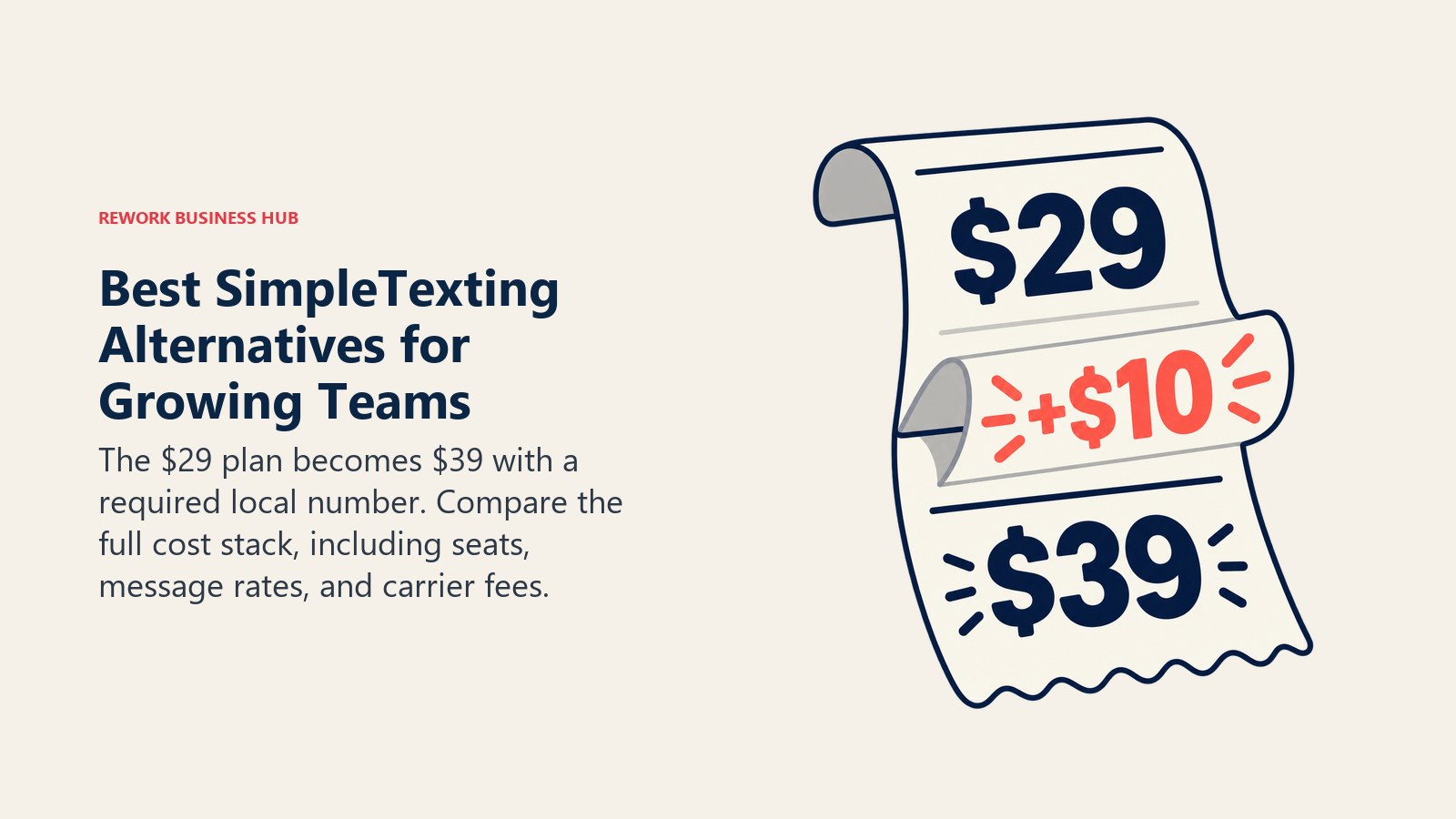
SimpleTexting is a genuinely good product, and most teams shopping alternatives aren't leaving because it broke. They're leaving because the math changed. The plan is $29 a month for 500 credits, but a working setup also needs a local number at $10 a month plus a $4 one-time carrier registration, which is why SimpleTexting's own pricing calculator shows $39.00 a month for the entry setup. Three users are included, and every teammate after that is $20 a month. At five users and 3,000 credits a month, that same "$29 platform" is a very different invoice. This guide evaluates 13 alternatives on published pricing, per-message and per-credit cost, seat fees, and whether the platform's depth actually matches the size of the team buying it. Every price below was checked against the vendor's own pricing page in August 2026. If you want the wider category view first, start with our best SMS marketing software roundup.
Key Facts
- Americans exchanged roughly 2.2 trillion SMS and MMS messages in 2024, about 42 billion more than the year before, per CTIA's 2025 Annual Wireless Industry Survey.
- 85.6% of US consumers are opted in to texts from businesses in 2026, up from 61.8% in 2021, per SimpleTexting's January 2026 survey of 1,000 consumers and 400 US business owners and marketers.
- 75.3% of businesses now use SMS marketing and 65.4% plan to increase their texting budget this year, from that same SimpleTexting 2026 survey.
- Automated SMS earns $0.74 in revenue per send versus $0.15 for one-off campaign sends, roughly 5x, per Omnisend's analysis of 321 million SMS messages from 150,000 brands in 2025.
- SMS flows make up only 7.6% of sends but drive 45.2% of total SMS revenue, per Klaviyo's 2026 SMS benchmarks drawn from more than 183,000 customers.
Quick Comparison Table
| Tool | Best For | Starting Price | Key Strength | Key Limitation |
|---|---|---|---|---|
| SlickText | Teams that want credits with more tiers | $29/mo for 500 credits | Eight published price points, credits roll over one term | Credits still expire after that carry-over term |
| EZ Texting | Small teams on the tightest budget | $25/mo ($20/mo annual) plus a $5/mo telecom fee | Cheapest published entry, extra users only $10/mo | Steep jump from the entry tier to the next one |
| Textedly | Teams that dislike feature-gated tiers | From $29/mo on a volume slider | Every feature on every plan, unlimited contacts | No purchase-triggered e-commerce flows |
| Sakari | Teams paying too much for seats | From $25/mo | Unlimited users and unlimited contacts | Tier pricing sits behind a slider and isn't published |
| TextMagic | Irregular, seasonal, or low volume | Prepaid, 4.9 cents per SMS | Pure pay as you go, no monthly platform fee | No volume plan, so heavy sending gets expensive |
| Sinch Engage (formerly MessageMedia) | Teams wanting packaged multi-channel tiers | $49/mo (Sinch Engage Basics) | Clear packaged ladder to $799/mo, unlimited contacts | Only 1 to 3 users included depending on tier |
| Podium | Local and multi-location service businesses | Not published, quote only | Texting, reviews, and payments in one inbox | No published pricing at any tier |
| Klaviyo SMS | Teams whose texts should use order data | Email from $30/mo (1,000 profiles), SMS a further $15/mo | Shared segments across email and SMS | Two plans that stack, not one price |
| Omnisend | Budget teams wanting email plus SMS plus push | $11.20/mo at 251 to 500 contacts | Lowest combined multi-channel entry price | Priced on contacts, so list growth raises the bill |
| Postscript | Shopify brands that want SMS run properly | $0/mo Starter with a $49 monthly minimum spend | Shopify-native capture and revenue attribution | Shopify only, and the $0 tier isn't actually free |
| Attentive | Enterprise-scale two-way SMS programs | Not published, quote only | Scale, AI send timing, deep compliance tooling | Nothing published, every deal needs a demo |
| Community | Brand-to-audience texting, not campaigns | Not published, quote only | SMS, WhatsApp, Apple Messages for Business, RCS | Not built for transactional or promotional blasts |
| Twilio | Engineering teams building their own layer | $0.0083 per SMS, no platform fee | No platform fee and no vendor markup | You build the marketing layer yourself |
SimpleTexting isn't a row in this table because it's the product you're comparing against. Its own numbers sit in the cost breakdown below, so you can put your current invoice next to every option here.
What SimpleTexting Actually Gets Right
Being fair about the incumbent makes the rest of this list more useful. SimpleTexting sells a clean, unfussy business texting product: two-way SMS, unlimited contacts, unlimited text-to-join keywords, and credit-based pricing with no revenue share and no percentage cut of whatever those texts earn. It works for a dental office, a nonprofit, a gym, and a DTC brand equally well, precisely because it isn't built around any one of them.
The pricing page is also unusually honest for this category. It shows the $10 local number fee and the $4 registration inline and adds them up for you, rather than letting you find them at checkout. Toll-free numbers carry no extra fee, the trial needs no credit card, and there's a 30-day money-back guarantee. Three vendors on this list won't tell you a price at all.
Why Teams Outgrow SimpleTexting
Four patterns come up repeatedly when a 10 to 200 person team starts shopping.
The seat fee compounds faster than the credit fee. Three users are included, then it's $20 a month for each additional teammate. Add a second location manager, a support lead, and a marketing coordinator and that's $60 a month in seats sitting on top of a $29 plan. EZ Texting charges $10 per extra user, Textedly charges $10, and Sakari doesn't charge for seats at all.
Credits and per-message pricing diverge at volume. Extra credits cost 5.5 cents each. That's fine at 500 messages and painful at 50,000. Platforms that price per message rather than per credit sit between 0.7 and 1.5 cents at comparable volume, and a pure API like Twilio runs $0.0083. The crossover usually shows up somewhere between 10,000 and 30,000 messages a month, which is exactly the range a growing list hits in its second year.
Announcements aren't the same job as order-triggered flows. SimpleTexting broadcasts and replies well. It doesn't build a browse-abandonment flow off a Shopify event or segment by lifetime order value. If your best-performing texts are the ones tied to a purchase, that gap is the whole reason to move. The Klaviyo and Omnisend data in the Key Facts box is the argument: automated, behavior-triggered sends carry several times the revenue per message of a broadcast.
Multiple numbers and multiple locations multiply the base cost. Each additional local number is another $10 a month. A franchise or multi-branch service business ends up paying number fees that dwarf the plan fee, which is where a packaged multi-channel tier or a per-message API starts making more sense.
What Changed in This Category Since 2025
Two things moved in the past year that will affect your shortlist, and both trip up buyers working from older comparison articles.
| What changed | What it means for your shortlist |
|---|---|
| Yotpo shut down its Email and SMS products. The company announced the sunset on 5 August 2025, with the end of service widely reported as 31 December 2025. Yotpo now sells Reviews and UGC, Loyalty and Referrals, and AI Visibility. | Don't shortlist Yotpo SMS. It's gone. Attentive was reported as the preferred migration partner for annual Yotpo customers, and Omnisend for self-serve brands, which is part of why both turn up more often in mid-market evaluations now. |
| MessageMedia is no longer a brand. Its US pricing URL now redirects to Sinch, and the product is sold as Sinch Engage. | If a comparison table still lists MessageMedia, it's out of date. Search for Sinch Engage instead, and check which Sinch product a quoted price refers to, because the Sinch SMS API is a completely separate per-message rate card. Our Twilio vs Sinch comparison covers that API side. |
The Real Cost of SMS: Three Layers
The number on a pricing page is almost never the number on the invoice. Every platform in this category stacks up to three cost layers, and which one dominates depends entirely on your volume.
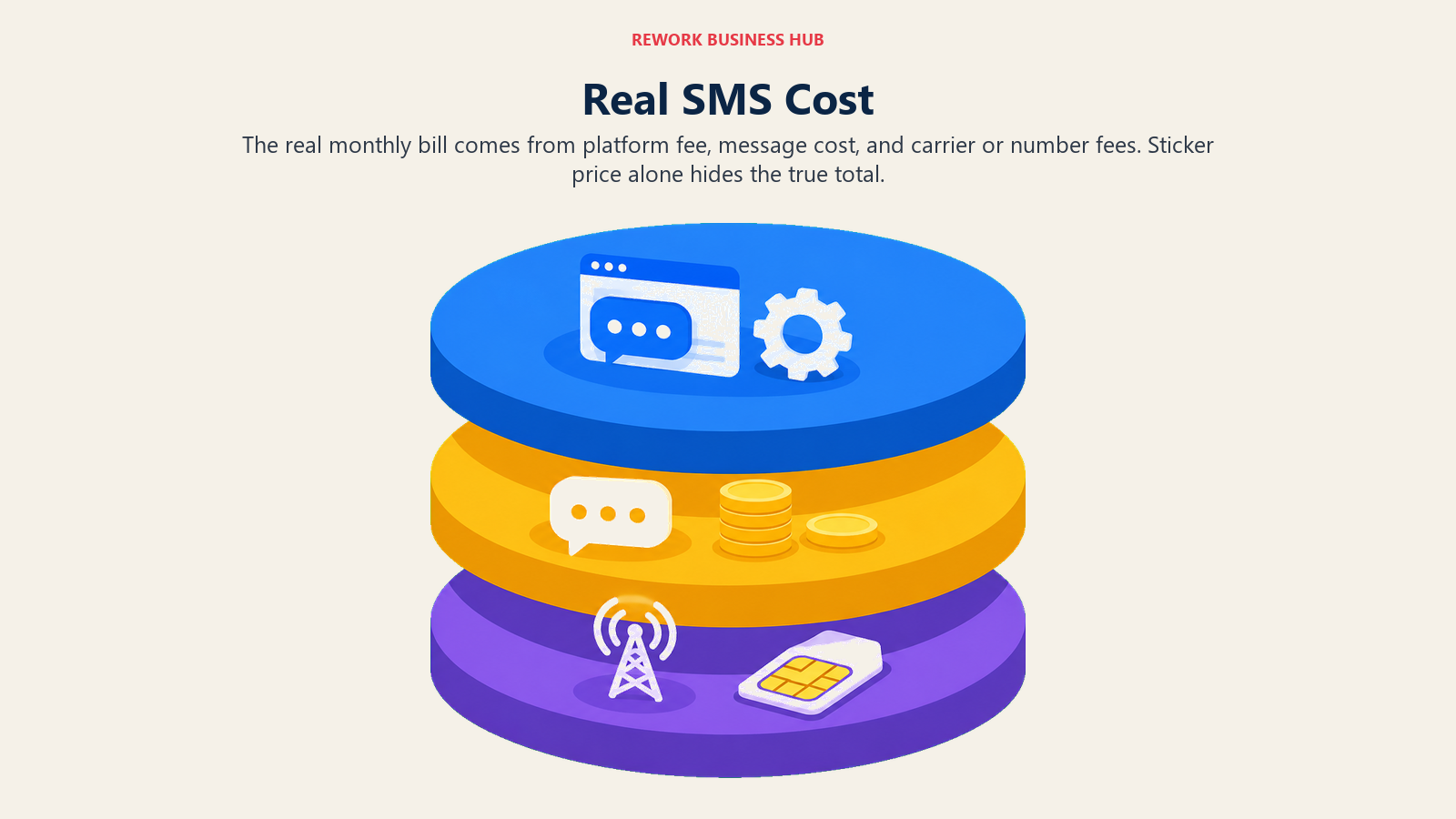
- Platform fee. The monthly subscription, usually tied to a credit allotment, a contact count, or a send volume tier.
- Per-message or per-credit cost. What you pay once you exceed the allotment, or in some cases from the very first message.
- Numbers, seats, and carrier fees. Local and toll-free number rental, per-user charges, one-time carrier registration, and the small per-message fee the mobile carriers themselves charge to deliver a text.
| Tool | Platform fee | Per-message or credit cost | Numbers, seats, and extras |
|---|---|---|---|
| SimpleTexting (your baseline) | $29/mo for 500 credits | 5.5 cents per extra credit | Local number $10/mo plus $4 one-time registration, 3 users included then $20/mo each, toll-free free, carrier fees about $0.0025/msg US and $0.0068 Canada |
| SlickText | $29/mo for 500 credits, rising to $939/mo for 50,000 | Credits included by tier, unused credits carry into one following term | Carrier fees charged separately, MMS uses 3 credits per segment |
| EZ Texting | $25/mo monthly or $20/mo annual, up to $3,000/mo Enterprise | Extra credits $0.04 down to $0.01 by tier | $5/mo telecom fee on the entry tier, waived from the $75 tier up, extra users $10/mo |
| Textedly | From $29/mo on a volume slider | Included in the tier you select on the slider | Teammates $10/mo each, annual billing adds about 20% more texts |
| Sakari | From $25/mo | Not published, the tier table sits behind a slider | One dedicated number included, extras from $4.00/mo, number lookup $0.01, call forwarding from $0.008/min, users unlimited |
| TextMagic | None, prepaid balance | 4.9 cents per SMS, or 1 cent per SMS on a connected CPaaS account | Dedicated number $10/number/mo with 1 month free, sender ID registration $10/campaign/mo with 1 month free |
| Sinch Engage | $49/mo to $799/mo packaged (Sinch Engage, not the Sinch SMS API) | SMS allotment included per tier, from 1,000 to 40,000 | 1 to 3 users by tier, unlimited contacts on all tiers, annual commitment shown as saving 16% |
| Podium | Not published | Not published | Not published, AI Employee sold as an add-on to any plan |
| Klaviyo SMS | Email from $30/mo at 1,000 active profiles, SMS a separate plan from $15/mo for 1,250 credits | Credits included, then per-credit overage | 150 SMS credits free per billing cycle on any account |
| Omnisend | $11.20/mo at 251 to 500 contacts, $41.30/mo at 2,500 contacts | SMS from $0.007 per message | SMS credits bought separately from the email plan, contact tiers run to 150,000+ |
| Postscript | $0/mo Starter carrying a $49 monthly minimum spend, Growth $100/mo, Professional $500/mo | $0.015 down to $0.007 per SMS by tier, MMS $0.045 down to $0.024 | US carrier fees average about $0.00418/SMS and $0.00841/MMS on top |
| Attentive | Not published | Not published, usage-based with no credit system | Not published |
| Community | Not published | Not published | Not published |
| Twilio | None, pure usage | $0.0083 per SMS sent or received | Local number $1.15/mo, toll-free $2.15/mo, short code $1,000/quarter random or $1,500/quarter vanity, plus carrier fees and A2P registration |
The pattern worth internalizing: at low volume the platform fee dominates and SimpleTexting is competitive. Past roughly 10,000 messages a month the per-message rate takes over, and past five or six users the seat fee does. Work out which of those three is growing fastest for you before you shortlist anything.
Stage Fit Matrix
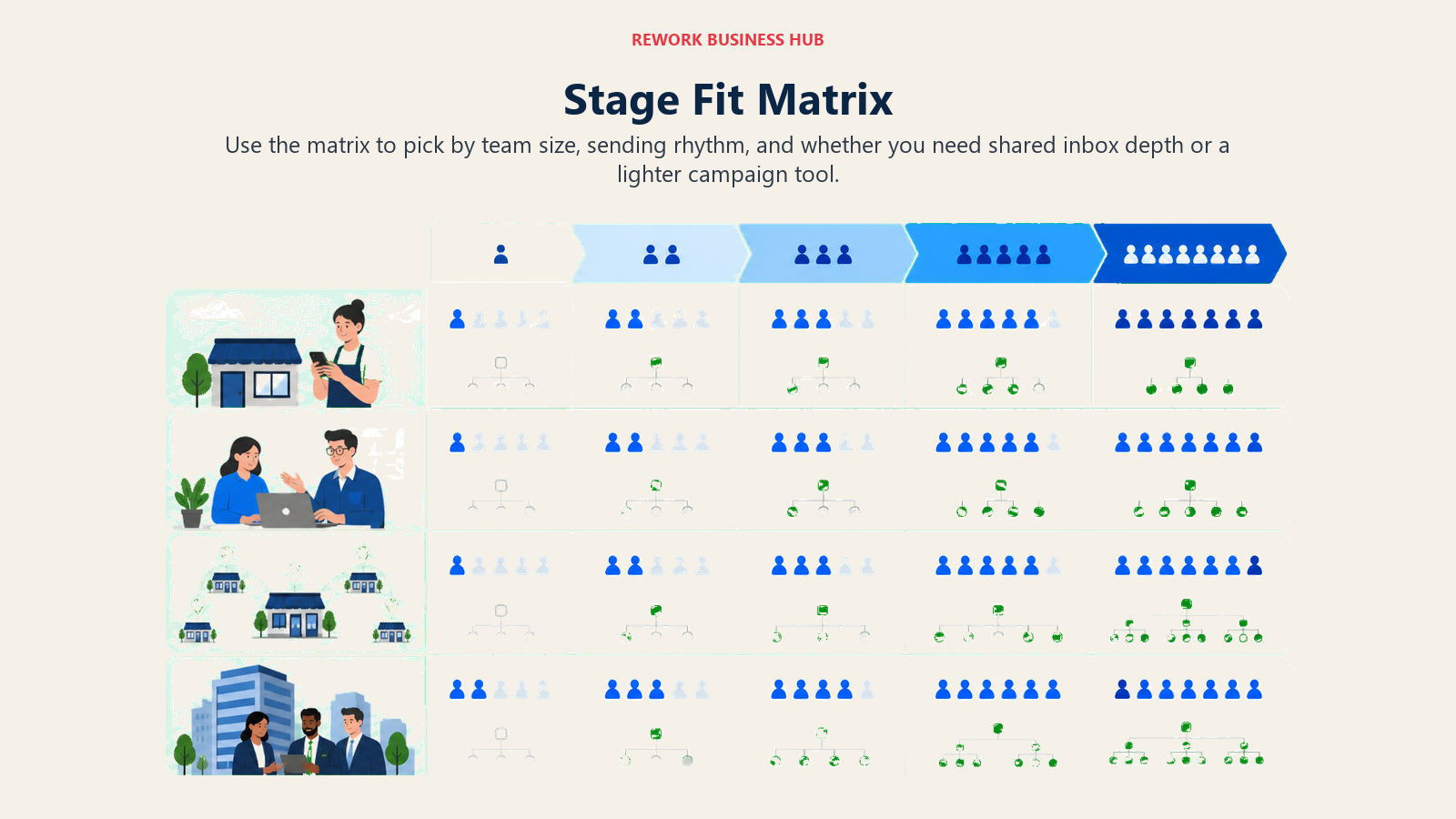
At this stage, the real question is not which text tool is best in the abstract. It is which one matches your sending volume, seat model, and team structure.
| Tool | Early (1-10) | Growth (10-50) | Mid-Market (50-200) | Enterprise (200+) |
|---|---|---|---|---|
| SlickText | Best fit | Best fit | Good | Limited |
| EZ Texting | Best fit | Good | Limited | Not recommended |
| Textedly | Best fit | Good | OK | Not recommended |
| Sakari | Good | Best fit | Good | Limited |
| TextMagic | Best fit | Good | Limited | Not recommended |
| Sinch Engage | Good | Best fit | Best fit | Good |
| Podium | OK | Good | Best fit | Good |
| Klaviyo SMS | Good | Best fit | Good | Limited |
| Omnisend | Best fit | Good | OK | Not recommended |
| Postscript | OK | Good | Best fit | Good |
| Attentive | Not recommended | Limited | Good | Best fit |
| Community | Limited | Good | Best fit | Good |
| Twilio | Not recommended | OK | Good | Best fit |
Sizing and Persona Table
| Tool | Team size sweet spot | Primary buyer | Use case |
|---|---|---|---|
| SlickText | 1-100 | Marketing Manager, SMB Owner | Credit-based texting with room to grow across eight price points |
| EZ Texting | 1-50 | Small Business Owner, Marketing Coordinator | A first SMS program on the smallest possible budget |
| Textedly | 1-100 | Marketing Coordinator, Operations Lead | Flat volume-based texting with no feature tiers to decode |
| Sakari | 10-200 | Operations Manager, RevOps Lead | Team-wide texting where everyone needs a login |
| TextMagic | 1-50 | Office Manager, Operations Lead | Seasonal or irregular sends where a monthly plan wastes money |
| Sinch Engage | 10-200 | Marketing Manager, Multi-location Operator | Packaged multi-channel messaging with sub-accounts and SSO |
| Podium | 10-200 | Location Manager, Owner-Operator | Local service business combining texting, reviews, and payments |
| Klaviyo SMS | 5-200 | Email Marketing Manager, Growth Lead | SMS layered onto an existing Klaviyo email program |
| Omnisend | 2-100 | E-commerce Manager, Marketing Lead | Cheapest route to email plus SMS plus push in one dashboard |
| Postscript | 10-200 | Retention Marketer, E-commerce Director | Shopify-native SMS with per-message revenue attribution |
| Attentive | 200+ | VP Marketing, Head of Retention | Enterprise-scale conversational SMS with dedicated support |
| Community | 20-500 | Brand Marketing Lead, Talent Manager | Direct brand-to-audience texting across SMS, WhatsApp, and RCS |
| Twilio | 10-500+ | Engineering Lead, Product Manager | Custom sending infrastructure with no platform markup |
1. SlickText - The Closest Swap, With a Deeper Credit Ladder
SlickText is the platform most likely to feel familiar on day one, because it sells the same thing SimpleTexting does: message credits, unlimited contacts, and two-way texting for any kind of business rather than one vertical. The methodology is nearly identical, which is the point. If your objection to SimpleTexting is the tier structure rather than the model itself, this is the lowest-friction move you can make.
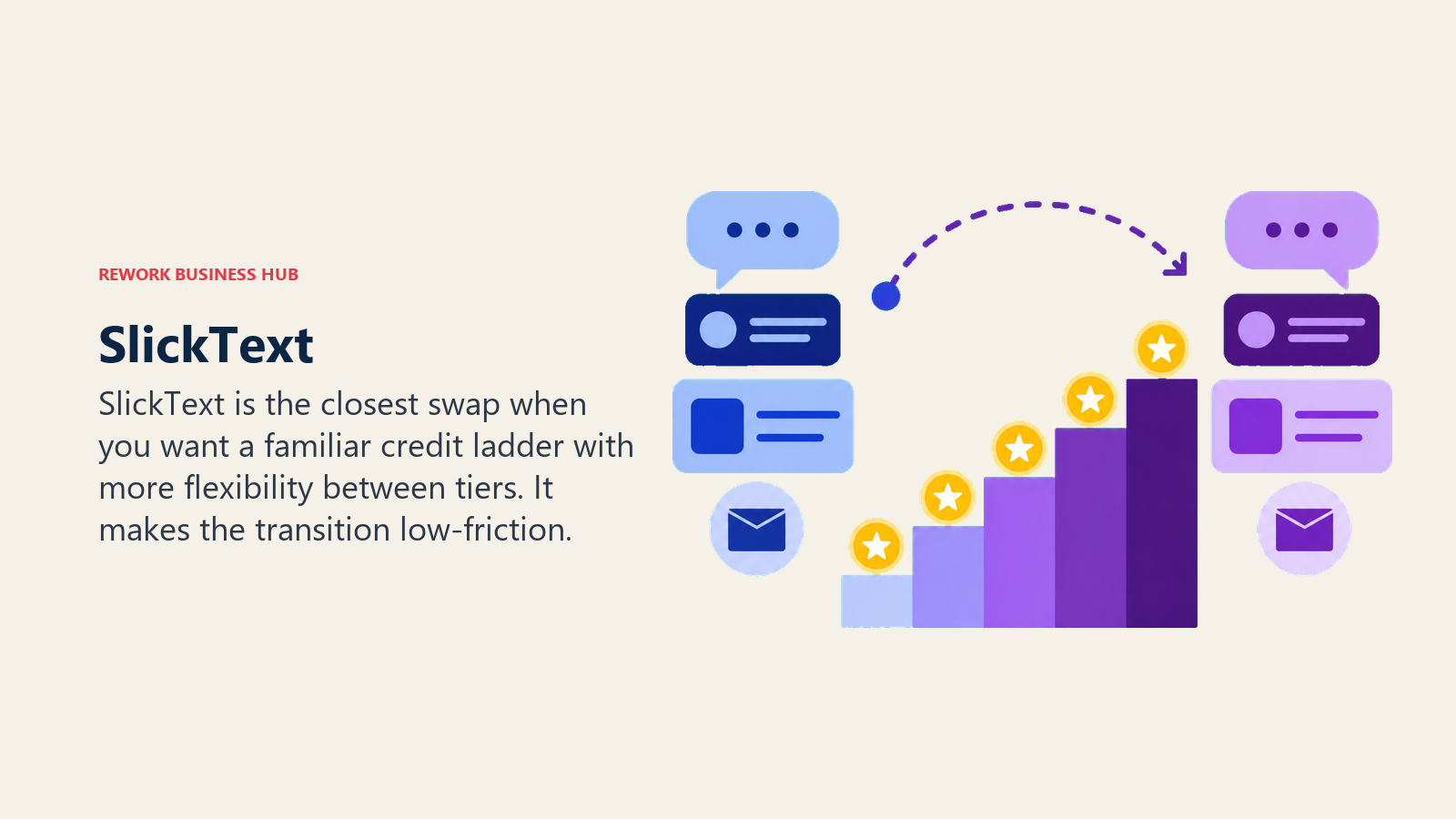
Where it separates itself is the ladder. SlickText publishes eight price points, starting at $29/mo for 500 credits and climbing through $49 (1,000 credits), $79 (2,000), $129 (3,500), $169 (5,000), $319 (10,000), $579 (25,000), and $939 (50,000), with a custom tier above that. Compare that to platforms where the gap between "small business" and "enterprise" is a cliff. The other genuinely useful difference is rollover: unused credits from a monthly or annual plan carry into one following term, which matters a lot if your sending is lumpy (a seasonal retailer, a school, an events business). Incoming texts are free on every plan.
| What you get | What you don't |
|---|---|
| Eight published price points with small steps between them | Purchase-triggered e-commerce flows |
| Unused credits carry into one following term | Per-message pricing at high volume |
| Unlimited contacts and free incoming texts on all plans | Published per-user limits (not stated on the pricing page) |
| 1-on-1 onboarding included from the $129 plan, dedicated CSM from $579 | A credit that never expires |
Pricing: $29/mo for 500 credits at entry, running up an eight-step ladder to $939/mo for 50,000 credits, plus a custom tier. Annual billing gives two months free. One credit equals one 160-character SMS segment to one subscriber; MMS consumes three credits per segment. Carrier fees are charged separately, as they are almost everywhere in this category. A 14-day free trial requires no credit card. One note on how this is presented: the tier names on SlickText's pricing page didn't render consistently across two separate reads, so the ladder above is described by price and credit allotment, which were identical both times.
Best for: Teams (1-100 people) that like the credit model and want smaller steps between tiers than SimpleTexting offers. Not ideal for: Teams that have concluded credits themselves are the problem and want per-message billing.
2. EZ Texting - The Lowest Published Entry Price, With the Telecom Fee Itemized
EZ Texting aims squarely at the team that has never run SMS and wants the cheapest honest way to find out whether it works. Its structure is built for that first year: a low entry plan, cheap extra seats, and unusual transparency about the one line item most vendors bury. The telecom fee is printed on the pricing page rather than appearing on the first invoice.
For a SimpleTexting user, the specific arithmetic to run is the seat math. Extra users are $10/mo here versus $20/mo at SimpleTexting, so a five-person team saves $40 a month on seats alone before any credit comparison. The tradeoff sits higher up the ladder: the jump from Launch to Boost roughly triples your platform fee, and the gap from Scale to Enterprise is enormous. This is a great place to start and a slightly awkward place to grow through.
| What you get | What you don't |
|---|---|
| Cheapest published entry price on this list | A gentle path between mid tiers and enterprise |
| Extra users at $10/mo, half SimpleTexting's rate | E-commerce automation or revenue attribution |
| The telecom fee itemized rather than hidden | A telecom-fee waiver on the entry tier |
| Annual discount on every tier | Unlimited seats at any price |
Pricing: Launch is $25/mo billed monthly or $20/mo billed annually, including 500 credits, with extra credits at $0.04 and a $5/mo telecom fee on top. Boost is $75/mo ($60/mo annual), extra credits $0.035, and the telecom fee is waived. Scale is $125/mo ($100/mo annual), extra credits $0.03. Enterprise is $3,000/mo with 200,000 credits and extra credits at $0.01. Extra users cost $10/mo each. SMS uses one credit, MMS uses three. A 14-day trial requires no card.
Best for: Small teams (1-50 people) running their first SMS campaigns with several people needing logins. Not ideal for: Teams already sending 10,000+ messages a month, where the mid-tier jumps get expensive fast.
3. Textedly - One Slider, Every Feature, No Tier Gates
Textedly's pitch is refreshingly narrow: pick your monthly message volume on a slider, pay one flat rate, and get every feature at every level. Nothing is gated. Keyword automation, drip campaigns, two-way messaging, and scheduling are all available on the cheapest plan, which removes the single most tedious part of buying software in this category, namely mapping a feature matrix against your requirements list.
That makes it a good fit for the SimpleTexting user whose frustration is about predicting cost rather than about features. You set the volume you expect, you pay that number, and if you're wrong you move the slider. Teammates are $10/mo, half SimpleTexting's rate. Where Textedly stops short is anything order-aware: there are no native cart-recovery templates and no purchase-based segmentation, so a DTC brand whose best texts are triggered by a Shopify event will find it thin.
| What you get | What you don't |
|---|---|
| Every feature available on every plan | Purchase-triggered or cart-recovery flows |
| Volume slider from 50 to 360,000 messages/mo | Deep segmentation on order history |
| Unlimited contacts, teammates at $10/mo | A per-message rate to compare against APIs |
| No long-term contract required | Multi-channel reach beyond SMS and MMS |
Pricing: From $29/mo, with a slider running from 50 to 360,000 messages a month. All features are included on every plan and contacts are unlimited. Additional teammates cost $10/mo each. Annual billing includes roughly 20% more texts for the same price. A free account comes with 50 texts and one keyword, which is enough to test the send flow but not a real campaign.
Best for: Any business (1-100 people) that wants predictable, fully-featured texting without decoding a tier matrix. Not ideal for: E-commerce teams whose highest-value messages are triggered by orders or browsing behavior.
4. Sakari - Unlimited Users, Which Is the Line Item You're Paying For
Sakari attacks the exact cost that pushes most growing teams off SimpleTexting: seats. Users are unlimited on every plan, and so are contacts. If your reason for reading this article is that you added three people and watched $60 a month appear on an invoice, this is the shortest path to fixing it. Sakari is also built with an operations mindset rather than a marketing one, with number lookup, call forwarding, and international numbers across 20-plus countries as first-class features rather than upsells.
The honest caveat is transparency. Sakari's plan table sits behind a volume slider and the individual tier figures don't render on the public page, so the only firm platform number available is the entry point of $25 a month, taken from Sakari's own FAQ. The add-on rates do render and are useful for modeling: extra phone numbers from $4.00/mo (one dedicated number is included free), number lookup at $0.01, and call forwarding from $0.008 per minute. Both monthly and annual billing are offered.
| What you get | What you don't |
|---|---|
| Unlimited users, which removes the seat fee entirely | A published per-tier price table |
| Unlimited contacts on every plan | E-commerce cart-recovery templates |
| One free dedicated number, extras from $4.00/mo | Enterprise-scale AI send optimization |
| International numbers across 20-plus countries | A clear published volume-to-price mapping |
Pricing: Starts at $25 USD per month per Sakari's own FAQ. Higher tiers scale on a volume slider whose figures aren't published, so treat the $25 as an entry point rather than a full picture and ask for the tier table that matches your volume. Add-ons that are published: extra phone numbers from $4.00/mo, number lookup $0.01 each, call forwarding from $0.008/min. A 14-day trial includes 100 messaging credits.
Best for: Operations-led teams (10-200 people) where a lot of people need to send and reply, and seat fees are the real cost driver. Not ideal for: Buyers who need a full published price ladder before they'll start an evaluation.
5. TextMagic - Prepaid Pay As You Go, With No Monthly Plan at All
TextMagic is the option for teams whose sending is genuinely irregular. There are no named plans and no monthly platform fee. You top up a prepaid balance and spend it, which means a month where you send nothing costs nothing beyond your number rental. For a seasonal retailer, an events business, a school district, or a professional services firm that texts clients in bursts, that's a structurally better fit than paying $29 for 500 credits you don't use.
The rate structure has one detail worth reading carefully. Standard sending is 4.9 cents per SMS, which is roughly comparable to SimpleTexting's 5.5 cent extra credit but well above what any volume plan charges. Connect a CPaaS account and the rate drops to 1 cent per SMS, which is a large enough gap to change the entire recommendation for anyone sending consistently. Each 160-character part bills separately, so long messages cost multiples of the headline rate.
| What you get | What you don't |
|---|---|
| No monthly platform fee, prepaid balance only | Any volume discount from a subscription plan |
| 1 cent per SMS on a connected CPaaS account | Marketing automation or campaign flow building |
| A dedicated number at $10/mo with the first month free | Bundled credits or rollover |
| A first month free on sender ID registration too | Competitive standard rates at high volume |
Pricing: Prepaid pay as you go with no plans. Standard rate is 4.9 cents per SMS, dropping to 1 cent per SMS on a connected CPaaS account. Each 160-character message part is billed separately. A dedicated number is $10 per number per month with one month free, and sender ID registration is $10 per campaign per month, also with one month free. TextMagic bundles email sending as well, with the first 10,000 emails free; its pricing page quotes two different overage rates for email in different places, so treat only the free allowance as confirmed. A free trial balance is available.
Best for: Teams (1-50 people) with seasonal, bursty, or unpredictable sending where a monthly plan wastes money. Not ideal for: Anyone sending consistent high volume, where the standard 4.9 cent rate beats a plan badly.
6. Sinch Engage (formerly MessageMedia) - Packaged Tiers With Sub-Accounts and SSO
Start with the naming, because it catches people out. MessageMedia no longer exists as a brand: its US pricing URL now redirects to Sinch, and the product is sold as Sinch Engage. If you shortlisted MessageMedia from an older article, this is the same lineage under a new name. Separately, and this is the detail that produces most of the wrong prices online, Sinch sells two entirely different things. Sinch Engage is the packaged SaaS product covered here. The Sinch SMS API is a per-message CPaaS rate card (US 10DLC at $0.0078 per message) aimed at developers, not marketers. Any price you see quoted for "Sinch" is meaningless until you know which of the two it refers to.
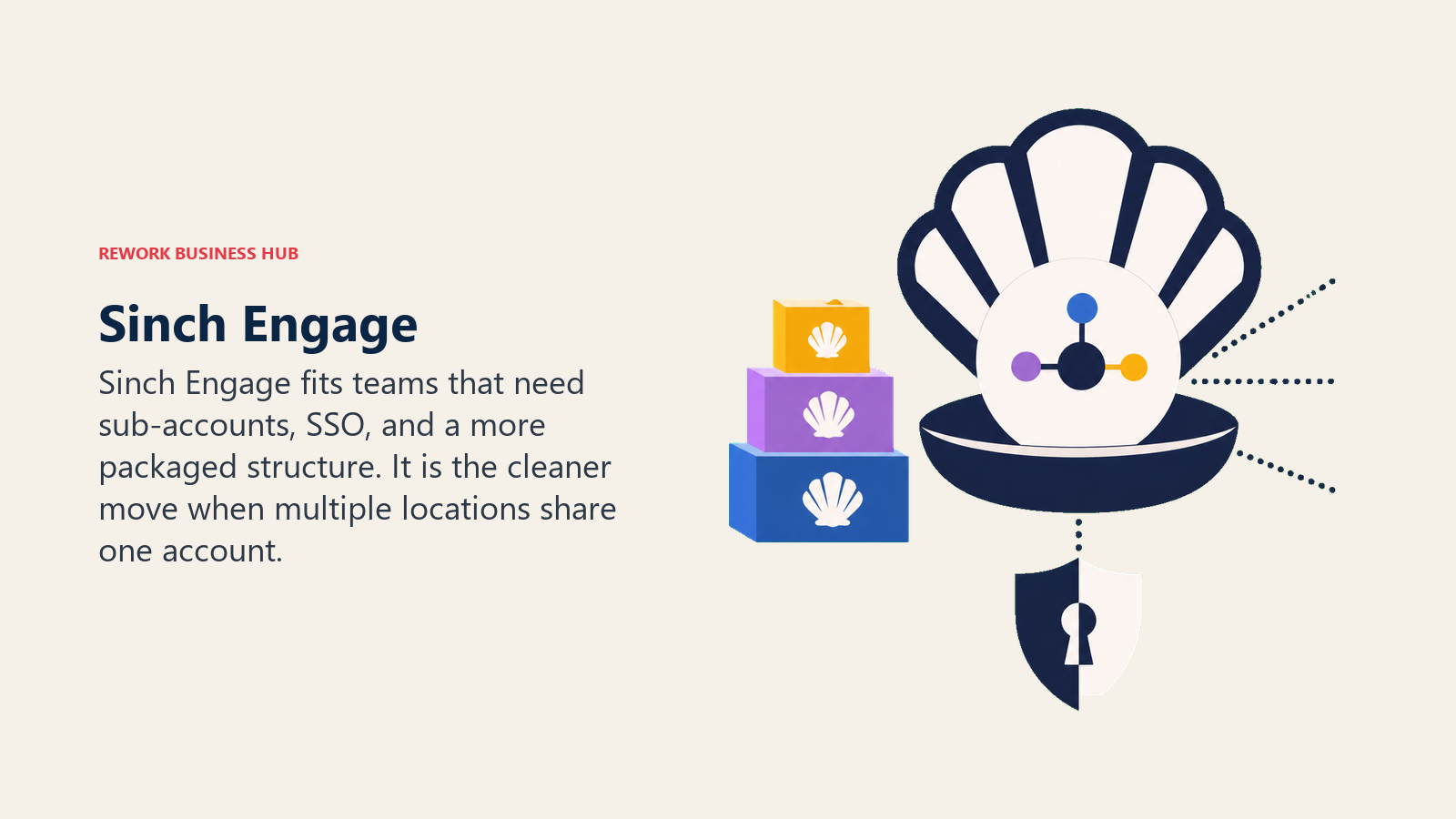
Sinch Engage's structure suits a team that has outgrown a single shared inbox. Higher tiers add sub-accounts, which is the feature multi-location businesses and agencies actually need, plus SSO from the $450 tier. Contacts are unlimited on every tier. The constraint to check before you buy is seats: Basics includes one user and the top three tiers include three, which is the same ceiling that pushes people off SimpleTexting in the first place.
| What you get | What you don't |
|---|---|
| A clear packaged ladder from $49 to $799/mo | Unlimited users at any tier |
| Sub-accounts for multi-location or agency structures | A cheap entry point below $49/mo |
| SSO from the $450/mo tier up | E-commerce order-triggered automation |
| Unlimited contacts on every tier | A single obvious price when you search "Sinch" |
Pricing: Sinch Engage (not the Sinch SMS API) runs five packaged tiers: Basics $49/mo (1,000 SMS, 1 user, 3 automations), Conversations $99/mo (3,000 SMS, 2 users, 30 automations), Pro $249/mo (10,000 SMS, 3 users, 1 sub-account), Pro Plus $450/mo (20,000 SMS, 3 users, 2 sub-accounts, SSO), and Advanced $799/mo (40,000 SMS, 3 users, 3 sub-accounts, SSO). Contacts are unlimited on all of them. An annual commitment is shown as saving 16%. A 14-day trial requires no card. For the developer-facing per-message side of Sinch, see our Twilio vs Sinch breakdown.
Best for: Multi-location or agency teams (10-200 people) that need sub-accounts and predictable packaged volume. Not ideal for: Teams with more than three people who need their own login, since seats cap out at three.
7. Podium - Texting Bundled With Reviews, Payments, and an AI Agent
Podium isn't really an SMS marketing platform, and that's the reason it belongs on this list. It's a local-business messaging system where texting is the connective tissue between the jobs a service business actually does: getting found, answering an inbound lead, collecting a review, and taking payment. If you're a dealership, a med spa, a home services company, or a multi-location retailer using SimpleTexting mostly to answer customers and chase reviews, Podium replaces three tools instead of one.
Its AI Employee, sold as an add-on to any plan, is the piece Podium leans on hardest right now: it answers inbound texts and web chats and tries to book the appointment without a human. Whether that's worth it depends entirely on your inbound volume. The real obstacle for a mid-market evaluation is pricing. Podium publishes nothing at any tier. Its pricing page says plans are designed to fit specific business needs and routes you to a sales conversation, which is a hard shift from a vendor whose calculator shows you $39.00 before you sign up. If your texting sits alongside a phone system, our best business phone system roundup covers that adjacent stack.
| What you get | What you don't |
|---|---|
| Texting, reviews, and payments in one inbox | Any published price, at any tier |
| An AI agent that answers and books inbound | Self-serve signup without a sales call |
| Strong fit for multi-location service businesses | E-commerce flow automation or SMS attribution |
| Webchat-to-text lead capture built in | A cheap way to test before committing |
Pricing: Not published. Podium's pricing page states that plans are built to fit a business's specific needs and directs buyers to talk to sales. AI Employee is sold as an add-on to any plan. There is no published tier structure, entry price, or per-message rate to compare against the numbers elsewhere in this article.
Best for: Local and multi-location service businesses (10-200 people) that want texting, reviews, and payments in one place. Not ideal for: Teams that need to build a budget before booking a demo, or that only need texting.
8. Klaviyo SMS - When Your Texts Should Read Your Order History
Klaviyo SMS isn't a standalone texting platform and shouldn't be evaluated as one. Its value is that SMS and email share a single customer profile, so a segment like "bought twice, hasn't opened in 30 days" can fire a text without you rebuilding that logic in a second tool. For a SimpleTexting user whose real problem is that broadcasts don't know who bought what, that shared-profile model is the actual upgrade, not the SMS features themselves.
The pricing needs care, because it's the most commonly misquoted structure in this category. Klaviyo email and Klaviyo SMS are separate plans that stack. Email starts at $30/mo at 1,000 active profiles, and SMS is a further $15/mo minimum for 1,250 credits. Anyone telling you "Klaviyo starts at $30" is quoting only half the bill, and only at a small list size. Both sides scale with your list, so a growing contact count raises two numbers rather than one.
| What you get | What you don't |
|---|---|
| One segmentation engine across email and SMS | A single combined price for both channels |
| Purchase and browse data driving text triggers | Standalone value without Klaviyo email |
| 150 free SMS credits per billing cycle on any account | Flat pricing as your list grows |
| Strong revenue attribution per message | A fit for non-e-commerce use cases |
Pricing: Email from $30/mo at 1,000 active profiles (roughly 10,000 sends/mo). SMS is a separate plan from $15/mo for 1,250 credits. These stack, so budgeting for Klaviyo means budgeting for both lines. The free plan covers 250 active profiles, 500 email sends/mo, and $5 of mobile messages/mo, and 150 SMS credits are included free each billing cycle on any account. If the email side is the bigger part of your decision, our best Klaviyo alternatives guide compares that half directly.
Best for: E-commerce teams (5-200 people) already running Klaviyo email that want texts driven by the same data. Not ideal for: Non-e-commerce businesses, or anyone who doesn't want to adopt Klaviyo's email pricing to get its SMS.
9. Omnisend - The Cheapest Route to Email, SMS, and Push Together
Omnisend gives e-commerce teams Klaviyo-shaped automation at a fraction of the entry price, with email, SMS, and web push in one dashboard and native connections to Shopify, WooCommerce, BigCommerce, and Wix. Pre-built workflows cover abandoned cart, welcome series, post-purchase, and browse abandonment, all with cross-channel revenue attribution. For a team leaving SimpleTexting because announcements alone stopped growing revenue, this is the lowest-risk way to get flows.
The structural difference from SimpleTexting is worth understanding before you switch: Omnisend prices on contacts, not credits. That's better when your list is small and sending is heavy, and worse when your list balloons but your send volume doesn't. SMS is charged from $0.007 per message on top of the plan, which is well under a cent and dramatically cheaper than SimpleTexting's 5.5 cent extra credit at any real volume.
| What you get | What you don't |
|---|---|
| Email, SMS, and push from one low-cost plan | Flat pricing as your contact list grows |
| Native e-commerce platform integrations | A fit for non-e-commerce businesses |
| SMS from $0.007 per message | Included SMS credits on the free plan |
| Cross-channel revenue attribution | A self-serve tier for very large lists |
Pricing: Standard from $11.20/mo at 251 to 500 contacts with 6,000 emails/mo. Pro from $41.30/mo at 2,500 contacts with unlimited emails and SMS from $0.007 per message. Pricing scales by contact tier to 150,000+, and moves to a custom quote above that. The free plan covers 250 contacts and 500 emails a month with no included SMS credits. Our best Omnisend alternatives guide covers where it hits limits, and the best email marketing software roundup is the wider view if email is the bigger half of your spend.
Best for: E-commerce brands (2-100 people) that want three channels and real flows at the lowest possible entry price. Not ideal for: Large lists where per-contact pricing outruns the value, or businesses with no store to connect.
10. Postscript - Shopify-Native SMS With Per-Message Billing
Postscript is what SMS looks like when it's built as a dedicated retention channel for one platform rather than as general-purpose texting. Subscriber capture happens through Shopify-native popups, checkout opt-in, and keywords; segmentation runs on purchase history; and every message carries revenue attribution so you can see which text produced which order. TCPA and CTIA compliance tooling is built in rather than bolted on.
The pricing model is the opposite of SimpleTexting's. There's no credit bundle. Starter is $0/mo, but it carries a $49 monthly minimum spend, so the real floor is $49 before a single text goes out. Messages then bill per send on top of the platform fee, from $0.015 down to $0.009 on Starter, and carrier fees (averaging about $0.00418 per SMS and $0.00841 per MMS in the US) sit on top of that. At 10,000 messages a month that lands well under what 10,000 SimpleTexting credits would cost, which is exactly the crossover this article keeps pointing at. The catch is that Postscript only works if you're on Shopify.
| What you get | What you don't |
|---|---|
| Shopify-native capture and per-message attribution | Any support for non-Shopify stores |
| Per-message billing that improves with volume | A genuinely free tier (the $49 minimum applies) |
| Compliance tooling built for US SMS rules | Bundled credits or a flat monthly cost |
| $100 of credit across the first 30 days | Email at parity with SMS |
Pricing: Starter is $0/mo but carries a $49 monthly minimum spend, so treat $49 as the real starting price. SMS on Starter runs $0.015 down to $0.009 and MMS $0.045. Growth is $100/mo (SMS $0.01 to $0.008, MMS $0.03). Professional is $500/mo (SMS $0.007, MMS $0.024). Enterprise is custom. Messages bill on top of the platform fee, and US carrier fees average about $0.00418/SMS and $0.00841/MMS on top of that. New accounts get $100 of credit for the first 30 days. For the other side of this evaluation, see our best Postscript alternatives guide and the head-to-head Attentive vs Postscript comparison.
Best for: Shopify brands (10-200 people) whose SMS revenue justifies a dedicated retention tool. Not ideal for: Anyone not on Shopify, or teams that want one predictable monthly number.
11. Attentive - The Enterprise Ceiling, Priced Only by Quote
Attentive is here as the top of the market rather than as a like-for-like swap. It runs two-way conversational SMS at volumes most platforms on this list never see, with AI-driven send timing, identity resolution that ties an anonymous visitor to a known subscriber, and compliance infrastructure built for brands that can't afford a mistake during a flash sale. If your list is heading past a few hundred thousand subscribers and SMS is becoming a top-three revenue channel, it belongs on your list.
For a team currently paying $39 a month, though, the gap is more than a tier upgrade. Attentive publishes no pricing at all, and every figure requires a demo. That's a defensible model for enterprise sales and an awkward one if you're trying to build a budget first. Attentive also became more visible in mid-market evaluations after Yotpo wound down its SMS product, having been reported as the preferred migration partner for annual Yotpo customers.
| What you get | What you don't |
|---|---|
| Genuine enterprise scale and deliverability | Any published price, tier, or range |
| AI send-time optimization per subscriber | A self-serve signup |
| Identity resolution tying visitors to subscribers | Month-to-month flexibility at entry |
| Deep TCPA and carrier compliance tooling | A sensible fit under a few hundred thousand contacts |
Pricing: Not published. Attentive states that pricing is tailored to each business based on message volume, subscriber list size, number of channels, and which AI products are selected, that it's usage-based with no credit system, and that discounts apply when channels or AI products are bundled. Every quote requires a demo. Our best Attentive alternatives guide covers this from the other direction, for teams already inside that contract.
Best for: Large retention teams (200+ people) running SMS as a core revenue channel at real scale. Not ideal for: Any team that needs a number before a sales call, which is most readers of this article.
12. Community - Brand-to-Audience Texting, Not Campaign Marketing
Community solves a different problem from everything else here. It isn't campaign-and-flow marketing; it's built for a brand, creator, or public figure texting an audience directly in a voice that reads as personal rather than promotional. The channel mix reflects that: SMS and MMS, WhatsApp, Apple Messages for Business, and RCS for Business, aimed at owning a direct line to an audience outside social platform algorithms.
If you're using SimpleTexting to run a fan list, a membership, or a community rather than a promotions calendar, Community is the closer conceptual match, and its multi-channel reach is genuinely broader. The tradeoffs are the two you'd expect: nothing is published about price, and it isn't built for high-volume transactional or promotional sending.
| What you get | What you don't |
|---|---|
| SMS, MMS, WhatsApp, Apple Messages for Business, RCS | Published pricing at any tier |
| A personal, non-broadcast tone by design | High-volume promotional or transactional sending |
| A direct audience relationship outside social feeds | Cart recovery or purchase-triggered flows |
| Tiers scaled from small business to enterprise | A self-serve signup and free trial |
Pricing: Not published. Community offers three tiers, Small Business, Mid Market, and Enterprise, and directs buyers to request personalized pricing. There is no published entry price or per-message rate.
Best for: Brands and creators (20-500 people) building a direct, personal text relationship with an audience. Not ideal for: Teams whose texts are promotions, reminders, or order updates rather than conversation.
13. Twilio - Drop the Platform Fee and Build the Layer Yourself
Twilio isn't a marketing platform, which is exactly why it belongs at the end of this list. It's the sending infrastructure underneath several tools on this page: an SMS and MMS API with no campaign builder, no segmentation UI, and no platform fee. Every opt-in form, every flow, every compliance workflow is something your team builds. What you get back is the raw rate with no vendor markup on top.
The math is the argument. At $0.0083 per SMS, 50,000 messages costs about $415 plus number rental and carrier fees. The same 50,000 SimpleTexting credits, bought as overage at 5.5 cents, would be dramatically more. But that comparison is only honest if you also price the engineering time to build and maintain what you'd be replacing, which is why this makes sense for teams with in-house developers and rarely for anyone else. Teams evaluating the API layer more broadly should read our best Twilio alternatives guide, and the wider engagement-platform category is covered in best Braze alternatives.
| What you get | What you don't |
|---|---|
| No platform fee, pure usage-based pricing | Any campaign builder or marketing dashboard |
| The same rate across long code, toll-free, short code | Built-in segmentation, opt-in forms, or attribution |
| Full control over sending logic and data | A fast path to a first campaign |
| No vendor markup on the message rate | Compliance workflows built for marketers |
Pricing: $0.0083 per SMS sent or received in the US, the same across long code, toll-free, and short code. MMS is $0.022 to send, and to receive it's $0.0165 on long code and short code or $0.02 on toll-free. Numbers bill separately: local $1.15/mo, toll-free $2.15/mo, bring-your-own $0.50/mo, and short codes at $1,000/quarter random or $1,500/quarter vanity plus a one-time setup fee. Carrier fees apply on top (long-code AT&T outbound SMS is $0.0035, for example), there's a $0.001 failed-message processing fee, and US A2P 10DLC registration fees apply but aren't listed on that page.
Best for: Engineering-led teams (10-500+ people) sending enough volume that the platform markup outweighs the build cost. Not ideal for: Marketing teams without developer support, which is most teams shopping SimpleTexting alternatives.
How to Choose: Decision Framework
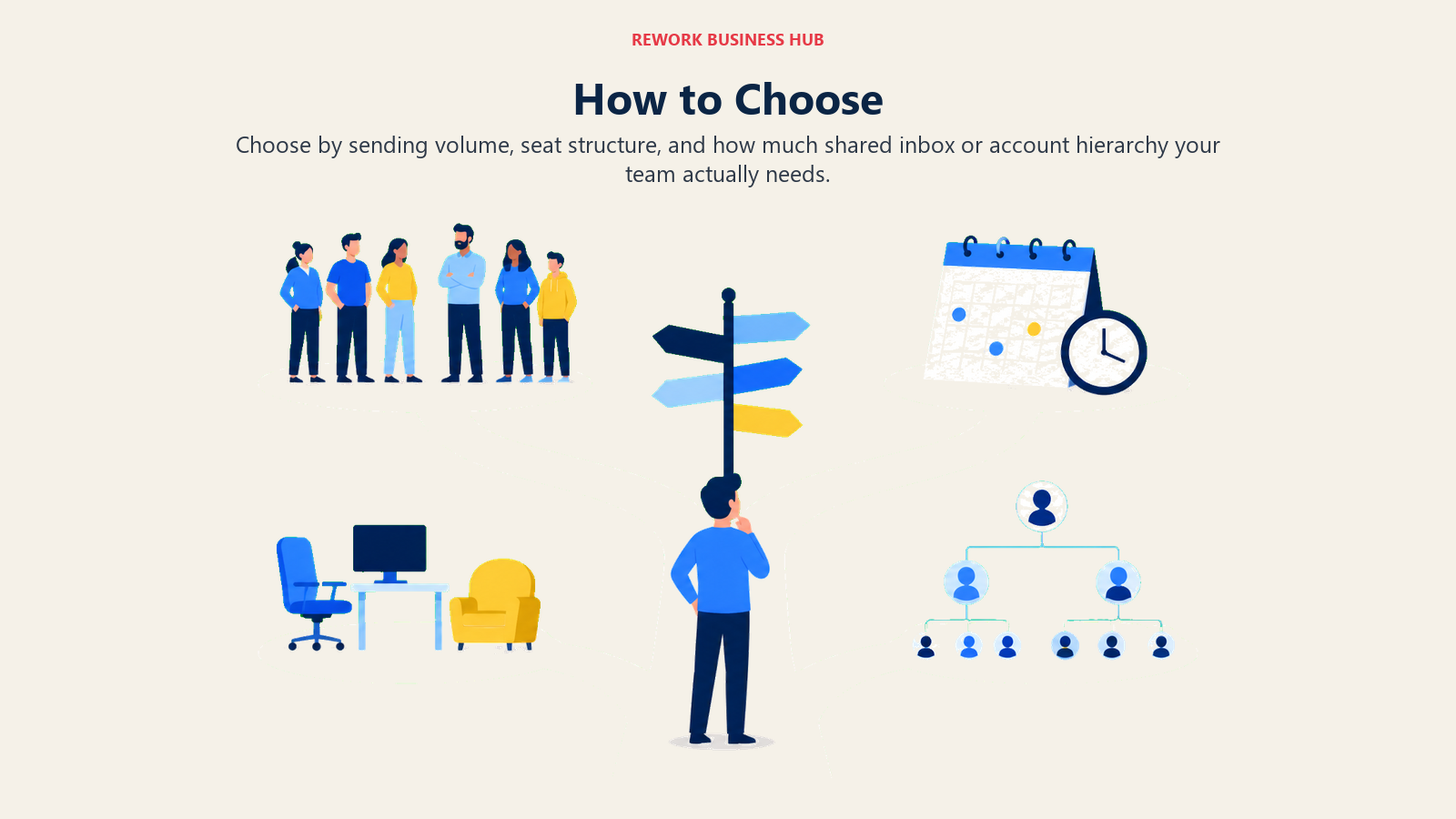
Start from the constraint that's actually costing you money, not from a feature list. For most teams leaving SimpleTexting it's one of three: seats, volume, or the absence of order-triggered flows.
| If you need... | Pick this |
|---|---|
| The same credit model with smaller steps between tiers | SlickText |
| The lowest published entry price with cheap extra seats | EZ Texting |
| Flat volume-based pricing with no feature gates | Textedly |
| Unlimited users so seats stop appearing on the invoice | Sakari |
| To pay only in the months you actually send | TextMagic |
| Sub-accounts and SSO for multiple locations or clients | Sinch Engage |
| Texting bundled with reviews and payment collection | Podium |
| Texts triggered by purchase and browse behavior | Klaviyo SMS or Postscript |
| Email, SMS, and push together at the lowest cost | Omnisend |
| Shopify-native SMS with per-message revenue attribution | Postscript |
| Enterprise scale, AI send timing, and dedicated support | Attentive |
| A personal, direct-to-audience relationship across channels | Community |
| Raw per-message cost with your own layer built on top | Twilio |
Matching by Team Profile
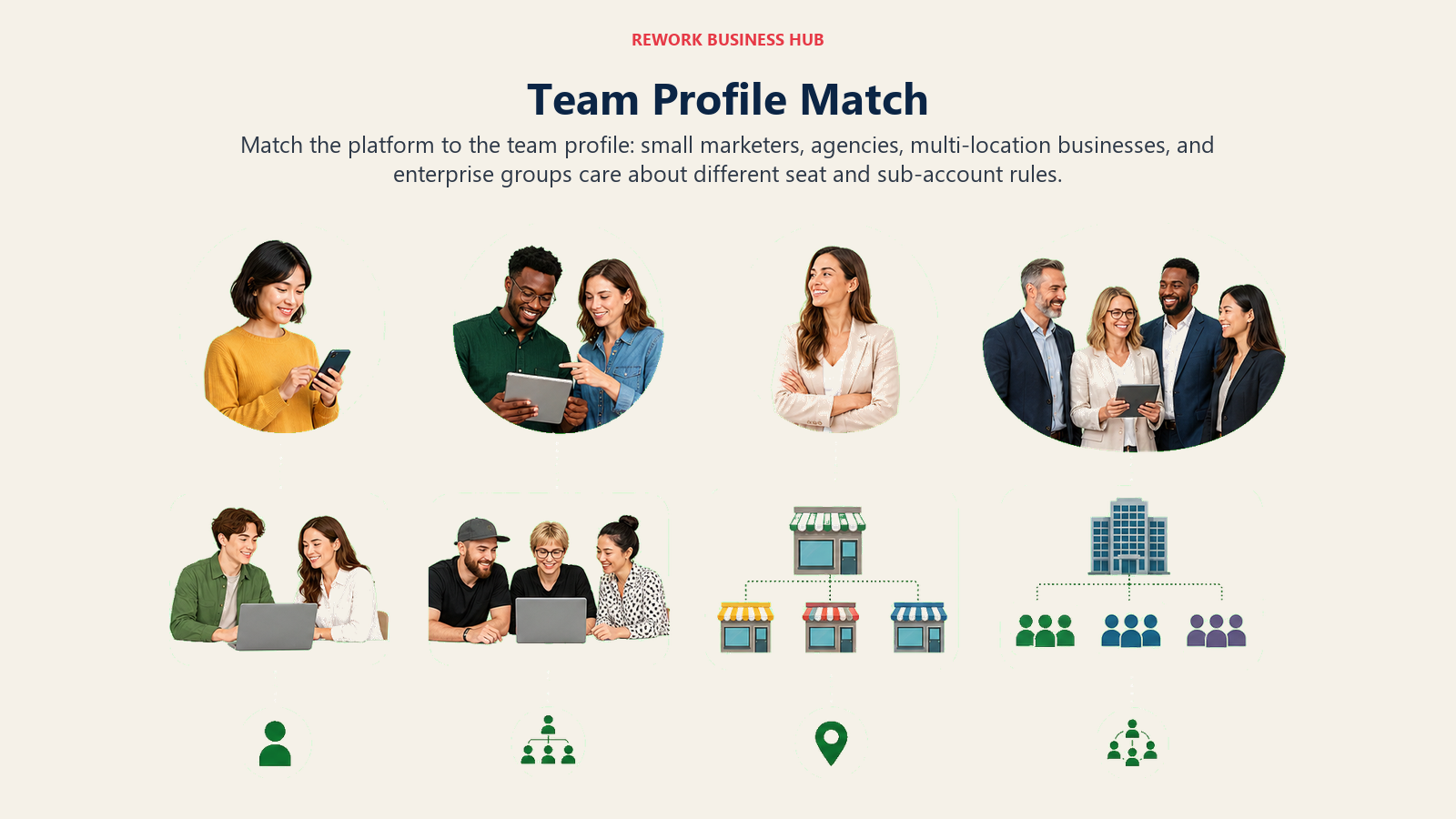
Once you know the stage fit, the next filter is who actually runs the tool day to day. Different profiles care about different seat rules, inbox depth, and automation limits.
| Your situation | Recommended path |
|---|---|
| Under 2,000 messages a month, three or fewer users | Stay on SimpleTexting, the math still works |
| Five or more people who need their own login | Sakari, or EZ Texting if budget is the harder constraint |
| Sending is seasonal or bursty, some months near zero | TextMagic |
| 10,000 to 50,000 messages a month and climbing | Postscript, Omnisend, or Sinch Engage, all per-message or packaged |
| Shopify store, texts should follow orders | Postscript, or Klaviyo SMS if you already run Klaviyo email |
| Tight budget and you want email plus SMS in one place | Omnisend |
| Several locations or franchises, each needing its own number | Sinch Engage or Podium |
| Local service business chasing reviews and payments too | Podium |
| A fan list or membership rather than a promotions calendar | Community |
| In-house engineers and 50,000+ messages a month | Twilio |
| Past a few hundred thousand subscribers, SMS is a top revenue line | Attentive |
Frequently Asked Questions about SimpleTexting Alternatives
How much does SimpleTexting actually cost per month?
The plan is $29 a month for 500 credits, but that isn't the working cost. A usable setup also needs a local number at $10 a month plus a $4 one-time carrier registration, which is why SimpleTexting's own pricing calculator shows $39.00 a month for the entry setup, or $398.40 billed yearly. Three users are included and each extra teammate is $20 a month, so a five-person team is already at $79 a month before any additional credits.
What is the cheapest SimpleTexting alternative?
EZ Texting has the lowest published entry price at $25 a month billed monthly, or $20 a month billed annually, for 500 credits, though a $5 monthly telecom fee applies on that entry tier. Sakari starts at $25 a month and includes one dedicated number and unlimited users. If you send irregularly, TextMagic can be cheaper than either because it has no monthly platform fee at all, just a prepaid balance charged at 4.9 cents per SMS.
At what volume does SimpleTexting stop being good value?
The turning point is usually somewhere between 10,000 and 30,000 messages a month. Extra SimpleTexting credits cost 5.5 cents each, while per-message platforms sit between 0.7 and 1.5 cents at comparable volume and Twilio's raw rate is $0.0083. Below roughly 10,000 messages the platform fee dominates and SimpleTexting is competitive. Above it, the per-message rate is what moves your bill.
Which alternative doesn't charge per user?
Sakari includes unlimited users and unlimited contacts on every plan, which is the cleanest fix if seat fees are what pushed you to shop. EZ Texting and Textedly both charge $10 per extra user, half SimpleTexting's $20. Sinch Engage caps out at three users even on its $799 a month tier, so check the seat count before assuming a higher tier solves it.
Is Postscript really free to start?
No. Postscript's Starter plan lists a $0 monthly platform fee, but it carries a $49 monthly minimum spend, so $49 is the real floor before you send anything. Messages then bill per send on top, from $0.015 down to $0.009, with US carrier fees averaging about $0.00418 per SMS on top of that. Treat every free SMS tier the same way and check for a minimum spend, an activation fee, or a per-number charge underneath the headline.
What happened to Yotpo SMS?
Yotpo shut it down. The company announced on 5 August 2025 that it would sunset its native Email and SMS products, with the end of service widely reported as 31 December 2025. Yotpo now sells Reviews and UGC, Loyalty and Referrals, and AI Visibility only. Attentive was reported as the preferred migration partner for annual Yotpo customers and Omnisend for self-serve brands, so if you're reading an older comparison that still lists Yotpo SMS, discount the rest of it too.
Is MessageMedia still available?
Not under that name. The MessageMedia US pricing page now redirects to Sinch, and the product is sold as Sinch Engage, running from $49 a month for 1,000 SMS up to $799 a month for 40,000. Be careful with any price quoted for "Sinch" without a product name attached, because the Sinch SMS API is a separate developer product billed per message at $0.0078 for US 10DLC, not a packaged plan.
Why do so many SMS platforms not publish pricing?
Attentive, Podium, and Community all route buyers to a sales conversation instead of a price page, and all three sell into segments where deal size varies enormously by volume, channel mix, and location count. That's a rational model for them and an expensive one for you, because you can't build a budget or compare options without a discovery call first. If published pricing matters, the shortlist narrows quickly to SlickText, EZ Texting, Textedly, Sinch Engage, Omnisend, Postscript, and Twilio.
What to Do Next
Don't switch off a comparison table. Pull your last three months of SimpleTexting invoices and write down three numbers: total messages sent, number of active users, and how many phone numbers you're renting. Those three drive almost every price difference on this page. Then run the same three numbers through your top two picks from the decision framework, including per-message rates and carrier fees rather than just the headline plan price.
If the answer comes back close, stay put. SimpleTexting's calculator is more honest than most, and a switch costs you carrier re-registration, list migration, and a few weeks of your team relearning an inbox. The switch pays for itself in exactly three situations: you have five or more users, you're past roughly 10,000 messages a month, or your best-performing texts should be firing off purchase data and currently can't.
When you do trial something, migrate a real segment and send the messages you actually send, not a test broadcast to yourself. Run it for 30 days alongside SimpleTexting rather than cutting over cold. Then compare the two invoices side by side, since that's the only comparison that settles the question.

Principal Product Marketing Strategist
On this page
- Key Facts
- Quick Comparison Table
- What SimpleTexting Actually Gets Right
- Why Teams Outgrow SimpleTexting
- What Changed in This Category Since 2025
- The Real Cost of SMS: Three Layers
- Stage Fit Matrix
- Sizing and Persona Table
- 1. SlickText - The Closest Swap, With a Deeper Credit Ladder
- 2. EZ Texting - The Lowest Published Entry Price, With the Telecom Fee Itemized
- 3. Textedly - One Slider, Every Feature, No Tier Gates
- 4. Sakari - Unlimited Users, Which Is the Line Item You're Paying For
- 5. TextMagic - Prepaid Pay As You Go, With No Monthly Plan at All
- 6. Sinch Engage (formerly MessageMedia) - Packaged Tiers With Sub-Accounts and SSO
- 7. Podium - Texting Bundled With Reviews, Payments, and an AI Agent
- 8. Klaviyo SMS - When Your Texts Should Read Your Order History
- 9. Omnisend - The Cheapest Route to Email, SMS, and Push Together
- 10. Postscript - Shopify-Native SMS With Per-Message Billing
- 11. Attentive - The Enterprise Ceiling, Priced Only by Quote
- 12. Community - Brand-to-Audience Texting, Not Campaign Marketing
- 13. Twilio - Drop the Platform Fee and Build the Layer Yourself
- How to Choose: Decision Framework
- Matching by Team Profile
- What to Do Next