Best Business Phone System in 2026: 15 VoIP Platforms Compared
Turn this article into takeaways for your work.


Each assistant summarizes the article only for you and suggests best practices for your work.
Updated August 2026
The best business phone system in 2026 depends on a question most shortlists skip: does the vendor still tell you what it costs? RingCentral, Nextiva, Dialpad, Aircall, Quo, Vonage, Ooma, Google Voice, CloudTalk and Phone.com all publish a per-user or per-licence rate you can read without a sales call. 8x8, GoTo Connect and Zoom Phone don't. All three route every path to "Contact Sales" or a checkout flow that only reveals the number at the point of purchase. That split shapes this whole guide, and it's a fact worth checking yourself before you build a budget around a number a rep quotes you.
This guide ranks all 15 platforms for IT directors, operations managers, COOs, and heads of sales or support at companies from five people to several thousand. Every price below comes straight from the vendor's own pricing page, fetched and cross-checked in August 2026, with monthly and annual rates stated separately in every cell because that single distinction is where most comparison articles get it wrong. Evaluation criteria: what a seat actually costs once AI add-ons and seat minimums are included, how each platform fits company size and calling volume, and how much of the price you can verify before a demo call.
Key Facts
- Almost 59% of the 797 organizations in Metrigy's Workplace Collaboration MetriCast 2025 study now name UCaaS their primary platform for calling, meetings and messaging, and AI-driven collaboration features are the top reason companies cite for adopting it (Metrigy).
- The global UCaaS market hit $23.0 billion in 2025, up 6.1% year over year, with Microsoft, Cisco, Zoom and RingCentral together holding 53% of seats; Metrigy forecasts 6.6% growth for 2026 (Metrigy press release).
- Gartner's 2026 Magic Quadrant for UCaaS kept Cisco, Microsoft, RingCentral and Zoom as Leaders for a second straight year, while the rated field shrank from 11 vendors to 9 as Google and Sangoma dropped out entirely (UC Today).
- By 2028, more than 50% of customer service organizations will double their technology spend without a matching cut in headcount, according to Gartner VP Analyst Kathy Ross, because AI tools still need people to run and supervise them (Gartner).
- The US VoIP services industry sits at $11.7 billion in 2026 with just 160 businesses competing in it and near-flat 0.2% year-over-year growth, a sign this is a consolidating, maturing market rather than a fast-growing one (IBISWorld).
Quick Comparison Table
| Tool | Best For | Starting Price | Key Strength | Key Limitation |
|---|---|---|---|---|
| RingCentral RingEX | All-in-one voice, meetings and team chat with heavy admin controls | Core: $20/user/mo annual, $30 monthly | 300-participant HD meetings and modular AI add-ons | AI Receptionist ($39+) and Conversational Intelligence ($60+) cost extra |
| Nextiva | Small business voice plus basic CX in one contract | Core: $15/user/mo annual, $23 monthly | Core, Engage and Scale tiers grow into a full CX platform | Scale tier's monthly rate isn't published; enterprise contact center quotes separately |
| Dialpad Connect | AI meeting transcripts and call summaries at the entry tier | Standard: $15/user/mo annual, $27 monthly | AI transcription and summaries included, not an add-on | CRM integrations require the Pro tier or above |
| Zoom Phone | Teams already on Zoom Meetings wanting phone in the same app | Not published, rate shown only in checkout | Gartner Leader status, familiar Zoom interface | No public price to compare before you start checkout |
| 8x8 | Enterprises wanting one quote across voice, contact center and video | Contact for pricing, no published rate | Gartner Visionary, single custom quote across the suite | Can't self-serve price even a small deployment |
| Microsoft Teams Phone | Microsoft 365 shops adding calling inside Teams | $10/user/mo annual for Teams Phone Standard (add-on, no minutes); $17/user/mo annual with the domestic Calling Plan | Lives inside the collaboration suite staff already use | $10 has no calling minutes; a calling plan is a separate charge |
| Quo (formerly OpenPhone) | Small teams wanting simple numbers with an AI agent built in | Starter: $15/user/mo annual, $19 monthly | Sona AI agent and automation credits from the entry tier | Unlimited calling is capped by a fair usage policy |
| Aircall | Sales and support teams wanting deep CRM and helpdesk integrations | Essentials: $30/licence/mo annual, $40 monthly (3-licence minimum) | 250+ integrations plus per-minute AI voice agents | 3-licence floor means a real minimum spend of $90/month annual |
| GoTo Connect | SMBs wanting phone bundled with meeting and IT tools | Contact for pricing, no published rate | Gartner Visionary, bundles CX and contact center packages | All four packages route to Contact Sales, no dollar figure anywhere |
| Vonage Business Communications | Companies wanting flexible per-line, mobile-first plans | Mobile: $13.99/line on a 12-month plan, $19.99 monthly | Three clear tiers priced per line, not per seat | Gartner rates it a Niche Player, not a Leader or Visionary |
| Ooma Office | Small businesses wanting flat, no-contract pricing | Essentials: $19.95/user/mo flat, no contract | Virtual receptionist and a free toll-free number included | Flat rate means no discount for paying annually |
| Google Voice | Google Workspace shops wanting calling without a new console | Starter: $10/user/mo, up to 10 users | Cheapest entry price here, native Workspace integration | Starter tier caps at 10 users |
| CloudTalk | Sales and support teams needing numbers in 160+ countries | Starter: $25/mo billed annually (1-licence minimum) | International number coverage, call flow builder included | Unlimited calling covers only US/Canada; EU/UK calling is capped |
| Phone.com | Budget-conscious teams wanting unlimited minutes, fees itemized | Basic: $15/user/mo annual, $18 monthly | 50 voice features, including IVR, at the entry tier | One number per account and user; no CRM tie-in until Pro |
| Grasshopper | Solos and very small teams wanting a virtual number, not seats | From $14/month, flat-rate, not per user | Cost doesn't scale with headcount | Pricing page is geo-restricted; higher tiers aren't published |
The Pricing Transparency Gap: Who Publishes a Rate and Who Doesn't
Ten of the 15 platforms in this roundup, RingCentral, Nextiva, Dialpad, Aircall, Quo, Vonage, Ooma, Google Voice, CloudTalk and Phone.com, still show a per-user or per-licence rate on their own pricing page. Grasshopper shows an entry rate ("from $14/month") without publishing its higher tiers. Three of the biggest names in the category no longer show a number at all.
8x8's pricing page carries the heading "Pricing and packages" with no rate on it anywhere; every path routes to a custom quote. GoTo Connect's page lists four packages, Phone System, Customer Experience, CX Complete and Contact Center, and every one says "Contact Sales." Zoom Phone names its plans (US and Canada Unlimited, Pro Plus, Business Plus, plus regional variants) but the actual per-user rate only renders inside the checkout flow, and it varies by country, so there's no figure to quote here even for the market's most recognizable video brand. All three still made Gartner's 2026 Magic Quadrant for UCaaS: Zoom as a Leader, 8x8 and GoTo Connect as Visionaries.
That split changes how you should run the buying process. For the ten vendors with published rates, you can build a real per-seat budget before you ever talk to sales, then use that number to negotiate. For 8x8, GoTo Connect and Zoom Phone, treat the first quote as a starting offer, not a market rate, and ask each for a written range before you narrow your shortlist. None of the three publishing gaps is new information about product quality. It's a fact about how each company chooses to sell, and it affects how much homework you can do before the first call.
The add-on layer complicates budgets further, even for vendors that do publish. RingCentral's Core tier is $20 per user a month annual, but AI Receptionist starts at $39 and Conversational Intelligence at $60, both billed as separate add-ons regardless of company size. Aircall's Essentials tier is $30 per licence, and AI Assist adds another $9 per licence a month, with AI Voice Agents billed from $0.14 a minute on top of that. Gartner's prediction that customer service technology spend will double at more than half of organizations by 2028 is exactly this pattern: the headline seat price is the smaller half of the real bill once AI features get switched on. Our best AI voice agents roundup covers the standalone alternatives if you'd rather buy that layer separately.
Stage Fit: Matching Company Size to Platform
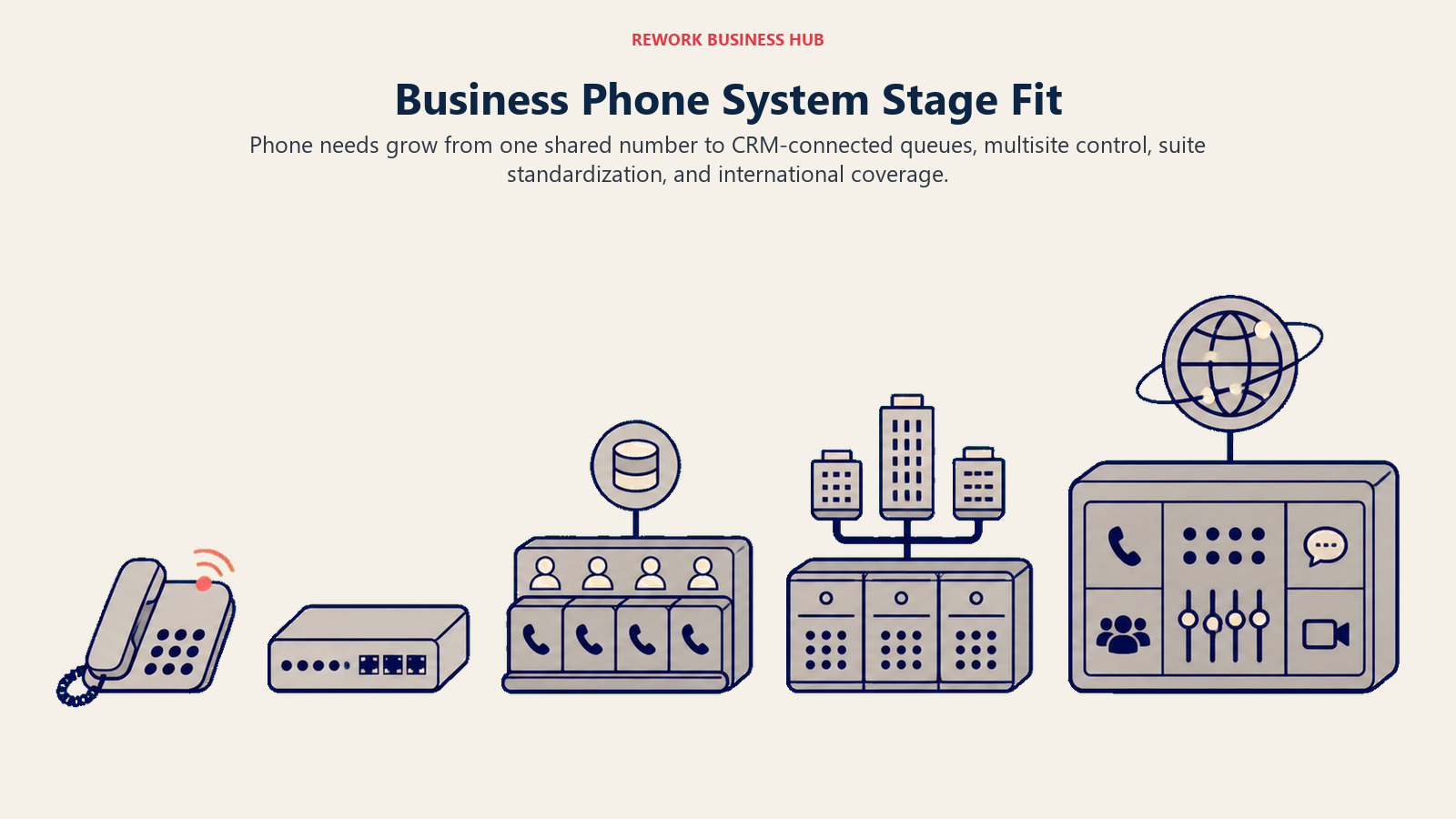
Company size is only a proxy for phone-system complexity. Match the platform to the routing, integration, reporting, and geographic coverage the team actually needs at its current stage.
| Company stage | What the phone system actually needs to do | Best fits |
|---|---|---|
| Solo to 5 people | One number, no per-seat admin overhead | Grasshopper, Google Voice Starter (under 10 users), Quo Starter |
| 5 to 25 people | Unlimited calling, basic routing, business SMS | Ooma Office, Phone.com, Quo, CloudTalk Starter |
| 25 to 100 people, first real sales or support desk | CRM integrations, call recording, IVR, queues | Aircall, Nextiva Core or Engage, Dialpad Connect Pro, RingCentral Core or Advanced |
| 100 to 500 people, multi-site | Admin depth, AI transcription, advanced reporting | RingCentral Ultra, Nextiva Scale, Dialpad Connect Enterprise, CloudTalk Expert |
| 500+ people, standardized on a suite | Calling inside the collaboration tool staff already use | Microsoft Teams Phone (if on M365), Zoom Phone (if on Zoom), 8x8, GoTo Connect |
| Multi-country operations | Local numbers and calling coverage outside North America | CloudTalk (160+ countries), RingCentral, 8x8 |
1. RingCentral RingEX
RingCentral RingEX is the platform most 50 to 2,000 person companies put on a shortlist first, and Gartner's 2026 Magic Quadrant for UCaaS backs that instinct: RingCentral held Leader status for a second straight year alongside Cisco, Microsoft and Zoom. The Core tier covers unlimited domestic calling, on-demand recording, 100 toll-free minutes, 25 SMS per user a month and HD meetings for up to 300 participants, at $20 per user a month billed annually or $30 monthly.
Advanced ($25 annual, $35 monthly) adds CRM integrations, multi-site support and core reporting. Ultra ($35 annual, $45 monthly) adds 10,000 toll-free minutes, unlimited storage and device analytics. A separate Customer Engagement Bundle layers Business SMS Booster and a Call Queues Booster on top of Ultra at custom pricing. The AI layer is entirely add-on: AI Receptionist starts at $39, Conversational Intelligence at $60, Call Queues Booster is $35 and Business SMS Booster is $25, and those prices hold steady whether you're buying for 5 seats or 500.
That modularity is the honest tradeoff. RingEX genuinely covers voice, meetings and chat in one contract, but the number you see on the pricing page undersells what a fully-loaded AI deployment costs. If you're weighing it against the field, best RingCentral alternatives covers the switching case, and RingCentral vs Nextiva walks the head-to-head against its closest small-business rival.
| Pros | Cons |
|---|---|
| 300-participant meetings included at the Core tier | AI Receptionist and Conversational Intelligence cost extra at every plan |
| Gartner Leader for UCaaS in 2026 | Ultra and the Customer Engagement Bundle both need a quote |
| Modular AI add-ons for teams that want them | Add-on pricing doesn't scale down for small teams |
| Strong CRM integrations from the Advanced tier up | Reporting depth requires Advanced or Ultra, not Core |
Best for: companies from roughly 20 to 2,000 employees that want voice, meetings and chat in one platform and are willing to price AI features separately.
2. Nextiva
Nextiva rebuilt its lineup around three tiers, Core, Engage and Scale, replacing the older Essential/Professional/Enterprise names and the four-tier Digital/Core/Engage/Power Suite structure some comparison sites still describe. If you're reading an older article that quotes $18.95 or names an "Essential" plan, it's describing a lineup Nextiva no longer sells.
Core runs $15 per user a month billed annually ($23 monthly) and covers voice, business SMS at 100 messages per user a month, video and call routing. Engage steps up to $25 annual ($50 monthly) and adds customer-to-team SMS at 500 messages per user, a toll-free number with up to 2,000 minutes, advanced reporting, an inbound call center, live chat and a chatbot, which puts it closer to a light help desk than a phone line. Scale is $75 per user a month annual (the monthly rate isn't shown) and adds unlimited SMS, up to 10,000 toll-free minutes, AI transcription and summary, and skills-based routing. Nextiva's separate enterprise contact center tab starts its Essential tier from $75 per agent a month, with Professional and Premium both quote-only.
Annual small-business pricing is only available to new customers with 1 to 100 employees on a 12-month or longer term, which is a real eligibility gate, not a formality. For the broader field of switching options, see best Nextiva alternatives.
| Pros | Cons |
|---|---|
| Core, Engage and Scale scale cleanly into a CX platform | Scale's monthly rate isn't published anywhere |
| Chatbot and live chat included from Engage up | Annual pricing eligibility caps at 100 employees |
| Enterprise contact center sold as a separate product line | Professional and Premium enterprise tiers are quote-only |
| Clear jump in SMS volume at each tier | Old tier names still circulate in outdated comparisons |
Best for: small businesses under 100 employees that want voice and a lightweight CX layer under one annual contract.
3. Dialpad Connect
Dialpad Connect is the platform to shortlist when AI transcription and summarization are the reason you're buying, not an upsell you'll get pitched later. The Standard tier already includes unlimited calling, AI meeting notes, built-in messaging, real-time transcripts and automatic call summaries, at $15 per user a month billed annually or $27 monthly, no separate AI charge.
Pro moves to $25 annual ($35 monthly) and adds CRM integrations, 24/7 support and multi-office management. Enterprise is quote-only and adds SSO, granular user access controls, unlimited office locations and a 99.9% uptime commitment. Note what's absent from Dialpad's own pricing page: a stated seat minimum. Older comparison articles frequently repeat a "3-seat minimum" for Dialpad that its current page simply doesn't assert, so don't budget around a floor that may not exist.
Dialpad also sells separate Support and Sell products built on the same AI core, which is worth knowing if you're evaluating it for more than plain telephony. Gartner's 2026 UCaaS Magic Quadrant places Dialpad as a Visionary, meaning strong vision on where AI-driven calling is headed without yet matching the Leaders' execution scale. If Dialpad's AI bundling is the reason it's on your list, Dialpad vs RingCentral works through what each vendor actually includes at 10, 25 and 50 seats, and best Dialpad alternatives covers the wider switching field.
| Pros | Cons |
|---|---|
| AI transcripts and call summaries included at Standard | CRM integrations require Pro or above |
| No separate AI charge, unlike RingCentral or Aircall | No stated seat minimum, so don't assume Dialpad's floor |
| Gartner Visionary for UCaaS in 2026 | Enterprise tier requires a quote for SSO and access controls |
| Sister products (Support, Sell) share the same AI engine | Multi-office management gated behind the Pro tier |
Best for: teams that want AI transcription and call summaries built into the base plan instead of purchased separately.
4. Zoom Phone
Zoom Phone is the natural add-on for any company already running Zoom Meetings, and it carries real market credibility: Gartner named Zoom a Leader in its 2026 Magic Quadrant for UCaaS for the seventh consecutive year. The plan names are public. Zoom's pricing page lists US and Canada Unlimited, Pro Plus and Business Plus, and its FAQ also references Zoom Phone Pro, Pro Global Select and regional plans for the US and Canada.
What isn't public is the price. The per-user rate renders only once you enter the checkout flow, and it's localized by country, so there's no dollar figure to quote here, and no honest way to compare it to a competitor's headline number without starting a purchase. That's a genuine change from how Zoom priced Phone a few years ago, and it puts Zoom in the same disclosure category as 8x8 and GoTo Connect rather than the ten vendors in this roundup that show a rate up front.
The practical move is to request a written quote before you shortlist Zoom Phone against a vendor whose price you can already see, and to ask specifically whether the number you're quoted matches what a same-sized company would see in checkout, since regional variation is built into the model.
| Pros | Cons |
|---|---|
| Gartner Leader for UCaaS, seventh straight year | No public per-user price anywhere outside checkout |
| Native fit for teams already on Zoom Meetings | Rate varies by country, complicating multi-region budgets |
| Multiple named plans for different calling needs | Can't build a budget without starting a purchase flow |
| Familiar interface reduces training time | Harder to negotiate without a comparable published rate |
Best for: organizations already standardized on Zoom Meetings that want calling in the same account, and are comfortable requesting a quote to see the price.
5. 8x8
8x8 has fully exited public per-user pricing. Its pricing page carries the heading "Pricing and packages" with a meta description that reads "Create a custom business communication plan with 8x8. Mix and match solutions," and every path on the page leads to "Request Quote." The X2/X4/X6/X8 tier names and rates some older articles still cite are gone from the live page entirely; don't repeat them.
What replaced the published rate card is a mix-and-match model across voice, contact center and video, sold as one custom plan rather than a menu of fixed SKUs. Gartner's 2026 Magic Quadrant for UCaaS rates 8x8 a Visionary, the same category as Dialpad and GoTo Connect, reflecting strong platform vision without Leader-tier execution scores. For a mid-market company that wants a single vendor across voice and contact center and doesn't mind a sales-led process, that combination is a legitimate fit. For a 15-person team wanting to self-serve a quote, it's a mismatch.
If a published, comparable rate matters more to you than a custom-bundled quote, best 8x8 alternatives lists 12 platforms where you can see the price before the first call.
| Pros | Cons |
|---|---|
| Single custom quote spans voice, contact center and video | Zero published per-user pricing anywhere on the site |
| Gartner Visionary for UCaaS in 2026 | Old X-series tier names and prices no longer apply |
| Suits companies that want one vendor negotiation | Can't self-serve a budget for a small deployment |
| Mix-and-match model fits complex, multi-product needs | Sales cycle is required even for basic voice-only needs |
Best for: mid-market and larger companies that want voice, contact center and video bundled into one negotiated contract.
6. Microsoft Teams Phone
Microsoft Teams Phone is calling bolted onto Teams, and the pricing only makes sense once you accept that framing. Teams Phone Standard is $10 per user a month, paid yearly, and it requires a separate Microsoft Teams licence you're likely already paying for as part of Microsoft 365. That $10 figure has no calling minutes attached. It's the add-on fee, not the all-in cost, and treating it as the full price is the single most common way this platform gets under-budgeted.
Actual calling requires a plan on top: the Domestic calling plan is $17 per user a month (paid yearly) and includes a number plus 3,000 domestic minutes in the US, UK or Canada, or 1,200 minutes elsewhere. Pay-as-You-Go runs $13 per user a month with metered outbound minutes billed separately by Microsoft. Domestic and International is $34 per user a month and includes 3,000 domestic or 600 international minutes depending on region.
The real comparison, then, is $10 Standard plus a calling plan, which lands most companies between $23 and $44 per user a month once you add the Teams licence cost most organizations already carry. That's a materially different number than the $10 headline, and it's worth modeling before you assume Teams Phone is the cheap option because your company already has Teams.
| Pros | Cons |
|---|---|
| Calling lives inside the collaboration tool staff already use | $10 Standard tier includes zero calling minutes |
| No new admin console to learn for IT | Requires a separate Teams licence on top |
| Multiple calling plan options by minute volume and region | Real per-user cost is $23 to $44+ once you add a calling plan |
| Predictable annual, paid-yearly billing | Weak on routing depth for dedicated sales or support queues |
Best for: Microsoft 365 organizations that want basic calling inside Teams and don't need deep call center routing.
7. Quo (formerly OpenPhone)
Quo (formerly OpenPhone) is the same product and the same team under a new name. The company renamed in September 2025 alongside $105 million in growth financing, and openphone.com/pricing now redirects to quo.com/pricing. If you're still telling colleagues to check out OpenPhone, correct it. It's Quo now, and it's repositioned around an AI voice agent called Sona rather than just a simple shared-number app.
Starter is $15 per user a month billed annually ($180 a year), or $19 monthly, and includes one number per user, voicemail transcripts, the Sona AI agent, API access and 1,000 automation credits. Business steps to $23 annual ($276 a year, $33 monthly) and adds AI call summaries and transcripts, group calling, call transfers, HubSpot and Salesforce integrations and auto call recording. Scale is $35 annual ($420 a year, $47 monthly) and adds AI call tags, dedicated onboarding and priority support. Calling and messaging to US and Canadian numbers is described as unlimited, but that's subject to a Fair Usage Policy, not a flat unlimited guarantee.
For a small sales or support team that wants an AI agent and CRM integrations without RingCentral or 8x8's enterprise scaffolding, Quo is a tight fit. It's a poor fit for a 300-person company needing site-level admin controls. Teams weighing it against the cheapest option usually end up at OpenPhone vs Google Voice; for the broader field, see best OpenPhone alternatives.
| Pros | Cons |
|---|---|
| Sona AI agent and automation credits from Starter | "Unlimited" calling is capped by a fair usage policy |
| HubSpot and Salesforce integrations at Business | Renamed from OpenPhone, so old bookmarks and quotes are stale |
| Clear three-tier structure, no hidden AI add-on fee | No multi-site admin depth for larger deployments |
| Recent funding round signals continued investment | Newer brand name still confuses some buyers mid-evaluation |
Best for: small sales or support teams (roughly 2 to 50 people) that want an AI agent and CRM sync without enterprise-scale admin overhead.
8. Aircall
Aircall is built for sales and support teams that live inside a CRM or helpdesk, not for a general office line. Its pitch is 250+ integrations, an IVR, recording, SMS and MMS and unlimited outbound calling, and the integration depth is genuinely what separates it from Ooma or Phone.com at a similar price point.
Essentials is $30 per licence a month billed annually, or $40 monthly, with a 3-licence minimum, meaning the real floor is "3 licences for $90 a month, billed annually," not the $30 headline. Professional is $50 annual ($70 monthly), also with a 3-licence minimum, and adds Salesforce CTI, advanced analytics, live monitoring, Power Dialer and queue callback. Custom pricing requires a 25-licence minimum and adds SLA terms, SSO and API developer support. The AI layer is separately metered: AI Assist is $9 per licence a month, AI Voice Agents start from $0.14 a minute (500 minutes for $130, 2,500 for $550), and AI Messaging Agents start from $0.15 a conversation, with 50 free AI Voice Agent minutes included per account every month on every plan.
Compare Aircall's real 3-licence floor to a single-seat competitor like Quo or Ooma before assuming it's the pricier option. At scale, with the integration depth this category needs, it usually isn't. If Aircall's minimum doesn't fit your team size, best Aircall alternatives covers 12 platforms without that floor.
| Pros | Cons |
|---|---|
| 250+ integrations, deepest in this roundup for sales/support | 3-licence minimum on Essentials and Professional |
| Salesforce CTI and Power Dialer at Professional | AI Assist and AI Voice Agents both bill separately |
| Per-minute AI voice agents avoid a flat monthly AI fee | Custom tier requires a 25-licence commitment |
| 50 free AI Voice Agent minutes on every plan | Real entry cost is $90/month, not the $30 headline |
Best for: sales and support teams of 3 or more running calls through a CRM or helpdesk, where integration depth matters more than the lowest headline price.
9. GoTo Connect
GoTo Connect sits alongside 8x8 and Zoom Phone in the no-published-pricing group. Its pricing page lists four packages, Phone System, Customer Experience (CX), CX Complete and Contact Center, and every single one reads "Contact Sales." There's no dollar figure anywhere on the page, and the old published per-user rate some articles still cite (around $27 per user) is not there anymore.
What the four package names do tell you is scope. Phone System is straightforward business calling. Customer Experience layers in live chat and basic support tooling, closer to a live chat add-on than a phone upgrade. CX Complete bundles further, and Contact Center is the full queue-and-routing product for dedicated support or sales floors. Gartner's 2026 Magic Quadrant for UCaaS rates GoTo a Visionary, the same tier as 8x8 and Dialpad, reflecting a platform with a clear roadmap that hasn't yet matched the Leaders on execution scale.
Because none of the four packages price publicly, get quotes for at least two of them (typically Phone System and CX) before you commit, since the jump between packages is where GoTo's real cost lives, not in a per-seat rate you can compare up front. If the quote wall itself is what's pushing you to look elsewhere, best GoTo Connect alternatives sorts the field by which vendors still publish a rate.
| Pros | Cons |
|---|---|
| Four packages map cleanly to voice, CX and contact center needs | Zero published pricing on any of the four packages |
| Gartner Visionary for UCaaS in 2026 | Can't self-serve a budget before a sales call |
| Bundles meeting and IT tools GoTo also sells | Older published rates (around $27/user) no longer apply |
| Clear package tiers simplify scope conversations | Comparing packages requires multiple separate quotes |
Best for: SMBs that want phone bundled with GoTo's meeting and IT support tools and are comfortable getting quoted before comparing.
10. Vonage Business Communications
Vonage Business Communications prices per line, not per generic seat, which fits a company with a mix of desk-bound and mobile staff. Every tier carries two legitimate prices, a discounted 12-month plan rate and a higher month-to-month rate, and both matter: quoting only the lower figure overstates what you'll actually pay if you ever go month to month.
Mobile is $13.99 per line on a 12-month plan (a 30% discount) or $19.99 month to month, plus taxes and fees, and covers desktop and mobile apps, unlimited domestic calling, SMS/MMS and voicemail. Premium is $20.99 on the 12-month plan or $29.99 monthly, adding desk phone support, unlimited video meetings up to 200 participants, team messaging, App Center access and SSO. Advanced is $27.99 on the 12-month plan or $39.99 monthly, adding on-demand call recording (15 hours a month), visual voicemail with transcription and call groups.
Gartner's 2026 Magic Quadrant for UCaaS places Vonage as a Niche Player, not a Leader or Visionary, which is a fair summary of where it sits: a solid, flexible, per-line option rather than a category-defining platform. That's not a knock for a company that specifically wants per-line billing; it's a reason to set expectations before you demo it against RingCentral or Nextiva. For the broader field of switching options, see best Vonage alternatives.
| Pros | Cons |
|---|---|
| Per-line pricing fits mixed desk and mobile teams | Gartner Niche Player status, not Leader or Visionary |
| Clear feature delta across three tiers | Two-price structure (12-month vs monthly) needs careful reading |
| App Center and SSO included from Premium up | Call recording capped at 15 hours a month even at Advanced |
| 30% discount rewards a 12-month commitment | Less integration depth than Aircall or RingCentral |
Best for: companies wanting per-line rather than per-seat billing, especially with a mobile-heavy workforce.
11. Ooma Office
Ooma Office is the flat-rate option in this roundup, and "flat" is meant literally: its pricing page states "no contract necessary," and none of its three published tiers offer an annual discount. $19.95, $24.95 and $29.95 are the same rate whether you pay monthly or commit for a year, so if you see an Ooma price quoted elsewhere as an annual rate, it is the monthly rate too.
Essentials is $19.95 per user a month and includes 100+ features, unlimited calling across the US, Canada, Mexico and Puerto Rico, a virtual receptionist, one free toll-free number and digital fax. Pro is $24.95 and adds a desktop app, 250 texts a month, video for up to 25 participants, call recording and enhanced call blocking. Pro Plus is $29.95 and adds AI transcriptions, AI insights, CRM integration, 1,000 texts a month, video up to 100 participants, team chat, hot desking and call queuing. Enterprise is custom-priced and adds SIP trunking, Teams integration with direct routing and call center features.
The lack of an annual discount is unusual in this category, where most vendors price annual meaningfully below monthly. It also means Ooma's cost is fully predictable, with no surprise renewal jump, which some small businesses will value over the maximum theoretical savings.
| Pros | Cons |
|---|---|
| No contract required at any published tier | No annual discount; flat rate regardless of commitment |
| Virtual receptionist and free toll-free number at entry | AI transcription and CRM integration require Pro Plus |
| CRM integration and AI insights at Pro Plus for $29.95 | Enterprise SIP trunking and Teams integration are quote-only |
| Predictable pricing with no renewal-cliff surprise | Fewer deep integrations than Aircall or Dialpad |
Best for: small businesses under about 50 people that want simple, flat, no-contract pricing without an annual commitment.
12. Google Voice
Google Voice, sold through Google Workspace, is the cheapest entry price in this entire roundup at $10 per user a month for the Starter tier, and it's genuinely simple for a company already living in Gmail, Calendar and Drive: no new admin console, no separate login, calling that shows up next to the rest of Workspace. Starter covers unlimited domestic calling, unlimited US texting, voicemail transcription and call recording, for individual users in the US or businesses in 14 countries.
The catch that trips up growing companies: Starter caps at 10 users. A 40-person team can't run on it no matter how attractive the $10 rate looks; you have to move to Standard at $20 per user a month, which removes the user cap and adds call queuing, auto attendants, ring groups, eDiscovery and SIP Link. Premier, at $30 per user a month, adds unlimited international billing locations, automatic call recording and BigQuery reporting for companies that want call data in their own analytics warehouse.
Google Voice is not trying to be a sales or support platform. There's no CRM integration layer, no IVR builder and no queue routing comparable to Aircall or RingCentral. It's a phone line for a company whose real infrastructure decision was choosing Google Workspace, not choosing a phone system.
| Pros | Cons |
|---|---|
| Cheapest published entry price in this roundup at $10/user | Starter tier hard-caps at 10 users |
| Zero new admin console for Workspace shops | No CRM, IVR or queue routing for sales/support teams |
| BigQuery reporting available at Premier | International coverage requires stepping up two tiers |
| Voicemail transcription included from Starter | Weakest feature depth of any vendor in this list |
Best for: Google Workspace companies under 10 users wanting a simple line, or larger Workspace shops on Standard/Premier that don't need dedicated call center features.
13. CloudTalk
CloudTalk earns its spot on this list on international reach: numbers in 160+ countries, and unlimited calls to the US and Canada or 500 outbound minutes across the EU, UK, Iceland and Norway on its entry tier. For a sales or support team calling internationally, that geographic coverage is harder to match than a US-only competitor at a similar price.
Starter is $25 a month billed annually, with a 1-licence minimum, and includes IVR, smart routing and a call flow builder from day one. Essential steps to $29 billed annually and adds unlimited domestic EU and UK calling plus advanced call handling and integrations. Expert is $49 billed annually and adds outbound dialers, real-time analytics and Salesforce integration. Note that "unlimited" on the Starter tier only applies to US and Canada; European and UK calling is capped until you move to Essential or above, which is easy to miss if you're comparing headline "unlimited" claims across vendors.
CloudTalk is a strong fit for a distributed sales team calling prospects across multiple continents, and a weaker fit for a single-office US company that will never touch the international routing it's built around.
| Pros | Cons |
|---|---|
| Numbers and coverage in 160+ countries | "Unlimited" on Starter only covers US/Canada, not EU/UK |
| Call flow builder and IVR included from Starter | Salesforce integration requires the Expert tier |
| Salesforce and real-time analytics at Expert | 1-licence minimum still means per-licence, not flat pricing |
| Advanced call handling from Essential up | Less North American brand recognition than RingCentral or Nextiva |
Best for: distributed sales or support teams that need genuine international calling coverage, not just a US-only number.
14. Phone.com
Phone.com is a straightforward, itemized alternative to the bigger names, and it's upfront about the parts of the bill other vendors bury: every price on its page is stated plus taxes and fees, rather than folding those into the headline number. Basic is $15 per user a month billed annually ($180 a year) or $18 monthly, and includes unlimited minutes, one number per account and user, and 50 voice features, including an IVR and video conferencing.
Plus is $22.50 annual ($269 a year, $27 monthly) and adds IP desk phone support, voicemail transcription and conversational text messaging. Pro is $33.33 annual ($399 a year, $40 monthly) and adds call recording, call analytics, CRM integration and 10-year data retention, which is a notably long retention window if your industry has compliance requirements around call records.
The one-number-per-account-and-user structure is worth checking against your team's actual calling pattern before you commit. If multiple people need to answer the same line, Phone.com's model handles that differently than a shared-queue platform like Aircall or CloudTalk, so test it with your real routing needs, not just the price sheet.
| Pros | Cons |
|---|---|
| 50 voice features, including IVR, at the Basic tier | No CRM integration until the Pro tier |
| Transparent about taxes and fees on every price | One number per account and user limits shared-line setups |
| 10-year call data retention at Pro, useful for compliance | Fewer integrations than Aircall or Dialpad |
| Clear monthly-vs-annual pricing on every tier | Smaller brand and support footprint than RingCentral or Nextiva |
Best for: budget-conscious small teams under 50 people that want unlimited minutes and a transparent, itemized bill.
15. Grasshopper
Grasshopper is the odd one out in this roundup by design: it's a flat-rate virtual phone service, not a per-user UCaaS platform. If you're a solo operator or a very small team that needs a professional number, extensions and a virtual receptionist without standing up a full communications platform, that's exactly the gap Grasshopper fills.
The vendor's own pricing page states "Pricing Starting at $14/month" in its page title, which is the only figure this article can verify. Grasshopper's pricing page is geo-restricted to the US and Canada, and its tier names and higher-tier prices aren't retrievable from outside that access window, so this guide can't responsibly state them. If you're evaluating Grasshopper, get the current tier structure directly from a US or Canadian vantage point rather than trusting a remembered figure from an older article.
Because Grasshopper doesn't price per user, it's genuinely difficult to compare line-for-line against the other 14 platforms here. Model your actual usage (call volume, number of extensions, whether you need SMS) directly against a current quote rather than assuming its flat rate beats a competitor's per-seat price at your specific headcount.
| Pros | Cons |
|---|---|
| Flat-rate model, cost doesn't scale with headcount | Higher tiers and features aren't publicly retrievable |
| Simple setup for solos and very small teams | Geo-restricted pricing page complicates verification |
| No per-user seat math to manage | Not built for CRM-integrated sales or support workflows |
| Virtual receptionist available without a full UCaaS platform | Hard to line up directly against per-seat competitors |
Best for: solo operators and teams of 2 to 5 that want a simple virtual number without per-seat billing.
Buying Mistakes to Avoid
| Mistake | What it looks like | What to do instead |
|---|---|---|
| Budgeting only the headline seat price | RingCentral at $20/user looks cheaper than Aircall until AI Receptionist ($39) and Conversational Intelligence ($60) get added | Price the full stack, including every add-on you'll actually turn on, before comparing vendors |
| Ignoring Aircall's licence minimum | A $30/licence quote reads like $30, but 3 licences means a $90/month floor | Ask for the minimum licence or seat count on the first call, not after the demo |
| Treating "Contact for pricing" as one vendor's quirk | 8x8, GoTo Connect and Zoom Phone all made the same call to stop publishing rates | Request a written range from each before you shortlist, and compare that range, not a remembered old price |
| Repeating stale tier names | Asking a Nextiva rep about "Essential" or an OpenPhone rep instead of Quo | Verify current product and tier names before the call, using this article or the vendor's own page |
| Missing a seat cap | Budgeting Google Voice Starter for a 40-person team that will hit its 10-user ceiling | Check published user or licence caps before you shortlist, not after deployment |
| Comparing a promotional or discounted rate to a standing rate | Vonage's 12-month $13.99 rate compared against a competitor's plain monthly price | Compare like billing terms: annual to annual, monthly to monthly |
How to Choose: Decision Framework
Start with the operating constraint that will be hardest to change later: suite fit, CRM depth, AI pricing, international coverage, or billing model. The table routes each need to the platform whose current product and pricing model fits it best.
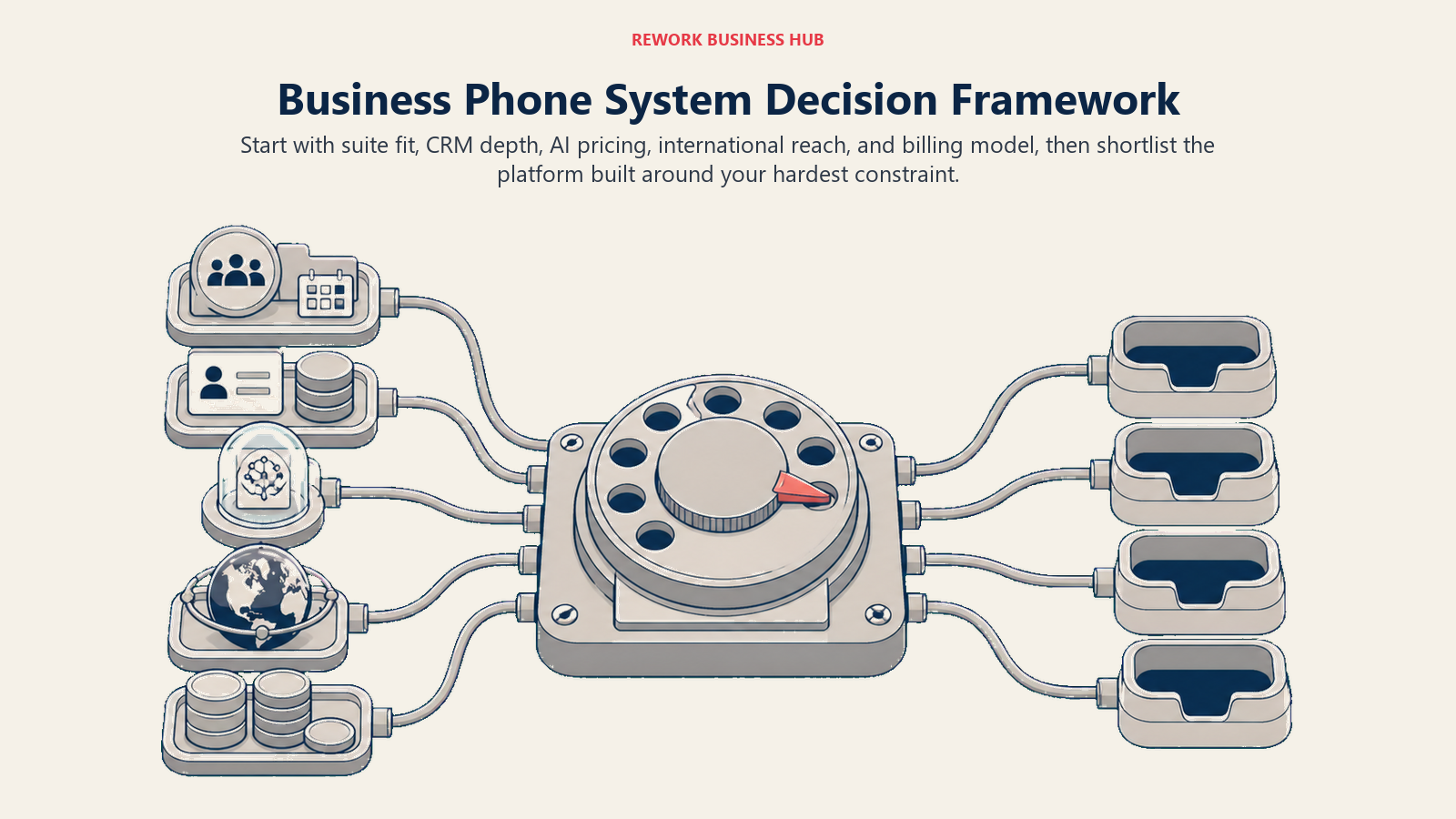
| If you need... | Pick... | Why |
|---|---|---|
| Voice, meetings and chat in one contract, willing to price AI separately | RingCentral RingEX | 300-participant meetings included at Core, Gartner Leader for UCaaS |
| Small-business voice plus a lightweight CX layer | Nextiva | Core, Engage and Scale scale cleanly, chatbot included from Engage |
| AI transcription and summaries without a separate charge | Dialpad Connect | Included at Standard, not gated behind an add-on fee |
| Calling inside a Zoom-first company, comfortable requesting a quote | Zoom Phone | Gartner Leader status, but no public price outside checkout |
| One negotiated contract across voice, contact center and video | 8x8 | Gartner Visionary, custom mix-and-match bundling |
| Calling inside an existing Microsoft 365 deployment | Microsoft Teams Phone | Lives inside Teams, though the $10 tier needs a calling plan on top |
| A small team with an AI agent and CRM sync, low overhead | Quo (formerly OpenPhone) | Sona AI agent from Starter, three simple tiers |
| Deep CRM and helpdesk integrations for sales or support | Aircall | 250+ integrations, per-minute AI voice agents |
| Phone bundled with meeting and IT support tools | GoTo Connect | Gartner Visionary, four scoped packages (quote-only) |
| Per-line billing for a mixed desk and mobile workforce | Vonage Business Communications | Three tiers priced per line, both 12-month and monthly rates shown |
| Flat, no-contract pricing for a small business | Ooma Office | No annual discount needed because there's no contract required |
| The cheapest entry price for a Google Workspace shop under 10 users | Google Voice | $10/user Starter, but hard-capped at 10 users |
| Genuine international calling coverage | CloudTalk | Numbers in 160+ countries, call flow builder from Starter |
| A transparent, itemized bill with unlimited minutes | Phone.com | Every price shown plus taxes and fees, 50 features at Basic |
| A flat-rate virtual number, not per-seat billing | Grasshopper | Cost doesn't scale with headcount, starts from $14/month |
Frequently Asked Questions about Business Phone Systems
What is the best business phone system in 2026?
There isn't one winner across every use case. RingCentral RingEX fits companies wanting voice, meetings and chat under one contract with modular AI add-ons. Nextiva fits small businesses under 100 employees wanting voice plus a light CX layer. Dialpad Connect fits teams that want AI transcription included, not billed separately. Aircall fits sales and support teams that live inside a CRM. The right pick depends on team size, calling volume and whether you need CRM integration depth.
Which business phone providers no longer publish per-user pricing?
8x8, GoTo Connect and Zoom Phone all route to a custom quote or checkout-only rate as of August 2026. 8x8's pricing page has no dollar figure anywhere and leads to "Request Quote." GoTo Connect lists four packages that all say "Contact Sales." Zoom Phone names its plans publicly but only reveals the per-user rate inside checkout, and that rate varies by country. The other 12 platforms in this roundup, including RingCentral, Nextiva, Dialpad and Aircall, still show a rate on their own pricing page.
Is OpenPhone still available, or has it changed?
OpenPhone renamed to Quo in September 2025 alongside $105 million in growth financing. It's the same product and team, repositioned around an AI voice agent called Sona. openphone.com/pricing now redirects to quo.com/pricing. If you're evaluating "OpenPhone," you're evaluating Quo; there's no separate product still operating under the old name.
What happened to Nextiva's old plan names?
Nextiva retired the Essential/Professional/Enterprise naming and the earlier four-tier Digital/Core/Engage/Power Suite lineup. Its current small-business tiers are Core, Engage and Scale, priced at $15, $25 and $75 per user a month respectively on annual billing. A separate enterprise contact center tab uses its own Essential/Professional/Premium naming, which is a different product line from the small-business tiers.
Do I need to buy a separate AI voice agent, or does my phone system include one?
It depends on the vendor, and the cost difference is real. Dialpad Connect and Quo include AI transcription, summaries or an AI agent in their base tiers. RingCentral, Aircall and Nextiva sell AI features as separate add-ons: RingCentral's AI Receptionist starts at $39 a month and Conversational Intelligence at $60, while Aircall's AI Assist is $9 per licence and its AI Voice Agents bill from $0.14 a minute. Gartner projects that more than half of customer service organizations will double their technology spend by 2028 without cutting headcount, largely because AI tools still need people to run them.
What's the difference between per-user, per-licence and flat-rate pricing?
Per-user pricing (RingCentral, Nextiva, Dialpad, Quo, Phone.com) charges by individual seat. Per-licence pricing (Aircall) works the same way but often carries a stated minimum, such as Aircall's 3-licence floor on its Essentials and Professional tiers. Per-line pricing (Vonage) charges by phone line rather than by named user, which suits mixed desk and mobile teams. Flat-rate pricing (Ooma, Grasshopper) charges the same amount regardless of headcount growth within a plan, trading per-seat savings at scale for predictability.
How is Gartner rating business phone vendors going into 2026?
Gartner's 2026 Magic Quadrant for UCaaS named Cisco, Microsoft, RingCentral and Zoom as Leaders for the second consecutive year. 8x8, Dialpad and GoTo Connect are rated Visionaries. Vonage is a Niche Player. The rated field shrank from 11 vendors to 9 as Google and Sangoma dropped out entirely, and Gartner flagged AI innovation as the category's primary competitive differentiator for 2026.
Should a small business choose per-user pricing or a flat-rate plan?
It depends on how close you are to a plan's user cap and how fast you expect to grow. Flat-rate options like Ooma Office ($19.95 to $29.95 regardless of billing term) or Grasshopper (from $14/month) offer predictable costs for a stable headcount. Per-user platforms like Phone.com or Quo scale more precisely with actual seats but require watching tier caps, such as Google Voice Starter's 10-user limit, so you don't get boxed in mid-growth.
What to Do Next
Shortlist two platforms, not five: one whose price you can already see and verify against this article, and one from the quote-only group (8x8, GoTo Connect or Zoom Phone) if your team's scale genuinely calls for a custom bundle. Then run one real test before any contract goes to legal. Price the full stack for both, including every AI add-on you'd actually turn on (RingCentral's AI Receptionist, Aircall's AI Assist, Dialpad's included transcription), not just the headline seat rate. Confirm seat or licence minimums in writing (Aircall's 3-licence floor, Google Voice Starter's 10-user cap, Nextiva's 100-employee annual eligibility window) before you build a budget around a number that assumes none of them apply.
If you're comparing two named vendors directly rather than the full field, RingCentral vs Nextiva walks that specific head-to-head. If your team already runs on a CRM or sales engagement platform, test call routing and click-to-dial against that system specifically, since integration quality varies more between these 15 platforms than the base call quality does.

Principal Product Marketing Strategist
On this page
- Key Facts
- Quick Comparison Table
- The Pricing Transparency Gap: Who Publishes a Rate and Who Doesn't
- Stage Fit: Matching Company Size to Platform
- 1. RingCentral RingEX
- 2. Nextiva
- 3. Dialpad Connect
- 4. Zoom Phone
- 5. 8x8
- 6. Microsoft Teams Phone
- 7. Quo (formerly OpenPhone)
- 8. Aircall
- 9. GoTo Connect
- 10. Vonage Business Communications
- 11. Ooma Office
- 12. Google Voice
- 13. CloudTalk
- 14. Phone.com
- 15. Grasshopper
- Buying Mistakes to Avoid
- How to Choose: Decision Framework
- What to Do Next