Twilio vs Sinch: Which Messaging API Fits Your Build in 2026?
Turn this article into takeaways for your work.


Each assistant summarizes the article only for you and suggests best practices for your work.
Updated August 2026.
If you're an engineering lead, platform architect, or technical founder picking a CPaaS provider to send application-to-person SMS at volume from inside your own product, Twilio and Sinch land on the shortlist for different reasons. Twilio is the default: the API most of your team has used at a previous job, with the deepest documentation and the largest third-party ecosystem. Sinch is the challenger with carrier-side heritage, owning network infrastructure, selling direct operator connections, and pricing a fraction of a cent below Twilio on the rates it publishes.
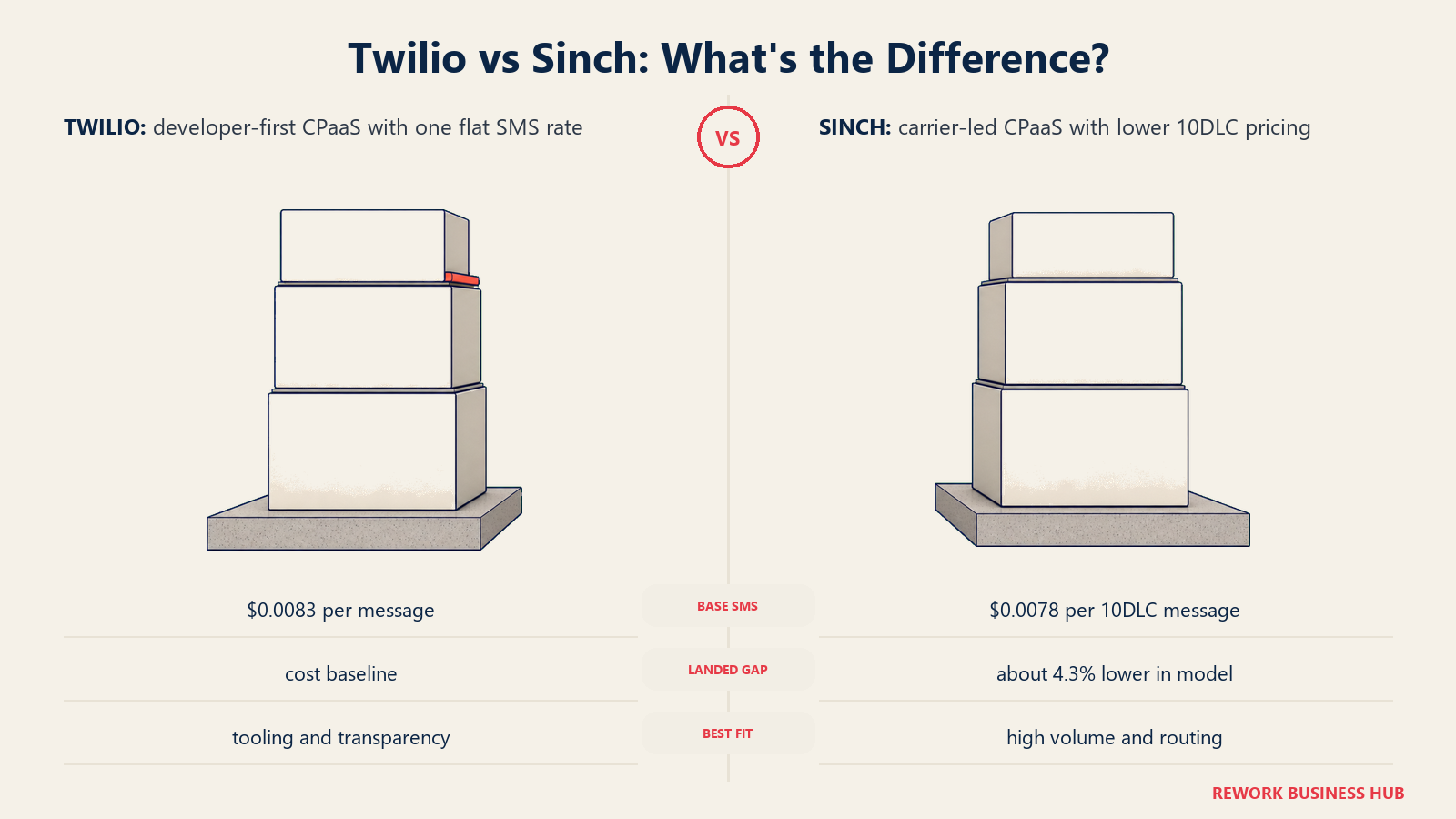
That fraction of a cent is where most comparisons stop, and it's where they go wrong. Twilio publishes $0.0083 per US SMS and Sinch publishes $0.0078 for 10DLC traffic through its SMS API. The 6% gap between those two figures is real, but it isn't the gap you'll see on an invoice, because carrier surcharges land on top of both rates identically and dwarf the difference. There's also a second problem: "Sinch" isn't one price. Sinch ships two entirely separate products with two entirely separate rate cards, and confusing them is the single easiest way to budget an SMS build incorrectly.
This comparison works through both: the two Sinch rate cards and which one actually competes with Twilio, per-message pricing, number and short code costs, how each handles US A2P 10DLC and carrier fee pass-through, global routing, API ergonomics, and a landed-cost model at 100,000, 1,000,000, and 10,000,000 messages a month.
TL;DR
| Twilio | Sinch | |
|---|---|---|
| Product shape | One CPaaS API, self-serve signup, pay as you go | Two separate products: the Sinch SMS API (CPaaS, pay as you go) and Sinch Engage (packaged SaaS, formerly MessageMedia) |
| US SMS rate | $0.0083 per message, send or receive, across long code, toll-free, and short code | Sinch SMS API: 10DLC and toll-free $0.0078 each direction; short code $0.009 out, $0.0075 in |
| US MMS rate | Send $0.022; receive $0.0165 (long code, short code) or $0.02 (toll-free) | Sinch SMS API: 10DLC $0.02 each direction; toll-free $0.018 each direction; short code send $0.02 |
| Local number rental | Local $1.15/mo, toll-free $2.15/mo, bring-your-own $0.50/mo | Sinch SMS API: 10DLC $1.00/mo ($1.00 setup), toll-free $2.00/mo |
| Short code | $1,000/quarter random, $1,500/quarter vanity, each including a one-time setup fee; bring-your-own vanity $500/quarter | Sinch Engage: short codes from $1,000/mo. The Sinch SMS API page does not publish a short code rental figure |
| Packaged plan option | None. Twilio is API-first, priced per message | Sinch Engage: $49 to $799/mo by tier, unlimited contacts on all tiers, 14-day trial with no card |
| Carrier fees | Passed through on top of the published rate (Twilio publishes examples, such as $0.0035 for AT&T long-code outbound SMS) | Passed through on top of the published rate. Sinch states carrier fees apply without publishing per-carrier amounts on its SMS pricing page |
| Failed-message fee | $0.001 per failed message | Not published |
| Best for | Teams that want the deepest SDK, docs, and integration ecosystem, plus a published fee schedule they can model line by line before signing anything | Teams sending high volume who want a lower published per-message rate and direct carrier relationships, or non-engineering teams who want Sinch Engage's packaged product instead of building |
Key Facts
- Operator business messaging revenue was $51.7 billion in 2025 and is forecast to reach $54.6 billion by 2030, growth of about 5% across the period, according to Juniper Research's A2P & Business Messaging Market 2025-2030 report. A2P messaging is a mature, slow-growing channel, not a land grab, which is why per-message rates move in hundredths of a cent rather than in steps.
- Twilio's published US rate is $0.0083 per SMS, the same figure for outbound and inbound and the same across long code, toll-free, and short code, per Twilio's own US SMS pricing page. The widely repeated $0.0079 figure is stale.
- Sinch's SMS API publishes $0.0078 per US 10DLC message in each direction, with the same $0.0078 for toll-free, per Sinch's SMS pricing page. That is a gap of five ten-thousandths of a dollar against Twilio, before carrier fees.
- US 10DLC is a gated channel: The Campaign Registry, the body that runs brand and campaign registration, describes 10DLC as a channel "in which Brands and Campaign Service Providers (CSPs) are verified prior to being allowed to send messages." Registration is a prerequisite for delivery on both providers, not an optional extra.
- Registration is not free, and vendors differ in whether they publish the cost. Amazon SNS publishes its full 10DLC fee schedule: $4 one-time company registration, a $50 one-time campaign registration fee that AWS states is waived until further notice, $10 per month per approved regular campaign (or $2 for a low-volume campaign), and $1 per month per 10DLC number. Neither Twilio's nor Sinch's SMS pricing page states its own registration amounts.
Who Each Provider Is Actually Built For
Both companies will sell you an SMS API, and both will happily take a 10-million-message-a-month account. But they arrive at that account from opposite directions, and the direction shapes what the buying process feels like.
Twilio is a developer-adoption company. The signup is self-serve, the docs are the marketing, and the growth path assumes an engineer builds a prototype on trial credit before procurement is involved. That model produced the deepest SDK coverage in the category and an unusually detailed public fee schedule: number rentals, short code quarterly rates, carrier surcharge examples, support plan pricing, and even a $0.001 failed-message processing fee are all published where you can model them.
Sinch came up through carrier infrastructure and enterprise messaging, and it acquired its way into the self-serve tier rather than growing into it. That heritage shows in routing, where direct operator connections are the core differentiator, and in the product lineup, where the packaged product a marketing team would buy is a separate acquisition with a separate rate card from the API a developer would build on. Sinch publishes per-message and number pricing, but short code rentals, surcharge amounts, and support tier costs all require a conversation.
If you're a team of one shipping a side project, neither is really aimed at you and both will work fine. The decision starts to matter past a few hundred thousand messages a month, or the moment a non-engineering team needs to send campaigns without filing a ticket. For the platform layer above raw CPaaS APIs, see our best SMS marketing software roundup for 2026.
Sinch Sells Two Different Products Under One Name
This is the fact that breaks most Twilio vs Sinch comparisons, so it's worth getting straight before any number below makes sense. Sinch publishes two pricing pages for two different products, and they are not tiers of the same thing.
The Sinch SMS API is the CPaaS product. It's pay as you go, priced per message, and it's the thing that actually competes with Twilio. When someone says "Sinch is cheaper than Twilio," this is the product they mean, whether or not they know it.
Sinch Engage is a packaged SaaS product with named monthly plans, message allowances, user seats, and automation limits. It is the former MessageMedia, and the rebrand is complete enough that messagemedia.com/us/pricing/ now returns a 301 redirect straight to sinch.com/engage/pricing/. If you've been shopping MessageMedia, you've been shopping Sinch Engage without being told. The MessageMedia brand is gone as a product name, so any comparison article still listing it as a separate vendor is describing a company that no longer sells under that name.
| Sinch SMS API | Sinch Engage (formerly MessageMedia) | |
|---|---|---|
| What it is | A CPaaS messaging API you build against | A packaged SaaS messaging product with a UI |
| Pricing model | Per message, pay as you go | Named monthly plans, $49 to $799/mo |
| Who buys it | Engineers | Marketing, ops, support, small business owners |
| Competes with | Twilio, Plivo, Telnyx, Bandwidth, Vonage | SimpleTexting, EZ Texting, SlickText, Textedly |
| US 10DLC SMS price | $0.0078 per message, each direction | Bundled into the plan's monthly SMS allowance |
| Entry commitment | None, pay for what you send | Monthly plan fee whether or not you send |
| Source | sinch.com/pricing/sms | sinch.com/engage/pricing |
Everywhere below, a price attributed to Sinch names which product it came from. That isn't pedantry. "Sinch starts at $49 a month" is true of Sinch Engage and meaningless to a team building against the API; "Sinch is $0.0078" is true of the SMS API and meaningless to someone comparing packaged plans.
Per-Message Pricing at Real US Volume
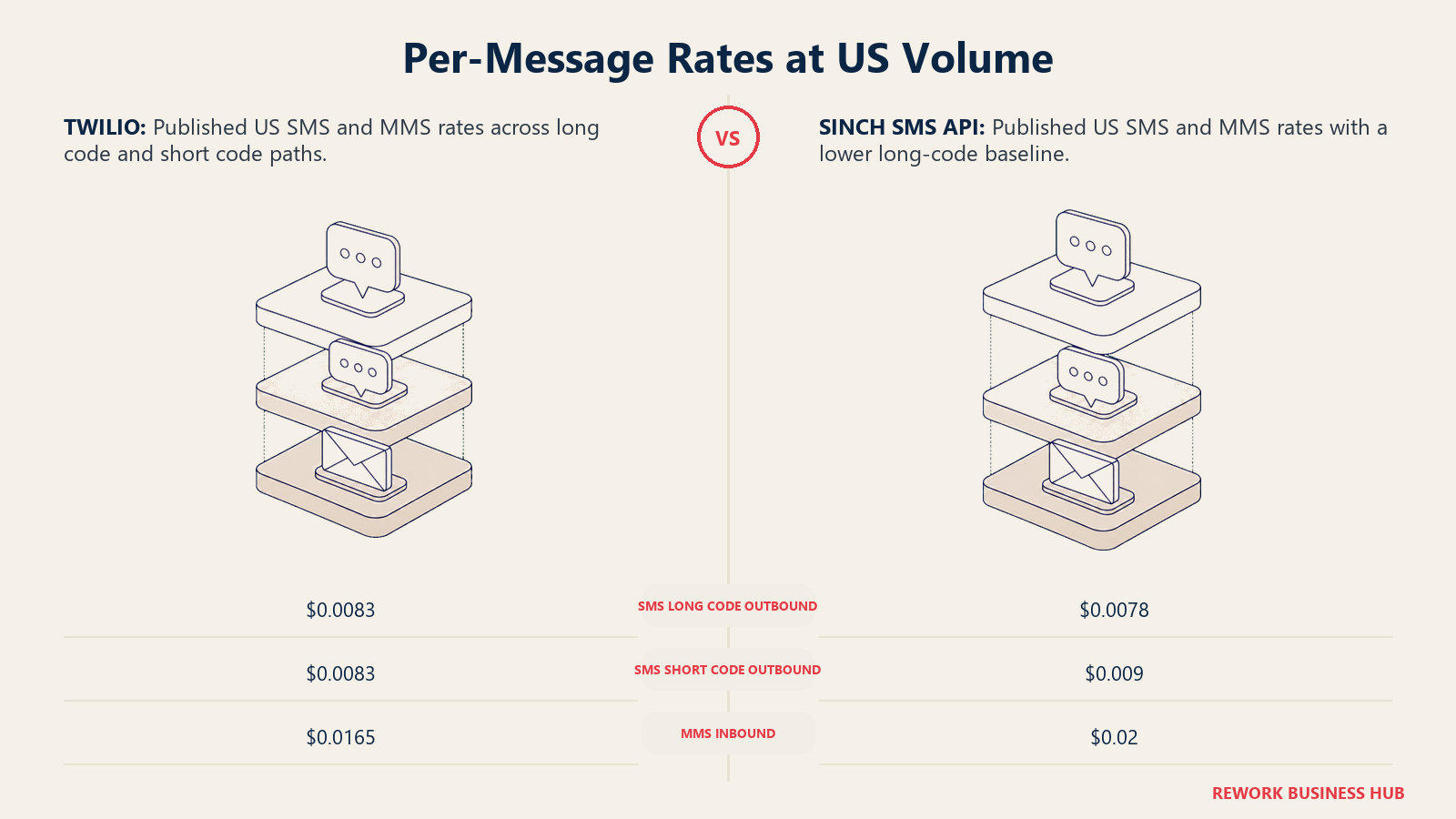
Here's the apples-to-apples comparison: Twilio's US pricing against the Sinch SMS API's US pricing. Both are the vendor's own published rate, both exclude carrier surcharges, and both are quoted per message part rather than per logical message, so a 320-character send bills as two.
| US rate, per message | Twilio | Sinch SMS API | Who's cheaper |
|---|---|---|---|
| SMS, 10DLC / long code, outbound | $0.0083 | $0.0078 | Sinch by $0.0005 |
| SMS, 10DLC / long code, inbound | $0.0083 | $0.0078 | Sinch by $0.0005 |
| SMS, toll-free, outbound | $0.0083 | $0.0078 | Sinch by $0.0005 |
| SMS, toll-free, inbound | $0.0083 | $0.0078 | Sinch by $0.0005 |
| SMS, short code, outbound | $0.0083 | $0.009 | Twilio by $0.0007 |
| SMS, short code, inbound | $0.0083 | $0.0075 | Sinch by $0.0008 |
| MMS, 10DLC / long code, outbound | $0.022 | $0.02 | Sinch by $0.002 |
| MMS, 10DLC / long code, inbound | $0.0165 | $0.02 | Twilio by $0.0035 |
| MMS, toll-free, outbound | $0.022 | $0.018 | Sinch by $0.004 |
| MMS, toll-free, inbound | $0.02 | $0.018 | Sinch by $0.002 |
| MMS, short code, outbound | $0.022 | $0.02 | Sinch by $0.002 |
| Failed-message processing | $0.001 per failed message | Not published | Twilio publishes it, which is worth something |
Three things in that table are worth pausing on.
First, Twilio's rate is flat. The same $0.0083 applies from a long code, a toll-free number, or a short code, outbound or inbound. That's unusual here and it makes forecasting simple, because you multiply volume by one number and you're close. Sinch varies by number type and direction, which is more granular and can work in your favour on inbound-heavy traffic, but your model has to reflect your actual channel mix.
Second, short code is the one place Twilio's published rate beats Sinch's. At $0.009 outbound, Sinch sits above Twilio's $0.0083 and the price advantage flips. Inbound short code goes the other way at $0.0075 against $0.0083, so a two-way short code application has to be modelled on its real send-to-receive ratio.
Third, MMS is the one place the SMS advantage does not carry over cleanly, and it is also the place Sinch's page is least stable. Sinch is cheaper on outbound 10DLC MMS ($0.02 against $0.022) and on toll-free in both directions ($0.018 against $0.022 out and $0.02 in), but Twilio is cheaper on inbound 10DLC MMS ($0.0165 against $0.02). Read that as a wash rather than a win for either, and verify it yourself if MMS is a large share of your traffic: Sinch's SMS pricing page is rendered client-side behind a country selector and repeated loads of it do not always return the same figures, which is a reason to confirm your own rates in the console before you model them.
The $0.0079-per-SMS figure you'll still find in a lot of Twilio comparisons is out of date. Twilio's own page publishes $0.0083 today, and a model built on the older number will come in about 5% light before you've added a single fee.
Phone Numbers, Toll-Free, and Short Codes
Per-message rates get the attention, but numbers are the line item that surprises teams, because 10DLC throughput limits mean you rarely send serious volume from one long code. You send from a pool, and the pool bills monthly whether or not it's busy.
| Number cost | Twilio | Sinch SMS API |
|---|---|---|
| Local / 10DLC long code, monthly | $1.15/mo | $1.00/mo (plus a stated $1.00 setup fee) |
| Toll-free, monthly | $2.15/mo | $2.00/mo (plus a stated $2.00 setup fee) |
| Bring your own number (hosted) | $0.50/mo for long code and toll-free alike | Not published on the SMS pricing page |
| Short code, random | $1,000 per quarter, with a one-time setup fee attached | Not published on the SMS pricing page. Sinch Engage lists short codes from $1,000/mo |
| Short code, vanity | $1,500 per quarter, with a one-time setup fee attached | Not published on the SMS pricing page |
| Short code, bring your own vanity | $500 per quarter, with a one-time setup fee attached | Not published |
| MMS enablement on a short code | $500 one-time additional fee | Not published |
Twilio publishes short code pricing in full. Sinch publishes short code rates on its SMS API page ($0.009 out, $0.0075 in) but not the short code rental, so a team that needs a dedicated short code can model the traffic and not the lease. Worth naming the trap: that absence isn't evidence Sinch lacks short codes, since its short code rates are right there. The rental simply isn't published in that place, so treat it as a question for the sales call.
Twilio's $0.50 hosted-number rate is worth a look too. If you already own numbers through a carrier or a business phone provider, Twilio will host messaging on them for less than half the cost of leasing new ones. Price that path before assuming you need a fresh pool; our best business phone system roundup for 2026 covers the voice side of the same estate.
US A2P 10DLC Registration and Carrier Fees
Every message either provider sends to a US mobile number rides on carrier infrastructure that neither of them owns, and US carriers charge for the privilege. This produces two cost categories that sit outside the vendor's rate card entirely and behave the same way whichever vendor you pick.
The first is registration. Under the A2P 10DLC framework, you can't just start sending. The Campaign Registry, which operates the registry on behalf of the mobile network operators, describes 10DLC as a channel "in which Brands and Campaign Service Providers (CSPs) are verified prior to being allowed to send messages." You register a brand, you register each campaign with sample messages and proof of opt-in, and unregistered traffic gets filtered or blocked rather than delivered.
Neither Twilio's nor Sinch's SMS pricing page states its own registration fee amounts. Twilio's page confirms that US A2P 10DLC traffic is "subject to registration onboarding fees" and points to separate documentation for the numbers. Rather than guess at either vendor's figures, here's what a provider that does publish the full schedule charges, as a reference point for the shape and scale of these fees.
| 10DLC registration line item | Amount published by Amazon SNS | Frequency |
|---|---|---|
| Company (brand) registration | $4 | One-time, per company |
| Campaign registration (T-Mobile) | $50, which AWS states is waived until further notice | One-time, per campaign |
| Approved regular campaign | $10 | Per month, per campaign |
| Approved low-volume campaign | $2 | Per month, per campaign |
| 10DLC phone number | $1 | Per month, per number |
Those are Amazon SNS's published figures, not Twilio's or Sinch's, and they're here purely to show what registration costs look like as a category. The one-time fees are trivial. The recurring per-campaign and per-number charges are the ones that matter at scale, because a product with fifteen distinct message types and a 200-number pool carries a monthly registration overhead before a single message sends. Ask both vendors for their exact schedule and compare it line by line rather than assuming it's a rounding error.
The second category is a carrier surcharge on every message, passed through by both providers on top of their published rate. Twilio publishes worked examples of what those surcharges look like, including $0.0035 for an outbound long-code SMS to AT&T. Sinch's SMS pricing page states that carrier fees apply across 10DLC, toll-free, and short code without publishing per-carrier amounts.
Because carriers set that surcharge and both providers pass it through, it doesn't change which vendor is cheaper. It substantially changes by how much, because it inflates both bills by the same absolute dollars. The landed-cost model below quantifies exactly that.
Landed Cost at 100K, 1M, and 10M Messages a Month
Headline per-message rates are the wrong unit for this decision, because they leave out the two costs that actually scale with you: the number pool you rent every month, and the carrier surcharge on every message. Here's the same traffic modelled end to end on both providers.
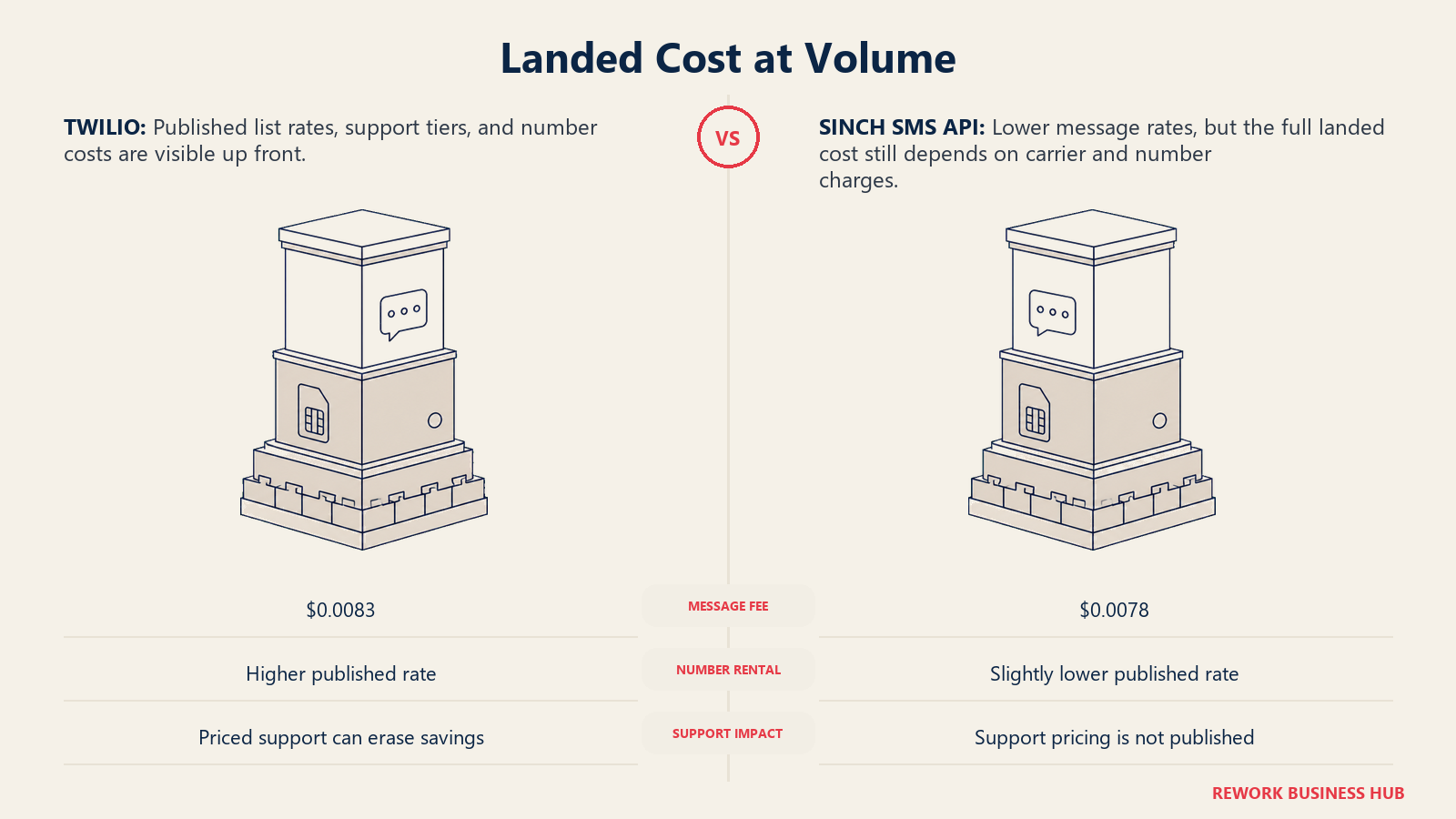
How this model is built. Every figure below is a calculation, not a vendor's quoted price. Assumptions: 100% outbound US 10DLC SMS, single message part each; a rented number pool of 10 / 50 / 200 long codes across the three volumes, reflecting 10DLC throughput limits; and a carrier surcharge modelled at $0.0035 per message, which is the AT&T long-code outbound example Twilio publishes, applied identically to both providers because carriers set it and both pass it through. 10DLC registration fees are excluded because neither vendor publishes its own amounts. Your real surcharge will vary by carrier mix.
| Modelled cost line (and its basis) | 100,000 SMS/mo | 1,000,000 SMS/mo | 10,000,000 SMS/mo |
|---|---|---|---|
| Twilio message fees, at Twilio's published $0.0083/SMS | $830.00 | $8,300.00 | $83,000.00 |
| Sinch SMS API message fees, at Sinch's published $0.0078/SMS | $780.00 | $7,800.00 | $78,000.00 |
| Vendor gap on message fees alone | $50.00 | $500.00 | $5,000.00 |
| Twilio number rental, modelled pool at Twilio's published $1.15/mo each | $11.50 (10 numbers) | $57.50 (50 numbers) | $230.00 (200 numbers) |
| Sinch SMS API number rental, same pool at Sinch's published $1.00/mo each | $10.00 (10 numbers) | $50.00 (50 numbers) | $200.00 (200 numbers) |
| Carrier surcharge, modelled at $0.0035/msg, identical on both providers | $350.00 | $3,500.00 | $35,000.00 |
| Twilio modelled landed cost per month | $1,191.50 | $11,857.50 | $118,230.00 |
| Sinch SMS API modelled landed cost per month | $1,140.00 | $11,350.00 | $113,200.00 |
| Modelled monthly saving on Sinch SMS API | $51.50 | $507.50 | $5,030.00 |
| Modelled saving as a share of landed cost | 4.3% | 4.3% | 4.3% |
| Modelled 12-month landed cost, Twilio (a calculated annual total, not a starting price) | $14,298.00 | $142,290.00 | $1,418,760.00 |
| Modelled 12-month landed cost, Sinch SMS API (a calculated annual total, not a starting price) | $13,680.00 | $136,200.00 | $1,358,400.00 |
| Modelled 12-month difference | $618.00 | $6,090.00 | $60,360.00 |
The number to take from that table is the shrink. On published per-message rates alone, Sinch looks 6.0% cheaper than Twilio. Once the number pool and the carrier surcharge are in the model, the advantage settles at 4.3% and stays there at every volume, because the surcharge is a fixed per-message amount that lands on both bills identically and inflates both totals by the same absolute dollars.
That reframes the decision usefully. At 100,000 messages a month you're arguing over $51.50, less than an hour of engineering time. At 1,000,000 it's about $6,090 a year, roughly where a migration might pay for itself if the switch is genuinely cheap. At 10,000,000 it's about $60,360 a year, real money and worth a serious evaluation, though it's also the volume where neither vendor charges list price anyway. Everything above is published self-serve pricing; at eight figures a month both companies negotiate, and a committed-volume contract can move the rate further than the 4.3% list gap does.
Sinch Engage: The Answer If You Do Not Want to Build
Everything above assumes you're building. If your actual problem is that a marketing or support team needs to send campaigns and two-way conversations without an engineer in the loop, the Sinch SMS API is the wrong product and so is Twilio, and Sinch has a second answer that Twilio simply doesn't.
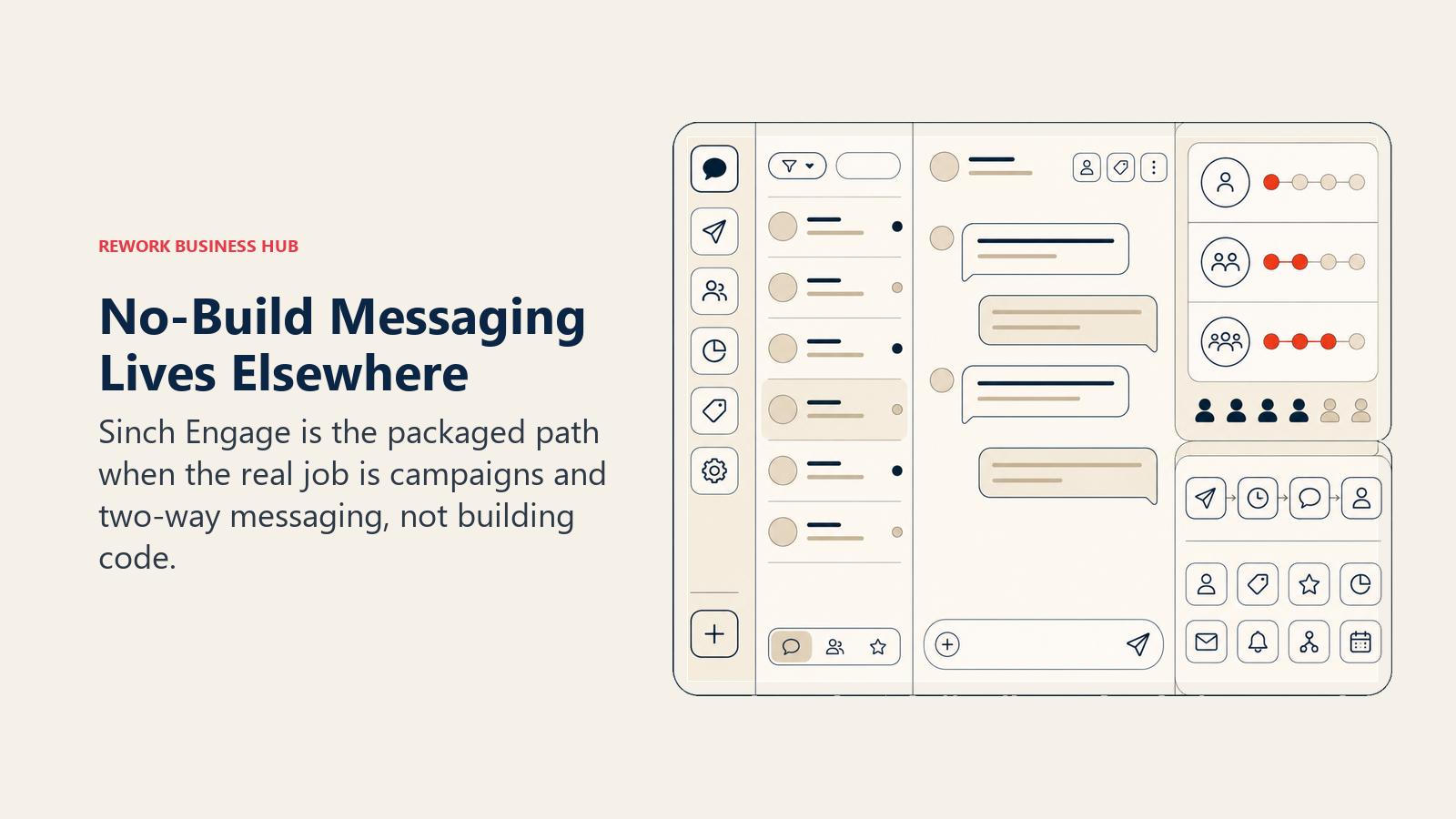
Sinch Engage is the packaged product, and it's the former MessageMedia. It sells named monthly plans with message allowances, seats, and automation limits rather than a per-message meter.
| Sinch Engage plan | Monthly price | SMS included | Users | Automations | Sub-accounts | SSO |
|---|---|---|---|---|---|---|
| Basics | $49/mo | 1,000 | 1 | 3 | None | No |
| Conversations | $99/mo | 3,000 | 2 | 30 | None | No |
| Pro | $249/mo | 10,000 | 3 | Unlimited | 1 | No |
| Pro Plus | $450/mo | 20,000 | 3 | Unlimited | 2 | Yes |
| Advanced | $799/mo | 40,000 | 3 | Unlimited | 3 | Yes |
Those are monthly-billing figures from Sinch's Engage pricing page. Every tier includes unlimited contacts and one free dedicated number. There's a 14-day trial with no card required, annual payment is presented as saving 16%, and carrier fees apply on top for US toll-free and 10DLC traffic just as they do on the API. Additional dedicated numbers run $25/mo, and short codes start at $1,000/mo.
Now compare the effective rate. Advanced at $799/mo for 40,000 messages works out to just under $0.02 per message, roughly two and a half times the Sinch SMS API's $0.0078. You aren't buying messages at that price, you're buying the application: the campaign builder, automations, inbox, seats, and the fact that nobody has to write code or maintain a webhook handler.
The rough dividing line: below about 40,000 messages a month with no engineering capacity to spare, a packaged product usually wins on total cost of ownership even at that premium. Above it, or anywhere the messaging is embedded in a product flow rather than sent as a campaign, the API is the right shape. If you land on the packaged side, shop the category rather than defaulting to Sinch Engage, and our best SimpleTexting alternatives guide covers the direct competitors at that price point.
Global Reach and Routing
If your traffic is US-only, skip this section. If you're sending internationally, routing is where the two companies differ structurally rather than by a fraction of a cent, and it's the one area where Sinch's pitch isn't about price at all.
Sinch's core claim is network ownership. Its Super Network page states 600+ direct carrier connections and roughly 12,800 interconnections, with direct Tier-1 mobile network operator connections across 95% of the North American network. The argument behind those numbers is that a message travelling over a direct operator connection takes fewer hops than one routed through aggregators, which reduces latency, improves delivery rates, and cuts out intermediary margin. Sinch also publishes a 99.99% uptime figure for enterprise on that page and lists ISO 27001, GDPR, SOC 2 Type II, and HIPAA among its certifications.
Twilio's SMS page states reach across 180+ countries with localized senders and compliance tooling, and cites its position as a Leader in the 2026 Gartner Magic Quadrant for Communications Platform as a Service, positioned highest for Ability to Execute. Twilio's model has historically leaned more on aggregation and route optimization than on owning the carrier relationship end to end, and it doesn't publish a direct-connection count.
One honest caveat: coverage claims are marketing surface, and Sinch's own site doesn't agree with itself on country count. Its Super Network page says 60+ countries while its international SMS gateway page says 190+. The only reliable evaluation of international routing is a paid pilot into your real destination countries, measuring delivery receipts and latency against a known-good handset on each network you care about.
API, SDK, and Developer Ergonomics
This is Twilio's clearest lead, and it isn't close.
Twilio publishes official server-side helper libraries in seven languages: C# / .NET, Java, Node.js, PHP, Python, Ruby, and Go. On top of that it maintains a public OpenAPI specification, which it says supports "Postman collections to API mocking to automatic client generation in over 40 programming languages." If your stack is Rust, Elixir, Kotlin, or anything off the mainstream list, you can generate a typed client rather than hand-rolling HTTP calls.
Sinch publishes official SDKs for its SMS API in four languages: Node.js, Java, .NET, and Python. It documents a CLI alongside its Functions product, and its SDK docs describe a single centralized authentication model across supported language versions. That covers the majority of backend stacks, and if you're writing Node, Java, .NET, or Python you will not feel the gap. If you're writing PHP, Ruby, or Go, you will, because there's no official Sinch SDK for any of them and you'd own that HTTP client forever.
So the practical read is narrower than the headline. If your team writes Node, Python, Java, or .NET, both are fine and the SDK difference shouldn't move your decision. If you value the OpenAPI spec, mock servers in CI, generated clients, and contract tests against a spec you didn't write, that's a genuine Twilio advantage that never shows up in a pricing comparison. Twilio's ubiquity also means onboarding a new backend hire costs close to nothing, where Sinch's smaller install base implies a real ramp. See our best Twilio alternatives guide for the wider API field.
Deliverability and Support Tiers
Here's the cost line that quietly undoes most of the landed-cost analysis above, and almost nobody puts it in the model.
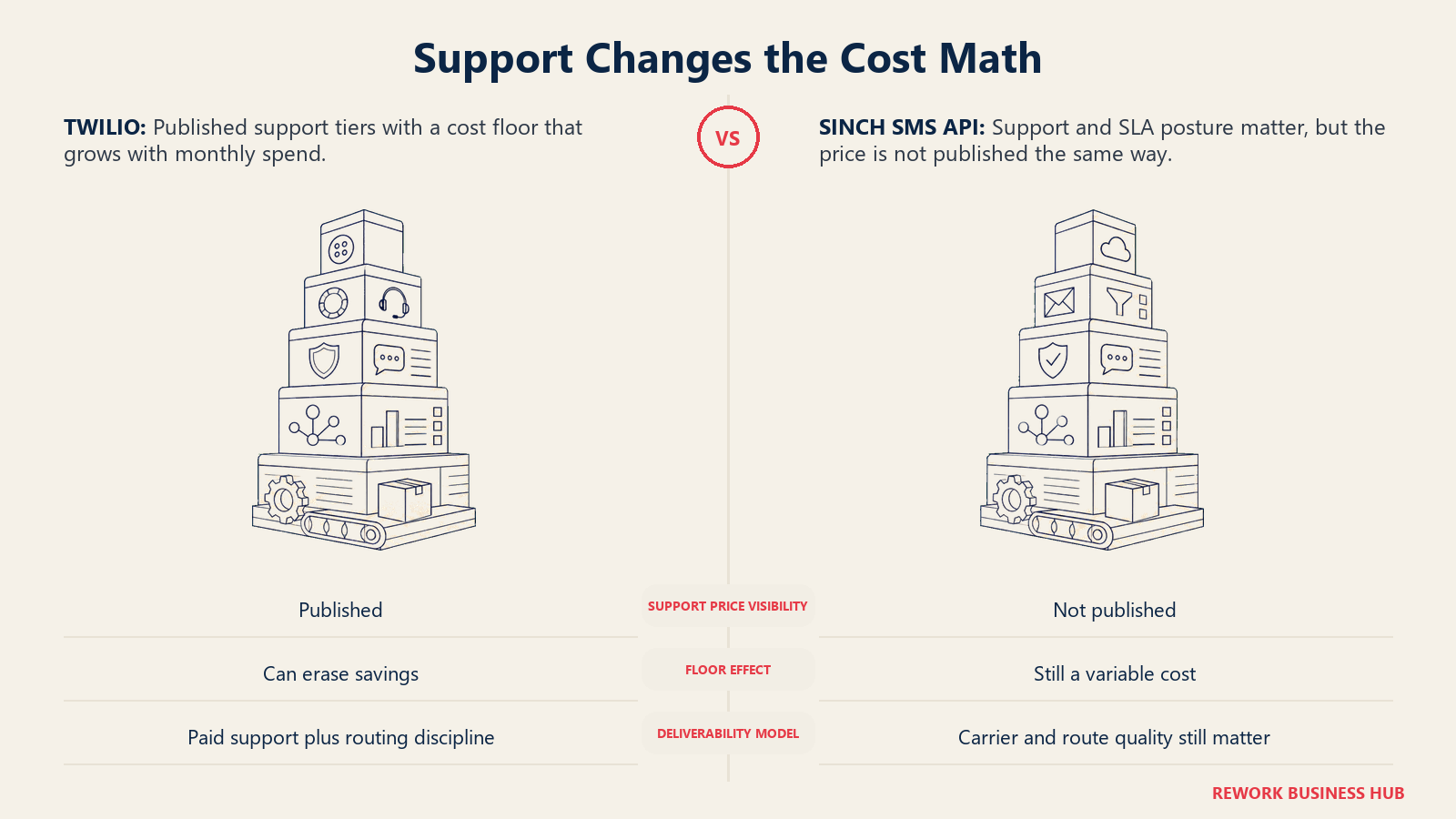
Twilio sells support as a priced product, and it publishes the price. The Developer plan is free with no guaranteed response times and an estimated three business days. Above that: Production is the greater of $250/mo or 4% of monthly spend, Business is the greater of $1,500/mo or 6%, and Personalized is the greater of $5,000/mo or 8%. All paid tiers carry guaranteed response times of 1 hour around the clock for business-critical issues, 2 business hours for degraded service, and 3 business hours for general issues.
Run that against the landed-cost model and the picture changes.
| At modelled volume | Twilio landed cost | Twilio Production support (greater of $250 or 4%) | Sinch SMS API modelled monthly saving | Saving remaining after Twilio support |
|---|---|---|---|---|
| 100,000 SMS/mo | $1,191.50 | $250.00 (the floor applies; 4% would be $47.66) | $51.50 | Negative. Support costs about 4.9x the entire vendor gap |
| 1,000,000 SMS/mo | $11,857.50 | $474.30 (4% of spend) | $507.50 | $33.20, so support absorbs about 93% of it |
| 10,000,000 SMS/mo | $118,230.00 | $4,729.20 (4% of spend) | $5,030.00 | $300.80, so support absorbs about 94% of it |
Read that table carefully, because it is not a claim that Sinch support is free. Sinch does not publish an equivalent priced support tier schedule on its public pricing pages, so this comparison is deliberately one-sided and you should ask Sinch directly what its paid support costs before you assume anything. The point isn't that Twilio is expensive. It's that Twilio's support cost is knowable, material, and scales with spend, so it belongs in your model, while Sinch's equivalent is a question you have to ask.
On the contractual side, Sinch does publish an SLA. Its messaging Service Level Agreement states minimum availability of 99.95%, SMS latency under 10 seconds for 90% of traffic internally and under 30 seconds for 90% of traffic to handset, and fault response targets of 30 minutes initial response with a 2-hour restoration target for P1, 1 hour and 4 hours for P2, 24 hours and 2 working days for P3, and 48 hours and 7 working days for P4.
Note the gap between marketing and contract on Sinch's own site: the Super Network page advertises 99.99% uptime for enterprise while the messaging SLA commits to 99.95%. Those are different numbers, and the one that binds is the one in the agreement. That difference sounds small and isn't: 99.99% allows about 4.3 minutes of downtime a month, 99.95% allows about 22. Read the contract, not the landing page, and note that the SLA states it forms part of an agreement for ordered services, which is a different posture from a self-serve entitlement.
Adjacent Products Each Vendor Sells
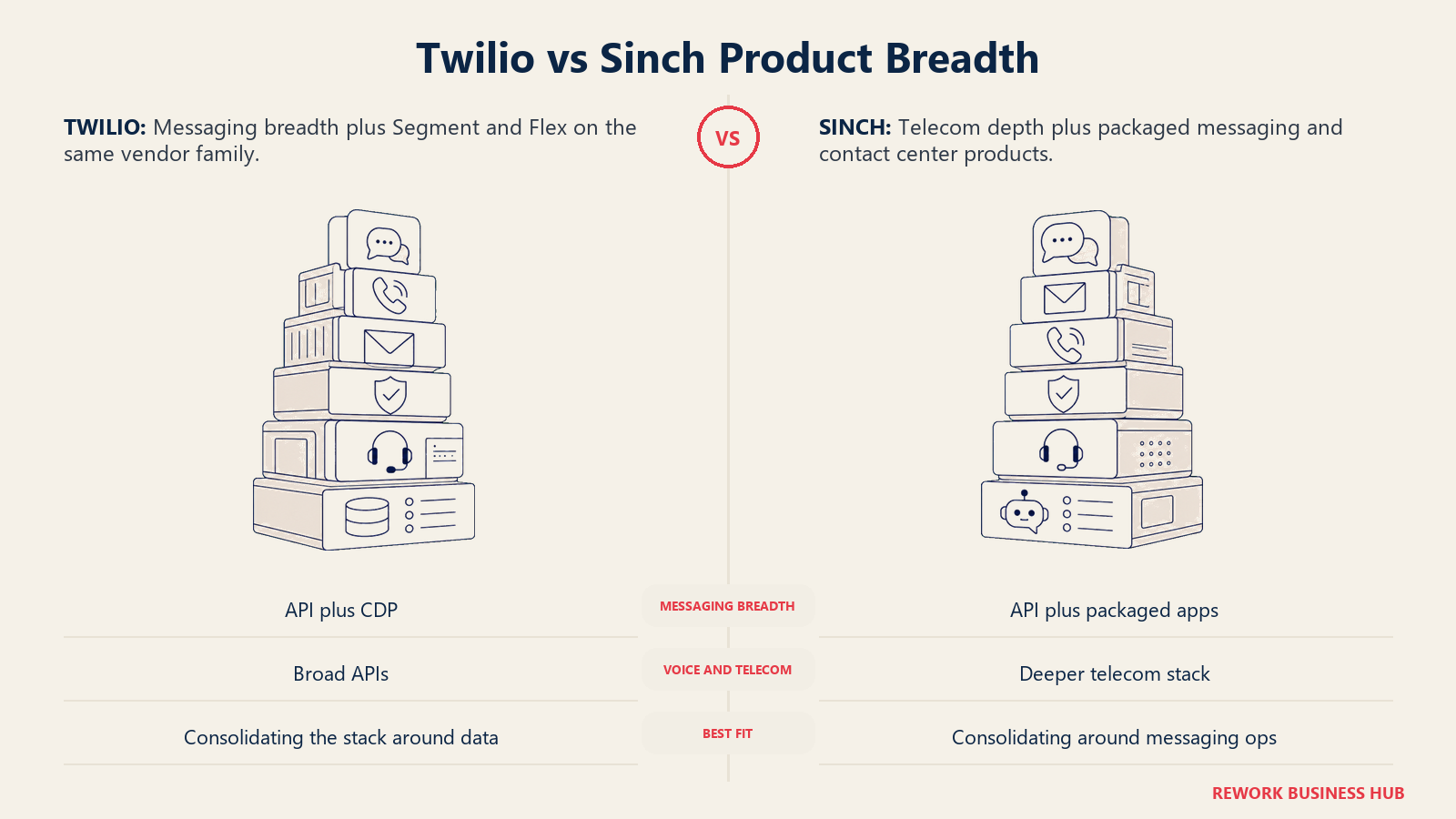
Neither company sells SMS in isolation, and if you're going to consolidate more of your communications stack with one vendor, the adjacent lineup matters as much as the SMS rate. Both have grown by acquisition, and both now cover messaging, voice, email, and verification.
| Category | Twilio | Sinch |
|---|---|---|
| Messaging channels | Messaging APIs, SMS, MMS, WhatsApp, RCS | SMS API, MMS API, RCS, WhatsApp, Conversation API (adds LINE, Telegram, Instagram) |
| Voice | Voice API, Elastic SIP Trunking, SIP Trunking, phone numbers | Voice API, SIP trunking, in-app voice and video, number masking, PSTN connectivity, porting, E911, Microsoft Teams direct routing and operator connect, Webex cloud connect |
| Email API | Twilio SendGrid Email API, SMTP Service, Marketing Campaigns | Send (Email API), Optimize, Validate, Inspect (Email on Acid) |
| Email platform | Marketing Campaigns | Sinch Mailjet |
| Verification | Verify, Lookup | Verification API, Number lookup |
| Contact centre | Twilio Flex, TaskRouter | Sinch Contact Pro |
| Chatbot / conversational | Conversation Orchestrator, Conversation Intelligence, Conversation Relay, Conversation Memory | Sinch Chatlayer |
| Customer data platform | Twilio Segment (Connections, Protocols, Unify, Engage, Privacy Portal) | None equivalent |
| Packaged SMS marketing app | None | Sinch Engage |
| Builder tooling | Serverless, Studio, Functions, Event Streams, Sync, Trust Hub, Interconnect | Functions and CLI |
| Video | Twilio Video | In-app video calling |
| Fax | Not listed | Fax API |
Two asymmetries stand out. Twilio has a CDP and Sinch doesn't. Segment is a serious product in its own category, so if you use it or expect to, buying messaging from the same vendor is a consolidation argument that has nothing to do with per-message rates.
Sinch has a deeper telecom stack and a packaged app layer, and Twilio doesn't. Microsoft Teams direct routing, operator connect, E911, number porting, fax, and Contact Pro are the product surface of a company that grew out of carrier infrastructure. If you're consolidating a phone system alongside programmable messaging, Sinch covers more of that estate from one contract.
On email, both own well-known brands. Twilio owns SendGrid; Sinch owns Mailjet and Email on Acid. If you're evaluating that side of the stack too, our SendGrid vs Mailgun comparison covers the transactional email decision in the same detail, and our best SendGrid alternatives and best Mailgun alternatives guides cover the wider field including Mailjet.
How the Rest of the CPaaS Field Prices
Twilio and Sinch aren't the only two names, and knowing where the rest of the field sits tells you whether a 4.3% gap between these two is even worth arguing about. Here's what the other major CPaaS providers publish for US outbound SMS, all taken from each vendor's own pricing page.
| Provider | Published US outbound SMS rate | Notes |
|---|---|---|
| Telnyx | $0.004 local, $0.0055 toll-free, $0.007 short code | Quoted per message part plus carrier fee. Roughly half Twilio's local rate. Number pricing is not stated on the messaging pricing page |
| Bandwidth | $0.006 outbound 10DLC, $0.006 short code, $0.0075 toll-free | Number pricing is not published; the page says full product pricing is available on request |
| Plivo | $0.0077 long code and short code, $0.0079 toll-free, each direction | Long code numbers $0.50/mo, toll-free $1.00/mo, short codes $500/mo regular or $1,000/mo vanity billed quarterly plus a $1,500 one-time fee |
| Sinch SMS API | $0.0078 10DLC and toll-free, $0.009 short code outbound | 10DLC numbers $1.00/mo, toll-free $2.00/mo |
| Twilio | $0.0083 across long code, toll-free, and short code | Local numbers $1.15/mo, toll-free $2.15/mo, hosted BYO $0.50/mo |
| Vonage | $0.0086 send from a virtual number, $0.00691 receive | Vonage publishes carrier fees of $0.0025 to $0.005 separately. Virtual number $1.05/mo with no initial setup fee. MMS is not priced on that page and routes to sales |
| Amazon SNS | Not published. AWS states rates vary by country, region, and carrier and are provided for guidance only | Publishes its 10DLC registration fees and number costs in full, including US short codes at $650 setup plus $995/mo |
| Infobip | Not published. Describes a pay-as-you-go model and routes to detailed pricing pages or sales | No per-message figure available to quote |
Telnyx's published $0.004 local rate is about 52% below Twilio's $0.0083 and roughly 49% below Sinch's $0.0078, an order of magnitude more consequential than the difference this article has spent several sections dissecting. Bandwidth at $0.006 sits in between. One caution on the cheap end: a lower published rate is only a lower bill if the messages arrive, and delivery rates vary by route. Pilot before you commit on price alone.
So if per-message price is genuinely your deciding variable, the honest answer is that neither Twilio nor Sinch is the cheapest option on published rates, and you're comparing the two most expensive providers in this table. The reasons to pick either of them are ecosystem depth, routing quality, product breadth, support structure, and the fact that at real volume both will negotiate. If none of those matter to you, look further down the list. Our best Twilio alternatives guide covers that field in depth, and best MessageBird alternatives is the closest companion piece to this comparison if you're specifically shopping omnichannel CPaaS.
Migration Effort Between the Two
If the 4.3% modelled saving still looks worth chasing, price the move before committing. Migrating a CPaaS provider is more work than swapping an email API, because phone numbers are regulated assets and 10DLC registration doesn't transfer with a config change.
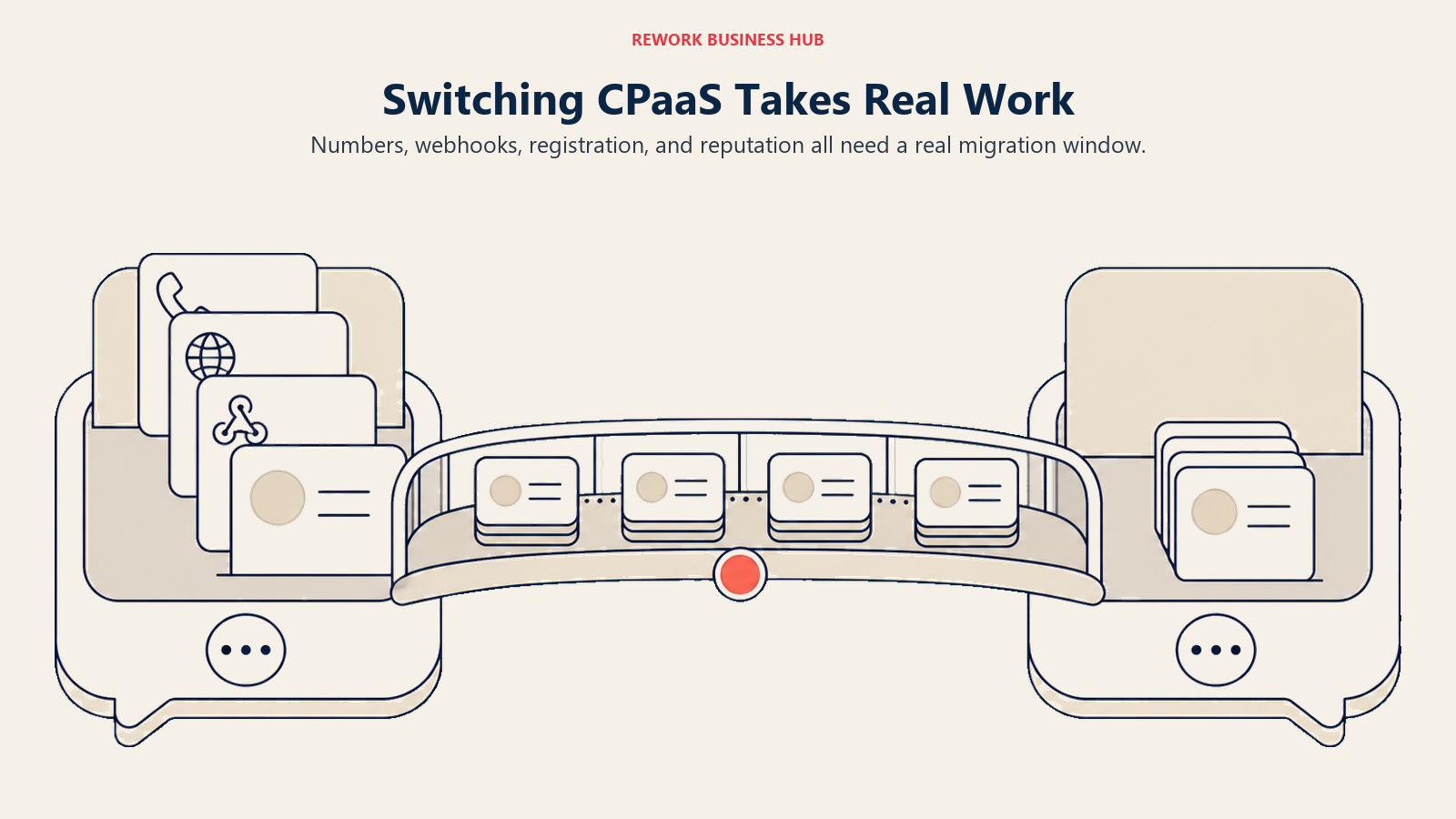
| Migration task | Effort | What actually happens |
|---|---|---|
| Rewrite send calls to the new SDK | Low, if you use Node, Java, .NET, or Python | Both providers ship SDKs in those four languages. Moving from Twilio in PHP, Ruby, or Go means writing your own REST client, since Sinch has no official SDK for those |
| Rewrite webhook handlers | Medium | Delivery receipt and inbound message payload formats differ between providers. This is application code, not configuration, and it needs its own tests |
| Port phone numbers | Medium to high | Numbers are portable but the process is carrier-mediated and takes days to weeks. Expect a coordination window, not a switch flip |
| Re-register 10DLC brand and campaigns | Medium | Registration is tied to the sending provider. Budget for approval time before you can send at volume on the new provider, and expect to run both in parallel meanwhile |
| Re-lease or port short codes | High | Short codes are the hardest asset to move. Twilio bills quarterly at $1,000 or $1,500; Sinch does not publish a short code rental on its SMS pricing page, so you cannot price this leg without asking |
| Re-establish throughput and reputation | Medium | New numbers and new campaigns start without sending history. Ramp deliberately rather than switching all traffic at once |
| Run both providers in parallel | Recommended | Abstract your send path behind an internal interface first, then shift traffic by percentage. This is also the only reliable way to measure the delivery-rate difference you were promised |
Add it up and a serious migration is measured in engineering weeks plus a registration and porting window, not in an afternoon. Against $618 a year of modelled saving at 100,000 messages a month, that math never works. Against $60,360 a year at 10,000,000, it plausibly does, and it's also the volume where you should be negotiating rather than taking list price from either vendor.
When Twilio Is the Right Call
Your stack is PHP, Ruby, or Go. Twilio ships an official SDK for each and Sinch ships none, so you'd own and maintain an HTTP client forever. That burden outlives any per-message saving.
You need to build a budget before talking to anyone. Twilio publishes number rentals, short code quarterly rates, the $0.001 failed-message fee, carrier surcharge examples, and full support plan pricing. On Sinch you can price messages and numbers, but short code rentals, surcharge amounts, and support costs all require a conversation. For a buyer who has to bring a number to a finance review first, that's worth more than 4.3%.
Short code is your primary channel. Twilio's $0.0083 outbound beats Sinch's $0.009, and Twilio publishes the lease where Sinch doesn't. It's the one channel where Twilio wins on price and transparency together.
Twilio Segment is in your stack or your roadmap. No Sinch product competes with a CDP, so consolidating messaging with the vendor that sells one is a real architectural argument.
Volume is under about 1,000,000 messages a month. The modelled saving is $618 a year at 100,000 messages, smaller than a single engineering week spent evaluating it. Take the deeper ecosystem and the larger pool of engineers who've already used it.
Tooling maturity shapes how you build. The public OpenAPI spec, generated clients, Postman collections, and API mocking matter if you run contract tests or need a client in an unsupported language.
When Sinch Is the Right Call
You're sending high volume. At 10,000,000 messages a month the modelled landed saving is about $60,360 a year on list rates. That's worth an evaluation, though it's also the point where you should be negotiating with both.
MMS is a meaningful share of your traffic. Sinch's published MMS rates beat Twilio's across the board, most sharply on inbound 10DLC at $0.01 against $0.0165.
Inbound is a meaningful share of your traffic. Sinch's $0.0075 inbound short code beats Twilio's $0.0083, and its $0.0078 inbound on 10DLC and toll-free beats it too. Two-way products should model their real send-to-receive ratio rather than assuming outbound dominates.
Routing quality is your bottleneck, not price. Sinch's 600+ direct carrier connections and direct Tier-1 operator coverage across 95% of the North American network is structurally different from aggregation. In heavily filtered markets a better delivery rate beats any per-message rate, because an undelivered message costs you the message plus the conversion behind it. Prove it with a paid pilot.
You need a packaged product, not an API. The clearest Sinch win, and Twilio has no answer to it. Sinch Engage gives a marketing or support team a campaign builder, automations, an inbox, and seats from $49/mo with no engineer required. If you arrived here searching for MessageMedia, this is where that product went.
You're consolidating a phone estate alongside messaging. Microsoft Teams direct routing and operator connect, E911, number porting, SIP trunking, fax, and Sinch Contact Pro cover more telecom surface from one vendor than Twilio's lineup does.
You want a published SLA with named response targets. Sinch's messaging SLA commits to 99.95% availability with a 30-minute P1 initial response and a 2-hour restoration target, in writing.
Decision Framework
| If this is your situation | Pick |
|---|---|
| You write PHP, Ruby, or Go | Twilio, official SDKs for all three; Sinch has none |
| You need to build a full budget from published prices before any sales call | Twilio, number, short code, failed-message, and support pricing are all public |
| Short code is your primary sending channel | Twilio, $0.0083 outbound beats Sinch's $0.009 and the lease price is published |
| You're under about 1,000,000 messages a month | Twilio, the modelled saving on Sinch is too small to justify anything |
| Twilio Segment is in your stack or your roadmap | Twilio, no Sinch product competes with a CDP |
| MMS or inbound traffic is a large share of your volume | Sinch SMS API, its published rates beat Twilio's on both |
| You're sending 10,000,000+ messages a month | Sinch SMS API on list rates, about $60,360/yr modelled saving. Negotiate with both first |
| International delivery rates are your bottleneck | Sinch, 600+ direct carrier connections. Prove it with a paid pilot before committing |
| A non-engineering team needs to send campaigns with no build | Sinch Engage, $49 to $799/mo. Twilio has no packaged equivalent |
| You were shopping MessageMedia | Sinch Engage. The brand was retired and the old pricing URL redirects there |
| You need Microsoft Teams routing, E911, porting, or fax from the same vendor | Sinch, its telecom product surface is deeper |
| Per-message price is genuinely your only variable | Neither. Telnyx publishes $0.004 and Bandwidth $0.006 for US outbound. See best Twilio alternatives |
| You need an SMS marketing platform rather than a CPaaS API | Neither. See best SMS marketing software in 2026 |
| You're an ecommerce brand comparing SMS marketing platforms specifically | Neither. See Attentive vs Postscript and best Postscript alternatives |
Frequently Asked Questions about Twilio vs Sinch
Is Sinch actually cheaper than Twilio?
On published US rates, yes, but by less than the headline suggests. Twilio charges $0.0083 per SMS and the Sinch SMS API charges $0.0078 for 10DLC traffic, a 6.0% gap. Once you add number rentals and the carrier surcharge that both providers pass through identically, the modelled landed difference settles at about 4.3% at every volume. Short code outbound is the exception, where Sinch's $0.009 is above Twilio's $0.0083.
Why does Sinch have two different prices?
Because Sinch sells two different products. The Sinch SMS API is the CPaaS product priced per message at $0.0078 for US 10DLC. Sinch Engage is a packaged SaaS product with monthly plans from $49 to $799. They are not tiers of the same thing, and only the SMS API is a direct competitor to Twilio.
What happened to MessageMedia?
It is now Sinch Engage. The rebrand is complete: the old MessageMedia US pricing URL returns a 301 redirect to sinch.com/engage/pricing/. The MessageMedia brand no longer exists as a product name, so any comparison still listing it as a separate vendor is out of date.
Is Twilio still $0.0079 per SMS?
No. Twilio's own US SMS pricing page publishes $0.0083 per message today, the same for outbound and inbound and the same across long code, toll-free, and short code. The $0.0079 figure is still widely quoted and is stale by roughly 5%.
What do phone numbers cost on each provider?
Twilio charges $1.15/mo for a local number, $2.15/mo for toll-free, and $0.50/mo to host a number you already own. The Sinch SMS API charges $1.00/mo for a 10DLC number with a stated $1.00 setup fee, and $2.00/mo for toll-free. Twilio publishes short code leases at $1,000 per quarter for a random code and $1,500 for a vanity one, each with a one-time setup fee; Sinch does not publish a short code rental on its SMS pricing page.
How much do A2P 10DLC registration fees cost?
Neither Twilio's nor Sinch's SMS pricing page states its own amounts, so ask each vendor directly rather than trusting a third-party figure. For scale, Amazon SNS publishes its full schedule: $4 one-time company registration, a $50 one-time campaign registration fee that AWS says is currently waived, $10/mo per approved regular campaign or $2 for a low-volume campaign, and $1/mo per 10DLC number. The recurring per-campaign and per-number lines are what add up at scale.
Do carrier fees change which provider is cheaper?
No, but they change by how much. Carrier surcharges are set by the carriers, not the CPaaS, and both providers pass them through on top of their published rates. Because the same absolute amount lands on both bills, it inflates both totals equally and compresses the percentage gap between them, from 6.0% on message fees alone to about 4.3% on modelled landed cost.
Does Twilio charge extra for support?
Yes, and it publishes the price. The Developer plan is free with no guaranteed response times. Production is the greater of $250/mo or 4% of monthly spend, Business is the greater of $1,500/mo or 6%, and Personalized is the greater of $5,000/mo or 8%. At the volumes modelled in this article, Twilio's Production support fee absorbs roughly 93% to 94% of the saving Sinch offers on message rates. Sinch does not publish an equivalent priced support schedule, so ask before assuming its support is free.
Are Twilio and Sinch the cheapest CPaaS options?
No. On published US outbound rates they are the two most expensive of the major providers. Telnyx publishes $0.004 for local SMS, Bandwidth $0.006, and Plivo $0.0077, against Sinch's $0.0078 and Twilio's $0.0083. If per-message price is your only variable, look further down that list; if ecosystem, routing quality, product breadth, or support structure matter, that is what you are paying the premium for.
Which one should a small team building a first SMS feature choose?
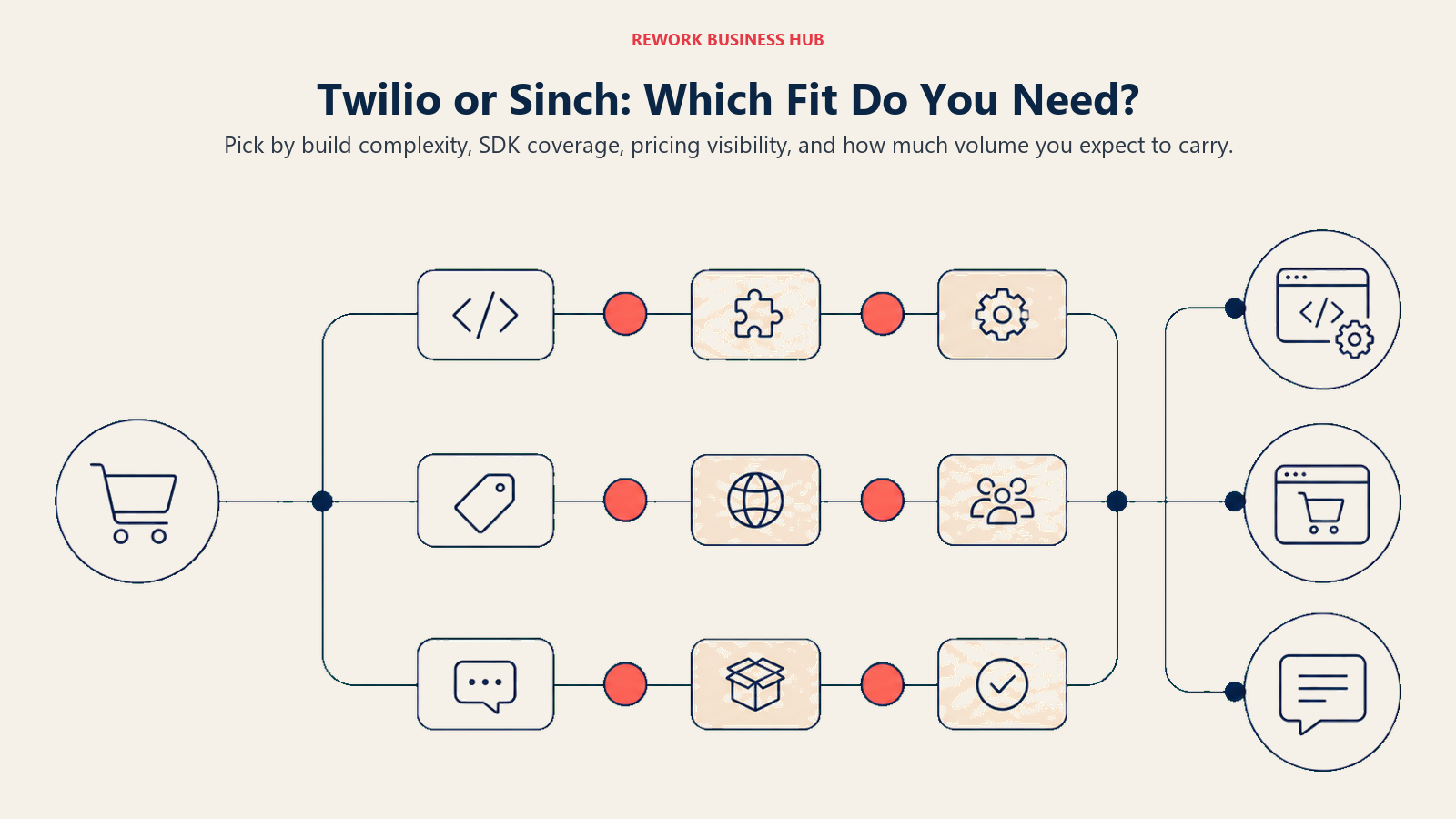
Twilio, in most cases. Below about 1,000,000 messages a month the modelled cost difference is $618 a year at 100,000 messages, less than a week of engineering time, and Twilio gives you seven official SDKs, a public OpenAPI spec, the largest integration ecosystem, and the largest pool of engineers who have already shipped against it.
What to Do Next
- Pull your real message mix, not your total volume. You need outbound SMS, inbound SMS, outbound MMS, and inbound MMS, split by number type. Sinch's rate card varies by direction and number type where Twilio's is flat, so relative cost depends entirely on that mix. A product that's 40% inbound MMS gets a different answer from one that's 100% outbound SMS.
- Put carrier fees and support in the model before you compare anything. Per-message rates alone gave a 6.0% gap that became 4.3% once numbers and surcharges were in, and Twilio's published support fee absorbed most of what remained. Build your own version with your real volumes.
- Ask both vendors what their pricing pages don't answer. For Sinch: short code rental, per-carrier surcharge amounts, the 10DLC registration schedule, and what paid support costs. For Twilio: the 10DLC registration amounts and which support tier you actually need.
- Run a paid pilot into your real destination countries. Send real traffic to real handsets on the networks you care about and measure delivery receipts and latency rather than reading coverage claims. This is the one part of the evaluation a table can't do for you.
- Build the abstraction layer on day one. Put your own interface in front of whichever SDK you choose. It costs a day or two now and turns the next provider decision into a config change, which is worth more than any rate difference here.
- If you need a platform rather than an API, start with our best SMS marketing software roundup for 2026, or best Attentive alternatives if you're an ecommerce brand shopping the marketing layer.
Related Resources:

Principal Product Marketing Strategist
On this page
- TL;DR
- Key Facts
- Who Each Provider Is Actually Built For
- Sinch Sells Two Different Products Under One Name
- Per-Message Pricing at Real US Volume
- Phone Numbers, Toll-Free, and Short Codes
- US A2P 10DLC Registration and Carrier Fees
- Landed Cost at 100K, 1M, and 10M Messages a Month
- Sinch Engage: The Answer If You Do Not Want to Build
- Global Reach and Routing
- API, SDK, and Developer Ergonomics
- Deliverability and Support Tiers
- Adjacent Products Each Vendor Sells
- How the Rest of the CPaaS Field Prices
- Migration Effort Between the Two
- When Twilio Is the Right Call
- When Sinch Is the Right Call
- Decision Framework
- What to Do Next