Best LMS Software for Corporate Training in 2026: 15 Platforms for L&D Teams
Turn this article into takeaways for your work.


Each assistant summarizes the article only for you and suggests best practices for your work.
The best LMS for corporate training in 2026 depends on who you're training and how many of them there are. Docebo and Absorb LMS lead for enterprise L&D teams training 250 or more learners who want AI-driven skills data tied to course delivery. TalentLMS and 360Learning fit small-to-mid teams that want predictable, published pricing instead of a sales call. LearnUpon and Skilljar fit companies training customers and partners as much as employees. Moodle covers both ends: free if you self-host, or a capped, paid tier if you don't want to run a server.
This guide ranks 15 platforms for L&D directors, CHROs, training managers and HR leaders building or replacing a corporate learning stack. Evaluation criteria: rollout cost at your headcount, how the platform handles employee versus external training, how much the roadmap has shifted through a recent acquisition or rebrand, and whether pricing is transparent enough to budget against. If you're still deciding whether structured continuous learning needs a dedicated platform at all, answer that first.
Key Facts
- Organizations with a high-development culture report 11% greater profitability and are twice as likely to retain their employees, according to Gallup.
- 88% of organizations are concerned about employee retention, and providing learning opportunities is their number one retention strategy, per LinkedIn Learning's Workplace Learning Report.
- 59 of every 100 workers worldwide will need reskilling or upskilling by 2030, according to the World Economic Forum's Future of Jobs Report 2025.
- Average direct learning expenditure ran $846 per employee in 2025, per ATD's 2026 State of the Industry report (figure confirmed via TrainingCost.com's ATD benchmark summary).
- Nearly three-quarters of organizations rely on a central LMS as the backbone of their learning stack, according to the State of Learning Technologies 2026 report (420 L&D decision-makers surveyed by Moweb Research).
Quick Comparison Table
| Tool | Best For | Starting Price | Key Strength | Key Limitation |
|---|---|---|---|---|
| Docebo | Enterprise orgs training 250+ learners wanting AI-driven skills data | Quote only, usage-based on active users | AI Workforce Readiness Platform, now with 365Talents skills intelligence | No published pricing anywhere |
| Absorb LMS | Mid-market to enterprise teams wanting AI admin agents | Quote only (learner-band form) | Absorb Aura AI agent team for admin and content tasks | Not even tier names are published |
| TalentLMS | Small teams wanting to start free and scale | Free (5 users, 10 courses); Core $119/mo | Real free plan plus predictable paid tiers | Base user bands mean cost jumps fast |
| 360Learning | Fast teams under 100 users wanting peer-built courses | $8/user/mo, billed monthly, capped at 100 users | Peer-authored courses by subject matter experts | Published rate stops at 100 users |
| iSpring Learn | Programs already using iSpring's authoring tools | $6.91/user/mo at 100 users, billed annually | Tight fit with iSpring Suite content authoring | Rate only drops at higher volume |
| LearnUpon | Companies training employees, customers and partners | Quote only, 100 to 300 user minimums by audience | One login for three training audiences | No published price, real minimums |
| Litmos | Enterprises needing a large ready-made compliance library | Quote only ("Contact for Pricing") | Deep off-the-shelf compliance and soft-skills content | Zero pricing information published |
| Cornerstone OnDemand | Enterprises consolidating legacy talent tools | Quote only | Cornerstone Galaxy folds in Saba, EdCast, SumTotal and more | No pricing, bigger than most buyers need |
| Moodle (3 products) | Self-hosters, or MoodleCloud teams under 750 users | Self-hosted: free (GPL). MoodleCloud: $170/yr for 50 users | Genuinely free core product if self-hosted | MoodleCloud caps at 750 users, no plugins |
| Continu | Mid-market teams wanting a modern interface | Quote only, tiered by monthly active users | Clean admin experience with AI content tools | No published pricing at any tier |
| Sana Learn | Teams wanting an AI tutor in the learning flow | Quote only, minimum 300 users | AI co-pilot built into the learning experience | No list price, 300-user minimum |
| Tovuti LMS | Teams wanting every feature with no tier-gating | $7,500/year for the first 100 learners | One all-inclusive plan, nothing gated | Extra-learner rate unpublished, annual only |
| Seismic Learning | Sales and CS teams needing enablement training | Quote only, enterprise pricing | Built-in scenario practice and coaching | Not designed for company-wide training |
| Skilljar | Companies training customers or partners | Quote only, tier plus active-user fee | Built for external certification, paid courses | Weak fit for internal-only training |
| Trainual | Small teams documenting SOPs and onboarding | Quote only, no figures on any of 4 tiers | SOP creation baked into the training flow | Stopped publishing prices entirely |
What Actually Changed in the LMS Category in 2026
Three things moved in the last year that most comparison articles still haven't caught up with.
| Change | What happened | What it means for your shortlist |
|---|---|---|
| Docebo repositioned around skills intelligence | Docebo acquired the French skills-intelligence vendor 365Talents for roughly $54.6 million in cash plus up to $5.1 million in earn-out (announced January 2026), kept the 365Talents brand independent, and now markets an "AI Workforce Readiness Platform" spanning Learning, Skills Intelligence, Enterprise Knowledge and AgentHub (Docebo, BusinessWire) | Docebo's pricing page now lists a third line item next to Elevate and Enterprise. A comparison table showing only two tiers is out of date |
| WorkRamp no longer exists as WorkRamp | Learning Pool acquired WorkRamp (announced October 15, 2025), then acquired the organizational-network-analysis vendor Confirm (announced May 19, 2026), then rebranded the combined company to Confirm on August 10, 2026, launching a "Workforce Enablement System.", both workramp.com and learningpool.com redirect to confirm.com (Learning News, Marlin Equity) | Don't point a shortlist to workramp.com for a demo, and don't treat WorkRamp as an independent vendor with its own roadmap. It's part of Confirm now |
| Trainual stopped publishing prices | Trainual's pricing page still names four tiers, Core, Pro, Premium and Enterprise, but shows zero figures next to any of them and routes every visitor to book a demo instead (Trainual) | Any article still quoting $199, $249 or $299 for Trainual is citing a number the vendor no longer stands behind |
The pattern behind all three: the category is consolidating around AI and skills data, and pricing pages are getting less transparent, not more. Verify every number yourself before you build a budget around it.
1. Docebo - The AI Workforce Readiness Platform for Scale
Docebo started as a straightforward corporate LMS and has spent the last year repositioning itself as something broader. Its January 2026 acquisition of 365Talents, a French skills-intelligence vendor, added a skills-mapping and internal-mobility layer that now sits alongside course delivery. Docebo markets the combined product as an "AI Workforce Readiness Platform," built from Learning, Skills Intelligence, Enterprise Knowledge and AgentHub. If your L&D roadmap is heading toward tying training to AI-augmented learning and skills data rather than course completion alone, Docebo is one of the few platforms already built for that shift.
Docebo publishes no prices. Its site lists three tiers, Elevate, Enterprise and 365Talents (Skills Intelligence), each described only as "custom pricing tailored to your organization's needs." Pricing is usage-based, tied to active users measured as monthly, yearly or registered active users depending on the contract. The vendor states plainly that Docebo is best suited to companies "training at least 250+ learners."
| Pros | Cons |
|---|---|
| Skills intelligence now built into the core platform | No published pricing at any tier |
| Strong content marketplace and integration ecosystem | Usage-based billing makes cost forecasting harder |
| AgentHub adds AI agents across admin and content workflows | Vendor explicitly targets 250+ learner organizations |
| Mature reporting for large, multi-department rollouts | Implementation and ramp-up take longer than SMB tools |
Best for: Enterprise L&D teams training 250 or more learners who want skills intelligence tied directly to formal learning. If you want the field around it, see best Docebo alternatives, and Absorb LMS vs Docebo for the shortlist pairing these two land on most often.
2. Absorb LMS - Enterprise Depth With an AI Agent Team
Absorb LMS is still branded Absorb LMS, run by Absorb Software Inc, and it has not renamed itself "Absorb AI," even though its pricing page now lives at absorbai.com. What actually changed is the product line sitting alongside the core LMS: Absorb Aura, described by the vendor as "a team of learning and admin agents" that handles content tagging, learner support and reporting automatically. The core LMS itself remains solid enterprise-grade software: course authoring, certifications, e-commerce for external training, and reporting built for large, multi-department deployments.
Absorb publishes no tier names and no prices at all. Its pricing page is a form that asks how many learners you have, with bands running from 1 to 50 learners up through 25,000 and beyond. That structure signals Absorb prices every deal individually rather than from a rate card, common at the enterprise end of this category but a real problem for early-stage budgeting.
| Pros | Cons |
|---|---|
| Absorb Aura AI agents reduce manual admin work | Zero pricing transparency, not even tier names |
| Mature enterprise feature set, e-commerce included | Learner-count form gives no sense of actual cost |
| Strong for compliance-heavy, regulated industries | Overkill for teams under a few hundred learners |
| Established vendor with a long enterprise track record | Sales-led process means a longer buying cycle |
Best for: Mid-market to enterprise teams that want a mature LMS with AI handling routine administration. For the field around it, see best Absorb LMS alternatives, or read Absorb LMS vs Docebo if both are already on your list.
3. TalentLMS - The Free-to-Start Option With a Real Growth Path
TalentLMS, part of Epignosis, built its reputation on being the LMS a small team can set up in an afternoon without a sales call. Self-serve signup, a genuinely usable free tier, and course creation tools simple enough that a non-specialist can build a first onboarding path or a set of certification programs without help.
Pricing is published and, unlike most of this list, easy to model. The Free plan covers up to 5 users and 10 courses, permanently, not a trial. Core runs $119 per month for a base band of 1 to 40 users. Grow runs $229 per month for 1 to 70 users. Pro runs $449 per month for 1 to 100 users, then $6 per additional user up to 500. Annual billing takes 20% off any paid tier. Enterprise is custom, starting at 1,000 users, with a Flexible option available from 500. TalentLMS and Docebo sit at opposite ends of this list on transparency, and the Docebo vs TalentLMS comparison works out where the answer flips as headcount grows.
| Pros | Cons |
|---|---|
| Free plan is real and permanent, not a trial | Base user bands mean a small headcount jump changes tier |
| Published, predictable pricing at every paid tier | Course-authoring depth trails Docebo or Absorb |
| Fast self-serve setup, no sales process required | Enterprise scale requires a custom quote regardless |
| 20% annual discount on every paid tier | Per-additional-user rate only applies on the top tier |
Best for: Small teams that want to start free and scale through clearly published tiers instead of a quote process. See best TalentLMS alternatives for the wider field.
4. 360Learning - Peer-Powered Learning for Teams Under 100 Users
360Learning's core idea is that the people who know the work best should build the training, not a dedicated instructional designer working from a template. Its collaborative authoring tools let subject matter experts co-create courses, and AI-assisted course generation speeds up the first draft, a fit for companies where product knowledge changes fast enough that a static course library goes stale within a quarter.
The published price is real but narrower than it looks: Team costs $8 per user per month, billed monthly, with no annual commitment and no minimum volume, but that rate is capped at 100 users. Business and Enterprise tiers are custom, generally billed annually, and priced on a mix of registered and monthly active users. Above 100 users, you're in custom-quote territory like most of this list.
| Pros | Cons |
|---|---|
| Genuinely low, published, no-commitment monthly rate | $8 rate is capped at 100 users |
| Peer-authored courses fit fast-changing product content | Above 100 users, pricing becomes fully custom |
| No minimum volume on the Team plan | Business/Enterprise pricing basis (registered vs. active) adds complexity |
| Strong AI course-creation assistance | Less suited to formal, compliance-driven training programs |
Best for: Teams under 100 users that want courses built by the people doing the work, not a separate content team. For the switching case in either direction, see best 360Learning alternatives.
5. iSpring Learn - Straightforward Pricing for Course-Heavy Programs
iSpring built its name on iSpring Suite, a PowerPoint-based authoring tool many L&D teams already use to build courses. iSpring Learn is the delivery half of that pair: an LMS designed to work seamlessly with content already authored in iSpring's tools, with tracking, quizzes, certificates and reporting layered on top.
Pricing is published, billed annually, and scales by active user count rather than a flat per-seat rate. At 100 users the Business plan runs $6.91 per user per month, or $8,286 a year. At 300 users it drops to $4.46, or $16,050 a year. At 500 users it's $3.97, or $23,790 a year. Enterprise is custom above that. A user counts as active only if they log in at least once during that month, which rewards ongoing engagement over programs that spike at onboarding and go quiet.
| Pros | Cons |
|---|---|
| Published, per-tier pricing that scales down with volume | Annual billing only on the published Business tier |
| Tight fit with iSpring Suite authoring tools | Less differentiated for teams not already using iSpring |
| Active-user billing rewards ongoing engagement | Per-user rate stays higher below the 300-user tier |
| Predictable annual cost once volume is known | Enterprise scale still requires a custom quote |
Best for: Course-heavy programs already invested in iSpring's authoring ecosystem that want predictable, volume-based pricing.
6. LearnUpon - Multi-Audience Training From One Login
LearnUpon's pitch is that most companies eventually need to train three different audiences, employees, customers and partners, and shouldn't need three different platforms to do it. Its "portals" model lets one admin backend run separate branded training experiences for each audience while reporting rolls up centrally, the honest differentiator versus employee-only platforms like TalentLMS or 360Learning.
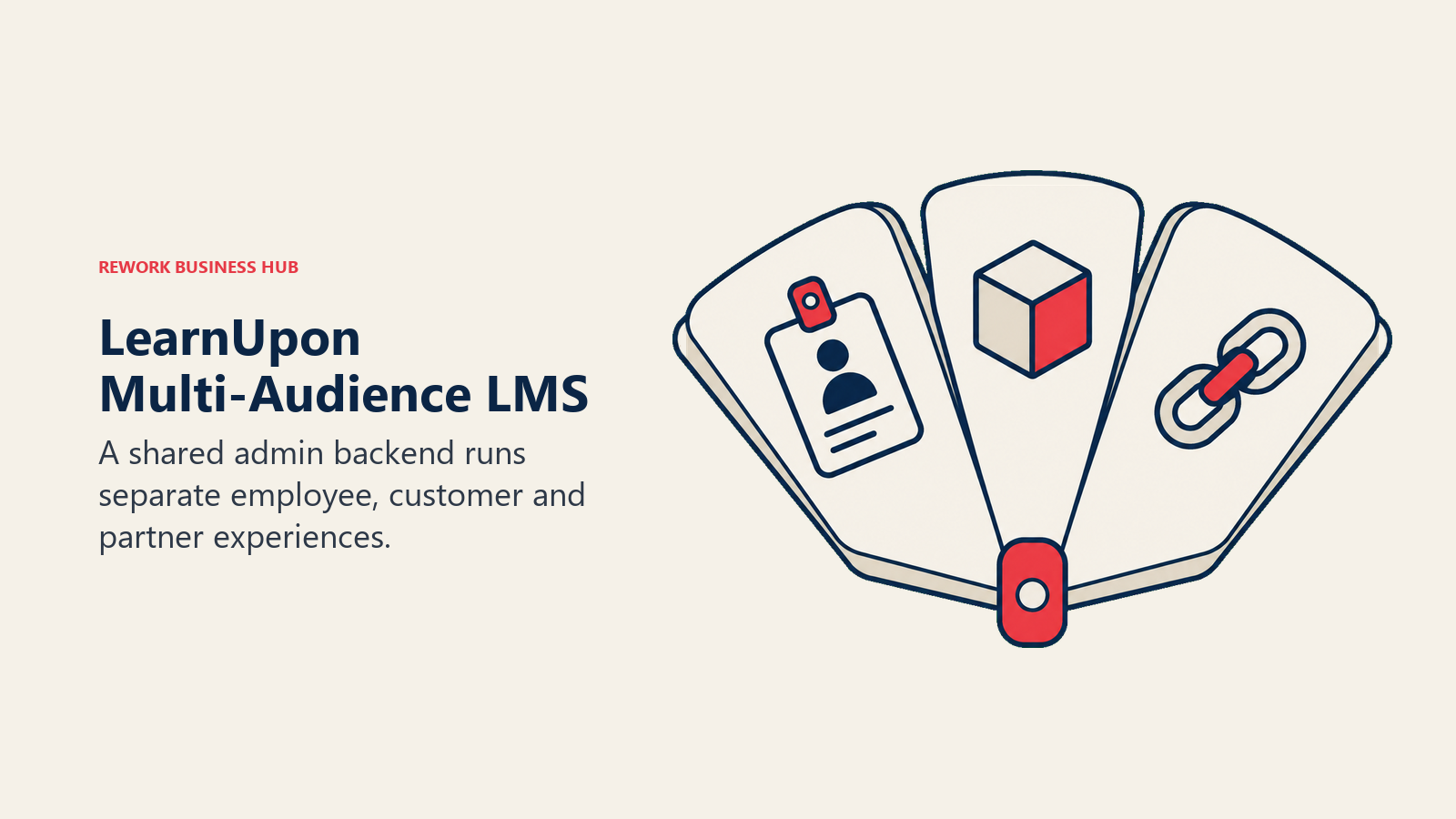
LearnUpon publishes no prices. What it does publish are minimum user counts by product line: LearnUpon for Employees starts "from 100 users," Customer Education starts "from 300 users," and Associations starts "from 150 users." Those minimums signal LearnUpon suits organizations already running structured training at scale, not a first program for a 20-person team.
| Pros | Cons |
|---|---|
| One platform for employee, customer and partner training | No published pricing at any tier |
| Branded portals per audience, centralized reporting | Minimum user counts exclude very small teams |
| Strong for companies running certification-based training | Sales-led process required to get any real number |
| Established mid-market to enterprise customer base | Employee-only teams may find the multi-portal model excessive |
Best for: Companies running structured training programs across more than one audience type, not just internal employees. If the 100-user floor rules you out, best LearnUpon alternatives covers the field around it.
7. Litmos - Compliance-Content Enterprise LMS, Quote Only
Litmos is no longer an SAP product, and that matters because the old reason to shortlist it was SAP alignment. SAP owned Litmos from 2018 and sold it to the private equity firm Francisco Partners, a deal that closed December 1, 2022, so evaluate it today as an independent vendor on its own roadmap rather than as a native fit for an SAP estate. It ships with a large library of off-the-shelf compliance and soft-skills content as an add-on, useful for organizations that need broad course coverage without authoring everything internally.
Pricing is entirely opaque. Litmos lists three plans, Foundation, Platinum and Platinum AI, and every one displays as "Contact for Pricing" with no user minimums published anywhere. There is genuinely no public number to anchor a budget conversation before you talk to sales.
| Pros | Cons |
|---|---|
| Broad course coverage without authoring everything in-house | Zero pricing information published, no minimums either |
| Large add-on content library for compliance training | Third corporate parent since 2011, worth confirming roadmap continuity |
| Mature enterprise reporting and admin controls | AI tier (Platinum AI) has no public detail on what differs |
| Operates independently since the 2022 Francisco Partners divestiture | Slower, more formal sales process than SMB-focused tools |
Best for: Enterprises that want a large ready-made compliance content library and can accept fully quote-only pricing.
8. Cornerstone OnDemand - The Suite That Absorbed a Half-Dozen Vendors
Cornerstone OnDemand isn't a single product anymore so much as a consolidation point. It has folded Saba, EdCast, SumTotal, SkyHive and TaleSpin into what it now calls the Cornerstone Galaxy platform, with EdCast rebranded as "Cornerstone Learning Experience." A buyer researching Saba Cloud or SumTotal as a standalone purchase today is actually researching an upgrade path into Galaxy, not an independent product with its own roadmap.
Cornerstone publishes no plan names and no prices. Its pricing page states that "each organization will have a different cost depending on needs and size," and directs visitors to request a free personalized demo and estimate, consistent with an enterprise suite sold on a long, consultative sales cycle rather than a self-serve rate card. For buyers already mid-contract and weighing an exit, the Cornerstone OnDemand alternatives guide works through migration, records portability and acquisition risk in more depth.
| Pros | Cons |
|---|---|
| Cornerstone Galaxy consolidates several legacy tools into one suite | No pricing at all, not even indicative ranges |
| Broad HCM-adjacent feature set beyond core LMS functions | Complexity and scope exceed what most mid-market buyers need |
| Strong for enterprises replacing multiple legacy point tools | Long, consultative sales process |
| Established base built over Saba, SumTotal and EdCast customers | Interface and administration carry legacy-platform weight |
Best for: Large enterprises consolidating several older talent-management tools into a single platform rather than buying a fresh, standalone LMS.
9. Moodle - Three Very Different Products Share One Name
Moodle is the single most misquoted vendor in this category, because "Moodle" actually refers to three separate products with three separate cost structures, and conflating them is the fastest way to budget wrong.
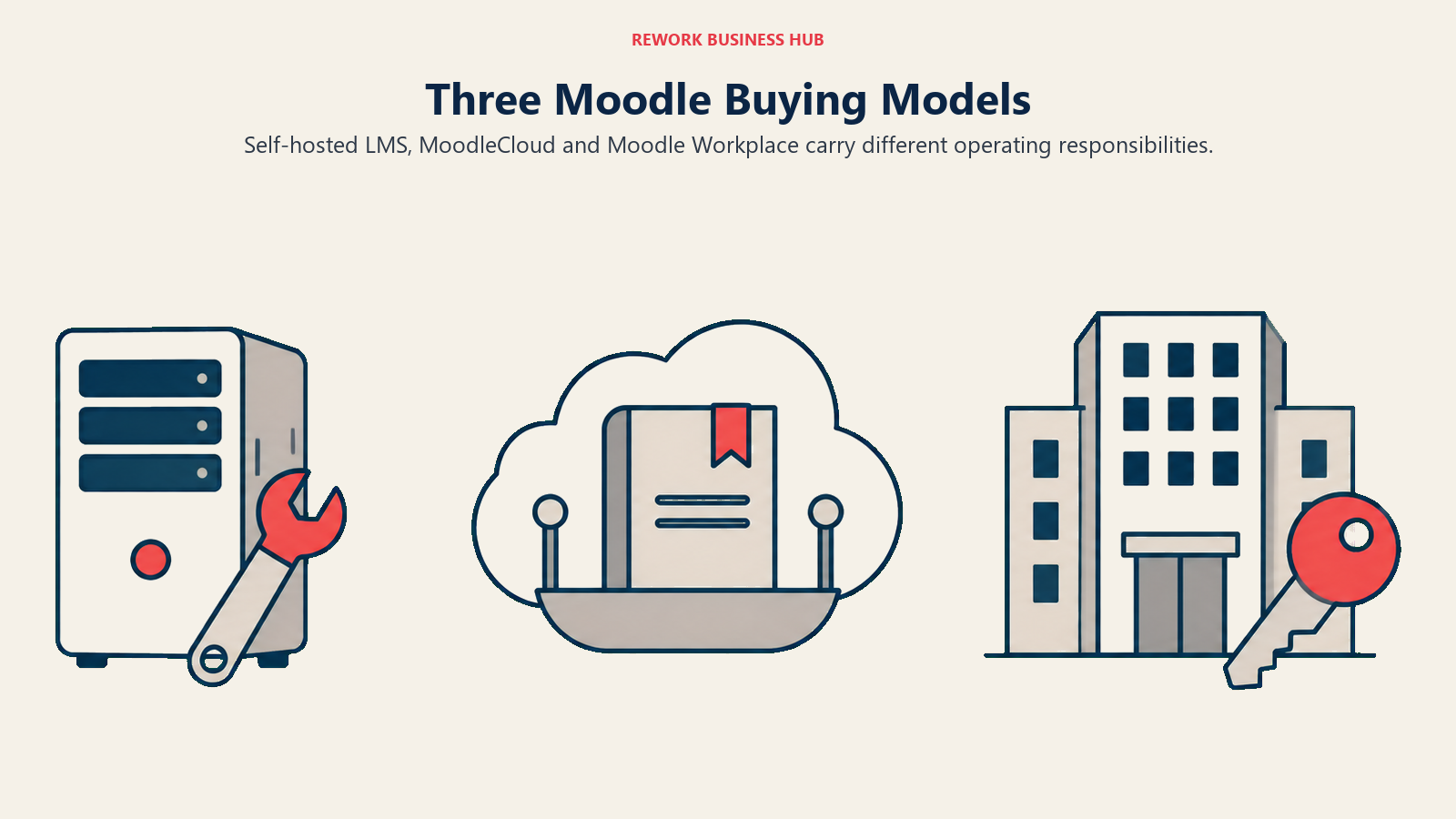
Self-hosted Moodle LMS is genuinely free and open source, licensed under the GPL. No license fee, ever, and no cap on users or plugins, but you own hosting, security, upgrades and support yourself, or pay a partner to do it for you.
MoodleCloud, the hosted version Moodle itself operates, is not free beyond a 28-day trial that requires no credit card. Pricing is annual, paid upfront: Starter gives 50 users and 1GB for $170 a year, Mini gives 100 users and 2.5GB for $280, Small gives 200 users and 5GB for $510, Medium gives 500 users and 20GB for $1,220, and Standard gives 750 users and 50GB for $2,150. No tier permits custom plugins, and 750 users is the hard ceiling.
Moodle Workplace, the enterprise edition with multi-tenancy and compliance-focused reporting, is sold exclusively through certified Moodle partners on a sales-led basis. There is no public list price, and any annual figure quoted for it elsewhere is a third-party estimate, not a vendor-confirmed number.
| Pros | Cons |
|---|---|
| Self-hosted core is genuinely free, GPL open source | MoodleCloud has no permanent free tier, only a 28-day trial |
| MoodleCloud pricing is fully published and predictable | MoodleCloud caps at 750 users, no custom plugins on any tier |
| Enormous plugin ecosystem on the self-hosted version | Moodle Workplace has no public pricing at all |
| Decades of higher-ed and compliance-training track record | Self-hosting requires real technical ownership |
Best for: Budget-conscious teams comfortable self-hosting, or teams under 750 users who want a published, capped hosted plan. For the field around it, see best Moodle alternatives.
10. Continu - Modern Interface, Tiered by Monthly Active Users
Continu positions itself against the older enterprise incumbents on interface alone: a cleaner, more modern admin and learner experience, built-in AI tools for content creation and search, and a lighter administrative footprint than Docebo, Absorb or Cornerstone typically require.
Continu prices in three tiers based on monthly active users: Growth covers under 1,000 MAU, Professional covers 1,000 to 5,000 MAU, and Enterprise covers 5,000 or more MAU. No prices are published at any tier, so every deal is quoted individually based on where a company's active-user count falls.
| Pros | Cons |
|---|---|
| Modern, easy-to-administer interface | No published pricing at any MAU tier |
| AI tools for content creation and search built in | Tier structure gives no sense of actual dollar cost |
| MAU-based pricing rewards genuine engagement | Newer entrant with a smaller enterprise track record |
| Lighter implementation lift than legacy enterprise suites | Less content-library depth than Litmos |
Best for: Mid-market teams that want a modern admin experience without the setup complexity of a legacy enterprise LMS.
11. Sana Learn - AI-Native Learning, Priced by Volume
Sana Learn, from Sana Labs, positions itself less as a traditional LMS and more as an AI learning platform, with an AI tutor and content-generation layer built into the learning experience rather than bolted on as a separate admin tool.
Pricing is per-user, monthly, and explicitly described by the vendor as varying by volume, with a minimum of 300 users. Sana's pricing page only shows indicative pricing after you enter your location and user count, with no public list price to quote directly. The 300-user floor rules it out for smaller teams regardless of budget.
| Pros | Cons |
|---|---|
| AI tutor and content generation built into the core experience | No public list price, indicative pricing only |
| Positioned specifically for AI-first learning strategies | 300-user minimum excludes small and mid-small teams |
| Modern architecture, not a retrofit onto an older platform | Shorter enterprise track record than Docebo or Cornerstone |
| Pricing scales down per user at higher volume | Requires entering company details before seeing any number |
Best for: Teams above 300 users specifically prioritizing an AI-native learning experience over traditional course-library depth.
12. Tovuti LMS - One All-Inclusive Plan, Priced by Learner
Tovuti's structural difference from most of this list is that it doesn't tier by feature. There's one plan, and everything, virtual classroom tools, gamification, quizzes and e-commerce for paid course sales, is included regardless of learner count, removing the common frustration of discovering a needed feature sits one tier up.
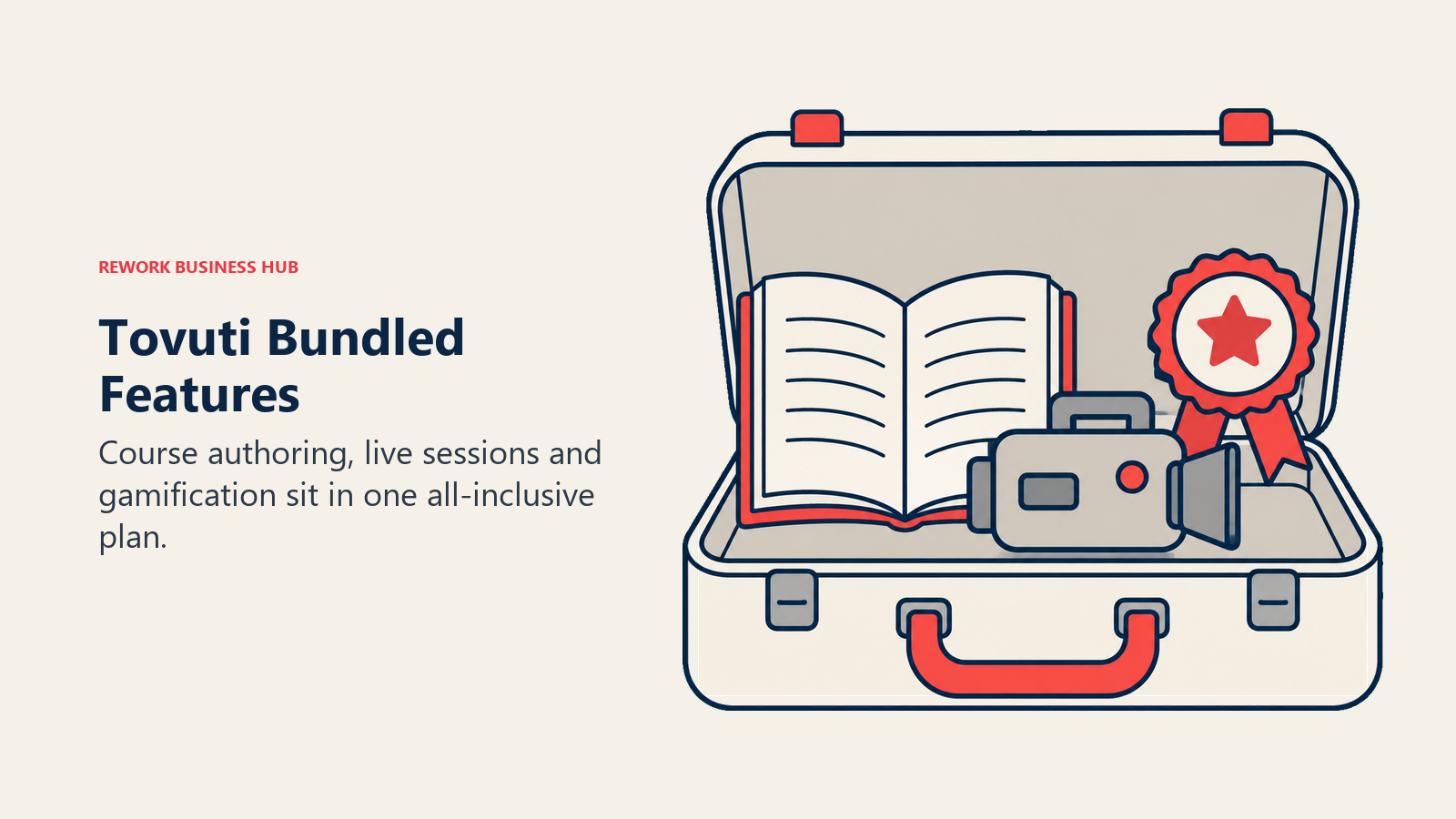
The published price is $7,500 per year for the first 100 learners, billed annually only, with cost scaling by learner count beyond that. The per-extra-learner rate above the first 100 isn't published, so scaling past that point needs a direct quote.
| Pros | Cons |
|---|---|
| Single all-inclusive plan, nothing feature-gated | Per-extra-learner rate above 100 isn't published |
| E-commerce for paid courses included at every tier | Annual billing only, no monthly option |
| Gamification and virtual classroom included as standard | Base price may be more than a small team needs upfront |
| Straightforward to explain internally, no tier confusion | Smaller ecosystem and integration list than category leaders |
Best for: Teams around 100 learners that want every feature available without discovering a paywall mid-rollout.
13. Seismic Learning - Sales Enablement Training, Formerly Lessonly
Seismic Learning was Lessonly before Seismic acquired it in 2021, worth knowing since some buyers still search the old name. What it does today is narrower than a general-purpose LMS: scenario-based practice, roleplay coaching and skill-check tools built for sales and customer-facing teams, delivered as part of Seismic's broader sales enablement suite rather than as a standalone product.
Seismic Learning publishes no pricing anywhere, sold as an enterprise quote only, typically bundled into a broader Seismic enablement contract rather than purchased in isolation.
| Pros | Cons |
|---|---|
| Purpose-built scenario practice and coaching for sales teams | No published pricing, enterprise quote only |
| Sits inside the broader Seismic enablement suite | Not designed for company-wide, general-purpose training |
| Strong fit for revenue-team skill certification | Usually requires buying into the wider Seismic platform |
| Coaching-style feedback loop beyond static course completion | Weak fit for compliance or onboarding-heavy programs |
Best for: Sales and customer-facing teams that need scenario-based enablement training, not general company-wide L&D.
14. Skilljar - Customer and Partner Training, Sold Through Gainsight
Skilljar is now sold as "Skilljar by Gainsight" following its move into the Gainsight portfolio, and it's built specifically for training people outside your organization: customers learning your product, or partners getting certified to sell or implement it. A meaningfully different job than internal employee onboarding, and Skilljar's e-commerce tools for paid courses plus reporting tied to product adoption reflect that focus. It's a natural fit alongside a broader product knowledge onboarding program aimed at external users rather than new hires.
Pricing runs on three quote-only tiers, Essentials, Professional and Enterprise, with the total price built from an annual subscription tier plus an active-user fee. The only figures Skilljar publishes are add-ons: Content Syndication runs $10,000, a Data Connector starts at $25,000, and Language Packs start at $10,000 for five languages.
| Pros | Cons |
|---|---|
| Purpose-built for external customer and partner training | No published base pricing, quote-only across all tiers |
| E-commerce and certification tooling for paid courses | Weak fit for internal, employee-only training programs |
| Reporting tied to product adoption, not just completion | Add-ons (data connector, language packs) add real cost fast |
| Backed by Gainsight's customer success ecosystem | Requires pairing with a separate tool for internal L&D |
Best for: Companies whose primary training need is customers or partners, not internal employees.
15. Trainual - SOP-Style Training for Small Teams
Trainual is built less like a traditional LMS and more like a hybrid of process documentation and onboarding training, aimed at small businesses turning "how we do things here" into something a new hire can actually follow. Its core strength is SOP and playbook creation living in the same flow as training assignments, suiting operators without a dedicated L&D function.
The change worth flagging: Trainual stopped publishing prices. Its pricing page still names four tiers, Core, Pro, Premium and Enterprise, but shows no dollar figures next to any of them, stating instead that "pricing and plans vary depending on the size of your team and the features you need." Any specific number circulating for Trainual elsewhere predates this change. If SOP documentation rather than course delivery is the actual job, the Trainual alternatives guide splits that market into process-documentation tools, real training platforms, and deskless onboarding apps.
| Pros | Cons |
|---|---|
| SOP and process documentation built into the training flow | Stopped publishing prices entirely as of 2026 |
| Simple enough for teams without a dedicated L&D function | Budgeting now requires a sales call before any number exists |
| Four-tier structure still gives a sense of feature progression | Less course-authoring depth than dedicated LMS platforms |
| Strong fit for fast-growing small businesses standardizing processes | Not built for large-scale, multi-department enterprise rollouts |
Best for: Small businesses that need process documentation and onboarding training combined, not enterprise-scale course delivery.
How to Choose: Decision Framework
| If you need... | Pick... | Why |
|---|---|---|
| AI-driven skills data tied to formal learning, at real scale | Docebo | 365Talents skills intelligence now sits inside the same platform |
| An enterprise LMS with AI agents handling admin work | Absorb LMS | Absorb Aura automates tasks most vendors still ask a human to do |
| To start free and grow without a platform switch | TalentLMS | Free plan is real, published tiers scale predictably to 500+ users |
| Courses authored by your own subject matter experts | 360Learning | Peer-authored courses at $8/user/month under 100 users |
| One login for employee, customer and partner training | LearnUpon | Three audience types, one admin backend, one reporting layer |
| Everything included with no feature-gated tiers | Tovuti LMS | One all-inclusive plan at every learner count |
| A free LMS core, and you're comfortable self-hosting | Moodle (self-hosted) | GPL open source, no license fee, full plugin freedom |
| Sales or CS enablement training, not general L&D | Seismic Learning | Scenario practice and coaching built for revenue teams |
| To train customers and partners, not just employees | Skilljar | Purpose-built for external certification and paid course sales |
What to Do Next
One check before you shortlist anything here: this list covers platforms for training people inside your organization, or your customers and partners. If what you actually want is to sell courses to the public as a product, that is a different category with different economics, and the Thinkific vs Teachable comparison is the better starting point, along with the Teachable alternatives and Thinkific alternatives guides.
Shortlist two platforms, not five, and match them to who you're actually training. If it's employees, put TalentLMS or 360Learning up against Docebo or Absorb LMS and run one real course, with your own content and your own SSO, through a free trial or sandbox before any contract goes near legal. If it's customers or partners, run the same test with Skilljar or LearnUpon instead. Ask each finalist for their current price in writing: more than half the vendors on this list, from Docebo to Trainual, will quote you a number their own website doesn't show, and the gap between a headline figure and a real quote is where budgets go wrong.

Principal Product Marketing Strategist
On this page
- Key Facts
- Quick Comparison Table
- What Actually Changed in the LMS Category in 2026
- 1. Docebo - The AI Workforce Readiness Platform for Scale
- 2. Absorb LMS - Enterprise Depth With an AI Agent Team
- 3. TalentLMS - The Free-to-Start Option With a Real Growth Path
- 4. 360Learning - Peer-Powered Learning for Teams Under 100 Users
- 5. iSpring Learn - Straightforward Pricing for Course-Heavy Programs
- 6. LearnUpon - Multi-Audience Training From One Login
- 7. Litmos - Compliance-Content Enterprise LMS, Quote Only
- 8. Cornerstone OnDemand - The Suite That Absorbed a Half-Dozen Vendors
- 9. Moodle - Three Very Different Products Share One Name
- 10. Continu - Modern Interface, Tiered by Monthly Active Users
- 11. Sana Learn - AI-Native Learning, Priced by Volume
- 12. Tovuti LMS - One All-Inclusive Plan, Priced by Learner
- 13. Seismic Learning - Sales Enablement Training, Formerly Lessonly
- 14. Skilljar - Customer and Partner Training, Sold Through Gainsight
- 15. Trainual - SOP-Style Training for Small Teams
- How to Choose: Decision Framework
- What to Do Next