Absorb LMS vs Docebo: Which AI LMS Fits Your Learner Count in 2026?
Turn this article into takeaways for your work.


Each assistant summarizes the article only for you and suggests best practices for your work.
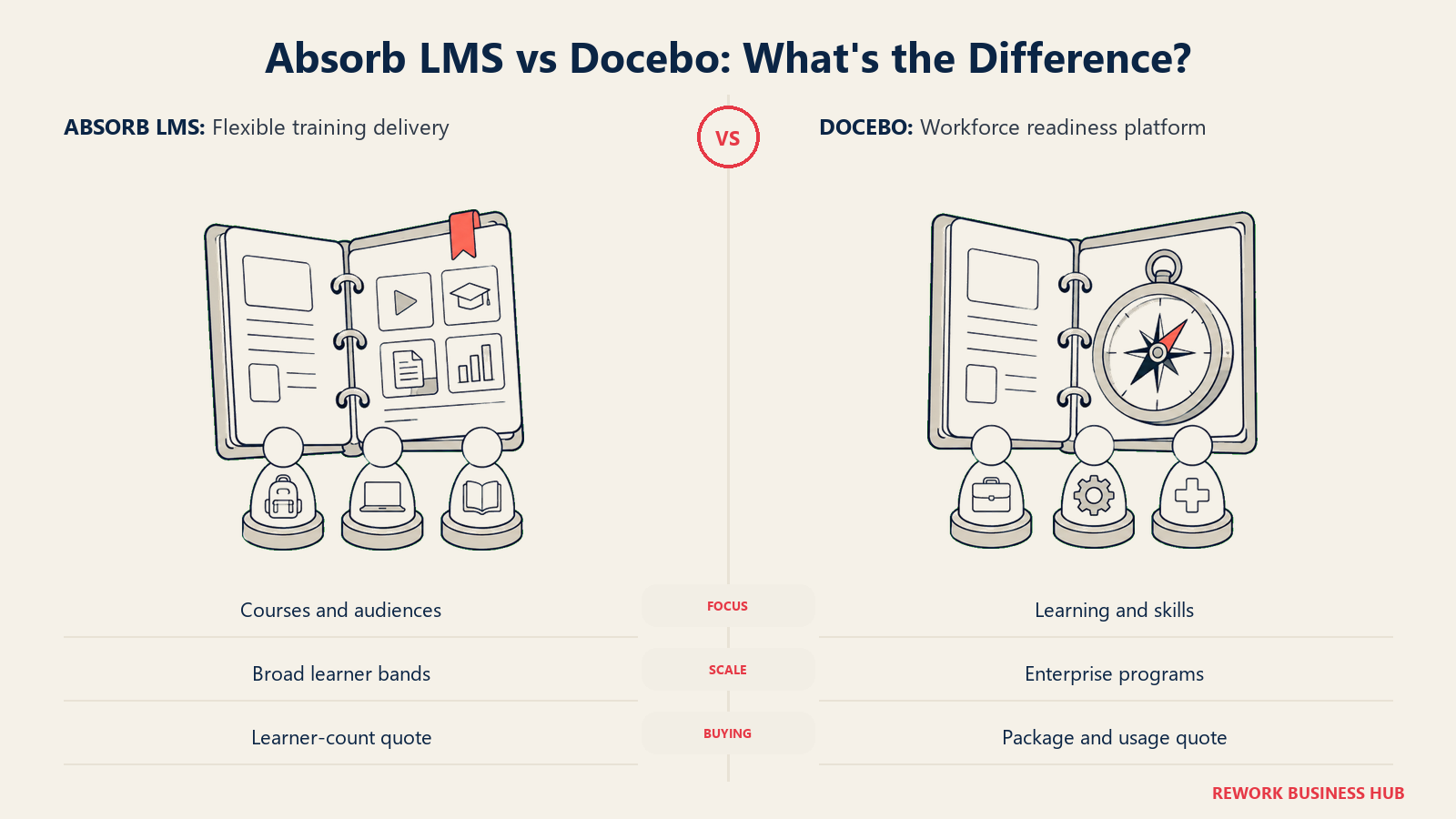
Both of these vendors will tell you they sell an "AI-powered learning platform" now, and both are telling the truth in their own way. That similarity is exactly why this comparison gets requested so often, and why it's the wrong way to shortlist between them. Absorb spent 2026 wrapping its LMS in an AI agent suite called Aura and still asks a mid-market training manager for a headcount band starting at 1 to 50 learners on its pricing form. Docebo spent 2026 rebuilding its entire pitch around something bigger than course delivery, an "AI Workforce Readiness Platform" that ties skills data to learning to agentic search, and its own FAQ says the product is typically best suited to organizations training at least 250 learners. Same AI buzzword, two very different companies underneath it.
This guide is for the L&D director, CHRO, or training manager who has both logos on a shortlist and needs to know which one is actually built for their headcount, their procurement process, and how much skills-and-AI depth they genuinely need versus what they're being sold. It covers what each platform's AI stack actually does today (not just the press release), how authoring and content libraries compare, what a compliance or security review will find, how admin and multi-audience branding differ, what happens to training on a phone with no signal, and real structural pricing at 50, 250, and 1,000 learners, since neither vendor publishes a dollar figure at any size. Every fact below comes from the vendor's own site or help documentation. If you haven't narrowed the field yet, start with the LMS software roundup for 2026.
Key Facts
- Organizations with a high-development culture report 11% greater profitability and are twice as likely to retain employees, according to Gallup.
- 49% of L&D professionals agree their executives are concerned employees don't have the right skills to execute the business strategy, per LinkedIn's Workplace Learning Report.
- 59 of every 100 workers worldwide will need reskilling or upskilling by 2030, according to the World Economic Forum's Future of Jobs Report 2025.
- Average direct learning expenditure ran $846 per employee in 2025, per ATD's 2026 State of the Industry report.
- 79% of HR managers say their company is adopting a skills-based approach to hiring, training, and career development, according to TalentLMS's 2026 L&D Report.
TL;DR
| Absorb LMS | Docebo | |
|---|---|---|
| Built for | Mid-market and growing companies running employee training, customer education, or partner enablement, often self-shortlisting before a full RFP | Enterprises training a mix of employees, customers, and partners that need skills data tied to delivery and can clear a procurement cycle |
| Pricing model | Not published. Learner-band lead form: 1-50 up to 25,000+, no plan names shown | Not published. Quote-only across two named tiers, Elevate and Enterprise, plus a separate Skills Intelligence product |
| Stated floor | None published, but the smallest learner band starts at 1-50, well below typical enterprise minimums | Docebo's own FAQ: "Typically, Docebo is best suited for companies who are training at least 250+ learners" |
| Billing basis | Not disclosed on the pricing page; priced by learner-count band | Active users, buyer's choice of Monthly (MAU), Yearly (YAU), or Registered (RAU) Active Users |
| AI stack | Absorb Aura: Aura Learn (in-app Q&A), Aura Create (prompt/document to course), Aura Admin Assist | AgentHub (agents native inside Claude, Microsoft Copilot, and ChatGPT), Skills Intelligence via the 365Talents acquisition, Enterprise Knowledge search |
| Company ownership | Private, Absorb Software Inc. | Public, listed on the Toronto Stock Exchange and Nasdaq under DCBO |
| Best for | A single company running its own training plus customer or partner education, that wants to self-serve as far as possible before talking to sales | Multi-thousand-learner programs that need workforce skills data connected to delivery and can absorb a real procurement cycle |
What Each Platform Is Actually Built For
Absorb started as a straightforward corporate LMS and has stayed closer to that identity even as it layers on AI. Its own homepage now leads with "The AI-powered LMS that actually knows your business," but the underlying product is still one platform sold to one buyer at a time, whether that buyer needs it for employee onboarding, compliance, customer education, or reselling courses to partners. The company states it serves 3,700+ organizations, including named customers like Sony, Gap, Johnson & Johnson, Samsung, Toyota, and Rakuten, spanning company sizes well below what a typical enterprise procurement cycle would touch.
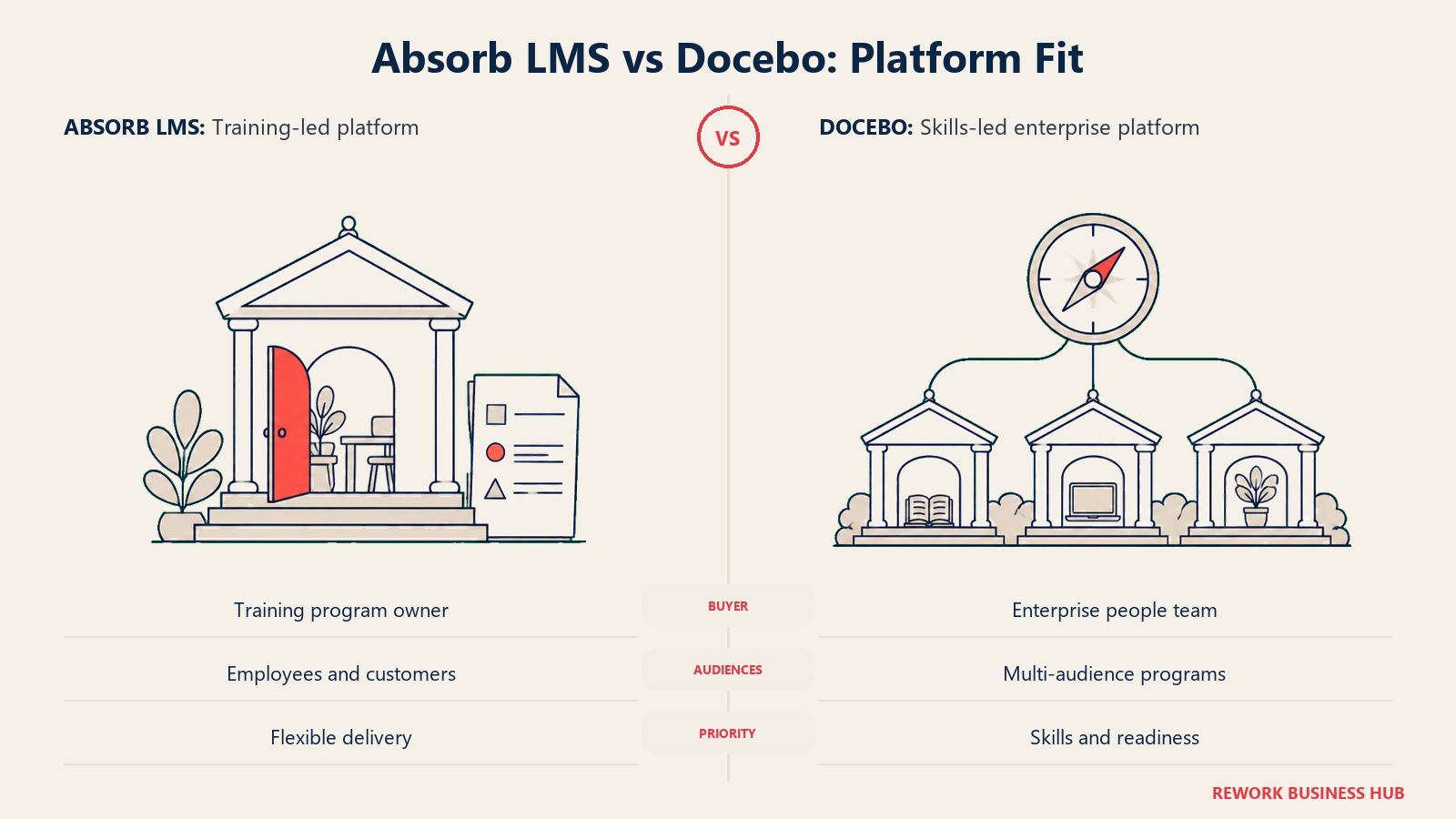
Docebo has spent the past year rebuilding its identity around something more ambitious than an LMS. The company is public, trading under the ticker DCBO, so its strategy gets narrated in quarterly earnings calls as much as release notes, and the current narration is an "AI Workforce Readiness Platform" that connects what employees can do, what they need to learn, and what the business needs next in one loop. That's a different sale than "buy us a course catalog," and Docebo's own pricing FAQ is explicit about who it's for: companies training at least 250 learners across some combination of employees, customers, and partners.
| Absorb LMS | Docebo | |
|---|---|---|
| Primary use case | Employee training, customer education, and partner enablement on one flexible platform | Enterprise learning delivery plus AI-driven skills intelligence and workforce search |
| Ideal buyer | An L&D, HR, or customer education lead who can move without a long RFP cycle | An L&D or people-ops function inside a company large enough to run procurement |
| Stated scale guidance | Learner-band pricing form starts as low as 1-50 | FAQ states best fit is 250+ learners across employees, customers, and partners |
| Sales motion | Lead-capture form segmented by learner band, then a sales conversation | Demo, security review, negotiated quote |
| Ownership | Private, Absorb Software Inc. | Publicly traded, TSX and Nasdaq under DCBO |
From LMS to AI Agent Suite: What Absorb Aura Actually Does
Absorb Aura launched through 2026 as the company's answer to Docebo's AI push, and it's worth being precise about what it is: not a rename of the company (the footer still reads "Absorb Software Inc." and the product is still called Absorb LMS), but a suite of three agents layered on top of it. Aura Learn answers learner questions in real time from their assigned training content. Aura Admin Assist answers platform configuration questions inside the app. Aura Create, released to all regions on June 23, 2026, is the most consequential of the three: an admin can go from a text prompt or an uploaded source document to a published, structured course in under an hour, drawing on organizational knowledge already sitting in SharePoint, Confluence, OneDrive, Google Drive, Box, or Dropbox (Absorb Help Center). Aura Create requires at least one Absorb Create license and current AI terms accepted, it isn't automatically bundled into every contract.
Skills Intelligence, Enterprise Knowledge, and AgentHub: Docebo's Bigger AI Bet
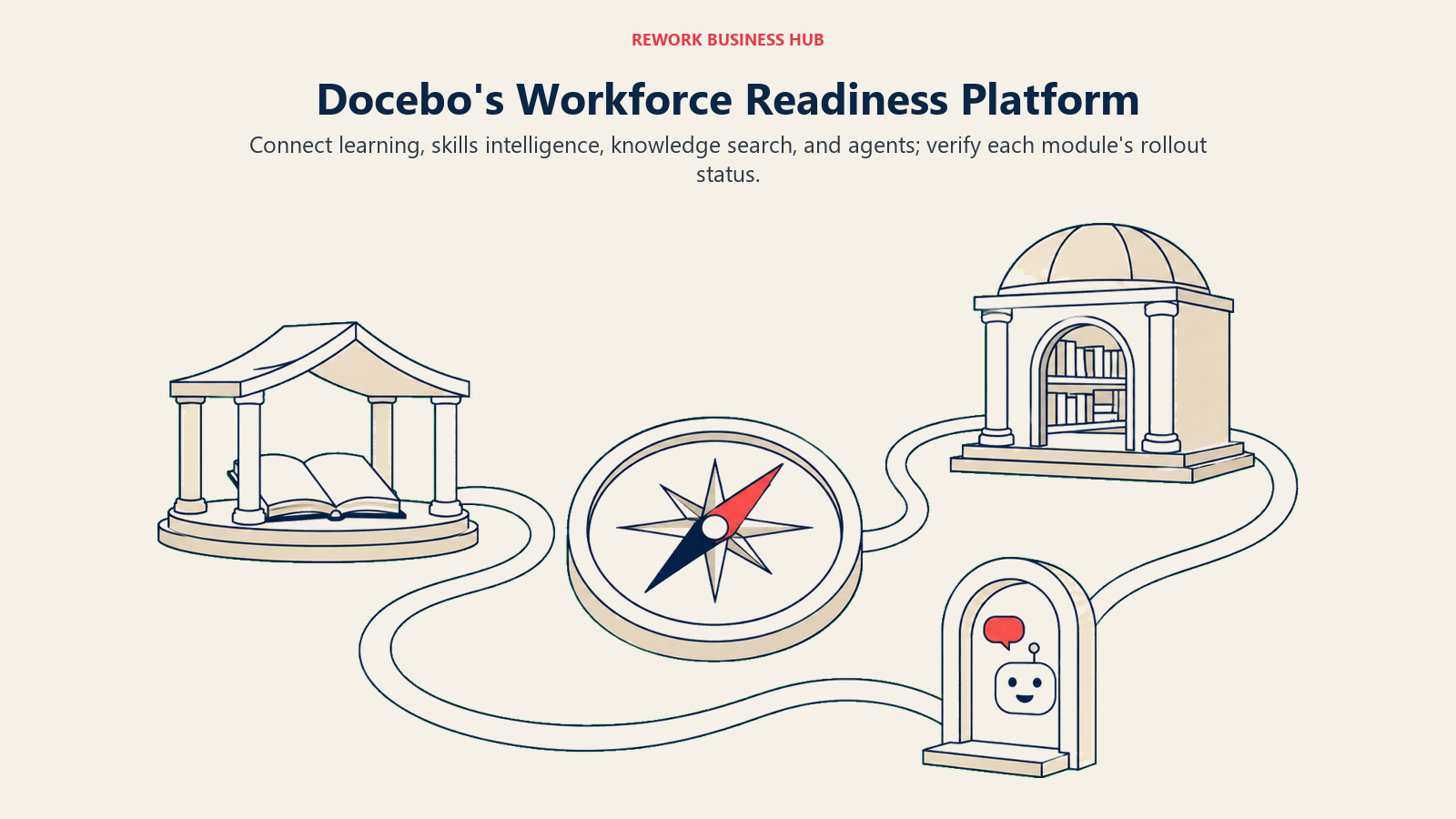
Docebo's AI story is broader and newer as a strategic pitch, even though pieces of it were bought rather than built in-house. The company acquired 365Talents, a France-based skills-intelligence firm, on January 20, 2026, for roughly $54.6 million in upfront cash plus an earn-out of up to $5.1 million (Docebo newsroom). Through 2026, 365Talents still operates as its own brand, connected to core Docebo Learn by API, with a tighter native integration planned for the second half of the year, not a same-day merge. In April 2026, at its Inspire event, Docebo folded that acquisition into a bigger announcement: AgentHub, AI agents that work natively inside Claude, Microsoft Copilot, and ChatGPT, alongside Enterprise Knowledge, search across 20+ connected knowledge sources, unifying Learning, Skills Intelligence, Enterprise Knowledge, and AgentHub as one AI Workforce Readiness Platform (Docebo newsroom). That's also why the pricing page now lists three packages, Elevate, Enterprise, and Skills Intelligence via 365Talents, instead of the two tiers older comparisons still describe.
Absorb's answer to workforce skills is Absorb Skills, a personalized upskilling module built against a taxonomy of more than 12,000 job skills, plus Absorb Analyze for reporting, Absorb Engage for social and gamified learning, and Absorb Infuse for surfacing training inside the flow of work. None of it is packaged as a company-level "workforce readiness" narrative the way Docebo's is, and there's no equivalent to agents running natively inside external chat tools like Copilot or ChatGPT. If a connected skills-intelligence platform tied to workforce planning is the actual requirement rather than a nice-to-have, that's the sharpest capability gap between these two vendors, and it comes at whatever price a 365Talents-inclusive Docebo quote lands on.
| Absorb LMS | Docebo | |
|---|---|---|
| Learner-facing AI | Aura Learn: real-time Q&A from assigned training | Enterprise Knowledge search across connected sources; AgentHub agents surfaced in Claude, Copilot, ChatGPT |
| Admin-facing AI | Aura Admin Assist: in-app platform questions; Aura Create: prompt/document to course | Docebo Creator: prompt/PDF/doc to structured course with lessons and knowledge checks |
| Skills intelligence | Absorb Skills: 12,000+ job skills, personalized upskilling paths | 365Talents (acquired Jan 2026): skills-gap and workforce-readiness data, still API-connected as of September 2026 |
| Where the AI story sits | A feature layer on top of a still-recognizable LMS | The core of the company's current market positioning, narrated in public earnings calls |
| Rollout status | Aura Create shipped to all regions June 23, 2026; requires an Absorb Create license | AgentHub and Enterprise Knowledge announced April 2026; 365Talents native integration targeted for H2 2026 |
Decision by Business Goal
| Your situation | Best fit | Why |
|---|---|---|
| You want to be evaluated without a multi-month sales cycle | Absorb LMS | Pricing form starts at a 1-50 learner band; Docebo's own FAQ points buyers under 250 learners elsewhere |
| You need skills-gap data tied to workforce planning, not just a course catalog | Docebo | 365Talents Skills Intelligence has no equivalent depth on Absorb's roadmap |
| You're training employees, customers, and partners from one instance and want branded portals for each | Both, roughly matched | Absorb offers multi-portal via connected instances; Docebo's Extended Enterprise does the same at a deeper administrative level |
| You want an admin to generate a course from an existing document today, without a separate authoring tool subscription | Absorb LMS, conditionally | Aura Create needs an Absorb Create license already in place; verify it's included in your quote |
| You want AI agents that plug into tools your team already uses daily, like Microsoft Copilot or ChatGPT | Docebo | AgentHub is built specifically around surfacing inside those tools; Absorb has no equivalent |
| You need a named regulatory certification for e-signatures in a compliance program | Both, verify scope | Both vendors cite FDA 21 CFR Part 11 support; confirm current audit scope for your specific regulator |
Team and Role Fit
| Role | Absorb LMS | Docebo |
|---|---|---|
| L&D / instructional designer | Aura Create plus Absorb Create covers prompt-to-course authoring; strong for a lean team | Docebo Creator covers a similar workflow, plus 46-language one-click translation and AI video presenters |
| HR / compliance lead | GDPR, WCAG 2.1, SOC 2 Type 2, and 21 CFR Part 11 e-signature support are all named | FDA 21 CFR Part 11, SOC 2 Type II annual report, and PCI DSS Level 2 are all named, with a built-in audit trail |
| People / skills strategy lead | Absorb Skills offers a 12,000+ skill taxonomy inside the core product | Purpose-built via 365Talents Skills Intelligence, the deeper option if this is the primary requirement |
| Customer education / partner enablement lead | A genuine first-class use case: multi-portal, white-label options, course-sales e-commerce integrations | Supported through Extended Enterprise, but positioned more as an enterprise training arm than a customer-ed product |
| IT / identity admin | SSO via SAML 2.0, LDAPS, OpenID Connect, and OAuth; HCM connectors for Workday, BambooHR, ADP, and more | SAML 2.0 native with named integrations for Okta, Entra ID, Salesforce Identity, and OneLogin, plus Just-In-Time provisioning |
Authoring and Content Libraries
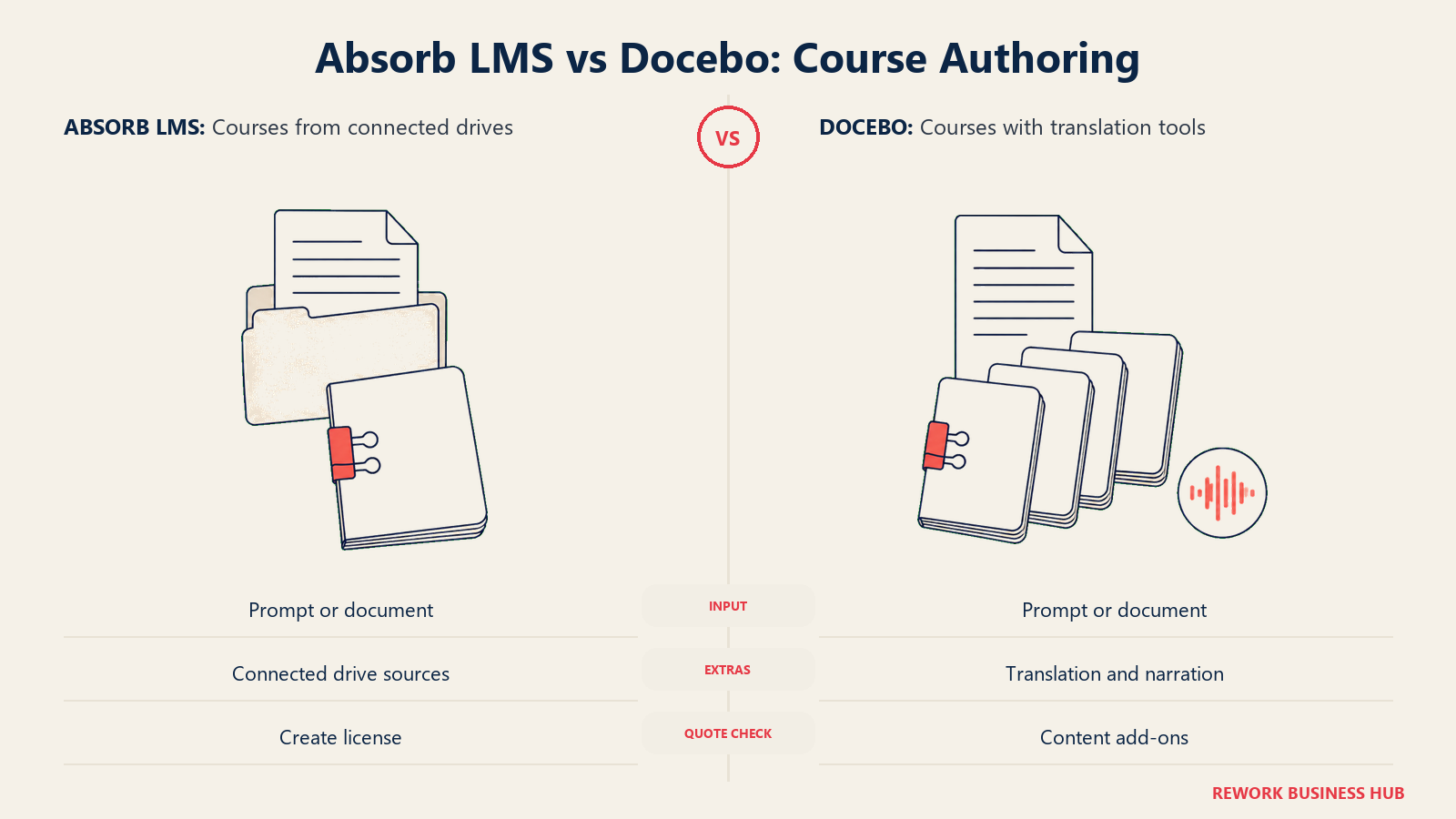
Both vendors now offer AI authoring as a headline feature, and both work from the same basic input, a prompt or an existing document, out to a structured course. Absorb's version runs through Aura Create, which pulls source material directly from connected drives like SharePoint, Confluence, and Google Drive and claims up to a 10x reduction in course creation and maintenance effort, though that figure comes from Absorb's own marketing rather than an independent study (Absorb Help Center). Docebo Creator covers similar ground and adds two things Absorb doesn't publicly claim at the same depth: one-click translation across 46 languages that the vendor states preserves instructional design and brand voice, and AI-generated video presenters with lesson narration built in (Docebo).
Neither vendor treats off-the-shelf content the same way as authoring. Docebo's Content Marketplace is a purchased add-on layered on top of the core platform, sourcing from named partners including OpenSesame for compliance and safety catalogs, Go1 for content from 250+ providers, VIPRE for phishing-simulation security awareness training, and Edflex for curated topic playlists, all bought through Docebo rather than managed as separate vendor relationships. Absorb's equivalent runs through its Absorb Amplify content-library integration alongside named partners like GO1, Traliant, MedTrainer, and SkillSoft, and the company states it makes over 20,000 pre-built courses available across its ecosystem.
| Absorb LMS | Docebo | |
|---|---|---|
| AI course authoring | Aura Create: prompt or document to published course, pulls from connected drives | Docebo Creator: prompt/PDF/doc to structured course with knowledge checks |
| Authoring extras | Requires an Absorb Create license alongside Aura Create | 46-language one-click translation, AI video presenters, lesson narration |
| Off-the-shelf content | Absorb Amplify plus partners: GO1, Traliant, MedTrainer, SkillSoft; 20,000+ pre-built courses claimed | Content Marketplace (paid add-on): OpenSesame, Go1 (250+ providers), VIPRE, Edflex |
| Is content library included | Not stated as bundled; verify at quote | Explicitly purchased separately, "through Docebo" |
Reporting and Analytics
Absorb's reporting runs through Absorb Analyze, described by the vendor as an upgrade over base reporting into a full dashboard experience: customizable BI widgets, pre-built and custom reports, branded dashboard themes, and a Report Manager that automates scheduled exports to Excel or PDF on a recurring basis (Absorb). Docebo splits reporting into two tiers of its own. Standard dashboards, included in the core platform, offer pre-built visuals and filters. Advanced Insights, part of a paid Learning Intelligence add-on built on Snowflake's data warehouse, adds custom KPIs, calculated fields, forecasting, and automated narratives, alongside a Learn Data layer for governed, BI-ready export into a company's own analytics stack (Docebo).
| Absorb LMS | Docebo | |
|---|---|---|
| Base reporting | Included: standard reports plus Absorb Analyze dashboards | Included: standard dashboards with pre-built visuals and filters |
| Advanced analytics | Absorb Analyze covers custom dashboards, BI widgets, and scheduled export in the named product | Learning Intelligence add-on (Advanced Insights plus Learn Data), built on Snowflake, priced separately |
| Scheduled exports | Report Manager: automated Excel/PDF delivery on a recurring schedule | Not detailed at the same granularity on public pages; confirm at demo |
| Branding | Branded dashboards and themes matching corporate identity | Custom KPIs and visual storytelling inside Advanced Insights |
Integrations
Absorb's integration list, per its own features page, groups into Human Capital Management systems (ADP, BambooHR, Namely, Workday, SAP SuccessFactors, UKG Pro, Dayforce, Deputy), CRM platforms (Salesforce, HubSpot, Zendesk Sell), content libraries and third-party learning apps (Absorb Amplify, Traliant, GO1, MedTrainer, SkillSoft), video conferencing (Zoom, WebEx), and a set of other named tools including Credly, Eventbrite, Marketo, NetSuite ERP, Google Workspace, Intercom, and ServiceNow, on top of RESTful APIs and webhooks for custom builds (Absorb).
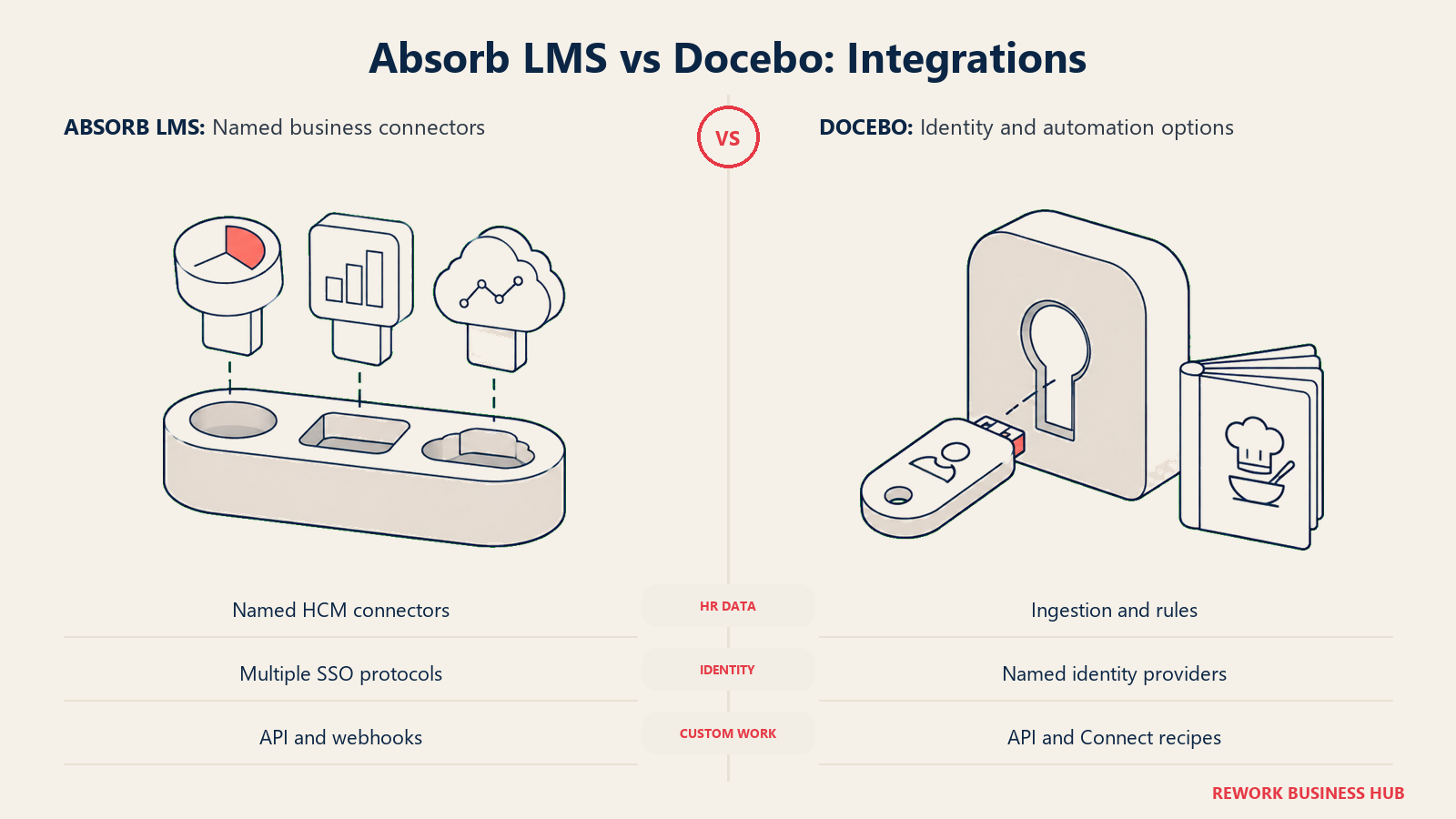
Docebo's named integrations lean more toward identity and enterprise systems: SAML 2.0-based SSO with Okta, Microsoft Entra ID, Salesforce Identity, and OneLogin specifically named, plus HRIS sync handled through an Automation App that ingests HRIS or CRM exports, or SAML attribute mapping paired with an Enrollment Rules App, rather than a long list of plug-and-play HR connectors.
| Category | Absorb LMS | Docebo |
|---|---|---|
| HCM / HRIS | ADP, BambooHR, Namely, Workday, SAP SuccessFactors, UKG Pro, Dayforce, Deputy | Automation App (report ingestion) or attribute mapping; specific connector names not published |
| CRM | Salesforce, HubSpot, Zendesk Sell | Not named on public integration pages at the same granularity |
| SSO / identity | SAML 2.0, LDAPS, OpenID Connect, OAuth | SAML 2.0 native, named support for Okta, Entra ID, Salesforce Identity, OneLogin |
| Video conferencing | Zoom, WebEx | Not detailed on public pages at the same specificity |
| Other named tools | Credly, Eventbrite, Marketo, NetSuite ERP, Google Workspace, Intercom, ServiceNow | Third-party content and phishing-simulation partners (OpenSesame, Go1, VIPRE, Edflex) via Content Marketplace |
| Custom integration | RESTful API and webhooks | API access; Docebo Connect "recipes" bundled into higher onboarding tiers |
Admin, Branding, and Multi-Audience Portals
Both vendors serve companies that need to train more than one audience, employees, customers, and partners, from a single license, and both do it with a multi-portal model rather than forcing separate platform purchases. Absorb's version runs through connected instances, each with its own admin access, reporting, and white-label branding down to login pages and interface themes, positioned as a genuine option for organizations managing more than one learner audience.
Docebo's Extended Enterprise app goes a layer deeper on administrative structure. Each domain gets its own secure URL, choice of authentication method (manual login, SAML, Okta, ADFS), its own e-commerce payment gateway if selling training, and its own branch structure, with white-label settings that can be enabled per client rather than applied platform-wide. That granularity is part of why Docebo's own onboarding runs longer, more domains to plan and configure means more implementation surface.
| Absorb LMS | Docebo | |
|---|---|---|
| Multi-portal model | Connected instances, separate admin and reporting per portal | Extended Enterprise app: multiple domains from one platform |
| Branding depth | Full white-label, including login pages and interface themes | Per-domain white-label settings, enabled per client rather than globally |
| Authentication per domain | Not detailed at domain-level granularity on public pages | Manual login, SAML, Okta, or ADFS, selectable per domain |
| E-commerce for course sales | Supported for external/customer education use cases | Separate secure payment gateway configurable per domain |
| Best for | A single company managing a handful of distinct audiences | Enterprises running many distinct branded programs at once |
Mobile and Offline Learning
Field staff, retail teams, and anyone without reliable Wi-Fi are a real share of either vendor's audience, and a course that only plays online doesn't reach them. Absorb's Learning mobile app, free on iOS and Android, lets learners download SCORM, xAPI (Tin Can), MP4 video, PDF or Microsoft Office files, and Assessment lessons for offline use, syncing progress once the device reconnects (Absorb). The app is explicitly learner-only, admins can't create or manage courses from it.
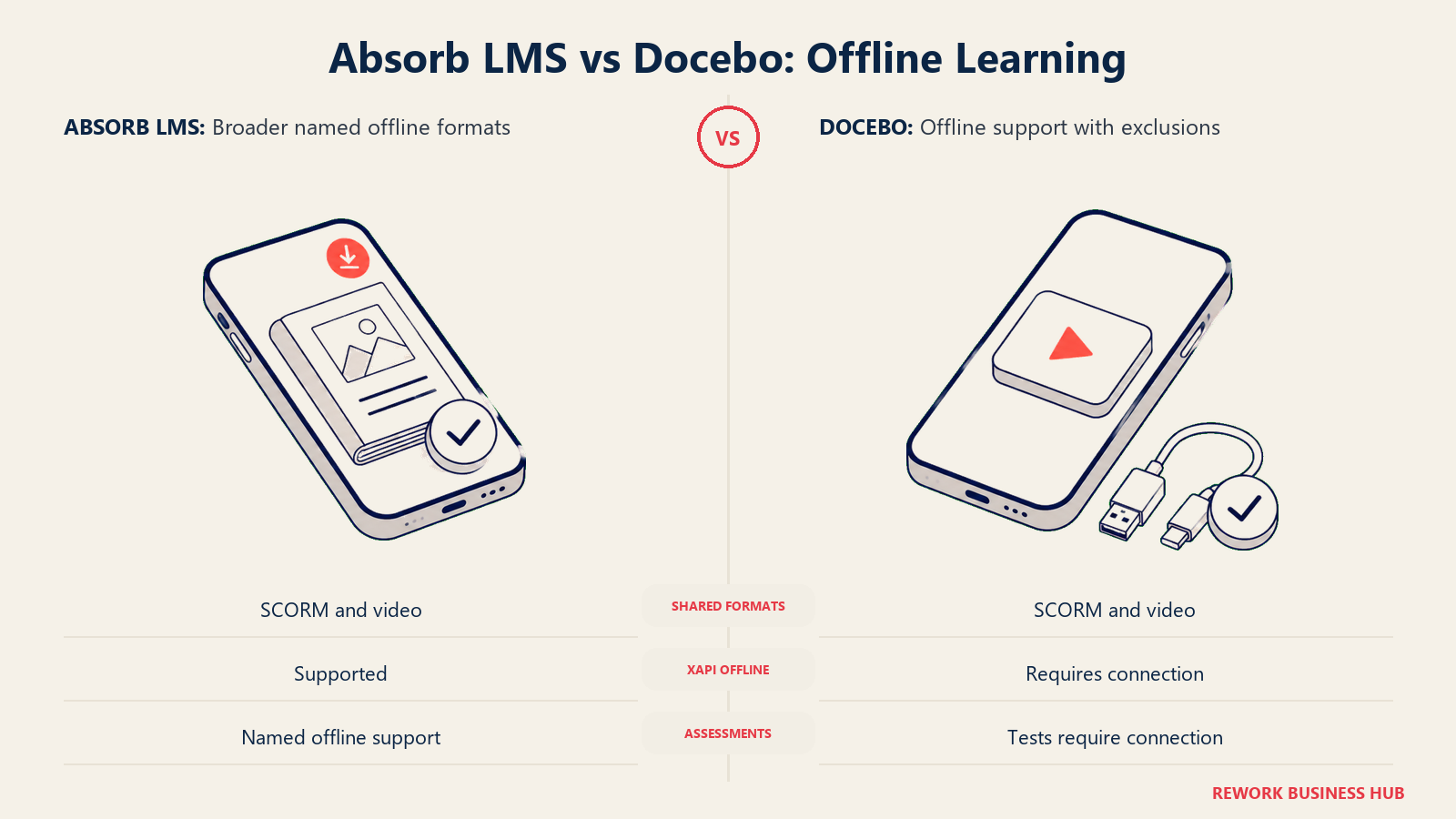
Docebo's Go.Learn app downloads SCORM, video, slides, files, and HTML content for offline play, but the vendor's own help documentation is specific about what doesn't work offline: xAPI, AICC, LTI, surveys, tests, and multi-SCO or multi-chapter SCORM packages all require a live connection (Docebo Help Center). That's a meaningfully narrower offline content list than Absorb's, worth testing directly if your deskless workforce relies on xAPI-tracked or assessment-heavy content.
| Absorb LMS | Docebo | |
|---|---|---|
| Native app | Yes, iOS and Android, learner-only | Yes, Go.Learn, iOS and Android |
| Offline content types | SCORM, xAPI, MP4 video, PDF/Office files, Assessment lessons | SCORM, video, slides, files, HTML |
| What doesn't work offline | Not documented as a specific exclusion list on public pages | xAPI, AICC, LTI, tests, surveys, multi-SCO/multi-chapter SCORM, per Docebo's own help docs |
| Admin functions on mobile | Not supported; learner access only | Not detailed as a separate admin mobile flow on public pages |
Compliance and Security
Both platforms name real, checkable certifications rather than vague "enterprise-grade security" language, and the lists overlap more than they diverge. Absorb states GDPR compliance, WCAG 2.1 accessibility for both learners and admins, a completed SOC 2 Type 2 examination, PCI compliance for payment processing, and named support for 21 CFR Part 11, the FDA regulation governing e-signatures (Absorb). Docebo names FDA 21 CFR Part 11 support including electronic signatures, an annual SOC 2 Type II report, and PCI DSS Level 2 certification, plus a built-in audit trail that logs who changed what and when, and certification and retraining tooling that retains prior certification records through renewal (Docebo).
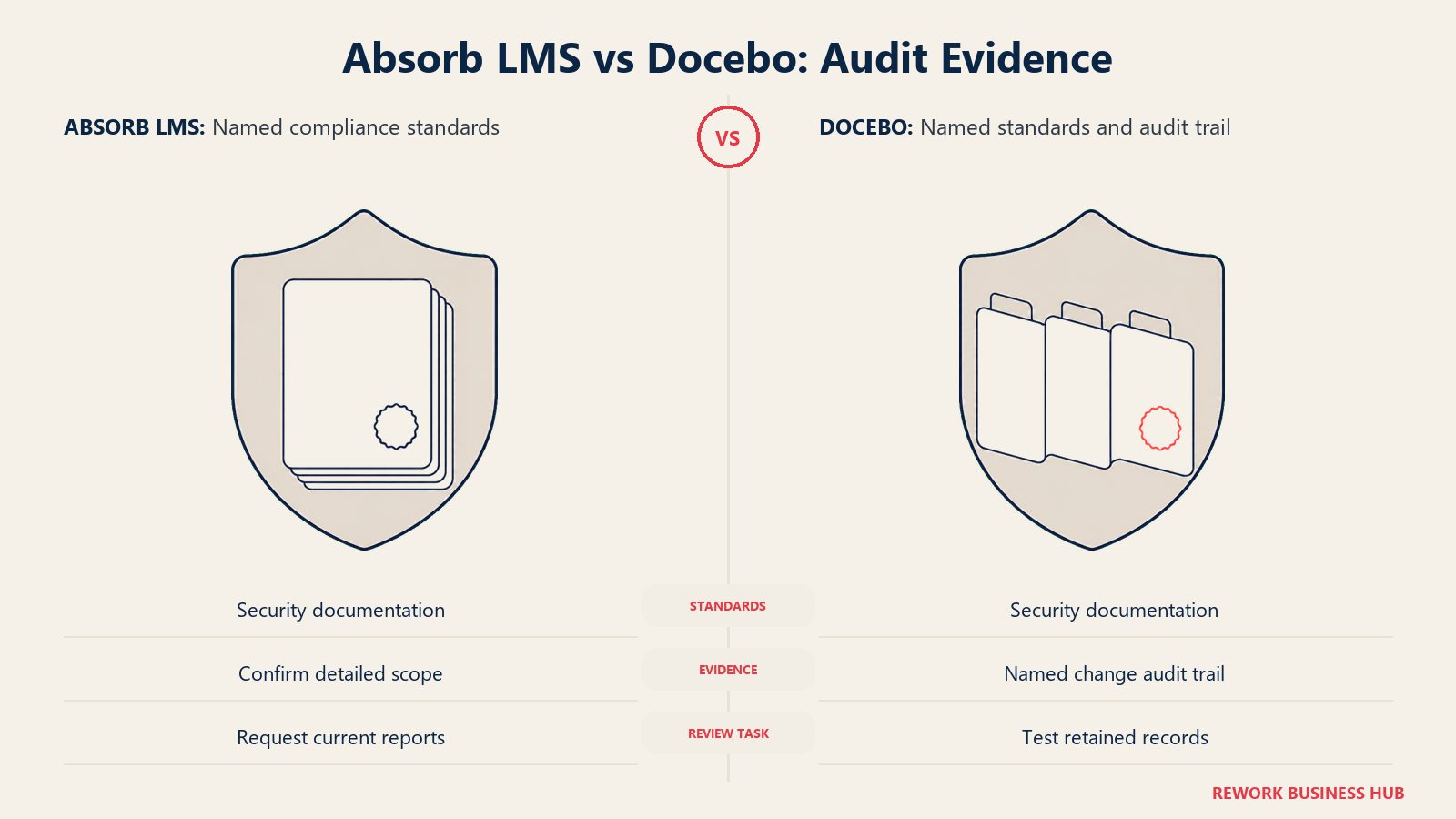
The practical difference isn't in the certification list, it's in how each surfaces that data for an audit. Docebo's audit trail and certifications tooling are named, standalone features built specifically for regulated, high-headcount programs. Absorb's compliance page names the same standards but doesn't describe an equivalently detailed, dedicated audit-trail feature on its public pages, worth confirming directly if your compliance mandate is pharma, medical device, or another Part 11-heavy industry.
| Absorb LMS | Docebo | |
|---|---|---|
| GDPR | Named, stated as meeting "highest LMS compliance standards for data security and privacy" | Covered under general data-protection posture; confirm current documentation |
| Accessibility | WCAG 2.1, for learners and system administrators | Not named at the same specificity on public compliance pages |
| SOC 2 | SOC 2 Type 2 completed | SOC 2 Type II, issued annually |
| Payment security | PCI compliant | PCI DSS Level 2 certified |
| FDA 21 CFR Part 11 | Named, tied to e-signature capability | Named, with e-signatures and a dedicated audit trail |
| Audit trail | Not detailed as a standalone named feature on public pages | Built-in, logs platform changes: who, what, when |
Pricing Structure: Learner Bands vs. MAU, YAU, and RAU
Neither vendor publishes a single dollar figure, at any learner count, on any package. That's the honest headline here, and it's identical for both companies, so the real pricing story is about how each one structures the ask before you ever see a number.
Absorb's pricing page (absorblms.com/pricing redirects straight to a lead-capture form) asks for your learner count against eight bands: 1-50, 51-150, 151-250, 251-500, 501-1,000, 1,001-5,000, 5,001-25,000, and 25,000+. No plan names, no feature comparison, no pricing model description sits anywhere on that page, submitting the form is the only way to reach a number. What it does tell you, honestly, is that Absorb is built to quote a 50-person company the same way it quotes a 5,000-person one, just through different sales motions once you're past the smallest bands.
Docebo skips the band question entirely. Every learner count gets the same answer: a quote, priced against Elevate or Enterprise tier selection plus your choice of billing model. There's no floor stated in dollars, but the FAQ is explicit that the product is built for 250+ learners, and the standard commercial terms reflect that: a one-year minimum contract, with the vendor stating most customers actually sign for 3 to 5 years (Docebo pricing).
At 50 learners, Absorb's form routes you into its lowest band; Docebo remains a quote, and its own guidance suggests you're below the segment it's built to serve. At 250 learners, Absorb's band structure keeps scaling normally; Docebo's FAQ puts you right at its stated floor, worth asking directly whether that's a soft guideline or a hard minimum deal size in practice. At 1,000 learners, both vendors are firmly in quote territory with real procurement processes on both sides, the learner-band-versus-quote distinction stops mattering as much as contract length and the MAU/YAU/RAU choice covered below.
| Learners | Absorb LMS | Docebo |
|---|---|---|
| 50 | Routes to the 1-50 learner band on the pricing form; no dollar figure shown | Quote only. FAQ suggests this is below Docebo's typical fit |
| 250 | Routes to the 151-250 or 251-500 band; no dollar figure shown | Quote only, at the stated 250-learner floor from Docebo's own FAQ |
| 1,000 | Routes to the 501-1,000 or 1,001-5,000 band; no dollar figure shown | Quote only, same as at every size |
Billing Basis: Docebo's MAU, YAU, RAU vs. Absorb's Flat Learner Bands
This is the mechanic that moves a real Docebo bill more than any single feature comparison, and it has no equivalent on Absorb's side at all. Docebo doesn't price by seats or accounts, it prices by active users, and the buyer chooses how "active" gets measured: Monthly Active Users (MAU), Yearly Active Users (YAU), or Registered Active Users (RAU) (Docebo pricing).
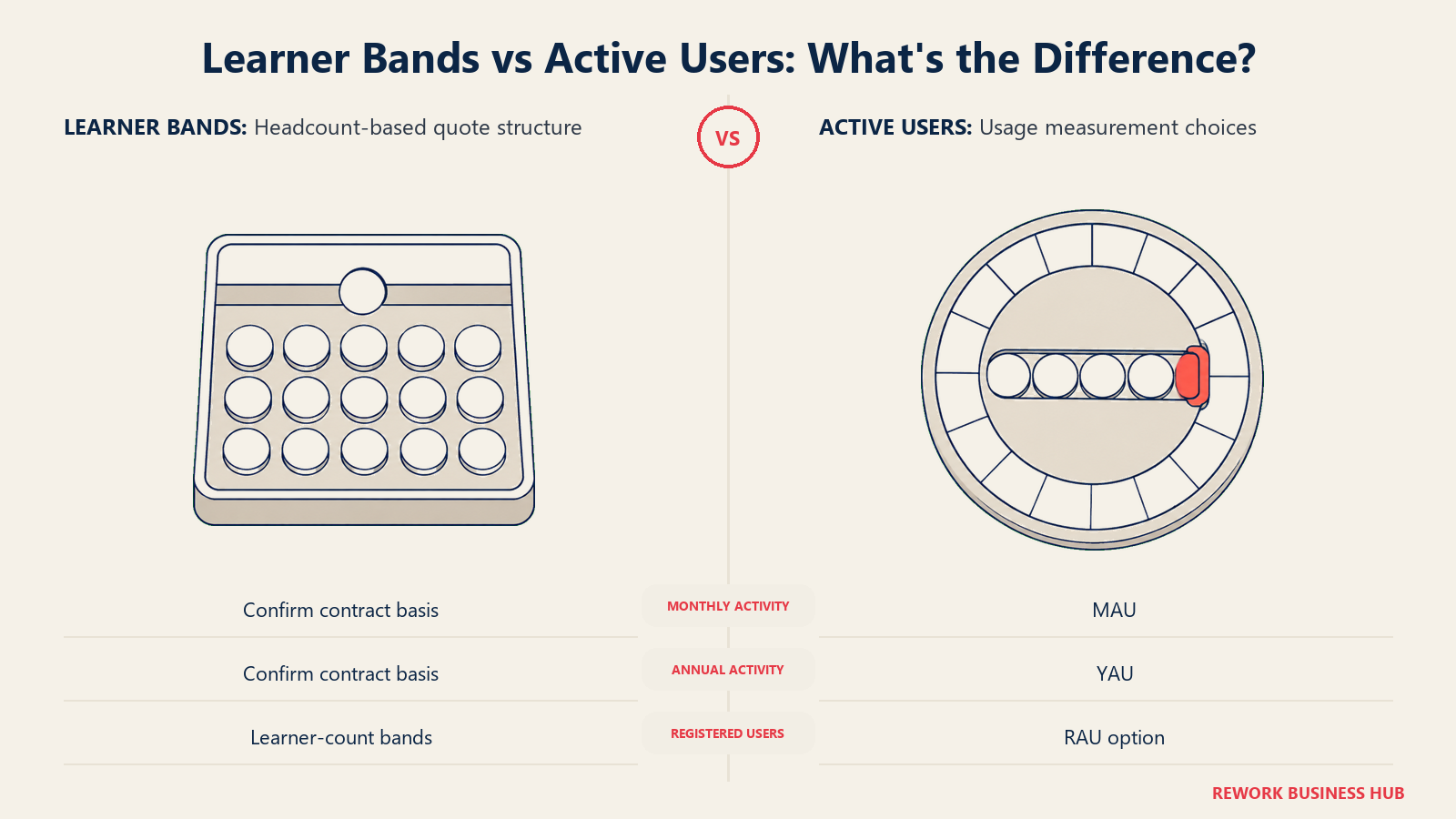
Picture a company where 40% of headcount only logs in for one annual compliance refresher, and the rest trains steadily throughout the year. Under MAU, that 40% shows up in the billed count for roughly one month a year and disappears from it the other eleven, so a company with bursty, concentrated training can negotiate a monthly number meaningfully below total headcount. Under YAU, that same group counts as active for the entire contract year the moment they log in once, converging the annual number toward closer to full headcount regardless of how sparse their real usage is, better for predictable budgeting, worse for a company whose training is genuinely uneven. Under RAU, every licensed seat counts whether anyone logs in or not, the simplest model to forecast, with licenses deactivated and reassigned as people leave and join to keep it from becoming "pay for headcount forever."
Absorb's learner-band model measures none of this. A dormant account still occupies a seat in whichever band your total headcount lands in, whether that person logged in once or fifty times. That's simpler to explain internally and impossible to game in either direction, but it also means Absorb structurally can't reward a company whose training usage is genuinely bursty the way Docebo's MAU option can. Know which model you're actually being quoted against before comparing a number from either vendor.
| Billing basis | What it counts | Favors | Used by |
|---|---|---|---|
| Flat learner band | Total headcount against a fixed band ceiling | Simplicity, predictable budgeting, zero activity tracking | Absorb LMS |
| Monthly Active Users (MAU) | Users active in a given month | Bursty, infrequent training patterns | Docebo (buyer's choice) |
| Yearly Active Users (YAU) | Users active at any point in the contract year | Predictable annual budgeting | Docebo (buyer's choice) |
| Registered Active Users (RAU) | All licensed seats, regardless of login | Simplicity, easiest to forecast | Docebo (buyer's choice) |
Sizing and Persona: Who Actually Fits Each Platform
The learner-count guidance both vendors publish (Absorb's bottom band starting at 1-50, Docebo's FAQ naming a 250-learner floor) is a genuinely useful proxy, but it's not the whole story. Company maturity, audience mix, and how much procurement bandwidth you have to spend on this purchase all matter as much as raw headcount.
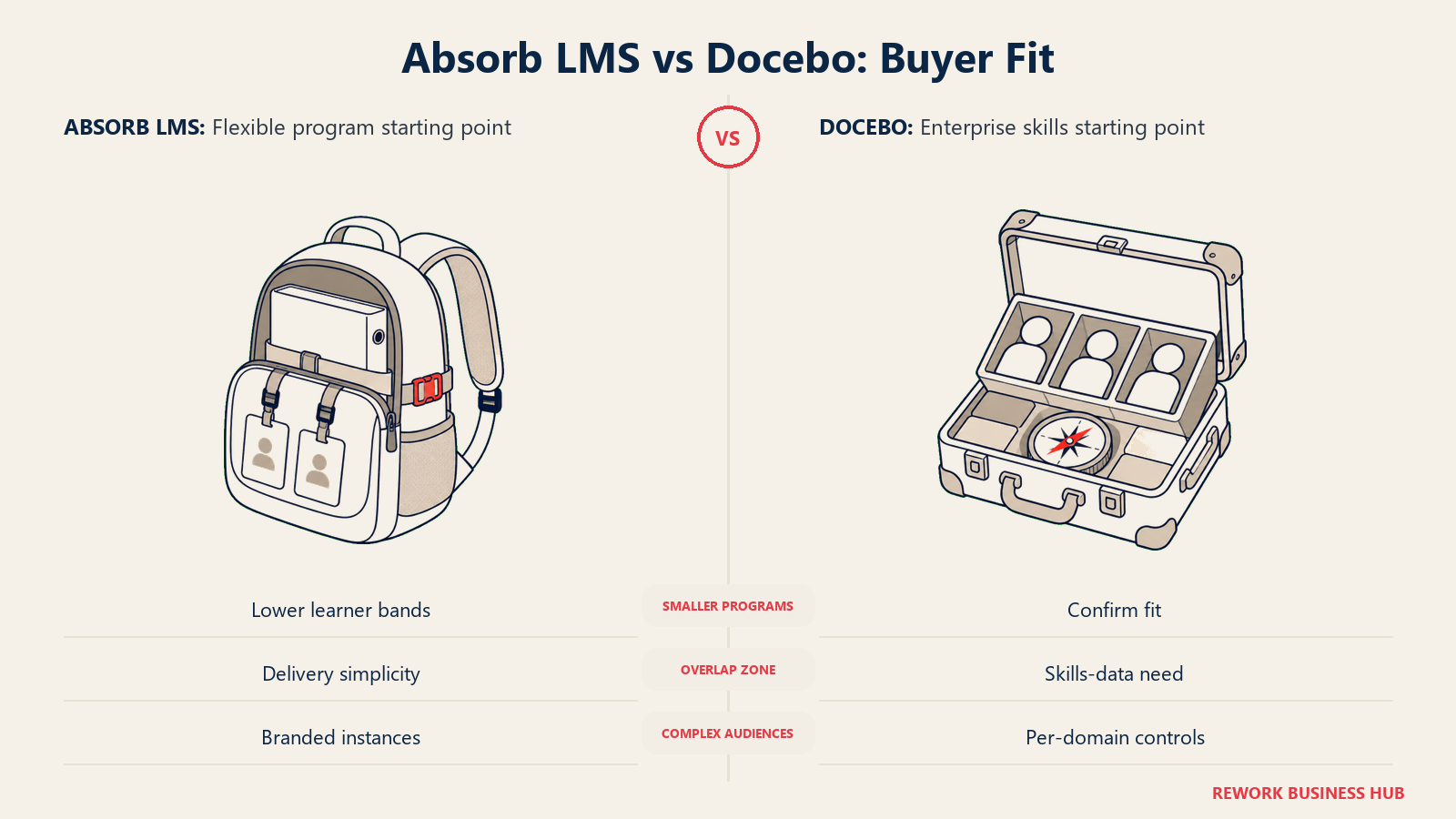
A company under about 250 learners training a single internal audience is squarely in Absorb's stated range and well below Docebo's own guidance, that reader should expect an Absorb evaluation to move faster and involve less internal process. A company in the 250 to 1,000 range training employees alongside external customers or partners sits in genuine overlap territory, and the deciding factor there tends to be whether skills-intelligence data is a real requirement (favoring Docebo) or whether faster time-to-first-course and a lighter admin lift matters more (favoring Absorb). Past roughly 1,000 learners with a multi-audience, multi-brand structure, Docebo's Extended Enterprise depth and public-company transparency around its AI roadmap start to outweigh Absorb's simpler pricing bands.
| Company profile | Better starting point | Why |
|---|---|---|
| Under 250 learners, single internal audience | Absorb LMS | Matches its stated pricing bands; well below Docebo's own 250-learner guidance |
| 250-1,000 learners, employees plus external audiences, no urgent skills-data need | Absorb LMS, lean toward Docebo if skills intelligence matters | Genuine overlap zone; the deciding factor is skills-data depth versus simplicity |
| 1,000+ learners, multi-brand or multi-region Extended Enterprise need | Docebo | Deeper per-domain administrative structure and a public AI roadmap |
| Needs workforce skills-gap data tied to delivery today | Docebo | 365Talents Skills Intelligence has no equivalent depth on Absorb's roadmap |
| Wants to pilot fast with minimal internal process | Absorb LMS | Lower stated learner floor, form-based entry point rather than a mandatory demo cycle |
Implementation and Support
Absorb runs a single standard onboarding path: eight weeks to go live, guided by a dedicated client onboarding specialist who also acts as project manager, with weekly status updates through five defined phases (Kickoff, Plan & Configure, Validate, Ready to Launch, Monitoring). After launch, the same team continues monitoring the account for an additional 60 days (Absorb).
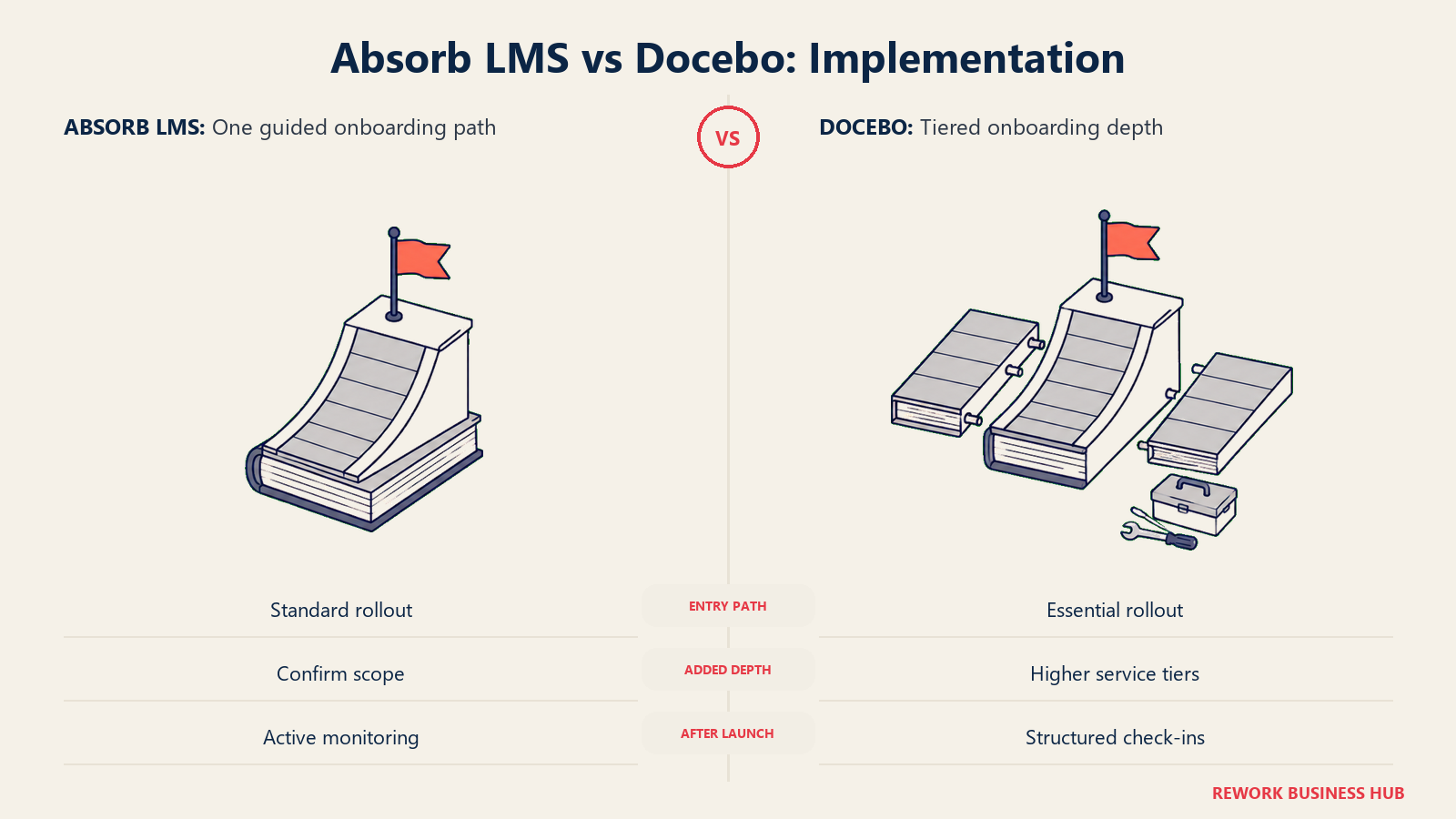
Docebo offers four tiered onboarding packages instead of one path. Essential runs 8 weeks for a guided MVP launch. Advantage and Premier each run 16 weeks, with Premier adding a Technical Deployment Manager and access to one templated Docebo Connect integration recipe. Elite runs 24 weeks with three templated Connect recipes and a dedicated project manager on top of a Solution Deployment Manager and project sponsor. Every tier includes a "Building on Success" program with structured check-ins at 30, 60, and 90 days post-launch, plus a four-week warranty period covering Docebo-caused configuration defects (Docebo).
| Absorb LMS | Docebo | |
|---|---|---|
| Standard timeline | 8 weeks, one path | 8 to 24 weeks across four tiers (Essential, Advantage, Premier, Elite) |
| Dedicated role | Client onboarding specialist, acting as project manager | Solution Deployment Manager; Technical Deployment Manager and full project manager on higher tiers |
| Post-launch support | 60 days of active monitoring from the onboarding team | Structured touchpoints at 30, 60, and 90 days, plus a 4-week configuration-defect warranty |
| Fastest path to launch | Any company on the standard 8-week path | Essential tier only; higher tiers trade speed for deeper integration support |
When Absorb LMS Is the Right Call
You're under roughly 250 learners, or well above it but running one primary internal audience, and you want to start with a pricing conversation rather than a multi-week security review. You're selling or delivering training to customers or partners alongside internal employee training, and want that handled as a first-class use case rather than a bolted-on module. You want an admin to turn an existing document into a published course today without negotiating a separate skills-intelligence contract, and you're comfortable confirming Aura Create's license requirements upfront. Your deskless workforce needs offline access to xAPI-tracked or assessment content specifically, a content type Docebo's own documentation says doesn't work offline in Go.Learn.
Wrong call if workforce skills-gap data tied to a formal talent strategy is the actual mandate from HR leadership, Absorb's Skills module covers upskilling paths but nothing at 365Talents' depth. Also wrong if you need AI agents surfaced natively inside tools like Microsoft Copilot or ChatGPT as part of your evaluation criteria; if either is the real requirement, the Absorb LMS alternatives guide is worth checking against Docebo and its closer peers first.
When Docebo Is the Right Call
You're training at least 250 learners, likely across a mix of employees, customers, and partners, and procurement is happening regardless of which vendor wins, so a published starting price wouldn't change your process anyway. You need workforce skills data connected to the same platform that delivers the training, closing the loop between what people can do and what the business needs next, and you're comfortable managing 365Talents as an API-connected product until deeper integration lands later in 2026. You want AI agents that live inside tools your team already has open all day, Copilot, ChatGPT, or Claude, rather than a separate learning-only chat interface. Your training usage is genuinely bursty, concentrated annual pushes or seasonal onboarding waves, where negotiating MAU-based billing could beat a flat structure.
Wrong call if you want a number before a sales call at any size, that number doesn't exist on Docebo's pricing page regardless of headcount. Also wrong if you're under a few hundred learners running one internal training program with no near-term skills-intelligence or multi-brand Extended Enterprise need, you'd be buying procurement overhead you don't need yet; the Docebo alternatives guide has lighter, faster-to-launch options worth a look first.
Decision Framework
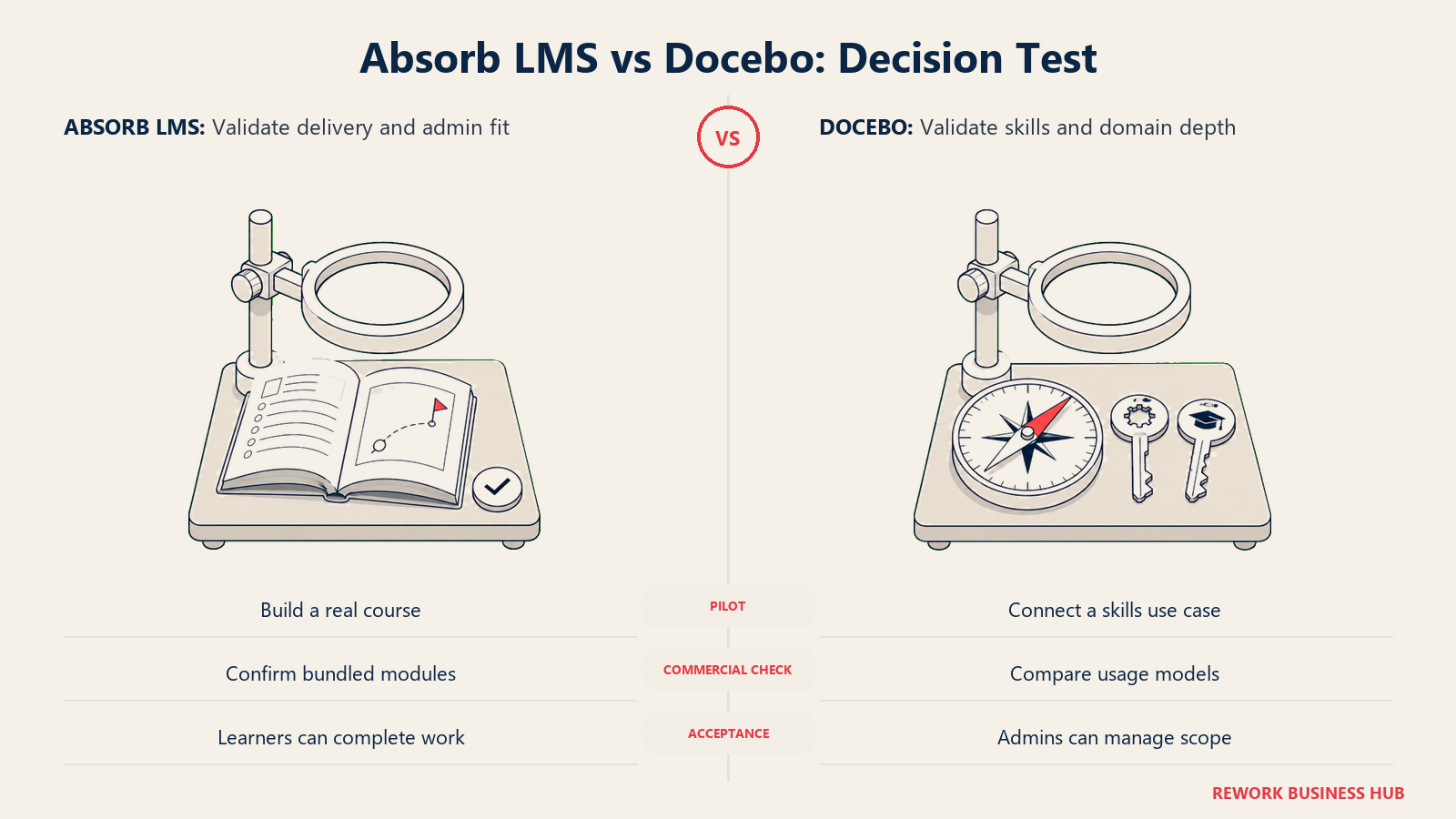
Use a real training program to test course delivery, skills-data needs, and administrative scope before comparing commercial terms.
| If you need... | Choose |
|---|---|
| A faster path to a first quote, with a lower stated learner floor | Absorb LMS |
| Skills-gap intelligence built into the same platform as delivery | Docebo (via 365Talents) |
| AI agents that live inside Copilot, ChatGPT, or Claude, not just an in-app chat | Docebo (AgentHub) |
| Prompt-to-course authoring pulling from your existing team drives | Absorb LMS (Aura Create) |
| Billing that can flex around bursty, infrequent training (MAU) | Docebo |
| The simplest possible pricing model to explain internally | Absorb LMS, flat learner bands |
| Offline access to xAPI-tracked or assessment content for deskless staff | Absorb LMS |
| A vendor whose AI and skills roadmap is disclosed through public-company reporting | Docebo |
| Deep per-domain branding and authentication for many distinct audiences | Docebo (Extended Enterprise) |
Frequently Asked Questions about Absorb LMS and Docebo
Is Absorb LMS the same company as Absorb AI?
Yes. Absorb Software Inc. still owns and operates the product under the name Absorb LMS; absorblms.com now redirects to absorbai.com, but the footer still identifies the company as Absorb Software Inc. and Absorb Aura is the company's new AI agent suite, not a company rebrand.
What's the actual difference between Absorb Aura and Docebo AgentHub?
Aura is a set of three agents (Learn, Create, Admin Assist) that operate inside Absorb LMS itself. AgentHub is built to surface Docebo's AI agents natively inside external tools your team already uses, Microsoft Copilot, ChatGPT, and Claude, rather than only inside the LMS's own interface.
Do either Absorb or Docebo publish real prices?
No. Absorb's pricing page is a lead-capture form segmented into nine learner bands from 1-50 up to 25,000+, with no dollar figures. Docebo's page names two tiers, Elevate and Enterprise, plus a separate Skills Intelligence product, all priced by quote with no published number at any learner count.
What are MAU, YAU, and RAU in Docebo's pricing?
They're three ways Docebo can measure "active" users for billing: Monthly Active Users counts anyone active in a given month, Yearly Active Users counts anyone active at any point in the contract year, and Registered Active Users counts every licensed seat regardless of login. Absorb has no equivalent, it bills against a flat learner-count band instead.
Is Docebo really only for companies over 250 learners?
That's Docebo's own stated guidance, not a hard technical limit. Its pricing FAQ says the platform is "typically best suited" for organizations training at least 250 learners across a combination of employees, customers, and partners, worth confirming directly if you're close to that line.
Which platform has stronger offline mobile learning?
Absorb's app supports offline SCORM, xAPI, video, PDF/Office files, and Assessment lessons. Docebo's Go.Learn app supports offline SCORM, video, slides, files, and HTML, but its own help documentation states xAPI, AICC, LTI, tests, surveys, and multi-SCO SCORM packages don't work offline. Test your actual content types in a sandbox before a deskless-heavy rollout on either platform.
How new is Docebo's Skills Intelligence product?
Docebo acquired 365Talents in January 2026 and folded it into a broader AI Workforce Readiness Platform announcement in April 2026. As of September 2026, 365Talents still operates as its own connected brand rather than a natively unified module, with tighter integration targeted for later in the year.
What to Do Next
Match the shortlist to your actual headcount and skills-data requirement before requesting pricing from either vendor, not after. If you're under roughly 250 learners, or above it but running one primary training audience without a formal skills-intelligence mandate, start with Absorb's pricing form and ask specifically whether Aura Create is bundled with the quote or requires a separate Absorb Create license. If workforce skills data tied to delivery, or AI agents surfaced inside tools like Copilot and ChatGPT, is the real requirement, request a Docebo quote and ask for MAU, YAU, and RAU pricing side by side against your actual usage pattern, since that choice alone can move the bill more than any add-on will.
Still comparing the wider field before committing: our Docebo vs. TalentLMS comparison covers the self-serve end of Docebo's own shortlist, and LearnUpon is worth a look if multi-audience customer training matters more than AI depth. Cornerstone is the other enterprise-procurement name that regularly lands on Docebo's shortlist, and if your program is smaller and more SOP-driven than either of these two is built for, Trainual is worth a look before committing to a full LMS. For a different three-way head-to-head in this collection, iSpring Learn vs. LearnUpon vs. Litmos covers three more names solving three more specific training jobs.
Camellia writes about L&D and training technology for B2B teams.

Principal Product Marketing Strategist
On this page
- Key Facts
- TL;DR
- What Each Platform Is Actually Built For
- From LMS to AI Agent Suite: What Absorb Aura Actually Does
- Skills Intelligence, Enterprise Knowledge, and AgentHub: Docebo's Bigger AI Bet
- Decision by Business Goal
- Team and Role Fit
- Authoring and Content Libraries
- Reporting and Analytics
- Integrations
- Admin, Branding, and Multi-Audience Portals
- Mobile and Offline Learning
- Compliance and Security
- Pricing Structure: Learner Bands vs. MAU, YAU, and RAU
- Billing Basis: Docebo's MAU, YAU, RAU vs. Absorb's Flat Learner Bands
- Sizing and Persona: Who Actually Fits Each Platform
- Implementation and Support
- When Absorb LMS Is the Right Call
- When Docebo Is the Right Call
- Decision Framework
- What to Do Next