Best Cornerstone OnDemand Alternatives in 2026: 15 LMS Platforms for Enterprise L&D
Turn this article into takeaways for your work.


Each assistant summarizes the article only for you and suggests best practices for your work.
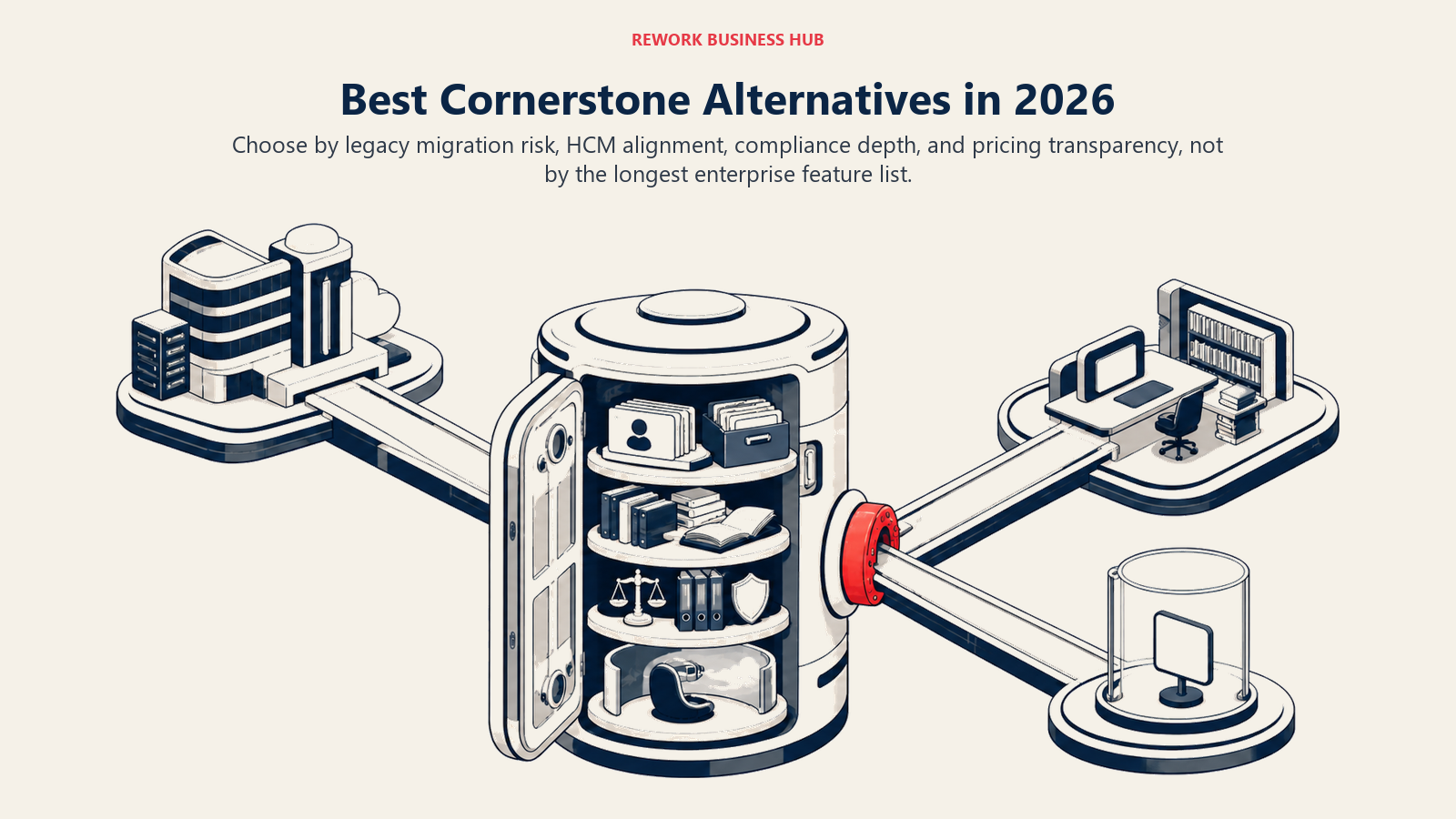
Docebo, SAP SuccessFactors Learning, and Absorb LMS are where most Cornerstone OnDemand evaluations land, though the right pick depends less on a feature checklist than on what you actually own today: a modern Cornerstone Learn deployment, or an inherited Saba Cloud or SumTotal contract that is being migrated into Cornerstone Galaxy whether you asked for it or not. Give Cornerstone its due first: it serves some of the largest, most complex workforces in the world, and Cornerstone Galaxy, the umbrella platform that has absorbed Saba, EdCast (now sold as Cornerstone Learning Experience), SumTotal, SkyHive, and TaleSpin, is a genuinely broad talent suite with learning as one module among several, not a bolt-on. For an enterprise that wants performance, skills, recruiting, and learning under one contract, that consolidation is hard to match feature for feature.
The catch is who ends up reading a guide like this one. Cornerstone's pricing page publishes no plan names and no dollar figures anywhere. It states plainly that each organization will have a different cost depending on needs and size, and the only path forward is a free personalized demo and estimate. So the people here are usually an L&D director or CHRO at a 1,000-plus employee company, often mid-contract, often inheriting an instance somebody else bought, and the decisions that actually matter are not feature checklists: they're consolidation risk, what happens to years of historical learner records during a migration, compliance and audit reporting, SSO and HRIS provisioning, and what a vendor's roadmap looks like eighteen months after its last acquisition. This guide evaluates 15 alternatives on real vendor-published pricing (or plainly says when none exists), acquisition history, and enterprise fit. For the full category view before narrowing to Cornerstone specifically, start with our LMS software roundup for 2026.
Key Facts
- Average direct learning expenditure per employee fell to $846 in 2025, down from $1,254 in 2024, a 33% drop, as organizations scrutinized platform costs before renewing usage-based contracts (ATD, 2026 State of the Industry Report).
- Total US training expenditure still rose 4.9% to $102.8 billion in 2025, so the budget scrutiny is about where money goes, not whether L&D gets funded at all (Training Magazine, 2025 Training Industry Report).
- 88% of organizations are concerned about employee retention, and offering learning opportunities is the No. 1 retention strategy respondents cite, the exact case an enterprise buyer has to make to justify a platform switch (LinkedIn Learning, 2025 Workplace Learning Report).
- Organizations with high-development cultures report 11% greater profitability and are twice as likely to retain employees, a direct line from L&D investment to numbers a CFO already tracks (Gallup).
- Employers expect 39% of workers' core skills to change by 2030, and 85% plan to upskill their workforce in response, the pressure behind Cornerstone's, Docebo's, and Degreed's parallel pushes into skills intelligence (World Economic Forum, Future of Jobs Report 2025).
Why Teams Look Past Cornerstone
Four patterns show up again and again in Cornerstone evaluations that end with a different vendor selected. None of them make Cornerstone a bad platform, they just mean the fit is narrower, and the diligence heavier, than the "one suite for everything" pitch suggests.
| Reason teams look elsewhere | The honest counterpoint |
|---|---|
| No published price anywhere on the site, every organization gets a custom estimate | A quote built around your actual needs and size can genuinely beat a rigid published rate card at real enterprise scale, especially with a competing bid in hand |
| Cornerstone Galaxy is a rollup of Saba, EdCast, SumTotal, SkyHive, and TaleSpin, not a platform built from a single codebase | A broad, consolidated suite is exactly the pitch for a buyer replacing five separate legacy contracts with one; it only becomes a liability if all you ever wanted was a plain LMS |
| If you bought Saba Cloud or SumTotal as a standalone product, you're now on a legacy line being migrated into Galaxy whether or not you asked for it | Cornerstone will support that migration, but it is still a migration. Budget the same records, reporting, and SSO diligence you'd apply to switching vendors entirely |
| The pricing page's only offer is a free personalized demo and estimate, with no self-serve information before that call | For a genuinely complex, multi-country enterprise deployment, a scoped estimate is arguably more honest than a published rate card that never survives contact with your real requirements |
One more branching decision before the list. If Cornerstone showed up as part of a broader HRIS evaluation rather than a standalone LMS swap, the standalone-LMS question might be premature: if you're weighing an HRIS-embedded learning module against a dedicated LMS specifically, start with the Rippling alternatives guide instead.
Quick Comparison Table
| Tool | Best For | Starting Price | Key Strength | Key Limitation |
|---|---|---|---|---|
| Docebo | Skills-intelligence-driven enterprise LMS | Custom, priced on package plus MAU/YAU/RAU | Three-package structure ties learning to skills data | No dollar figures anywhere, "250+ learners" guidance |
| SAP SuccessFactors Learning | Enterprises already running SAP HCM | Custom, quote only | Native module inside the broader SuccessFactors suite | Best evaluated as part of a full HCM decision, not standalone |
| Workday Learning (powered by Sana) | Enterprises already running Workday HCM | Custom, quote only | AI engine built on Workday's own people and skills data | Newest integration on this list, GA since July 2026 |
| Absorb LMS | Compliance-heavy, decentralized training operations | Custom, 8 learner bands, no published number | Decade-plus compliance reporting track record | No pricing published at any learner band |
| Degreed | Skills-based learning experience over course completion | Custom, personalized quote | Deep skills taxonomy layered over learning content | No published number, sales-led at every step |
| LearnUpon | Employee, customer, and partner portals in one tool | Custom, from 100 to 300 users depending on audience | Purpose-built multi-audience portals | No dollar figures, only minimum user counts |
| Litmos | Fast-deploy compliance content library | Custom, "Contact for Pricing" | Large ready-made compliance and onboarding library | Zero pricing transparency, not even minimums |
| Moodle Workplace | Extending Moodle's open-source core into an enterprise layer | Partner-sold, no list price | Built on the world's most widely deployed LMS core | No self-serve path, every deal needs a partner |
| Skilljar (by Gainsight) | Selling customer or partner education as its own program | Custom, tier plus active-user fee | Purpose-built for external, revenue-generating training | No published subscription price at any tier |
| Continu | Paying for usage instead of purchased seats | Custom, tiered by monthly active users | MAU-based tiers scale with real adoption | No dollar figures published for any tier |
| Sana Learn | AI-native learning, standalone or Workday-bundled | Custom, per-user/month, 300-user minimum | Same AI engine now inside Workday Learning, still sold alone | 300-user minimum before any pricing shows |
| 360Learning | Piloting collaborative learning with zero contract | $8/user/month (Team, up to 100 users) | Courses co-authored by the SMEs doing the work | Team plan hard-caps at 100 users |
| TalentLMS | Budget-conscious teams that want a free tier first | Free up to 5 users; Core $119/mo (1-40 users) | Published pricing at every self-serve tier | Enterprise band effectively starts at 1,000 users |
| iSpring Learn | Modeling renewal cost before you sign anything | $6.91/user/month at 100 users, billed annually | Real, published per-active-user rates | Enterprise tier above 500 users still goes custom |
| Tovuti | One flat annual number instead of per-seat math | $7,500/year, first 100 learners | Single all-inclusive plan, nothing to configure | Per-extra-learner rate above 100 not published |
Published Price vs. Quote-Only: The Real Spine of This Decision
Cornerstone itself is quote-only, full stop: no plan names, no tiers, no dollar figures anywhere on the site. At the enterprise end of this category, most of its alternatives are quote-only too, which is exactly why the four vendors below that DO publish real numbers, even though most are too small for a 1,000-plus employee buyer on their own, are worth reading closely as budget anchors. They're the only honest reference point for what "per-learner cost" looks like before a sales call reframes it.
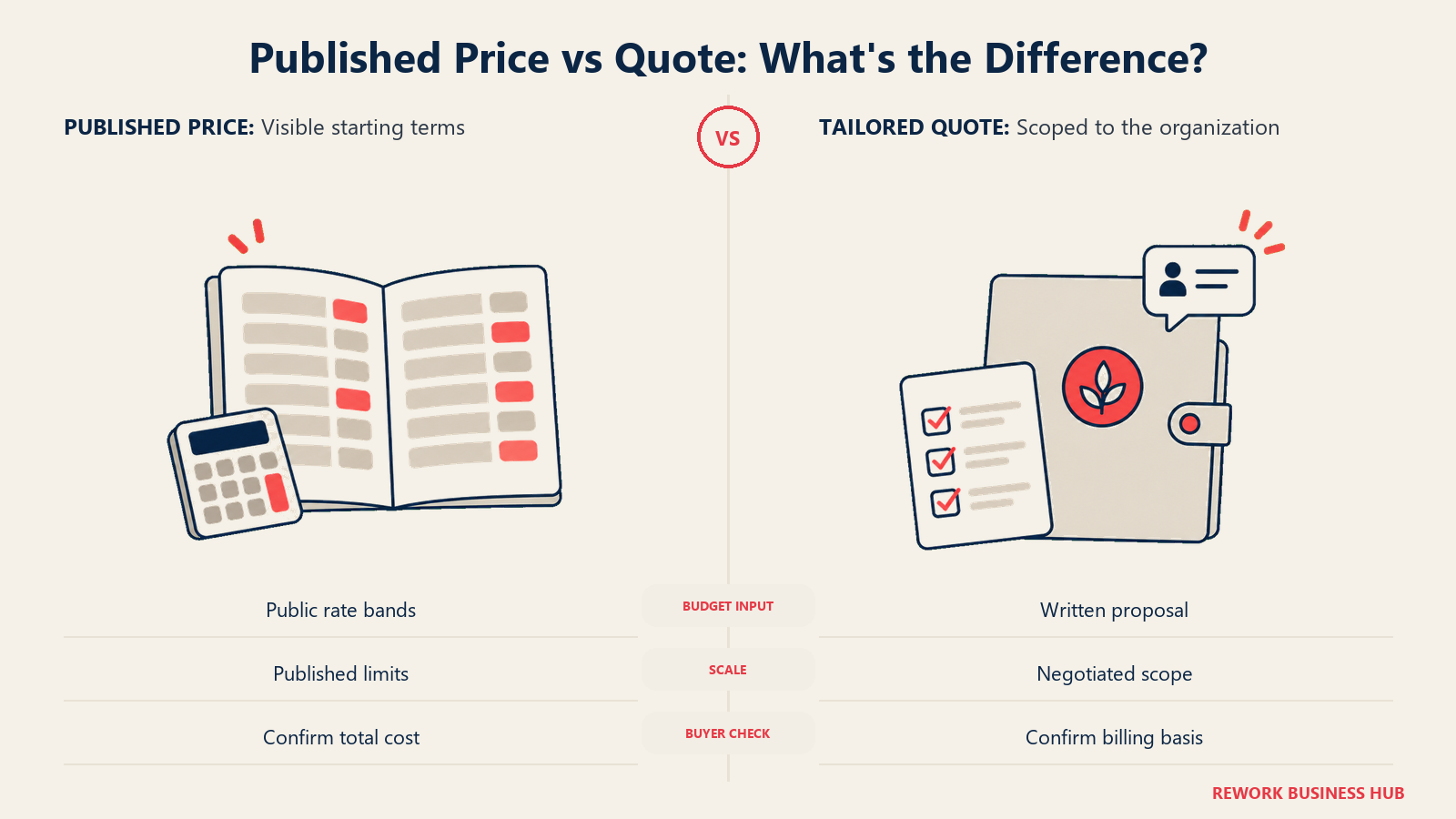
| Platform | Pricing status |
|---|---|
| Cornerstone OnDemand (the incumbent) | Quote-only, no plan names or prices published anywhere |
| Docebo | Quote-only, three named packages (Elevate, Enterprise, Skills Intelligence), no dollar figures |
| SAP SuccessFactors Learning | Quote-only, no dollar figures at all |
| Workday Learning (powered by Sana) | Quote-only, no dollar figures at all |
| Absorb LMS | Quote-only, eight learner-band request form, no tier names |
| Degreed | Quote-only, "personalized and flexible" per company, needs, budget, and headcount |
| LearnUpon | Quote-only, publishes user minimums, not prices |
| Litmos | Quote-only, "Contact for Pricing," no minimums published either |
| Moodle Workplace | Quote-only, partner-sold (MoodleCloud, a separate hosted product, does publish: $170/yr for 50 users) |
| Skilljar | Quote-only, only add-on prices published (Content Syndication $10,000, Data Connector from $25,000) |
| Continu | Quote-only, three named MAU tiers, no dollar figures |
| Sana Learn | Quote-only, indicative pricing shown only after entering headquarters and user count |
| 360Learning | Published on Team: $8/user/month, up to 100 users; Business and Enterprise custom |
| TalentLMS | Published through Pro ($449/mo, 1-100 users); Enterprise custom |
| iSpring Learn | Published through 500 users ($3.97/user/mo); Enterprise custom above that |
| Tovuti | Published: $7,500/year flat for the first 100 learners |
User Minimums and Billing Basis
Headline price matters less than what actually gets billed. An active-user model rewards low utilization; a flat seat count punishes it. Know which one you're signing before you compare two quotes side by side.
| Platform | Billing basis | Minimum or floor |
|---|---|---|
| Docebo | Active users: MAU, YAU, or RAU depending on package and add-ons | No published minimum; page guidance says "Training at least 250+ learners" |
| SAP SuccessFactors Learning | Not published | Not published |
| Workday Learning (powered by Sana) | Not published, bundled into a broader Workday HCM contract | Not published |
| Absorb LMS | Learner-count band, flat request form | Smallest published band is 1 to 50 learners |
| Degreed | Not published, custom by "company, needs, budget, and headcount" | Not published |
| LearnUpon | Per-seat, by audience-specific plan | 100 users (Employees), 150 (Associations), 300 (Customer Education) |
| Litmos | Not published | Not published |
| Moodle Workplace | Partner-negotiated, not published | Not published (MoodleCloud, the separate hosted product, runs 50 to 750 users) |
| Skilljar | Base subscription plus an active-user fee | Not published |
| Continu | Monthly active users (MAU) | Growth under 1,000 MAU; Professional 1,000 to 5,000; Enterprise 5,000-plus |
| Sana Learn | Per-user/month, varies by volume | 300-user minimum before any pricing is even indicated |
| 360Learning | Per-user/month on Team; a mix of registered and active users at higher tiers | No minimum on Team, capped at 100 users |
| TalentLMS | Flat monthly band, then per-user overage on Pro | No minimum; free tier caps at 5 users |
| iSpring Learn | Per-active-user/month, login-based, billed annually | No published minimum; smallest published band is 100 users |
| Tovuti | Flat annual price for an included learner band | Included band is the first 100 learners |
1. Docebo: The Closest Head-to-Head Skills-Intelligence Competitor
Docebo is the natural first stop for a Cornerstone evaluator because it's making the same argument Cornerstone Galaxy makes, learning tied to a bigger talent picture, just with a narrower, more recent acquisition instead of a decade of rollups. Since buying 365Talents in January 2026 for roughly $54.6 million cash plus up to $5.1 million in earn-outs, Docebo now sells three distinct packages: Elevate, Enterprise, and Skills Intelligence (365Talents). None of them come with a published number.
The billing basis is the detail almost nobody writes down, and it's the one that actually determines your renewal cost: Docebo prices on package tier plus active users, and it offers three different ways to count them (monthly, yearly, or registered active users, called MAU, YAU, and RAU) depending on the plan. Docebo's own pricing page still states the platform suits companies "Training at least 250+ learners," so smaller teams should expect a quote weighted toward that assumption. If Docebo itself becomes your shortlist, our dedicated Docebo alternatives guide and Docebo vs. TalentLMS comparison cover that narrower decision.
| Pros | Cons |
|---|---|
| Skills Intelligence package ties learning directly to internal mobility data | No dollar figures published for any of the three packages |
| MAU/YAU/RAU options let you match billing to how the platform is actually used | 365Talents integration is a year old, still maturing |
| Deep content marketplace and extended-enterprise features for partner training | "250+ learners" guidance means smaller teams pay for depth they won't use |
Pricing: Custom, three packages (Elevate, Enterprise, Skills Intelligence), billed on package tier plus MAU, YAU, or RAU. No dollar figures published.
Best for: enterprises that want a comparably deep alternative to Cornerstone Galaxy with a specific, recent skills-intelligence acquisition rather than a decade of rollups.
2. SAP SuccessFactors Learning: The Play for an Existing SAP Shop
SAP SuccessFactors Learning is worth shortlisting for one specific reason: if your organization already runs SAP for ERP or core HCM, the learning module sits inside a stack you're already paying for and already integrated with your HRIS, not a separate vendor relationship layered on top. That's the same consolidation logic Cornerstone Galaxy sells, applied to the SAP ecosystem instead.
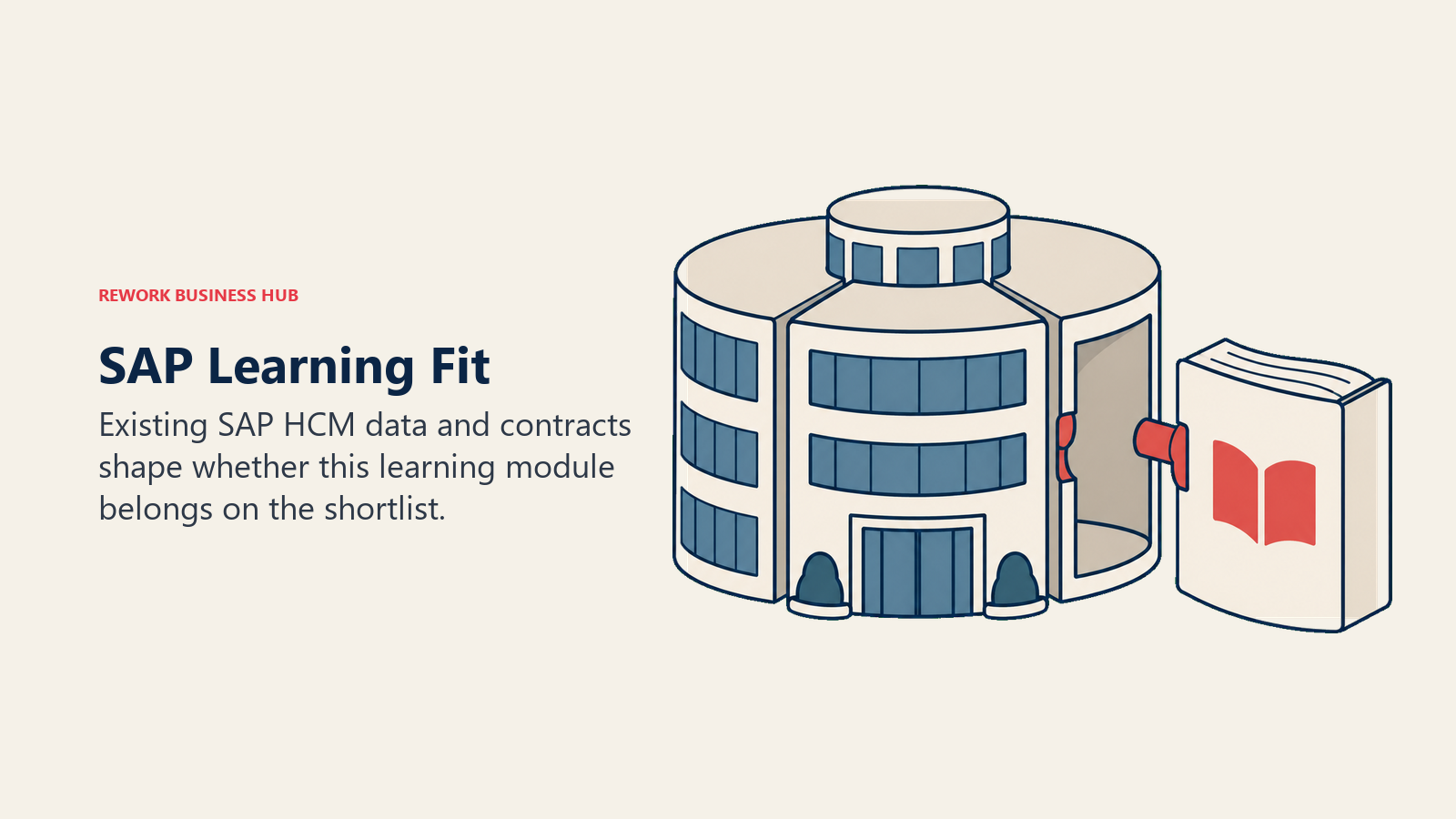
SAP's own pricing page for the corporate LMS is titled, plainly, "SAP SuccessFactors Learning pricing," and contains no numbers beneath that heading. The only options are "Request a quote," "Request a Demo," and "Contact Us." That's consistent with how SAP prices the rest of the SuccessFactors suite, HCM software is rarely sold as a standalone line item, which is also why this module is genuinely difficult to evaluate on its own. A buyer replacing Cornerstone with SAP SuccessFactors Learning is usually replacing a standalone LMS decision with a broader HCM one.
| Pros | Cons |
|---|---|
| Native fit for organizations already running SAP HCM or ERP | No standalone pricing, evaluated as part of a much larger suite decision |
| Compliance reporting benefits from SuccessFactors' broader HCM data model | Sales cycle and implementation scope run longer than a point LMS |
| One fewer vendor relationship for SAP-centric IT and procurement teams | Weak fit if you don't already run SAP elsewhere in HR or finance |
Pricing: Custom, quote only. No dollar figures published anywhere on the page.
Best for: enterprises already running SAP HCM that want learning inside the same contract and data model rather than a separate LMS vendor.
3. Workday Learning, Powered by Sana: The Newest AI Engine in Enterprise HCM
Workday Learning went generally available under its current form on July 22, 2026, rebuilt around Sana's AI engine after Workday's roughly $1.1 billion acquisition of Sana Labs, announced September 15, 2025. The pitch: an AI tutor that answers employee questions and recommends learning paths based on role and skills data already living in Workday, tools that convert existing documents and decks into interactive courses, and AI-driven automation for assignments and campaigns, all grounded in Workday's own people data rather than a bolted-on AI layer.
Like SAP SuccessFactors Learning, this is a module inside a much bigger HCM contract, not a standalone LMS purchase, and Workday publishes no pricing for it. The genuinely interesting wrinkle for an enterprise evaluator: the same underlying AI engine is also sold on its own, several entries down this list, as Sana Learn, which Sana's own pricing page confirms customers can "purchase, deploy, and run independently" of Workday. So a buyer gets a real choice between the AI engine bundled into a Workday HCM contract or standalone, a rare case where an acquisition produced two distinct buying paths instead of one.
| Pros | Cons |
|---|---|
| AI engine built on Workday's own people and skills data, not a third-party bolt-on | Newest integration in this list, live in its current form since July 2026 |
| Same underlying technology also available standalone as Sana Learn | No standalone pricing, tied to a full Workday HCM contract |
| Converts existing docs and decks into interactive courses automatically | Roadmap depth still being proven after a recent, large acquisition |
Pricing: Custom, quote only, bundled into a broader Workday HCM contract. No dollar figures published.
Best for: enterprises already running Workday HCM that want the newest AI-native learning engine in this category without adding a separate vendor.
4. Absorb LMS: Enterprise Depth Without a Published Price Tag
Absorb LMS, built by Absorb Software Inc. and still branded Absorb LMS even though its pricing page now lives at absorbai.com, has been a fixture in the enterprise and mid-market LMS conversation for over a decade. It earns that spot on breadth: strong compliance reporting, an extensive integration catalog, and a genuinely capable admin experience for large, decentralized training operations. Its newest push is Absorb Aura, a set of AI-powered learning and admin agents built in-house rather than acquired, which gives it one of the more stable ownership histories on this list.
Where it will frustrate a Cornerstone evaluator hunting for budget certainty is pricing transparency. Absorb publishes no tier names and no dollar figures. The pricing page is a lead-gen form asking "How many learners do you have?" against eight bands from 1 to 50 up to 25,000-plus, and a quote follows from there, the same quote-only wall Cornerstone puts up, just with a different sales team on the other end. For the wider field around this vendor specifically, see our Absorb LMS alternatives guide.
| Pros | Cons |
|---|---|
| Decade-plus compliance and reporting track record | No pricing published at any of the eight learner bands |
| Absorb Aura adds in-house AI agents, no acquisition dependency | Every deal starts with a lead-gen form, not a price list |
| Broad integration catalog for enterprise HR/HRIS stacks | Best suited to teams already above the smaller learner bands |
Pricing: Quote-only, eight bands from 1-50 to 25,000-plus learners, no published dollar figures.
Best for: enterprises that want depth comparable to Cornerstone Galaxy without the multi-vendor acquisition history behind it.
5. Degreed: A Skills Layer First, a Course Library Second
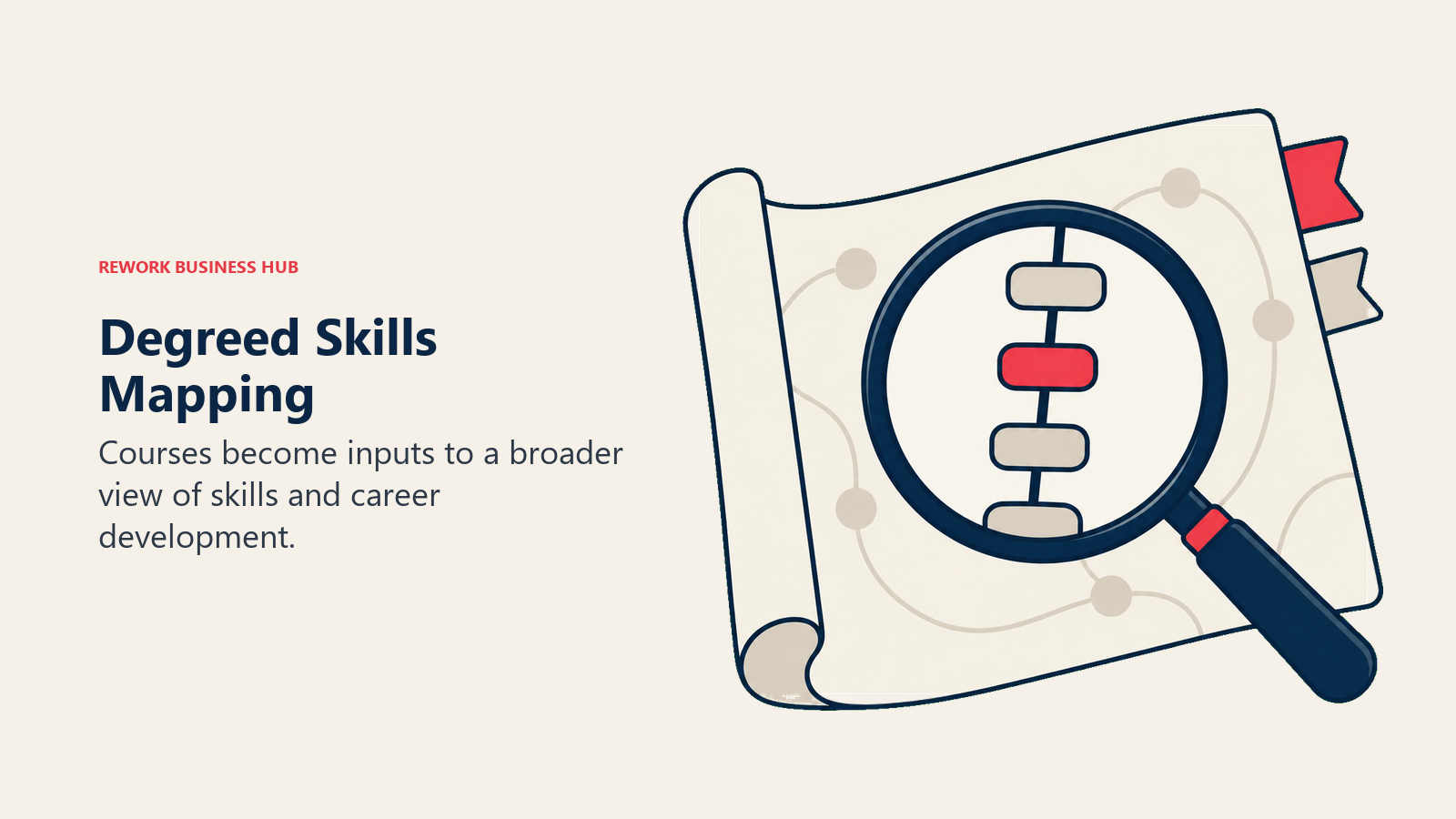
Degreed approaches the problem from the opposite direction of a traditional LMS: instead of organizing around courses and completions, it organizes around skills, and treats content, whether internal, purchased, or user-generated, as one input into a broader skills graph tied to career mobility. For a Cornerstone evaluator specifically drawn to the skills-intelligence side of Cornerstone Galaxy AI, Degreed is one of the more mature standalone plays making that same argument.
Degreed's own pricing page confirms there's nothing published: "Just like our learning tools, our pricing is personalized and flexible based on your company, needs, budget, and headcount," with every path routing to a "Talk to Sales" form. That's consistent with the rest of this list's quote-only enterprise tier, but it means a team evaluating Degreed against Cornerstone gets no self-serve number from either vendor.
| Pros | Cons |
|---|---|
| Skills-first data model rather than a course-completion ledger | No published number, same sales-led process as Cornerstone |
| Aggregates internal, purchased, and user-generated content into one skills graph | Weaker fit if compliance course delivery is the primary job, not skills mapping |
| Mature product with over a decade in the skills-intelligence space | Requires real organizational buy-in to keep skills data current |
Pricing: Custom, quote only. "Personalized and flexible based on your company, needs, budget, and headcount," no dollar figures published.
Best for: enterprises that want a skills-first learning experience platform rather than a course-completion LMS, and are comfortable with a fully sales-led buying process either way.
6. LearnUpon: Multi-Audience Training Without Cornerstone's Full Suite Overhead
LearnUpon's structure fits a specific, common complaint about Cornerstone: needing separate portals for employees, customers, and partners without buying an entire talent suite to get there. LearnUpon builds that multi-portal design in from the start, with a distinct plan for each audience: LearnUpon for Employees, Customer Education, and Associations.
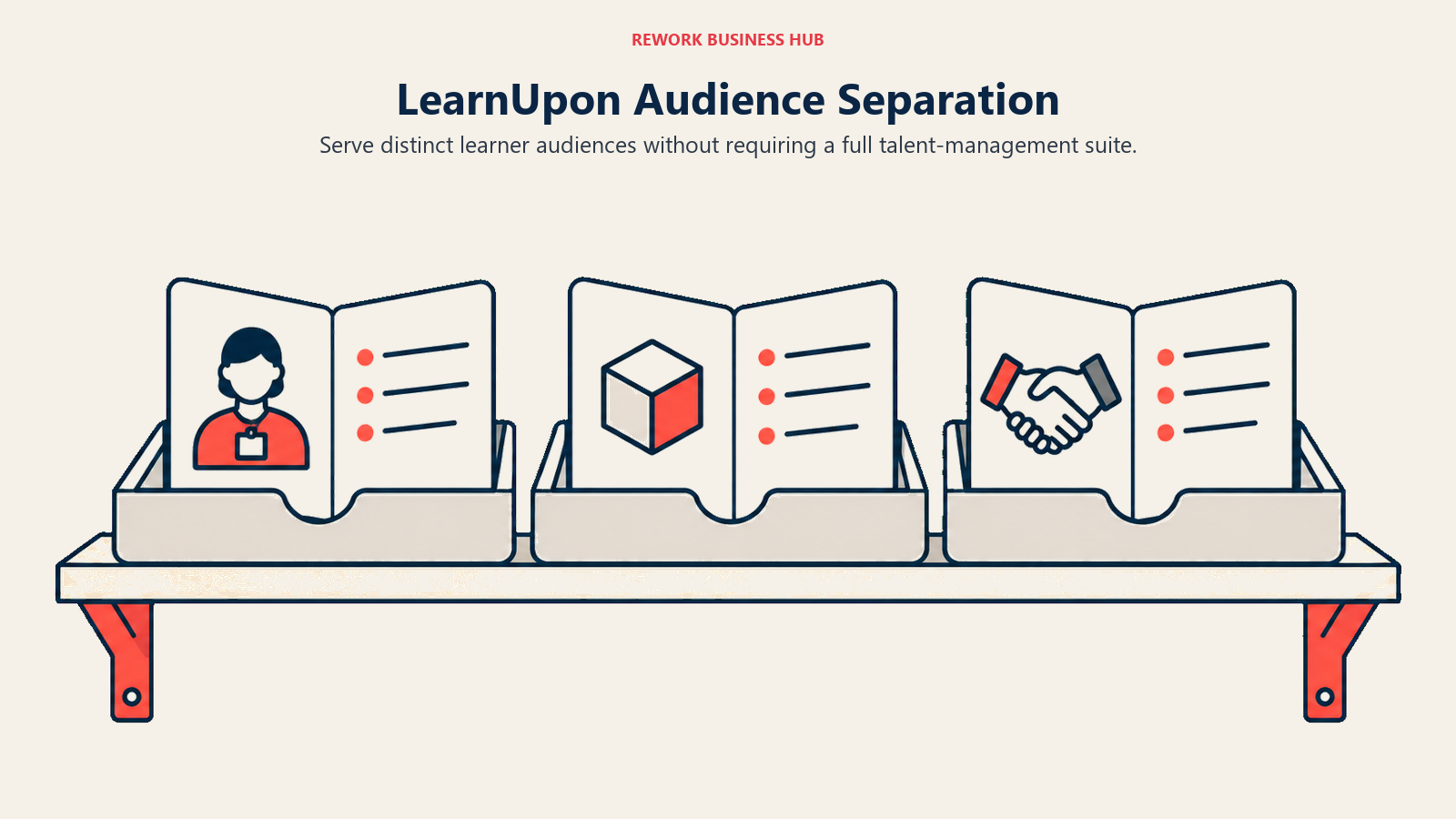
Pricing is not published, but the minimums are, and they're lower than the scale Cornerstone Galaxy is really built for. Employees starts from 100 users, Customer Education from 300 users, and Associations from 150 users. A company running internal employee training only can evaluate LearnUpon well below the true enterprise floor, while a customer-education use case needs real volume to make sense.
| Pros | Cons |
|---|---|
| Purpose-built plans for employee, customer, and association audiences | No published pricing at any plan |
| Lower entry minimum (100 users) than a full enterprise talent suite | Customer Education plan needs 300 users to even quote |
| Single platform can serve multiple audiences without a custom build | Every plan still routes to a sales conversation |
Pricing: Quote-only. LearnUpon for Employees "From 100 Users," Customer Education "From 300 Users," Associations "From 150 Users." No dollar figures published.
Best for: organizations that need separate employee, customer, and partner training experiences without buying into a full talent-management suite.
7. Litmos: Compliance Speed at the Cost of Any Pricing Transparency
Litmos built its reputation on compliance and onboarding content that ships ready to use, backed by a large pre-built course library many mid-size and large companies deploy with minimal custom authoring. Worth knowing before a demo: Litmos has changed hands twice since 2011, from CallidusCloud to SAP in 2018, then divested by SAP to Francisco Partners, a private-equity firm, in December 2022. It now operates independently under Francisco Partners, not as part of SAP's suite.
That ownership history matters for the same reason Cornerstone's acquisition trail matters: a third owner in fifteen years is a real pattern worth asking about in a demo, specifically what happened to the product roadmap at each transition. On price, Litmos is the least transparent vendor in this entire list. All three tiers, Foundation, Platinum, and Platinum AI, display as "Contact for Pricing" with no user minimums published anywhere. For a head-to-head look at Litmos against two other compliance-and-authoring options, see our iSpring Learn vs. LearnUpon vs. Litmos comparison.
| Pros | Cons |
|---|---|
| Large ready-made compliance and onboarding content library | Zero pricing transparency, not even user minimums |
| Now independently operated after divesting from SAP in December 2022 | Third corporate parent in fifteen years, worth diligence on roadmap continuity |
| Established, widely deployed compliance track record | No self-serve or published-price option at all |
Pricing: Quote-only across Foundation, Platinum, and Platinum AI. No user minimums or dollar figures published.
Best for: compliance-driven enterprises that want a ready-made content library and are prepared for a fully sales-led buying process.
8. Moodle Workplace: Open-Source Roots, Partner-Sold Enterprise Layer
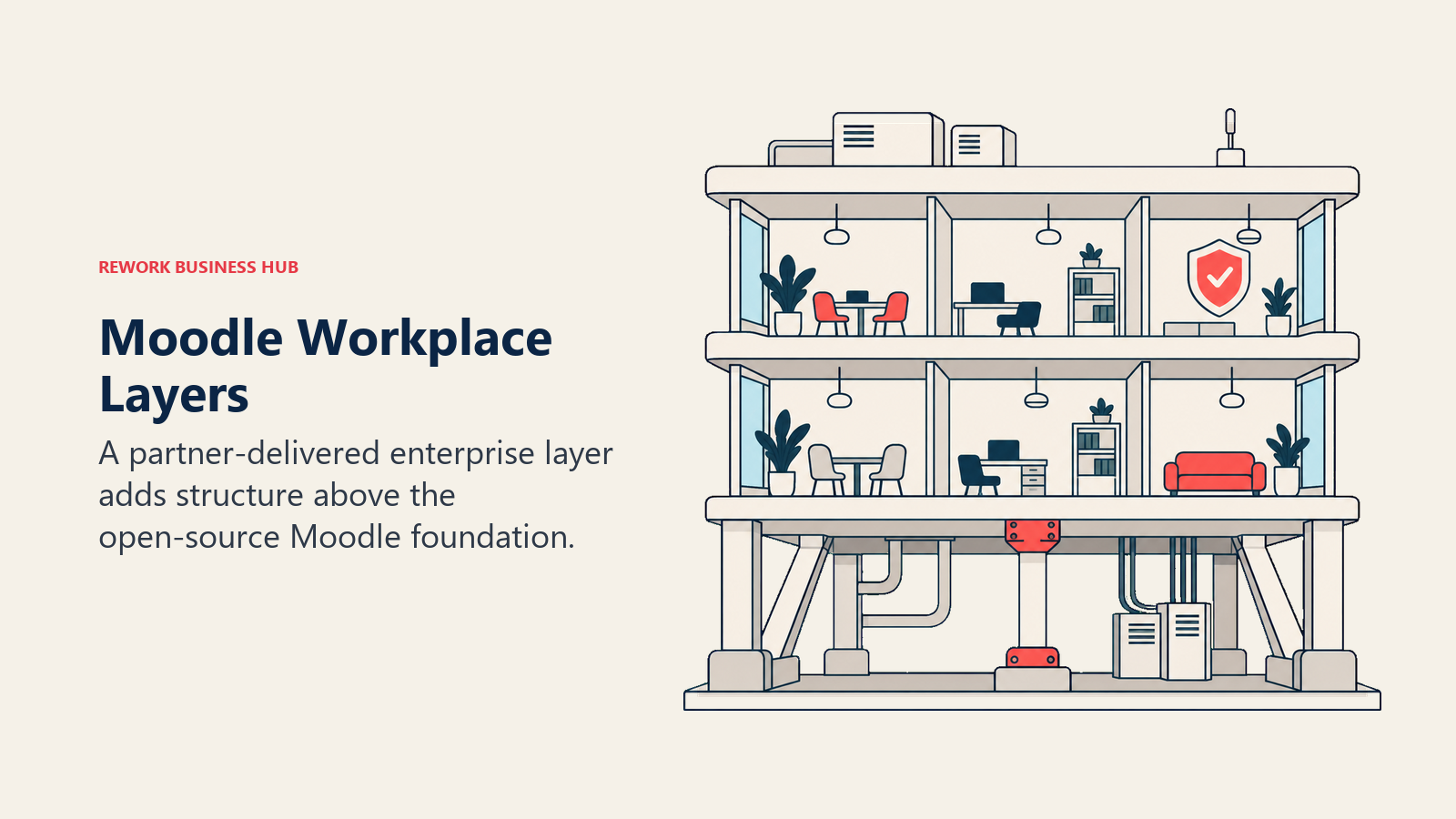
Moodle deserves a careful explanation for an enterprise evaluator, because "Moodle is free" is the most common wrong assumption in this category, and it's only half true. Core Moodle is genuinely free and open source under the GPL if you self-host it. Moodle Workplace, the product actually comparable to Cornerstone Galaxy at scale, is different: a commercial, enterprise-grade layer (multi-tenancy, compliance reporting, dynamic rules, org charts) sold exclusively through Certified Moodle Partners, with no self-serve tiers and no list price at all.
Buyers who want a Moodle-based option with a published price should look at MoodleCloud instead, the officially hosted version of core Moodle: it starts at $170 a year for 50 users on a 28-day free trial, scaling to $2,150 a year for 750 users. But MoodleCloud caps at 750 users and allows no custom plugins on any tier, exactly the workplace-grade flexibility Moodle Workplace exists to add back in, at a partner-negotiated price. For the wider Moodle-adjacent field, our Moodle alternatives guide covers it.
| Pros | Cons |
|---|---|
| Built on the world's most widely deployed open-source LMS core | No self-serve path or list price at all for the enterprise layer |
| Multi-tenant, compliance, and org-chart features beyond core Moodle | Every deal requires a Certified Moodle Partner relationship |
| Partner network can tailor implementation to unusual requirements | Cost and timeline vary by which partner you land with |
Pricing: Sold only through Certified Moodle Partners, no list price. (MoodleCloud, the hosted core product, is published: $170/year for 50 users up to $2,150/year for 750 users, annual, no custom plugins on any tier.)
Best for: organizations already bought into Moodle's open-source model that need enterprise features and are comfortable working through a partner.
9. Skilljar (by Gainsight): Purpose-Built for Selling Training, Not Just Delivering It
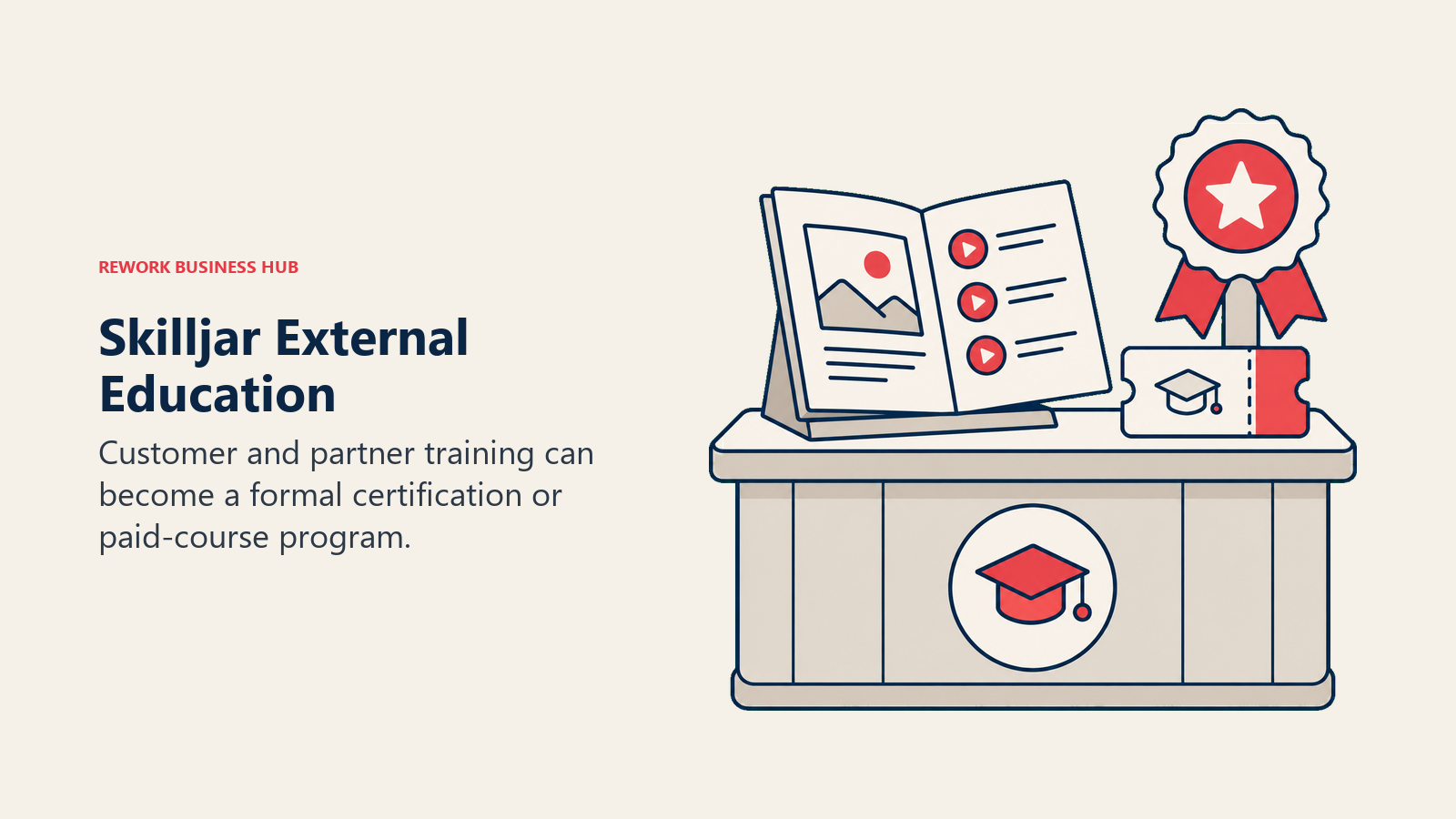
Skilljar, now sold as Skilljar by Gainsight after being acquired by the customer-success platform, is built for a job Cornerstone's extended-enterprise features approximate but don't specialize in: training external customers and partners as a product in its own right, sometimes a revenue line of its own. That focus shows up in certification tracking, e-commerce for paid courses, and reporting built around customer adoption and product usage rather than completion rates, a certification approach worth grounding in a real framework like our guide to certification programs.
Pricing follows the specialization. All three tiers, Essentials, Professional, and Enterprise, are quote-only, and the model is a base annual subscription plus an active-user fee rather than a flat per-seat rate. The only real numbers Skilljar publishes are add-ons: Content Syndication at $10,000, a Data Connector starting at $25,000, and Language Packs starting at $10,000 for 5 languages, a useful sense of scale even without a base subscription figure.
| Pros | Cons |
|---|---|
| Purpose-built for external customer and partner training | No published subscription price at any tier |
| Now backed by Gainsight's customer-success data ecosystem | Add-on prices ($10k-$25k-plus) hint at a high total cost |
| E-commerce and certification tracking built for the use case | Overkill for purely internal employee training |
Pricing: Quote-only across Essentials, Professional, and Enterprise (subscription plus active-user fee). Published add-ons only: Content Syndication $10,000, Data Connector from $25,000, Language Packs from $10,000 for 5 languages.
Best for: enterprises that sell or formalize customer or partner education as its own program, not just internal training.
10. Continu: Growth-Stage Pricing Logic Applied to Enterprise Scale
Continu prices on monthly active users rather than total employee count or purchased seats, split into three tiers: Growth for under 1,000 MAU, Professional for 1,000 to 5,000 MAU, and Enterprise for 5,000-plus MAU. No dollar figures are published for any tier, but the structure answers a real complaint about Cornerstone-scale seat-based contracts: you're not paying for licenses nobody opens.
The product leans into a modern, browsable content experience, skill paths and structured learning journeys built to be genuinely explored rather than assigned and forgotten. For an enterprise whose issue with Cornerstone was less about price and more about adoption inside a sprawling suite, Continu's MAU-first pricing at least aligns the vendor's incentive with actual usage rather than headcount alone.
| Pros | Cons |
|---|---|
| MAU-based tiers align cost with actual platform usage at real scale | No dollar figures published for any of the three tiers |
| Clean three-tier structure that scales predictably with growth | Thinner compliance and reporting depth than Cornerstone or Absorb |
| Modern content experience built for voluntary engagement | Enterprise band (5,000-plus MAU) still requires a custom quote |
Pricing: Quote-only, tiered by monthly active users: Growth (under 1,000 MAU), Professional (1,000-5,000 MAU), Enterprise (5,000-plus MAU). No prices published.
Best for: growth-stage-to-enterprise teams whose real problem is low adoption inside a bloated suite, not just Cornerstone's opacity on price.
11. Sana Learn: The AI Engine Available Two Ways
Sana Labs built Sana Learn around AI from the ground up: generating content, summarizing material, and surfacing the right learning moment inside the tools people already use for work. Workday acquired Sana Labs for roughly $1.1 billion in a deal announced September 15, 2025, and the resulting technology now also powers Workday Learning, covered earlier in this list. What makes Sana Learn worth its own entry is that it didn't disappear into Workday: Sana's own pricing page states plainly that Sana Learn "works alongside any HR system and requires no migration to Workday's systems," and that customers "can purchase, deploy, and run it independently."
That's a genuinely unusual outcome for an acquisition this size, and it means an enterprise evaluator gets a real choice: the same AI engine bundled into a Workday HCM contract, or bought standalone against any existing HRIS. The catch with the standalone product is scale. Pricing is per-user, per-month, and explicitly "varies by volume," but Sana requires a 300-user minimum before it will even generate indicative pricing, and that number only appears after entering your headquarters location and user count into its pricing tool. Worth reading against a broader view of AI-augmented learning before committing to an AI-native platform this new.
| Pros | Cons |
|---|---|
| Works alongside any HR system, no Workday migration required to buy it | 300-user minimum before any pricing is even indicated |
| Same AI engine now proven inside Workday Learning's GA release | No list price exists at any volume |
| AI-native content generation and delivery, not a bolted-on feature | Too much minimum commitment for smaller teams to evaluate |
Pricing: Per-user/month, varies by volume, 300-user minimum, indicative pricing only after entering headquarters location and user count. No list price published.
Best for: enterprises that want the same AI engine behind Workday Learning but need it to run independently of a Workday HCM contract.
12. 360Learning: Peer-Built Courses on a Published, No-Commitment Plan
360Learning's pitch is that the best course content comes from the people doing the work, not a training team building courses in isolation. Subject-matter experts co-author courses directly in the platform, and a collaborative learning engine surfaces feedback the way a wiki does, not the way a static file does. For a team piloting an alternative to a Cornerstone rollout before committing enterprise-wide, that flip in ownership is a real reason to trial it, not just the price.
The pricing is also the most transparent, lowest-commitment entry point on this entire list. The Team plan is $8 per user per month, billed monthly, with no annual commitment and no minimum volume, capped at 100 users. A 40-person pilot team can start this month and cancel next month if it doesn't work, something no Cornerstone deal allows. Business and Enterprise tiers go custom, priced on a mix of registered and monthly active users once you cross 100 seats. If 360Learning itself becomes the shortlist, our 360Learning alternatives guide covers the rest of that field.
| Pros | Cons |
|---|---|
| $8/user/month published, monthly billing, zero commitment | Team plan hard-caps at 100 users |
| Collaborative authoring gets SMEs actually contributing content | Business/Enterprise pricing reverts to custom quotes |
| Easiest platform on this list to pilot before an enterprise rollout | Lighter on extended-enterprise and skills-intelligence depth than Cornerstone |
Pricing: Team $8/user/month, up to 100 users, billed monthly, no annual commitment, no minimum volume. Business and Enterprise custom, annual, priced on a mix of registered and active users.
Best for: enterprise teams that want to pilot a genuinely collaborative alternative on a real credit card before committing to a company-wide rollout.
13. TalentLMS: The Budget Anchor With a Number at Every Tier
TalentLMS earns its spot on an enterprise-focused list for one reason: it's the clearest budget anchor available. Every tier, including the free one, has a published number attached, which makes it the fastest way to sanity-check what a quote-only vendor's sales rep tells you about "typical" pricing at your scale. The free plan covers up to 5 users and 10 courses, enough to test the interface before anyone signs anything.
Paid tiers scale in clearly published bands. Core is $119 per month for 1 to 40 users, Grow is $229 per month for 1 to 70 users, and Pro is $449 per month for 1 to 100 users, then $6 per additional user up to 500. Annual billing takes 20% off any of those. Enterprise is custom and, per TalentLMS's own page, effectively starts at 1,000 users, with a "Flexible" custom option from 500. That Enterprise band is genuinely comparable in scale to a Cornerstone deployment, worth a direct quote comparison for a mid-size enterprise rather than an assumption that TalentLMS is too small. See the full TalentLMS alternatives guide if you're comparing it against the rest of that field too.
| Pros | Cons |
|---|---|
| Free tier and published pricing at every paid band, including near-enterprise scale | Enterprise band, 1,000-plus users, still routes to a custom quote |
| Real, checkable published numbers to sanity-test any Cornerstone or Docebo quote | Lighter skills-intelligence and extended-enterprise depth than Cornerstone Galaxy |
| Fast self-serve setup, no sales call required to start evaluating | Pro tier's per-user overage ($6) can add up past 100 users |
Pricing: Free up to 5 users/10 courses. Core $119/mo (1-40 users). Grow $229/mo (1-70 users). Pro $449/mo (1-100 users, then plus $6/additional user to 500). Annual billing: 20% off. Enterprise custom, effectively starts at 1,000 users (Flexible option from 500).
Best for: budget owners who want a published number to hold every quote-only enterprise vendor accountable to, including at genuinely large scale.
14. iSpring Learn: The Cleanest Per-User Cost Model on This List
Most quote-only vendors in this list ask you to trust a sales rep's math. iSpring Learn is the exception: its Business plan publishes exact per-active-user rates at three real bands, billed annually. At 100 users it's $6.91 per user per month, or $8,286 a year. At 300 users the rate drops to $4.46 per user per month, or $16,050 a year. At 500 users it falls to $3.97 per user per month, or $23,790 a year. A user only counts as active if they log in at least once that month, which rewards low-utilization months rather than penalizing them the way a flat per-seat contract would.
That published math is the whole pitch for a team specifically frustrated by not being able to model a Cornerstone renewal in advance. Enterprise is still custom above the published bands, but you can build a real multi-year forecast off three public data points instead of one sales estimate. For a direct look at iSpring next to two other authoring-and-compliance-focused platforms, see the iSpring Learn vs. LearnUpon vs. Litmos comparison.
| Pros | Cons |
|---|---|
| Published per-active-user rates at three real bands through 500 users | Enterprise tier above 500 users still goes custom |
| Active-user billing (login-based) instead of flat seats | Rate improvements only kick in at meaningfully higher volume |
| Easiest vendor here to build a multi-year cost forecast for | Lighter extended-enterprise and skills-intelligence features than Cornerstone |
Pricing: Business plan, billed annually: 100 users $6.91/user/month ($8,286/year); 300 users $4.46/user/month ($16,050/year); 500 users $3.97/user/month ($23,790/year). Enterprise custom above published bands.
Best for: budget owners who want to build an actual cost model before a Cornerstone renewal conversation, not after one.
15. Tovuti: One Flat Number Instead of a Pricing Page
Tovuti closes this list with the simplest pricing structure of any vendor here: one all-inclusive plan at $7,500 per year for the first 100 learners, billed annually, with authoring, gamification, virtual classroom, and community features bundled in rather than sold as modules. For a buyer exhausted by Cornerstone's opaque, multi-product pricing process, that single number is the entire appeal, even though Tovuti itself is far too small to replace a true enterprise Cornerstone deployment on its own.
The honest limitation is what happens past 100 learners: Tovuti doesn't publish a per-extra-learner rate, so growth past the included band still requires a conversation, just a shorter one than most quote-only vendors on this list since you already know your starting price. There's also no monthly billing option, the $7,500 figure is an annual commitment.
| Pros | Cons |
|---|---|
| Single flat price, everything included, easy to budget for a pilot department | Per-extra-learner rate above 100 is not published |
| Simplest published pricing structure in this entire list | Annual-only billing, no monthly option |
| Broad feature set (authoring, gamification, community) in one plan | Far less enterprise depth than Cornerstone, Docebo, or Absorb at real scale |
Pricing: $7,500/year, first 100 learners, annual billing only. Per-extra-learner rate above 100 not published.
Best for: a single large department or division piloting an alternative with one predictable annual number, before any company-wide Cornerstone replacement decision.
Acquisition and Roadmap Risk
Cornerstone Galaxy's history of absorbing other companies is the whole reason a lot of readers are on this page. It's worth knowing that acquisition risk isn't unique to Cornerstone, several alternatives on this list carry their own ownership history worth asking about in a demo.
| Platform | Acquisition or consolidation history | What it means for a buyer |
|---|---|---|
| Cornerstone OnDemand (the incumbent) | Cornerstone Galaxy folded in Saba, EdCast (rebranded Cornerstone Learning Experience), SumTotal, SkyHive, and TaleSpin | If you inherited a Saba Cloud or SumTotal contract, you're already on a legacy line being migrated into Galaxy, not an independent product |
| Docebo | Acquired 365Talents for skills intelligence, announced January 2026 (roughly $54.6M cash plus up to $5.1M earn-out) | A recent, single acquisition, not a decade-long rollup; the Skills Intelligence package is still integrating |
| Workday Learning | Workday acquired Sana Labs for roughly $1.1 billion, announced September 15, 2025; "Workday Learning, powered by Sana" went GA July 22, 2026 | Newest AI engine in this list, live in its current form for only about a year |
| Sana Learn | Same Sana Labs entity acquired by Workday, but sold standalone per Sana's own pricing page ("purchase, deploy, and run it independently") | The one alternative here where a single acquisition produced two distinct buying paths, standalone or Workday-bundled |
| Litmos | CallidusCloud (2011) to SAP (2018) to Francisco Partners, a private-equity firm (December 2022) | A third corporate parent in fifteen years; ask specifically what changed in the roadmap at each transition |
| Skilljar | Acquired by Gainsight, now sold as "Skilljar by Gainsight" | Roadmap now ties customer training to Gainsight's broader customer-success data, a narrower but clearer parent thesis than Cornerstone's |
| Absorb LMS | No acquisitions of note; Absorb Aura was built in-house rather than bought | The most stable ownership history on this list, paired with a newer, less battle-tested AI roadmap |
Records and Migration: What Actually Follows You Out of Cornerstone
A migration is not just a data export, it's every downstream process that assumed Cornerstone was the system of record. Before signing anywhere, get a written answer on each of these, not a verbal assurance.
| What needs to survive the switch | Where it usually lives inside Cornerstone Galaxy | What to confirm with any alternative before signing |
|---|---|---|
| Historical course completions and certificates | Cornerstone Learning Management System, or a legacy Saba or SumTotal instance depending on when you bought in | Ask for a written commitment on SCORM, xAPI, or CSV export of the FULL completion history, not just the current year |
| Compliance and audit trail (who took what, when, pass or fail) | Cornerstone's reporting layer, sometimes split across Galaxy and a legacy Saba or SumTotal instance if internal migration never fully finished | Confirm the new platform's audit export includes pass/fail timestamps, not just a completion count, since regulators generally want the former |
| Course content itself (SCORM packages, video, assessments) | Authored natively or uploaded as SCORM or xAPI packages | Most modern LMS platforms import standard SCORM/xAPI packages; confirm before assuming a one-click migration, especially for older SCORM 1.2 content |
| Skills and competency data (if using Cornerstone Galaxy AI or Immerse) | A newer, still-evolving part of the Cornerstone data model | This is the least portable category. Ask any alternative exactly how it imports or rebuilds a skills taxonomy, none will simply absorb Cornerstone's proprietary skills graph |
| HRIS and SSO provisioning rules (who gets auto-enrolled and how) | Cornerstone's own identity and provisioning layer | Reconfirm SCIM/SSO mapping with your HRIS vendor for the new platform; provisioning rework is usually the biggest source of go-live delay, not content migration |
Compliance and Audit Reporting by Platform
For a regulated enterprise, "does it have reporting" is the wrong question, "does the report satisfy an auditor" is the right one. Here's what's actually established about each platform's compliance posture, and what's still worth verifying yourself.
| Platform | Built for compliance reporting? | What to verify |
|---|---|---|
| Cornerstone OnDemand (baseline) | Yes, one of its core historical strengths, especially via SumTotal's compliance heritage | Ask whether your instance still runs on legacy SumTotal reporting or has migrated into Galaxy's unified reporting layer |
| Absorb LMS | Yes, "strong compliance reporting built over a decade" is a stated strength | Confirm reporting depth against your specific regulatory framework (OSHA, GDPR, industry-specific rules) |
| Litmos | Yes, ships with a large pre-built compliance and onboarding content library | Zero pricing transparency means you can't budget the compliance module before a sales call |
| SAP SuccessFactors Learning | Yes, compliance reporting is native to the broader SuccessFactors HCM suite | Best evaluated as part of a full HCM decision, not a standalone LMS swap |
| Moodle Workplace | Yes, dynamic rules and compliance reporting are named features of the Workplace layer | Every deal requires a Certified Moodle Partner, so reporting configuration depends on which partner you use |
| LearnUpon | Partial, multi-audience portals track completions per audience without a dedicated published compliance module | Ask for a sample compliance report before signing, not just a features list |
| Degreed | Partial, the skills-first model reports on skill growth more than pass/fail compliance events | Confirm whether Degreed's reporting satisfies your auditor's definition of a compliance record, not just a learning record |
| Docebo, Workday Learning, Continu, Sana Learn, Skilljar, 360Learning, TalentLMS, iSpring Learn, Tovuti | Reporting exists but isn't marketed as a dedicated compliance module | Fine for internal training and onboarding; verify against your specific audit requirements before relying on any of them for regulated compliance training |
How to Choose: Decision Framework
| If you need... | Choose |
|---|---|
| Enterprise-scale consolidation with a recent, focused skills-intelligence acquisition | Docebo |
| Learning embedded in an SAP ERP/HCM stack you already run | SAP SuccessFactors Learning |
| Learning embedded in a Workday HCM stack, with a genuinely new AI engine | Workday Learning, powered by Sana |
| Deep compliance reporting without a bolt-on AI acquisition behind it | Absorb LMS |
| A skills-based learning experience platform rather than a course-completion LMS | Degreed |
| Separate portals for employees, customers, and partners | LearnUpon |
| A published price you can hold every quote-only vendor accountable to | TalentLMS or 360Learning |
| The same AI engine behind Workday Learning, but available independently of Workday | Sana Learn |
Frequently Asked Questions about Cornerstone OnDemand Alternatives
How much does Cornerstone OnDemand cost?
Cornerstone publishes no prices, no plan names, and no tiers anywhere. Its pricing page states that each organization will have a different cost depending on needs and size, and the only offer is a free personalized demo and estimate. The products it lists by name are Cornerstone Learning Management System, Cornerstone Learn, Cornerstone Immerse AI Companion, and Cornerstone Galaxy AI, alongside Saba and SumTotal as learning management offerings it now carries.
What is Cornerstone Galaxy, and how is it different from Cornerstone OnDemand?
Cornerstone Galaxy is the umbrella platform Cornerstone has built by folding Saba, EdCast (now rebranded Cornerstone Learning Experience), SumTotal, SkyHive, and TaleSpin into one product line. If you're evaluating Saba Cloud or SumTotal as a standalone purchase, you're actually looking at a legacy product line that now routes into Galaxy, not an independent product with its own roadmap.
What's the cheapest published alternative to Cornerstone?
TalentLMS has the lowest verified entry point, a free plan for up to 5 users and 10 courses, with paid tiers starting at $119 a month for 1 to 40 users. 360Learning is close behind at $8 per user per month on its Team plan, billed monthly with no annual commitment, capped at 100 users.
Which alternative fits a 1,000-plus employee enterprise consolidating several legacy tools?
Docebo, Absorb LMS, SAP SuccessFactors Learning, and Workday Learning all target that scale, but the right one usually depends on which HCM suite, if any, you already run. SAP shops should look at SAP SuccessFactors Learning first, Workday shops at Workday Learning, and everyone else at Docebo or Absorb LMS.
Is Sana Learn the same product as Workday Learning?
They share the same underlying AI engine. Workday acquired Sana Labs for roughly $1.1 billion in a deal announced September 15, 2025, and "Workday Learning, powered by Sana" went generally available on July 22, 2026. But Sana Learn itself remains a separately purchasable product; Sana's own pricing page confirms it "works alongside any HR system and requires no migration to Workday's systems."
How does Docebo's active-user billing actually work?
Docebo prices on package tier (Elevate, Enterprise, or Skills Intelligence) plus a count of active users, and it offers three ways to measure that count: monthly active users (MAU), yearly active users (YAU), or registered active users (RAU), depending on the plan. Which measurement applies to your contract changes your renewal cost more than almost any other line item, so get it in writing before comparing quotes.
Is Litmos still part of SAP?
No. SAP owned Litmos from 2018 until December 2022, when it divested the business to Francisco Partners, a private-equity firm. Litmos now operates independently under Francisco Partners, not inside the SAP SuccessFactors suite, so don't evaluate it expecting SAP-native integration.
Is Moodle actually free at enterprise scale?
Only the self-hosted, open-source Moodle core is genuinely free. MoodleCloud, the officially hosted version, starts at $170 a year for 50 users and caps at 750 users with no custom plugins, too small for most enterprise deployments. Moodle Workplace, the enterprise layer with multi-tenancy and compliance features actually comparable to Cornerstone Galaxy, is sold only through Certified Moodle Partners with no list price at all.
What to Do Next
Shortlist two alternatives from the decision framework above, one that matches the HCM stack you already run (or none, if you want a clean break) and one that would still work if your headcount doubled in two years, then request the same three numbers from both in writing: price at your current headcount, price at double that headcount, and the exact billing basis (registered, monthly active, or yearly active users). Do the same records-and-migration diligence from the table above before signing anything, since that's usually the real project timeline, not the sales cycle. If the switch is part of a broader onboarding overhaul, pair it with our guide to measuring time to productivity so the new platform's impact shows up in a number your CFO already tracks.
Camellia writes about L&D and training technology for B2B teams.

Principal Product Marketing Strategist
On this page
- Key Facts
- Why Teams Look Past Cornerstone
- Quick Comparison Table
- Published Price vs. Quote-Only: The Real Spine of This Decision
- User Minimums and Billing Basis
- 1. Docebo: The Closest Head-to-Head Skills-Intelligence Competitor
- 2. SAP SuccessFactors Learning: The Play for an Existing SAP Shop
- 3. Workday Learning, Powered by Sana: The Newest AI Engine in Enterprise HCM
- 4. Absorb LMS: Enterprise Depth Without a Published Price Tag
- 5. Degreed: A Skills Layer First, a Course Library Second
- 6. LearnUpon: Multi-Audience Training Without Cornerstone's Full Suite Overhead
- 7. Litmos: Compliance Speed at the Cost of Any Pricing Transparency
- 8. Moodle Workplace: Open-Source Roots, Partner-Sold Enterprise Layer
- 9. Skilljar (by Gainsight): Purpose-Built for Selling Training, Not Just Delivering It
- 10. Continu: Growth-Stage Pricing Logic Applied to Enterprise Scale
- 11. Sana Learn: The AI Engine Available Two Ways
- 12. 360Learning: Peer-Built Courses on a Published, No-Commitment Plan
- 13. TalentLMS: The Budget Anchor With a Number at Every Tier
- 14. iSpring Learn: The Cleanest Per-User Cost Model on This List
- 15. Tovuti: One Flat Number Instead of a Pricing Page
- Acquisition and Roadmap Risk
- Records and Migration: What Actually Follows You Out of Cornerstone
- Compliance and Audit Reporting by Platform
- How to Choose: Decision Framework
- What to Do Next