Best Docebo Alternatives in 2026: 12 LMS Platforms Compared
Turn this article into takeaways for your work.


Each assistant summarizes the article only for you and suggests best practices for your work.
Absorb LMS, 360Learning, and TalentLMS are where most Docebo evaluations land, though the right pick depends entirely on your headcount and whether you actually need the skills-intelligence layer Docebo has been building since it bought 365Talents in January 2026. Give Docebo its due first: it is a genuinely strong enterprise LMS, with a deep content marketplace, AI-assisted authoring, extended-enterprise features for training partners and customers, and now an AI Workforce Readiness Platform that ties learning to skills data and internal mobility. For a large, complex training operation, that combination is hard to match.
The catch is who Docebo is actually built for. Its own pricing page says the platform suits companies "Training at least 250+ learners," pricing is usage-based on active users (monthly, yearly, or registered, depending on the plan) rather than a flat per-seat rate, and every tier routes to a sales call instead of a published number. So the people reading this are usually one of three: below that 250-learner floor, wanting a number they can put in a budget spreadsheet without a call, or not needing an AI skills-intelligence layer at all. This guide evaluates 12 alternatives on real vendor-published pricing (or plainly says when none exists), learner-count fit, and platform depth. For the full category view before narrowing to Docebo specifically, start with our LMS software roundup for 2026.
Key Facts
- Average direct learning expenditure per employee fell to $846 in 2025, down from $1,254 in 2024, a 33% drop, as more organizations scrutinized platform costs before committing to usage-based pricing (ATD, 2026 State of the Industry Report).
- Total US training expenditure still rose 4.9% to $102.8 billion in 2025, driven partly by new companies entering the training market (Training Magazine, 2025 Training Industry Report).
- 88% of organizations are concerned about employee retention, and offering learning opportunities is the No. 1 retention strategy respondents cite (LinkedIn Learning, 2025 Workplace Learning Report).
- 71% of L&D professionals are already exploring, experimenting with, or integrating AI into their work, which is the same demand curve pushing Docebo, Sana Learn, and others toward AI-native positioning (LinkedIn Learning, 2025 Workplace Learning Report).
- Employers expect 39% of workers' core skills to change by 2030, and 85% plan to upskill their workforce in response, the exact pressure behind Docebo's move into skills intelligence (World Economic Forum, Future of Jobs Report 2025).
Why Teams Look Past Docebo
Three patterns show up again and again in Docebo evaluations that end with a different vendor selected. None of them make Docebo a bad product, they just mean the fit is narrower than the marketing suggests.
| Reason teams look elsewhere | The honest counterpoint |
|---|---|
| No published price anywhere on the site; every tier is "Custom pricing" | Usage-based pricing can genuinely beat flat-rate competitors at real scale, and a quote gets built around your actual active-user count, not a worst-case seat count |
| The pricing page states the platform suits companies "Training at least 250+ learners" | Docebo will still sell to smaller teams, but you would be paying for enterprise-grade depth (content marketplace, extended enterprise, skills intelligence) before you have enough learners to use most of it |
| Billing is usage-based on active users (MAU, YAU, or RAU depending on plan), so the renewal quote moves with adoption | A platform your team actually uses should cost more as adoption grows; that model punishes low utilization less harshly than a flat per-seat contract billing for logins nobody makes |
| The platform has expanded past a plain LMS since the 365Talents acquisition in January 2026, adding an AI Workforce Readiness Platform (Skills Intelligence, Enterprise Knowledge, AgentHub) | If skills intelligence and internal mobility are genuinely on your roadmap, that expansion is a reason to stay, not leave; it only becomes a limitation if all you ever wanted was course delivery |
One more branching decision before the list. If you have not settled on your broader HR stack yet, the standalone-LMS question might be premature: our HR software roundup covers the category from scratch. And if you are specifically weighing an HRIS-embedded learning module against a dedicated LMS, start with the Rippling alternatives guide instead.
Quick Comparison Table
| Tool | Best For | Starting Price | Key Strength | Key Limitation |
|---|---|---|---|---|
| Absorb LMS | Enterprise depth without picking up the phone first | Custom, quote by learner-count band, no published number | Long enterprise track record, strong compliance reporting | No pricing published at any of its eight learner bands |
| 360Learning | Piloting collaborative learning with zero contract | $8/user/month (Team, up to 100 users, billed monthly) | Courses co-authored by the SMEs doing the work | Team plan hard-caps at 100 users |
| TalentLMS | Budget-conscious teams that want a free tier | Free up to 5 users/10 courses; Core $119/mo (1-40 users), 20% off annual | Published pricing at every self-serve tier | Enterprise band effectively starts at 500-1,000 users |
| LearnUpon | Running employee, customer, and partner portals from one tool | Custom, "From 100 Users" (Employees plan) | Purpose-built multi-audience portals | No published price, only minimum user counts |
| Litmos | Fast-deploy compliance training | Custom, "Contact for Pricing" | Large ready-made compliance content library | Zero pricing transparency, not even user minimums |
| Cornerstone OnDemand | Consolidating several legacy learning tools at enterprise scale | Custom, quote-only | Broadest suite via Cornerstone Galaxy (Saba, EdCast, SumTotal folded in) | No plan names or prices published anywhere |
| iSpring Learn | Modeling your renewal cost before you sign | $6.91/user/month at 100 users ($8,286/yr), billed annually | Real, published per-active-user rates | Enterprise tier above 500 users still goes custom |
| Continu | Paying for usage instead of purchased seats | Custom, tiered by MAU (Growth under 1,000, Professional 1,000-5,000, Enterprise 5,000+) | MAU-based tiers that scale with actual adoption | No dollar figures published for any tier |
| Sana Learn | An AI-native platform comparable to Docebo's post-365Talents pitch | Custom, per-user/month, varies by volume, 300-user minimum | Content generation built around AI from day one | 300-user minimum before any pricing even shows |
| Moodle Workplace | Extending Moodle's open-source core into an enterprise layer | Partner-sold, no list price | Built on the world's most widely deployed LMS core | No self-serve path; every deal starts with a partner |
| Skilljar (by Gainsight) | Selling customer or partner education as its own program | Custom, tier plus active-user fee (Essentials/Professional/Enterprise) | Purpose-built for external training, not internal-only | No published subscription price at any tier |
| Tovuti LMS | One flat annual number instead of per-seat math | $7,500/year, first 100 learners, annual only | Single all-inclusive plan, nothing to configure | Per-extra-learner rate above 100 not published |
1. Absorb LMS - Enterprise Depth Without a Published Price Tag
Absorb LMS, built by Absorb Software Inc. and still branded Absorb LMS even though its pricing page now lives at absorbai.com, has been a fixture in the enterprise and mid-market LMS conversation for over a decade. It earns that spot on breadth: strong compliance reporting, an extensive integration catalog, and a genuinely capable admin experience for large, decentralized training operations. Its newest push is Absorb Aura, a set of AI-powered learning and admin agents layered onto the core LMS.
Where it will frustrate someone hunting for a Docebo alternative on budget grounds is pricing transparency. Absorb publishes no tier names and no dollar figures. The pricing page is a lead-gen form that asks "How many learners do you have?" against eight bands from 1-50 up to 25,000-plus, and a quote follows from there. A team leaving Docebo because it wanted a number without a sales call will hit the same wall here, just with a different vendor's sales team on the other end.
Target audience. Mid-market to enterprise organizations, typically 250-plus employees, that need compliance-heavy, multi-audience training.
Sizing fit. Strong from 50 to 200 and 200-plus. Smaller teams can buy in, but the depth outruns the need.
Stage fit. Established organizations with a dedicated L&D or compliance function, not a first-time LMS buyer.
| Pros | Cons |
|---|---|
| Deep compliance and reporting tooling built over a decade | No pricing published at any learner band |
| Absorb Aura adds AI agents for learners and admins | Every deal starts with a lead-gen form, not a price list |
| Broad integration catalog for enterprise HR/HRIS stacks | Best suited to teams already above the smaller learner bands |
Pricing: quote-only, eight bands from 1-50 to 25,000-plus learners, no published dollar figures.
Best for: enterprise teams that want a comparably deep alternative to Docebo and are prepared for the same quote-only sales process either way. If Absorb itself is the one you are replacing, our Absorb LMS alternatives guide covers that shortlist, and Absorb LMS vs Docebo compares them directly.
2. 360Learning - Peer-Built Courses on a Published, No-Commitment Plan
360Learning's pitch is that the best course content comes from the people doing the work, not a training team building courses in isolation. Subject-matter experts co-author courses directly in the platform, and a collaborative learning engine surfaces feedback and iteration the way a wiki does, not the way a static file does. For teams whose real problem with Docebo was that SMEs never touched the authoring tools, that flip in ownership is the whole reason to switch, not just the price.
The pricing is also the most transparent, low-commitment entry point in this list. The Team plan is $8 per user per month, billed monthly, with no annual commitment and no minimum volume, capped at 100 users. A 40-person team can start this month and cancel next month if it does not work out, something no Docebo deal allows. Business and Enterprise tiers go custom and are priced on a mix of registered and monthly active users once you cross 100 seats.
Target audience. Fast-growing companies of 50 to 500 employees that want SMEs actively building content.
Sizing fit. Strong from 10 to 100 (Team plan). Business and Enterprise scale further on custom terms.
Stage fit. Series A to growth-stage companies still building out a formal L&D function.
| Pros | Cons |
|---|---|
| $8/user/month published, monthly billing, zero commitment | Team plan hard-caps at 100 users |
| Collaborative authoring gets SMEs actually contributing content | Business/Enterprise pricing reverts to custom quotes |
| No minimum volume, easy to pilot before committing | Lighter on extended-enterprise/partner-training features than Docebo |
Pricing: Team $8/user/month, up to 100 users, billed monthly, no annual commitment, no minimum volume. Business and Enterprise custom, annual, priced on a mix of registered and active users.
Best for: growth-stage teams that want to pilot without a contract and build courses collaboratively with the people who do the work. Already shortlisting it? The 360Learning alternatives guide covers the rest of that field.
3. TalentLMS - The Only Free Tier Worth Starting On
If the whole reason you are reading this is that Docebo will not talk price without a sales call, TalentLMS solves that immediately: every tier, including the free one, has a number attached. The free plan covers up to 5 users and 10 courses, enough to actually build and test a course library before anyone signs anything.
Paid tiers scale in clearly published bands. Core is $119 per month for a base band of 1-40 users, Grow is $229 per month for 1-70 users, and Pro is $449 per month for a base band of 1-100 users, then $6 per additional user up to 500. Annual billing takes 20% off any of those. Enterprise is custom and, per TalentLMS's own page, effectively starts at 1,000 users, with a "Flexible" custom option from 500. That structure means a 30-person team and a 90-person team both stay in self-serve, published-price territory, something none of the quote-only enterprise vendors in this list can say.
Target audience. SMBs and mid-market teams of 5 to 500 employees that want to be live in days, not a sales cycle.
Sizing fit. Strong from 1 to 10, 10 to 50, and 50 to 200.
Stage fit. First-time LMS buyers and lean L&D teams of one or two people.
| Pros | Cons |
|---|---|
| Free tier and published pricing at every paid band | Enterprise band, 1,000-plus users, still routes to a custom quote |
| 20% discount for annual billing, clearly stated | Lighter skills-intelligence and extended-enterprise depth than Docebo |
| Fast self-serve setup, no sales call required to start | Pro tier's per-user overage ($6) can add up past 100 users |
Pricing: Free up to 5 users/10 courses. Core $119/mo (1-40 users). Grow $229/mo (1-70 users). Pro $449/mo (1-100 users, then plus $6/additional user to 500). Annual billing: 20% off. Enterprise custom, effectively starts at 1,000 users (Flexible option from 500).
Best for: lean teams that want to start free today and grow into published-price paid tiers without ever picking up the phone. If TalentLMS itself is what you are replacing, see the TalentLMS alternatives guide.
4. LearnUpon - Multi-Audience Training Without Docebo's Learner Floor
LearnUpon's structure fits a specific, common complaint about Docebo: needing separate portals for employees, customers, and partners without buying three separate platforms. LearnUpon builds that multi-portal design in from the start, with a distinct plan for each audience: LearnUpon for Employees, Customer Education, and Associations.
Pricing is not published, but the minimums are, and they replace Docebo's "250+ learners" guidance with audience-specific floors instead of one blanket number. Employees starts from 100 users, Customer Education from 300 users, and Associations from 150 users. A company running only internal employee training can evaluate LearnUpon well below Docebo's stated sweet spot, while a customer-education use case needs real scale to make sense.
Target audience. Companies running training programs for more than one audience, employees plus customers or partners.
Sizing fit. 10 to 50 and 50 to 200, depending on which portal plan applies.
Stage fit. Mid-market companies formalizing a customer education or partner enablement program for the first time.
| Pros | Cons |
|---|---|
| Purpose-built plans for employee, customer, and association audiences | No published pricing at any plan |
| Lower entry minimum (100 users) than Docebo's 250-plus guidance | Customer Education plan needs 300 users to even quote |
| Single platform can serve multiple audiences without a custom build | Every plan still routes to a sales conversation |
Pricing: quote-only. LearnUpon for Employees "From 100 Users," Customer Education "From 300 Users," Associations "From 150 Users." No dollar figures published.
Best for: teams that need separate employee, customer, and partner training experiences and want a lower entry floor than Docebo's 250-learner guidance.
5. Litmos - Compliance Training Fast, at the Cost of Any Pricing Transparency
Litmos built its reputation on compliance and onboarding content that ships ready to use, backed by a large pre-built course library that many mid-size companies deploy with minimal custom authoring. For a team that needs to be audit-ready quickly rather than build a bespoke curriculum from scratch, that library is the draw.
The tradeoff is that Litmos is the least transparent vendor on price in this entire list. All three tiers, Foundation, Platinum, and the newer Platinum AI, display as "Contact for Pricing" with no user minimums published anywhere on the page. If the whole reason you are shopping alternatives is Docebo's quote-only pricing, Litmos will not fix that problem; it is arguably worse, since Docebo at least states its learner-count guidance publicly.
Target audience. Mid-size companies with recurring compliance and onboarding training needs.
Sizing fit. 10 to 50 and 50 to 200.
Stage fit. Established companies with a compliance mandate (safety, HR, regulatory) rather than teams building custom skills programs.
| Pros | Cons |
|---|---|
| Large ready-made compliance and onboarding content library | Zero pricing transparency, not even user minimums |
| Fast to deploy for audit-ready training | Platinum AI tier's actual capabilities require a sales call to understand |
| Established, widely deployed compliance track record | No self-serve or published-price option at all |
Pricing: quote-only across Foundation, Platinum, and Platinum AI. No user minimums or dollar figures published.
Best for: compliance-driven teams that want a ready-made content library and are already resigned to a sales-led buying process.
6. Cornerstone OnDemand - The Consolidation Play, Now Called Cornerstone Galaxy
Cornerstone OnDemand is worth understanding correctly before you shortlist it, because its own product map has changed underneath its old name. Cornerstone has absorbed Saba, EdCast (now branded Cornerstone Learning Experience), SumTotal, SkyHive, and TaleSpin into a single platform called Cornerstone Galaxy. If you are researching Saba Cloud or SumTotal as a standalone purchase, you are actually researching a legacy product line that is now an upgrade path into Galaxy, not an independent buy.
For a Docebo evaluator, the appeal is scale: Cornerstone serves some of the largest, most complex workforces in the world, with talent-management modules well beyond course delivery. The pricing page states plainly that "each organization will have a different cost depending on needs and size," with no plan names or figures published anywhere, and the only offer is a personalized demo and estimate.
Target audience. Large enterprises, typically 1,000-plus employees, consolidating several legacy learning and talent tools.
Sizing fit. 200-plus.
Stage fit. Mature organizations mid-consolidation of an inherited toolset, not a first LMS purchase.
| Pros | Cons |
|---|---|
| Broadest enterprise talent suite in this list via Cornerstone Galaxy | No plan names or prices published anywhere |
| Absorbs Saba, EdCast, SumTotal, SkyHive, and TaleSpin into one roadmap | Legacy product names create real confusion during evaluation |
| Built for very large, complex, multi-country workforces | Overkill for anything smaller than a large enterprise |
Pricing: quote-only, no plan names or figures published. Cost estimated per organization after a demo.
Best for: large enterprises consolidating multiple inherited learning and talent products into a single platform.
7. iSpring Learn - The Only Vendor Here Publishing Real Per-Active-User Math
Most quote-only vendors in this list ask you to trust a sales rep's math. iSpring Learn is the exception: its Business plan publishes exact per-active-user rates at three real bands, billed annually. At 100 users it is $6.91 per user per month, or $8,286 a year. At 300 users the rate drops to $4.46 per user per month, or $16,050 a year. At 500 users it falls to $3.97 per user per month, or $23,790 a year. A user only counts as active if they log in at least once that month, which rewards low-utilization months rather than penalizing them the way a flat per-seat contract would.
That published math is the whole pitch for a team that specifically disliked not being able to model a Docebo renewal in advance. Enterprise is still custom above the published bands, but you can build a real multi-year forecast off three public data points instead of one sales estimate.
Target audience. Mid-size companies of 100 to 500 employees that want to model licensing costs precisely before signing.
Sizing fit. 50 to 200 and 200-plus.
Stage fit. Established companies replacing a quote-only vendor specifically over budgeting pain.
| Pros | Cons |
|---|---|
| Published per-active-user rates at three real bands | Enterprise tier above 500 users still goes custom |
| Active-user billing (login-based) instead of flat seats | Rate improvements only kick in at meaningfully higher volume |
| Easiest vendor here to build a multi-year cost forecast for | Lighter extended-enterprise and skills-intelligence features than Docebo |
Pricing: Business plan, billed annually: 100 users $6.91/user/month ($8,286/year); 300 users $4.46/user/month ($16,050/year); 500 users $3.97/user/month ($23,790/year). Enterprise custom above published bands.
Best for: budget owners who want to build an actual cost model before a renewal conversation, not after one.
8. Continu - Growth-Stage Pricing That Scales With Adoption, Not Headcount
Continu prices on monthly active users rather than total employee count or purchased seats, split into three tiers: Growth for under 1,000 MAU, Professional for 1,000 to 5,000 MAU, and Enterprise for 5,000-plus MAU. No dollar figures are published for any tier, but the structure answers a real complaint about seat-based LMS pricing: you are not paying for licenses nobody opens.
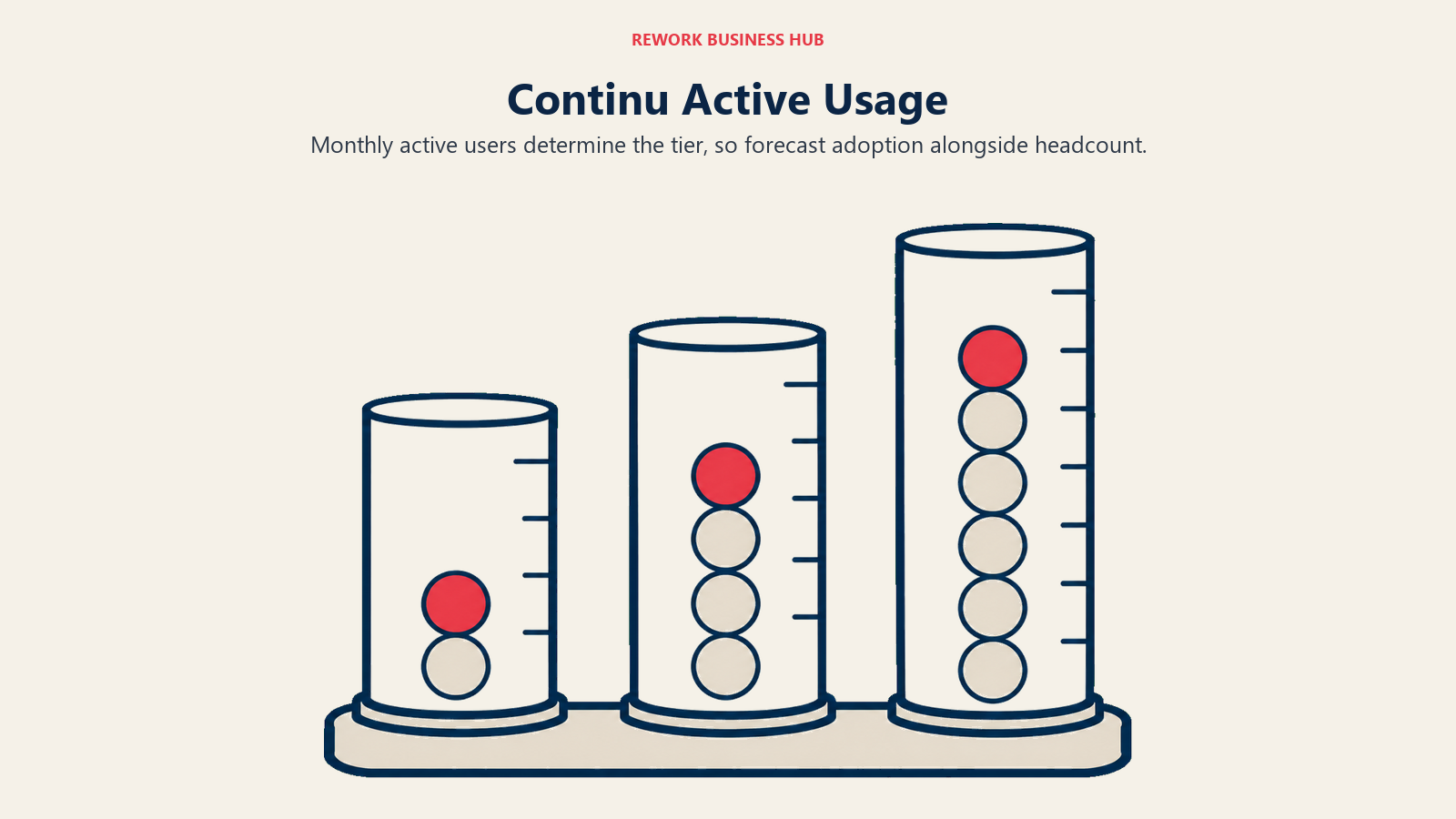
The product leans into a modern, browsable content experience: skill paths and structured learning journeys built to be genuinely explored rather than assigned and forgotten. For teams whose issue with Docebo was less about price and more about adoption, Continu's MAU-first pricing model at least aligns the vendor's incentive with actual usage.
Target audience. Growth-stage companies of 200 to 2,000 employees prioritizing engagement over feature checklists.
Sizing fit. 50 to 200 and 200-plus.
Stage fit. Scaling companies that already tried a heavier LMS and got low adoption.
| Pros | Cons |
|---|---|
| MAU-based tiers align cost with actual platform usage | No dollar figures published for any of the three tiers |
| Clean three-tier structure that scales predictably with growth | Thinner compliance/reporting depth than Docebo or Cornerstone |
| Modern content experience built for voluntary engagement | Enterprise band (5,000-plus MAU) still requires a custom quote |
Pricing: quote-only, tiered by monthly active users: Growth (under 1,000 MAU), Professional (1,000-5,000 MAU), Enterprise (5,000-plus MAU). No prices published.
Best for: growth-stage teams whose real problem is low adoption, not just Docebo's price.
9. Sana Learn - AI-Native Learning for Teams Ready to Commit to Scale
Sana Labs built Sana Learn around AI from the ground up rather than layering AI features onto an older LMS core: generating content, summarizing material, and surfacing the right learning moment inside the tools people already use for work. For a team specifically drawn to Docebo's AI Workforce Readiness push post-365Talents, Sana is one of the few alternatives making a comparably AI-first argument rather than a bolt-on one, and worth reading against a broader view of AI-augmented learning before you commit to an AI-native platform this early.
The catch is scale. Pricing is per-user, per-month, and explicitly "varies by volume," but Sana requires a 300-user minimum before it will even generate indicative pricing, and that indicative number only appears after you enter your location and user count into its pricing tool. There is no list price at any volume.
Target audience. Mid-size to large companies, 300-plus employees, that want AI-generated and AI-surfaced learning content.
Sizing fit. 200-plus.
Stage fit. Companies already comfortable buying AI-forward tools, not a first LMS purchase.
| Pros | Cons |
|---|---|
| AI-native content generation and delivery, not a bolted-on feature | 300-user minimum before any pricing is even indicated |
| Learning surfaced inside existing workflow tools | No list price exists at any volume |
| Directly comparable AI-first pitch to Docebo's post-365Talents positioning | Too much minimum commitment for smaller teams to evaluate |
Pricing: per-user/month, varies by volume, 300-user minimum, indicative pricing only after entering location and user count. No list price published.
Best for: mid-size and larger teams that want an AI-native platform and can clear the 300-user minimum.
10. Moodle Workplace - Open-Source Roots, Partner-Sold Enterprise Layer
Moodle deserves a careful explanation, because "Moodle is free" is the most common wrong assumption in this category, and it is only half true. The core Moodle LMS is genuinely free and open source under the GPL if you self-host and manage it yourself. Moodle Workplace, the item on this list, is different: a commercial, enterprise-grade layer built on top of Moodle (multi-tenancy, compliance reporting, dynamic rules, org charts) sold exclusively through Certified Moodle Partners, sales-led, with no self-serve tiers and no list price at all.
Buyers who want a Moodle-based option with a published price should look at MoodleCloud instead, the officially hosted version of core Moodle: it starts at $170 a year for 50 users on a 28-day free trial (no credit card), scaling up to $2,150 a year for 750 users. But note MoodleCloud caps at 750 users and allows no custom plugins on any tier, exactly the kind of workplace-grade flexibility Moodle Workplace exists to add back in, at a partner-negotiated price.
Target audience. Organizations that want Moodle's open-source foundation with enterprise features, willing to work through a partner.
Sizing fit. 50 to 200 and 200-plus.
Stage fit. Organizations with an existing Moodle deployment, or Moodle-friendly IT function, ready to formalize compliance and multi-tenant needs.
| Pros | Cons |
|---|---|
| Built on the world's most widely deployed open-source LMS core | No self-serve path or list price at all |
| Multi-tenant, compliance, and org-chart features beyond core Moodle | Every deal requires a Certified Moodle Partner relationship |
| Partner network can tailor implementation to unusual requirements | Cost and timeline vary by which partner you land with |
Pricing: sold only through Certified Moodle Partners, no list price. (For contrast, MoodleCloud, the hosted core product, is published: $170/year for 50 users up to $2,150/year for 750 users, annual, no custom plugins on any tier.)
Best for: organizations already bought into Moodle's open-source model that need enterprise features and are comfortable working through a partner. If a self-serve Moodle option fits better, see the Moodle alternatives guide for the wider field.
11. Skilljar - Purpose-Built for Selling Training, Not Just Delivering It
Skilljar, now sold as Skilljar by Gainsight, is built for a specific job Docebo's extended-enterprise features approximate but do not specialize in: training external customers and partners as a product in its own right, sometimes even a revenue line. That focus shows up in features like certification tracking, e-commerce for paid courses, and reporting built around customer adoption and product usage rather than just completion rates, a certification approach worth grounding in a real framework like our guide to certification programs.
Pricing follows the specialization. All three tiers, Essentials, Professional, and Enterprise, are quote-only, and the model is a base annual subscription plus an active-user fee rather than a flat per-seat rate. The only real numbers Skilljar publishes are add-ons: Content Syndication at $10,000, a Data Connector starting at $25,000, and Language Packs starting at $10,000 for 5 languages, which gives a sense of scale even without a base subscription figure.
Target audience. SaaS and product companies running formal customer or partner education programs.
Sizing fit. 50 to 200 and 200-plus.
Stage fit. Companies where customer education is a defined function, not a side project.
| Pros | Cons |
|---|---|
| Purpose-built for external customer and partner training | No published subscription price at any tier |
| E-commerce and certification tracking built for the use case | Add-on prices ($10k-$25k-plus) hint at a high total cost |
| Backed by Gainsight's customer-success data ecosystem | Overkill for purely internal employee training |
Pricing: quote-only across Essentials, Professional, and Enterprise (subscription plus active-user fee). Published add-ons only: Content Syndication $10,000, Data Connector from $25,000, Language Packs from $10,000 for 5 languages.
Best for: companies that sell or formalize customer or partner education as its own program, not just internal training.
12. Tovuti - One Flat Number Instead of a Pricing Page
Tovuti closes this list with the simplest pricing structure of any vendor here: one all-inclusive plan at $7,500 per year for the first 100 learners, billed annually, with everything (authoring, gamification, virtual classroom, community features) bundled in rather than sold as modules. For a buyer exhausted by Docebo's usage-based, multi-tier pricing model, that single number is the entire appeal.
The honest limitation is what happens past 100 learners: Tovuti does not publish a per-extra-learner rate, so growth past the included band still requires a conversation, just a shorter one than most quote-only vendors on this list since you already know your starting price. There is also no monthly billing option; the $7,500 figure is an annual commitment.
Target audience. Small to mid-size teams that want one predictable annual number and minimal plan configuration.
Sizing fit. 1 to 10, 10 to 50, and 50 to 200 (past 100 learners, pricing needs a follow-up quote).
Stage fit. First-time LMS buyers who want to avoid a multi-line-item invoice.
| Pros | Cons |
|---|---|
| Single flat price, everything included, easy to budget | Per-extra-learner rate above 100 is not published |
| Simplest published pricing structure in this entire list | Annual-only billing, no monthly option |
| Broad feature set (authoring, gamification, community) in one plan | Less enterprise depth than Docebo, Cornerstone, or Absorb |
Pricing: $7,500/year, first 100 learners, annual billing only. Per-extra-learner rate above 100 not published.
Best for: small and mid-size teams that want exactly one number on the invoice and are done comparing tiers.
Sizing and Persona Fit
Headcount changes the right answer more than any single feature does. Published per-seat pricing rewards small teams, MAU and active-user pricing rewards adoption, and flat packages reward whoever lands closest to the included band.
| Headcount | Best fit | Why | Watch out for |
|---|---|---|---|
| Under 50 | TalentLMS, Tovuti | Published pricing designed for small teams, no learner-count floor to clear | TalentLMS's Enterprise band and Tovuti's per-extra-learner rate both go dark above 100 |
| 50 to 150 | 360Learning, iSpring Learn | Team-plan and 100-user Business-plan pricing both stay published in this band | 360Learning's 100-user cap on Team; Sana Learn and Continu are still out of reach |
| 150 to 300 | LearnUpon, Litmos, Skilljar | Multi-audience and compliance-first tools start making sense at real scale | Docebo's own "250+ learners" floor also lands here, so compare both directly |
| 300 to 1,000 | Continu, Sana Learn, iSpring Learn (500-user band) | MAU-based and active-user pricing scale efficiently as usage grows | Sana Learn's 300-user minimum is the entry point, not a discount tier |
| 1,000-plus | Cornerstone OnDemand, Absorb LMS, Moodle Workplace | Built for large, complex, multi-audience or multi-tenant deployments | Expect a genuine sales cycle and implementation project at every one of these |
| Persona | What they optimize for | Strongest picks |
|---|---|---|
| L&D lead of one, no budget for a sales cycle | Published price, fast self-serve setup | TalentLMS, Tovuti |
| CHRO who needs a defensible per-user forecast | Transparent, modelable unit economics | iSpring Learn, 360Learning |
| Customer education or partner-training owner | Purpose-built external-training features | Skilljar, LearnUpon |
| Compliance or regulatory training lead | Ready-made content library, audit reporting | Litmos |
| IT-led buying committee at a large enterprise | Governance, tenancy, integration depth | Cornerstone OnDemand, Absorb LMS |
| Team chasing an AI or skills-intelligence roadmap | AI-native content and skills data | Sana Learn (or Docebo itself, via 365Talents) |
How to Choose: Decision Framework
| If you need... | Choose |
|---|---|
| A published price with zero sales calls, starting today | TalentLMS |
| A no-commitment monthly pilot before you decide | 360Learning |
| To model your renewal cost yourself, band by band | iSpring Learn |
| Separate portals for employees, customers, and partners | LearnUpon |
| One flat annual number and nothing to configure | Tovuti |
| Ready-made compliance content you don't have to author | Litmos |
| An AI-native platform comparable to Docebo's post-365Talents pitch | Sana Learn |
| Enterprise-scale consolidation of several inherited learning tools | Cornerstone OnDemand |
What to Do Next
Shortlist two alternatives from the decision framework above, one that would work at your current headcount and one that would still work if you doubled it in a year, then request pricing from both in writing using the same active-user or seat-count assumptions. That single step catches most of the "quote-only" surprises this guide flags, since a vendor's real price only becomes comparable once you force it onto your numbers instead of theirs. If the switch is part of a broader onboarding overhaul, pair it with our guide to measuring time to productivity so the new platform's impact shows up in a number your CFO already tracks.
Camellia writes about L&D and training technology for B2B teams.

Principal Product Marketing Strategist
On this page
- Key Facts
- Why Teams Look Past Docebo
- Quick Comparison Table
- 1. Absorb LMS - Enterprise Depth Without a Published Price Tag
- 2. 360Learning - Peer-Built Courses on a Published, No-Commitment Plan
- 3. TalentLMS - The Only Free Tier Worth Starting On
- 4. LearnUpon - Multi-Audience Training Without Docebo's Learner Floor
- 5. Litmos - Compliance Training Fast, at the Cost of Any Pricing Transparency
- 6. Cornerstone OnDemand - The Consolidation Play, Now Called Cornerstone Galaxy
- 7. iSpring Learn - The Only Vendor Here Publishing Real Per-Active-User Math
- 8. Continu - Growth-Stage Pricing That Scales With Adoption, Not Headcount
- 9. Sana Learn - AI-Native Learning for Teams Ready to Commit to Scale
- 10. Moodle Workplace - Open-Source Roots, Partner-Sold Enterprise Layer
- 11. Skilljar - Purpose-Built for Selling Training, Not Just Delivering It
- 12. Tovuti - One Flat Number Instead of a Pricing Page
- Sizing and Persona Fit
- How to Choose: Decision Framework
- What to Do Next