Docebo vs TalentLMS: Which LMS Fits Your Training Job in 2026?
Turn this article into takeaways for your work.


Each assistant summarizes the article only for you and suggests best practices for your work.
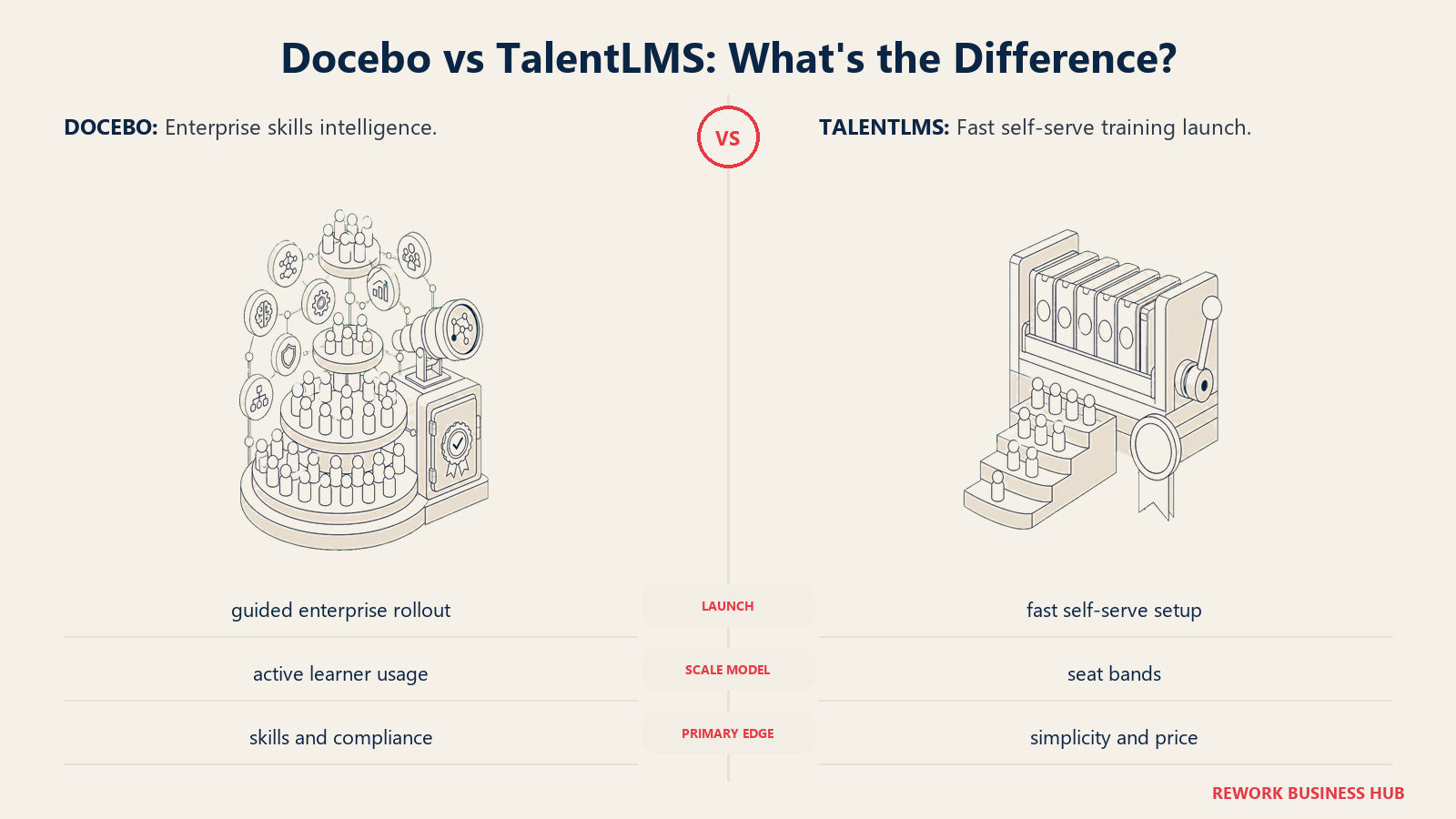
These two get shortlisted together constantly, and the honest version of this comparison starts by saying they shouldn't be. TalentLMS is a tool a training manager buys on a Tuesday afternoon: pick a plan, enter a card, invite forty people, done before lunch. Docebo is a tool procurement buys after a quarter of demos, security reviews, and a quote nobody outside the deal ever sees a number for. Put a 30-person team and a 3,000-person enterprise in front of the same two logos and you'll get two completely different answers, not because one product is better, but because they're built for two different jobs.
This guide is for the L&D director, CHRO, or training manager deciding which side of that line your company sits on, and what changes once you cross it. It covers what each platform is actually built for now that Docebo has folded a skills-intelligence acquisition into its pitch, how SCORM and xAPI content behaves on import, what a compliance audit actually gets from each tool's reporting, how SSO and HRIS provisioning work, what happens to training on a phone with no signal, and real pricing modeled at 50, 250, and 1,000 learners, including the one billing mechanic that quietly decides more Docebo deals than any feature on this page. Every figure below comes from the vendor's own pricing page. Haven't ruled out the rest of the category yet? Start with the LMS software roundup for 2026.
Key Facts
- Organizations with a high-development culture report 11% greater profitability and are twice as likely to retain their employees, according to Gallup.
- 88% of organizations are concerned about employee retention, and providing learning opportunities is their number one retention strategy, per LinkedIn Learning's Workplace Learning Report.
- 59 of every 100 workers worldwide will need reskilling or upskilling by 2030, according to the World Economic Forum's Future of Jobs Report 2025.
- Average direct learning expenditure ran $846 per employee in 2025, per ATD's 2026 State of the Industry report.
- Total US training expenditure rose 4.9% to $102.8 billion in 2025, according to Training Magazine's 2025 Training Industry Report.
TL;DR
| Docebo | TalentLMS | |
|---|---|---|
| Built for | Enterprises buying an AI-driven learning and skills platform through procurement | Teams under roughly 100 to 250 users who want a plan and a price today, no sales call |
| Pricing model | Not published. Quote-only, priced by tier plus active users (MAU, YAU, or RAU) | Published for Free through Pro; Enterprise (1,000+ users) is quote-only |
| Entry price (published) | None published at any of its three packages | Free for up to 5 users and 10 courses; Core $119/mo for 1-40 users |
| Billing basis | Active users, measured as Monthly, Yearly, or Registered Active Users, buyer's choice | Flat "up to N users" band per tier, no activity measurement |
| SCORM / xAPI | SCORM, AICC, xAPI, and cmi5, with an embedded Learning Record Store for xAPI/cmi5 | SCORM, xAPI, and cmi5, per the vendor's own features page; AICC not advertised |
| Recent repositioning | Acquired 365Talents (Jan 2026); now markets Learning, Skills Intelligence, Enterprise Knowledge, and AgentHub as one AI Workforce Readiness Platform | None. Still a straightforward LMS, recently refreshed its brand and UI |
| Ownership | Public company, listed on the TSX and Nasdaq under DCBO | Privately held, a product of Epignosis |
| Best for | Multi-thousand-learner programs that need skills data tied to delivery and can clear a procurement cycle | Single-audience employee training under about 250 users that wants a number before a call |
What Each Is Actually Built For
Docebo started in 2005 as a straightforward corporate LMS and has spent the last two years rebuilding its pitch around AI. The company is public, trading on the Toronto Stock Exchange and Nasdaq under the ticker DCBO, so its roadmap gets narrated in quarterly earnings calls, not just release notes, and the current narration is workforce readiness: connect what people can do, what they need to learn, and what the business needs next, in one closed loop. That's a different sale than "buy us a course catalog," and it shows up in who ends up in the room: IT and security for the SSO review, HR for the skills-taxonomy question, finance for a contract with no sticker price attached.
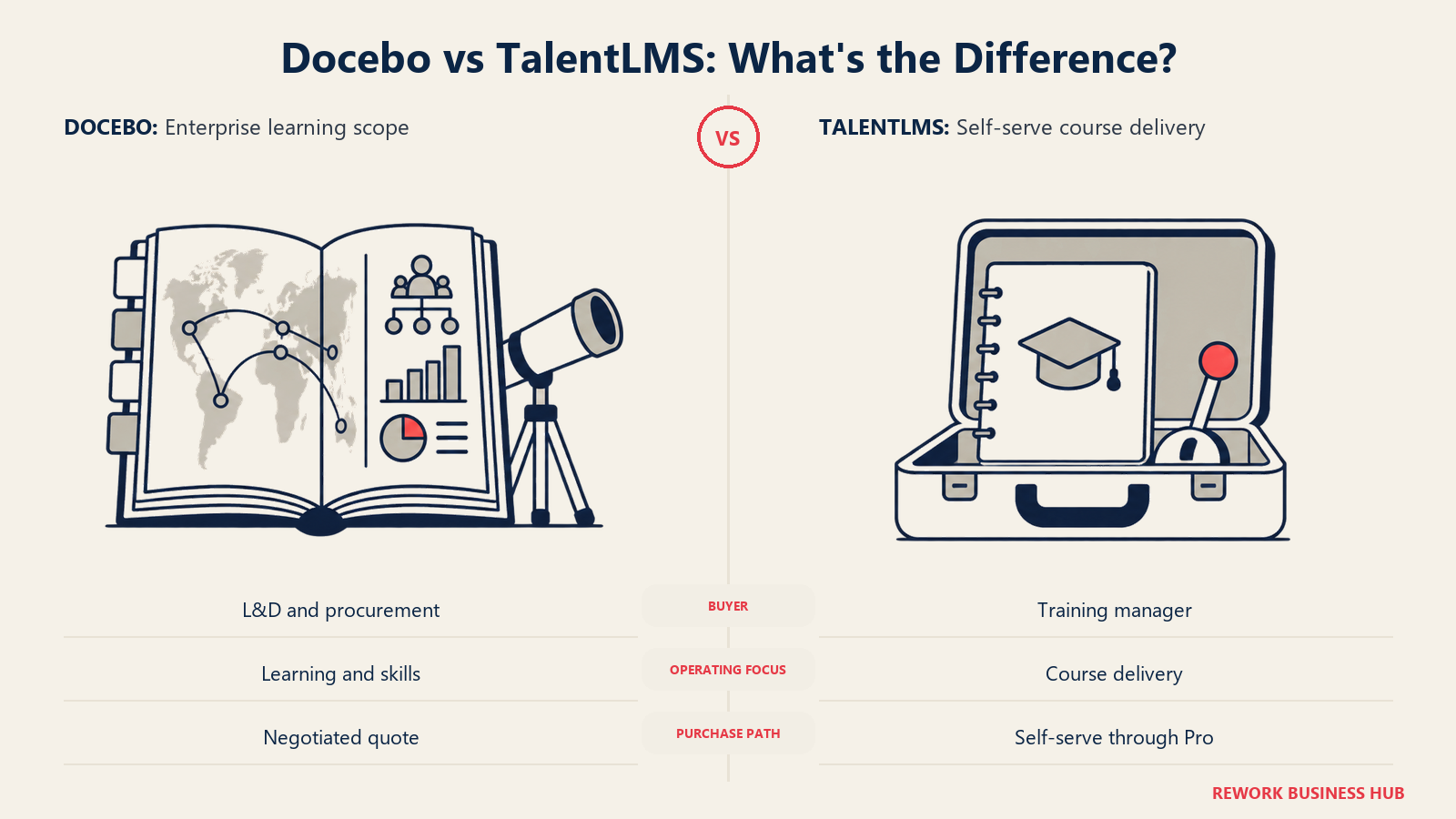
TalentLMS starts from the opposite instinct. Sign up, pick a plan, invite your team, publish a course, all in one sitting, no salesperson required unless you want Enterprise. That self-serve posture caps out somewhere in the low hundreds of users, not because the product breaks past that point, but because a training manager buying for 600 people is usually buying against someone else's budget approval, and at that point a published price stops being an advantage and procurement wants a negotiated one instead.
| Docebo | TalentLMS | |
|---|---|---|
| Primary use case | Enterprise learning delivery plus AI-driven skills intelligence and knowledge search | Fast, self-serve course delivery and tracking for a single training program |
| Ideal buyer | An L&D or people-ops function inside a company large enough to run procurement | A training manager or small HR team buying without a formal RFP |
| Company stage | Mid-market to enterprise, often multi-brand or multi-region | Small to mid-market, typically one HQ and one training program |
| Sales motion | Demo, security review, negotiated quote | Self-serve signup through Pro; Enterprise adds a sales conversation |
From LMS to AI Workforce Readiness Platform
Docebo announced the acquisition of 365Talents, a France-based skills-intelligence and workforce-analytics company, on January 20, 2026, for roughly $54.6 million in upfront cash plus an earn-out of up to $5.1 million (Docebo newsroom). The deal didn't get folded into Docebo Learn overnight. Through 2026, 365Talents operates as its own brand and sells as a separate product, connected to the core LMS by API, with a tighter, single-platform integration planned for the second half of the year.
By April 2026, that skills engine had become part of a much bigger repositioning. At its Inspire 2026 event, Docebo launched AgentHub and folded four pieces into one pitch: Learning (the LMS/LXP core), Skills Intelligence (365Talents), Enterprise Knowledge (search across 20+ connected knowledge sources), and AgentHub (AI agents that work natively inside Claude, Microsoft Copilot, and ChatGPT), unified as what it now calls an AI Workforce Readiness Platform (Docebo newsroom). That's why Docebo's pricing page now lists three packages, Elevate, Enterprise, and Skills Intelligence via 365Talents, instead of the two older comparisons still show. Any Docebo comparison naming only Elevate and Enterprise predates January 2026 and is out of date.
TalentLMS has no equivalent story to tell. Its recent moves are a brand and UI refresh and steady AI-authoring feature additions inside the existing product, not a repositioning of what the company sells. If your evaluation criteria includes "does this vendor have a credible skills-intelligence roadmap," that question has one real answer between these two right now, and it comes with a quote-only price tag attached.
Decision by Business Goal
| Your situation | Best fit | Why |
|---|---|---|
| You need a real number for a budget spreadsheet before anyone takes a sales call | TalentLMS | Free through Pro pricing is published outright; Docebo publishes none of its three packages |
| You're rolling out training to under 100 employees and want to be live this week | TalentLMS | Self-serve signup, no procurement cycle; Core and Grow cover 1-70 users without a quote |
| You need skills-gap data, who can do what, who's ready for what role, tied to the same platform that delivers the training | Docebo | Skills Intelligence via 365Talents is built into the pitch; TalentLMS has no comparable module |
| Legal or security needs FDA 21 CFR Part 11-style e-signatures and a platform-change audit trail at enterprise scale | Docebo | Audit trail and certifications/expiry tooling are built for regulated, high-headcount programs |
| You want to pilot with a handful of people before committing budget anywhere | TalentLMS | Free plan: up to 5 users and 10 courses, no time limit, no card required |
| You're past 1,000 learners and expect a real procurement process either way | Both, functionally | TalentLMS's published bands stop well below 1,000; Docebo never published one to begin with |
Team and Role Fit
| Role | Docebo | TalentLMS |
|---|---|---|
| L&D / instructional designer | Strong for large, multi-audience catalogs; steeper admin learning curve | Strong for a single team building and shipping courses fast |
| HR / compliance lead | Strongest fit at scale: audit trail, certification expiry, FDA 21 CFR Part 11 support | Workable for smaller compliance programs; reporting is real but less audit-specialized |
| People / skills strategy lead | Purpose-built via Skills Intelligence (365Talents), the strongest reason to pick Docebo at all | No equivalent module |
| IT / identity admin | SAML 2.0 native with Just-In-Time provisioning; HRIS sync via an Automation App or attribute mapping | SSO integration and HRIS/CRM workflow automation stated; less public detail on provisioning depth |
SCORM, xAPI, and What Actually Breaks on Import
Both vendors claim broad standards support, and on paper the lists look nearly identical. Docebo supports SCORM, AICC, xAPI, and cmi5, backed by an embedded Learning Record Store, the infrastructure cmi5 and xAPI actually need to log meaningful learning statements rather than just pass/fail flags. TalentLMS's own features page states support for SCORM, xAPI, and cmi5 plus LTI 1.3 for connecting existing training tools (TalentLMS); AICC isn't listed there, worth confirming directly if a legacy AICC course library is part of your migration.
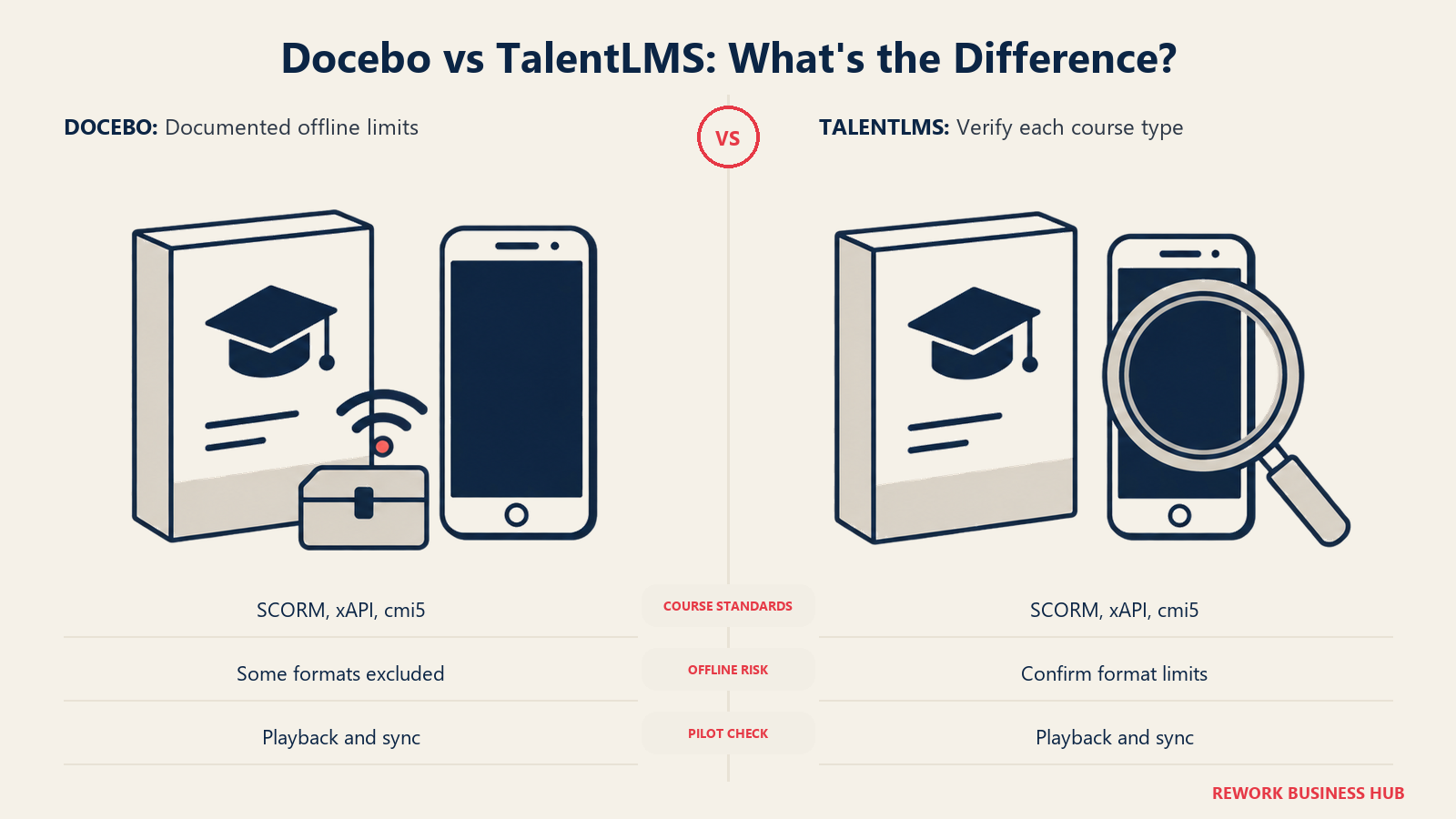
The real gap between the two shows up somewhere the pricing page never mentions: offline mobile playback. Docebo's Go.Learn app can download SCORM files, videos, slides, and HTML training material for offline use and syncs progress once the device reconnects, but the vendor's own help documentation states plainly that xAPI, AICC, LTI, surveys, and tests are not supported in offline mode, and multi-SCO or multi-chapter SCORM packages aren't either (Docebo Help Center). A course that reports perfectly over Wi-Fi in a demo can silently lose its xAPI statements the moment a deskless worker takes it out of signal range. TalentLMS's marketing describes offline access more broadly, learners can access courses "anytime, anywhere, even offline" (TalentLMS), without publishing the same level of content-type detail, which cuts the other way: fewer documented gotchas, but also less to verify against before rollout.
| Docebo | TalentLMS | |
|---|---|---|
| SCORM | 1.2 and 2004, native | Supported, per the vendor's features page |
| xAPI (Tin Can) | Supported via an embedded Learning Record Store | Supported, per the vendor's features page |
| AICC / cmi5 | Both supported | cmi5 supported; AICC not listed publicly |
| What actually breaks | xAPI, AICC, LTI, surveys, and tests don't work in offline mobile mode, per Docebo's own help docs | Offline access is marketed broadly; content-type limits aren't published in the same detail |
Compliance Reporting and Audit Trails
A compliance audit wants three things: a named person, a named course, and proof the certificate was still valid when the work happened. Docebo builds directly toward that. Its audit trail logs who changed what and when across the platform, its certifications and retraining tooling sets expiration dates and keeps prior certification records available in reporting even after a renewal, and Docebo states its LMS supports customers meeting FDA 21 CFR Part 11, including electronic signatures and comprehensive audit trails, on top of an annual SOC 2 Type II report and PCI DSS Level 2 certification (Docebo compliance training, Docebo Help Center: Audit trail, Docebo Help Center: Certifications).
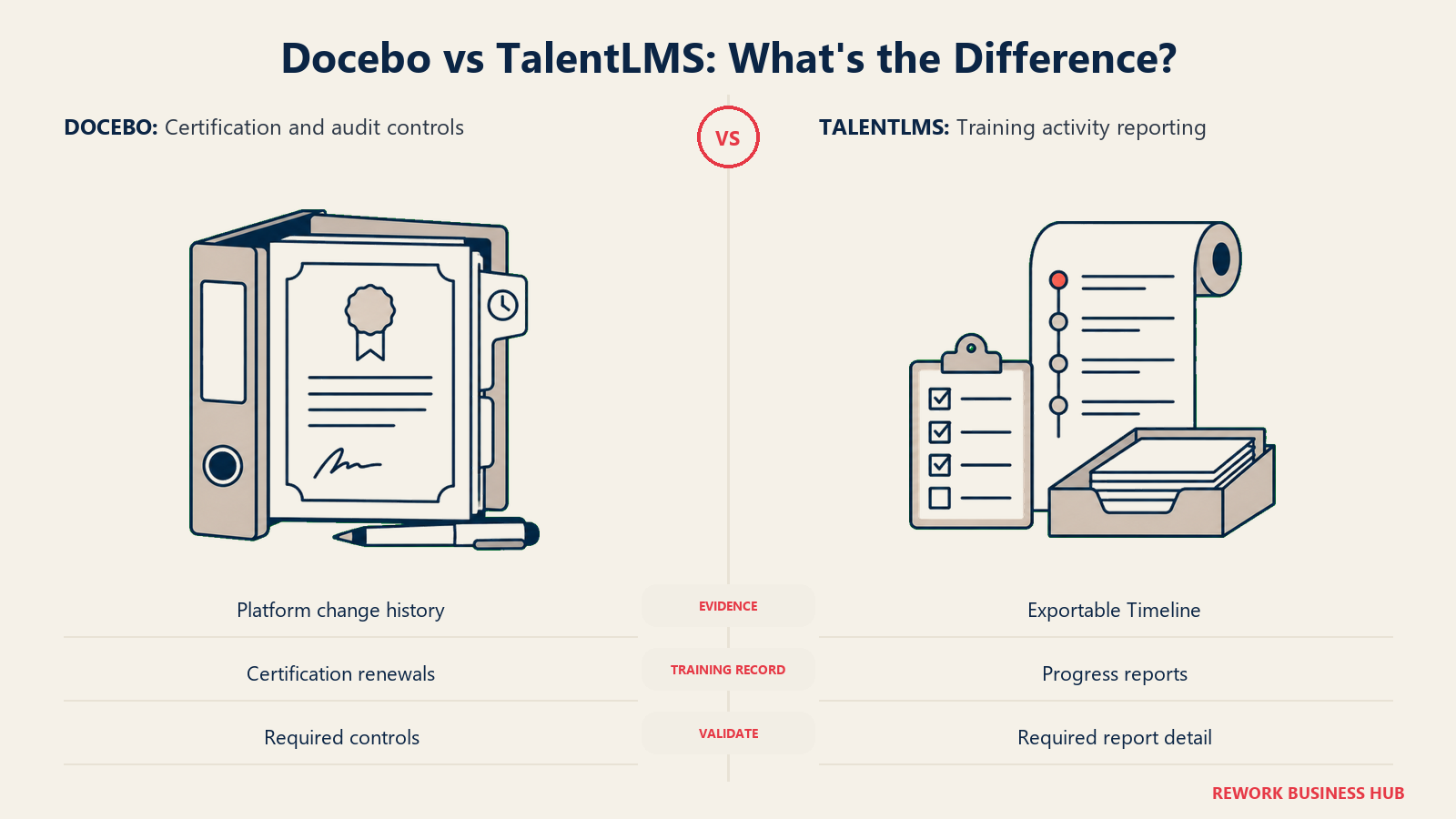
TalentLMS's reporting is real but sits a step less specialized. Real-time and custom reports track learner progress, and a Timeline feature logs platform activity with the option to export results for what the vendor itself calls a detailed audit trail (TalentLMS). It's ISO/IEC 27001:2022 and ISO 9001:2015 certified and GDPR compliant, solid ground for a standard corporate compliance program, but there's no equivalent to Docebo's named FDA 21 CFR Part 11 support or e-signature workflow. If your compliance mandate is pharma, medical device, or another regulated industry that specifically requires Part 11-style controls, that gap is the whole decision.
| Docebo | TalentLMS | |
|---|---|---|
| Audit trail | Logs platform changes: who, what, when | Timeline tracks activity, exportable for audit purposes |
| Certificate / expiry tracking | Built in, with prior records retained through renewal | Supported through reporting |
| Named regulatory support | FDA 21 CFR Part 11, including e-signatures | Not named; covered by GDPR, ISO/IEC 27001:2022, ISO 9001:2015 |
| Best for | Pharma, medical device, and other Part 11-regulated programs | Standard corporate compliance and certification tracking |
Identity, Provisioning, and Where Training Actually Happens
Single Sign-On and HRIS Provisioning
Docebo's SSO is SAML 2.0 native, documented for both SP-initiated and IdP-initiated flows with named integrations for Okta, Microsoft Entra ID, Salesforce Identity, and OneLogin, and it supports Just-In-Time provisioning, so a valid SSO login creates the user automatically if they don't already exist in the platform (Docebo: SAML 2.0). For HRIS sync specifically, Docebo doesn't name off-the-shelf connectors the way a dedicated HR platform would. Instead it offers an Automation App that ingests reports exported from an HRIS or CRM to provision users into the right branch, or SAML attribute mapping paired with its Enrollment Rules App to auto-enroll new groups into courses. Real, but it's assembly, not a one-click connector.
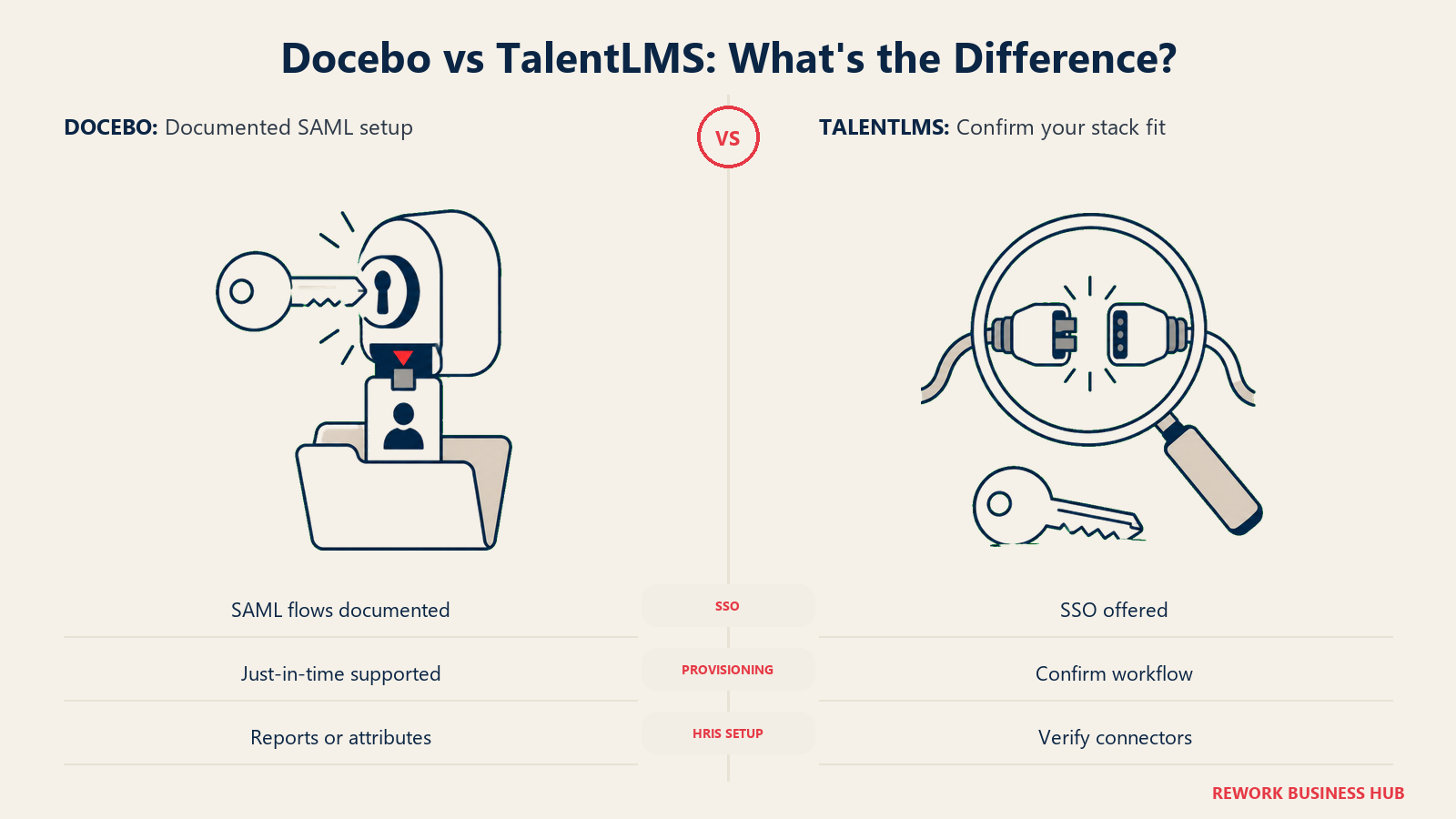
TalentLMS states SSO integration as a feature and separately promotes the ability to "automate workflows by connecting TalentLMS with your HRIS, CRM, and communication tools" (TalentLMS), without naming specific SSO protocols or HRIS connectors on its public features page. Confirm both against your actual identity provider and HRIS before assuming either tool's marketing language covers your stack out of the box. If you haven't settled on the HRIS these need to talk to yet, our HR software roundup covers that category from scratch.
| Docebo | TalentLMS | |
|---|---|---|
| SSO | SAML 2.0, SP- and IdP-initiated, named integrations (Okta, Entra ID, Salesforce, OneLogin) | Stated as a feature; specific protocols not detailed publicly |
| Provisioning | Just-In-Time provisioning on valid SSO login | Not detailed publicly |
| HRIS sync | Automation App (report ingestion) or SAML attribute mapping plus Enrollment Rules App | "Connect to your HRIS, CRM, and communication tools"; specific connectors not named |
Mobile and Offline Learning for Deskless Staff
Field techs, retail staff, and warehouse crews are a meaningful share of the audience either tool serves, and a course that only works over reliable Wi-Fi doesn't reach them. Docebo's Go.Learn app downloads SCORM, video, slide, file, and HTML content for offline play, syncing progress once the device reconnects, but as covered above, xAPI, AICC, LTI, and anything requiring a live server round-trip like tests and surveys explicitly doesn't work offline. TalentLMS ships native iOS and Android apps and markets access "even offline," with less public documentation of which specific content types are excluded. For a genuinely deskless-heavy rollout, test your actual course types, not the marketing sentence, in a sandbox on both before committing.
| Docebo | TalentLMS | |
|---|---|---|
| Native mobile app | Yes, Go.Learn, iOS and Android | Yes, iOS and Android |
| Offline content types | SCORM, video, slides, files, HTML; syncs on reconnect | Marketed broadly as offline-capable; content-type detail not public |
| What doesn't work offline | xAPI, AICC, LTI, tests, surveys, multi-SCO/multi-chapter SCORM | Not documented publicly; verify in a sandbox |
Pricing at 50, 250, and 1,000 Learners
None of these three learner counts gets priced the same way between the two, and that's before the billing-basis question in the next section. TalentLMS publishes a real rate card through its Pro tier and a stated overage formula past that. Docebo publishes nothing, at any headcount, on any of its three packages.
At 50 learners, TalentLMS's Core plan tops out at 40 users, so the Grow plan, $229 a month for 1 to 70 users, is what actually fits, with 20% off across all paid plans when billed annually. Docebo at 50 learners is a quote, the same as it is at every size; nothing on its pricing page even hints at a floor.
At 250 learners, TalentLMS's Pro plan covers the first 100 users for $449 a month, then adds $6 for every user past that, a formula the vendor states outright rather than leaving to a quote. Applying that published rule: $449 plus 150 additional users at $6 each comes to roughly $1,349 a month before any annual discount, a figure you can sanity-check yourself, not one TalentLMS displays directly at that headcount. Docebo remains a quote at 250 learners too.
At 1,000 learners, the gap disappears. TalentLMS's own Enterprise tier starts at 1,000 users and is priced by quote, no dollar figure published at that size any more than Docebo has one. Cross that line and both vendors send you to the same place, a sales conversation, with negotiating leverage sitting on price-per-active-user and contract length rather than a rate card either side can point to.
| Learners | Docebo | TalentLMS |
|---|---|---|
| 50 | Quote only. No published floor at any tier | $229/mo, Grow plan (1-70 users), published. Core tops out at 40 users so it doesn't reach 50 |
| 250 | Quote only. No published floor at any tier | Roughly $1,349/mo, applying Pro's published $449 base plus its stated $6-per-additional-user rate for 150 extra users. Not a number TalentLMS displays directly; confirm at signup |
| 1,000 | Quote only, as at every size | Quote only. Crosses into the Enterprise tier's 1,000-user floor, which publishes no dollar figure |
Billing Basis: MAU, YAU, RAU, and Published Seat Bands
This is the mechanic that decides more real Docebo deals than any single feature on this page, and almost nobody explains it in plain language. Docebo doesn't price by seats or accounts; it prices by active users, and it lets the buyer choose how "active" gets measured: Monthly Active Users (MAU), Yearly Active Users (YAU), or Registered Active Users (RAU) (Docebo pricing).
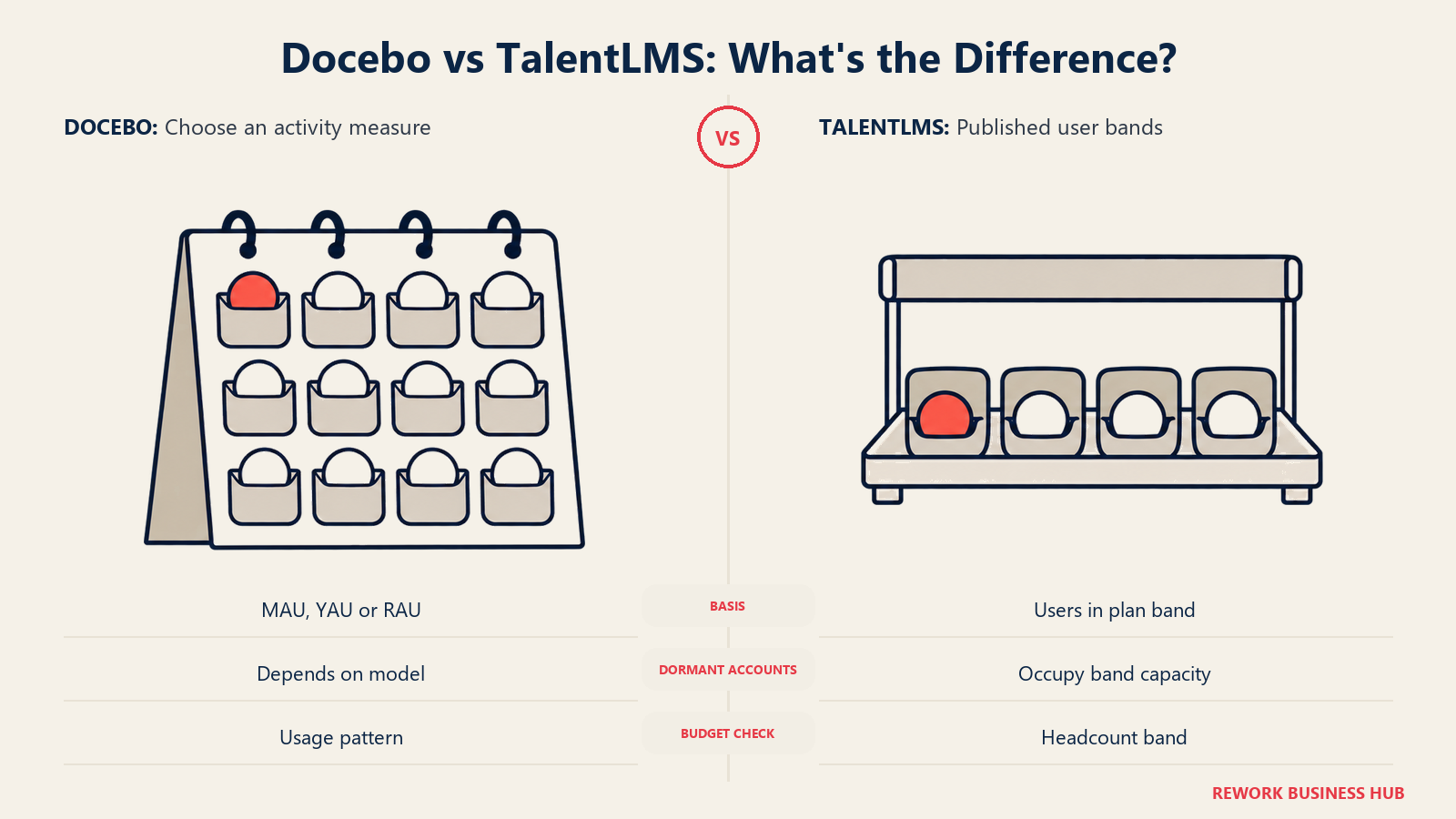
Walk through what that actually does to a bill at a company where, say, 40% of headcount only logs in for a single annual compliance refresher and the rest trains steadily. Under MAU, that 40% shows up in the count for roughly one month a year and disappears from the bill the other eleven; the contract can be sized around a monthly active number that's meaningfully smaller than total headcount, so if your real usage is concentrated and bursty, MAU is the model to push for in negotiation. Under YAU, that same 40% counts as active for the whole contract year the moment they log in once, so the annual number converges toward closer to full headcount regardless of how sparse their actual usage is, better for predictable budgeting, worse if your workforce trains unevenly. Under RAU, you're paying for every licensed seat whether anyone logs in or not, the simplest model to administer and forecast, but licenses can be deactivated and reassigned as people leave and join, the lever that keeps RAU from just being "pay for headcount forever."
TalentLMS doesn't measure activity at all. Its tiers are flat "up to N users" bands: Core covers 1 to 40, Grow covers 1 to 70, Pro covers 1 to 100 with per-user overage past that. A dormant account still occupies a seat in the band whether they've logged in once or fifty times. That's simpler to explain to a CFO and impossible to game in either direction, but it also means TalentLMS never rewards a company whose training is genuinely bursty the way Docebo's MAU option can. Before comparing a Docebo quote against a TalentLMS invoice, know which of these four models you're actually being charged under, because the same headcount can produce very different bills depending on the answer.
| Billing basis | What it counts | Favors | Watch out for | Used by |
|---|---|---|---|---|
| Monthly Active Users (MAU) | Users active in a given month | Bursty, infrequent training (annual refreshers, seasonal onboarding) | Usage spikes around a mandatory deadline can spike the bill that month | Docebo (buyer's choice) |
| Yearly Active Users (YAU) | Users active at any point in the contract year | Predictable, flat annual budgeting | Converges toward full headcount even with sparse usage | Docebo (buyer's choice) |
| Registered Active Users (RAU) | All licensed seats, regardless of login | Simplicity, easiest to forecast and administer | Paying for dormant seats unless licenses are actively deactivated and reassigned | Docebo (buyer's choice) |
| Published seat band | A flat "up to N users" ceiling per tier | Simplicity, zero ambiguity, no activity tracking required | Doesn't reward infrequent usage the way MAU can | TalentLMS |
Implementation and Change Management
Docebo's implementation looks like an enterprise software rollout because it's sold and built as one: SAML configuration with IT, branch and Extended Enterprise domain structuring for external audiences, admin training on a genuinely deep configuration surface, and now a second decision, whether and how to layer in Skills Intelligence, given 365Talents is still API-connected rather than natively unified until later in 2026. None of that is a criticism; it's the tradeoff for the depth.
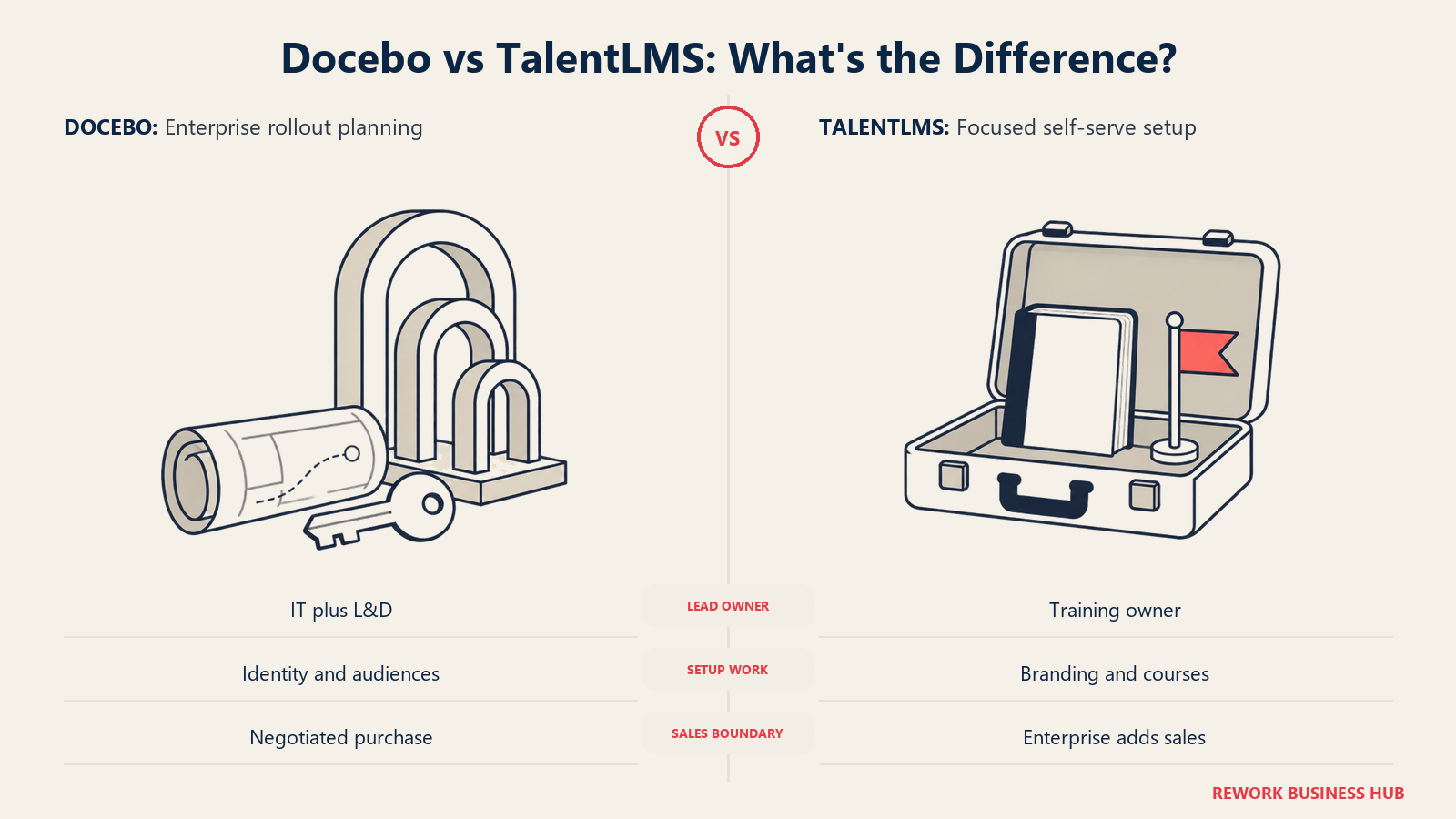
TalentLMS is built to skip most of that. A training manager can sign up, configure branding, and publish a first course inside an afternoon, and nothing about Core, Grow, or Pro requires a sales call, an IT ticket, or a security review to get started. That changes at Enterprise, where the 1,000-user floor brings back a real sales conversation, but under Pro the whole point of the product is that implementation barely exists as a phase.
| Docebo | TalentLMS | |
|---|---|---|
| Fastest path to launch | Teams that already have IT and security bandwidth reserved for the rollout | Any team under 100 users; self-serve from signup to a published course |
| Where it slows down | SAML setup, branch/domain structuring, and the still-separate 365Talents integration | The Enterprise tier, once you cross 1,000 users and re-enter a sales process |
| Who should lead the rollout | IT/identity plus L&D, often with Docebo professional services involved | Whoever owns training; typically no IT involvement required under Pro |
Migration and Record Portability
Neither vendor publishes a public policy on what happens to your data if you leave. Docebo's Advanced Analytics add-on and its audit trail and certifications reporting give you plenty of ways to view and export records while you're a customer, but nothing on its public pages states a defined process for exporting learner history, certificates, and completion records after cancellation. TalentLMS's Timeline feature explicitly supports exporting results for an audit trail, a genuinely useful ongoing capability, but that's a feature for active use, not a stated migration or offboarding policy either. Get the real answer in writing before you sign, not after you need it: what format records export in, and whether historical data is retained or deleted after cancellation, and for how long.
Risk and Governance
Vendor stability reads differently for these two. Docebo is a public company, listed on both the Toronto Stock Exchange and Nasdaq under DCBO, so quarterly earnings calls narrate its strategy in public, including how the 365Talents integration is progressing. TalentLMS is privately held, a product of Epignosis, the same company behind eFront and TalentCards, with no public financials to check against. Neither is a red flag by itself, but it changes how you verify the pitch: Docebo's roadmap gets discussed in public filings, while TalentLMS's roadmap lives in the product and the support relationship, the way it does with most SaaS vendors at this price point.
When Docebo Is the Right Call
You're running training across a large enough organization, or enough external audiences, that procurement is happening regardless of which vendor you pick, so a published starting price wouldn't change your process anyway. You need FDA 21 CFR Part 11-grade audit trails and e-signatures, or a compliance program with enterprise-scale reporting demands. You're building toward tying skills data to learning delivery, closing the loop between what people can do, what they're learning, and where the business needs them next, and you're willing to manage 365Talents as a connected-but-separate product until deeper integration lands later in 2026. Your training usage is genuinely bursty, one big annual push, seasonal onboarding waves, enough that negotiating MAU-based billing could beat a flat per-seat rate.
Wrong call if you want a number before a sales call at any size; that number doesn't exist on Docebo's pricing page regardless of headcount. Also wrong if you're under a few hundred learners and don't need skills intelligence, audit-grade compliance, or a branded extended-enterprise portal, you'd be buying procurement overhead you don't need yet; the Docebo alternatives guide has lighter options worth a look first.
When TalentLMS Is the Right Call
You want to be live this week, not this quarter, and you're training one audience, employees, under roughly 100 to 250 people. You want a real number for a budget conversation before anyone picks up the phone; Free through Pro is all published, plus a stated overage rate past 100 users you can calculate yourself. You want to pilot with a small group first: the free plan covers up to 5 users and 10 courses, no time limit, no card required, genuinely useful for testing fit before committing any budget. Your compliance needs are real but standard, ISO 27001 and GDPR-level, not FDA 21 CFR Part 11-grade.
Wrong call if you're past a few hundred learners and expect Enterprise pricing to still feel like TalentLMS's transparent self-serve tiers. It doesn't; Enterprise starts at 1,000 users and is a quote like everything Docebo sells. Also wrong if skills-gap intelligence tied to your LMS is the actual requirement; the TalentLMS alternatives guide is a better place to start there.
Decision Framework
| If you need... | Choose |
|---|---|
| A real, published price you can put in a budget spreadsheet today | TalentLMS |
| Skills-gap intelligence built into the same platform as delivery | Docebo (via 365Talents) |
| To be live and training people this week, with no sales call | TalentLMS |
| FDA 21 CFR Part 11-grade audit trails and e-signatures | Docebo |
| Billing that can flex around bursty, infrequent training (MAU) | Docebo |
| The simplest possible billing model to explain to a CFO | TalentLMS |
| A free plan to pilot before committing any budget | TalentLMS |
| A vendor whose AI and skills roadmap is public-company disclosed | Docebo |
| A workable answer above 1,000 learners without pretending either has published pricing there | Neither. Budget time for a real negotiation with whichever fits your actual job |
Frequently Asked Questions about Docebo and TalentLMS
Do Docebo and TalentLMS actually compete for the same buyer?
Rarely. TalentLMS is bought self-serve by teams generally under 100 to 250 users who want a published price and no sales call. Docebo is bought through procurement by enterprises that need skills intelligence, audit-grade compliance, or a branded extended-enterprise portal, and it prices everything by quote. The overlap zone sits somewhere in the low hundreds of users, and even there the two are answering different questions.
What's the difference between MAU, YAU, and RAU in Docebo's pricing?
They're three ways Docebo can measure "active" for billing. MAU counts users active in a given month, YAU counts anyone active at any point in the contract year, and RAU counts every registered, licensed seat regardless of login. A company with bursty or infrequent training, like an annual compliance refresher for 40% of staff, generally comes out ahead negotiating MAU; a company with steady, predictable usage may prefer YAU or RAU for simpler forecasting.
Does TalentLMS really have a free plan?
Yes, and it's real and current: up to 5 users and 10 courses, no time limit, and no credit card required. It's a genuine way to pilot the product before spending anything, not a disguised trial that expires.
Why does Docebo's pricing page now show three packages instead of two?
Docebo acquired 365Talents, a skills-intelligence company, in January 2026, and by April 2026 had folded it into a broader AI Workforce Readiness Platform pitch alongside Learning, Enterprise Knowledge, and AgentHub. The pricing page now lists Elevate, Enterprise, and Skills Intelligence (365Talents) as three separate packages. Any comparison showing only Elevate and Enterprise predates that change and is out of date.
Can I calculate an exact Docebo price the way I can with TalentLMS?
No. Docebo publishes no dollar figures on its pricing page at any tier or headcount; every quote is negotiated based on package, active-user billing model, and add-ons. TalentLMS publishes real numbers through its Pro tier and a stated per-user overage rate past 100 users, but becomes quote-only itself once you reach the 1,000-user Enterprise floor.
What breaks when SCORM or xAPI content moves between these two platforms?
The standards support looks similar on paper, SCORM, xAPI, and cmi5 on both, plus AICC on Docebo, less clearly stated on TalentLMS, but the real gap is offline mobile playback. Docebo's own help documentation states that xAPI, AICC, LTI, tests, and surveys don't work in its Go.Learn app's offline mode, along with multi-SCO SCORM packages. Test your actual course types in a sandbox before a deskless-heavy rollout, on either platform.
Is TalentLMS owned by SAP or another large enterprise vendor?
No. TalentLMS is a product of Epignosis, a privately held company that also makes eFront and TalentCards. Docebo, by contrast, is publicly traded on the Toronto Stock Exchange and Nasdaq under the ticker DCBO.
What to Do Next
Match your shortlist to the actual job before you request pricing, not after. If you're under roughly 250 users and want a number before a call, sign up for TalentLMS's free plan today, test it with a real course, then request a Pro quote at your actual headcount and check the overage math against the published $6-per-user rate. If skills intelligence, audit-grade compliance, or a genuinely enterprise-scale rollout is the actual requirement, request a Docebo quote and ask specifically for MAU, YAU, and RAU pricing side by side for your real usage pattern, since the difference between them can move the bill more than any add-on will. Either way, get a written answer on data export and migration before you sign; neither vendor states that policy publicly. Still comparing the wider field: 360Learning is worth a look if peer-generated content matters as much as top-down courses, and Cornerstone is the other enterprise-procurement name that lands on Docebo's shortlist. If your program is smaller and more SOP-driven, Trainual is worth a look before committing to a full LMS. And for a different head-to-head in this collection, iSpring Learn vs LearnUpon vs Litmos covers three more names solving three more specific training jobs.
Camellia writes about L&D and training technology for B2B teams.

Principal Product Marketing Strategist
On this page
- Key Facts
- TL;DR
- What Each Is Actually Built For
- From LMS to AI Workforce Readiness Platform
- Decision by Business Goal
- Team and Role Fit
- SCORM, xAPI, and What Actually Breaks on Import
- Compliance Reporting and Audit Trails
- Identity, Provisioning, and Where Training Actually Happens
- Single Sign-On and HRIS Provisioning
- Mobile and Offline Learning for Deskless Staff
- Pricing at 50, 250, and 1,000 Learners
- Billing Basis: MAU, YAU, RAU, and Published Seat Bands
- Implementation and Change Management
- Migration and Record Portability
- Risk and Governance
- When Docebo Is the Right Call
- When TalentLMS Is the Right Call
- Decision Framework
- What to Do Next