Best Microsoft Dynamics 365 Alternatives in 2026: 11 CRM and ERP Platforms for Mid-Size Companies
Turn this article into takeaways for your work.


Each assistant summarizes the article only for you and suggests best practices for your work.
The best Microsoft Dynamics 365 alternative depends on whether you need CRM, ERP, or both. Salesforce leads for the largest ecosystem, HubSpot for mid-size CRM without an implementation project, Zoho One for one budget bundle that covers CRM and finance, and NetSuite and Sage Intacct for true cloud ERP and finance. Rework fits teams replacing only the CRM side. The 11 ranked options below cover pricing, fit, and a decision framework.
Microsoft Dynamics 365 is, in theory, the everything platform for growing companies. CRM, ERP, finance, supply chain, field service, marketing automation: all of it unified on Azure, sitting inside the Microsoft stack you already use. For a 5,000-person enterprise with a dedicated IT team and a systems integrator on retainer, that promise holds up reasonably well. You can review Microsoft Dynamics 365's licensing overview to see how the per-module pricing stacks up before committing.
For mid-size companies in the 100 to 1,000 employee range, Dynamics 365 is more likely to become a project than a product. The licensing structure splits CRM and ERP into separate apps (Sales, Marketing, Customer Service, Finance, Supply Chain, Business Central), each with its own per-user per-month fee. A company that needs sales CRM plus basic financials is looking at multiple license stacks, an SI engagement to configure the modules, and an Azure infrastructure dependency that follows them everywhere. Mid-size buyers consistently report that the complexity and cost lands closer to enterprise software than the $50-$100 per seat sticker suggests.
If you're evaluating whether to move off Dynamics 365, or are comparing it during a first-time selection, this guide covers 11 alternatives with honest assessments of methodology, sizing fit, pricing, and who each tool actually serves. If you're evaluating cloud ERP platforms specifically, our best NetSuite alternatives guide covers the same mid-market segment in more depth. And if your team also manages HR platforms, check the best Hibob alternatives, since many companies evaluate HRIS and ERP at the same time.
Quick Comparison Table
| Tool | Best For | Starting Price | Key Strength | Key Limitation |
|---|---|---|---|---|
| Salesforce | Large mid-market to enterprise CRM | Starter Suite ~$25/seat/mo; Enterprise ~$165/seat/mo | World's largest CRM ecosystem, AppExchange depth | Expensive, requires admin; comparable complexity to Dynamics |
| HubSpot CRM | Marketing + sales-led growth teams | Free tier; Sales Hub Pro ~$90/seat/mo | Marketing + CRM integration, fast onboarding | Costs compound; limited ERP-adjacent capabilities |
| Zoho One | Budget-conscious SMB to mid-market needing breadth | ~$37/user/mo (all-apps bundle) | 50+ apps in one subscription, including CRM + Finance | UX inconsistency across modules; less enterprise depth |
| NetSuite | Mid-market to enterprise needing true cloud ERP | ~$999/mo base + $99/user/mo | Full cloud ERP with financials, inventory, CRM | High cost; implementation-heavy; not a CRM replacement |
| Rework | Mid-size CRM + lead management + chat inbox (CRM side only) | From $159/mo billed yearly, 5 marketing + 5 sales seats (rework.com/pricing) | Unified CRM + lead lifecycle + chat inbox, no SI needed | Not an ERP: no general ledger or accounting |
| SAP Business One | Small to mid-size manufacturers and distributors | $108/user/mo (professional) | Deep manufacturing/distribution ERP, global footprint | Limited CRM; requires VAR for implementation |
| Odoo | Budget-conscious mid-market wanting modular ERP+CRM | Free (Community); $13.60/user/mo (Enterprise) | Open-source flexibility, wide module library | Enterprise tier adds up; implementation complexity varies |
| Freshworks CRM | SMB to mid-market sales teams wanting AI + simplicity | Free tier; Growth ~$9/seat/mo | Freddy AI, built-in phone + email, fast setup | Less suited for ERP-adjacent ops; enterprise features gated |
| Monday.com | Work management + lightweight CRM for ops-heavy teams | ~$12/seat/mo (Basic, annual) | Flexible boards, strong project + ops management | CRM depth is limited compared to dedicated tools |
| Pipedrive | Sales-first mid-size teams wanting pipeline clarity | $14/seat/mo (Essential, annual) | Simple, visual pipeline; fast ramp | No ERP; thin marketing automation |
| Sage Intacct | Finance-led mid-market companies needing GAAP + multi-entity | Contact for pricing | Best-in-class financial management, AICPA-endorsed | Finance-only; no CRM module to speak of |
Why Companies Leave Dynamics 365
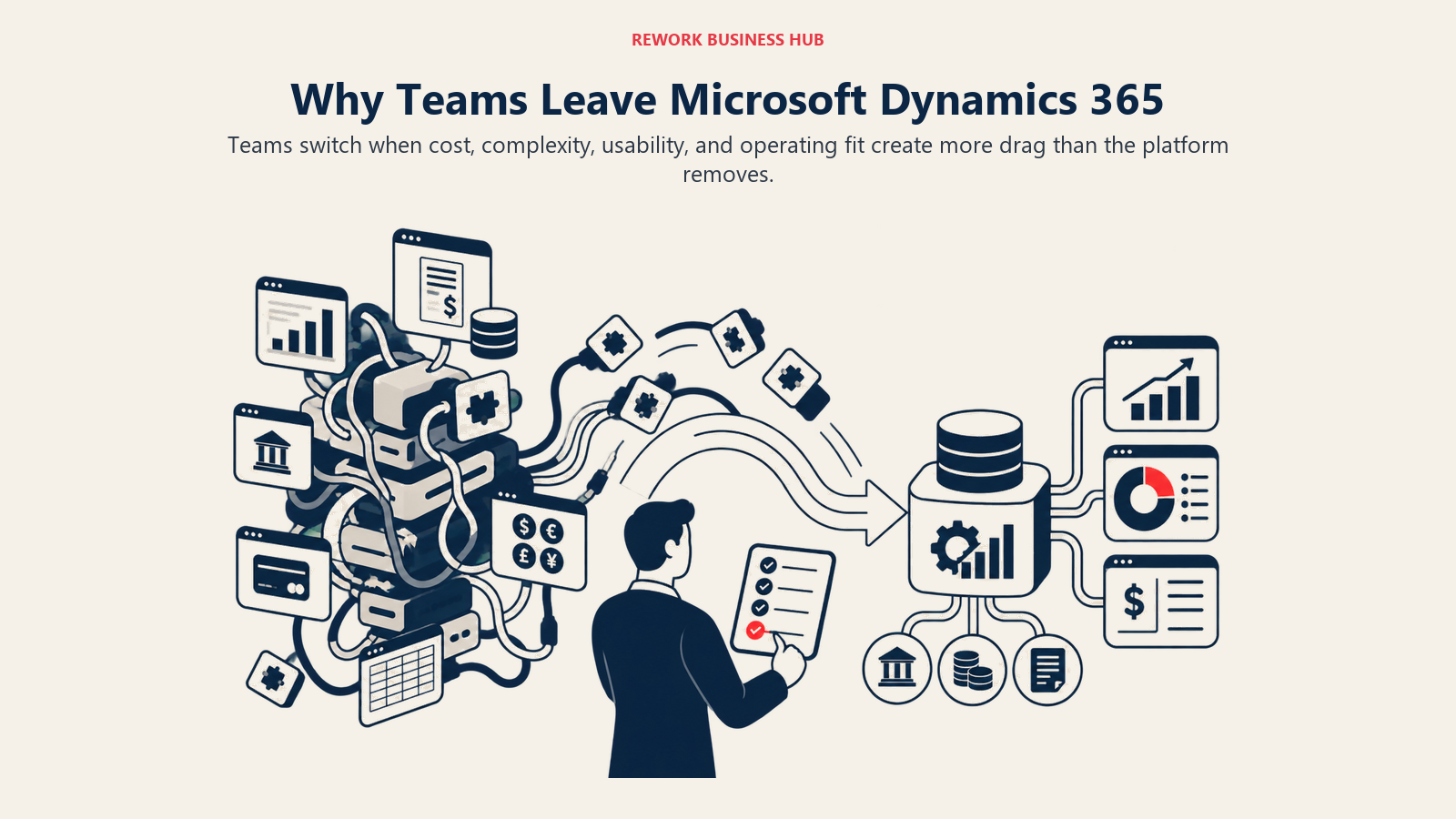
Before diving into alternatives, it helps to name the specific pain points that push mid-size companies to evaluate options. These aren't hypothetical. They're the reasons that show up consistently in migration conversations.
The Dynamics 365 Licensing Problem
Dynamics 365 doesn't have a single price. It has a matrix. Sales Professional, Sales Enterprise, Customer Service Professional, Customer Service Enterprise, Marketing (now called Customer Insights), Finance, Supply Chain Management, Business Central: each is a separate license, priced per user per month. A mid-size company that needs sales CRM plus customer service plus basic financials is stacking three or four license types before counting Azure consumption costs.
| License tier | Per-user cost (approx.) |
|---|---|
| Sales Professional | $65/user/mo |
| Sales Enterprise | $95/user/mo |
| Customer Service Professional | $50/user/mo |
| Customer Service Enterprise | $95/user/mo |
| Marketing / Customer Insights | From $1,500/tenant/mo |
| Business Central Essentials | $70/user/mo |
| Business Central Premium | $100/user/mo |
| Finance | $180/user/mo |
The Implementation Reality
Dynamics 365 is designed to be implemented by a Microsoft partner (SI). That's not a criticism; it's the business model. But for a mid-size company that wants to be running in 60-90 days, a 6-12 month SI engagement changes the total cost of ownership picture significantly. SI fees often exceed first-year license costs.
The Ecosystem Dependency
Dynamics 365 is deeply integrated with Azure Active Directory, Microsoft 365, Power Automate, Power BI, and the rest of the Microsoft stack. If your company already runs on Microsoft, this can be a genuine advantage. But it also means switching off Dynamics 365 later is materially harder than switching off a standalone CRM. Data, workflows, and identity management are all entangled. Teams planning a migration should read field mapping between systems before starting, as it covers the most common data model mismatches that slow Dynamics exits.
Stage Fit Matrix
| Tool | Startup (1-50) | Growth (50-200) | Mid-Market (200-1000) | Enterprise (1000+) |
|---|---|---|---|---|
| Salesforce | Overkill | Possible | Strong fit | Core market |
| HubSpot CRM | Good fit | Strong fit | Possible | Heavy |
| Zoho One | Good fit | Strong fit | Possible | Less common |
| NetSuite | Too early | Possible | Strong fit | Core market |
| Rework | Possible | Strong fit | Strong fit | Less common |
| SAP Business One | Possible | Possible | Strong fit | Transitional |
| Odoo | Good fit | Strong fit | Possible | Less common |
| Freshworks CRM | Good fit | Strong fit | Possible | Less common |
| Monday.com | Good fit | Strong fit | Possible | Less common |
| Pipedrive | Good fit | Strong fit | Possible | Limited |
| Sage Intacct | Too early | Possible | Strong fit | Core market |
Sizing and Persona Table
| Tool | Typical company size | Primary buyer | Team or company-wide? |
|---|---|---|---|
| Salesforce | 100-10,000+ employees | CRO, VP Sales, Salesforce Admin | Sales + service teams |
| HubSpot CRM | 20-500 employees | VP Marketing, Head of Sales | Marketing + sales |
| Zoho One | 10-500 employees | IT Director, COO, Founder | Company-wide |
| NetSuite | 100-2,000 employees | CFO, Controller, IT Director | Finance + ops company-wide |
| Rework | 50-500 employees | VP Sales, COO, Head of Marketing | Company-wide (CRM + ops) |
| SAP Business One | 50-500 employees | COO, IT Director, ERP Admin | Operations company-wide |
| Odoo | 10-500 employees | CTO, COO, IT Director | Company-wide |
| Freshworks CRM | 10-500 employees | Head of Sales, IT Lead | Sales + support teams |
| Monday.com | 10-500 employees | COO, Project Manager, Ops Lead | Ops + project teams |
| Pipedrive | 10-300 employees | Head of Sales, Sales Manager | Sales team |
| Sage Intacct | 50-500 employees | CFO, Controller, Finance Director | Finance team |
1. Salesforce: Enterprise CRM With the Largest Ecosystem
Salesforce built the market for cloud CRM and still owns more enterprise CRM market share than any competitor. Its methodology is "a configurable platform for any sales and service process." The AppExchange has 7,000+ apps, and almost any workflow can be built with clicks or code.
The honest comparison to Dynamics 365 is that they're peers in complexity and cost, not lighter alternatives to it. Salesforce Enterprise runs ~$165/seat/month before add-ons. See Salesforce's pricing page for the full breakdown by edition. You'll still need a Salesforce admin or an implementation partner. The key differentiator is that Salesforce's ecosystem is larger and more mature: more integrations, more ISV tools, more talent available in the market. For a detailed breakdown, see the best Salesforce alternatives guide, which covers the same complexity vs. cost trade-off from the other side.
For mid-size companies evaluating both, Salesforce makes sense if your team is CRM-centric and sales/service-heavy. It makes less sense if you need ERP functions, since Salesforce has no native financials module and integrates with NetSuite, Sage, or others via connectors.
| What you get | What you don't |
|---|---|
| Deepest CRM feature set on the market | Affordable pricing at mid-market scale |
| AppExchange: 7,000+ apps and integrations | Simple self-serve setup |
| Strong AI (Agentforce/Einstein) at Enterprise tier | Native ERP or financial management |
| Global support and compliance certifications | Low admin overhead |
| Industry clouds for financial services, healthcare, manufacturing | Fast time-to-value |
Pricing: Starter Suite ~$25/seat/mo; Professional ~$80/seat/mo; Enterprise ~$165/seat/mo; Unlimited ~$330/seat/mo. Billed annually.
Best for: Mid-market to enterprise companies (100-10,000+ employees) with dedicated Salesforce admins and complex sales or service processes.
Not ideal for: Teams under 50 people, companies without admin capacity, or buyers looking for ERP.
2. HubSpot CRM: Marketing and Sales on One Platform
HubSpot's methodology is "inbound growth." It's built around the idea that your CRM, marketing automation, and content management should work together natively, not via integration. The free CRM tier is genuinely capable, and the Sales Hub adds pipeline management, sequences, and call logging that covers most mid-size sales team needs.
Against Dynamics 365, HubSpot wins on time-to-value. Most teams are running in days, not months. The marketing + sales integration is tighter out of the box than what Dynamics Sales + Customer Insights requires. The tradeoff is that HubSpot has no ERP capabilities, and the pricing model compounds quickly: Sales Hub Pro + Marketing Hub Pro for 50 seats commonly lands at $5,000-$10,000/month.
For companies leaving Dynamics 365 specifically because they don't need ERP and found CRM implementation too slow, HubSpot is frequently the first serious consideration. See the best HubSpot alternatives guide for a full pricing breakdown across tiers.
| What you get | What you don't |
|---|---|
| Native CRM + marketing automation + service desk | ERP, finance, or inventory modules |
| Strong inbound marketing tools (landing pages, forms, blogs) | Predictable pricing at scale (costs compound) |
| Fast onboarding, no SI needed | Enterprise governance features without Operations Hub |
| Large app marketplace | Deep custom object flexibility |
| Free CRM entry tier | Built-in multi-channel chat inbox |
Pricing: Free CRM; Sales Hub Starter ~$15/seat/mo; Sales Hub Pro ~$90/seat/mo; Enterprise ~$150/seat/mo. Marketing Hub priced separately.
Best for: Growth-stage to mid-size companies (20-500 employees) where marketing and sales are tightly linked and inbound is the primary motion.
Not ideal for: Companies needing ERP, heavy outbound/call-center operations, or tight per-seat budget control.
3. Zoho One: Broadest App Bundle at Mid-Market Price
Zoho's philosophy is "one operating system for your business": 50+ apps covering CRM, finance, HR, marketing, helpdesk, projects, analytics, and more, all for roughly $37/user/month on the all-employee pricing. No other vendor comes close to that breadth-to-price ratio.
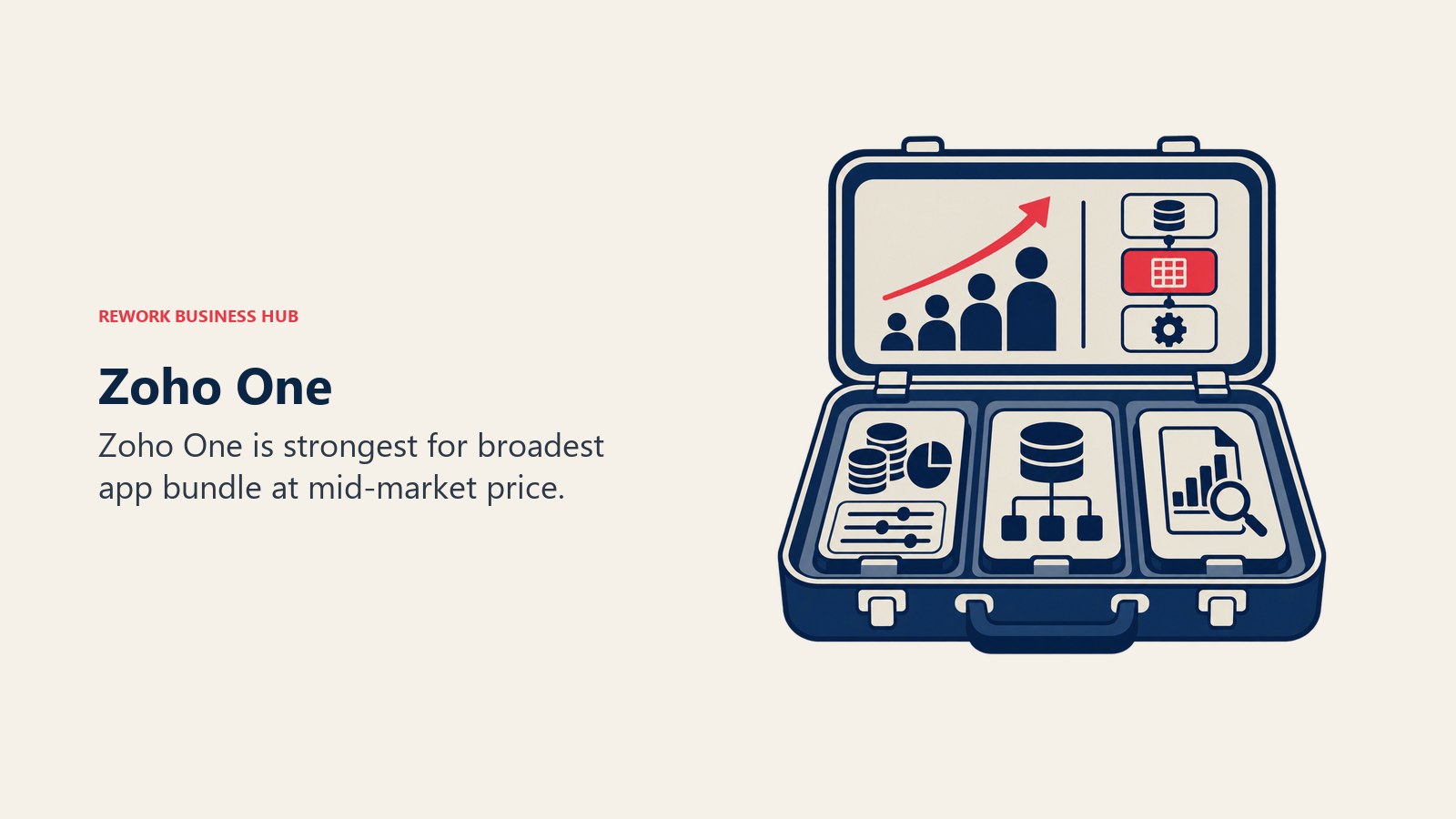
The Dynamics 365 parallel is intentional: Zoho One competes directly with the "we want one vendor for everything" buyer. The difference is that Zoho doesn't require an SI, and the total cost is a fraction of Dynamics. The honest limitation is quality consistency: Zoho CRM is solid, Zoho Books is capable, but some apps feel thinner than dedicated best-in-class tools. Teams with specific deep requirements (complex manufacturing ERP, enterprise-grade financial reporting) often find Zoho's apps adequate but not optimal.
For a 100-300 person company that needs CRM + finance + HR + helpdesk without a massive IT budget, Zoho One has the best value-to-price ratio in this guide. And if Zoho doesn't fit, the best Zoho alternatives covers the next tier of options.
| What you get | What you don't |
|---|---|
| 50+ apps: CRM, finance, HR, helpdesk, projects, analytics | Enterprise-depth in any single module |
| Very competitive pricing ($37/user/mo all-apps) | Consistent UX across all modules |
| No SI required; self-serve setup | Advanced manufacturing or supply chain ERP |
| Strong Zoho CRM with pipeline, scoring, automation | Microsoft ecosystem native integrations |
| Regular feature updates across the suite | Best-in-class depth of Salesforce or NetSuite |
Pricing: All-Employee Pricing ~$37/user/mo (annual); Flexible User Pricing ~$90/user/mo for non-all-employee deployments. Review Zoho One's pricing page for current rates.
Best for: SMB to mid-market companies (10-500 employees) that want broad coverage without multiple vendor contracts or SI engagements.
Not ideal for: Companies with complex, process-heavy manufacturing ERP needs or requiring deep enterprise governance.
4. NetSuite: Cloud ERP for Mid-Market Finance and Operations
NetSuite's methodology is "the cloud ERP built for growing companies": financial management, inventory, order management, revenue recognition, multi-entity consolidation, and CRM in a single cloud platform. Oracle acquired NetSuite in 2016 and it remains the dominant cloud ERP for mid-market companies that have outgrown QuickBooks or Sage 50.
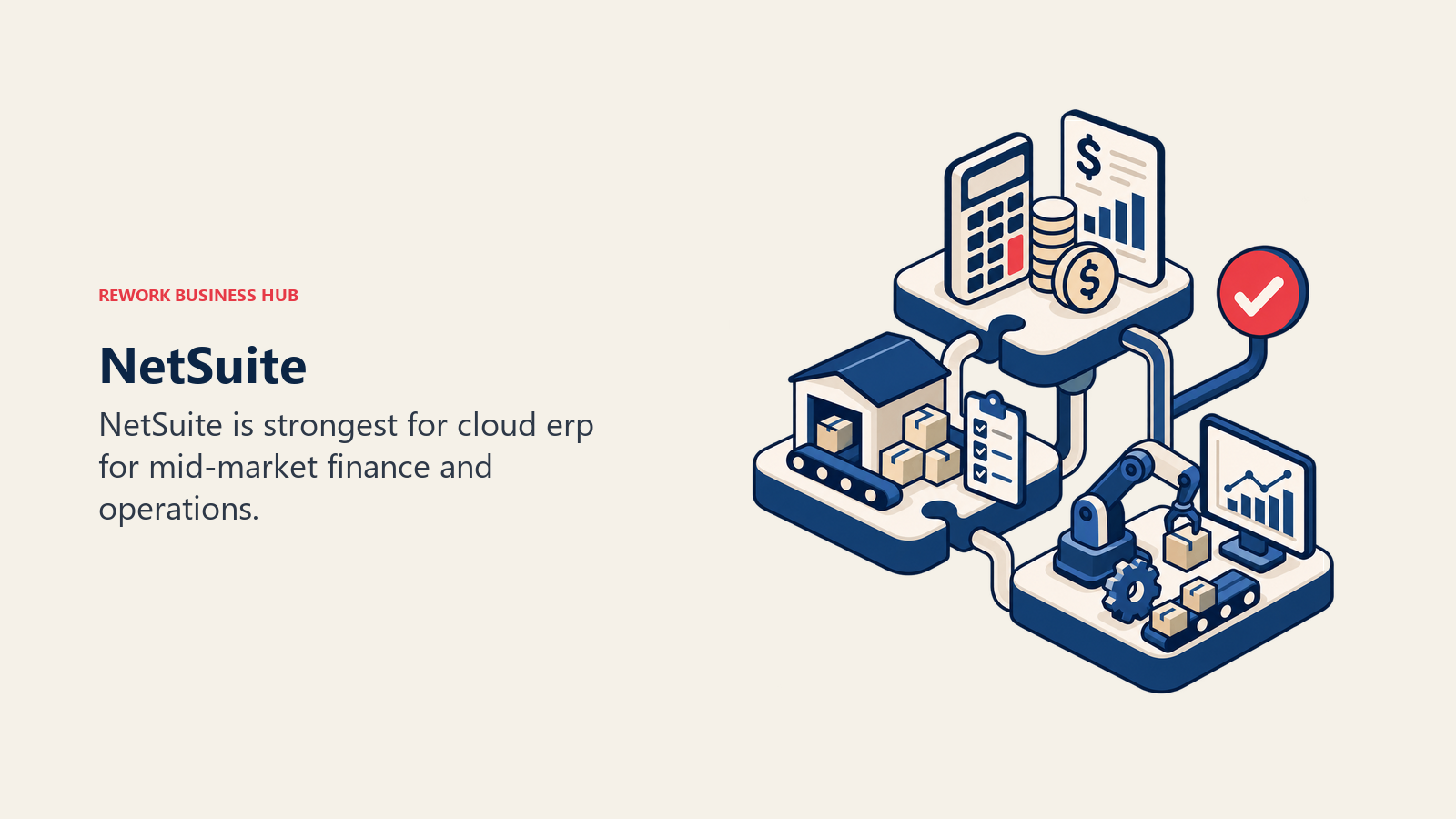
Against Dynamics 365, NetSuite is the strongest ERP competitor. Where Dynamics splits CRM (Sales/Service) from ERP (Finance/Business Central) into separate license stacks, NetSuite ships them integrated. The CRM module in NetSuite is functional but not deep by CRM standards. Most companies pair NetSuite financials with Salesforce or HubSpot for sales pipeline management.
If the core pain point with Dynamics 365 is the Business Central or Finance module complexity, NetSuite is the natural comparison. The best NetSuite alternatives guide covers the full mid-market ERP landscape if NetSuite also turns out to be more than you need.
| What you get | What you don't |
|---|---|
| Full cloud ERP: financials, inventory, order management | A modern CRM-first experience |
| Multi-entity and multi-currency out of the box | Simple self-serve pricing |
| Revenue recognition (ASC 606 compliant) | Short implementation timelines |
| Strong mid-market reference base | Best-in-class sales pipeline management |
| SuiteApps partner marketplace | Budget-friendly entry point |
Pricing: Base platform ~$999/month + $99/user/month. Implementation costs typically $25,000-$150,000+ depending on complexity. See NetSuite's product pages for module details.
Best for: Mid-market companies (100-2,000 employees) with real ERP requirements: multi-entity finance, complex inventory, revenue recognition.
Not ideal for: Companies that need CRM-first functionality; pure sales teams without ERP requirements.
5. Rework: CRM, Lead Management and Chat Inbox for the Dynamics 365 Sales Side
Rework replaces the CRM side of Dynamics 365 (the Sales and customer-engagement apps), not the ERP side. If you are leaving Dynamics 365 Sales because of licensing and implementation overhead, it ships CRM, lead management, and a chat inbox as one system, without separate licenses or an SI to connect them. If you are leaving Business Central or Finance, Rework is not your replacement: it has no general ledger, accounting, or supply chain planning modules.
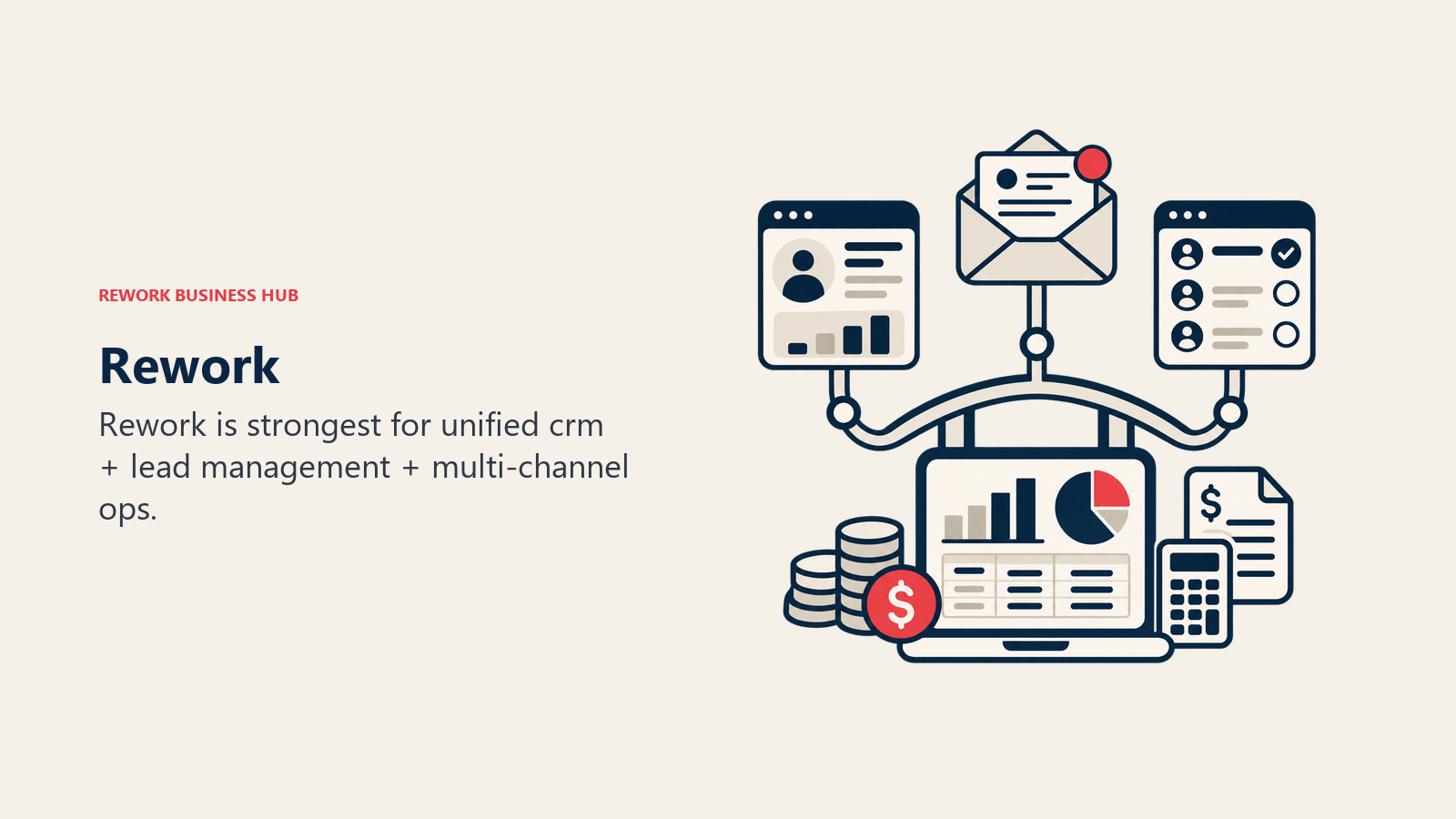
On the CRM side, the differentiator is operational simplicity. Lead routing with distribution rules and SLA clocks is configured without a developer. The inbox brings WhatsApp, Messenger, Instagram DM, TikTok, Telegram, LINE, Zalo and web chat into a single contact profile, which Dynamics 365 needs separate Customer Insights licensing and Power Automate flows to approximate. Rework's Commerce app adds quotes, orders, invoices and subscriptions next to the deal, but that is billing paperwork, not accounting: you still need a finance system such as NetSuite or Sage Intacct for the books.
It sits behind Zoho One and NetSuite here because most readers of this list need at least some of the ERP side, which those two cover and Rework doesn't. For a team that only outgrew the CRM layer, it belongs on the shortlist next to HubSpot.
| What you get | What you don't |
|---|---|
| CRM pipeline with forecasting and rep quotas | General ledger, accounting, supply chain planning |
| Native lead capture, scoring, and distribution | Deep custom object builder at Dynamics scale |
| Chat inbox: WhatsApp, Messenger, IG DM, TikTok, LINE, Zalo, web chat | Microsoft Power Platform integration |
| Quotes, orders, and invoices (Commerce app) | FedRAMP / HIPAA BAA (not documented) |
| Simple onboarding; no SI required | Fit for 1,000+ seat enterprise governance |
Pricing: Revenue Engine (CRM, Commerce, chat inbox and lead capture) is $159/month billed yearly ($1,908/year) or $190 month to month, with 5 marketing and 5 sales seats included. Extra seats come in blocks of 5 ($21/month per block on yearly billing). 14-day free trial. See rework.com/pricing.
Best for: Mid-size sales and marketing teams (50-500 employees) replacing Dynamics 365 Sales who need CRM, lead lifecycle and chat-based customer communication without an implementation project.
Not ideal for: Companies replacing Business Central or Dynamics Finance, anyone who needs accounting, or teams deeply embedded in Microsoft Power Platform workflows.
6. SAP Business One: ERP for Manufacturers and Distributors
SAP Business One is SAP's product for small to mid-size companies, distinct from SAP S/4HANA, which targets large enterprises. Its methodology is operational ERP for product-centric businesses: manufacturers, distributors, and wholesale companies that need production planning, warehouse management, purchasing, and financials integrated.
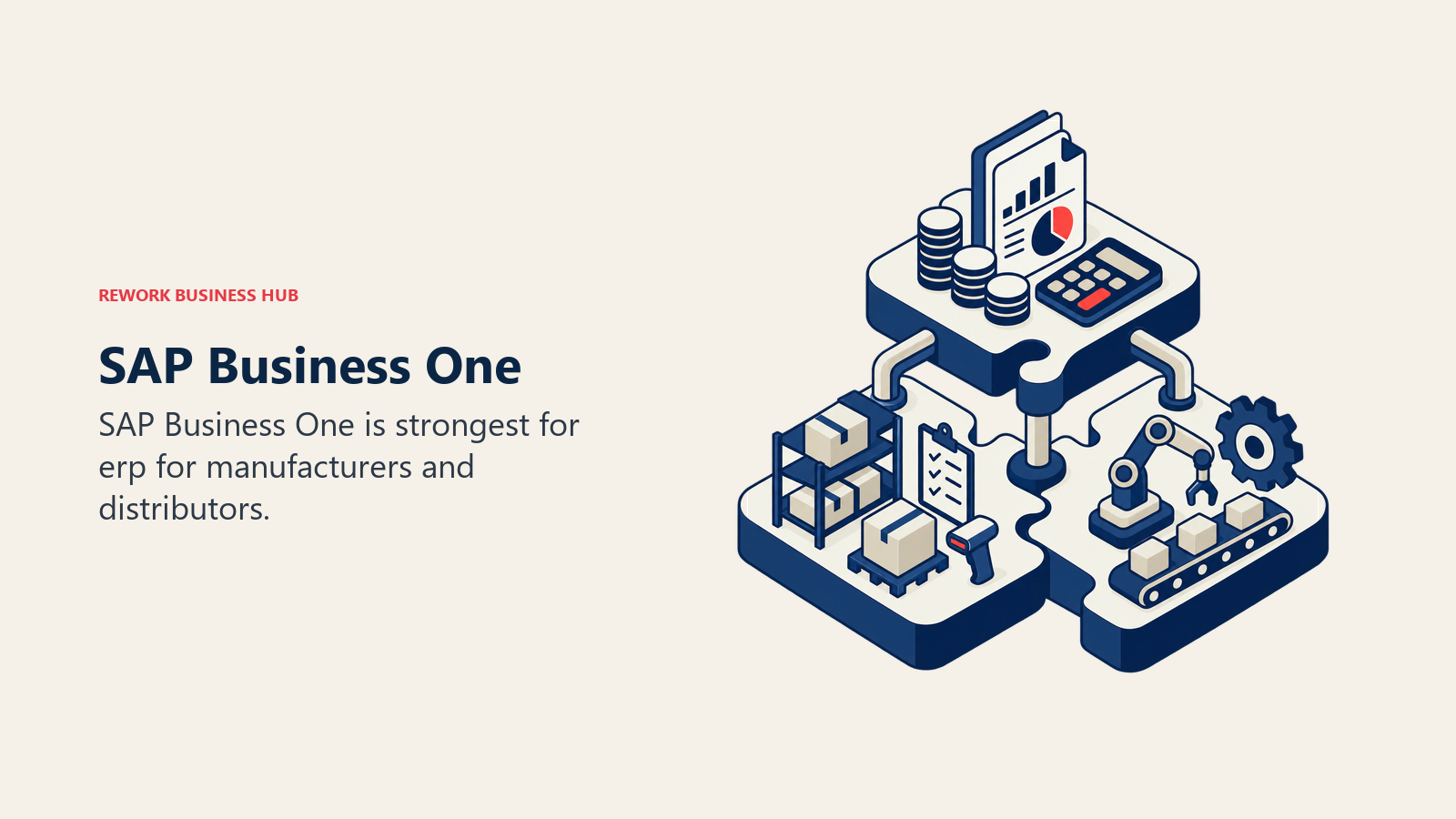
Against Dynamics 365, SAP Business One competes squarely for the mid-size manufacturer or distributor evaluating Business Central. SAP's advantage is deeper manufacturing and distribution logic; Dynamics' advantage is the Microsoft ecosystem integration and a broader partner network in some markets. The best SAP Business One alternatives guide covers what teams typically evaluate when B1's implementation cost is the sticking point.
SAP Business One requires implementation through a VAR (Value-Added Reseller), not unlike Dynamics 365 needing an SI. Self-serve deployment is not the model. For the right buyer, this is a known and accepted tradeoff for a mature, globally-deployed ERP platform.
| What you get | What you don't |
|---|---|
| Deep manufacturing and distribution ERP | Modern UX by 2026 standards |
| Bill of materials, production orders, MRP | Built-in CRM depth |
| Global deployment (50+ localizations) | Self-serve setup or fast implementation |
| SAP HANA in-memory database option | Competitive pricing vs. alternatives |
| Strong VAR ecosystem globally | Cloud-native architecture (on-prem roots) |
Pricing: Professional user ~$108/user/mo; Limited user ~$54/user/mo. SAP HANA Cloud version adds infrastructure costs. Implementation typically $30,000-$200,000+.
Best for: Mid-size manufacturers, distributors, and wholesalers (50-500 employees) that need production, warehouse, and financial management tightly integrated.
Not ideal for: Service businesses, CRM-first companies, or teams without budget for VAR implementation.
7. Odoo: Open-Source Modular ERP and CRM
Odoo's methodology is "one modular business software": an open-source platform with 80+ official apps covering CRM, accounting, inventory, manufacturing, HR, e-commerce, and more. The Community edition is free; the Enterprise edition adds hosted deployment, advanced features, and official support.
Against Dynamics 365, Odoo's pitch is flexibility and price. You pick exactly the modules you need, and the Community edition lets companies with developer resources deploy with near-zero licensing cost. The Enterprise edition at $13.60/user/month remains dramatically cheaper than Dynamics for comparable module coverage.
The honest complexity: Odoo implementations vary widely. A self-service deployment of CRM + invoicing for 20 people is genuinely simple. A full manufacturing + inventory + accounting + CRM deployment for 200 people is a real implementation project, even if it's cheaper than SAP or Dynamics. See the best Odoo alternatives guide if Odoo's open-source complexity is itself the concern.
| What you get | What you don't |
|---|---|
| 80+ modules: CRM, accounting, inventory, MFG, HR, e-commerce | Enterprise-tier polish of SAP or Oracle |
| Open-source flexibility; customize anything | Guaranteed fast implementation at scale |
| Strong price/performance ratio | Consistent quality across all 80 modules |
| Active developer and partner community | Official support without Enterprise plan |
| Modern UX compared to legacy ERP competitors | Deep Microsoft ecosystem integration |
Pricing: Community Edition: free (open-source, self-hosted). Enterprise Edition: ~$13.60/user/mo (hosted). Implementation via Odoo partners.
Best for: Mid-size companies (10-500 employees) with technical capacity wanting modular ERP + CRM at a fraction of SAP/Dynamics cost.
Not ideal for: Companies that need out-of-the-box deployment without developer resources; heavily regulated industries needing pre-certified compliance.
8. Freshworks CRM (Freshsales): AI-Assisted Sales CRM for Growing Teams
Freshworks' methodology is "modern, refreshingly easy CRM." The Freshworks suite (Freshsales for CRM, Freshdesk for support, Freshservice for IT) targets teams that want capable tools without the implementation overhead of Salesforce or Dynamics.
Freshsales specifically competes against Dynamics 365 Sales for mid-size companies that want sales pipeline management, email sequences, built-in phone, and AI-driven contact scoring without a complex deployment. Freddy AI (Freshworks' AI layer) handles lead scoring, deal insights, and conversation summaries across the suite.
Against Dynamics 365, Freshworks wins on simplicity and price. Against best-in-class CRM tools like Salesforce, it trades ecosystem depth for speed of deployment. It's a strong option for companies leaving Dynamics because CRM complexity was the pain point, not ERP. For context on how Freshworks compares against the broader CRM field, see the best Freshworks alternatives guide.
| What you get | What you don't |
|---|---|
| Freddy AI: lead scoring, deal insights, conversation summaries | ERP or financial management modules |
| Built-in phone, email, and chat | AppExchange-scale ecosystem |
| Strong auto-enrichment and deduplication | Advanced custom object modeling |
| Freshworks suite integration (support, IT, marketing) | Enterprise governance at Salesforce/Dynamics scale |
| Fast setup; minimal admin overhead | Deep field-level customization |
Pricing: Free tier; Growth ~$9/seat/mo; Pro ~$39/seat/mo; Enterprise ~$59/seat/mo. Billed annually.
Best for: SMB to mid-market sales teams (10-500 employees) that want AI-assisted CRM without a long implementation.
Not ideal for: Companies needing ERP; teams with complex territory or multi-org structures.
9. Monday.com: Work Management With CRM Capabilities
Monday.com's methodology is "work OS": a flexible board-based platform where teams build workflows for any process, covering projects, CRM, marketing campaigns, product launches, and HR onboarding. The CRM layer (Monday Sales CRM) is a structured extension of the work management platform, not a purpose-built CRM.
Against Dynamics 365, Monday.com competes for a specific type of buyer: operations-heavy companies that found Dynamics CRM too complex and primarily need pipeline visibility + project coordination in one tool. It's not a CRM replacement for high-volume sales organizations, but for 50-200 person companies where the same team manages projects and client relationships, it earns strong adoption.
Where Monday.com doesn't compete: financials, inventory, ERP, and deep sales automation. If ERP is the reason you're leaving Dynamics 365, Monday.com isn't in the evaluation. And if per-seat pricing is a concern, read seat-based pricing is dying before committing to Monday's per-user model.
| What you get | What you don't |
|---|---|
| Extremely flexible board-based views (CRM, projects, ops) | Deep CRM pipeline automation |
| Strong project and ops management | ERP, financial, or inventory management |
| Fast onboarding; intuitive UI | Built-in multi-channel communication inbox |
| 200+ integrations | Complex territory management or routing |
| Automations builder (no-code) | Enterprise sales forecasting |
Pricing: Basic ~$12/seat/mo; Standard ~$14/seat/mo; Pro ~$24/seat/mo; Enterprise custom. Billed annually, 3-seat minimum.
Best for: Operations and project-driven companies (10-500 employees) that want CRM visibility alongside work management, not a dedicated sales engine.
Not ideal for: High-volume inside sales teams, companies with ERP requirements, or teams needing deep CRM automation.
10. Pipedrive: Sales Pipeline Clarity Without Complexity
Pipedrive's methodology is "sales-first simplicity." It was built by salespeople frustrated with CRMs that prioritize admin reporting over rep productivity. The pipeline view is the center of the product, and every feature is evaluated through the lens of: does this help a rep close more deals?
Against Dynamics 365, Pipedrive is the sharpest contrast. Where Dynamics is broad, complex, and configurable, Pipedrive is narrow, simple, and opinionated. That's its strength. Teams that found Dynamics CRM overwhelming (too many objects, too many configuration options, too many things to set up before a rep could log a call) frequently find Pipedrive's focused approach a relief.
The tradeoff is ceiling. Pipedrive works well for sales teams up to ~200 people. It doesn't have ERP modules, marketing automation depth, or the kind of enterprise data model that large complex organizations need.
| What you get | What you don't |
|---|---|
| Best-in-class pipeline visualization | ERP, finance, or inventory modules |
| Fast onboarding; reps productive in a day | Deep marketing automation |
| Email sync, call logging, and activity tracking | Territory management or complex routing |
| AI-powered deal scoring (higher tiers) | Enterprise governance or SSO on base plans |
| 400+ integrations | Multi-org or multi-currency sophistication |
Pricing: Essential $14/seat/mo; Advanced $34/seat/mo; Professional $49/seat/mo; Power $64/seat/mo; Enterprise $99/seat/mo. Billed annually.
Best for: Sales-focused mid-size teams (10-300 employees) that want pipeline clarity and fast rep adoption over platform breadth.
Not ideal for: Companies with ERP needs, marketing-led growth motions, or complex multi-team workflows beyond sales.
11. Sage Intacct: Best-in-Class Financial Management for Mid-Market CFOs
Sage Intacct's methodology is "financial management built for growth." It's the AICPA-preferred financial management system for mid-market companies that need GAAP-compliant reporting, multi-entity consolidation, and dimensional general ledger without the cost and complexity of SAP or Oracle Financials.
Against Dynamics 365 Finance or Business Central, Sage Intacct competes directly for the finance-led buyer. Companies that chose Dynamics primarily for its financial management module and found it over-engineered frequently evaluate Intacct as a focused alternative. Intacct's financial reporting and consolidation capabilities are widely considered best-in-class for its market segment.
The clear limitation: Sage Intacct is a finance tool, not a CRM. It has no sales pipeline, no lead management, and no customer-facing capabilities beyond invoicing and AR. Most Sage Intacct customers pair it with a dedicated CRM (Salesforce, HubSpot, or Rework). Teams looking at how the CRM and finance layers connect should read CRM data model design before deciding which to pick first.
| What you get | What you don't |
|---|---|
| Best-in-class multi-entity financial consolidation | CRM or sales pipeline management |
| GAAP-compliant revenue recognition (ASC 606, ASC 842) | Inventory or manufacturing ERP modules |
| Dimensional GL for granular financial reporting | Field service, marketing, or customer service features |
| Strong AP automation and cash management | Self-serve pricing transparency |
| AICPA-preferred status; strong audit trails | Broad operational workflow management |
Pricing: Contact Sage for current pricing. Typically $400-$800/month for base module + per-user fees. Implementation commonly $15,000-$50,000+.
Best for: Mid-market CFOs and finance directors (50-500 employees) who need serious financial management and are willing to pair it with a separate CRM.
Not ideal for: Companies looking for a single platform covering CRM + finance; teams needing inventory or manufacturing ERP.
Module Coverage Comparison
| Module | Salesforce | HubSpot | Zoho One | NetSuite | Rework | SAP B1 | Odoo | Freshworks | Monday | Pipedrive | Sage Intacct |
|---|---|---|---|---|---|---|---|---|---|---|---|
| CRM / Pipeline | Yes | Yes | Yes | Basic | Yes | No | Yes | Yes | Basic | Yes | No |
| Lead Management | Yes | Yes | Yes | No | Yes | No | Yes | Yes | No | Partial | No |
| Marketing Automation | Add-on | Yes | Yes | No | Partial | No | Yes | Yes | No | Partial | No |
| Customer Service / Helpdesk | Add-on | Add-on | Yes | No | Partial | No | Yes | Yes | No | No | No |
| Financial Management | No | No | Yes | Yes | Invoicing only | Yes | Yes | No | No | No | Yes |
| Inventory Management | No | No | Yes | Yes | Yes | Yes | Yes | No | No | No | No |
| Manufacturing / MRP | No | No | Partial | Partial | No | Yes | Yes | No | No | No | No |
| HR / Payroll | No | No | Yes | No | Partial | No | Yes | No | Partial | No | No |
| Multi-Channel Inbox | No | No | Partial | No | Yes | No | Partial | Partial | No | No | No |
| Project Management | Add-on | Add-on | Yes | No | Partial | No | Yes | No | Yes | No | No |
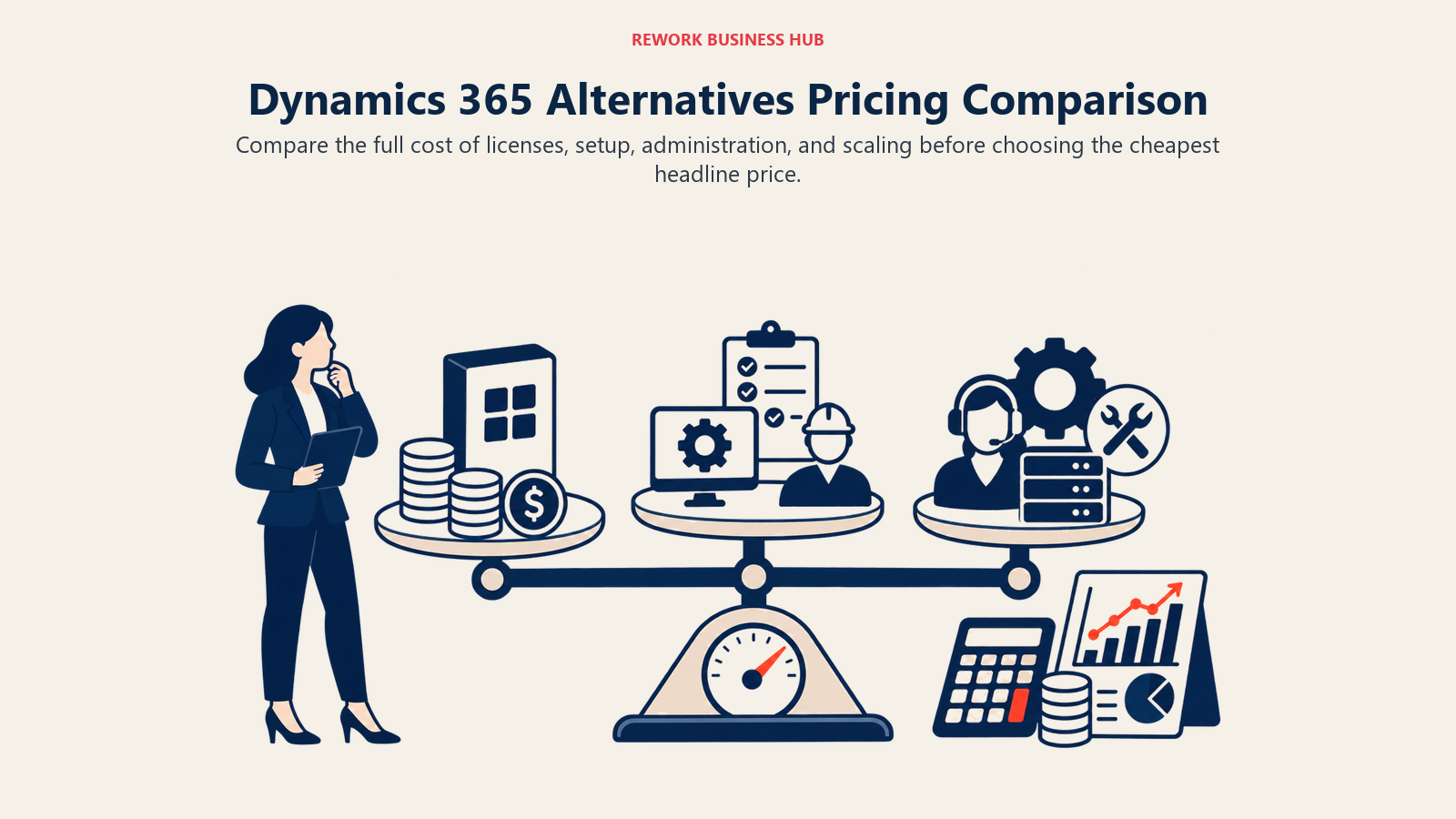
Pricing Comparison at 100 Seats
This table estimates annual cost for a 100-seat deployment at the mid-tier plan, which is the plan most mid-size companies land on after the initial tier proves insufficient.
| Tool | Estimated annual cost (100 seats, mid-tier) | Includes |
|---|---|---|
| Salesforce Enterprise | ~$198,000/yr | CRM only; add-ons extra |
| HubSpot Sales Hub Pro | ~$108,000/yr | Sales pipeline; Marketing Hub separate |
| Zoho One | ~$44,400/yr | 50+ apps |
| NetSuite | ~$120,000/yr+ | ERP + basic CRM; implementation extra |
| Rework | ~$8,772/yr | CRM + lead mgmt + chat inbox, no ERP (Revenue Engine, Advanced edition, billed yearly; 100 sales seats + 5 marketing seats) |
| SAP Business One | ~$129,600/yr | ERP; CRM limited |
| Odoo Enterprise | ~$16,320/yr | Modules selected |
| Freshsales Pro | ~$46,800/yr | CRM + AI |
| Monday.com Pro | ~$28,800/yr | Work OS + CRM boards |
| Pipedrive Professional | ~$58,800/yr | Sales pipeline |
| Sage Intacct | Contact; est. $60,000-$120,000/yr | Financial management |
Note: All figures are estimates based on publicly listed pricing where available. Actual quotes vary based on negotiation, bundle discounts, and module selection. According to Gartner's CRM market research, mid-market companies consistently underestimate total cost of ownership when evaluating multi-module platforms like Dynamics 365.
Implementation Complexity Comparison
| Tool | Typical time to value | SI / partner required? | Admin overhead |
|---|---|---|---|
| Salesforce | 3-12 months | Strongly recommended | High (dedicated admin) |
| HubSpot CRM | Days to weeks | No | Medium |
| Zoho One | Weeks to months | Recommended for full suite | Medium |
| NetSuite | 3-9 months | Yes | High |
| Rework | Days to weeks | No | Low |
| SAP Business One | 3-12 months | Yes (VAR required) | High |
| Odoo | Weeks to months | Recommended | Medium to high |
| Freshworks CRM | Days to weeks | No | Low |
| Monday.com | Days | No | Low |
| Pipedrive | Days | No | Low |
| Sage Intacct | 1-3 months | Recommended | Medium |
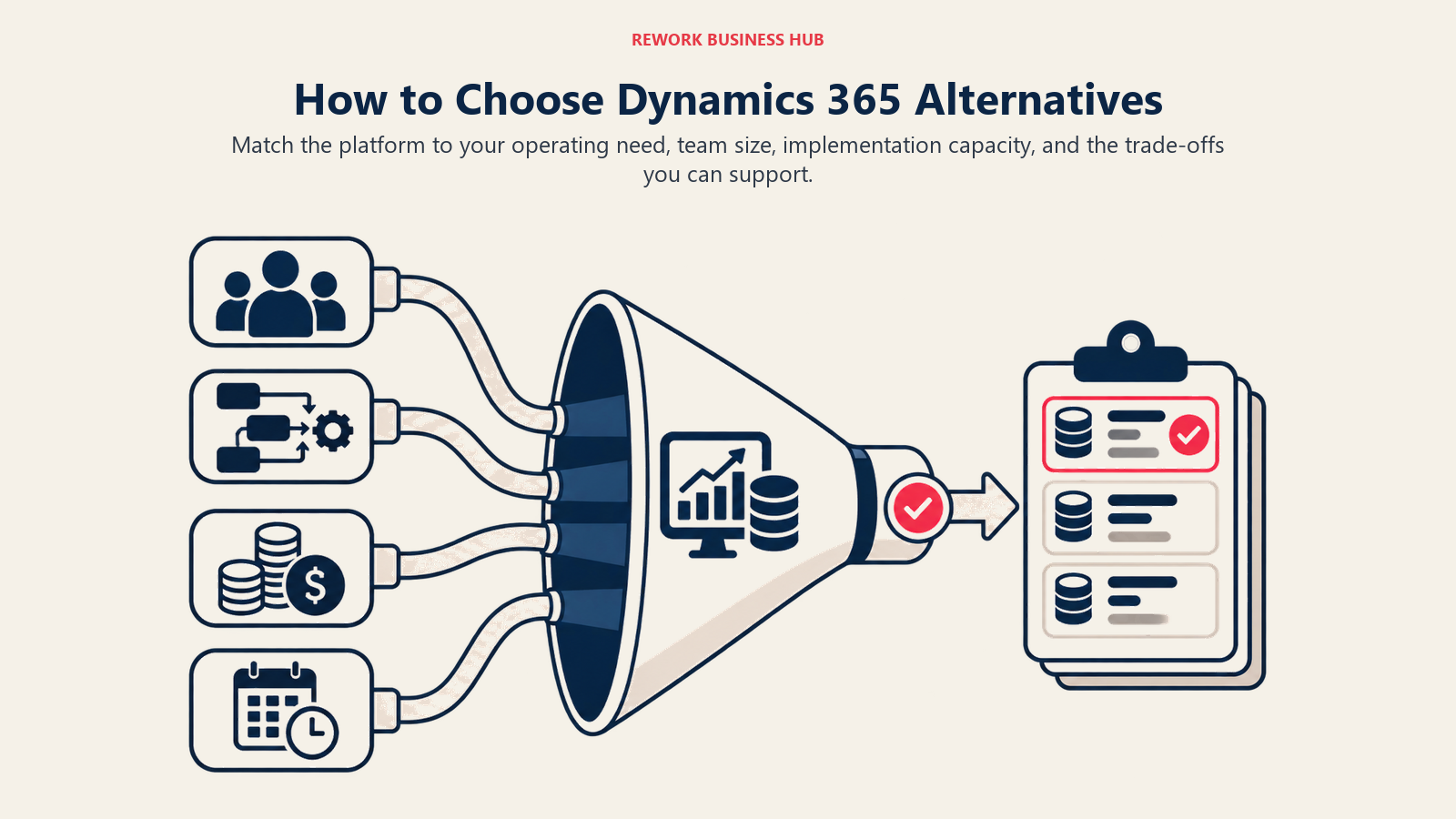
How to Choose: Decision Framework
Match the platform to your operating need, team size, implementation capacity, and the trade-offs you can support.
| If your primary need is... | Best pick | Runner-up |
|---|---|---|
| CRM + lead management + chat inbox (WhatsApp, Messenger), mid-size, no ERP | Rework | HubSpot CRM |
| Full-stack sales CRM with massive ecosystem | Salesforce | HubSpot CRM |
| Marketing + sales on one platform, inbound-led | HubSpot CRM | Zoho One |
| One vendor for CRM + finance + HR + helpdesk on a budget | Zoho One | Odoo |
| Cloud ERP with financials + inventory, mid-market | NetSuite | Odoo |
| Manufacturing or distribution ERP, established operations | SAP Business One | Odoo |
| Modular ERP + CRM at low cost, technical team available | Odoo | Zoho One |
| AI-assisted CRM, fast setup, no SI budget | Freshworks CRM | Pipedrive |
| Project + ops management + lightweight CRM | Monday.com | Zoho One |
| Sales pipeline clarity, rep-first simplicity | Pipedrive | Freshworks CRM |
| Best-in-class financial management, pairing with a CRM | Sage Intacct | NetSuite |
What to Do Next
Narrow your list to two tools that match your primary need, your budget, and your team's capacity for implementation. Teams that also need to modernize their document and contract workflows alongside their CRM should review the cutover day checklist, since many Dynamics 365 migrations include a document automation decision at the same time. Then run a structured 2-week pilot with each: real data, real users, real workflows. What teams discover in a live pilot (adoption friction, data model gaps, integration limits) almost never matches what vendor demos show.
For companies leaving Dynamics 365 specifically, it's worth separating the CRM and ERP decisions. Many organizations find that they didn't actually need Dynamics' ERP depth. They needed a better CRM and outgrew Dynamics' complexity and cost in that layer. If that's your situation, HubSpot, Pipedrive, or Rework move much faster than any ERP migration. If you genuinely need a new ERP, that's a longer project, and NetSuite, Odoo, or Sage Intacct deserve a structured evaluation alongside your CRM choice.
Frequently Asked Questions
What is the best Microsoft Dynamics 365 alternative?
It depends on your primary need. Salesforce wins if you want the largest ecosystem and have admin capacity. For mid-size CRM without an SI engagement, HubSpot is the fastest to value. Zoho One covers CRM plus finance in one budget bundle. For true cloud ERP, NetSuite is the strongest competitor, and Sage Intacct leads on finance specifically. Rework is worth a look if you only need to replace the CRM side and want lead routing and a chat inbox in the same system.
Why do mid-size companies leave Dynamics 365?
Three reasons dominate: per-app licensing that stacks separate fees for Sales, Customer Service, Finance, and Business Central; SI-dependent implementations that often run 6 to 12 months and exceed first-year license costs; and deep Microsoft ecosystem lock-in that makes switching harder later.
Is there a cheaper alternative to Dynamics 365?
Yes. Zoho One bundles 50+ apps for roughly $37 per user per month, Odoo Enterprise runs about $13.60 per user per month, and Freshworks CRM starts on a free tier. At 100 seats, several of these land far below a comparable Dynamics 365 deployment once implementation is included.
Which Dynamics 365 alternative is best for ERP?
NetSuite for full cloud ERP with financials, inventory, and multi-entity consolidation; SAP Business One for manufacturers and distributors; and Sage Intacct for finance-led companies that pair it with a separate CRM. Each ships ERP modules integrated rather than split into per-app licenses.
Do I need to replace both CRM and ERP when leaving Dynamics 365?
Often no. Many companies find they only outgrew the CRM layer and never needed Dynamics' ERP depth. Separating the two decisions lets you move fast on CRM with HubSpot, Pipedrive, or Rework while evaluating ERP on a longer, independent timeline.

Principal Product Marketing Strategist
On this page
- Quick Comparison Table
- Why Companies Leave Dynamics 365
- The Dynamics 365 Licensing Problem
- The Implementation Reality
- The Ecosystem Dependency
- Stage Fit Matrix
- Sizing and Persona Table
- 1. Salesforce: Enterprise CRM With the Largest Ecosystem
- 2. HubSpot CRM: Marketing and Sales on One Platform
- 3. Zoho One: Broadest App Bundle at Mid-Market Price
- 4. NetSuite: Cloud ERP for Mid-Market Finance and Operations
- 5. Rework: CRM, Lead Management and Chat Inbox for the Dynamics 365 Sales Side
- 6. SAP Business One: ERP for Manufacturers and Distributors
- 7. Odoo: Open-Source Modular ERP and CRM
- 8. Freshworks CRM (Freshsales): AI-Assisted Sales CRM for Growing Teams
- 9. Monday.com: Work Management With CRM Capabilities
- 10. Pipedrive: Sales Pipeline Clarity Without Complexity
- 11. Sage Intacct: Best-in-Class Financial Management for Mid-Market CFOs
- Module Coverage Comparison
- Pricing Comparison at 100 Seats
- Implementation Complexity Comparison
- How to Choose: Decision Framework
- What to Do Next
- Frequently Asked Questions