Best HiBob (Bob) Alternatives in 2026: 10 Modern HRIS Platforms for Mid-Size Companies
Turn this article into takeaways for your work.


Each assistant summarizes the article only for you and suggests best practices for your work.
Quick answer: The best HiBob alternatives in 2026 are BambooHR (trusted US mid-market HRIS), Personio and Factorial (European payroll and compliance), Rippling (HR plus IT plus Finance), Namely and Gusto (native US payroll), Deel (global hiring), Sage People (Salesforce-native), Lattice (performance), and Rework (HRIS, attendance, and payroll on one employee record). The right pick depends on your size, region, and whether payroll or performance is the priority.
HiBob built a strong reputation on culture-first HR: beautiful UI, solid onboarding flows, and compensation management that doesn't feel like it was designed in 2009. For companies between 50 and 500 employees scaling out of spreadsheets, it's a genuinely good product.
But it's not the right fit for everyone. Pricing is quote-only and lands higher than most buyers expect. Payroll integrations require third-party connectors rather than native processing in most markets. Performance management is functional but shallow compared to dedicated tools like Lattice. And if you need deep analytics, expect an upsell conversation. If you're a US company navigating state-level compliance complexity, HiBob's coverage is still catching up to legacy providers.
This guide is for HR Directors, COOs, and People Ops leads at companies with 50 to 2,000 employees who are either evaluating HiBob for the first time or actively looking for a better fit. We cover 10 alternatives, how each one thinks about the HR problem differently, and who each platform actually serves well.
If you're also reviewing your company's broader ops and finance stack alongside HR, see our guides on best NetSuite alternatives and best Microsoft Dynamics 365 alternatives. Both cover mid-market ERP and ops platforms that often come up in the same evaluation cycle. And if you're coming from BambooHR rather than HiBob, the best BambooHR alternatives positions both tools in context.
Quick Comparison Table
| Tool | Best For | Starting Price | Key Strength | Key Limitation |
|---|---|---|---|---|
| BambooHR | US mid-size companies needing a trusted HRIS | $10/employee/mo (Core) | Mature HR features, strong integrations | Limited outside North America |
| Personio | European companies wanting all-in-one HR | ~€5/employee/mo | European payroll + compliance built in | UI can feel dense |
| Rework | HRIS, attendance, and payroll unified with operations | Quote on request (rework.com/pricing) | HRIS, timesheets, and payroll on one employee record | No engagement or performance tools; statutory defaults point to Vietnam |
| Rippling | Companies wanting HR + IT + Finance in one | No public price; ~$8/employee/mo reported | Widest platform scope in the market | Complex to configure at full depth |
| Namely | US mid-market needing native payroll | Custom pricing | Payroll + HR in one US-focused system | Weak outside the US |
| Gusto | Small-to-mid companies prioritizing payroll | $49/mo base + $6/person | Best-in-class payroll UX for US teams | Limited enterprise HR depth |
| Deel | Distributed/global teams, contractors | $49/contractor/mo | Global payroll + EOR + compliance | HR features thinner than HRIS peers |
| Factorial | SMBs in Europe wanting modern HR + payroll | ~€5/employee/mo | Strong European compliance, modern UX | Less proven at 500+ employees |
| Sage People | Enterprise HR needing Salesforce-native platform | Custom (enterprise) | Deep Salesforce integration | Requires Salesforce investment |
| Lattice | Companies where performance is the priority | $11/person/mo | Best performance management on the market | HR features incomplete without add-ons |
Stage Fit Matrix
| Tool | Startup (1-50) | Growth (50-200) | Mid-Market (200-1000) | Enterprise (1000+) |
|---|---|---|---|---|
| BambooHR | Moderate | Strong | Strong | Limited |
| Personio | Moderate | Strong | Strong | Limited |
| Rework | Strong | Strong | Strong | Partial |
| Rippling | Moderate | Strong | Strong | Strong |
| Namely | Weak | Moderate | Strong | Moderate |
| Gusto | Strong | Strong | Moderate | Weak |
| Deel | Strong | Strong | Strong | Strong |
| Factorial | Strong | Strong | Moderate | Weak |
| Sage People | Weak | Weak | Moderate | Strong |
| Lattice | Weak | Strong | Strong | Strong |
Sizing and Buyer Persona Table
| Tool | Ideal Headcount | Primary Buyer | Secondary Buyer |
|---|---|---|---|
| BambooHR | 50-500 | HR Director | CHRO |
| Personio | 50-500 | HR Manager | CFO (European) |
| Rework | 20-500 | HR Director, COO | Head of Ops |
| Rippling | 50-1,000 | CTO, COO | HR Director, IT Lead |
| Namely | 100-1,000 | CHRO, HR Director | CFO |
| Gusto | 5-200 | Founder, HR Manager | Finance Lead |
| Deel | 10-5,000 | CFO, Legal | HR Director |
| Factorial | 10-300 | HR Manager | Office Manager |
| Sage People | 500+ | CHRO | IT Director |
| Lattice | 50-2,000 | VP People | CHRO |
1. BambooHR: The trusted HRIS for US mid-size companies
Methodology: BambooHR's bet is that HR software should be simple enough that non-HR managers actually use it. They've built around a clean self-service model: employees update their own data, managers approve requests without calling HR, and the HR team spends time on people work rather than admin. It's the most mature "HR for the rest of us" platform in the US market.
Target audience: HR Directors and CHROs at US companies with 50 to 500 employees that want a reliable, proven HRIS. Companies that have outgrown spreadsheets and basic payroll tools but don't need the complexity of enterprise HR.
Sizing fit: Ideal at 50-500 employees. Still workable up to around 1,000 but starts to show limits on customization at scale.
Stage fit: Best for growth-stage companies formalizing HR processes and mid-market teams needing operational stability.
Team vs company-wide: Company-wide HRIS. Handles all employees, all departments.
| What you get | What you don't |
|---|---|
| Strong US payroll (with add-on) | International payroll |
| ATS built in | Advanced analytics without add-ons |
| Onboarding workflows | Deep performance management |
| 150+ integrations | Strong European compliance |
| Excellent mobile app | Highly configurable workflows |
Pricing: Approximately $8-$12 per employee per month depending on tier. Payroll is an add-on. Custom quotes for larger teams.
Best for: US-based HR teams that want a dependable, well-integrated HRIS with strong employee self-service and a clean UI.
2. Personio: All-in-one HR built for European companies
Methodology: Personio's philosophy is that mid-size European companies deserve an HR platform that actually understands their labor markets. German works councils, French payroll, Spanish holiday rules: they've built compliance into the core rather than patching it on as an afterthought. Their vision is to be the single HR system for 10-2,000 employee European companies: recruiting, onboarding, payroll, time tracking, and performance, all in one place.
Target audience: HR Managers and HR Directors at European companies (primarily DACH, UK, Netherlands, Spain) with 50 to 500 employees. CFOs often co-sponsor the purchase because payroll compliance is part of the value proposition.
Sizing fit: Strongest at 50-300 employees. Capable up to 500-1,000 with some configuration effort.
Stage fit: Growth and mid-market companies formalizing European HR. Not a startup tool: you need real HR processes before Personio adds value.
Team vs company-wide: Full company HRIS. Covers all employees across HR and Finance functions.
| What you get | What you don't |
|---|---|
| European payroll with local compliance | Strong US market coverage |
| Recruiting module built in | Best-in-class performance management |
| Time and attendance tracking | Deep workflow customization |
| GDPR-native data handling | Strong API for custom integrations |
| Onboarding workflows | Fast-scaling enterprise support |
Pricing: Starts around €5 per employee per month for core HR. Payroll and full suite pricing requires a custom quote. Typically €8-€15 per employee depending on modules.
Best for: European companies that want one HR system instead of five, with payroll compliance baked in.
3. Rework: HRIS, attendance, and payroll on one employee record
Methodology: Rework People puts five apps (Hiring, Career, HRIS, Timesheet, and Payroll) on one employee record, inside the same platform that runs a company's sales, approvals, and projects. HRIS holds records, contracts, documents, and the tax, insurance, and benefit policies that apply to each person. Timesheet handles shifts, check-ins, time off, overtime, and locked timesheets. Payroll calculates pay from those two, with approval flows, payslips employees confirm, salary advances, and multi-currency runs, and Career covers offers, onboarding, promotions, and raises. Copilots in each app draft actions (leave and overtime requests, contract reviews, payroll anomaly briefs) for a person to confirm. Where HiBob leads with culture and engagement, Rework leads with operations: attendance feeding payroll, and HR handoffs that reach Finance, IT, and managers without a separate workflow tool.
Why it ranks third: BambooHR and Personio are closer like-for-like HRIS replacements. Rework doesn't center on the engagement surveys, culture features, and performance cycles that are much of why teams buy HiBob in the first place. Its statutory income-tax and social-insurance defaults point to Vietnam, and it does not file taxes, produce US forms such as W-2s, connect to benefits carriers, or act as an employer of record.
Target audience: HR Directors, COOs, and People Ops leads at 20-500 person companies, especially shift-based, multi-site, or Southeast Asia-based teams, who want attendance, payroll, and HR records in one system alongside sales and operations.
Sizing fit: Works best from 20 to 500 employees. Above that, enterprise HCM depth and multi-country compliance usually become the deciding factors.
Stage fit: Best for growth-stage and early mid-market companies replacing spreadsheets or a patchwork of separate HR, attendance, and payroll tools.
Team vs company-wide: Company-wide. Every employee has a record, a timesheet, and payslips, and HR workflows reach Finance, IT, and department heads on the same platform.
| What you get | What you don't |
|---|---|
| Employee records, contracts, and documents in HRIS | Engagement surveys and culture features |
| Shifts, check-ins, time off, overtime, and locked timesheets | Built-in performance reviews |
| Payroll built from the locked timesheet, with approvals and payslips | Tax filing, US forms (W-2), or benefits carriers |
| Offers, onboarding, promotions, and raises in Career | Out-of-the-box statutory rules outside Vietnam |
| Copilots that draft HR, leave, and payroll actions for approval | Employer of record or global payroll |
Pricing: Rework People is not publicly priced; pricing is quoted per organization. (rework.com/pricing)
Best for: Companies that want HR records, attendance, and payroll on one employee record, run alongside sales and operations, more than they want HiBob's culture and engagement layer.
4. Rippling: HR, IT, and Finance unified on one platform
Methodology: Rippling's thesis is that HR, IT, and Finance data all touch employees, and those three systems should be one. When you hire someone in Rippling, you can simultaneously set up their laptop, add them to the right Slack channels, enroll them in benefits, and run payroll, all from one action. They've built the widest platform scope in the market: HRIS, global payroll, IT management, and financial tools under one roof.
Target audience: COOs, CTOs, and HR Directors at 50-1,000 employee companies that want to reduce software sprawl. Companies with distributed teams or international hiring. Buyers who are as frustrated by IT and Finance fragmentation as they are by HR fragmentation.
Sizing fit: Works at 50 employees but really shines at 100-1,000 where cross-department tooling complexity is highest.
Stage fit: Growth through enterprise. Particularly strong for companies scaling internationally or going through rapid headcount growth.
Team vs company-wide: The most company-wide tool on this list. HR, IT, and Finance are all in scope.
| What you get | What you don't |
|---|---|
| Global payroll in 50+ countries | Simple setup experience |
| IT device management built in | Best-in-class performance tools |
| Automated provisioning/deprovisioning | Low price at full platform scope |
| Benefits administration (US-strong) | Deep HR analytics |
| Unified employee record across all systems | Fast-moving product that requires change management |
Pricing: Starts around $8 per employee per month for HR. Full platform pricing scales significantly. Expect $15-$25+ per employee for HR + IT + Finance modules. Custom quotes required.
Best for: Ops-led companies that want to consolidate HR, IT, and Finance tools and are willing to invest in a more complex setup.
5. Namely: Native payroll for US mid-market
Methodology: Namely was built specifically for US mid-market companies that found BambooHR too basic and Workday too expensive. Their bet is on native payroll combined with HR. Not an integration, but a single system where payroll data and HR data live together. That eliminates the reconciliation errors that come with syncing separate systems.
Target audience: CHROs and HR Directors at US companies with 100 to 1,000 employees. Finance leaders co-own the purchase because of payroll scope. Companies that have tried running HR and payroll in separate systems and hit data sync pain.
Sizing fit: Best at 200-1,000 employees. Below 100 it can be expensive relative to value. Above 1,000, enterprise HCMs typically win.
Stage fit: Mid-market companies with mature HR needs. Not the right tool for companies still building basic HR infrastructure.
Team vs company-wide: Full HRIS and payroll, covers all US employees.
| What you get | What you don't |
|---|---|
| Native US payroll (not integrated) | International payroll or compliance |
| Benefits administration | Modern, consumer-grade UI |
| Compliance calendar | Strong performance management |
| Onboarding and offboarding workflows | ATS built in |
| Time and attendance | Fast implementations |
Pricing: Custom pricing. HiBob's pricing page requires a sales call. Expect $12-$18 per employee per month for the full platform. Implementation fees apply.
Best for: US mid-market HR leaders who want native payroll and HRIS without stitching two systems together.
6. Gusto: Best payroll UX for small-to-mid US teams
Methodology: Gusto started as a payroll company for small businesses and built HR around that foundation. Their philosophy is that running payroll and onboarding an employee should feel as simple as sending an email. They've won a massive US customer base on the strength of their payroll UX, then expanded into benefits, hiring, and basic HR tools. They don't pretend to be enterprise HR. They're unapologetically built for the 5-200 employee range.
Target audience: Founders, Office Managers, and small HR teams at US companies with 5 to 200 employees. Finance leads often own the Gusto relationship because payroll came first.
Sizing fit: Strongest at 5-100 employees. Works up to 200-300 but starts showing limits on HR complexity. Not designed for 500+.
Stage fit: Pre-PMF startups and early growth companies. Companies formalizing payroll for the first time. Not the right tool for mid-market HR operations.
Team vs company-wide: Covers all employees but the feature depth is oriented toward small teams.
| What you get | What you don't |
|---|---|
| Best-in-class payroll UX for US teams | International payroll |
| Automated tax filings (federal + state) | Deep HR customization |
| Benefits administration | Strong ATS or recruiting tools |
| Contractor payments | Advanced performance management |
| Onboarding checklists | Enterprise compliance reporting |
Pricing: $49/month base plus $6 per person per month (Simple plan). The Plus plan runs $80/month plus $12 per person, and Premium is $180/month plus $22 per person.
Best for: US companies with up to 200 employees that want payroll and basic HR in a clean, easy-to-use system.
7. Deel: Global payroll and compliance for distributed teams
Methodology: Deel was built to solve one of the hardest HR problems: legally hiring people in countries where you don't have a legal entity. Their Employer of Record (EOR) service lets companies employ workers in 100+ countries without setting up subsidiaries. Beyond EOR, they've expanded into global payroll for companies with their own entities, contractor management, and increasingly HRIS features. Their philosophy is that the talent pool is global. Hiring tools should be too.
Target audience: CFOs, Legal leads, and HR Directors at companies with distributed or international teams. Companies hiring contractors internationally. Growth-stage to enterprise companies expanding into new markets without the overhead of local legal entities.
Sizing fit: Works at any size for global hiring. For domestic-only US or European companies, other tools on this list are better fits.
Stage fit: Any stage, as long as international hiring is in scope. Startups hiring their first international contractors through enterprise teams managing global payroll.
Team vs company-wide: Covers all employees and contractors but the HRIS depth is secondary to the global compliance layer.
| What you get | What you don't |
|---|---|
| EOR in 100+ countries | Deep performance management |
| Global payroll for entities you own | Benefits as competitive as US-native tools |
| Contractor management and payments | Strong domestic-only HR features |
| Built-in compliance and local contracts | Complex workflow automation |
| Equity management tools | Simple pricing for large teams |
Pricing: EOR starts at $599 per employee per month. Contractor management starts at $49 per contractor per month. Payroll for owned entities is priced separately. Costs scale quickly for large international teams.
Best for: Companies that need to hire, pay, and stay compliant across multiple countries, and are willing to pay for the legal infrastructure that makes that possible.
8. Factorial: Modern HR + payroll for European SMBs
Methodology: Factorial's vision is to bring the consumer-grade UX of modern SaaS to European SMB HR. They've built time tracking, leave management, payroll, performance reviews, and recruiting into a single platform with a clean interface that doesn't require an HR consultant to configure. They're growing fast in Spain, France, Germany, and Italy, with compliance adapted for each market.
Target audience: HR Managers and Office Managers at European companies with 10 to 300 employees. Companies where one person handles all HR and needs tools that don't demand HR expertise to operate.
Sizing fit: Strongest at 10-150 employees. Growing into the 150-300 range. Not yet battle-tested at 500+.
Stage fit: Early growth and growth-stage companies formalizing HR for the first time. Great first HRIS for European teams coming off spreadsheets.
Team vs company-wide: Full company coverage for HR, time, and payroll.
| What you get | What you don't |
|---|---|
| European payroll with local compliance | US payroll or compliance |
| Time and attendance built in | Deep enterprise customization |
| Modern UI, easy to learn | Proven track record at 500+ employees |
| Performance and OKR tracking | Strong ATS |
| Affordable entry pricing | Deep analytics |
Pricing: Starts around €5 per employee per month for core HR. Payroll and full suite pricing requires a quote. Typically €8-€12 per employee for the complete platform.
Best for: European SMBs that want modern HR software without enterprise complexity or enterprise pricing.
9. Sage People: Enterprise HR on the Salesforce platform
Methodology: Sage People is built for organizations that run Salesforce as their CRM and want their HR data in the same ecosystem. Their philosophy is that HR data and business data should live in one place. Customer, employee, and financial data unified on one platform enables workforce analytics that siloed HR systems can't deliver. It's a niche but powerful bet for Salesforce-first enterprises.
Target audience: CHROs and IT Directors at mid-to-large organizations with 500 to 5,000 employees that already run Salesforce. Companies where the CIO has strong influence over HR system selection. Organizations that want deep customization and are comfortable with Salesforce administration.
Sizing fit: Best at 500+ employees. Below that, the Salesforce overhead is hard to justify.
Stage fit: Mid-market and enterprise companies with existing Salesforce investment. Not a good fit for companies without Salesforce.
Team vs company-wide: Full HRIS scope, but the value proposition is strongest when it connects to a wider Salesforce deployment.
| What you get | What you don't |
|---|---|
| Deep Salesforce integration | Affordable entry pricing |
| Highly customizable data model | Easy setup without Salesforce expertise |
| Strong workforce analytics | Modern consumer-grade UX |
| Global HR capabilities | US payroll (requires separate system) |
| Enterprise-grade permissions | Fast implementation |
Pricing: Enterprise pricing, custom quotes only. Expect significant investment. This is positioned for 500+ employee organizations with Salesforce budgets.
Best for: Salesforce-native enterprises that want unified HR and business data and have the technical resources to configure and maintain it.
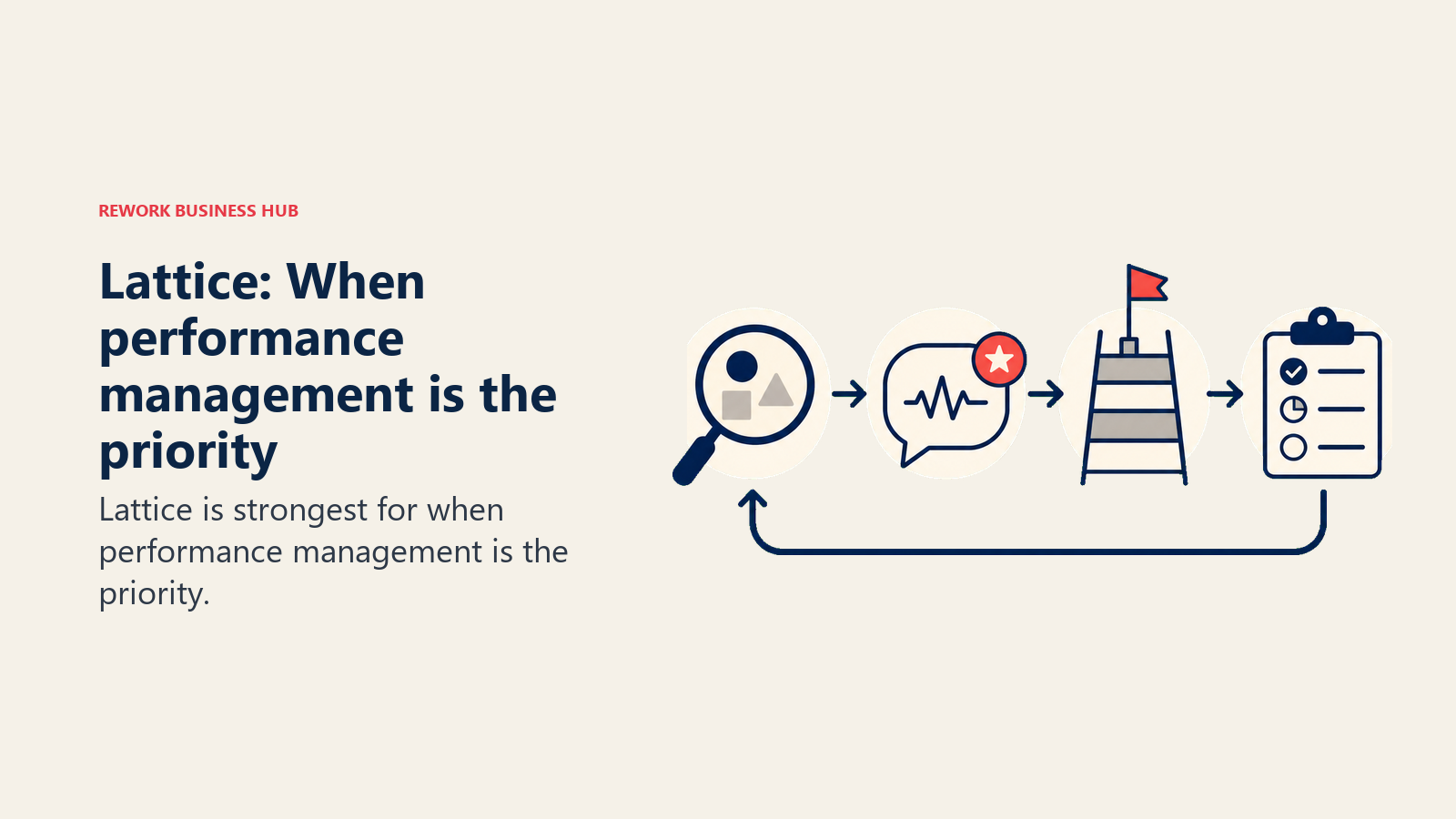
10. Lattice: When performance management is the priority
Methodology: Lattice built the most sophisticated performance management product in the market, then expanded into broader People Management. Their thesis is that HR's highest-leverage work is developing people, not just tracking them. So performance reviews, goal setting, OKRs, manager effectiveness, and engagement should be deeply connected. They've added HRIS features (compensation, headcount planning) but performance remains their core.
Target audience: VP People and CHROs at 50-2,000 employee companies where performance culture is a genuine priority. Companies where the People team is strategic, not just administrative. Engineering and product-led companies that care about OKRs and development cycles.
Sizing fit: Best at 100-1,000 employees. Below 50, performance tooling is often overkill. Above 2,000, enterprise HCMs tend to win.
Stage fit: Growth-stage companies building performance culture. Mid-market companies upgrading from basic annual review processes.
Team vs company-wide: Company-wide, but the deepest value is for managers and the People team running performance cycles.
| What you get | What you don't |
|---|---|
| Best-in-class performance reviews | Native payroll |
| OKR and goals tracking | Benefits administration |
| Engagement surveys | ATS built in |
| Manager effectiveness tools | Low price without add-ons |
| Compensation management | Full HRIS out of the box |
Pricing: Starts at $11 per person per month for performance management. Grows to $14-$17+ per person as you add HRIS, compensation, and engagement modules. Full platform is closer to $20+ per person.
Best for: Companies that want the best performance management tool on the market and are willing to keep a separate system for payroll and core HR records.
Why Teams Leave HiBob: The Real Reasons
Teams running recurring employee pulse surveys alongside HR workflows may find the best SurveyMonkey alternatives guide helpful. It covers tools that integrate with CRMs and ops platforms for automated feedback collection.
Before choosing an alternative, it's worth being specific about what's actually breaking down. HiBob problems tend to cluster around a few patterns:
| Pain Point | What It Looks Like | Better Fit |
|---|---|---|
| Pricing opaque + high | Quote process surprises budget; competitors cost 30-50% less | Factorial, Personio, BambooHR |
| Payroll integrations weak | Manual syncs to ADP/Gusto; errors in payroll reconciliation | Namely, Gusto, Rippling |
| Performance management shallow | No OKRs, weak calibration, limited manager tools | Lattice |
| US compliance gaps | State-specific regulations require workarounds | BambooHR, Namely, Rippling |
| Analytics locked behind premium | Standard reports require upgrade to get insights you expect | Personio, Rippling |
| Global team needs | Limited EOR; payroll in non-core markets weak | Deel, Rippling |
| HR workflow automation missing | Approval routing and cross-team tasks done manually | Rework |
How to Choose: Decision Framework
| If your priority is... | Pick... | Avoid... |
|---|---|---|
| HRIS, attendance, and payroll unified with operations | Rework | Lattice, Sage People |
| US payroll + HR in one system | Namely or Gusto | Deel, Factorial |
| European payroll + compliance | Personio or Factorial | Namely, Gusto |
| Global team or international hiring | Deel or Rippling | BambooHR, Factorial |
| Consolidating HR + IT + Finance | Rippling | Lattice, Gusto |
| Best performance management | Lattice | Gusto, Factorial |
| Enterprise Salesforce integration | Sage People | Factorial, Gusto |
| Modern HR for European SMB | Factorial | Sage People, Namely |
| Trusted mid-market HRIS in the US | BambooHR | Sage People, Factorial |
Feature Coverage by Category
| Category | BambooHR | Personio | Rework | Rippling | Namely | Gusto | Deel | Factorial | Sage People | Lattice |
|---|---|---|---|---|---|---|---|---|---|---|
| US Payroll | Add-on | No | No | Yes | Yes | Yes | No | No | No | No |
| European Payroll | No | Yes | No | Partial | No | No | No | Yes | Partial | No |
| Global Payroll / EOR | No | No | No | Yes | No | No | Yes | No | Partial | No |
| Performance Reviews | Basic | Basic | No | Basic | Basic | No | No | Basic | Moderate | Best-in-class |
| Benefits Admin | Yes | Partial | No | Yes | Yes | Yes | Partial | Partial | Partial | No |
| ATS / Recruiting | Yes | Yes | Hiring app | Yes | Basic | Basic | No | Yes | No | No |
| Time Tracking | Add-on | Yes | Yes | Yes | Yes | Yes | No | Yes | No | No |
| Workflow Automation | Limited | Limited | Yes | Strong | Limited | Limited | Limited | Limited | Strong | Limited |
| Analytics | Basic | Moderate | Basic | Strong | Moderate | Basic | Basic | Basic | Strong | Strong |
Pricing Comparison at 100 Employees
These are approximate monthly costs at 100 employees, including core HR features. Payroll add-ons and advanced modules are separate where noted.
| Tool | Estimated Monthly Cost (100 employees) | Notes |
|---|---|---|
| BambooHR | ~$800-$1,200/mo | Payroll is add-on |
| Personio | ~€500-€1,000/mo | Payroll module additional |
| Rework | Quote on request | Priced per organization, not per employee |
| Rippling | ~$800-$1,500/mo | Full platform costs more |
| Namely | Custom | Typically $1,200-$1,800/mo |
| Gusto | ~$640-$1,240/mo | Includes payroll |
| Deel | Varies widely | $5,990/mo for 10 EOR employees at $599 each |
| Factorial | ~€500-€1,200/mo | Payroll module additional |
| Sage People | Enterprise custom | 500+ employee minimum |
| Lattice | ~$1,100-$1,700/mo | Full platform |
What to Do Next
Run a two-week pilot with your top two picks. Export your data now and verify the import path before you sign anything. Migration quality varies significantly between vendors, and discovering that your compensation history doesn't transfer cleanly is better to learn before contract, not after. Most platforms on this list offer free trials or demo environments. Use them with a real workflow, not a toy scenario.
Bring in the people who will use the system daily: an HR manager running a hiring cycle, a Finance lead processing payroll, a line manager handling a time-off request. Software that looks good in a demo but frustrates users in week three isn't a win.
If you're replacing HiBob, export your data now and verify the import path before you sign anything. Migration quality varies significantly between vendors, and discovering that your compensation history doesn't transfer cleanly is better to learn before contract, not after.
For teams also evaluating adjacent tools, the best Rippling alternatives covers the unified HR+IT platforms that compete with Bob at the mid-market level. And if international hiring is part of the picture, the best Deel alternatives covers the EOR and global payroll options that typically sit alongside an HRIS like Bob. The day-one tool setup guide also shows what a structured cross-team onboarding workflow looks like when HR, IT, and department heads are aligned.
According to Gartner's HR Technology research, companies that involve line managers in HRIS selection see 40% higher adoption rates in the first year. That's worth factoring in before you pick a finalist.
The best HRIS is the one your team actually uses.
HiBob Alternatives FAQ
What is the best HiBob alternative for a mid-size company?
For US mid-size companies, BambooHR is the most common HiBob alternative thanks to its mature feature set and strong integrations. European teams usually shortlist Personio or Factorial for built-in payroll and compliance, while ops-led companies that want HR, IT, and Finance in one platform pick Rippling.
Why do companies leave HiBob?
The most frequent reasons are quote-only pricing that lands higher than expected, payroll that relies on third-party connectors rather than native processing, shallow performance management, US compliance gaps, and analytics locked behind premium tiers. Mapping your specific pain point to the right alternative matters more than picking the most popular tool.
Which HiBob alternatives include native payroll?
Namely and Gusto offer native US payroll, Personio and Factorial include European payroll with local compliance, and Deel covers global payroll and Employer of Record across 100-plus countries. Rippling supports global payroll as part of its wider platform.
How much do HiBob alternatives cost?
Entry pricing starts at $10 per employee per month for BambooHR's Core plan, with a flat rate starting at $250 per month for companies of 25 or fewer. Rippling, Namely, Sage People and Rework publish no rate card at all and quote per organization. At 100 employees, most core HR plans land between $600 and $1,500 per month before payroll add-ons.
HiBob, BambooHR, Personio, Rippling, Namely, Gusto, Deel, Factorial, Sage People, and Lattice are independent products. Pricing and features are based on publicly available information as of April 2026 and may change. Always verify current pricing directly with vendors.

Senior Customer Retention Strategist
On this page
- Quick Comparison Table
- Stage Fit Matrix
- Sizing and Buyer Persona Table
- 1. BambooHR: The trusted HRIS for US mid-size companies
- 2. Personio: All-in-one HR built for European companies
- 3. Rework: HRIS, attendance, and payroll on one employee record
- 4. Rippling: HR, IT, and Finance unified on one platform
- 5. Namely: Native payroll for US mid-market
- 6. Gusto: Best payroll UX for small-to-mid US teams
- 7. Deel: Global payroll and compliance for distributed teams
- 8. Factorial: Modern HR + payroll for European SMBs
- 9. Sage People: Enterprise HR on the Salesforce platform
- 10. Lattice: When performance management is the priority
- Why Teams Leave HiBob: The Real Reasons
- How to Choose: Decision Framework
- Feature Coverage by Category
- Pricing Comparison at 100 Employees
- What to Do Next