HubSpot vs Freshsales: Which CRM Bundle Actually Fits Your Growth Motion in 2026?
Turn this article into takeaways for your work.


Each assistant summarizes the article only for you and suggests best practices for your work.
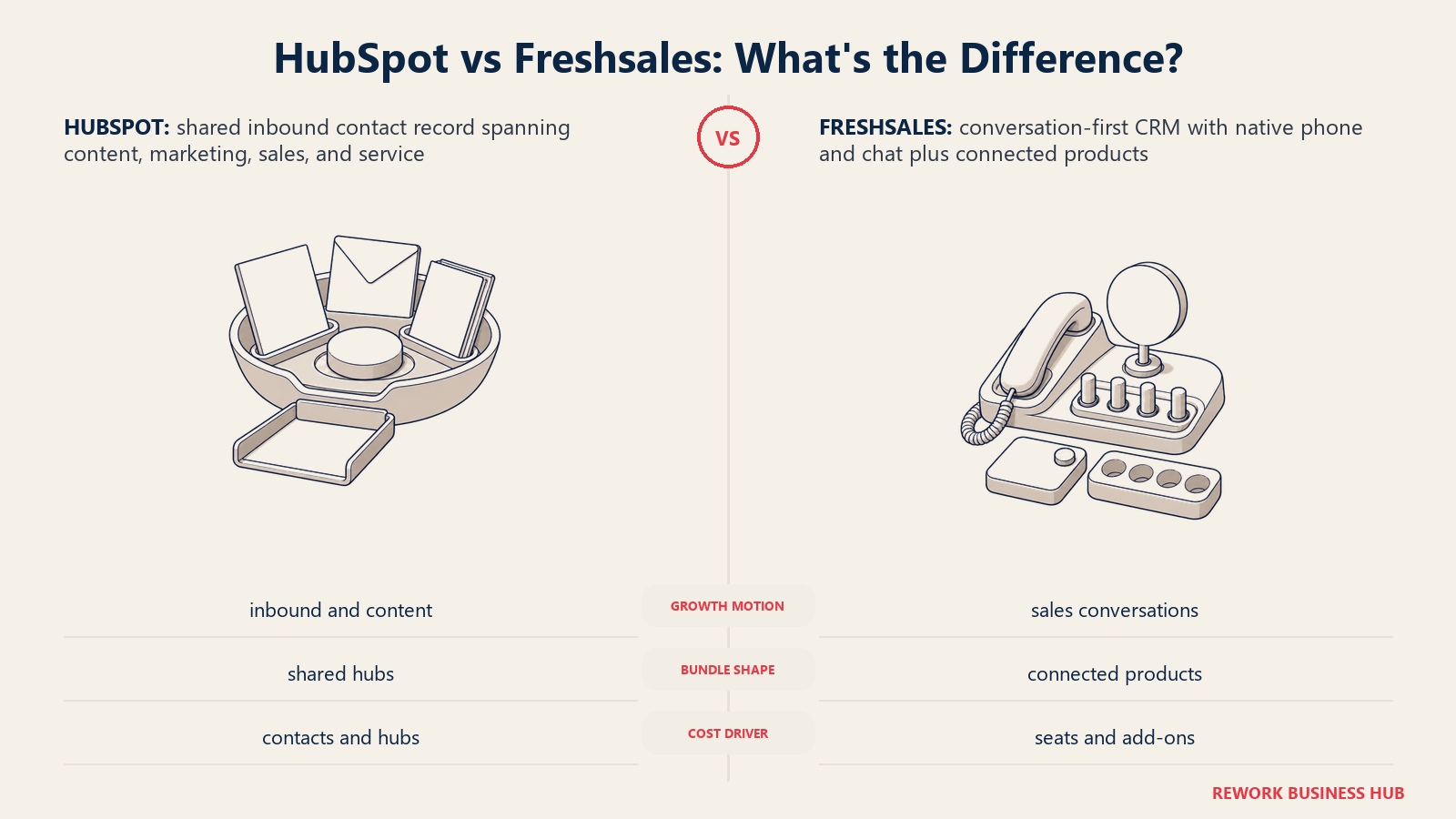
HubSpot vs Freshsales usually gets framed as a straight CRM feature fight: pipeline versus pipeline, AI versus AI. That framing misses the actual decision. Both vendors sell a CRM, but they've built two different businesses around it. HubSpot wraps its CRM in marketing and content tools, Marketing Hub and Content Hub, sharing one contact record and, at the entry tier, one shared price. Freshsales wraps its CRM in conversation infrastructure: native phone and chat built into the product, with a full contact center, omnichannel messaging, and a support desk sold as connected Freshworks products. Neither bundle is better in the abstract. Which one is worth paying for depends on whether your growth motion runs on inbound content or outbound conversation.
This comparison is built for the people at a 20 to 500 person company who have to defend that budget line: COOs, Heads of RevOps, VPs of Sales, and founders who are past the spreadsheet stage and choosing the platform their whole revenue team will live in for the next few years. We priced both vendors at 10, 25, and 100 seats using their own current pricing pages, including HubSpot's contact tier costs and mandatory onboarding fees, and Freshworks' per agent pricing across its connected telephony, chat, and support products. The ranking isn't fixed. It flips with team size, and that flip is the most useful thing this article can show you.
If you're comparing the wider field first, our guide to the best CRM software of 2026 covers more of the category before you narrow to these two.
TL;DR
| Factor | HubSpot | Freshsales |
|---|---|---|
| Bundle strategy | Marketing and content wrapped around the CRM, one shared contact record | Telephony, chat, and support wrapped around the CRM as connected products |
| Best known for | Inbound marketing to sales handoff in a single data model | Clean CRM with native phone and chat out of the box |
| Entry price | Free tools (2 users), then $7/seat/mo for the Starter Customer Platform, which bundles all five hubs | No free plan, Growth at $9/user/mo, 21 day free trial |
| Where automation unlocks | Professional, $90/seat/mo, plus a mandatory onboarding fee | Pro, $39/user/mo, no onboarding fee at any tier |
| Mandatory onboarding fee | $1,500 to $7,000 depending on which hub and tier | None, self-serve at every tier |
| Marketing and content | Native. Marketing Hub and Content Hub share the CRM's contact record | Not native. Freshmarketer is a separate connected product |
| Telephony and chat depth | Calling minutes and basic chat included per tier, deeper contact center via Service Hub | Basic phone and chat native from Growth, full depth via Freshcaller and Freshchat |
| Where each tends to lose | Small teams paying HubSpot's flat marketing and content add-on cost | Teams that need every seat on full telephony, chat, and support at once |
Key Facts
- HubSpot's Starter Customer Platform bundles Marketing Hub, Sales Hub, Service Hub, Content Hub, and Data Hub Starter into one $7/seat/month plan billed annually, with no mandatory onboarding fee (HubSpot pricing; HubSpot bundle pricing).
- Once you move to Professional, HubSpot prices each hub separately again. Sales Hub Professional carries a mandatory $1,500 onboarding fee and Marketing Hub Professional carries a mandatory $3,000 onboarding fee, on top of seat and contact costs (HubSpot Sales Hub pricing; HubSpot Marketing Hub pricing).
- Freshsales no longer has a permanent free plan. Freshworks' own pricing page offers a 21-day free trial with full access instead (Freshworks CRM pricing).
- Freshsales bundles basic phone and chat into every paid tier starting at Growth ($9/user/month), but the full versions, Freshcaller and Freshchat, are separate Freshworks products starting at $15 and $19 per agent per month (Freshcaller pricing; Freshchat pricing).
- HubSpot Sales Hub holds a 4.4 out of 5 rating across more than 13,500 reviews on G2, while Freshsales holds a 4.5 out of 5 rating across roughly 1,200 reviews (HubSpot Sales Hub reviews; Freshsales reviews).
- Freshworks reports more than 74,000 business customers worldwide (Freshworks company page), and HubSpot's ecosystem spans more than 2,000 App Marketplace integrations, per its own Q1 2026 earnings release (HubSpot investor relations).
What Each Tool Is Actually Built For
HubSpot's product philosophy is the flywheel: attract, engage, delight, all feeding a single contact database. Marketing Hub, Sales Hub, Service Hub, and Content Hub are built to sit on top of that one record, so a lead's website visits, email opens, and deal stage all live in the same place a rep already sees. That's the pitch behind the Starter Customer Platform: for one seat price, you get a working slice of all five hubs instead of shopping for them separately. HubSpot runs that same flywheel pitch against a Gmail-native rival in our HubSpot vs Copper comparison, where the competing case is built entirely around living inside the inbox instead of a shared contact record.
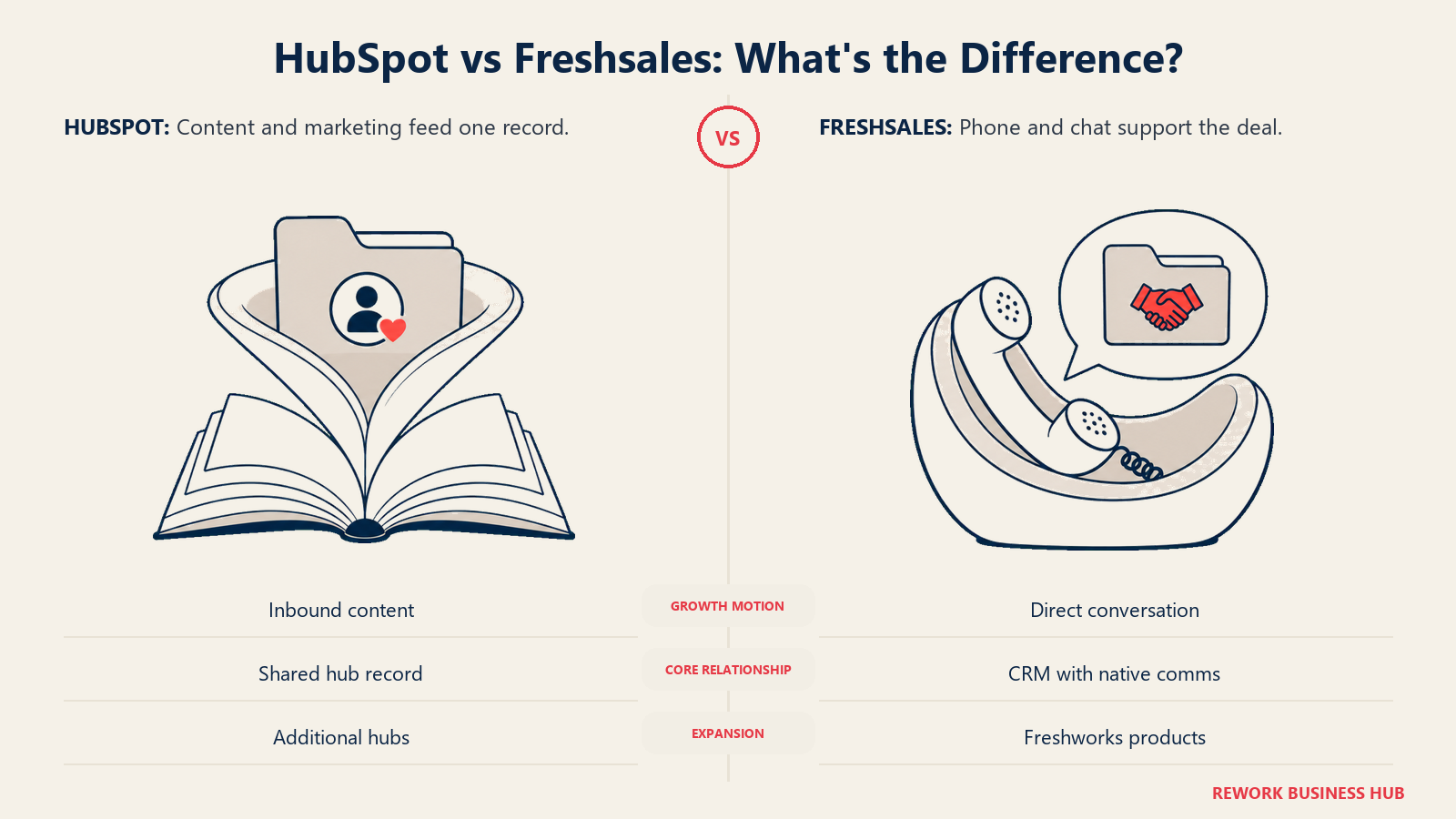
Freshsales starts from a narrower premise: a CRM a rep can be productive in on day one, with phone and chat already working inside it, no separate telephony vendor or messaging tool required just to start selling. That premise runs into a genuinely narrow rival in our Pipedrive vs Freshsales comparison, where the competing pitch skips native chat entirely and treats phone as a metered add-on rather than a bundled seat feature. Freshworks then sells the deeper version of that same idea, real IVR and call routing, real omnichannel messaging, a full support desk, as connected products under the same account. It's an ecosystem play, but one built around conversation and service infrastructure instead of marketing and content.
| HubSpot | Freshsales | |
|---|---|---|
| Sweet spot company size | 10 to 1,000 employees | 10 to 300 employees |
| Team maturity | Marketing and sales already share, or want to share, one funnel | Sales team wants to be selling today, without a marketing project first |
| Primary use case | Inbound lead generation through content and marketing, handed to sales in one record | Fast moving sales pipeline with native comms, expandable into a full Freshworks stack |
| Buying trigger | Marketing and sales run on separate tools and the handoff is manual | The team just needs a working CRM live now |
Neither company is chasing the other's exact buyer. HubSpot leans into unifying the top and middle of the funnel; Freshsales leans into unifying the conversation channels around the deal. The overlap, a 20 to 100 person revenue team deciding how much of its comms and content stack to consolidate under one vendor, is where the real decisions in this article get made. Freshsales makes that same conversation-channel case against a Gmail-native rival in our Copper vs Freshsales comparison, where the competing bet is zero data entry rather than zero extra vendors.
Decision by Business Goal
| Your goal | Better fit |
|---|---|
| Marketing and sales should share one contact record and one login, no integration to build | HubSpot |
| You want to publish and manage your website or blog from the same platform as the CRM | HubSpot, via Content Hub |
| Reps need native calling and live chat without buying a second product on day one | Freshsales |
| You'll eventually need a real support ticketing queue and want it from the same vendor | Either. HubSpot's Service Hub shares the CRM record; Freshworks sells Freshdesk as a connected account |
| Small team wanting the cheapest way to get marketing, sales, and content in one login | HubSpot Starter |
| You want linear, predictable per-seat pricing with no contact-list variable | Freshsales |
| Your marketing database is small today but will grow past a few thousand contacts within a year | Freshsales, to avoid HubSpot's contact-tier cost growth entirely |
If marketing automation is the actual deciding factor for you rather than a nice-to-have, our guide on marketing automation vs CRM walks through when you need the two combined in one platform versus a CRM plus a dedicated marketing tool.
Team and Role Fit
| Team | HubSpot | Freshsales |
|---|---|---|
| Sales | Full pipeline, forecasting from Professional, deal automation | Full pipeline, deal insights and territory management from Pro |
| Marketing | Marketing Hub, native, shares the CRM's contact record from Starter | Not native. Freshmarketer is a separate connected product |
| Content and web | Content Hub (CMS), shares the same login and contact data | Not a product Freshworks sells |
| Customer support | Service Hub, native ticketing that shares the contact record | Freshdesk, a separate product, same vendor and account |
| Phone-heavy sales or support | Calling minutes bundled per Sales Hub tier, deeper contact center via Service Hub add-ons | Native phone from Growth, full contact center via Freshcaller |
| RevOps and admin | One data model to administer once you're past the shared Starter bundle | Fewer objects to configure if you're staying CRM-only |
Lead scoring shows up on both sides of this table in a way worth naming separately: HubSpot scores leads natively from Starter, expanding at Professional, while Freshsales' Freddy AI adds scoring from Pro. If scoring and routing logic is the actual bottleneck in your funnel rather than which CRM holds the record, our guide to lead scoring systems covers how to build the rules regardless of which platform you land on.
Pricing at Real Team Sizes
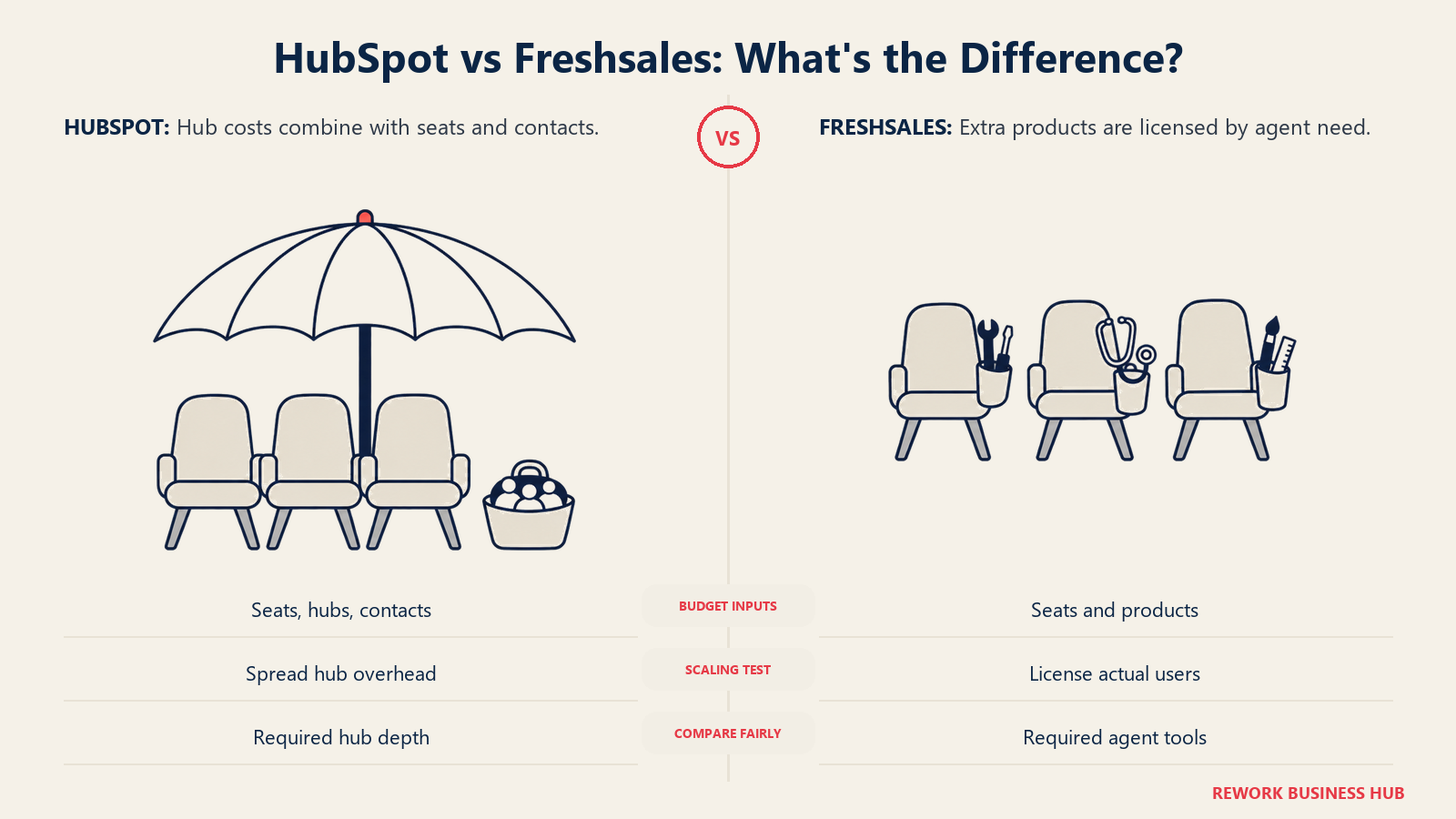
Seat price times headcount is the calculation most people run first, and it's genuinely the whole story at the entry tier. It stops being the whole story the moment you price in the bundle, because that's where the two vendors' pricing logic actually diverges.
What Each Platform Actually Costs
HubSpot's Starter tier is, in practice, a single bundled product. HubSpot calls it the Starter Customer Platform: one $7/seat/month price that includes Marketing Hub Starter, Sales Hub Starter, Service Hub Starter, Content Hub Starter, and Data Hub Starter together, with 1,000 marketing contacts included.
| HubSpot tier | Price (billed annually) | Onboarding fee | What's included |
|---|---|---|---|
| Free | $0, up to 2 users | None | Basic contact and deal tracking, entry-level reporting |
| Starter (Customer Platform) | $7/seat/mo | None | Sales, Marketing, Service, Content, and Data Hub Starter bundled as one product, 1,000 marketing contacts |
| Professional (Sales Hub) | $90/seat/mo | $1,500, one time | Up to 300 customizable workflows, forecasting, 3,000 calling minutes |
| Enterprise (Sales Hub) | $150/seat/mo | $3,500, one time | Up to 1,000 customizable workflows, custom objects, advanced forecasting, 12,000 calling minutes |
Source: HubSpot Sales Hub pricing and HubSpot bundle pricing.
Freshsales runs a shorter, three-tier ladder with no bundled marketing or content layer at all, and no free plan.
| Freshsales tier | Price (billed annually) | Onboarding fee | What's included |
|---|---|---|---|
| Growth | $9/user/mo | None | Kanban pipeline, native chat, email, and phone, basic workflows |
| Pro | $39/user/mo | None | Adds contact scoring, deal insights, sales sequences, territory management |
| Enterprise | $59/user/mo | None | Adds forecasting insights, field-level permissions, custom modules, sandbox |
Source: Freshworks CRM pricing. There's no permanent free tier, only a 21-day trial with full access.
The CRM-Only Cost at 10, 25, and 100 Seats
Comparing the CRM alone, before either vendor's wraparound bundle enters the picture, at the entry tier HubSpot's Starter runs slightly cheaper than Freshsales' Growth plan at every seat count:
| Seats | HubSpot Starter | Freshsales Growth |
|---|---|---|
| 10 | $840/yr | $1,080/yr |
| 25 | $2,100/yr | $2,700/yr |
| 100 | $8,400/yr | $10,800/yr |
Once you need the tier where real automation and forecasting unlock, the gap widens sharply, and HubSpot's mandatory onboarding fee adds a Year 1 tax Freshsales never charges:
| Seats | HubSpot Professional, Year 1 | HubSpot Professional, Year 2+ | Freshsales Pro |
|---|---|---|---|
| 10 | $12,300 ($10,800 + $1,500) | $10,800/yr | $4,680/yr |
| 25 | $28,500 ($27,000 + $1,500) | $27,000/yr | $11,700/yr |
| 100 | $109,500 ($108,000 + $1,500) | $108,000/yr | $46,800/yr |
On the CRM alone, Freshsales Pro costs less than half of HubSpot Professional at every seat count shown, even before the onboarding fee. That's the number most comparisons stop at. It's also the number that matters least to a team choosing between these two specifically for the bundle around the CRM, not the CRM itself.
The Cheapest Way Into Each Bundle
This is where the two vendors' strategies actually diverge. HubSpot's Starter tier already includes marketing and content in the seat price. Getting the equivalent wraparound on Freshsales means buying three additional Freshworks products, Freshcaller for telephony, Freshchat for full chat, Freshdesk for support, each at its own entry price:
| Seats | HubSpot Starter (all 5 hubs, 1 price) | Freshsales Growth + Freshcaller Growth + Freshchat Growth + Freshdesk Growth |
|---|---|---|
| 10 | $840/yr | $7,440/yr |
| 25 | $2,100/yr | $18,600/yr |
| 100 | $8,400/yr | $74,400/yr |
Source: HubSpot bundle pricing, Freshworks CRM pricing, Freshcaller pricing, Freshchat pricing, Freshdesk pricing. At the entry level, HubSpot's single-line-item bundle is dramatically cheaper than assembling the Freshworks equivalent, because you're paying for one product instead of four. The catch is depth: HubSpot's Starter hubs are genuinely basic, and Freshsales' native phone and chat are already included in that $9/seat Growth price before you add a single Freshworks product. This table prices the full contact-center-and-omnichannel version against HubSpot's lightest tier, which is the honest apples-to-apples question for a team that wants real telephony and chat, not just a checkbox.
What the Full Bundle Costs at Real Depth
Growing teams don't stay on Starter or Growth for long. Once you need Professional-level automation and Pro-level deal insight, the bundle math flips, and this is the table worth spending time on.
HubSpot's Marketing Hub Professional and Content Hub Professional are priced separately from Sales Hub, by marketing seats and contact volume, not by your total revenue headcount. Assuming a lean 3-person marketing and content team, realistic for a mid-market org where most headcount sits in sales, the flat add-on cost is $9,600/year for Marketing Hub Professional plus $5,400/year for Content Hub Professional, $15,000/year total, plus $3,000 in one-time onboarding for Marketing Hub (Content Hub's own pricing page lists no separate onboarding fee):
| Seats | HubSpot: Sales Hub Pro + Marketing Hub Pro + Content Hub Pro, Year 1 | HubSpot, Year 2+ | Freshsales Pro + Freshcaller Pro + Freshchat Pro + Freshdesk Pro |
|---|---|---|---|
| 10 | $30,300 | $25,800/yr | $21,840/yr |
| 25 | $46,500 | $42,000/yr | $54,600/yr |
| 100 | $127,500 | $123,000/yr | $218,400/yr |
At 10 seats, the fully stacked Freshworks bundle is cheaper than HubSpot's, because HubSpot's flat $15,000/year marketing and content add-on is a bigger burden on a small team. Somewhere around 15 to 20 seats, the lines cross: HubSpot's flat add-on cost gets diluted across enough reps that it beats Freshworks' strictly linear per-seat stack, and by 100 seats the gap is enormous in HubSpot's favor, because Freshworks' full stack keeps growing one-to-one with headcount while HubSpot's marketing and content layer barely grows at all.
One honest caveat: this table assumes every seat needs the full stack on both sides, which overstates the real Freshworks number for most teams. In practice, most orgs don't put every sales rep on a Freshdesk seat or a Freshcaller seat, support and phone-heavy roles are usually a subset of total headcount, so a real Freshworks deployment often costs less than this worked ceiling. HubSpot's marketing and content add-on doesn't have that same lever since it's priced by contact volume and dedicated marketing seats, not by who touches the CRM.
If the CRM itself, not the bundle, is what's actually driving your evaluation, our HubSpot alternatives and Freshsales alternatives guides both cover cheaper single-purpose options.
Implementation and Change Management
| Dimension | HubSpot | Freshsales |
|---|---|---|
| Typical setup path | Self-serve at Starter; Professional benefits from a partner or HubSpot's paid onboarding | Self-serve at every tier |
| Time to first value | Days at Starter; 1 to 3 weeks at Professional with real data migration | Same day for a basic pipeline |
| Mandatory onboarding fee | $1,500 to $7,000 depending on hub and tier | None at any tier |
| Who maintains it long-term | A sales ops generalist through Professional; more coordination once multiple hubs are live | A sales manager can usually own it without a dedicated admin |
| Training load | Grows with every hub you add: workflows, lifecycle stages, marketing automation, CMS modules | Lower for the CRM itself; grows only if you add Freshcaller, Freshchat, or Freshdesk separately |
Neither platform requires a dedicated hire to get started. The difference is where the complexity shows up: HubSpot's grows with how many hubs you're running at once, while Freshsales' grows with how many separate Freshworks products you've connected to the CRM. If you're migrating off a legacy CRM into either one, our CRM migration guide covers the field mapping and deduplication work that both vendors' own onboarding docs tend to underestimate.
Risk and Governance
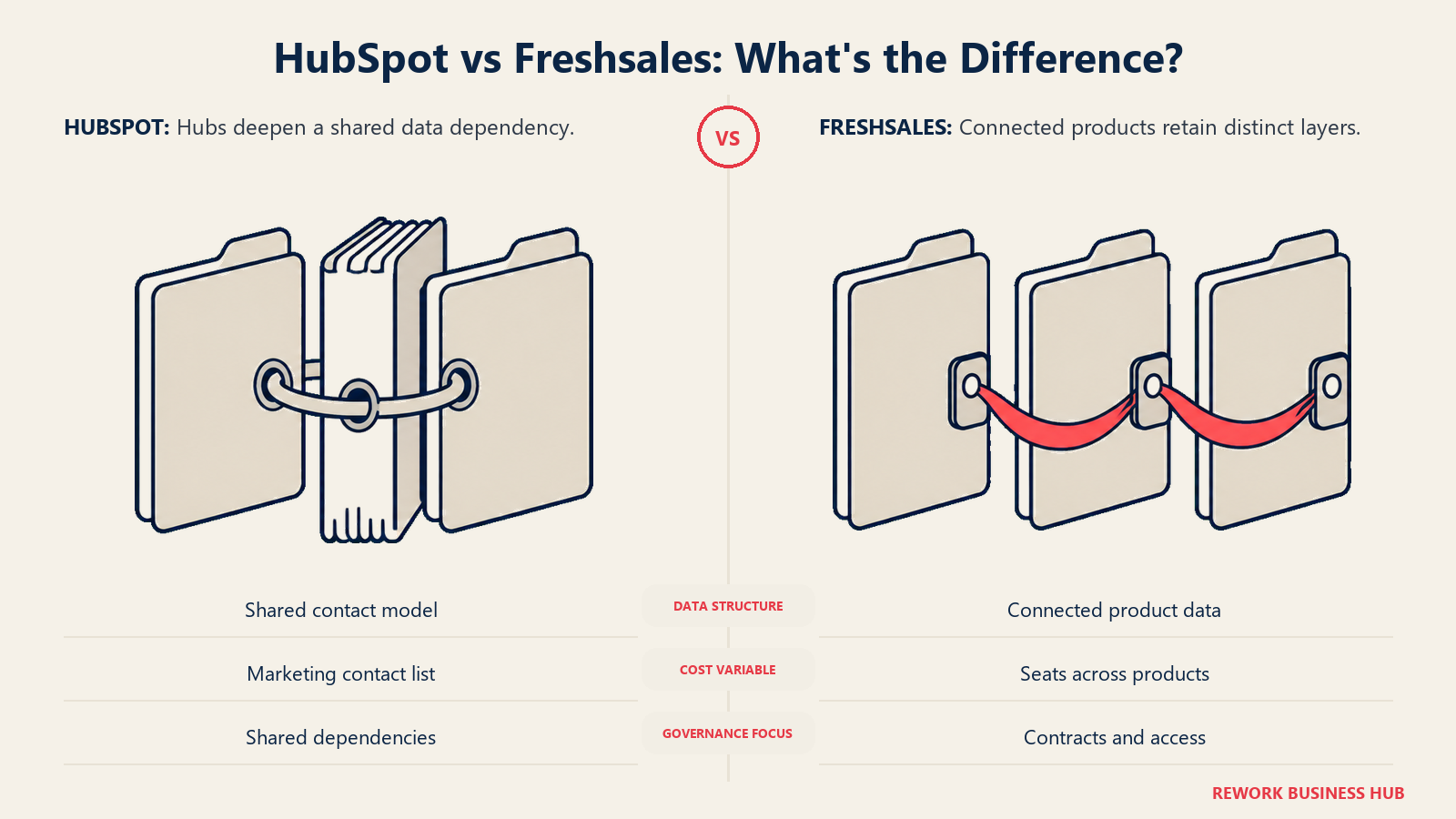
A shared HubSpot record concentrates dependencies. A connected Freshworks estate adds products and contracts to oversee.
| Dimension | HubSpot | Freshsales |
|---|---|---|
| Vendor stability | Public company, NYSE: HUBS | Public company, NASDAQ: FRSH |
| Data model | One shared contact record across every hub you buy | CRM-native record; Freshcaller, Freshchat, and Freshdesk each keep their own data layer, connected but distinct |
| Ecosystem and integrations | 2,000+ App Marketplace integrations | Freshworks Marketplace plus the vendor's own connected product line |
| Vendor lock-in shape | Deeper into HubSpot's shared data model with every hub added, harder to unwind later | Deeper into the Freshworks product line with every connected product added, each its own contract |
| Cost governance | Marketing Hub's cost tracks contact list size, not headcount. Budget owners need to monitor list growth, not just seats | Cost tracks seats and connected products. More predictable per head, but grows with every product you turn on |
For a governance-minded reader, the practical read is this: HubSpot's risk is a growing bill tied to a variable, your contact list, that sales headcount doesn't control. Freshsales' risk is contract sprawl, several separate line items with several separate renewal dates, once you're running the full stack. Our CRM evaluation criteria checklist is worth running against either vendor before you sign, especially the total cost of ownership section.
When HubSpot Is the Right Call
- Marketing and sales already share, or want to share, one funnel, and you don't want to build or maintain an integration between two separate tools.
- Content and web presence matter as much as the CRM does. Content Hub shares the same login and contact data as Sales Hub, no separate CMS to manage.
- You can budget the onboarding fees as known, published numbers rather than a surprise mid-rollout.
- Your revenue team is large enough, 25 seats and up in the math above, that the flat cost of Marketing Hub and Content Hub Professional gets diluted across enough reps to beat a fully stacked Freshworks bundle.
- You want the lowest possible entry price for a bundled marketing, sales, and content login, and Starter's depth is genuinely enough for where you are today.
When Freshsales Is the Right Call
- You want native phone and chat inside the CRM from day one, with no second product to configure before reps can call or message a lead.
- Your team is small, under roughly 20 to 25 seats, where the fully stacked bundle math favors Freshworks over HubSpot's flat marketing and content add-on.
- You don't want your marketing contact list to be a line item on your CRM bill. Freshsales' pricing is seat-based only, with no contact tier at all.
- You'd rather buy Freshcaller, Freshchat, and Freshdesk only for the specific agents who need them, not license a whole hub for capability most of your team won't touch.
- No mandatory onboarding fee matters to you, and self-serve setup at every tier is worth more than deeper built-in automation.
Decision Framework
| If you are... | Pick |
|---|---|
| An inbound, content-led team that wants one login across the whole funnel | HubSpot |
| A team that wants native phone and chat in the CRM without a second contract on day one | Freshsales |
| Under 10 people and want the cheapest way into a marketing, sales, and content bundle | HubSpot Starter |
| Planning to add real telephony, omnichannel chat, and a support desk as you scale | Budget for Freshworks' connected products, or HubSpot's Service Hub, not just the CRM seat price |
| Running a marketing database that will outgrow a few thousand contacts within a year | Freshsales, to avoid HubSpot's contact-tier cost growth |
| A revenue team of 25 or more that also wants marketing and content bundled in | Re-run the math above. HubSpot's flat hub add-on cost per seat shrinks fast at this size |
| Comparing the wider CRM field, not just these two | See our best CRM software roundup |
What to Do Next
- Map your actual bundle need before you compare seat prices. If marketing and content matter as much as the pipeline, price HubSpot's Starter Customer Platform first. If native phone and chat matter more, start with Freshsales Growth.
- Run the crossover math at your real headcount a year out, not today. The full-bundle comparison above flips around 15 to 20 seats, and most growing teams cross that line faster than they budget for.
- Get HubSpot's onboarding fees itemized separately from the seat price before presenting a budget number, and confirm exactly which hubs you need at Professional rather than buying all of them by default.
- If you're leaning Freshsales and expect to need full telephony, omnichannel chat, or a support desk, price Freshcaller, Freshchat, and Freshdesk for the specific agents who'll actually use them, not your whole headcount.
- Comparing more than these two? Our HubSpot alternatives and Freshsales alternatives guides cover more options in each direction, and Pipedrive vs HubSpot, Zoho CRM vs Freshsales, and HubSpot vs Salesforce cover how each vendor stacks up against a different rival.
Neither bundle wraps in broader cross-team operations outside marketing, content, and support. If what you actually need is CRM, lead management, and a multi-channel chat inbox, WhatsApp, Messenger, Instagram DM, in one product, without a second Freshworks contract for omnichannel chat or a second HubSpot hub for content, that's a smaller, differently shaped category. Rework packages that combination as its Revenue Engine, from $159/month billed yearly with 5 marketing and 5 sales seats (rework.com/pricing). It has a thinner marketplace than HubSpot's 2,000+ integrations and a narrower product line than Freshworks' full support and telephony suite, so it isn't the answer if ecosystem breadth is what you're optimizing for. But if the real friction is buying a second product just to get chat or content working with your CRM, it's worth a look.
Frequently Asked Questions about HubSpot vs Freshsales
Is HubSpot or Freshsales cheaper?
It depends on the tier and whether you're pricing the CRM alone or the full bundle. On the CRM alone, Freshsales Pro at $39/user/month costs less than half of HubSpot Professional's $90/seat/month. Once you add each vendor's wraparound bundle, marketing and content for HubSpot, telephony, chat, and support for Freshsales, the ranking flips around 15 to 20 seats in HubSpot's favor, because its bundle cost is flat while Freshworks' grows per seat.
Does HubSpot's Starter plan really include marketing and content tools?
Yes. HubSpot's $7/seat/month Starter Customer Platform bundles Marketing Hub Starter, Sales Hub Starter, Service Hub Starter, Content Hub Starter, and Data Hub Starter into one product with one price, no separate purchase required at that tier.
Does Freshsales include phone and chat for free?
Basic phone and chat are native starting at the Growth tier ($9/user/month), with no extra product to buy. The full versions, a real contact center through Freshcaller and full omnichannel messaging through Freshchat, are separate Freshworks products starting at $15 and $19 per agent per month.
Does Freshsales have a free plan?
No. Freshsales retired its free tier. Freshworks now offers a 21-day free trial with full feature access instead, after which you're on a paid plan starting at $9/user/month.
What does HubSpot's onboarding fee actually cost?
It's mandatory and tier-specific. Sales Hub Professional carries a $1,500 one-time fee and Enterprise carries $3,500. If you also add Marketing Hub Professional, that's another $3,000, and Marketing Hub Enterprise carries $7,000. Content Hub's own pricing page doesn't list a separate onboarding fee.
How does HubSpot's contact-based pricing work?
Marketing Hub bills by how many marketing contacts you have, not by CRM seats. Professional includes 2,000 contacts before overage tiers apply, and that cost grows with your list size regardless of headcount. Freshsales has no contact tier at all. Its pricing is seat-based only.
Which is better for a team scaling from 20 to 100 people?
Run the math at your actual headcount rather than assuming either wins by default. Below roughly 15 to 20 seats, a fully stacked Freshworks bundle tends to cost less than HubSpot's equivalent. Past that range, HubSpot's flat marketing and content add-on cost gets diluted across enough seats that it usually comes out cheaper, sometimes dramatically so by 100 seats.

Head of Enterprise Solutions
On this page
- TL;DR
- Key Facts
- What Each Tool Is Actually Built For
- Decision by Business Goal
- Team and Role Fit
- Pricing at Real Team Sizes
- What Each Platform Actually Costs
- The CRM-Only Cost at 10, 25, and 100 Seats
- The Cheapest Way Into Each Bundle
- What the Full Bundle Costs at Real Depth
- Implementation and Change Management
- Risk and Governance
- When HubSpot Is the Right Call
- When Freshsales Is the Right Call
- Decision Framework
- What to Do Next