Best Setmore Alternatives in 2026: 13 Booking Tools for Small Teams
Turn this article into takeaways for your work.


Each assistant summarizes the article only for you and suggests best practices for your work.
Calendly, Cal.com, and Square Appointments top this list, alongside ten other tools for small businesses that picked Setmore because it is genuinely free for up to 4 users and are now running into what that free tier does not cover. Setmore earns real loyalty for a reason: a clean booking page, a straightforward setup, and a free plan that actually supports a full team instead of one owner. Pro adds SMS reminders, two-way calendar sync, and the ability to remove Setmore's branding, all for $5 per user per month billed annually, which is cheap by category standards.
The catch is what happens once a team needs more than that. SMS reminders, two-way sync, and branding removal are all locked behind Pro, so a team that outgrows the free tier is choosing a paid plan the moment any one of those three matters. Pro also gets more expensive fast if you pay monthly: $12 per user per month, more than double the $5 annual rate, which is a bigger gap than most competitors run between their monthly and annual pricing. And Setmore is thinner than heavier platforms on packages, class scheduling, resource booking, and lead routing, so a service business selling bundles or running group classes hits a ceiling Setmore was never built to solve. This guide covers 13 alternatives for small business owners, service providers, and operations leads at companies from solo practices to a few hundred employees, with pricing pulled from each vendor's own page in August 2026. If you have not narrowed the category yet, start with the appointment scheduling software roundup.
Key Facts
- The global appointment scheduling software market was valued at USD 546.1 million in 2025 and is projected to reach USD 1,905.90 million by 2034, a 14.70% CAGR (Fortune Business Insights).
- Online booking does not automatically cut no-shows. A 2025 study in Frontiers in Digital Health found mean no-show rates of 1.8% online versus 5.9% offline at a private medical practice, but the result reversed at a university hospital, 14.3% online versus 11.2% offline (Frontiers in Digital Health).
- In a GetApp survey of 217 US consumers, nearly 70% said they would choose to book online if given the choice, and 94% said they would be more likely to pick a new provider that offered online booking (2021 survey) (GetApp).
- Microsoft's 2025 Work Trend Index found 30% of meetings now span multiple time zones, up 8 percentage points since 2021, and meetings starting after 8pm are up 16% year over year (Microsoft).
Quick Comparison Table
| Tool | Best For | Starting Price | Key Strength | Key Limitation |
|---|---|---|---|---|
| Calendly | The default meeting-scheduling standard | Free (1 event type); $10/seat/mo annual (Standard) | Widest adoption, easiest for invitees to trust | Free plan limited to 1 event type, 1 calendar |
| Acuity Scheduling | Client-facing services that take payments | $20/mo monthly, $16/mo annual (Starter) | Deep payments and package/class support | No free plan, only a 7-day trial |
| Cal.com | API-first, developer-controlled booking | Free (1 user); $12/user/mo annual (Teams) | Lower price than Calendly, deep API access | Free plan is 1 user, not a team plan |
| SimplyBook.me | A booking website, not just a link | Free (EUR 0, 50 bookings/mo); EUR 13.9/mo (Basic) | Full booking website with custom features marketplace | Priced in euros, monthly rate jumps at Standard |
| Square Appointments | Booking plus payments and POS in one | Free; Plus $49/mo per location | Payments, POS, and booking under one subscription | Appointments-only tiers retired, now bundled |
| Rework | Booking inside a wider operations platform | Quote on request | One platform for booking, CRM, and operations | Not built or priced for solo, 1-user buyers |
| OnceHub | Qualification and routing before the meeting | Free (1 user, 1 link); $12/seat/mo monthly (Schedule) | Routing and qualification logic ahead of the booking | Phone-number-based tiers get pricey per seat |
| Zoho Bookings | The Zoho ecosystem pick | Free (1 user); $6/user/mo annual (entry paid) | Cheapest paid entry, ties into Zoho's suite | Paid tier names hidden behind JavaScript pricing |
| Microsoft Bookings | No extra cost if you already pay for Microsoft 365 | $7/user/mo annual (Business Basic bundle) | No separate contract for teams already on M365 | Not sold standalone, tied to a 365 plan |
| YouCanBookMe | Simple, branded booking pages | Free (1 calendar, 1 page); ~$9/mo (reported) | Clean, brandable booking pages | Paid pricing not published on vendor's own page |
| Doodle | Group polls plus booking pages | Free (1 poll, 1 page); $11/mo/seat annual (Pro) | Best-in-class group availability polling | Monthly billing not published, annual only |
| Vagaro | Salon, spa, and fitness | $23.99/mo (Just Me) | Purpose-built for salon and fitness booking flows | Scaling cost per calendar not published |
| Mindbody | Larger wellness and fitness businesses | From $99/mo/location | Deep fitness and wellness class scheduling | Higher tiers are quote-only, no published ceiling |
Why People Outgrow Setmore
The complaints cluster into three patterns, and a team usually hits all three within a year of signing up free.
The features that matter most sit behind Pro. SMS reminders cut no-shows more than almost anything else a scheduling tool can do, and Setmore keeps that feature, along with two-way calendar sync and the option to remove Setmore's own branding from the booking page, on the Pro plan. A free-tier user who wants a client to stop seeing "powered by Setmore," or who needs their calendar to actually reflect what is already booked elsewhere, is already a Pro buyer whether they have realized it yet or not.
Monthly billing is a real trap. Pro costs $5 per user per month billed annually, which is a fair price. Paid monthly, the same plan costs $12 per user per month, more than double. A five-person team that signs up monthly to avoid an annual commitment is paying $60 a month instead of $25, a gap most competitors in this list do not run between their monthly and annual rates.
Packages, classes, and routing are thin. Setmore covers the core booking flow well: a page, a calendar, a confirmation. It is not built for a business selling multi-session packages, running recurring group classes, or routing an inbound lead to the right rep before a meeting gets booked. Acuity, Vagaro, and Mindbody go deeper on packages and classes; OnceHub and Rework go deeper on routing and operations.
None of that makes Setmore a bad product, and it remains one of the most honestly free tools in this category, a genuine rarity next to Calendly's single event type or Cal.com's single user. It makes Setmore a specific tool: right for a small team's first booking page, and worth outgrowing the moment SMS reminders, real calendar sync, or packages become the actual job. Staff shift scheduling is a different problem entirely, if what you actually need is rota and shift coverage rather than client-facing booking, see the employee scheduling software roundup instead.
Stage Fit
| Business stage | What usually breaks | Best fit |
|---|---|---|
| Solo practitioner, just starting | No budget for a paid plan yet, just needs a link | Setmore's own free plan, Calendly free, Cal.com free |
| Small team, 2 to 4 people | Free tier still fits, but reminders and sync are missing | YouCanBookMe, Zoho Bookings, OnceHub Basic |
| Small team, 5 to 15 people | Outgrown the free-user cap, needs SMS and sync | Calendly, Acuity Scheduling, Zoho Bookings |
| Growing service business, 15 to 50 | Packages, classes, or payments now matter | Acuity Scheduling, Square Appointments, Vagaro |
| Multi-location or franchise | Needs per-location billing and reporting | Square Appointments, Mindbody |
| Operations-heavy team, 50-plus | Booking is one piece of a bigger workflow | Rework, OnceHub, Microsoft Bookings |
Sizing and Persona Fit
| Team size | Best fit | Why | Watch out for |
|---|---|---|---|
| 1 person | Calendly free, Cal.com free, YouCanBookMe free | No paid plan justified at this scale yet | Rework is not built or priced for a 1-user buyer |
| 2 to 4 | Setmore free, Zoho Bookings free, OnceHub Basic | Free tiers genuinely cover a small team | Watch which "free" plan is per-user versus per-team |
| 5 to 20 | Calendly Standard, Acuity Scheduling, Doodle Pro | Per-seat pricing still scales down reasonably | Acuity's Starter tier caps at 1 calendar |
| 20 to 50 | Acuity Standard or Premium, Square Appointments, Vagaro | Multi-calendar and payments start paying off | Square's per-location model needs one plan per site |
| 50 to 200 | OnceHub Route or Engage, Microsoft Bookings, Rework | Routing, phone numbers, and platform consolidation matter | Rework's booking price is quote-only, budget for a call |
| 200-plus or multi-location | Mindbody, Square Appointments, Rework | Per-location billing and cross-team operations | Mindbody's higher tiers are quote-only above $99 |
| Persona | What they optimize for | Strongest picks |
|---|---|---|
| Solo practitioner or freelancer | Zero cost, minimal setup | Calendly free, Cal.com free, Setmore free |
| Clinic or salon owner | Payments, packages, and staff calendars in one place | Acuity Scheduling, Vagaro, Mindbody |
| Sales or business development lead | Qualification and routing before the meeting | OnceHub, Calendly Teams |
| IT-led buying committee at a 365 shop | No new contract to approve | Microsoft Bookings |
| Ops leader consolidating tools | Booking as part of a wider platform, not a fourth login | Rework |
| Budget-conscious small team | Lowest real monthly cost at their headcount | Setmore Pro, Zoho Bookings, Doodle Pro |
1. Calendly - The Default Meeting-Scheduling Standard
Calendly is where most Setmore evaluations start, because it is the name most invitees already recognize, and a link that looks familiar closes more bookings than one that does not. The product does one job extremely well: turn your availability into a link someone else can book against, with round-robin and lead-routing logic once a team grows into it.
The free plan is not as generous as its reputation suggests. It covers 1 event type and 1 calendar connection, which is fine for a single "book a call" link but breaks the moment you need a second meeting type or a second calendar synced. Standard, at $10 per seat per month billed annually (17% cheaper than monthly), removes that ceiling and adds automated workflows and more event types. Teams, at $16 per seat per month annually, adds round-robin distribution and centrally managed event types that a manager can enforce across a whole group. Enterprise starts at $15,000 per year with a 50-seat minimum, USD only. Notetaker and Callie, Calendly's AI features, are paid add-ons on top of Standard and Teams, not included.
Target audience. Any team whose booking flow is really a meeting-scheduling flow, sales calls, consultations, interviews, rather than a service appointment with a duration and a price.
Sizing fit. Strong from 1 to 200 seats. Below a handful of users the free plan's single event type is the real constraint, not price.
Stage fit. Best once a team has more than one kind of meeting to book, a sales call and a demo, say, since the free plan's single event type stops covering that on day one.
| Pros | Cons |
|---|---|
| The link invitees already recognize and trust | Free plan limited to 1 event type, 1 calendar |
| Round-robin and lead routing on Teams | Teams jumps to $16/seat/mo for that routing logic |
| AI features (Notetaker, Callie) available as add-ons | AI add-ons are paid extras, not included in either paid tier |
Pricing: Free (1 event type, 1 calendar). Standard $10/seat/mo billed annually. Teams $16/seat/mo billed annually. Enterprise starts at $15,000/year, 50-seat minimum, USD only.
Best for: Teams whose core need is meeting scheduling with routing logic, not service-appointment booking with packages or payments. See Calendly vs Acuity Scheduling for how the two compare head to head.
2. Acuity Scheduling - Client-Facing Service Businesses That Take Payments
Acuity Scheduling, owned by Squarespace, is built for the service business Setmore's free plan eventually stops fitting: one that takes deposits, sells multi-session packages, and needs intake forms filled out before the appointment even starts. Where Setmore hands you a booking page, Acuity hands you a booking page plus the commerce layer around it, payments, packages, memberships, and gift certificates, wired in from the start.
There is no free plan at all, only a 7-day trial with no card required, which is a real tradeoff against Setmore's honestly free tier. Starter runs $20 per month billed monthly or $16 per month billed annually, for a single calendar. Standard, at $34 monthly or $27 annually, covers up to 6 calendars, the point where most small teams land. Premium, at $61 monthly or $49 annually, scales to 36 calendars for larger multi-provider practices.
Target audience. Service businesses that already collect payment at booking, salons, clinics, coaches, consultants, and want packages or memberships without a separate payments tool.
Sizing fit. Best from 1 to 36 providers, matching the calendar caps on each tier. Larger multi-location groups should look at Vagaro or Mindbody instead.
Stage fit. Right the moment a business starts taking deposits or selling packages, which a pure booking-link tool like Calendly or Setmore's free tier was never built to do.
| Pros | Cons |
|---|---|
| Payments, packages, and memberships built in | No free plan, only a 7-day trial |
| Up to 36 calendars on Premium for multi-provider practices | Standard's 6-calendar cap arrives faster than expected |
| Backed by Squarespace's broader site and commerce tools | Annual pricing is meaningfully cheaper, monthly is a real markup |
Pricing: Starter $20/mo monthly, $16/mo annually (1 calendar). Standard $34/mo monthly, $27/mo annually (up to 6 calendars). Premium $61/mo monthly, $49/mo annually (up to 36 calendars).
Best for: Service businesses that need payments, packages, and intake forms alongside the booking page itself. If Acuity is already on your shortlist, the Acuity Scheduling alternatives guide covers the rest of that field, and since Squarespace owns Acuity, the Squarespace alternatives guide is worth a look if the website itself is also in play.
3. Cal.com - Open API, Lower Price, Developer-Controlled
Cal.com answers a question Setmore's free plan cannot: what if you want a deep API to build custom booking flows around. Its hosted product moved the commercial codebase to a private repository in April 2026, so Cal.com itself is closed source now; the free, self-hostable option is Cal.diy, an MIT-licensed community edition with the commercial features stripped out and not recommended for production. What still appeals to technical teams is the API-first design and the price, not owning the hosting stack.
The free forever plan covers 1 user, unlimited event types, unlimited calendars, and access to more than 100 integrations, generous compared to Calendly's single-event-type free plan, but it is genuinely one user, not a small team. Teams costs $12 per user per month billed annually, and Organizations, aimed at larger, multi-team companies, runs $28 per user per month billed annually. Enterprise is custom. Cal.com does not publish monthly-billed rates for either paid tier, so annual is effectively the only published option.
Target audience. Developer-led teams that want a deep API and a lower price than Calendly, plus anyone testing Cal.diy for a personal, non-production setup.
Sizing fit. The free plan fits exactly 1 user. Teams and Organizations scale from a handful of seats up to larger multi-team companies.
Stage fit. Best once a technical team is ready to pay for a hosted multi-user plan or build against the API, since the free tier caps out at a single person immediately.
| Pros | Cons |
|---|---|
| API-first design, full control over how booking is embedded | Free plan is 1 user, not a team plan |
| Unlimited event types and calendars even on free | Monthly-billed rates are not published, annual only |
| 100+ integrations available at every tier | Hosted Cal.com is closed source; Cal.diy, the free self-hosted edition, isn't built for production |
Pricing: Free forever (1 user, unlimited event types/calendars, 100+ integrations). Teams $12/user/mo billed annually. Organizations $28/user/mo billed annually. Enterprise custom.
Best for: Developer-led teams that want a deep API and a lower price than Calendly's Teams tier, not a fully self-hosted production stack.
4. SimplyBook.me - A Booking Website, Not Just a Link
SimplyBook.me is the pick for a business whose real complaint about Setmore is not the price, it is that the booking page still feels like an add-on rather than the storefront. SimplyBook.me builds a full booking website around your business, with a marketplace of custom features, memberships, coupons, gift cards, intake forms, so a small business can run its entire client-facing presence from one product instead of stitching a scheduling widget onto a separate site.
Pricing is published in euros rather than dollars, worth noting up front for US buyers converting the numbers. Free costs EUR 0 for 50 bookings per month and 1 custom feature, more generous than most free tiers on this list on the feature count, but limited on volume. Basic runs EUR 13.9 monthly or EUR 11.9 annually for 100 bookings and 3 custom features. Standard, at EUR 29.9 monthly or EUR 24.9 annually, covers 500 bookings and 8 custom features, the tier where most growing small businesses land. Premium, EUR 59.9 monthly or EUR 49.9 annually, covers 2,000 bookings with unlimited custom features. Enterprise is custom, with a 14-day trial of Premium features available to test first.
Target audience. Small service businesses that want a full booking website with add-on features, memberships and coupons among them, rather than a single scheduling link.
Sizing fit. Scales from a single-location free user up through Premium's 2,000-bookings-a-month ceiling, past which Enterprise applies.
Stage fit. Best for a business ready to invest in its booking experience as a real storefront, not just a link dropped into an email signature.
| Pros | Cons |
|---|---|
| Full booking website with a large custom-feature marketplace | Priced in euros, requires conversion for US budgeting |
| Free tier includes 1 custom feature, not just a bare calendar | Booking-volume caps tighten the moment you grow past them |
| Memberships, coupons, and gift cards built in | Feature count jumps meaningfully between Basic and Standard |
Pricing: Free (EUR 0, 50 bookings/mo, 1 custom feature). Basic EUR 13.9/mo monthly, EUR 11.9/mo annually (100 bookings, 3 features). Standard EUR 29.9/mo monthly, EUR 24.9/mo annually (500 bookings, 8 features). Premium EUR 59.9/mo monthly, EUR 49.9/mo annually (2,000 bookings, unlimited features). Enterprise custom, 14-day Premium trial.
Best for: Small businesses that want their booking page to function as a full client-facing website. If SimplyBook.me is already on your shortlist, the SimplyBook.me alternatives guide covers the rest of that field.
5. Square Appointments - Booking Plus Payments and POS in One
Square Appointments is the pick for a business that already runs Square for payments, or wants to, and would rather book, take a deposit, and ring up a retail sale from the same system instead of reconciling Setmore's calendar against a separate point of sale. Booking, payment processing, and POS live in one subscription rather than three logins.
Here is what changed and matters for anyone comparing prices: Square folded its standalone Appointments-only tiers into its unified subscription plans, priced per location. Square Free is $0 per month per location. Square Plus is $49 per month per location, with in-person processing at 2.5% plus 15 cents. Square Premium is $149 per month per location, processing at 2.4% plus 15 cents, and includes 24/7 phone support. Any older, cheaper Appointments-specific price you may have seen elsewhere is a retired product, not a current option.
Target audience. Service businesses that also sell retail products or take walk-in payments, and want one subscription covering booking, processing, and POS.
Sizing fit. Works from a single free location up through Premium, and scales per location for multi-site businesses.
Stage fit. Best once payment processing and point-of-sale matter as much as the booking calendar itself, not before.
| Pros | Cons |
|---|---|
| Booking, payments, and POS under one subscription | Per-location pricing, not a flat team rate |
| Free tier genuinely exists at $0/mo/location | Processing rates (2.4-2.5% + 15 cents) add up at volume |
| Premium includes 24/7 phone support | Standalone Appointments-only pricing no longer exists |
Pricing: Square Free $0/mo/location. Square Plus $49/mo/location, processing 2.5% + 15 cents. Square Premium $149/mo/location, processing 2.4% + 15 cents, 24/7 phone support.
Best for: Service businesses that want booking, payment processing, and retail POS in a single per-location subscription.
6. Rework - Booking Inside a Wider Operations Platform
Rework's E-Booking module answers a question this whole list has been dancing around: at what point does a standalone booking link stop being enough, not because the calendar is missing a feature, but because the booking sits disconnected from everything else the business runs on. Once a service business is also tracking leads, running a CRM, and managing a team's schedule, a booking tool that lives by itself means a customer's appointment history, their deal record, and their support thread all live in three different places.
Rework folds E-Booking into the same platform as its CRM and wider operations tools, so a booked appointment can attach to a contact record and a pipeline stage without an integration in between. That is a genuinely different pitch than everything else on this list, none of which try to be more than a scheduling tool. It is also the reason Rework is the wrong pick for a lot of readers of this exact article: Rework does not sell single-user licenses and is not priced or built for a solo practitioner or a 1-person business. If a link and a free calendar is genuinely all you need, Calendly free or Cal.com free will serve you better and cost nothing.
Rework's booking capability has no published price. It is quoted per organization, the same way several other tools on this list handle pricing, and you can get an actual number at rework.com/pricing. Do not expect a per-seat rate on the website; expect a conversation about your team size and which modules you need.
Target audience. Small and mid-size operations teams, roughly 10 to 200 people, that already need or want a CRM and cross-team workflow tools, and see booking as one piece of that rather than a standalone problem.
Sizing fit. Not built for solo or 1-user buyers. Strongest once a team is coordinating booking with sales, support, or operations work, typically 10 people and up.
Stage fit. Best for a business past its first year, with an actual team and a pipeline to connect the booking calendar to, not a business still validating its first service offering.
| Pros | Cons |
|---|---|
| Booking connects to CRM and pipeline data natively | No published price, budget time for a sales conversation |
| One platform instead of a booking tool plus a separate CRM | Not built or priced for solo, 1-user buyers |
| Fits teams already consolidating multiple operations tools | Overkill if a booking link is genuinely all you need |
Pricing: Quote on request, priced per organization. See rework.com/pricing.
Best for: Operations teams that want booking wired into the same platform as their CRM and pipeline, not solo practitioners who just need a link. Not the right fit if your only requirement is a standalone booking page.
7. OnceHub - Qualification and Routing Before the Meeting Is Booked
OnceHub is built for the moment booking stops being about "when" and starts being about "who." Instead of handing every visitor the same link, OnceHub qualifies a lead first, asking routing questions, checking against criteria, and then sends them to the right rep's calendar, or the right meeting type entirely. That matters more than it sounds: the Lead Response Management study found that contacting a lead within 5 minutes rather than 30 raises the odds of qualifying it by 21 times, and the speed-to-lead problem that research describes is exactly what routing logic is built to shorten.
Basic is free: 1 user, 1 connected calendar, 1 booking link, similar in shape to Setmore's own free tier but capped at a single user rather than four. Schedule, the entry paid plan, runs $12 per seat monthly or $10 per seat billed annually and includes 1 phone number. Route, at $23 monthly or $19 annually, adds a second phone number and the routing logic that gives the product its name. Engage, $47 monthly or $39 annually, includes 3 phone numbers and the deepest qualification tooling. A Security and Compliance add-on costs $6 monthly or $5 annually per seat on any paid plan, and extra phone numbers run $4 per month each. Enterprise is custom, aimed at teams of 30 or more, and a 14-day free trial of Engage is available on signup.
Target audience. Sales and business-development teams that need a lead qualified and routed to the right person before a meeting gets booked, not just a shared calendar.
Sizing fit. Free plan fits a single rep. Paid tiers scale from small sales teams up to the 30-plus-user Enterprise band.
Stage fit. Best once a team has more than one rep taking inbound meetings and needs those meetings routed by criteria, not just first-come availability.
| Pros | Cons |
|---|---|
| Qualification and routing logic ahead of the booking | Phone-number-based tiers get expensive per seat |
| Free plan available for a single user | Security add-on is a separate per-seat charge |
| 14-day Engage trial to test routing before paying | Entry paid tier ($12/seat) still trails Setmore's Pro on price |
Pricing: Basic free (1 user, 1 calendar, 1 link). Schedule $12/seat monthly, $10/seat annually (1 phone number). Route $23/mo monthly, $19/mo annually (2 phone numbers). Engage $47/mo monthly, $39/mo annually (3 phone numbers). Security add-on $6/mo, $5/mo annually per seat. Extra phone numbers $4/mo. Enterprise custom, 30+ users.
Best for: Sales teams whose real bottleneck is routing the right lead to the right rep fast, not just finding open calendar time. If OnceHub is already on your shortlist, the OnceHub alternatives guide and the sales engagement platform roundup cover the rest of that field.
8. Zoho Bookings - The Zoho Ecosystem Pick
Zoho Bookings makes the most sense for a business already inside Zoho's world, running Zoho CRM, Zoho Desk, or Zoho One, since a booking calendar that ties into a CRM contact record without a separate integration is worth more than one that stands alone. For everyone else, it is simply one of the cheapest paid booking tools on this list.
The free plan covers 1 user, 1 event type, 1 workspace, and 1 calendar sync, close in shape to Cal.com's free tier. The entry paid plan runs $6 per user per month billed annually, or $8 per user billed monthly, cheaper than Setmore's own $5 annual rate is not, but close, and meaningfully below Calendly or Acuity's entry points. The higher paid plan runs $9 per user per month annually, or $12 monthly. Zoho's main pricing page renders the actual tier names in JavaScript that a standard page read cannot capture, so this article quotes the prices themselves rather than guessing at labels that may not match what you see on the page.
Target audience. Small businesses already using other Zoho products, or price-sensitive teams that want the cheapest credible paid tier in this comparison.
Sizing fit. Scales from a single free user through small and mid-size paid teams; no published enterprise ceiling.
Stage fit. Best once a business has already picked Zoho for CRM or help desk and wants booking to plug into that ecosystem without a separate integration.
| Pros | Cons |
|---|---|
| Cheapest paid entry point in this comparison at $6/user/mo | Paid tier names are hidden behind JavaScript on the pricing page |
| Ties natively into Zoho CRM and the wider Zoho One suite | Less standalone brand recognition than Calendly or Acuity |
| Free tier covers 1 user, 1 event type, 1 calendar sync | Free tier is capped at a single calendar sync, no team plan |
Pricing: Free (1 user, 1 event type, 1 workspace, 1 calendar sync). Entry paid $6/user/mo annually, $8/user/mo monthly. Higher paid $9/user/mo annually, $12/user/mo monthly.
Best for: Teams already standardized on Zoho, or anyone shopping specifically on price who wants a published, low paid entry point. See the Zoho alternatives guide if the wider Zoho suite is also under review.
9. Microsoft Bookings - No Extra Line Item If You Already Pay for Microsoft 365
Microsoft Bookings is not a standalone product, and that is exactly its pitch. It is bundled into Microsoft 365 Business plans, so a company already paying for Outlook, Teams, and the rest of the 365 suite gets appointment booking without approving a new vendor or a new line item on the expense report, a real advantage for an IT-led buying committee that would rather avoid one more contract than save a few dollars a seat.
Business Basic runs $7.00 per user per month on an annual commitment, and that price covers the whole 365 Basic bundle, email, Teams, cloud storage, and Bookings included, not just the scheduling piece. Business Standard with Copilot runs $23.50 per user per month annually, and Business Premium with Copilot runs $32.00 per user per month annually, both adding the desktop Office apps, advanced security, and Copilot AI features on top. The honest way to frame the cost is not "a $7 scheduling tool," it is "no extra scheduling cost if the team is already on 365."
Target audience. Organizations already standardized on Microsoft 365 that want booking without adding a new vendor to procurement.
Sizing fit. Scales with however many 365 seats the organization already has; no separate booking-specific limit.
Stage fit. Best for any organization already committed to Microsoft 365, regardless of size, since the marginal cost of adding Bookings is effectively zero.
| Pros | Cons |
|---|---|
| No new vendor or contract if already on Microsoft 365 | Not sold standalone, requires a 365 subscription |
| Bundled into a plan most IT teams already trust | Copilot AI features only on higher, pricier tiers |
| Simple approval path through an existing procurement relationship | Fewer service-business features than Acuity or SimplyBook.me |
Pricing: Not sold standalone. Business Basic $7.00/user/mo, annual commitment. Business Standard with Copilot $23.50/user/mo, annual. Business Premium with Copilot $32.00/user/mo, annual.
Best for: Microsoft 365 shops that want scheduling folded into an existing subscription rather than a new contract to approve.
10. YouCanBookMe - Simple, Branded Booking Pages
YouCanBookMe keeps the same promise Setmore made when it launched: a booking page that is simple to set up and looks like your brand, not the vendor's. It skips the payments, packages, and routing logic that heavier tools carry, betting that most small teams just want a clean page that syncs to a calendar and matches their colors and logo.
The free plan, 1 calendar connection and 1 booking page, is listed on the vendor's own pricing page. For the paid tiers, third-party sources, Koalendar's pricing guide and G2 among them, report pricing at $9 per month for Individual, $13 for Professional, and $18 per member for Teams, with roughly 10% off if billed annually. Treat those figures as reported, not vendor-confirmed, and verify directly with YouCanBookMe before budgeting against them.
Target audience. Small teams and solo professionals who want a simple, branded booking page without payments, packages, or routing complexity attached.
Sizing fit. Free plan fits a single calendar and page. Reported paid tiers scale from individual up through small teams.
Stage fit. Best for a business at the same stage Setmore's own free tier serves well, just wanting different branding controls or a different free-tier shape.
| Pros | Cons |
|---|---|
| Clean, brandable booking pages, simple setup | Paid-tier figures come from third-party sources |
| Free tier available for a single calendar and page | Confirm current pricing with YouCanBookMe |
| No payments or package complexity to configure | Reported ~10% annual discount is third-party, unconfirmed |
Pricing: Free (1 calendar, 1 booking page). Paid tiers reported (not vendor-confirmed) at $9/mo (Individual), $13/mo (Professional), $18/member/mo (Teams), roughly 10% off annually, per Koalendar's pricing guide and G2.
Best for: Small teams that want Setmore's simplicity in a differently shaped free and paid structure, and are comfortable verifying pricing directly before committing.
11. Doodle - Group Polls Plus Booking Pages
Doodle solves a problem none of the other tools on this list are built for: finding a time that works for a group of people who all have to agree, not just one host and one invitee. Its group polling feature, the product Doodle is actually known for, sits alongside a more conventional booking page, so a team that needs both group scheduling and 1:1 booking gets them from one vendor instead of two.
Free covers 1 group poll, 1 booking page, 1 one-to-one meeting type, and basic sign-up sheets, enough to trial the core idea. Pro costs $11 per month per seat billed annually, and Team costs $16 per month per seat billed annually with a 2-seat minimum, adding shared availability and team booking pages. Enterprise starts at $15,000 per year, aimed at organizations of 50 or more employees. Doodle, like Cal.com, does not publish a monthly-billed rate for its paid tiers, so annual billing is the only published path to a paid plan.
Target audience. Teams that regularly need to schedule meetings across multiple people's calendars, not just book a single invitee against a single host.
Sizing fit. Free and Pro fit individuals and small teams. Team and Enterprise scale to larger organizations coordinating group availability at volume.
Stage fit. Best for any team, regardless of size, whose scheduling pain is specifically about finding group consensus, not just individual booking links.
| Pros | Cons |
|---|---|
| Purpose-built group polling alongside standard booking | Monthly billing not published, annual only |
| Free tier lets you trial both polling and booking | Team tier has a 2-seat minimum |
| Enterprise scales to 50-plus employee organizations | Less service-business feature depth than Acuity or Vagaro |
Pricing: Free (1 poll, 1 booking page, 1 one-to-one, basic sign-up sheets). Pro $11/mo per seat billed annually. Team $16/mo per seat billed annually, 2-seat minimum. Enterprise starts at $15,000/year, 50+ employees.
Best for: Teams whose scheduling problem is genuinely about group consensus, finding a time several people can agree on, not just individual appointment booking.
12. Vagaro - Salon, Spa, and Fitness
Vagaro is a specialist, not a generalist, and that focus is the whole reason to consider it over Setmore. It is built specifically for salons, spas, and fitness studios: staff-level calendars, service menus with add-ons, retail inventory, membership billing, and marketing tools tuned for exactly that kind of business, rather than a general-purpose booking page trying to fit every industry.
The entry price is clear: $23.99 per month for one bookable calendar, Vagaro's "Just Me" tier, aimed at a solo stylist or practitioner. What is not published is how that cost scales as a business adds more bookable calendars for more staff. Vagaro does not list a per-additional-calendar rate on its pricing page, so a multi-chair salon should confirm the actual multi-calendar cost directly with Vagaro before assuming it scales linearly from the solo price.
Target audience. Salons, spas, barbershops, and fitness or wellness studios that want booking built around their specific service and retail model.
Sizing fit. Clearest at the solo "Just Me" tier. Multi-staff pricing requires a direct check since the scaling rate is not published.
Stage fit. Best for a business already committed to the salon, spa, or fitness category, where the industry-specific features outweigh a generic booking tool's simplicity.
| Pros | Cons |
|---|---|
| Purpose-built for salon, spa, and fitness businesses | Multi-calendar scaling cost is not published |
| Retail inventory and membership billing included | Less useful outside its core industries |
| Clear, published solo entry price at $23.99/mo | "Just Me" pricing may not represent a multi-staff location's real cost |
Pricing: $23.99/mo for one bookable calendar (Just Me tier). Additional-calendar pricing not published; confirm directly with Vagaro for multi-staff locations.
Best for: Salon, spa, and fitness businesses that want industry-specific booking, retail, and membership tools rather than a general-purpose calendar link.
13. Mindbody - Larger Wellness and Fitness Businesses
Mindbody is the option for a wellness or fitness business that has outgrown even Vagaro's specialist feature set, particularly one running class schedules, memberships, and a consumer-facing app presence at real scale. It carries deep class-scheduling logic, waitlists, and a well-known consumer app that many studios use as a discovery channel as much as a booking tool.
The only figure Mindbody publishes is a starting point: "starting at $99 USD per month per location." Its three named tiers, Starter, Accelerate, and Ultimate, are all listed with "Let's talk" instead of a number, so anything above that $99 floor is a sales conversation, not a published rate. Treat any tier-specific dollar figure you see elsewhere as unconfirmed and label it that way if you cite it at all; the safer, accurate statement is that everything past the entry point is quote-only.
Target audience. Larger wellness and fitness businesses, studio chains and multi-location gyms especially, that need deep class scheduling and a consumer discovery app alongside booking.
Sizing fit. Aimed at businesses beyond what a single-location salon tool like Vagaro comfortably serves; per-location pricing scales with a footprint.
Stage fit. Best for an established, multi-location wellness or fitness brand, not a single studio just getting started.
| Pros | Cons |
|---|---|
| Deep class-scheduling and waitlist logic for fitness and wellness | Only the entry price ($99/mo/location) is published |
| Well-known consumer app doubles as a discovery channel | Every tier above entry is quote-only, "Let's talk" |
| Built for multi-location scale | Heavier and pricier than a single-location business likely needs |
Pricing: Starting at $99 USD/mo/location. Starter, Accelerate, and Ultimate tiers are quote-only, "Let's talk," no published figures.
Best for: Established, multi-location wellness and fitness businesses that need class scheduling and consumer app discovery beyond what a single-studio tool provides.
Migrating Off Setmore: What You Lose and What to Export
Two things do not travel with you automatically, and both are worth planning for before you cancel.
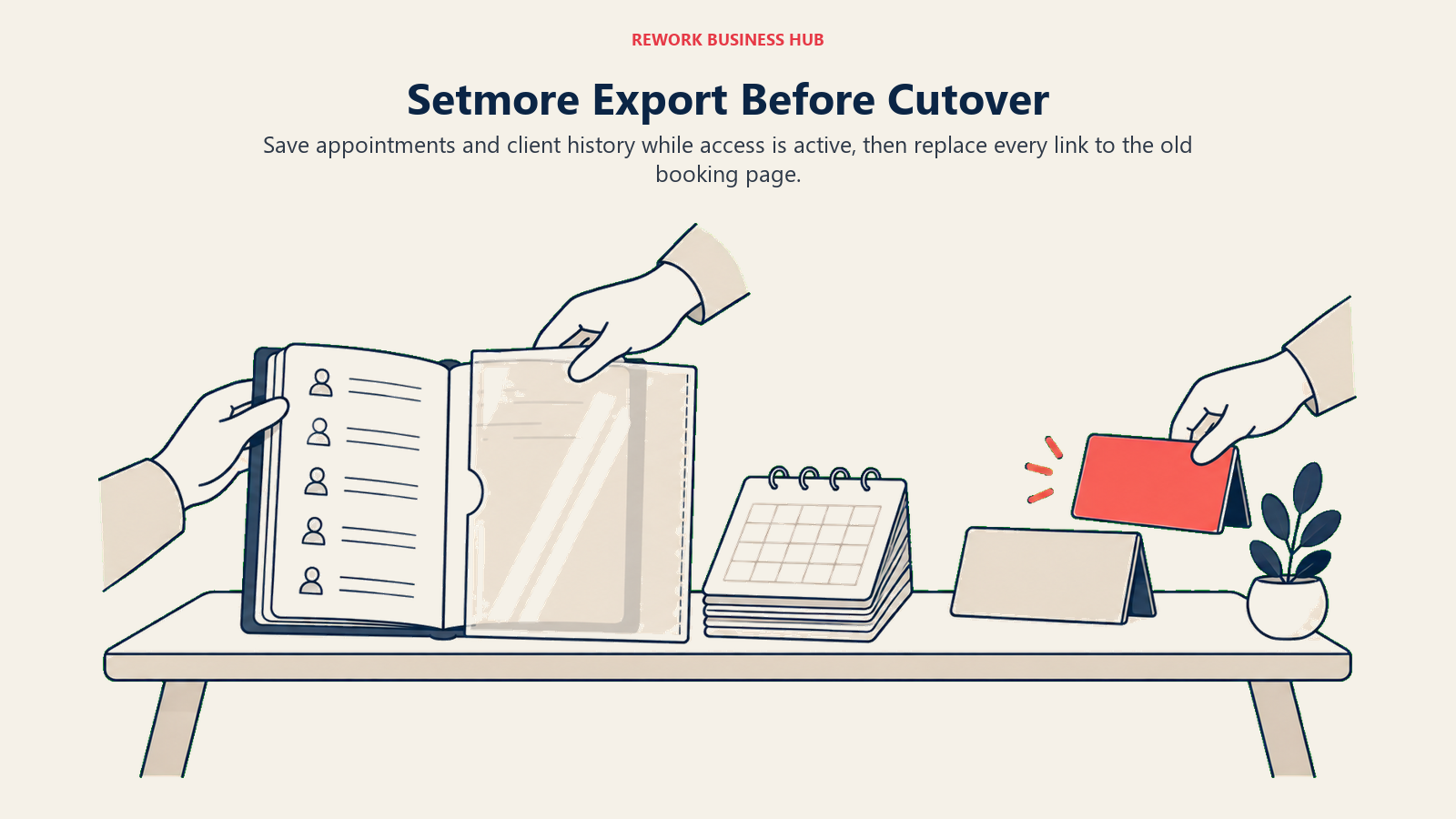
The first is your booking history. Setmore keeps a record of every past and upcoming appointment, tied to a customer's contact details and, if you used SMS reminders or notes on Pro, a communication history alongside it. None of that follows you into a new tool by default. Export it while your account is still active, not after you have already cancelled.
The second is your client-facing links. Any booking link you have shared, in an email signature, on a website, in a text thread, points at a Setmore URL that stops working the moment you leave. Update those links, and your booking widget embed if you have one on a website, on the same day you cut over, not a week later.
| Export before you cancel | Why it matters | Format to insist on |
|---|---|---|
| Full customer and contact list | The client relationships, not just the appointments | CSV with name, email, phone, and notes intact |
| Complete appointment history, past and upcoming | Continuity for repeat clients and any dispute later | CSV per customer, with dates and service type |
| Staff calendars and availability rules | The scheduling logic you already configured | Screenshot or written record, rules rarely export cleanly |
| Any custom services, durations, and pricing set up | The service catalog you already built | CSV or written list, re-entered manually if needed |
| Booking page URL and any embedded widget code | Every external link pointing at it needs updating | List of every place the old link or embed appears |
Update your booking link everywhere it lives on the same day you switch, and keep the old Setmore account active in read-only mode for a few weeks if the plan allows it, so a client who books an old link before it is fully retired does not fall through a gap.
How to Choose: Decision Framework
| If you need... | Choose |
|---|---|
| The most widely recognized booking link, free at the start | Calendly |
| Payments, packages, and memberships built in | Acuity Scheduling |
| A deep API and a lower price than Calendly, developer-controlled | Cal.com |
| A full booking website with custom add-on features | SimplyBook.me |
| Booking, payment processing, and retail POS in one | Square Appointments |
| Booking wired into a CRM and wider operations platform | Rework |
| Lead qualification and routing before the meeting is booked | OnceHub |
| The cheapest paid tier, especially inside the Zoho ecosystem | Zoho Bookings |
| Zero new cost on top of an existing Microsoft 365 plan | Microsoft Bookings |
| A simple, brandable booking page with no extras | YouCanBookMe |
| Group availability polling alongside 1:1 booking | Doodle |
| Salon, spa, or fitness-specific booking and retail tools | Vagaro |
| Multi-location wellness or fitness class scheduling at scale | Mindbody |
Frequently Asked Questions about Setmore Alternatives
Is Setmore actually free, or is that just a trial?
Setmore's free plan is genuinely free, not a trial, and covers up to 4 users. It does not include SMS reminders, two-way calendar sync, or the option to remove Setmore's branding, all of which sit behind the paid Pro plan. There is no published monthly appointment limit confirmed on Setmore's own pricing page, so treat that specific claim carefully if you see it elsewhere.
How much does Setmore Pro cost?
Pro costs $5 per user per month if you pay annually, or $12 per user per month if you pay monthly, more than double the annual rate. Pro is unlimited on users and adds SMS reminders, two-way calendar sync, and branding removal on top of the free plan.
What is the cheapest paid alternative to Setmore on this list?
Zoho Bookings publishes the lowest paid entry point in this comparison at $6 per user per month billed annually. Doodle Pro, at $11 per seat per month annually, and OnceHub's Schedule tier, at $10 per seat billed annually, are also below most of the other paid options here.
Which alternative is closest to Setmore's free-for-a-small-team model?
Zoho Bookings and Cal.com both offer genuinely free tiers, though Zoho's free plan is 1 user rather than Setmore's 4, and Cal.com's is also capped at 1 user. OnceHub's Basic plan is free for a single user as well. None of the free tiers on this list match Setmore's 4-user free cap exactly.
Does Rework make sense for a solo booking-page user?
No. Rework does not sell single-user licenses and its E-Booking module is not priced or built for a solo practitioner. If a link and a free calendar is genuinely all you need, Calendly free or Cal.com free will serve you better and cost nothing. Rework fits teams that already need or want booking connected to a CRM and wider operations tools, typically 10 people and up.
Does switching booking tools cut no-shows?
Not automatically. A 2025 study in Frontiers in Digital Health found online booking cut no-shows sharply at one private practice, 1.8% online versus 5.9% offline, but the result reversed at a university hospital, 14.3% online versus 11.2% offline. The honest read is that how a tool is implemented, SMS reminders, confirmation flows, easy rescheduling, matters more than which vendor's logo is on the booking page.
How long does switching off Setmore typically take?
Budget one to two weeks for a straightforward swap to another simple booking link tool, and four to six weeks if you are moving to a platform with payments, packages, or CRM connections, like Acuity Scheduling or Rework. Most of that time goes to exporting customer and appointment history and updating every place your old booking link is shared, not to configuring the new tool itself.
What to Do Next
Name the specific thing Setmore's free plan is not giving you, SMS reminders, real calendar sync, packages, routing, before you pick a replacement. That single question narrows this list fast: a team that just needs reminders and sync might be happier just paying for Setmore Pro's $5 annual rate than switching tools at all, while a team that needs packages or payments genuinely needs to move.
Then trial your top two picks against real bookings for two weeks, not a demo account. Send the actual booking link to a handful of real clients or leads, and watch whether reminders land, whether the calendar sync holds, and whether your team actually uses the new page without you chasing them. That two-week trial predicts the switch working better than any feature table, this one included.
Camellia writes about booking and scheduling tools for small and growing service businesses.

Principal Product Marketing Strategist
On this page
- Key Facts
- Quick Comparison Table
- Why People Outgrow Setmore
- Stage Fit
- Sizing and Persona Fit
- 1. Calendly - The Default Meeting-Scheduling Standard
- 2. Acuity Scheduling - Client-Facing Service Businesses That Take Payments
- 3. Cal.com - Open API, Lower Price, Developer-Controlled
- 4. SimplyBook.me - A Booking Website, Not Just a Link
- 5. Square Appointments - Booking Plus Payments and POS in One
- 6. Rework - Booking Inside a Wider Operations Platform
- 7. OnceHub - Qualification and Routing Before the Meeting Is Booked
- 8. Zoho Bookings - The Zoho Ecosystem Pick
- 9. Microsoft Bookings - No Extra Line Item If You Already Pay for Microsoft 365
- 10. YouCanBookMe - Simple, Branded Booking Pages
- 11. Doodle - Group Polls Plus Booking Pages
- 12. Vagaro - Salon, Spa, and Fitness
- 13. Mindbody - Larger Wellness and Fitness Businesses
- Migrating Off Setmore: What You Lose and What to Export
- How to Choose: Decision Framework
- What to Do Next