Best Squarespace Alternatives in 2026: 14 Platforms for Sellers Who've Outgrown a Website Builder
Turn this article into takeaways for your work.


Each assistant summarizes the article only for you and suggests best practices for your work.
If you run a store on Squarespace and you're reading this, you've probably hit one of two walls: the 2% transaction fee on the Basic plan is eating margin as sales grow, or your catalog and channel needs have outgrown what a website builder's storefront was built to do. Shopify, WooCommerce, and BigCommerce lead this list for sellers who need real commerce depth, Wix and Webflow Ecommerce for teams who want to keep the design-first workflow Squarespace trained them on, and Rework for operators who want orders and the customer record on the same platform as their CRM, not a separate storefront.
Squarespace earns its reputation honestly: no other platform here matches its templates out of the box, the editing experience is genuinely good, and everything runs from one subscription, hard to beat for a content-led brand or service business. The trouble starts once the store becomes the point rather than a feature of the site. Squarespace's commerce tools are a module bolted onto a website builder, not a platform built around selling, so inventory rules, multi-channel sync, shipping logic, POS, and app depth run out fast, and its cheapest plan still takes a cut of every sale on top of payment processing. For the full category view first, see Best Ecommerce Platforms in 2026.
Key Facts
- Squarespace's Basic plan (reported $16/month, billed annually) charges a 2% commerce transaction fee on every store sale on top of payment processing, while Core, Plus, and Advanced charge 0%. (Squarespace Support)
- The average documented online shopping cart abandonment rate is 70.22%, based on 50 aggregated studies. (Baymard Institute)
- Among actionable reasons shoppers give for abandoning a cart, "extra costs too high" (shipping, taxes, fees) is the leading cited issue at 40%. (Baymard Institute)
- E-commerce accounted for 16.9% of total US retail sales in the first quarter of 2026, up from 16.6% the prior quarter. (U.S. Census Bureau)
- Mobile devices accounted for 56.4% of US online transactions during the 2025 holiday shopping season (November 1 through December 31), a majority for the first time. (Adobe, reported January 2026)
Quick Comparison Table
| Tool | Best For | Starting Price | Key Strength | Key Limitation |
|---|---|---|---|---|
| Shopify | A dedicated commerce platform with the deepest app ecosystem | Basic $39/mo monthly, $29/mo billed annually (US list) | Largest app, theme, and multi-channel ecosystem | Gateway fee applies unless using Shopify Payments |
| Wix | Keeping a design-first builder while adding real store depth | $17 to $159/mo billed annually (vendor range) | Closest design-workflow match to Squarespace | Selling online starts one tier above the entry plan |
| WooCommerce | Full ownership on WordPress with no platform lock-in | Free plugin; hosting $25 to $350/mo (vendor guidance) | Total control over code, data, and hosting | You own setup, updates, and maintenance |
| BigCommerce | Growing stores wanting zero platform transaction fee | $39/mo Core, $29/mo billed annually | No BigCommerce transaction fee on any plan | Online sales limits per tier trigger upgrades |
| Webflow Ecommerce | Design-led brands wanting more layout control | Ecommerce pricing not independently confirmed | Best-in-class visual design and interaction control | Smaller commerce app ecosystem than Shopify |
| Rework | Sellers wanting orders, inventory, and the customer record on one platform | From $69/mo billed yearly (5 seats) | Commerce, CRM, inventory, and inbox on one platform | Not a storefront builder or checkout platform |
| Big Cartel | Independent artists and makers with small catalogs | Free (Gold, limited); $15/mo Platinum | Purpose-built for small-batch makers | Product-count ceilings even on paid tiers |
| Ecwid by Lightspeed | Adding a store widget to an existing site | $5/mo Starter, up to 10 products | Drops a store into almost any existing website | Entry tier caps out at 10 products |
| Square Online | Sellers who also sell in person and want POS synced | Free tier plus paid upgrades (figures not confirmed) | Tight in-person and online sync via Square hardware | Full plan pricing not independently confirmed |
| Shopware | Mid-market and enterprise European retailers | EUR 600/mo Rise, excl. VAT | Strong B2B and multi-storefront architecture | Priced in euros, overhead for a small US store |
| Shift4Shop | US merchants comfortable processing through Shift4 | $41/mo End-to-End plan | Full feature set without a separate app-store bill | Availability regional; historic free plan conditional |
| Adobe Commerce / Magento Open Source | Enterprise catalog depth or full code ownership | Adobe: quote-only (GMV-based); Magento OS: free, self-hosted | Enterprise catalog and customization depth | Needs developer resources either way |
| PrestaShop | EU-centric merchants wanting an owned, open-source storefront | Classic free, self-hosted; Hosted unpublished | Full code ownership on a mature open-source base | Hosted pricing requires a sales conversation |
| Salesforce Commerce Cloud | Enterprises that have outgrown every platform above | No published price, quoted per merchant | Deep personalization at enterprise B2B/B2C scale | Not built or priced for a small or boutique store |
1. Shopify: The Default Graduation Path
Shopify built its entire product around one job: running an online store. That shows up in the largest app and theme ecosystem here, a real point-of-sale system for teams selling in person too, and multi-channel selling into Amazon, TikTok Shop, and social storefronts built into the core product. Its pricing page lists US monthly pricing at Basic $39, Grow $105, Advanced $399, and Plus from $2,300, and publishes the annual rates alongside them at Basic $29, Grow $89, and Advanced $359. The $5 Starter plan still exists for merchants already on it but is closed to new stores. Shopify also localizes pricing by country. A third-party gateway fee applies unless you use Shopify Payments: 2% on Basic, 1% on Grow, 0.6% on Advanced, 0.2% on Plus. (Shopify) See Shopify vs BigCommerce if that's the other name on your shortlist.
| What you get | What you don't |
|---|---|
| The largest app, theme, and integration ecosystem here | A single flat price with zero fee math |
| Real POS hardware and in-person selling | Squarespace's built-in design polish out of the box |
| Native multi-channel selling (Amazon, TikTok Shop, social) | A gateway-fee-free plan unless you use Shopify Payments |
| A clear upgrade path as volume grows | Country-consistent list pricing |
Pricing: Basic $39/month up to Advanced $399/month billed monthly, US list; Plus from $2,300/month. Billed annually: Basic $29, Grow $89, Advanced $359. The $5/month Starter plan is closed to new stores. Third-party gateway fee runs 2% down to 0.2% by tier, waived with Shopify Payments. Best for: Sellers ready to run commerce as the core of the business rather than a feature of a website. Not ideal for: Teams who want one flat subscription with no gateway-fee tiering to track.
2. Wix: The Closest Design-First Alternative
Wix and Squarespace get compared constantly: both lead with a visual, drag-and-drop editor, and both started as website builders before layering commerce on top. The difference is depth once that layer isn't enough, Wix's app market and its own POS hardware give a growing store more places to add functionality, and its AI-assisted design tools have moved fast this year. Wix's plans page renders pricing by geography rather than one fixed global figure: paid Premium plans run $17 to $159 per month billed annually, from the entry Light plan (no online payments, selling starts one tier up) to Business Elite, with Core and Business between them. Fetch wix.com/plans yourself for an exact figure in your region. See Best Wix Alternatives for the full side-by-side.
| What you get | What you don't |
|---|---|
| A visual, template-driven editor similar to Squarespace's | One confirmed global price, pricing is geo-varied |
| A broader third-party app market than Squarespace | Squarespace's specific template aesthetic |
| Wix-branded POS hardware for in-person selling | Online payments on the entry-level plan |
| AI-assisted design tools moving quickly | A metadata-light, minimalist editor feel |
Pricing: $17 to $159/month billed annually across Wix's paid plans (vendor-stated range); selling online requires a tier above the entry Light plan. Best for: Teams that want to keep a visual, template-driven workflow but need a wider app ecosystem than Squarespace offers. Not ideal for: Sellers who want one settled number instead of a geography-dependent range.
3. WooCommerce: Full Ownership on WordPress
WooCommerce flips the Squarespace trade entirely: instead of one vendor hosting your site, store, and design in a single subscription, you run a free plugin on WordPress and own every layer yourself, hosting, theme, extensions, and data. WooCommerce's own pricing page confirms the core plugin is free and open source with 0% revenue share and no platform tiers at all; the real cost lives elsewhere, vendor guidance puts hosting at roughly $25 to $350 per month for most stores, extensions at $29 to $299 per year each, and WooPayments processing around 2.5% to 2.9% plus 30 cents per transaction. (WooCommerce) Write this one as "free plugin, real cost is hosting plus extensions plus processing," never as a $0 platform.
| What you get | What you don't |
|---|---|
| A free, open-source core with no revenue share | Squarespace's all-in-one hosting and support |
| Full control over hosting, code, and data | A single predictable monthly bill |
| An enormous plugin ecosystem for any feature you need | Built-in commerce features without extensions |
| No platform vendor to lock you in or raise fees | A vendor support line if something breaks |
Pricing: Free plugin, 0% revenue share; hosting typically $25 to $350/month, extensions $29 to $299/year each, WooPayments processing around 2.5% to 2.9% plus $0.30/transaction (all vendor-published guidance). Best for: Teams with technical comfort who want full ownership of their store's code, data, and hosting. Not ideal for: Sellers who want Squarespace's single-subscription simplicity without managing hosting or extensions themselves.
4. BigCommerce: No Platform Cut of a Sale on an Embedded Payment Partner
BigCommerce's pitch to a Squarespace seller is direct: real commerce depth (multi-currency, B2B features, headless options) without ever taking a cut of your sales. Its own pricing page lists Core at $39/month ($29/month annual) up to $30,000 in online sales trailing twelve months (TTM); Growth at $105/month ($79/month annual) up to $100,000 TTM; Scale at $399/month ($299/month annual) up to $33,333/month with a 0.9% overage above that; and Performance, custom from $1,499/month annual. BigCommerce charges no transaction fee of its own; the percentages per plan (2.0%, 1.0%, 0.6%, 0.0% with a contract) are the fee for using an Open Payment Provider other than its own processor. (BigCommerce) Reputation check: the tiers are Core, Growth, Scale, and Performance, not the older Standard, Plus, and Pro names some guides still use. See Shopify vs BigCommerce or Best BigCommerce Alternatives.
| What you get | What you don't |
|---|---|
| Zero BigCommerce transaction fee at every tier | Shopify's size of app and theme marketplace |
| Native multi-currency and B2B commerce features | A single flat rate regardless of sales volume |
| Annual billing that saves roughly 25% over monthly | Squarespace's out-of-the-box template polish |
| Headless commerce options for custom front ends | A sales-volume ceiling you can ignore forever |
Pricing: Core $39/month ($29/month annual) up to $30K TTM sales; Growth $105/month ($79/month annual) up to $100K TTM; Scale $399/month ($299/month annual); Performance custom from $1,499/month annual. Best for: Growing stores that want commerce-platform depth without ever paying BigCommerce a percentage of their own sales. Not ideal for: Very small stores that don't need multi-currency or B2B tooling and would rather start cheaper elsewhere.
5. Webflow Ecommerce: Design Control Beyond a Template
Webflow is the pick for a brand whose real complaint about Squarespace is creative ceiling: custom animations, precise layout control, and interactions a template system can't reproduce. Webflow changed its general site pricing on 13 May 2026, retiring the CMS and Business site plans for a single Premium site plan plus a new Team platform plan and custom Enterprise tier, with existing customers keeping current pricing until their first renewal on or after 29 June 2026. Its Ecommerce site plans weren't part of that change and still carry a 0% Webflow transaction fee. Check webflow.com/pricing for the current Ecommerce plan figures. Reputation check: don't call a current plan the "Webflow CMS plan" or "Webflow Business plan," both retired in the May 2026 change.
| What you get | What you don't |
|---|---|
| The deepest visual design and animation control on this list | Shopify- or BigCommerce-level app ecosystem for commerce |
| 0% Webflow transaction fee on Ecommerce plans | A settled, independently confirmed Ecommerce price |
| A CMS built for content-heavy, design-led sites | Squarespace's faster time-to-launch with templates |
| Recently simplified general site-plan tiers | Zero learning curve, Webflow rewards design skill |
Pricing: General site plans restructured 13 May 2026 into Premium, Team, and Enterprise; Ecommerce plans unchanged by that update and carry 0% Webflow transaction fee; exact Ecommerce dollar figures require checking webflow.com/pricing directly. Best for: Design-led brands whose ceiling on Squarespace is creative control, not commerce feature depth. Not ideal for: Sellers who want the largest possible library of ready-made commerce apps and integrations.
6. Rework: Commerce Operations on the Same Platform as the CRM
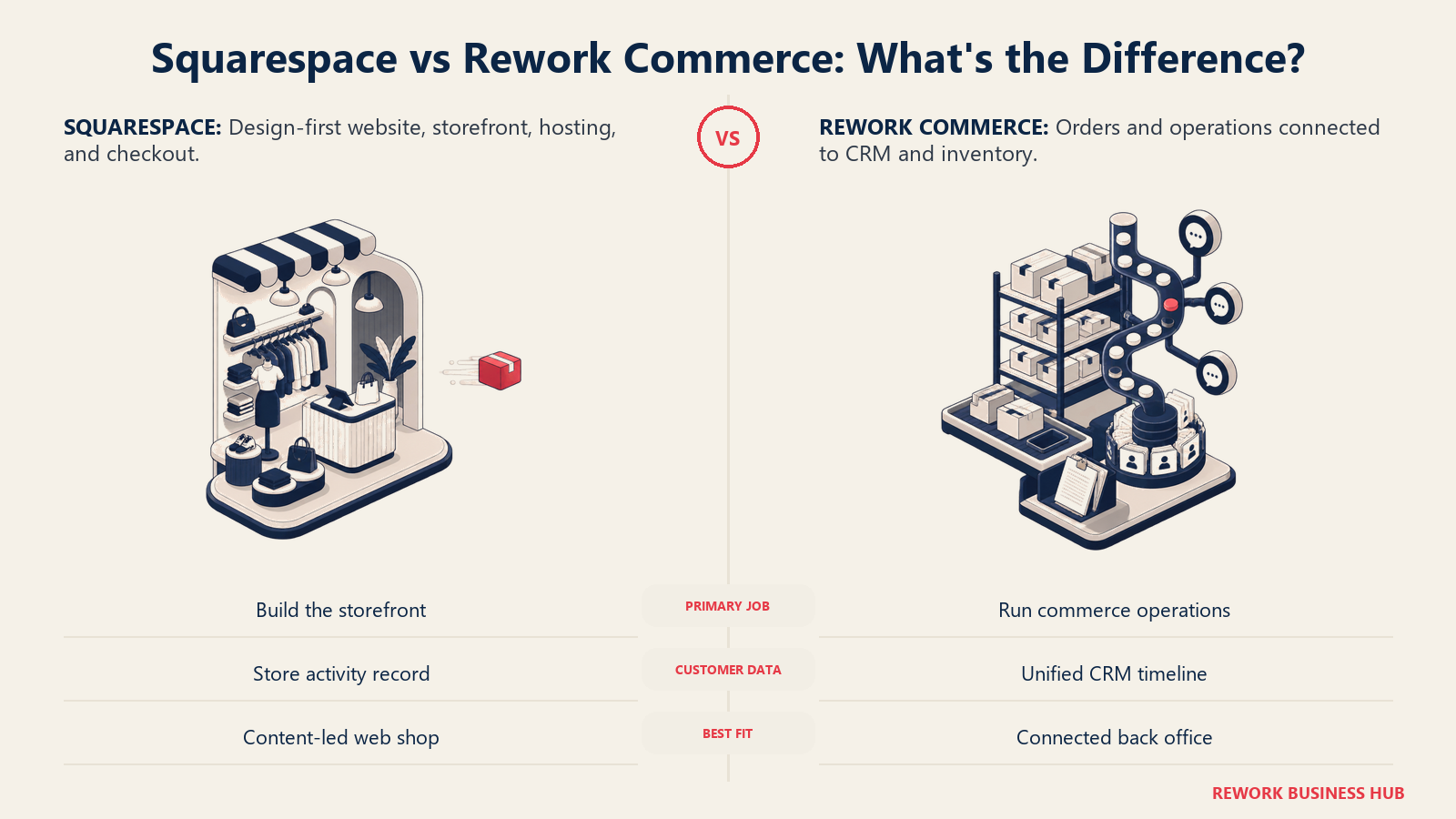
Rework's Commerce module handles order and commerce operations inside the wider Rework platform, which also carries Sales CRM, Lead, Inventory, Invoice, Product, Work Ops, and People. The pitch for a seller who has outgrown Squarespace's storefront isn't a better theme library, it's that orders, inventory, invoices, and the customer record sit on one platform instead of a storefront synced separately to a CRM, an inventory spreadsheet, and an accounting tool. Rework also runs a unified multi-channel inbox (WhatsApp, Messenger, Instagram DM, TikTok, Zalo, web chat on one contact timeline), which is why it fits social-commerce and B2B sellers whose buying conversation crosses channels a pure storefront never touches. Commerce comes with the Sales Engine, from $69/month billed yearly with 5 sales seats. See Best CRM Software if the CRM side is what's pulling you off Squarespace, or rework.com/pricing for current plans.
| What you get | What you don't |
|---|---|
| Orders, inventory, invoices, and CRM on one platform | A themed web storefront or a checkout page to design |
| A unified multi-channel inbox on the customer timeline | A template gallery or drag-and-drop site builder |
| One record per customer across sales, support, and orders | High-volume D2C storefront traffic handling |
| Commerce included in the Sales Engine alongside the CRM | A free or solo tier |
Pricing: Commerce comes with the Sales Engine, from $69/month billed yearly with 5 sales seats, or the Revenue Engine, from $159/month billed yearly. See rework.com/pricing. Best for: Mid-size operators, roughly 10 to 200 people, who want commerce operations on the same platform as their CRM, inventory, and multi-channel inbox instead of syncing a separate storefront tool to three other systems. Not ideal for: Rework is not a storefront builder. It doesn't host a themed web storefront, ship a template gallery, or serve as a checkout platform for a D2C web shop; it's the operations layer behind or beside one, not a replacement for Shopify's or Squarespace's storefront. Solo sellers should look elsewhere too.
7. Big Cartel: Built for Small-Batch Makers
Big Cartel has stayed narrowly focused: it's built for independent artists, musicians, and small-batch makers who need a simple store without the commerce-platform overhead of Shopify or BigCommerce, real ceilings, not a 500-SKU catalog platform, but for its audience that's a feature, not a gap. It publishes three tiers: a free Gold plan with limited features, Platinum at $15/month, and Diamond at $30/month, with annual billing bringing those to roughly $12/month and $24/month, and the Gold plan's product cap commonly cited at five products (reported). (Big Cartel) Reputation check: the older $9.99/$19.99/$29.99 tier names and prices some guides still list are retired.
| What you get | What you don't |
|---|---|
| A genuinely free tier to start (limited features) | A path to a large, multi-category catalog |
| Pricing built for solo artists and small studios | Shopify-level app or shipping-rule depth |
| A simple setup with minimal learning curve | Multi-channel selling or POS hardware |
| Low-cost paid tiers for growing beyond free | Enterprise or B2B commerce features |
Pricing: Free Gold plan (limited); Platinum $15/month ($12/month annual, reported); Diamond $30/month ($24/month annual, reported). Best for: Independent artists, musicians, and small-batch makers with a small product catalog. Not ideal for: Any seller planning to scale past a small catalog or needing multi-channel and shipping-rule depth.
8. Ecwid by Lightspeed: A Store Widget for Any Site
Ecwid solves a different problem than most of this list: instead of replacing your website, it drops a shopping cart widget into a site you already have, including, notably, a Squarespace page itself, the honest hybrid option for a seller who loves their design but wants Ecwid's commerce logic (multi-channel sync, POS, marketplace integrations) without a full migration. Published pricing runs Starter at $5/month (up to 10 products), Venture at $35/month or $29/month annual (100 products), Business at $65/month or $49/month annual (2,500 products), and Unlimited at $149/month or $119/month annual, with no setup or transaction fees on any tier. (Ecwid) Reputation check: Ecwid's free-forever plan is gone; entry today is the $5/month Starter tier.
| What you get | What you don't |
|---|---|
| A store widget that embeds into almost any existing site | A free plan, that tier is retired |
| No setup or transaction fees on any tier | Full platform ownership like Shopify or WooCommerce |
| Multi-channel sync (marketplaces, social) built in | Deep theme customization; you're adding a widget, not a site |
| A low-cost entry point for a small catalog | Room to grow past 10 products without upgrading |
Pricing: Starter $5/month (10 products); Venture $35/month or $29/month annual (100 products); Business $65/month or $49/month annual (2,500 products); Unlimited $149/month or $119/month annual. No setup or transaction fees. Best for: Sellers who want to add real commerce functionality to an existing website, including a Squarespace site, without migrating platforms. Not ideal for: Anyone who wants their store to be the whole site rather than a widget added to one.
9. Square Online: Built to Pair With In-Person Selling
Square Online exists mainly to extend Square's point-of-sale business online, the strongest fit here for a seller running a physical shop, market stall, or pop-up who wants inventory and orders synced automatically between register and website, something Squarespace can't do since it has no in-person hardware of its own. Square's marketing describes a free tier for a basic online store plus paid upgrades, with card processing charged per transaction rather than a flat platform fee, but Square's pricing pages block clean automated extraction, so specific plan dollar figures aren't independently confirmed here; pull them directly from squareup.com if exact numbers matter.
| What you get | What you don't |
|---|---|
| Tight sync between in-person Square POS and online orders | Independently confirmed plan dollar figures |
| A free entry tier for a basic online store | Squarespace's design and template depth |
| Per-transaction card processing instead of a flat platform fee | A large third-party app ecosystem |
| Square hardware options for markets, pop-ups, and retail | A dedicated commerce-first feature set beyond POS sync |
Pricing: Free tier plus paid upgrades; card processing charged per transaction. Exact plan dollar figures aren't independently confirmed; check squareup.com directly. Best for: Sellers who run in-person sales through Square hardware and want online orders synced automatically. Not ideal for: Pure online sellers with no in-person component, who won't use Square's core strength.
10. Shopware: European Mid-Market and Enterprise Depth
Shopware is the pick for a merchant operating primarily in Europe who needs B2B commerce features, multi-storefront management, or deeper customization than a website builder offers, and who's comfortable working in euros and, often, with an implementation partner. It publishes Community Edition as free and self-hosted, with Rise from EUR 600/month excluding VAT, Evolve from EUR 2,400/month excluding VAT, and Beyond priced custom; its Intelligence+ AI add-on runs EUR 29/month on Community and EUR 19/month on paid editions. (Shopware) Reputation check: the older "Shopware Professional at EUR 199/month" tier some guides still cite is retired.
| What you get | What you don't |
|---|---|
| A free, self-hosted Community edition to start | US-dollar pricing; everything is quoted in euros |
| Strong B2B and multi-storefront architecture | Squarespace-level template polish out of the box |
| Enterprise-grade customization at the Evolve/Beyond tiers | A budget fit for a small boutique US store |
| An established European commerce ecosystem | A simple, one-click launch |
Pricing: Community free, self-hosted; Rise from EUR 600/month excl. VAT; Evolve from EUR 2,400/month excl. VAT; Beyond custom quote. Best for: European mid-market and enterprise retailers needing B2B commerce and multi-storefront depth. Not ideal for: A small US-based boutique store without the budget or need for enterprise architecture.
11. Shift4Shop: A Full Feature Set Tied to One Processor
Shift4Shop packages a genuinely complete commerce feature set (unlimited products, no per-order fees, built-in marketing tools) into a single plan, appealing to a seller tired of Squarespace's per-feature app additions, though availability and payment-processor conditions are worth checking first. Its End-to-End eCommerce plan pricing page lists $41/month, and it also carries a notice that the platform "isn't yet available in your country or region," so confirm availability for your market. Third-party sources still describe a historic $0/month US plan conditional on processing exclusively through Shift4 Payments; treat that as reported and conditional, not a flat free plan. (Shift4Shop)
| What you get | What you don't |
|---|---|
| A complete feature set in a single published plan | Guaranteed availability in every country or region |
| No transaction fee structure to compare across tiers | A processor-agnostic path if $0/month appeals to you |
| Built-in marketing tools without a separate app bill | Shopify- or BigCommerce-level third-party app depth |
| A straightforward $41/month published price | Squarespace's design-first editing experience |
Pricing: End-to-End eCommerce plan at $41/month (vendor-published); a historic $0/month US plan tied to processing through Shift4 Payments is reported, not guaranteed everywhere. Best for: US merchants comfortable standardizing on Shift4 Payments who want a full feature set in one plan. Not ideal for: Sellers outside Shift4Shop's available regions or unwilling to tie their processing to one provider.
12. Adobe Commerce and Magento Open Source: Two Different Bets on Enterprise Depth
These are really two products for two different budgets. Adobe Commerce is the licensed, quote-only enterprise product (including Adobe Commerce as a Cloud Service, launched June 2025), sized against annual gross merchandise value rather than a published list price. Magento Open Source is the free, self-hosted version, where the buyer pays hosting, development, extensions, and maintenance instead of a license fee, either path assumes real developer resources, the opposite end of the spectrum from Squarespace's no-code editor. Adobe publishes no price for Adobe Commerce; any dollar figure quoted for it elsewhere is a third-party estimate, label it (reported) with a source or leave it out. Magento Open Source carries no licence fee at all. See Best Magento Alternatives if Magento specifically is what you're evaluating.
| What you get | What you don't |
|---|---|
| Enterprise catalog depth and deep customization | A published price for Adobe Commerce |
| A free, self-hosted option (Magento Open Source) | A no-code editor, this is a developer-run platform |
| Full code ownership on the Open Source edition | Fast time-to-launch compared with a website builder |
| An SaaS path (ACCS) if you want managed infrastructure | A fit for a small store without dev resources |
Pricing: Adobe Commerce is quote-only, priced per merchant on gross merchandise value, no published list price. Magento Open Source carries no licence fee; the buyer pays hosting, development, extensions, and maintenance. Best for: Developer-backed teams needing enterprise catalog depth (Adobe Commerce) or full code ownership on a budget (Magento Open Source). Not ideal for: A small or boutique seller without in-house or contracted development resources.
13. PrestaShop: Owned, Open-Source, EU-Centric
PrestaShop sits between WooCommerce and Magento Open Source in spirit: a mature, open-source commerce platform with deep roots in European retail, offering full ownership of your code and data without Magento's enterprise-scale complexity, a credible middle path for a merchant with some technical capacity who wants to own their platform outright. It publishes a free open-source download, called Classic, alongside a Hosted offer for merchants who don't want to self-manage infrastructure; PrestaShop does not publish a price for the Hosted offer on its pricing pages, so say exactly that rather than guessing a figure. (PrestaShop)
| What you get | What you don't |
|---|---|
| A free, open-source Classic edition to self-host | A published price for the Hosted offer |
| Strong roots in European ecommerce and B2B | Squarespace's zero-setup, no-code experience |
| Full ownership of code, data, and infrastructure | A large US-centric app marketplace like Shopify's |
| A path to managed hosting via the Hosted offer | A flat, comparable monthly number across offers |
Pricing: Classic free, self-hosted, open source. Hosted offer has no published price; a sales conversation is required. Best for: EU-centric merchants wanting an owned, open-source storefront without Magento-level complexity. Not ideal for: Sellers wanting a published, comparable monthly price before talking to sales.
14. Salesforce Commerce Cloud: The Enterprise Ceiling
Salesforce Commerce Cloud rounds out this list at the far end from Squarespace: deep personalization, unified B2B and B2C commerce, and integration with the broader Salesforce ecosystem, aimed at enterprises that have already outgrown every independent platform above. Most readers coming from Squarespace won't be shopping in this tier yet, but it's worth naming as the honest ceiling. Salesforce publishes no simple list price, and the product has historically been sold in part against gross merchandise value alongside platform fees, though no specific percentage is asserted here without a Salesforce page stating one. Quotes are negotiated per merchant based on scale and modules. (Salesforce)
| What you get | What you don't |
|---|---|
| Enterprise-grade personalization and B2B/B2C commerce | A published, self-serve price anywhere |
| Deep integration with the wider Salesforce ecosystem | A fit for a small or boutique store's budget |
| Proven scale for multi-brand, multi-region retailers | A fast, low-touch setup |
| A genuine ceiling to grow into, if you ever need it | Relevance to most readers coming from Squarespace |
Pricing: No published price. Quoted per merchant, historically tied in part to gross merchandise value alongside platform fees; confirm exact terms with Salesforce directly. Best for: Enterprises with multi-brand or multi-region commerce needs that have outgrown every independent platform above. Not ideal for: Nearly every reader of this article; if you're comparing Squarespace plans, you're not yet in Salesforce Commerce Cloud's buying range.
Why Sellers Leave Squarespace
Squarespace's core strengths hold up under scrutiny. Its templates remain the most polished starting point on this list, the editor is genuinely pleasant to use, and having design, hosting, domain, and commerce in one subscription removes the vendor-juggling a WooCommerce or Magento setup demands. For a content-led brand or service business layering on a small shop, that's a real reason to stay. The reasons sellers leave anyway cluster around a few honest limits.
The fee structure punishes growth on the cheapest plan. Basic charges a 2% commerce transaction fee on every sale and 7% on digital content and memberships, while Core, Plus, and Advanced drop the commerce fee to 0% and step the digital-content fee to 5%, 1%, and 0%. (Squarespace Support) A seller who launches on Basic to save money hands back 2% of every sale exactly as volume starts to matter, on top of Squarespace Payments processing at 2.5% to 2.9% plus $0.30.
Checkout friction compounds the abandonment problem every store fights. The average documented cart abandonment rate is 70.22% across 50 aggregated studies, and among actionable reasons shoppers give, unexpected extra costs, shipping, taxes, fees, are the single most-cited issue at 40%. (Baymard Institute) A platform fee doesn't appear as a line item to the shopper, but it shows up in the margin math behind what you charge for shipping, and thin shipping-rule flexibility makes that math harder than it needs to be.
Inventory, multi-channel, and app depth run out fast. Squarespace's commerce module handles the basics well, but it wasn't built around commerce as the primary job the way Shopify or BigCommerce were. Sellers needing multi-location inventory, wholesale pricing, subscription billing, or a deep app catalog hit that ceiling right as the business is finally growing enough to need it.
Mobile and channel expectations keep rising. Mobile devices accounted for 56.4% of US online transactions during the 2025 holiday season, the first time mobile crossed the halfway mark, and commerce-first platforms have generally moved faster on native mobile checkout and social selling than a website builder retrofitting a store module. (Adobe, reported January 2026) For a brand selling into the creator economy, projected to grow from $255.66 billion in 2025 to $323.48 billion in 2026, that flexibility increasingly matters as much as the storefront's look. (Research and Markets)
How to Choose: Decision Framework
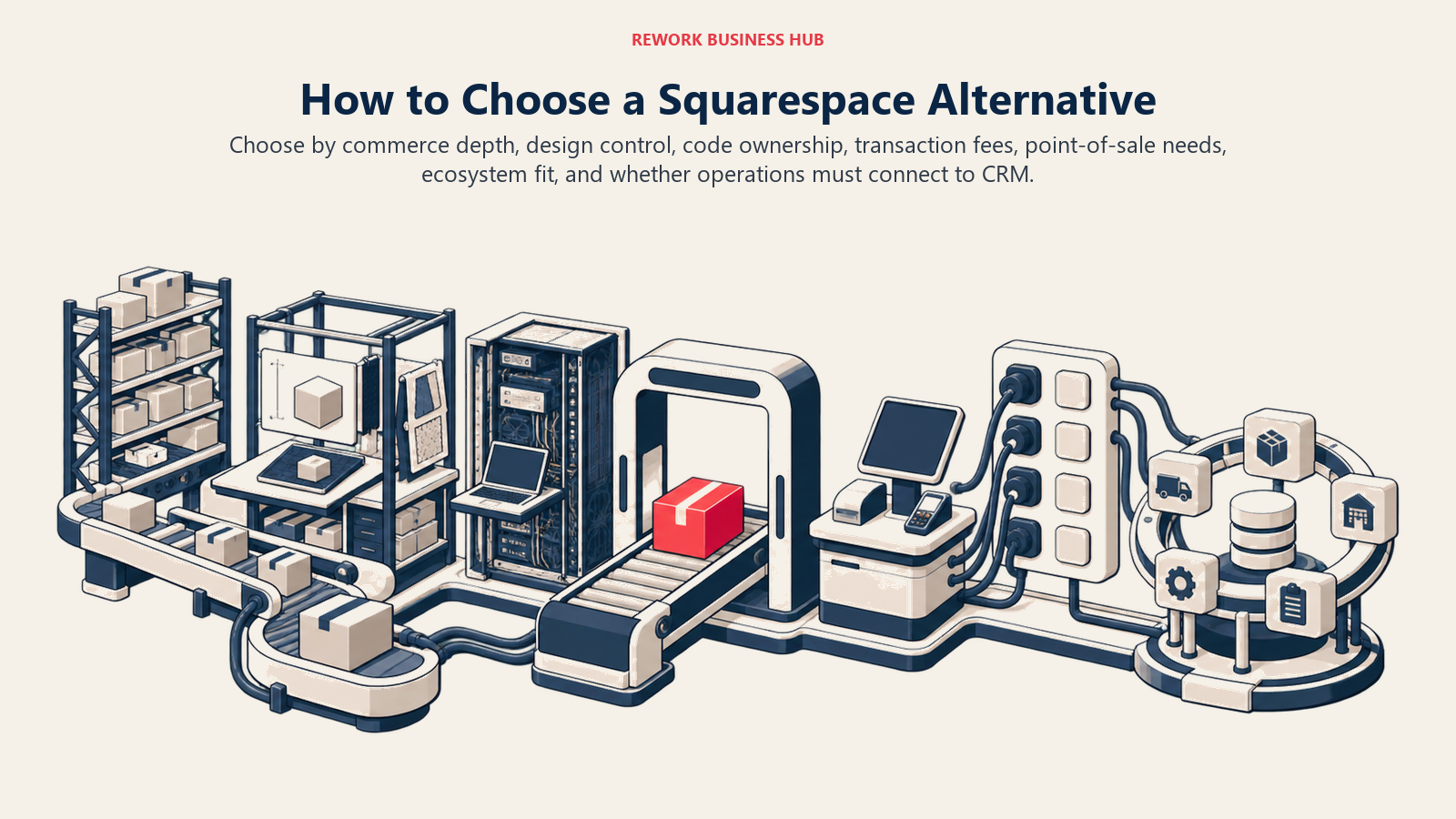
Choose around the capability Squarespace no longer covers, whether that is commerce depth, design control, ownership, transaction economics, POS, ecosystem breadth, or connected CRM operations.
| If you need... | Best pick |
|---|---|
| A dedicated commerce platform with the deepest app ecosystem | Shopify |
| To keep a design-first, drag-and-drop workflow like Squarespace's | Wix |
| Full ownership of code, data, and hosting on WordPress | WooCommerce |
| Zero platform transaction fee as sales grow | BigCommerce |
| Squarespace-level (or better) visual design control | Webflow Ecommerce |
| Orders, inventory, and the CRM on one platform instead of a separate storefront | Rework |
| A simple store for a small-batch maker or artist | Big Cartel |
| To add a store widget to a site you already have | Ecwid by Lightspeed |
| In-person and online sales synced through one POS | Square Online |
| European B2B and multi-storefront commerce depth | Shopware |
| A complete feature set in one plan tied to one processor | Shift4Shop |
| Enterprise catalog depth or free self-hosted code ownership | Adobe Commerce / Magento Open Source |
| An owned, open-source storefront rooted in European ecommerce | PrestaShop |
| Enterprise-scale, multi-brand, multi-region commerce | Salesforce Commerce Cloud |
Frequently Asked Questions about Squarespace Alternatives
Why do sellers leave Squarespace?
The Basic plan's 2% commerce transaction fee eats margin as sales grow (Core, Plus, and Advanced drop it to 0%), inventory and multi-channel features run out faster than on a dedicated commerce platform, the app ecosystem is thinner than Shopify's or BigCommerce's, and POS depth for in-person sellers trails Shopify or Square.
What are Squarespace's current plans, and how much do they cost?
Basic, Core, Plus, and Advanced, replacing the older Personal, Business, Commerce Basic, and Commerce Advanced names retired in late 2025. Squarespace renders dollar figures in JavaScript rather than static text; third-party reporting puts Basic at roughly $16/month, Core at $23/month, Plus at $39/month, and Advanced at $99/month, billed annually (reported).
Does Squarespace charge a transaction fee?
Yes, on Basic: 2% on every store sale plus 7% on digital content and memberships, on top of payment processing. Core, Plus, and Advanced all charge 0% on commerce transactions, with the digital-content fee stepping down to 5%, 1%, and 0%.
What's the cheapest real alternative if fees are the whole problem?
BigCommerce charges no transaction fee of its own at any tier, starting at $39/month (Core, $29/month annual); a separate Open Payment Provider fee applies only with a gateway other than its own. Ecwid's $5/month Starter plan also carries no setup or transaction fees, though it caps at 10 products.
Does Rework replace Squarespace?
Not for the storefront. Rework isn't a website builder; its Commerce module handles order, inventory, and invoice operations on the same platform as the CRM and multi-channel inbox. Pick Shopify, Wix, or Webflow for the storefront itself, and layer Rework in for the operations behind it if consolidation is the real pain point.
Is there a good option for keeping Squarespace's design feel but adding more commerce depth?
Wix is the closest match on workflow, both are visual, template-driven builders. Webflow goes further on design and interaction control at the cost of a steeper learning curve. Neither matches Shopify's or BigCommerce's app depth.
What's the difference between a self-hosted option like WooCommerce and a hosted platform like Shopify?
Self-hosted (WooCommerce, Magento Open Source, PrestaShop Classic) is free to license, but you manage hosting, security, and updates yourself and own the code outright. Hosted (Shopify, BigCommerce, Squarespace) bundles hosting, security, and updates into one subscription, trading control for less maintenance.
What to Do Next
Match your actual reason for shopping, fees, catalog ceiling, design control, or operations consolidation, to the framework above, then move your real catalog into your top two picks' free trials before deciding. Import 15 to 20 real SKUs with variants and shipping rules, then price out a projected year against Squarespace's current plan and fee structure. If the 2% Basic-plan fee is the whole complaint, start with BigCommerce or Ecwid. If design ceiling is the real issue, start with Webflow or Wix. If commerce has outgrown being a feature and needs to become the operation alongside a CRM and multi-channel inbox, that's where Rework's Commerce module fits, worth a conversation even while you keep shopping for the storefront itself.

Principal Product Marketing Strategist
On this page
- Key Facts
- Quick Comparison Table
- 1. Shopify: The Default Graduation Path
- 2. Wix: The Closest Design-First Alternative
- 3. WooCommerce: Full Ownership on WordPress
- 4. BigCommerce: No Platform Cut of a Sale on an Embedded Payment Partner
- 5. Webflow Ecommerce: Design Control Beyond a Template
- 6. Rework: Commerce Operations on the Same Platform as the CRM
- 7. Big Cartel: Built for Small-Batch Makers
- 8. Ecwid by Lightspeed: A Store Widget for Any Site
- 9. Square Online: Built to Pair With In-Person Selling
- 10. Shopware: European Mid-Market and Enterprise Depth
- 11. Shift4Shop: A Full Feature Set Tied to One Processor
- 12. Adobe Commerce and Magento Open Source: Two Different Bets on Enterprise Depth
- 13. PrestaShop: Owned, Open-Source, EU-Centric
- 14. Salesforce Commerce Cloud: The Enterprise Ceiling
- Why Sellers Leave Squarespace
- How to Choose: Decision Framework
- What to Do Next