Best Appointment Scheduling Software in 2026: 15 Tools for Client-Facing and Internal Booking
Turn this article into takeaways for your work.


Each assistant summarizes the article only for you and suggests best practices for your work.
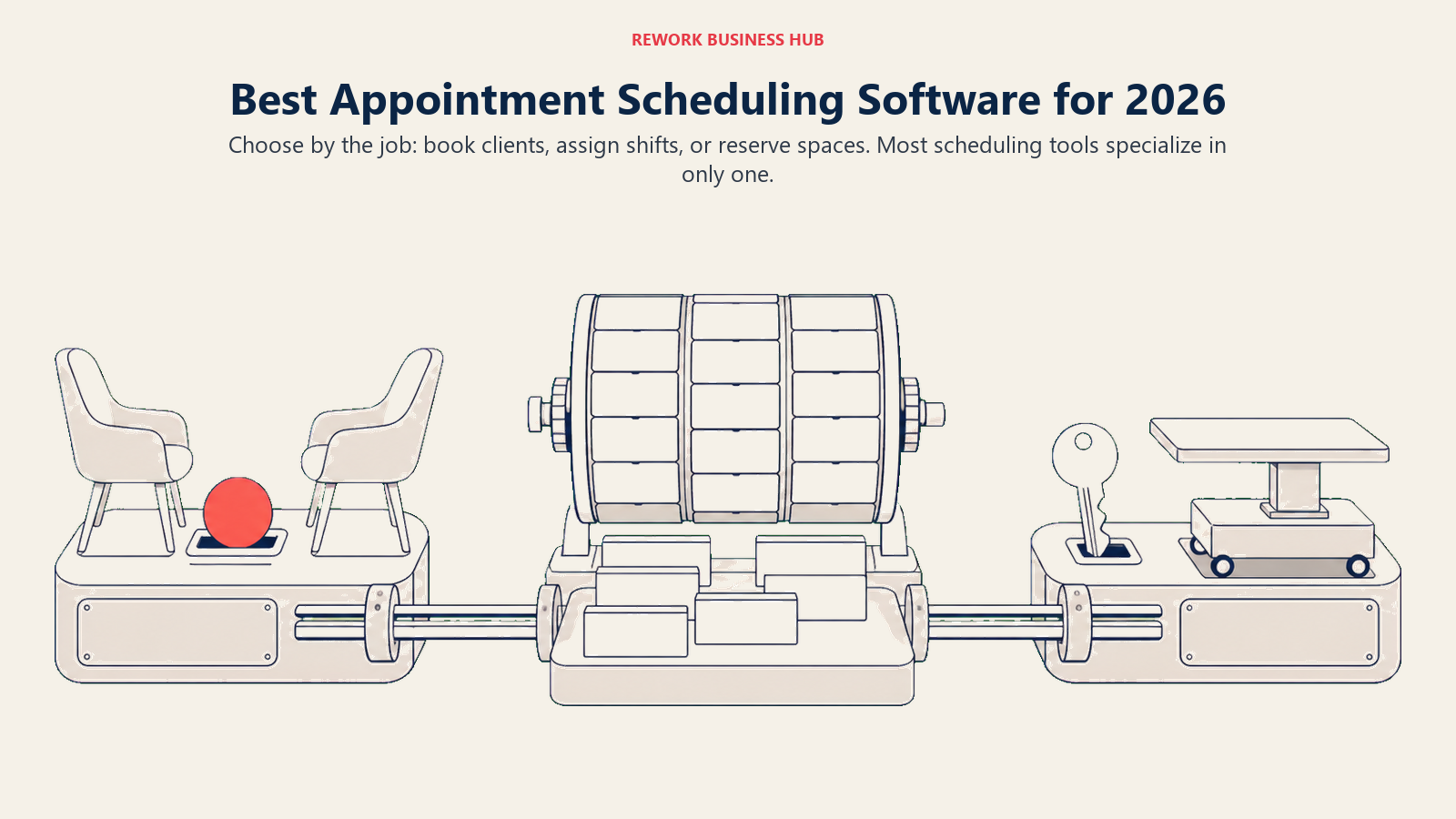
The best appointment scheduling software in 2026 depends on which of three different jobs you're actually hiring it for. Calendly is still the default for one-off meeting links. Acuity Scheduling and SimplyBook.me win for service businesses that take payments and manage a real booking calendar. Cal.com wins on price and API depth if you want a developer-first booking tool, though the hosted product itself went closed source in April 2026; the free self-hostable option is Cal.diy, a stripped-down community edition not meant for production. And Rework fits differently again: it's the pick when booking needs to live next to the CRM record and the rest of the team's operating system, not sit off to the side as its own subscription.
This guide ranks 15 tools for operations managers, founders, service business owners, and sales leaders who need booking working by next week. Where a vendor doesn't publish a price, this article says so instead of guessing.
Key Facts
- The global appointment scheduling software market was valued at $546.1 million in 2025 and is projected to reach $1,905.90 million by 2034, a 14.70% CAGR, according to Fortune Business Insights.
- Nearly 70% of consumers say they'd choose to book online if given the choice, and 94% said they'd be more likely to pick a new service provider that offered online booking, per a GetApp survey of 217 US consumers (2021).
- Online booking doesn't automatically cut no-shows: a 2025 study in Frontiers in Digital Health found a private practice's no-show rate was 1.8% for online bookings versus 5.9% for offline ones, while a university hospital saw the opposite (14.3% online versus 11.2% offline). Implementation matters more than the tool.
- Meetings starting after 8pm are up 16% year over year, and 30% of meetings now span multiple time zones, up 8 percentage points since 2021, according to Microsoft's 2025 Work Trend Index.
- Contacting a sales lead within 5 minutes instead of 30 raises the odds of qualifying it by 21 times, per the Lead Response Management study; a related Harvard Business Review analysis found firms responding within an hour are nearly 7 times more likely to qualify a lead, which is why fast lead response time matters for scheduling too.
Three Different Jobs Called "Scheduling"
Before you shortlist anything, sort out which job you're buying for. "Scheduling software" is a catch-all for three products that solve different problems.
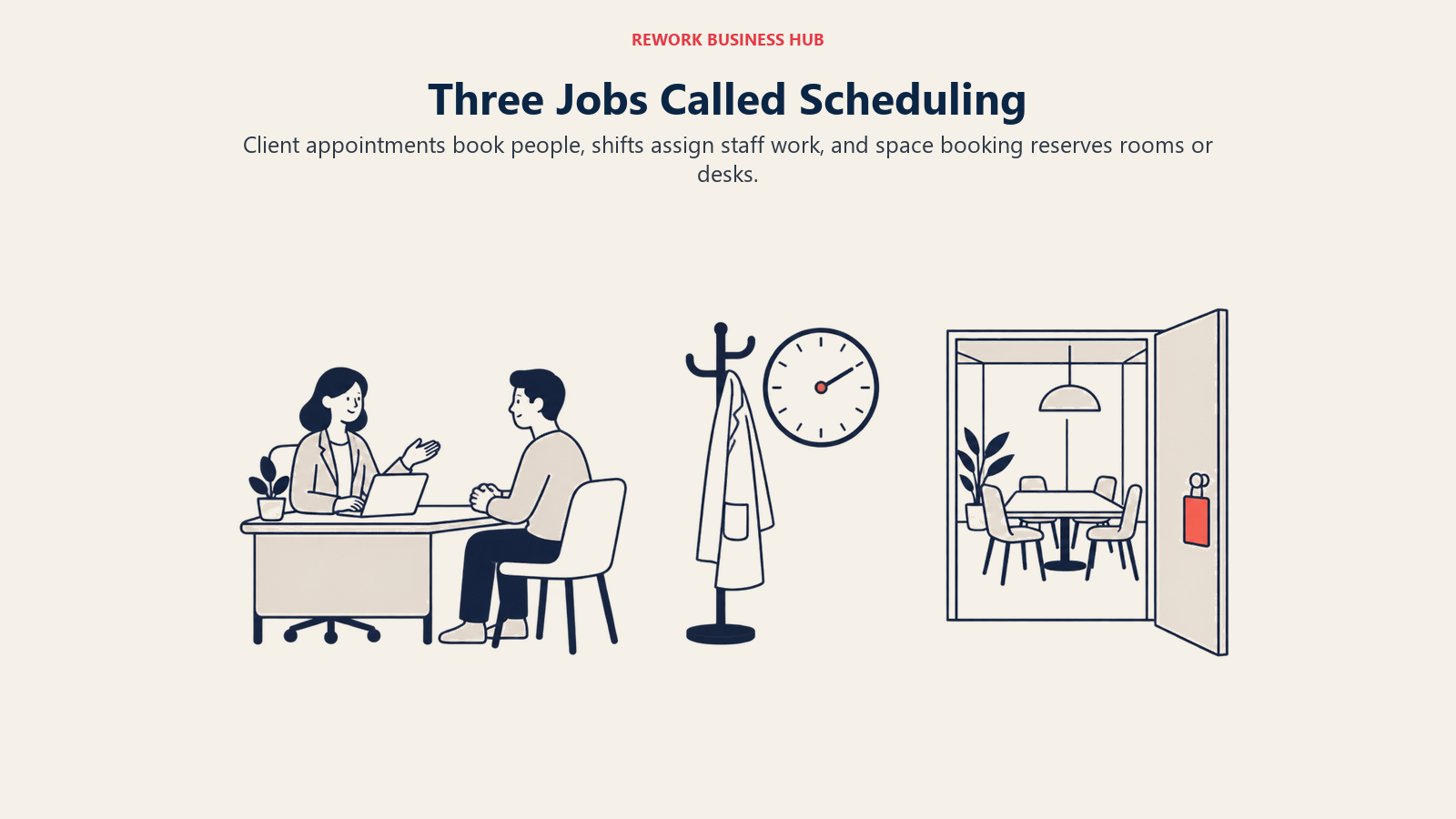
- Booking client appointments. A prospect, patient, or customer picks a slot on your calendar and it books itself. This is the category this article ranks, tools #1 through #14 below.
- Scheduling staff shifts. Assigning employees to work blocks and tracking labor coverage is a workforce management problem, not a booking-link problem. See the best employee scheduling software and the best Deputy alternatives if that's what you need.
- Reserving rooms, desks, or spaces. Booking a conference room or a hot desk means allocating a physical asset, not a person's time. Skedda (#15 below) covers that job and is included here because readers searching "appointment scheduling software" land on it by mistake more than any other tool.
If your problem is #2 or #3, skip ahead to the linked guides above. Everything else in this article is about #1: getting someone else onto your calendar without a back-and-forth email chain.
Quick Comparison Table
Entry pricing as published on each vendor's own page in August 2026. Monthly vs. annual billing is called out where it changes the number.
| Tool | Best For | Starting Price | Key Strength | Key Limitation |
|---|---|---|---|---|
| Calendly | The default meeting-scheduling standard | Free (1 event type); $10/seat/mo (Standard) | Universal familiarity, fastest setup | Free plan capped at 1 event type, 1 calendar |
| Acuity Scheduling | Service businesses taking payments | $20/mo, $16/mo billed annually (Starter) | Payments and package sales built in | No free plan, only a 7-day trial |
| Cal.com | API-first, developer-controlled booking | Free (1 user); Teams $12/user/mo, annual | Low cost, deep API access, 100+ integrations | Free plan is one user, not a team plan |
| SimplyBook.me | Businesses needing a full booking website | Free (EUR 0, 50 bookings/mo); EUR 13.9/mo | Booking website and widget, not just a link | Priced in euros, caps scale with tier |
| Setmore | Small teams needing free multi-user booking | Free (up to 4 users); $12/user/mo, $5 annually | Free tier covers multiple users, not just one | Free-plan appointment volume unpublished |
| Rework (E-Booking) | Booking inside a wider operations platform | Quote on request | Booking tied to the same CRM and contact record | Not for solo operators, no self-serve price |
| OnceHub | Qualification and routing before booking | Free (1 user); Schedule $12/seat/mo, $10 annually | Routing and qualification logic ahead of booking | Mid tiers gated by phone-number counts |
| Square Appointments | Appointments plus payments and POS in one | Free; Plus $49/mo per location | Booking bundled with POS and card processing | No appointments-only tier, priced per location |
| Microsoft Bookings | Microsoft 365 shops wanting no extra contract | Bundled: M365 Business Basic $7/user/mo, annual | No extra line item on top of Microsoft 365 | Not sold as a standalone product |
| Zoho Bookings | Zoho ecosystem buyers | Free (1 user); paid from $6/user/mo, annual | Cheapest paid entry point here, deep Zoho tie-in | Doesn't publish its paid tier names |
| Doodle | Group polls plus booking pages | Free; Pro $11/seat/mo billed annually | Best group-availability polling here | 1:1 booking secondary to polling |
| YouCanBookMe | Simple branded booking pages | Free (1 calendar, 1 page); from $9/mo (reported) | Fast setup, clean branded pages | Paid pricing unpublished on vendor's own page |
| Vagaro | Salon, spa, and fitness businesses | $23.99/mo (Just Me, one calendar) | Built for beauty/wellness booking, POS, memberships | Scaling cost per calendar unpublished |
| Mindbody | Larger wellness and fitness businesses | From $99/mo per location | Enterprise scheduling plus a client marketplace | Everything past entry tier is quote-only |
| Skedda | Rooms, desks, and spaces rather than people | From $99/mo (EMEA/APAC) or $249/mo (US/Canada), annual | Purpose-built for space booking | Wrong tool for client appointments |
1. Calendly: The Default Meeting-Scheduling Standard
Calendly is the tool most people mean when they say "just send me your Calendly." It solved the hardest scheduling problem cleanly: eliminating the "does Tuesday at 2pm work?" email thread. Share a link, the other person picks a slot, it lands on both calendars.
The free plan is the thing to get right before you shortlist it, since most articles still describe an older, more generous version. Today the free plan gives you exactly 1 event type and 1 calendar connection, enough for a single recurring meeting type but not a real multi-service booking practice. Standard, at $10 per seat per month, removes that ceiling and adds workflows and reminders. Teams, at $16 per seat per month, adds round-robin distribution and centrally managed event types, the tier most sales and CS teams actually need. Enterprise starts at $15,000 per year with a 50-seat minimum. Notetaker and Callie, Calendly's AI features, are paid add-ons, not included on Standard or Teams.
| What you get | What you don't |
|---|---|
| Fastest setup and highest name recognition of any tool here | Free plan is 1 event type and 1 calendar, not a multi-service booking page |
| Round-robin and lead routing on Teams | AI features (Notetaker, Callie) cost extra even on paid plans |
Best for: individuals and small teams who need one clean meeting link and don't need a full booking website or payment processing. If you've outgrown the free plan's 1-event-type limit, see how it stacks up head to head in Calendly vs. Acuity Scheduling.
2. Acuity Scheduling: Client-Facing Service Businesses That Take Payments
Acuity Scheduling, owned by Squarespace, is built for the service business that needs a booking calendar to double as a storefront: intake forms, deposits, package sales, and calendar rules (buffers, per-service durations, staff availability). It's the tool coaches, salons, consultants, and clinics reach for once a plain booking link stops being enough.
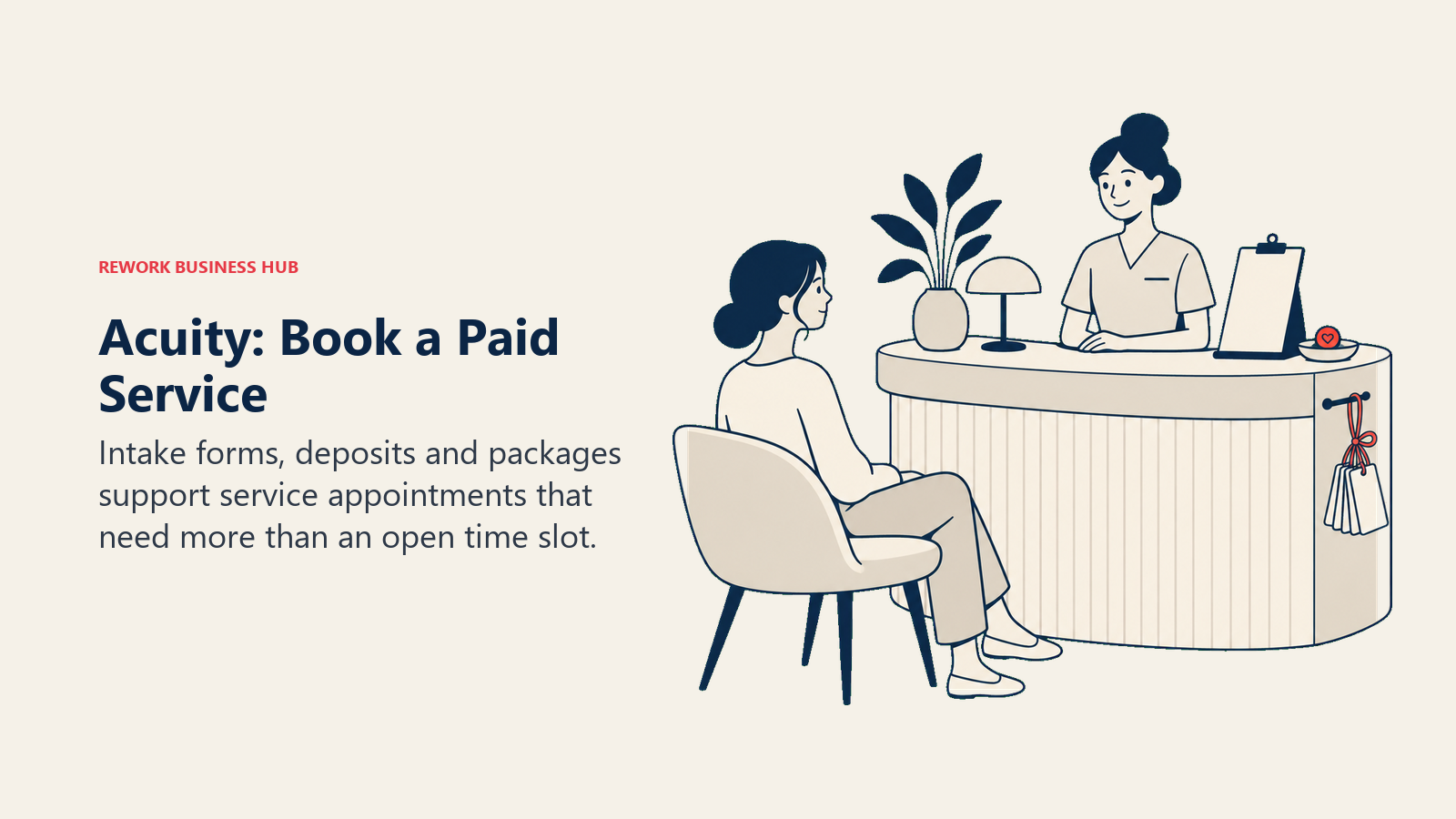
The thing to know before you shortlist Acuity: there is no free plan, just a 7-day trial with no card required. That surprises buyers who assume every scheduling tool has a free tier, since Calendly, Cal.com, Setmore, and Zoho Bookings all do. Starter runs $20 monthly or $16 monthly billed annually, for a single calendar. Standard, at $34 monthly or $27 annually, covers up to 6 calendars, the tier most small teams land on. Premium, at $61 monthly or $49 annually, scales to 36 calendars. If you're weighing Acuity against the platform it lives inside, our Squarespace alternatives guide covers the wider ecosystem question.
| What you get | What you don't |
|---|---|
| Deep service-business features: packages, deposits, intake forms | No free plan, only a 7-day trial |
| Owned by Squarespace, integrates cleanly with Squarespace sites | Jump from 1 to 6 calendars between Starter and Standard, no in-between |
Best for: service businesses (coaching, salons, clinics, consulting) that need payments, packages, and calendar rules a plain meeting-link tool doesn't offer. For a full field of alternatives if Acuity isn't quite right, see the best Acuity Scheduling alternatives.
3. Cal.com: Price, API Depth, and Developer Ergonomics
Cal.com exists because a chunk of the market looked at Calendly and asked "why doesn't this cost less and expose a real API?" Its hosted product moved the commercial codebase to a private repository in April 2026, so Cal.com itself is closed source now; the free, self-hostable option is Cal.diy, an MIT-licensed community edition with the commercial features stripped out and not recommended for production. What Cal.com still earns its spot on is price, API depth, and developer ergonomics, making it the pick for engineering teams who want scheduling embedded into their own product rather than bolted on as a third-party widget.
The free plan is genuinely useful but easy to misdescribe: it's one user, not a free team plan, with unlimited event types, unlimited calendars, and 100+ integrations. Teams, at $12 per user per month billed annually, is where multi-person booking starts. Organizations, at $28 per user per month billed annually, adds admin and workspace controls. Enterprise is custom. Cal.com doesn't publish monthly-billed rates for Teams or Organizations, so treat "$12" and "$28" as annual-only.
| What you get | What you don't |
|---|---|
| Lower price than Calendly at the Teams tier, with a deep API | Free plan is one user, "free for teams" is not accurate |
| API-first design for embedding booking into your own product | Hosted Cal.com is closed source; only Cal.diy (non-production) is self-hostable |
Best for: developer-led teams that want to embed booking into a product with a deep API, at a lower price than Calendly's Teams tier. If the free plan's one-user cap is what stops you, see the best Cal.com alternatives.
4. SimplyBook.me: A Booking Website, Not Just a Link
Most tools on this list give you a booking link or a widget to embed on a site you already have. SimplyBook.me gives you the whole booking website: a hosted client-facing page with your services, staff, and availability, plus a widget if you'd rather embed it. That fits service businesses that don't have a strong web presence otherwise and want the booking page to double as their storefront.
SimplyBook.me publishes its pricing in euros, not dollars, which trips up US buyers comparing it against a wall of dollar prices. Free is EUR 0 for 50 bookings a month and 1 custom feature. Basic runs EUR 13.9 monthly or EUR 11.9 annually for 100 bookings and 3 custom features. Standard, at EUR 29.9 monthly or EUR 24.9 annually, covers 500 bookings and 8 custom features. Premium, at EUR 59.9 monthly or EUR 49.9 annually, scales to 2,000 bookings with unlimited custom features. Enterprise is custom, with a 14-day trial of Premium features.
| What you get | What you don't |
|---|---|
| A full hosted booking website, not just a link or a widget | Pricing published in euros, requires currency conversion for USD budgets |
| Booking volume scales cleanly with tier (50 to 2,000/mo) | Less well known than Calendly or Acuity, smaller integration marketplace |
Best for: service businesses that want a ready-made booking website rather than a link to bolt onto an existing site. See the best SimplyBook.me alternatives if the euro pricing or feature caps don't fit, or Acuity vs SimplyBook.me if those two are your shortlist.
5. Setmore: Free Multi-User Booking for Small Teams
Setmore's pitch is narrow and clear: most "free" booking tools cap you at one user, and Setmore doesn't. The free plan supports up to 4 users, which matters for a small team (a two-person clinic, a four-person agency) that wants shared booking without paying for it on day one.
Worth being precise here: the vendor doesn't state an appointment cap on the free plan in either direction, and third-party sites claiming a 200-per-month limit aren't confirmed by Setmore's own pricing page. The honest answer is "free for up to 4 users," without a volume number attached. Pro, the paid tier, runs $12 per user per month billed monthly or $5 billed annually, and removes the 4-user ceiling entirely.
| What you get | What you don't |
|---|---|
| Free plan supports up to 4 users, not just 1 | Appointment volume cap on the free plan is unpublished either way |
| Pro tier drops to $5/user/mo on annual billing, cheap at scale | Fewer service-business-specific features than Acuity or SimplyBook.me |
Best for: small teams (2 to 4 people) that need shared booking without paying for a paid tier on day one. Once you outgrow the 4-user cap, compare it against the best Setmore alternatives.
6. Rework (E-Booking): Booking Inside a Wider Operations Platform
Every tool above this point is a standalone booking product: you sign up, connect a calendar, and the booking link is the whole product. Rework's E-Booking module solves a different problem. It sits inside a wider operations platform, so a booked appointment lands on the same contact record as the CRM and pipeline, instead of living in its own subscription someone has to reconcile against the CRM by hand.
That matters most where the person booking the appointment isn't the person following up on it, and "who booked what, and what happened next" needs to stay visible without switching tools. A sales team running lead response time as a real metric gets more from booking-plus-CRM-in-one-place than from a best-of-breed link needing a Zapier connection back into the CRM.
Rework's booking capability has no published price. It's quoted per organization, not sold as a standalone per-seat product the way Calendly or Setmore are. For current numbers, rework.com/pricing is the source, not a figure repeated from an old listicle.
| What you get | What you don't |
|---|---|
| Booking tied to the same contact record as CRM and pipeline data | No published self-serve price, no free tier to try before you talk to sales |
| One place for the whole team instead of a separate booking subscription | Not built as a pure booking-link product for solo use |
| Fits inside a broader ops platform if you're already coordinating sales, CS, or ops workflows | Not the right pick if all you need is a single meeting link |
Best for: teams of roughly 10 to 200 people that want booking connected to CRM and pipeline data, not a standalone link.
Not ideal for: solo operators or anyone who just needs a free personal booking link. Rework isn't sold as a 1-user product; Calendly's free plan solves that job better and cheaper.
7. OnceHub: Qualification and Routing Before the Meeting Books
OnceHub is built for sales and support teams whose real problem isn't "let someone pick a time," it's "route the right person to the right rep before the meeting even books." It layers qualification logic, lead routing, and chatbot-style pre-screening in front of the booking calendar.
Basic is free: 1 user, 1 connected calendar, 1 booking link. Schedule, at $12 per seat monthly or $10 annually, includes 1 phone number and is the entry point for real use. Route, at $23 monthly or $19 annually, adds a second phone number. Engage, at $47 monthly or $39 annually, includes 3 phone numbers and a 14-day free trial. A Security and Compliance add-on runs $6 monthly or $5 annually per seat; extra phone numbers cost $4 per month each. Enterprise is custom, aimed at teams of 30 or more.
| What you get | What you don't |
|---|---|
| Qualification and routing logic ahead of the booking step | Phone-number counts gate the tiers, an unusual pricing lever to track |
| 14-day free trial of the top tier (Engage) | Free plan (Basic) is 1 user, not enough to test routing |
Best for: sales and support teams that need to qualify or route a prospect before the meeting lands on a calendar. See the best OnceHub alternatives for other routing-first options.
8. Square Appointments: Booking, Payments, and POS in One
Square Appointments is the booking tool for businesses that already run payments and point-of-sale through Square. The pitch is "one system for scheduling, checkout, and card processing," fitting barbershops, spas, and repair shops that take payment the moment they deliver the service.
This is a genuine trap to check carefully. Square Appointments no longer has its own standalone subscription tiers. Booking sits inside Square's unified plans, priced per location: Square Free at $0, Square Plus at $49 per month per location with in-person processing at 2.5% plus 15 cents, and Square Premium at $149 per month per location with processing at 2.4% plus 15 cents and 24/7 phone support. Any older Appointments-only price quoted elsewhere no longer exists; the citable source is Square's own unified pricing page.
| What you get | What you don't |
|---|---|
| Booking, POS, and card processing under one subscription | No appointments-only tier anymore, priced per location as part of the unified plan |
| 24/7 phone support on Premium | Processing fees (2.4-2.5% + 15 cents) stack on top of the subscription |
Best for: service businesses that already process payments in person and want booking on the same bill as their POS.
9. Microsoft Bookings: No Extra Line Item for Microsoft 365 Shops
Microsoft Bookings isn't a product you buy on its own, it's a feature you already might be paying for. It's bundled into Microsoft 365 Business plans, the default answer for any company already standardized on Outlook and Teams that doesn't want a new vendor relationship just for scheduling.
Business Basic, at $7.00 per user per month on an annual commitment, includes Bookings along with the rest of the suite. Business Standard with Copilot runs $23.50 per user per month annually, and Business Premium with Copilot runs $32.00 annually. The right way to frame it isn't "a $7 scheduling tool," it's "no extra line item if you already pay for Microsoft 365," since almost nobody buys M365 Business Basic for Bookings alone.
| What you get | What you don't |
|---|---|
| No extra cost if you already have Microsoft 365 Business | Not sold standalone, you can't buy Bookings without the M365 plan around it |
| Native integration with Outlook and Teams calendars | Fewer service-business features (payments, packages) than Acuity or Vagaro |
Best for: Microsoft 365 Business customers who want booking without adding a new vendor.
10. Zoho Bookings: The Pick for Zoho Ecosystem Buyers
Zoho Bookings is the obvious choice for any team already running Zoho CRM, Zoho Desk, or Zoho One, since booking data ties into records maintained elsewhere in the ecosystem. Outside Zoho shops, it competes mostly on price: it's the cheapest paid entry point on this list.
Free covers 1 user, 1 event type, 1 workspace, and 1 calendar sync, similar in shape to Calendly's or Cal.com's free tier. The entry paid plan runs $6 per user per month billed annually or $8 billed monthly. The higher paid plan runs $9 per user per month billed annually or $12 billed monthly. One quirk: Zoho's main pricing page renders its tier figures in JavaScript and doesn't display clean tier names, so quote the prices rather than a label you can't verify against the vendor's own page.
| What you get | What you don't |
|---|---|
| Cheapest paid entry point on this list at $6/user/mo annually | Free plan is 1 user, 1 event type only |
| Deep tie-in if you already run Zoho CRM or Zoho One | Tier names aren't confirmed on the vendor's own pricing page |
Best for: teams already using Zoho CRM or Zoho One that want booking data flowing into records they already maintain. If you're weighing the wider ecosystem question, see the best Zoho alternatives.
11. Doodle: Group Polls Plus Booking Pages
Doodle solves a problem none of the other tools here solve well: finding a time that works for a group with different calendars, not just booking a 1:1 slot. The group poll (everyone marks times that work, Doodle finds the overlap) is still the cleanest version of that workflow, layered with a standard booking page for 1:1 use.
Free covers 1 group poll, 1 booking page, 1 one-to-one link, and basic sign-up sheets. Pro runs $11 per month per seat billed annually. Team, at $16 per month per seat billed annually, requires a minimum of 2 seats. Enterprise starts at $15,000 per year, aimed at organizations with 50 or more employees. Doodle doesn't publish monthly-billed rates for Pro or Team, so treat those as annual-only figures.
| What you get | What you don't |
|---|---|
| The best group-availability polling of any tool in this list | 1:1 booking depth is secondary to the polling feature |
| Useful even on the free plan for occasional group scheduling | No monthly billing option published for paid tiers |
Best for: anyone whose real scheduling pain is finding a time across a group, not booking a single 1:1 slot.
12. YouCanBookMe: Simple Branded Booking Pages
YouCanBookMe's pitch is speed and cleanliness: a booking page that looks like your brand, set up in minutes, without the feature sprawl of SimplyBook.me or Acuity.
The free plan is listed on the vendor's own page: 1 calendar connection, 1 booking page. Past that, the picture gets murkier than any other tool on this list. The paid tiers are reported, not vendor-confirmed, at $9 per month (Individual), $13 (Professional), and $18 per member (Teams), with roughly 10% off annually, per pricing guides from Koalendar and G2. Treat those as third-party estimates and confirm current pricing with YouCanBookMe.
| What you get | What you don't |
|---|---|
| Fast setup, clean branded booking pages | Paid pricing isn't published on the vendor's own page as of August 2026 |
| Free plan is confirmed and simple: 1 calendar, 1 page | Reported paid tiers ($9/$13/$18) aren't vendor-confirmed |
Best for: teams that want a clean, branded booking page fast and don't need service-business depth like payments or packages.
13. Vagaro: Built for Salon, Spa, and Fitness
Vagaro is a vertical-specific booking platform for beauty and wellness: salons, spas, barbershops, and fitness studios. Instead of general-purpose booking with add-ons, it starts from the workflows those businesses run, class scheduling, service menus, staff commissions, POS, memberships, and builds booking around them.
The entry tier, "Just Me," runs $23.99 per month for one bookable calendar, aimed at solo practitioners. What isn't published is the scaling cost as you add bookable calendars for additional staff. Pricing rises with the number of calendars, and the exact increment isn't stated publicly, so get a quote for your actual headcount rather than assume a linear per-seat rate.
| What you get | What you don't |
|---|---|
| Purpose-built for beauty and wellness: classes, memberships, commissions | Multi-calendar scaling cost isn't published |
| POS and payment processing built for the vertical | No published free tier |
Best for: salons, spas, barbershops, and fitness studios that want booking built around their specific workflows, not a general-purpose tool.
14. Mindbody: Larger Wellness and Fitness Businesses
Mindbody is the platform Vagaro's larger competitors graduate to: multi-location gyms, wellness chains, and studios needing enterprise-grade scheduling plus a consumer-facing marketplace app for client discovery. It's heavier and pricier than Vagaro, aimed at a different size of business.
The only figure Mindbody publishes is "starting at $99 USD per month per location." Past that, the named tiers, Starter, Accelerate, and Ultimate, are all listed as "Let's talk" rather than with prices. Any dollar figure attached to Accelerate or Ultimate elsewhere is a reported, third-party estimate, not vendor-confirmed; the safer framing is that anything past the entry tier is quote-only.
| What you get | What you don't |
|---|---|
| Enterprise-grade scheduling for multi-location wellness businesses | Everything past the $99/mo entry tier is quote-only |
| Built-in consumer marketplace app for client discovery | Heavier and more expensive than Vagaro for a single-location business |
Best for: multi-location gyms, wellness chains, and larger fitness studios that need enterprise scheduling plus client-acquisition tools. Since every tier above the $99 floor is quote-only, the best Mindbody alternatives roundup covers where studios go when that pricing stops working.
15. Skedda: Rooms, Desks, and Spaces Rather Than People
Skedda is the odd one out on this list on purpose. It doesn't book appointments between people, it books physical spaces: meeting rooms, hot desks, courts, studios, and other bookable venues. Readers searching "appointment scheduling software" land on Skedda by mistake more often than any other tool here, which is exactly why it's worth explaining rather than leaving out.
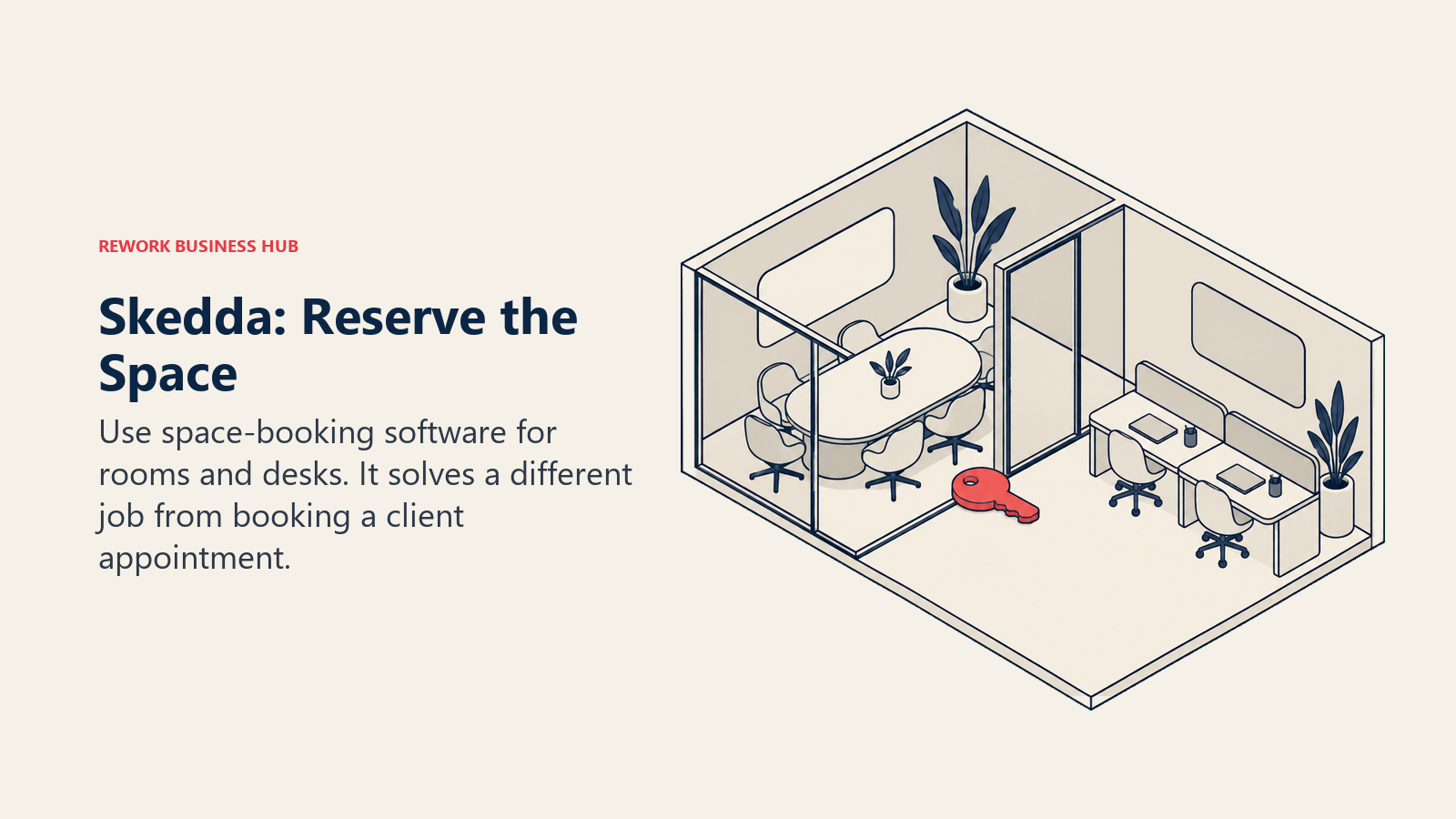
Skedda's pricing is regional and per-space. In the US and Canada, Plus starts from $249 per month billed annually and includes 35 spaces, while Premier starts from $349 and includes 45. In EMEA and APAC, Starter runs from $99 per month for 15 spaces, Plus is $149, and Premier is $199. There's no permanent free plan, only a 30-day trial. If your actual need is booking a person's time, not a room, none of Skedda's tiers are the right purchase.
| What you get | What you don't |
|---|---|
| Purpose-built for space and resource booking (rooms, desks, courts) | Not built for booking a person's time, wrong job for that use case |
| Regional pricing reflects real per-space costs (US/Canada vs. EMEA/APAC) | No permanent free plan, only a 30-day trial |
Best for: teams booking meeting rooms, desks, or physical spaces, not client or staff appointments. If that's not your problem, go back to #1 through #14. If it is, the best Skedda alternatives roundup covers the workplace-booking field properly, and Skedda vs Robin puts the two best-known options head to head.
How to Choose: Decision Framework
| If you need... | Pick |
|---|---|
| A single free meeting link, minimal setup | Calendly |
| Payments, packages, and intake forms | Acuity Scheduling |
| Low-cost, API-first booking to embed into a product | Cal.com |
| A hosted booking website, not just a link | SimplyBook.me |
| Free booking for a team of 2 to 4 | Setmore |
| Booking tied to your CRM and pipeline | Rework (E-Booking) |
| Qualification or routing before the meeting books | OnceHub |
| In-person payments and POS on one bill | Square Appointments |
| No new vendor beyond Microsoft 365 | Microsoft Bookings |
| The cheapest paid tier, already on Zoho | Zoho Bookings |
| A time across a whole group, not a 1:1 slot | Doodle |
| A fast, clean, branded booking page | YouCanBookMe |
| Salon, spa, or fitness class booking | Vagaro |
| Enterprise wellness scheduling with client discovery | Mindbody |
| To book a room or desk, not a person | Skedda |
A quick gut check: if your shortlist has more than two tools on it, you probably haven't decided which of the three jobs you're solving. Go back to that section, pick one job, and the list narrows fast.
What to Do Next
Pick two tools that match your actual job (client booking, staff scheduling, or space booking), not three or four. Set up the free or trial tier on each, run real test appointments through both, and see which one your team and your clients use without complaint for two weeks. The tool that disappears into the background is the right one. If your shortlist keeps drifting toward a CRM or pipeline conversation instead of a pure booking-link one, that's the sign you're evaluating Rework's category, not Calendly's, and it's worth talking to the Rework team directly instead of comparing per-seat prices that don't apply to how it's sold.

Principal Product Marketing Strategist
On this page
- Key Facts
- Three Different Jobs Called "Scheduling"
- Quick Comparison Table
- 1. Calendly: The Default Meeting-Scheduling Standard
- 2. Acuity Scheduling: Client-Facing Service Businesses That Take Payments
- 3. Cal.com: Price, API Depth, and Developer Ergonomics
- 4. SimplyBook.me: A Booking Website, Not Just a Link
- 5. Setmore: Free Multi-User Booking for Small Teams
- 6. Rework (E-Booking): Booking Inside a Wider Operations Platform
- 7. OnceHub: Qualification and Routing Before the Meeting Books
- 8. Square Appointments: Booking, Payments, and POS in One
- 9. Microsoft Bookings: No Extra Line Item for Microsoft 365 Shops
- 10. Zoho Bookings: The Pick for Zoho Ecosystem Buyers
- 11. Doodle: Group Polls Plus Booking Pages
- 12. YouCanBookMe: Simple Branded Booking Pages
- 13. Vagaro: Built for Salon, Spa, and Fitness
- 14. Mindbody: Larger Wellness and Fitness Businesses
- 15. Skedda: Rooms, Desks, and Spaces Rather Than People
- How to Choose: Decision Framework
- What to Do Next