Best AI Tools for Slide Decks in 2026: 13 Web-First Deck Builders Ranked by Job

Turn this article into takeaways for your work.


Each assistant summarizes the article only for you and suggests best practices for your work.
If the deck you're building lives on the web, gets sent to a prospect or an investor, and needs to look on-brand without a designer touching it, this list is scoped to you. Gamma leads for the fastest full deck from a single prompt, Beautiful.ai leads for decks that stay well-designed no matter who edits them, Storydoc and Pitch lead for trackable sales decks you can see a prospect actually open, Slidebean and PitchBob lead for startup pitch and investor decks, and Simplified and Canva Magic Design lead for teams that need every deck to match a brand kit automatically. This guide ranks 13 web-first deck builders by the job you need done, not by feature count.
This is a narrower list than a general "best AI presentation tools" roundup on purpose. It excludes AI add-ons that live inside PowerPoint or Google Slides (Microsoft Copilot, Google Gemini in Slides, Plus AI, SlidesAI) because those tools solve a different problem: improving a file you already build in Office or Workspace. If that's your job, see our companion guide on AI tools for PowerPoint presentations instead. Everything below was evaluated on real capability, current pricing, and where it genuinely earns its spot for pitch, sales, and brand decks specifically.
Key Facts
- Seed-stage pitch decks get an average of just 1 minute 56 seconds of total investor viewing time, a figure that has fallen 24% since 2021, per DocSend's pitch deck research.
- Decks shared through a warm introduction hold investor attention for roughly 4 minutes 18 seconds versus 2 minutes 31 seconds for a cold, unsolicited deck, per DocSend.
- 82% of global B2B marketing decision-makers agree that buyers now expect tailored sales and marketing experiences, a finding that applies directly to sales and pitch decks, per Forrester's State of B2B Personalization.
- The global presentation software market is sized at roughly $8.6 billion in 2026 and is forecast to grow at a 13.9% CAGR through 2033, per Coherent Market Insights.
- 88% of organizations now use AI in at least one business function, and 79% use generative AI specifically, per McKinsey's State of AI research.
- Generative AI reached 53% population adoption within three years, a faster climb than the personal computer or the internet, per the Stanford AI Index 2026 report.
What's Changed for Deck Builders in 2026
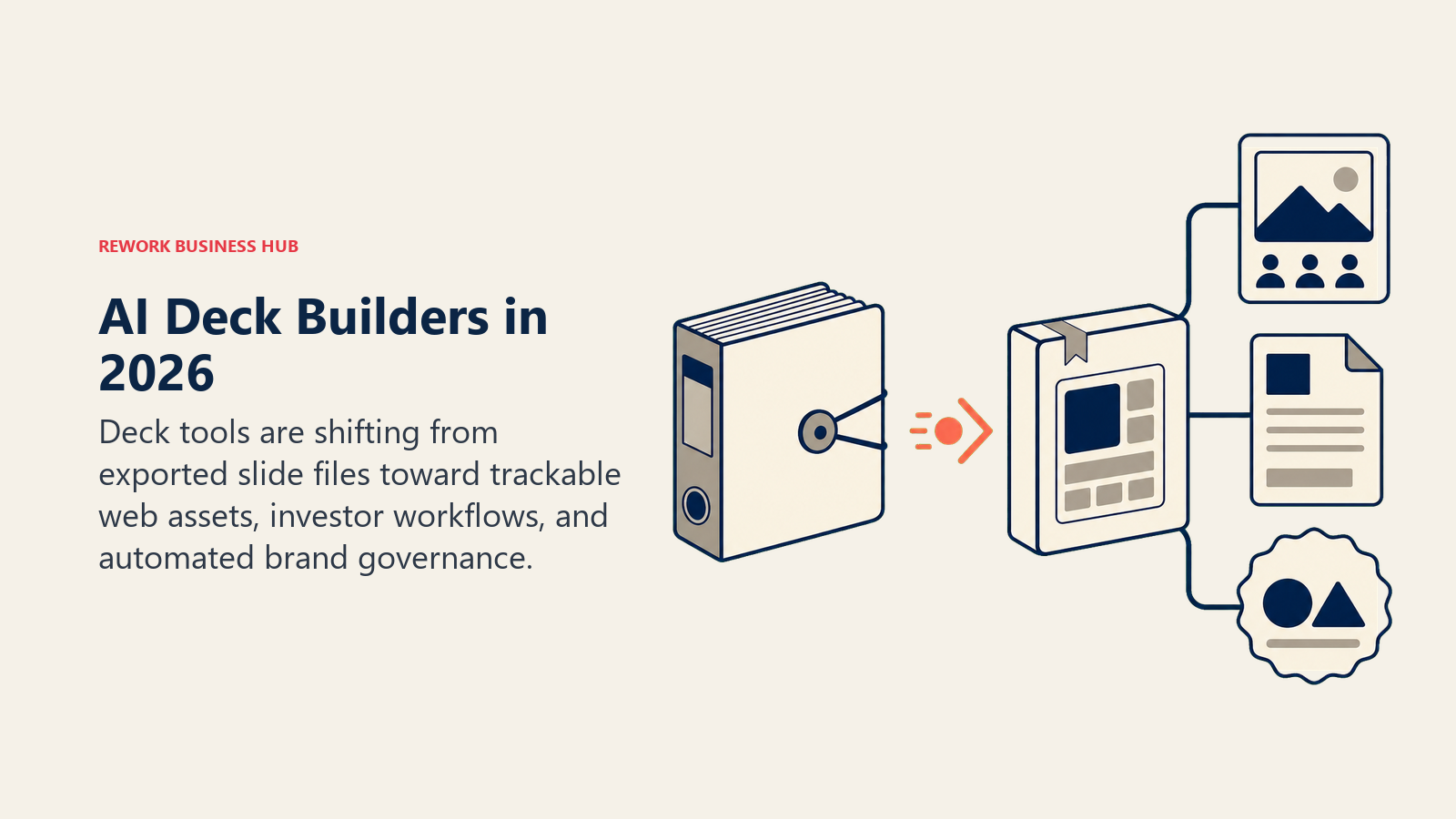
Tome, once a fixture on "best AI deck builder" lists, is no longer a presentation tool: the company sunset Tome Slides and pivoted to an AI sales-intelligence assistant, so it's excluded from this ranking entirely. In its place, a newer wave of web-first, trackable deck tools has gained real traction with sales and founder audiences specifically: Storydoc and Pitch for decks that report back who opened them and for how long, PitchBob for AI-generated investor decks paired with a business plan, and Simplified for teams that need a brand kit applied automatically across every deck a rep or marketer builds. That shift matters because it's the opposite of what a PowerPoint add-on does: these tools treat a deck as a living, trackable web asset instead of a file you export and forget.
Quick Comparison Table
| Tool | Best For | Standout Capability | Starting Price | Free Tier? |
|---|---|---|---|---|
| Gamma | Fastest full deck from one prompt | Largest AI-native user base, strong auto-layout | $9/seat/mo (Plus, annual) | Yes (400 one-time credits) |
| Beautiful.ai | Decks that stay well-designed as you edit | Smart Templates auto-adjust layout in real time | $12/mo (Pro, annual) | No (14-day trial only) |
| Storydoc | Trackable, interactive sales decks | Analytics show exactly who opened and how far they scrolled | $19/mo (Starter, annual) | 14-day trial, no credit card |
| Pitch | Team decks with live collaboration | Real-time co-editing, engagement analytics | $10/mo (Plus, annual) | Yes (up to 5 members) |
| Presentations.ai | Chat-based, continuous deck editing | Conversational interface, unlimited free users | $20/mo ($240/yr, annual only) | Yes (Starter) |
| Decktopus | Fast guided deck setup for non-designers | Question-based wizard plus large template library | $14.99/mo (Pro) | Yes (limited decks) |
| Slidebean | Startup pitch decks and fundraising | Investor-specific templates, financial modeling, Investor Finder CRM | $7/mo (Starter, annual) | Yes (unlimited, no export) |
| PitchBob | AI-generated investor deck plus business plan | One-time payment, no subscription required | $29.90 one-time (Advanced) | No (paid plans only) |
| Canva Magic Design | On-brand visuals fast, existing Canva users | Brand Kit plus the largest stock/template library | $13/mo (Pro) | Yes |
| Visme | Data-heavy decks with infographics and charts | Strongest native data visualization tools | $12.25/mo (Starter, annual) | Yes |
| Prezi | Non-linear, motion-based web storytelling | Zooming canvas format, not fixed slides | $7/mo (Standard) | Yes (Basic) |
| Genially | Interactive, gamified web decks | Click-through interactivity inside a single deck | ~$7.49/mo (entry tier) | Yes (2GB storage) |
| Simplified | Multi-brand-kit AI deck agent for teams | Applies a brand kit automatically across every deck | $29/mo (Simplified One) | No (trial only) |
Deck Builders vs. PowerPoint and Workspace-Native AI
Not every "AI tools for presentations" search has the same job behind it. The table below is the fastest way to tell which category you actually need.
| If you... | You need... | See instead |
|---|---|---|
| Build decks that live and get sent as web links, not files | A web-first deck builder (this list) | Keep reading |
| Need every viewer to open the exact same .pptx file | A PowerPoint-native AI tool | AI tools for PowerPoint presentations |
| Already pay for Microsoft 365 or Google Workspace and want AI inside it | Copilot in PowerPoint or Gemini in Slides | Best AI presentation tools |
| Want a broad, job-ranked view across every presentation use case | A general presentation tools roundup | Best AI presentation tools |
How to Choose: Decision Framework
Start from what happens to the deck after it's built. A sales rep sending a proposal, a founder pitching investors, and a marketer sending a client-facing brand deck all need different things from a "deck builder," even though they're all making slides.
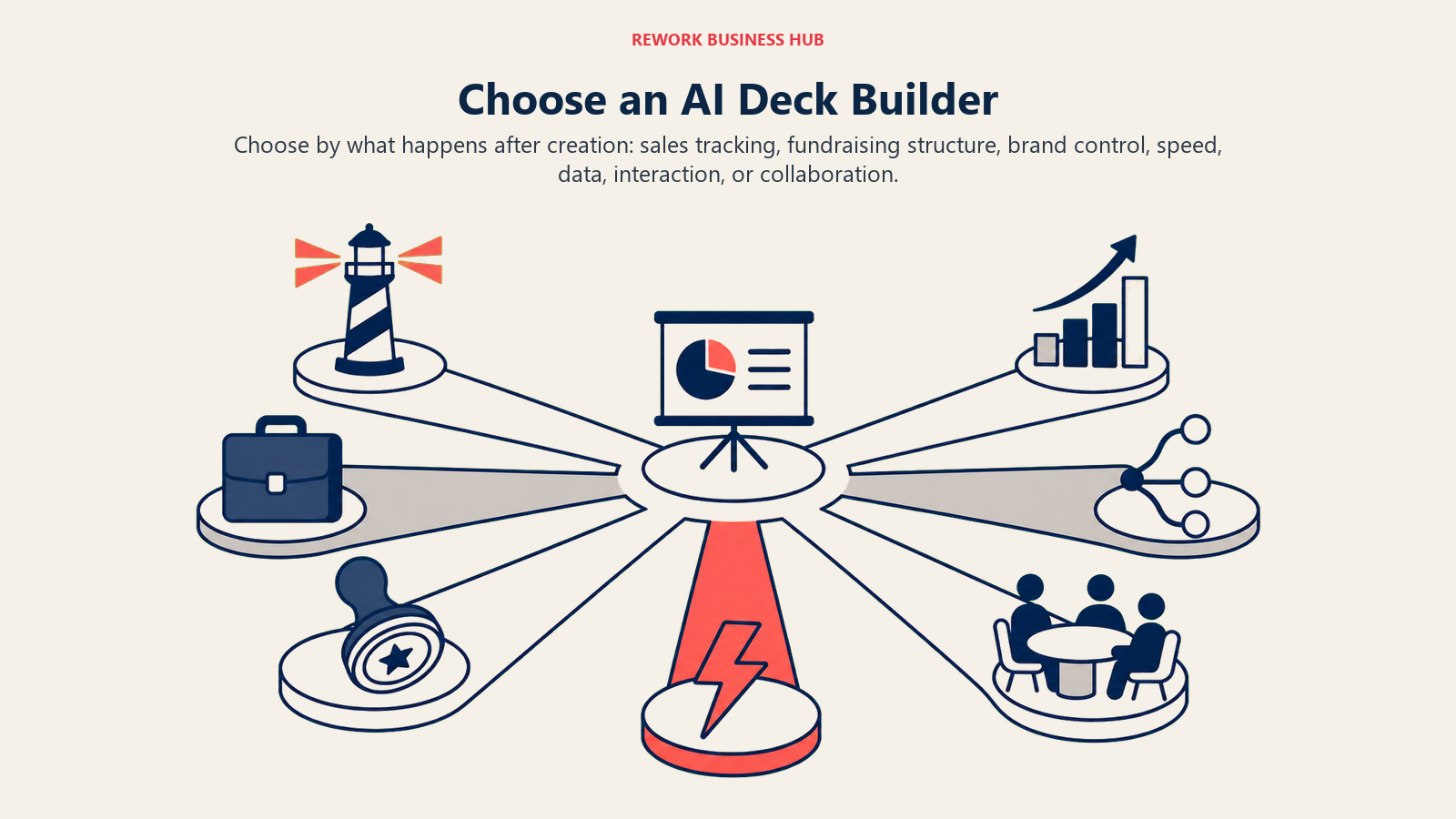
By Use Case
| If your deck is a... | What matters most | Best fits |
|---|---|---|
| Sales proposal you need to track after sending | Open and engagement analytics per viewer | Storydoc, Pitch |
| Fundraising or investor pitch deck | Investor-specific structure and financial modeling | Slidebean, PitchBob |
| Client-facing brand deck for a marketing or agency team | Automatic brand kit application, no manual formatting | Simplified, Canva Magic Design |
| Fast, one-off deck from a rough outline | Prompt-to-deck speed over granular control | Gamma, Decktopus |
| Data-heavy report or QBR-style deck | Native charts and infographics | Visme |
| Interactive or gamified web deck | Click-through, choose-your-path interactivity | Genially |
| Keynote or cinematic, non-linear talk | Zooming canvas instead of fixed slides | Prezi |
| Deck built and revised over several sessions with an AI collaborator | Conversational, chat-based revision | Presentations.ai |
| Deck built by multiple contributors at once | Real-time multi-editor collaboration | Pitch, Beautiful.ai |
If the decks in question are specifically sales decks that need to tie back to pipeline data after they're sent, the best AI tools for sales and best AI tools for business development guides cover that layer. And for the marketing team producing the source copy and campaign assets that feed into a brand deck, best AI tools for digital marketing covers that upstream step.
By Team Size and Budget
| Team Size | What to Prioritize | Realistic Monthly AI Tool Budget |
|---|---|---|
| Solo founder or freelancer | A generous free tier plus fast AI-native generation | $0-30/month |
| 2-10 person team | One shared tool plus brand consistency or tracking | $50-250/month |
| 10-50 person team | Collaboration, brand kits, and shared templates | $250-1,000/month |
| 50+ person team or enterprise | Multiple brand kits, admin controls, SSO | $1,000-4,000+/month |
For solo consultants and freelancers weighing a broader AI stack beyond decks alone, best AI tools for consultants and best AI tools for freelancers cover the adjacent tools worth pairing with a deck builder.
1. Gamma: Fastest Full Deck From a Single Prompt
Gamma's product philosophy is that a presentation should start as a conversation, not a blank canvas. Type a topic or paste an outline and Gamma generates a full deck, complete with layout, imagery, and copy, then lets you keep refining it with follow-up prompts. It's become the default AI-native deck builder for teams who want speed over granular design control, and it's a natural pairing with AI tools for content writers already generating the source material.
| Strengths | Limitations |
|---|---|
| Fastest path from prompt to a usable full deck | Design control is looser than Beautiful.ai or Canva |
| Generous free tier for testing (400 one-time credits) | Ultra tier has no annual discount |
| API access and custom domains on Pro and up | Credits run out fast on long or image-heavy decks |
Pricing: Free (400 one-time credits); Plus $9/seat/mo (annual) or $10/mo (monthly); Pro $18/seat/mo (annual) or $20/mo (monthly); Ultra $90/seat/mo; Team and Enterprise custom-priced. Source: gamma.app/pricing.
Best for: Teams and individuals who need a professional-looking full deck in minutes from a rough outline.
2. Beautiful.ai: Decks That Stay Well-Designed As You Edit
Beautiful.ai's bet is that most bad slides happen during editing, not creation, when someone drags a text box a few pixels off-grid or stretches an image until it distorts. Its Smart Templates auto-adjust layout, spacing, and hierarchy in real time as content changes, so it's nearly impossible to ship an ugly slide even after a dozen contributors have touched the deck.
| Strengths | Limitations |
|---|---|
| Smart Templates make bad layouts hard to create | No ongoing free tier, only a 14-day trial |
| AI text and image generation built into the editor | Team plan jumps sharply in price versus Pro |
| Strong for solo consultants who need polish fast | Less generative than Gamma for a first full draft |
Pricing: Pro $12/mo (annual) or $45/mo (monthly); Team $40/user/mo (annual) or $50/user/mo (monthly); Enterprise custom. Source: beautiful.ai/pricing.
Best for: Consultants, freelancers, and small teams who want every deck to look professionally designed without a design background.
3. Storydoc: Trackable, Interactive Sales Decks
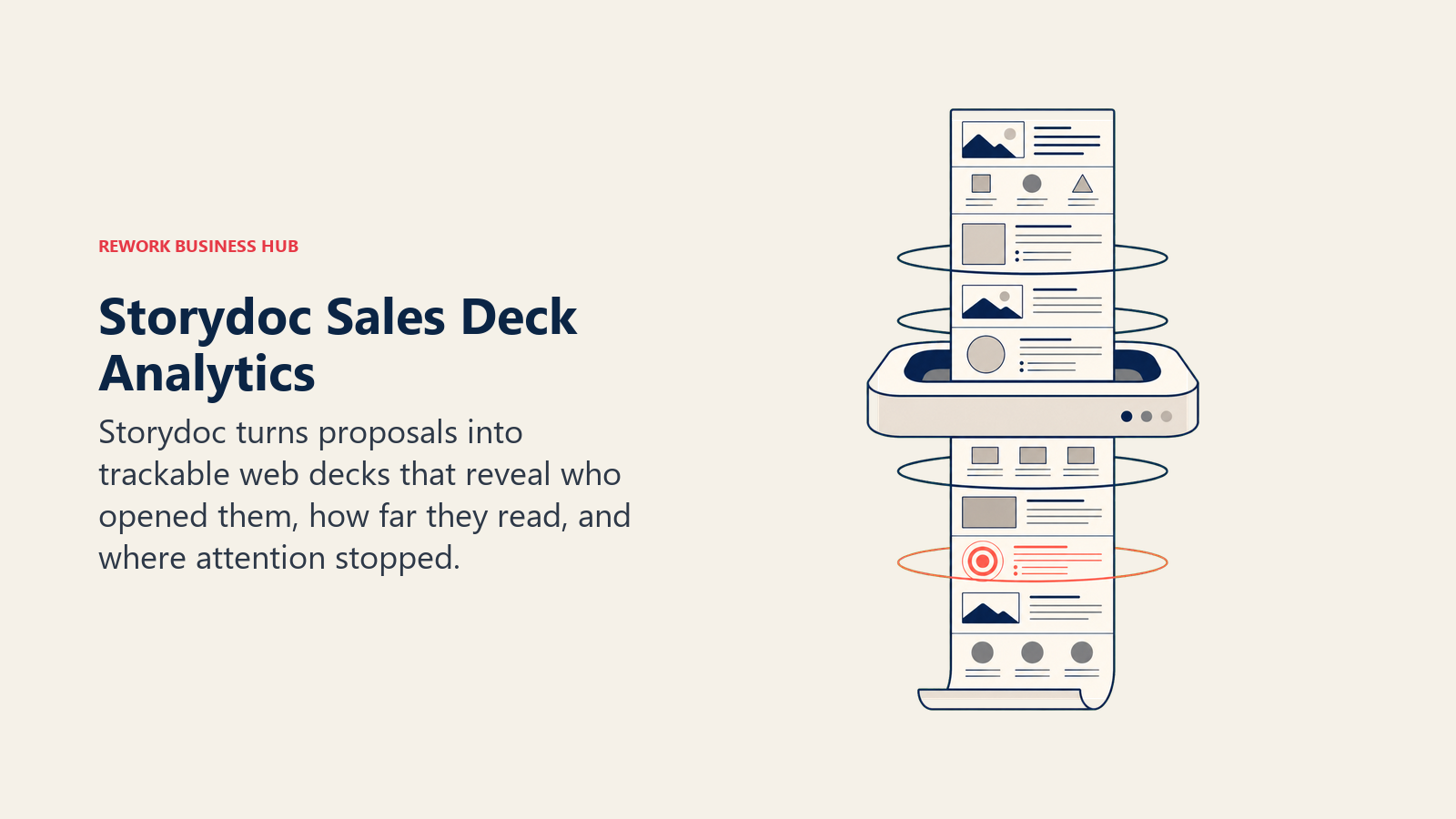
Storydoc treats a sales or pitch deck less like a slideshow and more like a landing page: decks live on the web, scroll instead of click through, and report back exactly who opened them, how far they scrolled, and which slide they dropped off on. For a sales team where 82% of buyers now expect a tailored experience, that visibility into what a prospect actually engaged with is the real product, not the slide design itself.
| Strengths | Limitations |
|---|---|
| Analytics show precisely who opened a deck and how far they read | No PowerPoint export; this is a web-first, browser-based deck |
| Personalization variables let one template serve many named prospects | Starter plan caps you at 5 active documents |
| AI text and image credits included even on the entry tier | Annual billing shows minimal or no savings versus monthly on some tiers |
Pricing: Starter $19/mo (annual), 5 active documents, 20 AI Image + 25 AI Text credits/mo; Pro $36/mo (annual), 30 active documents, 50 AI Image + 125 AI Text credits/mo; Teams custom-priced. 14-day free trial, no credit card. Source: storydoc.com/pricing.
Best for: Sales and customer success teams who need to know whether a prospect actually opened and read a proposal, not just that it was sent.
4. Pitch: Team Decks With Live Collaboration
Pitch was built for the reality that most business decks aren't built by one person. Real-time co-editing, shared teamspaces, engagement analytics on sent decks, and workspace roles are all native, closer to how Figma or Notion handle collaborative work than a traditional slide tool does.
| Strengths | Limitations |
|---|---|
| Real-time multi-editor collaboration, not just commenting | AI credits are modest even on the Business tier |
| Engagement analytics show who viewed a sent deck and for how long | Business tier at $20/seat/mo (annual) isn't the cheapest option |
| Free tier allows up to 5 members with admin rights | Design flexibility is more templated than Canva or Beautiful.ai |
Pricing: Free (up to 5 members); Plus $10/mo (annual) or $12/mo (monthly); Team $15/seat/mo (annual) or $18/seat/mo (monthly); Business $20/seat/mo (annual) or $24/seat/mo (monthly); Enterprise custom. Source: pitch.com/pricing.
Best for: Marketing and sales teams where multiple people co-build the same deck and need to see who's viewing it after it's sent.
5. Presentations.ai: Chat-Based, Continuous Deck Editing
Presentations.ai treats a deck like an ongoing conversation with an AI collaborator rather than a one-time generation. Describe what you want in plain language, it builds the deck, and you keep talking to it to revise tone, structure, or specific slides, closer to working with a chat assistant than a traditional slide editor.
| Strengths | Limitations |
|---|---|
| Genuinely unlimited free tier for unlimited users | No monthly billing, annual only on paid plans |
| Automatic brand sync keeps decks on-brand by default | PowerPoint export is a paid-tier feature |
| Conversational revision is fast for iterative decks | Smaller template library than Canva |
Pricing: Starter free (unlimited users, no credit card); Pro $240/year (about $20/mo effective); Enterprise custom. Source: presentations.ai/pricing.
Best for: Teams that want to keep revising a deck conversationally over several sessions instead of generating once and manually editing.
6. Decktopus: Fast Guided Setup for Non-Designers
Decktopus's product philosophy is a guided wizard: answer a short series of questions about your audience, goal, and tone, and it assembles a deck from a large template library with AI-written copy already dropped in. It's built for people who find a blank AI prompt box just as intimidating as a blank slide.
| Strengths | Limitations |
|---|---|
| Guided question flow lowers the barrier to a first draft | AI credits (30 per deck) run out faster on some plans |
| Slide analytics on Business tier track viewer engagement | Business tier price jumps sharply from Pro |
| Webhook integration for embedding decks in other tools | Smaller AI model quality ceiling than Gamma or Beautiful.ai |
Pricing: Free (limited decks); Pro $14.99/mo (monthly) or $179.99/yr (annual); Business $34.99/user/mo (monthly) or $419.99/user/yr (annual); Enterprise custom. Source: decktopus.com/pricing.
Best for: First-time deck builders, consultants, and small businesses who want a guided path instead of an open prompt.
7. Slidebean: Startup Pitch Decks and Fundraising
Slidebean solves one specific job better than any generalist tool: the investor pitch deck. Beyond AI-generated slides from 100+ startup-specific templates, it bundles a financial modeling tool, a cap table tool, and an Investor Finder CRM for tracking outreach to actual VCs and angels, useful given that seed decks now average under two minutes of investor attention.
| Strengths | Limitations |
|---|---|
| Only tool on this list built specifically for fundraising decks | Not a general-purpose deck builder for internal decks |
| Bundles financial modeling and an investor CRM, not just slides | Top "Accelerate" tier at $99/mo is priced for active fundraisers |
| Cheapest paid entry point on this list at $7/mo | Free tier can't export or share polished decks |
Pricing: Free (unlimited presentations, no export); Starter $7/mo (billed yearly, $84/yr); Accelerate $99/mo (monthly billing), includes investor CRM and strategy calls. Source: slidebean.com/pricing.
Best for: Founders actively fundraising who need an investor-ready deck plus the tools to track and manage outreach.
8. PitchBob: AI-Generated Investor Deck Plus Business Plan
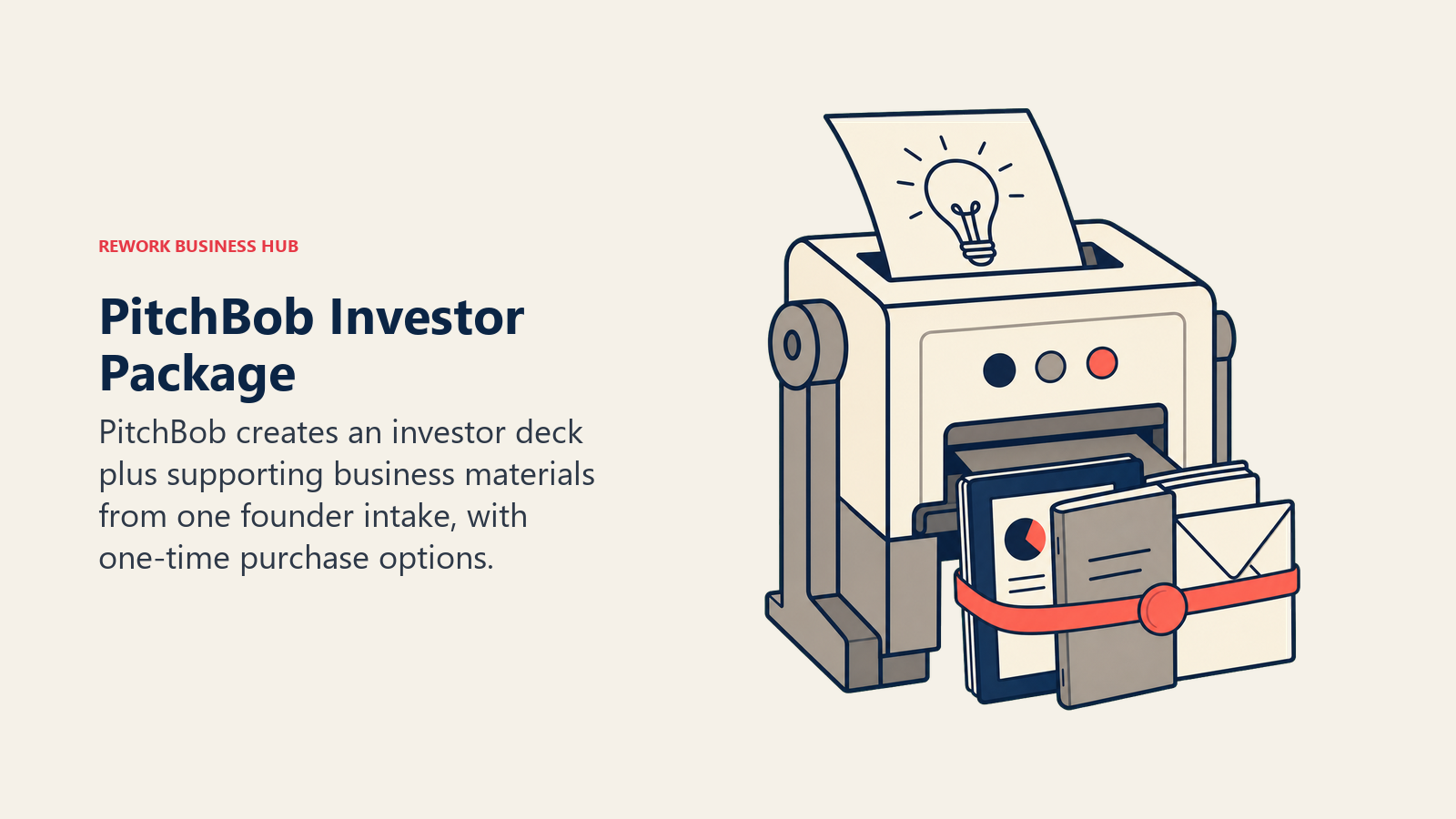
PitchBob's angle is breadth in a single output: it doesn't just generate slides, it generates a pitch deck, a business model summary, and (at higher tiers) an investor letter and full business plan from the same intake questions. It's also one of the only tools on this list priced as a one-time payment instead of a recurring subscription, which suits a founder who needs one strong deck for a fundraising sprint rather than an ongoing tool.
| Strengths | Limitations |
|---|---|
| One-time payment option, no subscription commitment required | No ongoing free tier; every plan is a paid purchase |
| Bundles a business plan and investor letter, not just slides | Narrower use case than a general-purpose deck builder |
| White-label option available for accelerators and consultants | Less design flexibility than Beautiful.ai or Canva |
Pricing: Advanced $29.90 one-time (AI-generated deck, business model, guidance); Pro $49.90 one-time (adds tailored messaging and investor letter); Super Pro $99.90 one-time (adds research insights and a landing page); Founders Co-Pilot subscription from $19.90/mo; white-label from $99/mo. Source: pitchbob.io.
Best for: First-time founders who want one polished investor deck and supporting materials without committing to a monthly tool.
9. Canva Magic Design: On-Brand Visuals Fast
Canva's philosophy has never really been "decks first," it's visual design first, and presentations are one output of a much larger design platform. Magic Design generates a full first draft from a prompt, and because it sits inside Canva, every slide can pull from the same Brand Kit, stock library, and asset system your marketing team already uses for everything else. If your team is deciding between Canva and dedicated design tools more broadly, the best Canva alternatives guide covers that comparison.
| Strengths | Limitations |
|---|---|
| Largest stock photo, icon, and template library on this list | Magic Design is capped at 10 free uses/month without Pro |
| Brand Kit keeps decks consistent with marketing materials | Less purpose-built for pitch-deck structure than Slidebean |
| Best cross-format reuse (deck assets become social posts, etc.) | Business tier repriced upward, toward $25/user/mo |
Pricing: Free (limited Magic Design uses); Pro about $13/mo; Business trending toward $25/user/mo; Enterprise custom. Source: canva.com/pricing.
Best for: Marketing and brand teams who already live in Canva and want decks to match everything else they design.
10. Visme: Data-Heavy Decks With Infographics and Charts
Visme's differentiation is depth in data visualization: live charts, interactive infographics, and dashboard-style layouts that most deck builders treat as an afterthought. Its AI Designer generates a first draft from a prompt, but the real value shows up when a deck needs to make a case with numbers, not just narrative, like a QBR or board deck.
| Strengths | Limitations |
|---|---|
| Strongest native charting and infographic tools on this list | Free plan can't export projects |
| Broader output range: presentations, one-pagers, documents, video | AI Designer credits are limited even on Pro (500/mo) |
| Analytics and password protection on Pro tier | Less streamlined for a fast single-prompt deck than Gamma |
Pricing: Free (Basic, 10 AI credits/mo); Starter $12.25/mo (annual), 200 AI credits; Pro $24.75/mo (annual), 500 AI credits; Enterprise custom, unlimited AI credits. Source: visme.co/pricing.
Best for: Analysts and RevOps teams building QBRs or board decks that lean on charts and data more than narrative slides.
11. Prezi: Non-Linear, Motion-Based Web Storytelling
Prezi has stuck to one differentiated idea since long before generative AI: presentations don't have to be a stack of slides. Its zooming canvas format lets you build a single visual map and move through it non-linearly, which suits keynotes and story-driven talks better than a fixed slide deck does. Prezi's AI additions (prompt-based generation, AI images, an "Ask AI" text tool) layer generative speed on top of that format.
| Strengths | Limitations |
|---|---|
| Unique zooming, non-linear format for storytelling talks | Learning curve is real if your team is used to slides |
| Lowest paid entry price on this list ($7/mo) | AI credits are capped even on Plus ($15/mo) |
| Web-native, no file to send; share a live link | Not the right format for dense, data-heavy reports |
Pricing: Basic free (500 AI credits/mo); Standard $7/mo; Plus $15/mo; Premium $25/mo; Teams $39/user/mo; paid tiers billed annually with a 14-day free trial. Source: prezi.com/gts/pricing.
Best for: Keynote speakers and storytellers who want a visual, non-linear narrative shared as a live web link instead of a file.
12. Genially: Interactive, Gamified Web Decks
Genially's bet is that a deck sent as a passive slideshow is a missed opportunity. Its decks support click-through interactivity, embedded quizzes, hotspots, and choose-your-path navigation, all built on the web so a viewer explores the deck instead of just clicking next. That makes it a genuine outlier on this list: most tools here optimize for building the deck fast, Genially optimizes for what happens after someone opens it.
| Strengths | Limitations |
|---|---|
| Interactive elements (hotspots, quizzes, branching paths) most tools lack | Steeper learning curve than a straight prompt-to-deck tool |
| Freemium entry point with 2GB of storage on the free plan | Business and Enterprise tiers require a sales conversation for exact pricing |
| Strong fit for training, onboarding, and self-guided sales decks | Less suited to a fast, linear pitch deck than Gamma or Slidebean |
Pricing: Free (2GB storage, core features); paid individual and team plans start around $7.49-$12.50/mo depending on billing term; Business (Master/Author) and Enterprise tiers are custom-quoted. Source: genially.com/plans.
Best for: Teams building self-guided, click-through decks for training, onboarding, or a sales deck a prospect explores on their own.
13. Simplified: Multi-Brand-Kit AI Deck Agent for Teams
Simplified's angle is brand governance at scale: brief its AI agent with a one-line prompt, and it picks a template, applies your Brand Kit to every slide, and hands back a complete deck, with support for multiple brand kits so an agency or multi-brand company can keep each client or product line visually distinct without manual reformatting.
| Strengths | Limitations |
|---|---|
| Applies a brand kit automatically to every generated deck | No ongoing free tier for the presentation maker itself |
| Multiple brand kits supported even on the entry paid tier | Presentation limits (50/mo) tighter than a dedicated deck-only tool |
| Bundled with a broader design suite beyond just decks | Agency-tier pricing jumps quickly for higher deck volume |
Pricing: Simplified One $29/mo (up to 50 AI presentations/mo, 1 brand kit); Business $79/mo (200 presentations/mo, multiple brand kits, team sharing); Agency $119/mo (500 presentations/mo, up to 5 brand kits). Source: simplified.com/ai-presentation-maker.
Best for: Agencies and multi-brand marketing teams that need every deck a rep or marketer builds to stay on-brand without a manual review step.
What to Do Next
Pick the job first, not the tool. If you need one deck out the door today for a pitch or proposal, start with Gamma or Slidebean depending on whether it's a general deck or a fundraising deck specifically. If the deck needs to prove it was actually read, pilot Storydoc or Pitch for two weeks against real prospects before you commit to a paid seat. And if you're building decks that need to tie back to a CRM record or a live deal once they're sent, the best AI tools for sales guide covers the layer that picks up after the deck goes out.

Principal Product Marketing Strategist
On this page
- Key Facts
- What's Changed for Deck Builders in 2026
- Quick Comparison Table
- Deck Builders vs. PowerPoint and Workspace-Native AI
- How to Choose: Decision Framework
- By Use Case
- By Team Size and Budget
- 1. Gamma: Fastest Full Deck From a Single Prompt
- 2. Beautiful.ai: Decks That Stay Well-Designed As You Edit
- 3. Storydoc: Trackable, Interactive Sales Decks
- 4. Pitch: Team Decks With Live Collaboration
- 5. Presentations.ai: Chat-Based, Continuous Deck Editing
- 6. Decktopus: Fast Guided Setup for Non-Designers
- 7. Slidebean: Startup Pitch Decks and Fundraising
- 8. PitchBob: AI-Generated Investor Deck Plus Business Plan
- 9. Canva Magic Design: On-Brand Visuals Fast
- 10. Visme: Data-Heavy Decks With Infographics and Charts
- 11. Prezi: Non-Linear, Motion-Based Web Storytelling
- 12. Genially: Interactive, Gamified Web Decks
- 13. Simplified: Multi-Brand-Kit AI Deck Agent for Teams
- What to Do Next