Best AI Tools for Sales in 2026: 13 Tools Ranked by Use Case
Turn this article into takeaways for your work.


Each assistant summarizes the article only for you and suggests best practices for your work.
If you're building an AI-assisted sales stack in 2026, Gong and Clari lead conversation intelligence and forecasting for enterprise teams, Apollo.io and Clay lead AI-powered prospecting, Salesforce Agentforce and HubSpot Breeze bring agents into the CRM you already run, and Rework packages AI-assisted CRM, lead routing, and a multi-channel inbox for mid-size teams that don't want to stitch five tools together. This guide ranks 13 tools by the job you actually need done, not by feature count.
Most "best AI sales tools" lists mix a $2-per-conversation enterprise agent platform with a $29-a-month email coach and call it a ranking. That's not useful. Each tool below is evaluated on what it actually does, who it's built for, and what it costs, for sales teams from 5 reps to 500.
What Changed in 2026
- Salesforce split Agentforce pricing into two models. Flat $2-per-conversation pricing still exists for customer-facing agents, but most new deployments now default to Flex Credits ($500 per 100,000 credits) because it covers employee and voice use cases the conversation model doesn't.
- Clay overhauled its entire pricing structure in March 2026, replacing three tiers with two (Launch and Growth) and splitting credits into Data Credits and Actions, cutting data marketplace costs by 50-90% in the process.
- Clari and Salesloft merged in December 2025, so Clari's forecasting core and Salesloft's Rhythm orchestration layer increasingly overlap in what they sell, worth knowing before you evaluate them as separate categories.
- HubSpot moved further into outcome-based AI pricing, charging per resolved conversation or per qualified lead for its Prospecting and Customer Agents instead of bundling them flat into a tier.
Key Facts
- 87% of sales organizations now use AI for tasks like prospecting, forecasting, lead scoring, or drafting emails, per Salesforce's State of Sales report.
- Sellers using AI agents expect them to cut prospect research time by 34% and email drafting time by 36% once fully adopted, per Salesforce State of Sales.
- Sales organizations that give reps AI-enabled next-best-action recommendations are 2.6x more likely to hit commercial growth targets, per Gartner.
- 92% of sellers now use at least some form of AI in their role, up from a small minority just two years ago, per HubSpot's B2B sales research.
- 64% of salespeople say AI automation of manual tasks saves them 1 to 5 hours a week, per HubSpot.
- 87% of salespeople say AI has made them use their CRM more, not less, per HubSpot.
- 88% of organizations report regularly using AI in at least one business function, with marketing and sales among the functions adopting fastest, per McKinsey's State of AI.
Quick Comparison Table
| Tool | Best For | Standout Capability | Starting Price | Free Tier? |
|---|---|---|---|---|
| Gong | Deal risk and coaching at enterprise scale | Conversation intelligence across every call and email | Quote-only; buyer reports put Foundations near $1,400-1,600/user/yr plus platform fee | No |
| Rework | Mid-size teams that want AI inside CRM + lead ops | Unified AI CRM, lead routing, and multi-channel inbox | $69/mo billed yearly (Sales Engine, 5 seats) | No |
| Apollo.io | Prospecting and outbound at any team size | AI-scored 210M+ contact database with native sequences | Free tier; $49/user/mo (Basic, billed annually) | Yes |
| Clay | Custom outbound research and enrichment workflows | No-code AI agent builder for enrichment waterfalls | Free tier; $167/mo (Launch, monthly billing) | Yes |
| Salesforce Agentforce | Teams already on Salesforce wanting agentic AI | Autonomous agents built on existing CRM objects | $2/conversation, or $500 per 100,000 Flex Credits | No (requires a Salesforce license) |
| HubSpot Breeze | HubSpot Sales Hub users wanting built-in AI | Outcome-based agents billed per resolved task | Baseline included from Sales Hub Starter; agents from $0.50-$1/outcome (Pro/Enterprise) | Partial |
| Outreach | Enterprise sales engagement with AI sequencing | Amplify AI agents layered across the full cycle | Quote-only; buyer reports put Engage near $100-140/user/mo | No |
| Salesloft Rhythm | Full-cycle sellers who want one AI action queue | Conductor AI prioritizes what a rep does next | Quote-only; buyer reports put list price near $125-165/user/mo | No |
| Lavender | Reps who want sharper cold email, fast | Real-time AI email scoring before you hit send | Free (5 emails/mo); $29/mo (Starter) | Yes |
| Regie.ai | Teams wanting AI sequencing plus a dialer bundle | Sequencing agents with parallel dialer add-on | $180/user/mo (AI SEP, 10-seat minimum) | No |
| Nooks | SDR teams doing high-volume outbound calling | AI parallel dialer with a virtual sales floor | Quote-only; buyer reports estimate roughly $5,000/user/yr | No |
| ZoomInfo Copilot | ZoomInfo users wanting AI layered on intent data | Surfaces buying signals across ZoomInfo's dataset | Bundled in Advanced ($24,995/yr) or Elite plans | No |
| Clari | RevOps leaders needing AI forecast accuracy | AI deal-risk scoring and forecast rollups | Quote-only; buyer reports put core near $100-125/user/mo | No |
How to Choose: Decision Framework
| If you need... | Pick... | Why |
|---|---|---|
| Unified AI CRM, lead routing, and a shared inbox for a 10-200 person team | Rework | One data model instead of five stitched tools; packaged pricing, no per-seat surprise |
| Deal coaching and call review at enterprise scale | Gong | Deepest conversation intelligence library on this list |
| Forecast accuracy and pipeline risk scoring for RevOps | Clari | Purpose-built for CRO-level forecast rollups |
| High-volume outbound prospecting with a built-in contact database | Apollo.io | 210M+ contacts, sequences, and AI scoring in one product |
| Fully custom AI research and enrichment workflows | Clay | No-code agent builder; you design the waterfall |
| AI agents that live inside an existing Salesforce org | Salesforce Agentforce | Reuses your CRM objects and automation instead of a new data layer |
| AI agents that live inside an existing HubSpot Sales Hub | HubSpot Breeze | Same logic, native to HubSpot's data model |
| AI-guided multi-touch sequencing at enterprise scale | Outreach | Amplify agents span the full engagement cycle, not just email |
| One AI queue telling full-cycle reps what to do next | Salesloft Rhythm | Conductor AI collapses prioritization into a single action list |
| Real-time coaching on cold email before you send | Lavender | Fastest, cheapest way to raise reply rates on outbound copy |
| AI sequencing bundled with a parallel dialer | Regie.ai | One vendor for both sequencing agents and dial volume |
| Maximum call volume for an SDR team | Nooks | Purpose-built parallel dialer and virtual sales floor |
| AI insight layered on an existing ZoomInfo subscription | ZoomInfo Copilot | No new data source; surfaces signals you're already paying for |
Framework: By Team Size and Budget
| Team Size | Budget Signal | Best Fits |
|---|---|---|
| 1-4 reps | Free or self-serve | Apollo.io free tier, Lavender free/Starter, Clay free tier |
| 5-10 reps | Under roughly $1,500/mo total stack | Rework Sales Engine, Apollo.io Basic, Lavender Teams |
| 10-50 reps | Structured budget, buying committee | Rework Standard, HubSpot Breeze, Outreach, Salesloft Rhythm |
| 50-200 reps | RevOps-led evaluation, multi-tool stack | Gong, Clari, Regie.ai, ZoomInfo Copilot |
| 200+ reps / enterprise | Custom contracts, dedicated CSM | Salesforce Agentforce, Gong, Clari, Nooks |
1. Gong: Conversation Intelligence for Deal Risk and Coaching
Gong's bet is that the truth about a deal lives in the calls and emails, not the CRM fields a rep fills in after the fact. It records, transcribes, and analyzes every sales conversation, then surfaces deal risk, competitor mentions, and coaching moments automatically. For sales leaders managing 50+ reps, that visibility is hard to replace once you've had it.
Best for: Enterprise sales orgs of 50+ reps that need deal risk visibility and rep coaching at scale
Key strengths:
- Deepest conversation intelligence library on this list, across calls, video, and email
- Deal Risk and Forecast modules flag deals losing momentum before a rep notices
- Coaching workflows tie directly to specific call moments, not generic scorecards
Limitations:
- Pricing isn't published; expect a platform fee on top of per-user licenses
- Buyer reports describe a 2-3x gap between the advertised seat rate and the real first-year cost once onboarding and add-ons are included
- Overkill for teams under 20 reps who don't have a dedicated RevOps function to run it
Pricing: Not published. Gong prices licenses per user plus a platform fee based on team size, and directs prospects to a custom quote. Foundations reportedly runs near $1,400-1,600/user/year, with bundled Engage and Forecast add-ons pushing that closer to $2,880-3,000/user/year.
| What you get | What you don't |
|---|---|
| Conversation intelligence across calls, video, email | No published pricing; requires a sales call to get a number |
| Deal Risk and Forecast AI modules | Mandatory platform fee stacks on top of per-seat cost |
| Deep coaching and call-review workflows | Heavy for teams without a RevOps function to run it |
For a direct comparison against the forecasting-first alternative, see Gong vs Clari. If Gong's pricing is the blocker, best Gong alternatives covers cheaper conversation intelligence options.
2. Rework: Unified AI CRM, Lead Routing, and Inbox for Mid-Size Sales Teams
Rework's position in this list is different from the rest: it's not a bolt-on AI layer for an existing CRM, it's an AI-assisted CRM, lead management, and multi-channel inbox built as one product. For a 10-200 person sales team that has outgrown spreadsheets but doesn't want Salesforce-level implementation cost, that matters more than any single AI feature.
The AI runs where the work already happens: lead scoring and routing that assigns the right rep automatically, AI-assisted drafting inside the same inbox that holds WhatsApp, email, and web chat, and pipeline visibility that doesn't require stitching Gong-style call intelligence onto a separate CRM. Teams moving off Salesforce, Monday.com, or a spreadsheet-and-WhatsApp stack typically consolidate several tools into one when they adopt it.
Best for: 10-200 person sales teams that want AI-assisted lead routing, CRM, and messaging in one product instead of five stitched tools
Not ideal for: Solo sellers or teams under 5 people (Rework sells packages, not single seats), and F500 orgs needing deep custom-object governance
Key strengths:
- CRM, lead scoring, and round-robin/territory/SLA-based routing in one data model, not separate SKUs
- Native multi-channel inbox (WhatsApp, Messenger, Instagram DM, TikTok, Zalo, web chat) with AI-assisted drafting on the same contact timeline
- Packaged pricing with no "contact sales" wall at the entry tier
Limitations:
- Not a Gong-style conversation intelligence replacement; no call recording/transcription library
- Less deep customization than Salesforce for complex, multi-org enterprise sales processes
- Minimum package starts at 5 users, so it isn't priced for solo operators
| What you get | What you don't |
|---|---|
| AI CRM + lead routing + multi-channel inbox in one product | Not built for solo sellers (5-user package minimum) |
| Packaged, transparent pricing (no seat-by-seat quote wall) | No dedicated call-recording/coaching library like Gong |
| Round-robin, territory, and SLA-based routing built in | Less enterprise customization depth than Salesforce |
Pricing: the Sales Engine is $69/month billed yearly or $80 month to month, with 5 sales seats included. Extra seats come in blocks of 5 at $21/month per block on yearly billing, so 10 reps run $90/month and 25 reps $153/month, billed yearly. The Revenue Engine ($159/month billed yearly) adds the inbox and lead capture. See rework.com/pricing.
For teams weighing Rework against a CRM-native AI agent instead, see Rework vs Salesforce Agentforce and Rework vs HubSpot Breeze. For the CRM category more broadly, Best CRM Software in 2026 covers 15 platforms segmented by team size and sales motion. And if you want the underlying concept explained, what is an AI sales operator breaks down what "AI-assisted sales ops" actually means in practice.
3. Apollo.io: AI-Powered Prospecting at Any Team Size
Apollo's bet is breadth: a 210M+ contact database, AI-driven lead scoring, and built-in sequences in one product, priced so a 2-person team and a 200-person team can both start on the same platform. That combination, database plus outreach plus a real free tier, is why Apollo shows up on nearly every SDR's shortlist by default.
Best for: Teams that need prospecting, enrichment, and outbound sequencing without buying three separate tools
Key strengths:
- Free tier includes the full contact database with basic filters, useful for validating fit before paying
- AI-scored contacts and intent signals built into the same workflow as sequencing
- Meeting scheduler, dialer, and email deliverability tools included at paid tiers
Limitations:
- The credit system, not the seat price, is the real cost driver; phone credits cost roughly 8x more than email credits
- Overage credits are priced per-unit with a purchase minimum, which adds up fast for high-volume outbound teams
- Data accuracy on smaller or newer companies lags larger enterprise accounts
Pricing: Free tier available. Basic is $49/user/month billed annually ($59 monthly). Professional is $79/user/month annually. Organization is $119/user/month annually with a 3-user minimum. See apollo.io/pricing.
| What you get | What you don't |
|---|---|
| 210M+ contact database plus sequencing in one product | Credit system, not seat price, drives real cost at scale |
| Real free tier for validating fit before paying | Phone credits cost roughly 8x email credits |
| AI scoring built into prospecting workflows | Data accuracy on smaller companies trails enterprise-grade sources |
See best Apollo alternatives if the credit math doesn't work for your volume, or Apollo AI vs ZoomInfo Copilot for a direct look at the two AI-prospecting approaches side by side.
4. Clay: No-Code AI Agent Builder for Outbound Research
Clay doesn't sell you a fixed workflow, it sells you a spreadsheet-like canvas where you build your own AI enrichment waterfall: pull data from 100+ providers, run it through an AI agent to qualify or personalize, then sync it wherever your outbound tool lives. For RevOps teams that have outgrown Apollo's fixed feature set but don't want to hire an engineer, Clay is the tool that closes that gap.
Best for: RevOps and growth teams building custom, multi-source enrichment and personalization workflows
Key strengths:
- No-code agent builder with access to 100+ data providers in one canvas
- Native CRM auto-sync now included starting at the Growth tier
- Flexible enough to power account research, lead scoring, and personalized outreach from one workflow
Limitations:
- Steep learning curve compared to a fixed-workflow tool like Apollo
- Dual credit system (Data Credits and Actions) takes real trial-and-error to budget accurately
- Enterprise contracts can run into five figures once usage scales
Pricing: Free tier includes 100 Data Credits and 500 Actions per month. Launch is $185/month (2,500 Data Credits, 15,000 Actions). Growth is $495/month (6,000 Data Credits, 40,000 Actions, native CRM sync). Enterprise is custom, with a median contract reported near $30,400/year.
| What you get | What you don't |
|---|---|
| No-code AI agent builder across 100+ data sources | Steeper learning curve than a fixed-workflow tool |
| Native CRM auto-sync from the Growth tier up | Dual credit system takes time to budget accurately |
| Flexible enough to replace several point tools | Enterprise usage can scale into five figures fast |
5. Salesforce Agentforce: Autonomous AI Agents Inside Your Existing CRM
Agentforce is Salesforce's bet that AI agents should act, not just suggest, using the objects, automation, and data model you've already built in Salesforce. Agents can qualify leads, draft outreach, update records, and escalate to a human, all inside the org your team already lives in. For companies already deep in Salesforce, that's the appeal: no new data layer to stand up.
Best for: Teams already running Salesforce Sales Cloud that want agentic AI without migrating data to a new platform
Key strengths:
- Reuses existing Salesforce objects, flows, and permissions instead of a bolt-on integration
- Flex Credits pricing now covers customer, employee, and voice use cases in one model
- Backed by the broadest AI agent ecosystem of any CRM vendor on this list
Limitations:
- Requires an existing Salesforce license; not a standalone product
- Two incompatible pricing models (Conversations vs Flex Credits) that can't run in the same org simultaneously
- Real cost is hard to predict until you know your agent usage volume
Pricing: $2 per conversation for customer-facing agents (pre-purchase only), or $500 per 100,000 Flex Credits covering customer, employee, and voice use cases. Requires an underlying Salesforce license. See salesforce.com/agentforce/pricing.
| What you get | What you don't |
|---|---|
| Agentic AI built on your existing Salesforce data model | Requires a Salesforce license; not standalone |
| Flex Credits cover customer, employee, and voice use cases | Two pricing models that can't coexist in one org |
| Deepest AI agent ecosystem of any CRM vendor here | Usage-based cost is hard to forecast up front |
For a head-to-head against a lighter-weight alternative, see Rework vs Salesforce Agentforce.
6. HubSpot Breeze: Outcome-Based AI Agents Inside Sales Hub
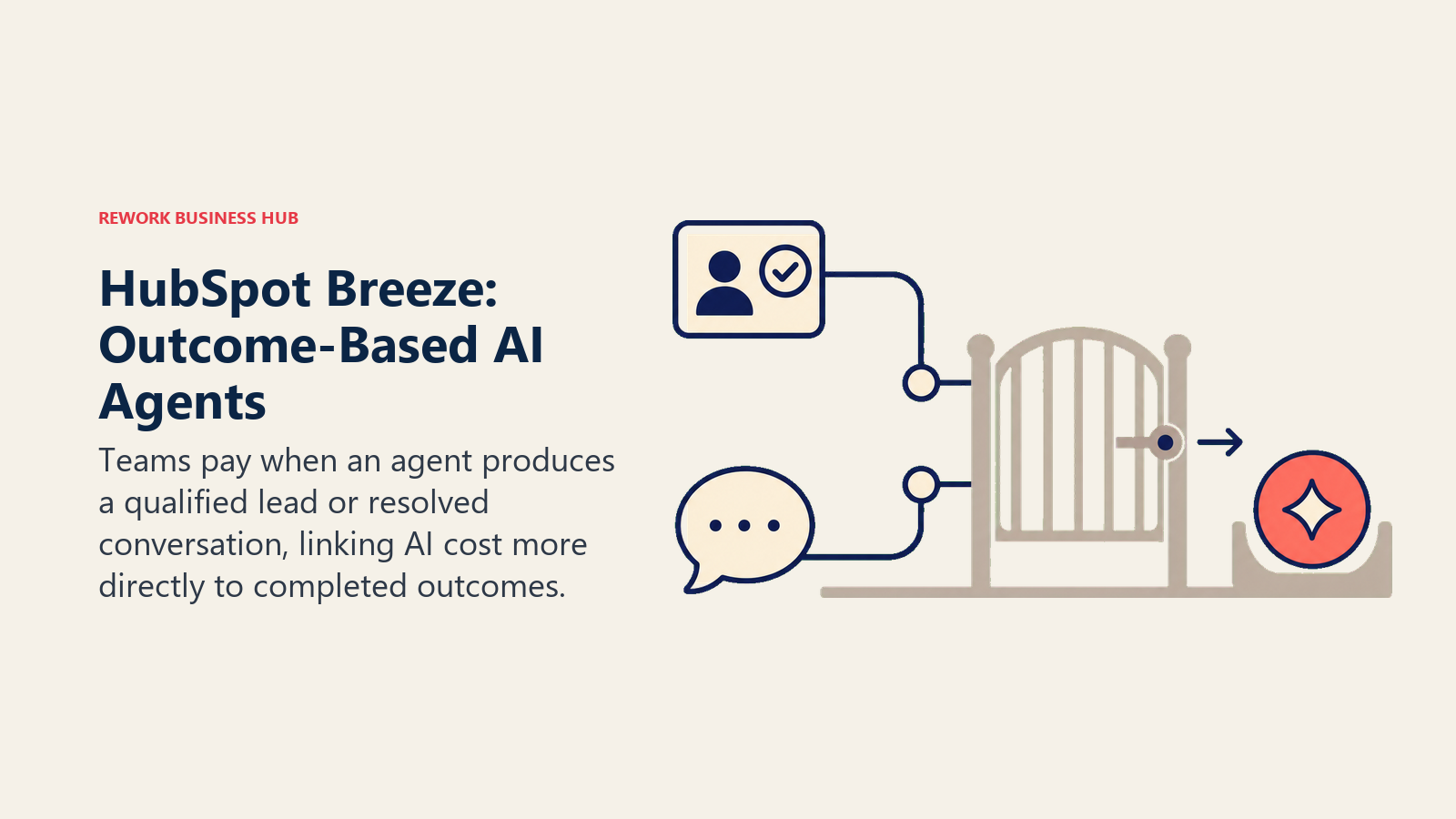
HubSpot's approach with Breeze is to charge for AI the way you'd charge a person: not by seat, but by the outcome it produces. The Prospecting Agent costs per qualified lead, the Customer Agent costs per resolved conversation. For teams that want to test AI ROI before committing to a flat seat price, that model is genuinely different from the rest of this list.
Best for: HubSpot Sales Hub Professional or Enterprise customers who want to pilot AI agents without a big upfront commitment
Key strengths:
- Outcome-based pricing means you pay only when the agent actually produces a result
- Baseline Breeze AI features are included across all Sales Hub tiers, even Starter
- Native to HubSpot's existing contact and deal data, no separate integration needed
Limitations:
- Full Prospecting and Customer Agents require Sales Hub Professional or Enterprise, a real cost jump from Starter
- Outcome-based pricing can get unpredictable at scale if volume spikes
- Less deep than Salesforce Agentforce for complex, multi-step agent workflows
Pricing: Baseline Breeze AI features are included in all Sales Hub plans (Starter from roughly $9-15/seat/month). Prospecting Agent costs $1 per qualified lead recommended for outreach (Pro/Enterprise only). Customer Agent costs $0.50 per resolved conversation. Data Agent costs $0.10 per answer.
| What you get | What you don't |
|---|---|
| Pay-per-outcome pricing instead of flat seat cost | Full agents require Sales Hub Pro or Enterprise |
| Baseline AI included even on the Starter tier | Outcome-based cost can spike with volume |
| Native to HubSpot's existing contact and deal data | Less deep agent workflows than Salesforce Agentforce |
See Rework vs HubSpot Breeze for how the two AI-in-CRM approaches compare directly.
7. Outreach: AI-Guided Sequencing for Enterprise Sales Engagement
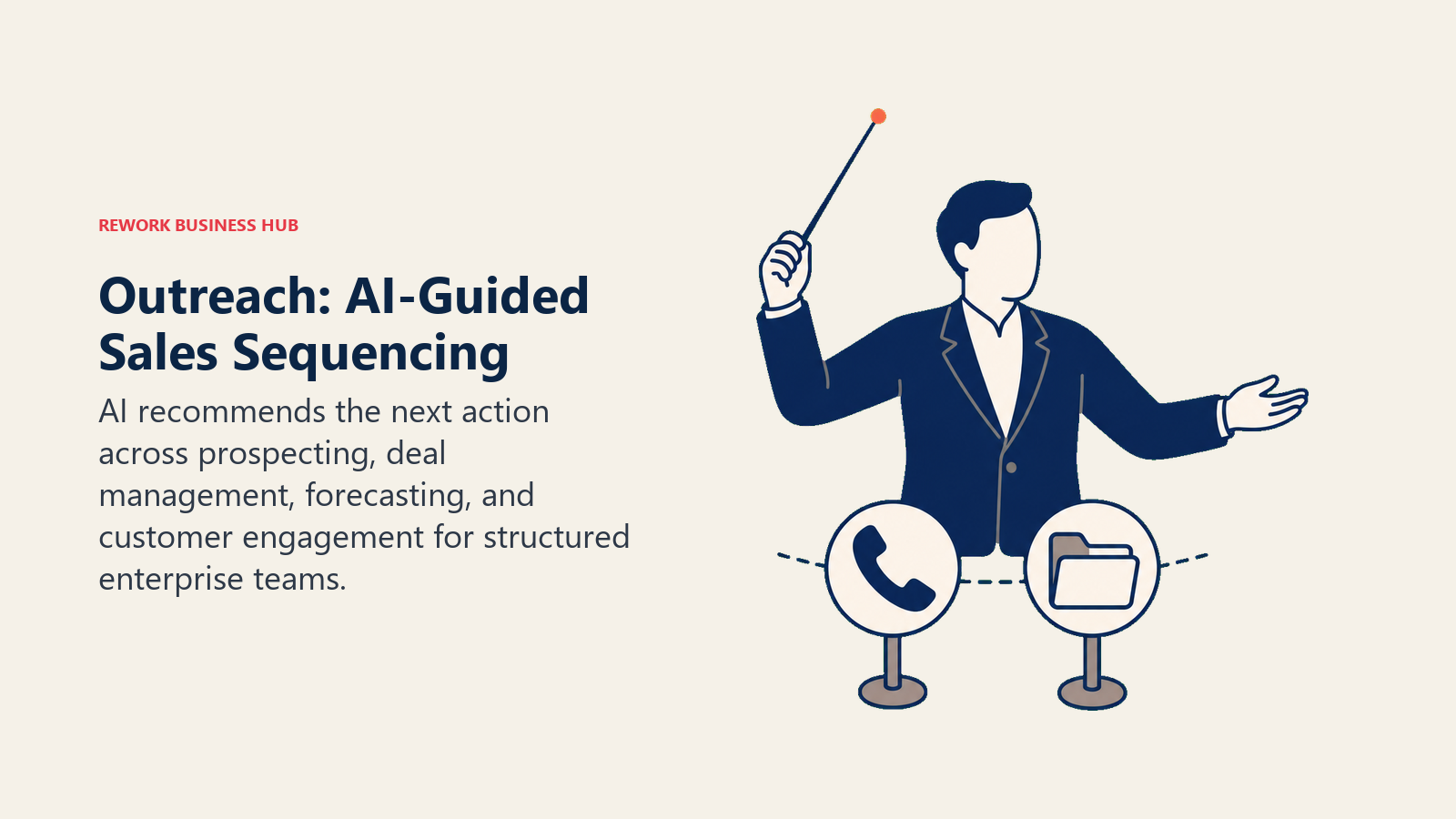
Outreach's Amplify AI agents sit on top of its sales engagement platform, guiding reps through prospecting, deal management, forecasting, and customer engagement with AI-recommended next steps at every stage. It's built for enterprise revenue teams running structured, multi-touch outbound at volume, not a lightweight sequencing tool.
Best for: Enterprise sales orgs running structured, multi-touch outbound sequences that want AI guidance layered across the whole cycle
Key strengths:
- Amplify AI agents span prospecting through forecasting, not just email sequencing
- Deep reporting and pipeline visibility built for RevOps-led organizations
- Modular add-ons (Meet, Deal, Forecast) let you scale usage by function
Limitations:
- No published pricing; requires a full annual commitment paid upfront
- Add-on modules stack quickly; a fully-loaded deployment costs meaningfully more than the base seat price
- Steep enough that smaller teams are usually better served elsewhere
Pricing: Not published. Outreach combines seat-based platform access with consumption-based AI credit usage. The core Engage tier reportedly runs near $100-140/user/month before Meet, Deal, Forecast, and Amplify add-ons.
| What you get | What you don't |
|---|---|
| AI guidance across the full engagement cycle, not just email | No published pricing; quote-based with annual commitment |
| Modular add-ons scale with what you actually need | Fully-loaded deployments cost well above the base seat price |
| Built for structured, high-volume outbound orgs | Overkill for teams under roughly 20 reps |
See best Outreach alternatives if the enterprise pricing and commitment don't fit your stage.
8. Salesloft Rhythm: One AI Queue for Full-Cycle Sellers
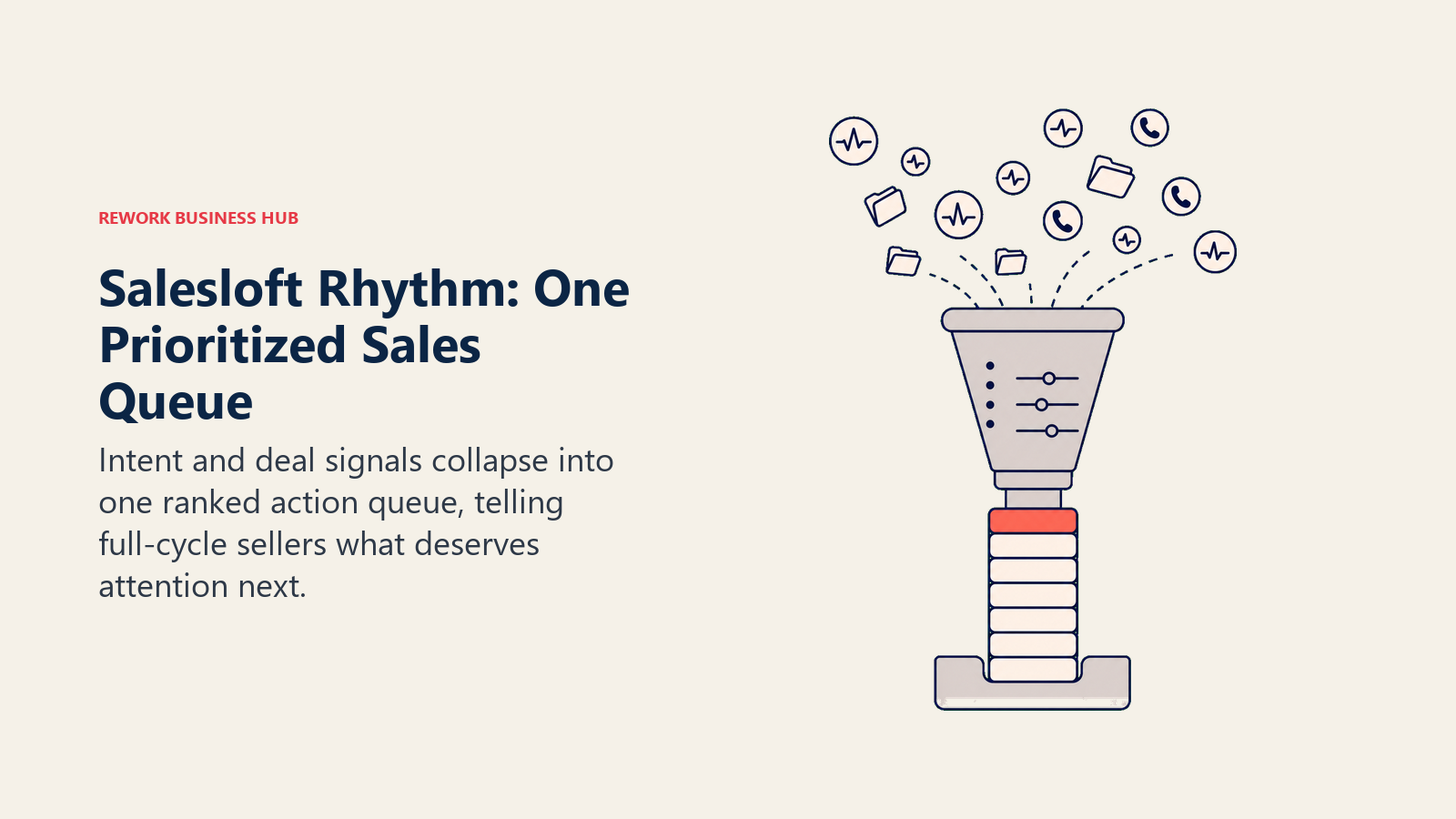
Salesloft's Rhythm, powered by its Conductor AI engine, collapses the seller's job into one prioritized action queue: call this account now, this deal needs attention today, this lead just showed intent. Rather than a rep checking five tabs, Rhythm tells them what to do next based on signal strength. Following Clari's late-2025 acquisition of Salesloft, Rhythm and Clari's forecasting core increasingly share the same AI backbone.
Best for: Full-cycle sellers (prospecting through close) who want one prioritized queue instead of juggling multiple views
Key strengths:
- Conductor AI orchestration prioritizes actions based on real intent signals, not a fixed cadence
- Deep CRM integrations and A/B testing at the Advanced tier and up
- Post-merger roadmap with Clari means tighter forecasting-to-execution integration ahead
Limitations:
- Pricing isn't published; buyer reports suggest real cost lands well above the advertised range after negotiation
- Rhythm and Conversations modules each add 15-40% on top of the base platform cost
- Post-merger product overlap with Clari means some capability boundaries are still shifting
Pricing: Not published. List price reportedly runs near $125-165/user/month across three tiers (Essentials, Advanced, Premier), with Rhythm adding roughly 15-30% on top of the base platform cost.
| What you get | What you don't |
|---|---|
| One AI-prioritized action queue instead of five views | No published pricing; quote-based negotiation required |
| Deep CRM integration and workflow automation | Rhythm and Conversations add-ons stack cost quickly |
| Tighter Clari integration since the December 2025 merger | Product boundaries between Salesloft and Clari still evolving |
See best Salesloft alternatives for other AI-guided sequencing options, or the broader best sales engagement platforms in 2026 roundup.
9. Lavender: Real-Time AI Email Coaching
Lavender doesn't send email for you, it makes the email you're about to send better before you hit send. A browser extension scores your draft in real time on length, tone, personalization, and likely reply rate, then suggests specific fixes. For reps who write a lot of cold email and want fast, cheap coaching, it's one of the highest-ROI tools on this list per dollar.
Best for: Individual reps and small teams who want to improve cold email reply rates without a platform overhaul
Key strengths:
- Real-time scoring and coaching inside Gmail or Outlook, no workflow change required
- Personalization suggestions adapt to who you're actually writing to
- Cheapest entry point on this list with a genuinely usable free tier
Limitations:
- Only solves the email-writing problem, not sequencing, dialing, or CRM data
- Team-level analytics require the higher-priced tiers
- Ora, Lavender's separate AI sales agent product, is priced well beyond the core coaching tool at $500/agent/month
Pricing: Free tier allows 5 emails/month. Starter is $29/month (unlimited coaching plus AI writer). Individual Pro is $49/month (deeper personalization). Teams is $69/user/month (team analytics, shared templates). Enterprise starts near $89+/month with custom AI training.
| What you get | What you don't |
|---|---|
| Real-time email coaching inside your existing inbox | No sequencing, dialing, or CRM functionality |
| Cheapest genuinely usable entry point on this list | Team analytics locked behind higher tiers |
| Personalization that adapts per recipient | Ora AI agent is priced far above the core product |
10. Regie.ai: AI Sequencing With a Parallel Dialer Bundle
Regie.ai's pitch is that sequencing and dialing shouldn't be two separate purchases. Its AI SEP (Sales Engagement Platform) tier ships static and dynamic sequencing agents, call coaching, and voicemail drops, and its higher Force Multiplier Rep tier bundles in a 9-line parallel dialer, provisioned mailboxes, and research agents.
Best for: Teams that want AI-run sequencing and a parallel dialer from one vendor instead of stitching two products together
Key strengths:
- Sequencing agents handle both static cadences and dynamic, signal-based adjustments
- Force Multiplier Rep tier bundles a 9-line parallel dialer with mailbox rotation included
- Research agents build account and contact enrichment into the same platform
Limitations:
- Both published tiers carry hard seat minimums (10 seats for AI SEP, 5 for Force Multiplier Rep)
- Add-on packages for data, mailbox rotation, and dialing push real cost meaningfully above list price
- AI drafts still typically need a human editor pass before sending, which adds labor cost the platform price doesn't show
Pricing: AI SEP is $180/user/month with a 10-seat minimum ($21,600/year floor). Force Multiplier Rep is $499/user/month with a 5-seat minimum ($29,940/year floor). Enterprise is custom. See regie.ai/pricing.
| What you get | What you don't |
|---|---|
| Sequencing agents plus a parallel dialer from one vendor | Hard seat minimums on both published tiers |
| Research agents built into the same platform | Add-ons for data and mailboxes stack cost quickly |
| Transparent published pricing, unlike most competitors here | AI drafts usually still need a human editing pass |
11. Nooks: AI Parallel Dialer for High-Volume Outbound
Nooks is built for one job: getting an SDR team through as many quality conversations as possible. Its AI parallel dialer connects reps only to answered calls, filtering out voicemails and no-answers automatically, and its "virtual sales floor" recreates the energy of a physical bullpen for remote teams.
Best for: SDR teams running high-volume outbound calling who need to maximize live conversations per hour
Key strengths:
- AI parallel dialing filters out voicemails and no-answers before connecting a rep
- Virtual sales floor feature replicates in-office coaching and energy for remote SDR pods
- Purpose-built for volume in a way general sales engagement platforms aren't
Limitations:
- No published pricing; every deal requires a demo and custom quote
- Reported cost (roughly $5,000/user/year) puts it toward the higher end of this list
- Narrow focus on dialing means it's not a replacement for a full sequencing or CRM platform
Pricing: Not published. Reportedly roughly $5,000/user/year (about $417/user/month), though some deals land at effective rates as low as $65-150+/user/month at volume.
| What you get | What you don't |
|---|---|
| AI dialer that filters to only answered, live calls | No published pricing; demo and custom quote required |
| Virtual sales floor for remote SDR team energy | Narrow focus; not a sequencing or CRM replacement |
| Purpose-built for maximum call volume | Reported cost sits toward the higher end of this list |
12. ZoomInfo Copilot: AI Insight Layered on Intent Data
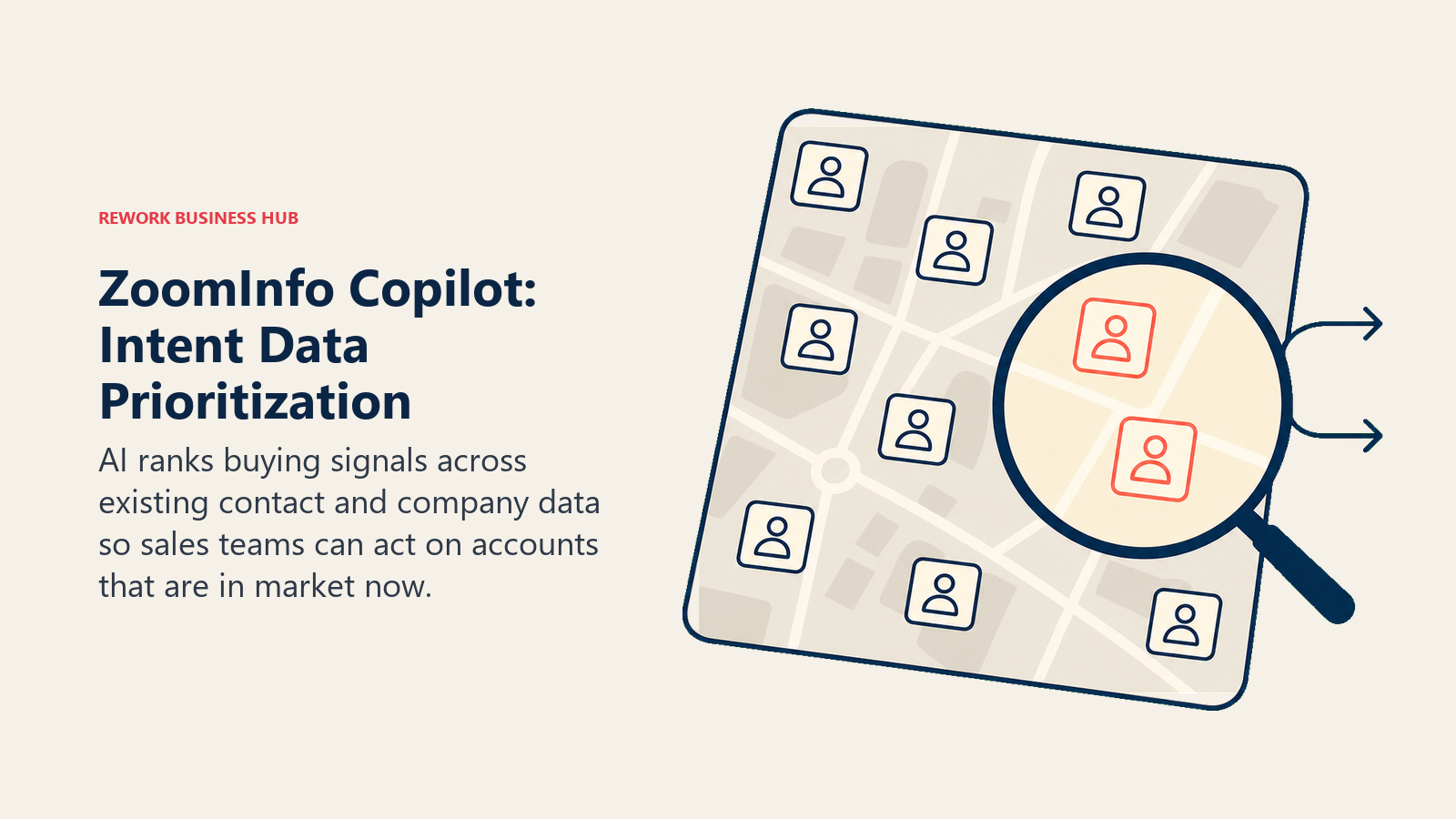
ZoomInfo Copilot doesn't replace your CRM or sequencing tool, it sits on top of ZoomInfo's existing contact, company, and intent data to surface which accounts are actually in-market right now. For teams already paying for ZoomInfo's database, Copilot is the AI layer that turns that data into a prioritized action list instead of a static export.
Best for: Teams already on a ZoomInfo Advanced or Elite plan who want AI-prioritized buying signals, not a new data source
Key strengths:
- Surfaces AI-ranked buying signals across ZoomInfo's existing intent and firmographic data
- No new integration required if you're already a ZoomInfo customer
- Predictive analytics and account scoring bundled into higher tiers
Limitations:
- Not sold as a standalone product; requires ZoomInfo Advanced or Elite
- Real all-in cost often lands well above the published base price once seats, credits, and intent data are added
- Less useful without an existing sequencing or CRM tool to act on the signals it surfaces
Pricing: Not sold standalone. ZoomInfo Advanced starts near $24,995/year and includes Copilot access; Elite starts near $39,995/year with deeper predictive analytics. Most mid-sized teams report an all-in cost of $30,000-60,000/year once seats and credits are added.
| What you get | What you don't |
|---|---|
| AI-ranked buying signals on data you already own | Not sold standalone; requires an Advanced or Elite plan |
| No new integration if you're already a ZoomInfo customer | Real all-in cost often runs well above the list price |
| Predictive account scoring at higher tiers | Needs a separate tool to act on the signals it surfaces |
For a direct comparison against Apollo's approach to AI prospecting, see Apollo AI vs ZoomInfo Copilot.
13. Clari: AI Forecast Accuracy for RevOps
Clari's bet is that pipeline data lies unless AI cross-checks it against what's actually happening in calls, emails, and CRM activity. Its Forecast module scores deal health and rolls it up into forecast accuracy that RevOps and CROs can actually defend in a board meeting, and its Copilot module adds conversation intelligence on top.
Best for: RevOps leaders and CROs who need defensible, AI-scored forecast accuracy across a large pipeline
Key strengths:
- AI deal-risk scoring pulls from CRM activity, not just rep-reported stage
- Forecast rollups built for CRO-level accuracy and scenario modeling
- Since merging with Salesloft in December 2025, tighter integration with Rhythm's execution layer
Limitations:
- No published pricing; described by Clari itself as "tailored to your unique use case"
- Implementation and setup fees (reportedly $10,000-30,000) stack on top of per-seat cost
- Full combined platform cost after the Salesloft merger can run $200-310+/user/month before implementation
Pricing: Not published. Clari Core (Forecasting and Pipeline) reportedly runs near $100-125/user/month, with the Copilot conversation intelligence add-on running $60-110/user/month. See clari.com/pricing.
| What you get | What you don't |
|---|---|
| AI-scored forecast accuracy built for CRO-level reporting | No published pricing; fully quote-based |
| Deal-risk scoring pulled from real CRM activity | Setup fees of $10,000-30,000 common on top of licenses |
| Tighter Rhythm integration since the Salesloft merger | Full combined platform can exceed $300/user/month |
See Gong vs Clari for a direct look at conversation intelligence versus forecast-first AI, and best AI tools for sales operations for the broader AI sales ops vendor landscape.
Pricing at a Glance
| Tool | Entry Price | Pricing Model | Free Tier? |
|---|---|---|---|
| Gong | Quote-only (est. $1,400-1,600/user/yr + platform fee) | Per-user license + platform fee | No |
| Rework | $69/mo billed yearly (Sales Engine, 5 seats) | Engine with seats in blocks of 5; monthly or yearly | No |
| Apollo.io | Free; $49/user/mo (Basic, annual) | Per-user + credit system | Yes |
| Clay | Free; $167/mo (Launch, monthly billing) | Usage-tiered + dual credits | Yes |
| Salesforce Agentforce | $2/conversation or $500/100K Flex Credits | Usage-based, requires SF license | No |
| HubSpot Breeze | Included from Sales Hub Starter; agents from $0.50-$1/outcome | Tier baseline + outcome-based agents | Partial |
| Outreach | Quote-only (est. $100-140/user/mo core) | Per-user + AI credit usage | No |
| Salesloft Rhythm | Quote-only (est. $125-165/user/mo) | Per-user, tiered | No |
| Lavender | Free (5 emails/mo); $29/mo (Starter) | Flat monthly tiers | Yes |
| Regie.ai | $180/user/mo (10-seat minimum) | Per-user, seat minimums | No |
| Nooks | Quote-only (est. ~$5,000/user/yr) | Per-user, annual contract | No |
| ZoomInfo Copilot | $24,995/yr (Advanced, bundled) | Bundled in tier | No |
| Clari | Quote-only (est. $100-125/user/mo core) | Per-user + implementation fee | No |
Where AI Sales Tools Are Headed
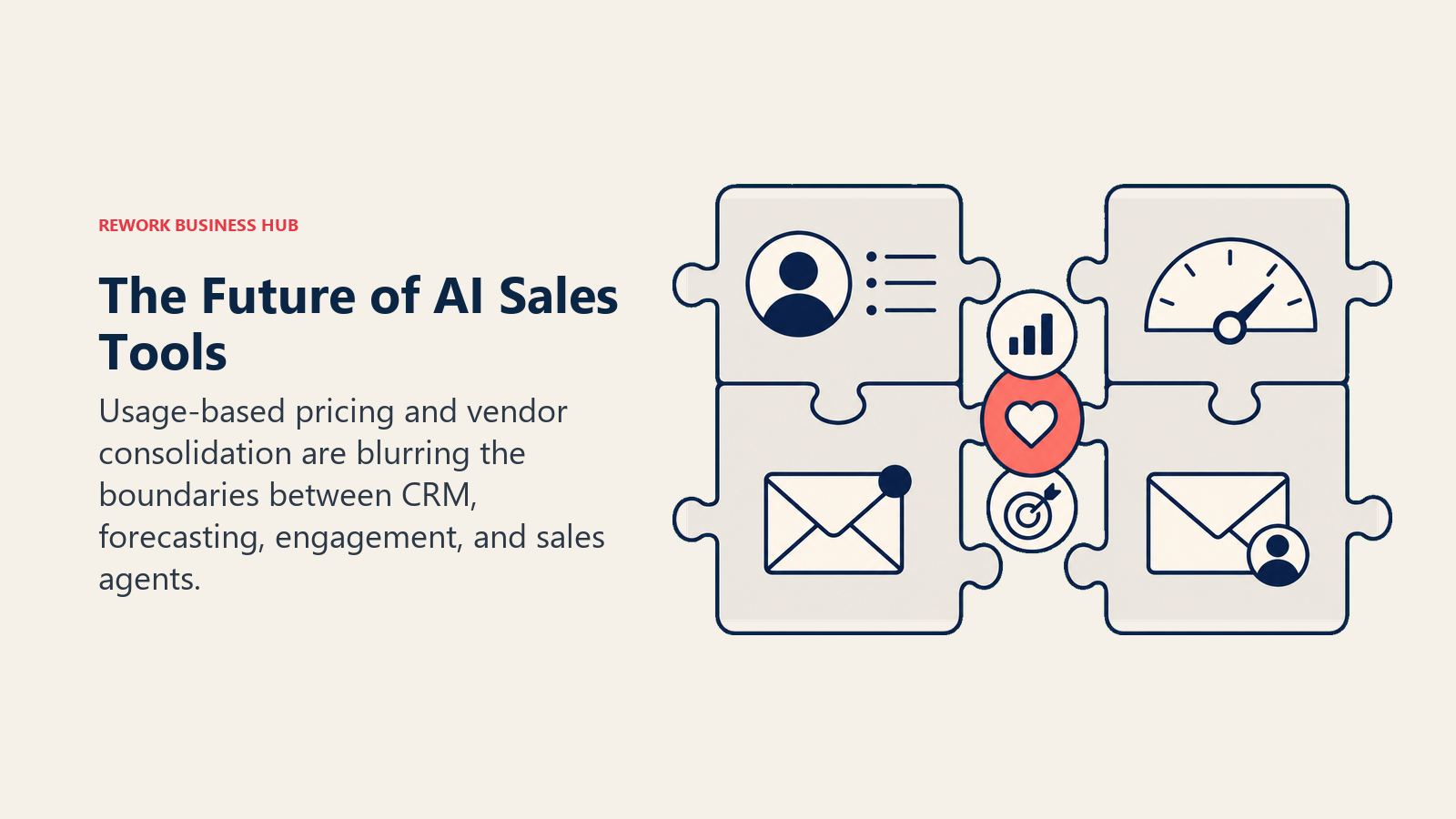
Two trends are converging fast. First, pricing is shifting from flat per-seat to usage-based and outcome-based models (Salesforce's Flex Credits, HubSpot's per-outcome agents, Apollo's credit system), which makes budgeting harder but ties cost more directly to value delivered. Second, category lines are blurring: Clari and Salesloft's merger means forecasting and execution AI now sit under one roof, and CRM-native agents (Agentforce, Breeze) are closing the gap on what used to require a standalone tool like Gong or Outreach. Expect more vendor consolidation and more usage-based pricing through the rest of 2026, and expect "which category does this tool belong to" to keep getting harder to answer.
Frequently Asked Questions about AI Tools for Sales
What is the best AI tool for sales teams in 2026?
There's no single best tool. Gong leads conversation intelligence for enterprise teams, Apollo.io leads AI-powered prospecting at any team size, and Rework leads unified AI CRM plus lead routing for mid-size teams that don't want five separate tools. Match the tool to the specific job, not a general ranking.
Are there free AI tools for sales?
Yes. Apollo.io, Clay, and Lavender all offer genuinely usable free tiers. Apollo's free tier includes the full contact database with basic filters, Clay's free tier includes 100 Data Credits and 500 Actions a month, and Lavender's free tier allows 5 coached emails a month.
Is Gong worth the cost for a mid-size sales team?
Usually not below 50 reps. Gong's real first-year cost, once platform fees and add-ons are included, often runs 2 to 3x the advertised per-seat rate. Teams under 50 reps typically get more value from a lighter conversation intelligence tool or an AI CRM with built-in coaching, like Rework or HubSpot Breeze.
What's the difference between an AI CRM copilot like Salesforce Agentforce and a standalone tool like Gong or Apollo?
A CRM copilot (Agentforce, HubSpot Breeze, Rework's AI-assisted CRM) runs inside your existing pipeline data and requires that CRM license. A standalone tool like Gong or Apollo layers on top of whatever CRM you use, but adds a second data source and integration to maintain. Teams with a settled CRM often prefer the copilot approach; teams still evaluating their CRM often start with the standalone tool.
Is my sales data safe with AI sales tools?
Most vendors on this list, including Gong, Clari, Salesforce, HubSpot, and Rework, publish SOC 2 compliance and standard data processing agreements. Ask any AI sales vendor directly whether your call recordings, emails, or CRM data are used to train models beyond your own account, and get the answer in writing before you sign.
Do I need Salesforce or HubSpot to use AI sales tools?
No. Salesforce Agentforce and HubSpot Breeze specifically require their own CRM license, but most tools on this list, including Gong, Apollo.io, Clay, Lavender, Nooks, and Rework, work as standalone platforms or integrate with whatever CRM you already run.
Which AI sales tool is best for a small team versus an enterprise?
Small teams (under 10 reps) usually get the most value from Apollo.io, Lavender, and the Rework Sales Engine, all of which have low entry costs and no heavy implementation. Enterprise teams (200+ reps) typically need Gong, Clari, Salesforce Agentforce, or Nooks, which carry higher cost but are built for that scale.
What to Do Next
Pick the one job that's costing you the most right now, whether that's deal visibility, prospecting volume, or a fragmented lead-to-close data model, and shortlist two tools against the decision framework above. Run a 2-week pilot with real reps and real pipeline before you sign anything longer than a month. If your primary pain is a fragmented stack rather than a missing point feature, start with the unified option: Rework's pricing starts with the Sales Engine at $69/month billed yearly for 5 sales seats. And if you're still mapping out where AI actually pays back in a sales org before you buy anything, why sales ops is the highest-ROI AI use case is a good next read.

Principal Product Marketing Strategist
On this page
- What Changed in 2026
- Key Facts
- Quick Comparison Table
- How to Choose: Decision Framework
- Framework: By Team Size and Budget
- 1. Gong: Conversation Intelligence for Deal Risk and Coaching
- 2. Rework: Unified AI CRM, Lead Routing, and Inbox for Mid-Size Sales Teams
- 3. Apollo.io: AI-Powered Prospecting at Any Team Size
- 4. Clay: No-Code AI Agent Builder for Outbound Research
- 5. Salesforce Agentforce: Autonomous AI Agents Inside Your Existing CRM
- 6. HubSpot Breeze: Outcome-Based AI Agents Inside Sales Hub
- 7. Outreach: AI-Guided Sequencing for Enterprise Sales Engagement
- 8. Salesloft Rhythm: One AI Queue for Full-Cycle Sellers
- 9. Lavender: Real-Time AI Email Coaching
- 10. Regie.ai: AI Sequencing With a Parallel Dialer Bundle
- 11. Nooks: AI Parallel Dialer for High-Volume Outbound
- 12. ZoomInfo Copilot: AI Insight Layered on Intent Data
- 13. Clari: AI Forecast Accuracy for RevOps
- Pricing at a Glance
- Where AI Sales Tools Are Headed
- What to Do Next