Best AI Tools for Business Development in 2026: 13 Tools for Prospecting, Enrichment, and Pipeline
Turn this article into takeaways for your work.


Each assistant summarizes the article only for you and suggests best practices for your work.
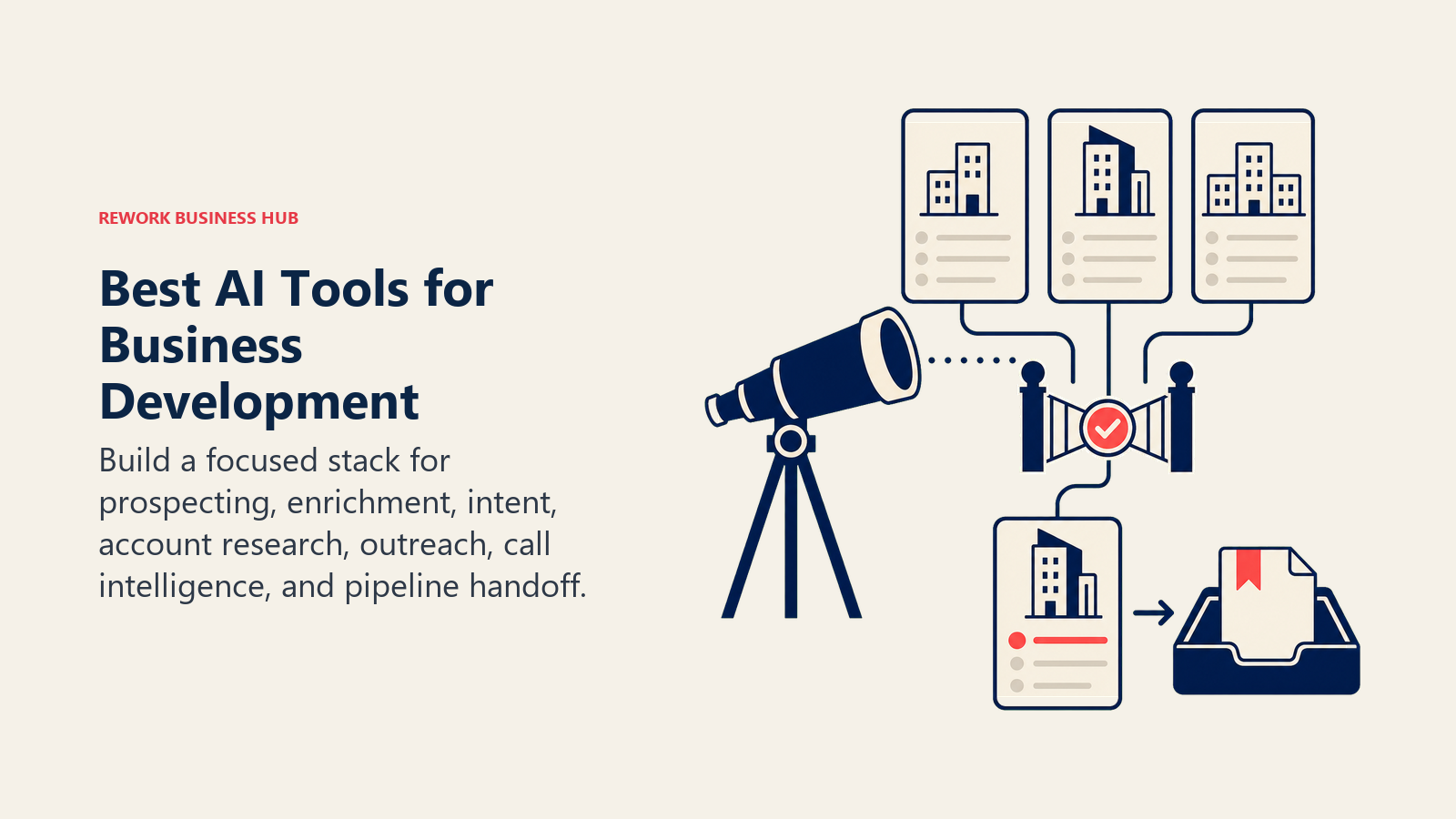
Apollo.io and Clay lead on data and enrichment, ZoomInfo Copilot and Cognism cover enterprise-grade intent and compliance, Perplexity and ChatGPT handle account research and outreach drafting, and a CRM such as Rework covers the pipeline layer those tools feed, for mid-size teams that need routing and handoff rather than another prospecting database. This guide ranks 13 real AI tools for business development, evaluated on data quality, AI capability, real-world adoption, and BD-specific fit.
Business development in 2026 runs on more AI than any other GTM function. Reps use it to find accounts, verify contacts, draft first-touch messages, research buying signals, and summarize discovery calls before the notes ever go cold. The problem isn't a shortage of tools, it's picking the two or three that actually fit your team's stage, budget, and workflow instead of stacking five overlapping subscriptions.
Updated July 2026: What Changed
- Clay overhauled its pricing in March 2026, splitting credits into separate "Data Credits" and "Actions" and dropping enrichment costs 50 to 90 percent per lookup.
- Clearbit is now fully rebranded as Breeze Intelligence inside HubSpot; the standalone product is sunset, so it only works if you already run HubSpot.
- LinkedIn Sales Navigator's AI layer (Account IQ and Lead IQ) moved from a beta add-on into the core Advanced plan.
- ChatGPT Team was renamed ChatGPT Business, and OpenAI cut the standard seat price by $5/month in April 2026.
Key Facts
- 87% of sales organizations now use some form of AI for prospecting, forecasting, lead scoring, or email drafting, per Salesforce's State of Sales report.
- Reps using AI tools save an average of 12 hours a week, and sellers expect AI agents to cut prospect research time by 34% once fully rolled out, per Salesforce's State of Sales report.
- Teams that used AI in the past year saw 83% revenue growth, compared to 66% for teams that didn't, per Salesforce's State of Sales report.
- 41% of enterprise B2B teams had at least one AI SDR running in production in Q1 2026, up from just 12% a year earlier, per Salesforce's State of Sales report.
- 60% of B2B software teams already use AI somewhere in their sales process, per G2's 2026 State of AI Sales Intelligence in Prospecting report.
Quick Comparison Table
| Tool | Best For | Standout Capability | Starting Price | Free Tier? |
|---|---|---|---|---|
| Apollo.io | All-in-one prospecting database + sequencer | 210M+ contact database with built-in AI research and sequencing | Free tier; paid from $49/user/mo (annual) | Yes |
| Clay | Ops-forward teams building custom enrichment workflows | Waterfall enrichment across 100+ data providers via AI agents | Free tier; paid from $167/mo (annual) | Yes |
| ZoomInfo Copilot | Enterprise teams wanting maximum data depth + AI signal surfacing | AI account research that flags buying signals across a company | Custom, Copilot bundled in Elite (~$39,995/yr) | Limited free (Lite) |
| Cognism | GDPR-compliant outbound in Europe and the US | Phone-verified mobile numbers + AI-scored intent topics | Custom quote-based | No |
| Rework | Mid-size BD teams needing CRM + pipeline behind their data tools | Lead scoring, SLA routing, and chat inbox on one record (no contact data) | From $69/mo billed yearly (Sales Engine, 5 seats); $159/mo with lead routing (Revenue Engine) | No (14-day trial) |
| Lusha | Fast, lightweight contact lookups for individual BDRs | Browser extension pulls verified contact data in one click | Free (40 credits/mo); paid from ~$37/mo | Yes |
| Crunchbase | Targeting accounts by funding stage and growth signals | AI-generated company growth and funding-event alerts | Free (limited); Pro $99/mo | Yes |
| Clearbit (Breeze Intelligence) | HubSpot shops wanting native visitor ID + enrichment | Identifies anonymous website visitors and auto-enriches records | From $45/mo (requires HubSpot) | No |
| LinkedIn Sales Navigator | Social selling and warm-path prospecting | AI-generated Account IQ and Lead IQ summaries | Core from $119.99/mo | No |
| Perplexity | Fast account and market research with cited sources | Real-time web research with inline citations | Free; Pro ~$20/mo; Enterprise Pro $40/mo/seat | Yes |
| ChatGPT | Drafting outreach, summarizing research, brainstorming angles | GPT-5.5 with Deep Research and 60+ connectors on Business plan | Free; Plus $20/mo; Business $20/user/mo (annual) | Yes |
| Gong | Capturing and analyzing BD-to-AE handoff calls | AI-surfaced buying signals and objection patterns across calls | Custom, roughly $1,400 to $1,600/user/yr + platform fee | No |
| Otter.ai | AI notetaking for discovery and qualification calls | Live transcription + AI meeting summaries and action items | Free (300 min/mo); Pro $8.33/user/mo (annual) | Yes |
How to Choose an AI Tool for Business Development
Most BD teams buy AI tools backwards: they demo the flashiest AI feature first and only later ask what problem it solves in their actual pipeline. Before adding a tool, map it against three questions.
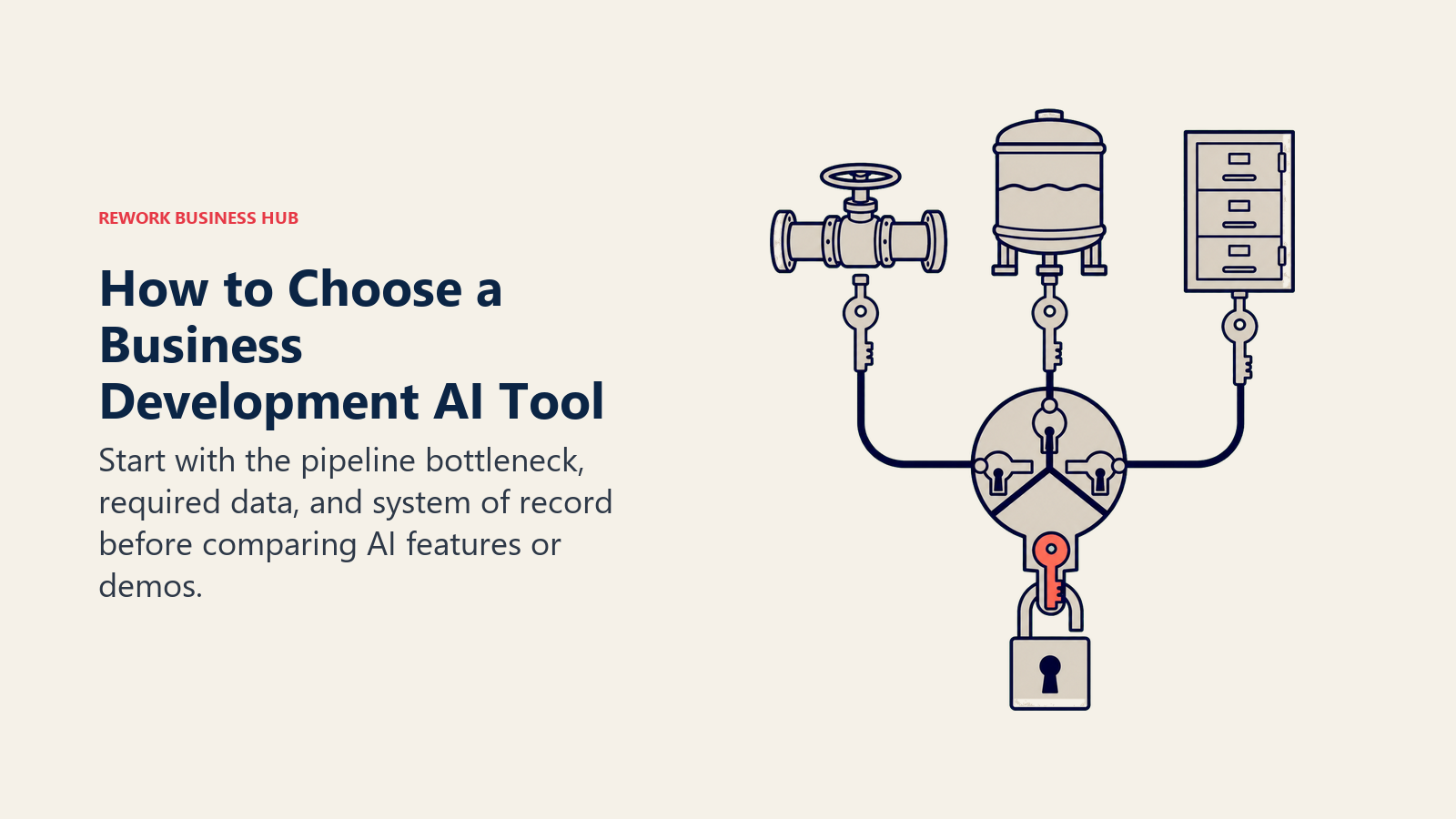
- What stage of the BD motion does it touch? Sourcing and targeting need a data tool (Apollo, ZoomInfo, Cognism, Crunchbase). Enrichment and workflow automation need Clay or Clearbit. Research and message drafting need Perplexity or ChatGPT. Call capture and coaching need Gong or Otter. Pipeline and handoff need a CRM like Rework. Most teams need at least one from three of these categories, not one tool that claims to do all five.
- How big is your BD team, and who owns the data? A 2-person BD function at a startup needs a lean stack (one prospecting tool, one research assistant). A 20-person BD org needs shared data governance, which is where per-seat contact tools start creating duplicate spend across reps unless something like a CRM sits on top to dedupe and route.
- Is the AI feature core to the product, or bolted on? Some vendors ship a genuinely new AI capability (Clay's waterfall enrichment agents, ZoomInfo Copilot's signal surfacing). Others slapped a chatbot on an existing product. Test the AI feature against a real account before buying, not a demo account the vendor pre-loaded with clean data.
Reading a BDR/SDR tools and tech stack breakdown before you shortlist helps separate the tools that change how BD actually works from the ones that just add a line item.
Framework: By BD Function
| If your main pain is... | Reach for... | Why |
|---|---|---|
| Finding the right accounts and contacts | Apollo.io, ZoomInfo Copilot, Cognism, Lusha | Core data platforms with the widest contact coverage |
| Enriching and routing messy, incomplete data | Clay, Clearbit/Breeze | AI-driven waterfall enrichment and workflow automation |
| Researching accounts before outreach | Perplexity, Crunchbase | Live web research with citations and funding/growth signals |
| Drafting and personalizing outreach at scale | ChatGPT, Apollo.io | LLM drafting plus sequence automation in one workflow |
| Capturing and coaching discovery calls | Gong, Otter.ai | Call transcription, AI summaries, and pattern surfacing |
| Owning the pipeline once a lead is qualified | Rework | CRM, scoring, and routing on one contact record |
Framework: By Team Size
| Team Size | What You Need | Best Fits |
|---|---|---|
| 1-4 BDRs, no CRM yet | One prospecting tool + a spreadsheet | Apollo.io free/Basic, Lusha free, ChatGPT free |
| 5-15 BDRs, first real process | Prospecting + enrichment + a lightweight CRM | Apollo.io, Clay, plus a CRM such as Rework |
| 15-50 BDRs, cross-functional handoff to AE | Data platform + call intelligence + unified CRM | Cognism/ZoomInfo, Gong, plus a CRM such as Rework (Revenue Engine plus seat blocks) |
| 50+ BDRs, enterprise governance | Full stack with SSO, data controls, custom contracts | ZoomInfo Copilot Elite, Gong, Salesforce/HubSpot ecosystem tools |
1. Apollo.io: All-in-One Prospecting Database and Sequencer
Apollo built its following by bundling a 210 million-plus contact database with email sequencing and a dialer in one affordable platform. For a BD team standing up outbound from zero, that all-in-one pitch is genuinely useful, you don't need to stitch three tools together on day one.
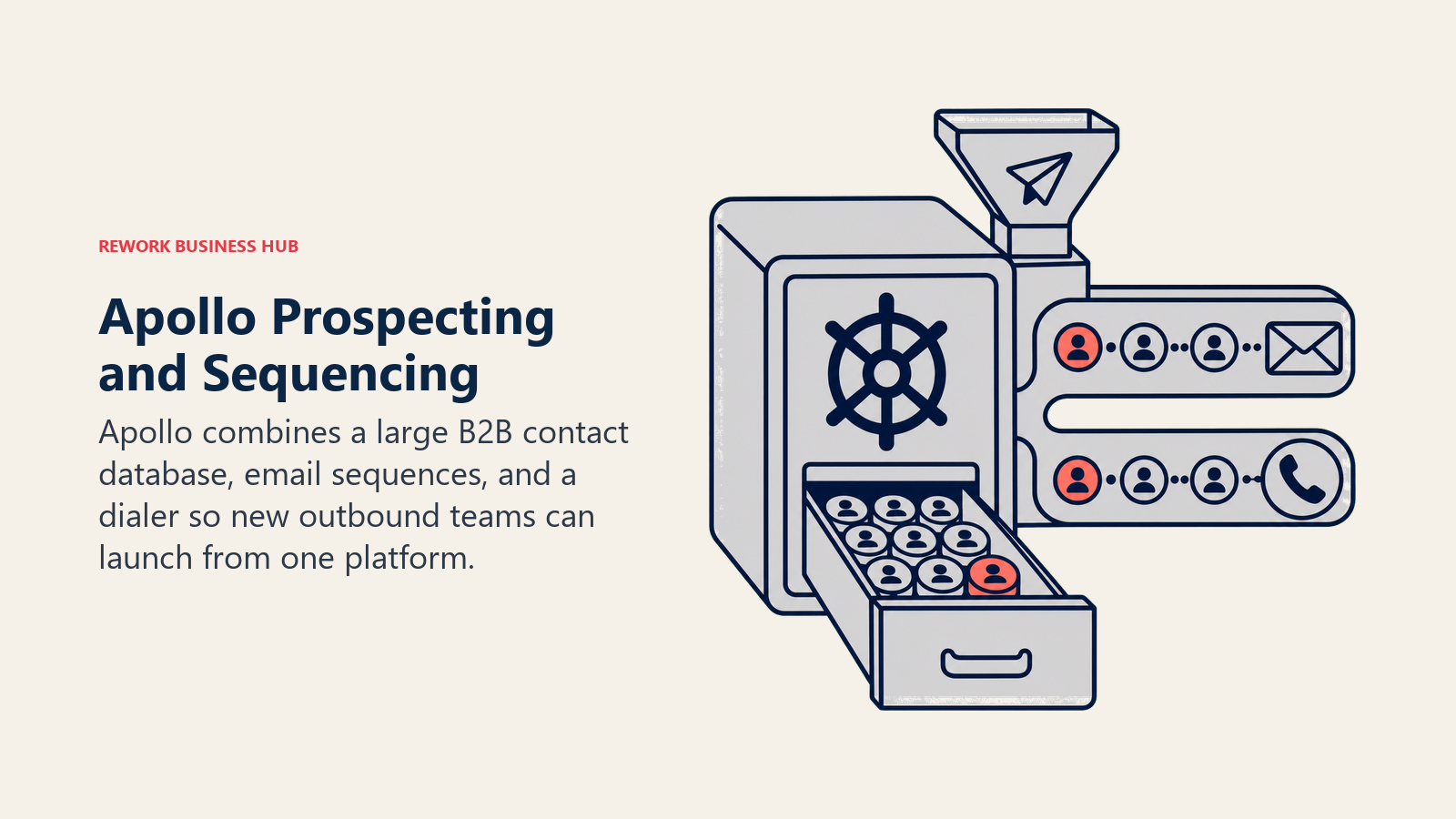
The AI layer has grown fast: Apollo now ships AI-assisted email writing, intent signals, and research summaries alongside the core search and sequence tools. The free plan is real (fair-use unlimited email sends, 5 mobile credits, 10 export credits monthly), which makes it a common first stop for a new BD hire before the team commits to a paid tier.
| What you get | What you don't |
|---|---|
| Largest accessible contact database at this price point | Data accuracy dips on smaller or newer companies |
| AI email writing and intent signals built in | Sequence builder is thinner than dedicated engagement platforms |
| Real free tier, not just a trial | Credits don't roll over; heavy enrichment burns through them fast |
Pricing: Free tier available. Basic $49/user/mo (annual, $59 monthly). Professional $79/user/mo (annual), unlimited sequences including A/B testing. Organization $119/user/mo (annual, 3-user minimum), adds international dialer and custom reports. See apollo.io/pricing.
Best for: Early-stage BD teams standing up their first outbound motion without a big budget. If you've outgrown it, the best Apollo.io alternatives guide covers where teams go next.
2. Clay: AI-Powered Enrichment and Workflow Automation
Clay's bet is that BD teams don't need one giant database, they need a way to combine dozens of data sources with AI agents that decide, row by row, which source to trust. That "waterfall enrichment" model runs a lead through multiple providers until it finds a verified email or phone number, then hands off to a workflow that can draft a personalized message using an LLM.
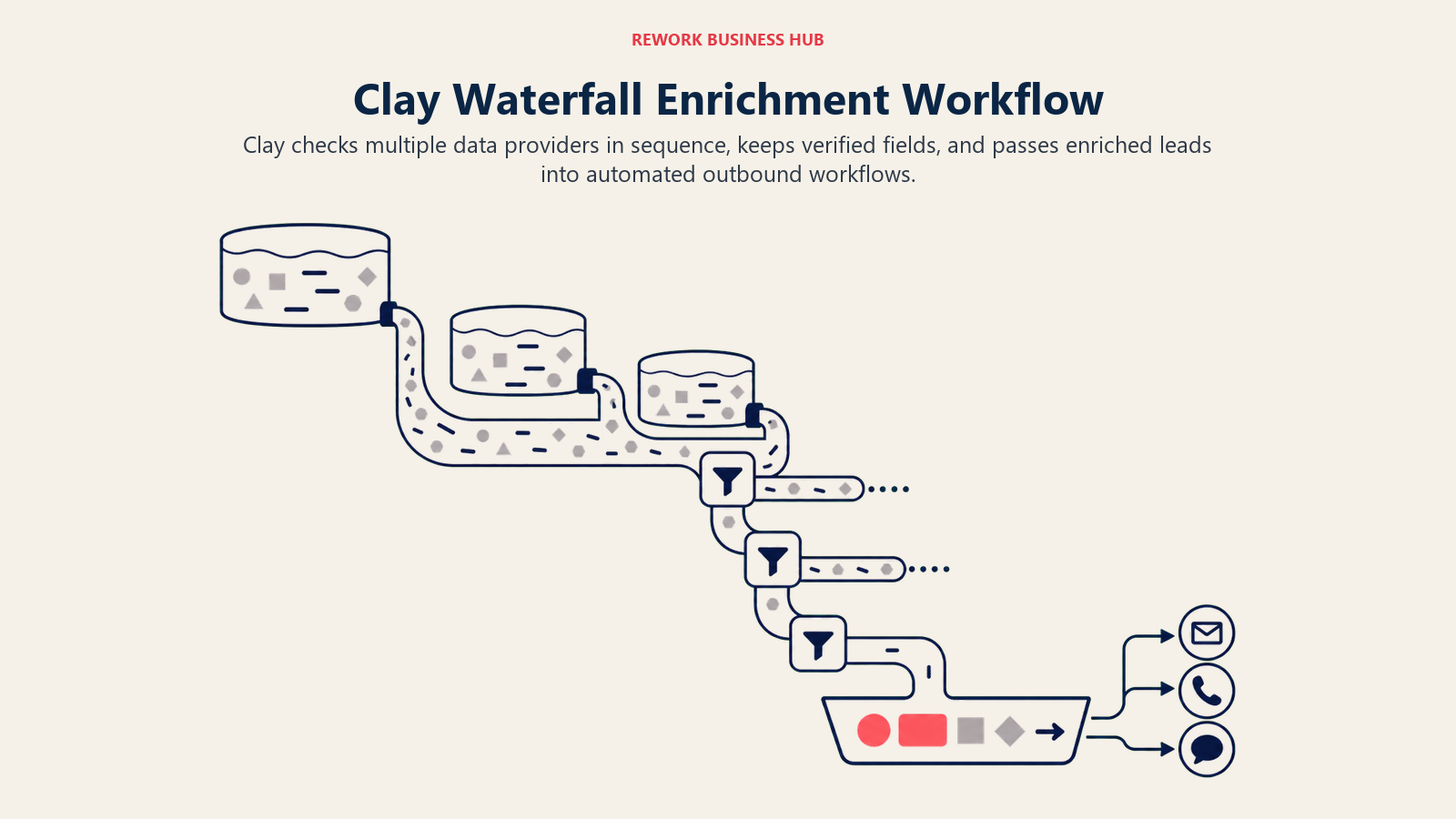
Clay overhauled pricing in March 2026, splitting credits into Data Credits (buying enrichment data) and Actions (running workflows), and cut per-lookup data costs 50 to 90 percent in the process. That makes it meaningfully cheaper to run large enrichment jobs than it was a year ago, but the learning curve is real: Clay is closer to a no-code automation tool than a plug-and-play prospecting app.
| What you get | What you don't |
|---|---|
| Enrichment across 100+ data providers with AI-driven fallback logic | Steep learning curve, not point-and-click like Apollo or Lusha |
| Native CRM auto-sync starting at the Growth tier | Enterprise contracts get expensive fast at real volume |
| AI agents that draft personalized outreach from enriched data | Requires ops time to build and maintain workflows |
Pricing: Free tier (100 Data Credits, 500 Actions/mo). Launch $167/mo (annual, $185 monthly), 2,500 Data Credits. Growth $446/mo (annual, $495 monthly), 6,000 Data Credits and 40,000 Actions. Enterprise custom, median contracts around $30,400/year per Vendr benchmark data. See clay.com/pricing.
Best for: Ops-forward BD teams with someone who owns workflow-building, or teams already outgrowing Apollo's enrichment depth.
3. ZoomInfo Copilot: Enterprise-Grade AI Signal Surfacing
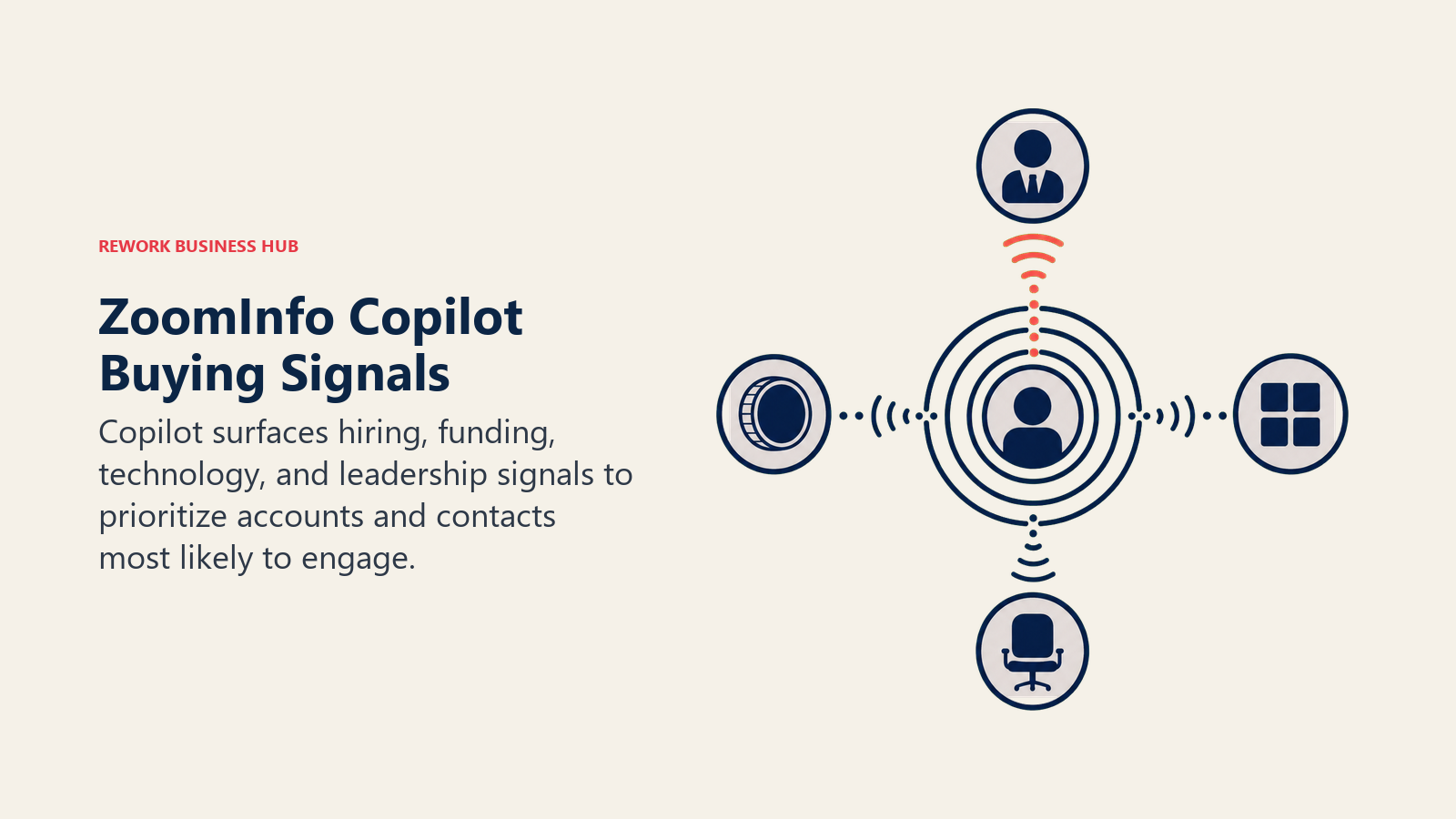
ZoomInfo built the deepest B2B contact and company database on the market, and Copilot is the AI layer sitting on top of it: it flags buying signals (hiring surges, funding events, tech-stack changes, leadership moves) across an account and surfaces which contacts are most likely to engage right now. For enterprise BD teams targeting large accounts, that signal-surfacing is the actual differentiator over raw contact lookups.
Pricing is not published; ZoomInfo sells entirely through custom quotes. Third-party benchmarks put base plans around $14,995 to $39,995 a year depending on tier, with Copilot access typically bundled into the Advanced and Elite plans. Most teams end up paying $30,000 to $60,000 a year once seats, data credits, and add-ons like intent data are factored in, so this is priced for teams with real budget, not early-stage BD.
| What you get | What you don't |
|---|---|
| Deepest US database coverage of any tool on this list | Pricing is opaque; expect real negotiation |
| AI-surfaced buying signals, not just static contact data | Overkill and overpriced for teams under ~20 reps |
| Copilot Access included in higher tiers | Extra data credits and intent add-ons stack costs quickly |
Pricing: Custom, quote-based. Third-party benchmarks: Professional ~$14,995/yr, Advanced ~$24,995/yr, Elite (includes Copilot) ~$39,995/yr, real total cost commonly $30,000-$60,000/yr with add-ons.
Best for: Enterprise BD orgs with 50+ reps and dedicated budget for the deepest data available. If you're weighing it against a lighter alternative, Apollo AI vs ZoomInfo Copilot covers the tradeoff directly.
4. Cognism: GDPR-Compliant Contact Data and AI-Scored Intent
Cognism's whole pitch is compliance-first data, which matters a lot for BD teams prospecting into Europe. Phone-verified mobile numbers, diligence around GDPR sourcing, and AI-scored intent topics (flagging accounts actively researching a category) make it the default pick for teams that got burned by compliance gaps in a cheaper US-centric tool.
Pricing is entirely custom, sold as Grow (formerly Platinum) and Elevate (formerly Diamond) tiers, each with 5 seats included and a credit system where 1 credit reveals 1 contact. Real contracts for a 5-seat team commonly land in the $15,000 to $37,000+ range depending on tier and how many intent topics you add.
| What you get | What you don't |
|---|---|
| Phone-verified mobiles and strong GDPR/compliance posture | No published pricing; every deal is negotiated |
| AI-scored intent topics for account prioritization | Smaller raw database than ZoomInfo in the US market |
| Grow and Elevate tiers scale with team size | Intent topics are a separate line item ($200-$400 each/yr) |
Pricing: Custom, quote-based. Real-world benchmarks: Grow tier roughly $1,500-$10,000/yr, Elevate roughly $2,550-$25,000+/yr, with a 5-seat team commonly quoted $22,000-$37,000/yr depending on tier and intent add-ons.
Best for: BD teams prospecting into the UK/EU where GDPR compliance is non-negotiable, or teams that need phone-verified mobile numbers specifically.
5. Rework: The CRM and Lead-Routing Layer Your Prospecting Tools Feed
Rework isn't a prospecting database, and on this guide's first criterion, data quality, it has nothing to offer: no contact data, no enrichment, no intent signals. That's why it sits below the four data and enrichment platforms above. It earns a place because this guide also covers pipeline, and Rework is the operating layer BD teams plug Apollo or Clay into once leads stop fitting in a spreadsheet: fit-and-intent lead scoring, round-robin, territory and SLA-based routing, and a chat inbox (WhatsApp, Messenger, Instagram, Telegram, Zalo, live chat) on the same record, so a BDR's touch and an AE's follow-up live in one timeline.
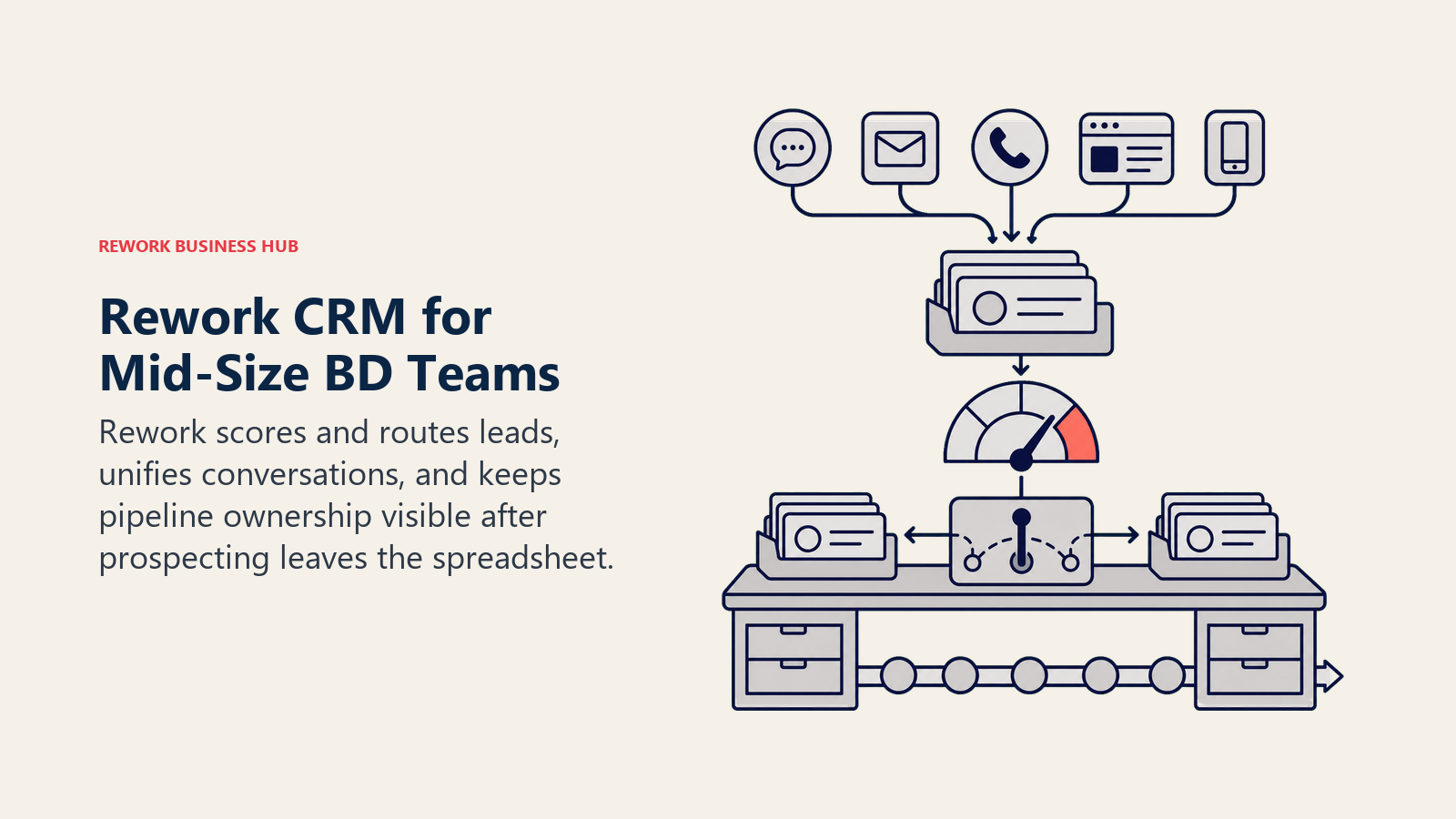
For BD teams, the gap it closes is what happens after a data tool hands you a list. Most teams import that list into a spreadsheet, assign it manually, and lose visibility the moment a rep goes on PTO. Rework captures the lead, scores it, routes it by SLA rules, and keeps the prospecting strategy tied to a pipeline stage instead of a static list. The AI is copilot-style: the Sales copilot summarizes deal status, risk, and next step and drafts tasks, notes, and field updates for a rep to confirm, and chat AI agents can answer inbound questions. There's no AI account research or signal surfacing of the kind ZoomInfo Copilot or Sales Navigator offer.
| What you get | What you don't |
|---|---|
| Lead scoring, SLA-based routing, and pipeline on one record | No contact database; still need Apollo, ZoomInfo, or Cognism for sourcing |
| Chat inbox for BD-to-AE handoff on messaging apps | No AI account research or buying-signal detection |
| Pipeline, forecast, and quotas tied to BD activity | Not a call intelligence tool (pair with Gong or Otter for that) |
| Engine pricing with 5 seats included, extra seats in blocks of 5 | Less deep than Salesforce for complex, highly customized orgs |
Pricing: the Sales Engine (pipeline) is $69/month billed yearly ($828/year) or $80 month to month, with 5 sales seats included; extra seats come in blocks of 5 at $21/month per block on yearly billing. Lead capture, scoring, routing, and the chat inbox need the Marketing Engine ($99/month billed yearly) or the Revenue Engine, which bundles both, at $159/month billed yearly. 14-day free trial, no free plan. See rework.com/pricing.
Best for: 20-500 person teams where BD hands off to AE inside a shared pipeline, especially B2B SaaS, professional services, real estate, and education.
Not ideal for: Solo BD reps, teams under 5 people, or anyone whose only need is a prospecting database.
6. Lusha: Fast, Lightweight Contact Enrichment
Lusha solves one problem well: a BDR looking at a LinkedIn profile who needs a verified email or phone number in one click. The browser extension pulls contact data without leaving the page, and the credit-based pricing makes it cheap to try before committing a whole team.
It's not trying to be a full prospecting platform. There's no built-in sequencer, no AI drafting, and workflow depth is thin compared to Apollo or Clay. For individual reps or small teams who just need reliable, fast contact lookups, that simplicity is the point.
| What you get | What you don't |
|---|---|
| Fast, accurate one-click contact lookups via browser extension | No native sequencing or outreach automation |
| Real free tier (40 credits/month) | Phone reveals cost more credits than email (10 vs 1) |
| Lower cost of entry than Apollo or ZoomInfo | Limited AI beyond basic data matching |
Pricing: Free (40 credits/mo). Starter $37.45/mo (annual, $49.90 monthly), ~400 credits. Pro $52.45/mo (annual), ~600 credits. Premium $299.95/mo (annual), ~3,400 credits. Scale is custom. See lusha.com/pricing.
Best for: Individual BDRs or small teams that need quick, accurate contact lookups without buying a full platform.
7. Crunchbase: Company and Funding Intelligence for Targeting
Crunchbase isn't a contact database, it's a company intelligence platform. BD teams use it to build target account lists based on funding stage, growth signals, leadership changes, and industry category, then hand that list to a contact tool like Apollo or Lusha to find the actual people. The AI layer summarizes company trajectories and flags growth signals worth acting on.
For BD teams selling into venture-backed startups or tracking M&A activity, Crunchbase's funding data is more current and more structured than what you'd piece together from news searches.
| What you get | What you don't |
|---|---|
| Structured funding, growth, and leadership-change data | No contact-level data; pair with a prospecting tool |
| AI-generated company summaries and growth alerts | Free tier is genuinely limited (partial search results) |
| Good for building account lists by funding stage | Enterprise pricing is custom and not cheap |
Pricing: Free (limited search results). Pro $99/mo or $588/year. Enterprise custom, typically five figures annually depending on seats and API access. See crunchbase.com.
Best for: BD teams targeting venture-backed or high-growth companies where funding stage and growth signals drive account prioritization.
8. Clearbit (Breeze Intelligence): Website Visitor ID Inside HubSpot
Clearbit is now fully absorbed into HubSpot as Breeze Intelligence, and the standalone product is being sunset. What's left is a genuinely useful capability for HubSpot-using BD teams: identifying anonymous website visitors and auto-enriching form-fill and chat records with firmographic data, which shortens forms and speeds up lead qualification.
The catch is real: you need a HubSpot subscription to use it at all, and pricing scales with your HubSpot tier on top of the Breeze credit packs. Teams not already on HubSpot should look elsewhere; this only makes sense as an add-on, not a standalone buy.
| What you get | What you don't |
|---|---|
| Native visitor identification inside HubSpot workflows | Requires an active HubSpot subscription, no standalone option |
| Auto-enrichment shortens forms and speeds qualification | Credits expire every 30 days with no rollover |
| Familiar to teams already running HubSpot Marketing/Sales Hub | Costs stack fast once you add HubSpot tier + credit packs |
Pricing: Breeze Intelligence starts at $45/month (annual, $50 monthly) for 100 credits, requires an active HubSpot subscription. Costs scale with HubSpot tier.
Best for: BD teams already running HubSpot who want native visitor ID and enrichment without a separate vendor. If you're not on HubSpot, the best Clearbit alternatives guide covers standalone options.
9. LinkedIn Sales Navigator: AI-Assisted Social Selling
For BD reps, LinkedIn Sales Navigator is still the default way to find warm paths into an account: shared connections, recent job changes, posts a prospect engaged with. In 2026, the AI layer (Account IQ and Lead IQ) generates company and person summaries automatically, pulling together funding news, leadership changes, and recent activity into a briefing a rep can scan before a call.
The Advanced plan adds Buyer Intent Signals (flagging accounts actively researching your category) and CRM-embedded profiles, which start to close the gap with dedicated intent-data tools, at a lower price than Cognism or ZoomInfo.
| What you get | What you don't |
|---|---|
| AI-generated Account IQ and Lead IQ summaries | Data is LinkedIn-only, no email/phone verification |
| Buyer Intent Signals on the Advanced plan | Native CRM sync is locked behind Advanced Plus (custom pricing) |
| Best warm-path prospecting via mutual connections | InMail credits are limited even on paid tiers |
Pricing: Core $119.99/mo ($1,079.88/yr, 25% off annual). Advanced $159.99/mo ($1,799.88/yr), adds Account IQ, Buyer Intent Signals, and Message Assist. Advanced Plus custom, typically $1,300-$1,600/seat/yr, adds native CRM sync. See business.linkedin.com/sales-solutions/compare-plans.
Best for: BD reps prospecting relationship-driven deals where warm intros and social proof matter more than cold data reach.
10. Perplexity: Fast Account Research With Cited Sources
Before a first-touch email or call, a good BDR spends time understanding what a company actually does, what changed recently, and who the likely buyer is. Perplexity turns that research from a 20-minute multi-tab search into a two-minute query, returning a synthesized answer with clickable citations so a rep can verify the source before quoting it in an email.
It's not a sales-specific tool, there's no CRM integration or contact database, but for the "understand this account before I reach out" step, it's faster than any dedicated sales intelligence tool.
| What you get | What you don't |
|---|---|
| Fast, cited research synthesis across live web sources | No native CRM, contact database, or sequencing |
| Enterprise Pro adds org-wide knowledge search and SOC 2 controls | Business-specific sales use cases require manual copy-paste |
| Real free tier for individual use | Team plans add cost fast if not paired with a workflow tool |
Pricing: Free. Pro ~$20/mo (individual). Enterprise Pro $40/mo or $400/year per seat (20% off annual). Enterprise Max $325/mo or $3,250/year per seat. See perplexity.ai/enterprise/pricing.
Best for: BD reps who need fast, source-backed account research before outreach, especially for accounts with sparse CRM history.
11. ChatGPT: Drafting Outreach and Synthesizing Research
ChatGPT's role in BD is less about data and more about output: drafting first-touch emails, rewriting a generic template into something specific to a prospect's role, summarizing a long research thread into three bullet points before a call. The April 2026 model, GPT-5.5, added Deep Research and 60+ connectors on the Business plan, letting reps pull context from Google Drive, Slack, or a CRM directly into a drafting session.
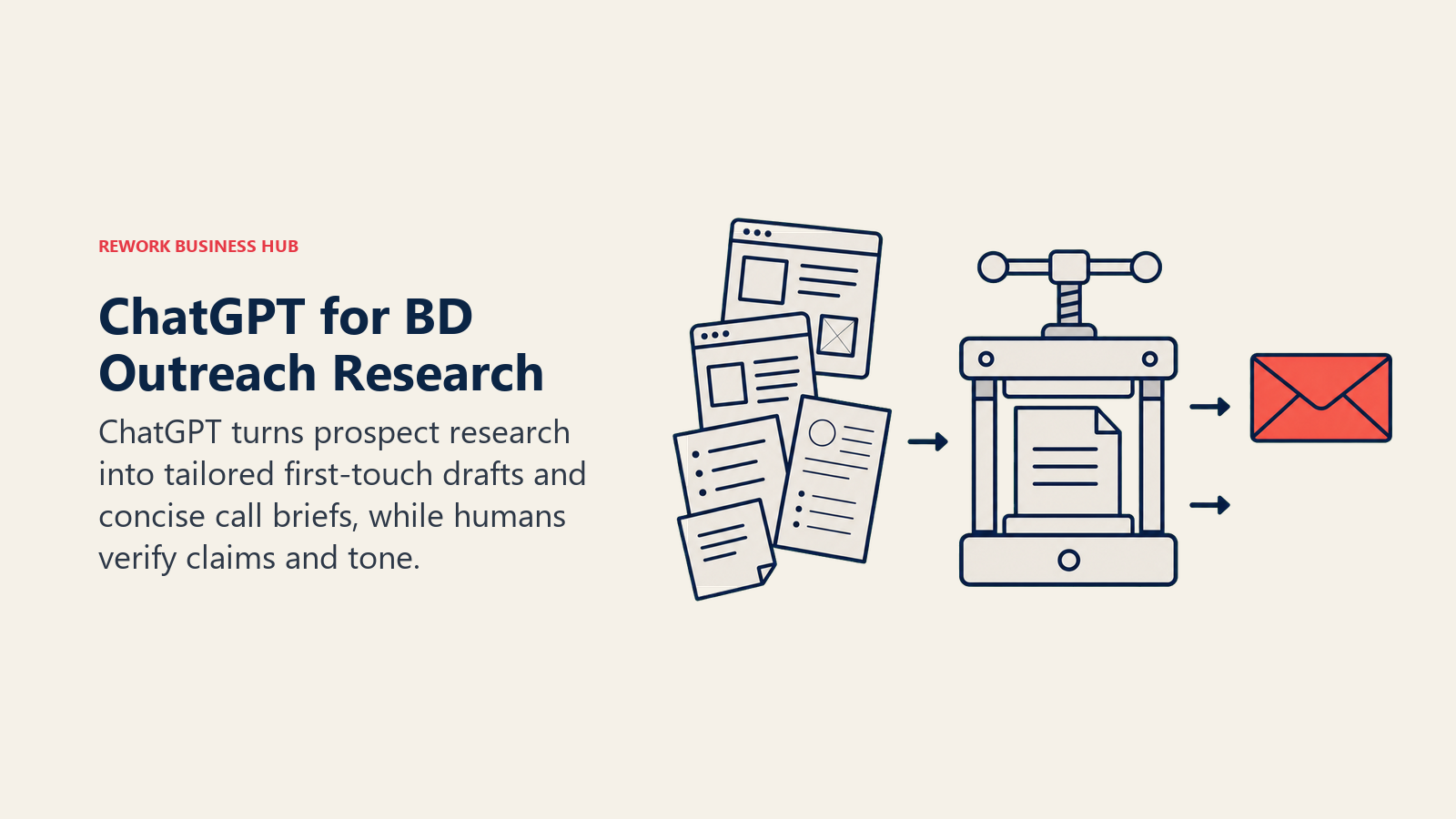
The honest limitation: without a connected data source, ChatGPT is only as good as what the rep pastes in. It doesn't replace a prospecting database, it replaces the blank page once you have the data.
| What you get | What you don't |
|---|---|
| Strong drafting and rewriting for personalized outreach | No native contact database or CRM |
| Deep Research and 60+ connectors on the Business plan | Output quality depends entirely on prompt and input data |
| Business plan has enterprise-grade security controls (SOC 2, SSO) | Enterprise tier pricing isn't published, quote-only |
Pricing: Free. Plus $20/mo (individual). Business $20/user/mo (annual, $25 monthly), 2-seat minimum. Enterprise custom, typically $45-75/user/mo depending on seat count and term. See openai.com/chatgpt/pricing.
Best for: BD teams that already have the data and need to move faster on message drafting, research summarization, and call prep. For a head-to-head against other LLMs, see Claude vs ChatGPT vs Gemini.
12. Gong: Conversation Intelligence for the BD-to-AE Handoff
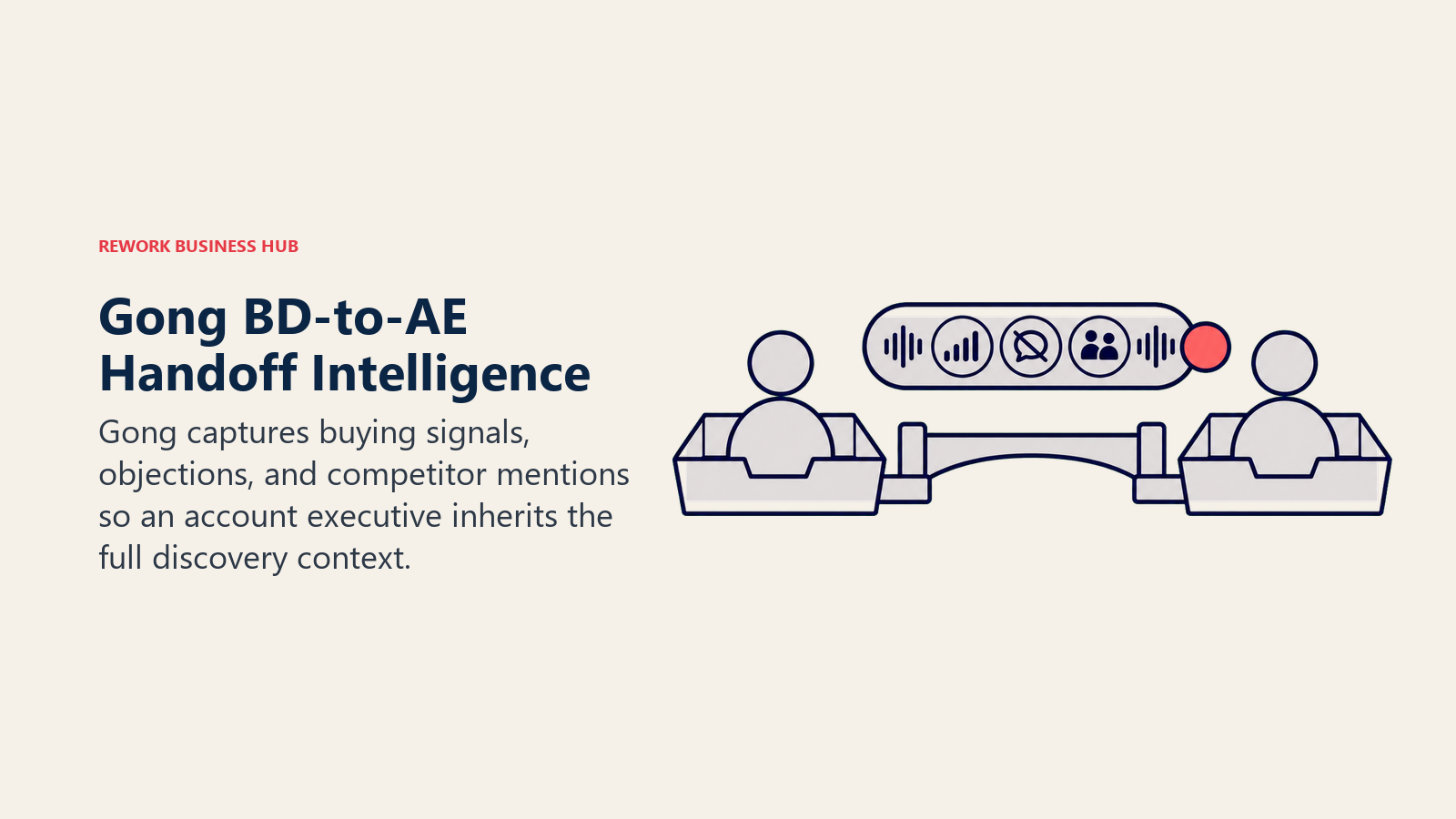
Gong records and analyzes sales calls, and for BD teams specifically, the value shows up at the handoff: when a BDR books a discovery call, Gong's AI flags the buying signals, objections, and competitive mentions that came up, so the AE picking up the deal doesn't start from zero. Over time, that same data trains newer BDRs on what a good qualifying call actually sounds like.
Gong's pricing is genuinely opaque and expensive: a flat platform fee plus a per-user annual license, with mandatory onboarding services on top. It's built for larger revenue orgs (50+ reps) where the coaching and pattern-surfacing pay for themselves; smaller BD teams should look at Otter first.
| What you get | What you don't |
|---|---|
| AI-surfaced buying signals and objection patterns across calls | Expensive at any team size, opaque pricing |
| Strong coaching tool for ramping new BDRs | Overkill for teams under ~20 reps |
| Deal and pipeline visibility tied to actual conversations | Requires real onboarding investment to get value |
Pricing: Custom, quote-based. Reported structure: $5,000 flat base + roughly $1,600/user/year for teams under 50 (declining per-user rate at higher volume), bundled Engage/Forecast packages run $2,880-$3,000/user/year.
Best for: BD orgs of 50+ reps that need conversation-level coaching and a structured handoff to AEs. For lighter options, see the best Gong alternatives.
13. Otter.ai: AI Notetaking for Discovery Calls
Otter is the lightweight alternative to Gong for BD teams that need call transcription and AI summaries without the enterprise price tag. It joins a call, transcribes it live, and generates a summary with action items, so a BDR isn't scrambling to type notes while trying to actually listen to the prospect.
For a BD team's specific use case, that means qualifying calls get logged automatically, and the summary can be pasted straight into a CRM note or handoff email to the AE, no manual transcription required.
| What you get | What you don't |
|---|---|
| Live transcription and AI summaries at a fraction of Gong's cost | No deal-level coaching or pattern analysis across calls |
| Business plan supports unlimited recording, 6,000 min/user/mo imports | 4-hour per-conversation cap even on Business |
| Fast, simple setup, no onboarding project required | Enterprise tier is custom-priced, less transparent |
Pricing: Basic free (300 min/mo). Pro $8.33/user/mo (annual, $16.99 monthly), 1,200 in-app minutes/mo. Business $19.99/user/mo (annual, $30 monthly), unlimited recording, 6,000 imported minutes/user/mo. Enterprise custom. See otter.ai/pricing.
Best for: BD teams that want call capture and summaries without Gong's price or onboarding lift. For a direct comparison, see Otter vs Fireflies vs Fathom.
Pricing at a Glance
| Tool | Free Tier | Entry Paid Price | Enterprise/Top Tier |
|---|---|---|---|
| Apollo.io | Yes | $49/user/mo (annual) | $119/user/mo (annual, Organization) |
| Clay | Yes | $167/mo (annual) | Custom, ~$30,400/yr median (Enterprise) |
| ZoomInfo Copilot | Limited | ~$14,995/yr (benchmark) | ~$39,995/yr (Elite, benchmark) |
| Cognism | No | ~$1,500-$10,000/yr (Grow, benchmark) | ~$2,550-$25,000+/yr (Elevate, benchmark) |
| Rework | No | $69/mo billed yearly (Sales Engine, 5 seats) | Advanced edition from $89/mo billed yearly; Enterprise custom |
| Lusha | Yes | $37.45/mo (annual) | $299.95/mo (annual, Premium) |
| Crunchbase | Yes (limited) | $99/mo | Custom (Enterprise) |
| Clearbit/Breeze | No | $45/mo (annual, requires HubSpot) | Scales with HubSpot tier |
| LinkedIn Sales Navigator | No | $119.99/mo (Core) | Custom (Advanced Plus, ~$1,300-1,600/seat/yr) |
| Perplexity | Yes | ~$20/mo (Pro) | $325/mo/seat (Enterprise Max) |
| ChatGPT | Yes | $20/user/mo (annual, Business) | Custom (~$45-75/user/mo, Enterprise) |
| Gong | No | Custom, ~$1,600/user/yr (benchmark) | Custom (bundled, ~$3,000/user/yr) |
| Otter.ai | Yes | $8.33/user/mo (annual, Pro) | $19.99/user/mo (annual, Business) |
Trends and Outlook for AI in Business Development
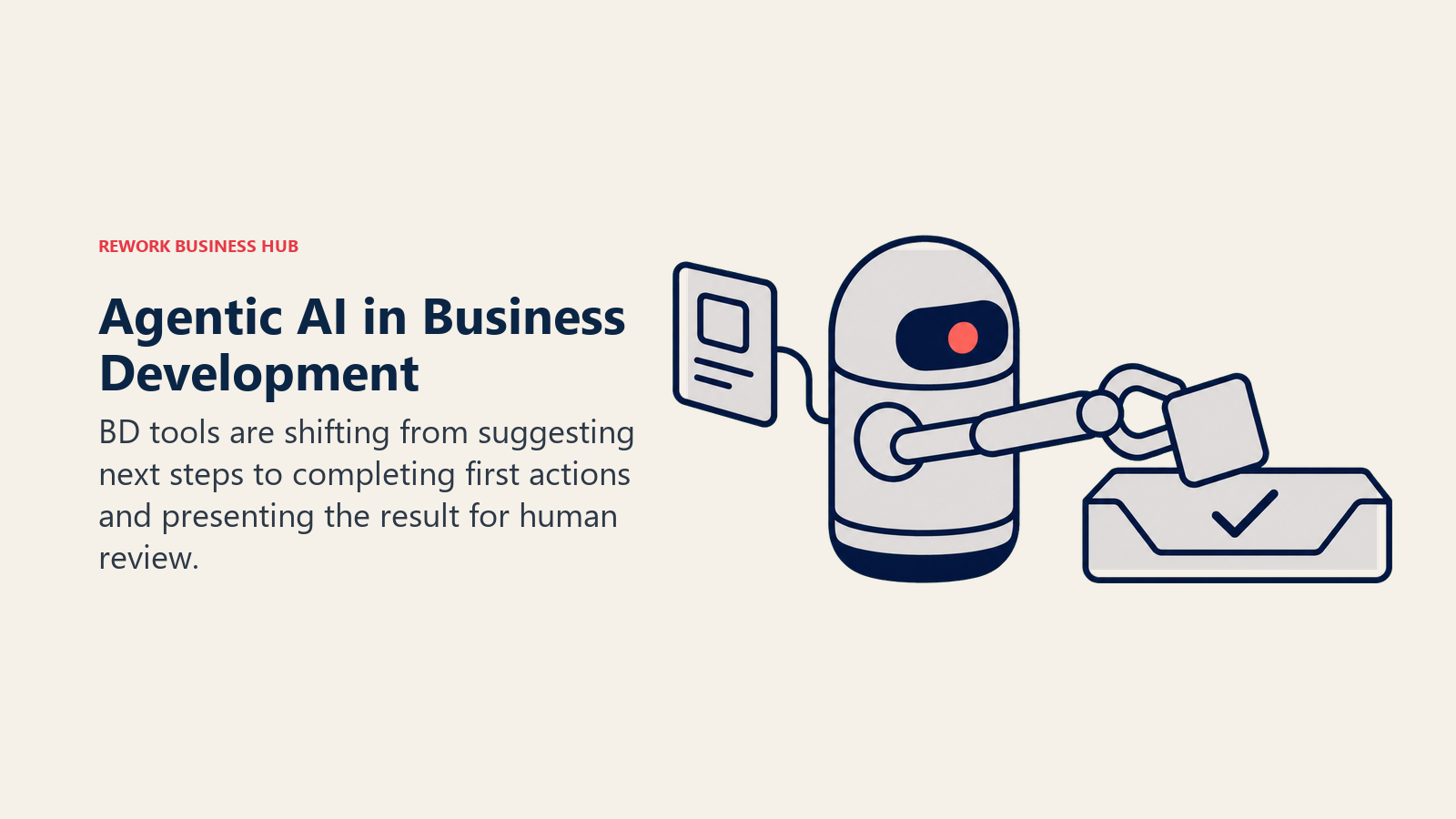
The direction for 2026 is agentic, not just assistive. Tools are moving from "suggest what to do next" toward "do the first step and flag it for review," which is why AI SDR adoption jumped from 12% to 41% of enterprise B2B teams in a single year. Expect pricing compression on raw contact data (Clay's 2026 credit repricing is an early signal) as AI-driven enrichment makes waterfall lookups cheaper to run, while conversation intelligence and signal-surfacing stay premium-priced because they require more infrastructure to run well. The teams winning with this stack aren't the ones buying the most tools, they're the ones connecting prospecting, research, and pipeline into one flow instead of five disconnected logins. Reading up on AI in BDR/SDR prospecting is a good next step if you're still deciding where AI fits your team's actual workflow.
Frequently Asked Questions about AI Tools for Business Development
What is the best AI tool for business development in 2026?
There's no single best tool, it depends on the stage of your BD motion. Apollo.io or Clay for sourcing and enrichment, Perplexity or ChatGPT for research and drafting, Gong or Otter for call capture, and a CRM such as Rework for the pipeline layer once leads need to be scored and routed.
Are there free AI tools for business development?
Yes. Apollo.io, Lusha, Crunchbase, Perplexity, ChatGPT, and Otter.ai all offer usable free tiers, not just trials. They're a reasonable starting point for a small BD team before committing budget to paid plans.
Is Apollo.io or Clay worth it for a small BD team?
Apollo.io is the better starting point for a small team because it bundles data, sequencing, and basic AI drafting in one affordable plan. Clay is worth it once you need custom enrichment workflows across multiple data providers and have someone who can own the setup.
Do AI prospecting tools replace human BDRs?
Not yet, and not fully. AI tools handle research, enrichment, and first-draft messaging faster than a human can, but qualifying a real prospect, reading tone on a call, and adjusting a pitch on the fly still need a person. Per Salesforce's State of Sales report, AI is expected to cut prospect research time by 34%, freeing reps for that human work rather than eliminating the role.
How much should a BD team budget for AI tools in 2026?
A 5-person BD team can run a functional stack (prospecting + research + a light CRM) for under $10,000 a year using Apollo.io, ChatGPT, and Rework's Sales Engine. Enterprise-grade data and call intelligence (ZoomInfo, Cognism, Gong) push that well into five or six figures depending on seat count.
Is my prospect data safe with these AI tools?
Data handling varies by vendor. Cognism markets itself specifically on GDPR compliance, ChatGPT Business and Perplexity Enterprise both carry SOC 2 controls and don't train on your data by default, and CRM platforms like Rework keep contact data in one governed system instead of scattered across per-rep tool logins. Always check a vendor's data processing agreement before loading real prospect data.
What's the difference between a CRM with AI and a standalone AI prospecting tool?
A standalone prospecting tool (Apollo, ZoomInfo, Cognism) finds and enriches contacts. A CRM like Rework takes what those tools find and scores, routes, and tracks it through a pipeline so the lead doesn't die in a spreadsheet after the first outreach attempt. Most BD teams need both, not one instead of the other.
What to Do Next
Pick one tool from the sourcing category and one from the research or call-capture category, not five tools across every category at once. Run a 30-day pilot with your actual target list, not a vendor demo account, and track whether it changes meeting-booked rate before you commit to an annual contract. If your BD team already has a data stack and the gap is what happens after a lead responds, that's the point to look at a pipeline-focused prospecting strategy and a CRM layer like Rework that ties sourcing, scoring, and handoff into one place.

Principal Product Marketing Strategist
On this page
- Updated July 2026: What Changed
- Key Facts
- Quick Comparison Table
- How to Choose an AI Tool for Business Development
- Framework: By BD Function
- Framework: By Team Size
- 1. Apollo.io: All-in-One Prospecting Database and Sequencer
- 2. Clay: AI-Powered Enrichment and Workflow Automation
- 3. ZoomInfo Copilot: Enterprise-Grade AI Signal Surfacing
- 4. Cognism: GDPR-Compliant Contact Data and AI-Scored Intent
- 5. Rework: The CRM and Lead-Routing Layer Your Prospecting Tools Feed
- 6. Lusha: Fast, Lightweight Contact Enrichment
- 7. Crunchbase: Company and Funding Intelligence for Targeting
- 8. Clearbit (Breeze Intelligence): Website Visitor ID Inside HubSpot
- 9. LinkedIn Sales Navigator: AI-Assisted Social Selling
- 10. Perplexity: Fast Account Research With Cited Sources
- 11. ChatGPT: Drafting Outreach and Synthesizing Research
- 12. Gong: Conversation Intelligence for the BD-to-AE Handoff
- 13. Otter.ai: AI Notetaking for Discovery Calls
- Pricing at a Glance
- Trends and Outlook for AI in Business Development
- What to Do Next