Seleção de Padrões por Tipo de Dado: Quais Padrões de AI Funcionam com Seus Dados

Turn this article into takeaways for your work.


Each assistant summarizes the article only for you and suggests best practices for your work.
A seleção de padrões tem dois pontos de entrada.
Você pode começar com o seu problema de negócio e encontrar o padrão que o resolve. Esse é o caminho baseado no problema, abordado em Escolhendo o Padrão de AI Certo para o Seu Problema.
Ou você pode começar com seus dados e encontrar o que é implantável a partir de onde você está. Esse é o caminho baseado nos dados. E geralmente é mais honesto, porque os padrões que parecem empolgantes nas demonstrações de fornecedores nem sempre são os padrões que seus dados atuais conseguem suportar.
Este artigo é o caminho baseado nos dados. Se você sabe quais tipos de dados tem (e em que qualidade), pode estreitar o campo rapidamente. Alguns padrões serão imediatamente implantáveis. Outros exigirão trabalho de dados primeiro. Alguns poucos estarão fora do alcance até que você resolva problemas específicos de pré-requisitos. Para a taxonomia completa de tipos de dados antes de começar, os 7 tipos de dados que alimentam a AI de negócios é o ponto de partida certo.
A matriz de referência
Adequação Forte significa que o padrão usa esse tipo de dado como entrada primária e foi projetado em torno dele. Adequação Fraca significa que o padrão pode usar esse tipo, mas é secundário ou situacional. Impossível significa que o padrão não consegue consumir esse tipo de dado de forma significativa.
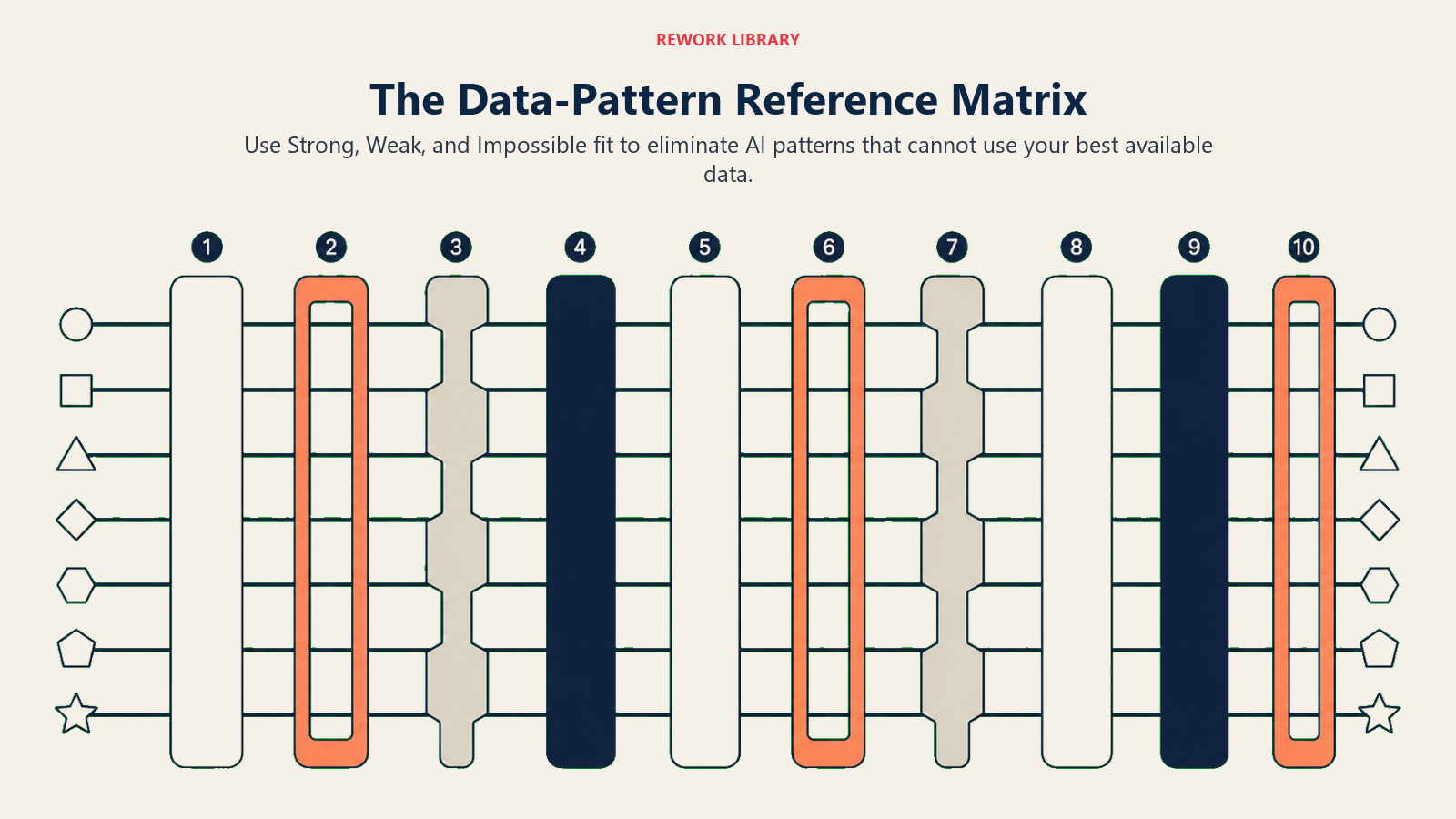
| Tipo de Dado | RAG Asst | Score+Route | Vision Extract | Meeting Intel | Anomaly Agent | Gen Research | Doc Review | Workflow Copilot | Personalization | Autonomous Agent |
|---|---|---|---|---|---|---|---|---|---|---|
| Texto | Forte | Fraca | Fraca | Fraca | Fraca | Forte | Forte | Forte | Fraca | Forte |
| Estruturado | Fraca | Forte | Fraca | Fraca | Forte | Fraca | Fraca | Fraca | Forte | Forte |
| Imagem | Impossível | Impossível | Forte | Impossível | Fraca | Impossível | Fraca | Impossível | Fraca | Fraca |
| Áudio | Impossível | Impossível | Impossível | Forte | Impossível | Impossível | Impossível | Impossível | Impossível | Fraca |
| Vídeo | Impossível | Impossível | Impossível | Forte | Impossível | Impossível | Impossível | Impossível | Impossível | Fraca |
| Código | Fraca | Impossível | Impossível | Impossível | Fraca | Fraca | Forte | Forte | Impossível | Forte |
| Série temporal | Impossível | Forte | Impossível | Impossível | Forte | Impossível | Impossível | Impossível | Forte | Fraca |
Leia isso como um filtro inicial. Se os seus dados primários disponíveis são gravações de áudio, você está olhando para o Meeting Intelligence. Se são registros estruturados de CRM com rótulos de resultado, Scoring and Routing e Anomaly Agent são suas opções mais implantáveis. Ter o tipo de dado é necessário, mas não suficiente. A qualidade e a acessibilidade desses dados determinam se o padrão realmente funciona. A pesquisa da Gartner sobre dados essenciais prontos para AI torna essa distinção clara: dados de "alta qualidade" pelos padrões tradicionais não são o mesmo que dados prontos para AI, porque o treinamento de AI requer dados representativos, incluindo casos extremos que a limpeza de dados tradicional remove. A Gartner prevê que até 2026, as organizações abandonarão 60% dos projetos de AI por falta de prontidão de dados.
Key Facts: Prontidão de Dados e AI Corporativa
- 80 a 90% dos dados corporativos não são estruturados, enquanto apenas 10 a 20% são estruturados, segundo a Gartner. A maioria das empresas superestima amplamente a quantidade de dados estruturados prontos para AI que realmente tem.
- Apenas 10% das empresas se sentem totalmente preparadas para adotar AI, e 54% admitem que não têm a infraestrutura de banco de dados necessária em vigor. (Typedef AI Unstructured Data Report, 2025)
- A Gartner prevê que até 2026, as organizações abandonarão 60% dos projetos de AI por falta de prontidão de dados, não por limitações de modelos.
Dados de texto
Texto é a entrada mais versátil. Quatro padrões o usam como tipo de dado primário.
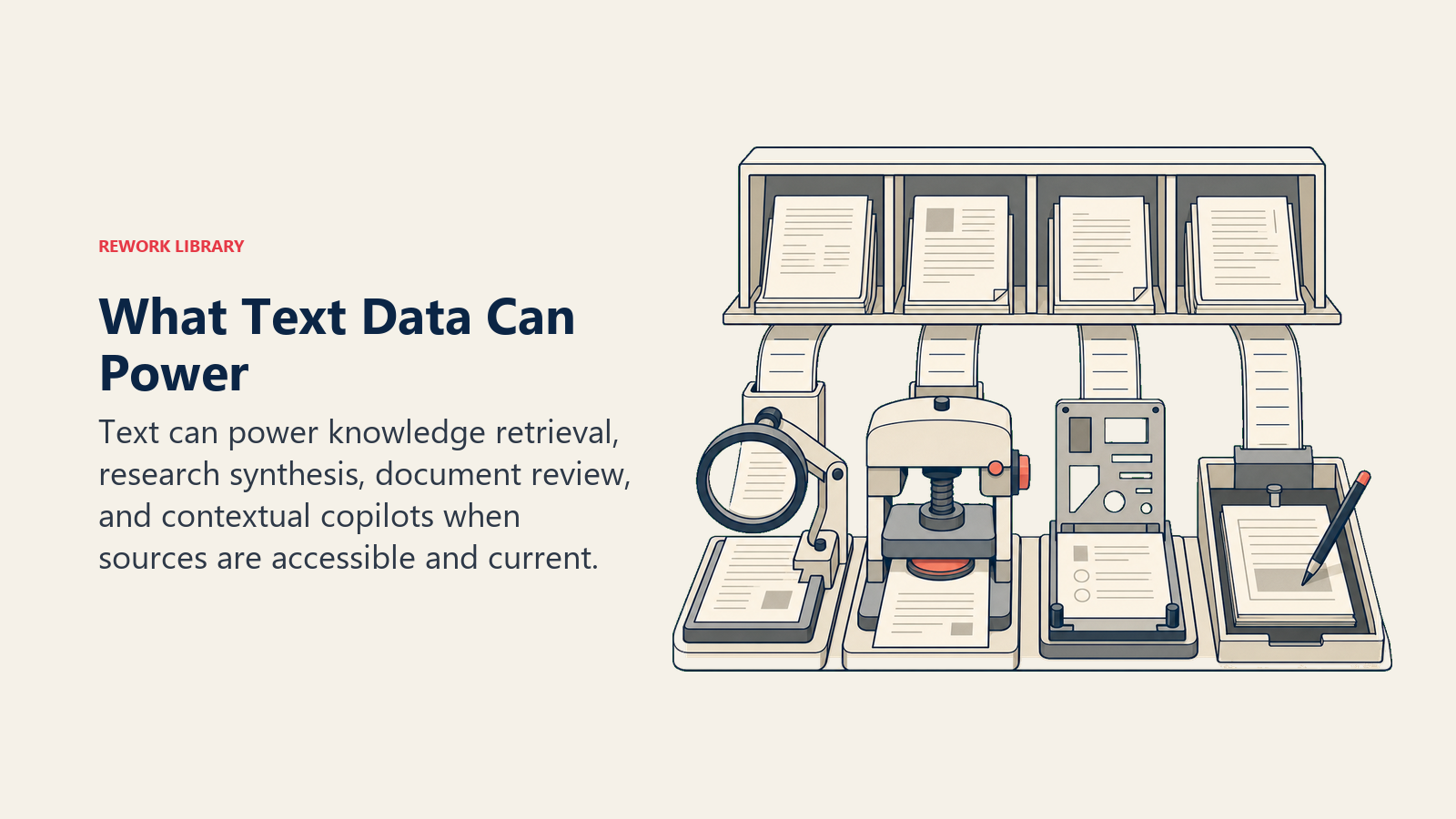
RAG Assistant existe inteiramente em texto. Ele ingere sua base de conhecimento (políticas, SOPs, documentação de produto, tickets antigos), recupera documentos relevantes e gera respostas. Para o RAG funcionar, seu texto precisa ser encontrável (indexado, não espalhado por repositórios de arquivos), recente (documentos desatualizados produzem respostas erradas e confiantes) e não contraditório (dois documentos que dizem coisas opostas produzirão resultados inconsistentes). O padrão tolera bem prosa desordenada, mas quebra em documentos fonte conflitantes.
Generative Research consome texto de múltiplas fontes (web, documentos internos, bancos de dados proprietários) e sintetiza. O requisito de qualidade aqui é diferente do RAG: você precisa de amplitude mais do que estrutura. O padrão consegue lidar com fontes heterogêneas. O que ele precisa é de acesso a essas fontes, seja via API, scraping ou upload direto de documentos.
Document Review requer texto estruturado, não texto conversacional. Um NDA ou um MSA tem seções consistentes e padrões conhecidos de cláusulas. O Generative Research pode trabalhar com uma postagem de blog. O Document Review precisa de documentos que sigam modelos ou padrões. Alimente-o com e-mails de forma livre e sua sinalização se torna ruído.
Workflow Copilot usa qualquer texto que esteja no contexto atual do usuário: o e-mail que está redigindo, o ticket que está resolvendo, as notas do CRM na conta que tem aberta. O requisito de qualidade é frescor contextual, não volume histórico. O copilot precisa de acesso em tempo real ao texto do estado atual, não de um arquivo histórico.
Dados estruturados
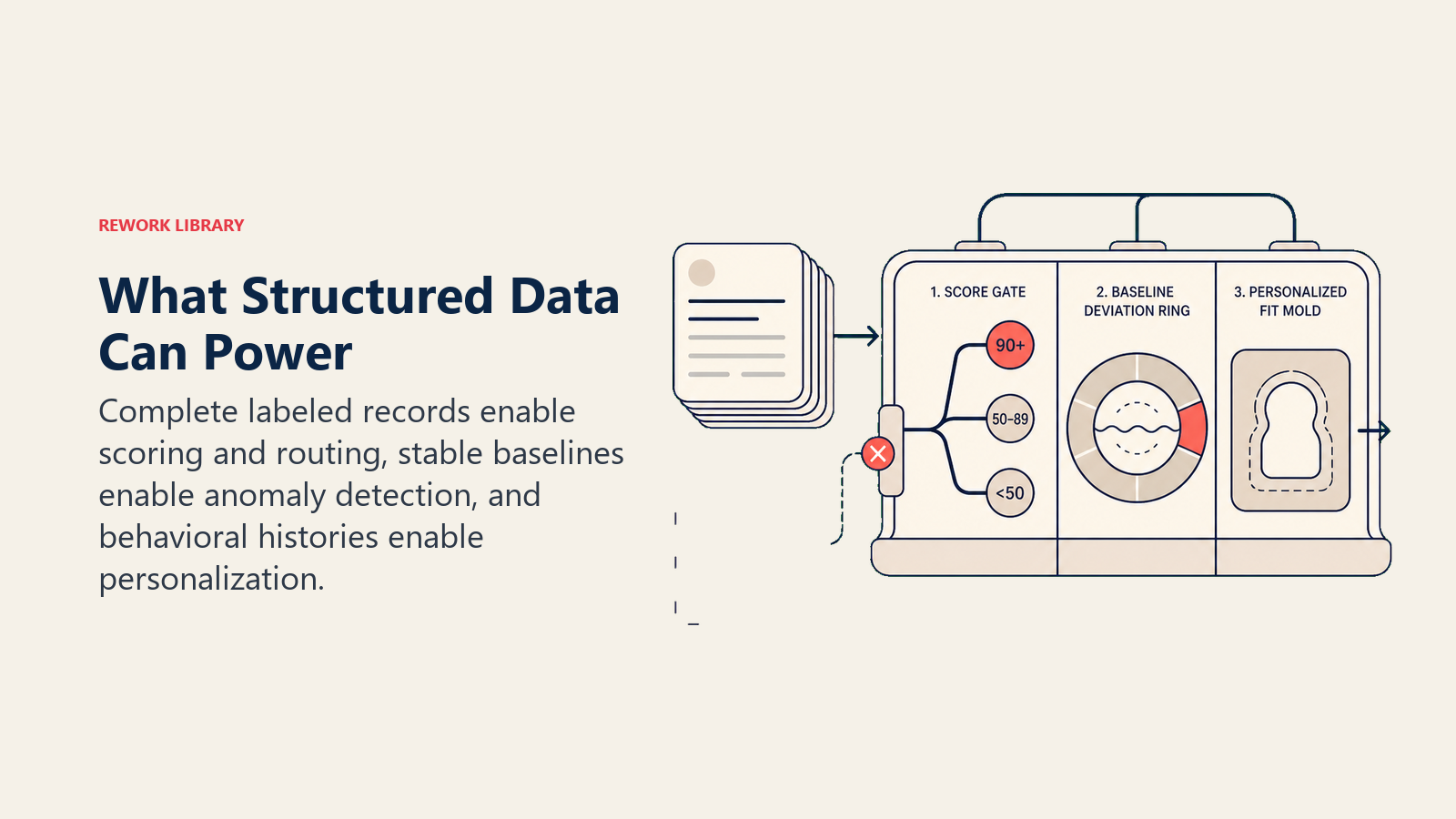
Dados estruturados são números, categorias, datas e registros consistentes com esquema. Três padrões dependem mais diretamente deles.
"Empresas que tentam implantar modelos de Scoring and Routing em conjuntos de dados de CRM com menos de 80% de preenchimento de campos em rótulos de resultado produzem modelos que funcionam como ruído em vez de sinal. Leads com alta pontuação fecham na mesma taxa que leads com baixa pontuação. O problema não é o modelo. É a entrada." (Rework Data Readiness Analysis, 2026)
Scoring and Routing precisa de dados estruturados com três propriedades: volume suficiente (normalmente 1.000+ registros históricos), rótulos de resultado (negócios marcados como ganhos/perdidos, leads marcados como convertidos/não convertidos, sinistros marcados como fraudulentos/legítimos) e integridade dos campos (se 40% dos registros têm valores nulos para características principais, o modelo aprende com sinal incompleto). Este é o padrão mais diretamente bloqueado por higiene incompleta do CRM. Um conjunto de dados estruturados limpo com resultados rotulados é um dos ativos de AI mais valiosos que uma empresa pode ter. A visão geral da Wikipedia sobre dados estruturados fornece a distinção fundamental útil aqui: dados estruturados estão em conformidade com um esquema predefinido, enquanto aproximadamente 90% dos dados corporativos não são estruturados. A maioria das empresas tem muito mais destes últimos e muito menos dos primeiros do que assumem ao planejar projetos de AI.
Anomaly Agent precisa de dados estruturados com uma linha de base estável. Métricas de série temporal, registros de transações, logs de eventos. O modelo aprende como é o "normal" e sinaliza desvios. Requisitos de qualidade: os dados de linha de base precisam estar limpos (anomalias no período de treinamento confundem o modelo), consistentes (os mesmos campos, o mesmo esquema, ao longo do tempo) e suficientemente longos (60 dias no mínimo, um ano inteiro para empresas sazonais).
Personalization Engine usa dados comportamentais estruturados: no que um usuário clicou, o que comprou, quanto tempo ficou em uma página, o que avaliou. O padrão funciona melhor quando os eventos comportamentais são rastreados de forma consistente, cada evento tem um identificador de usuário e há volume suficiente por usuário para construir um perfil individual. Produtos de baixo tráfego ou B2B com poucos usuários frequentemente não conseguem implantar esse padrão de forma eficaz porque não há comportamento suficiente por usuário para personalizar.
Dados de imagem
Imagem é o tipo de dado mais restrito. Um padrão é construído em torno dele. Alguns outros o utilizam situacionalmente.
Vision Extract é o padrão canônico de imagem. Ele ingere imagens ou documentos digitalizados, extrai campos estruturados e envia registros para um sistema de registro. Os requisitos de qualidade aqui são específicos e inegociáveis: a resolução da imagem deve ser alta o suficiente para ler texto claramente, variantes de documentos precisam ser representadas nos dados de treinamento (uma fatura do Fornecedor A parece diferente do Fornecedor B) e os campos alvo precisam ser suficientemente consistentes para que o modelo possa localizá-los de forma confiável. Consulte Vision Extract: Transformando Imagens em Dados Estruturados para padrões detalhados de qualidade.
Personalization Engine pode usar imagens de produtos como sinais de recomendação (se você viu este tênis azul, aqui estão estilos similares). Mas isso é mais uma funcionalidade do que uma capacidade independente. A maioria das implantações de Personalization Engines em mercados médios usa dados comportamentais estruturados, não sinais brutos de imagem.
Anomaly Agent pode sinalizar anomalias visuais (uma prateleira de produto com uma lacuna, uma peça de fabricação com um defeito) em implantações especializadas. Mas isso requer um pipeline dedicado de visão computacional, não uma implantação padrão de AI de negócios.
Dados de áudio
Áudio é quase exclusivo em AI de negócios.
Meeting Intelligence é o padrão de áudio. Ele ingere gravações de áudio de chamadas e reuniões, as transcreve, extrai tópicos e itens de ação, gera resumos e envia dados estruturados para o CRM. Os requisitos de qualidade são práticos: a gravação de chamadas precisa estar habilitada (o que requer consentimento dos participantes em muitas jurisdições), a qualidade do áudio precisa ser suficiente para transcrição (conexões móveis ruins produzem transcrições ruins, que se propagam por cada etapa subsequente) e a diarização de palestrantes (saber qual voz pertence a qual pessoa) importa para atribuição.
A distinção importante: arquivos de áudio e transcrições de áudio são coisas diferentes. Uma implantação de Meeting Intelligence que ingere áudio bruto está executando um pipeline mais complexo do que uma que ingere texto pré-transcrito. Muitas equipes pulam a ingestão de áudio bruto e usam serviços de transcrição (Otter.ai, transcrição do Zoom, transcrição do Teams) como pré-etapa, depois alimentam a transcrição na camada de análise. Essa é uma arquitetura válida e frequentemente mais econômica.
Autonomous Agent pode em princípio consumir áudio (um agente de interface de voz), mas isso é raro em implantações padrão de negócios. A maioria do trabalho autônomo de agentes funciona em entradas de texto ou dados estruturados.
Dados de vídeo
Vídeo é o tipo de dado com maior sobrecarga de processamento e é principalmente relevante como um superconjunto de áudio.
Meeting Intelligence trata chamadas de vídeo. O componente de vídeo adiciona informações visuais (o prospect está acenando? a câmera está desligada?), mas a maioria das ferramentas implantadas de Meeting Intelligence analisa a faixa de áudio e a transcrição, não o fluxo de vídeo. Os recursos específicos de vídeo (sinais de engajamento, pistas visuais) estão presentes em produtos como Gong, mas são secundários à análise do conteúdo da chamada. Se você está escolhendo entre gravação de áudio e gravação de vídeo para Meeting Intelligence, o áudio é suficiente para a maioria dos casos de uso.
A sobrecarga importa: arquivos de vídeo são 10 a 100 vezes maiores do que arquivos de áudio para a mesma duração. Armazenar, processar e indexar vídeo em escala requer significativamente mais infraestrutura do que pipelines somente de áudio. A maioria das equipes implementando Meeting Intelligence pela primeira vez deve começar com áudio.
Autonomous Agent em contextos de navegação visual (um agente de controle de navegador que precisa ver uma tela) usa vídeo ou capturas de tela como entradas. Esse é um padrão de implantação especializado, não um Workflow padrão de AI de negócios.
Dados de código
Código é texto, mas não é prosa. Os padrões que funcionam com código o tratam de forma diferente.
Workflow Copilot é o padrão canônico de código. GitHub Copilot, Cursor e ferramentas similares são Workflow Copilots especializados para um contexto de codificação. Eles ingerem o arquivo aberto no editor, o contexto do repositório e as edições em andamento do usuário, e geram sugestões de conclusão, refatorações e novas funções. Requisitos de qualidade: o código precisa ser acessível à ferramenta (repositório local, integração com IDE), e a janela de contexto importa mais do que com copilots de prosa porque as dependências do código abrangem arquivos.
Document Review se aplica a código em contextos de conformidade ou segurança. Uma auditoria de segurança revisando código em busca de vulnerabilidades OWASP, ou uma revisão jurídica verificando que uma integração de API não viola os termos de um fornecedor, é um Workflow de Document Review aplicado ao código como documento. Ferramentas padrão de revisão de documentos não suportam isso. Você precisa de ferramentas criadas especificamente para análise de código.
Autonomous Agent no extremo de codificação do espectro (agentes que leem issues, escrevem código, executam testes e abrem pull requests) trata o código tanto como entrada quanto como saída. O agente ingere um issue do GitHub (texto + contexto de código), analisa o escopo, gera uma correção e executa o commit e a execução de testes. Esta é uma das aplicações de autonomous agent mais maduras em 2026.
Dados de série temporal
Dados de série temporal são qualquer medição indexada ao tempo: métricas, leituras de sensores, logs de transações, eventos de uso. Três padrões os utilizam.
Anomaly Agent é o padrão primário de série temporal. Ele foi construído para aprender como é uma série temporal estável e sinalizar desvios. Frescor e consistência são os dois requisitos de qualidade que mais importam. Um fluxo de métricas que muda de instrumentação no meio do caminho cria falsas anomalias na mudança de instrumentação. Pontos de dados ausentes (lacunas no fluxo) criam falsos negativos. O modelo trata a lacuna como normal, portanto anomalias que ocorrem durante uma lacuna passam despercebidas.
Scoring + Routing pode incorporar características de série temporal (quantos tickets de suporte nos últimos 30 dias? como o NPS tendeu ao longo dos últimos quatro trimestres?) como entradas para um modelo de scoring. Mas ele precisa que essas séries temporais sejam sumarizadas em características estruturadas primeiro. A série temporal bruta precisa ser pré-processada (agregada, janelada, sumarizada) antes de ser útil como entrada de scoring.
Personalization Engine usa série temporal implicitamente. O histórico de navegação de um usuário ao longo do tempo, sua frequência de compra, seus padrões sazonais: esses são sinais comportamentais de série temporal. O padrão tem desempenho melhor quando consegue ver tendências comportamentais, não apenas um snapshot de um ponto no tempo.
Combinações multimodais
Algumas das implantações mais capazes combinam tipos de dados.
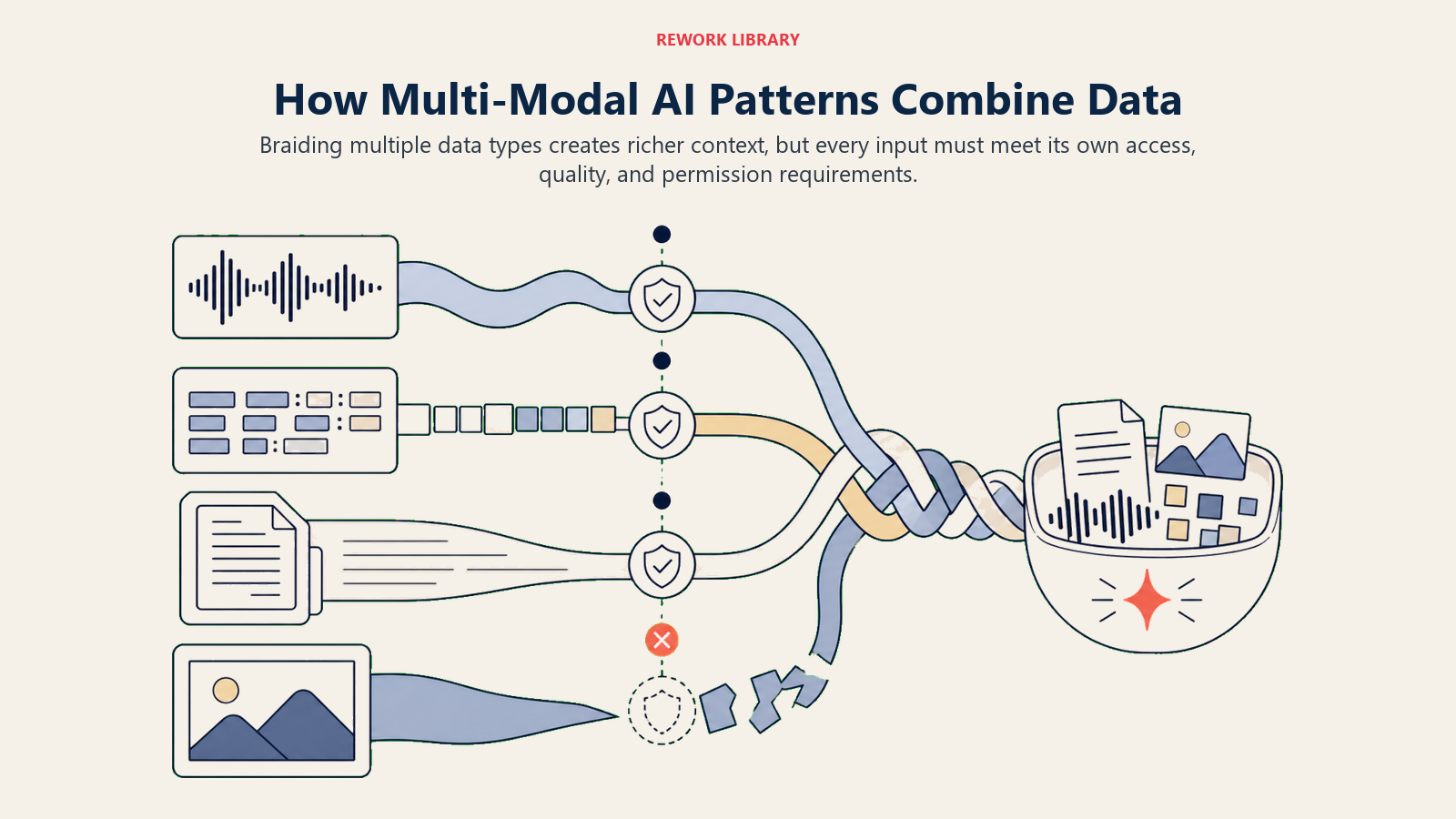
Meeting Intelligence + dados estruturados de CRM: Saber o que foi dito em uma chamada (áudio) é mais poderoso quando combinado com o que o CRM diz sobre a conta (estruturado). Um resumo de chamada que mostra "prospect mencionou preocupação com preço" é mais útil quando o sistema também pode mostrar "esta conta está em estágio de risco há 30 dias." A combinação permite que o passo de Geração produza contexto mais rico.
Personalization Engine + conteúdo de texto: Dados comportamentais estruturados (no que um usuário clicou) combinados com metadados de texto (sobre qual tópico esse conteúdo era) permitem ao mecanismo personalizar no nível de conteúdo, não apenas no nível de item. Em vez de "usuários como você compraram este produto", você obtém "usuários com seu padrão de leitura tendem a se preocupar mais com conformidade do que com preço."
Vision Extract + modelos de sistema de registro estruturado: Saber como é uma fatura no seu modelo de extração funciona melhor quando o modelo também pode consultar seu cadastro de fornecedores para verificar o nome do fornecedor que extraiu. O banco de dados estruturado valida o resultado da extração de imagem.
Combinações multimodais expandem o que é possível, mas multiplicam os requisitos de prontidão de dados. Você precisa de acesso, qualidade e permissões para cada tipo de dado que está combinando.
A Data-Pattern Matrix
A Data-Pattern Matrix é uma ferramenta de decisão que mapeia sete tipos de dados corporativos (texto, estruturado, imagem, áudio, vídeo, código, série temporal) para dez padrões de AI em três classificações de adequação: Adequação Forte (o padrão usa esse tipo de dado como entrada primária), Adequação Fraca (uso secundário ou situacional) e Impossível (o padrão não consegue consumir esse tipo de dado de forma significativa). A matriz funciona como filtro inicial: se seus melhores dados disponíveis não aparecem como entrada de Adequação Forte para o padrão que você está planejando, sua implantação terá desempenho abaixo do esperado independentemente da qualidade do modelo.
Rework Analysis: Com base na descoberta da Gartner de que 80 a 90% dos dados corporativos não são estruturados e que 60% dos projetos de AI com falta de dados prontos para AI são abandonados, a Data-Pattern Matrix aborda o erro de planejamento de AI mais comum: selecionar um padrão com base em sua capacidade de saída em vez de seus requisitos de entrada. Na experiência de implementação da Rework, equipes que executam a matriz em relação aos seus dados realmente disponíveis antes de se comprometer com um padrão reduzem seu tempo até o valor em uma média de 8 semanas, porque evitam a descoberta no meio da integração de que seu tipo de dado primário não suporta o padrão escolhido.
A trilha rápida de prontidão de dados
Se você está procurando o padrão implantável mais rápido a partir de cada tipo de dado:
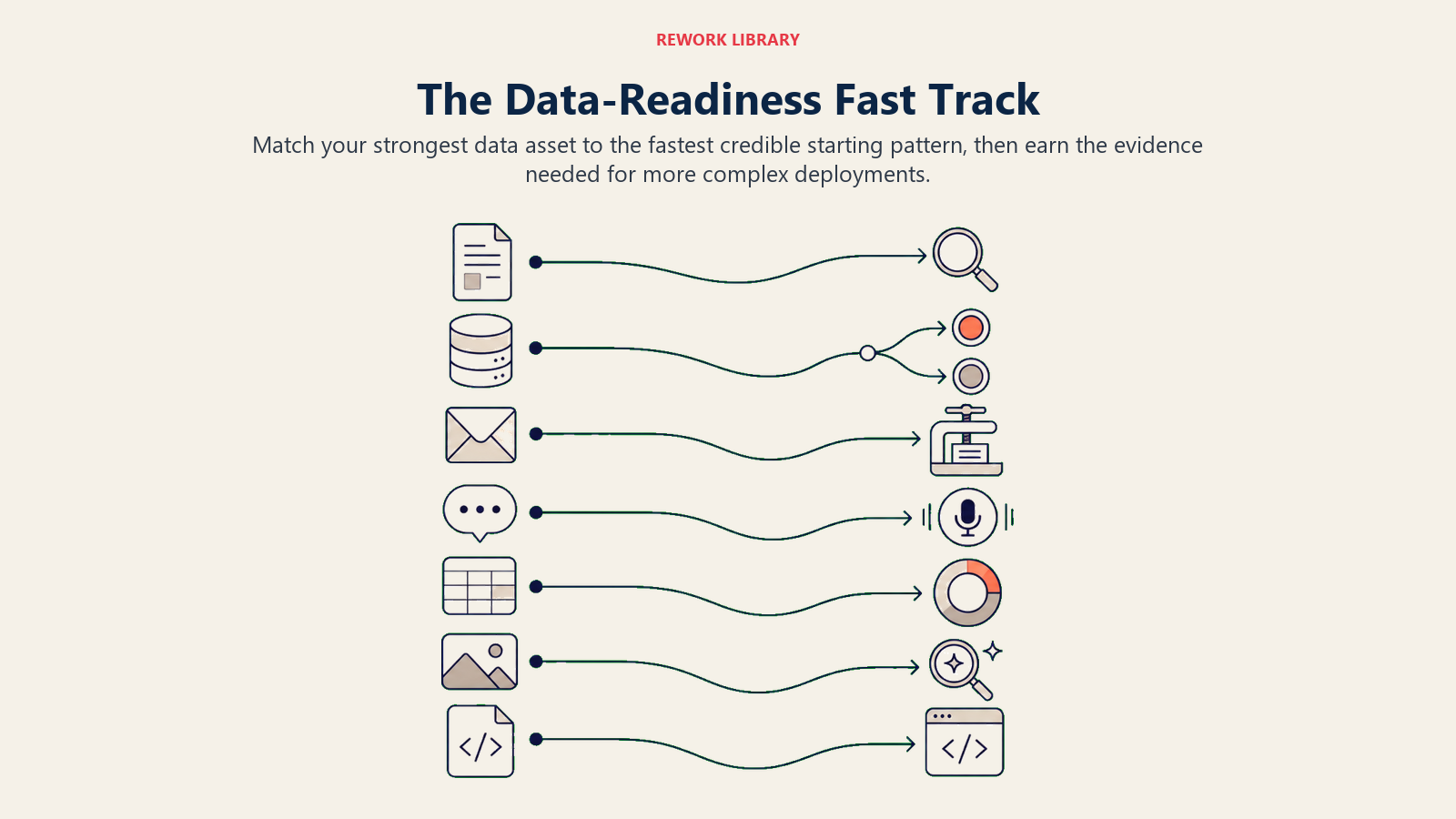
| Se seus melhores dados são... | Comece com... | Porque... |
|---|---|---|
| Documentos de texto limpos (políticas, SOPs, conteúdo de produto) | RAG Assistant | Baixa sobrecarga de preparação de dados; alto valor imediato para trabalhadores do conhecimento |
| Registros de CRM com 12+ meses de resultados rotulados | Scoring + Routing | ROI claro na priorização de leads; modelo treina com dados que você já tem |
| Faturas, recibos ou formulários digitalizados | Vision Extract | Resultado estruturado é imediatamente útil; ROI é mensurável em tempo de processamento |
| Gravações de chamadas de vendas ou suporte | Meeting Intelligence | A transcrição é confiável; a integração com CRM entrega valor no primeiro dia |
| Logs de transações ou fluxos de métricas com 90+ dias de histórico | Anomaly Agent | A linha de base está estabelecida; a sinalização pode começar quase imediatamente |
| Documentos web e internos de múltiplas fontes | Generative Research | Não precisa de dados estruturados; a qualidade da pesquisa melhora imediatamente |
| Repositórios de código com backlog de issues em aberto | Workflow Copilot | As ferramentas de desenvolvedor são maduras; a adoção é alta quando integrada no IDE |
Esses são pontos de partida, não arquiteturas finais. O padrão que implanta mais rápido não é sempre o que tem o maior ROI de longo prazo. Mas começar com seus dados mais fortes constrói confiança organizacional, gera resultados mensuráveis e cria os resultados rotulados que você precisará para padrões mais complexos mais adiante.
O que esta matriz não lhe diz
Ter um tipo de dado não significa que você está pronto para implantar o padrão correspondente. Verificação de Prontidão de Dados por Padrão de AI vai mais fundo nos limites específicos de qualidade que cada padrão precisa. Por exemplo, dados estruturados de CRM são necessários para Scoring + Routing, mas dados estruturados que estão apenas 60% completos no campo de resultado não estão prontos.
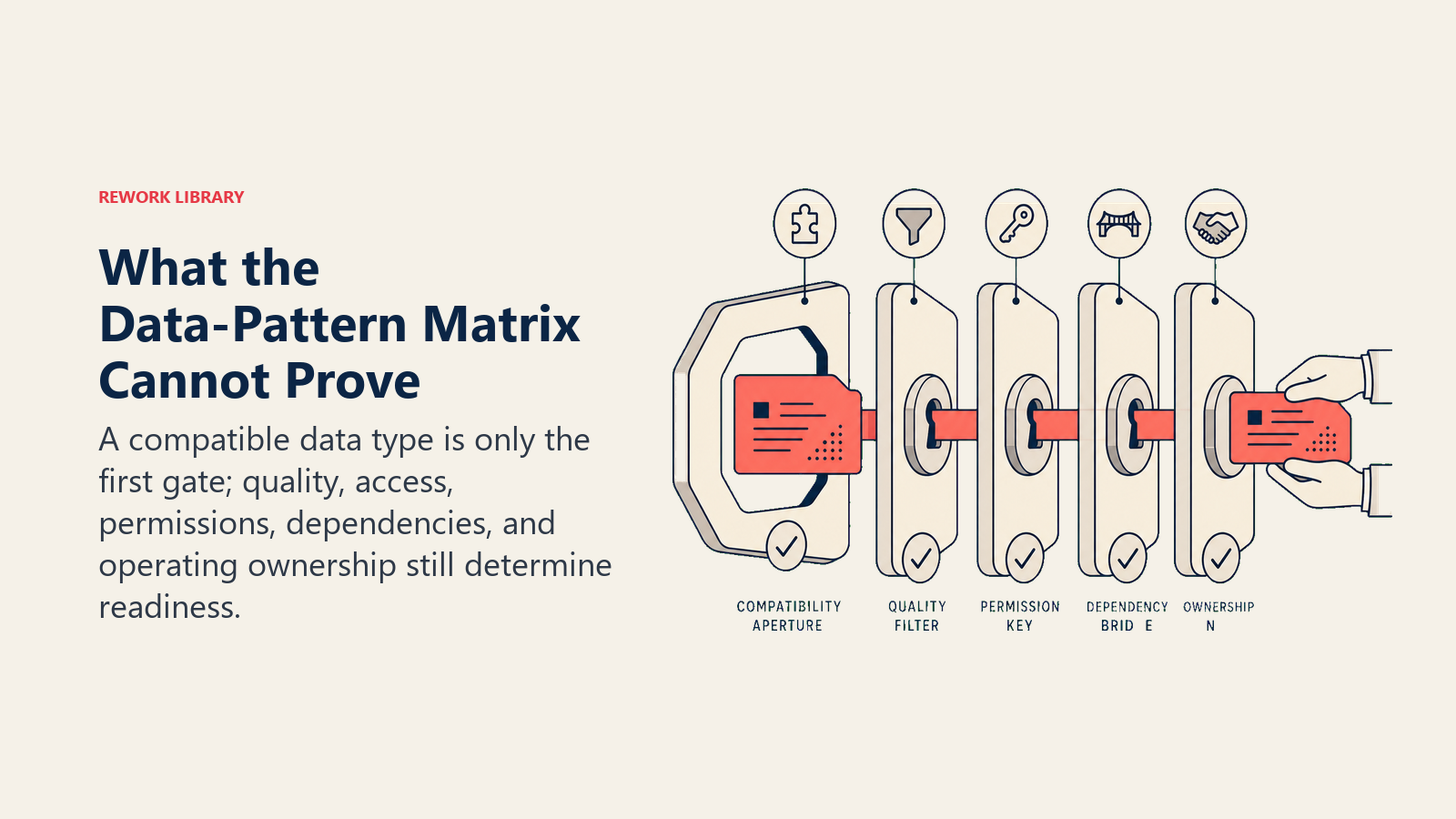
A matriz também não aborda dependências entre padrões. O Meeting Intelligence é implantável a partir de dados de áudio, mas se você quiser que seu resultado alimente o Scoring + Routing, você também precisa que a camada estruturada esteja funcionando. Dependências e Pré-requisitos de Padrões aborda como os padrões se constroem uns sobre os outros.
E se você está começando com O que é um AI Pattern?, esse é o ponto de partida certo antes de usar esta matriz como ferramenta de seleção.
Os dados são a base. A matriz diz quais portas estão abertas a partir de onde você está. As verificações de prontidão dizem se você realmente consegue atravessá-las.
Perguntas Frequentes
Qual é o erro mais comum na seleção de padrões de AI?
Selecionar um padrão com base em seu resultado prometido em vez de sua entrada requerida. Um modelo de Scoring and Routing precisa de dados estruturados de CRM com resultados históricos rotulados. Um Anomaly Agent precisa de 60 a 90 dias de dados de série temporal de linha de base. Um RAG Assistant precisa de uma base de conhecimento mantida e atual. Começar com os dados que você tem em vez do resultado que quer é o caminho mais confiável para um primeiro padrão implantável.
Quais padrões de AI podem ser implantados sem dados históricos de treinamento?
RAG Assistant, Generative Research, Document Review e Workflow Copilot podem todos ser implantados sem dados históricos de treinamento porque usam modelos de linguagem pré-treinados em vez de modelos treinados no seu histórico específico de resultados. Vision Extract requer exemplos de treinamento para seus tipos específicos de documentos, mas não rótulos de resultado. Scoring, Routing, Anomaly Agent e Personalization Engine todos requerem dados históricos específicos do seu ambiente.
Qual porcentagem dos dados corporativos é realmente estruturada?
A Gartner estima que 80 a 90% dos dados corporativos não são estruturados, o que significa que apenas 10 a 20% são estruturados. Essa lacuna é a razão pela qual a maioria das empresas tem muito menos dados prontos para AI do que assume ao planejar sua primeira implantação. Os padrões mais dependentes de dados estruturados (Scoring and Routing, Anomaly Agent, Personalization Engine) também são os que as equipes mais frequentemente planejam implantar primeiro, antes de confirmarem que os dados estruturados realmente existem e têm qualidade suficiente.
O Meeting Intelligence pode funcionar com texto pré-transcrito em vez de áudio bruto?
Sim. Muitas implantações usam serviços de transcrição (Zoom, Teams, Otter.ai) como pré-etapa, depois alimentam a transcrição na camada de análise. Essa é uma arquitetura válida e frequentemente mais econômica. A diferença de qualidade entre pipelines de áudio bruto e pré-transcritos é modesta para a maioria dos casos de uso. A principal troca é que pipelines pré-transcritos dependem da qualidade do serviço de transcrição, enquanto pipelines de áudio bruto dão mais controle sobre a qualidade da transcrição.
Qual tipo de dado tem mais padrões que conseguem consumi-lo?
Texto e dados estruturados têm a compatibilidade mais ampla com padrões. Texto é a entrada primária para RAG Assistant, Generative Research, Document Review e Workflow Copilot, com uso secundário em vários outros. Dados estruturados são a entrada primária para Scoring and Routing, Anomaly Agent e Personalization Engine. A maioria dos portfólios de AI corporativa acaba combinando ambos, razão pela qual combinações de texto mais estruturado produzem os conjuntos de padrões mais ricos possíveis.
Saiba mais

Co-Founder, Rework.com